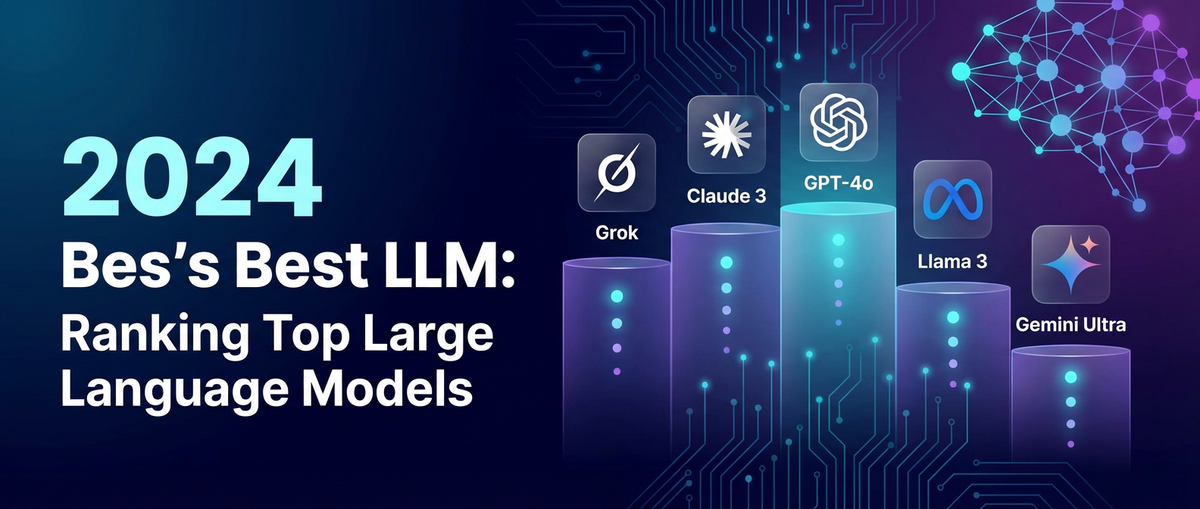
2024's Best LLM: Ranking Top Large Language Models

XRoute is a cutting-edge unified API platform designed to streamline access to large language models (LLMs) for developers, businesses, and AI enthusiasts. By providing a single, OpenAI-compatible endpoint, XRoute.AI simplifies the integration of over 60 AI models from more than 20 active providers(including OpenAI, Anthropic, Mistral, Llama2, Google Gemini, and more), enabling seamless development of AI-driven applications, chatbots, and automated workflows.
The Dawn of a New Intelligence: Navigating the Landscape of Large Language Models in 2024
The year 2024 marks a pivotal epoch in the evolution of artificial intelligence, with Large Language Models (LLMs) standing at the forefront of this transformative wave. These sophisticated AI constructs, trained on colossal datasets of text and code, have transcended mere automation, now demonstrating an uncanny ability to understand, generate, and even reason with human-like proficiency. From revolutionizing how businesses interact with customers to empowering individuals with unprecedented creative and analytical tools, LLMs are not just technological marvels; they are fundamentally reshaping the fabric of our digital existence. As their capabilities expand and their applications diversify, the quest to identify the best LLM becomes increasingly central to developers, enterprises, and AI enthusiasts alike.
The landscape of LLMs is a vibrant, fiercely competitive arena, characterized by relentless innovation and rapid advancements. What was considered cutting-edge just months ago might be surpassed by a new architecture or training methodology today. This dynamic environment presents both immense opportunities and significant challenges. For those seeking to leverage the power of these models, discerning which LLM is most suitable for a particular task, project, or organizational need is paramount. This isn't merely about raw processing power; it encompasses a complex interplay of factors including accuracy, cost-effectiveness, speed, ethical considerations, and the specific nuances of a model’s training data and architecture.
This comprehensive guide aims to cut through the complexity, offering an in-depth exploration of the leading Large Language Models available in 2024. We will delve into a detailed LLM rankings analysis, dissecting the strengths, weaknesses, and unique propositions of the top LLMs that are currently defining the industry standard. Our objective is to provide a robust framework for understanding these powerful tools, equipping readers with the insights necessary to make informed decisions in a rapidly evolving technological domain. Whether you're a seasoned AI developer, a business leader looking to integrate AI, or simply curious about the frontiers of machine intelligence, this article will serve as your definitive roadmap to the world of advanced Large Language Models.
What Exactly Are Large Language Models (LLMs)? A Deep Dive
Before we embark on our journey to rank the best LLM, it's crucial to establish a foundational understanding of what these models are and how they operate. At their core, LLMs are a type of artificial neural network, specifically deep learning models, that have been trained on vast amounts of text data. This data typically includes books, articles, websites, and other forms of digital text, amounting to trillions of words. The sheer scale of this training data is what gives "Large" its meaning in LLM.
The Transformer Architecture: The Brains Behind the Operation
The vast majority of modern LLMs, including all the top LLMs we will discuss, are built upon an architecture known as the "Transformer." Introduced by Google in 2017, the Transformer architecture revolutionized natural language processing (NLP) by introducing the concept of "attention mechanisms." Unlike previous recurrent neural networks (RNNs) that processed text sequentially, Transformers can process all parts of an input sequence simultaneously, allowing them to grasp long-range dependencies in language much more effectively.
- Self-Attention: This mechanism allows the model to weigh the importance of different words in the input text relative to each other when processing a specific word. For instance, in the sentence "The animal didn't cross the street because it was too tired," the Transformer can learn that "it" refers to "the animal" by attending to the relevant parts of the sentence.
- Encoder-Decoder Structure (or Decoder-Only): Transformers often come in two main flavors:
- Encoder-Decoder: Used for tasks like translation, where an encoder processes the input sequence and a decoder generates the output sequence.
- Decoder-Only: Predominantly used in generative LLMs (like GPT models), these models predict the next word in a sequence based on all preceding words, making them excellent for text generation, summarization, and conversation.
Training and Capabilities: From Prediction to Understanding
The training process for an LLM is a resource-intensive endeavor. It involves feeding the model massive amounts of text and tasking it with predicting the next word in a sentence, or filling in missing words (masked language modeling). Through this predictive learning, the model develops a sophisticated internal representation of language, encompassing grammar, semantics, facts about the world, and even some forms of reasoning.
Once trained, an LLM can perform an astonishing array of tasks, often with minimal or no additional training (few-shot or zero-shot learning):
- Text Generation: Crafting coherent articles, stories, poems, code, and more.
- Summarization: Condensing long documents into concise summaries.
- Translation: Converting text between different human languages.
- Question Answering: Providing informed answers to a wide range of queries.
- Code Generation and Debugging: Writing code in various programming languages and identifying errors.
- Chatbot Development: Powering highly interactive and context-aware conversational agents.
- Sentiment Analysis: Determining the emotional tone of a piece of text.
- Data Extraction and Transformation: Identifying and pulling specific information from unstructured text.
The remarkable versatility and continuous improvement in these capabilities are what fuel the ongoing competition for the title of the best LLM.
Setting the Standards: Key Criteria for LLM Ranking
Evaluating and ranking Large Language Models is not a straightforward task. There isn't a single metric that definitively declares one model as the outright best LLM across all possible applications. Instead, a nuanced approach considering multiple dimensions is required. Our LLM rankings are based on a comprehensive set of criteria that reflect the multifaceted nature of these powerful AI tools.
Here are the critical factors we consider when assessing the top LLMs of 2024:
- Performance & Accuracy:
- General Intelligence/Reasoning: How well does the model understand complex prompts, perform logical deductions, solve problems, and exhibit common sense? This is often measured by benchmarks like MMLU (Massive Multitask Language Understanding) and GSM8K (grade school math problems).
- Creativity & Fluency: The ability to generate coherent, natural-sounding, and imaginative text, whether for storytelling, poetry, or marketing copy.
- Context Window: The maximum amount of information (tokens) an LLM can consider at once. Larger context windows enable models to handle longer documents, maintain conversation history, and understand more complex instructions.
- Multimodality: The capacity to process and generate information across different modalities, such as text, images, audio, and video. While still nascent, multimodal capabilities are becoming a differentiator.
- Efficiency & Cost-Effectiveness:
- Inference Speed (Latency): How quickly does the model generate responses? Low latency is crucial for real-time applications like chatbots and interactive tools.
- Throughput: The number of requests an LLM can process per unit of time, vital for high-volume applications.
- Cost per Token: The pricing model for API calls, typically based on input and output tokens. Optimizing this is key for scalable applications.
- Computational Resources: For self-hosted models, the hardware requirements (GPUs, memory) needed for training and inference.
- Safety & Ethics:
- Harmful Content Mitigation: The effectiveness of safeguards against generating toxic, biased, illegal, or otherwise harmful content.
- Bias Reduction: The extent to which biases present in the training data have been identified and mitigated to prevent unfair or discriminatory outputs.
- Factuality/Hallucination Rate: The tendency of a model to generate factually incorrect but plausible-sounding information. Reducing hallucinations is a major research area.
- Specialized Capabilities & Fine-tuning:
- Code Generation/Programming: Proficiency in understanding programming languages, generating code, debugging, and explaining code snippets.
- Domain Specificity: While general-purpose, some models exhibit stronger performance in specific domains (e.g., medical, legal, financial) due to their architecture or fine-tuning capabilities.
- Fine-tuning/Customization: The ease and effectiveness with which a model can be fine-tuned on proprietary data to perform specific tasks or adhere to particular styles.
- Accessibility & Ecosystem:
- API Availability & Documentation: The ease with which developers can integrate the model into their applications, supported by clear and comprehensive documentation.
- Open-Source vs. Proprietary: The benefits of open-source models include transparency, community contribution, and the ability to run them locally, while proprietary models often offer superior performance and dedicated support.
- Community Support & Resources: The availability of forums, tutorials, and a strong developer community.
- Scalability & Reliability:
- Uptime & Service Level Agreements (SLAs): For API-based models, the reliability of the service and guarantees on uptime.
- Load Handling: The ability of the infrastructure to handle varying levels of demand without significant performance degradation.
By weighting these criteria, we can construct a holistic view of the strengths and weaknesses of different LLMs, providing a more nuanced and useful set of LLM rankings than a simple numerical score.
The Contenders: A Deep Dive into 2024's Top LLMs
The competition among large language models is fierce, with major tech giants and innovative startups constantly pushing the boundaries. Here, we delve into the profiles of the top LLMs that are making significant waves in 2024, dissecting their unique attributes, performance metrics, and ideal use cases. This section is designed to help you pinpoint the best LLM for your specific needs.
1. OpenAI's GPT Series: The Established Standard Bearer
OpenAI's Generative Pre-trained Transformer (GPT) series has, for many, set the benchmark for what LLMs can achieve. Their models are renowned for their remarkable general intelligence, creativity, and broad applicability.
- GPT-4 (and GPT-4 Turbo):
- Overview: GPT-4 remains arguably the most powerful and versatile general-purpose LLM available. It exhibits advanced reasoning capabilities, a deep understanding of complex prompts, and exceptional fluency across a wide array of tasks. GPT-4 Turbo, a refined version, offers a significantly larger context window (up to 128K tokens), improved cost-efficiency, and fresher knowledge cutoffs, making it a compelling choice for demanding applications.
- Strengths:
- Exceptional Reasoning: Consistently performs at human-level or near-human-level on various academic and professional benchmarks (e.g., passing bar exams, advanced placement tests).
- Creativity and Nuance: Excels at generating creative content, writing nuanced prose, and adapting to specific writing styles.
- Multimodality (GPT-4V): The Vision variant (GPT-4V) allows it to interpret images and combine visual input with textual understanding, opening up new application areas like image captioning, visual Q&A, and accessibility tools.
- Large Context Window: GPT-4 Turbo's 128K token context allows for processing entire books, extensive codebases, or prolonged conversational histories.
- Weaknesses:
- Cost: While GPT-4 Turbo is more cost-effective than its predecessor, it generally remains one of the more expensive models on a per-token basis, especially for high-volume use.
- Latency: Can be slower for real-time applications compared to smaller, optimized models.
- Availability: While widely accessible via API, access to the very latest iterations might sometimes be tiered.
- Use Cases: Advanced content generation, complex problem-solving, coding assistance, research summarization, nuanced conversational AI, creative writing, multimodal applications.
- Position in Rankings: GPT-4 consistently sits at the very top of most general-purpose LLM rankings due to its unparalleled overall performance and versatility. It is frequently considered the best LLM for tasks requiring high intelligence and accuracy.
- GPT-3.5 Turbo:
- Overview: While often overshadowed by GPT-4, GPT-3.5 Turbo remains an incredibly powerful and highly cost-effective model. It strikes an excellent balance between performance and price, making it a workhorse for many applications.
- Strengths:
- Speed and Cost-Efficiency: Significantly faster and more affordable than GPT-4, making it ideal for high-throughput, latency-sensitive applications.
- Good General Performance: Still highly capable for a vast range of tasks, including content generation, summarization, and chatbot interactions.
- Fine-tuning Capabilities: OpenAI offers robust fine-tuning options for GPT-3.5 Turbo, allowing businesses to tailor the model to their specific data and use cases, dramatically improving performance for niche applications.
- Weaknesses:
- Less Robust Reasoning: Not as adept as GPT-4 at highly complex logical reasoning or intricate problem-solving.
- Smaller Context Window: While sufficient for many tasks, its context window is smaller than GPT-4 Turbo.
- Use Cases: Chatbots, email generation, quick summarization, content drafts, internal knowledge bases, powering many consumer-facing AI features where cost and speed are critical.
- Position in Rankings: A strong contender for the "value champion" in LLM rankings, offering excellent performance for its price point.
2. Anthropic's Claude 3 Series: The New Challenger
Anthropic, founded by former OpenAI researchers, has rapidly emerged as a formidable competitor, particularly with its Claude 3 family of models, designed with a strong emphasis on safety and ethical AI development.
- Claude 3 (Opus, Sonnet, Haiku):
- Overview: The Claude 3 family is Anthropic’s most advanced suite of models, offering a compelling alternative to GPT-4. It comes in three sizes:
- Opus: The most intelligent model, rivalling or surpassing GPT-4 on many benchmarks.
- Sonnet: A balanced model, offering a strong performance-to-cost ratio.
- Haiku: The fastest and most compact model, optimized for near-instant responses.
- Strengths (across the series):
- Context Window: All Claude 3 models feature a 200K token context window, which is massive and allows for processing extremely long documents or extensive conversations.
- Multimodality: Exhibits strong multimodal capabilities, capable of processing and understanding images, charts, and diagrams.
- Strong Performance: Opus, in particular, demonstrates exceptional reasoning, mathematical, and coding abilities, often outperforming competitors on specific benchmarks.
- Safety and Responsible AI: Anthropic's core philosophy emphasizes constitutional AI and robust safety measures, aiming to reduce harmful outputs.
- Reduced Hallucinations: Efforts to improve factuality have shown promising results.
- Weaknesses:
- Novelty: As a newer series, its integration into various ecosystems and widespread adoption is still catching up to more established models.
- Cost (Opus): Opus is a premium model, and its cost reflects its high performance.
- Use Cases: Advanced research, legal document analysis, medical applications, highly nuanced content creation, secure and responsible AI deployments, multimodal data analysis.
- Position in Rankings: Claude 3 Opus is a strong contender for the overall best LLM in 2024, particularly for enterprise applications prioritizing both intelligence and safety. The entire Claude 3 family significantly elevates Anthropic's standing in LLM rankings.
- Overview: The Claude 3 family is Anthropic’s most advanced suite of models, offering a compelling alternative to GPT-4. It comes in three sizes:
3. Google's Gemini Series: The Integrated Ecosystem Play
Google's entry into the advanced LLM space is spearheaded by its Gemini family, designed for multimodality from the ground up and deeply integrated into Google's vast ecosystem.
- Gemini (Advanced, Pro):
- Overview: Gemini is Google's most ambitious LLM effort, aiming to be natively multimodal and highly efficient across various tasks. It’s available in different sizes:
- Gemini Advanced: The largest and most capable model, accessible through Google's services like Bard (now Gemini) and via API.
- Gemini Pro: A highly capable, scalable, and efficient model suitable for a wide range of tasks, often integrated into Google products.
- Strengths:
- Native Multimodality: Designed from inception to understand and operate across text, code, audio, image, and video. This gives it a significant edge in real-world applications where information isn't confined to a single format.
- Deep Integration with Google Ecosystem: Seamlessly integrated into Google Cloud, Android, and various Google services, offering powerful synergies for businesses and developers already within the Google fold.
- Strong Reasoning and Coding: Demonstrates impressive capabilities in complex reasoning, mathematical problem-solving, and code generation across multiple languages.
- Scalability: Leverages Google's formidable infrastructure for high availability and throughput.
- Weaknesses:
- Public Perception/Consistency: While powerful, early public releases sometimes faced criticism regarding consistency or safety, though significant improvements have been made.
- Proprietary Nature: While offering broad API access, its deepest integrations are within Google's own stack, which might be a consideration for those outside that ecosystem.
- Use Cases: Multimodal content understanding and generation (e.g., analyzing video and generating summaries, image-to-text generation), advanced conversational agents, sophisticated coding assistants, data analysis, powering intelligent features within Google products.
- Position in Rankings: Gemini Advanced firmly establishes Google among the top LLMs, particularly excelling in multimodal capabilities. Its comprehensive ecosystem integration makes it a strong contender for the best LLM for organizations already heavily invested in Google Cloud.
- Overview: Gemini is Google's most ambitious LLM effort, aiming to be natively multimodal and highly efficient across various tasks. It’s available in different sizes:
4. Meta's Llama Series: The Open-Source Powerhouse
Meta's Llama (Large Language Model Meta AI) series has revolutionized the open-source LLM landscape, providing powerful models that are freely available for research and commercial use.
- Llama 3 (8B, 70B):
- Overview: Llama 3 is Meta's latest and most advanced iteration, available in multiple parameter sizes (e.g., 8 billion and 70 billion parameters), with larger versions still in development. It represents a significant leap forward in performance for open-source models, narrowing the gap with proprietary counterparts.
- Strengths:
- Open-Source & Free: This is its paramount advantage. Free for both research and commercial use, fostering an enormous community of developers and researchers.
- Customization: Being open-source, it offers unparalleled flexibility for fine-tuning, experimentation, and deploying models on custom infrastructure.
- Strong Performance: Llama 3 (especially the 70B version) achieves state-of-the-art results across many benchmarks, often matching or exceeding the performance of proprietary models like GPT-3.5 and earlier versions of Claude.
- Community Support: A massive and active community contributes to its development, creates tools, and shares resources.
- Local Deployment: Can be run locally on sufficiently powerful hardware, offering data privacy and cost control benefits.
- Weaknesses:
- Infrastructure Requirements: Running larger Llama 3 models requires significant computational resources (GPUs), which can be a barrier for smaller teams or individuals.
- Less Out-of-the-Box Refinement: While powerful, it may require more engineering effort for deployment, safety guardrails, and specific use case optimization compared to polished API services.
- Limited Multimodality (Current): Primarily text-based, though multimodal extensions are being actively developed by the community.
- Use Cases: Custom AI applications, research and experimentation, local AI deployment, fine-tuning for highly specific domain tasks, building specialized agents, academic projects.
- Position in Rankings: Llama 3 is arguably the best LLM in the open-source category, and its 70B variant competes very favorably with many closed-source models in general LLM rankings. Its impact on democratizing advanced AI is immense.
5. Mistral AI's Models: The Efficiency Innovators
Mistral AI, a European startup, has rapidly gained prominence for its focus on highly efficient, powerful, and developer-friendly open-source and proprietary models.
- Mistral Large & Mixtral 8x7B:
- Overview: Mistral AI offers a spectrum of models, from the compact Mistral 7B to the more powerful Mixtral 8x7B (a Sparse Mixture-of-Experts model) and the proprietary Mistral Large. Their approach emphasizes performance for size and efficiency.
- Strengths:
- Efficiency: Mistral models are designed to be incredibly efficient, offering excellent performance with fewer parameters compared to some competitors. Mixtral 8x7B, in particular, leverages its MoE architecture to achieve high performance while only activating a fraction of its parameters per inference, making it faster and cheaper to run.
- Strong Performance (for size): Mixtral 8x7B often outperforms larger traditional models, making it an attractive option for balancing performance and resource usage. Mistral Large competes directly with top LLMs like GPT-4 and Claude 3 Opus on various benchmarks.
- Open-Source (Mixtral, Mistral 7B): Provides powerful open-source options, fostering community development and customization.
- Developer-Friendly: Known for clean APIs and easy integration.
- Weaknesses:
- Proprietary Offerings: Mistral Large is a closed-source, API-only model, similar to OpenAI and Anthropic, which might not appeal to those seeking full control.
- Context Window: While improving, some models might have smaller context windows compared to the absolute largest offerings.
- Use Cases: High-performance, cost-efficient API applications, custom chatbot development, code generation, summarization where speed and efficiency are paramount, local deployment on more modest hardware.
- Position in Rankings: Mistral AI's models consistently feature high in LLM rankings for their efficiency and strong performance relative to size, making them compelling choices, especially for developers looking for powerful open-source or highly efficient proprietary options.
6. Cohere's Command R+ / Command R: The Enterprise-Focused Powerhouses
Cohere focuses heavily on enterprise applications, offering powerful LLMs tailored for business use cases, with a strong emphasis on retrieval-augmented generation (RAG) and robust enterprise-grade solutions.
- Command R+ / Command R:
- Overview: Command R+ is Cohere's flagship model, designed for high-scale enterprise applications, offering capabilities specifically tuned for business needs. Command R is a more efficient, production-ready version.
- Strengths:
- Enterprise-Grade: Built with enterprise requirements in mind, focusing on reliability, scalability, and security.
- Strong RAG Capabilities: Excel at Retrieval-Augmented Generation, making them highly effective for grounding responses in specific, up-to-date, and proprietary enterprise data, significantly reducing hallucinations.
- Tool Use and Agents: Designed for seamless integration with tools and building sophisticated AI agents that can interact with external systems.
- Multilingual Support: Offers strong performance across many languages, crucial for global businesses.
- Long Context Window: Command R+ boasts a 128K token context window.
- Weaknesses:
- General Creativity: While highly performant for enterprise tasks, they might not be as creatively expansive as some other models for purely generative artistic tasks.
- Less Public Exposure: Often less discussed in consumer-focused circles compared to OpenAI or Anthropic, but highly respected in the enterprise AI space.
- Use Cases: Enterprise search, customer support automation (chatbots, helpdesk), knowledge management, legal and financial analysis, data extraction from proprietary documents, building sophisticated AI agents.
- Position in Rankings: Cohere's models are among the top LLMs for enterprise adoption, particularly for those building RAG-powered applications and AI agents. They are contenders for the best LLM in specific business contexts where data grounding and tool use are critical.
Comparative Overview: Top LLMs at a Glance
To provide a clearer comparative perspective, the following table summarizes key attributes of some of the leading LLMs discussed. Note that benchmarks are constantly updated, and specific performance can vary based on the task and prompt engineering. This table aims to give a general snapshot.
| Feature / Model | GPT-4 (Turbo) | Claude 3 Opus | Gemini Advanced | Llama 3 (70B) | Mixtral 8x7B | Command R+ |
|---|---|---|---|---|---|---|
| Developer | OpenAI | Anthropic | Meta | Mistral AI | Cohere | |
| Availability | API, ChatGPT Plus | API, Claude.ai | API, Google AI Studio, Gemini (consumer) | Open-source, Downloadable, API (via providers) | Open-source, API (via providers) | API |
| Architecture | Transformer (Decoder-only) | Transformer (Decoder-only) | Transformer (Native Multimodal) | Transformer (Decoder-only) | Sparse Mixture-of-Experts (MoE) | Transformer (focus on RAG/Tool Use) |
| Context Window (Max) | 128K tokens | 200K tokens | 1M tokens (experimental), 32K-128K (typical API) | ~8K-128K tokens (depending on variant/provider) | 32K tokens | 128K tokens |
| Key Strengths | General intelligence, reasoning, creativity, vision | Reasoning, safety, long context, multimodal | Native multimodality, Google ecosystem, reasoning | Open-source, customizable, strong performance | Efficiency, cost-effectiveness, open-source | Enterprise-focused, RAG, tool-use, multilingual |
| Best For | Complex tasks, creative content, broad apps | High-stakes enterprise, long documents, safety | Multimodal apps, Google-centric development | Custom solutions, research, local deployment | Balanced performance/cost, high throughput | Enterprise RAG, agents, business automation |
| Typical Cost | High | High (Opus), Medium (Sonnet), Low (Haiku) | Medium to High (depending on model/usage) | Free (open-source), Low to Medium (API) | Free (open-source), Low to Medium (API) | Medium to High |
| Multimodality | Yes (GPT-4V) | Yes | Yes (Native) | No (text-only, extensions exist) | No (text-only, extensions exist) | No (text-only) |
Note: "Typical Cost" is a generalization and can vary significantly based on usage, pricing tiers, and specific API providers.
The Evolving Role of LLMs: Beyond Basic Chat
The utility of LLMs extends far beyond simple conversational AI. As these models become more sophisticated, their integration into various workflows is deepening, leading to transformative impacts across industries.
Generative AI for Content Creation and Marketing
LLMs are revolutionizing content creation, from generating marketing copy and blog posts to scripting video content and crafting personalized customer communications. Their ability to produce high-quality, relevant text at scale significantly reduces the time and resources traditionally required for content development. Marketers can now A/B test different messaging strategies more effectively, create highly targeted campaigns, and personalize interactions at an unprecedented level. The best LLM in this space often combines creativity with a strong understanding of persuasive language and SEO principles.
Enhancing Software Development and Engineering
For developers, LLMs are proving to be invaluable co-pilots. They can: * Generate Code: Convert natural language descriptions into functional code snippets in various programming languages. * Debug and Refactor: Identify errors in existing code, suggest improvements, and explain complex code logic. * Write Documentation: Automatically generate API documentation, user manuals, and technical specifications. * Translate Code: Convert code from one language to another.
This significantly boosts developer productivity, accelerates development cycles, and allows engineers to focus on higher-level architectural challenges rather than boilerplate coding.
Revolutionizing Customer Service and Support
LLMs are powering the next generation of customer service. Intelligent chatbots can handle a vast percentage of routine inquiries, provide instant support, and guide users through complex processes. More advanced LLM integrations allow for: * Personalized Responses: Tailoring answers based on customer history and preferences. * Sentiment Analysis: Detecting customer frustration and escalating urgent cases to human agents. * Agent Assist Tools: Providing real-time information and suggestions to human agents, enhancing their efficiency and effectiveness. The top LLMs for customer service are often fine-tuned on company-specific knowledge bases to ensure accurate and brand-consistent responses.
Accelerating Research and Analysis
In fields ranging from scientific discovery to legal research, LLMs are accelerating analysis by: * Summarizing Literature: Quickly digesting vast amounts of research papers, reports, and legal documents. * Extracting Information: Identifying key data points, entities, and relationships from unstructured text. * Hypothesis Generation: Assisting researchers in formulating new hypotheses by identifying patterns and connections in data. * Translating Complex Texts: Making specialized knowledge more accessible across language barriers.
Enabling Education and Learning
LLMs are becoming powerful tools for personalized education. They can: * Generate Explanations: Break down complex topics into simpler terms, tailored to a student's understanding level. * Create Quizzes and Practice Problems: Generate customized learning materials. * Provide Tutoring: Offer interactive, adaptive learning experiences. * Translate Educational Content: Make learning resources accessible to a global audience.
The versatility of the best LLM allows for applications across virtually every sector, proving that their impact is truly global and cross-disciplinary.
Navigating the Complexity: The Role of Unified API Platforms
As the number of powerful LLMs proliferates, developers and businesses face a new challenge: how to effectively integrate, manage, and optimize access to these diverse models. Each LLM often comes with its own API, its own pricing structure, its own nuances in prompt formatting, and different levels of performance across various tasks. This fragmentation can lead to significant engineering overhead, vendor lock-in concerns, and difficulty in selecting the truly best LLM for a given dynamic use case. This is where unified API platforms like XRoute.AI step in, offering a transformative solution.
Imagine a scenario where your application needs to: 1. Generate highly creative marketing copy (perhaps best done by GPT-4). 2. Provide fast, cost-effective customer support responses (ideal for GPT-3.5 or Claude 3 Haiku). 3. Analyze complex legal documents with a very long context window (suited for Claude 3 Opus or Command R+). 4. Switch to an open-source model like Llama 3 for specific internal data processing due to privacy requirements.
Without a unified platform, this would require managing multiple API keys, writing custom code for each integration, handling different error codes, and constantly optimizing model selection based on task, cost, and latency. It's a logistical nightmare.
XRoute.AI: Your Gateway to Intelligent AI Integration
XRoute.AI is a cutting-edge unified API platform designed to streamline access to large language models (LLMs) for developers, businesses, and AI enthusiasts. By providing a single, OpenAI-compatible endpoint, XRoute.AI simplifies the integration of over 60 AI models from more than 20 active providers, enabling seamless development of AI-driven applications, chatbots, and automated workflows.
Here’s how XRoute.AI addresses the challenges of LLM proliferation:
- Single, OpenAI-Compatible Endpoint: Developers can interact with a multitude of LLMs using a familiar, standardized API interface. This dramatically reduces integration time and complexity, eliminating the need to learn new APIs for every model.
- Access to Over 60 Models from 20+ Providers: XRoute.AI aggregates a vast ecosystem of models, including those from OpenAI, Anthropic, Google, Mistral AI, Meta (Llama), and many more. This gives users unparalleled flexibility to choose the best LLM for any specific task, without having to manage individual vendor relationships.
- Low Latency AI: The platform is optimized for speed, ensuring that applications receive responses from LLMs with minimal delay. This is crucial for real-time user experiences, such as conversational AI or interactive tools.
- Cost-Effective AI: XRoute.AI provides tools and routing capabilities to dynamically select the most cost-effective model for a given request, based on performance requirements and current pricing. This allows businesses to optimize their AI spend without compromising on quality.
- Developer-Friendly Tools: With a focus on ease of use, XRoute.AI offers clear documentation, SDKs, and a robust platform that empowers developers to build intelligent solutions quickly and efficiently.
- High Throughput and Scalability: The platform is built to handle high volumes of requests and scale seamlessly, accommodating applications of all sizes, from nascent startups to large enterprise deployments.
By centralizing access and providing intelligent routing, XRoute.AI makes the process of leveraging diverse LLMs incredibly efficient. It allows businesses to dynamically switch between the top LLMs based on real-time performance, cost, and specific task requirements, ensuring they always use the most optimal model without complex manual management. This not only accelerates development but also significantly reduces operational costs and improves the overall resilience and adaptability of AI applications. For anyone navigating the complex world of LLM rankings and seeking to integrate the power of multiple models, XRoute.AI offers a compelling, future-proof solution.
Future Trends in LLMs: What's Next?
The rapid pace of innovation in LLMs suggests that the landscape will continue to evolve dramatically. Several key trends are emerging that will shape the next generation of these powerful AI systems:
- Enhanced Multimodality: While current top LLMs are making strides in multimodality, future models will seamlessly integrate and reason across text, images, audio, video, and even haptic feedback with greater sophistication. This will enable truly intelligent agents that can perceive and interact with the world in more human-like ways.
- Increased Efficiency and Specialization: Expect a continued push for more efficient models that can achieve high performance with fewer parameters or less computational power. We will also see a rise in highly specialized LLMs fine-tuned for niche domains (e.g., scientific research, legal analysis, specific industries), offering unparalleled accuracy within their scope.
- Autonomous AI Agents: The development of LLM-powered autonomous agents capable of performing complex multi-step tasks, interacting with various tools, and even learning from their own experiences will become more prevalent. These agents could automate entire workflows, from project management to scientific experimentation.
- Improved Reasoning and Factuality: Research will continue to focus on mitigating hallucinations and enhancing the logical reasoning capabilities of LLMs. Techniques like retrieval-augmented generation (RAG) will become standard, deeply embedding fact-checking and external knowledge retrieval into the core functioning of these models.
- Ethical AI and Alignment: As LLMs become more powerful, the imperative for ethical development, bias mitigation, and robust safety guardrails will intensify. Research into "Constitutional AI" and other alignment techniques will be critical to ensure these models serve humanity responsibly.
- Personalized and Edge AI: The ability to fine-tune and run smaller, highly personalized LLMs on local devices (edge computing) will grow, offering greater privacy, lower latency, and customization for individual users without relying solely on cloud services.
- Synthetic Data Generation: LLMs themselves will be used to generate synthetic training data for other AI models, including new LLMs, creating a virtuous cycle of AI improvement and potentially overcoming data scarcity challenges.
These trends collectively point towards a future where LLMs are not just tools, but intelligent, adaptable collaborators that drive innovation across every sector. The competition for the best LLM will likely intensify, but the overall beneficiation to society from these advancements promises to be profound.
Conclusion: The Ever-Evolving Frontier of Large Language Models
The journey through the landscape of 2024's top LLMs reveals a field pulsating with innovation, competition, and transformative potential. From the unparalleled reasoning of GPT-4 and Claude 3 Opus to the open-source empowerment of Llama 3, and the enterprise-grade robustness of Cohere's Command R+, each model brings unique strengths to the table, catering to a diverse array of applications and user needs. The quest for the singular "best LLM" is, in reality, a pursuit of the most appropriate LLM, one that aligns perfectly with specific project requirements, budget constraints, and ethical considerations.
Our LLM rankings highlight the dynamic interplay between raw intelligence, efficiency, specialized capabilities, and accessibility. While proprietary models continue to lead in bleeding-edge performance, the rapid advancements in open-source alternatives like Llama 3 and Mixtral 8x7B are democratizing access to powerful AI, fostering unprecedented innovation within the developer community. The rise of multimodal capabilities, more robust safety measures, and improved reasoning points towards a future where LLMs are even more integrated, intuitive, and impactful.
As businesses and developers navigate this complex and exciting frontier, platforms like XRoute.AI become indispensable. By offering a unified, optimized gateway to a vast ecosystem of large language models, XRoute.AI simplifies integration, reduces costs, and provides the flexibility to always harness the most suitable AI for any given task. This strategic approach to LLM deployment ensures that organizations can remain agile, leveraging the latest advancements without being entangled in the complexities of managing multiple API connections.
In conclusion, 2024 stands as a testament to the incredible progress in Large Language Models. The future promises even more profound breakthroughs, pushing the boundaries of what AI can achieve and continuing to reshape the way we interact with technology and the world around us. Staying informed and strategically adopting these tools will be key to unlocking their full potential in the years to come.
Frequently Asked Questions (FAQ)
Q1: What is the single best LLM available in 2024?
A1: There isn't a single "best" LLM for all purposes. The ideal LLM depends heavily on your specific needs. For complex reasoning and general-purpose intelligence, GPT-4 and Claude 3 Opus are often considered top contenders. For cost-effectiveness and speed in many applications, GPT-3.5 Turbo or Claude 3 Haiku might be better. If you need open-source flexibility, Llama 3 is highly rated. For enterprise applications focusing on retrieval-augmented generation (RAG), Cohere's Command R+ excels. It's crucial to evaluate models based on your specific use case, budget, latency requirements, and ethical considerations.
Q2: How do open-source LLMs like Llama 3 compare to proprietary models like GPT-4?
A2: Open-source LLMs like Llama 3 have made incredible strides, significantly narrowing the performance gap with proprietary models. While top proprietary models like GPT-4 and Claude 3 Opus often still lead in raw reasoning power and breadth of knowledge, open-source models offer unparalleled flexibility, transparency, and cost control (especially if self-hosted). They are ideal for customization, local deployment, and fostering community-driven innovation. For many common tasks, a well-fine-tuned open-source model can rival or even surpass a general-purpose proprietary model.
Q3: What is "multimodality" in LLMs, and why is it important?
A3: Multimodality refers to an LLM's ability to process and generate information across different types of data, such as text, images, audio, and video, rather than being limited to just text. It's important because real-world information is rarely confined to a single modality. Multimodal LLMs can understand context from images to answer questions, generate text descriptions from video, or even combine audio and text inputs. This capability significantly broadens their application areas, making AI systems more capable of understanding and interacting with the world in a holistic, human-like manner.
Q4: How can businesses effectively choose and manage multiple LLMs for different tasks?
A4: Businesses can effectively manage multiple LLMs by first clearly defining the requirements for each task (e.g., critical reasoning, speed, cost, data privacy, specific domain knowledge). They should then evaluate different LLMs against these criteria. To manage the complexity of integrating and switching between various models, unified API platforms like XRoute.AI are invaluable. These platforms provide a single entry point to multiple LLMs, allowing for dynamic routing based on real-time performance, cost, and task-specific needs, streamlining development and optimizing resource utilization.
Q5: What are the main challenges or ethical considerations when using LLMs?
A5: Key challenges include: * Hallucinations: LLMs can generate factually incorrect but plausible-sounding information. * Bias: Models can inherit and amplify biases present in their vast training data. * Safety and Harmful Content: Preventing the generation of toxic, illegal, or unethical content. * Privacy Concerns: Handling sensitive user data, especially when models are used for personalized interactions. * Computational Cost: Training and running powerful LLMs requires significant energy and resources.
Addressing these concerns through robust testing, ethical guidelines, user oversight, and advanced mitigation techniques is paramount for responsible LLM deployment.
🚀You can securely and efficiently connect to thousands of data sources with XRoute in just two steps:
Step 1: Create Your API Key
To start using XRoute.AI, the first step is to create an account and generate your XRoute API KEY. This key unlocks access to the platform’s unified API interface, allowing you to connect to a vast ecosystem of large language models with minimal setup.
Here’s how to do it: 1. Visit https://xroute.ai/ and sign up for a free account. 2. Upon registration, explore the platform. 3. Navigate to the user dashboard and generate your XRoute API KEY.
This process takes less than a minute, and your API key will serve as the gateway to XRoute.AI’s robust developer tools, enabling seamless integration with LLM APIs for your projects.
Step 2: Select a Model and Make API Calls
Once you have your XRoute API KEY, you can select from over 60 large language models available on XRoute.AI and start making API calls. The platform’s OpenAI-compatible endpoint ensures that you can easily integrate models into your applications using just a few lines of code.
Here’s a sample configuration to call an LLM:
curl --location 'https://api.xroute.ai/openai/v1/chat/completions' \
--header 'Authorization: Bearer $apikey' \
--header 'Content-Type: application/json' \
--data '{
    "model": "gpt-5",
    "messages": [
        {
            "content": "Your text prompt here",
            "role": "user"
        }
    ]
}'
With this setup, your application can instantly connect to XRoute.AI’s unified API platform, leveraging low latency AI and high throughput (handling 891.82K tokens per month globally). XRoute.AI manages provider routing, load balancing, and failover, ensuring reliable performance for real-time applications like chatbots, data analysis tools, or automated workflows. You can also purchase additional API credits to scale your usage as needed, making it a cost-effective AI solution for projects of all sizes.
Note: Explore the documentation on https://xroute.ai/ for model-specific details, SDKs, and open-source examples to accelerate your development.