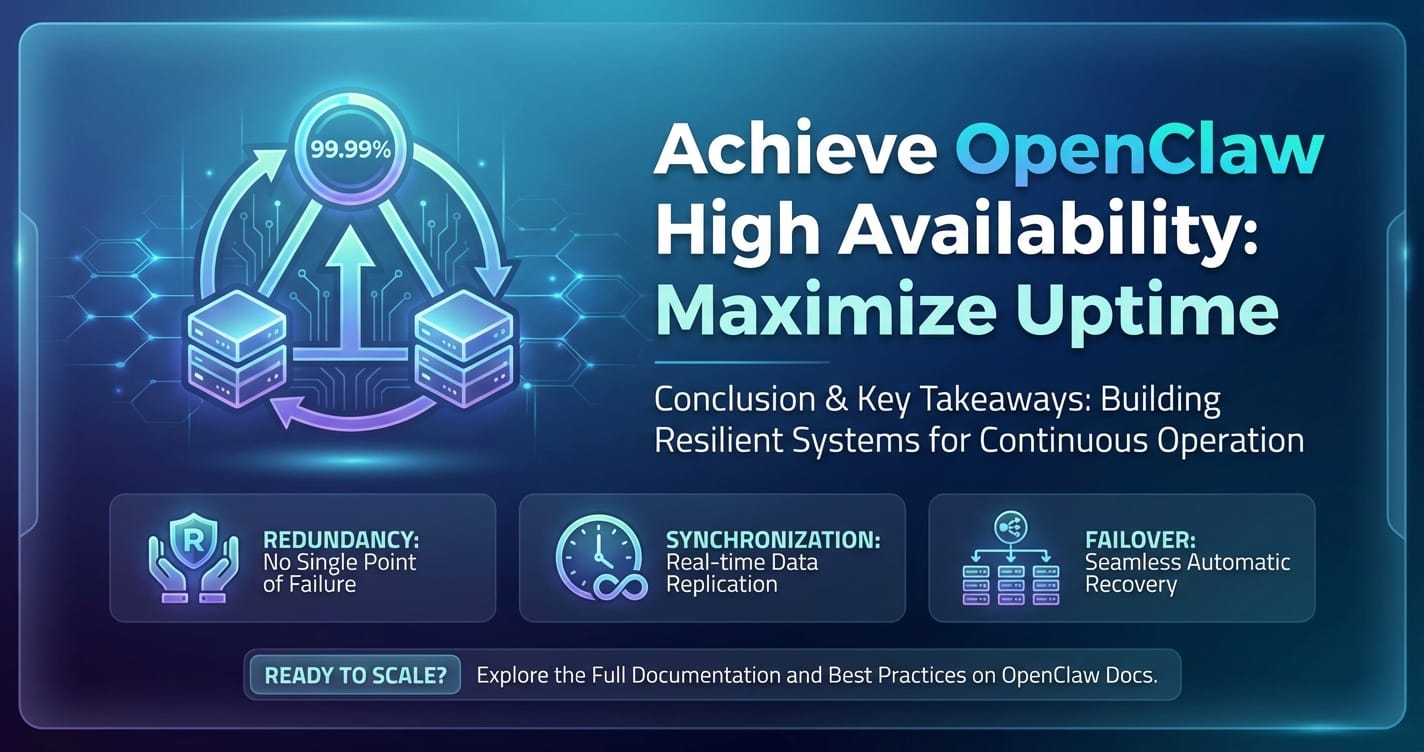
Achieve OpenClaw High Availability: Maximize Uptime


In the increasingly interconnected digital landscape, the expectation for continuous service availability is no longer a luxury but a fundamental requirement. For mission-critical systems like OpenClaw, any minute of downtime can translate into significant financial losses, reputational damage, and a severe erosion of user trust. OpenClaw, envisioned here as a sophisticated, distributed enterprise platform—perhaps a real-time analytics engine, a high-volume transaction processing system, or a critical data integration hub—demands an unwavering commitment to high availability (HA). Maximizing uptime for such a system isn't merely about preventing failures; it's about architecting resilience into every layer, anticipating potential disruptions, and implementing robust recovery mechanisms.
This comprehensive guide delves into the multifaceted strategies and indispensable technologies required to achieve and maintain OpenClaw's high availability. We will explore foundational design principles, practical implementation tactics across infrastructure, application, and data layers, and the critical roles of proactive monitoring and operational excellence. Crucially, we will also address the inherent tension between achieving maximum uptime and managing resources effectively, dedicating significant attention to cost optimization and performance optimization strategies. By understanding and applying these principles, organizations can ensure OpenClaw delivers consistent, uninterrupted service, safeguarding their operations and empowering their stakeholders.
Understanding High Availability for OpenClaw: The Imperative of Uninterrupted Service
High Availability (HA) refers to the capability of a system to operate continuously without failure for a long period of time. For OpenClaw, this translates to ensuring that its services, data, and functionalities remain accessible and operational even when individual components fail or unexpected events occur. In today's always-on economy, where businesses operate 24/7 across global time zones, the impact of downtime is magnified.
Why is HA Crucial for OpenClaw?
- Financial Impact: Downtime directly translates to lost revenue. For transaction-based OpenClaw services, every minute unavailable means missed sales or service opportunities. For data processing or analytics, it means delays that can affect critical business decisions.
- Reputational Damage: Users and clients expect reliability. Frequent or prolonged outages can severely damage an organization's reputation, leading to a loss of trust and potentially driving customers to competitors.
- Operational Disruption: OpenClaw might be an integral part of an organization's internal operations—supply chain management, internal communications, or even core HR functions. Its unavailability can halt internal processes, leading to cascading inefficiencies.
- Data Integrity and Consistency: While HA primarily focuses on availability, it often goes hand-in-hand with data integrity. Robust HA solutions ensure data is not only accessible but also consistent and protected from loss during failures.
- Regulatory Compliance: In certain industries (e.g., finance, healthcare), regulatory bodies mandate specific uptime requirements for critical systems. Failure to meet these can result in hefty fines and legal repercussions.
Key Principles of High Availability:
- Redundancy: Eliminating single points of failure by duplicating critical components. If one component fails, its redundant counterpart can take over.
- Failover: The automatic process of switching to a redundant or standby system when the primary system fails. This transition should be seamless and swift, ideally imperceptible to the end-user.
- Monitoring: Continuous observation of system health, performance, and availability metrics to detect potential issues before they escalate into outages.
- Recovery: The ability to restore a system to an operational state after a failure, which includes data recovery, application restart, and infrastructure provisioning.
- Resilience: The capacity of a system to recover gracefully from failures and continue to function, even if in a degraded mode, rather than crashing completely.
Defining Availability Metrics: The "Nines" and Beyond
High availability is often expressed in "nines," representing the percentage of uptime over a given period.
| Availability Percentage | Downtime Per Year | Downtime Per Month | Downtime Per Week |
|---|---|---|---|
| 99% (Two Nines) | 3 days, 15 hours | 7 hours, 12 minutes | 1 hour, 41 minutes |
| 99.9% (Three Nines) | 8 hours, 45 minutes | 43 minutes, 12 seconds | 10 minutes, 5 seconds |
| 99.99% (Four Nines) | 52 minutes | 4 minutes, 19 seconds | 1 minute, 1 second |
| 99.999% (Five Nines) | 5 minutes, 15 seconds | 25 seconds | 6 seconds |
While the "nines" provide a simple metric, a more comprehensive understanding of HA for OpenClaw requires considering:
- Recovery Time Objective (RTO): The maximum tolerable duration of time that a computer system, application or network can be down after a disaster or failure. For OpenClaw, a low RTO is often paramount.
- Recovery Point Objective (RPO): The maximum tolerable period in which data might be lost from an IT service due to a major incident. This dictates how frequently data backups or replications must occur.
Achieving higher "nines" for OpenClaw demands increasingly sophisticated and often more expensive architectures. Therefore, a careful balance between desired availability, acceptable RTO/RPO, and the associated costs is essential.
Designing for OpenClaw High Availability: Foundational Principles
The journey to maximizing OpenClaw's uptime begins with meticulous architectural design. High availability is not an afterthought; it must be ingrained into the system's blueprint from the very beginning.
1. Distributed Architecture and Microservices
Modern HA systems, including OpenClaw, increasingly adopt distributed architectures, often leveraging microservices. Instead of a monolithic application where a failure in one component can bring down the entire system, microservices break the application into smaller, independent, loosely coupled services.
- Benefits for OpenClaw HA:
- Fault Isolation: A failure in one microservice (e.g., user authentication) does not necessarily impact other services (e.g., data processing).
- Independent Deployment: Services can be deployed, updated, or scaled independently, reducing the risk of downtime during maintenance.
- Scalability: Individual services can be scaled horizontally based on their specific demand, optimizing resource utilization.
- Technology Diversity: Different services can use technologies best suited for their function, enhancing resilience.
However, distributed systems introduce complexity (network latency, distributed transactions, data consistency). Careful design, robust communication protocols (APIs), and effective service discovery are critical.
2. Statelessness vs. Stateful Management
- Stateless Services: Ideally, OpenClaw's application components should be stateless. This means that no session-specific data is stored on the server. Any server can handle any request, making it easy to scale horizontally and achieve seamless failover. If a server fails, the next request can simply be routed to another healthy server without losing user context.
- Stateful Services: Data layers (databases, message queues, caches) are inherently stateful. Achieving HA for these components is more challenging and typically involves replication, clustering, and robust failover mechanisms. Strategies include:
- Database Replication: Master-slave or multi-master setups for data redundancy and read scaling.
- Distributed Caching: Using systems like Redis or Memcached in a clustered configuration to ensure cached data is available even if one node fails.
- Persistent Storage: Using highly available network-attached storage (NAS) or storage area networks (SANs) with built-in redundancy, or cloud-native block storage replicated across availability zones.
3. Redundancy at Every Layer
True HA for OpenClaw requires redundancy from the ground up:
- Compute Redundancy: Multiple servers or virtual machines (VMs) running identical instances of OpenClaw components. This can be active-passive (one primary, one standby) or active-active (all instances processing requests simultaneously).
- Network Redundancy:
- Multiple Network Interfaces/Paths: Servers should have redundant network cards connected to redundant network switches.
- Redundant Internet Service Providers (ISPs): For external-facing OpenClaw services, having multiple ISP connections prevents a single ISP outage from isolating the system.
- DNS Failover: Using services that can automatically update DNS records to point to a healthy IP address in case of an outage.
- Storage Redundancy:
- RAID Configurations: Disk redundancy within individual storage units.
- Distributed File Systems: Systems like HDFS, GlusterFS, or Ceph, which replicate data across multiple nodes.
- Cloud Block Storage: Leveraging cloud providers' capabilities for highly durable and replicated block storage.
- Power Redundancy: Uninterruptible Power Supplies (UPS) and backup generators in on-premises data centers, or relying on the robust power infrastructure of cloud providers.
4. Load Balancing
Load balancers are critical for distributing incoming traffic across multiple healthy instances of OpenClaw services. They perform health checks on backend servers and automatically route traffic away from unhealthy instances, ensuring continuous service.
- Layer 4 (Transport Layer) Load Balancers: Distribute traffic based on network-level information (IP addresses, ports).
- Layer 7 (Application Layer) Load Balancers: Provide more advanced features, such as SSL termination, content-based routing, and cookie persistence, which can be vital for complex OpenClaw applications.
- Global Server Load Balancing (GSLB): Distributes traffic across geographically dispersed data centers or cloud regions, crucial for disaster recovery and truly global HA.
5. Disaster Recovery (DR) Planning
While HA focuses on resilience against component failures within a single site, Disaster Recovery addresses large-scale catastrophic events (e.g., natural disasters, widespread power outages) that might take down an entire data center or cloud region. DR for OpenClaw involves:
- Geographic Redundancy: Replicating OpenClaw's entire environment (infrastructure, applications, data) to a separate, geographically distant location.
- Regular Backups: Consistent and verifiable backups of all critical data and configurations.
- DR Drills: Regularly testing the DR plan to ensure it works as expected and to identify any weaknesses.
- Defined RTO/RPO for DR: These objectives will likely be higher (longer) than for local HA events but must still be well-defined and met.
Table: Comparison of HA Architectures
| Feature | Active-Passive (Warm Standby) | Active-Active (Hot Standby) |
|---|---|---|
| Description | One primary instance handles traffic; a secondary instance is on standby, ready to take over. | Multiple instances are active simultaneously, sharing the workload. |
| Resource Usage | Secondary instance consumes resources but is largely idle. | All instances are fully utilized, processing requests. |
| Failover Time | Typically longer, as the secondary instance needs to become fully active. | Nearly instantaneous, as traffic is simply rerouted to other active instances. |
| Complexity | Simpler to set up and manage. | More complex due to data synchronization, session management, and load balancing across active nodes. |
| Scalability | Limited to the capacity of the primary instance. | Highly scalable; easily adds more active instances to handle increased load. |
| Cost | Potentially lower infrastructure costs for idle standby, but wasted compute. | Higher infrastructure costs due to more active components, but better resource utilization. |
| Ideal For OpenClaw | Less critical components, or when simplicity is prioritized over fastest failover. | Mission-critical components requiring maximum uptime, low RTO, and high scalability. |
For OpenClaw's core services, an Active-Active architecture across multiple availability zones or regions is often the preferred choice to meet stringent HA requirements.
Implementing High Availability for OpenClaw: Practical Strategies & Technologies
Once the design principles are established, the next phase involves translating them into concrete implementations using specific technologies and methodologies.
1. Infrastructure Layer HA
The foundation of OpenClaw's high availability lies in its underlying infrastructure.
- Cloud vs. On-Premises:
- Cloud Advantage: Cloud providers (AWS, Azure, GCP) inherently offer robust HA features:
- Availability Zones (AZs): Physically isolated locations within a region, connected by low-latency networks. Deploying OpenClaw across multiple AZs provides resilience against single data center failures.
- Regions: Geographically separate locations. Deploying across regions offers disaster recovery capabilities.
- Managed Services: Cloud providers offer highly available managed databases, message queues, and storage services that reduce the operational burden of building HA from scratch.
- On-Premises Challenges: Building HA on-premises requires significant investment in redundant hardware, networking, power, and skilled personnel. However, it offers greater control over the physical infrastructure and data locality, which can be a requirement for certain OpenClaw deployments.
- Cloud Advantage: Cloud providers (AWS, Azure, GCP) inherently offer robust HA features:
- Virtualization and Containerization (Kubernetes):
- Virtualization (VMware, Hyper-V, KVM): Provides isolation and portability. HA features like live migration and automated VM restarts contribute to uptime.
- Containerization (Docker) and Orchestration (Kubernetes): This is a game-changer for OpenClaw's HA. Kubernetes excels at:
- Self-Healing: Automatically restarts failed containers, replaces unhealthy nodes, and reschedules containers.
- Automated Rollouts and Rollbacks: Enables seamless updates with minimal downtime and easy reversion if issues arise.
- Horizontal Pod Autoscaling (HPA): Automatically scales the number of OpenClaw application instances based on CPU utilization or custom metrics.
- Service Discovery and Load Balancing: Built-in mechanisms to route traffic to healthy pods.
- Pod Anti-Affinity: Ensures that replicas of critical OpenClaw components are scheduled on different physical nodes to prevent single-node failures from taking down an entire service.
- Network Redundancy:
- Redundant Network Devices: Deploying OpenClaw's networking components (routers, switches, firewalls) in pairs or clusters with automatic failover.
- Multiple Uplinks: Connecting OpenClaw servers to different network switches and providing redundant pathways to the network core.
- Bonding/Teaming: Combining multiple network interfaces on a server into a single logical interface for increased bandwidth and fault tolerance.
- Storage HA:
- Synchronous Replication: Data is written to multiple storage devices simultaneously. If one fails, the other has an up-to-date copy. This ensures zero data loss (RPO=0) but introduces latency.
- Asynchronous Replication: Data is written to the primary, then replicated to the secondary with a slight delay. Offers better performance but a small RPO window.
- Network File Systems (NFS/SMB): Can be made highly available through clustering or by using cloud-managed file storage services that handle replication and failover automatically.
2. Application Layer HA
OpenClaw's application code and design patterns play a pivotal role in its overall resilience.
- Fault-Tolerant Design Patterns:
- Circuit Breakers: Prevent an OpenClaw service from repeatedly trying to access a failing external service. It "breaks" the circuit, providing a fallback mechanism, and only attempts to reconnect after a timeout. This prevents cascading failures.
- Retries: Implement intelligent retry logic with exponential backoff for transient failures (e.g., network glitches). Avoid infinite retries, which can overload a recovering service.
- Bulkheads: Isolate components within OpenClaw so that a failure or excessive load in one area does not impact others. (e.g., using separate thread pools for different external service calls).
- Timeouts: Configure sensible timeouts for all network calls and external service integrations to prevent services from hanging indefinitely.
- Idempotent Operations: Design OpenClaw's APIs and operations to be idempotent, meaning that executing the same operation multiple times produces the same result as executing it once. This is crucial for safe retries and recovery from partial failures.
- Graceful Degradation: When an OpenClaw component or external dependency fails, the system should not crash entirely but rather continue operating in a reduced or degraded mode. For example, if a recommendations engine is down, the system might still display core product information without recommendations.
- Automated Deployments and Rollbacks (CI/CD):
- Continuous Integration/Continuous Deployment (CI/CD): Automate the build, test, and deployment process for OpenClaw. This reduces human error and ensures faster, more consistent deployments.
- Blue/Green Deployments: Deploy new versions of OpenClaw alongside the old, then switch traffic. If issues arise, traffic can instantly be reverted to the old version.
- Canary Deployments: Gradually roll out new OpenClaw versions to a small subset of users, monitoring for issues before a full rollout.
3. Data Layer HA
The data layer is often the most challenging aspect of OpenClaw's HA due to the need for consistency and integrity alongside availability.
- Database Replication:
- Master-Slave (Primary-Replica): The primary database handles all writes, and changes are asynchronously or synchronously replicated to one or more slave databases. Slaves can serve read requests or act as failover targets.
- Multi-Master (Active-Active): All database nodes can accept writes, with conflicts resolved by the database system. This offers higher write availability but is significantly more complex to manage and ensure consistency (especially for OpenClaw's geographically distributed deployments).
- Quorum-Based Replication: Used by distributed databases like Apache Cassandra or MongoDB. Data is replicated across multiple nodes, and a "quorum" (majority) of nodes must acknowledge a write for it to be considered successful.
- Distributed Databases: For massive scale and inherent HA, OpenClaw might leverage distributed databases that are designed for fault tolerance:
- NoSQL Databases: Cassandra, MongoDB, Couchbase offer built-in replication, sharding, and fault tolerance.
- Cloud-Native Databases: Amazon Aurora, Google Cloud Spanner, Azure Cosmos DB provide managed, highly available, and scalable database services.
- Backup and Restore Strategies:
- Regular Backups: Automated backups of all critical OpenClaw data, stored off-site and in multiple locations.
- Point-in-Time Recovery (PITR): The ability to restore a database to any specific point in time, crucial for recovering from data corruption or accidental deletions.
- Testing Backups: Regularly testing the backup and restore process to ensure data integrity and the ability to recover effectively.
Monitoring, Alerting, and Self-Healing for OpenClaw
Even the most robust HA architecture for OpenClaw is incomplete without a sophisticated monitoring, alerting, and self-healing system. These components are the eyes, ears, and automated response mechanisms of a resilient system.
1. The Bedrock of HA: Proactive Monitoring
Effective monitoring provides real-time visibility into OpenClaw's health, performance, and operational status, enabling detection of anomalies before they escalate into outages.
- Key Metrics to Monitor for OpenClaw:
- Availability: Is the service reachable? Are all critical endpoints responding?
- Latency/Response Time: How long does it take for OpenClaw to respond to requests? Spikes indicate performance bottlenecks or impending issues.
- Error Rates: Percentage of failed requests, application errors, or exceptions.
- Resource Utilization: CPU, memory, disk I/O, network I/O for all servers and containers running OpenClaw.
- Queue Lengths: For message queues or worker queues, monitor their size to detect backlogs.
- Database Metrics: Query performance, connection counts, replication lag, disk space.
- Log Analysis: Centralized logging systems to aggregate and analyze application and infrastructure logs for anomalies.
- Monitoring Tools and Platforms:
- Prometheus & Grafana: A powerful open-source combination for time-series monitoring and visualization. Prometheus collects metrics, and Grafana creates dashboards.
- ELK Stack (Elasticsearch, Logstash, Kibana): For centralized logging, aggregation, and analysis. Critical for understanding application behavior and debugging issues in OpenClaw.
- Cloud Monitoring Services: AWS CloudWatch, Azure Monitor, Google Cloud Monitoring offer integrated monitoring for cloud resources, often with auto-scaling triggers.
- Application Performance Monitoring (APM) Tools: Dynatrace, New Relic, Datadog provide deep insights into application code performance, tracing requests across microservices.
2. Automated Alerting
Monitoring is useless without timely alerts. OpenClaw needs a robust alerting system to notify the right people, through the right channels, at the right time.
- Alert Configuration: Define thresholds for critical metrics (e.g., CPU > 90% for 5 minutes, error rate > 5%).
- Severity Levels: Categorize alerts (informational, warning, critical) to prioritize responses.
- On-Call Rotation: Use tools like PagerDuty or Opsgenie to manage on-call schedules and escalations, ensuring that critical alerts for OpenClaw always reach an available engineer.
- Multiple Notification Channels: Alerts should be sent via SMS, email, Slack, voice calls, depending on severity and urgency.
3. Runbooks and Playbooks
When an alert fires, engineers need clear, concise instructions on how to respond.
- Runbooks: Step-by-step guides for common operational tasks and incident responses (e.g., "how to restart a failed OpenClaw service," "how to check database replication status").
- Playbooks: More comprehensive guides for complex incidents, outlining roles, communication strategies, and decision points during a major outage.
- Automation: Where possible, automate runbook steps. Scripts to perform routine checks, restarts, or even failovers can significantly reduce RTO.
4. Chaos Engineering
Proactive testing for resilience is vital. Chaos Engineering is the discipline of experimenting on a system in production to build confidence in the system's ability to withstand turbulent conditions.
- Principles:
- Inject Failures: Deliberately introduce failures into OpenClaw's infrastructure (e.g., terminate a VM, simulate network latency, exhaust CPU).
- Hypothesize Outcomes: Predict how OpenClaw will behave.
- Verify Hypotheses: Observe actual system behavior.
- Learn and Improve: Fix any weaknesses exposed.
- Tools: Netflix's Chaos Monkey, Chaos Mesh for Kubernetes.
- Benefits for OpenClaw: Identifies hidden weaknesses, validates HA mechanisms, and builds team confidence in the system's resilience.
XRoute is a cutting-edge unified API platform designed to streamline access to large language models (LLMs) for developers, businesses, and AI enthusiasts. By providing a single, OpenAI-compatible endpoint, XRoute.AI simplifies the integration of over 60 AI models from more than 20 active providers(including OpenAI, Anthropic, Mistral, Llama2, Google Gemini, and more), enabling seamless development of AI-driven applications, chatbots, and automated workflows.
Cost Optimization in OpenClaw High Availability
Achieving high availability for OpenClaw often comes with a significant price tag. The quest for "more nines" typically translates into increased infrastructure, software licenses, and operational overhead. However, it's possible to build a robust HA system while being mindful of the budget through strategic cost optimization.
1. Right-Sizing and Elasticity
- Avoid Over-Provisioning: Don't automatically allocate maximum resources. Use monitoring data to understand OpenClaw's actual peak and average resource consumption. Right-size instances to match demand.
- Leverage Autoscaling: Dynamically adjust the number of OpenClaw instances (servers, containers) based on real-time load. This ensures resources are scaled up during peak times and scaled down during off-peak hours, significantly reducing costs for idle capacity.
- Burstable Instances: For components with intermittent high usage, consider burstable VMs (e.g., AWS T-series) that can temporarily burst CPU performance.
2. Strategic Cloud Service Choices
- Managed Services: While seemingly more expensive per unit, managed database services, load balancers, and container orchestration platforms often provide built-in HA, patching, and backups, shifting operational costs to the cloud provider. For OpenClaw, this can mean a lower Total Cost of Ownership (TCO) compared to managing complex HA clusters in-house.
- Spot Instances/Preemptible VMs (with caution): For fault-tolerant, stateless OpenClaw workloads (e.g., batch processing, analytics), using spot instances can drastically reduce compute costs (up to 70-90%). However, these instances can be terminated with short notice, requiring careful design to handle interruptions.
- Reserved Instances/Savings Plans: For predictable, long-running OpenClaw components, committing to 1-3 year reserved instances can offer significant discounts over on-demand pricing.
3. Smart Data Storage and Transfer
- Tiered Storage: Utilize different storage classes for OpenClaw's data based on access frequency (e.g., hot data on high-performance storage, cold archives on cheaper object storage).
- Data Compression: Compress data where possible to reduce storage footprint and data transfer costs.
- Network Egress Costs: Be mindful of data transfer costs, especially between cloud regions or from cloud to on-premises. Design OpenClaw's data flow to minimize unnecessary cross-region or outbound traffic. Use CDNs for static content distribution.
4. Open-Source vs. Commercial Solutions
- Leverage Open-Source: Open-source technologies (Linux, Kubernetes, Prometheus, PostgreSQL, Kafka) are powerful, community-driven, and come with no direct licensing fees. Building OpenClaw's HA on an open-source stack can significantly reduce software costs.
- Evaluate Commercial Offerings: Commercial solutions often provide enterprise-grade support, advanced features, and user-friendly interfaces. Evaluate the trade-off between the licensing costs of commercial tools and the operational burden/skill requirements of managing open-source alternatives for OpenClaw.
5. Efficient Deployment and Operations
- Infrastructure as Code (IaC): Automate infrastructure provisioning (Terraform, CloudFormation, Ansible). This ensures consistent environments, reduces manual errors, and optimizes resource allocation.
- CI/CD Pipelines: Efficient CI/CD for OpenClaw reduces deployment time, minimizes errors, and allows for faster iteration, indirectly contributing to cost optimization by improving developer productivity and reducing the impact of failed deployments.
- Observability Stack Optimization: While essential for HA, monitoring and logging can be costly. Optimize log retention policies, filter noisy logs, and choose cost-effective monitoring solutions.
Table: Cost Optimization Techniques for OpenClaw HA
| Category | Technique | Description | Benefit for OpenClaw |
|---|---|---|---|
| Compute | Autoscaling | Automatically adjusts instance count based on load. | Prevents over-provisioning, pays only for what's needed. |
| Reserved Instances/Savings Plans | Commit to long-term usage for discounts. | Significant savings for stable, predictable workloads. | |
| Spot Instances (with caution) | Use for fault-tolerant, interruptible workloads at deep discounts. | Drastically reduces costs for suitable batch/analytics jobs. | |
| Storage | Tiered Storage | Match storage cost/performance to data access patterns. | Reduces overall storage expenses, especially for historical data. |
| Data Compression | Reduce storage footprint by compressing data. | Lower storage costs and faster data transfers. | |
| Networking | Minimize Egress | Design data flow to reduce data transfer out of cloud regions. | Significant savings on cloud egress fees. |
| Content Delivery Networks (CDNs) | Cache content closer to users, reducing origin server load and transfer costs. | Improves user experience while reducing bandwidth costs. | |
| Software | Open-Source Solutions | Leverage free, community-supported software for core components. | Eliminates licensing fees, fosters innovation. |
| Managed Services | Offload operational burden to cloud providers for built-in HA. | Lower TCO by reducing internal operational costs. | |
| Operations | Infrastructure as Code (IaC) | Automate provisioning, reduce manual errors, optimize resource allocation. | Faster deployments, consistent environments, efficient resource use. |
| Observability Optimization | Filter logs, optimize retention, choose cost-effective monitoring. | Reduces costs associated with monitoring and logging. |
Performance Optimization for OpenClaw High Availability
High availability is not just about keeping OpenClaw running; it's also about ensuring it performs optimally even under stress, during failovers, and across redundant systems. Poor performance can render an available system unusable, effectively achieving "soft downtime." Therefore, performance optimization is an intrinsic part of maximizing OpenClaw's true uptime and user satisfaction.
1. Caching Strategies
Caching is one of the most effective ways to boost performance and reduce the load on backend systems, which indirectly enhances HA by making components less susceptible to overload.
- Content Delivery Networks (CDNs): For external-facing OpenClaw components, CDNs cache static assets (images, CSS, JavaScript) geographically closer to users, reducing latency and offloading the origin server.
- Application-Level Caching: Cache frequently accessed data (e.g., product catalogs, user profiles) in memory or in a distributed cache (Redis, Memcached) within the OpenClaw application layer. This avoids repeated database lookups.
- Database Caching: Use database-specific caching mechanisms (e.g., query caches) or external caching layers for read-heavy workloads.
2. Database Performance Tuning
The database is often the bottleneck in high-throughput OpenClaw systems.
- Indexing: Ensure appropriate indexes are created on frequently queried columns to speed up data retrieval.
- Query Optimization: Profile and optimize slow-running SQL queries. Avoid N+1 queries.
- Sharding/Partitioning: Distribute large datasets across multiple database instances or partitions to improve scalability and reduce the load on any single node. This also enhances HA as a failure in one shard only impacts a subset of data.
- Connection Pooling: Efficiently manage database connections to minimize overhead.
- Read Replicas: For read-heavy OpenClaw workloads, offload read traffic to dedicated read replicas, freeing up the primary database for writes.
3. Code Optimization and Efficiency
- Profile and Optimize Code: Use profiling tools to identify performance bottlenecks in OpenClaw's application code. Optimize algorithms, reduce unnecessary computations, and improve I/O efficiency.
- Asynchronous Processing: For long-running or resource-intensive tasks, use asynchronous processing and message queues (e.g., Kafka, RabbitMQ). This prevents the main application thread from blocking and maintains responsiveness.
- Efficient Data Structures: Choose appropriate data structures for the task at hand to minimize processing time and memory usage.
- Garbage Collection Tuning: For languages with garbage collection (Java, C#), tune GC parameters to minimize pauses that can impact application responsiveness.
4. Network Latency Reduction
Network latency can significantly degrade OpenClaw's performance, especially in distributed or multi-region deployments.
- Proximity: Deploy application components and databases as close as possible to each other and to end-users (e.g., within the same availability zone or region).
- Efficient Communication Protocols: Use lightweight and efficient protocols for inter-service communication (e.g., gRPC over HTTP/REST for internal microservices).
- Bandwidth Optimization: Compress data transferred over the network, use efficient serialization formats (Protobuf, Avro).
5. Load Testing and Stress Testing
- Regular Load Testing: Simulate expected peak load conditions on OpenClaw to identify performance bottlenecks and validate system stability.
- Stress Testing: Push OpenClaw beyond its normal operating capacity to determine its breaking point and understand how it behaves under extreme load. This helps in capacity planning and identifying areas for further optimization.
- Performance Baselines: Establish performance baselines under normal operating conditions to detect performance degradation over time.
6. Resource Management and Throttling
- Resource Limits (e.g., Kubernetes): Set CPU and memory limits for OpenClaw's containers/pods to prevent any single component from consuming excessive resources and impacting others.
- API Throttling/Rate Limiting: Protect OpenClaw's backend services from being overwhelmed by too many requests (e.g., from external clients or misbehaving internal services). Implement rate limiting at API gateways or within the services themselves. This ensures that even under heavy load, critical services remain responsive, albeit with some requests potentially being queued or dropped.
Table: Performance Optimization Techniques for OpenClaw HA
| Category | Technique | Description | Benefit for OpenClaw |
|---|---|---|---|
| Data Access | Caching (CDN, App, DB) | Store frequently accessed data closer to the request source. | Reduces latency, offloads backend systems, improves responsiveness. |
| Database Indexing & Query Opt | Ensure efficient data retrieval from databases. | Faster query execution, reduced database load. | |
| Sharding/Partitioning | Distribute data across multiple database instances. | Horizontal scalability, improved query performance, fault isolation. | |
| Application Code | Code Profiling & Optimization | Identify and fix performance bottlenecks in application logic. | Faster execution, more efficient resource utilization. |
| Asynchronous Processing | Decouple long-running tasks from user requests using queues. | Maintains responsiveness for interactive components. | |
| Network | Proximity/Deployment Topology | Place components close to each other and users. | Minimizes network latency. |
| Efficient Protocols | Use high-performance communication protocols (e.g., gRPC). | Reduces overhead in inter-service communication. | |
| Testing & Ops | Load & Stress Testing | Simulate high traffic to identify bottlenecks and validate capacity. | Ensures stability and performance under expected and extreme loads. |
| Resource Limits & Throttling | Prevent runaway components and protect services from overload. | Maintains system stability and responsiveness during spikes. |
By integrating these performance optimization strategies, OpenClaw not only remains available but also delivers a consistently fast and reliable user experience, fulfilling the promise of true high availability.
Operational Excellence and Continuous Improvement
Achieving and maintaining OpenClaw's high availability is not a one-time project but an ongoing commitment to operational excellence and continuous improvement.
1. DevOps Principles and CI/CD for HA Systems
Embracing DevOps methodologies is critical.
- Collaboration: Foster strong collaboration between development and operations teams. Developers understand the operational implications of their code, and operations provide feedback on system behavior.
- Automation Everywhere: Automate testing, deployment, infrastructure provisioning, and monitoring for OpenClaw. This reduces human error, speeds up processes, and ensures consistency.
- Continuous Feedback: Implement mechanisms for continuous feedback from production environments back to development, allowing for rapid identification and resolution of issues.
2. Post-Mortem Analysis
Every incident, no matter how small, is an opportunity to learn and improve OpenClaw's resilience.
- Blameless Post-Mortems: Focus on systemic issues and process improvements rather than blaming individuals.
- Root Cause Analysis (RCA): Thoroughly investigate the underlying causes of an incident, not just the symptoms.
- Actionable Takeaways: Identify concrete actions to prevent recurrence, improve detection, or accelerate recovery.
3. Regular Drills and Testing
- Disaster Recovery Drills: Periodically simulate major outages (e.g., region failure) to test OpenClaw's DR plan, identify gaps, and train teams.
- Failover Testing: Regularly test the automatic and manual failover mechanisms for all critical OpenClaw components (databases, application clusters, load balancers).
- Security Audits: Regular security assessments are crucial, as security breaches can lead to significant downtime.
4. Documentation and Knowledge Sharing
- Comprehensive Documentation: Maintain up-to-date documentation for OpenClaw's architecture, deployment procedures, operational runbooks, and troubleshooting guides.
- Knowledge Base: Create a centralized knowledge base for common issues and their resolutions.
- Cross-Training: Ensure multiple team members are familiar with different aspects of OpenClaw's operation and HA mechanisms to avoid single points of knowledge.
The Future of OpenClaw HA: AI-Driven Operations and Proactive Resilience
As OpenClaw environments grow in complexity, the traditional manual approach to managing high availability becomes increasingly challenging. The future lies in leveraging artificial intelligence and machine learning to move towards more proactive and even predictive resilience. This is where AI-driven operations, or AIOps, comes into play.
AIOps platforms can ingest vast amounts of operational data from OpenClaw (logs, metrics, alerts, traces) and use AI algorithms to:
- Anomaly Detection: Automatically identify unusual patterns that might indicate impending failures, often before traditional threshold-based alerts would trigger.
- Root Cause Analysis Acceleration: Correlate events across different OpenClaw components to pinpoint the likely root cause of an issue much faster than human operators.
- Predictive Maintenance: Forecast potential hardware failures or capacity bottlenecks in OpenClaw based on historical data.
- Automated Remediation: In some cases, AI can even trigger automated actions to mitigate issues (e.g., scaling up resources, restarting services) based on learned patterns and established playbooks.
However, implementing AIOps requires significant capabilities to process and interpret complex data streams. This is where platforms designed to streamline access to advanced AI models become invaluable. Imagine OpenClaw's operational teams needing to integrate various large language models (LLMs) to enhance their AIOps capabilities – perhaps one LLM for sophisticated log analysis, another for generating concise incident summaries, and yet another for predicting resource needs. Managing these diverse APIs from different providers can be a significant overhead.
This is precisely where XRoute.AI offers a transformative solution. XRoute.AI is a cutting-edge unified API platform designed to streamline access to large language models (LLMs) for developers, businesses, and AI enthusiasts. By providing a single, OpenAI-compatible endpoint, XRoute.AI simplifies the integration of over 60 AI models from more than 20 active providers, enabling seamless development of AI-driven applications, chatbots, and automated workflows.
For OpenClaw's high availability strategy, integrating XRoute.AI means operational teams can leverage advanced LLM capabilities for:
- Enhanced Monitoring and Alerting: Use LLMs to process unstructured log data, identify subtle anomalies, or even summarize complex event streams into human-readable alerts, providing deeper insights than traditional monitoring.
- Faster Incident Response: LLMs could assist in diagnosing issues by cross-referencing incident descriptions with a vast knowledge base or generating potential remediation steps based on observed symptoms, drastically reducing RTO.
- Proactive System Health Checks: By analyzing performance trends and system metrics, LLMs accessed via XRoute.AI could help predict future capacity needs or identify potential points of failure within OpenClaw, enabling preemptive action.
- Automated Runbook Generation/Refinement: LLMs can help in creating and refining dynamic runbooks based on observed incident patterns and successful resolutions.
With a focus on low latency AI and cost-effective AI, XRoute.AI empowers users to build intelligent solutions without the complexity of managing multiple API connections. The platform’s high throughput, scalability, and flexible pricing model make it an ideal choice for projects of all sizes, from startups to enterprise-level applications. For OpenClaw, this means operational teams can integrate advanced AI capabilities into their HA strategy more easily and affordably, moving closer to a truly self-healing and predictive system that can anticipate and prevent downtime before it ever impacts service.
Conclusion
Achieving high availability for OpenClaw is a journey that encompasses meticulous design, robust implementation across all layers, vigilant monitoring, and a commitment to continuous improvement. From architecting distributed systems and eliminating single points of failure to leveraging advanced technologies like Kubernetes and cloud-native services, every decision contributes to the overarching goal of maximizing uptime.
Crucially, the pursuit of uninterrupted service must be balanced with strategic cost optimization and dedicated performance optimization efforts. An OpenClaw system that is always available but prohibitively expensive or consistently slow fails to meet the true demands of modern business. By making intelligent choices about resource allocation, leveraging cloud elasticities, and fine-tuning every aspect of the system, organizations can achieve a resilient, efficient, and cost-effective solution.
As OpenClaw evolves, so too will the strategies for its high availability. The advent of AI-driven operations, powered by platforms like XRoute.AI which simplify access to diverse large language models, promises a future where systems are not just reactive but truly proactive, anticipating and mitigating disruptions with unprecedented speed and intelligence. By embracing these principles and technologies, organizations can ensure OpenClaw remains a steadfast, high-performing asset, capable of meeting the relentless demands of the digital age.
Frequently Asked Questions (FAQ)
Q1: What is the primary difference between High Availability (HA) and Disaster Recovery (DR) for OpenClaw? A1: High Availability (HA) focuses on preventing service interruptions from component failures within a single data center or availability zone. It aims for continuous operation with minimal or no downtime (e.g., through redundant servers, automated failover). Disaster Recovery (DR), on the other hand, deals with large-scale catastrophic events (like a regional power outage or natural disaster) that might take down an entire data center. DR involves replicating the entire OpenClaw environment to a geographically distant location to restore services after such an event, typically with a higher RTO (Recovery Time Objective) and RPO (Recovery Point Objective) than HA.
Q2: How do "nines of availability" relate to OpenClaw's uptime, and what's a realistic target? A2: "Nines of availability" (e.g., 99.9% or "three nines") represent the percentage of time OpenClaw is operational over a year. Each additional "nine" drastically reduces acceptable downtime. For example, 99% allows ~3.5 days of downtime per year, while 99.999% allows only ~5 minutes. A realistic target for OpenClaw depends on its criticality; most mission-critical enterprise systems aim for 99.99% (four nines) or 99.999% (five nines), requiring significant investment in redundant infrastructure and sophisticated operational practices.
Q3: What are some key strategies for cost optimization when building OpenClaw for high availability? A3: Cost optimization for OpenClaw HA involves several strategies: 1. Right-Sizing and Autoscaling: Avoid over-provisioning by matching resources to actual demand and using autoscaling. 2. Strategic Cloud Service Choices: Leverage managed services (which shift operational costs) and utilize cost-effective options like Reserved Instances or Spot Instances for suitable workloads. 3. Efficient Data Storage: Implement tiered storage and data compression. 4. Open-Source Solutions: Opt for open-source software where feasible to reduce licensing costs. 5. Infrastructure as Code (IaC): Automate provisioning for efficiency and consistency.
Q4: How does performance optimization contribute to OpenClaw's high availability? A4: Performance optimization is crucial because an available but slow system can be as detrimental as an unavailable one. If OpenClaw performs poorly, users may abandon it, effectively creating "soft downtime." Strategies like caching (CDN, application-level), database tuning (indexing, query optimization), efficient code, network latency reduction, and rigorous load testing ensure OpenClaw remains responsive and usable even under high loads or during failovers, thus maximizing its effective uptime and user satisfaction.
Q5: How can XRoute.AI specifically help in enhancing OpenClaw's high availability? A5: XRoute.AI enhances OpenClaw's HA by simplifying the integration of advanced AI capabilities into operational workflows. By providing a unified API platform to access over 60 LLMs, XRoute.AI allows OpenClaw's operational teams to leverage AI for: * Proactive Anomaly Detection: LLMs can analyze vast log/metric data for subtle signs of impending failure. * Faster Incident Response: AI can help diagnose root causes and suggest remediation steps quickly. * Predictive Maintenance: Forecast resource needs or potential component failures. * Cost-effective AI & Low Latency AI: XRoute.AI ensures these advanced AI tools are accessible and performant, enabling more intelligent and automated HA management without the complexity of managing multiple AI vendor APIs. This shifts OpenClaw towards a more proactive and self-healing resilience model.
🚀You can securely and efficiently connect to thousands of data sources with XRoute in just two steps:
Step 1: Create Your API Key
To start using XRoute.AI, the first step is to create an account and generate your XRoute API KEY. This key unlocks access to the platform’s unified API interface, allowing you to connect to a vast ecosystem of large language models with minimal setup.
Here’s how to do it: 1. Visit https://xroute.ai/ and sign up for a free account. 2. Upon registration, explore the platform. 3. Navigate to the user dashboard and generate your XRoute API KEY.
This process takes less than a minute, and your API key will serve as the gateway to XRoute.AI’s robust developer tools, enabling seamless integration with LLM APIs for your projects.
Step 2: Select a Model and Make API Calls
Once you have your XRoute API KEY, you can select from over 60 large language models available on XRoute.AI and start making API calls. The platform’s OpenAI-compatible endpoint ensures that you can easily integrate models into your applications using just a few lines of code.
Here’s a sample configuration to call an LLM:
curl --location 'https://api.xroute.ai/openai/v1/chat/completions' \
--header 'Authorization: Bearer $apikey' \
--header 'Content-Type: application/json' \
--data '{
    "model": "gpt-5",
    "messages": [
        {
            "content": "Your text prompt here",
            "role": "user"
        }
    ]
}'
With this setup, your application can instantly connect to XRoute.AI’s unified API platform, leveraging low latency AI and high throughput (handling 891.82K tokens per month globally). XRoute.AI manages provider routing, load balancing, and failover, ensuring reliable performance for real-time applications like chatbots, data analysis tools, or automated workflows. You can also purchase additional API credits to scale your usage as needed, making it a cost-effective AI solution for projects of all sizes.
Note: Explore the documentation on https://xroute.ai/ for model-specific details, SDKs, and open-source examples to accelerate your development.