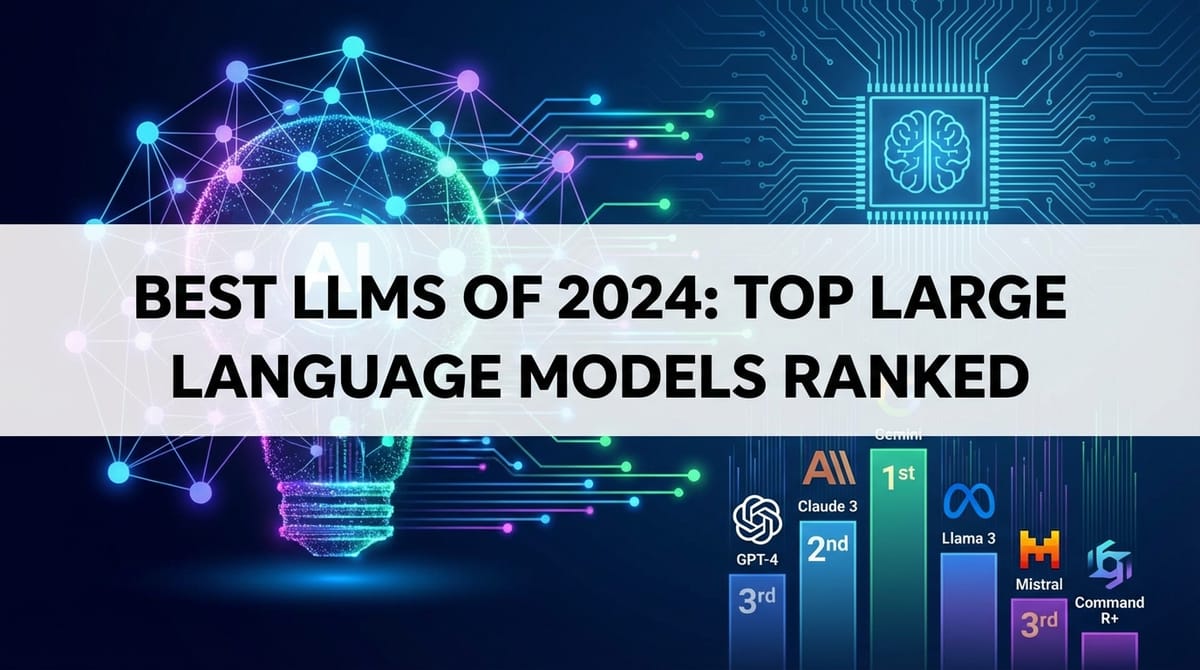
Best LLMs of 2024: Top Large Language Models Ranked

The year 2024 marks a pivotal moment in the evolution of artificial intelligence, with Large Language Models (LLMs) standing at the forefront of innovation. These sophisticated AI constructs, capable of understanding, generating, and manipulating human language with uncanny fluency, have transitioned from experimental marvels to indispensable tools across virtually every industry. From revolutionizing customer service and content creation to accelerating scientific research and enhancing personalized education, the impact of LLMs is profound and ever-expanding. As developers, businesses, and curious individuals navigate this rapidly advancing landscape, identifying the best LLMs for specific applications becomes paramount.
This comprehensive guide aims to provide an in-depth exploration and llm rankings of the top LLMs available in 2024. We will delve into the intricacies of what makes these models exceptional, evaluating them against a rigorous set of criteria that includes performance metrics, cost-effectiveness, accessibility, and ethical considerations. Our goal is to equip you with the knowledge needed to make informed decisions, whether you're building cutting-edge AI applications, optimizing existing workflows, or simply seeking to understand the vanguard of AI technology. The dynamic nature of this field means that what constitutes the "best" is constantly shifting, driven by breakthroughs in research, novel architectural designs, and the ever-growing demands of real-world use cases. Join us as we uncover the leaders shaping the future of conversational AI and intelligent automation.
Understanding Large Language Models (LLMs)
Before diving into specific models and their llm rankings, it's crucial to establish a foundational understanding of what Large Language Models are and how they operate. At their core, LLMs are a class of artificial intelligence models designed to process and generate human-like text. They are built upon deep learning architectures, most notably the Transformer architecture, which has proven exceptionally effective for sequential data like language.
The journey of an LLM begins with extensive pre-training on colossal datasets comprising vast amounts of text and, increasingly, other modalities like images and audio. These datasets can range from internet archives, books, articles, and codebases, allowing the models to learn statistical relationships, grammatical structures, factual knowledge, and even stylistic nuances of language. This unsupervised learning phase is incredibly computationally intensive, requiring immense processing power and time. During pre-training, the model learns to predict the next word in a sequence, effectively internalizing a probabilistic understanding of language.
Following pre-training, many LLMs undergo a fine-tuning phase. This often involves supervised learning on smaller, task-specific datasets, sometimes incorporating human feedback (Reinforcement Learning from Human Feedback, RLHF). This phase helps to align the model's outputs with human preferences, reduce harmful or biased responses, and improve performance on specific downstream tasks such as summarization, translation, question-answering, or code generation. The ability to fine-tune a general-purpose foundational model for specialized applications is one of the most powerful aspects of LLM technology.
Key Capabilities of LLMs:
- Text Generation: Creating coherent, grammatically correct, and contextually relevant text for articles, stories, marketing copy, emails, and more.
- Summarization: Condensing long documents or articles into concise summaries, retaining the most important information.
- Translation: Translating text between different human languages with increasing accuracy and nuance.
- Question Answering: Providing direct and relevant answers to questions based on its training data or provided context.
- Code Generation and Debugging: Writing code in various programming languages, explaining code, and identifying errors.
- Sentiment Analysis: Determining the emotional tone or sentiment expressed in a piece of text.
- Information Extraction: Identifying and extracting specific entities or relationships from unstructured text.
- Creative Writing: Assisting with brainstorming ideas, writing poetry, scripts, or fiction.
- Conversational AI: Powering chatbots and virtual assistants that can engage in natural, flowing dialogues.
However, despite their impressive capabilities, LLMs are not without their challenges and limitations. One significant issue is "hallucination," where models generate plausible-sounding but factually incorrect information. Bias present in the training data can also be reflected and even amplified in the model's outputs, leading to unfair or discriminatory results. Furthermore, the sheer computational cost of training and running these models can be substantial, and ensuring their ethical deployment remains an ongoing concern for researchers and developers alike. Understanding these nuances is crucial when evaluating the best LLMs and integrating them into real-world systems.
Criteria for Ranking the Best LLMs in 2024
In the highly competitive landscape of 2024, assessing the best LLMs requires a multifaceted approach. A simple benchmark score often doesn't tell the whole story, as different applications demand different strengths. Our llm rankings are informed by a comprehensive set of criteria, designed to provide a holistic view of each model's capabilities and suitability for various use cases.
1. Performance Metrics
At the core of any LLM evaluation is its raw performance. This category encompasses several critical dimensions:
- Accuracy and Relevance: How precisely does the model understand prompts and generate responses that are factually correct and contextually appropriate? This is often measured through benchmarks like MMLU (Massive Multitask Language Understanding) or specific task-oriented evaluations.
- Coherence and Fluency: Responses should not only be accurate but also flow naturally, exhibiting human-like coherence, grammar, and style. The ability to maintain long-range consistency in extended generations is key.
- Speed/Latency: For real-time applications like chatbots, customer service, or interactive tools, the time it takes for a model to generate a response is crucial. Low latency ensures a smooth and responsive user experience.
- Throughput: This refers to the number of requests an LLM can process per unit of time. High throughput is essential for applications handling large volumes of concurrent users or data processing tasks.
- Context Window Size: The maximum amount of text an LLM can "see" and process in a single prompt. Larger context windows allow models to handle longer documents, maintain complex conversations, and perform more sophisticated reasoning tasks without losing track of earlier information.
- Multimodality: The ability to understand and generate content across different modalities, such as text, images, audio, and video. Models that excel here open up new possibilities for integrated AI experiences.
2. Cost-Effectiveness
The operational cost of integrating and running LLMs is a significant factor, especially for businesses.
- API Pricing: Most commercial LLMs are accessed via APIs, with pricing typically based on token usage (input and output tokens). Comparing cost-per-token across different models is essential for budget planning.
- Infrastructure Costs (for self-hosting/open-source models): For models that can be self-hosted, the cost of GPUs, cloud computing resources, and ongoing maintenance must be considered.
- Efficiency in Resource Usage: Some models are more computationally efficient than others, meaning they can achieve similar performance with fewer resources, leading to lower operational costs.
3. Accessibility and Ease of Integration
A powerful LLM is only useful if developers can easily access and integrate it into their applications.
- API Availability and Documentation: Clear, comprehensive documentation and robust APIs are critical for developers.
- SDKs and Libraries: The availability of well-supported Software Development Kits (SDKs) in popular programming languages simplifies integration.
- Community Support: A vibrant community provides resources, troubleshooting help, and shared best practices.
- Platform Support: The ease with which an LLM can be deployed on various cloud platforms or integrated via unified API platforms like XRoute.AI, which aggregates multiple top LLMs, greatly enhances its utility.
4. Fine-tuning and Customization Capabilities
Many enterprise-level applications require LLMs to be tailored to specific domains, terminologies, or tasks.
- Ability to Adapt: How effectively can the model be fine-tuned with proprietary data to improve performance on specialized tasks or adopt a particular brand voice?
- Data Requirements: The amount and type of data required for effective fine-tuning.
- Availability of Tools: User-friendly tools and platforms for managing the fine-tuning process.
5. Ethical Considerations and Safety
As LLMs become more pervasive, their ethical implications are under increased scrutiny.
- Bias Mitigation: Efforts made by developers to identify and reduce harmful biases embedded in the training data and model outputs.
- Content Moderation: Built-in capabilities or external tools to filter out unsafe, hateful, or inappropriate content.
- Responsible AI Development: The developer's commitment to transparency, fairness, and accountability in their AI systems.
- Data Privacy and Security: How user data is handled, especially for enterprise-grade solutions.
6. Multimodality and Specialized Features
The future of AI is increasingly multimodal.
- Image, Audio, Video Integration: The capacity to process and generate content beyond pure text, understanding visual cues or generating spoken responses.
- Code Interpretation and Execution: Models that can not only generate code but also execute it or interact with external tools for dynamic problem-solving.
- Mathematical Reasoning: Enhanced abilities in symbolic reasoning and complex mathematical problem-solving.
7. Scalability and Reliability
For mission-critical applications, the underlying infrastructure supporting the LLM must be robust.
- Handling Large Volumes: The ability to scale effortlessly to handle fluctuating demand and large numbers of concurrent requests.
- Uptime and Maintenance: Guaranteed service levels, minimal downtime, and consistent performance.
By weighing each of these criteria, we can move beyond superficial comparisons and provide a truly insightful llm rankings of the best LLMs of 2024, helping you navigate this complex yet exhilarating technological frontier.
The Top LLMs of 2024: A Detailed Ranking
The year 2024 has witnessed an unprecedented surge in the capabilities and diversity of Large Language Models. From proprietary giants to rapidly evolving open-source alternatives, the competition for the title of best LLM is fierce. Here, we delve into the top LLMs that are setting the benchmarks and driving innovation across various sectors.
1. OpenAI's GPT-4 (and GPT-4 Turbo)
Developer: OpenAI Key Features & Strengths: OpenAI's GPT-4, and its optimized iteration GPT-4 Turbo, continue to hold a commanding position among the best LLMs. GPT-4 is renowned for its exceptional general intelligence, demonstrating advanced reasoning capabilities across a wide array of domains. It excels in complex problem-solving, creative writing, intricate code generation, and sophisticated logical inference. Its ability to handle nuanced prompts and generate highly coherent, contextually relevant, and human-like text is unparalleled for many tasks. GPT-4 Turbo significantly improves upon the original, offering a much larger context window (up to 128K tokens, equivalent to over 300 pages of text) and a more competitive price point, making it more cost-effective for high-volume applications. It also boasts enhanced instruction following and a fresher knowledge cutoff. Multimodality is a strong suit, with capabilities like image understanding (GPT-4V). Ideal Use Cases: Content creation, sophisticated chatbots, virtual assistants, advanced coding assistants, data analysis, summarization of lengthy documents, complex research, strategic decision support, and innovative product development. Limitations: While more affordable than its predecessor, API access still represents a significant operational cost, particularly for large-scale deployments. Its latency, though improved, might still be a factor for extremely real-time, low-latency applications compared to some specialized models. The "black box" nature can make debugging and understanding its reasoning challenging. Recent Updates in 2024: Continued fine-tuning and performance enhancements, broader access to its multimodal capabilities, and more robust API features for enterprise integration. OpenAI continues to push the boundaries, keeping GPT-4 at the pinnacle of llm rankings.
2. Google's Gemini (Pro, Ultra)
Developer: Google Key Features & Strengths: Google's Gemini represents a significant leap forward in multimodal AI, designed from the ground up to be natively multimodal, seamlessly understanding and operating across text, images, audio, and video. Gemini Ultra is positioned as Google's largest and most capable model, excelling in highly complex tasks and achieving state-of-the-art performance across numerous benchmarks, often surpassing GPT-4 in certain areas. Gemini Pro offers a strong balance of performance and efficiency, suitable for a broad range of enterprise and developer applications, including integration into Google's own products like Bard (now Gemini). Its strengths lie in its deep integration with Google's ecosystem, impressive reasoning abilities, and inherent multimodal understanding, making it a strong contender among the top LLMs. Ideal Use Cases: Multimodal content analysis, advanced conversational AI, intelligent agents interacting with various data types, educational tools, creative content generation (text, image prompts), complex research synthesis, and applications requiring real-world understanding through multiple senses. Limitations: The full capabilities of Gemini Ultra are primarily available to enterprise users and select partners, with broader access still rolling out. Performance can vary depending on the specific modality and task. Adoption might be tied to Google Cloud ecosystem for optimal performance and integration. Recent Updates in 2024: Broader API access for Gemini Pro, continuous performance improvements for Ultra, expansion of multimodal capabilities, and tighter integration with Google's suite of AI tools and services.
3. Anthropic's Claude 3 (Opus, Sonnet, Haiku)
Developer: Anthropic Key Features & Strengths: Anthropic's Claude 3 family (Opus, Sonnet, Haiku) has quickly established itself as a formidable challenger, particularly emphasizing safety, steerability, and long context windows. Opus is the most intelligent and powerful model, often rivaling or exceeding GPT-4 and Gemini Ultra on various benchmarks, especially those requiring complex reasoning and creativity. Sonnet strikes an excellent balance between intelligence and speed, making it suitable for a vast array of enterprise workloads. Haiku is the fastest and most cost-effective, ideal for near-instant responses and high-volume tasks. A standout feature across the Claude 3 series is its exceptionally long context window (up to 200K tokens for general use, with previews up to 1M tokens), making it superb for analyzing lengthy documents, books, or entire codebases. Anthropic’s commitment to "Constitutional AI" focuses on developing safe, helpful, and honest models, earning it high marks for ethical considerations. Ideal Use Cases: Legal document review, detailed research analysis, customer support, contract analysis, deep code analysis, medical information processing, summarizing large reports, and applications where safety and ethical alignment are paramount. Limitations: While highly capable, Opus's pricing can be on the higher end, aligning with its premium performance. The model family is relatively newer, so ecosystem integration might not be as mature as OpenAI or Google's offerings in some areas. Recent Updates in 2024: Public release of the full Claude 3 family, significant improvements in speed and cost-effectiveness for Sonnet and Haiku, and ongoing enhancements to safety and steerability features. Many now consider Claude 3 among the best LLMs for enterprise.
4. Meta's Llama 3 (and Open-Source Ecosystem)
Developer: Meta AI Key Features & Strengths: Meta's Llama 3 represents a monumental contribution to the open-source AI community. Available in 8B and 70B parameter versions (with larger models planned), Llama 3 is highly competitive with proprietary models in its class and often outperforms them on various benchmarks. Its open-source nature means it can be fine-tuned and deployed by anyone, fostering an enormous ecosystem of innovation, customization, and specialized derivatives. This democratizes access to powerful LLM technology, allowing researchers and developers to experiment, innovate, and deploy solutions without prohibitive licensing costs. Llama 3 features improved reasoning, code generation, and multimodal understanding (though the initial releases are primarily text-based, with multimodal capabilities in future versions). Its strong performance for its size makes it one of the most efficient and versatile options among the top LLMs for on-premise deployment or custom cloud solutions. Ideal Use Cases: Research, custom model development, self-hosted applications, privacy-sensitive environments, embedded AI, building highly specialized chatbots, code generation tools, and use cases where cost-effectiveness and full control over the model are critical. Limitations: Deploying and managing open-source models like Llama 3 requires significant technical expertise and computational resources. While the model itself is free, the infrastructure costs can be substantial. Support relies heavily on the community. Recent Updates in 2024: Release of Llama 3 8B and 70B models, accompanied by improved pre-training and fine-tuning methodologies, resulting in a step change in performance over Llama 2. Continued community engagement and the emergence of numerous fine-tuned variants.
5. Mistral AI's Models (Mistral Large, Mixtral 8x7B)
Developer: Mistral AI Key Features & Strengths: Mistral AI, a rapidly emerging European powerhouse, has made a significant impact with its highly efficient and performant models. Mixtral 8x7B, a Sparse Mixture of Experts (SMoE) model, offers exceptional performance for its size, often rivaling larger models while being significantly more cost-effective to run. Its architecture allows it to activate only a subset of its parameters for any given token, leading to faster inference and reduced computational load. Mistral Large is their flagship commercial model, boasting top-tier reasoning capabilities, excellent code generation, and strong multilingual support. Mistral models are known for their strong performance-to-cost ratio and developer-friendly approach, making them attractive for enterprise applications seeking efficiency without sacrificing quality. Ideal Use Cases: High-throughput API-driven applications, real-time chatbots, code generation, summarization, data extraction, multilingual applications, and scenarios where both performance and cost-efficiency are crucial. Limitations: While Mistral Large is commercially competitive, Mixtral's open-source version requires self-hosting infrastructure. The company is newer, so the long-term support ecosystem is still maturing compared to giants like Google or OpenAI. Recent Updates in 2024: Release of Mistral Large and continued refinement of Mixtral 8x7B, with ongoing performance enhancements and expanding availability through various cloud providers and API platforms. These models consistently rank high in efficiency benchmarks.
6. Cohere's Command Models (Command R+, Command R)
Developer: Cohere Key Features & Strengths: Cohere specializes in enterprise-grade LLMs, with its Command family being particularly strong in Retrieval Augmented Generation (RAG) and tool use. Command R+ is Cohere's most advanced model, designed specifically for enterprise-level applications requiring sophisticated reasoning, strong multilingual capabilities (supporting 10 key languages), and highly accurate RAG. It excels at complex business workflows, multi-step tasks, and generating grounded, factual responses by integrating with external data sources. Command R offers a highly scalable and cost-effective option for similar enterprise tasks. Cohere's focus on RAG optimization means their models are exceptionally good at understanding when to retrieve information and how to integrate it coherently into responses, minimizing hallucinations and enhancing factual accuracy. Ideal Use Cases: Enterprise search, intelligent document analysis, customized customer support, internal knowledge management systems, supply chain optimization, data privacy-sensitive applications, and building AI agents that interact with proprietary databases. Limitations: While optimized for enterprise, the models might not be as widely known for general creative writing tasks as some other models. Their strength lies in their targeted enterprise capabilities. Recent Updates in 2024: Release of Command R+ with significant improvements in reasoning, RAG, and multilingual capabilities, pushing it firmly into the top LLMs for business applications. Continued development of their embedding models and overall RAG ecosystem.
7. Perplexity AI's Models (e.g., pplx-70b-online)
Developer: Perplexity AI Key Features & Strengths: Perplexity AI's models stand out for their real-time internet access and focus on grounded, factual responses, often citing their sources. Models like pplx-70b-online integrate search capabilities directly into their inference process, allowing them to provide up-to-the-minute information and mitigate hallucination by cross-referencing against web sources. This makes them exceptionally powerful for tasks requiring current events, trending information, or verified facts. They are effectively optimized for question-answering and summarization with a strong emphasis on accuracy and transparency, offering a refreshing approach to LLM reliability. Ideal Use Cases: Research assistants requiring up-to-date information, news summarization, factual question answering, content generation with source citations, educational tools, and applications where real-time data and verifiability are critical. Limitations: While strong in factual retrieval, their creative generation capabilities might be less emphasized compared to general-purpose LLMs. Performance is heavily reliant on the quality and speed of integrated search infrastructure. Recent Updates in 2024: Continued development of their online models, improving speed, accuracy, and integration with real-time web data. Enhanced API offerings for developers to leverage their unique capabilities.
LLM Comparison Table (Snapshot)
| Feature / Model | GPT-4 Turbo (OpenAI) | Gemini Ultra (Google) | Claude 3 Opus (Anthropic) | Llama 3 70B (Meta) | Mistral Large (Mistral AI) | Command R+ (Cohere) |
|---|---|---|---|---|---|---|
| Developer | OpenAI | Anthropic | Meta AI | Mistral AI | Cohere | |
| Architecture | Transformer | Transformer (Multimodal) | Transformer | Transformer | Transformer (SMoE for Mixtral) | Transformer |
| Core Strength | General Intelligence, Reasoning | Native Multimodality, Integration | Safety, Long Context, Reasoning | Open-Source, Customization | Efficiency, Performance | RAG, Tool Use, Enterprise |
| Context Window | Up to 128K tokens | Variable, often large | Up to 200K tokens | 8K tokens (expandable) | 32K tokens | 128K tokens |
| Multimodality | Yes (Image input) | Yes (Native text, image, audio, video) | Yes (Image input) | Future (initial text-only) | Primarily Text | Primarily Text |
| Access | API (Commercial) | API (Commercial, limited Ultra) | API (Commercial) | Open-Source (Self-host/API) | API (Commercial & Open Source) | API (Commercial) |
| Ethical Focus | Responsible AI | Responsible AI | Constitutional AI, Safety | Responsible AI | Responsible AI | Responsible AI |
| Typical Use Cases | Creative content, coding, complex reasoning, chatbots | Multimodal agents, creative, advanced research | Legal, research, enterprise chat, safety-critical | Custom solutions, research, privacy, embedded | High-throughput, multilingual, cost-efficient | Enterprise search, knowledge management, specialized agents |
| Cost Efficiency (Scale 1-5, 5=Best) | 3 | 3 | 3 | 5 (free model, infra cost) | 4 | 4 |
Note: This table provides a general overview. Specific performance and cost can vary greatly depending on the exact task, model version, and implementation details. The "best LLMs" for you will depend on your unique requirements.
XRoute is a cutting-edge unified API platform designed to streamline access to large language models (LLMs) for developers, businesses, and AI enthusiasts. By providing a single, OpenAI-compatible endpoint, XRoute.AI simplifies the integration of over 60 AI models from more than 20 active providers(including OpenAI, Anthropic, Mistral, Llama2, Google Gemini, and more), enabling seamless development of AI-driven applications, chatbots, and automated workflows.
Emerging Trends and Future Outlook for LLMs
The landscape of LLMs is not static; it's a rapidly evolving domain characterized by continuous breakthroughs and the emergence of exciting new trends. Staying abreast of these developments is crucial for anyone looking to leverage the top LLMs effectively in the coming years.
One of the most significant trends is the push towards greater multimodality. While current best LLMs like GPT-4V and Gemini already integrate text and image understanding, the future promises truly seamless interaction across all sensory modalities – text, image, audio, video, and even tactile input. This will enable AI systems to perceive and interact with the world in a more holistic, human-like manner, opening doors to entirely new applications in robotics, augmented reality, and personalized learning. Imagine an AI that can not only describe a video but also generate a new video segment based on a textual prompt, or one that can understand your spoken query while simultaneously analyzing a complex diagram you've shown it.
Another critical development is the emphasis on smaller, more efficient models (Edge AI). While the race for larger, more powerful models continues, there's a growing recognition of the need for LLMs that can run efficiently on constrained hardware, such as smartphones, IoT devices, or edge servers. These compact models, often distilled from larger ones or designed with novel sparse architectures, will enable offline capabilities, reduce latency, enhance privacy, and dramatically lower operational costs for many localized applications. This will expand the reach of AI into environments where cloud connectivity is intermittent or where real-time, on-device processing is essential.
Hyper-personalization is also gaining traction. Future LLMs will be even more adept at understanding individual user preferences, interaction styles, and historical data to deliver highly tailored experiences. This goes beyond simple customization, moving towards truly adaptive AI companions that learn and evolve with their users, offering personalized recommendations, educational content, and conversational styles that feel uniquely attuned to individual needs.
The drive for explainable AI (XAI) is becoming more pronounced. As LLMs are deployed in critical domains like healthcare and finance, understanding why a model makes a particular decision or generates a specific response is paramount. Researchers are working on methods to make LLMs more transparent, providing insights into their internal workings and reasoning processes, thereby fostering greater trust and enabling better debugging and auditing.
Finally, the democratization of access to advanced LLMs through unified platforms and open-source initiatives will continue to be a dominant trend. Managing dozens of individual API connections to various LLMs from different providers can be a developer's nightmare. This is precisely where platforms like XRoute.AI come into play. XRoute.AI offers a cutting-edge unified API platform designed to streamline access to large language models (LLMs) for developers, businesses, and AI enthusiasts. By providing a single, OpenAI-compatible endpoint, XRoute.AI simplifies the integration of over 60 AI models from more than 20 active providers. This approach not only reduces development complexity but also enables seamless development of AI-driven applications, chatbots, and automated workflows. With a focus on low latency AI and cost-effective AI, XRoute.AI empowers users to build intelligent solutions without the complexity of managing multiple API connections, accelerating the deployment of the best LLMs across the ecosystem. This type of platform is essential for navigating the growing complexity and diversity of the LLM market, ensuring that even smaller teams can leverage the full power of these advanced models.
The future of LLMs promises more intelligent, more integrated, more efficient, and more ethically aligned AI systems that will continue to reshape our world in profound ways.
Choosing the Right LLM for Your Project
Selecting the "best" LLM is rarely about finding a single, universally superior model. Instead, it's about identifying the most suitable tool for your specific job, considering a confluence of factors that extend beyond raw benchmark scores. The dynamic nature of llm rankings means that today's leader might be surpassed tomorrow, emphasizing the need for an adaptive strategy.
First and foremost, define your core use case and requirements. Are you building a creative writing assistant, a legal document summarizer, a customer support chatbot, or a code generation tool? Each application has unique demands regarding accuracy, speed, context window, and specialized capabilities. For instance, a chatbot for immediate customer queries prioritizes low latency and cost-effectiveness, while a legal AI assistant demands a vast context window and impeccable factual accuracy.
Next, consider your budget constraints. Proprietary models often come with token-based pricing, which can accumulate quickly for high-volume applications. Open-source models, while free to use, incur significant infrastructure costs if self-hosted. Weigh the trade-offs between upfront API costs and long-term operational expenses. This is where a focus on cost-effective AI becomes critical.
Performance vs. Efficiency is another key trade-off. While models like GPT-4 Opus or Gemini Ultra offer unparalleled reasoning, they might be overkill (and over budget) for simpler tasks where a smaller, more efficient model like Haiku or Mixtral could perform adequately at a fraction of the cost. Look for the "good enough" model that meets your performance thresholds without unnecessary overhead.
Integration complexity and developer experience are often overlooked. A powerful LLM is only as good as its ease of integration. Comprehensive documentation, robust SDKs, and strong community support can significantly accelerate development. This is where innovative platforms become invaluable.
This is precisely the challenge that XRoute.AI addresses directly. As a cutting-edge unified API platform, XRoute.AI streamlines access to over 60 large language models (LLMs) from more than 20 active providers through a single, OpenAI-compatible endpoint. This means developers can switch between different top LLMs like GPT, Claude, Gemini, Llama, and Mistral with minimal code changes, allowing them to experiment and optimize for low latency AI and cost-effective AI without the complexity of managing multiple, disparate API connections.
For example, if you initially find that GPT-4 is too expensive for a particular task, XRoute.AI allows you to seamlessly test a more cost-effective model like Mistral Large or Claude 3 Sonnet from the same API endpoint. This flexibility is crucial for rapid iteration and ensuring you're always using the most appropriate (and cost-effective AI) model for your current needs. XRoute.AI empowers developers to focus on building intelligent solutions, confident that they can easily access and leverage the best LLMs available, maximizing performance and minimizing costs, all while ensuring high throughput and scalability.
Finally, always keep ethical considerations and data privacy in mind. If your application handles sensitive user data, ensure the chosen LLM and its deployment environment comply with relevant regulations and privacy standards. Look for models and platforms that prioritize responsible AI development and offer robust security features.
By systematically evaluating these factors against your project's unique context, you can navigate the complex world of LLMs and select the optimal model (or combination of models) to drive your innovation forward.
Conclusion
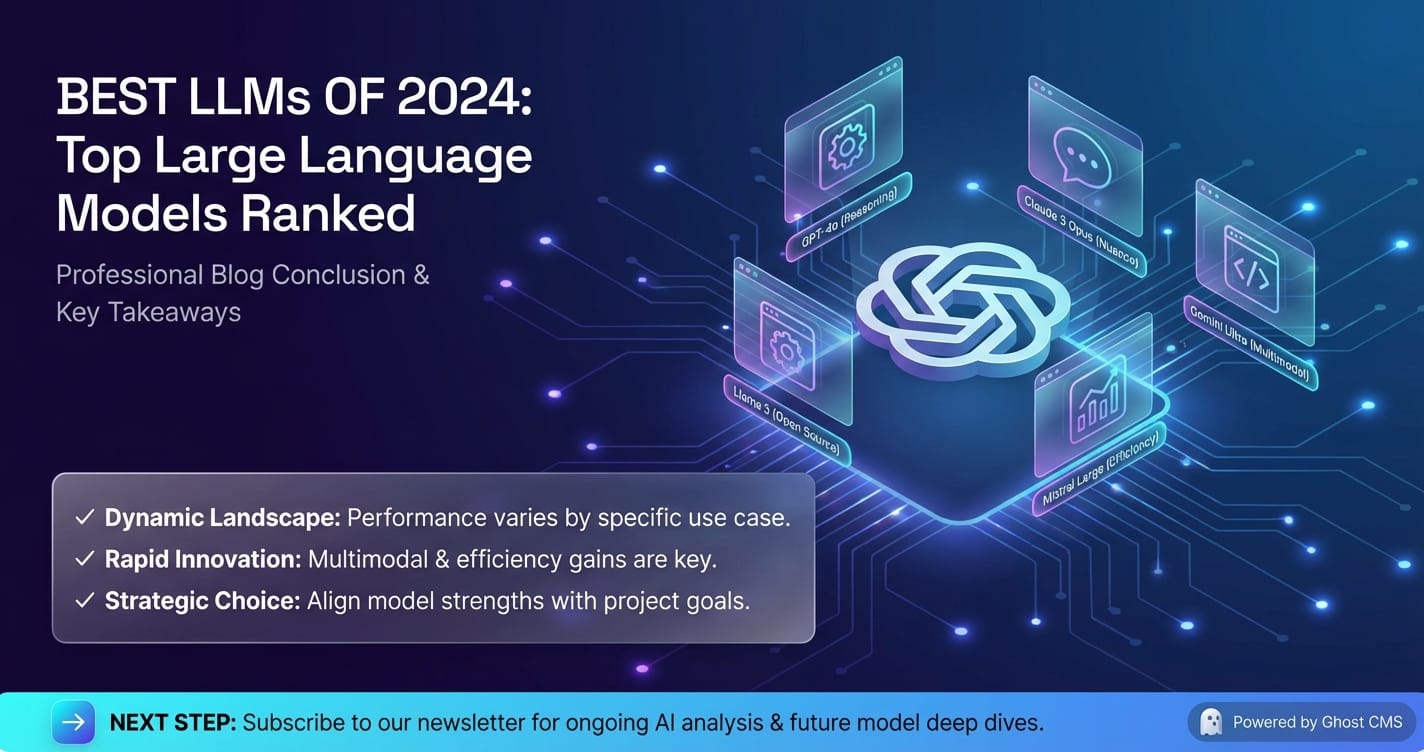
The year 2024 has solidified the position of Large Language Models as a transformative technology, reshaping industries and fundamentally altering how we interact with information and automation. From the unparalleled general intelligence of OpenAI's GPT-4 to the multimodal prowess of Google's Gemini, the ethical emphasis of Anthropic's Claude 3, and the democratizing force of Meta's Llama 3, the landscape is rich with powerful, diverse, and rapidly evolving solutions. We've seen how models like Mistral AI's offerings prioritize efficiency, while Cohere's Command models excel in enterprise RAG applications, each carving out its niche among the top LLMs.
The quest for the "best LLM" is not a search for a singular champion but rather an ongoing process of matching specific needs with specialized capabilities. As highlighted in our llm rankings, the ideal choice hinges on a careful consideration of performance, cost, integration ease, and the unique demands of your project. The future promises even more sophisticated multimodality, efficient on-device AI, and hyper-personalized experiences, all while striving for greater explainability and ethical alignment.
Navigating this complex, fast-paced environment requires not just an understanding of individual models but also the tools and platforms that simplify their integration and management. Solutions like XRoute.AI are becoming indispensable, offering a unified gateway to a vast ecosystem of LLMs. By providing a single, OpenAI-compatible endpoint for over 60 models, XRoute.AI empowers developers to seamlessly experiment, optimize, and deploy the best LLMs for their applications, ensuring low latency AI and cost-effective AI without the burden of managing multiple vendor-specific APIs.
As we look ahead, the continuous innovation in Large Language Models will undoubtedly unlock new frontiers of possibility. Embracing these powerful tools, with a clear understanding of their strengths, limitations, and the emerging trends, will be key to shaping the next generation of intelligent applications and driving meaningful progress across all domains. The journey with LLMs is just beginning, and the most exciting chapters are yet to be written.
FAQ
Q1: What is the single best LLM in 2024? A1: There isn't a single "best" LLM for all purposes in 2024. The optimal choice largely depends on your specific use case, budget, and performance requirements. Models like OpenAI's GPT-4 Turbo, Google's Gemini Ultra, and Anthropic's Claude 3 Opus generally lead in raw intelligence and reasoning, while open-source options like Meta's Llama 3 or Mistral AI's Mixtral offer excellent performance for cost-effective or self-hosted solutions.
Q2: How can I choose the right LLM for my specific application? A2: To choose the right LLM, first clearly define your application's needs, including required accuracy, speed, context window size, and specialized features (e.g., multimodality, code generation, RAG). Then, consider your budget for API usage or infrastructure. Finally, evaluate the ease of integration and developer support. Platforms like XRoute.AI can help by providing a unified API to experiment with multiple models seamlessly.
Q3: Are open-source LLMs competitive with proprietary ones? A3: Absolutely. Models like Meta's Llama 3 and Mistral AI's Mixtral 8x7B have demonstrated highly competitive, and in some benchmarks, even superior performance compared to proprietary models, especially given their size. They offer the significant advantages of customizability, privacy (for self-hosting), and cost-effectiveness, though they require more technical expertise to deploy and manage.
Q4: What are the main challenges facing LLMs today? A4: Key challenges for LLMs include addressing "hallucinations" (generating factually incorrect but plausible text), mitigating biases inherited from training data, ensuring data privacy and security, managing high computational costs for training and inference, and developing more robust methods for explainable AI to understand their decision-making processes.
Q5: How does XRoute.AI help with LLM integration? A5: XRoute.AI simplifies LLM integration by offering a unified API platform that provides a single, OpenAI-compatible endpoint to access over 60 different LLMs from more than 20 providers. This allows developers to easily switch between models like GPT, Claude, Gemini, Llama, and Mistral with minimal code changes, enabling faster development, cost optimization through flexible model choice, and ensuring low latency AI and cost-effective AI for their applications without managing individual APIs.
🚀You can securely and efficiently connect to thousands of data sources with XRoute in just two steps:
Step 1: Create Your API Key
To start using XRoute.AI, the first step is to create an account and generate your XRoute API KEY. This key unlocks access to the platform’s unified API interface, allowing you to connect to a vast ecosystem of large language models with minimal setup.
Here’s how to do it: 1. Visit https://xroute.ai/ and sign up for a free account. 2. Upon registration, explore the platform. 3. Navigate to the user dashboard and generate your XRoute API KEY.
This process takes less than a minute, and your API key will serve as the gateway to XRoute.AI’s robust developer tools, enabling seamless integration with LLM APIs for your projects.
Step 2: Select a Model and Make API Calls
Once you have your XRoute API KEY, you can select from over 60 large language models available on XRoute.AI and start making API calls. The platform’s OpenAI-compatible endpoint ensures that you can easily integrate models into your applications using just a few lines of code.
Here’s a sample configuration to call an LLM:
curl --location 'https://api.xroute.ai/openai/v1/chat/completions' \
--header 'Authorization: Bearer $apikey' \
--header 'Content-Type: application/json' \
--data '{
    "model": "gpt-5",
    "messages": [
        {
            "content": "Your text prompt here",
            "role": "user"
        }
    ]
}'
With this setup, your application can instantly connect to XRoute.AI’s unified API platform, leveraging low latency AI and high throughput (handling 891.82K tokens per month globally). XRoute.AI manages provider routing, load balancing, and failover, ensuring reliable performance for real-time applications like chatbots, data analysis tools, or automated workflows. You can also purchase additional API credits to scale your usage as needed, making it a cost-effective AI solution for projects of all sizes.
Note: Explore the documentation on https://xroute.ai/ for model-specific details, SDKs, and open-source examples to accelerate your development.