Boost Your LLM Rank: Strategies for Better Performance

The rapid ascent of Large Language Models (LLMs) has fundamentally reshaped our approach to software development, content creation, and even scientific research. From powering intelligent chatbots that handle customer service inquiries with unprecedented nuance to automating complex data analysis and generating creative content, LLMs are no longer a niche technology but a foundational pillar of modern digital infrastructure. Yet, with this transformative power comes a significant challenge: how do we ensure these models perform optimally? How do we determine the best LLM for a given task, and what strategies can we employ for effective performance optimization to achieve a higher LLM rank?
This question is more complex than it appears on the surface. "Performance" for an LLM isn't a singular metric; it's a multifaceted concept encompassing accuracy, speed, cost, scalability, and even ethical considerations. As businesses and developers increasingly integrate LLMs into their core operations, the ability to select, fine-tune, and manage these models effectively becomes a critical differentiator. A poorly performing LLM can lead to inaccurate outputs, frustrated users, inflated costs, and missed opportunities. Conversely, a well-optimized LLM can unlock significant efficiencies, drive innovation, and deliver superior user experiences.
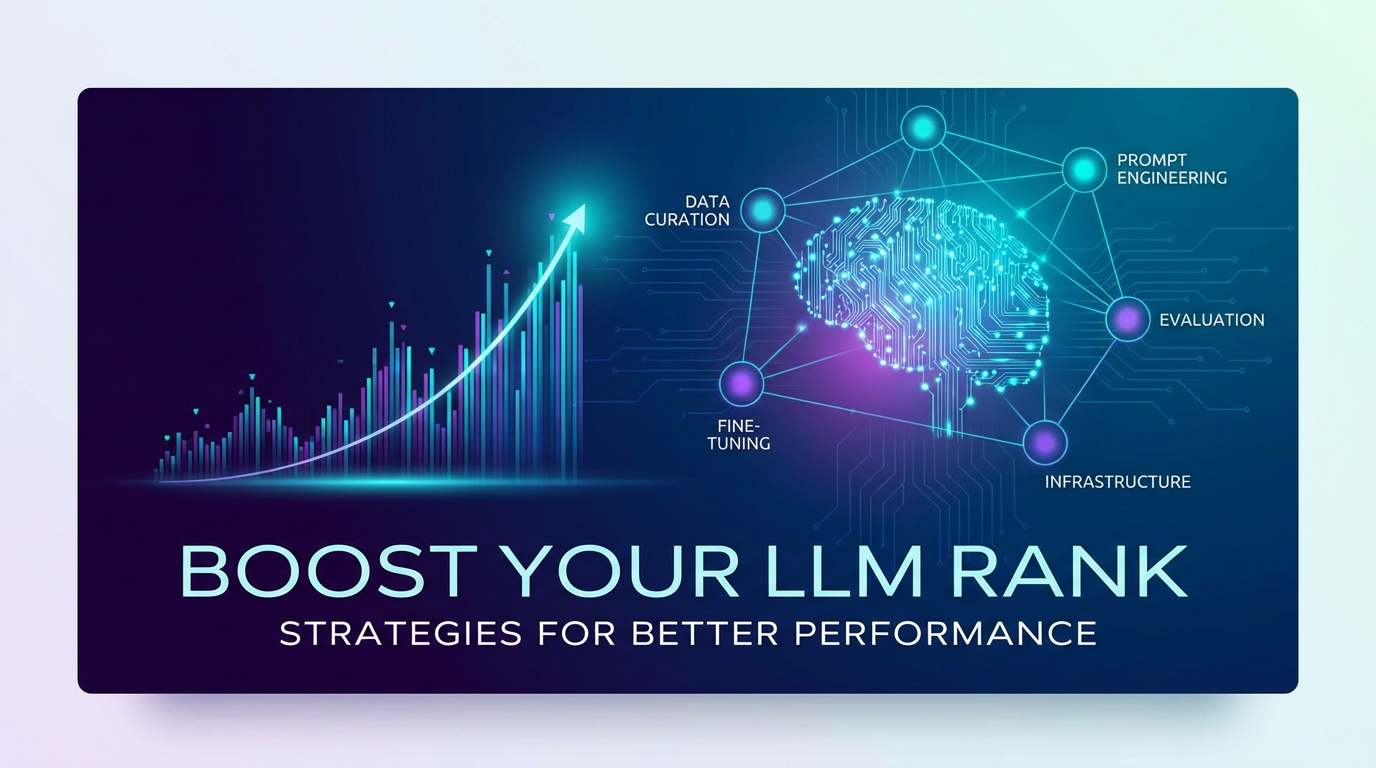
This comprehensive guide delves deep into the essential strategies and techniques for boosting your LLM rank. We will explore what truly defines "good" LLM performance, examining the various dimensions beyond mere output quality. From meticulous pre-deployment planning and data preparation to advanced fine-tuning methodologies, sophisticated prompt engineering, and critical post-deployment monitoring, we will cover the entire lifecycle of LLM performance optimization. We’ll also shed light on the crucial role of infrastructure and unified API platforms in streamlining this complex process, ensuring that your journey towards achieving the best LLM performance is both efficient and sustainable. Prepare to unlock the full potential of your LLM applications, transforming them from functional tools into truly exceptional, high-ranking assets.
Understanding LLM Rank: What Does "Good Performance" Really Mean?
Before embarking on any performance optimization journey, it's crucial to define what "good performance" truly means in the context of LLMs. Unlike traditional software where performance might primarily refer to speed or memory usage, an LLM rank is determined by a much broader spectrum of criteria. Simply put, there is no single best LLM for all tasks; the optimal choice and its performance metrics are highly contingent on the specific application, user expectations, and operational constraints.
Understanding these multifaceted dimensions is the first step toward effectively assessing and improving your LLM's standing. Let's break down the key metrics that contribute to an LLM rank:
Beyond Simple Accuracy: Delving into Multi-faceted Evaluation
While the perceived "intelligence" or accuracy of an LLM's output is often the first thing users notice, a holistic evaluation goes far beyond this. Consider a customer service chatbot that provides accurate answers but takes 30 seconds to respond – its utility is severely hampered by latency. Or an LLM that generates brilliant code but costs a fortune in API calls for every simple request. These scenarios highlight the need for a balanced view.
Key Metrics for Assessing LLM Rank
- Accuracy and Relevance:
- Factual Correctness: Does the LLM provide information that is verifiable and true? This is paramount for tasks like summarization, question answering, and data extraction. Hallucinations – the generation of plausible but incorrect information – are a significant challenge here.
- Semantic Relevance: Are the generated responses truly addressing the user's query or prompt? Even factually correct information can be irrelevant if it doesn't align with the user's intent.
- Coherence and Fluency: Is the output grammatically correct, logically structured, and easy to understand? For conversational agents or content generation, natural language flow is critical.
- Task-Specific Metrics: Depending on the task, specific metrics like ROUGE (for summarization), BLEU (for translation), or F1-score (for classification) might be used.
- Latency and Throughput:
- Latency: How quickly does the LLM respond to a query? Measured in milliseconds, low latency is vital for real-time applications like chatbots, interactive assistants, and live content generation, directly impacting user experience.
- Throughput: How many requests can the LLM process per unit of time? Measured in requests per second (RPS) or tokens per second, high throughput is essential for applications handling a large volume of concurrent queries, such as large-scale data processing or enterprise-level chatbots. These two metrics are often inversely related, and balancing them is a core aspect of
performance optimization.
- Cost-effectiveness:
- API Costs: Most large, proprietary LLMs are accessed via APIs, incurring costs per token, per request, or per hour of usage. Selecting a model that balances performance with reasonable costs is crucial for long-term sustainability.
- Infrastructure Costs: For self-hosted or fine-tuned models, this includes GPU usage, storage, and networking. Optimizing these resources is a significant part of cost management.
- Operational Costs: The human effort required for monitoring, debugging, and maintaining the LLM system. The more robust and reliable a system, the lower these costs.
- Scalability:
- Can the LLM system handle increasing loads and user demands without significant degradation in performance or substantial increases in cost? This involves considerations for parallel processing, load balancing, and efficient resource allocation. A truly
best LLMsolution can scale seamlessly with business growth.
- Can the LLM system handle increasing loads and user demands without significant degradation in performance or substantial increases in cost? This involves considerations for parallel processing, load balancing, and efficient resource allocation. A truly
- Robustness and Reliability:
- Consistency: Does the LLM provide consistent output quality over time and across similar inputs?
- Error Handling: How well does the system cope with unexpected inputs, edge cases, or API failures?
- Uptime: Is the LLM service consistently available? For mission-critical applications, high uptime is non-negotiable.
- Ethical Considerations:
- Bias: Does the LLM exhibit biases from its training data, leading to unfair or discriminatory outputs?
- Fairness: Are the outputs equitable across different demographic groups?
- Transparency: Can the reasoning behind an LLM's output be understood or explained, especially in sensitive domains?
- Data Privacy: How is user data handled and protected within the LLM's interaction?
- Safety: Does the LLM avoid generating harmful, hateful, or unsafe content?
Table 1: Key Dimensions of LLM Performance Ranking
| Dimension | Description | Example Metrics/Considerations | Impact on LLM Rank |
|---|---|---|---|
| Accuracy & Relevance | Factual correctness, semantic alignment with user intent, coherence, and fluency. | ROUGE, BLEU, F1-score, human evaluation, hallucination rate. | Core utility, trustworthiness, user satisfaction. |
| Latency & Throughput | Speed of response, number of requests processed per second. | Milliseconds per response, requests per second (RPS), tokens per second. | User experience, system capacity, real-time applicability. |
| Cost-effectiveness | API token costs, infrastructure expenses, operational overhead. | Cost per 1M tokens, GPU hours, developer time for maintenance. | Financial viability, ROI. |
| Scalability | Ability to handle increased load without performance degradation. | Max concurrent users, system stability under stress. | Growth potential, reliability under peak demand. |
| Robustness & Reliability | Consistency, error handling, uptime, resistance to adversarial attacks. | Uptime percentage, error rate, consistency scores. | Dependability, system integrity. |
| Ethical Considerations | Bias mitigation, fairness, transparency, data privacy, safety. | Bias metrics, safety scores, compliance with regulations (GDPR, HIPAA). | Responsible AI, brand reputation, legal compliance. |
Different Contexts, Different Best LLM Criteria
The relative importance of these metrics shifts dramatically depending on the specific application.
- For a highly interactive customer service chatbot, low latency and high accuracy are paramount.
- For an internal tool that summarizes thousands of documents overnight, throughput and cost-effectiveness might outweigh ultra-low latency.
- For a medical diagnostic assistant, factual correctness, robustness, and ethical considerations (e.g., bias) are non-negotiable, even if it means slightly higher latency.
Therefore, achieving a high LLM rank begins with a clear understanding of your specific needs, allowing you to prioritize and optimize the most relevant performance dimensions. This tailored approach is far more effective than a generic quest for abstract "better performance."
Pre-deployment Strategies: Laying the Foundation for Best LLM Selection
The journey to achieving a high LLM rank and identifying the best LLM for your needs begins long before any code is written or API calls are made. Thorough pre-deployment planning is paramount, as decisions made at this stage will profoundly impact the eventual performance, cost, and overall success of your LLM-powered application. This phase is about defining your problem, exploring the available solutions, and preparing your data with meticulous care.
A. Defining Your Use Case and Requirements
The most critical first step is to precisely define what you want your LLM to do and why. Vague objectives lead to unfocused development and suboptimal results.
- Specificity is Key: What is the Core Task?
- Is it a conversational AI for customer support, capable of handling complex queries and maintaining context?
- Is it a summarization tool for extracting key information from lengthy reports or articles?
- Is it a code generation assistant, translating natural language prompts into executable code?
- Is it a sentiment analysis engine, classifying the emotional tone of user reviews?
- Is it a content creation tool, generating marketing copy or creative narratives? Each of these tasks has distinct requirements in terms of output quality, input format, and acceptable error rates.
- Data Characteristics: The Fuel for Your LLM
- Volume: How much data will the LLM process? Are we talking about a few dozen requests a day, or millions? This impacts scalability and infrastructure choices.
- Type: What kind of data is involved? Text (short messages, long documents), code, tabular data, multilingual input? The nature of the data influences model selection and preprocessing.
- Sensitivity: Does the data contain personally identifiable information (PII), confidential business data, or medical records? Data privacy and security become paramount, often dictating whether an on-premise, fine-tuned, or a cloud-based general model is suitable. Compliance with regulations like GDPR or HIPAA will strongly influence your choices.
- Performance Benchmarks: What's Acceptable?
- Desired Latency: For an interactive chatbot, sub-second response times might be critical. For an asynchronous summarization service, a few seconds might be perfectly acceptable. Define your upper limits.
- Acceptable Error Rate: What percentage of incorrect or irrelevant responses can your application tolerate? For highly critical applications (e.g., financial advice), this rate must be extremely low.
- Throughput Requirements: How many concurrent requests must your system handle at peak times? This helps determine the necessary compute resources and API limits.
- Budget Constraints: Reality Checks
- API Costs: If using proprietary models, understand the pricing models (per token, per call, tiered pricing). Estimate usage to project costs.
- Infrastructure Costs: For self-hosted or fine-tuned models, factor in GPU instances, storage, and networking.
- Development and Maintenance Costs: Allocate resources for fine-tuning, prompt engineering, monitoring, and ongoing optimization.
B. Exploring the Landscape of LLMs
Once your requirements are clear, the next step is to survey the vast and rapidly evolving LLM landscape. This involves understanding the different categories of models and how they might fit your specific needs.
- Open-source vs. Proprietary Models:
- Proprietary Models (e.g., OpenAI's GPT series, Anthropic's Claude, Google's Gemini):
- Pros: Generally state-of-the-art performance, easy API access, strong general capabilities, often well-maintained.
- Cons: Higher costs, vendor lock-in, less control over the model's inner workings, data privacy concerns (your data is sent to a third party).
- Open-source Models (e.g., Meta's LLaMA, Mistral AI's Mistral/Mixtral, Falcon):
- Pros: Cost-effective (no per-token fees, only compute), full control over the model, ability to fine-tune extensively on private data, strong community support, data privacy can be managed in-house.
- Cons: Requires significant technical expertise and compute resources for deployment and management, performance might lag behind leading proprietary models for general tasks (though fine-tuned open-source models can excel in specific niches).
- Proprietary Models (e.g., OpenAI's GPT series, Anthropic's Claude, Google's Gemini):
- Model Sizes and Architectures:
- LLMs come in various sizes, from billions to hundreds of billions of parameters. Larger models generally exhibit better general intelligence but are more expensive and slower.
- Architectures vary (e.g., decoder-only like GPT, encoder-decoder for specific tasks). Understanding these differences helps in selecting a model designed for your target task. For instance, smaller models like Mistral 7B can achieve remarkable performance for their size, making them excellent candidates for
performance optimizationin resource-constrained environments.
- Evaluating Models Based on Public Benchmarks:
- While not a perfect predictor for your specific use case, public benchmarks provide a useful starting point for
LLM rankassessment. - HELM (Holistic Evaluation of Language Models): A comprehensive framework evaluating LLMs across various scenarios, metrics, and trustworthiness dimensions.
- MMLU (Massive Multitask Language Understanding): Tests models on a wide range of academic and professional subjects.
- GPQA (General Purpose Question Answering): Focuses on highly difficult, fact-based questions.
- Leaderboards (e.g., Hugging Face Open LLM Leaderboard): Offer real-time ranking of open-source models based on various evaluation tasks.
- Caveat: These benchmarks often use generic datasets. Your domain-specific data might yield different results, necessitating internal testing.
- While not a perfect predictor for your specific use case, public benchmarks provide a useful starting point for
- Initial Selection Process:
- Based on your requirements, budget, and a review of benchmarks, create a shortlist of 2-3 promising models.
- Consider a "pilot project" to test these models with a small subset of your real data. This practical evaluation is often more informative than theoretical comparisons.
C. Data Preparation and Preprocessing
The quality of the data your LLM interacts with – whether for training, fine-tuning, or inference – is arguably the single most important factor determining its LLM rank. The old adage "garbage in, garbage out" holds especially true for LLMs.
- The "Garbage In, Garbage Out" Principle:
- Poorly prepared data can lead to biased outputs, hallucinations, irrelevant responses, and significant
performance optimizationchallenges downstream. - Invest time and resources here; it will pay dividends later.
- Poorly prepared data can lead to biased outputs, hallucinations, irrelevant responses, and significant
- Cleaning, Tokenization, Normalization:
- Cleaning: Remove irrelevant information (HTML tags, advertisements, boilerplate text), duplicate entries, personal identifiable information (PII) if not needed and privacy is a concern, and correct grammatical errors or typos in training data.
- Tokenization: Convert raw text into numerical tokens that the LLM can understand. Different models use different tokenizers (e.g., SentencePiece, BPE). Consistency is key.
- Normalization: Standardize text formatting, case, special characters, and abbreviations. This reduces ambiguity and improves consistency.
- Creating High-Quality Training/Fine-tuning Datasets:
- Relevance: Ensure your dataset is highly relevant to your specific use case and domain.
- Diversity: Include a wide range of examples to cover various scenarios, tones, and input styles. This helps the LLM generalize better.
- Quality Labels: For supervised fine-tuning, ensure that labels or desired outputs are accurate, consistent, and well-defined. This often requires human annotation or expert review.
- Size: While LLMs are data-hungry, even small, high-quality, task-specific datasets can significantly improve
performance optimizationthrough fine-tuning.
By meticulously executing these pre-deployment strategies, you establish a solid foundation, enabling you to make informed decisions about model selection and setting the stage for effective performance optimization that will truly boost your LLM rank.
Fine-tuning and Customization: Elevating Your LLM Rank
Even the most advanced general-purpose LLMs, while incredibly versatile, often fall short when confronted with highly specialized domains, unique brand voices, or specific task requirements. This is where fine-tuning and customization come into play, offering a powerful pathway to significantly elevate your LLM rank and achieve true performance optimization. These techniques allow you to adapt a pre-trained "base" model to your exact needs, transforming it into a highly specialized expert.
A. Why Fine-tuning Matters
Fine-tuning is the process of taking a pre-trained LLM and further training it on a smaller, domain-specific dataset. This process adjusts the model's weights to better align with the patterns, vocabulary, and nuances of your particular data.
- Adapting General Models to Specific Domains:
- A general LLM might understand medical terms in isolation but may struggle with the intricate reasoning required for clinical note summarization. Fine-tuning on a dataset of clinical notes helps it learn the context and relationships specific to medicine.
- Similarly, a model fine-tuned on legal documents will perform significantly better on legal research or contract review than a general model.
- Improving Task-Specific Performance Optimization:
- If your goal is to extract specific entities from unstructured text, fine-tuning with examples of tagged entities will dramatically improve precision and recall compared to just prompting a general model.
- For content generation, fine-tuning on your brand's style guide and previous marketing materials ensures the generated content matches your unique voice.
- Reducing Hallucinations and Improving Factual Accuracy:
- General LLMs are prone to "hallucinating" facts, especially on niche topics. By fine-tuning on a curated, factual dataset relevant to your domain, you can significantly reduce the incidence of these errors, leading to more reliable outputs and a higher
LLM rankfor trustworthiness.
- General LLMs are prone to "hallucinating" facts, especially on niche topics. By fine-tuning on a curated, factual dataset relevant to your domain, you can significantly reduce the incidence of these errors, leading to more reliable outputs and a higher
B. Techniques for Fine-tuning
The field of fine-tuning is rapidly evolving, offering various techniques depending on your data, resources, and desired outcome.
- Supervised Fine-tuning (SFT): With Labeled Datasets:
- Concept: This is the most common form of fine-tuning, where the model is trained on a dataset of input-output pairs (e.g., prompt-response, document-summary, question-answer).
- Process: You provide the model with an input and its corresponding correct output, and the model learns to map inputs to outputs.
- Benefits: Highly effective for specific tasks where high-quality labeled data is available. Directly teaches the model desired behaviors.
- Drawbacks: Requires significant effort to create and curate high-quality labeled datasets. Can be computationally intensive.
- Parameter-Efficient Fine-tuning (PEFT): LoRA, QLoRA, Adapters:
- Concept: Instead of updating all millions or billions of parameters in a large LLM, PEFT methods only fine-tune a small fraction of the model's parameters or introduce small, trainable "adapter" modules.
- Techniques:
- LoRA (Low-Rank Adaptation): Inserts small, trainable matrices into the transformer architecture. These matrices learn to adapt to the new task, and only their weights are updated during fine-tuning.
- QLoRA (Quantized LoRA): An extension of LoRA that quantizes the base model's weights (e.g., to 4-bit) to reduce memory footprint even further, making it possible to fine-tune very large models on consumer-grade GPUs.
- Adapters: Small neural networks inserted between layers of the pre-trained model. Only the adapter weights are updated.
- Benefits: Dramatically reduces computational costs (GPU memory, training time), makes fine-tuning large models more accessible, and prevents catastrophic forgetting of general knowledge. Crucial for cost-effective
performance optimization. - Drawbacks: May not achieve the absolute peak performance of full SFT for extremely complex tasks, but the trade-off is often worthwhile.
- Reinforcement Learning from Human Feedback (RLHF): Aligning with Human Preferences:
- Concept: This advanced technique aims to align the LLM's behavior with human values and preferences. It involves training a "reward model" based on human judgments of LLM outputs, which then guides a policy model (the LLM) to generate more preferred responses.
- Process:
- Supervised Fine-tuning: Initial fine-tuning on a dataset of desired responses.
- Reward Model Training: Humans rank or score multiple LLM outputs for a given prompt. This data trains a separate model (the reward model) to predict human preferences.
- Reinforcement Learning: The LLM is then fine-tuned using reinforcement learning, where the reward model provides feedback, encouraging the LLM to generate responses that maximize the predicted human preference score.
- Benefits: Excellent for improving conversational quality, helpfulness, harmlessness, and overall alignment with complex human instructions. Key for
LLM rankin terms of safety and user satisfaction. - Drawbacks: Highly complex, resource-intensive, and requires significant human annotation effort for ranking data.
C. Prompt Engineering: The Art of Instruction
While fine-tuning alters the model's underlying knowledge, prompt engineering is about getting the best LLM out of a pre-trained or fine-tuned model by carefully crafting the input instructions. It's a vital, often overlooked, aspect of performance optimization.
- Crafting Effective Prompts: Clarity, Specificity, Context:
- Clarity: Use unambiguous language. Avoid jargon unless the LLM is fine-tuned on it.
- Specificity: Be explicit about what you want. "Summarize this article" is less effective than "Summarize this article for a busy executive, focusing on key financial impacts and next steps, in no more than 150 words."
- Context: Provide relevant background information or examples. The more context, the better the LLM can understand your intent.
- Role-Playing: Instruct the LLM to adopt a persona (e.g., "Act as a marketing expert...").
- Few-shot, Zero-shot Prompting:
- Zero-shot: Provide no examples, just the instruction (e.g., "Translate this English sentence to French: 'Hello world.'").
- Few-shot: Provide a few examples within the prompt to guide the LLM's understanding of the task and desired output format (e.g., "English: Cat, French: Chat. English: Dog, French: Chien. English: Bird, French: ?"). This significantly improves
performance optimizationfor specific patterns.
- Chain-of-Thought (CoT), Tree-of-Thought Prompting:
- CoT: Instruct the LLM to "think step-by-step" or "show your reasoning." This encourages the model to break down complex problems into intermediate steps, often leading to more accurate and reliable answers, especially for mathematical or logical reasoning tasks.
- Tree-of-Thought (ToT): An advanced variant where the LLM explores multiple reasoning paths, evaluating and pruning less promising ones, similar to how humans might explore options. This can achieve even higher accuracy for very complex problem-solving.
- Iterative Prompt Refinement:
- Prompt engineering is an iterative process. Start with a basic prompt, test it, analyze the output, and refine the prompt based on observed shortcomings. This continuous feedback loop is essential for achieving the
best LLMperformance from your chosen model.
- Prompt engineering is an iterative process. Start with a basic prompt, test it, analyze the output, and refine the prompt based on observed shortcomings. This continuous feedback loop is essential for achieving the
D. Knowledge Augmentation: RAG (Retrieval-Augmented Generation)
Even fine-tuned LLMs have a knowledge cutoff (the date of their last training data) and may struggle with highly dynamic or proprietary information. Retrieval-Augmented Generation (RAG) is a powerful architecture that addresses these limitations, significantly boosting your LLM rank for factual accuracy and relevance.
- Overcoming LLM Knowledge Cutoffs:
- RAG allows LLMs to access and incorporate up-to-date, external, or proprietary information that wasn't part of their training data. This is crucial for applications requiring current events, specific company policies, or niche database lookups.
- Integrating External Knowledge Bases:
- Instead of memorizing all knowledge (which is impractical and constantly changing), RAG enables the LLM to "look up" relevant information from a designated knowledge base (e.g., a database, a collection of documents, a company wiki).
- Architecture of RAG Systems: Retriever, Generator:
- Retriever: When a user poses a query, the retriever component first searches a comprehensive external knowledge base (often a vector database containing embeddings of documents) for relevant snippets or documents. This step is critical for finding the most pertinent information.
- Generator: The retrieved information, along with the original user query, is then fed as context into the LLM (the generator). The LLM then synthesizes a response based on this augmented context, rather than relying solely on its internal, potentially outdated, knowledge.
- Benefits: Dramatically improves factual accuracy, reduces hallucinations, provides transparency (by often citing sources), and allows LLMs to stay current with dynamic information. It’s a key strategy for
performance optimizationin enterprise-level applications.
By strategically applying these fine-tuning and customization techniques, you can transform a general LLM into a highly specialized, high-performing agent that excels in your specific domain, ensuring your application consistently achieves a superior LLM rank.
XRoute is a cutting-edge unified API platform designed to streamline access to large language models (LLMs) for developers, businesses, and AI enthusiasts. By providing a single, OpenAI-compatible endpoint, XRoute.AI simplifies the integration of over 60 AI models from more than 20 active providers(including OpenAI, Anthropic, Mistral, Llama2, Google Gemini, and more), enabling seamless development of AI-driven applications, chatbots, and automated workflows.
Post-deployment Performance Optimization: Continuous Improvement
Deploying an LLM is not the end of the journey; it's merely the beginning of a continuous cycle of monitoring, analysis, and performance optimization. The dynamic nature of LLM usage, evolving user expectations, and the constant emergence of new models and techniques necessitate an agile approach to maintaining and improving your LLM rank. This post-deployment phase is critical for ensuring sustained high performance, managing costs, and adapting to real-world conditions.
A. Monitoring and Observability
Robust monitoring is the bedrock of any successful performance optimization strategy. Without understanding how your LLM is performing in the wild, you cannot effectively improve it.
- Key Metrics to Track:
- Latency: Average and percentile (e.g., P95, P99) response times. Spikes indicate bottlenecks.
- Error Rates: Percentage of failed requests, API errors, or undesirable outputs (e.g., hallucinations, irrelevant responses). Categorizing error types is crucial.
- User Satisfaction: Implicit (e.g., user interaction patterns, bounce rates) and explicit (e.g., thumbs up/down, feedback forms) feedback.
- Token Usage: Monitor input/output token counts to track API costs, especially for proprietary models.
- Resource Utilization: For self-hosted models, track GPU/CPU usage, memory, and network I/O.
- Hallucination Rate: While hard to automate completely, sampling and human review can provide an estimate.
- Bias Metrics: If applicable, monitor for disproportionate performance or harmful outputs across different demographic groups.
- Tools and Platforms for Monitoring LLM Performance:
- Standard APM (Application Performance Monitoring) tools: Can track API latency, error rates (e.g., Datadog, New Relic).
- Specialized LLM Observability Platforms: Emerging tools (e.g., LangChain, Arize AI, Weights & Biases) offer specific functionalities for tracing LLM chains, logging prompts/responses, evaluating model drift, and detecting specific LLM-related issues.
- Custom Logging: Implementing detailed logging within your application to capture prompts, responses, user feedback, and relevant timestamps.
- Establishing Feedback Loops:
- Human-in-the-Loop (HITL): Integrate mechanisms for users or human reviewers to flag incorrect, unhelpful, or biased responses. This feedback is invaluable for fine-tuning datasets and prompt refinement.
- Automated Evaluation: Use automated metrics (e.g., sentiment analysis on responses, keyword presence) where feasible, but always complement with human review.
- A/B Testing: Continuously test different models, prompts, or fine-tuning approaches with a subset of users to gather data on real-world performance.
B. Model Quantization and Pruning
For self-hosted models or scenarios where latency and cost are paramount, reducing the model's computational footprint is a powerful performance optimization technique.
- Reducing Model Size and Computational Footprint:
- Smaller models require less memory and fewer computational resources (GPUs), leading to faster inference and lower operational costs.
- This is especially critical for edge devices or applications needing extremely
low latency AI.
- Trade-offs Between Performance and Efficiency:
- These techniques often involve a slight degradation in model accuracy. The goal is to find the optimal balance where the efficiency gains outweigh the minor performance dip.
- Techniques:
- Quantization: Reducing the precision of the model's weights and activations (e.g., from 32-bit floating-point to 16-bit or even 8-bit integers). This dramatically reduces memory footprint and can accelerate computation on hardware optimized for lower precision arithmetic.
- Pruning: Removing redundant or less important weights/neurons from the model without significantly impacting its performance. This creates a "sparser" model that requires fewer calculations.
- Distillation: Training a smaller "student" model to mimic the behavior of a larger, more complex "teacher" model. The student model learns to achieve similar performance with a much smaller footprint.
C. Batching and Parallelization
For applications with high throughput demands, optimizing how requests are processed is key to achieving a high LLM rank for responsiveness and scalability.
- Optimizing Inference Speed for High Throughput Scenarios:
- Batching: Instead of processing each request individually, group multiple user requests into a "batch" and process them simultaneously. GPUs are highly optimized for parallel operations, so processing a batch of inputs often takes only slightly longer than processing a single input, leading to massive gains in overall throughput.
- Dynamic Batching: Adjusting batch size dynamically based on current load to maximize GPU utilization.
- Handling Concurrent Requests Efficiently:
- Parallelization: Distributing inference tasks across multiple GPUs or even multiple servers.
- Load Balancing: Ensuring incoming requests are evenly distributed across available LLM instances to prevent bottlenecks and maximize resource utilization.
D. Caching Strategies
Caching can drastically reduce latency and operational costs by storing frequently requested LLM responses.
- Storing Common Queries and Responses to Reduce Latency and Cost:
- If a user asks a question that has been asked (and answered) before, retrieving the cached response is far faster and cheaper than running the LLM inference again.
- This is particularly effective for static or slowly changing information.
- Intelligent Cache Invalidation:
- Develop strategies to invalidate cached responses when underlying data changes or the LLM itself is updated.
- Consider time-to-live (TTL) for cached entries and mechanisms for manual invalidation.
E. A/B Testing and Iterative Deployment
Continuous experimentation is crucial for identifying the best LLM strategies and maintaining a competitive LLM rank.
- Experimenting with Different Models, Prompts, or Optimization Techniques:
- Run parallel versions of your LLM application with different configurations (e.g., Model A vs. Model B, Prompt V1 vs. Prompt V2, with/without RAG).
- Direct user traffic to these different versions and collect performance metrics and user feedback.
- Gradual Rollout to Minimize Risks:
- Instead of deploying a new configuration to all users at once, use canary deployments or gradual rollouts. Start with a small percentage of users, monitor closely, and then incrementally increase the rollout if performance is satisfactory. This minimizes the impact of potential regressions.
F. Cost-Effective AI Solutions
Cost is a major consideration, especially at scale. Performance optimization often means cost-effective AI.
- Balancing Performance with Operational Costs:
- The
best LLMisn't always the most expensive or the largest. Often, a smaller, fine-tuned model or a cleverly prompted general model can achieve 80-90% of the performance at a fraction of the cost. - Regularly review your token usage and consider switching to more
cost-effective AImodels for less critical tasks.
- The
- Strategic Model Selection Based on Task Complexity:
- For simple, high-volume tasks (e.g., sentiment analysis of short reviews), a smaller, cheaper model (or even a traditional machine learning model) might suffice.
- Reserve larger, more expensive models for complex, nuanced tasks requiring advanced reasoning or extensive knowledge.
- Optimizing API Calls and Token Usage:
- Prompt Compression: Condense prompts without losing essential information.
- Response Length Limits: Specify maximum response lengths to prevent excessive token generation.
- Input Filtering: Pre-process inputs to filter out irrelevant information before sending to the LLM.
- Batching: As discussed, batching significantly reduces the per-request overhead for API calls.
This is where a platform like XRoute.AI becomes invaluable. XRoute.AI is a cutting-edge unified API platform designed to streamline access to LLMs. It directly helps in achieving cost-effective AI and low latency AI by providing a single, OpenAI-compatible endpoint that allows you to seamlessly switch between over 60 AI models from more than 20 active providers. This flexibility means you can dynamically choose the most cost-effective model for a given task without rewriting your code, and XRoute.AI’s intelligent routing can automatically direct traffic to the lowest latency or most affordable provider, significantly enhancing your overall performance optimization strategy. By centralizing access and enabling dynamic model switching, XRoute.AI empowers developers to optimize both cost and speed, ensuring a superior LLM rank for their applications.
The Role of Infrastructure and API Platforms in Achieving Best LLM Performance
Navigating the fragmented and rapidly evolving landscape of Large Language Models presents significant infrastructural challenges. Developers and businesses often find themselves juggling multiple API keys, managing diverse model integrations, and struggling to optimize for speed, cost, and reliability across various providers. This complexity can hinder performance optimization and delay the deployment of the best LLM solutions. This is precisely where modern infrastructure and unified API platforms become indispensable, acting as critical enablers for achieving a superior LLM rank.
A. Managing Multiple LLMs and Providers
The allure of LLMs comes with a practical headache:
- The Complexity of Integrating Diverse APIs:
- Each LLM provider (OpenAI, Anthropic, Google, Hugging Face, etc.) typically has its own distinct API specifications, authentication methods, rate limits, and data formats.
- Integrating just a few models can lead to a tangled web of code, increasing development time and maintenance overhead. This makes comparing and switching between models a significant engineering effort.
- Challenges in Ensuring Consistency and Reliability:
- Monitoring the uptime, latency, and error rates of multiple independent APIs is a considerable task.
- Implementing fallback mechanisms (e.g., if one provider's API goes down, switch to another) requires sophisticated engineering.
- Maintaining consistent performance metrics across different providers for the same task becomes a data aggregation and normalization challenge.
B. The Power of a Unified API
A unified API platform addresses these challenges head-on by abstracting away the underlying complexities of individual LLM providers.
- Simplified Integration: One Endpoint for Many Models:
- Instead of writing custom code for each LLM, you integrate with a single, consistent API endpoint. This dramatically reduces development time and technical debt.
- Developers can focus on building innovative features rather than grappling with API intricacies.
- Intelligent Routing for Low Latency AI and Cost-Effective AI:
- Advanced unified platforms can dynamically route your requests to the best-performing or most
cost-effective AImodel available at any given moment. - This might involve real-time latency monitoring across providers to ensure
low latency AIresponses, or selecting the provider with the lowest token cost for a specific type of query. - This dynamic optimization ensures your applications always benefit from the highest
LLM rankin terms of speed and budget.
- Advanced unified platforms can dynamically route your requests to the best-performing or most
- Seamless Fallback Mechanisms:
- A robust unified API can automatically switch to an alternative provider if the primary one experiences outages or performance degradation. This ensures high availability and resilience for your LLM-powered applications, minimizing downtime and maintaining user trust.
This is the core value proposition of XRoute.AI. XRoute.AI is a cutting-edge unified API platform specifically designed to streamline access to large language models (LLMs) for developers, businesses, and AI enthusiasts. By providing a single, OpenAI-compatible endpoint, XRoute.AI simplifies the integration of over 60 AI models from more than 20 active providers, enabling seamless development of AI-driven applications, chatbots, and automated workflows. This means you can integrate once and gain access to a vast ecosystem of models – from state-of-the-art proprietary models to highly efficient open-source alternatives – without the complexity of managing multiple API connections.
XRoute.AI focuses on delivering low latency AI and cost-effective AI through intelligent routing and robust infrastructure. Its high throughput, scalability, and flexible pricing model make it an ideal choice for projects of all sizes, from startups seeking to rapidly iterate to enterprise-level applications demanding reliable performance optimization. With XRoute.AI, you can focus on building intelligent solutions, confident that your underlying LLM infrastructure is optimized for speed, reliability, and cost-efficiency, ultimately boosting your application's LLM rank.
C. Scalability and Reliability
Unified API platforms contribute significantly to the overall scalability and reliability of your LLM deployments.
- Ensuring Your AI Applications Can Handle Growth:
- By abstracting individual provider limits and automatically load balancing across multiple models and providers, these platforms enable your applications to scale gracefully with increasing user demand.
- They handle the underlying infrastructure complexities, allowing your application to absorb spikes in traffic without performance degradation.
- Redundancy and Uptime Considerations:
- Built-in redundancy through multi-provider access ensures that if one LLM service goes offline, your application can automatically failover to another, maintaining continuous operation. This level of resilience is incredibly difficult and expensive to build in-house.
D. Developer Experience
Ultimately, the goal is to empower developers to build better, faster.
- Ease of Use, Comprehensive Documentation, Community Support:
- A well-designed unified API comes with clear documentation, SDKs, and often a supportive community. This reduces the learning curve and accelerates development.
- The OpenAI-compatible endpoint offered by XRoute.AI means developers familiar with OpenAI's API can quickly leverage dozens of other models without relearning new interfaces.
By leveraging the capabilities of a unified API platform like XRoute.AI, organizations can overcome the inherent complexities of multi-LLM management. This not only streamlines development and reduces operational burdens but critically enables continuous performance optimization for low latency AI and cost-effective AI, ensuring that your applications are always powered by the best LLM for the task at hand, solidifying your LLM rank in a competitive landscape.
Ethical Considerations and Responsible LLM Deployment
As we strive for higher LLM rank and advanced performance optimization, it is imperative not to overlook the profound ethical implications of deploying these powerful models. The pursuit of the best LLM must always be balanced with a commitment to responsible AI development, ensuring that our intelligent systems are fair, transparent, private, and safe. Neglecting these considerations can lead to reputational damage, legal liabilities, and, most importantly, harm to users and society.
Bias Detection and Mitigation
LLMs are trained on vast datasets that reflect human language and culture, which, unfortunately, often contain societal biases. These biases can be inadvertently learned and amplified by the model, leading to discriminatory or unfair outputs.
- Detection: Implement rigorous evaluation frameworks to identify biases related to gender, race, religion, socioeconomic status, and other protected attributes. This can involve testing the model with specific fairness datasets, analyzing word embeddings for biased associations, and employing techniques like perturbation testing.
- Mitigation:
- Data Debiasing: Pre-process training data to reduce explicit and implicit biases, though this is challenging for massive datasets.
- Model Debiasing Techniques: Apply algorithms during or after training to reduce biased representations or outputs.
- Prompt Engineering: Design prompts to explicitly request unbiased or diverse responses.
- Human Oversight: Maintain a human-in-the-loop system to review and correct biased outputs, especially in sensitive applications.
Transparency and Explainability
Understanding why an LLM made a particular decision or generated a specific response is crucial, particularly in high-stakes domains like healthcare, finance, or legal services.
- Transparency: Clearly communicate the limitations of the LLM, its potential for errors, and its intended use cases. Avoid presenting LLM outputs as infallible.
- Explainability (XAI): While LLMs are often black boxes, techniques are emerging to provide some level of insight into their reasoning.
- Chain-of-Thought Prompting: As discussed, this encourages the LLM to articulate its intermediate reasoning steps.
- Attribution Methods: Tools that highlight which parts of the input text were most influential in generating a specific output.
- RAG (Retrieval-Augmented Generation): By citing the sources from which information was retrieved, RAG inherently provides a degree of transparency and explainability.
Data Privacy and Security
LLMs interact with vast amounts of data, much of which can be sensitive. Protecting this data is a paramount ethical and legal responsibility.
- Data Minimization: Only collect and use the data strictly necessary for the LLM's function.
- Anonymization/Pseudonymization: Remove or mask personally identifiable information (PII) from training and inference data whenever possible.
- Secure Data Handling: Implement robust security measures (encryption, access controls) to protect data at rest and in transit.
- Compliance: Adhere to relevant data privacy regulations such as GDPR, HIPAA, CCPA, etc. Ensure that any third-party LLM providers also meet these standards.
- Model Inversion Attacks: Be aware of the risk that malicious actors might try to extract training data from the LLM itself and implement safeguards where appropriate.
Combating Hallucinations and Misinformation
LLMs, by their nature, can generate plausible-sounding but entirely fabricated information (hallucinations). In an era of rampant misinformation, this poses a significant ethical challenge.
- Fact-Checking: Implement automated or human fact-checking mechanisms for critical outputs.
- RAG Systems: As mentioned, integrating external, verified knowledge bases through RAG significantly reduces hallucinations by grounding responses in factual data.
- Confidence Scores: Some models can provide confidence scores for their predictions, which can be used to flag potentially unreliable outputs for human review.
- Disclaimers: Clearly communicate that LLM outputs should be verified, especially for factual or critical information.
Ensuring Fair and Equitable AI Systems
Responsible deployment goes beyond avoiding harm; it also involves actively working towards beneficial and equitable outcomes for all users.
- Accessibility: Design LLM-powered applications to be accessible to users with diverse needs and abilities.
- Equitable Access: Consider how LLM technologies can be made available to underserved communities, bridging digital divides.
- Impact Assessment: Conduct thorough ethical impact assessments before deploying LLMs, identifying potential societal consequences and planning for mitigation.
- Continuous Auditing: Regularly audit your LLM systems for new biases, vulnerabilities, or unintended consequences as they interact with real-world data and users.
Achieving a high LLM rank requires not just technical prowess in performance optimization but also a deep ethical consciousness. By embedding these considerations throughout the entire LLM lifecycle – from design and development to deployment and ongoing maintenance – we can build intelligent systems that are not only powerful and efficient but also trustworthy, responsible, and beneficial to humanity.
Conclusion: The Continuous Journey to a Higher LLM Rank
The landscape of Large Language Models is a testament to rapid innovation and transformative potential. From revolutionizing how businesses interact with customers to empowering developers with unprecedented automation capabilities, LLMs are undeniably shaping the future. However, harnessing this power effectively demands more than simply integrating an API; it requires a strategic, holistic, and continuous approach to performance optimization to truly elevate your LLM rank.
We've embarked on a detailed exploration of this journey, starting with the fundamental understanding that "good performance" for an LLM is a multifaceted concept. It extends far beyond mere accuracy, encompassing critical factors such as latency, throughput, cost-effectiveness, scalability, robustness, and crucial ethical considerations. Defining these metrics specific to your use case is the crucial first step in identifying the best LLM for your unique requirements.
Our discussion then delved into robust pre-deployment strategies, emphasizing the importance of meticulously defining your use case, carefully selecting from the diverse array of open-source and proprietary models, and, perhaps most critically, preparing high-quality data. We explored how powerful techniques like supervised fine-tuning, parameter-efficient fine-tuning (PEFT) with methods like LoRA, and the advanced capabilities of Reinforcement Learning from Human Feedback (RLHF) can adapt general models into specialized experts, dramatically improving their LLM rank for specific tasks. Alongside these, the art of prompt engineering, from crafting clear instructions to employing advanced techniques like Chain-of-Thought, proved itself to be an indispensable tool for extracting optimal performance. Furthermore, Retrieval-Augmented Generation (RAG) emerged as a vital architecture for grounding LLM outputs in up-to-date, factual knowledge, combating hallucinations, and providing critical transparency.
The journey doesn't end at deployment. Post-deployment performance optimization is an ongoing cycle of vigilant monitoring, iterative refinement, and strategic resource management. Techniques like model quantization, efficient batching, intelligent caching, and rigorous A/B testing are essential for maintaining high throughput, low latency, and managing operational costs effectively.
Crucially, we highlighted the pivotal role of infrastructure and unified API platforms in simplifying this complex ecosystem. Managing multiple LLM providers and their disparate APIs can be a daunting task, hindering innovation and inflating costs. Platforms like XRoute.AI stand out as essential enablers, offering a single, OpenAI-compatible endpoint to access a vast array of models. This approach not only streamlines integration but also facilitates low latency AI and cost-effective AI through intelligent routing and seamless model switching, ultimately empowering developers to achieve superior LLM rank without being bogged down by infrastructural complexities.
Finally, we underscored that true LLM rank is inextricably linked to responsible deployment. Addressing bias, ensuring transparency, safeguarding data privacy, combating misinformation, and fostering equitable systems are not optional extras but fundamental pillars of ethical AI.
The pursuit of the best LLM and continuous performance optimization is an iterative process, a dynamic interplay of technical prowess, strategic planning, and ethical mindfulness. By embracing these strategies and leveraging the right tools, developers and businesses can not only boost their LLM rank but also unlock the full, transformative potential of artificial intelligence responsibly and effectively. The future of AI is not just about building powerful models, but about building them well, optimizing them wisely, and deploying them ethically.
FAQ
Q1: What does "LLM rank" mean, and why is it important? A1: "LLM rank" refers to the overall performance and standing of a Large Language Model (LLM) based on a comprehensive set of criteria, not just simple accuracy. It includes factors like factual correctness, relevance, latency, throughput, cost-effectiveness, scalability, robustness, and ethical considerations (e.g., bias, safety). Achieving a high LLM rank is crucial because it directly impacts user experience, operational efficiency, cost management, and the overall success and trustworthiness of an LLM-powered application.
Q2: How can I choose the best LLM for my specific application? A2: Choosing the best LLM involves a detailed pre-deployment strategy. First, clearly define your use case, data characteristics (volume, type, sensitivity), desired performance benchmarks (latency, error rate), and budget constraints. Then, explore the landscape of open-source vs. proprietary models, evaluating them against public benchmarks (e.g., HELM, MMLU) and, ideally, through pilot testing with your own data. The best LLM is always the one that most effectively meets your specific functional and non-functional requirements.
Q3: What are some effective strategies for performance optimization in LLMs? A3: Effective performance optimization involves several strategies: * Fine-tuning: Adapting models to your specific domain using techniques like SFT or PEFT (LoRA, QLoRA). * Prompt Engineering: Crafting clear, specific prompts, and using advanced methods like Chain-of-Thought. * RAG (Retrieval-Augmented Generation): Integrating external knowledge bases for factual accuracy and up-to-date information. * Post-deployment Optimization: Monitoring key metrics, model quantization/pruning, batching requests, caching responses, and A/B testing. * Infrastructure: Leveraging unified API platforms like XRoute.AI for intelligent routing and managing multiple models efficiently for low latency AI and cost-effective AI.
Q4: How do unified API platforms like XRoute.AI help improve LLM performance and manage costs? A4: Unified API platforms significantly streamline LLM management. XRoute.AI, for example, provides a single, OpenAI-compatible endpoint to access over 60 models from 20+ providers. This simplifies integration, reduces development overhead, and allows for seamless switching between models. More importantly, these platforms often feature intelligent routing to optimize for low latency AI by directing requests to the fastest provider and for cost-effective AI by choosing the most affordable model for a given task, while also providing fallback mechanisms for reliability and scalability.
Q5: What ethical considerations should I keep in mind when deploying LLMs? A5: Ethical considerations are paramount for responsible LLM deployment. Key areas include: * Bias Mitigation: Actively detecting and reducing biases in training data and model outputs. * Transparency & Explainability: Communicating model limitations and, where possible, explaining reasoning (e.g., through RAG or Chain-of-Thought). * Data Privacy & Security: Protecting user data through anonymization, secure handling, and compliance with regulations. * Combating Hallucinations: Implementing fact-checking and RAG systems to reduce the generation of misinformation. * Fairness & Equity: Ensuring the LLM system is designed for equitable access and avoids discriminatory outcomes. Continuous monitoring and human oversight are vital for addressing these ongoing challenges.
🚀You can securely and efficiently connect to thousands of data sources with XRoute in just two steps:
Step 1: Create Your API Key
To start using XRoute.AI, the first step is to create an account and generate your XRoute API KEY. This key unlocks access to the platform’s unified API interface, allowing you to connect to a vast ecosystem of large language models with minimal setup.
Here’s how to do it: 1. Visit https://xroute.ai/ and sign up for a free account. 2. Upon registration, explore the platform. 3. Navigate to the user dashboard and generate your XRoute API KEY.
This process takes less than a minute, and your API key will serve as the gateway to XRoute.AI’s robust developer tools, enabling seamless integration with LLM APIs for your projects.
Step 2: Select a Model and Make API Calls
Once you have your XRoute API KEY, you can select from over 60 large language models available on XRoute.AI and start making API calls. The platform’s OpenAI-compatible endpoint ensures that you can easily integrate models into your applications using just a few lines of code.
Here’s a sample configuration to call an LLM:
curl --location 'https://api.xroute.ai/openai/v1/chat/completions' \
--header 'Authorization: Bearer $apikey' \
--header 'Content-Type: application/json' \
--data '{
    "model": "gpt-5",
    "messages": [
        {
            "content": "Your text prompt here",
            "role": "user"
        }
    ]
}'
With this setup, your application can instantly connect to XRoute.AI’s unified API platform, leveraging low latency AI and high throughput (handling 891.82K tokens per month globally). XRoute.AI manages provider routing, load balancing, and failover, ensuring reliable performance for real-time applications like chatbots, data analysis tools, or automated workflows. You can also purchase additional API credits to scale your usage as needed, making it a cost-effective AI solution for projects of all sizes.
Note: Explore the documentation on https://xroute.ai/ for model-specific details, SDKs, and open-source examples to accelerate your development.