Claude Opus 4 vs. Claude Sonnet 4: Performance & Features

The landscape of artificial intelligence is in a constant state of flux, with new and increasingly sophisticated models emerging at an astounding pace. At the forefront of this innovation is Anthropic, a company committed to developing safe and powerful AI systems. As the industry anticipates the next generation of large language models (LLMs), hypothetical discussions around advanced iterations like Claude Opus 4 and Claude Sonnet 4 ignite considerable interest among developers, researchers, and businesses alike. These prospective models, building upon the impressive foundations laid by their predecessors, are expected to redefine the benchmarks for intelligence, efficiency, and application versatility.
Choosing the right AI model is no longer a trivial decision; it’s a strategic imperative that can significantly impact project outcomes, operational costs, and the overall user experience. For those embarking on complex AI-driven initiatives or seeking to optimize existing workflows, a detailed AI model comparison becomes indispensable. This article aims to provide a comprehensive, in-depth analysis of what we might expect from Claude Opus 4 vs. Claude Sonnet 4, exploring their anticipated performance capabilities, distinctive feature sets, and ideal use cases. By dissecting their potential strengths and weaknesses, we hope to arm you with the insights needed to make an informed decision, ensuring your venture into the cutting edge of AI is both successful and sustainable.
Our exploration will delve into the nuances that differentiate a flagship, high-intelligence model like Opus from a highly efficient and balanced model like Sonnet. We will examine how each model might push the boundaries of reasoning, creativity, speed, and cost-effectiveness, painting a clear picture of their respective roles in the evolving AI ecosystem. From advanced scientific research to large-scale customer support, understanding the core philosophies behind these potential models is crucial for leveraging their full potential. This comparative journey will not only highlight the technical advancements but also underscore the practical implications for real-world applications, ultimately guiding you towards the optimal choice for your specific needs.
Understanding the Claude Lineage: A Foundation for Future Innovation
Before delving into the specifics of Claude Opus 4 and Claude Sonnet 4, it's crucial to understand the lineage from which they emerge. Anthropic's Claude series has consistently pushed the boundaries of what large language models can achieve, marked by a commitment to safety, helpfulness, and honesty—principles enshrined in their "Constitutional AI" approach. Each iteration in the Claude family has been designed with specific use cases and performance profiles in mind, catering to a diverse array of computational needs and budget considerations.
The journey began with earlier versions of Claude, which demonstrated robust capabilities in text generation, summarization, and question-answering. These foundational models established Anthropic's reputation for producing highly capable and ethically aligned AI. The significant leap came with the Claude 3 family, which introduced three distinct models: Haiku, Sonnet, and Opus. This tiered approach allowed users to select an LLM precisely tailored to their requirements, balancing intelligence, speed, and cost.
- Claude 3 Haiku was positioned as the fastest and most compact model, ideal for quick, low-latency tasks where speed and efficiency were paramount. It excelled in simple summarization, rapid content generation, and swift conversational AI.
- Claude 3 Sonnet represented the "workhorse" of the family, offering a compelling balance of intelligence and speed. It was designed for large-scale production deployments, handling tasks like data processing, content moderation, and more complex customer service interactions with reliable performance and cost-efficiency.
- Claude 3 Opus emerged as the most intelligent and powerful model, targeting highly complex, open-ended tasks that demanded advanced reasoning, nuanced understanding, and superior creativity. It was built for cutting-edge research, strategic analysis, and sophisticated content generation, pushing the boundaries of what current LLMs could achieve.
This tiered strategy is fundamental to understanding the anticipated evolution towards "Claude 4." Historically, each new generation brings not just incremental improvements but often significant architectural advancements, larger training datasets, and refined alignment techniques. We can expect Claude Opus 4 and Claude Sonnet 4 to build upon these established philosophies, refining the trade-offs between intelligence, speed, and cost while introducing new capabilities that address emerging challenges and opportunities in the AI landscape.
The transition from Claude 3 to Claude 4 would likely involve:
- Expanded Context Windows: Enabling models to process and remember significantly larger amounts of information, crucial for long-form content, complex codebases, and extensive data analysis.
- Enhanced Multimodality: Deeper and more integrated understanding of various data types beyond text, including images, audio, and potentially video, moving towards truly general-purpose AI.
- Improved Reasoning and Problem-Solving: A reduction in hallucinations, an increase in logical coherence, and a greater ability to tackle multi-step, abstract problems with human-like proficiency.
- Greater Efficiency: Even the most powerful models are continually optimized for lower inference costs and faster response times, making advanced AI more accessible and practical for a broader range of applications.
- Robust Safety Features: Continuous refinement of constitutional AI principles to ensure models remain helpful, harmless, and honest, especially as their capabilities grow.
By maintaining distinct "Opus" and "Sonnet" designations, Anthropic signals a continued commitment to offering specialized tools. "Opus" will remain the pinnacle of raw intelligence and capability, designed for tasks where no compromise on quality or complexity is acceptable. "Sonnet" will continue to be the pragmatic choice, delivering premium performance at a scale and cost suitable for mainstream enterprise and developer applications. This foundational understanding is key to appreciating the specific differentiators we will explore in the anticipated Claude Opus 4 vs. Claude Sonnet 4 comparison.
Claude Opus 4: The Apex of Intelligence and Capability
As the anticipated flagship model in Anthropic’s next generation, Claude Opus 4 is expected to embody the absolute zenith of large language model capabilities. It will likely be engineered for tasks that demand unparalleled cognitive prowess, deep contextual understanding, and exceptional creative output. This model is not just an incremental upgrade; it represents a conceptual leap, targeting scenarios where precision, nuance, and advanced problem-solving are paramount, irrespective of the computational intensity.
Core Philosophy and Target Audience
The core philosophy behind Claude Opus 4 is to serve as the ultimate AI assistant for highly complex, open-ended problems. It’s designed for the trailblazers, the researchers pushing scientific boundaries, the strategists navigating intricate business landscapes, and the creators generating groundbreaking content. Its target audience includes enterprise-level organizations with critical AI requirements, academic institutions conducting cutting-edge research, and developers building the next generation of sophisticated AI agents that demand the highest possible level of intelligence and reliability.
Anticipated Performance Metrics
- Reasoning and Logic: Claude Opus 4 is projected to exhibit unprecedented capabilities in complex reasoning. This includes multi-step logical deduction, scientific problem-solving, mathematical proofs, and the ability to grasp abstract concepts with a depth previously unattainable by AI. It would excel at analyzing intricate data patterns, identifying subtle correlations, and synthesizing disparate information to draw insightful conclusions. Its capacity to perform root cause analysis and develop innovative solutions for previously unsolved problems would be a significant differentiator.
- Creativity and Nuance: Expect Claude Opus 4 to redefine creative generation. From crafting compelling long-form narratives and sophisticated marketing campaigns to generating complex code structures or designing innovative product concepts, its output would be marked by originality, fluency, and a profound understanding of stylistic requirements. It would be capable of adapting its tone and style with remarkable flexibility, producing content that feels genuinely human-crafted and deeply insightful. This includes sophisticated poetic composition, advanced musical motif generation, and even conceptual artistic design.
- Multimodality: Building on recent advancements, Claude Opus 4 is expected to possess profoundly enhanced multimodal capabilities. This means not just processing and generating text based on images or audio, but truly understanding the semantic content, spatial relationships, and temporal dynamics within diverse media. Imagine an AI that can not only describe a complex surgical procedure from a video but also offer insights into optimal techniques, identify potential complications, and even suggest improvements based on its vast knowledge base. Its ability to integrate information across different modalities to form a holistic understanding would be revolutionary.
- Context Window: A hallmark of advanced LLMs, the context window in Claude Opus 4 is anticipated to be substantially larger than any preceding model. This would allow it to process and retain vast amounts of information—entire novels, extensive legal documents, massive code repositories, or years of company communications—within a single interaction. This capability is critical for tasks requiring deep understanding of historical data, long-term memory in conversational agents, or comprehensive analysis of extensive textual datasets without losing coherence or detail.
- Accuracy and Robustness: While no AI is perfect, Claude Opus 4 would strive for drastically reduced hallucination rates and an elevated level of factual accuracy. This would be achieved through more rigorous training methodologies, sophisticated alignment techniques, and potentially real-time fact-checking mechanisms. Its outputs would be highly reliable, making it suitable for applications where errors could have significant consequences, such as medical diagnostics support, legal research, or financial analysis.
Key Features and Applications
The superior performance metrics of Claude Opus 4 translate into an impressive array of features and applications:
- Advanced Code Generation and Debugging: Beyond simply writing code, Opus 4 could act as a senior software architect, designing complex system architectures, optimizing algorithms for performance and security, and proactively identifying and fixing subtle bugs across vast codebases. It might even suggest alternative design patterns or refactoring strategies based on long-term project goals.
- Scientific Research and Discovery: From hypothesis generation and experimental design to data interpretation and peer-review simulation, Opus 4 could accelerate scientific discovery. It could synthesize information from millions of research papers, identify novel connections, and even draft publishable scientific articles, complete with citations and methodologies.
- Complex Data Analysis and Synthesis: Processing unstructured and structured data from myriad sources, Opus 4 could uncover hidden insights, predict market trends with greater accuracy, and generate comprehensive strategic reports. Imagine it analyzing global geopolitical events, economic indicators, and social sentiment to provide actionable business intelligence.
- Robust Long-Form Content Generation: For industries requiring extensive, detailed, and highly specialized content—such as legal firms drafting intricate contracts, publishers generating textbooks, or regulatory bodies compiling compliance documentation—Opus 4 would deliver unmatched quality and depth, significantly reducing human effort and turnaround times.
- Sophisticated Strategic Planning and Decision Support: Acting as a co-pilot for executives, Opus 4 could simulate various business scenarios, evaluate risks and opportunities, and formulate adaptive strategies. It could analyze competitive landscapes, internal resources, and external market forces to recommend optimal pathways for growth and resilience.
- Highly Personalized AI Agents: Building truly empathetic and contextually aware AI assistants capable of understanding complex human emotions, anticipating needs, and offering highly personalized advice across various domains, from personal finance to mental well-being support.
In essence, Claude Opus 4 would represent a significant leap towards general artificial intelligence, offering a tool capable of augmenting human intellect in the most demanding and critical domains. Its deployment would undoubtedly redefine what’s possible with AI, pushing the boundaries of innovation across industries.
Claude Sonnet 4: The Balanced Performer
While Claude Opus 4 aims for the pinnacle of raw intelligence, Claude Sonnet 4 is expected to carve its niche as the quintessential "workhorse" model, striking an optimal balance between high performance, speed, and cost-effectiveness. It is designed to be the go-to solution for large-scale, high-throughput production environments where consistent, reliable performance and economic viability are paramount. Sonnet 4 isn't about compromising on intelligence; rather, it’s about optimizing it for efficiency and widespread applicability, making advanced AI accessible for a broader spectrum of daily operational needs.
Core Philosophy and Target Audience
The core philosophy behind Claude Sonnet 4 is to deliver premium AI capabilities that are both powerful and practical for everyday business operations. It’s built for reliability, scalability, and efficiency, making it the ideal choice for developers and organizations deploying AI at scale. Its target audience encompasses businesses of all sizes, from startups building innovative applications to large enterprises automating core processes. If you need an AI that performs exceptionally well across a wide range of common tasks without breaking the bank, Claude Sonnet 4 is designed to be your steadfast partner.
Anticipated Performance Metrics
- Speed & Throughput: Claude Sonnet 4 is projected to offer an exceptional balance of speed and intelligence. While it might not match Opus 4's absolute processing power for the most complex, multi-layered reasoning tasks, it would significantly outperform previous generations in terms of inference speed for the majority of common AI workloads. This would allow for high throughput, enabling businesses to process vast quantities of requests quickly and efficiently, crucial for real-time applications and high-volume data streams.
- Reliability and Consistency: A key attribute of Sonnet 4 would be its unwavering reliability. It would provide consistent, high-quality outputs across a wide array of tasks, making it a dependable choice for mission-critical applications where predictability is essential. This consistency minimizes the need for extensive post-processing or human oversight, streamlining workflows and reducing operational overhead. Its robust performance would ensure that applications remain stable and responsive even under heavy load.
- General Intelligence and Versatility: Claude Sonnet 4 is expected to demonstrate strong general intelligence, capable of handling a broad spectrum of tasks with high proficiency. This includes advanced summarization of long documents, accurate multilingual translation, nuanced question-answering, effective content generation for various formats, and sophisticated data extraction. It would understand context deeply enough to provide relevant and helpful responses across diverse domains, making it highly versatile for many business needs.
- Cost-Effectiveness: This is arguably one of the most compelling advantages of Claude Sonnet 4. It is designed to offer a premium level of intelligence and performance at a significantly more accessible price point than its Opus counterpart. This cost-efficiency allows businesses to scale their AI implementations without prohibitive expenses, making advanced LLM capabilities economically feasible for a wider range of projects and budgets. The optimized architecture and inference processes contribute directly to this affordability.
- Developer Friendliness: While all Anthropic models are developer-friendly, Sonnet 4 would be particularly tuned for ease of integration and deployment in existing software ecosystems. Its predictable performance, clear API documentation, and potential for extensive tooling support would make it an attractive choice for development teams looking to quickly integrate powerful AI capabilities into their applications.
Key Features and Applications
The balanced performance metrics of Claude Sonnet 4 translate into a broad spectrum of practical features and applications, making it a workhorse for diverse industries:
- Efficient Customer Service and Support: Claude Sonnet 4 would power next-generation chatbots and virtual assistants capable of handling complex customer inquiries, providing personalized support, resolving issues, and even performing proactive outreach. Its ability to understand natural language nuances and access vast knowledge bases would significantly enhance customer experience and reduce call center load.
- Large-Scale Content Moderation and Summarization: For platforms dealing with vast amounts of user-generated content, Sonnet 4 could efficiently moderate content for compliance, detect harmful material, and summarize lengthy articles or discussions into concise, actionable insights. This capability is invaluable for social media, news aggregators, and internal communication platforms.
- Automated Content Creation and Augmentation: From generating marketing copy and blog posts to drafting internal memos and personalized emails, Sonnet 4 would streamline content workflows. It could assist content creators by generating outlines, conducting background research, and even producing drafts that significantly reduce the time and effort required for high-quality output.
- Code Assistance for Everyday Development Tasks: While Opus 4 might excel at architectural design, Sonnet 4 would be excellent for everyday coding tasks: generating boilerplate code, writing unit tests, refactoring snippets, converting code between languages, and providing contextual suggestions within IDEs. It would act as a highly competent coding assistant for individual developers and teams.
- Data Extraction and Structured Output: Businesses often grapple with extracting structured information from unstructured text. Sonnet 4 would excel at identifying and extracting key entities, sentiments, and facts from documents like invoices, contracts, customer feedback, and legal filings, presenting them in easily digestible, structured formats for further analysis.
- Educational Tools and Personalized Learning: Powering intelligent tutors, interactive learning platforms, and content adaptation engines, Sonnet 4 could provide personalized learning experiences, answer student questions, explain complex concepts, and generate tailored study materials. This would democratize access to high-quality education and support individual learning paces.
- Business Process Automation: Claude Sonnet 4 could automate numerous routine tasks across various departments, from HR (drafting job descriptions, answering employee FAQs) to finance (processing reports, summarizing financial data) and operations (generating workflow documentation).
In essence, Claude Sonnet 4 is designed to be the pragmatic choice, offering robust, intelligent AI capabilities that are scalable, reliable, and economically viable for widespread adoption across a multitude of industries and applications. It represents the smart investment for organizations looking to integrate advanced AI into their core operations without compromising on quality or efficiency.
XRoute is a cutting-edge unified API platform designed to streamline access to large language models (LLMs) for developers, businesses, and AI enthusiasts. By providing a single, OpenAI-compatible endpoint, XRoute.AI simplifies the integration of over 60 AI models from more than 20 active providers(including OpenAI, Anthropic, Mistral, Llama2, Google Gemini, and more), enabling seamless development of AI-driven applications, chatbots, and automated workflows.
Direct Comparison: Claude Opus 4 vs. Claude Sonnet 4
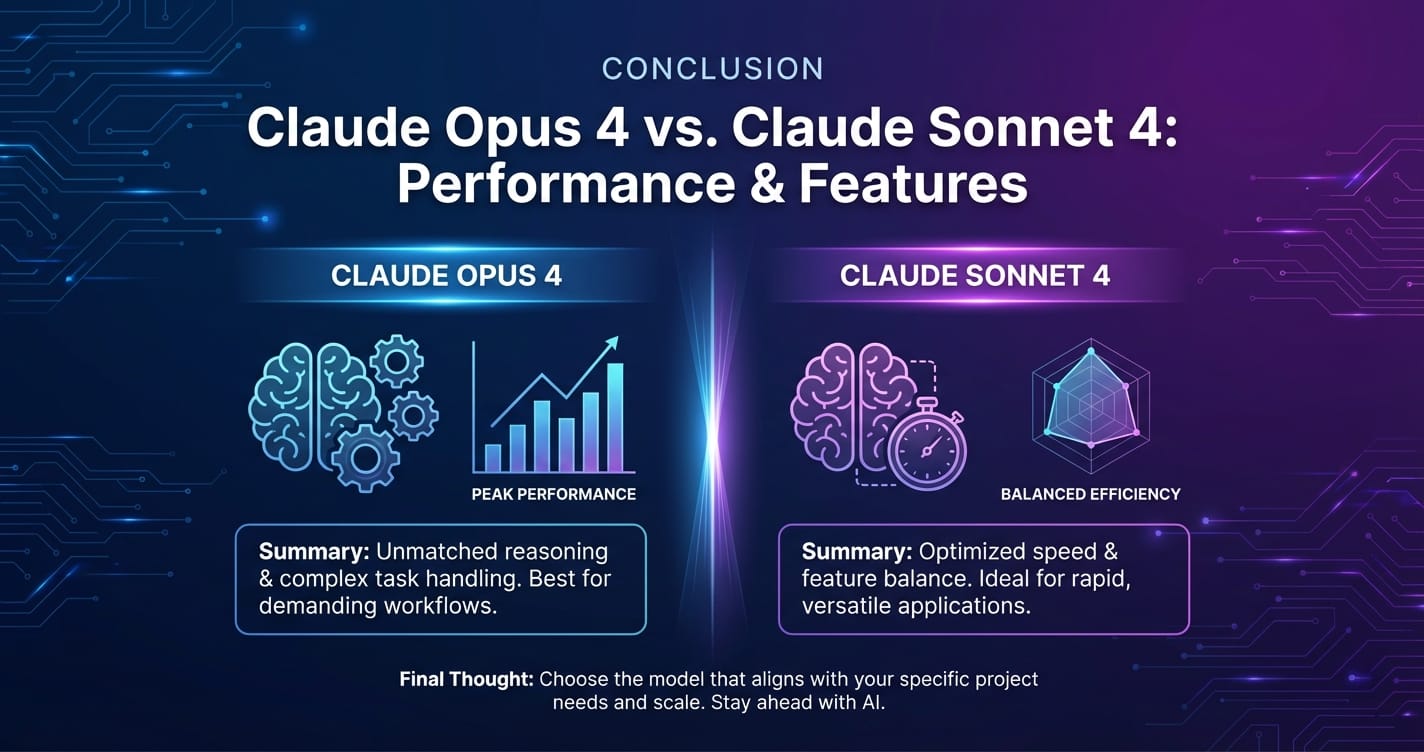
Understanding the individual strengths of Claude Opus 4 and Claude Sonnet 4 is crucial, but the true value lies in a direct AI model comparison. This section will highlight the key differentiators between these two anticipated models, offering a clearer picture of when and why to choose one over the other. The choice often boils down to a fundamental trade-off between absolute intelligence/capability and cost/speed efficiency.
Key Differentiators
| Feature/Category | Claude Opus 4 | Claude Sonnet 4 |
|---|---|---|
| Primary Focus | Cutting-edge intelligence, deep reasoning, maximum capability, nuanced understanding. | Balanced performance, high efficiency, reliability, cost-effectiveness for scale. |
| Target Use Cases | Advanced R&D, strategic analysis, complex problem-solving, high-stakes decisions. | High-volume production, business automation, customer support, content workflows. |
| Reasoning Depth | Unparalleled multi-step reasoning, abstract problem-solving, scientific inquiry. | Strong general reasoning, reliable for common analytical and logical tasks. |
| Creative Output | Exceptional originality, stylistic versatility, sophisticated long-form content. | High-quality, coherent, and consistent content generation for standard needs. |
| Multimodality | Deep, integrated understanding across diverse media types (text, image, audio, video). | Robust multimodal capabilities for common applications (e.g., image description). |
| Context Window | Expected to be extremely large, handling vast datasets and long-term memory. | Large and highly capable, sufficient for most extensive document processing. |
| Speed/Latency | Optimized for accuracy and complexity, may have higher latency for some tasks. | Optimized for speed and throughput, lower latency for most production workloads. |
| Cost | Higher cost per token/inference, reflecting its superior intelligence. | Significantly more cost-effective, ideal for scaling AI operations. |
| Developer Experience | For advanced AI engineering, pushing boundaries. | Easy integration, robust for mainstream development, predictable performance. |
| Training Data/Scale | Largest and most diverse datasets, potentially incorporating proprietary knowledge. | Extensive and diverse datasets, optimized for broad applicability. |
| "Hallucination" Rate | Expected to be the lowest among current models, highest factual accuracy. | Very low, highly reliable for general tasks, strong factual grounding. |
| Security & Safety | State-of-the-art constitutional AI, robust guardrails for complex, sensitive tasks. | Strong constitutional AI, reliable safety for broad applications. |
Cost-Benefit Analysis
The decision between Claude Opus 4 vs. Claude Sonnet 4 will frequently hinge on a thorough cost-benefit analysis. While Opus 4 offers unmatched intelligence, its higher cost per token or inference means it should be reserved for tasks where that absolute intelligence translates directly into significant business value that justifies the expense. This includes scenarios where:
- Error rates are unacceptable: e.g., medical diagnostics, legal document review, financial trading algorithms.
- Innovation is key: e.g., R&D, complex product design, scientific discovery.
- Strategic insights are paramount: e.g., C-suite decision support, geopolitical analysis.
- Unique, highly creative output is required: e.g., high-end marketing campaigns, novel artistic generation.
Conversely, Claude Sonnet 4 presents an extremely compelling value proposition for the vast majority of AI applications. Its lower cost and higher throughput make it ideal for:
- Scaling operations: e.g., millions of customer service interactions, large-scale data processing.
- Automating routine but intelligence-demanding tasks: e.g., content moderation, internal communication summaries.
- Cost-sensitive projects: where budget constraints are a primary concern, but quality cannot be severely compromised.
- Rapid prototyping and broad deployment: its efficiency allows for faster iteration and wider application across an organization.
Scalability and Throughput
Claude Sonnet 4 is engineered for superior scalability and throughput in production environments. Its optimized architecture allows it to handle a massive volume of requests with consistent performance and lower latency. This makes it suitable for applications requiring real-time responses or processing vast datasets continuously. Think of it as a highly efficient assembly line for AI tasks.
Claude Opus 4, while incredibly powerful, might inherently have higher inference times due to the sheer computational complexity involved in its advanced reasoning and comprehensive contextual analysis. For critical, high-stakes tasks, a slightly longer response time is often acceptable if it guarantees superior accuracy and depth of insight. However, deploying Opus 4 for every single query might become prohibitively expensive and could introduce latency bottlenecks in high-volume scenarios.
Developer Experience
Anthropic generally prioritizes a developer-friendly experience across its models. For Claude Opus 4 and Claude Sonnet 4, developers can expect well-documented APIs and robust SDKs. However, the nuances might differ:
- Opus 4 might appeal to advanced AI engineers and researchers looking to push the boundaries of what's possible, potentially leveraging more complex prompt engineering techniques to unlock its full power. Its unique capabilities might require more bespoke integration strategies for highly specialized applications.
- Sonnet 4 is likely to be the easier model to integrate into existing applications due to its predictable performance and general-purpose nature. Its efficiency and cost-effectiveness make it a safer bet for quick deployments and iterative development cycles.
Platforms like XRoute.AI are specifically designed to abstract away the complexities of integrating various LLMs. By providing a unified API platform, XRoute.AI simplifies access to large language models (LLMs) like Claude Opus 4 and Claude Sonnet 4. This means developers can switch between models, or even use them in tandem, with minimal code changes. Such platforms ensure low latency AI and cost-effective AI by optimizing routing and offering flexible pricing, making the choice between Opus 4 and Sonnet 4 more about functionality and less about integration headaches.
Ethical Considerations & Safety
Anthropic's commitment to "Constitutional AI" is a cornerstone of its model development. Both Claude Opus 4 and Claude Sonnet 4 would be rigorously trained and aligned to be helpful, harmless, and honest. However, the sheer power of Opus 4 implies a need for even more sophisticated guardrails, especially when dealing with highly sensitive or ambiguous prompts. Opus 4's ability to engage in deeper reasoning could also mean it has a more nuanced understanding of ethical dilemmas, potentially providing more robust safety checks internally. Sonnet 4 would also embody strong safety principles, ensuring reliable and ethically sound outputs for its broad range of applications. This continuous focus on safety ensures that despite their increasing capabilities, these models remain beneficial tools for humanity.
In summary, the choice between Claude Opus 4 and Claude Sonnet 4 is not about one being definitively "better" than the other, but rather about alignment with specific project requirements, budget constraints, and performance priorities. Both models represent significant advancements, but they are designed to excel in different arenas of the AI ecosystem.
Choosing the Right Model for Your Needs
The decision to integrate an advanced LLM into your operations is a significant one, and the choice between Claude Opus 4 and Claude Sonnet 4 requires careful consideration. It’s not merely about selecting the most powerful model, but rather identifying the one that best aligns with your specific objectives, technical requirements, and financial constraints. This section provides scenario-based guidance to help you navigate this critical decision.
Scenario-Based Guidance
- For Bleeding-Edge R&D and Critical Decision-Making: Opt for Claude Opus 4.
- Use Case: Scientific discovery, drug development, complex financial modeling, strategic market analysis, advanced legal document review, high-stakes game theory applications, or designing intricate engineering solutions.
- Why Opus 4: These tasks demand the highest level of reasoning, a profound ability to handle ambiguity, and minimal error rates. Opus 4's anticipated unparalleled intelligence, vast context window, and superior accuracy are indispensable here. The insights generated by Opus 4 in these fields could lead to breakthroughs or prevent catastrophic errors, justifying its potentially higher cost. If your project involves pushing the absolute boundaries of what AI can do, and the consequences of inaccuracy are severe, Opus 4 is the clear choice.
- For High-Volume, Cost-Sensitive Production Applications: Choose Claude Sonnet 4.
- Use Case: Scaling customer support chatbots, automating content moderation for a large social media platform, generating personalized marketing emails for millions of users, data extraction from thousands of invoices daily, or general code assistance for a large development team.
- Why Sonnet 4: These scenarios require a model that can perform reliably at scale, with consistent speed and efficiency, while remaining economically viable. Sonnet 4’s optimized balance of intelligence, speed, and cost-effectiveness makes it the ideal workhorse for production environments where throughput and budget are key considerations. You need a model that delivers excellent performance on a vast number of interactions without introducing prohibitive operational costs or unacceptable latency.
- Hybrid Approaches: Leveraging Both Claude Opus 4 and Claude Sonnet 4.
- Use Case: A complex AI-driven project that has both high-level strategic planning components and high-volume execution components. For example, an AI agent for business strategy that analyzes market trends (Opus 4) and then generates thousands of personalized outreach emails (Sonnet 4). Or, a legal AI that performs deep case analysis for precedent (Opus 4) and then summarizes general legal queries for clients (Sonnet 4).
- Why a Hybrid: This approach offers the best of both worlds. Opus 4 can be used for the most critical, intelligence-intensive stages of a workflow, such as initial analysis, complex problem identification, or generating highly nuanced strategic recommendations. Once the "brainstorming" or deep analysis is done, Sonnet 4 can take over for the execution phase, leveraging its efficiency and lower cost to implement the strategies or generate large volumes of content based on Opus 4's insights. This strategy optimizes both quality and cost.
Key Considerations for Your Choice
- Budget: The most straightforward differentiator. If your project has a strict budget and requires extensive AI usage, Sonnet 4 will likely be more sustainable. If the value generated by Opus 4's superior intelligence far outweighs its cost, then the investment is justified.
- Latency Requirements: For real-time applications (e.g., live chat, interactive gaming), Sonnet 4’s faster inference might be crucial. For background analysis or tasks where a few extra seconds don’t matter, Opus 4’s thoroughness could be more valuable.
- Complexity of Task: Is your task a straightforward content generation or summarization? Sonnet 4 is likely sufficient. Does it involve multi-step reasoning, abstract problem-solving, or highly nuanced interpretation? Opus 4 is better equipped.
- Volume of Requests: High-volume applications benefit significantly from Sonnet 4's efficiency. Low-volume, high-value applications can afford Opus 4.
- Acceptable Error Rate: If even a small error can have catastrophic consequences (e.g., in medical or legal contexts), Opus 4's superior accuracy and reduced hallucination rates would be preferred. For less critical tasks, Sonnet 4 offers excellent reliability.
Simplifying LLM Integration with XRoute.AI
Regardless of whether you choose Claude Opus 4, Claude Sonnet 4, or a combination of both, managing multiple LLM integrations can be a complex undertaking for developers. This is where platforms like XRoute.AI become invaluable.
XRoute.AI is a cutting-edge unified API platform specifically designed to streamline access to large language models (LLMs) for developers, businesses, and AI enthusiasts. By providing a single, OpenAI-compatible endpoint, XRoute.AI simplifies the integration of over 60 AI models from more than 20 active providers. This means you can effortlessly switch between powerful models like Claude Opus 4 and Claude Sonnet 4 without rewriting extensive portions of your codebase.
With a focus on low latency AI and cost-effective AI, XRoute.AI empowers users to build intelligent solutions without the complexity of managing multiple API connections. The platform’s high throughput, scalability, and flexible pricing model make it an ideal choice for projects of all sizes, from startups to enterprise-level applications. XRoute.AI helps you focus on building innovative features rather than wrestling with API compatibility issues, ensuring that your choice of Claude Opus 4 and Claude Sonnet 4 can be implemented smoothly and efficiently. It ensures that you're always leveraging the optimal model for your specific task, dynamically routing requests to the best performing or most cost-efficient endpoint as needed, providing a robust solution for integrating claude opus 4 claude sonnet 4 into your AI strategy.
The Broader AI Landscape and Future Implications
The emergence of models like Claude Opus 4 and Claude Sonnet 4 signifies more than just an incremental upgrade in AI capabilities; they represent a continued acceleration in the evolution of artificial intelligence. This relentless progress has profound implications for industries, economies, and society at large. Understanding their potential impact requires looking beyond the individual model features and considering the broader context of the AI landscape.
The Role of AI Model Comparison in a Competitive Market
The intense competition among AI developers—Anthropic, OpenAI, Google, and others—is a primary driver of innovation. This competitive environment necessitates continuous AI model comparison not just for end-users, but for the developers themselves. Each new model raises the bar, pushing competitors to invest more in research and development. This virtuous cycle ensures that the capabilities of LLMs are rapidly expanding, leading to more sophisticated, reliable, and accessible AI solutions.
The distinct positioning of Claude Opus 4 (as the intelligence leader) and Claude Sonnet 4 (as the efficiency champion) reflects a mature market where specialization is key. No single model can be "best" for every task. This differentiation allows businesses to select tools that precisely match their needs, fostering a more robust and diverse ecosystem of AI applications. The ability to perform a granular AI model comparison empowers organizations to make data-driven decisions, optimizing for performance, cost, and ethical considerations.
How Models Like Claude Opus 4 and Claude Sonnet 4 Drive Innovation
These advanced models are not merely tools for automation; they are catalysts for innovation across every sector.
- Accelerated Research & Development: With the ability to process vast amounts of scientific literature, generate hypotheses, and even design experiments, Opus 4 could dramatically shorten discovery cycles in fields like medicine, material science, and clean energy.
- Democratization of Expertise: Sonnet 4’s ability to summarize complex information and provide expert-level answers makes specialized knowledge more accessible, empowering individuals and small businesses to leverage insights previously available only to large enterprises.
- New Product and Service Creation: Both models could enable entirely new categories of AI-powered products and services, from hyper-personalized educational platforms to advanced autonomous agents capable of complex decision-making in real-time. Imagine AI-driven virtual assistants that truly understand your emotional state and adapt their responses accordingly.
- Enhanced Human Creativity: Instead of replacing human creativity, these models can augment it. Opus 4 could serve as a creative partner for artists, writers, and designers, offering fresh perspectives, generating initial concepts, or handling tedious iterative tasks, freeing humans to focus on higher-level creative direction and emotional depth.
Future Trends Shaped by Advanced LLMs
The anticipated capabilities of claude opus 4 claude sonnet 4 point towards several transformative future trends:
- Hyper-Personalization at Scale: With enhanced context windows and reasoning, future AI will offer truly personalized experiences across all digital touchpoints, from adaptive learning environments to bespoke product recommendations and emotionally intelligent conversational agents.
- Multimodal Dominance: The move towards deeper multimodal understanding will lead to AI that can process and generate content seamlessly across text, images, audio, and video, mimicking human perception more closely. This will unlock new applications in fields like content creation, accessibility, and human-computer interaction.
- Emergence of "AI Agents" with Agency: Models with superior reasoning like Opus 4 could form the core of autonomous AI agents capable of planning, executing, and monitoring complex tasks with minimal human intervention, across digital and physical domains. This implies a future where AI handles more strategic and proactive roles.
- Specialized Small Models: While Opus 4 excels at general intelligence, we may also see a parallel trend of "distilled" or highly specialized smaller models optimized for very specific, narrow tasks, offering extreme efficiency and cost-effectiveness. The choice between large generalists and small specialists will become a critical strategic decision.
- Ethical AI Governance: As AI becomes more powerful and pervasive, the importance of ethical guidelines, regulatory frameworks, and robust safety mechanisms will grow exponentially. Anthropic's commitment to Constitutional AI will be even more critical in shaping a responsible AI future.
In this rapidly evolving landscape, the complexity of interacting with numerous AI models from various providers can become a significant hurdle for developers. This underscores the critical role of platforms like XRoute.AI. XRoute.AI’s unified API platform acts as a crucial bridge, streamlining the integration of over 60 AI models from more than 20 active providers. It handles the intricacies of different APIs, allowing developers to seamlessly deploy and switch between models such as Claude Opus 4 and Claude Sonnet 4 with ease. By abstracting away these complexities, XRoute.AI enables developers to focus their efforts on building truly intelligent solutions and innovative applications, rather than on managing API connections. This makes it an ideal choice for any project aiming to leverage the full power of the evolving AI landscape, particularly when integrating powerful models like claude opus 4 and claude sonnet 4.
Conclusion
The anticipated arrival of Claude Opus 4 and Claude Sonnet 4 marks another significant milestone in the relentless progression of artificial intelligence. Our in-depth AI model comparison reveals that these hypothetical next-generation models are designed not to compete directly in every aspect, but rather to cater to distinct needs within the vast and expanding AI ecosystem.
Claude Opus 4 is poised to be the undisputed leader in raw intelligence, advanced reasoning, and creative prowess. It will be the tool of choice for pioneering research, complex strategic analysis, and any application where the absolute highest quality, accuracy, and depth of understanding are non-negotiable, regardless of the computational cost. Its ability to tackle multi-faceted problems and generate highly nuanced outputs will redefine what's possible at the bleeding edge of AI.
Conversely, Claude Sonnet 4 is set to become the ultimate workhorse: a model that delivers an exceptional balance of performance, speed, and cost-efficiency. It will be the pragmatic choice for enterprises and developers looking to deploy robust, reliable, and scalable AI solutions across a wide array of everyday business operations. Its strength lies in handling high volumes of requests with consistent quality and predictable costs, making advanced AI capabilities accessible for mainstream adoption.
Ultimately, the "best" model between Claude Opus 4 vs. Claude Sonnet 4 is not absolute; it is entirely dependent on your specific requirements, strategic goals, and resource constraints. The informed decision will come from a clear understanding of your use case, the acceptable trade-offs between intelligence and efficiency, and your budget.
As the AI landscape continues to evolve at breakneck speed, the ability to seamlessly integrate and manage these powerful models becomes increasingly vital. This is precisely where platforms like XRoute.AI shine. By offering a unified API platform that simplifies access to a multitude of large language models (LLMs) from various providers, XRoute.AI empowers developers to leverage the full potential of both Claude Opus 4 and Claude Sonnet 4 without the inherent complexities of direct API management. It ensures low latency AI and cost-effective AI, allowing you to focus on innovation rather than infrastructure.
In this exciting new era of AI, choosing the right tools and platforms is paramount. Whether your ambition lies in groundbreaking discovery with Opus 4 or scalable efficiency with Sonnet 4, understanding their distinct strengths will be key to unlocking the next generation of intelligent applications and driving transformative change.
FAQ: Claude Opus 4 vs. Claude Sonnet 4
Q1: What are the primary differences between Claude Opus 4 and Claude Sonnet 4? A1: The primary difference lies in their optimization goals. Claude Opus 4 is anticipated to be the most intelligent and capable model, designed for complex reasoning, advanced problem-solving, and superior creative output, often at a higher cost. Claude Sonnet 4, on the other hand, is expected to offer a balanced performance—high intelligence with a focus on speed, efficiency, and cost-effectiveness, making it ideal for large-scale production applications.
Q2: When should I choose Claude Opus 4 over Claude Sonnet 4? A2: You should choose Claude Opus 4 for tasks that demand the absolute highest level of intelligence, accuracy, and nuanced understanding, where precision and creativity are paramount, and where potential errors carry significant consequences. This includes cutting-edge research, strategic decision-making, complex data analysis, and highly specialized content generation.
Q3: Are there scenarios where using both Claude Opus 4 and Claude Sonnet 4 together is beneficial? A3: Absolutely. A hybrid approach can be highly effective. For instance, you might use Claude Opus 4 for initial strategic planning, deep analysis, or generating highly nuanced insights, and then deploy Claude Sonnet 4 for executing high-volume tasks based on Opus 4's outputs, such as generating personalized content or automating routine workflows. This optimizes both quality and cost-efficiency.
Q4: How does Anthropic ensure the safety and ethical use of its AI models like Claude Opus 4 Claude Sonnet 4? A4: Anthropic employs a unique approach called "Constitutional AI" to ensure its models are helpful, harmless, and honest. This involves training models with a set of principles and using AI itself to oversee and align the model's behavior with these values. Both Claude Opus 4 Claude Sonnet 4 would be rigorously developed with these ethical considerations embedded from their core architecture to their deployment.
Q5: How can a platform like XRoute.AI help me integrate these models? A5: XRoute.AI is a unified API platform that simplifies access to various large language models (LLMs), including anticipated models like Claude Opus 4 and Claude Sonnet 4. It provides a single, OpenAI-compatible endpoint, allowing developers to easily switch between models, or use them in combination, without managing multiple complex API integrations. This approach ensures low latency AI and cost-effective AI, streamlining your development process and making it easier to leverage the best model for any given task.
🚀You can securely and efficiently connect to thousands of data sources with XRoute in just two steps:
Step 1: Create Your API Key
To start using XRoute.AI, the first step is to create an account and generate your XRoute API KEY. This key unlocks access to the platform’s unified API interface, allowing you to connect to a vast ecosystem of large language models with minimal setup.
Here’s how to do it: 1. Visit https://xroute.ai/ and sign up for a free account. 2. Upon registration, explore the platform. 3. Navigate to the user dashboard and generate your XRoute API KEY.
This process takes less than a minute, and your API key will serve as the gateway to XRoute.AI’s robust developer tools, enabling seamless integration with LLM APIs for your projects.
Step 2: Select a Model and Make API Calls
Once you have your XRoute API KEY, you can select from over 60 large language models available on XRoute.AI and start making API calls. The platform’s OpenAI-compatible endpoint ensures that you can easily integrate models into your applications using just a few lines of code.
Here’s a sample configuration to call an LLM:
curl --location 'https://api.xroute.ai/openai/v1/chat/completions' \
--header 'Authorization: Bearer $apikey' \
--header 'Content-Type: application/json' \
--data '{
    "model": "gpt-5",
    "messages": [
        {
            "content": "Your text prompt here",
            "role": "user"
        }
    ]
}'
With this setup, your application can instantly connect to XRoute.AI’s unified API platform, leveraging low latency AI and high throughput (handling 891.82K tokens per month globally). XRoute.AI manages provider routing, load balancing, and failover, ensuring reliable performance for real-time applications like chatbots, data analysis tools, or automated workflows. You can also purchase additional API credits to scale your usage as needed, making it a cost-effective AI solution for projects of all sizes.
Note: Explore the documentation on https://xroute.ai/ for model-specific details, SDKs, and open-source examples to accelerate your development.