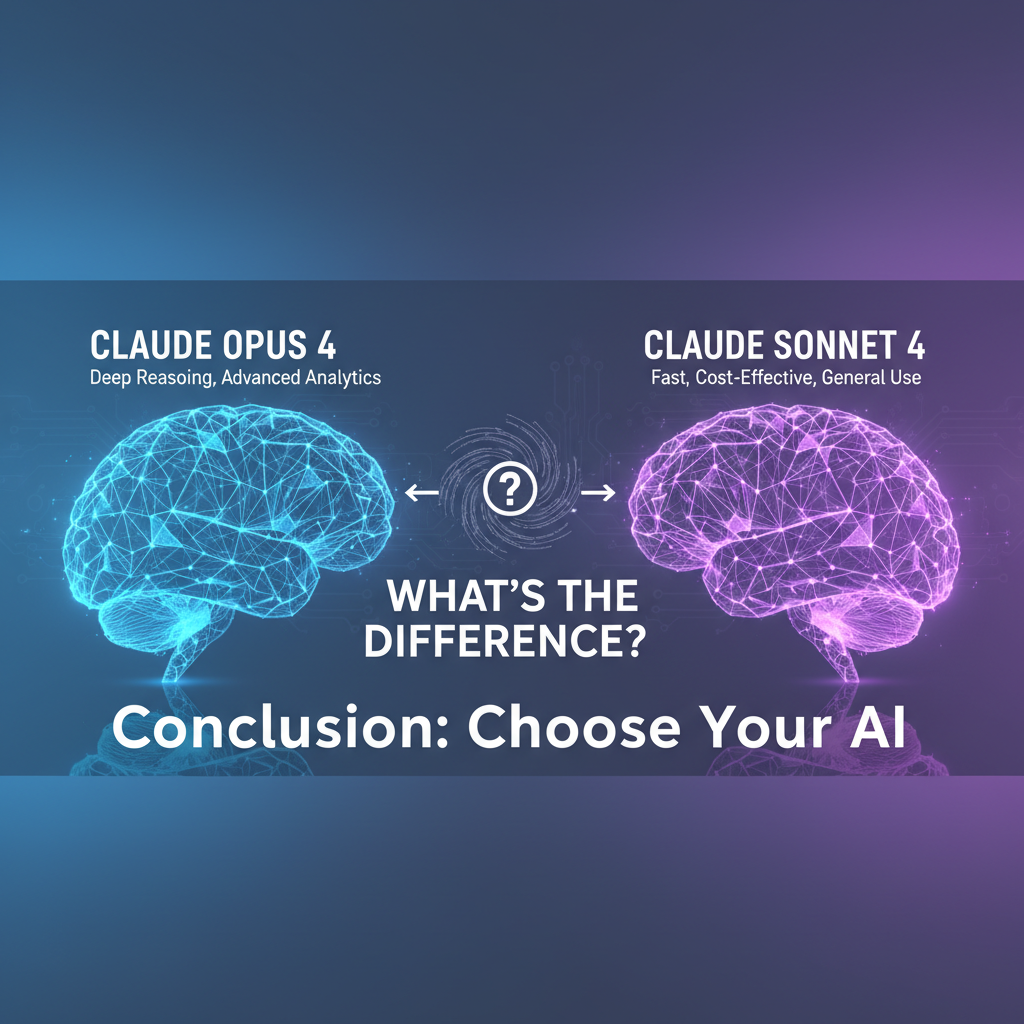
Claude Opus 4 vs. Sonnet 4: What's the Difference?

In the rapidly evolving landscape of artificial intelligence, large language models (LLMs) are at the forefront of innovation, constantly pushing the boundaries of what machines can understand, generate, and reason. Anthropic, a prominent AI safety and research company, has emerged as a key player, distinguishing itself with its focus on "constitutional AI" and developing highly capable models. Among their latest offerings, Claude Opus 4 and Claude Sonnet 4 stand out as powerful tools, each designed with specific strengths and applications in mind. While both models represent significant advancements, understanding their nuances is crucial for developers, businesses, and researchers looking to leverage AI effectively.
This comprehensive guide will delve deep into the core differences between Claude Opus 4 and Claude Sonnet 4, exploring their unique capabilities, ideal use cases, performance characteristics, and strategic implications. By dissecting their architectural philosophies and practical applications, we aim to provide a clear roadmap for choosing the right Claude model to empower your projects and workflows. Whether you're a startup optimizing for efficiency or an enterprise tackling complex analytical challenges, comprehending the distinct profiles of claude opus 4 and claude sonnet 4 is essential for making informed decisions in the ever-expanding AI ecosystem.
The Genesis of Claude: Anthropic's Vision for Responsible AI
Before diving into the specifics of Opus 4 and Sonnet 4, it's worth briefly contextualizing Anthropic's approach to AI development. Founded by former OpenAI researchers, Anthropic places a strong emphasis on AI safety, alignment, and interpretability. Their "Constitutional AI" training method, which uses a set of principles to guide model behavior rather than extensive human feedback, aims to create models that are helpful, harmless, and honest. This foundational philosophy permeates all their models, including the sophisticated offerings like Claude Opus 4 and the more balanced Claude Sonnet 4.
The Claude family of models has consistently delivered impressive performance across a wide range of tasks, from sophisticated reasoning and complex problem-solving to creative writing and summarization. With each iteration, Anthropic strives to enhance not just the raw capabilities but also the safety and reliability of its AI agents. The introduction of Opus 4 and Sonnet 4 marks a significant milestone, catering to a broader spectrum of user needs with distinct performance-to-cost ratios. The continuous evolution of models like claude sonnet and its more powerful sibling, claude opus 4, underscores the rapid pace of innovation in the LLM space.
Claude Opus 4: The Pinnacle of Intelligence and Reasoning
Claude Opus 4 is Anthropic's flagship model, positioned as their most intelligent, capable, and versatile offering. It's designed to excel at highly complex, nuanced, and open-ended tasks that demand advanced reasoning, strategic planning, and sophisticated comprehension. When absolute performance, accuracy, and depth of analysis are paramount, claude opus 4 is engineered to deliver.
Core Strengths and Capabilities of Claude Opus 4
- Advanced Reasoning and Problem Solving:
- Multi-step Logic: Opus 4 can follow and execute multi-step instructions with exceptional precision, handling intricate logical sequences and dependencies that might stump lesser models. This makes it ideal for tasks requiring sequential reasoning, such as complex coding challenges, scientific problem-solving, or multi-stage project planning.
- Nuance and Subtlety: It excels at understanding implicit meanings, subtle contextual cues, and ambiguous language, allowing it to navigate complex human communication with a high degree of fidelity. This is crucial for legal analysis, deep market research, and understanding stakeholder sentiment from diverse data sources.
- Strategic Planning: Claude Opus 4 can extrapolate trends, anticipate outcomes, and formulate long-term strategies. For instance, in a business scenario, it could analyze market data, competitive landscapes, and internal resources to suggest comprehensive strategic initiatives, weighing pros and cons across various options.
- Handling Ambiguity and Contradictions: Unlike models that might falter when presented with conflicting information, Opus 4 demonstrates a superior ability to identify discrepancies, ask clarifying questions, and offer reasoned interpretations, or even propose reconciliation strategies.
- Robust Data Analysis and Synthesis:
- Comprehensive Document Analysis: Opus 4 can ingest and synthesize information from vast quantities of text, including dense technical manuals, financial reports, academic papers, and legal documents. It can extract key insights, identify patterns, and summarize findings with remarkable accuracy, making it invaluable for due diligence, literature reviews, and intelligence gathering.
- Code Generation and Debugging: While not solely a coding model, claude opus 4 demonstrates advanced capabilities in generating complex code snippets, explaining intricate algorithms, and identifying logical errors in existing codebases across multiple programming languages. Its understanding of software architecture and best practices is notably high.
- Multimodal Reasoning (Emerging/Enhanced): While primarily text-based, the trend for advanced models like Opus is towards enhanced multimodal capabilities. If Opus 4 extends its multimodal understanding, it would signify a leap in processing and reasoning across various data types, from images and charts to audio transcripts, integrating them into its textual responses. This would revolutionize fields like medical diagnostics or architectural design review.
- Creative and Contextual Content Generation:
- High-Quality Long-Form Content: For tasks requiring extensive, well-structured, and highly coherent content – such as drafting book chapters, comprehensive reports, or detailed articles – Opus 4 delivers unparalleled quality. Its ability to maintain a consistent tone, style, and narrative arc over long stretches is a significant advantage.
- Sophisticated Storytelling: Beyond mere factual recall, claude opus 4 can weave intricate narratives, develop compelling character arcs, and generate creative works that demonstrate a profound understanding of storytelling principles. This makes it a powerful tool for authors, screenwriters, and content marketers seeking truly original material.
- Personalization and Adaptation: It can adapt its output based on extremely granular instructions regarding target audience, desired tone, and specific stylistic constraints, producing highly customized and impactful content.
Ideal Use Cases for Claude Opus 4
Given its advanced capabilities, claude opus 4 is best suited for applications where the highest level of intelligence, accuracy, and robust reasoning are non-negotiable, and where the value of exceptional output outweighs potential cost considerations.
- Strategic Business Consulting: Analyzing vast datasets to identify market opportunities, predict trends, and develop comprehensive business strategies. This could involve deep dives into competitor analysis, customer behavior, and macroeconomic indicators to inform executive decisions.
- Advanced Research and Development: Assisting scientists and researchers in synthesizing complex literature, generating hypotheses, designing experiments, and interpreting results across diverse scientific fields. Imagine it aiding in drug discovery by cross-referencing millions of research papers.
- Legal and Financial Analysis: Conducting in-depth analysis of legal documents, contracts, financial reports, and regulatory frameworks. This could include identifying potential risks, opportunities, or compliance issues within highly complex textual data.
- Complex Software Engineering: Generating sophisticated architectural designs, writing intricate code modules, performing advanced code reviews, and debugging complex systems. It can act as an AI co-pilot for senior developers tackling challenging projects.
- High-Stakes Decision Support: Providing critical insights for decision-makers in fields like intelligence, defense, or critical infrastructure management, where errors can have severe consequences.
- Cutting-Edge Content Creation: Crafting entire novels, screenplays, comprehensive academic papers, or highly persuasive marketing campaigns that require deep contextual understanding and creative flair.
In essence, claude opus 4 is designed for the most demanding intellectual heavy lifting, acting as an indispensable partner for professionals operating at the apex of complexity and creativity.
Claude Sonnet 4: The Efficient Workhorse for Scalable AI
In contrast to the raw power of Opus 4, Claude Sonnet 4 is engineered to be Anthropic's "workhorse" model, striking an exceptional balance between intelligence, speed, and cost-effectiveness. It's designed for scalability and efficiency, making it the go-to choice for a vast array of everyday AI applications where high throughput and economical operation are key, without significantly compromising on quality. The emphasis for claude sonnet is on practical application across a broad spectrum of enterprise and consumer needs.
Core Strengths and Capabilities of Claude Sonnet 4
- Optimized Performance and Efficiency:
- Speed and Low Latency: Sonnet 4 is optimized for rapid response times, making it excellent for interactive applications like chatbots, customer service agents, and real-time content generation where immediate feedback is crucial.
- Cost-Effectiveness: It offers a significantly more attractive price point per token compared to Opus 4, enabling organizations to deploy AI solutions at scale without prohibitive costs. This makes it accessible for high-volume tasks.
- High Throughput: Designed to handle a large volume of requests concurrently, Sonnet 4 can power numerous applications simultaneously, making it suitable for enterprise-wide deployments and consumer-facing platforms that experience peak loads.
- Strong General Purpose Intelligence:
- Solid Reasoning and Comprehension: While not as profoundly strategic as Opus 4, Sonnet 4 possesses strong reasoning abilities for most common business and personal tasks. It can accurately summarize information, answer factual questions, follow detailed instructions, and perform logical deductions effectively.
- Versatile Content Generation: It can generate a wide range of content, from marketing copy and social media posts to email drafts, blog articles, and internal communications. The quality is consistently high, suitable for most professional contexts.
- Code Assistance: Claude Sonnet 4 is adept at generating boilerplate code, assisting with basic scripting, explaining code snippets, and even suggesting simple debugging fixes. It's a valuable tool for developers looking to accelerate their workflow for routine coding tasks.
- Reliability and Consistency:
- Consistent Output: Sonnet 4 delivers reliable and consistent output across diverse prompts and use cases, making it a dependable choice for automated processes where predictability is important.
- Ease of Integration: Its design prioritizes ease of integration into existing systems and workflows, with clear API documentation and robust support, further reducing development overhead.
Ideal Use Cases for Claude Sonnet 4
Claude Sonnet 4 shines in applications where a balance of good performance and cost-efficiency is paramount, enabling broad deployment and scalable solutions across an organization.
- Enhanced Customer Service: Powering advanced chatbots for customer support, handling common queries, troubleshooting issues, and providing personalized assistance. Its speed allows for seamless, real-time interactions.
- Content Generation at Scale: Producing large volumes of marketing copy, product descriptions, social media updates, email newsletters, and blog posts. Businesses can rapidly scale their content efforts without breaking the bank.
- Internal Communication and Knowledge Management: Summarizing long internal documents, drafting reports, generating meeting minutes, and assisting employees with information retrieval from extensive knowledge bases.
- Developer Tools and Productivity: Assisting developers with routine coding tasks, generating test cases, explaining APIs, and automating documentation, thereby accelerating the software development lifecycle.
- Educational Applications: Creating personalized learning materials, generating quizzes, explaining complex concepts, and providing tutoring assistance for students.
- Data Extraction and Summarization: Quickly processing large volumes of textual data from various sources to extract key information, identify trends, and generate concise summaries for business intelligence or market research.
- Automation of Business Processes: Automating tasks like report generation, email categorization, data entry validation, and initial drafting of proposals or presentations.
Essentially, claude sonnet 4 is the workhorse designed for efficient, scalable deployment across a wide range of practical applications, delivering strong performance without the premium cost of its more powerful counterpart. Its role as a foundational model for many AI-powered services cannot be overstated, providing a robust yet economical engine for innovation.
Claude Opus 4 and Claude Sonnet 4: A Head-to-Head Comparison
To truly understand the difference between these two formidable models, let's lay out a direct comparison across various critical dimensions. This will clarify when to opt for the unparalleled intelligence of claude opus 4 and when the balanced efficiency of claude sonnet 4 is the more strategic choice.
Performance Metrics and Capabilities
| Feature/Metric | Claude Opus 4 | Claude Sonnet 4 |
|---|---|---|
| Intelligence & Reasoning | Elite-tier, cutting-edge. Excels at complex, multi-step reasoning, strategic planning, and nuanced problem-solving. Superior handling of ambiguity. | Strong general intelligence. Good for logical deduction, factual recall, and common problem-solving. |
| Creativity & Nuance | Exceptional. Generates highly creative, long-form, and contextually rich content with deep understanding of style and tone. | Very good. Produces high-quality, varied content suitable for most professional applications. |
| Task Complexity | Designed for the most difficult, open-ended, and critical tasks. | Ideal for a wide range of moderately complex to routine tasks. |
| Latency | Typically higher latency due to increased computational requirements for deeper processing. | Optimized for lower latency and faster response times, suitable for real-time interactions. |
| Throughput | Lower throughput compared to Sonnet 4, but still robust for its class. | Higher throughput, designed to handle large volumes of concurrent requests efficiently. |
| Cost | Highest cost per token, reflecting its premium capabilities. | Significantly more cost-effective per token, enabling scalable deployment. |
| Memory/Context Window | Often supports the largest context windows for processing extensive information. | Robust context window, sufficient for most typical applications and document processing. |
| Error Rate/Accuracy | Lowest error rate, highest accuracy for critical, high-stakes tasks. | Very low error rate, high accuracy for general tasks, excellent for reliability in production. |
| Multimodality | Stronger potential for advanced multimodal understanding and generation (e.g., integrating image, audio, video context). | Developing multimodal capabilities, often focused on efficient processing of common formats (e.g., text from images). |
| Learning & Adaptation | More capable of few-shot learning and adapting to highly specific, novel instructions with fewer examples. | Good at few-shot learning, but may require more examples for highly nuanced or novel adaptations than Opus 4. |
Technical and Operational Aspects
While specific architectural details of these proprietary models are not publicly disclosed, we can infer operational differences based on their described performance characteristics. Claude Opus 4 likely utilizes a larger number of parameters, more extensive and diverse training data, and potentially more complex computational graphs, leading to its superior reasoning and contextual understanding. This computational intensity naturally translates to higher latency and cost.
On the other hand, claude sonnet 4 is likely optimized for efficiency through architectural refinements that prioritize speed and lower inference costs, possibly involving techniques like distillation or quantization, without drastically sacrificing performance. The goal for claude sonnet is to achieve "good enough" performance for the majority of use cases at a fraction of the cost, making it highly attractive for widespread commercial deployment. The choice between claude opus 4 and claude sonnet 4 therefore often boils down to a fundamental trade-off: unparalleled intelligence at a premium versus highly capable efficiency at a significantly lower cost.
Target Audience and Strategic Fit
The distinction between claude opus 4 and claude sonnet 4 isn't just about raw power; it's about strategic fit for different organizational needs and budgets.
- Claude Opus 4 is for organizations and projects where:
- Accuracy is paramount: Industries like healthcare, finance, legal, and advanced scientific research where errors can have severe consequences.
- Innovation is the driver: Teams pushing the boundaries of AI capabilities, developing novel applications that require cutting-edge reasoning.
- Value of insights is high: For strategic decision-making, competitive intelligence, or intellectual property creation where the generated output can lead to significant business advantage.
- Budget allows for premium: Where the return on investment from superior AI performance justifies the higher operational costs.
- Claude Sonnet 4 is for organizations and projects where:
- Scalability is key: Businesses needing to deploy AI across a wide user base or integrate it into numerous internal workflows.
- Cost-effectiveness is a major consideration: Startups, SMBs, or departments with budget constraints looking for robust AI without premium pricing.
- Speed and low latency are crucial: Applications like customer service, real-time content generation, or interactive user experiences.
- General-purpose AI tasks dominate: Most daily operational tasks, content creation, internal communication, and data processing that don't require the absolute apex of intelligence.
Many organizations might find value in a hybrid approach, using claude opus 4 for high-stakes, critical analytical tasks, and deploying claude sonnet 4 for more routine, high-volume operations. This allows for optimal resource allocation, leveraging each model for its specific strengths.
XRoute is a cutting-edge unified API platform designed to streamline access to large language models (LLMs) for developers, businesses, and AI enthusiasts. By providing a single, OpenAI-compatible endpoint, XRoute.AI simplifies the integration of over 60 AI models from more than 20 active providers(including OpenAI, Anthropic, Mistral, Llama2, Google Gemini, and more), enabling seamless development of AI-driven applications, chatbots, and automated workflows.
Real-World Applications and Choosing the Right Claude Model
Let's explore some practical scenarios to illustrate how the choice between claude opus 4 and claude sonnet 4 can impact real-world applications.
Scenario 1: Developing a Financial Market Analysis Tool
- Requirement: An AI to analyze complex financial reports, news articles, and economic indicators to identify potential investment opportunities or risks, requiring deep contextual understanding and predictive reasoning.
- Choice: Claude Opus 4
- Reasoning: Financial analysis involves highly nuanced data, often with implicit meanings, and requires sophisticated risk assessment and strategic forecasting. The ability of claude opus 4 to perform multi-step reasoning, understand subtle market sentiments, and synthesize vast amounts of disparate information with high accuracy is crucial. A small error in analysis could lead to significant financial losses, making Opus 4's premium intelligence a worthwhile investment. It could identify complex interdependencies between global events and stock performance, something a less capable model might miss.
Scenario 2: Powering a Customer Support Chatbot for an E-commerce Platform
- Requirement: An AI chatbot to handle a high volume of customer queries, provide instant product information, assist with order tracking, and resolve common issues, requiring fast, accurate, and consistent responses.
- Choice: Claude Sonnet 4
- Reasoning: Customer support demands low latency and high throughput to ensure a smooth user experience, especially during peak hours. The majority of customer queries are relatively straightforward, requiring good general comprehension rather than deep strategic reasoning. Claude Sonnet 4 offers an excellent balance of speed, accuracy, and cost-effectiveness, making it ideal for scaling customer interactions without incurring prohibitive expenses. It can quickly access product databases, understand natural language queries, and provide helpful responses consistently.
Scenario 3: Creating Personalized Learning Paths for Students
- Requirement: An AI system to generate customized educational content, explain complex subjects in simplified terms, create quizzes, and adapt to individual student learning styles, covering a broad range of academic disciplines.
- Choice: Claude Sonnet 4 (with potential Opus 4 for advanced modules)
- Reasoning: For generating most instructional content, quizzes, and standard explanations, claude sonnet 4 is highly capable and cost-effective, allowing for widespread deployment across an educational platform. However, for highly advanced subjects, niche research topics, or to generate deeply personalized, creative problem-solving scenarios for gifted students, integrating claude opus 4 might be considered for those specific, higher-value modules. This hybrid approach optimizes resources.
Scenario 4: Scientific Literature Review and Hypothesis Generation
- Requirement: An AI assistant for researchers to rapidly review thousands of scientific papers, identify gaps in current research, synthesize findings across different disciplines, and propose novel research hypotheses.
- Choice: Claude Opus 4
- Reasoning: This task demands the highest level of textual comprehension, ability to identify subtle patterns in complex data, and advanced reasoning to formulate coherent, innovative hypotheses. Claude Opus 4's strength in deep document analysis, multi-step logical inference, and creative synthesis makes it an invaluable tool for accelerating scientific discovery, where the quality and novelty of generated insights are paramount. It can cross-reference methods, results, and discussions from disparate papers to identify unique correlations or suggest new experimental designs.
Decision Framework: When to Use Which Model
When deciding between claude opus 4 and claude sonnet 4, consider the following questions:
- What is the stakes of the task? Is accuracy absolutely critical, with severe consequences for errors (Opus 4)? Or is a "very good" but not "perfect" output acceptable for the majority of cases (Sonnet 4)?
- How complex is the reasoning required? Does the task involve multi-step logical deductions, strategic planning, or deep contextual understanding of highly nuanced information (Opus 4)? Or are more straightforward comprehension, summarization, and generation sufficient (Sonnet 4)?
- What are the budget constraints? Is there a premium budget for top-tier performance (Opus 4)? Or is cost-effectiveness and scalable deployment a primary concern (Sonnet 4)?
- What are the latency and throughput requirements? Does the application need real-time, instantaneous responses for a large volume of users (Sonnet 4)? Or is a slightly longer processing time acceptable for deeper, more robust analysis (Opus 4)?
- How novel or creative does the output need to be? Is groundbreaking, highly original content required (Opus 4)? Or is high-quality, professional-grade content for general purposes sufficient (Sonnet 4)?
By carefully evaluating these factors, organizations can strategically deploy either claude sonnet or claude opus 4, or even combine their strengths, to achieve optimal outcomes for their specific AI initiatives.
The Broader Ecosystem: Integrating Claude Models into Your Workflow
Accessing powerful LLMs like claude opus 4 and claude sonnet 4 often involves navigating various API platforms and managing integrations. For developers and businesses, this can become a significant hurdle, especially when experimenting with different models from multiple providers to find the best fit for specific tasks or to optimize for cost and performance.
This is where platforms like XRoute.AI become invaluable. XRoute.AI is a cutting-edge unified API platform designed to streamline access to large language models (LLMs) for developers, businesses, and AI enthusiasts. By providing a single, OpenAI-compatible endpoint, XRoute.AI simplifies the integration of over 60 AI models from more than 20 active providers, enabling seamless development of AI-driven applications, chatbots, and automated workflows. This means that whether you want to leverage the unparalleled intelligence of claude opus 4 for a high-stakes analytical task or deploy the efficient, scalable power of claude sonnet 4 across thousands of customer interactions, XRoute.AI offers a streamlined pathway.
With a focus on low latency AI, cost-effective AI, and developer-friendly tools, XRoute.AI empowers users to build intelligent solutions without the complexity of managing multiple API connections. Imagine effortlessly switching between different Claude models, or even combining them with models from other providers, all through a single, consistent API. The platform’s high throughput, scalability, and flexible pricing model make it an ideal choice for projects of all sizes, from startups to enterprise-level applications, ensuring you can always access the right AI model, including powerful options like claude sonnet and claude opus 4, for your specific needs, optimized for both performance and budget.
Future Outlook and Impact on AI Development
The continuous development of models like Claude Opus 4 and Claude Sonnet 4 signifies a pivotal moment in AI. These advancements are not just about incremental improvements; they represent a fundamental shift in how we interact with and deploy artificial intelligence.
Claude Opus 4, with its profound reasoning capabilities, is pushing the boundaries of what AI can achieve in complex problem-solving and strategic decision-making. It heralds an era where AI can genuinely augment human intellect in critical, high-level tasks, acting as a true cognitive partner rather than just an automation tool. Its potential to accelerate scientific discovery, revolutionize strategic planning, and enable entirely new forms of creative expression is immense.
Claude Sonnet 4, on the other hand, is democratizing access to high-quality AI. By offering robust performance at an accessible price point, it empowers a vast array of businesses and developers to integrate sophisticated AI into their products and services. This widespread adoption of capable yet efficient models like claude sonnet will drive innovation across industries, leading to more intelligent applications, enhanced customer experiences, and more efficient operational workflows. It paves the way for AI to become a ubiquitous utility, seamlessly woven into the fabric of daily life and business.
The tandem development of a flagship model like claude opus 4 and a high-efficiency model like claude sonnet 4 creates a balanced ecosystem. It allows for both groundbreaking research and scalable, practical applications, ensuring that AI advancements serve a broad spectrum of needs. As these models evolve, we can expect even greater integration, more refined multimodal capabilities, and continuous improvements in safety and interpretability, guided by Anthropic's constitutional AI principles. The ongoing rivalry and innovation between leading AI labs will continue to drive exponential growth in LLM capabilities, making platforms that simplify access and management, such as XRoute.AI, even more critical for navigating this exciting future.
Conclusion
The emergence of Claude Opus 4 and Claude Sonnet 4 represents a significant leap forward in the capabilities of large language models. While both are powerful tools from Anthropic, they are meticulously crafted for distinct purposes. Claude Opus 4 stands as the pinnacle of AI intelligence, designed for the most complex, high-stakes tasks requiring profound reasoning, strategic thinking, and unparalleled accuracy. It's the choice for organizations pushing the boundaries of what AI can achieve, where performance reigns supreme.
Conversely, Claude Sonnet 4 is the pragmatic champion, offering an exceptional balance of strong intelligence, remarkable speed, and cost-effectiveness. It's the ideal workhorse for scalable applications, high-volume tasks, and scenarios where efficiency and economic deployment are paramount. The choice between claude opus 4 and claude sonnet 4 is not about which is "better" in an absolute sense, but rather which is "better suited" for a given set of requirements, budget constraints, and desired outcomes.
Understanding these differences is crucial for any developer, business, or researcher navigating the AI landscape. By strategically selecting the appropriate Claude model – whether it's the premium intelligence of claude opus 4 or the efficient versatility of claude sonnet – you can unlock new levels of productivity, innovation, and competitive advantage. Furthermore, leveraging unified API platforms like XRoute.AI can significantly simplify the integration and management of these advanced models, ensuring that you always have seamless access to the cutting edge of AI technology. The future of AI is bright, and with tools like Claude Opus 4 and Sonnet 4, the possibilities are virtually limitless.
Frequently Asked Questions (FAQ)
Q1: What is the main difference between Claude Opus 4 and Claude Sonnet 4?
A1: The main difference lies in their optimization goals. Claude Opus 4 is Anthropic's most intelligent and capable model, designed for complex reasoning, strategic analysis, and high-stakes tasks where absolute accuracy and depth are critical, at a higher cost. Claude Sonnet 4 is optimized for efficiency, balancing strong general intelligence with speed and cost-effectiveness, making it ideal for scalable, high-throughput applications and everyday tasks.
Q2: Which Claude model should I use for a customer service chatbot?
A2: For a customer service chatbot, Claude Sonnet 4 would generally be the more suitable choice. Its optimization for low latency, high throughput, and cost-effectiveness makes it excellent for handling a large volume of real-time customer interactions efficiently, providing quick and accurate responses without the premium cost of Opus 4.
Q3: Can Claude Opus 4 or Claude Sonnet 4 generate code?
A3: Yes, both Claude Opus 4 and Claude Sonnet 4 can generate code. Claude Opus 4 excels at more complex coding challenges, generating intricate algorithms, and performing deep code reviews. Claude Sonnet 4 is also very capable, adept at generating boilerplate code, assisting with scripting, and explaining code snippets for a wide range of common programming tasks.
Q4: Is Claude Sonnet 4 significantly less capable than Claude Opus 4?
A4: While Claude Sonnet 4 is not as profoundly intelligent or strategically complex as Claude Opus 4, it is by no means "significantly less capable." Sonnet 4 offers very strong general intelligence, robust reasoning, and high-quality content generation that meets the requirements for the vast majority of business and personal applications. It provides an excellent performance-to-cost ratio, making high-quality AI accessible for scalable deployment.
Q5: Can I use both Claude Opus 4 and Claude Sonnet 4 in the same application or workflow?
A5: Absolutely. Many organizations adopt a hybrid strategy, leveraging Claude Opus 4 for high-value, critical analytical components (e.g., strategic insights, advanced R&D) and deploying Claude Sonnet 4 for more routine, high-volume operations (e.g., customer support, content generation). Platforms like XRoute.AI can streamline the management and integration of both models through a unified API, making such a combined approach highly efficient.
🚀You can securely and efficiently connect to thousands of data sources with XRoute in just two steps:
Step 1: Create Your API Key
To start using XRoute.AI, the first step is to create an account and generate your XRoute API KEY. This key unlocks access to the platform’s unified API interface, allowing you to connect to a vast ecosystem of large language models with minimal setup.
Here’s how to do it: 1. Visit https://xroute.ai/ and sign up for a free account. 2. Upon registration, explore the platform. 3. Navigate to the user dashboard and generate your XRoute API KEY.
This process takes less than a minute, and your API key will serve as the gateway to XRoute.AI’s robust developer tools, enabling seamless integration with LLM APIs for your projects.
Step 2: Select a Model and Make API Calls
Once you have your XRoute API KEY, you can select from over 60 large language models available on XRoute.AI and start making API calls. The platform’s OpenAI-compatible endpoint ensures that you can easily integrate models into your applications using just a few lines of code.
Here’s a sample configuration to call an LLM:
curl --location 'https://api.xroute.ai/openai/v1/chat/completions' \
--header 'Authorization: Bearer $apikey' \
--header 'Content-Type: application/json' \
--data '{
    "model": "gpt-5",
    "messages": [
        {
            "content": "Your text prompt here",
            "role": "user"
        }
    ]
}'
With this setup, your application can instantly connect to XRoute.AI’s unified API platform, leveraging low latency AI and high throughput (handling 891.82K tokens per month globally). XRoute.AI manages provider routing, load balancing, and failover, ensuring reliable performance for real-time applications like chatbots, data analysis tools, or automated workflows. You can also purchase additional API credits to scale your usage as needed, making it a cost-effective AI solution for projects of all sizes.
Note: Explore the documentation on https://xroute.ai/ for model-specific details, SDKs, and open-source examples to accelerate your development.