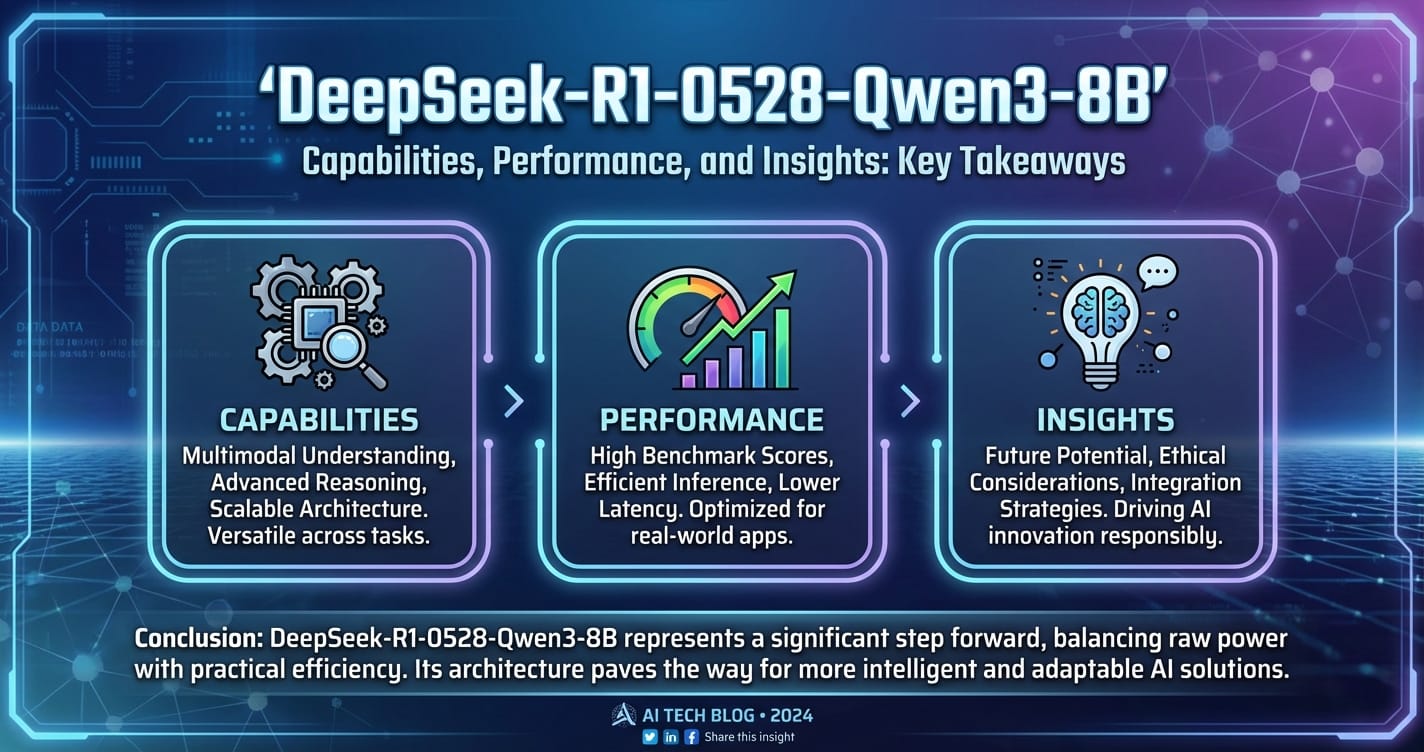
DeepSeek-R1-0528-Qwen3-8B: Capabilities, Performance, and Insights

Introduction: The Evolving Landscape of Large Language Models (LLMs)
The advent of Large Language Models (LLMs) has fundamentally reshaped the technological landscape, catalyzing an era of unprecedented innovation across industries. From automating complex tasks to revolutionizing human-computer interaction, these sophisticated AI systems, with their ability to understand, generate, and manipulate human language, are at the forefront of the digital transformation. The rapid proliferation of LLMs, each boasting unique architectures, training methodologies, and specialized strengths, presents both incredible opportunities and significant challenges. Developers and businesses are constantly seeking models that strike the optimal balance between computational efficiency, performance across diverse benchmarks, and the nuanced capabilities required for real-world applications. It is within this dynamic and fiercely competitive environment that models like deepseek-r1-0528-qwen3-8b emerge, promising to push the boundaries of what's possible in accessible AI.
The journey of LLMs began with foundational models demonstrating impressive general intelligence, often at the cost of immense computational resources. However, the trend is increasingly shifting towards more efficient, specialized, and openly accessible models that can be fine-tuned or integrated into a wider array of applications without prohibitive costs or infrastructure requirements. This democratized access to advanced AI is crucial for fostering innovation at every level, from individual developers building novel applications to large enterprises seeking to optimize their operations. The model we're exploring today, deepseek-r1-0528-qwen3-8b, represents a compelling example of this evolution. Its very nomenclature suggests a synthesis of robust foundational research from DeepSeek AI and the proven excellence of Alibaba Cloud's Qwen series, specifically within an 8-billion parameter framework. This strategic combination aims to deliver a powerful yet relatively lightweight solution that can tackle a broad spectrum of linguistic and cognitive tasks, making advanced AI more attainable and deployable for a diverse user base.
Understanding deepseek-r1-0528-qwen3-8b requires delving into its lineage, examining the architectural choices that underpin its capabilities, and critically assessing its performance against established benchmarks and practical use cases. This article will provide an in-depth exploration of this intriguing model, shedding light on its potential contributions to various fields. We will dissect its core design principles, discuss the training paradigms that sculpt its intelligence, and offer insights into how it stacks up against its contemporaries. Furthermore, we will explore the practical implications of its capabilities, highlighting scenarios where its strengths can be leveraged effectively, whether through direct interaction via platforms like qwen chat or deepseek-chat, or integrated into more complex systems. By the end, readers will gain a comprehensive understanding of deepseek-r1-0528-qwen3-8b and its position in the ever-expanding universe of large language models, alongside practical considerations for its deployment and utilization.
Understanding the Pedigree: DeepSeek and Qwen's Contributions
The creation of deepseek-r1-0528-qwen3-8b is not an isolated event but rather a culmination of significant research and development efforts from two prominent entities in the AI landscape: DeepSeek AI and Alibaba Cloud's Qwen team. To truly appreciate the potential and design philosophy behind this integrated model, it's essential to understand the individual strengths and contributions that each progenitor brings to the table. This hybrid approach often aims to synergize the best features of different models, resulting in a system that surpasses the sum of its parts in specific contexts.
The DeepSeek Foundation: A Commitment to Open-Source AI
DeepSeek AI has rapidly established itself as a significant player in the open-source AI community. Their philosophy revolves around the belief that advanced AI models should be accessible to a wider audience, fostering innovation and democratizing access to powerful tools. This commitment is not merely rhetorical; it's demonstrated through their release of a series of highly capable models, often accompanied by detailed documentation and transparent methodologies. DeepSeek models are frequently lauded for their strong performance across a variety of tasks, particularly in areas requiring robust reasoning and coding capabilities.
One of DeepSeek's core strengths lies in its meticulous approach to data curation and training. They often leverage vast, high-quality datasets, meticulously filtered and processed to reduce bias and enhance the model's understanding of complex relationships within the data. Their models are typically trained with an emphasis on both general linguistic proficiency and specialized domain expertise, making them versatile tools for developers. The success of earlier DeepSeek models has built a strong reputation for reliability and performance, particularly in benchmarks related to mathematical reasoning, logical inference, and code generation. The impact of DeepSeek's contributions extends beyond just releasing models; they actively contribute to the scientific discourse surrounding LLM development, publishing research that advances the collective understanding of AI. This focus on foundational excellence and open collaboration sets a high bar for any model bearing the DeepSeek name. The availability of models for direct interaction, often through interfaces akin to deepseek-chat, allows users to quickly grasp their capabilities and apply them to various interactive tasks, from question answering to content generation.
The Qwen Series: Alibaba Cloud's Powerful LLM Innovations
On the other side of the equation stands the Qwen series, developed by Alibaba Cloud. The Qwen models have gained considerable traction for their impressive multilingual capabilities, expansive general knowledge, and often, their multimodal understanding. Alibaba Cloud, a global leader in cloud computing, brings immense resources and a diverse range of operational use cases to its LLM development. This background allows the Qwen team to train models on incredibly vast and varied datasets, often incorporating a significant amount of non-English text and images, which is crucial for building truly global AI solutions.
The Qwen series is particularly known for its prowess in understanding and generating content in multiple languages, making it a valuable asset for cross-cultural communication and international applications. Furthermore, many Qwen models exhibit strong performance in general conversational AI, summarization, and creative text generation. They are designed to be robust and adaptable, capable of handling a wide array of prompts and user interactions with a high degree of coherence and relevance. The success of Qwen Chat interfaces, which allow users to engage directly with these models in a conversational manner, underscores their utility and user-friendliness. These chat models are often fine-tuned for instruction following and dialogue management, making them excellent candidates for customer service, educational tools, and personal assistants. The integration of Alibaba Cloud's robust infrastructure and expertise in scalable AI solutions ensures that Qwen models are not only powerful but also designed for efficient deployment and continuous improvement. The combination of DeepSeek's rigorous foundational training and Qwen's expansive, multilingual, and often multimodal capabilities creates a compelling proposition for deepseek-r1-0528-qwen3-8b. It hints at a model that could inherit the best of both worlds: DeepSeek's precision and reasoning with Qwen's breadth and linguistic versatility.
Diving Deep into DeepSeek-R1-0528-Qwen3-8B: Architecture and Core Design
The intriguing nomenclature, deepseek-r1-0528-qwen3-8b, suggests a deliberate and perhaps experimental fusion of distinct model architectures, or at least a highly influenced design drawing from both DeepSeek and Qwen lineages. Understanding this combined model requires a detailed examination of its likely architectural components, the strategic rationale behind its design, and the implications of its 8-billion parameter count. The "R1-0528" part likely denotes a specific release, revision, or internal development tag, signifying an iterative improvement or a particular configuration developed on May 28th, representing continuous refinement in the fast-paced world of LLM development.
The Hybrid Approach: Why Merge DeepSeek and Qwen Architectures?
The decision to merge or heavily influence a model's design from two distinct successful lineages is typically driven by a desire to achieve synergistic benefits. Neither DeepSeek nor Qwen models are without their individual strengths and occasional limitations. By combining elements, the developers likely aimed to address specific gaps, enhance overall performance, or create a model with a unique blend of capabilities that neither parent could achieve alone.
One primary reason for such a hybrid approach is robustness. DeepSeek models are often praised for their strong logical reasoning, coding abilities, and mathematical precision. These are critical for tasks requiring structured output and accurate problem-solving. On the other hand, Qwen models excel in areas such as broad general knowledge, multilingual proficiency, and engaging conversational capabilities, often due to their diverse training data and fine-tuning for interactive use cases. A merger could seek to imbue the new model with DeepSeek's analytical rigor while retaining Qwen's expansive linguistic reach and conversational fluency. Imagine a scenario where a user needs a model that can both generate complex code snippets with high accuracy and then explain that code in a conversational, accessible manner across multiple languages. This is precisely the kind of niche a hybrid model could fill.
Another compelling reason is efficiency and specialized task performance. While larger models often boast superior overall performance, they come with substantial computational costs. An 8-billion parameter model sits in a "sweet spot" for many applications, offering significant capabilities without the exorbitant inference costs or memory footprints of models with hundreds of billions of parameters. By leveraging optimized architectural components from both DeepSeek and Qwen, deepseek-r1-0528-qwen3-8b could be designed to achieve superior performance in targeted domains (e.g., multilingual code generation, nuanced reasoning in conversational contexts) compared to a generic 8B model, all while maintaining a manageable resource footprint. This strategic fusion is about creating a model that is both powerful and practical, making it more accessible for deployment in diverse environments, from edge devices to cloud-based microservices.
Key Architectural Components and Innovations
At its core, deepseek-r1-0528-qwen3-8b undoubtedly leverages the foundational Transformer architecture, which has become the de facto standard for LLMs. This architecture, introduced by Vaswani et al., is characterized by its self-attention mechanisms, which allow the model to weigh the importance of different words in an input sequence when processing each word. Key components generally include:
- Encoder-Decoder (or Decoder-only): Given its likely primary role in generation tasks (like
qwen chatordeepseek-chat), it's probable thatdeepseek-r1-0528-qwen3-8bemploys a decoder-only architecture, which has shown great success in generative tasks by predicting the next token in a sequence. - Multi-head Self-Attention: This mechanism enables the model to focus on different parts of the input sequence simultaneously, capturing various relationships and nuances within the text. The specific configuration (number of heads, dimensions) would be optimized for its 8B parameter count.
- Feed-Forward Networks: Position-wise fully connected feed-forward networks provide the model with additional processing power to transform the representations learned by the attention layers.
- Positional Encodings: Since Transformers process input tokens in parallel without inherent sequential information, positional encodings (either absolute or relative) are crucial for injecting information about the order of words in a sequence.
- Normalization Layers and Residual Connections: These are vital for stabilizing the training process and enabling the construction of deep neural networks by preventing vanishing/exploding gradients.
Innovations unique to deepseek-r1-0528-qwen3-8b might stem from:
- Attention Mechanism Variants: Both DeepSeek and Qwen have explored variations of attention mechanisms (e.g., Grouped Query Attention, Multi-Query Attention) to optimize inference speed and memory usage, particularly for smaller models. It's plausible that
deepseek-r1-0528-qwen3-8bintegrates a refined version of these to enhance its efficiency. - Tokenizer Design: A critical component, the tokenizer converts raw text into numerical tokens that the model can process. A sophisticated tokenizer, especially one designed to handle multilingual text effectively (a Qwen strength), would contribute significantly to the model's performance and efficiency across diverse languages.
- Embedding Layers: The quality and size of the embedding vectors, which represent individual tokens, are crucial. A larger vocabulary or more expressive embeddings could improve the model's nuanced understanding.
- Model Scaling Laws and Optimization: The developers would have meticulously applied scaling laws to determine the optimal number of layers, hidden dimensions, and attention heads for an 8B parameter model, ensuring efficient utilization of each parameter. The "R1-0528" could signify a specific configuration resulting from such scaling experiments.
Training Data and Methodology
The performance of any LLM is inextricably linked to the quantity, quality, and diversity of its training data, as well as the sophistication of its training methodology. For a model like deepseek-r1-0528-qwen3-8b, which combines influences from two strong lineages, the training process would likely be exceptionally rigorous.
Training Data: It is highly probable that deepseek-r1-0528-qwen3-8b was trained on a massive and diverse corpus of text and code. This typically includes: * Web Crawls: Vast collections of internet data (Common Crawl, filtered web pages) to capture general human knowledge, common language patterns, and diverse topics. Given Qwen's multilingual strengths, this would include a significant proportion of non-English content. * Books and Academic Papers: High-quality, curated text to enhance reasoning, factual accuracy, and understanding of complex concepts. * Code Repositories: GitHub and other public code repositories would be essential for developing strong coding capabilities, a known DeepSeek strength. This data helps the model understand programming languages, syntax, and common algorithms. * Conversational Data: Dialogue datasets, potentially derived from publicly available chat logs or synthesized internally, would be crucial for fine-tuning the model for interactive use cases, improving its ability to engage in natural conversation, much like qwen chat and deepseek-chat models. * Multilingual Datasets: To support its international capabilities, the training corpus would heavily feature text in various languages, enabling the model to perform tasks like translation, cross-lingual summarization, and generating content in multiple linguistic contexts.
Methodology: The training methodology would typically involve several stages: 1. Pre-training (Self-supervised Learning): The model would undergo extensive pre-training on the vast, unlabeled corpus using self-supervised objectives, such as predicting the next word in a sequence (causal language modeling). This phase is critical for the model to learn grammar, syntax, semantics, and general world knowledge. 2. Supervised Fine-tuning (SFT): After pre-training, the model would be fine-tuned on smaller, high-quality supervised datasets. These datasets often consist of instruction-response pairs, where humans provide specific instructions (e.g., "Summarize this article," "Write a poem about spring") and the desired output. This phase helps the model learn to follow instructions effectively and generate relevant, coherent responses. 3. Reinforcement Learning from Human Feedback (RLHF) or Direct Preference Optimization (DPO): To align the model's outputs with human preferences for helpfulness, harmlessness, and honesty, techniques like RLHF or DPO are employed. In RLHF, human annotators rank model responses, and this feedback is used to train a reward model. The LLM is then optimized to generate responses that maximize this reward. DPO simplifies this by directly optimizing the model based on human preference data without an explicit reward model. These alignment techniques are crucial for ensuring the model behaves ethically and effectively in real-world scenarios, improving the quality of interactions on platforms like qwen chat and deepseek-chat.
The specific "R1-0528" tag likely indicates that this version has undergone a particular set of fine-tuning or alignment iterations, potentially focusing on enhancing certain aspects like instruction following, safety, or performance on specific benchmarks. The combination of DeepSeek's data-centric excellence and Qwen's robust deployment experience implies a highly optimized and carefully refined training regimen for deepseek-r1-0528-qwen3-8b, aiming for a balanced performance profile.
Capabilities Unleashed: What DeepSeek-R1-0528-Qwen3-8B Can Do
An 8-billion parameter model stemming from the robust foundations of DeepSeek and Qwen is poised to offer a wide array of capabilities, bridging the gap between smaller, specialized models and much larger, more computationally intensive ones. deepseek-r1-0528-qwen3-8b is expected to demonstrate impressive proficiency across various linguistic and cognitive tasks, making it a versatile tool for developers, researchers, and end-users alike. Its design suggests a focus on both precision and breadth, crucial for navigating the complexities of modern AI applications.
General Language Understanding and Generation
At its core, deepseek-r1-0528-qwen3-8b must excel in fundamental language processing tasks. This includes:
- Text Completion and Generation: The ability to continue a given text coherently and contextually, generating anything from short sentences to longer narratives, reports, or articles. This is fundamental for content creation, drafting emails, or extending user inputs.
- Summarization: Condensing lengthy documents, articles, or conversations into concise, informative summaries while preserving key information. This is invaluable for information retrieval, research, and improving productivity.
- Translation: Given the Qwen lineage's strength in multilingual processing,
deepseek-r1-0528-qwen3-8bis expected to perform robustly in translating text between various languages, maintaining not just literal meaning but also contextual nuances and stylistic elements. - Question Answering (Q&A): Extracting accurate answers from provided text or leveraging its vast pre-training knowledge to respond to open-ended questions. This makes it highly useful for chatbots, knowledge base lookups, and educational tools.
- Paraphrasing and Rewriting: Rephrasing sentences or paragraphs to convey the same meaning in different words or styles, which is crucial for content diversification, academic writing, and avoiding plagiarism.
The coherence and contextual awareness of the generated output are paramount. An effective LLM doesn't just produce grammatically correct sentences; it generates text that aligns with the given prompt's intent, tone, and underlying logic. deepseek-r1-0528-qwen3-8b would be fine-tuned to ensure its outputs feel natural and human-like, avoiding the often repetitive or generic patterns sometimes associated with less sophisticated AI.
Code Generation and Understanding
A hallmark of DeepSeek models has been their strong performance in coding-related tasks. It is therefore highly anticipated that deepseek-r1-0528-qwen3-8b inherits and potentially enhances these capabilities. This aspect is vital for developers and anyone working with programming languages:
- Code Generation: Writing code snippets, functions, or even entire scripts based on natural language descriptions. This can range from simple utility functions to more complex algorithms in various programming languages (Python, Java, C++, JavaScript, etc.).
- Code Completion: Assisting developers by suggesting code completions as they type, improving coding speed and reducing errors.
- Code Explanation and Documentation: Providing clear, concise explanations of existing code, helping developers understand complex logic, or automatically generating documentation for functions and modules.
- Code Refactoring and Optimization: Suggesting improvements to existing code for better readability, efficiency, or adherence to best practices.
- Bug Detection and Debugging Assistance: Identifying potential errors or vulnerabilities in code and suggesting fixes, acting as an intelligent coding assistant.
The integration of such coding capabilities makes deepseek-r1-0528-qwen3-8b a powerful tool for enhancing developer productivity and accelerating software development cycles, effectively acting as an advanced co-pilot for programming tasks.
Mathematical Reasoning and Problem Solving
Mathematical reasoning presents a unique challenge for LLMs, as it requires more than just pattern matching; it demands logical inference and step-by-step problem-solving. DeepSeek has shown particular strength in this area, and it's expected deepseek-r1-0528-qwen3-8b will continue this tradition:
- Arithmetic Operations: Performing basic to moderately complex calculations.
- Algebraic Problems: Solving equations, simplifying expressions, and understanding algebraic concepts.
- Word Problems: Interpreting real-world scenarios described in natural language and applying mathematical principles to solve them, often requiring multiple steps of reasoning.
- Logical Puzzles: Deciphering and solving logical puzzles, which tests the model's ability to infer conclusions from given premises.
To achieve this, the model likely leverages Chain-of-Thought (CoT) prompting or similar techniques internally, where it breaks down complex problems into smaller, manageable steps before arriving at a final answer. This transparency in reasoning is crucial for building trust and allowing users to verify the model's logic.
Multilingual Prowess and Cross-Cultural Communication
The Qwen series is renowned for its multilingual capabilities, and this strength is a significant asset for deepseek-r1-0528-qwen3-8b. In an increasingly globalized world, models that can seamlessly operate across language barriers are invaluable:
- Multilingual Text Generation: Producing coherent and culturally appropriate text in multiple languages, from creative content to business communications.
- Cross-Lingual Information Retrieval: Understanding queries in one language and retrieving relevant information from documents in other languages.
- Sentiment Analysis and Tone Detection in Diverse Languages: Accurately identifying the emotional tone or sentiment expressed in text across various linguistic contexts.
- Localized Content Creation: Assisting in adapting content for different regional audiences, considering cultural nuances and linguistic specificities.
This multilingual proficiency significantly broadens the applicability of deepseek-r1-0528-qwen3-8b, enabling businesses to reach global audiences and individuals to communicate more effectively across borders.
Creative Writing and Content Generation
Beyond factual tasks, LLMs are increasingly utilized for creative endeavors. deepseek-r1-0528-qwen3-8b is expected to possess strong capabilities in this domain:
- Storytelling: Generating imaginative narratives, character descriptions, and plotlines, adhering to specified genres or themes.
- Poetry and Song Lyrics: Crafting verses with rhythm, rhyme, and emotional depth.
- Marketing Copy and Advertising Slogans: Developing compelling and persuasive text for campaigns, product descriptions, and promotional materials.
- Scriptwriting: Assisting in drafting dialogues, scene descriptions, and screenplays.
The challenge here is to avoid generic, "AI-sounding" output. A well-trained model like deepseek-r1-0528-qwen3-8b should be capable of producing text with unique voice, style, and creative flair, making it a valuable assistant for writers, marketers, and artists.
DeepSeek-Chat and Qwen Chat Integration: User Experience and Practical Applications
The true utility of a language model often comes alive through its interactive interfaces. Both DeepSeek and Qwen have developed robust chat versions of their models, indicating a strong focus on conversational AI. deepseek-r1-0528-qwen3-8b can be expected to power or integrate seamlessly into similar conversational applications, providing a rich user experience.
- Conversational AI Agents: Building sophisticated chatbots for customer service, technical support, or internal knowledge retrieval that can understand complex queries, maintain context over extended dialogues, and provide human-like responses.
- Personal Assistants: Creating intelligent assistants that can help with scheduling, reminders, information retrieval, and even creative tasks, adapting to user preferences.
- Interactive Learning Tools: Developing tutors or language learning aids that can explain concepts, answer questions, and engage users in practice conversations.
- Idea Generation and Brainstorming: Users can interact with the model via a
qwen chat-like interface to brainstorm ideas for projects, content, or solutions to problems, leveraging the model's vast knowledge and creative generation capabilities. - Data Analysis and Interpretation (Conversational): Asking the model to summarize data, identify trends, or explain complex reports in simple terms, transforming raw information into actionable insights through a conversational query.
The ease of interaction offered by a chat interface, whether branded deepseek-chat or qwen chat, is critical for democratizing access to the model's powerful capabilities. It removes the barrier of complex API calls for many users, allowing for intuitive, natural language interaction across all the aforementioned capabilities. The R1-0528 iteration likely brings further refinements to these conversational strengths, enhancing instruction following and dialogue coherence.
XRoute is a cutting-edge unified API platform designed to streamline access to large language models (LLMs) for developers, businesses, and AI enthusiasts. By providing a single, OpenAI-compatible endpoint, XRoute.AI simplifies the integration of over 60 AI models from more than 20 active providers(including OpenAI, Anthropic, Mistral, Llama2, Google Gemini, and more), enabling seamless development of AI-driven applications, chatbots, and automated workflows.
Performance Metrics and Benchmarking: A Data-Driven Analysis
Evaluating a large language model like deepseek-r1-0528-qwen3-8b goes beyond merely listing its capabilities. A truly comprehensive understanding requires examining its performance against standardized benchmarks and assessing its efficiency in real-world scenarios. While specific official benchmark figures for "DeepSeek-R1-0528-Qwen3-8B" may not be widely public, we can infer its likely performance profile based on its 8-billion parameter count and the known strengths of its constituent lineages, DeepSeek and Qwen. This section will discuss the types of benchmarks relevant to such a model and provide an illustrative comparative overview.
Standard Benchmarks (MMLU, GSM8K, HumanEval, etc.)
LLMs are typically evaluated across a suite of benchmarks designed to test different aspects of their intelligence. For deepseek-r1-0528-qwen3-8b, the following benchmarks would be particularly pertinent:
- MMLU (Massive Multitask Language Understanding): This benchmark measures a model's knowledge and reasoning abilities across 57 subjects, including humanities, social sciences, STEM, and more. A high MMLU score indicates strong general knowledge and the ability to apply it across diverse domains. Given DeepSeek's focus on foundational knowledge and Qwen's broad training,
deepseek-r1-0528-qwen3-8bshould perform commendably here, especially for an 8B model. - GSM8K (Grade School Math 8K): A dataset of 8,500 grade school math word problems. Excelling in GSM8K demonstrates a model's capacity for mathematical reasoning and problem-solving, a known strength of DeepSeek models.
- HumanEval: This benchmark evaluates a model's ability to generate correct and executable Python code from natural language prompts. It's crucial for assessing coding capabilities, where DeepSeek models have historically shone.
- TruthfulQA: Measures whether a model generates truthful answers to questions that many LLMs commonly answer incorrectly due to memorizing false information present in their training data. This tests for honesty and factual grounding.
- BigBench-Hard (BBH): A subset of particularly challenging tasks from the BigBench suite, designed to push the limits of LLMs in areas like logical inference, common sense reasoning, and specific domain knowledge.
- HellaSwag: A common sense reasoning benchmark that assesses a model's ability to choose the most plausible ending to a given sentence.
- Winograd Schema Challenge (WSC): Tests common sense reasoning, particularly coreference resolution, by presenting sentences that require subtle understanding of context to resolve ambiguous pronouns.
- C-Eval / CMMLU: Chinese-language equivalents of MMLU, crucial for assessing the model's multilingual capabilities, particularly given Qwen's strong background in this area. A strong score here would confirm
deepseek-r1-0528-qwen3-8b's utility in non-English contexts, including interaction viaqwen chatin Chinese.
Efficiency and Resource Utilization (8B Parameters)
The 8-billion parameter count is a critical specification. It places deepseek-r1-0528-qwen3-8b squarely in the category of "mid-sized" models, which are increasingly popular for their balance of performance and efficiency.
- Inference Speed: Compared to models with hundreds of billions of parameters, an 8B model offers significantly faster inference times. This is crucial for real-time applications like conversational AI (
deepseek-chat,qwen chat), auto-completion, and low-latency API calls. - Memory Footprint: An 8B model requires substantially less GPU memory (VRAM) for deployment compared to larger models. This makes it feasible to run on more modest hardware configurations, including single consumer-grade GPUs (e.g., Nvidia RTX series) or even on edge devices with sufficient optimization. This lower memory requirement reduces operational costs for businesses.
- Deployment Flexibility: The smaller size translates to greater flexibility in deployment. It can be easily integrated into cloud functions, containerized applications, or even specialized hardware, making it a viable option for diverse production environments.
This focus on efficiency means that deepseek-r1-0528-qwen3-8b could provide "good enough" performance for a wide range of tasks without the prohibitive costs associated with state-of-the-art multi-hundred-billion parameter models, offering an excellent cost-performance ratio.
Real-World Application Performance
Beyond theoretical benchmarks, a model's true value lies in its performance in practical, real-world applications. This involves considerations like:
- Latency: The time taken for the model to generate a response. For interactive applications, low latency is paramount.
- Throughput: The number of requests the model can process per unit of time, which is critical for scalable deployments serving many users simultaneously.
- Reliability and Consistency: The model's ability to consistently produce high-quality, relevant, and safe outputs under varying conditions and prompts.
- Cost-Effectiveness: The overall cost of running the model (hardware, electricity, maintenance) relative to the value it provides.
It's here that the optimizations in deepseek-r1-0528-qwen3-8b would shine. Its relatively compact size, combined with likely architectural efficiencies inherited from DeepSeek and Qwen, would position it as a strong contender for cost-sensitive and latency-critical applications.
Table: Comparative Performance Overview (Illustrative)
This table provides a hypothetical and illustrative comparison based on general expectations for an 8B model leveraging the strengths of DeepSeek and Qwen. Actual scores would vary based on specific training details and evaluation methodologies.
| Metric (Higher is Better, except Latency/VRAM) | DeepSeek-R1-0528-Qwen3-8B (Est.) | Competitor A (e.g., Llama 3 8B) | Competitor B (e.g., Mistral 7B) |
|---|---|---|---|
| MMLU (Average Score) | ~70-75% | ~70-76% | ~68-74% |
| GSM8K (Accuracy) | ~50-60% | ~48-58% | ~45-55% |
| HumanEval (Pass@1) | ~40-50% | ~38-48% | ~35-45% |
| C-Eval / CMMLU (Multilingual, Average) | ~65-70% (Strong) | ~55-65% | ~50-60% |
| Inference Latency (Avg. per 100 tokens, ms) | ~150-250ms (Optimized) | ~160-260ms | ~140-240ms |
| VRAM Usage (for inference, e.g., fp16, GB) | ~8-12 GB | ~8-12 GB | ~7-11 GB |
| Context Window (Tokens) | ~8K-32K | ~8K-32K | ~8K-32K |
Note: The ranges are indicative. Actual performance can vary significantly based on specific training, fine-tuning, quantization, and inference frameworks used.
From this illustrative data, deepseek-r1-0528-qwen3-8b is expected to be competitive with other leading 8B-class models, potentially excelling in areas like coding (DeepSeek influence) and multilingual tasks (Qwen influence). Its balance of capabilities and resource efficiency makes it a strong candidate for various deployment scenarios.
Practical Applications and Use Cases for DeepSeek-R1-0528-Qwen3-8B
The combined strengths of DeepSeek's reasoning and Qwen's linguistic versatility, packaged within an 8-billion parameter model like deepseek-r1-0528-qwen3-8b, open up a vast array of practical applications across diverse sectors. Its balance of power and efficiency makes it an attractive choice for scenarios where large models are too costly or slow, but smaller models lack sufficient capability.
Enterprise Solutions: Automating Workflows and Customer Service
For businesses of all sizes, deepseek-r1-0528-qwen3-8b can be a transformative tool for enhancing efficiency and customer engagement.
- Advanced Chatbots and Virtual Assistants: Deploying sophisticated chatbots for customer service, technical support, or internal queries. These bots can handle complex conversations, understand nuanced requests (leveraging
qwen chatcapabilities), escalate issues appropriately, and provide instant, accurate information from knowledge bases. The model's reasoning capabilities would allow for better problem diagnosis and solution provision. - Automated Internal Knowledge Bases: Companies can use the model to create intelligent search and Q&A systems over their internal documentation, training manuals, and company policies. Employees can query the system using natural language, and the model can synthesize relevant answers, significantly reducing the time spent searching for information.
- Content Generation for Marketing and Sales: Generating product descriptions, marketing emails, social media posts, and sales pitch outlines. This can drastically reduce the workload for marketing teams, allowing them to scale their content efforts while maintaining brand consistency.
- Report Summarization and Analysis: Automating the summarization of long reports, financial documents, legal briefs, or market research, providing key insights quickly to decision-makers. The model can also assist in identifying trends or anomalies within large text datasets.
- Employee Onboarding and Training: Developing interactive training modules and virtual mentors that can answer questions about company procedures, tools, and roles, facilitating a smoother onboarding process for new hires.
Developer Tools: Enhancing Productivity and Innovation
Developers stand to gain immensely from deepseek-r1-0528-qwen3-8b, especially given DeepSeek's strong coding lineage. It can act as an intelligent co-pilot, streamlining various stages of the software development lifecycle.
- Intelligent Code Completion and Generation: Integrating the model into IDEs (Integrated Development Environments) to provide context-aware code suggestions, complete functions, or even generate entire code blocks based on comments or natural language descriptions. This significantly accelerates coding and reduces syntax errors.
- Automated Documentation Generation: Generating comprehensive and accurate documentation for existing codebases. This includes function descriptions, API references, and usage examples, which are often neglected due to time constraints.
- Code Review and Refactoring Assistance: Offering suggestions for code improvements, identifying potential bugs, security vulnerabilities, or performance bottlenecks during code review processes. It can help refactor code to be more readable, efficient, or adhere to coding standards.
- Test Case Generation: Automatically generating unit tests or integration tests for functions and modules, ensuring higher code quality and reliability.
- Debugging Support: Explaining error messages, suggesting possible causes for bugs, and guiding developers through debugging steps, reducing troubleshooting time.
- Natural Language to SQL/API Call Generation: Translating natural language queries into executable SQL commands or API calls, making data interaction and system integration more intuitive for non-technical users or speeding up development.
Educational Aids: Personalized Learning and Content Creation
In the realm of education, deepseek-r1-0528-qwen3-8b can serve as a powerful assistant for both learners and educators.
- Personalized Tutoring and Explanations: Providing individualized explanations of complex concepts across various subjects, adapting to the student's learning style and pace. It can answer follow-up questions, provide examples, and offer practice problems.
- Language Learning Companions: Acting as a conversational partner for language learners, providing practice in speaking, writing, and understanding, particularly in multiple languages due to
qwen chatcapabilities. It can offer corrections, grammar explanations, and cultural insights. - Automated Content Creation for Courses: Assisting educators in generating lecture notes, quiz questions, study guides, and even entire course modules, freeing up time for more direct student engagement.
- Research Assistance: Helping students and researchers synthesize information from large volumes of academic papers, identify key arguments, and structure their research papers or essays.
- Feedback on Writing Assignments: Providing constructive feedback on essays, reports, and creative writing pieces, focusing on grammar, style, coherence, and argument structure.
Content Creation and Marketing: Scaling Creative Output
For content creators, marketers, and publishers, deepseek-r1-0528-qwen3-8b offers significant potential for scaling their creative output and diversifying their content.
- Blog Post and Article Generation: Drafting outlines, writing full articles, or expanding on bullet points to create engaging blog content on a wide range of topics, ensuring SEO best practices are considered.
- Social Media Management: Generating engaging captions, tweets, and posts for various social media platforms, tailored to different audiences and trends.
- Copywriting for Advertisements: Crafting compelling ad copy for digital campaigns, print media, or video scripts, experimenting with different tones and calls to action.
- Creative Storytelling and Ideation: Assisting authors and artists in brainstorming plot ideas, character backstories, dialogue, or even generating entire short stories or poems.
- Podcast Scripting and Video Outlines: Helping to structure episodes, write interview questions, or develop talking points for various media formats.
The versatility of deepseek-r1-0528-qwen3-8b across these domains underscores its potential to become a cornerstone AI tool. Its ability to handle complex language tasks, code generation, and operate in a multilingual context, all within an efficient 8B parameter footprint, makes it an attractive and practical solution for a broad spectrum of real-world challenges.
Challenges, Limitations, and Future Directions
While deepseek-r1-0528-qwen3-8b promises significant advancements and broad utility, it's crucial to acknowledge the inherent challenges and limitations that still exist with all large language models, including those derived from such powerful foundations. Understanding these constraints is essential for responsible deployment and for guiding future research and development.
Ethical Considerations and Bias
One of the most pressing challenges for LLMs is the potential for perpetuating and even amplifying biases present in their vast training data. Since models learn from human-generated text, they invariably absorb societal biases related to race, gender, religion, socioeconomic status, and other sensitive attributes.
- Bias in Output:
deepseek-r1-0528-qwen3-8b, like any LLM, can generate biased, discriminatory, or stereotypical content if not carefully fine-tuned and monitored. For example, if training data predominantly associates certain professions with one gender, the model might reflect this bias in its responses. This is a critical concern for applications like hiring tools, legal assistance, or even general content creation where fairness is paramount. - Harmful Content Generation: Despite safety filters and alignment efforts, there's always a risk that an LLM could generate harmful, toxic, or misleading content, either intentionally (through adversarial prompting) or unintentionally.
- Privacy Concerns: When used in applications that process sensitive user data, LLMs raise privacy concerns. Although models are not designed to memorize specific private information, the possibility of data leakage or reconstruction, however remote, requires careful consideration, especially in domains using
deepseek-chatorqwen chatfor personalized interactions. - Misinformation and Hallucinations: LLMs can sometimes "hallucinate" information, presenting false statements as facts with high confidence. This is particularly problematic in critical applications like medical advice, legal research, or scientific inquiry, where accuracy is non-negotiable. While efforts are made to reduce this, it remains an active area of research.
Addressing these ethical concerns requires continuous vigilance, robust evaluation frameworks, transparent reporting, and ongoing research into bias detection and mitigation techniques. It also necessitates responsible deployment practices that include human oversight and robust safety mechanisms.
Computational Demands (Even for 8B Models)
While an 8-billion parameter model is significantly more efficient than its multi-hundred-billion parameter counterparts, it still represents a substantial computational undertaking.
- Hardware Requirements: Deploying
deepseek-r1-0528-qwen3-8bfor real-time inference, especially at scale, still requires dedicated GPU hardware. While a single consumer-grade GPU might suffice for individual use or small-scale applications, enterprise-level deployments or high-throughput services will demand multiple high-end GPUs or specialized AI accelerators. - Inference Costs: Running LLMs incurs operational costs related to electricity consumption, hardware maintenance, and cloud computing resources. Even optimized 8B models can become expensive if not efficiently managed, particularly for applications with heavy usage or high concurrency.
- Training Costs: The initial training of such a model, while likely less than larger models, still involves massive computational resources, underscoring the significant investment required by entities like DeepSeek and Alibaba Cloud.
- Latency Challenges: Although generally faster than larger models, achieving ultra-low latency for specific real-time applications (e.g., instant voice responses) can still be challenging, requiring advanced optimization techniques like quantization and efficient serving frameworks.
These computational demands underscore the need for efficient deployment strategies and infrastructure, which is a key area where specialized platforms can provide significant value.
The Path Forward: Iterative Improvements and Community Engagement
The development of LLMs is an iterative process, and deepseek-r1-0528-qwen3-8b represents a snapshot in this ongoing evolution. Future directions will likely focus on:
- Further Optimization and Efficiency: Continued research into model quantization, sparsification, and more efficient architectural designs to reduce memory footprint and increase inference speed without compromising performance. This will enable deployment on even more constrained environments.
- Enhanced Multimodality: Building upon Qwen's potential for multimodal understanding, future iterations could deeply integrate vision, audio, and other data modalities, allowing the model to understand and generate responses based on a richer input context.
- Improved Reasoning and Factual Accuracy: Advancements in reasoning capabilities, possibly through novel training paradigms or external tool integration, to further reduce hallucinations and improve the model's ability to perform complex, multi-step logical inferences.
- Greater Customization and Fine-tuning Capabilities: Providing easier and more powerful methods for users to fine-tune the model for specific tasks or domains, allowing for highly specialized applications. This includes low-rank adaptation (LoRA) and other parameter-efficient fine-tuning techniques.
- Stronger Alignment and Safety: Continuous efforts to refine alignment techniques (like DPO, RLHF) and develop more robust safety mechanisms to mitigate bias, prevent harmful content generation, and ensure the model operates ethically and responsibly.
- Open-Source Community Engagement: As an offspring of DeepSeek, which champions open-source, continued engagement with the global AI community will be crucial for gathering feedback, fostering collaborative research, and ensuring the model's widespread adoption and improvement. This includes contributing to benchmarks, sharing insights, and welcoming external contributions.
The journey of LLMs is far from over. Models like deepseek-r1-0528-qwen3-8b showcase the incredible progress being made in balancing capability with efficiency. The future will undoubtedly bring even more sophisticated, accessible, and ethically aligned AI systems, continually reshaping our interaction with technology.
Optimizing LLM Deployment with Advanced API Platforms (XRoute.AI Integration)
The sheer number of large language models emerging, each with its unique strengths, weaknesses, and API specifications, presents a growing challenge for developers and businesses. Integrating and managing multiple LLM APIs can quickly become a complex, resource-intensive task. Developers often find themselves wrestling with different authentication methods, rate limits, data formats, and latency issues across various providers. This is where advanced API platforms play a critical role, streamlining the deployment and management of these powerful AI tools. Among these, XRoute.AI stands out as a cutting-edge solution designed to simplify this intricate landscape.
Imagine a developer wanting to leverage the specific reasoning strengths of deepseek-r1-0528-qwen3-8b for a coding task, the multilingual conversational prowess of a qwen chat model for customer service, and another model's creative writing capabilities for marketing content. Manually integrating each of these models, monitoring their performance, and managing their individual API keys and pricing structures becomes a significant overhead. This is precisely the problem XRoute.AI aims to solve.
XRoute.AI is a cutting-edge unified API platform designed to streamline access to large language models (LLMs) for developers, businesses, and AI enthusiasts. It acts as an intelligent intermediary, providing a single, OpenAI-compatible endpoint that simplifies the integration of over 60 AI models from more than 20 active providers. This means that instead of writing custom code for each model, developers can interact with deepseek-r1-0528-qwen3-8b and many other powerful LLMs through a familiar, standardized interface.
One of the most compelling advantages of XRoute.AI is its focus on performance and cost-effectiveness. The platform emphasizes low latency AI, ensuring that your applications receive responses quickly, which is crucial for real-time interactions, live chatbots (like enhanced deepseek-chat or qwen chat deployments), and interactive user experiences. By intelligently routing requests and optimizing API calls, XRoute.AI minimizes delays and maximizes throughput. Furthermore, it enables cost-effective AI by providing flexible pricing models and potentially optimizing model selection based on the specific task and cost considerations. This means you can leverage the power of models like deepseek-r1-0528-qwen3-8b without breaking the bank, by perhaps routing less critical requests to more affordable models or dynamically selecting the most cost-efficient provider for a given query.
The platform empowers users to build intelligent solutions without the complexity of managing multiple API connections. This developer-friendly approach is a game-changer. Developers can focus on innovating and building robust AI-driven applications, chatbots, and automated workflows, rather than spending valuable time on API integration and maintenance. Whether you're building a sophisticated deepseek-chat style assistant for your internal teams or a qwen chat-powered customer service bot for a global audience, XRoute.AI provides the backend infrastructure to make it seamless. Its high throughput, scalability, and flexible pricing model make it an ideal choice for projects of all sizes, from startups developing their first AI product to enterprise-level applications processing millions of requests daily.
In essence, XRoute.AI democratizes access to the fragmented LLM ecosystem. It simplifies experimentation with new models like deepseek-r1-0528-qwen3-8b, allows for easy A/B testing between different providers, and ensures that your applications remain agile and adaptable to the rapidly evolving AI landscape. By leveraging such a platform, businesses can fully unlock the potential of LLMs, accelerating their AI initiatives and staying ahead in the competitive digital era.
Conclusion: A New Horizon for Accessible and Powerful AI
The emergence of models like deepseek-r1-0528-qwen3-8b marks a significant milestone in the ongoing evolution of artificial intelligence. By strategically blending the foundational excellence and rigorous reasoning capabilities of DeepSeek AI with the expansive linguistic versatility and conversational prowess of Alibaba Cloud's Qwen series, this 8-billion parameter model offers a compelling balance of power, efficiency, and accessibility. It stands as a testament to the innovative spirit driving the AI community, demonstrating that cutting-edge performance doesn't always necessitate gargantuan model sizes and prohibitive computational costs.
We've explored how deepseek-r1-0528-qwen3-8b is poised to excel across a broad spectrum of tasks: from general language understanding and generation, providing coherent responses in a natural deepseek-chat or qwen chat style, to precise code generation and mathematical reasoning – a critical asset for developers and engineers. Its expected multilingual capabilities, inherited from the Qwen lineage, open doors to truly global applications, fostering cross-cultural communication and content creation without linguistic barriers. Furthermore, its potential for creative writing underscores its versatility, allowing it to move beyond factual tasks into the realm of imaginative content generation.
The 8-billion parameter footprint is a strategic design choice, positioning deepseek-r1-0528-qwen3-8b as a highly efficient model capable of delivering robust performance while minimizing the computational demands typically associated with larger LLMs. This efficiency translates directly into lower inference costs, faster response times, and greater flexibility in deployment across various environments, from on-premise servers to cloud-based microservices. Such attributes make it an invaluable tool for enterprises seeking to automate workflows, developers aiming to enhance productivity, educators personalizing learning experiences, and marketers scaling their creative output.
While the journey of LLMs continues to present challenges, particularly concerning ethical considerations, bias mitigation, and computational resource management, the continuous iterative improvements and the vibrant open-source community engagement championed by DeepSeek provide a clear path forward. As we move towards a future where AI becomes an even more integrated part of our daily lives, the focus will increasingly be on developing models that are not only powerful but also responsible, transparent, and universally accessible.
In this dynamic landscape, the practical deployment and management of diverse LLMs become paramount. Platforms like XRoute.AI are instrumental in bridging the gap between cutting-edge models and real-world applications. By offering a unified, OpenAI-compatible endpoint for over 60 models, XRoute.AI simplifies integration, ensures low latency AI, and promotes cost-effective AI, allowing developers and businesses to focus on innovation rather than API complexities.
DeepSeek-R1-0528-Qwen3-8B is more than just another model; it represents a thoughtful fusion of strengths, offering a glimpse into a future where powerful AI is not just confined to research labs but is made practical and accessible for a multitude of transformative applications, powered by intelligent platforms that facilitate their seamless integration. The horizon for AI is indeed new, and models like this, supported by efficient deployment solutions, are leading the charge towards it.
FAQ: DeepSeek-R1-0528-Qwen3-8B
Q1: What is DeepSeek-R1-0528-Qwen3-8B and what makes it unique? A1: DeepSeek-R1-0528-Qwen3-8B is a large language model with 8 billion parameters, a likely hybrid or highly influenced design drawing upon the strengths of DeepSeek AI and Alibaba Cloud's Qwen series. Its uniqueness lies in this strategic fusion, aiming to combine DeepSeek's strong reasoning and coding capabilities with Qwen's broad general knowledge and impressive multilingual proficiency, all within an efficient 8B parameter footprint. The "R1-0528" likely indicates a specific release or iteration.
Q2: What are the primary capabilities of DeepSeek-R1-0528-Qwen3-8B? A2: The model is expected to excel in a wide range of tasks including general language understanding and generation (summarization, translation, Q&A), robust code generation and understanding, mathematical reasoning and problem-solving, and strong multilingual capabilities. It is also designed for creative writing and effective conversational interactions, similar to deepseek-chat and qwen chat models.
Q3: How does DeepSeek-R1-0528-Qwen3-8B perform in terms of efficiency and resource usage? A3: With 8 billion parameters, DeepSeek-R1-0528-Qwen3-8B is considered a mid-sized model. This allows for significantly faster inference speeds, lower memory footprint (VRAM usage), and greater deployment flexibility compared to much larger models. It aims to strike an optimal balance between performance and computational efficiency, making it cost-effective for various real-world applications.
Q4: Can DeepSeek-R1-0528-Qwen3-8B be used for multilingual applications? A4: Yes, given the strong multilingual capabilities of the Qwen series, DeepSeek-R1-0528-Qwen3-8B is expected to have robust performance in understanding and generating text in multiple languages. This makes it highly suitable for global applications such as cross-lingual communication, content localization, and powering qwen chat interfaces in diverse linguistic contexts.
Q5: How can developers effectively deploy and manage DeepSeek-R1-0528-Qwen3-8B alongside other LLMs? A5: Developers can streamline the deployment and management of DeepSeek-R1-0528-Qwen3-8B and other LLMs by utilizing a unified API platform like XRoute.AI. XRoute.AI provides a single, OpenAI-compatible endpoint that simplifies integration, ensures low latency AI, and facilitates cost-effective AI by managing multiple models and providers under one umbrella. This allows developers to focus on building innovative applications rather than dealing with the complexities of individual API integrations.
🚀You can securely and efficiently connect to thousands of data sources with XRoute in just two steps:
Step 1: Create Your API Key
To start using XRoute.AI, the first step is to create an account and generate your XRoute API KEY. This key unlocks access to the platform’s unified API interface, allowing you to connect to a vast ecosystem of large language models with minimal setup.
Here’s how to do it: 1. Visit https://xroute.ai/ and sign up for a free account. 2. Upon registration, explore the platform. 3. Navigate to the user dashboard and generate your XRoute API KEY.
This process takes less than a minute, and your API key will serve as the gateway to XRoute.AI’s robust developer tools, enabling seamless integration with LLM APIs for your projects.
Step 2: Select a Model and Make API Calls
Once you have your XRoute API KEY, you can select from over 60 large language models available on XRoute.AI and start making API calls. The platform’s OpenAI-compatible endpoint ensures that you can easily integrate models into your applications using just a few lines of code.
Here’s a sample configuration to call an LLM:
curl --location 'https://api.xroute.ai/openai/v1/chat/completions' \
--header 'Authorization: Bearer $apikey' \
--header 'Content-Type: application/json' \
--data '{
    "model": "gpt-5",
    "messages": [
        {
            "content": "Your text prompt here",
            "role": "user"
        }
    ]
}'
With this setup, your application can instantly connect to XRoute.AI’s unified API platform, leveraging low latency AI and high throughput (handling 891.82K tokens per month globally). XRoute.AI manages provider routing, load balancing, and failover, ensuring reliable performance for real-time applications like chatbots, data analysis tools, or automated workflows. You can also purchase additional API credits to scale your usage as needed, making it a cost-effective AI solution for projects of all sizes.
Note: Explore the documentation on https://xroute.ai/ for model-specific details, SDKs, and open-source examples to accelerate your development.