Essential OpenClaw VPS Requirements for Optimal Performance

In the rapidly evolving landscape of digital infrastructure, a Virtual Private Server (VPS) stands as a pivotal solution for businesses and developers seeking dedicated resources without the hefty price tag of a physical server. For applications like OpenClaw, which we will assume is a resource-intensive, mission-critical platform – perhaps for data processing, real-time analytics, or complex simulation – the choice and configuration of its underlying VPS are not merely technical decisions but strategic imperatives. Achieving optimal performance for OpenClaw on a VPS requires a meticulous understanding of hardware specifications, software environments, network architecture, and a proactive approach to security and maintenance. This comprehensive guide will delve into the essential requirements, offering insights into how to establish a robust, efficient, and cost-effective environment that ensures OpenClaw operates at its peak potential.
Our journey will explore the intricate balance between raw power and efficient resource utilization, focusing intently on two critical aspects: Performance optimization and Cost optimization. While raw performance might seem like the obvious goal, an unconstrained pursuit can lead to exorbitant expenses. Conversely, cutting corners on resources can cripple OpenClaw's capabilities, leading to system bottlenecks, slow response times, and ultimately, a detrimental impact on user experience and operational efficiency. Therefore, our objective is to provide a detailed roadmap for building an OpenClaw VPS that not only meets demanding performance benchmarks but also does so in an economically sensible manner, ensuring every dollar spent contributes meaningfully to the overall efficacy of your deployment.
Understanding OpenClaw and Its Demands
Before we dive into the technical specifications, it's crucial to establish a foundational understanding of what OpenClaw might entail and why it necessitates specific, optimized VPS requirements. Let's conceptualize OpenClaw as a sophisticated, potentially open-source platform designed for high-throughput data processing, complex scientific simulations, or perhaps a large-scale web application with real-time interaction capabilities. Such a system would inherently demand significant computational resources, fast I/O operations, ample memory, and low-latency network connectivity.
The core characteristics that define OpenClaw's resource appetite likely include:
- CPU-Intensive Workloads: Processing large datasets, executing complex algorithms, or running concurrent user requests would heavily tax the CPU.
- Memory-Hungry Operations: In-memory caching, large data structures, or extensive concurrent processes can quickly consume available RAM.
- Disk I/O Demands: Logging, database operations, frequent read/write cycles for temporary files, or serving static assets would put pressure on storage performance.
- Network-Sensitive Applications: Real-time data streaming, API interactions, or distributed computing components require robust and low-latency network connections.
Understanding these inherent demands forms the bedrock upon which we build our ideal OpenClaw VPS infrastructure. Each component of the VPS – from the CPU to the network interface – must be carefully selected and configured to meet these challenges head-on.
I. Core VPS Hardware Requirements
The fundamental building blocks of any high-performing VPS lie in its underlying hardware. For OpenClaw, these components are not merely specifications but critical determinants of its operational ceiling.
A. Central Processing Unit (CPU)
The CPU is the brain of your OpenClaw VPS, executing all the computations and instructions. For a demanding application, CPU selection is paramount.
- Core Count and Clock Speed:
- Core Count: Modern CPUs feature multiple cores, allowing them to handle multiple tasks concurrently. For OpenClaw, especially if it involves parallel processing, multi-threading, or managing numerous concurrent user sessions, a higher core count is generally beneficial. Aim for at least 4-8 dedicated vCPUs for a moderately sized OpenClaw deployment, scaling up to 16 or more for enterprise-level or high-traffic scenarios. Ensure these are "dedicated" vCPUs rather than shared, as shared resources can lead to inconsistent performance optimization due to noisy neighbor issues.
- Clock Speed: Measured in GHz, clock speed dictates how many cycles per second a single core can execute. While more cores are often preferred for parallel tasks, higher clock speeds can significantly benefit single-threaded performance-critical OpenClaw processes. A good balance between core count and clock speed is key, typically looking for CPUs with base clock speeds of 2.5 GHz or higher, with turbo boost capabilities.
- CPU Architecture:
- Most VPS providers utilize Intel Xeon or AMD EPYC processors. Both offer excellent performance, but AMD EPYC often provides a higher core count and larger cache per dollar, which can be advantageous for cost optimization without sacrificing performance in multi-threaded scenarios. Intel Xeon, particularly recent generations, excels in single-core performance and offers robust virtualization features. Investigate the specific CPU models offered by your VPS provider.
- Virtualization Technology: Ensure the underlying host server utilizes virtualization technologies like Intel VT-x or AMD-V. While this is standard, its efficient implementation by the provider impacts the overhead of virtualization, directly affecting the available CPU cycles for OpenClaw.
B. Random Access Memory (RAM)
RAM acts as the short-term memory for your OpenClaw application, storing data and instructions that the CPU needs to access quickly. Insufficient RAM is a common bottleneck, leading to excessive disk swapping (using storage as virtual memory), which dramatically degrades performance.
- Capacity:
- OpenClaw's specific memory requirements will depend on its workload:
- Databases: If OpenClaw interacts with a database (e.g., PostgreSQL, MySQL), allocate sufficient RAM for its cache and buffer pools.
- In-Memory Caching: Caching layers (like Redis or Memcached) require substantial RAM to store frequently accessed data, dramatically improving response times.
- Concurrent Processes: Each OpenClaw process or user session will consume a certain amount of RAM. Estimate the maximum concurrent load to determine total RAM needs.
- A minimum of 8 GB RAM is recommended for a basic OpenClaw deployment, scaling up to 32 GB, 64 GB, or even 128 GB for larger, more complex applications with extensive data processing or high concurrency.
- OpenClaw's specific memory requirements will depend on its workload:
- RAM Speed and Type:
- DDR4 is standard; DDR5 offers even greater speeds and efficiency. While VPS providers typically manage RAM type, faster RAM directly contributes to overall system responsiveness by reducing latency in data access.
- Error-Correcting Code (ECC) RAM: For mission-critical OpenClaw deployments, ECC RAM is highly advisable. It detects and corrects memory errors, preventing data corruption and improving system stability, which is a key component of robust performance optimization.
C. Storage
Storage performance is often overlooked but is crucial, especially for applications like OpenClaw that frequently read from and write to disk, manage databases, or handle large files.
- Solid State Drives (SSDs) vs. Non-Volatile Memory Express (NVMe):
- SSDs: A minimum requirement for any serious OpenClaw VPS. They offer significantly faster read/write speeds and lower latency compared to traditional Hard Disk Drives (HDDs). This translates to faster boot times, quicker application loading, and more responsive database operations.
- NVMe SSDs: For ultimate performance optimization, NVMe drives are the gold standard. They connect directly to the PCIe bus, bypassing SATA bottlenecks, and delivering I/O operations per second (IOPS) that are several times higher than traditional SATA SSDs. If OpenClaw is heavily disk-bound, using NVMe storage will provide the most significant performance boost.
- I/O Performance (IOPS):
- Beyond raw sequential speeds, IOPS (Input/Output Operations Per Second) is a critical metric for transactional workloads like databases. High IOPS capabilities ensure that OpenClaw can quickly process numerous small read/write requests, preventing storage from becoming a bottleneck. Look for providers that guarantee specific IOPS figures, especially for NVMe storage.
- Capacity:
- Allocate enough storage for the OpenClaw application itself, its data, databases, logs, operating system, and any temporary files. Always factor in future growth and allocate extra space for backups and potential expansion. A typical starting point might be 100-200 GB, but this can easily scale into terabytes depending on data volume.
- Redundancy and Reliability:
- While VPS storage is typically abstracted, inquire about the underlying RAID configurations or distributed storage solutions used by the provider. Data redundancy is vital to prevent data loss due to hardware failure.
Here's a comparison of storage types relevant for OpenClaw:
| Feature | HDD (Traditional) | SATA SSD | NVMe SSD |
|---|---|---|---|
| Speed (Sequential Read/Write) | Slow (50-200 MB/s) | Medium (300-550 MB/s) | Very Fast (1 GB/s - 7 GB/s) |
| IOPS (Random) | Low (Hundreds) | Medium (Thousands - ~100K) | Very High (Hundreds of K - Millions) |
| Latency | High | Low | Very Low |
| Cost per GB | Lowest | Medium | Highest |
| Best for OpenClaw | Not recommended | Good for general use | Essential for high-performance |
| Use Case | Archival, backup | General purpose, less demanding apps | Databases, real-time analytics, intensive I/O workloads |
D. Network Connectivity
For OpenClaw, especially if it's a web-facing application, part of a distributed system, or interacting with external APIs (like those managed by XRoute.AI), robust and fast network connectivity is non-negotiable.
- Bandwidth:
- Ensure your VPS comes with ample bandwidth. Providers typically offer shared network ports (e.g., 1 Gbps, 10 Gbps) but rate-limit outbound traffic. For high-traffic OpenClaw applications, look for guarantees of dedicated bandwidth or generous allocation. Consistent bandwidth ensures smooth data transfer, which is a key aspect of performance optimization.
- Low Latency:
- Latency is the delay in data transmission. For real-time OpenClaw components, interactive user experiences, or distributed microservices, low latency is critical. Choose a VPS provider with data centers geographically close to your target user base or other services OpenClaw interacts with.
- Data Transfer Allowance:
- VPS plans usually include a monthly data transfer allowance. Carefully estimate OpenClaw's inbound and outbound data usage to avoid unexpected overage charges, which can significantly impact cost optimization. Look for plans with unmetered bandwidth or high allowances.
- DDoS Protection:
- For any public-facing OpenClaw deployment, basic DDoS protection offered by the VPS provider is an important security layer that helps maintain service availability and performance during attacks.
II. Operating System and Software Stack
Beyond the bare metal, the software environment within your OpenClaw VPS plays an equally crucial role in its performance, stability, and security.
A. Operating System (OS) Choice
The selection of the operating system forms the foundation of your OpenClaw environment.
- Linux Distributions:
- Ubuntu Server: A highly popular choice due to its ease of use, extensive documentation, vast community support, and regular updates. It's an excellent general-purpose OS for OpenClaw.
- CentOS/Rocky Linux: Known for its stability and enterprise-grade features, often preferred in production environments where long-term support (LTS) and predictability are paramount.
- Debian: Offers a balance of stability and up-to-dateness, known for its commitment to free software and strong security.
- Alpine Linux: A lightweight, security-focused distribution, ideal for containerized OpenClaw deployments where minimal footprint is desired for performance optimization and resource efficiency.
- Windows Server:
- If OpenClaw has specific dependencies that require the Windows ecosystem (e.g., .NET Framework, specific Microsoft SQL Server features), Windows Server is necessary. However, it generally incurs higher licensing costs and often higher resource overhead compared to Linux, impacting cost optimization.
- Recommendation: For most OpenClaw deployments, a Linux distribution (Ubuntu or CentOS/Rocky Linux) is recommended due to its open-source nature, lower overhead, strong community support, and robust tooling for server management and performance optimization.
B. Kernel Optimization
Even after selecting an OS, fine-tuning its kernel parameters can yield significant performance gains for OpenClaw.
- TCP/IP Stack Tuning: For network-intensive OpenClaw applications, adjusting parameters like
net.core.somaxconn,net.ipv4.tcp_tw_reuse, andnet.ipv4.tcp_max_syn_backlogcan improve network throughput and handle more concurrent connections. - File System Choice: Ext4 is a common and robust choice. For very high-I/O scenarios, XFS can offer better performance with large files and directories.
- Swappiness: Adjusting
vm.swappinesscontrols how aggressively the kernel uses swap space. For OpenClaw, ideally, you want to keep data in RAM, so a lower swappiness value (e.g., 10-30) is often preferred to reduce disk I/O from swapping.
C. Key Software Dependencies and Runtime Environment
OpenClaw will likely rely on a specific stack of software. Optimizing these components is integral to overall performance optimization.
- Databases:
- SQL (e.g., PostgreSQL, MySQL/MariaDB): Choose based on OpenClaw's requirements. Optimize database configurations (buffer pools, cache sizes, connection limits) to align with available RAM and CPU.
- NoSQL (e.g., MongoDB, Redis, Cassandra): For specific data models or caching needs. Optimize their respective configurations for memory usage, persistence, and replication.
- Web Servers/Proxies:
- Nginx: Highly efficient, low-resource usage, excellent for serving static content, reverse proxying, and load balancing for OpenClaw.
- Apache HTTP Server: Robust and feature-rich, but generally has a higher memory footprint than Nginx.
- Caddy: An increasingly popular, easy-to-configure web server with automatic HTTPS.
- Runtime Environment:
- Ensure the correct version of the OpenClaw runtime (e.g., Python, Node.js, Java JVM, Go, PHP) is installed and optimized. This includes using optimized interpreters/compilers and configuring memory settings (e.g., JVM heap size) appropriately.
- Caching Layers:
- Implement in-memory caches (Redis, Memcached) to reduce database load and speed up data retrieval for OpenClaw. Browser-level and CDN caching should also be considered.
D. Containerization (Docker, Kubernetes)
For modern OpenClaw deployments, containerization offers significant benefits in terms of portability, scalability, and resource isolation, contributing positively to both performance optimization and cost optimization.
- Docker: Encapsulating OpenClaw and its dependencies within Docker containers simplifies deployment, ensures consistency across environments, and allows for more efficient resource utilization.
- Kubernetes (K8s): For larger, distributed OpenClaw architectures, Kubernetes orchestrates containers, providing automated scaling, self-healing, and declarative management. While Kubernetes itself adds overhead, its long-term benefits for complex applications are immense. Using a lightweight Kubernetes distribution (e.g., K3s) on a powerful VPS can be a good starting point.
III. Network Infrastructure and Connectivity
The network is the lifeline of your OpenClaw VPS, connecting it to users, other services, and external APIs. Any weakness here can undermine even the most optimized hardware and software stack.
A. Bandwidth Considerations
- Sufficient Throughput: Ensure the VPS provider guarantees sufficient network throughput for your OpenClaw application. This includes both ingress (incoming traffic) and egress (outgoing traffic). Heavy data transfers, large file serving, or high API call volumes will demand high bandwidth.
- Burstable vs. Guaranteed: Understand if the advertised bandwidth is burstable (temporarily higher) or guaranteed (consistent minimum). For OpenClaw's consistent performance, guaranteed bandwidth is often preferable.
- Data Transfer Limits: Carefully monitor and plan for your monthly data transfer limits. Overage charges can quickly negate any cost optimization efforts. If usage is unpredictable, look for plans with generous or unmetered bandwidth.
B. Latency and Geographical Location
- Proximity to Users: The physical location of your VPS data center relative to your primary user base significantly impacts network latency. Shorter distances mean faster response times for OpenClaw users, enhancing their experience.
- Proximity to External Services: If OpenClaw frequently interacts with external APIs, databases, or other cloud services (e.g., an LLM gateway like XRoute.AI), choose a data center geographically close to these services to minimize round-trip times and optimize communication performance optimization.
C. DDoS Protection
- Distributed Denial of Service (DDoS) attacks can cripple OpenClaw's availability and performance. Many VPS providers offer basic to advanced DDoS protection as part of their service. Ensure this is in place, especially for public-facing OpenClaw deployments. For more critical applications, consider external DDoS mitigation services like Cloudflare.
D. Content Delivery Network (CDN) Integration
- For OpenClaw applications that serve a large volume of static assets (images, CSS, JavaScript, videos) or cater to a global audience, integrating a CDN is a powerful performance optimization strategy. A CDN caches these assets at edge locations worldwide, serving them from the nearest server to the user, thereby reducing latency, decreasing load on your OpenClaw VPS, and saving bandwidth costs.
XRoute is a cutting-edge unified API platform designed to streamline access to large language models (LLMs) for developers, businesses, and AI enthusiasts. By providing a single, OpenAI-compatible endpoint, XRoute.AI simplifies the integration of over 60 AI models from more than 20 active providers(including OpenAI, Anthropic, Mistral, Llama2, Google Gemini, and more), enabling seamless development of AI-driven applications, chatbots, and automated workflows.
IV. Security Best Practices for OpenClaw VPS
Security is not an afterthought; it's an ongoing process vital for protecting OpenClaw's data, ensuring its availability, and maintaining user trust. Neglecting security can lead to costly breaches and downtime, completely undermining performance optimization and cost optimization efforts.
A. Firewall Configuration
- Principle of Least Privilege: Configure your VPS firewall (e.g.,
ufwon Ubuntu,firewalldon CentOS) to allow only necessary inbound and outbound traffic. For OpenClaw, this typically means opening ports for SSH (22), HTTP (80), HTTPS (443), and any other specific ports OpenClaw or its components require. Close all other ports by default. - IP Whitelisting: For administrative access (SSH) or communication between internal services, whitelist specific IP addresses to further restrict access.
B. Regular Updates and Patching
- Stay Current: Keep the OpenClaw application, its underlying OS, and all software dependencies (web server, database, runtime) updated with the latest security patches. This is the simplest yet most effective way to protect against known vulnerabilities.
- Automated Updates: Consider setting up automated security updates for non-critical components, but always test major application updates in a staging environment first.
C. SSH Hardening
- Disable Password Authentication: Use SSH key-based authentication exclusively.
- Change Default Port: Change the default SSH port (22) to a non-standard one to deter automated scanning attempts.
- Disable Root Login: Never allow direct root login via SSH. Instead, log in as a regular user and use
sudofor administrative tasks. - Fail2Ban: Install Fail2Ban to automatically ban IP addresses that attempt multiple failed login attempts, adding an extra layer of brute-force protection.
D. Intrusion Detection and Monitoring
- Log Monitoring: Regularly review system logs (e.g.,
syslog,auth.log) for suspicious activity. Implement centralized log management for easier analysis. - Intrusion Detection Systems (IDS): Consider tools like OSSEC or Suricata for real-time threat detection and alerting.
E. Backup Strategies
- Regular Backups: Implement a robust backup strategy for all OpenClaw data, including databases, application code, and configurations.
- Off-site Storage: Store backups in a separate geographical location to protect against data center-wide disasters.
- Testing: Regularly test your backup restoration process to ensure data integrity and the ability to recover OpenClaw quickly in case of failure.
- Multiple Backup Types: Combine daily incremental backups with weekly full backups.
F. SSL/TLS Encryption
- HTTPS Everywhere: Ensure all traffic to and from your OpenClaw application is encrypted using SSL/TLS certificates. This protects data in transit and is essential for user trust and SEO. Use Let's Encrypt for free, automated certificates.
V. Performance Optimization Strategies
Achieving and maintaining optimal performance for OpenClaw on a VPS is an ongoing process that requires continuous monitoring, analysis, and refinement. This section dives into actionable strategies for performance optimization.
A. System Monitoring and Alerting
- Key Metrics: Monitor CPU utilization, RAM usage, disk I/O, network traffic, and application-specific metrics (e.g., request latency, error rates, database query times).
- Monitoring Tools: Utilize tools like Prometheus and Grafana for comprehensive metrics collection and visualization. Other options include Netdata for real-time monitoring, or cloud provider-specific tools.
- Alerting: Set up alerts for critical thresholds (e.g., CPU > 90% for 5 minutes, disk space < 10%) to proactively address issues before they impact OpenClaw's performance or availability.
B. Resource Scaling
- Vertical Scaling (Scaling Up): Upgrading your existing VPS with more CPU, RAM, or faster storage. This is straightforward but has physical limits and can be less cost-optimized if resources are underutilized during off-peak hours.
- Horizontal Scaling (Scaling Out): Adding more VPS instances to distribute the OpenClaw workload. This is more complex (requiring load balancing and distributed architecture) but offers greater flexibility, fault tolerance, and cost optimization through automated scaling. For high-demand OpenClaw applications, horizontal scaling is the preferred long-term strategy.
C. Load Balancing
- If you're horizontally scaling OpenClaw, a load balancer (e.g., Nginx, HAProxy, or a cloud provider's load balancer) is essential. It distributes incoming traffic across multiple OpenClaw VPS instances, preventing any single server from becoming a bottleneck and improving overall responsiveness and availability.
D. Database Optimization
- Indexing: Ensure proper indexing on frequently queried database columns to speed up read operations for OpenClaw.
- Query Optimization: Profile and optimize slow SQL queries. Avoid N+1 queries.
- Connection Pooling: Use connection pooling to efficiently manage database connections, reducing overhead.
- Caching: Implement database-level caching (e.g., PostgreSQL shared buffers) and application-level caching (e.g., Redis, Memcached) to reduce the number of direct database calls.
E. Application-Level Tuning for OpenClaw
- Code Profiling: Use profiling tools specific to OpenClaw's language (e.g., Python's cProfile, Node.js V8 profiler) to identify performance bottlenecks within the application code itself.
- Asynchronous Processing: Implement asynchronous tasks and background jobs for non-critical operations (e.g., sending emails, generating reports) to free up resources for primary OpenClaw functions.
- Efficient Algorithms: Ensure OpenClaw utilizes efficient algorithms and data structures, especially for computation-intensive tasks.
- Resource Leaks: Actively monitor for memory leaks or unclosed connections that can degrade OpenClaw's long-term performance.
F. Caching Mechanisms
- Browser Caching: Configure HTTP headers to instruct client browsers to cache static assets, reducing subsequent requests to the OpenClaw VPS.
- Application-Level Caching: As mentioned, Redis or Memcached can cache results of expensive computations or database queries.
- Reverse Proxy Caching: Nginx can be configured to cache responses from OpenClaw, further reducing the load.
- CDN Caching: For global distribution, CDN caching is paramount.
VI. Cost Optimization Strategies
While performance optimization is crucial, it must be balanced with fiscal responsibility. Cost optimization means getting the most value from your VPS investment without compromising OpenClaw's required performance.
A. Right-Sizing Your VPS
- Avoid Over-Provisioning: The biggest mistake in cost optimization is purchasing a VPS with significantly more resources (CPU, RAM, storage) than OpenClaw actually needs. Start with a conservative estimate, monitor actual usage, and scale up if necessary.
- Monitor and Adjust: Continuously monitor resource utilization. If your OpenClaw VPS consistently runs at low CPU/RAM percentages, consider downgrading to a smaller plan. If it's constantly maxed out, it's time to upgrade.
- Tiered Pricing Models: Understand your provider's pricing. Some offer different tiers or flexible scaling options (e.g., burstable CPU vs. dedicated CPU, different storage IOPS tiers) that can be matched to OpenClaw's needs.
B. Leveraging Reserved Instances / Long-Term Commitments
- Many VPS providers offer significant discounts (e.g., 20-50%) for committing to a VPS instance for a longer period (1 year, 3 years) compared to hourly or monthly on-demand pricing. If OpenClaw is a long-term deployment, this is an excellent cost optimization strategy.
C. Choosing Cost-Effective Providers
- Compare Providers: Don't settle for the first VPS provider you find. Research and compare pricing, features, support, and underlying hardware from various reputable providers. Look for transparent pricing models without hidden fees.
- Specialized Plans: Some providers offer plans specifically tailored for certain workloads (e.g., high memory, high CPU, high I/O) which might be more cost-effective for OpenClaw than a general-purpose plan.
- Managed vs. Unmanaged: Unmanaged VPS plans are typically cheaper but require more technical expertise to maintain. If you have the in-house skills, an unmanaged plan can be a significant cost optimization.
D. Automated Scaling to Reduce Idle Costs
- For dynamic OpenClaw workloads, implementing auto-scaling (if supported by your provider or through container orchestration like Kubernetes) can automatically adjust the number of VPS instances based on demand. This ensures you only pay for the resources you use, eliminating costs during idle periods.
- Scheduled Scaling: If OpenClaw has predictable peak and off-peak hours, schedule automated scaling events to spin up/down instances accordingly.
E. Optimize Software Licensing
- If your OpenClaw deployment relies on commercial software (e.g., Windows Server, commercial databases), explore open-source alternatives (Linux, PostgreSQL, MariaDB) where feasible. The licensing costs of commercial software can be a substantial part of the total cost, making open-source choices key to cost optimization.
F. Efficient Data Storage
- Data Compression: Implement data compression where appropriate for files stored on the VPS, reducing required storage capacity.
- Tiered Storage: For large datasets, consider separating hot (frequently accessed) data on fast NVMe storage and cold (archival) data on cheaper, slower storage or object storage services, if OpenClaw's architecture allows.
VII. Advanced Considerations and Integration
As OpenClaw evolves and its requirements grow, certain advanced considerations become paramount for ensuring its long-term viability, resilience, and capability.
A. High Availability and Disaster Recovery
- Redundancy: For mission-critical OpenClaw deployments, a single VPS instance is a single point of failure. Implement high availability (HA) by deploying OpenClaw across multiple VPS instances in different availability zones or data centers.
- Load Balancers with Health Checks: Use load balancers that perform health checks on your OpenClaw instances and automatically route traffic away from unhealthy servers.
- Database Replication: Set up database replication (e.g., PostgreSQL streaming replication, MySQL master-replica) to ensure data redundancy and quick failover.
- Automated Backups and Disaster Recovery Plans: Beyond simple backups, have a well-defined and tested disaster recovery plan that outlines steps to restore OpenClaw operations in the event of a catastrophic failure.
B. Monitoring and Alerting Systems
- While touched upon, a comprehensive monitoring strategy extends beyond basic resource checks. It involves:
- Application Performance Monitoring (APM): Tools like New Relic, Datadog, or Sentry can provide deep insights into OpenClaw's code execution, tracing requests, and identifying performance bottlenecks at the application level.
- Log Aggregation: Centralize logs from all OpenClaw components (web server, application, database) using tools like ELK stack (Elasticsearch, Logstash, Kibana) or Splunk. This enables easier debugging, auditing, and security analysis.
- Custom Metrics: Define and collect custom metrics relevant to OpenClaw's specific business logic (e.g., number of processed items per second, successful API calls).
C. Automation Tools
- Infrastructure as Code (IaC): Use tools like Terraform or Ansible to define and provision your OpenClaw VPS infrastructure declaratively. This ensures consistency, repeatability, and reduces manual errors, contributing to both performance optimization and robust deployments.
- Configuration Management: Tools like Ansible, Chef, or Puppet automate the configuration of software and services on your VPS instances, ensuring they are always in the desired state.
- CI/CD Pipelines: Implement Continuous Integration/Continuous Deployment (CI/CD) pipelines to automate the testing, building, and deployment of OpenClaw updates, accelerating development cycles and minimizing deployment risks.
D. Integration with AI/ML Workloads
Modern applications, including OpenClaw, increasingly leverage artificial intelligence and machine learning for enhanced functionalities such as predictive analytics, content generation, or intelligent automation. Running such demanding AI workloads on an OpenClaw VPS necessitates powerful compute resources, and the complexity of integrating various AI models can be a significant challenge.
For developers and businesses building AI-driven applications on platforms like OpenClaw, a unified API platform like XRoute.AI can be a game-changer. XRoute.AI is designed to streamline access to large language models (LLMs) from over 20 active providers via a single, OpenAI-compatible endpoint. This eliminates the need for managing multiple API connections and SDKs, simplifying the development of chatbots, automated workflows, and other AI-powered features within OpenClaw. By focusing on low latency AI and cost-effective AI, XRoute.AI empowers OpenClaw users to integrate advanced AI capabilities without adding undue complexity or spiraling costs. Its high throughput, scalability, and flexible pricing model ensure that your OpenClaw VPS can seamlessly interact with cutting-edge AI, leveraging its power for enhanced performance optimization of intelligent features, all while maintaining excellent cost optimization through efficient model routing and management. Whether OpenClaw is serving AI models itself or consuming them, XRoute.AI provides a robust and developer-friendly solution to integrate LLMs effectively.
Conclusion
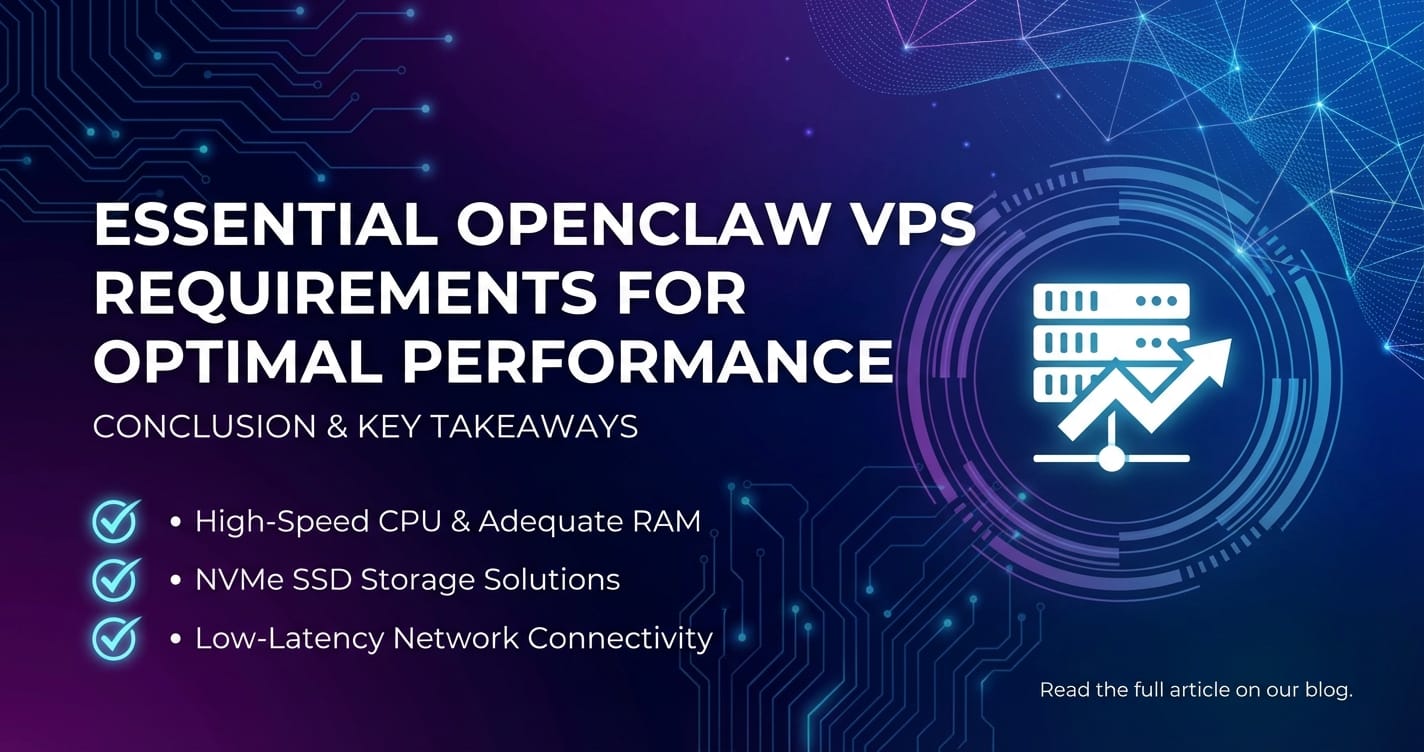
Establishing an OpenClaw VPS that delivers optimal performance is a multi-faceted endeavor that extends far beyond simply provisioning a server. It requires a holistic approach, starting with a deep understanding of OpenClaw's inherent demands and translating those into precise hardware specifications – powerful CPUs, ample fast RAM, and high-IOPS NVMe storage – all underpinned by a robust network infrastructure.
Beyond the hardware, the software stack, from the choice of operating system to the configuration of databases and caching layers, plays a critical role. Meticulous performance optimization strategies, including continuous monitoring, smart resource scaling, application-level tuning, and aggressive caching, are not optional but essential for extracting maximum efficiency from your investment. Simultaneously, proactive security measures are non-negotiable for protecting your OpenClaw deployment and ensuring its continuous availability.
Crucially, every technical decision must be made with an eye on cost optimization. This involves right-sizing your resources, leveraging long-term commitments, choosing providers wisely, and exploring automated scaling to eliminate waste. The balance between raw power and efficient spending is the sweet spot for any successful OpenClaw deployment.
By adhering to these essential requirements and implementing the outlined strategies, you can build an OpenClaw VPS that not only meets the stringent demands of high-performance applications but also scales gracefully, remains secure, and operates within a sensible budget. This foundational strength will enable OpenClaw to achieve its full potential, driving innovation and delivering exceptional value for your users and operations.
FAQ
Q1: What are the absolute minimum VPS specifications for a small OpenClaw deployment? A1: For a small OpenClaw deployment with moderate traffic, we recommend a VPS with at least 2-4 dedicated vCPUs, 8 GB of RAM, and 100-200 GB of NVMe SSD storage. Network bandwidth should ideally be 1 Gbps with a reasonable data transfer allowance. However, actual needs can vary, so always monitor your initial usage and scale up if necessary.
Q2: How can I balance OpenClaw's performance needs with cost optimization on a VPS? A2: The key is "right-sizing." Start with specifications slightly above your estimated minimum needs, then diligently monitor CPU, RAM, and I/O usage. Downgrade if you're consistently under-utilizing resources or upgrade if you're frequently hitting bottlenecks. Leverage long-term commitments from providers for discounts, use open-source software where possible, and consider automated scaling for dynamic workloads to pay only for what you use during peak times.
Q3: Is NVMe storage truly necessary for OpenClaw, or can I get by with SATA SSDs? A3: For optimal performance optimization, especially if OpenClaw involves databases, extensive logging, or frequent read/write operations, NVMe SSDs are highly recommended. They offer significantly higher IOPS and lower latency than SATA SSDs, dramatically reducing storage bottlenecks. While SATA SSDs are much better than HDDs, NVMe is crucial for high-performance and I/O-intensive OpenClaw workloads.
Q4: What are the most common performance bottlenecks for OpenClaw on a VPS? A4: The most common bottlenecks include insufficient RAM (leading to excessive swapping), slow storage I/O, an underpowered CPU (especially for CPU-intensive tasks), and network latency or insufficient bandwidth. Application-level issues like inefficient database queries or unoptimized code within OpenClaw itself can also be major culprits, making profiling and monitoring critical.
Q5: How can a platform like XRoute.AI benefit my OpenClaw deployment if I'm integrating AI? A5: If your OpenClaw application needs to incorporate advanced AI capabilities, particularly those involving Large Language Models (LLMs), XRoute.AI can significantly simplify integration. It provides a unified API platform that streamlines access to over 60 AI models from various providers through a single, OpenAI-compatible endpoint. This not only reduces development complexity but also aids in cost-effective AI by allowing flexible model selection and ensures low latency AI operations, making your OpenClaw's AI features more responsive and efficient.
🚀You can securely and efficiently connect to thousands of data sources with XRoute in just two steps:
Step 1: Create Your API Key
To start using XRoute.AI, the first step is to create an account and generate your XRoute API KEY. This key unlocks access to the platform’s unified API interface, allowing you to connect to a vast ecosystem of large language models with minimal setup.
Here’s how to do it: 1. Visit https://xroute.ai/ and sign up for a free account. 2. Upon registration, explore the platform. 3. Navigate to the user dashboard and generate your XRoute API KEY.
This process takes less than a minute, and your API key will serve as the gateway to XRoute.AI’s robust developer tools, enabling seamless integration with LLM APIs for your projects.
Step 2: Select a Model and Make API Calls
Once you have your XRoute API KEY, you can select from over 60 large language models available on XRoute.AI and start making API calls. The platform’s OpenAI-compatible endpoint ensures that you can easily integrate models into your applications using just a few lines of code.
Here’s a sample configuration to call an LLM:
curl --location 'https://api.xroute.ai/openai/v1/chat/completions' \
--header 'Authorization: Bearer $apikey' \
--header 'Content-Type: application/json' \
--data '{
    "model": "gpt-5",
    "messages": [
        {
            "content": "Your text prompt here",
            "role": "user"
        }
    ]
}'
With this setup, your application can instantly connect to XRoute.AI’s unified API platform, leveraging low latency AI and high throughput (handling 891.82K tokens per month globally). XRoute.AI manages provider routing, load balancing, and failover, ensuring reliable performance for real-time applications like chatbots, data analysis tools, or automated workflows. You can also purchase additional API credits to scale your usage as needed, making it a cost-effective AI solution for projects of all sizes.
Note: Explore the documentation on https://xroute.ai/ for model-specific details, SDKs, and open-source examples to accelerate your development.