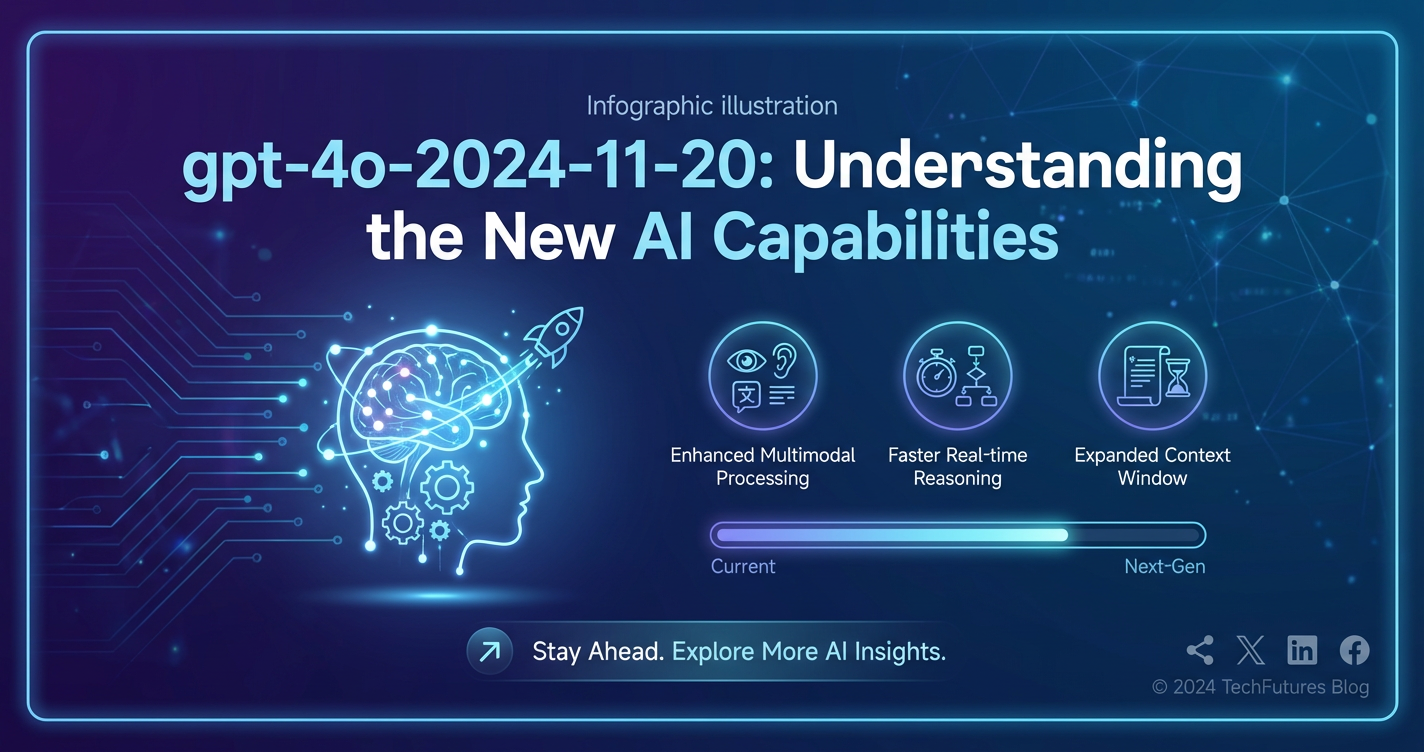
gpt-4o-2024-11-20: Understanding the New AI Capabilities

The landscape of artificial intelligence is perpetually shifting, characterized by breakthroughs that redefine what machines can achieve. Among the vanguard of these advancements stands OpenAI's GPT series, a lineage of large language models that have consistently pushed the boundaries of human-computer interaction. The initial unveiling of GPT-4o, or "Omni" for its multimodal capabilities, marked a pivotal moment, showcasing an unprecedented integration of text, audio, and visual processing. Yet, the journey of innovation is continuous, and as we look towards anticipated developments, the discussion around gpt-4o-2024-11-20 emerges as a focal point for understanding the next evolution in AI. This date, while speculative, symbolizes a potential future milestone, hinting at further refinements, expanded functionalities, and an even deeper integration of AI into our daily lives and sophisticated applications.
This comprehensive exploration delves into the core capabilities of GPT-4o, projects what an update around 2024-11-20 might entail, and examines how these advancements are poised to reshape industries, creative endeavors, and our fundamental interaction with digital intelligence. From enhanced multimodal understanding to a more accessible gpt-4o mini, we will dissect the technical prowess, practical implications, and the broader societal impact of these cutting-edge AI models. Our aim is to provide a detailed, human-centric perspective, demystifying complex AI concepts and illustrating their tangible value in an increasingly AI-driven world.
The Foundation: A Recap of GPT-4o's Groundbreaking Debut
Before we peer into the future represented by gpt-4o-2024-11-20, it's essential to appreciate the revolutionary strides made by GPT-4o upon its initial release. GPT-4o was not merely an incremental upgrade; it represented a paradigm shift in how AI models perceive and generate information. Its "omnimodal" nature meant that it was trained end-to-end across text, vision, and audio, allowing it to interpret and respond to inputs with a holistic understanding that was previously unattainable.
Historically, AI models often excelled in one modality but struggled to seamlessly integrate others. GPT-4, for instance, could process text and images but handled them somewhat separately. GPT-4o shattered these silos. It could hear a user's voice, interpret their tone, observe their facial expressions through a video feed, process accompanying text, and then generate responses in natural language, complete with expressive vocal intonations and even singing. This level of real-time, integrated understanding opened up a myriad of possibilities, from more empathetic customer service agents to interactive educational tools that genuinely feel like a conversation.
Key characteristics that defined the initial gpt-4o release included: * Native Multimodality: Unlike previous models that might layer different AI systems (e.g., a speech-to-text converter feeding a text model, which then feeds a text-to-speech generator), GPT-4o processed all modalities natively. This direct integration significantly reduced latency and improved the coherence and nuance of responses. * Exceptional Speed and Responsiveness: GPT-4o demonstrated remarkable speed in processing requests, particularly for audio interactions, achieving response times comparable to human conversation. This low latency was crucial for applications requiring real-time engagement. * Enhanced Performance Across Benchmarks: It outperformed previous models, including GPT-4 Turbo, in various text, reasoning, coding, and mathematical benchmarks. Its vision capabilities were particularly impressive, allowing for detailed image analysis and creative interpretation. * Cost-Effectiveness: OpenAI made GPT-4o significantly more affordable than its predecessors, particularly for API access, democratizing advanced AI capabilities for a broader range of developers and businesses. This strategic move underscored a commitment to widespread adoption and innovation. * Expressive Audio Output: The generated audio was not just synthetically clear but also rich in emotion and natural intonation, making interactions feel more human-like and engaging. This was a critical step in overcoming the "robotic" feel often associated with AI voices.
The impact of gpt-4o was immediate and far-reaching. Developers began to experiment with applications that leveraged its multimodal strengths, from personal AI assistants capable of understanding complex emotional cues to sophisticated content creation tools that could blend visual and textual narratives. Businesses saw opportunities to revolutionize customer interactions, streamline design processes, and even foster new forms of digital entertainment. It wasn't just about what the model could do, but how it did it—with a fluidity and naturalness that hinted at a future where AI interfaces are virtually indistinguishable from human interaction.
This foundational understanding of gpt-4o sets the stage for our anticipation of the gpt-4o-2024-11-20 update. What further refinements and revolutionary features might OpenAI be preparing, building upon this already impressive bedrock? The subsequent sections will delve into these possibilities, exploring how the next iteration could push the boundaries even further.
The Significance of the gpt-4o-2024-11-20 Update: Anticipating the Next Evolution
The date 2024-11-20, while acting as a placeholder for a significant future update, signals a commitment to continuous innovation within the gpt-4o lineage. Given the rapid pace of AI development and OpenAI's track record, such an update would likely focus on addressing current limitations, expanding capabilities, and making the technology even more robust, efficient, and accessible. This section explores the key areas where an update around gpt-4o-2024-11-20 could bring transformative enhancements, building on the already impressive foundation of gpt-4o.
1. Deeper Multimodal Integration and Nuance
While the initial gpt-4o was groundbreaking in its multimodal capabilities, the 2024-11-20 update could push this even further, moving beyond mere parallel processing to truly integrated, nuanced understanding. * Contextual Cohesion Across Modalities: Imagine an AI that doesn't just process a user's spoken words and visual cues independently, but genuinely understands the interplay between them. For instance, if a user points to an object on screen while describing a problem, the updated model could better infer the exact object of discussion, even if the verbal description is ambiguous. This means a more seamless "thought process" for the AI, mirroring human cognitive integration of sensory inputs. * Enhanced Emotional Intelligence: Building on GPT-4o's ability to interpret tone, the update could incorporate finer-grained emotional understanding from vocal inflection, facial micro-expressions, and even body language from video input. This would enable the AI to respond with greater empathy, tailor its communication style to the user's emotional state, and provide support that feels genuinely understanding. * Cross-Modal Generation Fidelity: The update might allow for generating not just text or audio or images, but truly synergistic outputs. For example, asking the AI to "illustrate this concept" could result in an animated explanation, combining dynamically generated visuals with a perfectly synchronized, expressive voiceover, and accompanying text annotations—all created from a single prompt.
2. Superior Reasoning and Complex Problem-Solving
One of the persistent challenges for AI has been complex, multi-step reasoning that mimics human-level cognitive flexibility. The gpt-4o-2024-11-20 update could introduce significant strides in this domain. * Advanced Logical Deduction: Expect improvements in the AI's ability to handle intricate logical puzzles, code debugging with deeper contextual understanding, and scientific problem-solving that requires connecting disparate pieces of information. This might involve improved internal "thought chains" or planning mechanisms that allow the model to break down problems more effectively. * Longer-form Coherence and Consistency: For tasks requiring extended dialogue or generation (e.g., writing a novel, managing a complex project, participating in a protracted negotiation), the updated model could maintain coherence and consistency over much longer stretches of interaction, reducing instances of "forgetting" earlier context or contradicting previous statements. * Adaptive Learning and Personalization: The model could potentially demonstrate a more sophisticated form of in-context learning, adapting its responses and knowledge base more rapidly to individual user preferences or specific domain knowledge presented within a conversation, without requiring full fine-tuning.
3. Real-time Interaction and Ultra-Low Latency
While gpt-4o was fast, the 2024-11-20 update might target even lower latencies, crucial for truly fluid, human-like conversations and real-time control applications. * Sub-200ms Response Times for Audio: Pushing the boundaries of audio response speed, potentially achieving average latency below what's perceptible as a delay in human conversation. This would make AI interactions indistinguishable from talking to another person over a good connection. * Enhanced Bandwidth and Throughput: For enterprise-level applications, the ability to handle a massive volume of concurrent requests with minimal latency is paramount. The update could optimize the underlying architecture for even higher throughput, serving millions of users simultaneously without degradation in performance. * Edge AI Integration: While gpt-4o is cloud-based, advancements might pave the way for more efficient local processing of certain components, or specialized "edge" versions, reducing reliance on constant cloud connectivity for some real-time tasks, particularly for IoT devices or advanced robotics.
4. Broader Accessibility and Cost-Efficiency (Introducing gpt-4o mini)
OpenAI's commitment to democratizing AI often involves making models more accessible and affordable. The 2024-11-20 update could solidify this, particularly with the potential expansion or formal introduction of gpt-4o mini. * gpt-4o mini as a Core Offering: While often discussed, a formal, highly optimized gpt-4o mini could become a standard offering, providing a smaller, faster, and significantly cheaper alternative to the full gpt-4o model. This would be ideal for applications where advanced reasoning or multimodal depth isn't strictly necessary, but quick, reliable text or basic multimodal generation is crucial. Think simple chatbots, automated data entry, or lightweight content generation. * Tiered Pricing and Resource Optimization: The update could introduce more granular pricing tiers, allowing developers to pay only for the exact capabilities they need. Furthermore, internal optimizations might lead to a further reduction in computational costs for running gpt-4o, which OpenAI could pass on to users through even lower API prices.
5. Enhanced Safety, Ethics, and Control
As AI becomes more powerful, the imperative for robust safety mechanisms and ethical deployment grows. The gpt-4o-2024-11-20 update would undoubtedly include significant improvements in these areas. * Advanced Guardrails and Bias Mitigation: Refined training techniques and post-training filtering could further reduce the generation of harmful, biased, or inappropriate content. This might involve more sophisticated understanding of nuanced harmful contexts and proactive prevention. * Improved Transparency and Explainability: While a fully transparent "black box" model is challenging, the update could offer developers and users better tools to understand why the AI made certain decisions or generated specific outputs, fostering trust and enabling more responsible deployment. * User Control and Customization of Safety Features: Providing developers with more granular control over safety settings, allowing them to tailor the model's behavior to specific application requirements while adhering to ethical guidelines.
The gpt-4o-2024-11-20 update represents not just a version bump, but a potential leap forward in making AI more intelligent, more intuitive, and more integrated into the fabric of our digital world. Each anticipated enhancement addresses a critical aspect of AI's current state, paving the way for a future where these models are not just tools, but collaborative partners in innovation and problem-solving.
Deep Dive into Core Capabilities Post-gpt-4o-2024-11-20 Update
The anticipated gpt-4o-2024-11-20 update is expected to amplify the model's core strengths, pushing the boundaries of what multimodal AI can achieve. Let's explore these enhanced capabilities in detail, understanding their technical underpinnings and practical implications.
1. Enhanced Multimodal Understanding and Generation: A Seamless Cognitive Fabric
The primary differentiator of gpt-4o is its native multimodality, and the 2024-11-20 update is likely to deepen this integration. This isn't just about processing different data types side-by-side; it's about forming a unified cognitive fabric where text, audio, and vision inform each other in real-time, much like human perception.
- Unified Encoding and Representation: At a technical level, the update might involve a more sophisticated architecture for representing information from diverse modalities within a shared latent space. This means that a concept, whether expressed in text, as an image, or via spoken words, is encoded in a way that its semantic meaning is consistently understood across all forms. For instance, the AI could understand that "a majestic lion" in text, an image of a lion, and the sound of a lion's roar all relate to the same underlying entity, with all its associated attributes (strength, wildness, etc.).
- Cross-Modal Referencing and Inference: The model's ability to connect elements across modalities would be significantly improved. If a user says, "Tell me about this," while pointing to a specific, complex diagram, the AI wouldn't just describe the diagram generically. Instead, it would understand the implied focus of the user's gesture and provide a highly targeted explanation relevant to the pointed section, drawing on both visual and linguistic cues. This reduces ambiguity and improves the precision of interaction.
- Contextual Visual and Auditory Processing: The AI could be better at understanding not just what is in an image or what is being said, but also the broader context and implications. For vision, this could mean interpreting complex scenes with multiple objects and actions, discerning relationships, and even predicting potential outcomes. For audio, it's about going beyond transcription to understand emotional subtext, sarcasm, or cultural nuances in speech patterns, even amidst background noise.
- Dynamic Multimodal Generation: The output would also reflect this deeper integration. Instead of merely transcribing spoken words, the AI could generate responses that are a cohesive blend of modalities. Imagine asking the AI to "explain quantum entanglement visually and verbally." The
gpt-4o-2024-11-20model could simultaneously generate a clear, concise verbal explanation with an animated visual aid, synchronizing both perfectly to enhance understanding – all from a single prompt. This pushes the boundary beyond static image or text generation to dynamic, interactive media creation.
2. Superior Reasoning and Problem-Solving: Beyond Pattern Matching
The next evolution of gpt-4o is expected to significantly advance its reasoning capabilities, moving beyond sophisticated pattern matching to a more robust form of cognitive problem-solving.
- Multi-Step and Iterative Reasoning: The update could empower the AI to engage in more complex, multi-step reasoning processes. This means it can break down intricate problems into smaller, manageable sub-problems, solve each step sequentially, and then synthesize the intermediate results to arrive at a comprehensive solution. This is particularly valuable for scientific research, complex engineering challenges, or legal analysis where intricate logical chains are required.
- Symbolic and Abstract Reasoning: While LLMs excel at statistical patterns, true intelligence often involves symbolic manipulation and abstract thinking. The
2024-11-20update might seegpt-4oimproving in areas like mathematical theorem proving, understanding abstract concepts (e.g., justice, freedom) in diverse contexts, and generating creative solutions that are not merely recombinations of existing data but genuinely novel. - Hypothetical and Counterfactual Reasoning: The ability to understand "what if" scenarios and counterfactuals is a hallmark of advanced intelligence. The updated model could more effectively simulate different outcomes based on altered conditions, provide nuanced risk assessments, and help in strategic planning by exploring various possibilities. For example, "What if we launched this product under different market conditions?" or "How would this legal precedent impact future cases if interpreted differently?"
- Self-Correction and Reflection: A significant leap would be an improved capacity for self-correction. After generating a response or solution, the AI could internally "reflect" on its output, identify potential flaws or inconsistencies, and refine its answer without external human intervention. This would lead to higher quality outputs and reduced need for prompt engineering.
3. Real-time Interaction and Latency Improvements: The Seamless Conversation
The initial gpt-4o brought impressive speed, but the gpt-4o-2024-11-20 update aims for a level of real-time interaction that blurs the lines between human and AI communication.
- Sub-Human Latency for Audio: The goal is to achieve average audio response latencies consistently below 200 milliseconds, or even closer to 100 milliseconds, which is the threshold where humans perceive a conversation as truly fluid and uninterrupted. This is crucial for applications like live interpretation, personal AI assistants that feel like a companion, or interactive gaming.
- Predictive Processing and Anticipation: To achieve ultra-low latency, the model might incorporate more advanced predictive processing. This involves the AI anticipating the user's next words or actions even before they fully articulate them, pre-computing potential responses, and then rapidly selecting the most appropriate one as the final input is received. This requires sophisticated probabilistic modeling and efficient resource allocation.
- Optimized Data Flow and Infrastructure: Technical improvements in data transmission, model inference optimization (e.g., quantization, more efficient tensor operations), and potentially distributed computing architectures would be key. This could involve leveraging specialized hardware (like custom AI chips) and more efficient networking protocols to minimize bottlenecks.
- Concurrent Multimodal Processing: The model could simultaneously process incoming audio, visual, and textual cues without any perceived delay, allowing for truly dynamic and responsive interactions. For instance, if a user speaks, gestures, and types simultaneously, the AI processes all inputs instantly and integrates them into a single, coherent understanding to formulate its response.
4. Cost-Efficiency and Accessibility: Democratizing Advanced AI
The gpt-4o-2024-11-20 update is expected to further democratize access to advanced AI, primarily through enhanced cost-efficiency and the broader availability of models like gpt-4o mini.
- Further Price Reduction for
gpt-4o: Through continued optimization of its training and inference pipelines, OpenAI could reduce the operational costs of runninggpt-4o, leading to even more competitive pricing for API usage. This makes sophisticated AI more viable for startups and smaller businesses. - The Rise of
gpt-4o mini: Thegpt-4o minimodel, a more compact and streamlined version of its larger sibling, would be designed for maximum efficiency and speed at a fraction of the cost.- Purpose:
gpt-4o miniwould cater to use cases where high-volume, low-latency text or simpler multimodal processing is required without the full reasoning depth or complex multimodal integration ofgpt-4o. - Target Audience: Ideal for developers building basic chatbots, content summarizers, simple sentiment analyzers, or applications requiring rapid, cost-effective API calls.
- Capabilities: While not as powerful as
gpt-4oin complex multimodal reasoning,gpt-4o miniwould still offer excellent performance for its target tasks, maintaining a high degree of natural language understanding and generation, and potentially retaining some basic multimodal capabilities (e.g., efficient image captioning, basic audio transcription). - Use Cases for
gpt-4o mini:- Customer Support: Quick FAQ responses, basic query routing.
- Content Generation: Short social media posts, email drafts, basic article outlines.
- Data Processing: Simple text classification, data extraction from structured documents.
- Lightweight Chatbots: Interactive agents for websites or mobile apps where primary function is information retrieval or simple task automation.
- Educational Tools: Generating quizzes, providing basic explanations of concepts.
- Purpose:
- Optimized Resource Consumption: Both
gpt-4oandgpt-4o miniwould benefit from continuous research into more energy-efficient AI models and inference techniques, reducing the computational footprint and environmental impact, which also translates to cost savings.
5. Enhanced Safety, Ethics, and Responsible AI: Building Trust
As AI becomes more integral to critical applications, the gpt-4o-2024-11-20 update will place an even greater emphasis on safety and ethical considerations.
- Proactive Harm Detection and Mitigation: The model would feature more sophisticated internal mechanisms to detect and prevent the generation of harmful content (hate speech, misinformation, unsafe instructions) even when subtly prompted. This involves a deeper understanding of intent and context.
- Bias Auditing and Remediation: Continued efforts in identifying and mitigating biases embedded in training data and model outputs. This might include more transparent reporting on bias detection and offering tools for developers to perform their own bias audits.
- Robust Privacy Preserving Techniques: Improvements in data handling and processing to enhance user privacy, potentially through advanced differential privacy methods or secure multi-party computation during training or inference.
- Customizable Safety Layers: Developers would be given more granular control over safety filters and content moderation settings, allowing them to tailor the AI's behavior to specific use cases while adhering to regulatory and ethical guidelines relevant to their industry. This balance of flexibility and responsibility is crucial for widespread adoption.
The cumulative effect of these enhancements in the gpt-4o-2024-11-20 update is a model that is not only more powerful and intelligent but also more reliable, accessible, and ethically sound, ready to tackle a broader spectrum of real-world challenges with unprecedented efficiency and nuance.
Technical Deep Dive and Developer Implications of gpt-4o-2024-11-20
For developers and engineers, the gpt-4o-2024-11-20 update isn't just about new features; it's about a refined API, improved performance metrics, and a more robust ecosystem for building next-generation AI applications. The technical underpinnings of this update will significantly impact how AI is integrated, scaled, and managed in production environments.
1. API Enhancements and Developer Experience
OpenAI consistently aims to make its models easy to integrate. The gpt-4o-2024-11-20 update would likely introduce several API improvements: * Unified Multimodal Endpoints: While gpt-4o already offered strong multimodal capabilities, the update could streamline the API for even more complex, concurrent multimodal inputs and outputs. Developers might see simplified payload structures for mixed audio-visual-text inputs, making it easier to orchestrate sophisticated interactions without complex serialization. * Granular Control Over Model Behavior: New API parameters could offer finer control over model aspects like temperature (creativity), top-p (diversity), and even explicit control over specific safety filters or content generation styles. This allows for highly customized AI personalities and behaviors tailored to specific application needs. * Improved Streaming Capabilities: For real-time applications, enhanced streaming of both input and output is critical. The gpt-4o-2024-11-20 API could offer more robust and efficient streaming protocols for all modalities, ensuring minimal latency in continuous interactions like live translation or immersive virtual experiences. * Enhanced Tool Use and Function Calling: The ability for LLMs to call external tools or functions is a game-changer. The update might refine gpt-4o's tool-use capabilities, making it more reliable in identifying when to call a tool, extracting correct arguments, and interpreting the results. This is crucial for building AI agents that can interact with external systems, databases, and APIs.
2. Performance Metrics and Scalability
Performance is paramount for production-grade AI. The gpt-4o-2024-11-20 update is expected to deliver tangible improvements in key metrics: * Reduced Latency: As discussed, ultra-low latency is a core focus. This means further optimization of inference engines, potentially leveraging advanced hardware (like custom TPUs or GPUs) and more efficient model architectures. Developers will notice quicker response times, particularly for audio and interactive tasks. * Increased Throughput: For enterprise applications, the ability to handle a massive volume of concurrent requests is critical. The update would likely enhance gpt-4o's backend infrastructure and load balancing, allowing it to process more tokens per second across more simultaneous users without sacrificing individual request latency. This translates to higher capacity for businesses. * Lower Token Costs: Through continued research and development in model compression, distillation, and optimized inference, OpenAI could achieve even greater cost-efficiency, resulting in lower per-token pricing for both input and output. This makes scaling AI applications more economically viable. * Improved Context Window Management: While gpt-4o already boasts a substantial context window, the update might optimize how this context is managed internally, allowing the model to more effectively utilize long contexts without performance degradation or "forgetting" crucial details from earlier in the conversation.
3. Integration Complexity Simplified with Unified API Platforms
Integrating advanced LLMs like gpt-4o and gpt-4o mini into existing systems can still present challenges. Developers often grapple with managing multiple API keys, handling different rate limits, ensuring consistent performance across various models, and optimizing costs. This is where unified API platforms become invaluable.
XRoute.AI is a cutting-edge unified API platform designed to streamline access to large language models (LLMs) for developers, businesses, and AI enthusiasts. By providing a single, OpenAI-compatible endpoint, XRoute.AI simplifies the integration of over 60 AI models from more than 20 active providers, enabling seamless development of AI-driven applications, chatbots, and automated workflows. With a focus on low latency AI, cost-effective AI, and developer-friendly tools, XRoute.AI empowers users to build intelligent solutions without the complexity of managing multiple API connections. The platform’s high throughput, scalability, and flexible pricing model make it an ideal choice for projects of all sizes, from startups to enterprise-level applications.
For developers working with gpt-4o-2024-11-20 and gpt-4o mini, a platform like XRoute.AI offers significant advantages: * Single Integration Point: Instead of integrating directly with OpenAI's API and potentially others, developers can use XRoute.AI's single, familiar OpenAI-compatible endpoint. This dramatically reduces development time and complexity. * Simplified Model Switching: Easily switch between gpt-4o, gpt-4o mini, or other providers' models without changing a single line of application code, allowing for A/B testing, fallback mechanisms, or dynamic model selection based on cost or performance needs. * Optimized Performance: XRoute.AI intelligently routes requests to optimize for latency and availability, ensuring applications always get the best possible performance from their chosen models. * Cost Management: By centralizing API calls, XRoute.AI provides unified analytics and cost reporting, helping developers monitor and optimize their LLM spending across multiple providers, including various OpenAI models. * Future-Proofing: As new models and updates (like gpt-4o-2024-11-20) are released, XRoute.AI abstracts away the integration details, ensuring applications remain compatible and can leverage the latest innovations without constant refactoring.
4. Fine-tuning and Customization Options
The gpt-4o-2024-11-20 update could also bring enhanced capabilities for fine-tuning and customizing the model: * Multimodal Fine-tuning: While current fine-tuning largely focuses on text, the update might introduce more robust methods for fine-tuning gpt-4o on specific audio or visual datasets, allowing organizations to imbue the model with domain-specific knowledge across all modalities. * Personalized Safety Controls: Beyond general guardrails, developers might get more tools to fine-tune the model's safety and moderation layers to align with specific brand guidelines or regulatory requirements for their niche. * "Instruction Following" Improvements: Fine-tuning will likely become even more effective at teaching the model to follow complex, multi-part instructions, reducing the need for extensive prompt engineering in daily use.
In summary, the gpt-4o-2024-11-20 update represents a mature phase of AI development where the focus shifts not only to raw capability but also to developer experience, efficiency, and responsible deployment. Platforms like XRoute.AI become indispensable tools in this ecosystem, allowing developers to harness the power of models like gpt-4o and gpt-4o mini with unprecedented ease and scalability.
XRoute is a cutting-edge unified API platform designed to streamline access to large language models (LLMs) for developers, businesses, and AI enthusiasts. By providing a single, OpenAI-compatible endpoint, XRoute.AI simplifies the integration of over 60 AI models from more than 20 active providers(including OpenAI, Anthropic, Mistral, Llama2, Google Gemini, and more), enabling seamless development of AI-driven applications, chatbots, and automated workflows.
Practical Applications and Use Cases Post-gpt-4o-2024-11-20 Update
The advancements brought by the gpt-4o-2024-11-20 update will unlock a new wave of practical applications, transforming industries and enhancing user experiences across various domains. The combination of heightened multimodal understanding, superior reasoning, and ultra-low latency will move AI from a mere tool to a truly collaborative partner.
1. Enterprise Solutions: Revolutionizing Business Operations
For businesses, the gpt-4o-2024-11-20 update promises to streamline operations, enhance decision-making, and redefine customer engagement.
- Intelligent Customer Experience (CX): Imagine a customer service agent powered by
gpt-4othat can not only understand spoken queries but also interpret the customer's emotional state from their voice and facial expressions during a video call. It can access and synthesize complex product information, offer personalized troubleshooting steps with visual aids, and even proactively suggest solutions before the customer fully articulates their need. This moves beyond chatbots to truly empathetic and effective digital assistants.gpt-4o minicould handle initial triage, routing complex cases to the fullgpt-4omodel or a human agent. - Automated Content Creation and Marketing: From drafting sophisticated marketing copy that resonates with specific demographics (informed by visual trend analysis) to generating engaging video scripts and even basic animated explainers based on a single prompt, the updated
gpt-4owill be a powerhouse for creative teams. It can analyze competitor content, understand market sentiment, and produce highly optimized, multimodal marketing assets at scale. - Advanced Data Analysis and Business Intelligence:
gpt-4ocould process vast datasets, including unstructured text from reports, images from market research, and audio from customer interviews, to identify patterns, generate actionable insights, and present them in easy-to-understand multimodal summaries (e.g., a spoken executive summary accompanied by dynamic charts and graphs). This democratizes data science, making complex analysis accessible to a broader range of business users. - Personalized Training and Onboarding: For employee training,
gpt-4ocould create highly personalized learning modules that adapt to an individual's learning style, offering explanations via text, audio, or interactive visuals. It could simulate real-world scenarios, provide real-time feedback on performance, and answer complex questions, accelerating skill development and onboarding processes.
2. Creative Industries: Unleashing New Artistic Possibilities
The creative sector stands to benefit immensely, with gpt-4o-2024-11-20 acting as a co-creator and muse.
- Interactive Storytelling and Game Development: Imagine games where NPCs (non-player characters) have genuinely dynamic conversations, adapting their dialogue and behavior in real-time based on player actions and emotions, thanks to
gpt-4o's multimodal understanding and real-time responsiveness. Game developers could use it to rapidly prototype game narratives, generate diverse character dialogues, and even create dynamic in-game assets. - Music Composition and Production:
gpt-4ocould assist musicians by generating melodies, harmonies, or even entire musical pieces based on textual descriptions, mood boards, or even short vocal samples. Its understanding of audio could extend to suggesting instrumentations or mastering techniques, becoming an indispensable tool for producers. - Visual Arts and Design: Designers could leverage
gpt-4oto rapidly iterate on visual concepts, generating high-fidelity images, 3D models, or architectural designs from textual or spoken prompts. Its ability to understand complex visual cues and translate abstract ideas into concrete designs would accelerate the creative process, from fashion design to product rendering. - Film and Media Production: From script doctoring and character development to storyboarding with generated visuals and even synthesizing voiceovers in multiple languages with emotional nuance,
gpt-4ocould become a critical tool across the entire media production pipeline, especially for independent creators.
3. Education: Personalized Learning and Global Access
The gpt-4o-2024-11-20 update has the potential to fundamentally transform education, making learning more engaging, personalized, and accessible.
- Personalized Tutors: An AI tutor powered by
gpt-4ocould understand a student's learning pace, identify their conceptual misunderstandings through their questions and even their facial expressions, and then provide tailored explanations using the most effective modality (visuals, audio, text). It could generate practice problems, offer real-time feedback, and adapt its teaching style to maximize retention. - Interactive Language Learning: For language learners,
gpt-4ocould provide immersive conversational practice, correcting pronunciation in real-time, understanding grammatical errors, and engaging in natural dialogues that simulate real-world interactions. - Accessibility Tools: The model's enhanced multimodal capabilities could power advanced accessibility tools, for example, generating real-time descriptions of visual content for the visually impaired, or translating spoken language into sign language avatars, bridging communication gaps.
4. Healthcare: Diagnostics and Patient Interaction
While strict regulations apply, the potential for gpt-4o-2024-11-20 in healthcare is immense.
- Clinical Decision Support: Assisting medical professionals by rapidly synthesizing vast amounts of medical literature, patient records, and diagnostic images to suggest potential diagnoses or treatment plans, acting as an intelligent co-pilot for doctors.
- Patient Engagement and Education: Providing patients with clear, concise, and personalized explanations of their conditions, treatments, and medication instructions, in their preferred language and modality, improving health literacy and adherence.
- Mental Health Support: Offering initial conversational support, identifying potential signs of distress through voice analysis, and guiding users towards professional help, acting as a first line of non-diagnostic support.
5. Robotics and IoT: Intuitive Interaction
The real-time, multimodal nature of gpt-4o-2024-11-20 makes it a prime candidate for enhancing physical systems.
- Natural Human-Robot Interaction: Robots equipped with
gpt-4ocould understand complex, nuanced verbal commands combined with gestures, interpret emotional states, and respond in a far more natural and helpful way, making human-robot collaboration seamless in manufacturing, elder care, or domestic settings. - Smart Environment Control: Imagine smart homes or offices where
gpt-4ointerprets verbal commands, visual cues (e.g., someone looking at a thermostat), and even ambient sounds to proactively adjust lighting, temperature, or security systems, creating truly intelligent and responsive environments.
The gpt-4o-2024-11-20 update signifies a shift towards more intelligent, intuitive, and integrated AI experiences. Its applications are limited only by our imagination, promising a future where AI acts as an invaluable assistant, a creative partner, and a force for positive transformation across every aspect of human endeavor.
Challenges and Future Outlook of gpt-4o-2024-11-20
While the gpt-4o-2024-11-20 update promises unprecedented capabilities, its deployment and evolution are not without significant challenges. Addressing these will be crucial for realizing the full potential of this advanced AI and ensuring its responsible integration into society. Simultaneously, understanding the future outlook provides a roadmap for continued innovation.
1. Persistent Challenges
- Ethical AI and Bias Mitigation: Despite continuous efforts, ensuring
gpt-4oand its successors are free from biases inherited from vast training datasets remains a paramount challenge. As models become more nuanced in their understanding, subtle biases can manifest in complex ways, affecting fairness, equity, and representation. Proactive auditing, diverse data curation, and explainable AI techniques are critical but complex areas of ongoing research. - Safety and Misinformation: The ability of advanced generative AI to create highly convincing and contextually appropriate content across modalities also poses risks, particularly in the spread of misinformation, deepfakes, and potentially harmful instructions. The
gpt-4o-2024-11-20update will undoubtedly include stronger guardrails, but the arms race between AI capabilities and misuse prevention is continuous. - Privacy and Data Security: The multimodal nature of
gpt-4o, processing sensitive data like user voices, images, and conversations, raises significant privacy concerns. Ensuring robust data encryption, anonymization techniques, and strict adherence to global privacy regulations (like GDPR) is vital. The sheer volume of data processed by these models makes safeguarding it a formidable task. - Computational Costs and Environmental Impact: While
gpt-4ostrives for cost-efficiency, training and operating models of this scale still require immense computational resources, leading to substantial energy consumption. Future advancements must balance increasing capability with developing more energy-efficient architectures and inference methods to reduce the carbon footprint of AI. - Hallucinations and Reliability: Despite superior reasoning, LLMs can still "hallucinate" – generate factually incorrect or nonsensical information with high confidence. For critical applications in healthcare, law, or engineering, absolute reliability is non-negotiable. Reducing hallucinations and increasing the model's capacity for verifiable factual recall remains a key technical hurdle.
- Regulatory Landscape: The rapid pace of AI development often outstrips the ability of legal and regulatory frameworks to keep pace. Governments worldwide are grappling with questions of AI governance, intellectual property rights concerning AI-generated content, liability in AI-driven decisions, and ethical guidelines. A fragmented or unclear regulatory environment can hinder adoption and innovation.
- Human-AI Teaming and Skill Gaps: Integrating such powerful AI into workplaces requires new skills and workflows. There's a challenge in teaching humans how to effectively collaborate with AI, leveraging its strengths while understanding its limitations. This includes prompt engineering, critical evaluation of AI outputs, and adapting job roles.
2. Future Outlook
The gpt-4o-2024-11-20 update is a stepping stone towards an even more advanced future for AI, characterized by:
- Towards General AI (AGI): Each iteration of GPT-4o, especially with advancements in reasoning and multimodal understanding, brings us closer to Artificial General Intelligence (AGI) – AI that can understand, learn, and apply intelligence across a wide range of tasks at a human level. While AGI remains a distant goal, these models are increasingly demonstrating general-purpose capabilities.
- Embodied AI and Robotics: The enhanced real-time, multimodal understanding of
gpt-4ois a perfect match for embodied AI. Expect to see more sophisticated integration with robotics, enabling robots to interpret complex human commands, understand their environment more deeply, and perform nuanced tasks in unstructured settings. - Hyper-Personalized Experiences: Future iterations will lead to even more hyper-personalized AI experiences. Imagine AI that learns your specific preferences across all aspects of your digital life, anticipating your needs and seamlessly interacting with you across devices, languages, and contexts, acting as a truly intelligent digital twin.
- AI for Scientific Discovery:
gpt-4o's improved reasoning and data synthesis capabilities will accelerate scientific research. From hypothesis generation to experimental design and data interpretation, AI will become an indispensable partner in accelerating breakthroughs in medicine, materials science, and climate research. - Decentralized and Distributed AI: The future might also see advancements in deploying parts of these large models in a more decentralized or federated manner, potentially reducing latency and improving privacy by processing some data locally on devices while leveraging cloud for more complex tasks.
- New Forms of Human-AI Collaboration: Beyond current tools,
gpt-4owill enable entirely new modalities of collaboration. Imagine neural interfaces controlling AI, or AI directly augmenting human cognition in real-time, opening up frontiers currently confined to science fiction.
The gpt-4o-2024-11-20 update is not just about a technological advancement; it’s about shaping a future where AI is a more capable, accessible, and integral part of our world. Navigating the challenges with foresight and embracing the opportunities with innovation will define how we harness these powerful tools for the betterment of humanity.
Comparison Table: gpt-4o, gpt-4o mini, and GPT-4 Turbo (Anticipated Post-2024-11-20 Update)
To further illustrate the impact and positioning of the gpt-4o-2024-11-20 update, let's compare the key characteristics of gpt-4o, its anticipated gpt-4o mini counterpart, and the preceding GPT-4 Turbo model. This table highlights how the 2024-11-20 update refines capabilities and introduces more specialized offerings.
| Feature | GPT-4 Turbo (Pre-gpt-4o) |
gpt-4o (Post-2024-11-20 Update) |
gpt-4o mini (Post-2024-11-20 Update) |
|---|---|---|---|
| Core Modalities | Text, Image Input | Native Text, Audio, Vision (Omnimodal) | Text (Primary), Basic Multimodal (Efficient) |
| Multimodal Integration | Separate processing of text/image | Deep, real-time, unified understanding across all modalities | Basic interpretation, optimized for efficiency |
| Reasoning & Problem Solving | Advanced, strong logical deduction (text) | Superior, multi-step, abstract, and cross-modal reasoning | Good for common tasks, less complex reasoning |
| Speed/Latency (Audio) | Slower (sequential processing) | Ultra-low latency (near-human conversation speed) | Very fast, optimized for quick responses |
| Cost-Efficiency | Moderately expensive | Highly cost-effective for its capabilities | Extremely cost-effective, budget-friendly |
| Context Window | Large (e.g., 128k tokens) | Enhanced management, possibly larger effective context | Moderate to large, optimized for throughput |
| Creative Generation | High-quality text & static image | Dynamic, cohesive multimodal content (e.g., animated explanations, expressive audio) | High-quality text, simple image generation |
| Emotion/Nuance | Limited (primarily text-based) | Advanced emotional intelligence (voice, facial expressions) | Basic emotional tone understanding |
| Primary Use Cases | Complex text generation, coding, analysis, image captioning | Real-time interactive agents, advanced creative tools, deep data analysis, complex problem solving | High-volume chatbots, efficient content generation, quick summarization, basic automated workflows |
| Developer Target | General-purpose AI development | Developers pushing multimodal frontiers, demanding real-time interaction, enterprise-grade solutions | Developers seeking high throughput, low cost, rapid text/basic multimodal APIs |
| API Complexity | Standard text/image API | Streamlined multimodal API, enhanced function calling | Simplified, highly optimized API for speed and scale |
| Safety Features | Robust moderation and safety layers | Enhanced, context-aware, customizable safety and ethical guardrails | Efficient, optimized safety features for target use cases |
This table underscores that the gpt-4o-2024-11-20 update isn't just about a single model but about a diversified offering. The core gpt-4o pushes the envelope in intelligence and multimodal integration, while gpt-4o mini broadens accessibility and efficiency for a wider range of high-volume, cost-sensitive applications. Both represent significant steps forward from previous generations, collectively expanding the horizon of what AI can accomplish.
Conclusion: The Horizon Broadens with gpt-4o-2024-11-20
The journey of artificial intelligence is one of relentless innovation, and the anticipated gpt-4o-2024-11-20 update represents a significant landmark on this path. Building upon the already revolutionary foundation of gpt-4o, this next iteration promises to deepen our interaction with AI, transforming it from a powerful tool into an almost seamless cognitive partner. We've explored how enhancements in multimodal understanding, superior reasoning, ultra-low latency, and greater cost-efficiency, exemplified by the introduction or refinement of gpt-4o mini, are poised to unlock unprecedented applications across industries.
From enterprise solutions that redefine customer experience and accelerate business intelligence, to creative endeavors that push the boundaries of art and storytelling, and educational tools that democratize personalized learning, the impact of gpt-4o-2024-11-20 is projected to be profound and far-reaching. Developers, in particular, will find a more robust, efficient, and user-friendly ecosystem, especially when leveraging unified API platforms like XRoute.AI, which simplify the integration and management of these powerful models.
However, with great power comes great responsibility. The challenges of ethical deployment, bias mitigation, privacy, and computational sustainability remain critical areas of focus. Addressing these concerns thoughtfully and proactively will be essential to ensure that the advancements brought by gpt-4o-2024-11-20 serve to enhance human potential and contribute positively to society.
Ultimately, the gpt-4o-2024-11-20 update signifies more than just a technological upgrade; it marks a pivotal moment in the evolution of AI, pushing us closer to a future where intelligent machines are not just capable of understanding our world, but are capable of understanding us, in all our multimodal complexity, creating experiences that are intuitive, impactful, and truly transformative. The horizon has broadened, and the possibilities are exhilarating.
Frequently Asked Questions (FAQ)
Q1: What is gpt-4o-2024-11-20 and why is this date significant?
A1: gpt-4o-2024-11-20 refers to an anticipated future update or release milestone for OpenAI's gpt-4o model. While the specific features are speculative, the date symbolizes a potential next phase of advancements, focusing on deeper multimodal integration, superior reasoning, ultra-low latency, and enhanced cost-efficiency. It indicates a continuous evolution of the already groundbreaking gpt-4o capabilities.
Q2: How does gpt-4o differ from previous models like GPT-4 Turbo?
A2: The core difference lies in gpt-4o's native "omnimodal" architecture. Unlike previous models that often processed text, audio, and vision sequentially or through separate components, gpt-4o was trained end-to-end across all modalities. This allows it to understand and generate responses with a unified, real-time comprehension of text, audio, and visual inputs, leading to much faster response times and more nuanced interactions, especially with audio. The 2024-11-20 update is expected to further enhance this integration.
Q3: What is gpt-4o mini, and how will it be used?
A3: gpt-4o mini is envisioned as a smaller, faster, and more cost-effective version of the full gpt-4o model. It is designed for developers who need high-volume, low-latency text or simpler multimodal processing for specific tasks without requiring the full advanced reasoning and deep multimodal integration of the larger model. Use cases include basic chatbots, quick content summarization, efficient data classification, and other applications where speed and affordability are paramount.
Q4: How will the gpt-4o-2024-11-20 update impact developers and businesses?
A4: For developers, the update is expected to bring a more streamlined API, improved performance metrics (lower latency, higher throughput), and potentially more granular control over model behavior. For businesses, it means access to more intelligent and cost-effective AI solutions for customer service, content creation, data analysis, and personalized experiences. Platforms like XRoute.AI will become even more valuable in simplifying the integration and management of these advanced models.
Q5: What are the main challenges associated with the continued development and deployment of gpt-4o?
A5: Key challenges include ensuring ethical AI development, mitigating biases in model outputs, safeguarding user privacy and data security, managing the significant computational costs and environmental impact, and reducing "hallucinations" to ensure reliability in critical applications. Furthermore, navigating the rapidly evolving regulatory landscape and adapting human skills for effective human-AI collaboration will be crucial for the responsible integration of these powerful AI systems.
🚀You can securely and efficiently connect to thousands of data sources with XRoute in just two steps:
Step 1: Create Your API Key
To start using XRoute.AI, the first step is to create an account and generate your XRoute API KEY. This key unlocks access to the platform’s unified API interface, allowing you to connect to a vast ecosystem of large language models with minimal setup.
Here’s how to do it: 1. Visit https://xroute.ai/ and sign up for a free account. 2. Upon registration, explore the platform. 3. Navigate to the user dashboard and generate your XRoute API KEY.
This process takes less than a minute, and your API key will serve as the gateway to XRoute.AI’s robust developer tools, enabling seamless integration with LLM APIs for your projects.
Step 2: Select a Model and Make API Calls
Once you have your XRoute API KEY, you can select from over 60 large language models available on XRoute.AI and start making API calls. The platform’s OpenAI-compatible endpoint ensures that you can easily integrate models into your applications using just a few lines of code.
Here’s a sample configuration to call an LLM:
curl --location 'https://api.xroute.ai/openai/v1/chat/completions' \
--header 'Authorization: Bearer $apikey' \
--header 'Content-Type: application/json' \
--data '{
    "model": "gpt-5",
    "messages": [
        {
            "content": "Your text prompt here",
            "role": "user"
        }
    ]
}'
With this setup, your application can instantly connect to XRoute.AI’s unified API platform, leveraging low latency AI and high throughput (handling 891.82K tokens per month globally). XRoute.AI manages provider routing, load balancing, and failover, ensuring reliable performance for real-time applications like chatbots, data analysis tools, or automated workflows. You can also purchase additional API credits to scale your usage as needed, making it a cost-effective AI solution for projects of all sizes.
Note: Explore the documentation on https://xroute.ai/ for model-specific details, SDKs, and open-source examples to accelerate your development.