GPT-4o Explained: What's New in Multimodal AI
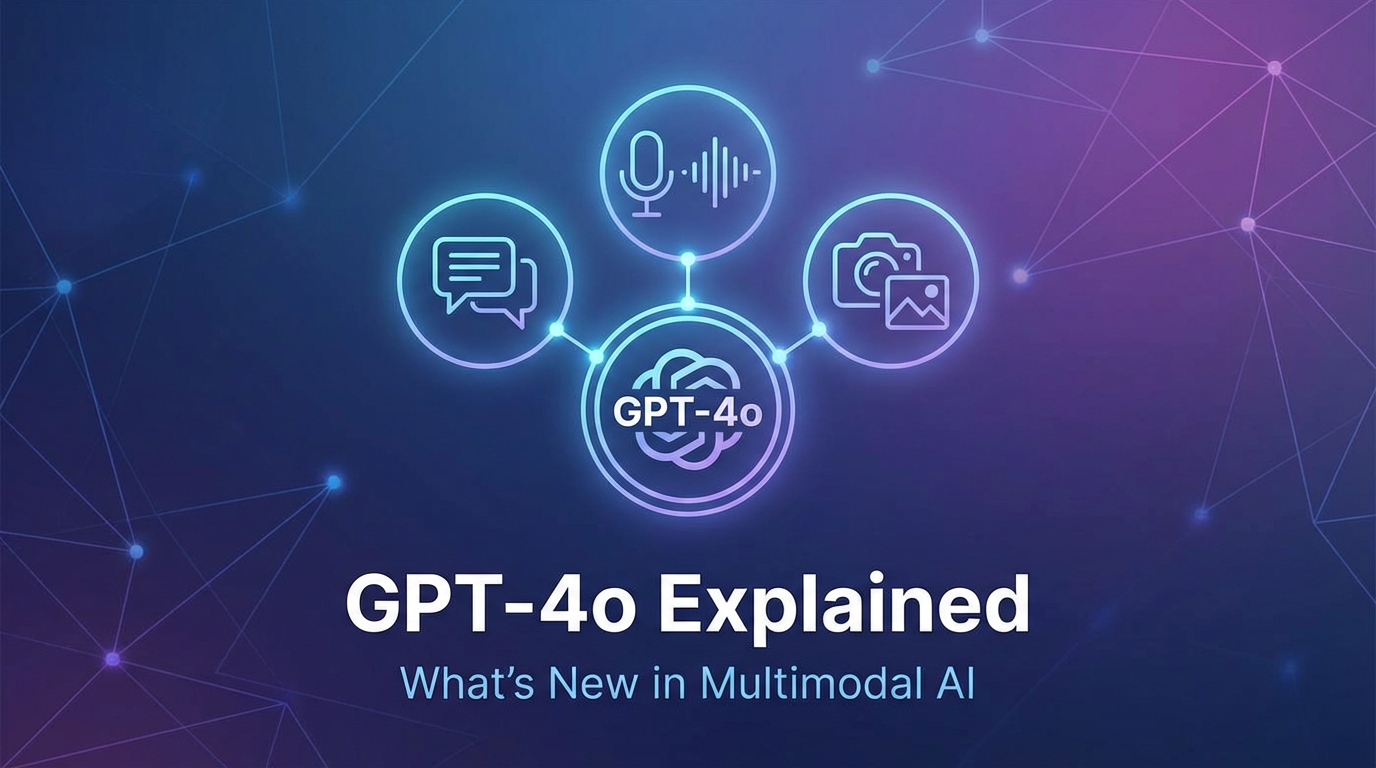

The landscape of artificial intelligence is in a constant state of flux, with advancements arriving at an exhilarating pace. Among the many breakthroughs, OpenAI's release of GPT-4o (the "o" stands for "omni") marks a particularly significant milestone, pushing the boundaries of what large language models (LLMs) can achieve. This latest iteration is not merely an incremental update but a foundational shift towards truly multimodal AI, capable of processing and generating content across text, audio, and vision with unprecedented fluency and integration.
For years, AI models excelled in specific domains – text generation, image recognition, or speech synthesis. The grand challenge, however, has always been to weave these capabilities into a single, cohesive intelligence that can understand and respond to the world in a way that mimics human perception. GPT-4o represents a substantial leap in this direction, promising more natural, intuitive, and powerful interactions with AI. It is designed to be inherently multimodal from its core, meaning it isn't just a collection of separate models stitched together, but a single neural network trained across different modalities simultaneously. This integrated approach allows GPT-4o to perceive nuances, infer context, and generate outputs that are richer and more coherent than ever before, fundamentally altering our expectations for AI companions and tools.
The Dawn of Omni-Modal Intelligence: Understanding GPT-4o's Foundation
At its heart, GPT-4o is built on a revolutionary architecture that processes text, audio, and visual inputs and outputs within a single model. Unlike previous iterations where a text model might be chained with a separate speech-to-text converter and a text-to-speech synthesizer, GPT-4o handles all these modalities end-to-end. This unified architecture is crucial, as it allows the model to deeply understand the interplay between different forms of information. For instance, when presented with a video, it can not only transcribe the speech but also interpret facial expressions, body language, and on-screen text, integrating all these elements to form a holistic understanding. This integrated processing significantly reduces latency, enhances contextual awareness, and opens up a vast array of new possibilities for human-AI interaction.
The underlying technology leverages advancements in transformer architectures, extending their capability beyond sequential text processing to encompass rich, diverse data streams. By training on massive datasets that combine text with corresponding images, videos, and audio recordings, GPT-4o learns to identify patterns and relationships across modalities. This cross-modal learning enables the model to translate between different forms of input and output seamlessly. Imagine asking an AI a question verbally while pointing at an object in a picture; GPT-4o can process both your spoken words and the visual information to provide a contextually relevant and accurate response, potentially even in a synthetic voice that conveys appropriate emotion.
This end-to-end training paradigm also contributes to GPT-4o's remarkable efficiency. By eliminating the need for separate models for each modality, the entire system becomes more streamlined and performant. This efficiency is not just about speed; it also impacts cost and scalability, making advanced multimodal AI more accessible to developers and businesses. The promise of low latency AI and cost-effective AI with such advanced capabilities is a game-changer, fostering an environment ripe for innovation across various industries.
Key Architectural Innovations
The core innovations enabling GPT-4o's multimodal prowess can be distilled into several key areas:
- Unified Transformer Architecture: Instead of separate encoders/decoders for each modality, GPT-4o uses a single, coherent transformer network. This allows for shared representations and direct learning of cross-modal correlations. The model doesn't just pass information between discrete components; it understands inputs from all modalities as parts of a unified whole from the outset.
- Direct Raw Data Processing: GPT-4o is capable of processing raw audio and image data directly, rather than relying on intermediary transcription or object detection layers. This reduces information loss and allows for a more nuanced understanding of the input. For instance, when analyzing audio, it can discern not just the words but also prosody, tone, and even subtle emotional cues, leading to more human-like comprehension and generation.
- Massive Multimodal Pre-training: The training data for GPT-4o includes vast quantities of intricately linked text, image, and audio data. This extensive multimodal dataset enables the model to learn deep, complex relationships between different forms of information, allowing it to generate highly coherent and contextually rich outputs across modalities.
- Optimized Inference Pathways: Significant engineering effort has gone into optimizing the model for faster inference times, particularly for audio and visual inputs. This optimization is critical for real-time interactions, which are a cornerstone of GPT-4o's capabilities. The ability to respond to audio inputs in mere milliseconds makes conversations feel far more natural and engaging.
These architectural advancements are not just technical feats; they represent a philosophical shift in AI development. Moving away from siloed AI capabilities towards a unified, omni-modal intelligence opens doors to applications that were previously the domain of science fiction.
Unpacking GPT-4o's Multimodal Capabilities
GPT-4o’s true power lies in its seamless integration of different modalities. This section delves into the specifics of how it handles text, audio, and vision, and how these capabilities synergize.
1. Text-to-Text Enhancements
While the spotlight often shines on its new audio and visual capabilities, GPT-4o also brings significant improvements to its core text processing. It demonstrates enhanced reasoning, greater factual accuracy, and a more nuanced understanding of complex prompts. The model is better at handling long contexts, maintaining coherence over extended conversations, and adhering to specific stylistic or formatting instructions. Its linguistic fluidity is remarkable, capable of generating text that is virtually indistinguishable from human writing across a wide array of tones and styles.
For developers and content creators, this means even more powerful capabilities for: * Advanced Content Generation: From drafting articles and marketing copy to composing creative narratives and detailed reports, GPT-4o can produce high-quality text with greater precision and stylistic control. * Sophisticated Code Generation and Debugging: It can generate code snippets, explain complex programming concepts, and even assist in debugging by identifying potential issues in codebases. * Complex Data Analysis and Summarization: The model can ingest large volumes of textual data, extract key insights, summarize lengthy documents, and answer intricate questions based on the provided information. * Multilingual Fluency: GPT-4o demonstrates superior performance in multilingual contexts, offering more accurate translations and the ability to operate effectively in various languages, expanding global accessibility.
2. Revolutionary Audio and Voice Capabilities
Perhaps the most striking new feature of GPT-4o is its real-time audio interaction. It can understand spoken commands and respond vocally with remarkable speed and naturalness. This isn't just about faster speech-to-text and text-to-speech; it's about intelligent audio processing.
- Real-time Conversational AI: GPT-4o can respond to audio inputs in as little as 232 milliseconds, with an average of 320 milliseconds, which is comparable to human response times in a conversation. This low latency makes interactions feel incredibly fluid and natural, dissolving the friction often associated with AI voice assistants.
- Emotional Intelligence in Voice: The model can interpret the emotional tone of a speaker's voice, identify nuances like hesitation, sarcasm, or excitement, and then generate its own voice responses with appropriate emotional inflection. This allows for more empathetic and engaging conversations, moving beyond robotic replies to truly dynamic interactions.
- Background Noise Filtering and Speaker Identification: GPT-4o can effectively filter out background noise, focus on specific speakers in a multi-party conversation, and even recognize different voices, enhancing its utility in complex audio environments.
- Multilingual Voice Interactions: The model can seamlessly switch between languages in a spoken conversation, making it an invaluable tool for global communication and cross-cultural interactions.
Imagine a user describing a complex technical issue over the phone, with the AI not only understanding the problem but also picking up on the user's frustration and offering reassuring, empathetic responses, guiding them through a solution with real-time feedback. This level of interaction was previously unattainable.
3. Advanced Vision Capabilities
GPT-4o's ability to "see" and interpret visual information marks another monumental leap. It can process images and videos, understand their content, and interact with users based on what it perceives.
- Image Interpretation and Analysis: The model can take an image as input and provide detailed descriptions, answer questions about its content, identify objects, recognize famous landmarks, or even explain complex diagrams. For example, a user could upload a picture of a circuit board and ask, "What is this component here?" and GPT-4o could identify it and explain its function.
- Video Understanding and Real-time Commentary: GPT-4o can process video streams, understand the actions taking place, identify people and objects, and even offer real-time commentary or analysis. This opens doors for applications in surveillance, live event analysis, or even creating interactive educational content.
- Cross-Modal Referencing: Its true power emerges when vision is combined with other modalities. A user could show GPT-4o an image and verbally ask, "What is this person doing?" or "Can you describe the architectural style of this building?" The model integrates both inputs to provide a comprehensive answer.
- Accessibility Features: For individuals with visual impairments, GPT-4o can describe their surroundings in real-time, read out text from signs, or even help identify currency, enhancing independence and daily living.
Synergistic Multimodal Understanding
The real magic of GPT-4o is not just its individual prowess in each modality, but how it combines them. It's a single model that understands that a frown in an image, a sigh in an audio input, and the word "frustrated" in text all convey a similar underlying emotion. This deeply integrated understanding allows for:
- Contextual Cohesion: The model maintains a consistent understanding across different inputs. If a user points at a broken machine and verbally explains the issue, GPT-4o processes both the visual evidence of damage and the verbal description to form a complete picture of the problem.
- Natural Human-AI Interaction: This synergy creates a far more natural and human-like interaction experience. Users can switch effortlessly between speaking, typing, or showing images, and the AI maintains a coherent conversation thread, adapting its responses accordingly.
- Problem Solving Across Domains: GPT-4o can tackle complex problems that require information from multiple sources. For instance, in a medical context, it could analyze patient charts (text), X-ray images (vision), and patient descriptions of symptoms (audio) to assist in diagnosis.
This table provides a glimpse into the diverse applications of GPT-4o's multimodal capabilities:
| Modality Combination | Example Use Case | Description |
|---|---|---|
| Text & Audio | Real-time Language Translation | Two individuals speaking different languages can converse naturally, with GPT-4o translating in real-time, preserving tone and emotion. |
| Text & Vision | Accessibility for Visually Impaired | An AI can describe a user's surroundings, read labels, or help navigate, using text prompts to guide the visual analysis. |
| Audio & Vision | Interactive Tutorials/Troubleshooting | A user shows a broken appliance (video) and describes the issue (audio). GPT-4o can visually identify parts, verbally guide them through troubleshooting steps, and adapt based on their actions. |
| All Three | Advanced AI Assistant / Digital Companion | An AI that can understand verbal commands, interpret facial expressions during a video call, analyze on-screen documents, and respond with contextually rich audio or text. |
| Text Generation | Personalized Storytelling | Based on a user's textual prompts and preferred genres, GPT-4o generates dynamic and engaging narratives. |
| Code Assistance | Complex Software Development | Developers can describe coding challenges verbally or in text, and GPT-4o generates or refines code, explains logic, and suggests optimizations. |
| Data Visualization | Explaining Charts and Graphs | Given an image of a complex graph, GPT-4o can analyze its data, identify trends, and provide a detailed textual or verbal explanation. |
| Creative Arts | Idea Generation and Brainstorming | Artists and designers can verbally describe concepts or show inspiration images, and GPT-4o offers creative ideas, prompts, and even generates initial design sketches. |
Performance, Efficiency, and Accessibility
Beyond its groundbreaking multimodal features, GPT-4o also delivers significant advancements in performance, efficiency, and accessibility, making it a more practical and widespread tool for a broader range of applications.
Unprecedented Speed and Low Latency
One of the most immediate and noticeable improvements in GPT-4o is its speed. For text and image inputs, it performs comparably to GPT-4 Turbo, but for audio, the difference is transformative. The average response time for audio inputs is a mere 320 milliseconds, with a minimum of 232 milliseconds. This is a critical breakthrough for real-time applications such as live translation, interactive customer service bots, and hands-free AI assistants. The reduction in latency makes interactions feel seamless and natural, eliminating the awkward pauses that often characterize current AI voice interfaces. This pursuit of low latency AI has been a major focus for developers, and GPT-4o sets a new benchmark.
Enhanced Cost-Effectiveness
OpenAI has also made GPT-4o significantly more affordable compared to its predecessors. For API users, it's priced at half the cost of GPT-4 Turbo for input tokens and five times cheaper for output tokens. This drastic reduction in pricing democratizes access to advanced multimodal AI, making it viable for a much wider array of businesses and individual developers. The push for cost-effective AI with high performance is vital for widespread adoption, allowing startups and smaller organizations to build innovative solutions without prohibitive operational expenses. This financial accessibility accelerates experimentation and deployment of AI-powered services.
Availability and Developer Access
GPT-4o is rolled out across various platforms to maximize its impact: * ChatGPT Free Tier: Many of GPT-4o's capabilities, including access to text and image inputs, are available to free ChatGPT users, bringing advanced AI to the masses. This broad accessibility encourages widespread adoption and allows users to experience its power firsthand. * ChatGPT Plus Subscribers: Plus subscribers receive higher message limits and additional features, leveraging the full potential of GPT-4o for more intensive use cases. * API Access: For developers, GPT-4o is available through OpenAI's API, enabling them to integrate its multimodal capabilities into their own applications. This programmatic access is crucial for innovation, allowing the creation of bespoke AI solutions tailored to specific business needs. The API is designed to be highly compatible and user-friendly, supporting a wide range of programming languages and frameworks.
The combination of superior performance, reduced costs, and broad accessibility positions GPT-4o as a pivotal tool for the next wave of AI development. It empowers both end-users and developers to engage with AI in ways that were previously out of reach, paving the way for more intelligent, intuitive, and integrated digital experiences.
The Developer's Gateway: Leveraging GPT-4o with XRoute.AI
For developers eager to harness the power of advanced LLMs like GPT-4o, navigating the intricate landscape of different API endpoints, pricing models, and specific integration requirements can be daunting. This is where platforms like XRoute.AI offer a pivotal solution, acting as a crucial bridge between cutting-edge AI models and developers.
XRoute.AI is a cutting-edge unified API platform designed to streamline access to large language models (LLMs) for developers, businesses, and AI enthusiasts. By providing a single, OpenAI-compatible endpoint, XRoute.AI simplifies the integration of over 60 AI models from more than 20 active providers, including leading models like GPT-4o. This consolidated approach allows developers to seamlessly develop AI-driven applications, chatbots, and automated workflows without the complexity of managing multiple API connections.
Imagine building an application that needs to leverage GPT-4o's multimodal understanding for real-time voice interactions, but also requires access to specialized models for specific tasks, or needs to switch between providers for optimal cost or performance. Traditionally, this would involve managing multiple API keys, different authentication methods, and diverse data formats. XRoute.AI abstracts away this complexity, offering a unified interface that feels familiar (OpenAI-compatible) while giving access to a vast ecosystem of models.
This platform is particularly valuable for projects prioritizing low latency AI and cost-effective AI. XRoute.AI's intelligent routing and optimization features ensure that developers can achieve high throughput and scalability, choosing the best model for a given task based on performance, cost, and specific capabilities. Whether your project demands the broad multimodal intelligence of GPT-4o or the focused expertise of another model, XRoute.AI provides the flexibility and control needed to build intelligent solutions efficiently.
By simplifying the integration process, XRoute.AI empowers developers to focus on innovation and application logic, rather than API management. This accelerates development cycles, reduces time-to-market for AI products, and makes advanced AI accessible to a broader community of builders.
XRoute is a cutting-edge unified API platform designed to streamline access to large language models (LLMs) for developers, businesses, and AI enthusiasts. By providing a single, OpenAI-compatible endpoint, XRoute.AI simplifies the integration of over 60 AI models from more than 20 active providers(including OpenAI, Anthropic, Mistral, Llama2, Google Gemini, and more), enabling seamless development of AI-driven applications, chatbots, and automated workflows.
Practical Applications and Transformative Use Cases
The multimodal capabilities of GPT-4o unlock a vast array of practical applications across various industries, promising to revolutionize how we interact with technology and each other.
1. Revolutionizing Customer Service and Support
Traditional chatbots often frustrate users with their limited understanding and rigid scripts. GPT-4o transforms customer service into a far more dynamic and empathetic experience. * Intelligent Virtual Agents: AI agents can now handle complex queries over voice, understanding emotional nuances, processing images (e.g., a customer sending a picture of a damaged product), and providing step-by-step troubleshooting instructions verbally or visually. * Real-time Multilingual Support: Businesses can offer instantaneous support in multiple languages, with GPT-4o acting as a real-time translator during voice calls, breaking down language barriers and expanding global reach. * Proactive Issue Resolution: By analyzing customer interactions across text, chat, and voice, GPT-4o can identify recurring issues, predict potential problems, and even proactively offer solutions before customers explicitly ask.
2. Enhancing Creative Industries
GPT-4o serves as an invaluable co-creator for artists, designers, writers, and musicians. * Interactive Storytelling and Content Creation: Writers can verbally describe scene ideas, show reference images, and receive immediate textual or even visual suggestions, accelerating the creative process. * Personalized Media Generation: Imagine an AI that can generate a personalized bedtime story for a child, complete with audio narration and dynamically created illustrations, based on a few simple prompts. * Design and Brainstorming Assistant: Designers can show sketches and verbally explain concepts, receiving instant feedback, alternative ideas, or even rendered suggestions from the AI.
3. Advanced Educational Tools
The potential for GPT-4o in education is immense, offering personalized and highly interactive learning experiences. * Adaptive Tutors: AI tutors can understand a student's learning style through their verbal responses, provide visual explanations for complex topics, and adjust the pace and method of instruction in real-time. * Interactive Language Learning: Students can practice speaking a new language with an AI that understands their pronunciation, corrects errors, and simulates real-world conversations. * Accessibility for Learners with Disabilities: For students with dyslexia, the AI can read text aloud while highlighting words; for those with visual impairments, it can describe complex diagrams or images in detail.
4. Boosting Productivity and Accessibility for Daily Life
GPT-4o’s capabilities extend to making everyday tasks easier and more accessible. * Smart Home Integration: Interact with smart home devices more naturally, issuing complex commands verbally that involve multiple actions, or showing a device and asking for troubleshooting help. * Personal Digital Assistants: Imagine an assistant that can manage your calendar, read and summarize emails, answer questions based on information you've shown it (e.g., a flight ticket), and interact vocally with a human-like demeanor. * Enhanced Navigation and Exploration: An AI that can look through your phone's camera, identify landmarks, read signs in foreign languages, and guide you verbally, acting as a personal tour guide.
5. Developer Opportunities and Future Innovations
The API access to GPT-4o opens a floodgate of opportunities for developers to build next-generation applications. * AI-Powered Robotics: Imagine robots that can see their environment, understand verbal commands, and respond contextually to perform tasks, from industrial automation to companion robots. * Augmented Reality (AR) Experiences: GPT-4o can power AR applications that offer real-time information overlayed on the physical world, responding to user queries about objects they are seeing through their device camera. * Cross-Modal Data Analysis: Developers can build tools that analyze vast datasets comprising text, images, and audio to uncover deeper insights in fields like scientific research, market analysis, or medical diagnostics.
These are just a few examples; the true impact of GPT-4o will likely be realized in unforeseen ways as developers and innovators experiment with its powerful multimodal capabilities.
Addressing the "Mini" Models: GPT-4o Mini, ChatGPT 4o Mini, and O1 Mini vs GPT 4o
While GPT-4o is a powerhouse, the AI community often discusses the concept of smaller, more specialized models. The keywords "gpt-4o mini", "chatgpt 4o mini", and "o1 mini vs gpt 4o" reflect a strong interest in how advanced models can be distilled or compared with more compact, efficient alternatives.
The Concept of "Mini" Versions
The idea of a "mini" version of a powerful AI model typically refers to a more lightweight, optimized variant designed for specific tasks or environments with limited computational resources, such as mobile devices or edge computing. While OpenAI has not officially released a "gpt-4o mini" or "chatgpt 4o mini" as distinct product lines, the underlying advancements in GPT-4o itself make the concept of highly efficient, smaller models more feasible and desirable.
GPT-4o's emphasis on efficiency and lower cost per token means that a model with similar (though potentially scaled-down) capabilities could theoretically run on less powerful hardware or for specific, constrained applications. This efficiency implicitly enables the potential for "mini" versions by making the core technology more adaptable. Developers might custom-fine-tune a smaller portion of the GPT-4o architecture or leverage its principles to create specialized models for narrow use cases where the full omni-modal power isn't required.
For example, a "chatgpt 4o mini" might be a version primarily optimized for text-based customer service on mobile, perhaps sacrificing some of the high-fidelity audio or complex visual understanding for speed and minimal resource consumption. This aligns with the broader trend in AI towards deploying models that are "just enough" for the task at hand, balancing performance with resource efficiency.
O1 Mini vs GPT-4o: A Conceptual Comparison
The term "o1 mini" likely represents a hypothetical, extremely optimized, and small-footprint model, perhaps from a different lineage or focusing on singular, highly efficient operations. When comparing "o1 mini vs gpt 4o", we are essentially looking at a trade-off between extreme specialization and broad, multimodal generality.
| Feature | GPT-4o | "O1 Mini" (Conceptual) |
|---|---|---|
| Primary Focus | Omni-modal (text, audio, vision), general intelligence | Highly specialized, likely single-modal or limited multimodal |
| Capabilities | Broad understanding, complex reasoning, creativity | Fast, efficient execution for specific, narrow tasks |
| Resource Footprint | Significant (though highly optimized for its power) | Minimal, designed for edge devices/constrained environments |
| Latency | Very low for its capability, especially audio | Ultra-low, optimized for immediate, atomic responses |
| Cost | Cost-effective for its capabilities | Extremely low, suitable for high-volume, repetitive tasks |
| Training Data | Massive, multimodal datasets | Smaller, highly curated, task-specific datasets |
| Flexibility | High, adaptable to diverse applications | Low, optimized for a predefined set of functions |
| Ideal Use Case | Advanced AI assistants, complex problem solving, creative co-pilots | IoT devices, simple conversational agents, embedded AI |
In essence, GPT-4o is the versatile, all-in-one powerhouse, capable of handling almost any AI task with remarkable intelligence and fluidity. An "o1 mini" would be a highly refined specialist, designed to excel in one specific niche with unparalleled efficiency and minimal overhead. The choice between them depends entirely on the application's requirements: * If you need broad understanding, creative generation, complex reasoning across modalities, and human-like interaction, GPT-4o is the superior choice. * If you require lightning-fast, highly specific responses for a predefined task on resource-constrained hardware, and are willing to sacrifice generality, then a "mini" model like the conceptual "o1 mini" would be more appropriate.
The existence and development of GPT-4o, with its improved efficiency, paradoxically fuels the discussion around "mini" models. Its advancements may inspire future architectures that can deliver scaled-down, yet still powerful, multimodal capabilities suitable for edge deployments, potentially bridging the gap between large generalist AI and highly optimized specialists.
Ethical Considerations and Challenges in Multimodal AI
As AI models like GPT-4o become more capable and deeply integrated into our daily lives, the ethical implications and challenges associated with their development and deployment grow increasingly complex. Multimodal AI introduces new layers of complexity that require careful consideration.
1. Bias and Fairness
AI models learn from the data they are trained on. If this data contains biases (e.g., reflecting societal prejudices in language, images, or audio), the AI will inevitably learn and perpetuate these biases. In a multimodal context, this risk is amplified: * Stereotyping: An AI might associate certain accents, appearances, or linguistic patterns with specific demographics, leading to discriminatory outputs or treatment. * Misrepresentation: If training data lacks diverse representation, the AI may perform poorly or incorrectly interpret inputs from underrepresented groups. For instance, an AI trained predominantly on certain facial features might struggle to accurately interpret expressions from other ethnic backgrounds. * Algorithmic Discrimination: Biased models could lead to unfair outcomes in critical applications like hiring, credit scoring, or even criminal justice, making decisions based on unacknowledged biases in multimodal inputs.
Mitigating bias requires meticulous data curation, diverse representation, and ongoing fairness evaluations, which become more challenging with the sheer volume and variety of multimodal data.
2. Misinformation and Deepfakes
The ability of GPT-4o to generate highly realistic audio, video, and text raises significant concerns about the proliferation of misinformation and the creation of sophisticated deepfakes. * Synthetic Media Generation: It could be used to create convincing fake news articles, fabricate audio recordings of individuals saying things they never did, or generate manipulated video content that is difficult to distinguish from reality. * Impersonation: The AI’s ability to mimic voices and even visual mannerisms could be exploited for impersonation, leading to fraud, identity theft, or social engineering attacks. * Erosion of Trust: The widespread availability of such tools could erode public trust in digital media, making it harder to discern truth from falsehood, with profound societal consequences.
Developing robust detection mechanisms for AI-generated content and implementing strong ethical guidelines for its use are paramount.
3. Privacy Concerns
Multimodal AI models process highly sensitive personal data, including voices, faces, and detailed contextual information from images and videos. * Data Collection and Storage: The sheer volume of data required to train and operate these models raises questions about how this data is collected, stored, and secured. * Surveillance: The ability to analyze live audio and video streams could be repurposed for surveillance purposes, monitoring individuals without their explicit consent, and raising concerns about personal freedoms. * Anonymization Challenges: Anonymizing multimodal data is inherently more complex than text data, as unique biometric identifiers like voice prints or facial features are difficult to fully mask.
Strict data governance policies, informed consent mechanisms, and robust security protocols are essential to protect individual privacy.
4. Security and Misuse
Like any powerful technology, GPT-4o can be misused for malicious purposes. * Cybersecurity Threats: AI could be used to generate highly convincing phishing emails, automate social engineering attacks, or create new forms of malware. Its ability to understand context could make these attacks far more targeted and effective. * Harmful Content Generation: The model could be prompted to generate hateful speech, extremist propaganda, or instructions for dangerous activities. * Autonomous Weapon Systems: In the long term, advanced multimodal AI could contribute to the development of autonomous weapons, raising profound ethical questions about control, accountability, and the nature of warfare.
Developers and deployers have a responsibility to implement strong safety guardrails, content moderation systems, and to monitor for potential misuse.
5. Accountability and Explainability
As AI systems become more complex and autonomous, determining accountability when errors occur or harmful outputs are generated becomes challenging. * Black Box Problem: The intricate nature of deep learning models can make their decision-making processes opaque, hindering efforts to understand why a particular output was generated (the "black box" problem). * Legal and Regulatory Frameworks: Existing legal frameworks are often ill-equipped to handle the complexities of AI liability, especially for multimodal systems that combine inputs and generate outputs across diverse domains.
Efforts towards explainable AI (XAI) and the development of clear regulatory guidelines are crucial to ensure transparency and assign responsibility.
Addressing these ethical challenges is not merely a technical problem; it requires a concerted effort involving AI researchers, ethicists, policymakers, and society at large to define responsible development and deployment practices for multimodal AI. OpenAI's commitment to safety and responsible AI development, including red teaming and iterative deployment, is a step in the right direction, but continuous vigilance and adaptation will be necessary.
The Future of Multimodal AI: A Glimpse Ahead
GPT-4o is a significant leap, but it is merely a step on a much longer journey towards artificial general intelligence (AGI). The trajectory of multimodal AI suggests an even more integrated, intuitive, and pervasive future.
Towards Seamless Human-AI Symbiosis
The ultimate goal of multimodal AI is to enable truly seamless human-AI interaction, where the AI understands and responds in a way that feels natural, intuitive, and genuinely helpful. Future iterations will likely feature: * Enhanced Emotional and Social Intelligence: AI will become even more adept at understanding human emotions, social cues, and cultural nuances, allowing for more empathetic and context-aware interactions. This could lead to more effective mental health support, personalized educational experiences, and truly engaging companions. * Proactive and Predictive Capabilities: Rather than just responding to prompts, AI will become more proactive, anticipating user needs, offering relevant information before being asked, or even intervening in potentially harmful situations (e.g., detecting signs of distress in a user's voice and suggesting assistance). * Personalized Learning and Adaptation: AI models will continuously learn from individual user interactions, adapting their communication style, knowledge base, and preferences to provide highly personalized experiences over time.
Expanding Sensory Modalities
While GPT-4o covers text, audio, and vision, the human experience involves many more senses. Future multimodal AI could explore: * Tactile and Haptic Feedback: AI systems could understand and generate tactile information, enabling robots to perform delicate tasks or haptic interfaces to provide more immersive feedback. * Olfactory and Gustatory Inputs: While highly complex, the long-term vision might include AI that can analyze and even synthesize scents and tastes, opening doors for applications in food science, perfumery, or environmental monitoring. * Internal State Monitoring: Integration with biometric data could allow AI to understand a user's physiological state (e.g., heart rate, stress levels), leading to more personalized health and wellness applications.
Integration with Robotics and Physical Embodiment
The combination of advanced multimodal AI with robotics holds immense potential. Robots equipped with GPT-4o-like intelligence could: * Understand Complex Environments: Navigate and interact with the physical world more intelligently, processing visual data, verbal commands, and environmental sounds simultaneously. * Perform Intricate Tasks: Carry out complex manipulations and tasks that require real-time understanding of physical objects and human intent, from assisting in surgery to performing household chores. * Human-Robot Collaboration: Engage in natural, intuitive collaboration with humans, communicating effectively through speech, gestures, and visual cues, fostering safer and more efficient work environments.
The Role of Smaller, Specialized Models
Even as generalist models like GPT-4o grow in power, the need for specialized, efficient models (like the conceptual "o1 mini" discussed earlier) will persist and grow. Future advancements will likely see a symbiotic relationship: * Edge AI Deployments: Smaller, highly optimized models derived from or inspired by generalist architectures will run directly on devices (phones, IoT sensors, smart appliances), offering immediate, private, and low-power AI capabilities. * Hybrid Architectures: Complex applications might employ a hybrid approach, offloading specific, routine tasks to efficient edge models while leveraging the full power of cloud-based multimodal giants like GPT-4o for complex reasoning or novel situations. * Federated Learning: This approach allows models to learn from decentralized data on local devices without sending raw data to a central server, balancing privacy with collective intelligence.
The journey of multimodal AI is characterized by continuous innovation, pushing the boundaries of what machines can perceive, understand, and create. GPT-4o is a testament to this progress, laying a robust foundation for an exciting future where AI becomes an even more integrated, intelligent, and indispensable part of our lives. The pursuit of general artificial intelligence will continue to drive these developments, with each new model bringing us closer to a future defined by truly intelligent and empathetic machines.
Conclusion
GPT-4o represents a pivotal moment in the evolution of artificial intelligence, heralding a new era of truly multimodal capabilities. By unifying text, audio, and vision into a single, cohesive model, OpenAI has delivered an AI that is not only faster and more cost-effective but also capable of understanding and interacting with the world in a profoundly more natural and intuitive manner. From real-time conversational AI with emotional intelligence to sophisticated visual interpretation and cross-modal reasoning, GPT-4o sets a new benchmark for human-AI interaction.
The implications are far-reaching, promising to revolutionize industries from customer service and education to creative arts and accessibility. For developers, the API access to GPT-4o opens up immense opportunities for innovation, empowering them to build next-generation applications. Platforms like XRoute.AI further enhance this accessibility, providing a unified and efficient gateway to a diverse array of advanced LLMs, including GPT-4o, simplifying integration and fostering rapid development.
While the advent of such powerful AI brings exciting possibilities, it also underscores the critical importance of addressing ethical challenges related to bias, misinformation, privacy, and security. As we continue to push the frontiers of AI, a collective commitment to responsible development and deployment will be essential to harness its potential for good. GPT-4o is more than just a technological upgrade; it's a testament to the accelerating pace of AI innovation and a compelling glimpse into a future where artificial intelligence becomes an ever more integrated and intelligent companion in our lives.
Frequently Asked Questions (FAQ)
Q1: What exactly does "multimodal" mean in the context of GPT-4o? A1: Multimodal in GPT-4o means that the model can inherently process and generate information across multiple types of data, specifically text, audio, and vision, within a single neural network. Unlike previous models that might chain separate components for speech-to-text or image analysis, GPT-4o understands the interplay between these modalities directly, leading to more coherent and contextually rich interactions.
Q2: How does GPT-4o differ from previous versions like GPT-4 Turbo? A2: GPT-4o's key differentiators from GPT-4 Turbo lie in its native multimodal capabilities and significantly enhanced efficiency. While GPT-4 Turbo excelled at text, GPT-4o integrates audio and vision processing directly, offering real-time conversational abilities with human-like latency and emotional understanding. It's also more cost-effective for API users, making advanced AI more accessible.
Q3: Is there an official "gpt-4o mini" or "chatgpt 4o mini" version available? A3: As of its launch, OpenAI has not officially released a distinct "gpt-4o mini" or "chatgpt 4o mini" product. However, GPT-4o's architectural advancements make it significantly more efficient and cheaper than its predecessors. This efficiency implicitly enables the potential for developers to create highly optimized, smaller-footprint applications or fine-tuned models for specific, resource-constrained use cases, leveraging the core GPT-4o technology.
Q4: Can GPT-4o understand emotions in speech and images? A4: Yes, GPT-4o is designed to interpret emotional nuances. In audio, it can pick up on tone, pitch, and prosody to infer emotions like excitement, frustration, or hesitation. When processing images and video, it can interpret facial expressions and body language. This allows it to generate responses that are not just factually accurate but also emotionally appropriate and empathetic, leading to more natural interactions.
Q5: How can developers integrate GPT-4o into their own applications? A5: Developers can access GPT-4o through OpenAI's API, which provides a programmatic interface for its text, audio, and vision capabilities. For those looking to streamline their integration across multiple AI models, platforms like XRoute.AI offer a unified API endpoint. XRoute.AI simplifies access to GPT-4o and over 60 other LLMs from various providers, enabling developers to build powerful AI applications with low latency AI and cost-effective AI without managing complex, disparate API connections.
🚀You can securely and efficiently connect to thousands of data sources with XRoute in just two steps:
Step 1: Create Your API Key
To start using XRoute.AI, the first step is to create an account and generate your XRoute API KEY. This key unlocks access to the platform’s unified API interface, allowing you to connect to a vast ecosystem of large language models with minimal setup.
Here’s how to do it: 1. Visit https://xroute.ai/ and sign up for a free account. 2. Upon registration, explore the platform. 3. Navigate to the user dashboard and generate your XRoute API KEY.
This process takes less than a minute, and your API key will serve as the gateway to XRoute.AI’s robust developer tools, enabling seamless integration with LLM APIs for your projects.
Step 2: Select a Model and Make API Calls
Once you have your XRoute API KEY, you can select from over 60 large language models available on XRoute.AI and start making API calls. The platform’s OpenAI-compatible endpoint ensures that you can easily integrate models into your applications using just a few lines of code.
Here’s a sample configuration to call an LLM:
curl --location 'https://api.xroute.ai/openai/v1/chat/completions' \
--header 'Authorization: Bearer $apikey' \
--header 'Content-Type: application/json' \
--data '{
    "model": "gpt-5",
    "messages": [
        {
            "content": "Your text prompt here",
            "role": "user"
        }
    ]
}'
With this setup, your application can instantly connect to XRoute.AI’s unified API platform, leveraging low latency AI and high throughput (handling 891.82K tokens per month globally). XRoute.AI manages provider routing, load balancing, and failover, ensuring reliable performance for real-time applications like chatbots, data analysis tools, or automated workflows. You can also purchase additional API credits to scale your usage as needed, making it a cost-effective AI solution for projects of all sizes.
Note: Explore the documentation on https://xroute.ai/ for model-specific details, SDKs, and open-source examples to accelerate your development.