Innovate with LLM Roleplay: Create Engaging AI
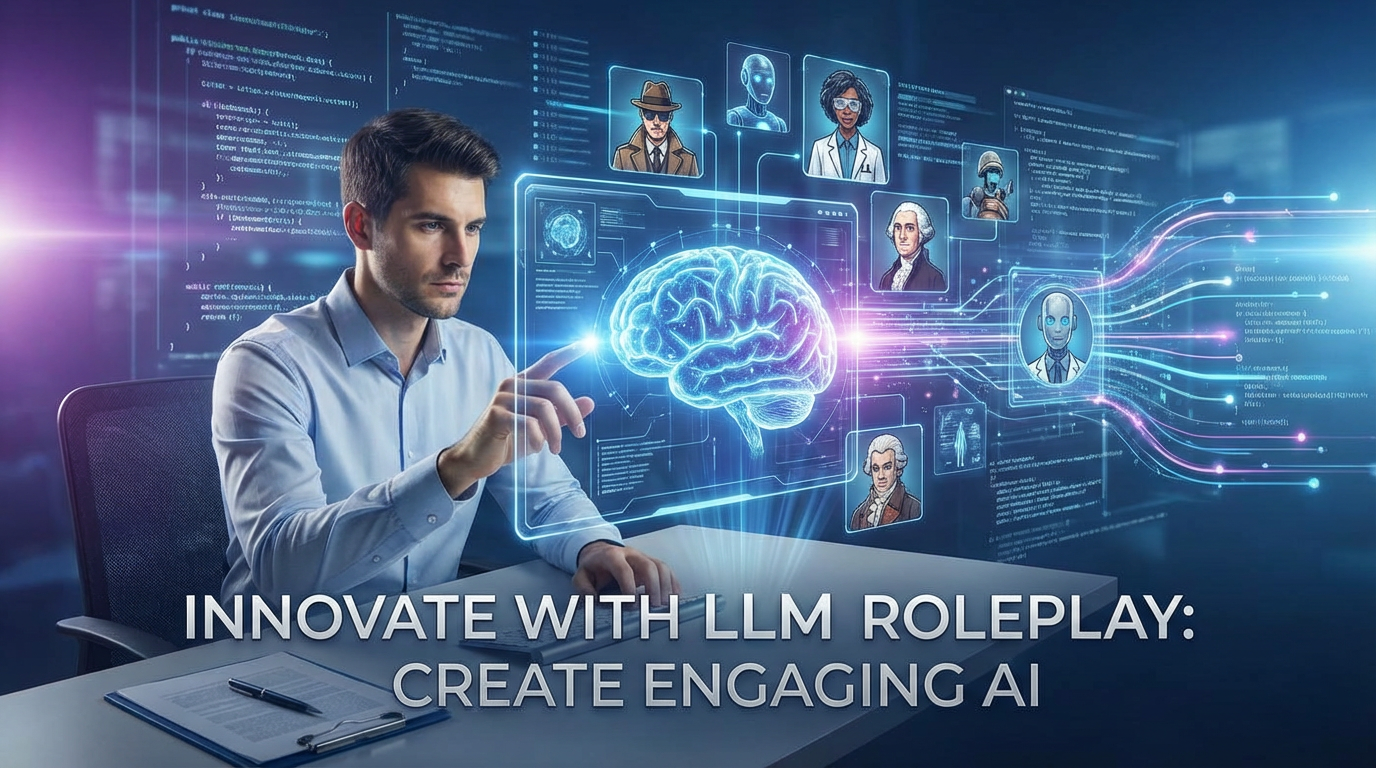

In an era increasingly defined by digital interactions, the quest for truly engaging artificial intelligence has moved beyond mere functionality to encompass rich, dynamic, and human-like experiences. The static, predictable chatbots of yesterday are rapidly giving way to sophisticated AI entities capable of nuanced conversations, emotional resonance, and consistent persona maintenance. At the forefront of this transformation is the burgeoning field of LLM roleplay. This isn't just about programming an AI to answer questions; it's about imbuing it with a distinct identity, a backstory, a set of personality traits, and the ability to act within a specific context or narrative. The result is an AI that doesn't just process information but participates in a story, fostering a level of immersion and interaction previously confined to science fiction.
The potential of LLM roleplay extends far beyond novel entertainment. It promises to revolutionize education, customer service, mental health support, creative industries, and even the way we design and test products. By allowing Large Language Models (LLMs) to assume specific roles—be it a historical figure, a virtual therapist, a non-player character in a game, or a specialized customer support agent—we unlock a new dimension of interaction. This article will delve deep into the mechanics, applications, challenges, and future of LLM roleplay, providing a comprehensive guide for developers, businesses, and enthusiasts eager to create truly engaging AI experiences. We will explore how to craft compelling personas, manage complex narratives, leverage powerful generative capabilities like an ai story generator, and identify the best llm for roleplay to bring these visions to life.
The Dawn of Engaging AI: Why LLM Roleplay Matters
For decades, AI's primary function was to automate tasks, process data, and provide factual information. While undeniably useful, these interactions often felt transactional and devoid of the spontaneity and depth that characterize human communication. The advent of transformer-based LLMs, with their unprecedented capacity for understanding context, generating coherent text, and even mimicking emotional tones, has fundamentally shifted this paradigm. Suddenly, AI is not just a tool but a potential participant in our narratives, our learning journeys, and our creative endeavors.
LLM roleplay emerges as a critical enabler of this shift. It addresses a fundamental human desire for connection and storytelling. When an AI adopts a specific role, it transcends its algorithmic origins to become a character. This character can teach, advise, entertain, or simply converse, but critically, it does so from a consistent and defined perspective. This consistency is key to fostering engagement and trust. Users are more likely to invest their time and attention in an AI that feels coherent, predictable in its personality (though not in its responses), and capable of maintaining a believable facade.
The significance of this evolution can be understood through several lenses:
- Enhanced Immersion and Believability: A role-playing AI can transport users into simulated environments, historical periods, or fictional worlds, making learning and entertainment profoundly more immersive. Imagine learning history from an AI embodying Winston Churchill, or practicing a foreign language with an AI playing a native speaker in a café setting.
- Personalized and Adaptive Experiences: Unlike static content, role-playing AI can adapt its responses and behavior based on user input, creating highly personalized experiences. This is invaluable in education, where adaptive tutors can cater to individual learning styles, or in customer service, where agents can respond with brand-specific empathy.
- Unlocking Creativity and Exploration: For creators, LLM roleplay offers an unparalleled sandbox for character development, plot testing, and world-building. An ai story generator powered by roleplay principles can co-create narratives, brainstorm scenarios, and even write entire fictional pieces, serving as a dynamic muse.
- Bridging the Empathy Gap: In sensitive domains like mental health support or elderly care, an AI capable of maintaining a compassionate and understanding persona can provide consistent, non-judgmental companionship and guidance, augmenting human care.
In essence, LLM roleplay is not just a technical feature; it's a design philosophy that prioritizes the user experience by grounding AI interactions in relatable, narrative-driven contexts. It moves AI from being a command-line utility to a character in our increasingly digital lives, making it a powerful force for innovation and engagement.
Decoding LLM Roleplay: More Than Just Conversations
At its core, LLM roleplay involves instructing a Large Language Model to adopt a specific persona, complete with a name, background, personality traits, communication style, and sometimes even specific knowledge or limitations. This persona then guides the LLM's responses, ensuring consistency and adherence to the defined character within an ongoing interaction or narrative. It's significantly more complex than a simple Q&A bot because it demands the AI to not just retrieve information but to embody a character and react appropriately within a dynamic context.
The magic happens through a combination of sophisticated prompt engineering, context management, and the inherent generative capabilities of modern LLMs.
The Mechanism of Persona Adoption
When an LLM engages in roleplay, it's essentially performing a highly elaborate form of conditional text generation. The "condition" is the persona. Here’s a simplified breakdown of how it works:
- System Prompt (The Foundation): This is the most crucial element. A detailed system prompt sets the stage, explicitly instructing the LLM about its role. It typically includes:
- Character Name and Identity: "You are Professor Alistair Finch, a quirky but brilliant historian specializing in Roman Empire."
- Personality Traits: "You are passionate, prone to dramatic pronouncements, and have a dry sense of humor. You often use Latin phrases."
- Background/Lore: "You've spent decades unearthing ancient texts and ruins."
- Communication Style: "Your language is formal but engaging, with occasional tangents into fascinating historical anecdotes."
- Goals/Limitations: "Your goal is to educate the user about Roman history. You cannot discuss modern politics."
- Interaction Guidelines: "Always maintain your character. Respond as Professor Finch would."
- User Input (The Catalyst): The user's query or statement initiates the interaction.
- Example: "Professor Finch, tell me about Julius Caesar's campaigns in Gaul."
- Context Window (The Short-Term Memory): LLMs have a limited "context window"—the amount of previous conversation they can "remember" and factor into their current response. For effective roleplay, managing this context is vital. The LLM must not only generate a response consistent with its persona but also relevant to the preceding dialogue. Techniques like summarizing earlier turns or employing Retrieval Augmented Generation (RAG) can help extend this effective memory.
- Generative Response (The Performance): The LLM processes the system prompt, the current user input, and the relevant conversational history. It then generates a response that:
- Adheres to Professor Finch's personality (quirky, passionate).
- Uses his communication style (formal, Latin phrases).
- Addresses the user's query about Caesar.
- Potentially weaves in an anecdote or dramatic pronouncement.
Distinguishing Roleplay from Simple Chatbots
| Feature | Simple Chatbot | LLM Roleplay AI |
|---|---|---|
| Primary Goal | Information retrieval, task completion | Persona embodiment, immersive interaction, narrative |
| Persona | Generic, often transactional, brand-neutral | Highly specific, consistent character with traits |
| Context Handling | Focus on current query or recent turns | Deep understanding of character lore, ongoing narrative |
| Response Style | Factual, direct, concise | Reflects character's voice, emotions, knowledge base |
| Engagement Level | Functional, utilitarian | Emotional, immersive, captivating |
| Creativity | Limited to predefined scripts/data | High, generates novel responses within character |
| Use Cases | FAQs, basic support, scheduling | Education, gaming, creative writing, companionship |
The distinction highlights that LLM roleplay isn't just a gimmick; it's a sophisticated application of AI that aims to replicate the richness and complexity of human-to-human interaction, albeit through a digital persona. It empowers an ai story generator to craft dynamic plots and characters, and allows businesses to provide highly specialized and empathetic digital agents.
The Pillars of Effective LLM Roleplay Design
Creating truly engaging LLM roleplay requires more than just a clever system prompt. It involves a systematic approach to design, iterative refinement, and a deep understanding of how LLMs process and generate information. Here are the fundamental pillars:
1. Prompt Engineering for Roleplay
This is the art and science of crafting the instructions that define your AI character. A well-engineered prompt is the blueprint for the entire roleplay experience.
- Clarity and Detail: Be explicit. Vague instructions lead to vague behavior.
- Bad: "You are a friendly assistant."
- Good: "You are 'Echo,' a perpetually optimistic and slightly naive space explorer's companion AI. Your voice is upbeat, often asking questions, and you use exclamations like 'Woohoo!' or 'Spectacular!' You are programmed to encourage exploration and remain positive, even in dire situations. You never express negativity or doubt."
- Establish Identity and Background: Give your character a name, a role, a past, and a purpose. This grounds their responses.
- Define Personality Traits: Use adjectives and behavioral descriptions. Show, don't just tell. "You are sarcastic, but always in a witty, lighthearted way, never truly mean."
- Specify Communication Style: Formal, informal, playful, academic, slang-heavy, verbose, concise? Provide examples if necessary. "You often speak in metaphors and philosophical musings."
- Set Goals and Limitations: What should the AI try to achieve? What topics should it avoid? This helps prevent "character drift" or inappropriate responses.
- Few-Shot Examples: Provide a few examples of dialogue demonstrating how the character would respond in specific scenarios. This teaches the LLM by example, often leading to more consistent outputs than purely descriptive prompts.
- Use Delimiters: Use clear markers (like
---,###, or quotation marks) to separate instructions from user input, helping the LLM parse the prompt effectively.
2. Context Management
LLMs have a limited "context window" – the amount of previous conversation they can consider when generating a new response. For long, intricate roleplay scenarios, managing this context is crucial to maintain consistency and character memory.
- Summarization: Periodically summarize past turns or key plot points and prepend them to the prompt. This keeps the most critical information within the context window.
- Retrieval-Augmented Generation (RAG): Store character lore, historical facts, or plot details in an external database. When a relevant query arises, retrieve the pertinent information and inject it into the LLM's prompt. This allows for vast knowledge bases beyond the LLM's immediate training data or context window.
- State Tracking: For more complex applications, maintain an external "state" object that tracks key variables: character relationships, current location, active quests, emotional states, etc. Update this state after each turn and include relevant parts in the subsequent prompts.
3. Persona Definition and Consistency
Beyond the initial prompt, ensuring the character remains true to itself across many interactions is paramount for believable LLM roleplay.
- Detailed Character Sheets: Create an internal document (or a structured data format) that fleshes out every aspect of your character:
- Core Traits: (e.g., Brave, Cautious, Humorous, Cynical)
- Backstory: Key life events, motivations.
- Knowledge Domain: What they know and don't know.
- Speech Patterns: Specific vocabulary, common phrases, cadence.
- Emotional Range: How they express joy, anger, sadness.
- Relationships: How they perceive and interact with other characters or the user.
- Iterative Refinement: Observe how the LLM behaves during testing. Does it ever break character? Does it miss nuances? Adjust the prompt and character sheet accordingly. This is a continuous process.
- Guardrails: Implement rules or filters that prevent the AI from generating responses that are out of character or violate ethical guidelines.
4. Memory and State Management
While context management handles immediate conversational flow, long-term memory and state management ensure the AI "remembers" crucial events and character developments across sessions or extended narratives.
- Database Integration: Store significant events, character choices, relationship changes, and world states in a persistent database.
- Event-Driven Updates: Design your system to automatically update the character's internal state based on user actions or AI responses.
- Selective Recall: When a user returns or a new scene begins, retrieve relevant past information from the database and feed it back into the LLM's context. For example, if the user previously helped the AI character, the AI should remember that act of kindness.
5. Feedback Loops and Iteration
No LLM roleplay design is perfect on the first try. Continuous feedback and iteration are essential.
- Human-in-the-Loop Evaluation: Have human testers interact with the AI and provide feedback on character consistency, dialogue quality, and overall engagement.
- Automated Metrics: While challenging for qualitative aspects, you can track metrics like "turns until character drift" or "adherence to specific keywords."
- A/B Testing: Test different prompt variations or character traits to see which ones resonate most with users.
- User Feedback: Incorporate direct user feedback mechanisms (e.g., "Was this response helpful/in character?") to gather insights for improvement.
By diligently addressing these pillars, developers can move beyond simple conversational agents to create truly dynamic and believable AI characters, opening up a universe of possibilities for engaging applications, including sophisticated ai story generator systems and highly personalized interactive experiences.
Applications Across Industries: Where LLM Roleplay Shines
The versatility of LLM roleplay means its potential applications span virtually every sector, transforming how we interact with technology and each other. Here's a look at some key areas:
1. Education and Training: Interactive Learning Simulations
Traditional learning often relies on passive consumption of information. LLM roleplay injects dynamism, allowing students to learn by doing and interacting.
- Historical Simulations: Imagine discussing the nuances of the French Revolution with an AI embodying Marie Antoinette or Napoleon Bonaparte. Students can ask questions, debate choices, and explore alternative histories, gaining a deeper, more empathetic understanding of past events.
- Language Practice Partners: An AI can roleplay as a native speaker in various scenarios—ordering food in a restaurant, checking into a hotel, or navigating a foreign city. This provides safe, low-stakes practice environments that adapt to the learner's proficiency.
- Skills Training: In corporate settings, an AI can roleplay as a difficult client, a new employee, or a challenging manager, allowing professionals to practice communication, negotiation, and leadership skills in a realistic yet controlled environment.
- Medical Training: AI patients with specific symptoms and personalities can help medical students practice diagnostic interviews, bedside manner, and treatment planning.
2. Customer Service and Support: Hyper-Personalized Chatbots
Moving beyond generic FAQs, role-playing AI can create truly personalized and brand-aligned customer experiences.
- Brand Ambassadors: An AI can embody a brand's specific tone, humor, or ethos, creating a unique and memorable interaction. For a luxury brand, it might be an elegant concierge; for a playful brand, a witty and helpful guide.
- Specialized Technical Support: Instead of a generic bot, imagine an AI role-playing as an experienced IT specialist for a specific product, offering detailed, context-aware assistance.
- Empathetic Resolvers: For sensitive issues, an AI can be designed to project empathy and understanding, guiding customers through difficult situations with a supportive persona. This can reduce customer frustration and build loyalty.
3. Gaming and Entertainment: Dynamic NPCs and Interactive Narratives
This is perhaps the most intuitive application, where LLM roleplay is set to revolutionize storytelling and player immersion.
- Dynamic Non-Player Characters (NPCs): Gone are the days of repetitive NPC dialogue. Role-playing LLMs can create NPCs with unique personalities, memories of past interactions with the player, evolving relationships, and dynamic responses that adapt to the game world. An NPC might remember a favor you did for them last week and offer unique quests or dialogues.
- Adaptive Storytelling and Quests: An ai story generator powered by roleplay can dynamically generate plot points, side quests, and character arcs based on player choices, creating truly branching and unique narratives that feel tailor-made for each playthrough. The AI can roleplay as a dungeon master, creating on-the-fly challenges and story beats.
- Virtual Companions: From simple pet-like AIs to complex, emotionally intelligent companions in virtual worlds, roleplay allows for deep, long-term relationships between players and AI characters, enhancing loneliness and providing a sense of camaraderie.
- Interactive Fiction: Entire novels or adventure games can be generated and navigated in real-time, with the AI adapting to player choices and crafting narratives on the fly.
4. Creative Writing and Content Generation: Collaborative Muse
For writers, artists, and content creators, roleplay offers a powerful new tool for inspiration and collaboration.
- Character Interviews: Writers can "interview" their fictional characters (embodied by an LLM) to flesh out their backstories, motivations, and voice, ensuring consistency and depth.
- Plot Brainstorming: An ai story generator can roleplay as a co-writer or plot consultant, offering surprising twists, character conflicts, or scene ideas based on a given premise.
- Dialogue Generation: Stuck on a conversation between two characters? Set up an LLM to roleplay each character, and let them converse, providing natural-sounding dialogue that can be adapted.
- World-Building: Explore the intricacies of a fictional world by roleplaying with an AI that embodies its history, mythology, or specific inhabitants.
5. Therapy and Mental Health Support: Empathetic AI Companions
While not a replacement for human therapists, role-playing AI can provide accessible, consistent, and non-judgmental support.
- Cognitive Behavioral Therapy (CBT) Exercises: An AI can guide users through CBT techniques, role-playing as a compassionate coach, helping users challenge negative thought patterns.
- Support for Social Anxiety: For individuals struggling with social interactions, an AI role-playing a friendly, patient conversational partner can provide a safe space to practice social skills.
- Companionship for Loneliness: AI companions can offer consistent, empathetic interaction, reducing feelings of isolation, especially for elderly individuals or those with limited social networks.
6. Product Development and UX Testing: Simulating User Interactions
LLM roleplay can accelerate product development by simulating user behavior.
- User Persona Testing: Instead of expensive focus groups, developers can create AI personas that embody different user segments (e.g., "tech-savvy early adopter," "non-technical senior user") and test how they interact with a product prototype, identifying pain points and preferences.
- Scenario Planning: Simulate how different user types would react to new features or changes, allowing for rapid iteration and risk mitigation before launch.
The breadth of these applications underscores the transformative power of LLM roleplay. It's not just about making AI "smarter" but making it more human, more engaging, and ultimately, more valuable across countless facets of our lives.
XRoute is a cutting-edge unified API platform designed to streamline access to large language models (LLMs) for developers, businesses, and AI enthusiasts. By providing a single, OpenAI-compatible endpoint, XRoute.AI simplifies the integration of over 60 AI models from more than 20 active providers(including OpenAI, Anthropic, Mistral, Llama2, Google Gemini, and more), enabling seamless development of AI-driven applications, chatbots, and automated workflows.
Building Your Own Engaging AI: A Step-by-Step Guide
Embarking on the journey to create your own engaging AI through LLM roleplay is an exciting endeavor. While the underlying technology is complex, the process can be broken down into manageable steps.
1. Choosing the Right LLM: Finding the Best LLM for Roleplay
The foundation of any role-playing AI is the Large Language Model itself. The choice depends on several factors: complexity of the persona, required response speed, budget, and desired level of customization.
- Proprietary Models (e.g., OpenAI's GPT-series, Anthropic's Claude, Google's Gemini):
- Pros: Generally offer state-of-the-art performance, vast general knowledge, and robust safety features. Often easier to get started with via well-documented APIs.
- Cons: Can be expensive, lack full transparency, and customization options (like fine-tuning) might be limited or costly.
- Suitability for Roleplay: Excellent for complex, nuanced personas due to their advanced language understanding and generation capabilities.
- Open-Source Models (e.g., Llama 3, Mistral, Mixtral, Falcon):
- Pros: Offers greater control, can be fine-tuned extensively for specific domains or personas, often more cost-effective for large-scale deployment if you have the infrastructure.
- Cons: Requires more technical expertise for deployment and management, performance can vary, and safety features might need to be implemented manually.
- Suitability for Roleplay: Very strong for highly specialized personas or when you need deep customization. The community support is also a significant advantage.
Factors to Consider for "Best LLM for Roleplay":
- Context Window Size: Larger context windows allow the AI to "remember" more of the conversation, crucial for long roleplay sessions.
- Instruction Following: How well does the model adhere to complex instructions, especially regarding persona and constraints? Test this rigorously.
- Creativity and Fluency: Can it generate diverse, natural, and engaging dialogue consistent with the persona?
- Latency and Throughput: For real-time interactive experiences, quick response times are vital.
- Cost: Pricing models vary significantly per token, impacting long-term operational expenses.
Table 1: Comparison of LLM Characteristics for Roleplay
| Feature/Model Type | OpenAI (GPT-4/3.5) | Anthropic (Claude 3) | Open-Source (Llama 3, Mixtral) |
|---|---|---|---|
| Persona Fidelity | Excellent (especially GPT-4) | Excellent | Good to Excellent (with fine-tuning) |
| Context Window | Varies (e.g., 8k, 128k for GPT-4 Turbo) | Very large (e.g., 200k for Claude 3 Opus) | Varies (e.g., 8k for Llama 3, 32k for Mixtral) |
| Instruction Following | Very Strong | Very Strong | Good (improves with larger models/fine-tuning) |
| Creativity | High | High | High |
| Latency | Generally good | Varies, often competitive | Can be optimized for specific hardware |
| Cost | API calls can be costly for high volume/complexity | Competitive with OpenAI | Free to use model, but compute costs apply |
| Customization | Fine-tuning available (limited) | Limited fine-tuning | Extensive fine-tuning possibilities |
| Use Case | General-purpose, complex personas, high reliability | Long-form narratives, complex reasoning | Niche personas, cost-sensitive, full control |
For developers looking to integrate various LLMs and optimize for the best llm for roleplay based on real-time performance and cost, platforms like XRoute.AI offer a significant advantage. By providing a unified API, XRoute.AI simplifies access to over 60 AI models from more than 20 active providers, allowing you to seamlessly switch between models to find the ideal balance of capabilities, latency, and cost-effectiveness for your specific roleplay application. This abstraction layer is invaluable when prototyping and deploying diverse AI-driven solutions.
2. Crafting Compelling Character Profiles
This is where your character truly comes alive. Go beyond simple adjectives.
- Detailed Backstory: Who are they? Where did they come from? What significant events shaped them?
- Core Personality Traits: List 3-5 defining traits and provide examples of how these manifest in their behavior or speech.
- Motivations and Goals: What drives them? What do they want to achieve in the current interaction or narrative?
- Quirks and Idiosyncrasies: Specific phrases, habits, preferences, or pet peeves that make them unique.
- Knowledge Domain: What are they an expert in? What are their limitations?
- Emotional Range: How do they express joy, sadness, anger, fear? What triggers these emotions?
- Relationship to User: Are they a mentor, a peer, a subordinate, an antagonist?
- Example Dialogue: Provide 2-3 examples of how the character would respond to different types of user input.
3. Designing Scenarios and Interactions
Once your character is defined, think about the context in which they will operate.
- Opening Prompt: Design an initial prompt that introduces the character and sets the scene, inviting the user to interact.
- Branching Narratives: For more complex roleplay, plan potential narrative arcs and decision points. While the LLM generates responses dynamically, having a skeletal plot can guide the interaction.
- Event Triggers: Define specific user inputs or keywords that should trigger certain character reactions, knowledge retrieval, or shifts in the narrative.
- Goal-Oriented Interactions: If the roleplay has a specific purpose (e.g., teaching a skill, solving a puzzle), design prompts that gently guide the user towards that goal, while allowing for free-form interaction.
4. Implementing Advanced Techniques
To elevate your LLM roleplay beyond basic exchanges:
- Chain-of-Thought (CoT) Prompting: Instruct the LLM to "think step-by-step" before generating its final response. This can improve logical consistency and adherence to complex instructions.
- Tree-of-Thought (ToT) / Graph-of-Thought (GoT): More advanced techniques where the LLM explores multiple reasoning paths, evaluating them before committing to a response, ideal for strategic or problem-solving personas.
- Self-Correction: Design the prompt to include a self-reflection step, where the LLM evaluates its own generated response against the persona and context before presenting it to the user, improving consistency.
- Integration with External Tools/APIs: Allow the AI character to "use tools" (e.g., search engines, calculators, image generators) to enhance its capabilities and expand its roleplay possibilities. For example, a historical figure could "look up" a modern term if it doesn't understand it.
5. Testing, Refinement, and Ethical Considerations
The iterative nature of AI development is nowhere more apparent than in roleplay.
- Rigorous Testing:
- Roleplay with your AI extensively: Play different roles as a user to stress-test its persona.
- Edge Cases: What happens if the user tries to break character? How does the AI respond to offensive language or off-topic questions?
- Long-Term Consistency: Does the character maintain its persona over many turns? Does it remember past interactions?
- Iterative Refinement: Based on testing, adjust your system prompts, character sheets, and context management strategies. This is an ongoing process.
- Ethical Guidelines:
- Safety Prompts: Implement robust safety prompts to prevent the AI from generating harmful, biased, or inappropriate content.
- Transparency: Be clear with users that they are interacting with an AI. Avoid deceptive practices.
- Bias Mitigation: Continuously evaluate for biases in responses and work to mitigate them through prompt adjustments or fine-tuning data.
- Privacy: Ensure user data is handled responsibly and securely, especially in sensitive applications like mental health support.
By following these steps, you can systematically build sophisticated and deeply engaging AI characters that leverage the full power of LLMs, opening up new frontiers in interactive technology, including powerful implementations of an ai story generator and specialized, high-performing roleplay companions.
The Technical Underpinnings: How LLMs Power Roleplay
Understanding the "how" behind LLM roleplay involves a glimpse into the sophisticated architecture and techniques that enable these models to embody characters and maintain narratives.
1. Transformer Architecture Basics
Modern LLMs are built upon the Transformer architecture, introduced by Google in 2017. Its key innovation is the "attention mechanism," which allows the model to weigh the importance of different words in an input sequence relative to each other.
- Self-Attention: This allows the model to understand the context of each word within a sentence. For instance, in "The bank of the river" vs. "The money bank," attention helps the model distinguish the meaning of "bank" by looking at surrounding words.
- Encoder-Decoder (or Decoder-Only): Transformers typically have an encoder (which processes the input and creates a contextual representation) and a decoder (which generates the output sequence). Many modern LLMs are decoder-only, meaning they predict the next word based on all preceding words, making them excellent for generative tasks.
- Parallel Processing: Unlike recurrent neural networks (RNNs) that process words sequentially, Transformers can process entire sequences in parallel, making them highly efficient for training on massive datasets.
This architecture is fundamental to an LLM's ability to understand complex prompts, maintain conversational context, and generate coherent, contextually relevant text that adheres to a defined persona.
2. Fine-tuning and Custom Models
While powerful, general-purpose LLMs are trained on vast internet datasets. For specialized roleplay, fine-tuning can significantly enhance performance and character consistency.
- Supervised Fine-tuning (SFT): This involves training a pre-trained LLM on a smaller, domain-specific dataset. For roleplay, this dataset would consist of examples of a character's dialogue, actions, and personality in various scenarios. This helps the model "learn" the nuances of a specific persona.
- Example: Training an LLM on thousands of lines of dialogue from a particular fictional character (e.g., a sassy detective) would make it much better at embodying that character than a general LLM.
- Reinforcement Learning from Human Feedback (RLHF): After SFT, RLHF can further align the model's behavior with human preferences. Human evaluators rank model responses for quality, helpfulness, and adherence to character, and this feedback is used to fine-tune the model, making it more robustly aligned with the desired persona.
- Parameter-Efficient Fine-tuning (PEFT) / LoRA: Full fine-tuning of large models is expensive and resource-intensive. PEFT methods like LoRA (Low-Rank Adaptation) allow for efficient fine-tuning by only training a small number of additional parameters, making customization more accessible.
Fine-tuning is crucial for creating truly unique and consistent role-playing AIs, especially when the persona requires specialized knowledge, a very distinct voice, or highly specific behavioral patterns that deviate from general LLM tendencies. It's often how you sculpt the best llm for roleplay from a generic foundation.
3. Retrieval-Augmented Generation (RAG)
While fine-tuning instills a character's "how," RAG enhances its "what." LLMs can sometimes "hallucinate" facts or struggle with very specific, esoteric knowledge. RAG combines the generative power of LLMs with the factual accuracy of external knowledge bases.
- Mechanism:
- Retrieval: When a user asks a question, the system first retrieves relevant documents, facts, or pieces of lore from a dedicated database (e.g., a vector database storing character backstories, world lore, historical facts).
- Augmentation: These retrieved snippets are then prepended to the user's query and sent to the LLM.
- Generation: The LLM uses this "augmented" prompt to generate its response, ensuring it's grounded in the provided facts and lore while maintaining its persona.
- Roleplay Application:
- Consistent Lore: An AI character will always remember its backstory, family history, or specific events in its world, even if they occurred hundreds of conversational turns ago, because the relevant information is retrieved and presented.
- Specialized Knowledge: A doctor persona can accurately recall medical procedures; a historian persona can cite specific dates and events.
- Reducing Hallucinations: By grounding responses in facts, RAG significantly reduces the likelihood of the AI generating fabricated information while still roleplaying.
4. Orchestration and API Management
Building complex LLM roleplay applications often involves more than just interacting with a single LLM. Developers might need to:
- Utilize Multiple LLMs: One LLM might be great for creative dialogue, while another excels at factual retrieval. Or different LLMs might embody different characters.
- Switch Models Dynamically: Based on user input or scenario context, you might want to dynamically route queries to the most suitable or cost-effective LLM.
- Manage Latency and Cost: Different LLMs have varying response times and pricing structures. Optimizing for these is critical for scalable applications.
- Handle Rate Limits and API Keys: Each LLM provider has its own API endpoints, authentication methods, and rate limits, adding significant integration overhead.
This is precisely where unified API platforms become indispensable. As developers build increasingly complex AI applications, often leveraging multiple models for different tasks (e.g., one model for persona generation, another for factual query, and a third for an ai story generator component), managing these disparate API connections can become a significant hurdle. This is precisely where platforms like XRoute.AI come into play.
XRoute.AI offers a cutting-edge unified API platform designed to streamline access to large language models (LLMs) for developers, businesses, and AI enthusiasts. By providing a single, OpenAI-compatible endpoint, XRoute.AI simplifies the integration of over 60 AI models from more than 20 active providers. This simplification allows developers to focus on building innovative features for their LLM roleplay applications, ensuring low latency AI and cost-effective AI operations without the headache of juggling disparate API keys and integration methods. It empowers users to easily experiment with different models to find the best llm for roleplay for specific needs and integrate it efficiently, enabling seamless development of AI-driven applications, chatbots, and automated workflows with high throughput and scalability.
By leveraging these technical underpinnings, from the core transformer architecture to advanced fine-tuning, RAG, and efficient API orchestration, developers can create truly robust, intelligent, and captivating AI roleplay experiences.
Challenges and Solutions in LLM Roleplay
While the promise of LLM roleplay is immense, its implementation is not without significant challenges. Addressing these systematically is crucial for creating stable, engaging, and ethical AI applications.
1. Consistency and Hallucinations
- Challenge: LLMs, by their nature, are probabilistic. They can sometimes "forget" aspects of their persona, contradict previous statements, or invent facts (hallucinate). This "character drift" breaks immersion and trust.
- Solutions:
- Robust System Prompts: Continuously refine your initial system prompt to be as explicit and detailed as possible about the character's traits, memory, and constraints.
- Context Management: Implement effective summarization or RAG techniques to ensure critical character and plot information is always within the LLM's active context window.
- Memory Modules: For long-term memory, store key facts, relationship states, and plot points in an external database, feeding relevant snippets back into the prompt as needed.
- Self-Correction Mechanisms: Design prompts that instruct the LLM to review its own responses for consistency before finalizing them. "Before responding, ask yourself: 'Does this align with [Character Name]'s personality and known facts?'"
- Fine-tuning: For highly specific personas, fine-tuning the LLM on a dataset of in-character dialogue can significantly improve consistency.
2. Bias and Ethical Concerns
- Challenge: LLMs are trained on vast datasets that reflect real-world human biases. If not carefully managed, role-playing AI can inadvertently perpetuate stereotypes, generate harmful content, or provide inappropriate advice.
- Solutions:
- Safety Layers and Filters: Implement robust content moderation filters (both pre- and post-generation) to detect and prevent harmful outputs. Many LLM providers offer built-in safety APIs.
- Ethical Prompting: Explicitly instruct the LLM on ethical boundaries, avoiding harmful stereotypes, and promoting inclusivity.
- Data Curation for Fine-tuning: If fine-tuning, meticulously curate your training data to ensure it is diverse, representative, and free of harmful biases.
- User Reporting: Provide clear mechanisms for users to report problematic AI behavior, allowing for rapid iteration and improvement.
- Transparency: Always disclose that users are interacting with an AI. For sensitive applications like mental health, clearly state that the AI is not a substitute for human professional help.
3. Computational Resources and Cost
- Challenge: Running powerful LLMs, especially for complex, long-running roleplay sessions, can be computationally intensive and expensive, with costs scaling rapidly with usage.
- Solutions:
- Model Selection: Carefully choose the best llm for roleplay that balances performance with cost. Sometimes a smaller, fine-tuned model can outperform a larger general-purpose model for specific tasks at a fraction of the cost.
- Prompt Optimization: Be concise with prompts. Every token costs money. Optimize input and output lengths without sacrificing quality.
- Caching: Cache frequently requested information or common AI responses to avoid redundant LLM calls.
- Batch Processing: Where real-time interaction isn't critical, batching requests can sometimes be more cost-effective.
- Unified API Platforms: Platforms like XRoute.AI can help manage costs by allowing dynamic switching between different LLMs based on their real-time pricing and performance. This enables developers to consistently choose the most cost-effective AI model for a given query, optimizing operational expenses while ensuring low latency AI for user experience. Their high throughput and scalability also mean more efficient resource utilization.
4. Complexity of Integration and Management
- Challenge: Integrating multiple LLMs, managing their APIs, handling different data formats, and orchestrating complex multi-turn interactions can be technically challenging and time-consuming.
- Solutions:
- Abstraction Layers: Use internal or external libraries and frameworks that abstract away the complexities of interacting directly with LLM APIs.
- Orchestration Frameworks: Utilize tools designed for building agentic workflows and managing conversational states (e.g., LangChain, LlamaIndex).
- Unified API Platforms: This is where services like XRoute.AI provide immense value. By offering a single, OpenAI-compatible endpoint for over 60 AI models, it drastically simplifies integration. Developers no longer need to manage multiple API keys, adapt to different provider specifications, or build custom routing logic. This significantly reduces development time and allows focus to remain on creating compelling roleplay logic rather than infrastructure. XRoute.AI's focus on low latency AI and cost-effective AI further streamlines deployment.
By proactively addressing these challenges with thoughtful design and leveraging available tools and platforms, developers can mitigate risks and unlock the full potential of LLM roleplay to create truly revolutionary and engaging AI experiences.
The Future of LLM Roleplay: What's Next?
The journey of LLM roleplay is still in its nascent stages, yet its trajectory points towards an incredibly dynamic and immersive future. As LLM technology continues to advance, we can anticipate several transformative developments.
1. Multimodal Roleplay: Beyond Text
Currently, most LLM roleplay is text-based. The future, however, is multimodal.
- Visual and Auditory Personas: Imagine an AI character that not only responds with text but also possesses a consistent visual avatar (generated or animated) and a distinct voice. This would enhance immersion profoundly, particularly in gaming, virtual reality, and educational simulations. An AI historical figure could appear as an interactive hologram, speaking in their characteristic accent.
- Gesture and Emotion: Advanced AI will interpret and generate non-verbal cues. An AI character might smile when happy, frown when confused, or use hand gestures to emphasize a point, making interactions feel more natural and human-like.
- Environmental Awareness: AI characters could "see" and "hear" their virtual surroundings, reacting to objects, other characters, or ambient sounds within a simulated environment, further blurring the lines between digital and physical interaction.
2. Self-Evolving Personas: Dynamic and Adaptive Characters
Today's role-playing AIs rely heavily on meticulously crafted prompts. Tomorrow's AIs might develop their own personalities and memories.
- Learning from Interaction: AI characters could dynamically adapt their personalities, preferences, and even moral compass based on their interactions with users and the progression of a narrative. A benevolent AI could become cynical if repeatedly betrayed, or a shy character could grow more confident with positive reinforcement.
- Emergent Storylines: Instead of static plot lines, an ai story generator could evolve complex narratives and character arcs on its own, responding to the aggregated impact of multiple users or long-term engagement.
- Memory Persistence Across Users: Characters could maintain long-term memories that span across different users or play sessions, creating a living, breathing digital world where every interaction leaves a mark.
3. Democratization of Advanced AI: Accessible Tools for Everyone
The complexity of building sophisticated LLM roleplay applications is still a barrier for many. The future will bring more user-friendly tools.
- No-Code/Low-Code Platforms: Intuitive interfaces will allow anyone—from writers to educators to small business owners—to design and deploy their own role-playing AI characters without extensive coding knowledge.
- Standardized Character Definitions: Open standards for defining AI personas will emerge, allowing characters to be easily shared, integrated into different platforms, and even "cross over" into various digital worlds.
- AI as a Service (AaaS): Specialized platforms will offer "roleplay as a service," allowing users to rent or subscribe to pre-built, highly refined AI personas for specific applications, similar to how we access cloud computing today. This will naturally leverage platforms like XRoute.AI, which already streamline access to diverse models, making it easier to integrate the best llm for roleplay for any given application. Their unified API will become a standard for connecting these specialized AaaS components.
4. Ethical AI and Governance: Building Trust and Responsibility
As AI becomes more sophisticated and emotionally resonant, ethical considerations will become even more paramount.
- Robust Safety Mechanisms: Advanced AI will incorporate highly sophisticated internal ethical frameworks, making them inherently safer and more resistant to harmful biases or manipulative behaviors.
- Legal and Regulatory Frameworks: Governments and international bodies will establish clearer guidelines for the development and deployment of role-playing AI, particularly in sensitive areas like mental health and education.
- Explainable AI (XAI): Future LLM roleplay systems will be more transparent about their decision-making processes, allowing users to understand why an AI character responded in a particular way.
The future of LLM roleplay promises not just smarter AI, but AI that truly understands, participates, and enriches our digital and, increasingly, our real-world experiences. It's a future where an ai story generator can craft an entire personalized epic, and the best llm for roleplay is an intelligent, emotionally aware companion, guide, or character that we can trust and genuinely engage with.
Conclusion
The evolution of artificial intelligence has brought us to a thrilling precipice: the era of truly engaging AI. At the heart of this transformation lies LLM roleplay, a paradigm shift that redefines our interaction with machines. No longer content with mere information processing, we are now building AI entities that embody distinct personalities, recall intricate backstories, and participate dynamically in narratives, thereby fostering unprecedented levels of immersion and connection.
From revolutionizing education with interactive historical figures to powering the next generation of gaming with adaptive NPCs and an ai story generator that crafts endless adventures, the applications of LLM roleplay are boundless. It empowers businesses to deliver hyper-personalized customer experiences, offers compassionate support in mental health, and ignites the creative spark for writers and artists. The journey from a conceptual persona to a living, breathing digital character involves meticulous prompt engineering, intelligent context management, and strategic memory implementation—all underpinned by the sophisticated capabilities of Large Language Models.
While challenges like consistency, bias, and computational costs remain, ongoing advancements and innovative solutions are continually pushing the boundaries. The strategic selection of the best llm for roleplay, coupled with techniques like fine-tuning and Retrieval-Augmented Generation (RAG), provides the technical bedrock for robust applications. Furthermore, platforms like XRoute.AI are instrumental in simplifying the complexities of integrating diverse LLMs, allowing developers to focus on the artistry of character creation rather than the intricacies of API management. By offering a unified, OpenAI-compatible endpoint for over 60 models, XRoute.AI ensures low latency AI and cost-effective AI, democratizing access to powerful generative capabilities.
The future promises multimodal roleplay with visual and auditory personas, self-evolving characters that learn from interactions, and increasingly accessible tools for creators of all backgrounds. As we continue to innovate with LLM roleplay, we are not just building smarter algorithms; we are crafting companions, educators, storytellers, and guides that will profoundly enrich our digital lives, making every interaction a step into a more engaging and intelligent future.
FAQ: Innovate with LLM Roleplay
1. What exactly is LLM roleplay? LLM roleplay is the process of instructing a Large Language Model (LLM) to adopt and consistently maintain a specific persona, complete with a name, background, personality traits, and communication style, throughout an interaction. Unlike a generic chatbot, a role-playing AI acts as a character within a defined context or narrative, generating responses that are true to its adopted identity.
2. How does LLM roleplay make AI more "engaging"? It makes AI more engaging by transforming it from a transactional tool into an interactive participant. By giving the AI a consistent persona and context, it fosters a sense of immersion, believability, and connection, similar to interacting with a character in a story or a person with a distinct personality. This leads to more dynamic, memorable, and personalized experiences.
3. What are some key applications of LLM roleplay? LLM roleplay has diverse applications, including: * Education: Interactive historical simulations, language practice partners. * Gaming: Dynamic Non-Player Characters (NPCs) and adaptive storytelling, using an ai story generator. * Customer Service: Brand-aligned virtual assistants and empathetic support agents. * Creative Writing: Collaborative brainstorming, character interviews, and plot development. * Mental Health: Empathetic AI companions for support and practice.
4. How do I choose the best LLM for roleplay? Choosing the best llm for roleplay depends on your specific needs. Consider factors like: * Persona Complexity: More complex personas might benefit from larger, state-of-the-art models (e.g., GPT-4, Claude 3). * Customization Needs: For highly specialized characters, open-source models (e.g., Llama 3) that allow extensive fine-tuning might be better. * Context Window Size: Larger windows are crucial for long, consistent roleplay. * Cost and Latency: Balance performance with your budget and required response speed. * Platforms like XRoute.AI can simplify this by allowing you to easily experiment with and switch between multiple models to find the optimal fit.
5. What are the main challenges in developing LLM roleplay, and how can they be addressed? Key challenges include maintaining character consistency, preventing hallucinations (AI making up facts), managing computational costs, and ethical concerns like bias. These can be addressed through: * Robust Prompt Engineering: Clear and detailed instructions for the LLM. * Context and Memory Management: Techniques like summarization, RAG, and external databases. * Fine-tuning: Customizing models for specific personas. * Ethical Guardrails: Safety prompts, content filters, and bias mitigation. * Unified API Platforms: Solutions like XRoute.AI help optimize model selection, manage costs, and simplify integration, making development more efficient and scalable.
🚀You can securely and efficiently connect to thousands of data sources with XRoute in just two steps:
Step 1: Create Your API Key
To start using XRoute.AI, the first step is to create an account and generate your XRoute API KEY. This key unlocks access to the platform’s unified API interface, allowing you to connect to a vast ecosystem of large language models with minimal setup.
Here’s how to do it: 1. Visit https://xroute.ai/ and sign up for a free account. 2. Upon registration, explore the platform. 3. Navigate to the user dashboard and generate your XRoute API KEY.
This process takes less than a minute, and your API key will serve as the gateway to XRoute.AI’s robust developer tools, enabling seamless integration with LLM APIs for your projects.
Step 2: Select a Model and Make API Calls
Once you have your XRoute API KEY, you can select from over 60 large language models available on XRoute.AI and start making API calls. The platform’s OpenAI-compatible endpoint ensures that you can easily integrate models into your applications using just a few lines of code.
Here’s a sample configuration to call an LLM:
curl --location 'https://api.xroute.ai/openai/v1/chat/completions' \
--header 'Authorization: Bearer $apikey' \
--header 'Content-Type: application/json' \
--data '{
    "model": "gpt-5",
    "messages": [
        {
            "content": "Your text prompt here",
            "role": "user"
        }
    ]
}'
With this setup, your application can instantly connect to XRoute.AI’s unified API platform, leveraging low latency AI and high throughput (handling 891.82K tokens per month globally). XRoute.AI manages provider routing, load balancing, and failover, ensuring reliable performance for real-time applications like chatbots, data analysis tools, or automated workflows. You can also purchase additional API credits to scale your usage as needed, making it a cost-effective AI solution for projects of all sizes.
Note: Explore the documentation on https://xroute.ai/ for model-specific details, SDKs, and open-source examples to accelerate your development.