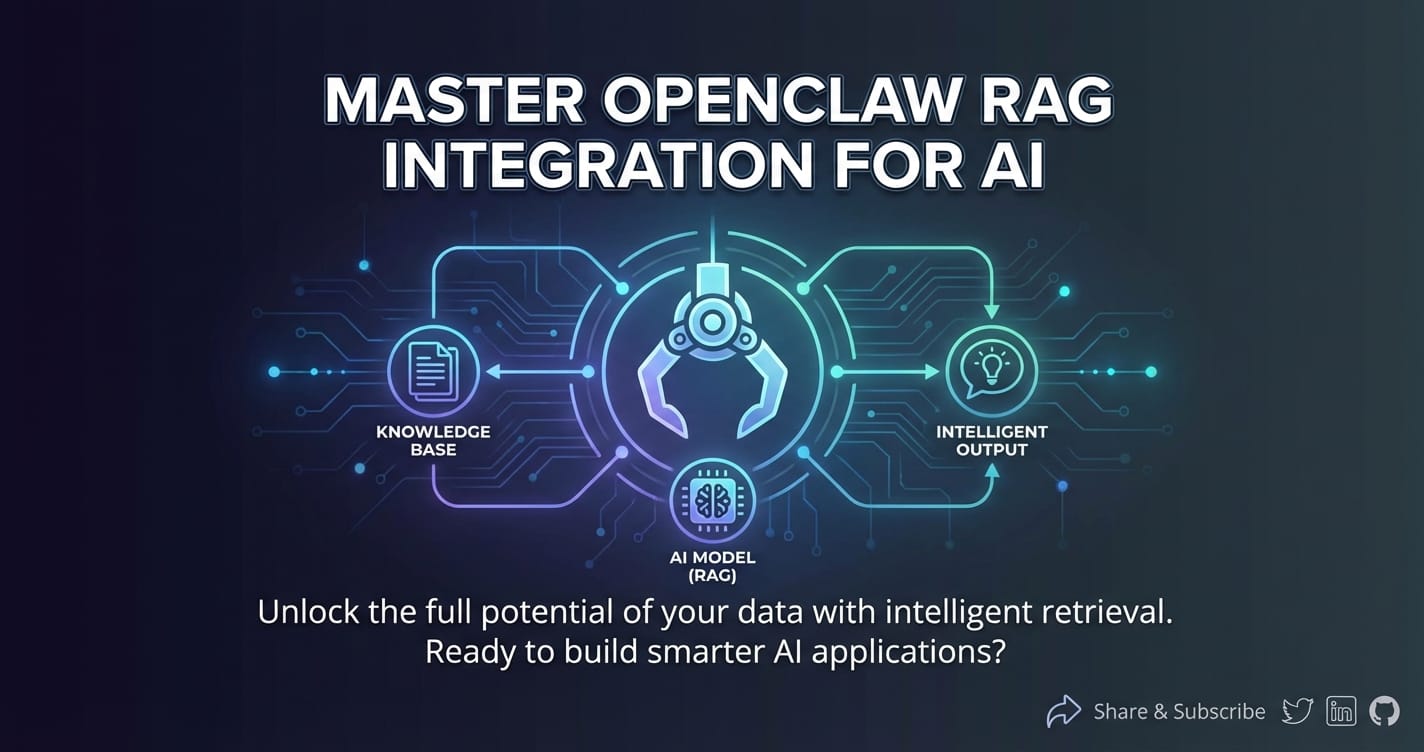
Master OpenClaw RAG Integration for AI

The frontier of artificial intelligence is expanding at an unprecedented pace, bringing with it both immense potential and significant complexity. As developers and businesses strive to build more intelligent, accurate, and responsive AI applications, the challenges of managing diverse models, optimizing performance, and ensuring factual consistency become increasingly paramount. This is particularly true when dealing with Large Language Models (LLMs), which, despite their incredible capabilities, often suffer from "hallucinations" or a lack of up-to-date information.
Enter Retrieval-Augmented Generation (RAG) – a powerful paradigm designed to bridge this gap by grounding LLMs in external, up-to-date, and verifiable knowledge sources. When combined with advanced frameworks like OpenClaw, which empower AI agents with complex reasoning and tool-use abilities, RAG becomes an even more formidable tool. However, unlocking the full potential of OpenClaw RAG integration requires a sophisticated approach to LLM management, demanding not just a basic understanding but a mastery of concepts like a unified LLM API, intelligent LLM routing, and robust multi-model support.
This comprehensive guide is meticulously crafted to navigate you through the intricate landscape of integrating OpenClaw with RAG systems. We will delve into the architectural nuances, explore advanced strategies for model orchestration, and provide actionable insights to build highly performant, cost-effective, and accurate AI solutions. By the end of this article, you will possess the knowledge to not only integrate OpenClaw with RAG effectively but to truly master the underlying principles that drive next-generation AI applications, leveraging the power of standardized API access and intelligent model selection.
1. Understanding the Landscape of Modern AI and RAG
The journey to mastering OpenClaw RAG integration begins with a solid understanding of the foundational elements: the evolution of LLMs, the transformative power of RAG, and the innovative capabilities introduced by frameworks like OpenClaw.
1.1 The Evolution of Large Language Models (LLMs)
The past few years have witnessed an explosion in the capabilities of Large Language Models. From early statistical models to sophisticated transformer-based architectures, LLMs have evolved to understand, generate, and process human language with astonishing fluency. Models like GPT, LLaMA, Claude, and Gemini have demonstrated abilities ranging from creative writing and sophisticated code generation to complex problem-solving and nuanced conversational AI.
Initially, these models were primarily trained on vast datasets of text and code, allowing them to capture intricate patterns of language, common knowledge, and reasoning capabilities. Their emergence has revolutionized numerous industries, accelerating automation, enhancing customer service, and sparking unprecedented innovation in content creation and data analysis. However, despite their impressive scale and generalized knowledge, LLMs inherently possess limitations:
- Static Knowledge: Their knowledge base is frozen at the time of their last training data cutoff, making them unaware of recent events or developments.
- Hallucinations: LLMs can confidently generate factually incorrect or nonsensical information, often inventing details that sound plausible but lack truth.
- Lack of Domain Specificity: While generalists, they often struggle with highly specialized jargon or niche knowledge required for specific professional domains (e.g., medical, legal, financial).
- Limited Traceability: It's often difficult to ascertain the source of information generated by an LLM, making verification challenging.
These limitations underscore the need for supplementary mechanisms that can ground LLM outputs in verifiable, real-time, and domain-specific information, paving the way for Retrieval-Augmented Generation.
1.2 The Promise of Retrieval-Augmented Generation (RAG)
Retrieval-Augmented Generation (RAG) is a revolutionary technique designed to mitigate the inherent limitations of LLMs by enabling them to access, retrieve, and incorporate external information into their responses. Instead of relying solely on their pre-trained knowledge, RAG systems equip LLMs with a dynamic memory, allowing them to consult a curated knowledge base before generating an answer.
The core idea of RAG is elegantly simple yet incredibly powerful: 1. Retrieve: When a user poses a query, the RAG system first searches a private or external knowledge base (e.g., documents, databases, web pages) for relevant information. This retrieval process typically involves converting the query and the knowledge base content into numerical representations (embeddings) and finding the closest matches. 2. Augment: The retrieved snippets of information are then provided as additional context to the LLM, alongside the original user query. This enriched prompt guides the LLM, giving it specific, relevant details. 3. Generate: The LLM, now armed with both the original query and the retrieved context, generates a response that is more accurate, grounded in facts, and up-to-date.
Components of a RAG System:
- Data Sources: Raw documents, databases, APIs, websites, etc.
- Chunking & Embedding: Breaking down documents into smaller, manageable "chunks" and converting them into high-dimensional vectors (embeddings) using specialized embedding models.
- Vector Database (Vector Store): A specialized database optimized for storing and querying these embeddings, allowing for efficient semantic search.
- Retriever: The component responsible for taking a user query, converting it to an embedding, and querying the vector database to find the most relevant document chunks.
- Generator (LLM): The language model that synthesizes the final answer using the original query and the context provided by the retriever.
Benefits of RAG:
- Enhanced Factual Accuracy: Significantly reduces hallucinations by grounding responses in verified data.
- Access to Up-to-Date Information: Allows LLMs to respond to queries about recent events or proprietary data not included in their training.
- Domain Specificity: Tailors LLM responses to specific industries or knowledge domains.
- Reduced Training Costs: Eliminates the need for expensive fine-tuning or retraining an LLM every time new information becomes available.
- Traceability and Explainability: Users can often see the source documents from which the information was retrieved, increasing trust and allowing for verification.
- Improved User Experience: Provides more relevant, precise, and trustworthy answers, leading to higher user satisfaction.
RAG represents a crucial step towards building truly reliable and intelligent AI applications that can dynamically adapt to new information and provide verifiable insights.
1.3 Introducing OpenClaw: A New Paradigm for AI Interaction
While RAG excels at grounding LLMs in knowledge, the complexity of modern AI tasks often goes beyond simple retrieval and generation. This is where frameworks like OpenClaw step in, representing a new paradigm for AI interaction. OpenClaw, often described as an agentic framework or a tool-use orchestrator, enhances the capabilities of LLMs by enabling them to:
- Reason and Plan: Break down complex problems into smaller, manageable steps.
- Use Tools: Interact with external APIs, databases, or even other AI models (e.g., code interpreters, web search tools, calculators) to gather information or perform actions.
- Self-Correct: Evaluate their own progress and make adjustments or retry steps if necessary.
- Manage State: Maintain conversational context and memory over extended interactions.
In essence, OpenClaw transforms a passive LLM into an active, intelligent agent capable of much more than just generating text. It allows AI to act, not just to speak.
How OpenClaw Complements RAG:
The synergy between OpenClaw and RAG is profound. While RAG provides the knowledge, OpenClaw provides the intelligence to apply that knowledge effectively.
- Intelligent Retrieval: An OpenClaw agent can use its reasoning capabilities to formulate more sophisticated queries for the RAG system. Instead of a single keyword search, OpenClaw might analyze the user's intent, identify multiple sub-questions, and orchestrate several targeted retrievals to build a comprehensive context.
- Contextual Tool Use: After retrieving information via RAG, OpenClaw can use other tools to further process or analyze that information. For example, if RAG retrieves financial reports, OpenClaw might then use a data analysis tool to extract key figures or a summarization tool to distill the findings before presenting them.
- Multi-Hop Reasoning: For complex questions requiring multiple steps of information gathering and synthesis, OpenClaw can chain RAG retrievals. It might retrieve initial context, then use that context to formulate a follow-up query for the RAG system, iteratively building towards a complete answer.
- Response Refinement: OpenClaw can evaluate the initial answer generated by the LLM (using RAG context) and, if it deems it insufficient or incomplete, can trigger further retrieval or tool use to refine the response.
- Decision Making: In agentic workflows, OpenClaw might use RAG-provided information as critical input for making decisions or executing actions. For instance, an OpenClaw agent planning a travel itinerary might use RAG to retrieve real-time flight availability or hotel prices before making a booking recommendation.
The combination of RAG's grounded accuracy and OpenClaw's intelligent orchestration creates an AI system that is not only knowledgeable but also capable of complex, goal-oriented behavior, pushing the boundaries of what AI can achieve.
2. The Core Challenge: Managing Diverse LLMs for RAG
As AI systems become more sophisticated, especially with OpenClaw RAG integrations, the underlying infrastructure for managing Large Language Models becomes a critical bottleneck. The reality is that no single LLM is a silver bullet; different models excel at different tasks, posing significant challenges for developers seeking optimal performance, cost-efficiency, and flexibility.
2.1 The Multi-Model Imperative for Robust RAG
The vision of a comprehensive RAG system, particularly one enhanced by OpenClaw's agentic capabilities, naturally leads to the need for multi-model support. Why is this imperative?
- Specialization for Sub-Tasks: A RAG pipeline isn't a monolithic operation. It involves distinct sub-tasks:
- Embedding Generation: Creating vector representations of text for retrieval. Some models are specifically trained for this (e.g., Sentence-BERT variants, OpenAI Embeddings, Cohere Embeddings).
- Query Expansion/Rewriting: Before retrieving, a powerful LLM might rephrase or expand the user's query to improve retrieval recall.
- Re-ranking: After initial retrieval, a smaller, faster LLM might re-rank the retrieved documents based on relevance to the original query.
- Summarization of Retrieved Context: Condensing lengthy retrieved documents before feeding them to the main generator.
- Final Answer Generation: The core task of synthesizing the answer, often requiring a larger, more capable LLM.
- OpenClaw's Orchestration/Tool Use: OpenClaw itself might leverage different models for planning, function calling, or even evaluating tool outputs.
- Performance vs. Cost Trade-offs: Smaller, faster models (e.g., LLaMA-2 7B, Mistral) are often sufficient for simpler tasks, offering lower latency and significantly reduced costs. Larger, more capable models (e.g., GPT-4, Claude 3 Opus) excel at complex reasoning but come with higher latency and much greater expense. A robust RAG system benefits from judiciously selecting the right model for the right job.
- Resilience and Redundancy: Relying on a single LLM provider or model introduces a single point of failure. Multi-model support allows for failover mechanisms; if one model's API is down or experiences high latency, the system can gracefully switch to another.
- Avoiding Vendor Lock-in: Diversifying model usage across providers reduces dependency on a single vendor, providing greater negotiation power and flexibility to adapt to market changes or new model releases.
- Experimentation and Innovation: The LLM landscape is constantly evolving. Multi-model support enables developers to easily experiment with new models, compare their performance for specific RAG components, and integrate improvements without rewriting significant portions of their codebase.
Integrating various models directly, however, presents its own set of formidable challenges, leading to what many developers term "API sprawl."
2.2 The Pitfalls of Fragmented LLM Integrations
Attempting to directly integrate multiple LLMs from different providers into an OpenClaw RAG system can quickly become a developer's nightmare. Each provider typically offers its own distinct API, SDK, and set of authentication methods, leading to a host of problems:
- API Sprawl and Inconsistent Interfaces:
- Every LLM provider (OpenAI, Anthropic, Google, Cohere, Hugging Face, etc.) has its unique API endpoint, request/response format, authentication headers, and parameter naming conventions.
- This forces developers to write custom integration code for each model, leading to duplicated efforts and increased code complexity.
- Managing different client libraries, versioning, and dependencies for each provider becomes a constant headache.
- Varying Latency and Throughput:
- Different models and providers have varying infrastructure capabilities, leading to unpredictable latency and throughput.
- Optimizing for performance across a fragmented landscape requires complex logic to manage timeouts, retries, and asynchronous calls for each specific API.
- Cost Management Complexities:
- Pricing models differ vastly (per token, per request, per minute, tiered pricing). Tracking and optimizing costs across multiple providers requires bespoke accounting and monitoring solutions.
- It's challenging to dynamically switch to a cheaper model for simple queries if each model has its own integration path.
- Maintenance Overhead:
- API updates, deprecations, or changes in pricing models from individual providers necessitate constant monitoring and code adjustments.
- Debugging issues across a multitude of disparate integrations is time-consuming and error-prone.
- Security and Credential Management:
- Storing and managing separate API keys, secrets, and authentication tokens for each provider increases the attack surface and complicates security audits.
- Ensuring consistent access control and permissions across various integrations is a significant undertaking.
- Vendor Lock-in Risks:
- While trying to avoid vendor lock-in by using multiple models, directly integrating each one can inadvertently create a new form of "integration lock-in," where switching out one model becomes a substantial engineering effort.
The cumulative effect of these challenges is slower development cycles, increased operational costs, decreased system reliability, and a significant diversion of engineering resources from core AI innovation to API plumbing.
2.3 The Solution: A Unified LLM API
The answer to the complexities of fragmented LLM integrations, especially for advanced OpenClaw RAG systems, lies in the adoption of a unified LLM API. This concept introduces an abstraction layer that sits between your application and the diverse LLM providers, offering a single, standardized interface to interact with multiple models.
A unified LLM API acts as a central gateway, normalizing requests and responses across different LLM providers. Instead of your application needing to know the specific quirks of OpenAI, Anthropic, Google, or Cohere, it communicates with one consistent endpoint, and the unified API handles the translation and routing behind the scenes.
Key Characteristics and Benefits:
- Single, Standardized Endpoint: Your application makes requests to a single API endpoint, regardless of the underlying LLM provider or model. This dramatically simplifies client-side code.
- OpenAI-Compatible Interfaces: Many unified LLM APIs adopt the widely accepted OpenAI API standard, making it incredibly easy to switch models or providers without changing your application's logic. If your application already uses OpenAI's API, integrating a unified API often requires just changing the base URL.
- Abstracted Authentication: Manage all your LLM provider API keys in one place within the unified API platform, rather than scattering them throughout your application code.
- Simplified Model Management: Easily configure and switch between different models from various providers through the unified API's dashboard or configuration.
- Reduced Integration Time: Developers can integrate new models or providers in minutes, rather than days or weeks, accelerating development cycles.
- Enhanced Flexibility: Future-proof your application. If a new, superior model emerges, or an existing provider changes its API, the unified API layer can absorb those changes, minimizing impact on your application.
- Centralized Logging and Monitoring: All requests and responses flow through the unified API, enabling centralized logging, performance monitoring, and cost tracking across all your LLM interactions.
For OpenClaw RAG integration, a unified LLM API becomes an indispensable tool. It allows OpenClaw agents to leverage the best model for a given sub-task (e.g., a fast, cheap model for initial query parsing, a powerful model for complex reasoning, a specialized embedding model for retrieval) without the agent logic itself being burdened by provider-specific API calls. This enables cleaner code, more robust systems, and greater agility in development.
An excellent example of such a platform is XRoute.AI. XRoute.AI positions itself as a cutting-edge unified API platform designed specifically to streamline access to large language models (LLMs) for developers, businesses, and AI enthusiasts. By providing a single, OpenAI-compatible endpoint, it simplifies the integration of over 60 AI models from more than 20 active providers, enabling seamless development of AI-driven applications, chatbots, and automated workflows. This kind of platform is precisely what's needed to abstract away the complexity of multi-model support and lay the groundwork for intelligent LLM routing.
3. Deep Dive into OpenClaw RAG Integration
With a clear understanding of LLMs, RAG, OpenClaw, and the critical role of a unified LLM API, we can now delve into the architectural specifics and practical considerations for a robust OpenClaw RAG integration. This section outlines the design principles, data handling, and orchestration strategies essential for success.
3.1 Designing Your OpenClaw RAG Architecture
A well-designed OpenClaw RAG architecture is modular, scalable, and efficient. It thoughtfully separates concerns, allowing for independent optimization and upgrades of each component.
Here's a conceptual breakdown of the key components and their interaction:
- Data Sources: The origin of your knowledge. This can be anything from internal documents (PDFs, Word files, spreadsheets), databases (SQL, NoSQL), web content (crawled pages), APIs, or structured datasets. The quality and breadth of these sources directly impact the RAG system's efficacy.
- Data Ingestion & Preprocessing Pipeline:
- Crawlers/Connectors: Tools to extract data from various sources.
- Loaders: Libraries (e.g., LangChain document loaders) to load data in different formats.
- Chunking Strategy: Breaking down large documents into smaller, semantically meaningful chunks (e.g., paragraphs, sections) to optimize retrieval and fit within LLM context windows.
- Text Cleaning/Normalization: Removing irrelevant characters, HTML tags, standardizing formats.
- Embedding Model: A specialized LLM (or a part of one) responsible for converting text chunks and user queries into dense numerical vectors (embeddings). The choice of embedding model significantly affects retrieval quality. Different models offer varying performance, dimensionality, and cost. This is where initial consideration for multi-model support arises.
- Vector Database (Vector Store): Stores the generated embeddings along with metadata or references back to the original text chunks. It facilitates efficient similarity search, quickly finding chunks whose embeddings are "closest" to the query's embedding. Popular options include Pinecone, Milvus, Qdrant, Weaviate, Chroma, and specialized cloud solutions.
- Retriever Component:
- Takes the user's query.
- Uses the same embedding model to convert the query into an embedding.
- Queries the vector database to fetch top-K most similar document chunks.
- May involve query expansion (rewriting the query to capture more nuances) or re-ranking (scoring retrieved documents to improve relevance) using smaller LLMs.
- OpenClaw (Orchestrator/Generator): This is the brain of your agentic RAG system.
- Receives the original user query and potentially the initially retrieved context.
- Planning: OpenClaw decides the optimal strategy: Is direct generation enough? Does it need more retrieval? Does it need to use external tools?
- Tool Use: OpenClaw integrates the RAG system as one of its tools. It can invoke the retriever to fetch context. It can also use other tools (e.g., calculator, code interpreter, web search) to process or augment the retrieved information.
- Generation: Utilizes an LLM (often the largest, most capable one) to synthesize the final answer, incorporating the retrieved context and any outputs from other tools.
- Self-Correction: May evaluate the generated answer and, if unsatisfactory, initiate further retrieval or tool use cycles.
- User Interface (UI): The front-end application where users interact with the OpenClaw RAG system.
Conceptual Flow Diagram:
[User Query]
      |
      V
[OpenClaw Agent]
      | (Decides if Retrieval or other Tool Use is needed)
      V
[Retriever Component] <-------------------------------
      |                                              |
      | (Embeds Query)                               | (Retrieves relevant chunks)
      V                                              |
[Embedding Model] ---> [Vector Database] <------------
      |                                              |
      V                                              | (Contextualized chunks)
[LLM (Generator, within OpenClaw)] <-----------------
      |
      V
[OpenClaw Agent] (Synthesizes, Refines, Uses other Tools)
      |
      V
[Final AI Response]
3.2 Data Ingestion and Indexing for OpenClaw
The efficacy of any RAG system is directly proportional to the quality and relevance of its indexed knowledge base. For OpenClaw RAG, this foundational step is paramount.
- Strategies for Collecting and Cleaning Data:
- Diversity of Sources: Identify all relevant data sources (internal documentation, customer support transcripts, public APIs, web pages, structured databases).
- Data Quality: Implement robust pipelines for cleaning, deduplicating, and normalizing data. Remove irrelevant boilerplate, malformed entries, or redundant information.
- Update Frequency: Determine how often your knowledge base needs to be updated. For rapidly changing information, real-time or near real-time ingestion is crucial.
- Metadata: Extract and store rich metadata alongside your text chunks (e.g., author, date, source URL, document type). This metadata can be invaluable for advanced retrieval filtering or re-ranking strategies.
- Choosing Appropriate Embedding Models:
- Embedding models convert text into numerical vectors that capture semantic meaning. A good embedding model ensures that semantically similar texts have similar vector representations.
- Open vs. Closed Source: Options range from open-source models (e.g.,
all-MiniLM-L6-v2,BAAI/bge-large-en-v1.5) that can be self-hosted to proprietary models offered by LLM providers (e.g., OpenAI'stext-embedding-ada-002, Cohere Embeddings). - Performance Benchmarks: Evaluate models based on standard benchmarks (e.g., MTEB leaderboard) for your specific language and domain.
- Dimensionality: Higher dimensions often capture more nuance but increase storage and computational cost.
- Cost and Rate Limits: If using a cloud-based embedding API, consider the cost per embedding and available rate limits.
- Consistency: Use the same embedding model for both indexing your documents and embedding your user queries to ensure vector space compatibility.
- Leveraging Multi-model support: A unified LLM API can simplify switching between different embedding models without code changes, allowing you to easily experiment and find the best fit.
- Vector Database Selection:
- The vector database is where your embedded knowledge base resides. Key factors for selection include:
- Scalability: Can it handle billions of vectors and high query loads?
- Performance: Low latency for similarity searches (Approximate Nearest Neighbor - ANN algorithms).
- Features: Support for filtering by metadata, hybrid search, real-time updates, and specific indexing algorithms.
- Deployment Options: Self-hosted (e.g., Milvus, Qdrant, Chroma) vs. managed cloud services (e.g., Pinecone, Weaviate Cloud).
- Cost: Licensing, infrastructure, and operational costs.
3.3 The Retriever Component in an OpenClaw Context
The retriever is the bridge between your user's query and your knowledge base. In an OpenClaw-powered RAG system, the retriever can be significantly enhanced through intelligent orchestration.
- Basic Retrieval:
- Embedding Query: The user query is embedded using the chosen embedding model.
- Vector Search: The query embedding is used to search the vector database for the top-K most semantically similar document chunks.
- Context Assembly: The retrieved text chunks are assembled into a coherent context block, often with some overlap to ensure continuity.
- Advanced Retrieval Strategies:
- Query Expansion/Rewriting: Before performing a vector search, OpenClaw can use an LLM (perhaps a smaller, faster one) to:
- Generate multiple rephrased versions of the original query.
- Extract keywords or entities.
- Break a complex query into simpler sub-queries.
- This enriches the search and improves recall.
- Hybrid Search: Combining semantic search (vector search) with keyword-based search (e.g., BM25) to capture both semantic relevance and exact keyword matches.
- Contextual Chunking: Instead of fixed-size chunks, dynamically chunk documents based on semantic boundaries (e.g., paragraphs, sections) or by ensuring a certain context window around relevant keywords.
- Re-ranking: After the initial top-K retrieval, a dedicated re-ranking model (often a smaller, specialized LLM or a transformer-based cross-encoder) can score the relevance of these chunks more precisely, pushing the most pertinent ones to the top. This significantly improves precision.
- Multi-Query Retrieval: OpenClaw can decide to generate several different queries for the RAG system based on different aspects of the user's request, perform multiple retrievals, and then synthesize the results.
- Graph-based Retrieval: For highly structured or interconnected knowledge, OpenClaw might convert parts of the retrieved information into a knowledge graph and then query the graph for deeper relationships.
- Query Expansion/Rewriting: Before performing a vector search, OpenClaw can use an LLM (perhaps a smaller, faster one) to:
- How OpenClaw Informs Retrieval Strategies:
- OpenClaw acts as the intelligent director. It can analyze the user's prompt, determine the intent, and dynamically select the most appropriate retrieval strategy.
- For a simple factual question, a straightforward vector search might suffice.
- For a complex analytical query, OpenClaw might orchestrate query expansion, multiple retrievals, and then pass the results to another tool for analysis before final generation.
- This dynamic selection is where LLM routing becomes crucial, as OpenClaw can decide which LLM is best suited for query rewriting or re-ranking tasks based on real-time performance and cost.
3.4 Orchestrating Generation with OpenClaw
The generation phase is where the LLM synthesizes the final response, but with OpenClaw, this is an orchestrated, iterative process rather than a single API call. OpenClaw leverages its agentic capabilities to ensure the LLM makes the most effective use of the retrieved context.
- Prompt Design for OpenClaw to Effectively Utilize Retrieved Context:
- Clear Instructions: OpenClaw will pass a meticulously crafted prompt to the generator LLM. This prompt must clearly instruct the LLM on its role, the task, and how to use the provided context.
- Example: "You are an expert financial analyst. Based on the following retrieved documents, answer the user's question. If the information is not in the documents, state that. Do not hallucinate."
- Context Placement: Place the retrieved context clearly within the prompt, often encapsulated by markers like
<context>and</context>to differentiate it from the user query. - Role and Persona: Define the LLM's persona or role to guide its tone and style (e.g., "You are a helpful assistant," "You are a technical expert").
- Constraint Setting: Explicitly instruct the LLM on constraints such as length, format, or what to do if information is missing.
- Thought Process Guidance: For complex tasks, OpenClaw might even instruct the LLM to "think step-by-step" or to output its reasoning process before the final answer, enhancing transparency and allowing for self-correction.
- Clear Instructions: OpenClaw will pass a meticulously crafted prompt to the generator LLM. This prompt must clearly instruct the LLM on its role, the task, and how to use the provided context.
- Instruction Tuning and Few-Shot Learning with OpenClaw:
- Instruction Tuning: While fine-tuning is an option, OpenClaw primarily relies on instruction tuning through prompt engineering. It crafts instructions that guide the LLM to perform specific tasks, such as summarizing retrieved documents, extracting entities, or answering questions based only on the provided context.
- Few-Shot Learning: OpenClaw can include a few examples (input-output pairs) within the prompt to demonstrate the desired behavior to the LLM. For instance, if you want the LLM to format financial data in a specific way, OpenClaw can provide an example of that format using sample retrieved data. This is particularly effective when dealing with nuanced response styles or specific output structures.
- How OpenClaw Leverages its Agentic Capabilities to Refine Answers Based on RAG Output:
- Iterative Refinement: OpenClaw doesn't just make one call to the LLM. It can evaluate the initial response from the generator LLM against predefined criteria or even against another smaller LLM. If the response is incomplete, not factual, or doesn't meet quality standards, OpenClaw can:
- Re-prompt the LLM with additional instructions.
- Perform another round of retrieval with a modified query.
- Invoke other tools to fill information gaps or perform calculations.
- Multi-Step Reasoning: For complex queries, OpenClaw can decompose the problem, perform partial retrievals, use an LLM to generate intermediate thoughts, and then combine these with further retrievals and generations to build up a final, comprehensive answer.
- Tool Chaining: OpenClaw seamlessly integrates RAG with other tools. For example, it might:
- Retrieve relevant financial reports (RAG).
- Use a code interpreter tool to analyze the retrieved reports and extract key metrics.
- Use an LLM (generator) to summarize these metrics and provide insights, citing the source documents.
- Fact Checking and Verification: OpenClaw can use a separate, potentially smaller, LLM or even external verification tools to cross-reference facts from the generated answer against the original retrieved documents, further enhancing accuracy.
- Dynamic Model Selection: For different stages of refinement or specific tool interactions, OpenClaw can dynamically select the most appropriate LLM based on task complexity, cost, and latency, a clear application of LLM routing powered by a unified LLM API. This ensures that high-cost, high-capability models are only used when absolutely necessary, optimizing both performance and budget.
- Iterative Refinement: OpenClaw doesn't just make one call to the LLM. It can evaluate the initial response from the generator LLM against predefined criteria or even against another smaller LLM. If the response is incomplete, not factual, or doesn't meet quality standards, OpenClaw can:
By orchestrating the generation process with such intelligence, OpenClaw elevates RAG from a simple lookup mechanism to a powerful, adaptive, and highly accurate AI system capable of tackling complex, real-world problems.
XRoute is a cutting-edge unified API platform designed to streamline access to large language models (LLMs) for developers, businesses, and AI enthusiasts. By providing a single, OpenAI-compatible endpoint, XRoute.AI simplifies the integration of over 60 AI models from more than 20 active providers(including OpenAI, Anthropic, Mistral, Llama2, Google Gemini, and more), enabling seamless development of AI-driven applications, chatbots, and automated workflows.
4. Advanced LLM Management for OpenClaw RAG
Building robust OpenClaw RAG systems demands more than just integration; it requires sophisticated management of the underlying LLMs. This is where advanced concepts like LLM routing and comprehensive multi-model support truly shine, enabling unparalleled performance optimization, cost-effectiveness, and flexibility.
4.1 The Power of LLM Routing
LLM routing is the intelligent process of dynamically selecting the most appropriate Large Language Model for a given task or query at runtime. Instead of hardcoding your application to use a single LLM (or even a fixed sequence of LLMs), routing introduces an adaptive layer that makes real-time decisions based on various criteria. This is particularly vital for sophisticated OpenClaw RAG systems that interact with LLMs at multiple points for diverse sub-tasks.
What is LLM Routing?
"LLM routing" involves a decision-making component that evaluates incoming requests and directs them to the optimal LLM based on:
- Task Complexity: Is it a simple summarization, a complex reasoning problem, or a creative writing task?
- Cost: Which model offers the best price-to-performance ratio for this specific request?
- Latency Requirements: Does the response need to be near real-time, or can it tolerate a few extra seconds?
- Token Limits: Can the context fit within the model's maximum input token limit?
- Performance Metrics: Which model has historically performed best for similar requests in terms of accuracy or style?
- Availability/Reliability: Is a particular model or provider currently experiencing outages or high load?
- Specialization: Is there a model specifically fine-tuned for a particular domain or task (e.g., code generation, legal text analysis)?
Examples of LLM Routing in Action:
- Simple Query Routing: A user asks, "What's the capital of France?" This is a trivial factual query. The router might direct it to a smaller, cheaper, and faster model (e.g., GPT-3.5-turbo, Mistral-7B) to conserve resources.
- Complex Reasoning Routing: A user asks, "Analyze the financial implications of Q3 2023 earnings report in the context of global macroeconomic trends, and summarize key risks." This requires deep reasoning and context understanding. The router would send this to a highly capable, larger model (e.g., GPT-4, Claude 3 Opus).
- Tool-Use Routing (OpenClaw): When an OpenClaw agent decides it needs to call an external tool or perform a specific function (e.g., database lookup, API call), it might route the tool call reasoning to a model optimized for function calling.
- Embedding Model Routing: For document chunking and query embedding, the router could select an embedding model based on its performance for semantic similarity in your domain, balancing accuracy with cost.
- Fallback Routing: If the primary chosen model fails to respond or exceeds latency thresholds, the router can automatically send the request to a secondary, backup model, ensuring service continuity.
Strategies for LLM Routing:
- Rule-Based Routing: Define explicit rules based on keywords, query length, user roles, or specific API endpoints requested. This is straightforward but less flexible.
- AI-Driven Routing (Meta-LLM): A smaller, faster LLM (the "router LLM") analyzes the user's query and decides which larger LLM to use. This provides more nuanced and adaptive routing decisions.
- Performance-Based Routing: Continuously monitor the latency, success rate, and cost of different models and dynamically route requests to the best-performing or most cost-effective option in real-time.
- Load Balancing: Distribute requests across multiple instances of the same model or across different models to prevent any single endpoint from being overwhelmed.
For OpenClaw RAG, intelligent LLM routing is a game-changer. OpenClaw, as the orchestrator, can provide the router with rich context about the task it's trying to accomplish, enabling highly precise model selection. For instance, OpenClaw might tell the router, "I need to summarize these 5 retrieved documents," and the router would then pick the most suitable summarization LLM. This leads to significantly improved resource utilization, lower operating costs, and faster response times.
This is precisely where platforms like XRoute.AI provide immense value. XRoute.AI offers sophisticated LLM routing capabilities that allow developers to achieve low latency AI and cost-effective AI by automatically directing requests to the optimal model based on various criteria. Its ability to simplify dynamic model switching across a vast array of providers makes it an indispensable tool for advanced OpenClaw RAG deployments.
4.2 Implementing Multi-Model Support for Diverse RAG Needs
Effective multi-model support is not just about having access to many LLMs; it's about strategically deploying them to maximize the strengths of each. In an OpenClaw RAG system, this means leveraging specialized LLMs for different stages of the pipeline.
- Leveraging Specialized LLMs for Different RAG Stages:
- Initial Query Understanding & Expansion: Use a compact, fast LLM to parse the user's initial query, identify entities, extract intent, or generate alternative query formulations. This pre-processing step can significantly improve the quality of subsequent retrieval.
- Context Summarization/Refinement: After retrieving numerous document chunks, a mid-sized LLM can summarize these chunks or extract key information before feeding them to the main generator. This reduces token count, speeds up generation, and helps the larger LLM focus on synthesizing the answer.
- Final Answer Generation: Reserve the most powerful, capable LLM for the core task of generating the final, coherent, and high-quality answer, leveraging its superior reasoning and language generation abilities.
- Re-ranking Retrieved Documents: Employ a specific re-ranking model (often a cross-encoder) to re-evaluate the relevance of initially retrieved documents, ensuring the most pertinent information is presented to the generator LLM.
- Fact Verification/Correction: A separate LLM or even an ensemble of smaller models can be used to cross-check facts in the generated answer against the retrieved context or external sources, adding an extra layer of accuracy.
- Code Interpretation/Execution (via OpenClaw tools): If OpenClaw needs to execute code or interpret data, a model specialized in code understanding (e.g., Code LLaMA, StarCoder) might be routed for those specific sub-tasks.
- Managing API Keys and Rate Limits Across Models:
- Directly managing API keys for 10+ providers and their respective rate limits is a major operational burden. Each provider has unique restrictions (requests per minute, tokens per minute).
- A unified LLM API significantly simplifies this. It acts as a central proxy where you configure all your provider API keys once. The platform then handles the outgoing requests, often implementing intelligent queuing, rate limiting, and caching across providers to ensure compliance and optimal performance.
- This central management reduces the risk of exposing API keys in client-side code and centralizes security practices.
- Using a "unified llm api" to Abstract Away These Complexities:
- This is the cornerstone of effective multi-model support. Instead of your OpenClaw RAG application directly interacting with
openai.com/v1/chat/completions,api.anthropic.com/v1/messages, andgenerativelanguage.googleapis.com/v1beta/models, it communicates with a single endpoint provided by the unified API. - The unified API translates your standardized request into the provider-specific format, handles authentication, routes the request to the chosen LLM, receives the response, and translates it back into a consistent format for your application.
- This abstraction means that your OpenClaw RAG logic can simply specify
model="gpt-4"ormodel="claude-3-opus"ormodel="mistral-7b", and the unified API takes care of the underlying provider-specific details and routing decisions. - This greatly enhances developer velocity, reduces errors, and makes your OpenClaw RAG system highly adaptable to new models and market changes. It allows your engineering team to focus on the core AI logic rather than API plumbing.
- This is the cornerstone of effective multi-model support. Instead of your OpenClaw RAG application directly interacting with
4.3 Performance Optimization: Latency, Throughput, and Cost
The trifecta of performance optimization in OpenClaw RAG with multi-model support is balancing latency, throughput, and cost. A unified LLM API with intelligent LLM routing is the most effective tool to achieve this balance.
- Strategies for Reducing Latency in RAG:
- Model Selection via LLM Routing: The most immediate impact on latency comes from choosing the right model. Simple queries routed to smaller, faster models yield quicker responses.
- Parallel Processing: If an OpenClaw agent needs to retrieve multiple pieces of information or interact with several tools, a unified API can facilitate parallel calls to different LLMs or embedding models, reducing overall wait time.
- Caching: Implement a caching layer for frequently asked questions or common retrieval results. If a query has been seen before, or similar context has been retrieved, serve from cache instead of hitting the LLM API or vector database.
- Geographic Proximity: If using cloud-based LLM APIs or vector databases, deploying your application closer to these services can reduce network latency.
- Optimized Chunking and Indexing: Efficient chunking and a well-indexed vector database reduce retrieval time.
- Prompt Compression: For the generator LLM, ensure the context is as concise as possible without losing crucial information, as longer prompts take longer to process.
- Achieving High Throughput:
- Batching Requests: When possible, send multiple requests to the LLM API in a single batch. A unified API can handle the batching logic and distribute it efficiently to underlying providers.
- Asynchronous Processing: Design your application to handle LLM calls asynchronously, allowing it to process other tasks while waiting for LLM responses.
- Load Balancing (LLM Routing): Distribute requests across different models or instances of the same model (if supported by the unified API) to prevent bottlenecks.
- Scaling Infrastructure: Ensure your OpenClaw application, vector database, and any middleware can scale horizontally to handle increased traffic.
- Cost-Effectiveness:
- Dynamic Model Switching (LLM Routing): This is the single biggest lever for cost reduction. By routing simple tasks to cheaper models and only using expensive, powerful models for complex problems, you can drastically cut operational expenses.
- Token Monitoring: Continuously monitor token usage across all LLMs. A unified API often provides consolidated dashboards for this, allowing you to identify expensive patterns.
- Prompt Engineering for Conciseness: Optimize prompts to be clear and concise, reducing the number of input and output tokens for LLMs.
- Effective Caching: Reduce redundant LLM calls by caching responses for frequently accessed information.
- Negotiation (with Multi-model Support): Having the flexibility to switch providers (made easy by a unified API) gives you leverage to negotiate better rates or migrate if a provider's costs become prohibitive.
XRoute.AI excels in these areas. By focusing on low latency AI and cost-effective AI, its unified API platform offers built-in features for intelligent LLM routing, high throughput, and scalable infrastructure. This empowers developers to manage their LLM interactions with precision, ensuring that OpenClaw RAG systems not only perform accurately but also operate efficiently within budgetary constraints. XRoute.AI's robust API gateway is designed to handle spikes in traffic and dynamically allocate resources, providing the backbone for enterprise-grade AI applications.
5. Practical Considerations and Best Practices
Mastering OpenClaw RAG integration for AI involves not only understanding the technical architecture but also adopting best practices for deployment, monitoring, security, and long-term sustainability.
5.1 Monitoring and Evaluation of OpenClaw RAG Systems
Once deployed, continuous monitoring and rigorous evaluation are crucial to ensure the OpenClaw RAG system performs as expected, maintains accuracy, and operates efficiently.
- Metrics for RAG Performance:
- Relevance: How well do the retrieved chunks match the user's query? (Precision, Recall, F1 score, MRR - Mean Reciprocal Rank).
- Accuracy (Faithfulness): How often does the generated answer align with the retrieved context? Does it avoid hallucinating beyond the provided information?
- Answer Correctness: Is the final answer factually correct, given the context and external knowledge? (Often requires human evaluation or specialized LLM-based evaluators).
- Completeness: Does the answer fully address all aspects of the user's question?
- Conciseness: Is the answer brief and to the point without sacrificing necessary detail?
- Latency: Average time from query submission to response.
- Throughput: Number of queries processed per unit of time.
- Recall@K / Precision@K: For retrieval, measures the percentage of relevant documents found within the top K retrieved results.
- Monitoring LLM API Usage, Costs, and Latency:
- Centralized Dashboards: Leverage the monitoring capabilities of your unified LLM API platform (like XRoute.AI) to get a consolidated view of all LLM interactions. This includes total tokens consumed, API calls made, costs incurred per model/provider, and latency metrics.
- Alerting: Set up alerts for unusual spikes in cost, prolonged latency, or error rates from specific models or providers.
- Quota Management: Monitor and manage API quotas/rate limits to prevent service interruptions.
- Performance Baselines: Establish baseline performance metrics for your RAG system and individual LLM components to detect regressions quickly.
- A/B Testing Different RAG Configurations:
- Continuously experiment with different components:
- Embedding Models: Test various embedding models for retrieval accuracy.
- Chunking Strategies: Evaluate different chunk sizes and overlap.
- Retriever Algorithms: Compare vector search parameters, re-ranking models, or hybrid search configurations.
- Generator LLMs: A/B test different LLMs (e.g., GPT-4 vs. Claude 3) for final answer quality, style, and cost.
- Prompt Variations: Experiment with different prompt engineering techniques for OpenClaw's generation and tool use.
- A unified LLM API makes A/B testing much easier by allowing you to switch models or routing strategies with minimal code changes, facilitating rapid iteration and optimization.
- Continuously experiment with different components:
5.2 Security and Compliance in RAG Deployments
Data privacy and security are paramount, especially when dealing with proprietary data in RAG systems.
- Data Privacy:
- Data Minimization: Only index and retrieve data that is strictly necessary.
- Anonymization/Pseudonymization: For sensitive data, consider anonymizing or pseudonymizing it before ingestion into the RAG system.
- Access Controls: Implement robust role-based access controls (RBAC) for your vector database and any direct data sources, ensuring only authorized users/services can access specific data.
- No PII in Prompts (unless necessary and secure): Avoid sending Personally Identifiable Information (PII) to LLM APIs unless explicitly required for the use case and stringent security measures are in place. Many LLM providers have policies regarding data retention and usage, which must be carefully reviewed.
- Access Control and Authentication:
- Securely manage API keys for your LLM providers and vector database. Use environment variables, secret management services (e.g., AWS Secrets Manager, Azure Key Vault), or the centralized key management of your unified LLM API.
- Implement strong authentication for users accessing your OpenClaw RAG application.
- Responsible AI:
- Bias Detection: Monitor for potential biases in retrieved information or generated responses.
- Fairness and Transparency: Strive for fair and transparent AI outputs. RAG systems, by providing sources, inherently offer more transparency than pure LLMs.
- Harmful Content Filtering: Implement mechanisms to filter out or flag harmful, illegal, or unethical content that might be present in your knowledge base or generated by the LLM. Many LLM APIs offer content moderation features.
5.3 Scaling Your OpenClaw RAG Solution
As your application gains traction, scalability becomes a key concern. OpenClaw RAG systems involve multiple interconnected components, each requiring careful scaling.
- Infrastructure Considerations:
- Cloud Providers: Leverage elastic cloud infrastructure (AWS, Azure, GCP) to dynamically scale compute resources for your OpenClaw application.
- Serverless Functions: For event-driven or bursty workloads, consider using serverless functions (AWS Lambda, Azure Functions) to manage OpenClaw agent execution, benefiting from automatic scaling and pay-per-execution billing.
- Containerization (Docker, Kubernetes): Package your OpenClaw RAG components into Docker containers and orchestrate them with Kubernetes for efficient resource management, horizontal scaling, and high availability.
- Database Scaling for Vector Stores:
- Ensure your chosen vector database can scale horizontally to accommodate a growing number of embeddings and increasing query loads. Cloud-managed vector databases often handle this automatically.
- Optimize indexing strategies and hardware for fast ANN search.
- Managing Increasing LLM API Traffic:
- A unified LLM API is critical here. It acts as a resilient proxy, absorbing high traffic, distributing requests, and potentially leveraging multiple API keys across providers to bypass individual rate limits.
- Its built-in load balancing and intelligent LLM routing capabilities ensure that even under heavy load, requests are directed to the most available and cost-effective models.
- Consider implementing client-side exponential backoff and retry logic for LLM API calls to gracefully handle temporary service disruptions.
5.4 The Role of a Unified API Platform in Future-Proofing
The rapid evolution of AI models means that today's cutting-edge LLM might be superseded by a new, more performant, or cheaper alternative tomorrow. A unified LLM API platform is not just a convenience; it's a strategic investment for future-proofing your OpenClaw RAG solution.
- Flexibility and Resilience Against Model Deprecation or Changes:
- If a specific LLM is deprecated, changes its API, or becomes too expensive, a unified platform allows you to switch to an alternative model from another provider with minimal or zero code changes in your application logic.
- This insulation layer protects your application from the constant flux of the LLM ecosystem, ensuring continuous operation and reducing maintenance burden.
- Simplifying Experimentation with New Models:
- The standardized interface of a unified API makes it incredibly easy to integrate and test new models as they become available. You can quickly perform A/B tests to see how a new model performs for specific RAG tasks without significant engineering effort.
- This agility fosters innovation, allowing your OpenClaw RAG system to always leverage the latest advancements in AI.
By embracing a platform like XRoute.AI, which serves as a cutting-edge unified API platform with robust LLM routing and multi-model support, you are not just building an OpenClaw RAG system for today. You are constructing a resilient, adaptable, and high-performance AI solution that is ready for the challenges and opportunities of tomorrow's rapidly evolving AI landscape. This strategic approach ensures your investment in AI development yields long-term returns, keeping you at the forefront of innovation with low latency AI and cost-effective AI.
Conclusion
Mastering OpenClaw RAG integration for AI is a multifaceted endeavor that combines intelligent data management, sophisticated model orchestration, and strategic API infrastructure. We've traversed the landscape from the foundational limitations of standalone LLMs to the transformative power of Retrieval-Augmented Generation, further amplified by the agentic capabilities of OpenClaw.
The journey has underscored a pivotal insight: the true potential of these advanced AI systems can only be fully realized through an intelligent approach to LLM management. The inherent complexities of dealing with disparate models, varying performance characteristics, and fluctuating costs necessitate robust solutions. This is precisely where a unified LLM API, intelligent LLM routing, and comprehensive multi-model support emerge not just as desirable features but as indispensable components.
By adopting a unified LLM API like that offered by XRoute.AI, developers can abstract away the daunting challenges of integrating numerous LLM providers, standardizing interactions, and centralizing control. This foundational layer then enables dynamic LLM routing, allowing OpenClaw agents to intelligently select the optimal model for each sub-task based on factors like cost, latency, and specific capabilities. The result is an OpenClaw RAG system that is not only accurate and grounded in real-time data but also exceptionally efficient, exhibiting low latency AI and cost-effective AI without compromising on performance.
Embracing multi-model support through such a platform future-proofs your AI investments, offering unparalleled flexibility to adapt to new models, overcome vendor lock-in, and continuously optimize for performance and budget. The detailed architectural insights, practical best practices, and strategic considerations outlined in this guide provide a robust framework for building and scaling next-generation AI applications.
As the AI landscape continues to evolve, mastering OpenClaw RAG integration, underpinned by intelligent LLM management, will be the hallmark of truly impactful and sustainable AI development. Empower your OpenClaw RAG systems with the agility and efficiency they deserve, and confidently navigate the future of artificial intelligence.
FAQ
Q1: What is the primary benefit of using RAG with OpenClaw over a standalone LLM? A1: The primary benefit is improved accuracy, reduced hallucinations, and access to up-to-date, domain-specific information. RAG grounds the LLM in external knowledge, while OpenClaw enhances the LLM's ability to reason, plan, and use tools, making the AI system more intelligent and capable of complex, verifiable tasks.
Q2: How does a "unified LLM API" simplify OpenClaw RAG integration? A2: A "unified LLM API" provides a single, standardized endpoint for accessing multiple LLMs from various providers. This greatly simplifies development by abstracting away provider-specific API differences, handling authentication, and enabling easy model switching, thus reducing code complexity and accelerating integration.
Q3: What is "LLM routing" and why is it important for OpenClaw RAG? A3: "LLM routing" is the dynamic selection of the most suitable LLM for a given task based on criteria like cost, latency, complexity, and model capabilities. For OpenClaw RAG, it's crucial because different RAG sub-tasks (e.g., query expansion, summarization, final generation) can benefit from specialized models, optimizing performance and cost-effectiveness. Platforms like XRoute.AI offer advanced LLM routing capabilities.
Q4: Can I use different embedding models and generator LLMs in the same OpenClaw RAG system? A4: Yes, and it's highly recommended for optimal "multi-model support". Using specialized embedding models for retrieval and a different, more powerful LLM for generation allows you to leverage the strengths of each. A unified LLM API can help manage these diverse models seamlessly, enabling you to switch between them easily.
Q5: How does a platform like XRoute.AI contribute to building "low latency AI" and "cost-effective AI" with OpenClaw RAG? A5: XRoute.AI contributes by offering sophisticated "LLM routing" that directs requests to the fastest and most cost-efficient models for each specific task. Its "unified API platform" also provides high throughput, scalability, and centralized monitoring, allowing developers to optimize for "low latency AI" by ensuring efficient model access and achieve "cost-effective AI" through intelligent resource allocation and dynamic model switching.
🚀You can securely and efficiently connect to thousands of data sources with XRoute in just two steps:
Step 1: Create Your API Key
To start using XRoute.AI, the first step is to create an account and generate your XRoute API KEY. This key unlocks access to the platform’s unified API interface, allowing you to connect to a vast ecosystem of large language models with minimal setup.
Here’s how to do it: 1. Visit https://xroute.ai/ and sign up for a free account. 2. Upon registration, explore the platform. 3. Navigate to the user dashboard and generate your XRoute API KEY.
This process takes less than a minute, and your API key will serve as the gateway to XRoute.AI’s robust developer tools, enabling seamless integration with LLM APIs for your projects.
Step 2: Select a Model and Make API Calls
Once you have your XRoute API KEY, you can select from over 60 large language models available on XRoute.AI and start making API calls. The platform’s OpenAI-compatible endpoint ensures that you can easily integrate models into your applications using just a few lines of code.
Here’s a sample configuration to call an LLM:
curl --location 'https://api.xroute.ai/openai/v1/chat/completions' \
--header 'Authorization: Bearer $apikey' \
--header 'Content-Type: application/json' \
--data '{
    "model": "gpt-5",
    "messages": [
        {
            "content": "Your text prompt here",
            "role": "user"
        }
    ]
}'
With this setup, your application can instantly connect to XRoute.AI’s unified API platform, leveraging low latency AI and high throughput (handling 891.82K tokens per month globally). XRoute.AI manages provider routing, load balancing, and failover, ensuring reliable performance for real-time applications like chatbots, data analysis tools, or automated workflows. You can also purchase additional API credits to scale your usage as needed, making it a cost-effective AI solution for projects of all sizes.
Note: Explore the documentation on https://xroute.ai/ for model-specific details, SDKs, and open-source examples to accelerate your development.