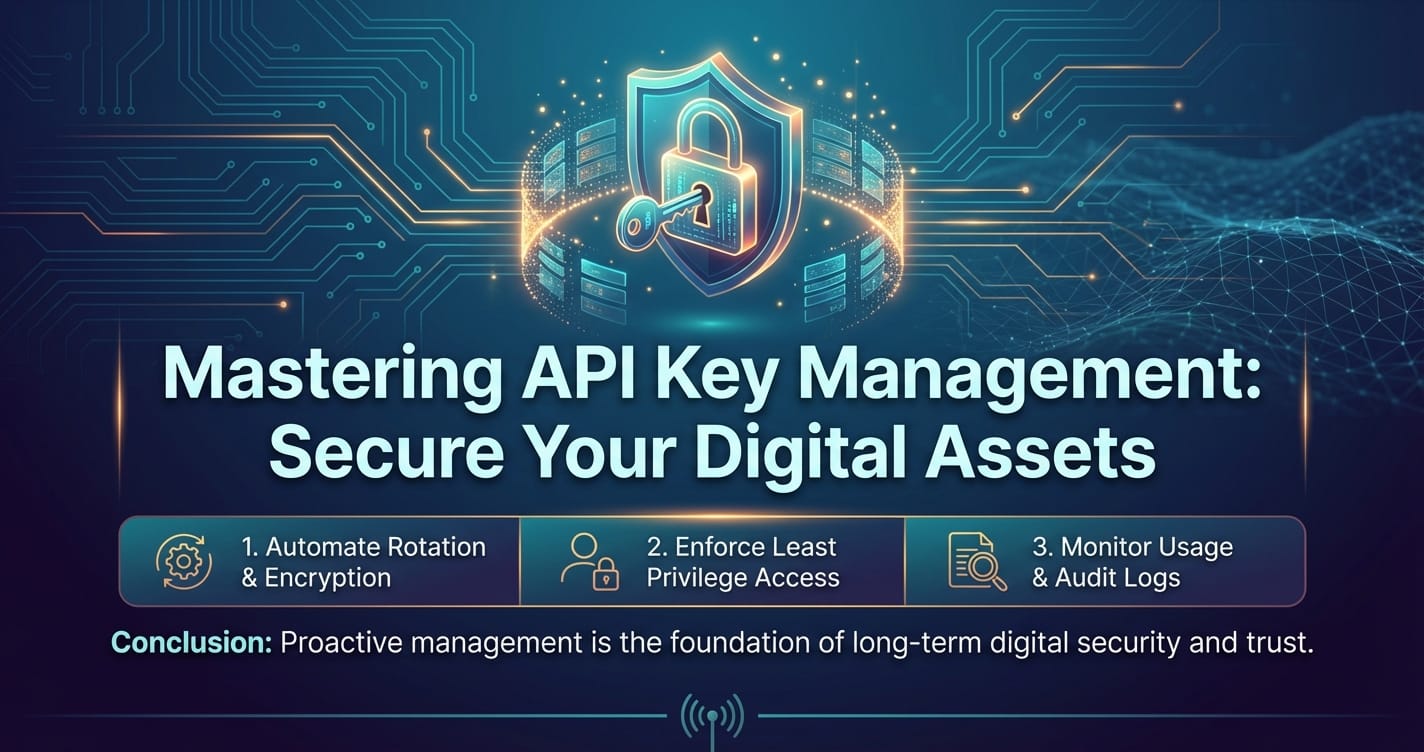
Mastering API Key Management: Secure Your Digital Assets


In the intricate tapestry of modern software development, Application Programming Interfaces (APIs) serve as the fundamental threads that connect disparate systems, enabling seamless data exchange and feature integration. From mobile applications querying backend services to sophisticated cloud platforms communicating with microservices, APIs are the silent workhorses powering our digital economy. However, with this pervasive connectivity comes a critical responsibility: securing the credentials that grant access to these powerful interfaces. This is where robust Api key management emerges not merely as a best practice but as an absolute necessity for safeguarding an organization's most valuable digital assets.
The sheer volume of APIs in use today – spanning financial transactions, personal data, intellectual property, and critical infrastructure controls – means that a compromised API key can have catastrophic consequences. It's the digital equivalent of leaving the keys to your entire data center under the doormat. In an era where data breaches are increasingly common and the cost of remediation can run into millions, understanding, implementing, and continually refining your Api key management strategies is paramount. This comprehensive guide will delve deep into the nuances of securing API keys, exploring fundamental principles, practical strategies, the unique challenges posed by the burgeoning field of api ai, and the advanced techniques required to maintain a formidable security posture. We aim to equip developers, security professionals, and business leaders with the knowledge to not just mitigate risks but to truly master the art of API key protection.
The Unseen Backbone: Understanding APIs and Their Inherent Vulnerabilities
At its core, an API defines the methods and data formats that applications can use to request and exchange information. It's an agreement, a contract, between two software components. For instance, when you check the weather on your phone, your weather app likely uses an API to fetch data from a weather service provider. When you log in using your Google account on a third-party website, that website is interacting with Google's authentication API. These interactions are fundamentally enabled by API keys.
An API key is typically a unique identifier, a string of characters, issued to a developer or application to access an API. It serves multiple purposes: 1. Authentication: Verifying the identity of the calling application. 2. Authorization: Determining what resources the application is allowed to access. 3. Usage Tracking: Monitoring API consumption for billing, rate limiting, and analytics.
While incredibly convenient and essential for functionality, the very nature of API keys introduces significant security risks. Unlike traditional user passwords, API keys often have broad programmatic access, meaning they don't require human interaction for each use. This "headless" nature makes them particularly potent targets for malicious actors.
Common Pitfalls and Exposures: Where API Keys Go Astray
Many real-world data breaches can be traced back to poor Api key management. The common vulnerabilities include:
- Hardcoding in Source Code: One of the most egregious errors is embedding API keys directly into application source code. When this code is pushed to public repositories (like GitHub), automated tools can quickly scrape these keys, granting attackers immediate access. Even in private repositories, hardcoded keys can be exposed if the repository itself is compromised.
- Exposure in Client-Side Code: Keys intended for server-side use are sometimes mistakenly exposed in client-side JavaScript or mobile application binaries. While some public APIs require client-side keys (often with strict domain restrictions), exposing sensitive backend keys here is a critical flaw.
- Insecure Configuration Files: Storing keys in plain text configuration files that are easily accessible or improperly secured on servers poses a significant risk.
- Insufficient Permissions: Granting an API key more privileges than it needs (e.g., read/write access when only read access is required) widens the blast radius if the key is compromised. This violates the principle of least privilege.
- Lack of Rotation: Static, long-lived API keys provide a persistent window of opportunity for attackers. If a key is compromised but never rotated, the attacker can maintain access indefinitely.
- Weak Access Control: Not implementing proper access controls around who can create, retrieve, or manage API keys within an organization.
- Logging and Monitoring Deficiencies: Failure to log API key usage or to monitor for anomalous activity means that a compromise might go unnoticed for extended periods.
Consider the implications: a compromised key for a payment gateway could lead to fraudulent transactions; a key for a cloud storage service could expose sensitive customer data; a key for a critical infrastructure API could allow unauthorized control over physical systems. The potential damage underscores why exemplary Api key management is not a luxury, but a fundamental security pillar.
Core Principles of Secure API Key Management
Building a resilient defense against API key compromises requires adherence to several core principles. These principles form the bedrock of any effective token management strategy, guiding decisions from initial key generation to eventual deprecation.
Principle 1: The Principle of Least Privilege
This foundational security concept dictates that any entity – be it a user, process, or API key – should be granted only the minimum necessary permissions to perform its intended function.
- Application: If an API key only needs to read data from a specific endpoint, it should not have write, update, or delete capabilities.
- Granularity: Utilize APIs that offer fine-grained access controls. Instead of a single "admin" key, create multiple keys, each with a narrow scope. For example, one key for analytical data access, another for user profile updates, and a third for background processing.
- Impact Reduction: Should a key with limited privileges be compromised, the potential damage is significantly contained, preventing lateral movement or broader system compromise.
Principle 2: Regular Key Rotation
Stale keys are vulnerable keys. Regular rotation of API keys, similar to rotating passwords, minimizes the window of opportunity for an attacker using a compromised key.
- Automated vs. Manual: Ideally, key rotation should be automated, especially for high-volume or critical APIs. Manual rotation is feasible for less critical keys but prone to human error and oversight.
- Grace Period: Implement a grace period during rotation where both the old and new keys are valid. This allows applications to transition to the new key without service interruption. Once all applications have switched, the old key can be fully revoked.
- Frequency: The frequency of rotation depends on the key's sensitivity, usage volume, and the organization's risk tolerance. Quarterly or monthly rotations are common for critical keys, while less sensitive keys might be rotated annually.
Principle 3: Segregation of Keys and Environments
Never use the same API key across different environments (development, staging, production) or for disparate services.
- Environment Segregation: A key for the development environment should never work in production. This prevents testing mishaps from impacting live systems and limits the damage if a dev key is accidentally exposed.
- Service Segregation: If you have multiple microservices or applications, each should ideally have its own unique API key (or set of keys). This isolation means a breach in one service doesn't automatically compromise others. For example, a key for a payment processing service should be distinct from a key used for user analytics.
- Clear Labeling: Ensure all keys are clearly labeled with their purpose, associated application, and environment to avoid confusion and accidental misuse.
Principle 4: Secure Storage and Retrieval
This is arguably the most critical principle. API keys must never be stored in plain text or hardcoded directly into applications.
- Secrets Management Tools: Dedicated secrets management solutions (e.g., HashiCorp Vault, AWS Secrets Manager, Azure Key Vault, Google Secret Manager) are the gold standard. These tools encrypt keys at rest and in transit, provide centralized storage, enforce access controls, and often facilitate automated rotation.
- Environment Variables: For simpler deployments, storing keys as environment variables is a significant improvement over hardcoding. They are not checked into source control and are accessed dynamically at runtime.
- Secure Configuration Management: If keys must be in configuration files, ensure these files are heavily permissioned, encrypted, and excluded from source control.
- Avoid Client-Side Exposure: Never embed sensitive API keys in client-side code (JavaScript, mobile apps). If a key is required on the client side, ensure it has strict domain restrictions, rate limits, and only access to public-facing data.
Principle 5: Comprehensive Monitoring and Auditing
Knowing who accessed what, when, and from where is crucial for detecting and responding to potential compromises.
- API Gateway Logging: Utilize API gateways to log all API requests, including the API key used, source IP, time, and requested endpoint.
- Centralized Logging: Integrate API key usage logs with a centralized security information and event management (SIEM) system.
- Anomaly Detection: Implement systems to detect unusual API key usage patterns – sudden spikes in requests, access from unexpected geographical locations, or attempts to access unauthorized endpoints.
- Audit Trails: Maintain immutable audit trails of all API key management actions: creation, modification, rotation, revocation, and access attempts.
Principle 6: Robust Lifecycle Management
API keys have a lifecycle, from creation to eventual deprecation. Managing this lifecycle efficiently and securely is vital.
- Provisioning: Securely generate and distribute keys to authorized applications or users.
- Activation: Enable keys for use only when necessary.
- Monitoring: Continuously track key usage and health.
- Rotation: Regularly update keys.
- Revocation: Immediately revoke keys that are compromised, no longer needed, or associated with decommissioned applications. Ensure a clear process for rapid revocation.
- Deprecation: Gracefully phase out old or weak keys and transition to new, stronger ones.
By embedding these six principles into your development and operational workflows, you build a robust framework for Api key management that significantly fortifies your digital perimeter.
Practical Strategies for API Key Management Across the Organization
Implementing these principles requires concrete strategies tailored to different roles within an organization. From individual developers to large enterprises, a multi-faceted approach ensures comprehensive security.
For Developers: Writing Secure Code from the Outset
Developers are often the first line of defense. Integrating secure token management practices into the coding workflow is essential.
- Utilize Environment Variables: Instead of hardcoding keys, developers should always retrieve them from environment variables.
- Example (Python):
api_key = os.environ.get("MY_API_KEY") - Example (Node.js):
const apiKey = process.env.MY_API_KEY; - When deploying, these variables are set on the server or container, preventing them from being checked into version control.
- Example (Python):
.envFiles for Local Development: For local development,.envfiles can be used to store environment variables. Crucially,.envfiles must be added to.gitignoreto prevent accidental commits.- SDKs and Client Libraries: Many API providers offer SDKs that abstract away the complexity of Api key management. These SDKs often have built-in mechanisms for securely handling keys, such as automatically fetching them from standard locations or prompting for secure input. Leverage these whenever possible.
- Secure Configuration Frameworks: Modern frameworks (e.g., Spring Boot, ASP.NET Core) offer robust configuration systems that support various secret storage methods. Developers should use these features to load keys securely.
- Automated Code Scanning: Integrate static application security testing (SAST) tools into your CI/CD pipeline. Tools like GitGuardian, TruffleHog, or Snyk can scan codebases (including commit history) for hardcoded secrets and alert developers before they are pushed.
- Avoid Inline Comments for Keys: Even if keys aren't hardcoded, avoid putting them in code comments or example snippets that might accidentally be committed.
- Developer Training: Regular training on secure coding practices, especially regarding API key handling, is vital. Developers need to understand the 'why' behind these rules.
For Operations/DevOps: Automating Secrets and Infrastructure Security
DevOps teams are responsible for deploying and managing applications, making them central to secure Api key management in production environments.
- Centralized Storage: All secrets are in one location, making auditing and management easier.
- Encryption: Secrets are encrypted at rest and often in transit.
- Dynamic Secrets: Many systems can generate short-lived, on-demand credentials (e.g., database passwords), drastically reducing the risk of long-lived keys.
- Access Control: Fine-grained access policies define which applications or users can retrieve which secrets.
- Auditing: Comprehensive audit logs track every access attempt, creation, or modification of a secret.
- Automated Rotation: Built-in capabilities to automatically rotate API keys, database credentials, and other secrets.
- Infrastructure as Code (IaC): When provisioning infrastructure (e.g., using Terraform, CloudFormation, Ansible), avoid embedding secrets directly in your IaC templates. Instead, reference secrets from your secrets management system or use secure input variables that are populated at runtime.
- Container Security: For containerized applications (Docker, Kubernetes), be mindful of how secrets are passed. Kubernetes Secrets offer a way to store and manage sensitive information, but they are base64 encoded by default, not encrypted at rest. Use external secrets operators (like External Secrets Operator) to pull secrets from a dedicated secrets manager into Kubernetes Secrets, or directly mount secrets from Vault/Key Vault into pods.
- API Gateways: An API gateway acts as a single entry point for all API requests. It can enforce Api key management policies, including authentication, authorization, rate limiting, and logging. It can also integrate with secrets managers to validate incoming keys against securely stored credentials.
Secrets Management Systems (The Gold Standard): These are specialized systems designed to store, manage, and distribute secrets securely. They offer a host of benefits:
| Secrets Management Solution | Key Features | Cloud/Self-Hosted | Integration |
|---|---|---|---|
| HashiCorp Vault | Dynamic secrets, encryption as a service, robust access control, extensive plugin ecosystem, secret leasing. | Both | Kubernetes, AWS, Azure, GCP, various databases, message queues. |
| AWS Secrets Manager | Automated rotation for AWS services, fine-grained IAM policies, integration with AWS services (Lambda, RDS). | Cloud (AWS) | AWS Lambda, EC2, ECS, EKS, RDS, Redshift, DocumentDB. |
| Azure Key Vault | Managed HSM, certificates, keys, secrets management, integration with Azure AD, secure storage for SSL/TLS certificates. | Cloud (Azure) | Azure VMs, App Services, Functions, Kubernetes (AKS), SQL Database. |
| Google Secret Manager | Versioning, access control with IAM, automatic key rotation (planned for some services), audit logging. | Cloud (GCP) | Google Cloud Functions, App Engine, Kubernetes Engine (GKE), Compute Engine. |
| CyberArk Conjur | Enterprise-grade secrets management, strong identity-based access, policy-as-code, dynamic secrets. | Both | Kubernetes, OpenShift, Jenkins, CI/CD tools, various application servers. |
Integrating these solutions into CI/CD pipelines ensures that applications retrieve keys securely at deploy time, rather than having them hardcoded or passed through insecure channels.
For Organizations/Policy Makers: Governance and Training
Ultimately, secure Api key management is a cultural issue, driven by organizational policies and reinforced through education.
- Establish Clear Policies: Define clear, documented policies for API key creation, usage, rotation, revocation, and storage. These policies should cover all environments and types of API keys.
- Mandatory Security Training: Conduct regular security awareness training for all employees, especially developers, operations staff, and anyone with access to sensitive systems. Emphasize the risks associated with API keys and best practices for handling them.
- Regular Security Audits and Penetration Testing: Periodically audit your API key usage, storage, and management processes. Engage third-party security firms for penetration testing to identify vulnerabilities that internal teams might miss.
- Implement Multi-Factor Authentication (MFA): For any system or console that allows management of API keys, enforce MFA to prevent unauthorized access, even if primary credentials are stolen.
- Incident Response Plan: Develop and regularly test an incident response plan specifically for API key compromises. This plan should detail steps for detection, containment, eradication, recovery, and post-mortem analysis.
By empowering developers with tools and knowledge, automating operations with secure infrastructure, and establishing robust organizational governance, companies can collectively uplift their Api key management posture.
XRoute is a cutting-edge unified API platform designed to streamline access to large language models (LLMs) for developers, businesses, and AI enthusiasts. By providing a single, OpenAI-compatible endpoint, XRoute.AI simplifies the integration of over 60 AI models from more than 20 active providers(including OpenAI, Anthropic, Mistral, Llama2, Google Gemini, and more), enabling seamless development of AI-driven applications, chatbots, and automated workflows.
The Rise of API AI and Its Unique Management Implications
The rapid proliferation of Artificial Intelligence (AI) services, particularly Large Language Models (LLMs), has introduced a new dimension to Api key management. Services like OpenAI's GPT models, Google's Gemini, Anthropic's Claude, and numerous others are predominantly consumed via APIs. This explosion of api ai brings with it a unique set of challenges and elevates the criticality of robust token management.
Specific Challenges with API AI Keys:
- High Usage Rates and Increased Exposure: AI applications, especially generative AI, can generate a massive volume of API calls. Each call typically requires an API key for authentication. This high frequency of use inherently increases the surface area for key exposure. Applications that query api ai models often run continuously, making long-term key security a persistent concern.
- Sensitivity of Data Processed by API AI: Many api ai models process highly sensitive information—customer queries, proprietary business data, personal identifiable information (PII), or even confidential code snippets. A compromised API key for such a service could not only allow unauthorized access to the AI model itself but also expose the sensitive input data being sent to it or the generated output. This raises significant privacy and compliance concerns (e.g., GDPR, CCPA).
- Cost Implications of Compromised API AI Keys: Access to powerful api ai models often comes with a usage-based billing model. If an api ai key is compromised, attackers can rack up substantial, unauthorized charges very quickly. Malicious actors might use the key to run expensive computations, generate large volumes of text, or perform other resource-intensive tasks, leading to unexpected and exorbitant bills for the legitimate account holder. This makes robust token management for api ai not just a security issue but also a significant financial one.
- Complexity of Multi-Model and Multi-Provider AI Architectures: Modern AI applications frequently leverage multiple AI models from different providers (e.g., one LLM for text generation, another for image processing, a third for sentiment analysis). Each provider and often each model might require its own unique API key. Managing this growing number of api ai keys manually becomes an unsustainable and error-prone task, increasing the likelihood of keys being mismanaged or exposed.
- Rate Limiting and Quota Management: Api ai services often impose strict rate limits and quotas. Compromised keys can exhaust these limits, leading to denial of service for legitimate applications. Effective token management helps monitor and control usage, preventing such scenarios.
Adapting Api Key Management for API AI:
The principles of secure Api key management remain the same, but their application to api ai demands heightened vigilance and specialized tools:
- Strict Least Privilege for AI Keys: Ensure AI keys only have access to the specific models and endpoints required. If a key is used for a public-facing chatbot, it should not have access to fine-tuning models or data upload capabilities.
- Aggressive Key Rotation: Given the high usage and potential cost implications, implementing very frequent, ideally automated, key rotation for api ai keys is crucial.
- Dedicated Secrets Managers: For api ai deployments, using a dedicated secrets management solution is non-negotiable. It provides the necessary automation for rotation, granular access control, and comprehensive auditing required to manage these high-value keys.
- Enhanced Monitoring for Anomalous AI Usage: Implement specific monitoring rules to detect unusual patterns in api ai key usage. This includes sudden spikes in API calls, requests from unusual geographic locations, attempts to access models not typically used by the application, or excessive expenditure. Alerting mechanisms should be tuned to respond rapidly to such anomalies.
- Token Management for API AI Orchestration: As AI workflows become more complex, encompassing multiple models and services, robust token management solutions can help orchestrate secure access without exposing individual keys directly to developers or runtime environments. This can involve using intermediary services that manage and proxy requests, adding an extra layer of abstraction and security.
The intersection of AI and API security is a rapidly evolving frontier. Proactive and sophisticated Api key management is the only way to harness the transformative power of api ai safely and sustainably.
Advanced Techniques and Future Trends in Token Management
As the threat landscape evolves, so too must our token management strategies. Beyond the core principles, several advanced techniques are gaining traction, offering even greater levels of security and operational efficiency.
Dynamic Key Generation and Short-Lived Credentials
Instead of static, long-lived API keys, the trend is towards generating keys on demand with very limited lifespans.
- How it works: When an application needs to access an API, it first authenticates with a secrets management system (or an identity provider). This system then dynamically generates a temporary API key or token with a short expiry time (e.g., minutes or hours).
- Benefits: If such a short-lived key is compromised, its utility to an attacker is severely restricted by its expiration. The system can also automatically revoke it after use or upon detecting suspicious activity.
- Application: Ideal for microservices architectures where services frequently authenticate with each other, or for serverless functions that need temporary access to resources.
Tokenization
Tokenization involves replacing sensitive data (like a credit card number or a long-lived API key) with a non-sensitive substitute called a "token."
- How it works: A secure tokenization service stores the original sensitive data and issues a unique, randomly generated token. Applications then use this token in place of the original sensitive data. When the original data is needed, the token is sent back to the tokenization service for de-tokenization.
- Benefits: The token itself holds no intrinsic value or meaning, rendering it useless if intercepted. This significantly reduces the scope of PCI DSS or other compliance requirements for systems handling tokens rather than raw sensitive data.
- Application: Primarily used for payment processing, but the concept can be extended to manage other sensitive credentials, including API keys, by assigning tokens to represent the actual keys in application code.
Identity and Access Management (IAM) Integration
Tightly integrating Api key management with an organization's broader IAM system is crucial for a unified security posture.
- Unified Access Control: Leverage existing identity providers (e.g., Okta, Azure AD, Auth0) to manage who can create, view, or manage API keys.
- Role-Based Access Control (RBAC): Define roles within your IAM system that correspond to different levels of API key access. For example, a "Developer" role might be able to create development keys, while a "Security Admin" role can manage all production keys and revocation.
- SSO for Management Consoles: Ensure that all management consoles for API keys or secrets managers enforce Single Sign-On (SSO) and MFA for human access.
Zero Trust Architecture
The principle of "never trust, always verify" is particularly pertinent to Api key management. In a Zero Trust model, no user, device, or application is inherently trusted, regardless of whether they are inside or outside the network perimeter.
- Continuous Verification: Every API call, even from within the internal network, must be authenticated and authorized.
- Micro-segmentation: Isolate network segments for different applications and services. This limits the lateral movement of an attacker even if an API key in one segment is compromised.
- Contextual Access: Access decisions are made based on multiple factors, including user identity, device health, location, and the sensitivity of the resource being accessed.
- Application to API Keys: This means API keys are continuously validated, their permissions are dynamically assessed, and their usage is constantly monitored against established baselines.
API Gateways as Enforcement Points
Modern API gateways play a pivotal role in advanced token management by acting as policy enforcement points.
- Centralized Authentication/Authorization: All API requests pass through the gateway, where API keys can be validated against a secrets manager or IAM system.
- Rate Limiting and Throttling: Prevent abuse and denial-of-service attacks by controlling how often an API key can be used.
- Usage Analytics: Gather detailed telemetry on API key usage, feeding into monitoring and auditing systems.
- Threat Protection: Many gateways offer built-in protections against common API attacks, adding another layer of defense beyond just key validation.
- Policy Orchestration: API gateways can apply complex policies based on the API key, the requesting application, and the specific API endpoint being accessed.
These advanced techniques, when combined with foundational best practices, create a multi-layered, adaptive security posture that is crucial for navigating the complexities of an API-driven world.
Leveraging Unified API Platforms for Simplified Management
As developers increasingly rely on a diverse array of specialized APIs—from payment gateways and communication services to sophisticated api ai models—the complexity of managing individual API keys for each service can become overwhelming. Each API often comes with its own authentication method, rate limits, and management portal, leading to a fragmented and error-prone Api key management landscape. This challenge is particularly acute in the burgeoning field of AI, where applications might integrate with numerous Large Language Models (LLMs) and other AI services from various providers.
The traditional approach requires developers to: 1. Obtain an API key for each distinct service. 2. Securely store and retrieve each of these keys. 3. Implement individual API calls and handle different data formats for each service. 4. Monitor usage and manage billing for each key separately. 5. Maintain separate security policies and rotation schedules.
This fragmentation not only introduces significant operational overhead but also magnifies the security risks associated with token management. A larger number of independently managed keys increases the chances of one being misplaced, exposed, or left unrotated.
This is precisely where unified API platforms offer a transformative solution. These platforms act as an intelligent intermediary, providing a single, consistent interface to access a multitude of underlying APIs. By abstracting away the complexities of integrating with individual services, unified platforms simplify the developer experience and, critically, centralize Api key management.
For instance, platforms like XRoute.AI offer a cutting-edge unified API platform designed to streamline access to a vast array of Large Language Models (LLMs) and other AI services. By providing a single, OpenAI-compatible endpoint, XRoute.AI simplifies the integration of over 60 AI models from more than 20 active providers. This approach significantly reduces the burden of individual Api key management for each AI service, as developers can manage access to a multitude of api ai functionalities through a single, well-managed connection point.
Instead of needing separate keys for various LLMs (e.g., from OpenAI, Google, Anthropic, or others), developers using XRoute.AI interact with just one platform key or a small set of keys. XRoute.AI then intelligently routes requests to the appropriate underlying AI model, handling the specific API key and authentication requirements for that model behind the scenes. This not only makes the development process smoother but also drastically simplifies token management for complex AI ecosystems.
XRoute.AI's focus on low latency AI, cost-effective AI, and developer-friendly tools not only enhances performance but also centralizes the security perimeter. By providing a single point of entry and management, it allows organizations to apply consistent Api key management policies, implement unified monitoring, and streamline key rotation for their entire api ai infrastructure. This consolidation significantly enhances security by reducing the number of individual secrets that need to be managed and securing access to the consolidated platform rather than numerous disparate services. With XRoute.AI, Api key management for generative AI applications moves from a distributed, complex challenge to a centralized, manageable, and highly secure operation.
Conclusion: An Ongoing Commitment to Digital Security
In a world increasingly powered by interconnected services, mastering Api key management is not merely a technical task but a continuous strategic imperative. API keys are the gatekeepers to an organization's most valuable digital assets, and their compromise can lead to devastating financial, reputational, and operational consequences.
We have traversed the landscape of API vulnerabilities, explored the foundational principles of secure token management, and delved into practical strategies for developers, DevOps teams, and organizational policymakers. We've also highlighted the unique and critical challenges posed by the rapid adoption of api ai, where the stakes for secure Api key management are higher than ever, given the sensitive data and significant costs involved. Finally, we've seen how innovative solutions like unified API platforms, exemplified by XRoute.AI, can fundamentally simplify and strengthen the management of a diverse range of APIs, especially within the complex api ai ecosystem.
The journey to impeccable API key security is iterative. It demands a culture of security awareness, continuous vigilance, and the proactive adoption of best practices and advanced technologies. Organizations must move beyond basic protection and embrace a comprehensive approach that includes: * Implementing the Principle of Least Privilege: Granting only essential access. * Aggressive Key Rotation: Minimizing the window of exposure. * Segregation of Keys and Environments: Containing potential breaches. * Utilizing Dedicated Secrets Management Systems: Centralizing and fortifying storage. * Robust Monitoring and Auditing: Detecting and responding to anomalies rapidly. * Strategic Lifecycle Management: From creation to secure deprecation. * Leveraging Unified Platforms: For streamlined access and management, particularly for api ai.
By treating Api key management with the seriousness it deserves, organizations can unlock the full potential of their digital infrastructure while simultaneously safeguarding their integrity, privacy, and financial stability. It is an ongoing commitment, but one that is absolutely essential for thriving in our API-driven future.
Frequently Asked Questions about API Key Management
Q1: What is the primary difference between an API key and a traditional password? A1: While both API keys and passwords are credentials used for authentication, an API key is typically a long string of characters primarily designed for application-to-application communication, offering programmatic access to specific API endpoints. Traditional passwords are for human users to log into systems. API keys often have more granular permissions tied to specific services rather than a human identity, and their exposure can have a broader system-wide impact if not properly managed, especially if they are long-lived and widely privileged.
Q2: Why is hardcoding API keys a critical security risk? A2: Hardcoding API keys means embedding them directly into your application's source code. This is extremely risky because if the code is ever exposed (e.g., pushed to a public GitHub repository, accessed during a breach, or even compiled into a client-side application), the API key becomes immediately visible to anyone. Attackers actively scan public repositories for hardcoded secrets. Once compromised, such a key grants unauthorized access to the associated API service, potentially leading to data breaches, service manipulation, or significant unauthorized billing, especially for services like api ai.
Q3: How do secrets management tools like HashiCorp Vault or AWS Secrets Manager help in API key management? A3: Secrets management tools are purpose-built to securely store, manage, and distribute sensitive credentials, including API keys. They help by: 1. Centralizing Storage: Providing a single, secure repository for all secrets. 2. Encryption: Encrypting keys at rest and often in transit. 3. Access Control: Implementing fine-grained permissions to dictate who (or what application) can access which keys. 4. Automated Rotation: Facilitating automatic changing of keys at regular intervals. 5. Auditing: Logging all access attempts and modifications for accountability and detection of anomalies. 6. Dynamic Secrets: Some can even generate short-lived, on-demand credentials, further reducing risk.
Q4: What specific challenges does API key management face when dealing with API AI services? A4: Api ai services, particularly Large Language Models, introduce unique challenges: 1. High Usage & Cost: AI applications often make a huge volume of API calls, increasing exposure and the financial impact of compromised keys due to usage-based billing. 2. Sensitive Data: AI models frequently process highly sensitive input data, making key compromise a significant privacy and compliance risk. 3. Multi-Provider Complexity: AI applications often integrate multiple models from different providers, leading to a large number of diverse keys that need careful token management. These factors necessitate even more rigorous Api key management, frequent rotation, and advanced monitoring for anomalous usage.
Q5: What is the role of unified API platforms like XRoute.AI in simplifying API key management? A5: Unified API platforms simplify Api key management by acting as a single gateway to multiple underlying APIs, especially for diverse services like api ai. Instead of managing individual API keys for each distinct AI model or service provider, developers interact with one platform's API key. The platform (e.g., XRoute.AI) then handles the authentication and routing to the specific underlying services using its own securely managed keys. This approach: 1. Reduces Complexity: Fewer keys for developers to manage directly. 2. Centralizes Security: A single point to apply security policies, monitor usage, and implement key rotation. 3. Streamlines Integration: Simplifies development by offering a consistent API interface across different providers, enhancing both security and efficiency.
🚀You can securely and efficiently connect to thousands of data sources with XRoute in just two steps:
Step 1: Create Your API Key
To start using XRoute.AI, the first step is to create an account and generate your XRoute API KEY. This key unlocks access to the platform’s unified API interface, allowing you to connect to a vast ecosystem of large language models with minimal setup.
Here’s how to do it: 1. Visit https://xroute.ai/ and sign up for a free account. 2. Upon registration, explore the platform. 3. Navigate to the user dashboard and generate your XRoute API KEY.
This process takes less than a minute, and your API key will serve as the gateway to XRoute.AI’s robust developer tools, enabling seamless integration with LLM APIs for your projects.
Step 2: Select a Model and Make API Calls
Once you have your XRoute API KEY, you can select from over 60 large language models available on XRoute.AI and start making API calls. The platform’s OpenAI-compatible endpoint ensures that you can easily integrate models into your applications using just a few lines of code.
Here’s a sample configuration to call an LLM:
curl --location 'https://api.xroute.ai/openai/v1/chat/completions' \
--header 'Authorization: Bearer $apikey' \
--header 'Content-Type: application/json' \
--data '{
    "model": "gpt-5",
    "messages": [
        {
            "content": "Your text prompt here",
            "role": "user"
        }
    ]
}'
With this setup, your application can instantly connect to XRoute.AI’s unified API platform, leveraging low latency AI and high throughput (handling 891.82K tokens per month globally). XRoute.AI manages provider routing, load balancing, and failover, ensuring reliable performance for real-time applications like chatbots, data analysis tools, or automated workflows. You can also purchase additional API credits to scale your usage as needed, making it a cost-effective AI solution for projects of all sizes.
Note: Explore the documentation on https://xroute.ai/ for model-specific details, SDKs, and open-source examples to accelerate your development.