Mastering Grok3 Coding: Essential Tips & Techniques

The landscape of software development is undergoing a profound transformation, driven by the rapid advancements in artificial intelligence. What was once the sole domain of human ingenuity is now being augmented, accelerated, and even reinvented by intelligent machines. Among the most significant breakthroughs are large language models (LLMs), which have moved beyond simple text generation to become powerful co-pilots and problem-solvers for developers. In this evolving ecosystem, Grok3 coding stands out as a frontier, promising to reshape how we interact with code, debug complex systems, and innovate at an unprecedented pace.
This comprehensive guide delves deep into the world of Grok3 coding, offering essential tips and techniques to harness its full potential. We will explore how Grok3, as a cutting-edge AI for coding, can streamline workflows, enhance productivity, and even democratize access to advanced programming concepts. From crafting the perfect prompt to leveraging Grok3 for iterative development and learning, our goal is to equip you with the knowledge to not just use, but master this powerful tool. We'll also consider whether Grok3 might just be the best LLM for coding for specific applications, comparing its strengths and unique capabilities in the broader AI landscape.
Join us as we unlock the secrets to effective Grok3 utilization, navigating its intricacies and discovering how to integrate it seamlessly into your daily development practices. The future of coding is intelligent, and understanding Grok3 is a crucial step towards embracing it.
The Dawn of Advanced AI in Software Development
For decades, software development has been a craft demanding meticulous attention to detail, profound logical reasoning, and a continuous learning curve. Developers spend countless hours writing, debugging, testing, and refining code. While tools and methodologies have evolved, the core intellectual effort remained profoundly human-centric. However, the advent of sophisticated AI models, particularly large language models (LLMs), has begun to fundamentally alter this paradigm.
Initially, AI's role in coding was limited to rudimentary tasks like syntax highlighting, auto-completion, or basic error detection. These were helpful but didn't fundamentally change the developer's core responsibilities. The introduction of LLMs with billions or even trillions of parameters, trained on vast datasets of code and natural language, marked a significant inflection point. These models demonstrated an uncanny ability to understand context, generate coherent code snippets, explain complex functions, and even debug subtle errors.
This evolution signifies more than just incremental improvement; it represents a paradigm shift where AI for coding transitions from a passive assistant to an active participant in the development process. Developers are no longer just writing code; they are orchestrating AI to generate, refine, and validate code, allowing them to focus on higher-level architectural design, complex problem-solving, and innovative feature development. This shift is not about replacing human developers but empowering them with supercharged capabilities, augmenting their creativity, and significantly accelerating the pace of innovation. As we step into an era where models like Grok3 become increasingly prevalent, understanding how to effectively leverage them is no longer an optional skill but a core competency for any forward-thinking developer.
Understanding Grok3: A Paradigm Shift in AI for Coding
Grok3, as xAI's latest iteration of its conversational AI, represents a significant leap forward in the capabilities of AI for coding. While specific architectural details of Grok3 are often proprietary, its design philosophy and reported performance characteristics point towards a model engineered for deep understanding, advanced reasoning, and dynamic interaction—qualities particularly crucial for complex software development tasks. Unlike earlier, more general-purpose LLMs, Grok3 is likely fine-tuned with an extensive dataset of code across multiple programming languages, frameworks, and architectural patterns, enabling it to grasp the nuances of software engineering beyond mere syntax.
What makes Grok3 a potential game-changer for Grok3 coding?
- Enhanced Contextual Understanding: Grok3 is designed to process and retain longer contexts, meaning it can "remember" and build upon previous interactions, code snippets, and design decisions. This is invaluable when working on large projects where consistency across modules and understanding of architectural patterns are paramount. It moves beyond isolated snippet generation to participating in a sustained coding dialogue.
- Advanced Reasoning Capabilities: Beyond pattern matching, Grok3 is expected to exhibit stronger logical reasoning. This allows it to not just suggest code, but to explain why a particular solution is optimal, identify potential pitfalls in a design, or propose alternative algorithms based on performance or scalability considerations. This deep reasoning is what truly elevates an LLM from a code generator to a coding co-architect.
- Real-time Information Integration: One of xAI's distinguishing features for Grok has been its ability to leverage real-time information. While the direct application to internal coding knowledge bases might vary, this capability can be crucial for staying updated on the latest library versions, security vulnerabilities, or best practices emerging in the developer community, making Grok3 coding responsive to the latest trends.
- Multimodal Potential (Future-proofing): While primarily text-based, future iterations or current hidden capabilities might hint at multimodal understanding. This could mean processing diagrams, UI mockups, or even short video explanations to generate corresponding code, further blurring the lines between design and implementation.
- Focus on Practical Utility: xAI’s approach often emphasizes practical, real-world utility. This suggests Grok3 is engineered not just for academic benchmarks but for tangible improvements in a developer's daily workflow, making it a highly attractive option for those seeking the best LLM for coding that delivers immediate, measurable value.
In essence, Grok3 is not merely an autocomplete on steroids. It represents a sophisticated cognitive assistant, capable of engaging in nuanced technical discussions, generating robust solutions, and acting as a force multiplier for individual developers and development teams. Its ability to handle complex logical structures and its deep understanding of code semantics position it as a formidable tool for anyone serious about pushing the boundaries of software innovation.
Key Features and Capabilities of Grok3 for Developers
For developers looking to integrate advanced AI for coding into their toolkit, understanding the specific features and capabilities of Grok3 is paramount. Grok3 offers a rich suite of functionalities that extend far beyond simple code generation, positioning it as a versatile partner throughout the entire software development lifecycle.
Here's a breakdown of its key offerings:
- Intelligent Code Generation:
- Snippet to Full Module: From a simple natural language request like "create a Python function to parse JSON data from a URL" to complex requests like "generate a basic REST API using Node.js and Express for user management with CRUD operations," Grok3 can produce highly functional and contextually relevant code.
- Multi-language Support: Grok3 is trained on a vast corpus of code, enabling it to generate code in Python, JavaScript, Java, C++, Go, Ruby, and many other languages, often adhering to idiomatic practices for each.
- Framework-Awareness: It understands and applies common frameworks and libraries (e.g., React, Angular, Django, Spring Boot), generating code that fits within existing architectural patterns.
- Advanced Debugging and Error Resolution:
- Contextual Error Analysis: When presented with error messages and surrounding code, Grok3 can analyze the context to pinpoint the root cause of issues, often suggesting multiple potential fixes.
- Performance Bottleneck Identification: It can analyze code for potential performance issues, such as inefficient loops, suboptimal data structures, or N+1 queries, and propose optimized alternatives.
- Security Vulnerability Spotting: Grok3 can identify common security flaws (e.g., SQL injection vulnerabilities, cross-site scripting risks) in generated or provided code and offer remediation strategies.
- Code Refactoring and Optimization:
- Readability Improvement: It can transform convoluted or poorly structured code into more readable and maintainable formats, suggesting clear variable names, improved function signatures, and better modularization.
- Algorithmic Enhancement: For specific problems, Grok3 can suggest more efficient algorithms or data structures to improve runtime performance or memory usage.
- Design Pattern Application: It can guide developers in applying appropriate design patterns (e.g., Factory, Singleton, Observer) to enhance code scalability and maintainability.
- Automated Documentation and Explanations:
- Docstring Generation: Grok3 can automatically generate comprehensive docstrings or comments for functions, classes, and modules, explaining their purpose, parameters, return values, and potential exceptions.
- Code Explanation: Presenting Grok3 with a complex piece of code prompts it to break down its logic step-by-step, making it an invaluable tool for onboarding new team members or understanding legacy systems.
- Technical Writing Assistance: Beyond code, Grok3 can help draft technical specifications, API documentation, or user manuals based on code logic.
- Learning and Skill Development:
- Concept Explanation: It can clarify complex programming concepts, design patterns, or algorithmic principles with examples.
- Language Tutoring: For developers learning a new language or framework, Grok3 can provide syntax examples, explain core functionalities, and even act as a coding tutor, offering practice problems and feedback.
- Best Practice Guidance: Grok3 can inform developers about industry best practices, coding standards, and common pitfalls for specific technologies.
These capabilities underscore why Grok3 coding is not just about automation but about intelligent augmentation. It frees developers from repetitive, boilerplate tasks, allowing them to channel their cognitive energy towards innovation and solving truly challenging problems. Its ability to act as a knowledgeable peer, a tireless debugger, and a patient teacher makes it a strong contender for the title of best LLM for coding in many contemporary development scenarios.
Setting Up Your Grok3 Coding Environment
Integrating Grok3 into your development workflow isn't about installing a new IDE or compiler; it's about establishing effective communication channels and leveraging its API. Since Grok3 is a large language model, your interaction will primarily be through an API, which can then be integrated into various tools and environments. The goal is to make Grok3 coding feel as seamless and native as possible.
Here's a conceptual guide to setting up and optimizing your environment for Grok3:
- API Access and Authentication:
- Obtain API Key: The foundational step is to gain access to the Grok3 API, typically by signing up for an xAI developer account and generating an API key. This key is your credential for making requests.
- Secure Storage: Never hardcode your API key directly into your applications. Use environment variables, secure configuration management tools (e.g., HashiCorp Vault), or cloud secret managers (AWS Secrets Manager, Azure Key Vault, Google Secret Manager) to store and retrieve it securely.
- Rate Limits and Usage Monitoring: Familiarize yourself with Grok3's API rate limits to avoid unexpected service interruptions. Implement logging and monitoring for your API calls to track usage and identify potential issues.
- Choosing Your Integration Method:
- Direct API Calls: For maximum flexibility, you can make direct HTTP requests to the Grok3 API endpoint using any programming language. This is suitable for custom scripts, backend services, or specific automation tasks. ```python import requests import osapi_key = os.environ.get("GROK3_API_KEY") headers = { "Authorization": f"Bearer {api_key}", "Content-Type": "application/json" } data = { "model": "grok-3", # or whatever the specific model ID is "messages": [{"role": "user", "content": "Write a Python function for quicksort."}], "max_tokens": 500 } response = requests.post("https://api.xroute.ai/v1/chat/completions", headers=headers, json=data) print(response.json()) ``` * SDKs and Libraries: xAI will likely provide official SDKs for popular programming languages (Python, Node.js, etc.) that simplify interaction with the API, handling authentication, request formatting, and response parsing. These are often the easiest and most robust ways to integrate. * IDE Extensions/Plugins: The most developer-friendly approach involves integrating Grok3 directly into your Integrated Development Environment (IDE). Many LLMs now have official or community-developed plugins for VS Code, IntelliJ IDEA, PyCharm, etc., allowing you to send prompts, receive code suggestions, and debug directly within your coding environment. This is where Grok3 coding truly feels integrated. * Command-Line Interface (CLI) Tools: For quick, ad-hoc queries or scripting, a CLI tool that wraps the Grok3 API can be incredibly useful. 3. Optimizing for Performance and Cost: * Prompt Engineering: The quality and length of your prompts directly impact both the quality of Grok3's output and the tokens consumed (which relates to cost). Invest time in learning effective prompt engineering techniques (discussed in a later section). * Caching: For frequently asked questions or boilerplate code snippets, consider implementing a local caching mechanism to reduce redundant API calls. * Asynchronous Processing: For applications that require high throughput or minimal latency, use asynchronous API calls to prevent your application from blocking while waiting for Grok3's response. * Context Window Management: Be mindful of Grok3's context window. While larger, feeding it only necessary information for each query helps manage cost and keeps responses focused. 4. Version Control and Collaboration: * Git Integration: Treat AI-generated code just like human-written code. Integrate it into your version control system (Git) with clear commit messages. * Code Review: Always review AI-generated code. It's a powerful assistant, not an infallible oracle. Human oversight remains critical for correctness, security, and adherence to project standards. * Team Guidelines: Establish guidelines for how your team will use Grok3. This might include standards for prompt documentation, review processes for AI-generated code, and policies on what types of tasks are suitable for AI assistance.
By thoughtfully setting up your Grok3 coding environment, you lay the groundwork for a highly productive and efficient development experience. The initial investment in configuration and process definition will pay dividends in the form of accelerated development cycles and higher quality code, solidifying Grok3's role as a potent AI for coding.
Practical Applications of Grok3 in the Software Development Lifecycle
Grok3 coding isn't just a niche tool; it's a versatile assistant capable of augmenting virtually every stage of the software development lifecycle (SDLC). By intelligently applying Grok3's capabilities, teams can enhance efficiency, reduce manual effort, and improve the overall quality of their software.
Here's how Grok3 can be integrated into various phases of the SDLC:
1. Planning and Design Phase
- Requirements Clarification: Feed user stories or ambiguous requirements to Grok3 and ask it to elaborate, identify edge cases, or suggest potential ambiguities. For instance, "Given this user story: 'As a user, I want to filter products by price,' what are potential filtering scenarios, error conditions, and UI considerations?"
- Architecture Prototyping: Describe a system's desired functionality and constraints (e.g., "Build a scalable microservice architecture for an e-commerce platform using AWS Lambda and DynamoDB") and Grok3 can suggest high-level architectural patterns, technology stacks, and component interactions.
- API Design: Ask Grok3 to design RESTful API endpoints for specific functionalities, including request/response schemas, HTTP methods, and error handling, ensuring consistency and best practices.
2. Development Phase
- Accelerated Code Generation: This is where Grok3 coding shines brightest.
- Boilerplate Code: Generate CRUD operations, database schema definitions (SQL, NoSQL), or basic UI components.
- Complex Algorithms: Request implementations for specific algorithms (e.g., "Implement a Dijkstra's algorithm in Java" or "Write a Python script to perform sentiment analysis on a given text using NLTK").
- Unit and Integration Tests: Ask Grok3 to generate test cases for existing functions or modules, significantly speeding up the testing process. For example, "Write unit tests for the following Python function that calculates factorial: [code here]."
- Code Refactoring and Optimization:
- Legacy Code Modernization: Provide old code snippets and ask Grok3 to refactor them into modern syntax or apply current design patterns.
- Performance Tuning: Get suggestions for optimizing specific code blocks that are identified as performance bottlenecks.
- Readability Enhancement: Ask Grok3 to improve code readability, add comments, or restructure functions for better clarity.
- Learning and Skill Enhancement: Use Grok3 as an on-demand tutor for new languages, frameworks, or libraries encountered during development, asking for explanations, examples, or debugging assistance.
3. Testing and Quality Assurance Phase
- Automated Test Script Generation: Beyond unit tests, Grok3 can assist in generating broader integration tests, end-to-end test scenarios, or even performance test scripts based on functional requirements.
- Bug Detection and Resolution: When a bug is identified, provide Grok3 with the error message, stack trace, and relevant code. It can suggest potential causes and fixes, often accelerating the debugging process.
- Code Review Assistance: While human review is critical, Grok3 can perform an initial pass, identifying potential issues like code smells, deviations from style guides, or common vulnerabilities, acting as an intelligent linter.
4. Deployment and Operations Phase
- Infrastructure as Code (IaC) Generation: Grok3 can help generate basic IaC scripts (e.g., Terraform, CloudFormation) for deploying applications or setting up infrastructure components.
- Troubleshooting Production Issues: When production issues arise, provide Grok3 with logs, monitoring data, and error messages. It can help correlate events, diagnose potential causes, and suggest mitigation steps.
- Scripting for Automation: Generate scripts for deployment automation, server configuration, or data migration tasks.
5. Maintenance and Support Phase
- Documentation Updates: Automatically update documentation, API specs, or user manuals when code changes are made.
- Feature Enhancement Suggestions: Based on user feedback or market trends, Grok3 can suggest potential new features or improvements to existing ones.
- Legacy System Understanding: For complex or poorly documented legacy systems, Grok3 can explain code segments, trace execution flows, and help developers understand intricate logic.
By integrating Grok3 intelligently into these phases, development teams can unlock significant productivity gains and elevate the quality of their output. This holistic application solidifies Grok3's position as a powerful AI for coding and a strong contender in the discussion of what constitutes the best LLM for coding.
XRoute is a cutting-edge unified API platform designed to streamline access to large language models (LLMs) for developers, businesses, and AI enthusiasts. By providing a single, OpenAI-compatible endpoint, XRoute.AI simplifies the integration of over 60 AI models from more than 20 active providers(including OpenAI, Anthropic, Mistral, Llama2, Google Gemini, and more), enabling seamless development of AI-driven applications, chatbots, and automated workflows.
Tips and Techniques for Effective Grok3 Coding
Mastering Grok3 coding is less about memorizing commands and more about understanding how to effectively communicate with an intelligent system. It requires a blend of prompt engineering, iterative interaction, and critical evaluation. Here are essential tips and techniques to maximize your productivity and get the most out of Grok3.
1. Crafting Effective Prompts: The Art of Instruction
Your prompt is the primary interface with Grok3. A well-crafted prompt can yield accurate, relevant, and high-quality results, while a poorly defined one can lead to generic or incorrect outputs.
- Be Clear and Specific: Avoid ambiguity. Instead of "Write some code," say "Write a Python function named
calculate_areathat takeslengthandwidthas parameters, calculates the area of a rectangle, and returns the result. Include docstrings." - Provide Context: Give Grok3 enough background information. If it's part of a larger system, briefly explain the system's purpose or relevant constraints. E.g., "In a Django project, create a model
Productwith fieldsname(CharField),price(DecimalField), anddescription(TextField). Ensurenameis unique." - Define Constraints and Requirements: Specify language, framework, libraries, performance targets, security considerations, or stylistic preferences. "Generate a JavaScript component using React and TypeScript for a 'dark mode' toggle. It should store user preference in
localStorage." - Use Examples (Few-Shot Learning): If you have a specific style or pattern, provide a small example. "Given the following example of an Express route:
app.get('/users', (req, res) => { /* logic */ });, generate a similar route for fetching specific products by ID." - Specify Output Format: Clearly state how you want the output structured. "Provide the code wrapped in markdown code blocks. Also, explain each part of the solution briefly."
- Adopt a Persona: Sometimes, asking Grok3 to act as an expert can improve output quality. "Act as a senior DevOps engineer. Draft a Kubernetes deployment YAML for a stateless web application with 3 replicas and a service exposing port 80."
- Break Down Complex Tasks: For very large or intricate problems, split them into smaller, manageable sub-problems. Generate one part, review, then ask for the next. This prevents context overload and improves accuracy.
2. Iterative Refinement and Debugging with Grok3
Treat Grok3 as a conversational partner, not a one-shot answer machine. Rarely will the first output be perfect.
- Review and Critique: Always critically evaluate Grok3's output. Does it meet all requirements? Are there any logical errors? Is it efficient?
- Provide Feedback: If an output is incorrect or needs adjustment, tell Grok3 what's wrong and how to fix it. "The previous Python function for sorting has a bug; it's not handling negative numbers correctly. Please revise it." or "This code uses callbacks; refactor it to use async/await."
- Ask Follow-up Questions: Don't hesitate to ask for clarifications or alternative approaches. "Can you explain why you chose this data structure?" or "What are the performance implications of this approach, and are there more efficient alternatives?"
- Isolate Issues: When debugging, provide Grok3 with the minimal reproducible example (MRE) of the error, along with the error message and stack trace. "I'm getting a
TypeError: Cannot read property 'map' of undefinedin this React component: [code]. The error occurs when fetching data. What could be the issue?" - Explore Alternatives: If a solution isn't working, ask Grok3 for entirely different approaches to the problem. "My current approach to real-time updates is complex. Can you suggest three alternative real-time communication patterns for a web application?"
3. Leveraging Grok3 for Code Generation and Optimization
Beyond basic generation, Grok3 excels at sophisticated code tasks.
- Code Transformation: Ask Grok3 to transform code from one language to another (e.g., Python to Go), or from one framework version to another (e.g., Angular.js to Angular 14).
- Algorithmic Optimization: "Optimize this bubble sort implementation for average case performance, or suggest a better sorting algorithm for large datasets."
- Design Pattern Implementation: "Implement a 'Strategy' design pattern in C# for processing different payment methods."
- Regular Expression Generation: Regex is notoriously hard. "Generate a regex to validate an email address that allows subdomains and specific top-level domains like .com, .org, .net."
- Data Structure Suggestions: Describe your data access patterns and ask Grok3 to suggest optimal data structures.
4. Automated Testing and Quality Assurance with AI
Grok3 can significantly accelerate the QA process.
- Test Case Scenarios: "Generate comprehensive test cases for a user registration form, including valid inputs, invalid email formats, missing required fields, and password complexity rules."
- Mock Data Generation: "Create mock JSON data for a list of 10 users, each with
id,name,email, andregistration_datefields." - Edge Case Identification: "What are some tricky edge cases I should consider when unit testing a function that calculates discounts based on purchase amount and customer loyalty tier?"
- Test-Driven Development (TDD) Support: Start by asking Grok3 to write a failing test for a desired feature, then ask it to write the code to make that test pass.
5. Learning New Languages and Frameworks Faster
Grok3 is an excellent personalized tutor.
- Syntax and Semantics: "Explain the difference between
var,let, andconstin JavaScript with code examples." - Best Practices: "What are the common best practices for error handling in Go?"
- Concept Clarification: "Break down the concept of 'closures' in JavaScript and provide a practical example."
- Guided Projects: "Walk me through building a simple 'to-do list' application using Vue.js, step by step, including component structure and state management."
By integrating these techniques, your Grok3 coding experience will transform from a basic interaction into a highly productive and collaborative partnership, leveraging the full power of this advanced AI for coding.
Grok3 vs. Other LLMs: Is it the Best LLM for Coding?
The question of which is the best LLM for coding is complex and highly dependent on specific needs, existing infrastructure, and budget. While Grok3 presents compelling features, it operates within a competitive landscape populated by other powerful models like OpenAI's GPT-4, Google's Gemini, Anthropic's Claude, and specialized coding models like GitHub Copilot (which often leverages GPT).
Here's a comparative perspective on where Grok3 likely stands:
| Feature/Aspect | Grok3 (Likely Strengths) | Other Leading LLMs (e.g., GPT-4, Gemini, Claude) | Specialized Coding LLMs (e.g., Copilot) |
|---|---|---|---|
| Contextual Understanding | Potentially very strong due to xAI's focus on reasoning and real-time data. Long context windows. | Generally strong, especially GPT-4. Long context windows are becoming standard. | Focuses on immediate code context, less on broader project. |
| Code Generation Quality | High-quality, idiomatic code across multiple languages/frameworks. | Excellent, highly proficient across diverse languages and domains. | Excellent for code completion & boilerplate in IDE. |
| Reasoning & Problem Solving | Emphasizes logical reasoning and detailed explanations. | Strong analytical capabilities for complex problems. | Good for immediate task reasoning, less for architectural. |
| Real-time Information | A potential differentiator for xAI models, offering up-to-date info. | Typically trained on static datasets, may lack real-time data. | Generally static data, might integrate current docs. |
| Speed & Latency | Optimized for rapid responses (xAI focus on efficiency). | Varies by model and provider load; can be high or low. | Optimized for quick in-IDE suggestions. |
| Cost-Effectiveness | Positioned to be competitive, especially for specific use cases. | Varies significantly by model, token usage, and provider. | Often subscription-based, integrated into dev tools. |
| Integration Ecosystem | API-first approach, potentially robust SDKs. | Mature APIs, extensive SDKs, broad community support, many plugins. | Deep IDE integration (e.g., VS Code). |
| Ethical/Safety Guardrails | Expected to have robust safeguards, but xAI's approach might be distinct. | Extensive research and implementation of safety and ethics. | Focus on code safety, less on broad ethical concerns. |
| Unique Differentiator | Potential for real-time information access, xAI's distinct approach to "understanding the universe." | Broad general knowledge, versatility, strong creative writing. | Seamless, intuitive in-IDE code completion. |
Is Grok3 the Best?
It's unlikely there will be a single "best" LLM for coding that suits everyone. Grok3's strengths particularly shine in:
- Developers prioritizing deep reasoning and contextual understanding: If your work involves complex architectural decisions, intricate debugging, or generating highly optimized, domain-specific solutions where understanding the why is as important as the what, Grok3 could be exceptionally powerful.
- Need for up-to-date knowledge: If xAI's real-time information integration proves superior for rapidly evolving tech stacks or current security advisories, Grok3 would offer a significant advantage.
- Those seeking an alternative perspective: Different LLMs often have unique "personalities" or reasoning pathways. Grok3 could offer novel approaches or debugging insights that other models might miss.
- Integration with the broader xAI ecosystem: For those already using xAI products or deeply invested in their vision, Grok3 would be a natural fit.
However, existing leaders like GPT-4 offer incredibly robust performance, massive community support, and a mature ecosystem of integrations. Specialized tools like GitHub Copilot provide unparalleled in-IDE experience for rapid prototyping and boilerplate reduction.
Ultimately, the "best" choice for AI for coding will come down to:
- Your specific use case: Are you generating full applications, debugging, learning, or just needing quick snippets?
- Your budget: Token costs and subscription models vary.
- Your existing toolchain: How easily can Grok3 integrate with your current IDEs, CI/CD pipelines, and other developer tools?
- Performance requirements: Latency and throughput needs.
A multi-model approach, where different LLMs are used for different strengths, might even be the most effective strategy. This is where platforms like XRoute.AI become invaluable, as they simplify the process of leveraging the strengths of various models without the overhead of managing multiple individual APIs.
Overcoming Challenges and Best Practices
While Grok3 coding offers immense potential, it's not a silver bullet. Developers must be aware of its limitations and adopt best practices to mitigate potential pitfalls. Integrating an advanced AI for coding requires a thoughtful approach to ensure it genuinely enhances productivity and code quality, rather than introducing new complexities.
Common Challenges and Limitations:
- Hallucinations and Inaccuracies: LLMs can confidently generate incorrect code, fabricate non-existent libraries, or propose outdated solutions. This is the most critical challenge.
- Mitigation: Always verify AI-generated code. Run tests, perform manual code reviews, and cross-reference documentation. Treat Grok3 as a highly capable assistant, not an infallible oracle.
- Lack of Real-World Context: While Grok3 has a large context window, it doesn't have intrinsic knowledge of your specific codebase's history, architectural decisions, or nuanced business logic.
- Mitigation: Provide as much specific context as possible in your prompts. Explain existing code structures, database schemas, or project conventions. For long-term projects, consider fine-tuning or retrieval-augmented generation (RAG) approaches if supported.
- Over-Reliance and Skill Erosion: Developers might become overly dependent on AI, potentially neglecting fundamental problem-solving skills or deep understanding of underlying concepts.
- Mitigation: Use Grok3 to learn and understand, not just to copy-paste. Ask "why" it suggested a particular solution, and challenge its logic. Continue to practice core coding skills independently.
- Security Risks: AI-generated code could inadvertently introduce vulnerabilities or expose sensitive data if prompts contain such information.
- Mitigation: Never feed proprietary or sensitive code/data into public LLM APIs without proper anonymization or explicit company approval. Thoroughly review all AI-generated code for security flaws before deployment. Consider using self-hosted or private LLMs for highly sensitive projects.
- Cost and Resource Usage: API calls to advanced LLMs can accumulate costs, especially with extensive token usage for long prompts and responses.
- Mitigation: Optimize prompts for conciseness without losing clarity. Implement caching for frequently requested information. Monitor API usage and set budget alerts.
- Ethical Concerns: Bias present in training data can lead to biased or unfair code outputs.
- Mitigation: Be aware of potential biases. Implement diverse code review processes. Test applications rigorously across various demographic inputs to ensure fair outcomes.
Best Practices for Effective Grok3 Coding:
- Start Small and Iterate: Don't try to build an entire application with one prompt. Break down tasks into smaller, manageable chunks. Get a basic function working, then refine, add features, and debug iteratively.
- Treat AI as a Pair Programmer: Engage with Grok3 as you would with a human pair programmer. Discuss ideas, ask for alternative solutions, and challenge its assumptions.
- Maintain Human Oversight: The developer remains the ultimate authority. Grok3 is a tool to amplify your capabilities, not replace your judgment. Every line of AI-generated code should be understood and approved by a human.
- Document Your Prompts: For complex or highly effective prompts, save them. This allows for reproducibility and helps onboard other team members.
- Understand Grok3's "Personality": Spend time interacting with Grok3 to understand its strengths, weaknesses, and preferred response styles. Different LLMs might respond better to different prompting styles.
- Integrate Smartly: Utilize IDE plugins, custom scripts, or API orchestrators to seamlessly integrate Grok3 into your existing workflow without introducing friction.
- Continuous Learning: The field of AI is evolving rapidly. Stay updated on new Grok3 features, prompt engineering techniques, and the broader advancements in AI for coding.
By adhering to these best practices and being mindful of the inherent challenges, developers can truly unlock the transformative power of Grok3 coding, turning it into a powerful asset in their quest to build innovative and high-quality software.
The Future of Grok3 and AI in Coding
The journey of AI for coding is still in its early stages, yet models like Grok3 are already demonstrating capabilities that were unimaginable just a few years ago. Looking ahead, the evolution of Grok3 and similar LLMs promises even more profound changes in how we develop software. The future is likely to be characterized by deeper integration, more sophisticated reasoning, and a truly symbiotic relationship between humans and AI.
Here are some trends and predictions for the future of Grok3 and AI for coding:
- Deeper Integration into Development Environments: Expect Grok3 (and its successors) to become an even more intrinsic part of IDEs, version control systems, and CI/CD pipelines. Imagine Grok3 not just suggesting code, but automatically reviewing pull requests, optimizing build configurations, or even proactively fixing minor bugs detected in production monitoring systems. The boundary between AI assistant and core development tool will continue to blur.
- Advanced Multi-Modal Capabilities: Future iterations might move beyond text and code to understand and generate based on diagrams, UI mockups, voice commands, or even architectural blueprints. This means a developer could sketch out an application flow, describe features verbally, and Grok3 could generate substantial portions of the codebase, including frontend and backend logic.
- Enhanced Autonomous Agents: The concept of AI agents capable of planning, executing multi-step tasks, and self-correcting will mature. A future Grok-based agent might be given a high-level goal, such as "Implement user authentication with OAuth2 and a PostgreSQL database," and it would autonomously break down the task, write code, run tests, and even integrate with existing systems, all while providing detailed progress reports.
- Personalized AI Co-pilots: Grok3 could evolve to be highly personalized, learning your individual coding style, preferences, common errors, and project-specific knowledge. It would become an AI twin of your development expertise, offering suggestions that are perfectly aligned with your unique workflow and the project's specific conventions.
- Domain-Specific Specialization: While Grok3 is a generalist, future versions or specialized derivatives might be fine-tuned for specific domains (e.g., medical imaging software, financial trading systems, embedded systems). These models would possess an even deeper understanding of industry-specific regulations, algorithms, and performance requirements, making them the ultimate best LLM for coding in their niche.
- Improved Explainability and Trust: As AI's role in coding grows, so too will the demand for explainability. Future Grok models will likely be able to provide clearer rationales for their code suggestions, debug explanations, and architectural choices, fostering greater trust and enabling developers to better understand and learn from the AI.
- Ethical AI and Responsible Development: With increased power comes increased responsibility. The development of Grok3 and other LLMs will continue to incorporate stronger ethical guidelines, focusing on bias detection, secure code generation, and preventing misuse. Regulatory frameworks around AI-generated code will also likely evolve.
- Simplifying Multi-Model Orchestration: As more specialized and powerful LLMs emerge, the challenge of integrating and choosing among them will grow. This is where unified API platforms will play an increasingly critical role.
The future of Grok3 coding is not just about writing code faster; it's about fundamentally rethinking the development process itself. It's about empowering developers to solve more ambitious problems, reduce technical debt, and innovate at an unparalleled pace, transforming the developer into an orchestrator of intelligent systems.
Integrating Grok3 and Other LLMs Seamlessly: A Look at XRoute.AI
As the AI landscape continues to expand with new, powerful models like Grok3 emerging, developers face a growing challenge: how to effectively integrate and manage multiple Large Language Models (LLMs) from various providers. Each model might excel in different areas—one for creative writing, another for logical reasoning, and perhaps Grok3 for its unique Grok3 coding capabilities or real-time understanding. Managing separate API keys, diverse endpoints, varying data formats, and different pricing structures can quickly become a significant overhead. This is where XRoute.AI steps in as a crucial solution, simplifying access and orchestration for the modern developer.
XRoute.AI is a cutting-edge unified API platform designed to streamline access to LLMs for developers, businesses, and AI enthusiasts. By providing a single, OpenAI-compatible endpoint, XRoute.AI simplifies the integration of over 60 AI models from more than 20 active providers, enabling seamless development of AI-driven applications, chatbots, and automated workflows.
Here's how XRoute.AI addresses the complexities and empowers developers leveraging models like Grok3:
- Unified API Endpoint: Instead of dealing with disparate APIs for different LLMs, XRoute.AI offers a single, standardized endpoint. This means you write your code once, and you can switch between models—whether it's Grok3, GPT-4, Gemini, or Claude—with minimal configuration changes, making it much easier to find the best LLM for coding for any given task.
- Simplified Integration: With its OpenAI-compatible structure, developers already familiar with the OpenAI API can integrate XRoute.AI almost instantly. This drastically reduces the learning curve and time to market for new AI features.
- Access to a Broad Spectrum of Models: XRoute.AI aggregates a vast collection of models. This broad access is invaluable for Grok3 coding scenarios where you might need Grok3 for its reasoning, but then want to use another model for a different, perhaps more creative or cost-effective, task. You can dynamically choose the best model for the job without re-coding your entire integration.
- Low Latency AI: XRoute.AI focuses on delivering low latency AI responses. For interactive Grok3 coding experiences, like real-time code suggestions or rapid debugging, low latency is paramount for a smooth user experience. XRoute.AI's optimized routing ensures your requests reach the LLM and return with minimal delay.
- Cost-Effective AI: The platform helps developers achieve cost-effective AI solutions by enabling intelligent routing and providing options to leverage models that offer the best performance-to-cost ratio for specific tasks. This ensures you're not overpaying for capabilities you don't need, making your AI for coding endeavors more economically viable.
- High Throughput and Scalability: For applications requiring high volumes of AI interactions, XRoute.AI is built for high throughput and scalability. This is crucial for enterprise-level applications or rapidly growing startups that need to handle a large number of concurrent requests without performance degradation.
- Flexible Pricing Model: The platform offers a flexible pricing model, catering to projects of all sizes, from individual startups to large enterprises. This allows developers to scale their AI usage without prohibitive upfront costs.
Imagine a scenario where you're building a complex application. You might use Grok3 via XRoute.AI for its advanced reasoning during the initial code generation phase, then switch to a more specialized, cost-effective model (also accessible via XRoute.AI) for generating documentation or simple UI components. Later, for critical debugging, you might route your requests to another top-tier model that excels at error analysis, all from a single API integration.
By abstracting away the complexities of multi-LLM management, XRoute.AI empowers developers to truly harness the power of diverse AI for coding tools, making it easier to build intelligent solutions, experiment with new models like Grok3, and optimize for performance and cost—ultimately accelerating innovation in the AI-driven development era.
Conclusion: Empowering Developers with Intelligent Tools
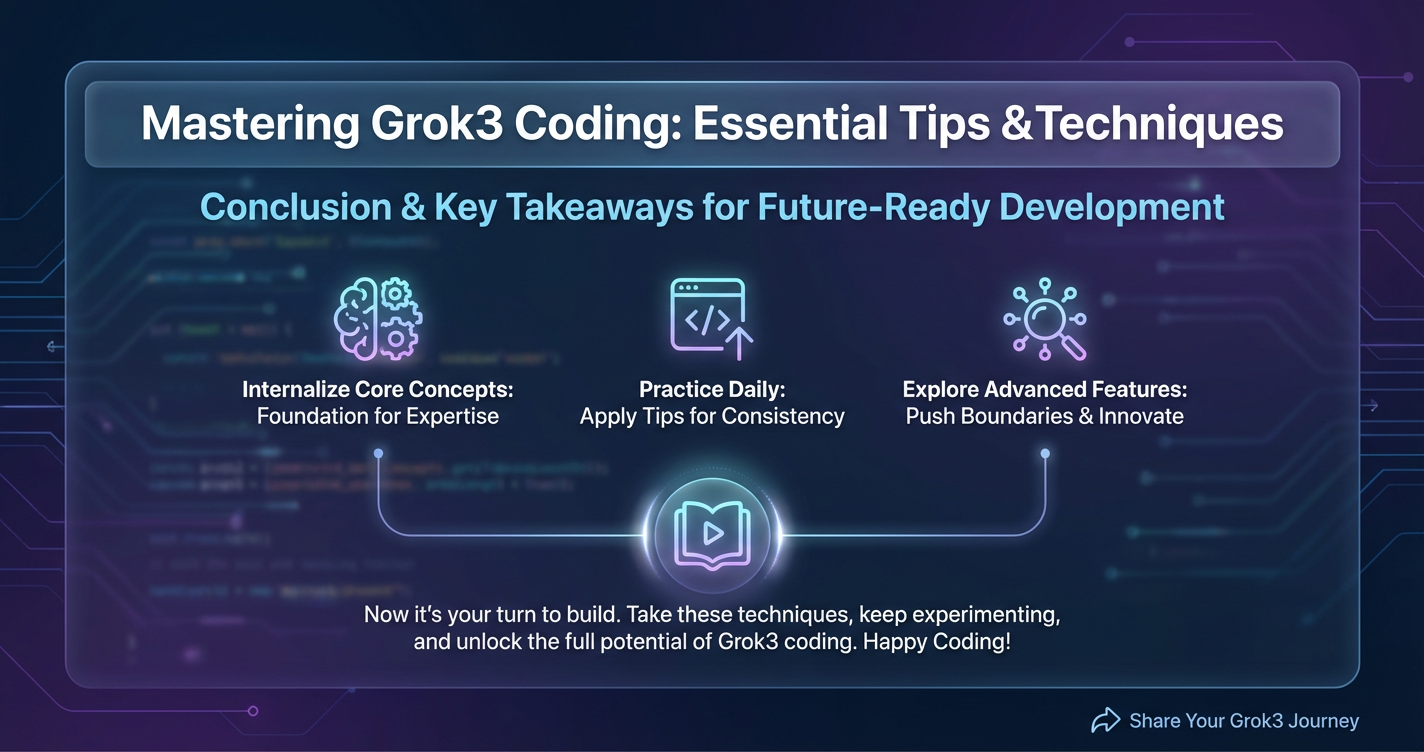
The advent of powerful large language models like Grok3 is unequivocally reshaping the future of software development. We've explored how Grok3 coding transcends simple automation, becoming a sophisticated co-pilot capable of assisting developers across every stage of the software development lifecycle—from conceptual planning and rapid code generation to intricate debugging, refactoring, and even continuous learning. Grok3's emphasis on deep contextual understanding, advanced reasoning, and potentially real-time information access positions it as a formidable contender in the race for the best LLM for coding.
While the promise of AI for coding is vast, realizing its full potential requires a thoughtful and strategic approach. Mastering Grok3 isn't just about understanding its capabilities; it's about cultivating the art of prompt engineering, embracing iterative development, maintaining human oversight, and being acutely aware of both its immense power and its inherent limitations. Developers must remain vigilant, critically evaluating AI-generated content, fostering a symbiotic relationship where AI augments human intellect rather than replacing it.
As the AI landscape continues to evolve, the ability to seamlessly integrate and orchestrate various LLMs will become increasingly vital. Platforms like XRoute.AI offer an elegant solution to this burgeoning complexity, providing a unified API that simplifies access to a multitude of models, including advanced ones like Grok3, optimizing for latency and cost-effectiveness. This enables developers to cherry-pick the most suitable AI for each specific task, fostering unparalleled flexibility and efficiency.
In essence, the future of coding is intelligent, collaborative, and deeply integrated with AI. By embracing tools like Grok3 and platforms that facilitate their unified access, developers are not just adapting to change; they are actively driving the next wave of innovation, empowering themselves to build more robust, efficient, and intelligent software than ever before. The era of the augmented developer is here, and mastering Grok3 coding is a crucial step in navigating and leading this exciting new frontier.
Frequently Asked Questions (FAQ)
Q1: What is Grok3 coding, and how does it differ from traditional coding?
A1: Grok3 coding refers to the practice of using xAI's advanced large language model, Grok3, as an intelligent assistant throughout the software development process. Unlike traditional coding which relies solely on human input for writing, debugging, and testing, Grok3 coding leverages AI to generate code, identify errors, suggest optimizations, and even explain complex concepts. It augments human capabilities rather than replacing them, allowing developers to be more productive and focus on higher-level problem-solving.
Q2: Is Grok3 the best LLM for coding compared to others like GPT-4 or Gemini?
A2: The "best" LLM for coding depends heavily on specific use cases, preferences, and project requirements. Grok3 offers unique strengths such as potentially enhanced real-time information access and a strong emphasis on logical reasoning, which can be highly beneficial for complex programming tasks. However, other models like GPT-4 and Gemini also excel in various areas, offering strong code generation, broad knowledge, and mature ecosystems. Many developers find value in a multi-model approach, using different LLMs for their respective strengths.
Q3: How can I integrate Grok3 into my existing development workflow?
A3: Integrating Grok3 primarily involves using its API. You would obtain an API key, then interact with Grok3 through direct HTTP requests, official SDKs (if available), or third-party IDE extensions/plugins for tools like VS Code or IntelliJ IDEA. Platforms like XRoute.AI can further simplify this by providing a unified API endpoint for Grok3 and over 60 other LLMs, allowing for seamless integration and management of multiple AI tools without dealing with disparate APIs.
Q4: What are the main challenges when using Grok3 for coding, and how can I overcome them?
A4: Key challenges include potential "hallucinations" (AI generating incorrect or fabricated information), the AI's lack of specific project context, the risk of over-reliance leading to skill erosion, and security concerns when handling sensitive code. To overcome these, always verify AI-generated code, provide ample context in your prompts, maintain human oversight, continuously review for security vulnerabilities, and use Grok3 as a learning tool rather than a definitive answer source.
Q5: Can Grok3 help me learn new programming languages or frameworks?
A5: Absolutely! Grok3 is an excellent tool for learning. You can ask it to explain complex programming concepts, provide syntax examples for a new language, walk you through implementing a feature in a specific framework, clarify best practices, or even generate small practice problems. It acts as a personalized, on-demand tutor, providing explanations and code snippets tailored to your queries, significantly accelerating your learning process in AI for coding.
🚀You can securely and efficiently connect to thousands of data sources with XRoute in just two steps:
Step 1: Create Your API Key
To start using XRoute.AI, the first step is to create an account and generate your XRoute API KEY. This key unlocks access to the platform’s unified API interface, allowing you to connect to a vast ecosystem of large language models with minimal setup.
Here’s how to do it: 1. Visit https://xroute.ai/ and sign up for a free account. 2. Upon registration, explore the platform. 3. Navigate to the user dashboard and generate your XRoute API KEY.
This process takes less than a minute, and your API key will serve as the gateway to XRoute.AI’s robust developer tools, enabling seamless integration with LLM APIs for your projects.
Step 2: Select a Model and Make API Calls
Once you have your XRoute API KEY, you can select from over 60 large language models available on XRoute.AI and start making API calls. The platform’s OpenAI-compatible endpoint ensures that you can easily integrate models into your applications using just a few lines of code.
Here’s a sample configuration to call an LLM:
curl --location 'https://api.xroute.ai/openai/v1/chat/completions' \
--header 'Authorization: Bearer $apikey' \
--header 'Content-Type: application/json' \
--data '{
    "model": "gpt-5",
    "messages": [
        {
            "content": "Your text prompt here",
            "role": "user"
        }
    ]
}'
With this setup, your application can instantly connect to XRoute.AI’s unified API platform, leveraging low latency AI and high throughput (handling 891.82K tokens per month globally). XRoute.AI manages provider routing, load balancing, and failover, ensuring reliable performance for real-time applications like chatbots, data analysis tools, or automated workflows. You can also purchase additional API credits to scale your usage as needed, making it a cost-effective AI solution for projects of all sizes.
Note: Explore the documentation on https://xroute.ai/ for model-specific details, SDKs, and open-source examples to accelerate your development.