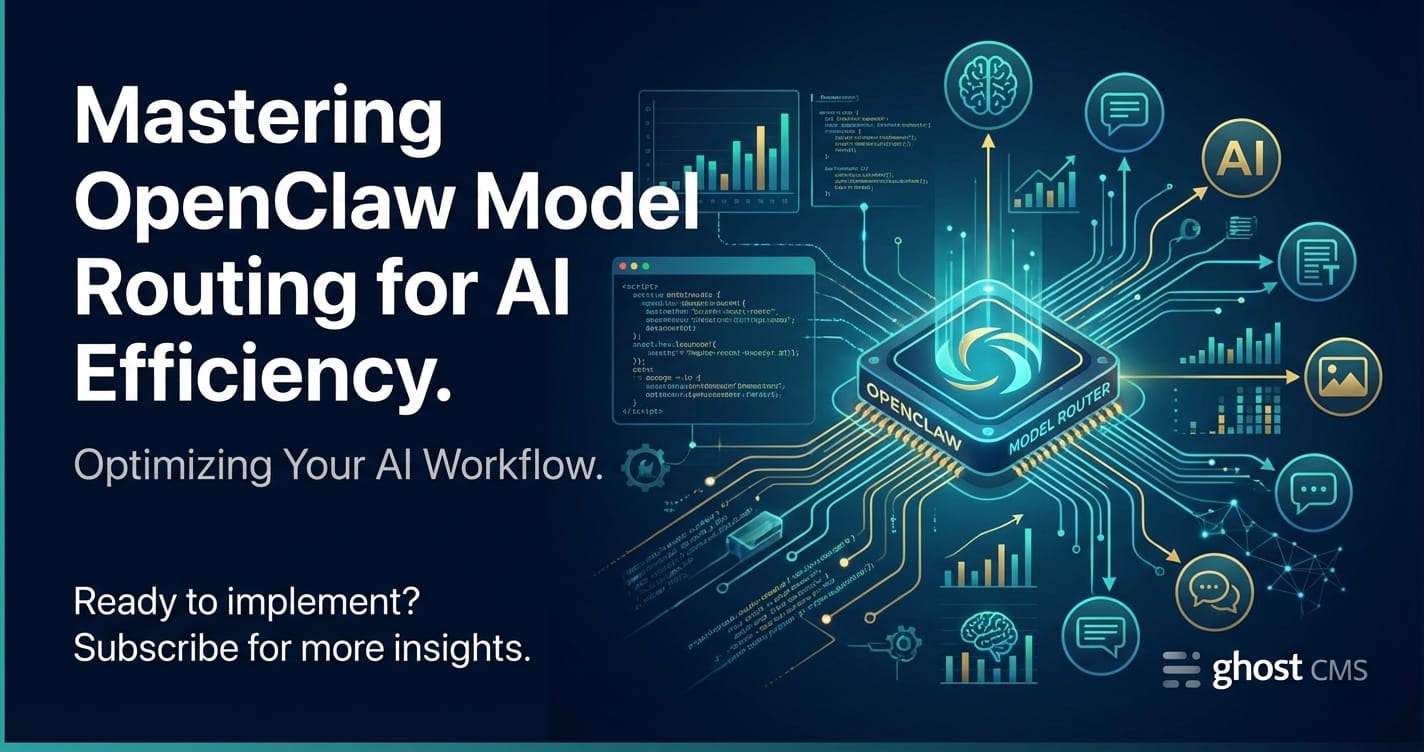
Mastering OpenClaw Model Routing for AI Efficiency

The landscape of Artificial Intelligence has undergone a seismic shift, largely driven by the unprecedented advancements in Large Language Models (LLMs). From revolutionizing customer service with sophisticated chatbots to transforming content creation, data analysis, and software development, LLMs have become indispensable tools across virtually every industry. However, the sheer proliferation of these powerful models – each with its unique strengths, weaknesses, pricing structures, and performance characteristics – has introduced a new layer of complexity for developers and organizations. Navigating this intricate ecosystem, ensuring optimal performance, maximizing accuracy, and critically, managing escalating operational costs, presents a formidable challenge.
In this dynamic environment, a strategic approach to model selection and deployment is no longer a luxury but a necessity. This is where the concept of intelligent llm routing emerges as a pivotal strategy, transforming the way we interact with and leverage AI. By dynamically directing requests to the most appropriate LLM based on a myriad of criteria, llm routing promises to unlock unprecedented levels of efficiency and effectiveness. This comprehensive article will delve deep into the art and science of mastering open router models and sophisticated llm routing strategies. We will introduce and elaborate on the "OpenClaw" paradigm – a conceptual framework for dynamic, intelligent LLM management – demonstrating how its principles can be applied to achieve unparalleled Cost optimization and operational efficiency in AI deployments, thereby future-proofing your AI initiatives.
The Evolving Landscape of Large Language Models (LLMs)
The journey of Large Language Models has been nothing short of spectacular. What began with foundational models demonstrating remarkable generative capabilities has rapidly evolved into a diverse ecosystem encompassing hundreds of models, both proprietary behemoths like GPT-4 and Claude 3, and increasingly powerful open-source alternatives such as Llama 3, Mixtral, and Falcon. This rapid evolution has democratized access to advanced AI capabilities, but simultaneously introduced a labyrinth of choices.
Each LLM possesses a distinct architectural design, training data, and resulting performance profile. Some excel at complex reasoning, others at creative writing, specific language translation, or highly specialized tasks like code generation or medical diagnosis. This specialization is a double-edged sword: it offers immense power for tailored applications but complicates the decision-making process for developers. Should you use a general-purpose model for all tasks, risking suboptimal performance and higher costs for niche queries? Or should you integrate multiple specialized models, grappling with API heterogeneity and increased management overhead?
The challenges extend beyond mere selection. Performance variability is a constant concern; latency can fluctuate based on model load, infrastructure, and even the complexity of the prompt. Accuracy, while generally high, can vary significantly across models for specific tasks or datasets, necessitating careful benchmarking. Perhaps the most pressing concern, however, is the escalating operational cost. LLM inference, especially for larger models or high-volume applications, consumes significant computational resources, translating directly into substantial API usage fees. Without a strategic approach, these costs can quickly spiral out of control, eroding the ROI of AI initiatives. Furthermore, relying on a single vendor or proprietary model introduces the risk of vendor lock-in, limiting flexibility, bargaining power, and future adaptability. These complexities underscore the urgent need for sophisticated management strategies that can intelligently navigate this diverse LLM landscape.
Understanding LLM Routing: The Core of Efficiency
At its heart, llm routing is the intelligent orchestration layer that sits between your application's requests and the multitude of available Large Language Models. It's akin to a sophisticated traffic controller for your AI queries, dynamically directing each incoming request to the most appropriate and optimal LLM based on a predefined set of criteria. Instead of hardcoding a single model for all tasks, or manually switching between APIs, llm routing automates this decision-making process, ensuring that every interaction leverages the best possible model for the job at hand.
What is LLM Routing?
Imagine a vast network of specialized workshops, each capable of performing different tasks – some are incredibly fast but expensive, others are slower but more precise for specific crafts, and some are generalists but might not excel at anything in particular. When a client comes with a request, you wouldn't send every request to the same workshop. Instead, you'd analyze the request: Is it urgent? Does it require extreme precision? Is it a common task? Based on this analysis, you'd route it to the workshop that best fits the requirements in terms of speed, quality, and cost. This is precisely what llm routing does for AI queries.
The routing mechanism can evaluate various factors: * Prompt characteristics: Length, complexity, detected intent (e.g., summarization, code generation, translation, Q&A). * User context: User tier, historical preferences, subscription level. * Real-time model metrics: Current latency, availability, error rates, and load of different LLMs. * Business logic: Defined budgets, priority levels for different types of requests.
By intelligently evaluating these parameters, the llm routing system decides which of the available LLMs should process the request. This might involve choosing between different models from the same provider, or even switching between entirely different providers.
Why is LLM Routing Crucial?
The strategic implementation of llm routing offers a multitude of benefits that are crucial for any organization serious about maximizing its AI investment:
- Enhanced Performance: For time-sensitive applications, routing queries to models known for low latency can significantly improve user experience. For example, a chatbot requiring real-time responses might prioritize a faster, albeit potentially more expensive, model.
- Improved Accuracy and Quality: Specialized models often outperform general-purpose ones for specific domains or tasks.
LLM routingallows you to direct domain-specific queries (e.g., legal, medical, financial) to fine-tuned models, ensuring higher accuracy and more relevant responses. - Significant
Cost optimization: This is arguably one of the most compelling advantages. By dynamically selecting models based on their current pricing and the perceived value of the request, organizations can dramatically reduce their API expenditure. Low-priority or high-volume, repetitive tasks can be routed to cheaper, less powerful models, reserving premium models for critical, complex, or high-value interactions. - Increased Resilience and Reliability: If one LLM provider experiences an outage or performance degradation, a robust
llm routingsystem can automatically failover to an alternative model or provider, ensuring uninterrupted service. This redundancy is vital for business-critical AI applications. - Future-Proofing and Flexibility: The LLM landscape is constantly evolving. New, more powerful, or more cost-effective models emerge regularly. With an
llm routinglayer, integrating new models or deprecating older ones becomes a seamless process, minimizing disruption to your applications. It decouples your application logic from specific LLM APIs. - Experimentation and A/B Testing: Routing enables easy A/B testing of different models or prompt engineering strategies. You can direct a percentage of traffic to a new model to evaluate its performance and cost-effectiveness in a live environment without impacting all users.
Key Principles of Effective LLM Routing
To fully leverage the power of llm routing, several foundational principles must be adhered to:
- Dynamic Decision-Making: The routing system must be capable of making real-time decisions based on a continuously updated understanding of model performance, cost, and availability. Static, hardcoded rules are insufficient in a rapidly changing environment.
- Transparency and Observability: It's essential to know why a particular request was routed to a specific model. Logging and monitoring are critical for debugging, performance analysis, and
Cost optimization. - Configurability and Adaptability: The routing logic should be easily configurable and adaptable to new models, changing business requirements, and evolving cost structures without requiring extensive code changes.
- Scalability: The routing layer itself must be able to handle the same volume and throughput as the LLM requests it manages, without introducing significant latency.
- Security and Compliance: Routing sensitive data across multiple providers necessitates robust security measures and adherence to data privacy regulations.
By embracing these principles, organizations can build a resilient, efficient, and cost-effective AI infrastructure that maximizes the potential of open router models and paves the way for advanced AI capabilities.
Deep Dive into Open Router Models and the OpenClaw Paradigm
As we delve deeper into the practicalities of llm routing, understanding the concept of open router models becomes paramount. This term refers not necessarily to models with open-source weights, but rather to models that are accessible through an open, unified API or a platform designed to aggregate and standardize access to a multitude of LLMs. These platforms abstract away the complexities of dealing with disparate APIs, offering developers a single, consistent interface to a diverse range of models. This approach embodies flexibility, interoperability, and freedom of choice, standing in stark contrast to being confined to a single provider's ecosystem.
Defining Open Router Models
An open router model environment typically provides:
- Unified API Endpoint: A single API endpoint that can be used to invoke various underlying LLMs. This greatly simplifies integration, as developers don't need to write custom code for each model provider.
- Model Agnostic Interaction: The ability to specify which model to use via a simple parameter in the API call, rather than needing to switch API keys, authentication methods, or request formats.
- Access to Diverse Models: These platforms often integrate dozens, if not hundreds, of LLMs – including proprietary models (like those from OpenAI, Anthropic, Google) and popular open-source models (hosted by various providers).
- Built-in Routing Capabilities: Many
open router modelsplatforms come with nativellm routingfunctionalities, allowing users to define policies based on cost, performance, or capability.
The primary benefit of working within an open router models ecosystem is the unparalleled flexibility it offers. Developers are no longer tied to the performance or pricing of a single vendor. They can experiment with new models with minimal effort, switch providers if a better option emerges, and optimize their AI workflows across a broader spectrum of choices. This democratizes access to cutting-edge AI and fosters healthy competition among model providers, ultimately benefiting the end-user through better performance and Cost optimization.
Introducing the "OpenClaw" Paradigm (Conceptual Framework)
To truly master llm routing within an open router models environment, we propose the "OpenClaw" paradigm – a comprehensive, multi-pronged approach to intelligent LLM management. Imagine a sophisticated robotic claw, each finger representing a critical dimension of optimization: Performance, Cost, Accuracy, Reliability, and Developer Experience. By simultaneously gripping and balancing these five aspects, organizations can achieve a holistic and truly efficient AI infrastructure.
Claw 1: Performance-Driven Routing
The first claw focuses on the speed and efficiency of AI responses. In many applications, latency is a critical factor – a slow chatbot can frustrate users, and a sluggish backend AI can bottleneck entire workflows.
- Latency Considerations: Prioritizing models with historically low response times for interactive applications. This might involve real-time monitoring of model APIs to detect momentary slowdowns.
- Throughput Management: For high-volume asynchronous tasks, routing can optimize for models that handle larger concurrent request loads or process requests more efficiently in batches.
- Real-time Model Monitoring: Implementing systems that continuously track the actual performance (latency, error rates, uptime) of all integrated
open router models. This data then feeds directly into the routing decision-making process, allowing for dynamic adjustments. For instance, if a preferred low-latency model suddenly experiences an increase in response time, the system can temporarily reroute traffic to an alternative. - Task-Specific Performance Profiles: Recognizing that "performance" isn't monolithic. A model might be fast for short summarizations but slow for complex multi-turn conversations. Routing should account for these nuances, directing conversational AI to models optimized for quick turns, while routing batch processing of documents to models that might have higher individual latency but offer better overall throughput or cost efficiency.
Claw 2: Cost-Aware Routing
This claw directly addresses Cost optimization, a paramount concern for any scalable AI deployment. Without intelligent routing, costs can quickly become prohibitive, diminishing the ROI of AI initiatives.
- Dynamic Pricing Models: Different LLMs have varying pricing structures, often based on input tokens, output tokens, or per-call rates. Furthermore, these prices can fluctuate or differ across regions or providers. The routing system must be aware of these dynamic costs.
- Prioritizing Cheaper Models: For non-critical, high-volume tasks where a slight dip in performance or a broader response is acceptable, the routing system should intelligently default to the most cost-effective
open router models. Examples include internal summarization of routine emails, basic data classification, or initial drafts of content where human review is anticipated. - Budget Constraints and Guardrails: Implementing routing rules that incorporate budget limits. If a certain daily or monthly budget for a premium model is approached, the system can automatically switch to a cheaper alternative or prompt for human intervention.
- Token Cost Analysis: The system can analyze the expected token usage of a prompt and choose a model that offers the best cost-per-token ratio for that specific length, or even decide if a smaller, fine-tuned model would suffice, thereby significantly reducing token expenditure.
- Tiered Model Strategy: Define tiers of models (e.g., "economy," "standard," "premium") based on their cost-to-performance ratio. Route requests to the lowest possible tier that still meets performance or accuracy requirements. For instance, a customer support chatbot could use an "economy" model for routine FAQs, but escalate to a "premium" model for complex inquiries requiring nuanced understanding.
Claw 3: Accuracy and Specialization Routing
The third claw ensures that the right tool is used for the right job, maximizing the quality and relevance of AI-generated responses.
- Task-Type Based Routing: Identifying the intent of the user's prompt (e.g., code generation, creative writing, factual Q&A, sentiment analysis, translation) and routing it to an
open router modelspecifically trained or known to excel in that area. For example, a request to generate Python code would go to a code-focused model, while a request for a marketing slogan would go to a creative text model. - Leveraging Specialized Fine-Tuned Models: Many organizations fine-tune LLMs on their proprietary data for specific tasks.
LLM routingallows these specialized models to be integrated seamlessly, ensuring that queries requiring deep domain knowledge are routed appropriately. - Confidence Scoring and Model Ensemble: In advanced scenarios, a request might be sent to multiple models simultaneously. The
llm routingsystem could then evaluate the confidence scores of each model's response or use a smaller meta-model to synthesize the best answer or select the most accurate one. - Domain-Specific Routing: For organizations operating in regulated industries, certain types of queries (e.g., legal advice, medical questions) might need to be routed to highly specialized, compliant models, potentially even ones hosted on private infrastructure.
Claw 4: Reliability and Redundancy Routing
This claw ensures the continuous availability and robustness of your AI services, even in the face of outages or performance degradation from individual providers.
- Failover Mechanisms: A critical component of reliability. If a primary
open router modelor provider fails to respond within a timeout period or returns an error, the system automatically reroutes the request to a designated backup model or provider. This maintains service continuity and minimizes downtime. - Load Balancing Across Providers: Distributing requests across multiple healthy LLM providers to prevent any single point of failure from becoming a bottleneck and to ensure even utilization of resources. This can be based on real-time load metrics from each provider.
- Geographic Distribution and Compliance: For global applications, routing requests to LLMs hosted in specific geographic regions can reduce latency and ensure compliance with regional data residency and privacy regulations (e.g., GDPR).
- Graceful Degradation: In extreme circumstances, if all premium models are unavailable or over capacity, the routing system can temporarily fall back to a less capable but always available model, or even provide a user-friendly message, preventing a complete service interruption.
Claw 5: Developer Experience and Simplicity Routing
The final claw recognizes that the most powerful tools are useless if they are too complex to integrate and manage. A strong focus on developer experience simplifies the entire LLM lifecycle.
- Unified API Platforms: The core of simplifying integration. Instead of learning and implementing distinct APIs for OpenAI, Anthropic, Google, and various open-source models, developers interact with a single, consistent endpoint. This reduces boilerplate code, accelerates development cycles, and minimizes integration errors.
- Simplified Model Management: A good
open router modelsplatform provides a clear interface (API or dashboard) for discovering, configuring, and enabling/disabling different LLMs without needing to modify application code. - Abstracting Away Complexity: The platform should handle the intricate details of authentication, request formatting, rate limiting, and error handling for each underlying LLM, presenting a clean, consistent interface to the developer.
- Developer-Friendly Tools: This includes comprehensive SDKs, clear documentation, example code, and monitoring dashboards that provide insights into model usage, performance, and
Cost optimization.
For developers grappling with the complexities of managing numerous LLM APIs and implementing sophisticated llm routing strategies, platforms like XRoute.AI offer a cutting-edge solution. XRoute.AI stands out as a unified API platform specifically designed to streamline access to over 60 large language models from more than 20 active providers. By presenting a single, OpenAI-compatible endpoint, it effectively simplifies the integration process, allowing developers to focus on building intelligent applications, chatbots, and automated workflows. This platform embodies the principles of low latency AI and cost-effective AI by abstracting away the underlying complexities of model selection and provider management. Its high throughput, scalability, and flexible pricing model directly contribute to significant Cost optimization and enhance developer productivity, making it an indispensable tool for mastering open router models in real-world applications. XRoute.AI enables developers to effortlessly switch between models and providers, ensuring their AI applications are always powered by the optimal choice for performance, accuracy, and cost-efficiency.
XRoute is a cutting-edge unified API platform designed to streamline access to large language models (LLMs) for developers, businesses, and AI enthusiasts. By providing a single, OpenAI-compatible endpoint, XRoute.AI simplifies the integration of over 60 AI models from more than 20 active providers(including OpenAI, Anthropic, Mistral, Llama2, Google Gemini, and more), enabling seamless development of AI-driven applications, chatbots, and automated workflows.
Implementing Advanced LLM Routing Strategies
Moving from conceptual understanding to practical implementation requires a structured approach to designing and deploying llm routing mechanisms. The effectiveness of your routing system hinges on the metrics you use to make decisions and the architecture you choose to support those decisions.
Decision Metrics for Routing
Intelligent routing relies on a rich set of data points to inform its choices. These metrics can be broadly categorized:
- Performance Metrics:
- Latency: Average response time (RT) of a model for specific query types.
- Throughput: Number of requests a model can handle per second.
- Error Rate: Percentage of failed requests for a given model.
- Availability: Uptime status of the model and its API.
- Cost Metrics:
- Cost per token (Input/Output): The most common LLM pricing unit.
- Cost per API call: Some models or providers charge a flat fee per call.
- Tiered Pricing: Understanding volume discounts or premium access costs.
- Budget Adherence: Tracking against predefined spending limits.
- Capability Metrics:
- Model Specialization: Does the model excel at code, summarization, creative writing, or specific domains?
- Context Window Size: The maximum number of tokens a model can process in a single request, crucial for longer documents or conversations.
- Language Support: Which languages does the model perform best in?
- Feature Set: Does it support specific features like function calling, image understanding, or multimodal inputs?
- Request & User Context Metrics:
- Prompt Complexity: Categorizing prompts as simple (e.g., "What is 2+2?") vs. complex (e.g., "Write a detailed market analysis for Q4 2023 for the semiconductor industry, considering macroeconomic factors and geopolitical tensions").
- User Priority: Routing requests from premium users or critical internal tools to higher-performance models.
- Session State: For multi-turn conversations, ensuring continuity by routing to the same model or a compatible one.
Routing Architectures
The architectural choice for your llm routing system impacts its flexibility, scalability, and complexity.
- Client-Side Routing:
- Mechanism: The application itself decides which LLM to call, often based on local rules or simple configurations.
- Pros: Simpler to implement for basic use cases, lower infrastructure overhead.
- Cons: Limited flexibility (rules need client updates), lacks real-time global context (e.g., cannot monitor all model loads), prone to security risks if API keys are client-exposed. Best for very static and simple routing.
- Server-Side Routing:
- Mechanism: A dedicated backend service acts as an intermediary. Client requests go to this service, which then applies routing logic and forwards the request to the appropriate LLM.
- Pros: Centralized control, robust
llm routinglogic, improved security (API keys are server-side), ability to incorporate real-time metrics and complex decisioning. - Cons: Adds latency (an extra hop), requires managing an additional service. This is the most common and recommended approach for production systems.
- Proxy-Based Routing (often as part of unified API platforms):
- Mechanism: Similar to server-side, but often provided as a managed service by platforms that aggregate
open router models. Your application calls the proxy's unified API, and the proxy handles all the underlying routing. - Pros: Easiest to integrate (managed service), high scalability, usually offers advanced
llm routingfeatures andCost optimizationout of the box (as seen with XRoute.AI). - Cons: Vendor reliance, potentially less customization for extremely niche routing needs.
- Mechanism: Similar to server-side, but often provided as a managed service by platforms that aggregate
Rule-Based Routing
The most straightforward way to implement llm routing is through a set of predefined rules. These are essentially if-then-else statements that guide the routing decisions.
Examples: * Cost-driven Rule: "If prompt.length > 5000 tokens AND request.priority = 'low', THEN use OpenAI:gpt-3.5-turbo (cost-effective). ELSE use Anthropic:claude-3-opus (premium)." * Task-driven Rule: "If request.intent = 'code_generation', THEN use Google:Gemini-1.5-Pro (specialized). ELSE IF request.intent = 'creative_writing', THEN use Anthropic:claude-3-sonnet." * Failover Rule: "If primary_model_A.status = 'down' OR primary_model_A.latency > 500ms, THEN route to backup_model_B."
Rule-based routing is effective for predictable scenarios but can become cumbersome as the number of models and routing criteria grows.
Dynamic and Intelligent Routing (AI-driven Routing)
For more sophisticated and adaptive llm routing, AI-driven approaches are increasingly being explored:
- Meta-LLMs or Smaller Classification Models: A smaller, faster LLM (or a traditional machine learning classifier) can be used to analyze the incoming prompt's intent, complexity, or sentiment. Based on this analysis, it then recommends the most suitable larger LLM for the actual generation. This reduces the need to send every prompt to a large, expensive model for initial categorization.
- Reinforcement Learning for Continuous Optimization: An RL agent can be trained to dynamically adjust routing policies based on observed outcomes (e.g., cost, latency, user satisfaction scores). The agent learns which routing decisions yield the best results over time, adapting to changing model performance or pricing.
- Predictive Routing: Using historical data, machine learning models can predict the likely latency or cost of different LLMs for a given request type at a specific time, allowing the router to make proactive, optimized decisions.
Practical Steps for Setting Up an Open Router Model System
- Identify Core Use Cases and Requirements: What are the key tasks your AI will perform? What are the critical performance, accuracy, and cost constraints for each?
- Evaluate Available Models and Providers: Research various
open router modelsplatforms and individual LLM providers. Benchmark models relevant to your use cases for performance and accuracy. - Choose a Routing Platform or Build In-House:
- Managed Platform (e.g., XRoute.AI): Offers quick setup, reduced maintenance, and often includes advanced features. Ideal for most businesses.
- In-House: Provides maximum control and customization but requires significant engineering effort. Suitable for organizations with unique, complex requirements and ample resources.
- Define Routing Policies: Translate your requirements into concrete routing rules. Start simple and progressively add complexity. Consider:
- Default model for general queries.
- Specific models for identified intents (e.g., code, summarization).
- Cost thresholds for different request types.
- Failover strategies.
- Integrate and Test: Connect your applications to the chosen
llm routinglayer. Thoroughly test all routing scenarios, including edge cases and failover conditions. - Monitor and Iterate: Deploy robust monitoring for performance, cost, and accuracy. Continuously analyze data to identify areas for improvement. The LLM landscape is dynamic; your routing strategies must also evolve. This iterative process is key to long-term
Cost optimizationand efficiency.
Cost Optimization in Practice with Open Router Models
One of the most immediate and tangible benefits of implementing sophisticated llm routing strategies, particularly with open router models, is the substantial potential for Cost optimization. Without careful management, LLM inference costs can quickly become a significant line item in an organization's budget. Understanding the drivers of these costs and employing intelligent routing techniques can lead to dramatic savings without compromising performance or quality.
Understanding LLM Cost Drivers
To effectively optimize costs, it's crucial to understand what factors contribute to LLM expenditure:
- Token Usage (Input/Output): This is the primary cost driver for most LLMs. You pay for every token sent to the model (input) and every token generated by the model (output). Longer prompts and longer responses directly translate to higher costs.
- Model Size and Complexity: Larger, more capable models (e.g., GPT-4, Claude 3 Opus) are inherently more expensive per token than smaller, less complex models (e.g., GPT-3.5-turbo, Llama 3).
- API Call Volume: While token usage is dominant, high volumes of short calls can also accumulate costs, especially if there's a per-call fee.
- Provider Pricing Structures: Each LLM provider has its own pricing model, which can include:
- Per-token pricing: Varies significantly between input and output tokens, and across models.
- Tiered pricing: Discounts for higher usage volumes.
- Regional pricing: Costs might differ based on the geographic location of the model inference.
- Specialized model pricing: Some models (e.g., fine-tuned versions, vision models) may have different rates.
Strategies for Cost Optimization
Leveraging open router models and advanced llm routing allows for a multi-faceted approach to Cost optimization:
1. Tiered Routing: The Smart Allocation of Resources
This strategy involves categorizing requests based on their importance, complexity, and desired performance, and then routing them to the most cost-effective model that meets those specific requirements.
- High-Volume, Low-Stakes: Route routine, non-critical tasks (e.g., simple internal summaries, basic data categorization, preliminary drafts) to the cheapest
open router modelsavailable (e.g., smaller, fast open-source models or older, cheaper proprietary models). - Critical, Low-Volume: Reserve premium, more expensive models for tasks requiring high accuracy, complex reasoning, or rapid response times (e.g., customer-facing chatbots for critical inquiries, complex data analysis, code generation for production systems).
- Intermediate Tier: A middle ground for tasks that are moderately important but don't warrant the highest expense.
2. Fallback Mechanisms with Cost Awareness
Beyond simple failover, cost-aware fallback involves using a cheaper model as a primary choice, with a more expensive but robust model serving as a backup.
- Primary Cheap, Backup Expensive: Attempt to use a cost-effective model first. If it fails, or if a defined quality threshold isn't met, then automatically fall back to a more capable (and likely more expensive) model. This ensures quality and reliability while prioritizing cost savings.
3. Batching and Caching for Efficiency
- Batching Requests: For asynchronous or non-real-time tasks, batching multiple prompts into a single API call can sometimes reduce per-request overhead and improve throughput, potentially leading to better pricing tiers or more efficient token usage.
- Caching Responses: For frequently asked questions or repetitive prompts, caching LLM responses can eliminate the need to make a new API call, saving both cost and latency. Intelligent caching mechanisms can invalidate cached responses if underlying data changes.
4. Prompt Engineering for Efficiency
The way you structure your prompts directly impacts token usage and thus cost.
- Minimizing Token Count: Be concise. Remove unnecessary words, examples, or instructions from your prompts without sacrificing clarity.
- Few-Shot vs. Zero-Shot: While few-shot prompting can improve accuracy, providing too many examples can drastically increase input token count. Balance the need for context with
Cost optimization. - Output Control: Explicitly instruct the LLM to provide concise answers or specific formats to minimize output tokens.
5. Dynamic Model Switching Based on Real-time Data
Sophisticated llm routing systems can adjust their model selection in real-time based on external factors:
- Real-time Cost Fluctuations: If a provider temporarily offers a discount or changes its pricing, the router can immediately shift traffic to leverage these savings.
- Budget Adherence: Automatically switch to cheaper models when a project's budget threshold is approaching, providing a safeguard against overspending.
6. Monitoring and Analytics for Continuous Improvement
Comprehensive logging and analytics are vital for identifying Cost optimization opportunities.
- Detailed Usage Tracking: Monitor token usage, API calls, and actual costs per model, per user, per application, and per task type.
- Cost Anomaly Detection: Identify sudden spikes in usage or unexpected cost increases that might indicate inefficient routing, prompt issues, or unintended model choices.
- Performance vs. Cost Trade-offs: Continuously analyze the balance between model performance (latency, accuracy) and its associated cost. Are you overspending for marginal gains, or are there areas where a slightly less performant but much cheaper model would suffice?
7. Leveraging Provider-Specific Discounts and Open Router Models Platforms
- Many
open router modelsplatforms negotiate bulk discounts with underlying LLM providers. By consolidating your usage through such a platform, you might access better rates than direct API access. - The competitive nature of
open router modelsencourages providers to offer more attractive pricing, which intelligentllm routingcan exploit.
Table 1: Hypothetical LLM Costs and Routing Decisions for Different Tasks
| Task Type | Required Performance | Required Accuracy | Expected Tokens (Input/Output) | Current Cost/1K Tokens (Input) | Current Cost/1K Tokens (Output) | Recommended Default Model | Rationale & Cost Savings |
|---|---|---|---|---|---|---|---|
| Email Summarization (Internal) | Low Latency | Moderate | 500 / 100 | $0.0005 (GPT-3.5-turbo) | $0.0015 (GPT-3.5-turbo) | GPT-3.5-turbo (OpenAI) | High volume, low priority. Good baseline cost-efficiency. |
| Customer Support Chatbot (Routine FAQ) | Low Latency | High | 200 / 80 | $0.0008 (Claude 3 Haiku) | $0.004 (Claude 3 Haiku) | Claude 3 Haiku (Anthropic) | Fast, accurate for general Q&A, good value. |
| Legal Document Review (Compliance Check) | Moderate Latency | Very High | 8000 / 1500 | $0.003 (Gemini 1.5 Pro) | $0.004 (Gemini 1.5 Pro) | Gemini 1.5 Pro (Google) | Large context window, strong reasoning. Higher cost justified by critical accuracy. |
| Code Generation (Production) | Moderate Latency | Very High | 1000 / 500 | $0.005 (GPT-4o) | $0.015 (GPT-4o) | GPT-4o (OpenAI) | Best-in-class for code, higher cost for production-grade output. |
| Creative Content Draft (Marketing) | Moderate Latency | High (creativity) | 600 / 300 | $0.0015 (Mixtral 8x7B) | $0.003 (Mixtral 8x7B) | Mixtral 8x7B (Open Source) | Good balance of creativity and cost for initial drafts. |
Note: Costs are illustrative and subject to change by providers.
Table 2: Impact of LLM Routing Strategy on Estimated Monthly Cost
| Scenario | Average Cost per Request | Estimated Monthly Requests | Estimated Monthly Cost | Potential Savings with Routing |
|---|---|---|---|---|
| No Routing (All requests to GPT-4o) | $0.05 | 1,000,000 | $50,000 | N/A |
| Basic Rule-Based Routing | $0.025 | 1,000,000 | $25,000 | 50% |
| (70% to GPT-3.5, 20% to Claude 3 Haiku, 10% to GPT-4o) | ||||
| Advanced "OpenClaw" Routing (Dynamic, Cost-aware) | $0.012 | 1,000,000 | $12,000 | 76% (vs. no routing) |
| (Optimized based on real-time costs, usage, intent) |
These tables illustrate that while initial costs with premium models can be high, strategic llm routing through open router models can significantly drive down operational expenses, making AI solutions more sustainable and scalable.
Challenges and Future Trends in LLM Routing
While the benefits of mastering llm routing are clear, the path to implementing truly intelligent and efficient systems is not without its hurdles. Understanding these challenges and anticipating future trends is crucial for building resilient and forward-thinking AI infrastructures.
Challenges in LLM Routing
- Complexity of Managing Diverse Models: The sheer number of
open router modelsand their continuous evolution make it challenging to keep track of their capabilities, performance benchmarks, and pricing. Each model has unique quirks, input/output formats, and rate limits, which the routing system must meticulously handle. - Ensuring Data Privacy and Security Across Providers: Routing sensitive data across multiple third-party LLM providers introduces significant data governance challenges. Organizations must ensure that each provider adheres to strict security protocols, compliance regulations (e.g., GDPR, HIPAA), and data residency requirements. Trusting multiple vendors with proprietary or user data requires robust vetting and contractual agreements.
- Cold Start Problems for New Models: When a new model is introduced, there's often no historical performance data. This "cold start" makes it difficult for intelligent routing systems to make optimal decisions immediately, requiring a period of monitoring and manual calibration.
- Maintaining Model Performance Benchmarks: The performance of LLMs can fluctuate due to updates, infrastructure changes, or varying load. Continuously benchmarking and validating the accuracy, latency, and reliability of all integrated models is an ongoing, resource-intensive task.
- The "Black Box" Nature of Some Proprietary Models: While
open router modelsplatforms offer unified access, the underlying proprietary models can still be black boxes. Understanding why a certain response was generated or why performance degraded can be challenging, making troubleshooting routing issues more complex. - Cost Monitoring Granularity: Accurately attributing costs to specific users, features, or departments when routing across multiple providers can be difficult without sophisticated cost attribution and reporting tools.
Future Trends in LLM Routing
The field of llm routing is dynamic and will continue to evolve rapidly. Several key trends are expected to shape its future:
- More Sophisticated AI-Driven Routing: Expect to see increased adoption of reinforcement learning and smaller "meta-LLMs" dedicated solely to routing decisions. These systems will learn and adapt routing policies in real-time, optimizing for multiple objectives (cost, latency, accuracy) simultaneously, far beyond simple rule-based systems.
- Federated LLM Systems and Edge AI: As LLMs become more efficient, certain models or components of models might run on edge devices or in a federated manner, closer to the data source. Routing systems will need to account for these distributed deployments, optimizing for local processing where possible to reduce latency and transfer costs.
- Specialized Routing for Multimodal LLMs: With the rise of multimodal LLMs that can process text, images, audio, and video,
llm routingwill extend beyond textual inputs. Routing decisions will need to consider the type, size, and complexity of all input modalities, directing them to models best suited for specific multimodal tasks. - Greater Emphasis on Ethical AI and Bias Mitigation in Routing: Routing systems will incorporate ethical considerations. For instance, specific sensitive queries might be routed to models known for lower bias or higher safety standards. This will involve active monitoring for model bias and the ability to dynamically route away from models that exhibit problematic behavior.
- Standardization of Routing Protocols and Interoperability: As
llm routingbecomes ubiquitous, there will likely be a push for greater standardization in API interfaces, metadata for model capabilities, and routing protocols. This will further enhance interoperability betweenopen router modelsplatforms and make it easier to switch between them. - Advanced
Cost OptimizationFeatures: Expectopen router modelsplatforms to offer more granular cost controls, predictive cost analytics, and sophisticated budget management tools, allowing businesses to set dynamic spending limits and automatically adjust routing strategies to stay within budget.
The integration of platforms like XRoute.AI, with its focus on a unified API platform for large language models, is perfectly aligned with these future trends. By providing a single, OpenAI-compatible endpoint for over 60 models from 20+ providers, XRoute.AI already simplifies many of these complex challenges, offering low latency AI and cost-effective AI through its inherent routing capabilities. Its commitment to developer-friendly tools, high throughput, and scalability positions it as a foundational component for future AI architectures that demand advanced llm routing and Cost optimization.
Conclusion
The era of Large Language Models has ushered in unparalleled opportunities for innovation and efficiency across industries. However, to truly harness this power, organizations must navigate a complex and rapidly evolving ecosystem. The mastery of llm routing strategies, particularly within the flexible framework offered by open router models, is no longer an optional enhancement but a fundamental requirement for sustainable and impactful AI deployment.
We have explored the "OpenClaw" paradigm, a comprehensive approach that systematically addresses the critical dimensions of Performance, Cost, Accuracy, Reliability, and Developer Experience. By intelligently orchestrating requests across a diverse array of models, llm routing empowers businesses to achieve enhanced performance, superior accuracy for specialized tasks, robust reliability through failover mechanisms, and most significantly, dramatic Cost optimization. The ability to dynamically select the most appropriate model based on real-time metrics ensures that every AI interaction is not only effective but also economically viable.
Platforms like XRoute.AI exemplify this paradigm by offering a unified, developer-friendly gateway to a vast selection of LLMs, simplifying integration, and enabling sophisticated routing strategies that directly contribute to low latency AI and cost-effective AI. As the AI landscape continues to expand, organizations that invest in mastering open router models and intelligent llm routing will gain a decisive strategic advantage, transforming their AI initiatives from mere experiments into highly efficient, scalable, and indispensable components of their operational fabric. The future of AI efficiency lies in smart routing, ensuring that the right model is always available at the right time and at the right cost.
FAQ
Q1: What exactly is LLM routing and why is it so important for AI applications? A1: LLM routing is the intelligent process of dynamically directing an application's requests to the most suitable Large Language Model (LLM) from a pool of available models. It's crucial because it allows you to optimize for various factors like performance (speed), accuracy (choosing specialized models), reliability (failover to backup models), and most importantly, Cost optimization. Without routing, you'd likely use a single model for all tasks, which is inefficient and costly.
Q2: How do open router models differ from using a single LLM API directly? A2: Open router models refer to models accessible through a unified API platform that aggregates multiple LLMs from various providers (e.g., OpenAI, Anthropic, Google, open-source models). Instead of integrating with each provider's unique API, you interact with a single, standardized endpoint. This offers immense flexibility, reduces integration complexity, and enables easy switching between models for better performance or Cost optimization without changing your application code.
Q3: What are the primary ways LLM routing helps in Cost optimization? A3: LLM routing optimizes costs by: 1. Tiered Routing: Sending high-volume, low-priority tasks to cheaper models and reserving expensive, premium models for critical tasks. 2. Dynamic Model Switching: Adapting to real-time cost fluctuations or budget limits by routing requests to the most cost-effective model at any given moment. 3. Prompt Efficiency: Using models that are more efficient with token usage for specific prompt lengths or complexities. 4. Failover to Cheaper Models: Prioritizing a cheaper model as primary, falling back to a more expensive one only when necessary. 5. Analytics: Providing granular insights into where costs are being incurred, allowing for continuous refinement of routing policies.
Q4: Can LLM routing also improve the reliability of my AI applications? A4: Absolutely. A well-implemented llm routing system significantly enhances reliability by incorporating failover mechanisms. If a primary LLM provider experiences an outage or performance degradation, the routing system can automatically detect this and redirect requests to an alternative, healthy model or provider. This ensures business continuity and minimizes downtime for your AI-powered services.
Q5: How does a platform like XRoute.AI fit into the concept of mastering OpenClaw Model Routing? A5: XRoute.AI is an excellent example of a platform that embodies the principles of the "OpenClaw" paradigm. It acts as a unified API platform, giving developers a single, OpenAI-compatible endpoint to access over 60 open router models from more than 20 providers. This directly addresses the "Developer Experience and Simplicity" claw. By abstracting away API complexities and enabling seamless model switching, XRoute.AI inherently facilitates low latency AI and cost-effective AI strategies, allowing developers to easily implement all the other "claws" – performance, cost, accuracy, and reliability-driven routing – within a powerful and scalable infrastructure, ultimately leading to significant Cost optimization.
🚀You can securely and efficiently connect to thousands of data sources with XRoute in just two steps:
Step 1: Create Your API Key
To start using XRoute.AI, the first step is to create an account and generate your XRoute API KEY. This key unlocks access to the platform’s unified API interface, allowing you to connect to a vast ecosystem of large language models with minimal setup.
Here’s how to do it: 1. Visit https://xroute.ai/ and sign up for a free account. 2. Upon registration, explore the platform. 3. Navigate to the user dashboard and generate your XRoute API KEY.
This process takes less than a minute, and your API key will serve as the gateway to XRoute.AI’s robust developer tools, enabling seamless integration with LLM APIs for your projects.
Step 2: Select a Model and Make API Calls
Once you have your XRoute API KEY, you can select from over 60 large language models available on XRoute.AI and start making API calls. The platform’s OpenAI-compatible endpoint ensures that you can easily integrate models into your applications using just a few lines of code.
Here’s a sample configuration to call an LLM:
curl --location 'https://api.xroute.ai/openai/v1/chat/completions' \
--header 'Authorization: Bearer $apikey' \
--header 'Content-Type: application/json' \
--data '{
    "model": "gpt-5",
    "messages": [
        {
            "content": "Your text prompt here",
            "role": "user"
        }
    ]
}'
With this setup, your application can instantly connect to XRoute.AI’s unified API platform, leveraging low latency AI and high throughput (handling 891.82K tokens per month globally). XRoute.AI manages provider routing, load balancing, and failover, ensuring reliable performance for real-time applications like chatbots, data analysis tools, or automated workflows. You can also purchase additional API credits to scale your usage as needed, making it a cost-effective AI solution for projects of all sizes.
Note: Explore the documentation on https://xroute.ai/ for model-specific details, SDKs, and open-source examples to accelerate your development.