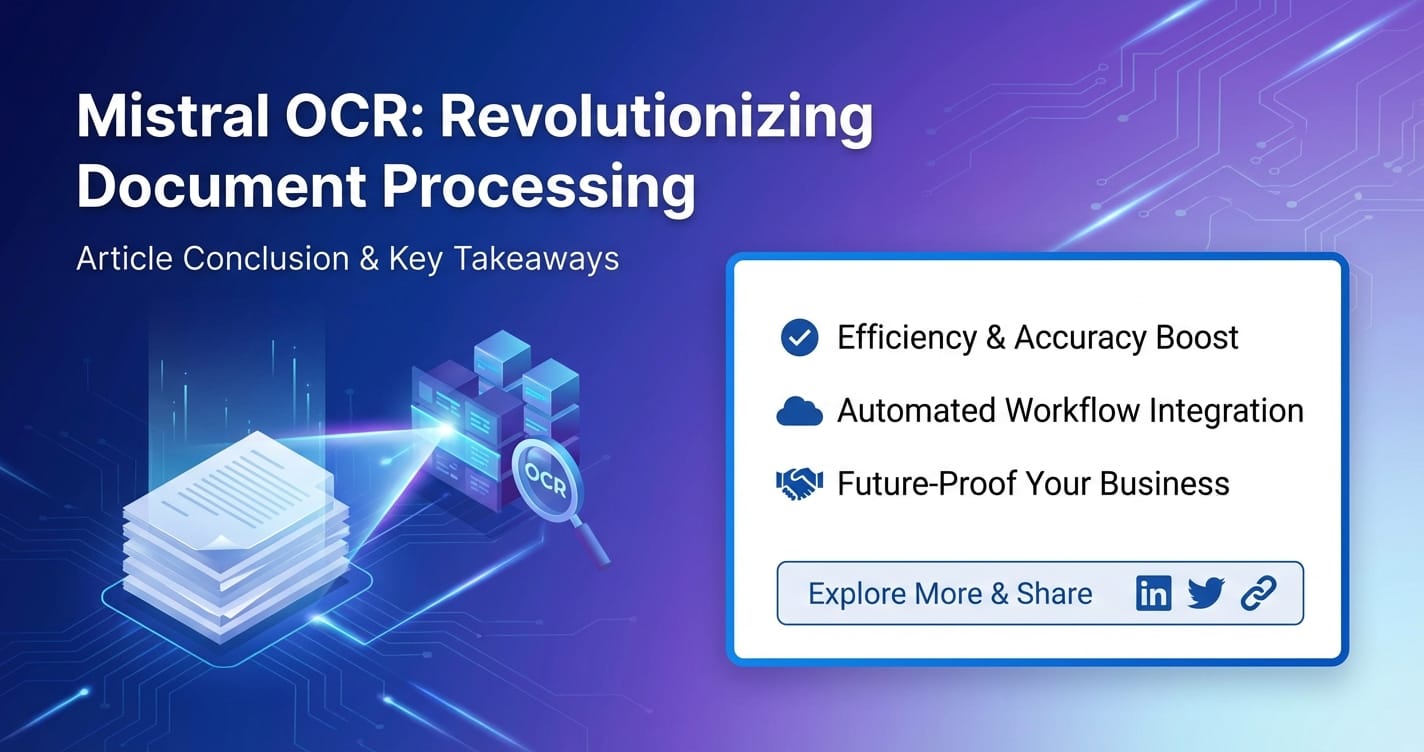
Mistral OCR: Revolutionizing Document Processing

1. Introduction: The Dawn of Intelligent Document Processing
In an era defined by information, businesses globally grapple with an unending deluge of documents. From intricate legal contracts and multi-page financial reports to handwritten medical forms and diverse logistical manifests, the sheer volume of unstructured data presents a monumental challenge. Organizations spend countless hours manually extracting, verifying, and inputting information, a process that is not only excruciatingly slow and resource-intensive but also highly prone to human error. This bottleneck significantly impedes operational efficiency, delays critical decision-making, and diverts valuable human capital from more strategic initiatives.
At the heart of tackling this challenge lies Optical Character Recognition (OCR), a technology that has long been the backbone of converting physical or image-based documents into machine-readable text. For decades, traditional OCR systems have served as a vital bridge, digitizing paper archives and enabling basic text searchability. However, as the complexity and diversity of documents have grown, so too have the limitations of these older systems. They often falter when confronted with varying layouts, low-quality scans, diverse fonts, and, most critically, the need for semantic understanding—the ability to grasp the meaning and context behind the extracted words.
The persistent shortcomings of conventional OCR have underscored an urgent need for a revolution in document processing. What if systems could not just read the text, but understand it? What if they could identify critical data points, validate information against context, summarize lengthy documents, and even flag anomalies, all with minimal human intervention? This vision is now becoming a reality, spearheaded by advancements in Artificial Intelligence, particularly Large Language Models (LLMs). This article introduces the transformative concept of "Mistral OCR" – not as a standalone OCR product from Mistral AI, but rather as the strategic application of powerful LLMs, such as the sophisticated mistral-small3.1 model, to profoundly enhance and augment existing OCR pipelines.
The fusion of robust OCR engines with the advanced reasoning and contextual understanding capabilities of Mistral AI’s models is fundamentally redefining how businesses interact with their documents. This paradigm shift moves us beyond mere text extraction towards true intelligent document processing (IDP), where machines can comprehend, analyze, and act upon the information contained within documents with unprecedented accuracy and efficiency. This article will delve deep into how Mistral-powered approaches are revolutionizing document processing, offering a glimpse into a future where unstructured data becomes a valuable asset rather than a persistent burden, transforming everything from basic data extraction to complex contextual understanding across myriad industries.
2. The Evolution of OCR: From Pixels to Perception
To truly appreciate the transformative potential of Mistral OCR (or more accurately, Mistral-powered OCR), it's crucial to understand the journey of Optical Character Recognition itself. This technological evolution reflects humanity's continuous quest to bridge the gap between human-readable and machine-readable information.
2.1. Early Days: Pattern Matching and Template-based Systems
The concept of OCR dates back to the early 20th century, but practical applications began to emerge in the mid-20th century. Early OCR systems were rudimentary, relying heavily on template matching and pattern recognition. These systems worked by comparing scanned characters to a library of stored character images (templates). If a pixel pattern from the document matched a template, it was recognized.
- Strengths: Relatively simple to implement for highly standardized fonts and layouts.
- Weaknesses: Extremely rigid. Any deviation in font style, size, rotation, or document layout would drastically reduce accuracy. They struggled immensely with noise, distortions, and were entirely incapable of handling handwritten text or even slightly varied printed text. Each new font or layout required extensive re-training or new templates.
2.2. Statistical OCR: Embracing Variability
As computing power grew, OCR technology advanced to incorporate statistical methods, notably Hidden Markov Models (HMMs). Instead of rigid pattern matching, HMMs allowed for sequences of characters to be recognized based on probabilities. This approach could model the variations within a character's appearance and the likelihood of character sequences, making it more robust to slight deformations and noise.
- Strengths: Improved accuracy over template-based systems, better handling of variations in character appearance and common textual patterns. Could process more diverse documents.
- Weaknesses: Still struggled with significant variations, complex layouts, and semantic interpretation. The "intelligence" was limited to character and word probabilities, not contextual understanding. Handwritten text remained a major hurdle.
2.3. The Deep Learning Revolution: Neural Network OCR
The most significant leap in OCR capabilities came with the advent of deep learning in the 2010s. The application of Convolutional Neural Networks (CNNs) and Recurrent Neural Networks (RNNs) fundamentally changed how OCR worked. Instead of pre-defined rules or statistical models, deep learning models learned features directly from vast datasets of images and their corresponding text.
- CNNs became adept at identifying visual features of characters and words, even in noisy or distorted images.
- RNNs (and later LSTMs) helped in understanding the sequential nature of text, improving accuracy for entire words and lines rather than just isolated characters.
This deep learning paradigm led to a dramatic improvement in accuracy across a wider range of document types, fonts, and even significantly advanced the recognition of handwritten text. Open-source projects like Tesseract (especially its later versions incorporating deep learning) exemplify this progress.
- Strengths: High accuracy for a wide range of printed fonts and layouts, improved handling of noise and distortions, significant advancements in handwritten text recognition.
- Weaknesses: While able to accurately extract text, these systems still operated primarily at the lexical level. They could tell you what the text was, but not what it meant in the broader document context. Semantic understanding, data extraction based on context, and complex reasoning remained largely out of reach, requiring significant post-processing logic.
2.4. Current State: Hybrid Approaches and the Rise of LLMs
Today's cutting-edge document processing systems often employ hybrid approaches, combining the strengths of traditional OCR for initial text extraction with advanced AI models for interpretation. The most revolutionary development in this current phase is the integration of Large Language Models (LLMs).
LLMs, like those developed by Mistral AI, bring an unprecedented level of contextual understanding and reasoning capabilities to the table. They don't just see characters or words; they understand the relationships between them, the grammar, the syntax, and even the implied meaning within a document. This means they can: * Identify key-value pairs even if they are not explicitly labelled. * Extract specific entities regardless of their position on a page. * Summarize documents and answer complex questions about their content. * Validate information based on logical rules and external knowledge.
This evolution culminates in the concept of Intelligent Document Processing (IDP), where OCR is just one component of a much larger, AI-driven workflow. The arrival of powerful, efficient LLMs like mistral-small3.1 is pushing the boundaries of IDP, transforming raw text into actionable insights and truly revolutionizing how businesses manage their most critical information assets. This shift from mere character recognition to genuine semantic perception marks a pivotal moment in the history of document processing.
3. The Persistent Hurdles in Traditional Document Processing
Despite the significant advancements made by deep learning in OCR, several persistent challenges continue to plague traditional document processing systems. These hurdles highlight why a more advanced, AI-driven approach—the very essence of Mistral OCR—is not just an improvement, but a fundamental necessity for modern enterprises.
3.1. Variability in Document Layouts and Structures One of the most formidable challenges is the sheer diversity of document layouts. Businesses deal with an endless array of forms, invoices, contracts, purchase orders, medical reports, and legal filings, each with its unique structure, formatting, and information placement. * Problem: Traditional OCR often relies on template-based extraction or predefined rules tied to specific coordinates or patterns. When a new document type or even a slightly altered version of an existing document arrives, these templates break, requiring manual intervention to create new rules or readjust existing ones. This process is time-consuming, expensive, and difficult to scale across a multitude of document types. * Example: An invoice from one vendor might place the "Total Amount Due" at the top right, while another places it at the bottom left, and a third might use the label "Grand Total" instead. Traditional systems struggle to adapt dynamically.
3.2. Intricacies of Handwritten Text Recognition (HTR) While deep learning has made strides in HTR, it remains a significant hurdle. Handwritten text is inherently variable due to individual writing styles, penmanship quality, and the presence of cursive versus print. * Problem: The vast permutations of handwritten characters, coupled with inconsistent spacing, alignment, and pressure, make it incredibly difficult for even advanced OCR engines to achieve perfect accuracy. Errors in HTR often necessitate extensive human review and correction, negating much of the automation benefits. * Impact: Industries like healthcare (patient notes), insurance (claim forms), and logistics (delivery receipts) are heavily impacted by this challenge.
3.3. Low-Quality Scans and Environmental Noise The real world is far from perfect. Documents are often scanned from old archives, photocopied multiple times, or captured with varying lighting conditions and camera angles. * Problem: Low-resolution images, blurry text, uneven lighting, shadows, creases, coffee stains, and faded ink introduce "noise" that severely degrades OCR accuracy. Traditional systems can misinterpret characters, omit words, or struggle to segment text regions from background artifacts. Pre-processing steps can mitigate some of these issues but cannot fully compensate for severely degraded input. * Consequence: Increased error rates lead to higher manual review costs and potential data inaccuracies.
3.4. Multilingual Documents and Code-Switching In a globalized world, businesses frequently encounter documents in multiple languages or documents that switch between languages (code-switching). * Problem: Traditional OCR engines are often optimized for specific languages or character sets. Processing multilingual documents requires either multiple specialized OCR engines or a single engine that can detect and switch languages, which adds complexity and can degrade performance if not perfectly executed. The nuances of different scripts (e.g., Latin, Cyrillic, Arabic, Chinese) pose distinct recognition challenges.
3.5. The Semantic Understanding Gap: Beyond Text Extraction Perhaps the most critical limitation of traditional OCR is its inability to comprehend context and meaning. It excels at converting pixels to characters but fails to interpret the information these characters convey. * Problem: Traditional OCR extracts raw text. It cannot differentiate between a "date of service" and a "date of birth" without explicit, hard-coded rules. It cannot summarize a paragraph, identify sentiment, or understand logical relationships between different data points on a page. This means that after OCR, a significant amount of human effort or complex rule-based programming is still required to make the data truly useful. * Example: OCR might extract "Total: $1200", "Balance Due: $1000", and "Paid: $200". A human understands the relationship; a traditional OCR system does not without extensive post-processing logic.
3.6. Integration, Scalability, and Maintenance Issues Building and maintaining traditional OCR solutions for enterprise-scale operations often involves significant overhead. * Problem: Integrating various OCR engines, developing custom rule sets for each document type, and continuously updating these rules as document formats change can be a costly and complex endeavor. Scaling these solutions to handle millions of documents or adding support for new document types can be resource-intensive, requiring specialized IT expertise.
These challenges collectively highlight the urgent need for a more intelligent, adaptive, and context-aware approach to document processing. It is precisely these pain points that advanced AI, embodied by the capabilities of Mistral AI’s language models, aims to address, ushering in the era of true intelligent document processing.
4. Unleashing the Power of Mistral in OCR Contexts: Beyond Basic Text Extraction
The limitations of traditional OCR systems, particularly their lack of semantic understanding, have paved the way for a new paradigm: Intelligent Document Processing (IDP) powered by advanced AI. Central to this evolution is the strategic application of Large Language Models (LLMs), like those developed by Mistral AI. When we speak of "Mistral OCR," it is crucial to clarify that Mistral AI does not offer a standalone OCR product in the conventional sense. Instead, "Mistral OCR" refers to the powerful augmentation of existing OCR pipelines through the integration of Mistral's sophisticated LLMs, such as the highly capable mistral-small3.1 model. This integration transcends basic text extraction, enabling deeper contextual understanding and automated reasoning.
4.1. Defining "Mistral OCR": A Synergistic Approach
"Mistral OCR" describes a synergistic approach where a conventional OCR engine performs the initial task of converting image-based documents into raw, machine-readable text. This raw text is then fed into a Mistral AI LLM, which acts as an intelligent processing layer. This LLM's role is to: 1. Interpret Context: Understand the semantic meaning of the extracted text. 2. Extract Structured Data: Identify and pull out specific information (e.g., names, dates, amounts) based on context, even from unstructured or semi-structured documents. 3. Validate Information: Cross-reference extracted data with logical rules or external knowledge bases. 4. Summarize and Analyze: Condense lengthy documents or provide insights. 5. Handle Ambiguity: Resolve potential errors or inconsistencies from the initial OCR pass.
This combination elevates document processing from mere data capture to intelligent data interpretation and actionability.
4.2. The Role of LLMs in Post-OCR Processing
Mistral AI's LLMs are trained on vast datasets of text and code, enabling them to understand and generate human-like language with remarkable proficiency. When applied to post-OCR processing, these models offer capabilities that were previously unimaginable:
- Contextual Understanding: Unlike rule-based systems, LLMs don't need explicit templates for every document type. They can infer meaning from the surrounding text. For example, if a document contains "Date of service: 2023-10-26" and later "Date of birth: 1985-04-12," the LLM understands the distinct context of each date without being explicitly told.
- Structured Data Extraction: LLMs can be prompted to identify and extract key-value pairs, entities (people, organizations, locations), and relationships between them. This allows for dynamic data extraction, adapting to variations in how information is presented in different documents. For instance, extracting "invoice number," "total amount," and "vendor name" from various invoice layouts becomes feasible.
- Anomaly Detection: By understanding the expected patterns and relationships in documents, LLMs can flag inconsistencies. If an invoice shows a "Total Amount" that doesn't reconcile with the sum of "Subtotal" and "Tax," the LLM can identify this anomaly for human review.
- Summarization and Abstraction: For lengthy legal contracts, research papers, or medical reports, LLMs can generate concise summaries, highlighting the most critical information, significantly speeding up review processes.
- Translation and Multilingual Processing: Mistral models are proficient in multiple languages. This capability can be leveraged to translate extracted text or to process documents originally written in various languages, broadening the scope of automated document processing for global businesses.
- Query Answering: Users can interact with processed documents by asking natural language questions (e.g., "What is the expiration date of this contract?", "Who is the primary contact person on this insurance policy?"), and the LLM can provide accurate answers by intelligently navigating the document's content.
4.3. The Core Technical Foundation (Conceptual)
The power of Mistral's LLMs, and indeed most modern LLMs, stems from the Transformer architecture. This neural network architecture, introduced in 2017, revolutionized natural language processing (NLP) by efficiently handling sequential data and capturing long-range dependencies within text.
- Attention Mechanisms: A core component of Transformers, attention allows the model to weigh the importance of different parts of the input sequence when processing a particular word or phrase. This is crucial for understanding context across long documents.
- Massive Pre-training: Mistral models undergo extensive pre-training on colossal datasets of text and code. This pre-training phase enables them to learn vast amounts of world knowledge, linguistic patterns, and reasoning capabilities, making them highly versatile.
- Fine-tuning for Specific Tasks: While pre-trained models are powerful, they can be further fine-tuned on smaller, task-specific datasets to optimize their performance for particular document processing challenges (e.g., invoice extraction, contract analysis). This ensures the model's general intelligence is adapted to the nuances of specific industry documents.
By leveraging these advanced AI capabilities, the "Mistral OCR" approach transforms document processing from a rudimentary text conversion task into a sophisticated, intelligent workflow that can truly understand, interpret, and automate actions based on document content. This marks a significant leap forward in how organizations manage and extract value from their vast repositories of unstructured information.
5. Key Advantages of Mistral-Powered Intelligent Document Processing
The integration of Mistral AI's advanced LLMs, particularly models like mistral-small3.1, into OCR workflows brings a host of unprecedented advantages that fundamentally change the landscape of document processing. These benefits extend far beyond mere accuracy improvements, touching upon efficiency, adaptability, and strategic value.
5.1. Unprecedented Accuracy and Reduced Error Rates While traditional OCR focuses on character-level accuracy, Mistral-powered solutions achieve accuracy at a much higher, semantic level. * How it works: LLMs use contextual cues to correct OCR errors (e.g., if OCR misreads "Bank" as "Bark," the LLM can infer the correct word based on surrounding financial terms). They also excel at dynamically identifying and extracting data fields, reducing errors caused by template mismatches or varied formatting. * Benefit: This leads to significantly lower error rates in extracted data, minimizing the need for costly and time-consuming manual corrections. Businesses can rely on cleaner, more reliable data for their operations.
5.2. Enhanced Semantic Understanding: From "What" to "Why" The most profound advantage is the shift from simple text recognition to genuine semantic comprehension. * How it works: Mistral models can understand the meaning, intent, and relationships between data points within a document. They can infer details, identify complex entities, and understand the overall purpose of a document. * Benefit: Instead of just extracting a date, the system understands it's a "contract expiry date" or a "loan origination date." This deeper understanding unlocks automated classification, intelligent routing, and more informed decision-making based on document content.
5.3. Adaptive Learning and Flexibility Beyond Templates Traditional OCR often requires rigid templates or rules for each document type, making it inflexible. Mistral-powered IDP is inherently more adaptive. * How it works: LLMs are pre-trained on vast datasets, giving them a generalized understanding of language and document structures. They can infer extraction logic from examples or even natural language instructions, rather than requiring explicit, pixel-perfect template definitions. * Benefit: This adaptability means faster onboarding of new document types, reduced development and maintenance effort, and the ability to handle variations in documents from different sources without breaking the system. This is crucial for environments with diverse document streams.
5.4. Multilingual Prowess for Global Operations In an interconnected world, global businesses deal with documents in numerous languages. * How it works: Mistral models are inherently multilingual, capable of understanding and processing text in many languages. They can perform language identification, extract data, and even translate information across different linguistic contexts. * Benefit: Enables seamless document processing across international branches and customer bases, breaking down language barriers and expanding market reach without requiring separate, specialized systems for each language.
5.5. Reduced Manual Intervention and Accelerated Processing Speed Automation is a primary driver for adopting IDP. * How it works: By intelligently extracting, validating, and even summarizing information, Mistral-powered solutions drastically reduce the need for human data entry, review, and correction. Processes that once took hours or days can be completed in minutes. * Benefit: Significantly increases operational efficiency, frees up human resources for higher-value tasks, and accelerates critical business workflows (e.g., invoice processing, loan approvals, patient onboarding).
5.6. Long-term Cost-Effectiveness While initial investment might be present, the long-term cost savings are substantial. * How it works: Automation reduces labor costs associated with manual data entry, review, and error correction. The ability to quickly adapt to new document types and scale operations without proportional increases in human resources further contributes to cost savings. * Benefit: Improves ROI by optimizing operational expenditures and preventing costly errors, leading to a more streamlined and profitable business.
Table 1: Comparison: Traditional OCR vs. Mistral-Powered Intelligent Document Processing
| Feature/Aspect | Traditional OCR | Mistral-Powered IDP (using LLMs like mistral-small3.1) |
|---|---|---|
| Primary Goal | Text Recognition (pixels to characters) | Semantic Understanding & Data Extraction (meaning from text) |
| Accuracy Level | Character/Word-level; sensitive to noise | Contextual & Semantic-level; robust to minor OCR errors; higher overall data accuracy |
| Flexibility | Rigid; template-dependent; struggles with variations | Highly adaptive; context-driven; handles diverse layouts without rigid templates |
| Semantic Understanding | None; extracts raw text only | Deep; comprehends meaning, intent, relationships, and sentiment |
| Data Extraction | Rule/template-based; fragile | Dynamic; inferential; extracts structured data from unstructured sources |
| Error Handling | Passes OCR errors; requires manual correction | Can self-correct minor OCR errors; identifies and flags anomalies |
| Multilingual Support | Often language-specific; requires separate engines | Inherently multilingual; processes various languages seamlessly |
| Manual Intervention | High for verification, rule creation, error correction | Significantly reduced; focused on exception handling and high-level review |
| Setup & Maintenance | Complex; high effort for new document types | Faster setup; lower maintenance; adapts to new documents with less effort |
| Output | Raw text, sometimes coordinates | Structured data (JSON, XML), summaries, answers to queries, classifications |
| Value Proposition | Digitization, searchability | Automation, intelligent insights, accelerated workflows, strategic decision support |
These advantages collectively position Mistral-powered IDP as a critical technology for any organization aiming to transform its document-driven processes into efficient, intelligent, and scalable operations.
6. Deep Dive into Mistral-small3.1 and its Application in IDP
Among Mistral AI's impressive suite of language models, mistral-small3.1 stands out as a particularly powerful and versatile tool for enhancing Intelligent Document Processing (IDP) workflows. This model, a refined iteration of Mistral's "small" series, balances high performance with efficiency, making it ideal for integration into complex enterprise applications.
6.1. Introducing Mistral-small3.1: Capabilities for Document Intelligence
Mistral-small3.1 is engineered to deliver robust reasoning, summarization, and understanding of complex instructions. Key capabilities that make it exceptionally well-suited for document processing include:
- Advanced Reasoning: The model can understand logical connections and infer information, crucial for data validation and anomaly detection within documents. It can follow complex multi-step instructions, making it adept at intricate extraction tasks.
- Summarization Prowess: Ability to distill vast amounts of text into concise, coherent summaries, preserving key information. This is invaluable for legal reviews, research, and executive briefings.
- Contextual Understanding: It grasps the nuances of natural language, allowing it to interpret ambiguous phrases and extract data even when presented in unconventional ways.
- Function Calling: A powerful feature that allows the LLM to interact with external tools or APIs. For IDP, this means the model can, for instance, trigger a lookup in a database to validate extracted customer IDs or retrieve additional information.
- Multilingual Support: As with other Mistral models, it supports processing in multiple languages, making it globally applicable.
These capabilities transform raw OCR output into deeply understood, actionable intelligence.
6.2. Practical Applications of mistral-small3.1 in OCR Workflows
The integration of mistral-small3.1 into the post-OCR phase unlocks a new realm of possibilities for automated document processing:
- 6.2.1. Post-OCR Data Validation and Reconciliation: After an OCR engine extracts text, mistral-small3.1 can act as a sophisticated validation layer.
- Internal Consistency: It can check if numerical totals on an invoice add up correctly (e.g., Line Item Total + Tax = Grand Total). If not, it can flag the discrepancy.
- External Cross-referencing: Using its function calling capability, it can be prompted to validate extracted customer IDs, vendor names, or product codes against an internal database or CRM system. If a customer ID extracted from a contract doesn't exist in the database, the model can identify it as an error or an unknown entity.
- Logical Checks: For legal documents, it can identify if clauses contradict each other or if required fields are missing based on the document type.
- 6.2.2. Dynamic Data Extraction and Entity Recognition: Moving beyond static templates, mistral-small3.1 can intelligently identify and extract specific data points regardless of their exact position or wording.
- Named Entity Recognition (NER): It can reliably identify persons, organizations, locations, dates, monetary values, and other custom entities from unstructured text.
- Key-Value Pair Extraction: Instead of relying on a predefined "Invoice Number:" label, the model can infer that a sequence of numbers near "Inv #" or "Reference No." is the invoice number.
- Table Extraction and Interpretation: While OCR provides raw text, mistral-small3.1 can be prompted to parse complex tables, understand column headers, and extract specific rows or cells based on contextual queries.
- 6.2.3. Document Classification and Intelligent Routing: Automatically categorize documents for efficient workflow management.
- Document Type Classification: Given the raw text from a scanned document, mistral-small3.1 can accurately classify it as an "invoice," "contract," "purchase order," "medical record," or "HR document."
- Sub-classification and Routing: Beyond primary classification, it can further categorize documents (e.g., "urgent invoice" vs. "standard invoice") and trigger specific downstream workflows (e.g., routing to finance, legal, or HR departments).
- 6.2.4. Information Synthesis and Summarization: Transform lengthy, dense documents into digestible insights.
- Executive Summaries: Generate concise summaries of long reports, legal briefs, or research papers, highlighting key findings, risks, or action items.
- Key Clause Extraction: For contracts, it can extract all clauses related to "termination," "liability," or "payment terms," making review much faster.
- Meeting Minutes Generation: From a transcript (after OCR), it can synthesize meeting minutes, identifying attendees, decisions made, and action items.
- 6.2.5. Handling Ambiguity and Inferring Missing Information: LLMs can often resolve issues that would stump traditional systems.
- Contextual Error Correction: If OCR outputs a slightly garbled word like "paymint," mistral-small3.1 can correct it to "payment" based on context.
- Inferring Missing Dates/Values: In some cases, if a date or amount is heavily smudged but implied by surrounding text or logical sequences, the model might be able to infer a probable value or at least flag it for review with a strong suggestion.
By leveraging the advanced capabilities of mistral-small3.1, organizations can build IDP solutions that are not only more accurate and efficient but also more intelligent, adaptable, and capable of unlocking deeper insights from their unstructured document data. This marks a profound shift from simple automation to truly intelligent automation, providing a significant competitive advantage.
XRoute is a cutting-edge unified API platform designed to streamline access to large language models (LLMs) for developers, businesses, and AI enthusiasts. By providing a single, OpenAI-compatible endpoint, XRoute.AI simplifies the integration of over 60 AI models from more than 20 active providers(including OpenAI, Anthropic, Mistral, Llama2, Google Gemini, and more), enabling seamless development of AI-driven applications, chatbots, and automated workflows.
7. Real-World Applications and Industry Impact
The transformative power of Mistral-powered Intelligent Document Processing (IDP) extends across virtually every industry, addressing long-standing pain points and unlocking new efficiencies. By combining the precision of OCR with the semantic understanding of advanced LLMs like mistral-small3.1, businesses can automate complex document-driven workflows that were previously manual and error-prone.
7.1. Finance and Banking The financial sector is notorious for its document intensity, from loan applications to compliance reports. * Invoice Processing: Automatically extract vendor details, line items, amounts, and dates from diverse invoice formats. Validate against purchase orders and quickly route for approval, dramatically reducing processing cycles and preventing late payment penalties. * Loan and Mortgage Applications: Rapidly process application forms, extract borrower information, income details, asset statements, and credit history. This accelerates approval times and reduces operational costs. * Know Your Customer (KYC) & Anti-Money Laundering (AML): Extract and verify identity documents, utility bills, and proof of address. Flag suspicious patterns or inconsistencies for fraud detection and regulatory compliance. * Contract Analysis: Summarize complex financial agreements, extract key terms (e.g., interest rates, repayment schedules, collateral), and identify potential risks or non-standard clauses.
7.2. Healthcare Healthcare relies heavily on patient records, insurance claims, and diagnostic reports, often in varied and sometimes handwritten formats. * Patient Record Digitization: Convert paper-based patient charts, intake forms, and historical records into structured digital data. Extract demographics, medical history, diagnoses, and treatment plans for easier access and analysis. * Insurance Claims Processing: Automate the extraction of patient, provider, service, and diagnostic codes from claim forms. Validate claims against policy rules and medical necessity criteria, speeding up reimbursement and reducing fraud. * Medical Forms and Prescriptions: Accurately extract information from doctor's notes, lab results, and prescriptions, including handwritten elements, ensuring correct medication dispensing and treatment protocols. * Clinical Trial Data Extraction: Efficiently pull relevant data points from research papers and trial documents to support R&D efforts.
7.3. Legal The legal industry is document-centric, dealing with contracts, litigation documents, and regulatory filings. * Contract Review and Analysis: Extract critical clauses (e.g., indemnification, force majeure, termination), identify key dates, parties, and obligations. Compare contracts against templates, highlight deviations, and generate summaries for legal teams, significantly reducing manual review time for due diligence. * E-Discovery: Process vast volumes of unstructured legal documents to identify relevant evidence, key entities, and relationships for litigation support. * Legal Document Review: Automate the classification and routing of legal correspondence, patents, and case files. * Case Summaries: Generate concise overviews of legal cases from extensive court documents.
7.4. Logistics and Supply Chain Managing global supply chains involves numerous shipping documents, customs forms, and inventory records. * Bill of Lading (BOL) and Freight Documents: Automatically extract shipper/consignee details, cargo descriptions, weights, dimensions, and routing information. This accelerates customs clearance and tracking. * Customs Declarations: Process complex customs forms, extracting tariff codes, country of origin, and value for automated compliance checks. * Inventory Management: Digitize packing slips, warehouse receipts, and product specifications to maintain accurate inventory levels and streamline order fulfillment.
7.5. Government and Public Sector Government agencies handle immense volumes of citizen forms, archival documents, and policy papers. * Citizen Service Applications: Process applications for permits, licenses, benefits, and services. Extract applicant details, supporting documentation, and streamline approval workflows. * Archival Digitization: Convert historical documents, land records, and public records into searchable, digital formats, improving accessibility and preservation. * Policy Document Analysis: Extract key provisions, stakeholder information, and impact assessments from legislative and policy documents.
7.6. Retail and E-commerce From customer receipts to feedback forms, retail generates a diverse range of documents. * Receipt Processing: Automate expense reporting by extracting merchant, date, and amount from receipts. * Customer Feedback Analysis: Process scanned customer surveys and feedback forms to extract sentiment, product preferences, and common issues, informing business strategy.
Table 2: Industry Use Cases for Mistral-Powered IDP
| Industry | Key Document Types | Mistral-Powered IDP Application Areas |
|---|---|---|
| Finance & Banking | Invoices, Loan Applications, KYC, Contracts, Account Statements | Invoice automation, fraud detection, rapid loan processing, compliance checks, risk analysis |
| Healthcare | Patient Records, Insurance Claims, Prescriptions, Lab Reports | Patient data digitization, claims adjudication, clinical documentation, medical coding |
| Legal | Contracts, Legal Briefs, Pleadings, Patents, Discovery Documents | Contract analysis, e-discovery, litigation support, legal research |
| Logistics & Supply Chain | Bills of Lading, Customs Forms, Delivery Notes, Packing Lists | Automated customs clearance, cargo tracking, inventory reconciliation |
| Government & Public Sector | Permits, Licenses, Tax Forms, Census Data, Archival Records | Citizen service automation, historical data digitization, policy analysis |
| Retail & E-commerce | Receipts, Customer Feedback Forms, Warranty Cards | Expense reporting, customer insight extraction, product return processing |
By intelligently automating these document-centric processes, organizations across all sectors can achieve significant operational efficiencies, reduce costs, improve accuracy, enhance compliance, and ultimately gain a competitive edge in their respective markets. The shift from manual processing to intelligent, AI-driven document understanding is not just an incremental improvement, but a fundamental transformation of business operations.
8. Implementing Mistral-Powered Document Processing Solutions
Building and deploying Mistral-powered Intelligent Document Processing (IDP) solutions requires a thoughtful approach, combining robust technical architecture with best practices for data management and continuous improvement. The goal is to create a seamless workflow that maximizes automation while ensuring accuracy and compliance.
8.1. Architectural Considerations: Orchestrating OCR and LLMs
A typical architecture for Mistral-powered IDP involves a layered approach:
- Document Ingestion Layer: This is the entry point for documents, which can come from various sources:
- Scanners: For physical documents.
- Email Attachments: For digital documents.
- Cloud Storage/APIs: For existing digital archives.
- SFTP/File Shares: For bulk ingestion. This layer often includes a queuing mechanism to handle varying document volumes.
- Pre-processing Layer: Before OCR, documents often require enhancement to optimize recognition.
- Image Quality Improvement: Deskewing, denoising, de-speckling, rotation correction, contrast adjustment.
- Layout Analysis: Identifying document boundaries, text blocks, tables, and figures.
- Document Type Classification (Optional initial pass): A simpler, faster AI model might classify the document type early to route it to a specialized OCR model if available.
- OCR Engine Layer: The core component responsible for converting images or PDFs into machine-readable text.
- Selection: Choose a high-performance OCR engine (e.g., Tesseract, Google Vision AI OCR, AWS Textract, Microsoft Azure Computer Vision, commercial OCR SDKs) based on accuracy needs, language support, and cost.
- Output: Generates raw text, bounding box coordinates for each character/word, and sometimes confidence scores.
- LLM Integration Layer (Mistral-powered Intelligence): This is where Mistral AI's models, particularly mistral-small3.1, come into play.
- API Gateway: Securely connect to Mistral's API (or a unified API platform like XRoute.AI, discussed later, which simplifies access).
- Prompt Engineering Module: Dynamically construct prompts for the LLM based on the document type and desired extraction tasks. This is critical for guiding the LLM effectively.
- Response Parsing: Process the LLM's output (often JSON) to extract the structured data.
- Orchestration Logic: A workflow engine that manages the sequence of operations (e.g., OCR -> LLM for extraction -> LLM for validation -> LLM for summarization).
- Post-processing & Validation Layer:
- Data Validation Rules: Implement business rules to validate extracted data (e.g., date formats, numerical ranges).
- Human-in-the-Loop (HITL): For documents with low confidence scores or flagged anomalies, route them to human operators for review and correction. This is crucial for maintaining high data quality and for continuous learning.
- Data Transformation: Convert extracted data into required formats for downstream systems.
- Data Storage & Integration Layer:
- Structured Data Storage: Store extracted and validated data in databases (SQL, NoSQL).
- Document Archival: Store original documents and extracted text for audit trails and future reference in document management systems (DMS) or content repositories.
- System Integration: Integrate with enterprise systems like ERP, CRM, HRIS, accounting software, and business intelligence tools via APIs or data pipelines.
8.2. Data Preparation and Pre-processing: Fueling Accuracy
The quality of input data directly impacts the accuracy of OCR and subsequent LLM processing. * Image Enhancement: Automated tools for cleaning images, straightening pages, removing noise, and improving contrast are essential. * Document Splitting/Merging: For multi-page documents, ensure correct page order. For large documents, breaking them into logical sections can help manage LLM context windows. * Data Annotation (for fine-tuning): If fine-tuning a Mistral model for highly specific document types, a clean, accurately labeled dataset is required.
8.3. Integration Strategies: Seamless Workflow
- API-First Approach: Leverage APIs from both OCR providers and LLM providers (or unified platforms) for flexible and scalable integration.
- SDKs: Utilize Software Development Kits (SDKs) where available for faster development.
- Containerization (Docker/Kubernetes): Package components into containers for easier deployment, scaling, and management in cloud or on-premise environments.
- Serverless Functions: For event-driven document processing (e.g., new document uploaded triggers a serverless function), serverless architectures can be highly cost-effective and scalable.
8.4. Evaluating Performance: Metrics that Matter
Measuring the effectiveness of the IDP solution is critical for continuous improvement. * Extraction Accuracy: * F1 Score, Precision, Recall: For named entity recognition and key-value pair extraction. * Character Error Rate (CER), Word Error Rate (WER): For the OCR component. * Throughput/Speed: Documents processed per hour/minute. * Human-in-the-Loop Rate: Percentage of documents requiring manual review. Lower is better. * Cost Per Document: Total cost (compute, API calls, human review) divided by the number of documents processed. * End-to-End Latency: Time from document ingestion to data availability in downstream systems.
8.5. Security and Compliance: Non-Negotiables
Document processing often involves sensitive information, making security paramount. * Data Encryption: Encrypt data at rest and in transit. * Access Control: Implement strict role-based access control (RBAC) to ensure only authorized personnel and systems can access documents and extracted data. * Privacy Regulations: Adhere to GDPR, HIPAA, CCPA, and other relevant data privacy regulations, especially when handling personal or health information. Ensure LLM usage complies with data retention and usage policies. * Vendor Due Diligence: Select OCR and LLM providers that meet stringent security and compliance standards.
8.6. Iterative Development and Continuous Improvement
IDP solutions are rarely "set and forget." * Monitor Performance: Regularly track key metrics. * Feedback Loop: Use insights from human-in-the-loop corrections to refine prompts, fine-tune models, or adjust business rules. * Adaptation: Be prepared to adapt the solution as document types evolve or as new business requirements emerge.
By meticulously planning and executing these implementation steps, organizations can successfully leverage the power of Mistral AI to build highly effective and intelligent document processing solutions that drive significant business value.
9. Overcoming Challenges and Best Practices
While Mistral-powered IDP offers immense potential, its successful implementation is not without challenges. Adopting best practices can help organizations navigate these complexities and maximize their return on investment.
9.1. Data Quality: The Foundation of Success
- Challenge: Poor quality input documents (blurry scans, complex layouts, inconsistent handwriting) can significantly degrade both OCR accuracy and subsequent LLM performance. "Garbage in, garbage out" remains a fundamental truth.
- Best Practice:
- Aggressive Pre-processing: Invest in robust image enhancement techniques (deskewing, denoising, contrast adjustment, binarization) to optimize images before OCR.
- Standardize Input Channels: Encourage employees/customers to provide high-quality digital documents or use high-resolution scanners.
- Document Classification: Accurately classify document types early in the pipeline to apply specialized processing rules or models.
9.2. Model Selection and Fine-tuning: Right Tool for the Job
- Challenge: Choosing the right LLM (e.g., mistral-small3.1 versus a larger model) and determining whether fine-tuning is necessary can be complex, impacting both performance and cost.
- Best Practice:
- Start with General Models: Begin with a powerful, general-purpose LLM like mistral-small3.1, which often performs remarkably well out-of-the-box for many IDP tasks.
- Evaluate Against Specific Use Cases: Test the model's performance on a representative sample of your actual documents.
- Consider Fine-tuning for Niche Tasks: If general models struggle with highly specialized terminology, unique document structures, or specific data entities critical to your business, consider fine-tuning a model with a smaller, labeled dataset. This can significantly boost accuracy for very specific tasks.
9.3. Prompt Engineering: The Art of Instruction
- Challenge: Crafting effective prompts that consistently elicit the desired information from LLMs without ambiguity can be tricky. Poorly designed prompts lead to inaccurate or incomplete extractions.
- Best Practice:
- Be Clear and Specific: Provide unambiguous instructions on what to extract and in what format (e.g., "Extract the 'Total Amount Due' as a float with two decimal places," "Identify all 'Parties Involved' and list them as a comma-separated string").
- Provide Context and Examples (Few-Shot Learning): Include examples of the desired input/output pairs in the prompt, especially for complex or nuanced extractions.
- Iterate and Refine: Continuously test and refine prompts based on output quality and feedback from human review.
- Use Role-Playing: Instruct the LLM to "act as a data extraction specialist" to guide its behavior.
- Define Guardrails: Instruct the LLM on how to handle missing information or uncertainty (e.g., "If 'Expiration Date' is not found, return 'N/A'").
9.4. Cost Management: Balancing Performance and Expense
- Challenge: LLM API calls, especially for larger models or high volumes, can incur significant costs.
- Best Practice:
- Optimize Prompt Length: Shorter, more concise prompts reduce token usage.
- Batch Processing: Where possible, send multiple document segments or extraction requests in a single API call to reduce overhead.
- Strategic Model Selection: Use smaller, more cost-effective models like mistral-small3.1 for tasks where their performance is sufficient, reserving larger, more expensive models for truly complex reasoning tasks.
- Caching: Cache results for frequently accessed or unchanging documents to avoid redundant API calls.
- Hybrid Approach: Use simpler, rule-based extraction for highly structured documents, and only leverage LLMs for complex, variable documents.
9.5. Ethical AI Considerations: Fairness and Transparency
- Challenge: LLMs can inherit biases present in their training data, leading to unfair or discriminatory outcomes. Lack of transparency in their decision-making can also be a concern.
- Best Practice:
- Bias Auditing: Regularly audit the output of the IDP system for any signs of bias, especially when processing sensitive information (e.g., loan applications, HR documents).
- Human-in-the-Loop: Implement a strong HITL mechanism to review and correct potentially biased outputs, providing a crucial safety net.
- Explainability: Where possible, design systems to provide explanations or confidence scores for extractions, enhancing transparency.
- Data Diversity: If fine-tuning, ensure your custom datasets are diverse and representative to mitigate bias.
9.6. Human-in-the-Loop (HITL): The Essential Safety Net and Learning Mechanism
- Challenge: Achieving 100% automation with absolute accuracy is rarely feasible, especially for varied or low-quality documents. Over-automating can lead to costly errors.
- Best Practice:
- Strategic Intervention: Design HITL workflows for exceptions—documents with low confidence scores, identified anomalies, or completely new document types.
- Intuitive Review Interfaces: Provide human operators with user-friendly tools to quickly review, correct, and validate extracted data.
- Feedback Loop Integration: Crucially, integrate the feedback from human corrections back into the system to continuously improve model performance and prompt engineering over time. This creates a self-improving system.
By proactively addressing these challenges and adhering to these best practices, organizations can build robust, accurate, and scalable Mistral-powered IDP solutions that deliver significant business value while mitigating potential risks.
10. The Future Landscape of Document Processing with AI
The journey of document processing, from its rudimentary origins to the sophisticated capabilities of Mistral OCR approaches, is far from over. Artificial Intelligence continues to evolve at an unprecedented pace, promising even more revolutionary changes in how we interact with and derive value from our documents. The future landscape will be characterized by greater intelligence, autonomy, and seamless integration, pushing the boundaries of what IDP can achieve.
10.1. Multimodal AI: Beyond Text and Images Current IDP primarily focuses on text extracted from images. The next frontier is multimodal AI, where systems can simultaneously process and understand information from various data types. * Enhanced Understanding: Imagine an AI system that not only reads the text on an invoice but also interprets graphical elements (e.g., logos, stamps, signatures), understands spatial relationships, and even processes embedded barcode or QR code data. * Deeper Context: For a medical report, a multimodal AI could analyze X-ray images, integrate textual diagnoses, and even understand transcribed verbal notes to form a more complete patient profile. * Richer Insights: This holistic approach will lead to significantly deeper contextual understanding and more robust data validation, reducing ambiguity that might persist with text-only processing.
10.2. Generative AI in Document Creation and Augmentation While current IDP focuses on understanding existing documents, Generative AI introduces the ability to create and augment them intelligently. * Automated Document Generation: Imagine an AI that, given a set of extracted data points from a customer onboarding process, can automatically draft a personalized welcome letter, a service agreement, or even pre-fill complex government forms. * Intelligent Template Creation: Generative AI could dynamically create new document templates based on business needs or adapt existing ones to new regulatory requirements, eliminating manual design efforts. * Contextual Document Augmentation: An AI could review a contract, identify missing clauses based on industry best practices, and suggest new wording for improved protection or clarity.
10.3. Autonomous Document Workflows: End-to-End Automation The ultimate goal for many businesses is truly autonomous document processing, where human intervention is minimized to only exceptional cases. * Self-Learning Systems: Future IDP systems will continuously learn from human corrections, automatically refining their extraction models and business rules without explicit programming. * Adaptive Processes: The system will dynamically adjust workflows based on document types, content, and external conditions (e.g., higher scrutiny for high-value transactions). * Proactive Issue Resolution: AI will not only flag anomalies but also suggest or even execute corrective actions (e.g., auto-requesting missing information, automatically initiating a payment dispute based on identified discrepancies).
10.4. Personalized Document Interactions and Information Retrieval Moving beyond batch processing, future AI will enable more natural and personalized interactions with document content. * Conversational AI: Users will be able to "chat" with their documents, asking complex questions in natural language and receiving instant, accurate answers extracted or synthesized from the content. * Personalized Summaries: AI could generate summaries tailored to the specific role or interests of the user accessing the document (e.g., a finance summary vs. a legal summary of the same contract). * Proactive Insights: AI systems could proactively push relevant information or alerts based on document content, such as reminding a sales team about an upcoming contract renewal extracted from a CRM.
10.5. Edge AI for Real-time Processing As AI models become more efficient, processing can increasingly happen closer to the data source (on "the edge" – e.g., on a scanner device, a local server). * Instant Feedback: Real-time OCR and IDP at the point of ingestion, providing immediate feedback on data quality or missing information. * Enhanced Privacy: Processing sensitive documents locally can reduce the need to send raw data to cloud-based services, improving data privacy and compliance. * Reduced Latency: Critical for applications requiring immediate decision-making, such as border control, point-of-sale systems, or rapid emergency response.
The integration of advanced LLMs like mistral-small3.1 has already significantly elevated the capabilities of document processing. As AI continues its rapid advancement into multimodal, generative, and autonomous domains, the role of intelligent systems in managing and extracting value from documents will only grow, transforming what was once a manual burden into a dynamic, insightful, and strategic asset. The future of document processing is not just automated; it is profoundly intelligent.
11. The Role of Unified API Platforms in Accelerating AI Adoption (XRoute.AI Integration)
The rapid advancement in AI, particularly with powerful Large Language Models like those from Mistral AI, presents both incredible opportunities and significant integration challenges for developers and businesses. Accessing and managing these sophisticated models, especially for applications like Mistral OCR (i.e., Mistral-powered IDP), often requires navigating a fragmented ecosystem of different providers, APIs, and technical specifications. This is where unified API platforms play a crucial, enabling role.
11.1. The Challenge of Fragmented AI Ecosystems
For developers looking to integrate advanced AI into their applications, the current landscape can be daunting: * Multiple APIs: Each LLM provider (OpenAI, Mistral, Anthropic, Google, etc.) has its own API structure, authentication methods, and data formats. * Integration Complexity: Integrating with multiple APIs means writing different codebases, handling various SDKs, and managing diverse documentation. * Model Management: Deciding which model to use for a specific task, switching between models, or A/B testing different providers for performance and cost requires substantial effort. * Scalability & Latency: Ensuring high throughput, low latency, and consistent performance across various providers can be technically complex. * Cost Optimization: Pricing models vary wildly, making it difficult to optimize for cost-effectiveness without abstracting the underlying provider.
These complexities can slow down development, increase time-to-market, and divert valuable engineering resources from core product development.
11.2. Introducing XRoute.AI: A Simplified Solution
Addressing these challenges head-on is XRoute.AI, a cutting-edge unified API platform designed to streamline access to large language models (LLMs) for developers, businesses, and AI enthusiasts. XRoute.AI acts as an intelligent intermediary, abstracting away the complexities of interacting with multiple AI providers.
11.3. How XRoute.AI Streamlines Access to LLMs like Mistral
XRoute.AI is built with a clear mission: to simplify the integration of powerful AI models. It achieves this through several key features:
- Single, OpenAI-compatible Endpoint: This is a game-changer. Developers can interact with over 60 AI models from more than 20 active providers (including Mistral AI's models like mistral-small3.1) using a single, familiar API interface that mimics the widely adopted OpenAI API. This drastically reduces the learning curve and integration effort.
- Access to Over 60 AI Models from 20+ Providers: XRoute.AI provides a comprehensive marketplace of models, giving developers the flexibility to choose the best model for their specific task without vendor lock-in or complex individual integrations. This means leveraging the power of mistral-small3.1 for nuanced document understanding is as easy as swapping a model identifier.
- Low Latency AI: XRoute.AI is engineered for high performance, optimizing routing and connections to ensure minimal response times. For time-sensitive document processing tasks, this translates directly to faster workflows and improved user experience.
- Cost-Effective AI: The platform offers flexible pricing models and intelligent routing capabilities that can help developers optimize costs by automatically selecting the most economical model for a given query while meeting performance requirements. This is crucial for scaling IDP solutions without breaking the budget.
- Developer-Friendly Tools: With a focus on ease of use, XRoute.AI enables seamless development of AI-driven applications, chatbots, and automated workflows. Its straightforward API simplifies the process of sending raw text from an OCR engine and receiving structured, contextually understood data back from an LLM.
- High Throughput and Scalability: Whether processing hundreds or millions of documents, XRoute.AI's infrastructure is built to handle large volumes, ensuring that your IDP solutions can scale seamlessly with your business needs.
11.4. Benefits for Document Processing Developers
For developers building Mistral OCR (Mistral-powered IDP) solutions, XRoute.AI offers compelling advantages:
- Faster Development Cycles: Focus on your core application logic instead of managing complex AI API integrations.
- Reduced Complexity: Simplify your codebase with a unified API, making your solutions easier to build, maintain, and upgrade.
- Cost Optimization: Leverage XRoute.AI's features to select the most cost-effective model for each IDP task, potentially saving significant operational costs.
- Future-Proofing: Easily switch to newer, better, or more cost-effective models as they become available on the XRoute.AI platform, without re-architecting your entire integration.
- Experimentation: Rapidly A/B test different LLMs for specific document types or extraction tasks to find the optimal solution.
By providing a unified, performant, and cost-effective gateway to the vast world of LLMs, XRoute.AI empowers developers to build intelligent document processing solutions with unprecedented speed and efficiency. It democratizes access to powerful AI capabilities like mistral-small3.1, making advanced Mistral OCR a practical reality for businesses of all sizes.
12. Conclusion: Embracing the Intelligent Document Future
The journey of document processing has reached a pivotal juncture. What began as a rudimentary attempt to digitize paper through basic Optical Character Recognition has evolved into an sophisticated realm of Intelligent Document Processing, fundamentally reshaped by the transformative power of Artificial Intelligence. The concept of "Mistral OCR," emblematic of leveraging advanced LLMs like mistral-small3.1 within existing OCR pipelines, signifies this profound shift from mere character recognition to deep contextual understanding and actionable intelligence.
We have explored how Mistral-powered approaches are not just incrementally improving accuracy but are revolutionizing the very essence of how businesses interact with their documents. These advancements enable unprecedented levels of semantic understanding, allowing systems to not only extract text but also to grasp its meaning, validate its veracity, summarize its content, and even engage in complex reasoning tasks. The limitations that once plagued traditional OCR—varied layouts, inconsistent formatting, multilingual complexities, and the critical absence of semantic comprehension—are now being systematically addressed by the adaptive and intelligent capabilities of modern LLMs.
The benefits for businesses are immense and far-reaching: dramatically reduced manual intervention, accelerated processing speeds, significantly lower error rates, and the ability to unlock strategic insights from vast troves of unstructured data. Across diverse industries such as finance, healthcare, legal, and logistics, Mistral-powered IDP is driving operational efficiency, enhancing compliance, mitigating risks, and fostering innovation. Whether it's automating invoice processing, streamlining patient record digitization, or accelerating contract review, the impact is undeniable and overwhelmingly positive.
Implementing these solutions requires a strategic architectural approach, meticulous data preparation, and a commitment to best practices, including robust prompt engineering and a crucial human-in-the-loop mechanism. Yet, the ongoing evolution of AI, promising multimodal capabilities, generative document creation, and truly autonomous workflows, suggests that we are only at the beginning of this transformative journey.
Unified API platforms like XRoute.AI play a critical role in this ecosystem, democratizing access to powerful models such as mistral-small3.1. By simplifying integration, optimizing for low latency and cost-effectiveness, and offering a single, OpenAI-compatible endpoint to a multitude of AI models, XRoute.AI empowers developers to build these revolutionary IDP solutions with unparalleled speed and efficiency.
The future of document processing is not just automated; it is profoundly intelligent, adaptive, and seamlessly integrated into the fabric of business operations. Embracing this intelligent document future is no longer an option but a strategic imperative for organizations aiming to thrive in an increasingly data-driven world. The time to unlock the full potential of your unstructured information is now, with AI leading the charge.
13. Frequently Asked Questions (FAQ)
Q1: What exactly is "Mistral OCR"? Is it a specific product from Mistral AI? A1: "Mistral OCR" is not a standalone OCR product offered by Mistral AI. Instead, it refers to the strategic and innovative approach of integrating Mistral AI's advanced Large Language Models (LLMs), such as mistral-small3.1, into existing Optical Character Recognition (OCR) workflows. The conventional OCR engine extracts raw text from documents, and then Mistral's LLM processes this text to provide deep contextual understanding, perform intelligent data extraction, validate information, summarize content, and even answer queries, thereby transforming basic text into actionable intelligence.
Q2: How does Mistral-small3.1 enhance document processing beyond what traditional OCR offers? A2: Mistral-small3.1 goes far beyond traditional OCR's capabilities by providing semantic understanding and reasoning. While traditional OCR converts images to text, mistral-small3.1 interprets the meaning of that text. It can dynamically extract structured data (e.g., specific amounts, dates, names) regardless of where they appear on a page, identify and correct OCR errors based on context, summarize lengthy documents, classify document types, validate extracted information against logical rules, and answer natural language questions about the document's content. This elevates processing from mere data capture to intelligent data interpretation.
Q3: Is it difficult to integrate Mistral-powered solutions into existing systems? A3: Integrating Mistral-powered solutions can involve some technical complexity, as it requires orchestrating an OCR engine with an LLM and connecting to various enterprise systems. However, this process is significantly simplified by unified API platforms like XRoute.AI. XRoute.AI provides a single, OpenAI-compatible endpoint to access mistral-small3.1 and over 60 other AI models, drastically reducing the development effort, accelerating integration, and simplifying model management compared to integrating directly with multiple individual AI providers.
Q4: What are the main benefits of using AI for Intelligent Document Processing (IDP)? A4: The main benefits of using AI for IDP include: 1. Increased Accuracy: Higher accuracy in data extraction and reduced errors compared to manual or rule-based methods. 2. Enhanced Efficiency: Faster processing times, leading to accelerated workflows and improved operational throughput. 3. Cost Reduction: Lower labor costs associated with manual data entry, review, and error correction. 4. Deeper Insights: The ability to understand document content semantically, enabling better decision-making and strategic analysis. 5. Scalability: Ability to process vast volumes of documents without proportional increases in human resources. 6. Flexibility: Adaptability to new document types and variations without extensive re-configuration.
Q5: How does XRoute.AI fit into the ecosystem of Mistral-powered Intelligent Document Processing? A5: XRoute.AI acts as a crucial enabler for Mistral-powered IDP. It provides a simplified gateway for developers to access and utilize powerful LLMs like mistral-small3.1 without the hassle of managing multiple API integrations. By offering a unified API, low latency AI, and cost-effective AI, XRoute.AI significantly accelerates the development, deployment, and scalability of IDP solutions. It allows developers to focus on building intelligent applications, knowing they can seamlessly tap into the best available AI models to drive their document processing automation.
🚀You can securely and efficiently connect to thousands of data sources with XRoute in just two steps:
Step 1: Create Your API Key
To start using XRoute.AI, the first step is to create an account and generate your XRoute API KEY. This key unlocks access to the platform’s unified API interface, allowing you to connect to a vast ecosystem of large language models with minimal setup.
Here’s how to do it: 1. Visit https://xroute.ai/ and sign up for a free account. 2. Upon registration, explore the platform. 3. Navigate to the user dashboard and generate your XRoute API KEY.
This process takes less than a minute, and your API key will serve as the gateway to XRoute.AI’s robust developer tools, enabling seamless integration with LLM APIs for your projects.
Step 2: Select a Model and Make API Calls
Once you have your XRoute API KEY, you can select from over 60 large language models available on XRoute.AI and start making API calls. The platform’s OpenAI-compatible endpoint ensures that you can easily integrate models into your applications using just a few lines of code.
Here’s a sample configuration to call an LLM:
curl --location 'https://api.xroute.ai/openai/v1/chat/completions' \
--header 'Authorization: Bearer $apikey' \
--header 'Content-Type: application/json' \
--data '{
    "model": "gpt-5",
    "messages": [
        {
            "content": "Your text prompt here",
            "role": "user"
        }
    ]
}'
With this setup, your application can instantly connect to XRoute.AI’s unified API platform, leveraging low latency AI and high throughput (handling 891.82K tokens per month globally). XRoute.AI manages provider routing, load balancing, and failover, ensuring reliable performance for real-time applications like chatbots, data analysis tools, or automated workflows. You can also purchase additional API credits to scale your usage as needed, making it a cost-effective AI solution for projects of all sizes.
Note: Explore the documentation on https://xroute.ai/ for model-specific details, SDKs, and open-source examples to accelerate your development.