O1 Mini vs 4o: The Definitive Comparison

The landscape of large language models (LLMs) is evolving at an unprecedented pace, with new iterations and specialized versions emerging almost monthly. This rapid advancement offers developers and businesses an ever-expanding toolkit, but it also introduces the challenge of discerning which model best fits a particular need. Among the most discussed recent developments are OpenAI’s formidable GPT-4o and its more streamlined sibling, GPT-4o Mini. Yet, in the whispers of the AI community and the pursuit of ultimate efficiency, another contender, often conceptualized as "O1 Mini," looms as a potential game-changer, pushing the boundaries of speed and cost-effectiveness.
This article aims to provide a definitive comparison, dissecting the capabilities, performance, and ideal use cases of GPT-4o, GPT-4o Mini, and the hypothetical yet highly anticipated O1 Mini. We will delve into their architectural philosophies, their strengths and limitations, and ultimately, help you navigate the complex decision of choosing the right AI model for your next project. From the multi-modal behemoth to the ultra-efficient micro-model, understanding these distinctions is crucial for anyone looking to harness the true power of AI in an intelligent, scalable, and cost-effective manner.
The Rapid Ascent of LLMs: A Landscape of Innovation
The journey of large language models has been nothing short of revolutionary. What started with foundational models demonstrating impressive text generation capabilities has quickly evolved into sophisticated systems capable of understanding and generating not just text, but also images, audio, and even video. This evolution is driven by a constant push for greater intelligence, improved efficiency, and broader applicability across diverse industries.
OpenAI, a leader in this domain, has consistently raised the bar. Their GPT series has become synonymous with state-of-the-art AI, pushing the boundaries of what's possible in natural language processing and beyond. The introduction of GPT-4o marked a significant milestone, integrating full multimodality and unparalleled responsiveness. Following this, the release of GPT-4o Mini signaled a strategic move towards democratizing advanced AI, offering a more accessible and economical entry point for high-volume applications.
Parallel to these developments, there's a growing appetite for models that prioritize extreme efficiency and speed. This is where the concept of "O1 Mini" takes center stage – not necessarily as a singular, officially released product at the time of writing, but rather as an embodiment of the industry's drive towards ultra-lightweight, lightning-fast, and incredibly cost-effective models. These are models designed to thrive in environments where every millisecond and every penny counts, opening doors for AI applications previously deemed too expensive or too slow.
Understanding the nuances between these categories – the powerful flagship, the optimized workhorse, and the ultra-efficient specialist – is key to making informed decisions in the fast-paced world of AI development. This comparison is designed to arm you with that understanding, moving beyond marketing jargon to provide a practical guide to the current and emerging leaders in the LLM space.
Understanding the Contenders: A Deep Dive into Each Model
Before we pit them against each other, let’s establish a foundational understanding of each model, their core philosophies, and their intended roles in the AI ecosystem.
GPT-4o: The Multimodal Powerhouse
GPT-4o, where 'o' stands for "omni," represents a significant leap forward in OpenAI's pursuit of artificial general intelligence. It is designed from the ground up to be a natively multimodal model, meaning it can process and generate content across text, audio, and visual modalities seamlessly. This isn't just a collection of separate models stitched together; GPT-4o processes all inputs and outputs through a single neural network, allowing for a richer, more integrated understanding and generation of information.
Key Characteristics: * Native Multimodality: Unlike previous models that might have separate vision encoders or speech-to-text components, GPT-4o integrates these capabilities directly within its core architecture. This allows it to understand nuances in tone of voice, detect emotions from facial expressions, and process complex visual information directly alongside textual prompts. * Unprecedented Speed and Responsiveness: GPT-4o is remarkably fast. For audio inputs, it can respond in as little as 232 milliseconds, with an average of 320 milliseconds, which is comparable to human response times in conversation. This makes it ideal for real-time applications like voice assistants and interactive chatbots. * Superior Performance Across Benchmarks: In traditional text-based benchmarks, GPT-4o maintains or surpasses the high performance of GPT-4 Turbo. Its reasoning capabilities, coding proficiency, and creative writing skills are top-tier, making it suitable for complex tasks requiring deep understanding and nuanced generation. * Broad Application Scope: Its multimodal nature unlocks a vast array of applications, from advanced customer service bots that can understand emotional cues in a customer's voice to sophisticated data analysis tools that can interpret charts and graphs alongside textual reports. * Large Context Window: GPT-4o typically offers a generous context window, allowing it to maintain conversational coherence over longer interactions and process substantial documents or codebases.
Ideal Use Cases for GPT-4o: * Advanced Conversational AI: Building highly intelligent and natural-sounding voice assistants, tutors, or companions. * Complex Content Creation: Generating long-form articles, intricate code, scripts, or marketing campaigns that require creativity and adherence to specific styles. * Multimodal Data Analysis: Interpreting scientific papers with embedded diagrams, analyzing video transcripts with visual cues, or developing accessibility tools that translate content across modalities. * Intelligent Automation: Powering sophisticated AI agents that can interact with various interfaces (voice, text, screen sharing) to perform complex tasks.
GPT-4o represents the pinnacle of current general-purpose AI capabilities, offering a blend of intelligence, speed, and versatility that few models can match. However, this power often comes with a higher operational cost and resource intensity, which brings us to its more compact sibling.
GPT-4o Mini: The Agile Workhorse
Recognizing the diverse needs of the developer community, OpenAI introduced GPT-4o Mini. This model is designed to be a highly efficient, more cost-effective, and faster version of its full-sized counterpart, tailored for applications that require high throughput and lower latency without necessarily needing the absolute bleeding edge of multimodal reasoning. It's built on a similar architectural foundation but optimized for efficiency.
Key Characteristics: * Cost-Effective Performance: GPT-4o Mini offers significantly lower pricing than GPT-4o, making it an attractive option for applications with high volume usage where cost per token is a critical factor. * Enhanced Speed and Throughput: While not as blisteringly fast as GPT-4o for complex multimodal processing, GPT-4o Mini is still remarkably quick, especially for text-based tasks. It's designed to handle a larger number of requests per second, making it ideal for scalable applications. * Strong Text Capabilities: For text generation and understanding, GPT-4o Mini retains a very high level of performance, often sufficient for the vast majority of common LLM tasks. Its reasoning and summarization capabilities are excellent for its class. * Reduced Multimodal Nuance (Compared to Full 4o): While it inherits some multimodal capabilities, the depth and nuance of its understanding in complex audio or visual scenarios might be slightly less than the full GPT-4o, reflecting its optimization for efficiency. * Broader Accessibility: Its lower cost and high efficiency make advanced AI accessible to a wider range of developers and businesses, enabling them to integrate sophisticated AI into more parts of their operations.
Ideal Use Cases for GPT-4o Mini: * High-Volume Customer Support: Powering chatbots for FAQs, initial triage, or providing quick, accurate responses to common queries. * Automated Content Summarization: Generating summaries of articles, emails, or meeting transcripts for internal use. * Rapid Prototyping and Development: For developers building new AI features, GPT-4o Mini offers a fast and affordable way to test ideas and iterate quickly. * Data Extraction and Classification: Efficiently processing large datasets to extract specific information or categorize content. * Internal Tools and Workflows: Automating routine text-based tasks within an organization, such as drafting internal communications or generating reports.
GPT-4o Mini occupies a sweet spot, providing substantial AI capabilities at a fraction of the cost and with impressive speed, making it the workhorse for many practical, scaled AI deployments.
O1 Mini: The Emerging Challenger (or Future Vision)
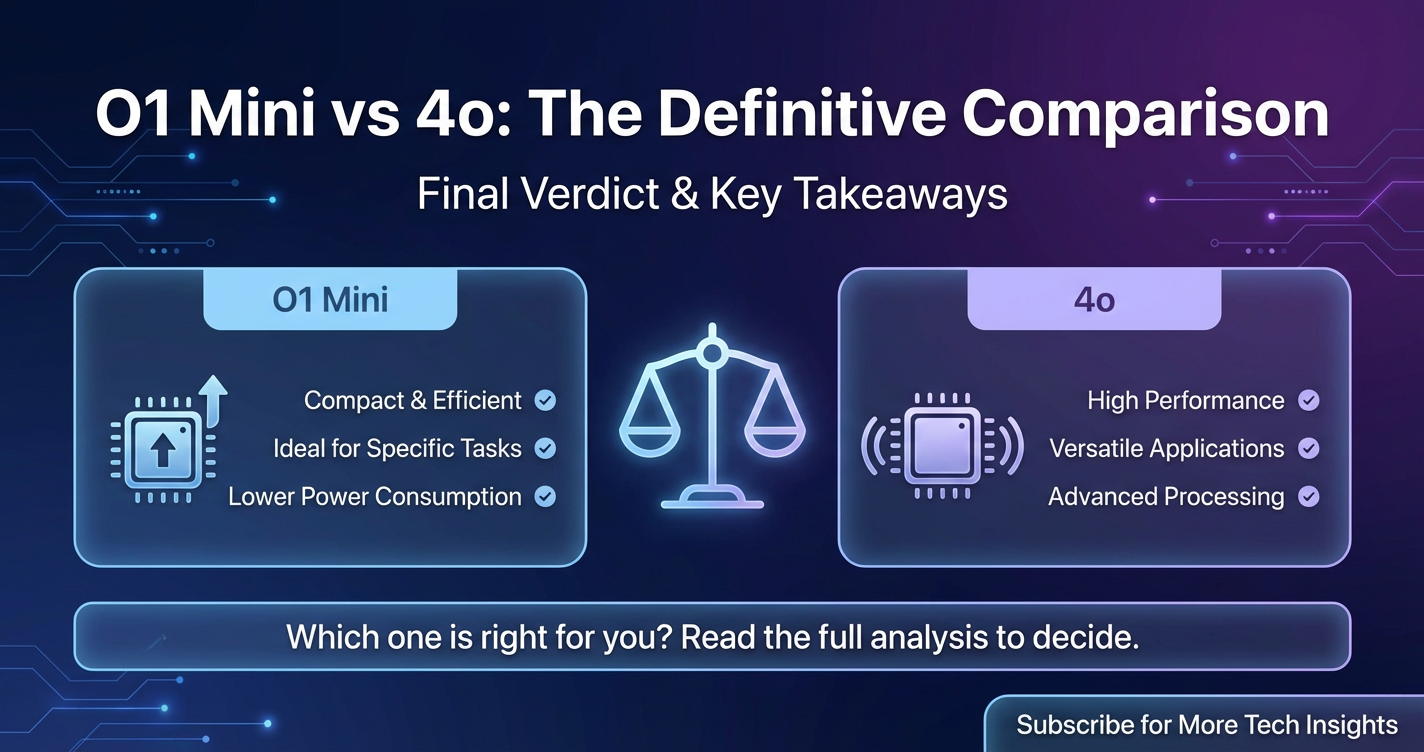
The "O1 Mini" as a specific, officially announced model from a major AI lab is not widely recognized or publicly detailed at the time of writing. However, the concept it represents – an ultra-efficient, potentially hyper-specialized "mini" model – is a crucial and accelerating trend in the LLM ecosystem. It embodies the relentless pursuit of optimizing AI models for extreme speed, minimal resource consumption, and unparalleled cost-effectiveness. For the purpose of this comparison, we will treat O1 Mini as a hypothetical or conceptual model that pushes these boundaries further than current "mini" offerings. It's the model that sacrifices broad generality for peak performance in specific, constrained environments.
Key Characteristics (Hypothetical/Conceptual): * Extreme Optimization for Speed: O1 Mini would likely be engineered for the absolute lowest possible latency. This could involve highly optimized architectures, fewer parameters, or specialized hardware acceleration. Its response times would be measured in tens of milliseconds, approaching instantaneity for many tasks. * Unparalleled Cost-Effectiveness: Designed to be incredibly cheap to run, possibly offering API calls at a fraction of a cent. This would open up new paradigms for AI integration where millions of calls are made daily, making even micro-transactions feasible. * Hyper-Specialization: To achieve its extreme efficiency, O1 Mini might be more specialized. While GPT-4o Mini is a general-purpose model, O1 Mini could be fine-tuned for a very narrow range of tasks (e.g., sentiment analysis, entity extraction, very short response generation) or trained on a smaller, more focused dataset. * Smaller Footprint and Edge AI Potential: Its compact size and minimal resource requirements would make it ideal for deployment on edge devices, mobile phones, or embedded systems where computational power and memory are severely limited. * Potentially Reduced Generality/Context: To achieve its speed and cost goals, O1 Mini might have a significantly smaller context window or less broad reasoning capabilities compared to the GPT-4o family. It would prioritize speed and specific task accuracy over complex, open-ended intelligence. * Innovative Architecture: It might incorporate novel distillation techniques, sparse activation methods, or completely new neural network designs to achieve its efficiency gains.
Ideal Use Cases for O1 Mini (Hypothetical/Conceptual): * Real-time Edge Computing: Running AI directly on IoT devices, smart sensors, or mobile phones for instant local processing without cloud latency. * High-Frequency Micro-Interactions: Powering millions of tiny AI-driven decisions, like real-time content filtering, quick spell checks, or personalized recommendations in high-traffic applications. * Basic Conversational Triggers: Extremely lightweight chatbots for simple command processing or quick transactional responses where complex dialogue isn't needed. * Automated Data Tagging and Classification: Rapidly categorizing incoming data streams or performing simple classification tasks on the fly. * Low-Power AI Applications: Integrating AI into devices with strict power consumption constraints, such as wearables or battery-powered sensors.
The O1 Mini, whether it emerges as a specific product or a category of highly optimized models, represents the future frontier of AI efficiency. It's about pushing AI into every nook and cranny of our digital and physical world, making intelligent processing ubiquitous and virtually free for specific tasks.
Head-to-Head Comparison: Key Metrics and Dimensions
Now that we have a clearer picture of each model, let's conduct a detailed o1 mini vs 4o and o1 mini vs gpt 4o comparison across several critical dimensions. This will highlight their strengths, weaknesses, and ideal positioning in the vast AI ecosystem.
1. Performance and Accuracy
| Feature | GPT-4o | GPT-4o Mini | O1 Mini (Hypothetical) |
|---|---|---|---|
| Reasoning | Top-tier, highly nuanced, complex problem-solving | Very strong, excellent for most common tasks | Good for specific, constrained reasoning; less general |
| Coding | Excellent, capable of complex code generation & debugging | Strong, suitable for most development tasks | Limited to simple code snippets/logic or highly specialized code generation |
| Creative Writing | Exceptional, highly imaginative & stylistic | Very good, capable of diverse styles & formats | Basic text generation; less creative depth or nuance |
| Factual Recall | Extensive knowledge base, highly accurate | Broad knowledge base, generally accurate | Focused knowledge base, accurate within its domain |
| Multimodal Interpretation | Native, deep understanding of text, audio, vision | Good for basic multimodal inputs (e.g., image descriptions, simple audio commands) | Highly specialized multimodal (e.g., object detection, tone classification for specific use cases); or text-only for maximal efficiency |
Discussion: GPT-4o unequivocally leads in raw intelligence, complex reasoning, and creative output. Its ability to weave together information from various modalities gives it a profound understanding of context, leading to superior performance on challenging, open-ended tasks. When you need the absolute best in terms of AI 'brainpower,' GPT-4o is the benchmark.
GPT-4o Mini, while slightly less powerful than its full-sized sibling, still offers exceptional performance for its cost and speed. For 80-90% of common LLM applications, its accuracy and intelligence are more than sufficient. It can handle complex summarization, detailed question answering, and robust content generation with high fidelity. The gpt-4o mini strikes an excellent balance, making advanced AI more accessible for practical, scaled deployments.
O1 Mini, being an extreme efficiency play, would likely trade some of this broad, general intelligence for hyper-optimized performance in specific areas. Its accuracy would be highest for the tasks it's specifically designed or fine-tuned for, potentially surpassing the others in those narrow domains due to its specialized architecture. However, straying outside its specialization would likely reveal its limitations. For the most part, its performance would be about delivering fast, reliable answers to simple, defined problems rather than complex, nuanced ones. The core of o1 mini vs 4o here is a trade-off: broad intelligence vs. surgical precision and speed.
2. Multimodality
GPT-4o is the undisputed king of multimodality. Its 'omni' nature means it understands and generates seamlessly across text, audio, and vision. This is not merely concatenating outputs from different models but a truly integrated understanding. Imagine an AI that can listen to a conversation, see the participants' expressions, and read accompanying text, then respond appropriately in any of those modalities. That's GPT-4o.
GPT-4o Mini inherits some of this capability, particularly for simpler multimodal tasks. It can handle image input for descriptive tasks or process audio for basic conversational commands. However, it might not possess the same depth of nuanced understanding for complex, cross-modal reasoning that GPT-4o exhibits (e.g., interpreting subtle emotions from a video clip and connecting them to a textual query). It’s multimodal, but perhaps with a slightly shallower interpretation layer for highly complex, interwoven inputs.
O1 Mini, in its quest for ultimate efficiency, might either forgo multimodality entirely (focusing solely on text for maximum speed) or implement a highly constrained form. For example, it might have a very lightweight vision component for specific object recognition or a simple audio classification capability for voice commands, but it would not offer the general-purpose, integrated multimodal intelligence of GPT-4o. The primary aim in o1 mini vs gpt 4o regarding multimodality is about what is absolutely essential vs. everything possible.
3. Speed and Latency
| Model | Typical Latency (Text-based generation) | Latency for Multimodal (Audio) | Throughput (Requests/Second) |
|---|---|---|---|
| GPT-4o | Fast (sub-second for short outputs) | ~320ms average | High |
| GPT-4o Mini | Very Fast (often < 100ms for short outputs) | Possibly slightly higher than 4o but still good | Very High (optimized for volume) |
| O1 Mini (Hypothetical) | Extremely Fast (tens of milliseconds) | Potentially instant for specialized tasks | Ultra-High (designed for massive scale) |
Discussion: Speed is where O1 Mini is designed to shine, potentially setting new industry standards. For tasks where instant feedback is paramount, such as real-time gaming interactions, IoT command processing, or ultra-low-latency financial analysis, O1 Mini would be the go-to. Its architecture would be streamlined to minimize computational steps and maximize parallel processing.
GPT-4o Mini is already remarkably fast, significantly quicker than previous generations of GPT-4, making it suitable for responsive applications that don't demand the absolute lowest latency. It processes text inputs and generates responses at speeds that feel natural in conversational settings.
GPT-4o, while extremely fast for its capabilities, especially its multimodal responses, might experience slightly higher latencies for complex, context-heavy tasks simply due to the sheer volume of parameters and the depth of reasoning it performs. However, for a model of its power, its speed is still exceptional, particularly in natural, human-like conversations involving voice.
The difference in speed between o1 mini vs gpt 4o (and its mini version) will be a primary deciding factor for many developers. For interactive, human-facing applications, GPT-4o Mini offers a great blend. For mission-critical, machine-to-machine, or edge computing applications where latency must be minimal, the O1 Mini concept is key.
4. Cost-Effectiveness
Cost is often the ultimate gatekeeper for scaling AI applications. * GPT-4o: Represents a premium service. While its pricing is competitive for its capabilities, it's designed for tasks where the value derived from its advanced intelligence justifies the higher per-token cost. Think complex legal review, high-stakes creative generation, or advanced research. * GPT-4o Mini: This is where it truly democratizes AI. Its pricing is significantly lower than GPT-4o, often by a factor of 5x or more per token. This makes it incredibly attractive for high-volume applications like customer service, internal tooling, or large-scale data processing where millions of API calls are made daily. The gpt-4o mini is built for economic scalability. * O1 Mini (Hypothetical): The ambition for O1 Mini would be to be orders of magnitude cheaper than even GPT-4o Mini. We're talking about prices that approach negligible costs per call, making it feasible for micro-AI services embedded everywhere. This extreme cost reduction would open up entirely new business models and AI integrations that are currently economically unviable. The o1 mini vs gpt 4o discussion on cost will boil down to whether the marginal gain in intelligence is worth the exponential increase in price for specific use cases.
5. Context Window
The context window refers to the amount of text (or multimodal information) a model can "remember" or process in a single interaction. * GPT-4o: Offers a substantial context window, typically around 128K tokens. This allows it to handle very long documents, maintain extended conversations, or process large codebases, providing a deep understanding of the entire input. * GPT-4o Mini: Also provides a very generous context window, often matching GPT-4o's 128K tokens or a slightly smaller but still substantial amount. This is crucial for its role as a workhorse, as it enables it to process large inputs efficiently. * O1 Mini (Hypothetical): To achieve its extreme efficiency, O1 Mini might have a smaller context window, perhaps in the range of a few thousand to tens of thousands of tokens. This trade-off would be necessary to keep inference fast and resource usage low. For many ultra-fast, specific tasks (e.g., classifying a short message, generating a one-line response), a massive context window is often unnecessary.
6. Ease of Integration and Developer Experience
All models from OpenAI (GPT-4o and GPT-4o Mini) benefit from OpenAI's robust API ecosystem, extensive documentation, and developer-friendly tools. They adhere to well-established API standards, making integration into existing applications relatively straightforward. Developers can leverage client libraries, SDKs, and a growing community for support.
When dealing with multiple LLMs, or even different versions of the same model, managing API keys, endpoints, and ensuring optimal routing for low latency and cost-effectiveness can become a complex challenge. This is where platforms like XRoute.AI become invaluable. XRoute.AI offers a cutting-edge unified API platform designed to streamline access to large language models (LLMs) for developers, businesses, and AI enthusiasts. By providing a single, OpenAI-compatible endpoint, XRoute.AI simplifies the integration of over 60 AI models from more than 20 active providers, enabling seamless development of AI-driven applications, chatbots, and automated workflows. With a focus on low latency AI, cost-effective AI, and developer-friendly tools, XRoute.AI empowers users to build intelligent solutions without the complexity of managing multiple API connections. Whether you're deciding between GPT-4o, GPT-4o Mini, or even potentially integrating an O1 Mini-like model in the future, XRoute.AI's ability to intelligently route your requests ensures you're always using the best model for the task at the optimal price and speed. The platform’s high throughput, scalability, and flexible pricing model make it an ideal choice for projects of all sizes, from startups to enterprise-level applications, significantly simplifying the developer's journey.
For O1 Mini (hypothetical), its integration might be even simpler if it's designed for extremely specific tasks with minimal API surface, or it could be integrated through platforms like XRoute.AI that abstract away model-specific complexities.
7. Scalability and Throughput
- GPT-4o: Designed for high scalability, capable of handling significant request volumes. However, due to its computational intensity, scaling to extremely high throughput might involve higher operational costs.
- GPT-4o Mini: Engineered for very high throughput at a lower cost. It's built to handle massive volumes of requests efficiently, making it ideal for applications that need to serve millions of users or process vast amounts of data. This is its core strength in the o1 mini vs gpt 4o context for enterprise-level scaling.
- O1 Mini (Hypothetical): Would likely be designed for ultra-high throughput with minimal resource overhead. Its small footprint and optimized architecture would allow for unprecedented scalability, potentially handling billions of requests daily across distributed systems or edge devices.
XRoute is a cutting-edge unified API platform designed to streamline access to large language models (LLMs) for developers, businesses, and AI enthusiasts. By providing a single, OpenAI-compatible endpoint, XRoute.AI simplifies the integration of over 60 AI models from more than 20 active providers(including OpenAI, Anthropic, Mistral, Llama2, Google Gemini, and more), enabling seamless development of AI-driven applications, chatbots, and automated workflows.
Use Cases and Applications: Choosing the Right Tool for the Job
The ultimate choice between these models hinges on the specific demands of your application. Each model excels in different environments and for different types of problems.
When to Choose GPT-4o
GPT-4o is the ideal choice when you require: * Unparalleled Intelligence and Nuance: Projects demanding the highest levels of reasoning, creativity, and understanding. Think scientific research assistants, advanced legal document analysis, or complex strategic planning tools. * Full Multimodal Interaction: Applications that need to genuinely understand and generate across text, audio, and visual modalities. Examples include next-generation voice assistants that can interpret emotional cues, AI tutors that analyze student engagement via video, or interactive storytelling platforms. * High-Stakes Content Generation: Creating critical content where quality, accuracy, and creativity are non-negotiable, such as generating book drafts, intricate marketing campaigns, or highly sensitive legal documents. * Cutting-Edge R&D: For exploring the frontiers of AI capabilities, GPT-4o provides the most advanced canvas.
Example Scenario: A startup building an AI-powered therapy companion that needs to understand user emotions from voice, analyze their facial expressions during video calls, and provide empathetic, nuanced textual responses. GPT-4o’s native multimodality and deep emotional intelligence would be crucial here.
When to Choose GPT-4o Mini
GPT-4o Mini is the pragmatic choice for situations demanding: * Cost-Effective Scalability: Applications requiring high throughput at an affordable price point. This is the bread and butter for most enterprise-level automation. * Robust Text-Based Performance: Tasks primarily involving text generation, summarization, classification, or question answering where high accuracy is needed but not necessarily the absolute peak of GPT-4o. * Responsive User Experiences: Chatbots, virtual assistants, or internal tools where users expect quick, reliable responses without significant latency. * Data Processing and Automation: Large-scale data extraction, sentiment analysis of customer reviews, or automated report generation.
Example Scenario: A large e-commerce company wants to scale its customer support chatbot to handle millions of inquiries daily, providing instant answers to FAQs, order status updates, and basic troubleshooting. GPT-4o Mini offers the perfect blend of performance and cost-efficiency for this high-volume, text-centric application.
When to Consider O1 Mini (Hypothetical/Conceptual)
The O1 Mini concept is for the most demanding efficiency requirements: * Extreme Low Latency: Applications where response times are measured in milliseconds and cannot tolerate any perceptible delay. Think real-time gaming AI, rapid financial trading algorithms, or instant IoT device command processing. * Ultra-Low Cost per Operation: Scenarios requiring billions of API calls where even GPT-4o Mini's cost becomes prohibitive. This could unlock entirely new AI-driven micro-services. * Edge Computing and Resource-Constrained Environments: Deploying AI directly on devices with limited computational power, memory, or battery life, such as smart appliances, drones, or wearables. * Highly Specialized, Simple Tasks: For very specific classification, recognition, or generation tasks that do not require broad general intelligence.
Example Scenario: A smart city initiative wants to embed AI in thousands of traffic cameras to instantly classify vehicle types and detect anomalies in real-time, without sending all data to the cloud. An O1 Mini-like model, highly optimized for speed and low power consumption, would be deployed directly on the cameras to provide instantaneous, localized intelligence.
The Future of LLMs: Efficiency, Specialization, and Accessibility
The trajectory of LLMs is clear: a continuous drive towards greater intelligence, but crucially, also towards greater efficiency and specialization. While models like GPT-4o will continue to push the boundaries of general-purpose AI, the emergence of 'Mini' versions and the conceptualization of ultra-efficient models like O1 Mini highlight a parallel and equally important trend: making AI ubiquitous, affordable, and adaptable to a vast array of niche applications.
This bifurcated approach ensures that AI can serve both the most complex, high-value tasks and the simplest, highest-volume interactions. It fosters an ecosystem where developers aren't forced into a one-size-fits-all solution but can meticulously select the AI model that precisely matches their technical and economic constraints.
The future will likely see even more specialized "mini" models, fine-tuned for specific languages, domains, or tasks. This will necessitate more sophisticated tools for model management, routing, and cost optimization, reinforcing the value of platforms like XRoute.AI that abstract away this complexity, allowing developers to focus on innovation rather than infrastructure. The goal is not just to build smarter AI, but to build AI that is smart about its own deployment – using the right model for the right job, every single time.
Conclusion
The choice between GPT-4o, GPT-4o Mini, and the emerging concept of O1 Mini is not a matter of one being inherently "better" than the others. Instead, it's a strategic decision based on a careful evaluation of project requirements, budget, latency tolerance, and the desired depth of AI intelligence.
GPT-4o stands as the undisputed champion for tasks demanding unparalleled multimodal intelligence, complex reasoning, and creative prowess. It's the premium engine for groundbreaking applications.
GPT-4o Mini offers a compelling balance of strong performance, impressive speed, and significant cost-effectiveness, making it the workhorse for scaling a wide range of practical AI solutions across enterprises. For most applications that need reliable, robust AI without the absolute peak of a flagship, the gpt-4o mini is the clear winner.
O1 Mini, while currently more of a conceptual frontier, represents the relentless pursuit of ultimate efficiency. It promises ultra-low latency, unprecedented cost-effectiveness, and the potential for ubiquitous AI deployment in resource-constrained or high-frequency environments. The o1 mini vs 4o and o1 mini vs gpt 4o comparison reveals a spectrum of capabilities, from expansive intelligence to surgical efficiency, catering to the diverse and ever-growing demands of the AI era.
As the AI landscape continues to evolve, understanding these distinctions will empower developers and businesses to make informed decisions, ensuring they harness the transformative power of large language models in the most effective and efficient way possible.
Frequently Asked Questions (FAQ)
Q1: What is the primary difference between GPT-4o and GPT-4o Mini?
A1: The primary difference lies in their capabilities, cost, and optimization goals. GPT-4o is a natively multimodal flagship model, offering superior intelligence, creativity, and nuanced understanding across text, audio, and vision, but at a higher cost. GPT-4o Mini is a more streamlined, cost-effective, and faster version, highly optimized for high-volume text-based tasks and responsive applications, with slightly less deep multimodal interpretation compared to the full 4o. It's designed for scalability and affordability.
Q2: Is "O1 Mini" an official product, and how does it compare to OpenAI's models?
A2: At the time of writing, "O1 Mini" is not a widely recognized or officially released product from a major AI provider like OpenAI. In this article, it is discussed as a hypothetical or conceptual model representing the industry's push towards extreme efficiency, ultra-low latency, and unparalleled cost-effectiveness, often through specialization. It would likely trade broad general intelligence and multimodal capabilities for hyper-optimized performance in specific, constrained tasks, surpassing even GPT-4o Mini in speed and cost for its niche.
Q3: Which model should I choose for a new AI chatbot project?
A3: * For an advanced, emotionally intelligent, and multimodal chatbot (e.g., a virtual therapist or sophisticated voice assistant): GPT-4o is the best choice due to its deep understanding and native multimodal capabilities. * For a high-volume customer service bot or internal tool requiring fast, accurate text responses at a low cost: GPT-4o Mini is highly recommended. * For an extremely lightweight, real-time command-processing bot (if it were to exist): A conceptual O1 Mini could be ideal for very simple, instant interactions.
Q4: How does XRoute.AI help developers working with these different LLMs?
A4: XRoute.AI is a unified API platform that simplifies access to over 60 AI models from 20+ providers, including models like GPT-4o and GPT-4o Mini. It provides a single, OpenAI-compatible endpoint, allowing developers to integrate various LLMs without managing multiple APIs. XRoute.AI intelligently routes requests to optimize for low latency, cost-effectiveness, and high throughput, making it easier for developers to leverage the best model for their needs, streamline development, and scale their AI applications efficiently.
Q5: What are the key considerations when choosing between a powerful model like GPT-4o and a more efficient one like GPT-4o Mini or a conceptual O1 Mini?
A5: The key considerations include: * Complexity of Task: Do you need deep reasoning and creativity (GPT-4o) or robust, reliable performance for common tasks (GPT-4o Mini), or highly specialized, simple actions (O1 Mini)? * Multimodality Requirements: Do you need native text, audio, and vision understanding (GPT-4o) or mostly text with basic multimodal support (GPT-4o Mini)? * Latency Tolerance: How fast do responses need to be (GPT-4o for natural human-like speed, GPT-4o Mini for very fast, O1 Mini for near-instant)? * Budget & Scale: What is your cost per token budget, and what volume of requests do you anticipate (GPT-4o for premium, GPT-4o Mini for high-volume and cost-effective, O1 Mini for ultra-low cost and massive scale)? * Context Window Needs: How much information does the model need to process in a single interaction?
🚀You can securely and efficiently connect to thousands of data sources with XRoute in just two steps:
Step 1: Create Your API Key
To start using XRoute.AI, the first step is to create an account and generate your XRoute API KEY. This key unlocks access to the platform’s unified API interface, allowing you to connect to a vast ecosystem of large language models with minimal setup.
Here’s how to do it: 1. Visit https://xroute.ai/ and sign up for a free account. 2. Upon registration, explore the platform. 3. Navigate to the user dashboard and generate your XRoute API KEY.
This process takes less than a minute, and your API key will serve as the gateway to XRoute.AI’s robust developer tools, enabling seamless integration with LLM APIs for your projects.
Step 2: Select a Model and Make API Calls
Once you have your XRoute API KEY, you can select from over 60 large language models available on XRoute.AI and start making API calls. The platform’s OpenAI-compatible endpoint ensures that you can easily integrate models into your applications using just a few lines of code.
Here’s a sample configuration to call an LLM:
curl --location 'https://api.xroute.ai/openai/v1/chat/completions' \
--header 'Authorization: Bearer $apikey' \
--header 'Content-Type: application/json' \
--data '{
    "model": "gpt-5",
    "messages": [
        {
            "content": "Your text prompt here",
            "role": "user"
        }
    ]
}'
With this setup, your application can instantly connect to XRoute.AI’s unified API platform, leveraging low latency AI and high throughput (handling 891.82K tokens per month globally). XRoute.AI manages provider routing, load balancing, and failover, ensuring reliable performance for real-time applications like chatbots, data analysis tools, or automated workflows. You can also purchase additional API credits to scale your usage as needed, making it a cost-effective AI solution for projects of all sizes.
Note: Explore the documentation on https://xroute.ai/ for model-specific details, SDKs, and open-source examples to accelerate your development.