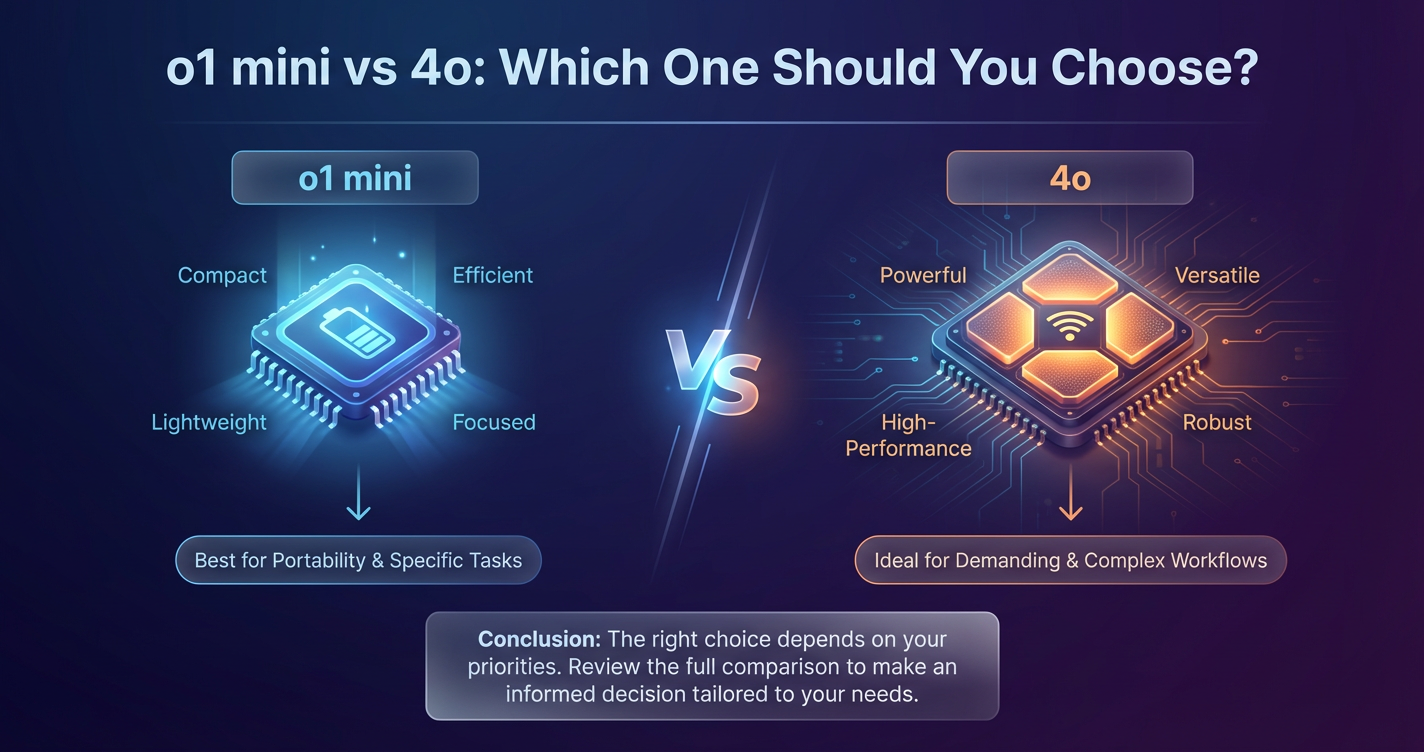
o1 mini vs 4o: Which One Should You Choose?

The landscape of Artificial Intelligence is evolving at an unprecedented pace, marked by continuous breakthroughs in large language models (LLMs). What was once the exclusive domain of colossal, resource-intensive models is now increasingly being democratized by the advent of "mini" LLMs. These smaller, more efficient, yet remarkably powerful models are reshaping how developers and businesses approach AI integration, promising lower costs, faster inference, and broader accessibility. Amidst this exciting shift, a critical question emerges for many: how to navigate the burgeoning options and select the right tool for the job?
This article aims to dissect a compelling comparison at the heart of this discussion: o1 mini vs 4o. On one side, we have GPT-4o mini, a testament to OpenAI's strategy of extending its cutting-edge capabilities to a wider audience through more cost-effective and faster iterations. On the other, we conceptualize o1 mini – representing a class of emerging, potentially more specialized, or open-source alternatives that might prioritize different architectural philosophies, niche performance, or specific deployment paradigms. The choice between these two archetypes is not merely technical; it reflects differing strategic priorities in terms of cost, performance, flexibility, and integration.
As we delve into the intricate details of their features, performance metrics, ideal use cases, and underlying philosophies, our goal is to provide a comprehensive guide. This isn't just about raw power; it's about understanding the nuances that make one model a better fit than the other for your specific challenges. We'll explore everything from their multimodal capabilities and processing speed to their cost structures and developer ecosystems, culminating in a framework designed to help you make an informed decision and confidently choose the optimal "mini" LLM for your upcoming AI endeavors.
Understanding the Rise and Importance of "Mini" LLMs
Before we dive into the specifics of o1 mini vs 4o, it's crucial to grasp the overarching trend that has brought these models to the forefront: the rise of "mini" LLMs. For years, the AI community was fixated on scaling models to ever-larger parameter counts, chasing marginal improvements in general intelligence. While models like GPT-3, GPT-4, and Gemini Ultra demonstrated incredible capabilities, their sheer size translated into significant computational costs, slower inference times, and substantial infrastructure requirements, often limiting their practical deployment to well-funded organizations with extensive cloud resources.
However, the tide has begun to turn. Developers and businesses quickly realized that for many real-world applications, the full breadth and depth of a multi-trillion-parameter model were often overkill. A customer service chatbot doesn't need to write Shakespearean sonnets, nor does an internal knowledge retrieval system need to ace medical exams. What they do need is speed, accuracy within their domain, and cost-efficiency. This realization spurred innovation in model architecture, quantization techniques, distillation, and efficient fine-tuning, paving the way for smaller, more specialized, and highly optimized models.
Why are "mini" LLMs becoming so important?
- Cost-Efficiency: Smaller models inherently require fewer computational resources for training and inference. This directly translates to lower API costs for providers like OpenAI and reduced infrastructure expenses for those hosting models themselves. For startups and projects with tight budgets, this can be a game-changer, making advanced AI accessible without breaking the bank.
- Faster Inference Times: Less complex models process information more quickly. In applications where real-time interaction is crucial – such as live chatbots, voice assistants, or interactive content generation – faster inference drastically improves user experience and system responsiveness. The difference between a 500ms and a 2-second response can be the difference between engagement and frustration.
- Edge Deployment Potential: The reduced footprint of "mini" LLMs makes them suitable for deployment on edge devices, suchsmarter IoT devices, embedded systems, or even mobile phones, where computational power and memory are limited. This opens up entirely new categories of offline AI applications, enhancing privacy and reducing reliance on cloud connectivity.
- Specialization and Fine-Tuning: While larger models are generalists, "mini" models can often be fine-tuned more effectively and efficiently for specific tasks or domains. This allows them to achieve expert-level performance in niche areas, often outperforming larger generalist models without the associated overhead. A model trained exclusively on legal documents, for example, can be highly adept at legal queries.
- Environmental Impact: The energy consumption of training and running massive LLMs is a growing concern. "Mini" models offer a more sustainable pathway to deploying AI, reducing the carbon footprint associated with complex computational tasks.
- Data Privacy and Security: For organizations handling sensitive data, deploying smaller, potentially open-source or locally hostable models offers greater control over data privacy and compliance. This reduces the need to send proprietary or confidential information to third-party cloud services.
The market now demands not just powerful AI, but practical AI. "Mini" LLMs represent this paradigm shift, enabling broader adoption and integration of AI into everyday applications and specialized workflows. As we scrutinize o1 mini vs 4o, these underlying benefits will serve as crucial benchmarks for comparison, highlighting which model best embodies the promise of efficient, accessible, and impactful AI.
Deep Dive into GPT-4o Mini (4o): The OpenAI Contender
OpenAI has consistently been at the forefront of AI innovation, pushing the boundaries of what large language models can achieve. With the introduction of GPT-4o, they presented a truly multimodal flagship model, capable of seamlessly processing and generating text, audio, and visual information. Following this groundbreaking release, the strategic decision to launch GPT-4o mini (often referred to simply as 4o mini or 4o in a comparison context) underscores OpenAI's commitment to making advanced AI capabilities more accessible, cost-effective, and practical for a wider range of applications.
Background and Philosophy
GPT-4o mini is a direct descendant of the powerful GPT-4o architecture. Its core philosophy revolves around delivering a substantial portion of GPT-4o's multimodal intelligence in a much more efficient package. This means optimizing the model for speed and cost without sacrificing critical functionalities. OpenAI's strategy here is clear: to cater to developers who require robust performance and multimodal understanding but operate under tighter budgetary constraints or have latency-sensitive applications. It's about democratizing access to cutting-edge AI, allowing for broader experimentation and deployment across industries, from small startups to large enterprises.
Key Features and Capabilities
While being a "mini" version, GPT-4o mini retains an impressive suite of features that make it a formidable contender in the LLM space:
- Multimodal Capabilities: This is arguably GPT-4o mini's most significant differentiator. While scaled down from the full GPT-4o, it is designed to understand and generate content across various modalities:
- Text: Superior text generation, summarization, translation, code generation, and complex reasoning capabilities, comparable to high-tier previous models.
- Audio: Potential for understanding spoken language, transcribing, and generating natural-sounding speech (though direct audio-in/out via API might be more complex than full 4o).
- Vision: Ability to interpret images, analyze charts, understand visual context, and describe visual inputs. This opens doors for applications in image analysis, content moderation, and visually-driven chatbots.
- Performance Benchmarks: OpenAI aims for GPT-4o mini to offer a highly competitive performance-to-cost ratio. It is engineered to perform tasks with accuracy levels that often surpass previous generations of larger, more expensive models (e.g., GPT-3.5 Turbo), making it a significant upgrade for many existing applications. It leverages the latest architectural improvements from GPT-4o, ensuring strong reasoning and contextual understanding.
- Low Latency and High Throughput: A core design goal for "mini" models is speed. GPT-4o mini is optimized for rapid inference, crucial for real-time applications. This speed, combined with OpenAI's robust API infrastructure, allows for high throughput, enabling applications to handle a large volume of requests concurrently without significant delays.
- Cost Structure: This is where
gpt-4o minitruly shines for many users. OpenAI prices its mini models significantly lower than their full-sized counterparts. This drastic reduction in per-token cost makes complex AI interactions economically viable for projects that were previously constrained by budget. For example, the cost of an identical task might be an order of magnitude less than with a full GPT-4 model. - Ease of Integration (API Focus): OpenAI's developer ecosystem is mature and well-documented.
gpt-4o miniis accessible via a simple, well-defined API, making it incredibly easy for developers to integrate into existing applications or build new ones from scratch. The API consistency with other OpenAI models reduces the learning curve. - Safety and Guardrails: As with all OpenAI models,
gpt-4o minibenefits from extensive safety training, moderation tools, and responsible AI practices. This includes measures to reduce bias, prevent harmful content generation, and ensure ethical use, providing a level of reliability and trustworthiness that is critical for production environments. - Broad Language Support: Inheriting from its larger sibling,
gpt-4o miniis capable of processing and generating text in a multitude of languages, facilitating global application development.
Typical Use Cases for GPT-4o Mini
Given its balance of capability, speed, and cost, gpt-4o mini is an excellent choice for a wide array of applications:
- Enhanced Chatbots and Virtual Assistants: Powering customer support, internal knowledge bases, and interactive conversational agents with improved understanding and more natural responses. The multimodal aspect can even enable visual queries (e.g., "What is this product in the image?").
- Content Generation and Summarization: Quickly generating drafts, marketing copy, social media updates, articles, or summarizing lengthy documents for various purposes, including internal reporting and educational materials.
- Translation Services: Providing high-quality, real-time language translation for text and potentially spoken word, facilitating international communication.
- Educational Tools: Creating personalized learning experiences, generating quizzes, explaining complex concepts, or providing language practice.
- Basic Data Analysis and Interpretation: Extracting insights from unstructured text data, categorizing information, or even interpreting data presented in images (e.g., charts and graphs).
- Initial Prototyping and MVPs: For startups and developers looking to quickly build and test AI-driven features without significant upfront investment.
- Automated Workflows: Integrating into CRM systems, email platforms, or project management tools to automate tasks like lead qualification, email response drafting, or meeting minute summarization.
In essence, gpt-4o mini represents a powerful, accessible iteration of cutting-edge AI. It aims to be the go-to choice for developers seeking a robust, multimodal, and economically viable LLM solution that doesn't compromise on the intelligence expected from an OpenAI model.
Introducing o1 mini: An Alternative Perspective
While gpt-4o mini stands as a prominent offering from a leading AI research powerhouse, the dynamic nature of the AI industry ensures that innovation isn't confined to a single entity. The concept of o1 mini emerges here as a representation of an alternative paradigm in the "mini" LLM space. Unlike gpt-4o mini, which stems from a known general-purpose, multimodal giant, o1 mini can be envisioned as a model with a distinct design philosophy, perhaps emphasizing specialization, extreme efficiency, transparency, or novel architectural approaches. It might not have the same broad name recognition, but its potential strengths lie in its differentiated focus.
For the purpose of this comparison, let's conceptualize o1 mini not as a single, known entity, but as an exemplar of the innovative, often open-source or highly specialized models that are gaining traction. It represents a model that might prioritize different trade-offs compared to the more generalist gpt-4o mini.
Conceptualization and Background
Imagine o1 mini as a model born from a philosophy centered on efficiency at its core, perhaps even more so than gpt-4o mini which inherits complexity from its larger multimodal parent. Its background might stem from academic research focused on compact model architectures, a startup dedicated to hyper-specialized AI, or an open-source community pushing the boundaries of local inference.
Its design principles could include: * Extreme Resource Efficiency: Prioritizing minimal memory footprint and computational cycles, even if it means sacrificing some of the very high-level, general reasoning found in larger models. * Domain Specificity by Design: Rather than being a generalist model, o1 mini might be inherently designed and trained for a narrower set of tasks, achieving exceptional performance within that niche. * Architectural Innovation: Exploring novel, lightweight neural network structures or quantization techniques that allow for significant performance on constrained hardware. * Privacy-by-Design: Potentially offering a pathway to full local deployment, ensuring sensitive data never leaves the user's controlled environment. * Transparency and Customizability: Given its conceptual nature, o1 mini could represent models where the underlying architecture and training data are more accessible, allowing for deeper customization and auditing.
Key Features and Capabilities
Given its conceptual nature, the features of o1 mini would contrast with gpt-4o mini by leaning into its unique design goals:
- Focused Modality/Specialization: While
gpt-4o miniis multimodal,o1 minimight be highly optimized for a single modality (e.g., text generation for a specific language or domain, or perhaps highly efficient image classification, but not both seamlessly). Its strength lies in doing one thing exceptionally well with minimal resources. For example, it might be an incredibly fast text summarizer for financial documents, or a highly accurate code generator for a specific programming language. - Unparalleled Efficiency for Niche Tasks: For its specific domain,
o1 miniwould boast extremely fast inference times and low computational requirements. This would make it ideal for scenarios wheregpt-4o mini, despite its efficiency, might still be considered overkill or too resource-intensive for the target hardware. - Potential for Local/Edge Deployment: Due to its minimal footprint,
o1 minicould be designed to run effectively on consumer-grade hardware, mobile devices, or embedded systems without relying on cloud APIs. This is a crucial distinction for applications requiring offline capabilities or strict data residency. - High Customization and Fine-tuning Potential: Models like
o1 miniare often more amenable to in-depth fine-tuning with proprietary datasets. Their simpler architectures might make it easier to mold them precisely to unique business requirements, potentially leading to higher accuracy in very specific tasks after customization. - Transparent and Auditable: If
o1 minirepresents an open-source or more transparent model, it offers developers and enterprises the ability to inspect its internal workings, understand its biases, and ensure compliance with regulatory standards, which can be challenging with proprietary models. - Potentially Lower Long-Term Operational Costs (Self-Hosted): While
gpt-4o minioffers competitive API pricing,o1 mini, if self-hosted or open-source, could eliminate recurring API fees, leading to significant cost savings for high-volume, long-term deployments, provided the initial setup and maintenance costs are manageable. - Robust Privacy & Data Control: The ability to run
o1 minientirely within an organization's own infrastructure means complete control over data, addressing stringent privacy requirements (e.g., GDPR, HIPAA) that might be difficult to meet when relying on external APIs.
Typical Use Cases for o1 mini
Given its hypothesized characteristics, o1 mini would excel in scenarios where gpt-4o mini might be less optimal:
- Highly Secure and Private Environments: Government agencies, healthcare providers, or financial institutions requiring on-premise AI processing of highly sensitive data.
- Edge AI Applications: Deploying AI directly on smart devices, drones, industrial sensors, or in vehicles for real-time, offline intelligence where cloud connectivity is intermittent or non-existent.
- Specialized Enterprise Solutions: Niche applications requiring deep domain expertise, such as automated legal document review, specific medical diagnostic support, or highly technical engineering assistance.
- Resource-Constrained Systems: Running AI on older hardware, low-power devices, or embedded systems where every byte of memory and every CPU cycle counts.
- Open-Source Projects and Academic Research: Providing a flexible, transparent, and modifiable base for experimentation and innovation, free from commercial API dependencies.
- Cost-Sensitive High-Volume Internal Tasks: For businesses with massive internal data processing needs where API costs would quickly become prohibitive, and self-hosting a specialized, efficient model is more economical in the long run.
- Specific Language or Dialect Support: Training a highly optimized model for an underserved language or a very specific regional dialect, where generalist models might struggle.
In essence, o1 mini represents the paradigm of tailored, efficient, and often more controllable AI. While it might not offer the broad multimodal prowess of gpt-4o mini, its strength lies in its ability to deliver superior, resource-optimized performance for specific tasks and deployment environments, offering a compelling alternative for projects with distinct requirements.
Direct Comparison: o1 mini vs 4o
Choosing between o1 mini and gpt-4o mini ultimately boils down to a thorough evaluation of your project's specific needs, constraints, and long-term vision. While both are "mini" LLMs, their underlying philosophies and optimal applications diverge significantly. Let's break down the comparison across several critical dimensions.
Performance: Breadth vs. Depth
- GPT-4o Mini (4o): This model excels in breadth and general intelligence. It inherits multimodal capabilities from GPT-4o, meaning it can handle text, audio, and visual inputs and outputs (to varying degrees of implementation via API). Its text understanding and generation are highly advanced, offering strong reasoning, creativity, and fluency across a wide range of topics and languages. It's a generalist powerhouse in a compact form, making it versatile for diverse tasks.
- o1 mini: As conceptualized,
o1 miniwould likely prioritize depth and hyper-efficiency within a specific domain or modality. It might achieve superior accuracy and speed for its intended niche (e.g., medical text summarization, specific code generation, or highly efficient image tagging). However, it would likely lack the multimodal versatility and broad general knowledge ofgpt-4o mini. For tasks outside its specialization, its performance might drop off significantly.
Cost-Effectiveness: API vs. Operational
- GPT-4o Mini (4o): Offers incredibly competitive per-token API pricing, making it highly cost-effective for a vast range of cloud-based applications. You pay for what you use, and OpenAI handles all the infrastructure. This is ideal for variable workloads and projects that prefer operational expenditures over capital investments.
- o1 mini: If open-source or self-hosted,
o1 minicould offer zero per-token API costs, leading to substantial savings for very high-volume, long-term deployments. However, this comes with the hidden costs of infrastructure (servers, GPUs), maintenance, talent for deployment and fine-tuning, and electricity. While potentially cheaper over time for certain use cases, the upfront and ongoing operational costs can be significant.
Ease of Integration & Developer Experience
- GPT-4o Mini (4o): Integration is straightforward via OpenAI's well-documented, stable, and widely adopted API. There's a mature ecosystem of libraries, tutorials, and community support. Developers can get started quickly with minimal setup overhead, focusing directly on application logic.
- o1 mini: Integration could be more complex. If it's a proprietary model with its own API, it might have a smaller ecosystem. If it's an open-source model requiring self-hosting, developers need expertise in machine learning operations (MLOps), containerization, and infrastructure management. This implies a steeper learning curve and potentially more development time.
Scalability & Throughput
- GPT-4o Mini (4o): OpenAI's robust cloud infrastructure ensures high scalability and throughput. Their APIs are designed to handle millions of requests, automatically managing load balancing and resource allocation. This makes
gpt-4o miniideal for applications with unpredictable or rapidly growing user bases. - o1 mini: Scalability for
o1 minidepends entirely on its deployment strategy. If self-hosted, the user is responsible for scaling infrastructure, which requires considerable planning, resources, and expertise. While potentially offering immense control, it's a significant operational burden for large-scale deployments.
Flexibility & Customization
- GPT-4o Mini (4o): Offers flexibility through prompt engineering, function calling, and basic fine-tuning capabilities (though fine-tuning costs can add up). While you can steer its behavior, you don't have direct access to its internal architecture or training data.
- o1 mini: As a conceptual, potentially more open or specialized model,
o1 minicould offer deeper customization. This might include architectural modifications, extensive fine-tuning with highly specific datasets, or even training from scratch if it's based on an open-source framework. This level of control is invaluable for niche applications requiring precise output and behavior.
Security & Privacy
- GPT-4o Mini (4o): OpenAI adheres to robust security protocols and offers data privacy options. However, data still passes through their servers. For organizations with extremely stringent data residency or privacy requirements, this can be a point of concern.
- o1 mini: If
o1 minisupports on-premise or edge deployment, it offers superior data control and privacy. All data processing occurs within your controlled environment, eliminating concerns about third-party data access or transfer, which is critical for highly regulated industries.
Ecosystem & Support
- GPT-4o Mini (4o): Benefits from a massive, active developer community, extensive documentation, and direct support from OpenAI. Troubleshooting resources and best practices are abundant.
- o1 mini: Ecosystem and support would likely be smaller, perhaps community-driven for open-source variants, or directly from a specialized vendor for proprietary ones. This could mean fewer readily available resources and potentially slower resolution of issues.
Comparative Analysis Table
To summarize these points, here’s a comparative table between the two models:
| Feature | GPT-4o Mini (4o) | o1 mini (Conceptual) |
|---|---|---|
| Primary Strength | Broad multimodal capabilities, general intelligence, ease of use | Extreme efficiency, deep specialization, privacy, local deployment |
| Modality Support | Text, audio, vision (multimodal) | Highly specialized (e.g., text-only, specific vision task) |
| Performance | Excellent general reasoning, good speed | Exceptional speed & accuracy for niche tasks, resource-light |
| Cost Model | Pay-per-token API (cost-effective for cloud) | Potential for zero API fees (self-hosted), higher operational overhead |
| Integration | Simple, well-documented API, large ecosystem | More complex, requires MLOps expertise for self-hosting; smaller ecosystem |
| Scalability | Cloud-managed, high throughput, automatic | User-managed, requires significant infrastructure planning |
| Flexibility | Prompt engineering, basic fine-tuning | Deep customization, architectural access, extensive fine-tuning |
| Security/Privacy | Robust cloud security, data processed by OpenAI | Full data control (on-premise/edge), privacy-by-design |
| Deployment | Cloud-based (API) | Cloud, On-Premise, Edge devices (flexible) |
| Ideal For | General-purpose AI, chatbots, content creation, rapid prototyping, diverse applications | Highly sensitive data, edge computing, specialized tasks, resource-constrained environments, specific domain mastery |
| Community/Support | Large, active community, official OpenAI support | Smaller, potentially community-driven or vendor-specific |
This table highlights that while gpt-4o mini is a fantastic generalist tool, o1 mini would be the champion for highly specific, resource-constrained, or privacy-critical applications. The choice isn't about which is inherently "better," but which is the right fit for your unique requirements.
XRoute is a cutting-edge unified API platform designed to streamline access to large language models (LLMs) for developers, businesses, and AI enthusiasts. By providing a single, OpenAI-compatible endpoint, XRoute.AI simplifies the integration of over 60 AI models from more than 20 active providers(including OpenAI, Anthropic, Mistral, Llama2, Google Gemini, and more), enabling seamless development of AI-driven applications, chatbots, and automated workflows.
Deep Dive into Specific Scenarios and Decision Factors
The abstract comparison between o1 mini and gpt-4o mini becomes much more tangible when grounded in real-world scenarios. Your decision hinges on a careful evaluation of various factors that reflect your project's technical, financial, and strategic imperatives.
1. Budgetary Constraints: When Cost is Paramount
- Choosing
gpt-4o mini: If your budget is tight but you still need access to powerful, general-purpose AI capabilities,gpt-4o miniis an extremely attractive option. Its low per-token pricing for API access means you can experiment, prototype, and even deploy at scale without massive upfront investments. This is ideal for startups, SMBs, or projects with fluctuating usage patterns, as you only pay for what you consume. The cost transparency and lack of infrastructure management can significantly simplify financial planning. - Choosing
o1 mini: If your project involves extremely high volumes of inferences over a long period, and you have the technical expertise and capital for initial infrastructure investment, a self-hostedo1 mini(or a similar specialized open-source model) might offer superior long-term cost-effectiveness. The absence of recurring API fees could eventually lead to significant savings. However, be wary of underestimating the "hidden" costs: hardware procurement, power consumption, cooling, IT personnel, and the ongoing effort for maintenance, updates, and troubleshooting. For one-off or bursty tasks,gpt-4o miniis almost always cheaper and simpler.
2. Performance Demands: Speed, Accuracy, and Modality
- Choosing
gpt-4o mini: When your application demands versatility, high general accuracy, and multimodal understanding,gpt-4o miniis the clear winner. If your chatbot needs to respond to text queries, analyze images uploaded by users, or process voice commands,gpt-4o mini’s integrated multimodal architecture provides a seamless solution. Its high reasoning capabilities make it suitable for tasks requiring nuanced understanding and complex output. Furthermore, OpenAI's infrastructure ensures fast, consistent inference times for most cloud-based applications. - Choosing
o1 mini: If your primary concern is absolute speed and precision within a very specific, narrow domain, and you can forgo general versatility,o1 minicould be optimized to deliver. For example, a model trained exclusively on legal documents might identify clauses faster and more accurately than a generalist model for legal-specific queries. If inference needs to happen milliseconds faster for real-time robotic control or high-frequency trading insights, a highly specialized and efficiento1 minicould be engineered to meet those extreme requirements. This often comes at the expense of performance outside its narrow focus.
3. Data Sensitivity & Compliance: Trust and Control
- Choosing
gpt-4o mini: While OpenAI has strong data privacy policies and offers options for data retention and usage, the fact remains that your data is processed on their cloud servers. For industries with strict regulatory compliance (e.g., healthcare with HIPAA, finance with GDPR/PCI DSS, government agencies), this can be a deal-breaker. Even with robust security, the concept of data leaving your controlled environment is a significant hurdle. - Choosing
o1 mini: This is where ano1 minithat supports on-premise or edge deployment truly shines. By running the model entirely within your own data centers or on your local devices, you maintain complete control over sensitive data. This is crucial for applications dealing with Personally Identifiable Information (PII), proprietary business secrets, classified information, or patient health records. The ability to audit the model's environment and ensure data never traverses external networks offers unparalleled peace of mind for compliance and security teams.
4. Integration Complexity: Developer Resources and Time-to-Market
- Choosing
gpt-4o mini: If your development team is lean, prefers off-the-shelf solutions, or needs to deploy an AI feature rapidly,gpt-4o miniis the more practical choice. Its user-friendly API, extensive documentation, and readily available SDKs (Software Development Kits) allow developers to integrate AI capabilities with minimal friction. Time-to-market is significantly reduced as you don't need to worry about model hosting, scaling, or maintenance. - Choosing
o1 mini: Opting for ano1 minithat requires self-hosting or specialized integration means accepting a higher degree of complexity. This requires developers with expertise in MLOps, cloud infrastructure, model optimization, and potentially lower-level programming. While it offers more control, it also demands more development resources, extends the development cycle, and increases the operational burden. This is more suited for organizations with mature MLOps teams and long-term strategic commitments to custom AI infrastructure.
5. Future-Proofing & Ecosystem: Long-term Viability
- Choosing
gpt-4o mini: You benefit from OpenAI's continuous research and development. As they improve their larger models, those innovations often trickle down to their "mini" versions, ensuring your application remains competitive with state-of-the-art AI. The large ecosystem means ongoing support, new features, and a thriving community. - Choosing
o1 mini: Ifo1 miniis an open-source model, its future depends on community contributions and sustained interest. If it's from a niche vendor, its longevity depends on the vendor's financial stability and product roadmap. While this offers flexibility, it also introduces more uncertainty regarding future updates, compatibility, and community support compared to a dominant player like OpenAI.
6. The "Multimodal Advantage": How Crucial is Vision/Audio?
- Crucial for
gpt-4o mini: If your application inherently requires understanding both text and images (e.g., e-commerce product identification, visual content moderation, generating descriptions from photos) or integrating voice commands (e.g., interactive voice assistants, transcription services),gpt-4o mini's multimodal capabilities are a fundamental differentiator. Trying to cobble together separate vision and language models is often more complex, less performant, and more expensive. - Less relevant for
o1 mini: If your application is purely text-based (e.g., internal document summarizer, code analysis tool) or focuses on a single, non-textual modality, then the multimodal prowess ofgpt-4o miniis largely unused. In such cases,o1 minimight be a more efficient choice by focusing its resources on mastering that single modality.
7. The "Specialization Advantage": When a Niche Model Shines
- Less relevant for
gpt-4o mini: Whilegpt-4o minican be prompted for specialized tasks, its generalist nature means it might not always have the deep, nuanced understanding or domain-specific terminology of a model explicitly trained for that niche. It's good at many things, but perhaps not the absolute best at one hyper-specific thing without extensive fine-tuning. - Crucial for
o1 mini: This is the core strength ofo1 mini. For highly specialized tasks like parsing complex legal contracts, generating scientific hypotheses from vast datasets, or providing hyper-accurate medical diagnostic support, a dedicatedo1 minicould leverage its specialized training to outperform generalist models. These models are designed to understand the jargon, context, and intricacies of their particular domain, leading to superior results where generic understanding isn't enough.
By methodically evaluating these decision factors against your project's unique circumstances, you can move beyond generic comparisons and make a strategic choice between the broad, accessible power of gpt-4o mini and the focused, efficient control offered by o1 mini.
Leveraging Unified API Platforms like XRoute.AI
In an AI landscape increasingly populated by diverse and specialized models, developers and businesses face a growing challenge: managing multiple API connections. Whether you choose the broad capabilities of gpt-4o mini or the niche efficiency of o1 mini (or even a combination of both for different tasks), integrating these models directly can quickly lead to API sprawl, increased complexity, and vendor lock-in concerns. This is precisely where cutting-edge unified API platforms like XRoute.AI become indispensable.
XRoute.AI is a game-changer for anyone working with LLMs. It offers a single, OpenAI-compatible endpoint that acts as a gateway to over 60 AI models from more than 20 active providers. This means that instead of managing individual API keys, authentication, rate limits, and data formats for each model you want to use, you connect to XRoute.AI once. From there, you can seamlessly switch between gpt-4o mini, various open-source models (which o1 mini might represent), or even other proprietary models, often with just a change in a model parameter in your code.
How XRoute.AI Addresses the o1 mini vs 4o Dilemma and Enhances AI Development:
- Simplifies Model Switching and Experimentation: The decision between
gpt-4o miniando1 miniisn't always clear-cut from the start. XRoute.AI allows you to experiment with both (or models similar too1 miniif integrated) using the same API interface. You can A/B test different models for specific tasks without rewriting significant portions of your integration code. This reduces the friction of trying out new models as they emerge, ensuring you always use the best tool for the job. - Achieving Low Latency AI and Cost-Effective AI: XRoute.AI is engineered for low latency AI and cost-effective AI. By abstracting away the complexities of direct API connections, it can often route your requests to the most performant or cost-efficient model available at any given moment, or even manage caching and load balancing to optimize response times. This means your applications can benefit from faster responses and potentially lower overall API costs, regardless of which underlying model you choose to leverage.
- Seamless Development and Reduced Complexity: For developers, the promise of
XRoute.AIis seamless development. Building AI-driven applications, chatbots, and automated workflows becomes significantly easier. You don't need to learn a new API for every new model; the familiar OpenAI-compatible interface simplifies integration. This accelerates development cycles and frees up engineering resources to focus on core application logic rather than API management. - Access to a Broad Ecosystem: Whether you lean towards the established power of
gpt-4o minior seek the flexibility of models represented byo1 mini,XRoute.AIprovides access to a vast ecosystem. This includes not just the popular OpenAI models but also niche, specialized, and emerging LLMs, ensuring you're not limited by a single provider's offerings. - Future-Proofing Your Applications: The AI landscape is dynamic. Models evolve, new ones appear, and pricing structures change. By integrating with
XRoute.AI, your application becomes more resilient to these shifts. You can swap out an underperforming or suddenly expensive model for a better alternative with minimal code changes, effectively future-proofing your AI strategy. - High Throughput and Scalability: XRoute.AI's robust platform is designed to handle high throughput and offer excellent scalability, similar to how individual providers manage their infrastructure. This means your applications can grow and handle increasing user loads without encountering bottlenecks related to API management.
In essence, whether your decision leads you to gpt-4o mini for its general intelligence or a specialized o1 mini for its efficiency, integrating through a platform like XRoute.AI empowers you with unparalleled flexibility, cost-efficiency, and ease of development. It transforms the challenging task of LLM integration into a strategic advantage, allowing you to focus on building intelligent solutions without getting bogged down by underlying API complexities.
Making Your Choice: A Framework for Decision-Making
Navigating the nuances of o1 mini vs 4o (or any comparable LLM choice) requires a structured approach. The "best" model is not a universal truth but a context-dependent reality. Here's a framework to guide your decision-making process:
1. Define Your Project's Core Requirements and Constraints
Start by meticulously documenting what your AI application needs to achieve and under what conditions.
- Functional Requirements:
- What specific tasks must the AI perform (e.g., generate articles, answer questions, classify images, summarize conversations, translate languages, write code)?
- What level of accuracy is acceptable/required?
- Does it need to handle multiple modalities (text, audio, vision) or is it single-modal?
- Does it require deep domain-specific knowledge, or is general intelligence sufficient?
- What languages does it need to support?
- Performance Requirements:
- What is the maximum acceptable latency for responses? Is real-time interaction critical?
- What is the expected throughput (requests per second)?
- Will the workload be consistent, or will it have significant peaks and troughs?
- Technical Constraints:
- What is the target deployment environment (cloud, on-premise, edge device, mobile)?
- What are the available computational resources (CPU, GPU, memory)?
- What is your team's MLOps expertise and capacity for infrastructure management?
- What existing technology stack are you integrating with?
- Business Constraints:
- What is your budget for AI services (API costs, infrastructure, development, maintenance)?
- What is your time-to-market goal?
- What are your long-term strategic goals for AI (e.g., build proprietary models, leverage external services)?
- Compliance & Security Requirements:
- Are there strict data privacy regulations (e.g., GDPR, HIPAA, CCPA) that mandate data residency or specific security protocols?
- How sensitive is the data being processed?
- Do you require auditability or transparency into the model's workings?
2. Evaluate Model Strengths Against Your Requirements
Once you have a clear understanding of your needs, map them against the strengths and weaknesses of gpt-4o mini and o1 mini (or their real-world counterparts).
- If Multimodality and General Intelligence are Key:
gpt-4o miniis likely your primary candidate. Its ability to process and generate across text, vision, and audio, combined with strong general reasoning, makes it incredibly versatile for diverse applications like advanced chatbots, content creation, and general data interpretation. - If Extreme Efficiency, Specialization, or Data Control are Paramount: Focus on
o1 minior models representing its paradigm. If you need lightning-fast responses for a niche task, strict data privacy, or the ability to run AI on constrained edge devices, a specialized, potentially self-hosted model might be the superior choice. - Consider the Trade-offs: Be honest about what you can compromise on. Can you sacrifice a little general versatility for significantly lower operational costs with a self-hosted
o1 mini? Or can you accept cloud-based data processing for the sheer power and ease of use ofgpt-4o mini?
3. Consider Long-Term Strategy
Your choice today should also align with your future vision.
- Vendor Lock-in: Relying heavily on a single provider (like OpenAI) can lead to vendor lock-in, though platforms like XRoute.AI mitigate this by offering a unified gateway to multiple providers.
- Ecosystem Growth: Will the chosen model's ecosystem continue to evolve and provide the tools and support you need in the long run?
- Internal AI Capabilities: Do you want to build up internal MLOps expertise (which
o1 minimight necessitate) or primarily leverage external services?
4. Pilot Testing and Iteration
Theory only goes so far. The most effective way to validate your choice is through practical application.
- Proof of Concept (PoC): Start with a small-scale PoC using both
gpt-4o mini(via its API) and potentially a suitable open-source alternative (if it aligns with theo1 miniconcept) to perform your core tasks. - Benchmarking: Measure key metrics like latency, accuracy, cost per inference, and developer effort for integration.
- User Feedback: If applicable, gather early user feedback on the quality and responsiveness of the AI.
- Iterate: Be prepared to adjust your choice or even combine models for different parts of your application based on real-world testing. For instance,
gpt-4o minicould handle general queries, while ano1 mini-like model processes highly sensitive, domain-specific data internally.
By systematically working through this framework, you'll move beyond assumptions and make a data-driven, strategic decision about whether gpt-4o mini's versatile power or o1 mini's focused efficiency is the right engine for your next AI project.
Conclusion
The decision between o1 mini vs 4o is a microcosm of the broader strategic choices developers and businesses face in the rapidly evolving AI landscape. There is no single "best" model; rather, there is the most appropriate model for a given set of requirements, constraints, and aspirations.
GPT-4o mini stands out as a remarkable achievement, offering unparalleled versatility, powerful multimodal capabilities, and an incredibly cost-effective entry point into state-of-the-art general AI. Its ease of integration via OpenAI's robust API, coupled with competitive pricing, makes it an ideal choice for a vast array of applications, from intelligent chatbots and content generation to initial prototyping and educational tools. It represents the pinnacle of accessible, broadly capable AI that can accelerate innovation for most cloud-based projects.
On the other hand, o1 mini, conceptualized as a representative of specialized, highly efficient, or open-source models, carves its niche by prioritizing entirely different virtues. Its strength lies in extreme resource efficiency, deep domain specialization, and the critical ability to enable on-premise or edge deployment, thereby offering superior data privacy and control. For highly regulated industries, resource-constrained environments, or tasks demanding hyper-specific expertise where generalist models fall short, o1 mini provides a compelling and often more strategic alternative.
Ultimately, the choice hinges on your project's unique DNA. Do you need a Swiss Army knife that handles many tasks well with minimal operational overhead? gpt-4o mini is your champion. Or do you need a precision-engineered tool that excels in one specific, critical function, perhaps offline or with absolute data control? Then o1 mini (or a model reflecting its philosophy) is the path forward.
Furthermore, remember that the landscape is dynamic. Tools like XRoute.AI are emerging to simplify this complex decision-making process, offering a unified API platform that provides seamless access to a multitude of models, including both the gpt-4o mini family and potentially specialized o1 mini-like alternatives. This not only facilitates experimentation and reduces integration complexity but also ensures you're leveraging the most cost-effective AI and low latency AI solutions available, regardless of your ultimate model choice.
The era of "mini" LLMs is here to stay, democratizing AI and enabling a new wave of intelligent applications. By carefully considering your specific needs and leveraging the right tools, you can confidently navigate this exciting frontier and build solutions that are not only powerful but also practical, efficient, and aligned with your strategic goals.
Frequently Asked Questions (FAQ)
Q1: What are the main differences between a generalist "mini" LLM like gpt-4o mini and a specialized one like o1 mini?
A1: The main difference lies in their scope and optimization. GPT-4o mini is a generalist, designed to handle a wide range of tasks across multiple modalities (text, vision, audio) with strong reasoning. It prioritizes versatility and ease of access via a powerful API. O1 mini, as conceptualized, would be a specialized model, optimized for extreme efficiency and accuracy within a narrow domain or for specific deployment environments (e.g., edge devices, on-premise). It might excel in speed or resource usage for its niche but lack the broad capabilities of a generalist model.
Q2: Is gpt-4o mini truly "mini" in terms of its capabilities?
A2: Yes, gpt-4o mini is "mini" in terms of its resource footprint and cost compared to its larger sibling, GPT-4o, and previous flagship models. However, it retains a remarkable level of capability, often outperforming older, larger models like GPT-3.5 Turbo. It delivers a significant portion of GPT-4o's multimodal intelligence, making it a very capable model for most common AI tasks while being more accessible and faster.
Q3: When should I choose o1 mini for its privacy benefits?
A3: You should prioritize o1 mini (or a similar self-hostable, specialized model) when your application deals with highly sensitive data (e.g., medical records, financial data, classified information) and strict regulatory compliance (e.g., HIPAA, GDPR) requires data to remain within your controlled environment. The ability to deploy o1 mini on-premise or on edge devices ensures that data processing occurs locally, eliminating concerns about third-party data exposure or transfer.
Q4: How does XRoute.AI help me choose between models like o1 mini and gpt-4o mini?
A4: XRoute.AI significantly simplifies the decision and implementation process. By offering a single, OpenAI-compatible endpoint to access over 60 models (including gpt-4o mini and various specialized alternatives), it allows you to easily switch and experiment with different models for specific tasks without extensive code changes. This reduces integration complexity, facilitates A/B testing, and helps you identify the most cost-effective AI and low latency AI solution for your project, making your decision less about a permanent commitment and more about an agile, informed choice.
Q5: Can I use both gpt-4o mini and o1 mini in the same application?
A5: Absolutely! A hybrid approach is often the most effective. You could leverage gpt-4o mini for general tasks requiring broad intelligence and multimodal understanding (e.g., user-facing dialogue, creative content generation). Simultaneously, a specialized o1 mini could handle highly specific, sensitive, or resource-intensive tasks internally (e.g., proprietary data analysis, real-time edge processing). This allows you to combine the strengths of both paradigms, optimizing for performance, cost, and privacy where it matters most. Platforms like XRoute.AI further streamline the management of such a multi-model architecture.
🚀You can securely and efficiently connect to thousands of data sources with XRoute in just two steps:
Step 1: Create Your API Key
To start using XRoute.AI, the first step is to create an account and generate your XRoute API KEY. This key unlocks access to the platform’s unified API interface, allowing you to connect to a vast ecosystem of large language models with minimal setup.
Here’s how to do it: 1. Visit https://xroute.ai/ and sign up for a free account. 2. Upon registration, explore the platform. 3. Navigate to the user dashboard and generate your XRoute API KEY.
This process takes less than a minute, and your API key will serve as the gateway to XRoute.AI’s robust developer tools, enabling seamless integration with LLM APIs for your projects.
Step 2: Select a Model and Make API Calls
Once you have your XRoute API KEY, you can select from over 60 large language models available on XRoute.AI and start making API calls. The platform’s OpenAI-compatible endpoint ensures that you can easily integrate models into your applications using just a few lines of code.
Here’s a sample configuration to call an LLM:
curl --location 'https://api.xroute.ai/openai/v1/chat/completions' \
--header 'Authorization: Bearer $apikey' \
--header 'Content-Type: application/json' \
--data '{
    "model": "gpt-5",
    "messages": [
        {
            "content": "Your text prompt here",
            "role": "user"
        }
    ]
}'
With this setup, your application can instantly connect to XRoute.AI’s unified API platform, leveraging low latency AI and high throughput (handling 891.82K tokens per month globally). XRoute.AI manages provider routing, load balancing, and failover, ensuring reliable performance for real-time applications like chatbots, data analysis tools, or automated workflows. You can also purchase additional API credits to scale your usage as needed, making it a cost-effective AI solution for projects of all sizes.
Note: Explore the documentation on https://xroute.ai/ for model-specific details, SDKs, and open-source examples to accelerate your development.