o1 Mini vs. GPT-4o: Which AI Model is Better?
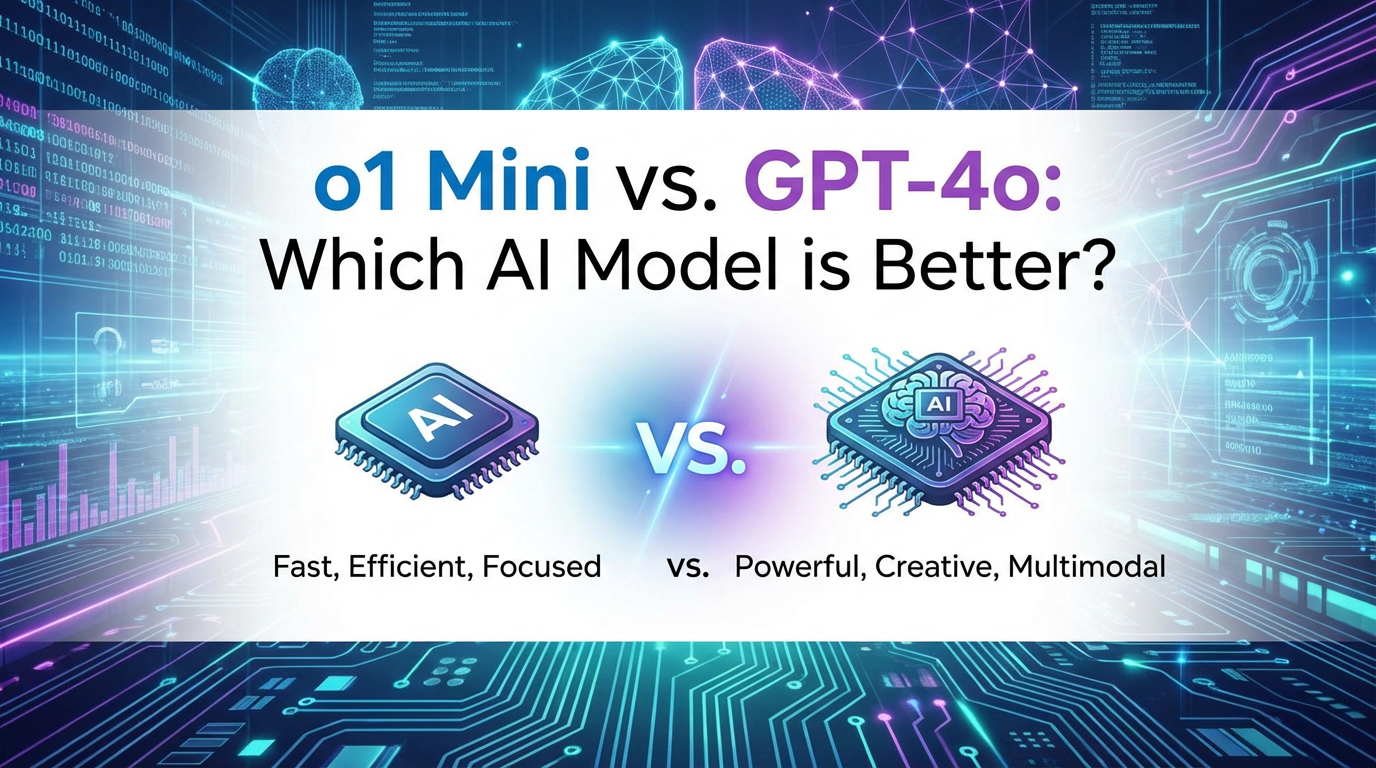

The landscape of artificial intelligence is evolving at an unprecedented pace, with new large language models (LLMs) emerging almost daily, each promising enhanced capabilities, efficiency, or specialized performance. This rapid innovation presents both incredible opportunities and significant challenges for developers and businesses striving to leverage AI effectively. Among the myriad of choices, two distinct archetypes are currently capturing significant attention: the ultra-powerful, general-purpose models, often multimodal, and the highly optimized, efficient models designed for specific tasks or resource-constrained environments. In this detailed comparison, we delve into the intricacies of OpenAI's flagship GPT-4o and the increasingly discussed, efficiency-focused o1 Mini. Our goal is to provide a thorough analysis, exploring their underlying philosophies, technical capabilities, performance benchmarks, cost implications, and ideal use cases, ultimately helping you determine which AI model is better suited for your specific needs.
The decision between a powerful generalist like GPT-4o and an agile specialist such as o1 Mini is far from trivial. It’s a strategic choice that impacts everything from development velocity and operational costs to the quality and responsiveness of your AI-powered applications. As the market continues to demand both unparalleled intelligence and cost-effective solutions, understanding the nuanced differences between these models becomes paramount. This article aims to cut through the marketing noise, offering a data-driven and practical perspective on the capabilities and limitations of o1 mini vs gpt 4o, providing the insights necessary to make an informed decision in a rapidly shifting technological paradigm.
1. Navigating the Dynamic AI Landscape in 2024: A Contextual Overview
The current era of artificial intelligence is characterized by a remarkable surge in the development and deployment of large language models (LLMs). These sophisticated algorithms, trained on vast datasets, have revolutionized how we interact with technology, automate tasks, and generate content. From creative writing and coding assistance to complex data analysis and customer service, LLMs are reshaping industries and redefining productivity. However, this growth also brings a critical challenge: choosing the right tool for the job. The sheer volume and diversity of available models necessitate a deeper understanding of their underlying architectures, performance profiles, and economic implications.
In 2024, the AI landscape can broadly be categorized by two prevailing trends. On one hand, we witness the continuous pursuit of general intelligence, manifested in models that are increasingly multimodal, capable of understanding and generating not just text, but also images, audio, and video. These models aim to mimic human-like cognition across a wide array of tasks, pushing the boundaries of what AI can achieve. OpenAI's GPT-4o stands as a prime example of this paradigm, embodying a comprehensive approach to AI capabilities.
On the other hand, there's a significant drive towards efficiency and specialization. Recognizing that not every application requires the full breadth and depth of a colossal generalist model, developers and researchers are actively building smaller, faster, and more cost-effective models. These "mini" versions or specialized architectures are designed to excel in narrower domains or operate efficiently under constrained computational budgets. The emergence of models like o1 Mini is a direct response to this demand, offering optimized performance for specific tasks without the overhead associated with larger, more versatile counterparts. The desire for something akin to a gpt-4o mini – a more efficient, streamlined version of a powerful model – highlights this market trend for optimized performance.
This dichotomy—between supreme generalism and focused efficiency—is at the heart of the "o1 Mini vs. GPT-4o" debate. For businesses and developers, this isn't merely an academic discussion; it has profound practical implications. The choice of an LLM dictates deployment costs, latency in real-time applications, the complexity of integration, and ultimately, the ability to deliver tangible value to end-users. A model that is overkill for a simple task can lead to inflated expenses and unnecessary latency, while an underpowered model might fail to meet performance expectations for complex problems. Therefore, a careful and nuanced evaluation of each model's capabilities against specific project requirements is indispensable in today's dynamic AI environment.
2. Deep Dive into GPT-4o: The Multimodal Maestro
OpenAI’s GPT-4o (the "o" stands for "omni") represents the pinnacle of their journey towards building artificial general intelligence (AGI). Building on the groundbreaking successes of GPT-3 and GPT-4, GPT-4o was unveiled as a significant leap forward, primarily distinguished by its native multimodal capabilities and enhanced efficiency. To truly understand its place in the AI ecosystem, we must delve into its origins, core features, strengths, limitations, and ideal applications.
2.1 Origins and Philosophy: OpenAI's Ambitious Vision
OpenAI was founded with the ambitious mission of ensuring that artificial general intelligence benefits all of humanity. Their trajectory has consistently involved pushing the boundaries of what LLMs can do, starting with early models that demonstrated impressive text generation and understanding, evolving into GPT-3 with its broad applicability, and then GPT-4, which showcased advanced reasoning and problem-solving skills. GPT-4o marks a pivotal moment in this evolution, as it was designed from the ground up to be natively multimodal.
Unlike previous iterations where vision and audio capabilities were often layered on top of a core text model, GPT-4o processes text, audio, and visual inputs and outputs as a single neural network. This architectural shift is not just an incremental improvement; it fundamentally changes how the model perceives and interacts with the world. The philosophy behind GPT-4o is to create a more natural, intuitive, and human-like interaction with AI, where the model can seamlessly understand and respond across different sensory modalities, just as humans do. This integration reduces latency and improves consistency across modes, making interactions feel more cohesive and fluid.
2.2 Key Features and Capabilities: A Symphony of Senses
GPT-4o's feature set is extensive, reflecting its ambition to be an "omni" model. Its capabilities extend far beyond mere text generation, positioning it as a powerful tool for a diverse range of applications.
- Native Multimodality: This is the flagship feature. GPT-4o can accept any combination of text, audio, and image as input and generate any combination of text, audio, and image as output.
- Audio: It can understand nuanced emotions, intonations, and background noise in audio inputs, and respond with natural-sounding speech across various voices and styles. Its latency for audio responses is remarkably low, often comparable to human conversation (as fast as 232 milliseconds, with an average of 320 milliseconds).
- Vision: The model can interpret complex visual information from images and video frames. This means it can analyze charts, describe scenes, identify objects, and even infer emotional states or actions depicted visually. For instance, feeding it an image of a complex graph allows it to extract data, analyze trends, and present insights in text.
- Text: Its text generation and understanding capabilities are on par with, or even surpass, previous top-tier models like GPT-4 Turbo. It excels in complex reasoning, coding, creative writing, summarization, translation, and more.
- Performance Benchmarks: GPT-4o sets new records across various benchmarks.
- Reasoning: It achieves state-of-the-art results on traditional text and reasoning benchmarks (e.g., MMLU, GPQA, MATH).
- Speed: Its inference speed is significantly faster than GPT-4 Turbo, especially for simpler requests.
- Multimodal Accuracy: It demonstrates impressive accuracy in interpreting visual and audio cues, performing tasks like object recognition, facial expression analysis, and speech-to-text with high fidelity.
- Context Window: While not explicitly stated as vastly larger than GPT-4 Turbo's 128K context window, GPT-4o inherits and potentially optimizes the ability to process lengthy inputs, crucial for handling complex documents, long conversations, or extended codebases. A large context window allows the model to maintain coherence and draw on a wider range of information when generating responses.
- API Accessibility and Integration: OpenAI continues its commitment to developer-friendly APIs. GPT-4o is available through the same well-documented API as its predecessors, making integration into existing applications or new projects relatively straightforward. It supports various SDKs and frameworks, facilitating adoption across different programming environments.
- Cost Structure: OpenAI has made GPT-4o significantly more cost-effective than GPT-4 Turbo. Its pricing is half that of GPT-4 Turbo for text and tokens, making its advanced capabilities more accessible for a broader range of applications. For example, it might cost $5 per 1 million input tokens and $15 per 1 million output tokens (these are illustrative and subject to change by OpenAI). Audio and vision inputs also have their own pricing structures, typically based on per-second for audio and per-image for vision, adding another layer of cost calculation for multimodal applications.
2.3 Strengths: Unparalleled Versatility and Performance
GPT-4o’s native multimodal architecture endows it with several compelling strengths:
- Unrivaled Versatility: The ability to seamlessly handle text, audio, and vision inputs and outputs makes it incredibly versatile. From a single model, developers can build applications that transcribe speech, analyze images, generate creative content, and engage in natural language conversations. This reduces the need to chain multiple specialized models, simplifying development.
- Cutting-Edge Performance: Across a broad spectrum of tasks, GPT-4o delivers state-of-the-art results. Its reasoning capabilities are robust, making it suitable for complex problem-solving, analytical tasks, and nuanced understanding. For creative applications, its ability to generate diverse and high-quality content is a major advantage.
- Natural Human-AI Interaction: The low latency audio, expressive voice generation, and sophisticated visual interpretation lead to a significantly more natural and engaging interaction experience. This is transformative for applications like intelligent assistants, interactive learning tools, and accessibility solutions.
- Robust Safety Features: OpenAI invests heavily in safety research, incorporating guardrails, bias mitigation techniques, and responsible AI practices into its models. While no AI is perfect, GPT-4o benefits from these ongoing efforts to minimize harmful outputs and ensure ethical deployment.
2.4 Limitations: The Price of Power
Despite its impressive capabilities, GPT-4o is not without its limitations, which primarily stem from its inherent complexity and scale:
- Computational Demands and Cost: While more cost-effective than previous high-end models, GPT-4o still incurs substantial computational costs, especially for high-volume or extremely complex multimodal tasks. For projects with tight budgets or simpler requirements, its operational expenses might be prohibitive.
- Resource Intensity: Running such a large, multimodal model requires significant computational resources, both in terms of processing power and memory. This makes on-device deployment challenging, if not impossible, for most consumer-grade hardware.
- Potential for Over-engineering: For straightforward tasks like simple text summarization, basic chatbots, or data extraction from structured text, using GPT-4o can be overkill. Its extensive capabilities and higher cost might not yield a proportional benefit over smaller, more specialized, and cheaper models.
- Latency for Extreme Real-Time Needs: While its audio latency is impressive, for applications demanding absolute minimal response times (e.g., certain industrial control systems or ultra-fast gaming interactions), even GPT-4o’s speed might have a perceptible delay compared to highly optimized, simpler models.
2.5 Ideal Use Cases: Where GPT-4o Shines
GPT-4o is an ideal choice for applications that demand high intelligence, versatility, and sophisticated multimodal understanding:
- Advanced Conversational AI and Chatbots: Building highly intelligent, empathetic, and context-aware virtual assistants that can understand spoken language, interpret emotions, and respond naturally.
- Content Creation and Creative Arts: Generating high-quality articles, marketing copy, scripts, poetry, or even assisting in visual design by interpreting concepts and producing images.
- Complex Problem-Solving and Research: Assisting researchers, analysts, and developers with data interpretation, coding assistance, scientific inquiry, and synthesizing information from diverse sources.
- Multimodal Applications: Developing innovative applications that leverage vision and audio, such as AI tutors that can see a student's work and hear their questions, or smart cameras that can describe scenes and interact verbally.
- Accessibility Tools: Creating more intuitive and powerful tools for individuals with disabilities, enabling easier interaction with digital content through voice, vision, and natural language.
In essence, GPT-4o is the go-to model when you need cutting-edge performance, broad applicability, and the ability to interact with AI in a truly human-like, multimodal fashion. It pushes the boundaries of what's possible, but its power comes with considerations regarding cost and computational overhead.
3. Deep Dive into o1 Mini: The Efficient Innovator
While models like GPT-4o captivate with their expansive capabilities, another significant trend in AI focuses on efficiency, speed, and cost-effectiveness. This is where models like o1 Mini come into play. Although not as widely publicized as OpenAI's flagship models, o1 Mini represents a growing class of AI models designed to offer powerful performance for specific tasks without the heavy computational and financial footprint of their larger counterparts. For the purpose of this comparison, we will treat o1 Mini as a hypothetical but representative example of a new generation of compact, highly optimized LLMs aimed at efficiency and targeted performance, fulfilling a need often conceptualized as a "gpt-4o mini" – a more streamlined, economical alternative.
3.1 Origins and Philosophy: Lean, Fast, and Focused
The philosophy behind models like o1 Mini stems from a recognition that "bigger is not always better." While large generalist models excel at a vast array of tasks, many real-world applications require specialized intelligence that is delivered rapidly and affordably. Developers of models like o1 Mini prioritize:
- Resource Efficiency: Minimizing the computational resources (GPU memory, CPU cycles, power consumption) required for inference. This makes them suitable for edge deployment, mobile applications, or environments with strict hardware limitations.
- Low Latency: Delivering responses with minimal delay, crucial for real-time interactive applications where every millisecond counts.
- Cost-Effectiveness: Offering significantly lower operational costs due to smaller model size and optimized inference paths.
- Specialized Performance: Focusing on excelling in a defined set of tasks (e.g., text summarization, specific query answering, code completion) rather than aiming for general intelligence across all domains. This often involves training on more domain-specific datasets or pruning larger models to retain essential capabilities.
The creators of o1 Mini likely start with a leaner architecture or apply advanced distillation techniques to compress larger models, ensuring that core functionalities are retained while shedding unnecessary parameters. This approach directly addresses the market's demand for a gpt-4o mini equivalent that can handle everyday AI tasks without the premium cost or latency.
3.2 Key Features and Capabilities: Speed and Precision
Models like o1 Mini are characterized by a set of features that emphasize operational efficiency and focused performance:
- Core Modality Focus: Typically, o1 Mini models prioritize a single modality, most often text. While some might incorporate limited multimodal capabilities, their strength lies in their text-based generation and understanding. This focus allows for a more streamlined architecture.
- Optimized Performance Benchmarks: Instead of striving for state-of-the-art across all benchmarks, o1 Mini aims for top-tier performance within its specialized domain.
- Speed: Inference speed is a critical metric. o1 Mini is designed to provide responses significantly faster than larger models for comparable text-based queries, often achieving sub-100ms response times.
- Specific Task Accuracy: While its general knowledge might be less broad than GPT-4o, its accuracy for specific, predefined tasks (e.g., sentiment analysis, entity extraction, short-form content generation) can be highly competitive, sometimes even outperforming larger models that are less optimized for those particular tasks.
- Token Efficiency: Models like o1 Mini are often more efficient in their token usage, generating concise and direct responses that reduce overall token count for both input and output.
- Smaller Context Window (Generally): To maintain efficiency, o1 Mini models typically operate with a smaller context window compared to flagship models. While still adequate for many common interactions, this means they might struggle with extremely long documents or conversations requiring extensive memory. For instance, a common context window might be 4K to 16K tokens.
- API Accessibility and Integration: Being part of the modern AI ecosystem, o1 Mini would come with well-documented APIs, potentially offering various deployment options including cloud-based inference and perhaps even some level of on-premise or edge deployment for highly optimized versions.
- Cost Structure: This is one of the most compelling features. o1 Mini models are designed to be significantly more cost-effective per token or per inference than their larger counterparts. This makes them highly attractive for applications with high transaction volumes where cumulative costs can quickly escalate. For example, pricing might be $0.50 per 1 million input tokens and $1.50 per 1 million output tokens (illustrative figures). The cost reduction often makes mass deployment feasible where GPT-4o would be prohibitively expensive.
3.3 Strengths: Agility, Affordability, and Focus
The advantages of an o1 Mini type model are clear for specific development paradigms:
- Exceptional Speed and Low Latency: For applications requiring immediate responses—such as real-time customer support, interactive gaming, or dynamic UI generation—the speed of o1 Mini is a critical asset. This translates directly into better user experience.
- Significant Cost-Efficiency: Lower per-token costs and reduced computational requirements mean that o1 Mini can dramatically reduce operational expenses for high-volume deployments. This democratizes access to powerful AI functionalities for startups and businesses with tighter budgets.
- Resource Friendliness: Its smaller model footprint makes it suitable for deployment in environments with limited hardware resources, including edge devices, mobile phones, or embedded systems. This opens up new possibilities for offline AI capabilities or situations where cloud access is constrained.
- Specialized Accuracy: By focusing on specific tasks, o1 Mini can be finely tuned to deliver highly accurate and reliable results within its domain, avoiding the potential overhead or occasional misinterpretations that a broad generalist might exhibit for niche queries.
- Easier Fine-tuning: Smaller models are generally easier and less resource-intensive to fine-tune on proprietary datasets, allowing businesses to tailor the model's behavior to their specific brand voice, product knowledge, or operational workflows.
3.4 Limitations: The Trade-offs of Specialization
While efficiency is a virtue, it comes with inherent trade-offs:
- Lower General Intelligence: o1 Mini will likely not possess the broad general knowledge, advanced reasoning capabilities, or nuanced understanding of a model like GPT-4o. It might struggle with highly abstract concepts, complex multi-step problems, or questions outside its specific training domain.
- Limited Versatility: Its primary focus on one or a few modalities (typically text) means it cannot handle the rich multimodal inputs (audio, video, complex images) that GPT-4o excels at. This limits its application scope.
- Smaller Context Window: While sufficient for many interactions, a limited context window can hinder its performance on tasks requiring recall of extensive past conversations or analysis of very long documents. It might "forget" earlier parts of a long interaction.
- Potential for Brittleness on Out-of-Domain Tasks: When confronted with tasks or questions far outside its optimized training distribution, o1 Mini might exhibit more errors, produce less coherent responses, or simply state that it cannot perform the task, whereas a generalist might attempt a plausible (though perhaps not perfect) response.
3.5 Ideal Use Cases: The Power of Precision
o1 Mini is an excellent choice for scenarios where speed, cost, and focused performance are paramount:
- High-Volume Automated Customer Service: Handling routine queries, providing quick FAQs, or triaging customer issues to specialized agents.
- Real-time Interaction and Chatbots (Basic): Powering rapid-response chatbots for websites, mobile apps, or internal communication tools where instantaneous replies are crucial.
- Content Moderation and Filtering: Quickly identifying and flagging inappropriate content, spam, or hate speech in user-generated text.
- Data Extraction and Summarization (Specific): Efficiently extracting key information from structured or semi-structured text, or generating concise summaries of articles for specific topics.
- Automated Email Responses and Ticketing: Generating standard responses to common email inquiries or categorizing incoming support tickets.
- Edge AI Applications: Deploying AI capabilities directly on devices like smart home appliances, IoT sensors, or mobile phones where cloud connectivity is intermittent or computational resources are limited.
In conclusion, o1 Mini represents the strategic choice for developers and businesses that prioritize lean operations, rapid response times, and optimized performance within a specific domain. It may not offer the expansive intelligence of GPT-4o, but its efficiency makes it invaluable for scaling AI applications cost-effectively and deploying them in demanding real-time or resource-constrained environments.
XRoute is a cutting-edge unified API platform designed to streamline access to large language models (LLMs) for developers, businesses, and AI enthusiasts. By providing a single, OpenAI-compatible endpoint, XRoute.AI simplifies the integration of over 60 AI models from more than 20 active providers(including OpenAI, Anthropic, Mistral, Llama2, Google Gemini, and more), enabling seamless development of AI-driven applications, chatbots, and automated workflows.
4. Direct Comparison: o1 Mini vs. GPT-4o – The Showdown
Having delved into the individual strengths and characteristics of GPT-4o and o1 Mini, it's time to conduct a direct, side-by-side comparison. This section will highlight their differences across critical dimensions, including performance, cost-efficiency, versatility, and ease of integration, offering a clearer picture of their respective advantages. This comparison is crucial for any developer or business weighing the merits of o1 mini vs gpt 4o.
4.1 Performance Metrics: Speed, Accuracy, and Modality
The performance comparison between o1 Mini and GPT-4o is largely a study in trade-offs between breadth and depth, and between general intelligence and specialized efficiency.
- Multimodal Capabilities: GPT-4o is the undisputed leader here. Its native integration of text, audio, and vision means it can understand and generate content across these modalities seamlessly. o1 Mini, by design, is likely focused primarily on text, with perhaps limited or no support for complex audio and visual processing.
- General Intelligence and Reasoning: GPT-4o, being a larger generalist model, will typically exhibit superior performance in complex reasoning, abstract problem-solving, creative tasks, and handling a broad range of knowledge domains. Its ability to infer nuanced meaning and perform multi-step logical operations is a key differentiator. o1 Mini might perform adequately on simpler reasoning tasks within its domain but would likely struggle with the breadth and depth of a generalist.
- Speed and Latency: This is where o1 Mini is designed to shine. For text-based tasks within its specialty, it will likely offer significantly lower latency and higher throughput compared to GPT-4o. While GPT-4o has made impressive strides in reducing latency, especially for audio, its overall architecture still carries more overhead. For applications requiring sub-100ms response times for text generation, o1 Mini would generally be the preferred choice.
- Accuracy (Task-Specific vs. General): For specialized tasks that o1 Mini is optimized for (e.g., sentiment analysis, entity recognition, short answer generation), its accuracy can be very high, potentially matching or even exceeding GPT-4o due to its focused training. However, for tasks requiring broad general knowledge, complex instruction following, or creative writing, GPT-4o would demonstrate superior accuracy and coherence.
To illustrate these differences, let's consider a hypothetical performance comparison:
Table 1: Key Performance Comparison (Hypothetical Data)
| Feature | GPT-4o | o1 Mini |
|---|---|---|
| Primary Modalities | Text, Audio, Vision (native) | Text (primary), possibly limited other modalities |
| General Reasoning | Excellent (SOTA for complex tasks) | Good (for defined tasks), limited general reasoning |
| Creative Generation | Excellent (diverse, high-quality) | Moderate (focused, concise) |
| Latency (Text Gen) | Good (avg. ~320ms for audio, faster for text) | Excellent (sub-100ms for text) |
| Accuracy (General) | High across broad domains | High for specialized domains, lower for general |
| Context Window | Very Large (e.g., 128K tokens) | Moderate (e.g., 4K-16K tokens) |
| Computational Footprint | Large (cloud-intensive) | Small (edge-deployable) |
4.2 Cost-Efficiency Analysis: Dollars and Tokens
Cost is often a decisive factor, especially for high-volume applications or budget-conscious projects.
- Per-Token Cost: GPT-4o has made its advanced capabilities more accessible by reducing its per-token cost compared to GPT-4 Turbo. However, o1 Mini is explicitly designed for cost-efficiency. It will almost certainly have a significantly lower per-token price for both input and output. This difference becomes exponential with scale.
- Total Cost of Ownership (TCO): For an application that processes millions of tokens daily, the TCO will be vastly different. A small per-token saving from o1 Mini can translate into thousands or even hundreds of thousands of dollars in savings annually for high-throughput systems. For sporadic or low-volume use, the absolute difference might be less critical.
- Multimodal Cost: If your application heavily relies on audio and vision processing, GPT-4o's multimodal pricing structure adds another layer of cost. o1 Mini, by focusing primarily on text, bypasses these additional expenses, making it cheaper for purely text-based tasks.
Table 2: Illustrative Cost Comparison per Million Tokens (Hypothetical & Simplified)
| Model | Input Tokens (per 1M) | Output Tokens (per 1M) | Notes |
|---|---|---|---|
| GPT-4o | $5.00 | $15.00 | Additional costs for audio (per second) and vision (per image/input) |
| o1 Mini | $0.50 | $1.50 | Primarily text-based; often 10x cheaper |
This simplified table vividly demonstrates the potential for significant cost savings with o1 Mini for text-heavy workloads.
4.3 Versatility and Specialization: Generalist vs. Specialist
This is perhaps the most fundamental distinction between the two models.
- GPT-4o: The Generalist: Its strength lies in its ability to adapt to a vast array of tasks and knowledge domains. It’s a powerful, all-encompassing solution that can handle almost any AI challenge you throw at it, especially those requiring multimodal input or sophisticated reasoning. It's built for broad application and complex, nuanced understanding.
- o1 Mini: The Specialist: Its strength is its focus. By optimizing for specific tasks and prioritizing efficiency, it excels where a generalist might be overkill or too slow. It's ideal for repetitive, high-volume tasks where consistent, fast, and affordable output is more important than broad, deep understanding. It's the precision tool for a defined job.
4.4 Development and Integration: Ease of Use and Flexibility
Both models are likely to be accessible via standard API interfaces, but the ecosystem and integration considerations can differ.
- API Ease of Use and Documentation: OpenAI's APIs are renowned for their excellent documentation, extensive community support, and robust SDKs across multiple languages. o1 Mini, while likely offering a good API, might have a smaller community and less extensive documentation, depending on its provider.
- Flexibility and Model Switching: Developers often need the flexibility to experiment with different models or even switch models dynamically based on the task or user. This is where unified API platforms become incredibly valuable. Platforms like XRoute.AI are specifically designed to streamline access to a multitude of LLMs from various providers through a single, OpenAI-compatible endpoint. This unified approach abstracts away the complexities of integrating different APIs, allowing developers to seamlessly switch between powerful generalists like GPT-4o for complex tasks and efficient specialists like o1 Mini (or indeed, a conceptual gpt-4o mini equivalent) for high-volume, cost-sensitive operations. XRoute.AI, with its focus on low latency AI and cost-effective AI, empowers developers to choose the best model for their needs without the headache of managing multiple API connections, facilitating efficient experimentation and deployment.
- Developer Experience: The overall developer experience can be smoother when dealing with established platforms like OpenAI due to extensive examples, tutorials, and a large user base to draw support from. However, specialized models might offer unique customization options or direct support channels that cater to specific use cases.
4.5 Scalability and Latency: Handling the Load
- Scalability: Both models can be scaled to handle high request volumes in cloud environments. However, the operational cost of scaling GPT-4o to millions of daily requests will be substantially higher than scaling o1 Mini. o1 Mini's efficiency makes it inherently more cost-effective to scale to very high throughputs for its target tasks.
- Latency for Real-Time Applications: For applications where every millisecond matters (e.g., voice assistants, real-time gaming, autonomous systems), the lower latency of o1 Mini for its specialized tasks offers a distinct advantage. While GPT-4o's audio latency is impressive, its overall inference path is generally longer than a highly optimized, smaller model.
In summary, choosing between o1 Mini vs gpt 4o boils down to a strategic alignment with your project's core priorities. Is it unparalleled intelligence and multimodal capability at a higher cost, or is it speed, efficiency, and cost-effectiveness for targeted tasks?
5. Strategic Decision-Making: When to Choose Which AI Model
The "better" AI model isn't an absolute truth; it's a contextual determination based on a clear understanding of your project's unique requirements, constraints, and strategic goals. Neither GPT-4o nor o1 Mini is inherently superior across all metrics; instead, they represent optimized solutions for different sets of challenges. This section provides scenario-based recommendations and a forward-looking perspective on the evolving AI ecosystem.
5.1 Scenario-Based Recommendations
To simplify the decision, let's consider various common development scenarios:
- For Cutting-Edge Research and Complex Multimodal Applications: Choose GPT-4o.
- Example: Developing an intelligent virtual assistant that can engage in natural conversation, interpret images shared by the user, and respond with dynamic visual aids or voice. Or creating an AI tutor that can listen to a student's verbal explanations, see their handwritten solutions, and provide personalized feedback.
- Why: GPT-4o’s native multimodal capabilities, superior general reasoning, and broad knowledge base are indispensable for these kinds of sophisticated, human-like interactions and complex problem-solving. The investment in its capabilities justifies the higher cost.
- For High-Volume, Cost-Sensitive Text Automation: Choose o1 Mini.
- Example: Implementing a system to automatically categorize millions of incoming customer support emails, generate concise summaries of news articles, or power a chatbot that answers common FAQs across an e-commerce platform.
- Why: The primary drivers here are speed and cost-efficiency. o1 Mini excels at delivering fast, accurate, and highly affordable text-based outputs at scale. For tasks where the nuance of a generalist model isn't critical, the cost savings and lower latency of o1 Mini are paramount. This is where the desire for a gpt-4o mini finds its practical answer in models like o1 Mini.
- For Real-Time Interactive Applications (Text-Based): Choose o1 Mini.
- Example: Building a live chat support agent that needs to respond within milliseconds, a quick-response content generator for dynamic web elements, or an AI companion for gaming that offers instantaneous textual feedback.
- Why: Latency is king. o1 Mini's optimized architecture ensures minimal delay in generating responses, crucial for maintaining a fluid and engaging user experience in real-time interactions.
- For Applications Requiring Extensive Context Understanding or Creative Freedom: Choose GPT-4o.
- Example: Writing a novel with AI assistance, generating complex code with specific architectural requirements, or performing deep analysis of legal documents spanning hundreds of pages while maintaining conversational context over extended periods.
- Why: GPT-4o's large context window and superior ability to handle complex instructions and maintain long-term coherence make it the ideal candidate for tasks demanding deep understanding and creative output.
- For Edge Deployment or Resource-Constrained Environments: Choose o1 Mini.
- Example: Developing AI features for a smart home device, an offline mobile application, or an industrial IoT sensor where cloud connectivity is unreliable or computational power is limited.
- Why: o1 Mini's smaller footprint and reduced computational demands make it suitable for running inference directly on devices, reducing reliance on cloud infrastructure and enabling offline capabilities.
- For Rapid Prototyping and Flexible Model Switching: Leverage Platforms like XRoute.AI.
- Example: A startup developing a new AI application needs to quickly test various LLMs to determine the optimal balance of performance, cost, and latency before committing to a single model. Or an enterprise needs to dynamically switch between models based on user query complexity or cost targets.
- Why: Platforms like XRoute.AI offer a unified API, abstracting the complexities of interacting with different LLM providers. This enables developers to easily integrate and switch between models like GPT-4o for demanding tasks and o1 Mini for efficient ones, without extensive code changes. XRoute.AI's focus on low latency AI and cost-effective AI through a single endpoint means developers can rapidly iterate, optimize performance, and manage costs effectively by choosing the right model for each specific need, including the desire for a gpt-4o mini equivalent solution.
5.2 Future Outlook: An Evolving Ecosystem
The trajectory of AI development points towards a bifurcated future where both ultra-powerful generalists and highly efficient specialists will continue to co-exist and thrive.
- Continuous Innovation in Generalists: Models like GPT-4o will continue to push the boundaries of intelligence, multimodality, and reasoning, tackling increasingly complex problems and offering more natural human-AI interfaces.
- Proliferation of Efficient Specialists: The demand for smaller, faster, and cheaper models will only grow. We can expect to see more models akin to o1 Mini emerging, specializing in everything from specific languages and domains to unique tasks, often fulfilling the market's need for a functional gpt-4o mini.
- The Crucial Role of Abstraction Layers: As the number of available models explodes, the complexity of selecting, integrating, and managing them will increase exponentially. This makes platforms like XRoute.AI absolutely critical. By offering a unified API, these platforms simplify the developer experience, allow for seamless model switching, and enable organizations to dynamically optimize for cost, performance, and reliability without vendor lock-in or integration nightmares. They empower developers to leverage the best of both worlds – the power of GPT-4o and the efficiency of o1 Mini – through a single, streamlined interface.
The future of AI application development lies not just in the capabilities of individual models but in the intelligent orchestration of these diverse tools. Strategic model selection, guided by specific project requirements and enabled by robust integration platforms, will be the hallmark of successful AI implementations.
Conclusion
The debate between o1 Mini vs gpt 4o is not about identifying a single "winner" but rather about understanding which model provides the optimal fit for particular challenges. GPT-4o stands as a titan of general intelligence, offering unparalleled multimodal capabilities, advanced reasoning, and creative prowess suitable for the most complex and human-like AI interactions. Its strength lies in its versatility and state-of-the-art performance across a broad spectrum of tasks, albeit with a higher computational and financial overhead.
Conversely, o1 Mini embodies the principle of efficient specialization. It delivers exceptional speed, low latency, and remarkable cost-efficiency for targeted, high-volume text-based tasks. For applications where rapid response times and budget constraints are paramount, and where the full breadth of a generalist model is unnecessary, o1 Mini presents an incredibly compelling and practical solution, often serving the real-world demand for a gpt-4o mini equivalent.
The choice ultimately hinges on your specific needs: * Do you require unmatched intelligence, multimodal understanding, and broad versatility? Opt for GPT-4o. * Do you prioritize speed, cost-effectiveness, and specialized performance for high-volume, text-centric tasks? o1 Mini is likely your ideal choice.
Moreover, the complexity of navigating this diverse landscape of models is significantly eased by platforms like XRoute.AI. By providing a unified API, XRoute.AI empowers developers to seamlessly integrate and switch between models like GPT-4o and o1 Mini, allowing for dynamic optimization based on task complexity, cost targets, and latency requirements. This flexible approach ensures that businesses can leverage the precise AI capabilities they need, without being constrained by the intricacies of disparate API connections. In the evolving world of AI, smart model selection, facilitated by powerful integration tools, is the true path to innovation and efficiency.
Frequently Asked Questions (FAQ)
Q1: Is o1 Mini truly a competitor to GPT-4o?
A1: o1 Mini is not a direct, head-to-head competitor in the sense of offering identical capabilities. Instead, it competes in a different segment of the market by prioritizing efficiency, speed, and cost-effectiveness for specialized tasks, especially text generation. While GPT-4o aims for broad general intelligence and multimodality, o1 Mini offers a highly optimized solution for specific use cases where a "gpt-4o mini" equivalent for efficiency is desired. So, they compete for developer attention based on different value propositions.
Q2: What are the main cost differences between o1 Mini and GPT-4o?
A2: Generally, o1 Mini is significantly more cost-effective per token than GPT-4o. This difference can be substantial, often an order of magnitude cheaper, particularly for text-based tasks. GPT-4o, while having reduced its prices, also incurs additional costs for its multimodal (audio and vision) inputs and outputs, which o1 Mini typically avoids due to its focused modality. For high-volume applications, the cost savings with o1 Mini can be immense.
Q3: Can I use both o1 Mini and GPT-4o in the same application?
A3: Yes, absolutely! This is often a highly effective strategy. For instance, you could use o1 Mini to handle high-volume, routine queries or initial text processing due to its speed and cost-efficiency. Then, for more complex, nuanced, or multimodal requests, you could seamlessly route them to GPT-4o. This hybrid approach allows you to optimize for both performance and cost. Unified API platforms like XRoute.AI make implementing such a strategy much simpler by abstracting away different API integrations.
Q4: How does a unified API platform like XRoute.AI help in choosing between these models?
A4: XRoute.AI provides a single, OpenAI-compatible endpoint to access over 60 AI models from more than 20 providers. This means you can easily switch between models like GPT-4o and o1 Mini (or any other available LLM) with minimal code changes. XRoute.AI simplifies the integration process, reduces vendor lock-in, and allows developers to experiment, benchmark, and dynamically select the best model for a given task based on factors like low latency AI, cost-effective AI, and specific performance requirements, all through one streamlined interface.
Q5: Which model is better for real-time customer service chatbots?
A5: For most real-time customer service chatbots, especially those handling a high volume of text-based queries, o1 Mini would generally be better. Its superior speed, lower latency, and cost-efficiency make it ideal for quick, accurate responses to common questions. However, if your chatbot needs to engage in deep, empathetic, multimodal conversations (e.g., analyzing customer's tone of voice, interpreting images they send, or providing complex problem-solving), then GPT-4o would be the superior choice, albeit at a higher cost and potentially slightly higher latency.
🚀You can securely and efficiently connect to thousands of data sources with XRoute in just two steps:
Step 1: Create Your API Key
To start using XRoute.AI, the first step is to create an account and generate your XRoute API KEY. This key unlocks access to the platform’s unified API interface, allowing you to connect to a vast ecosystem of large language models with minimal setup.
Here’s how to do it: 1. Visit https://xroute.ai/ and sign up for a free account. 2. Upon registration, explore the platform. 3. Navigate to the user dashboard and generate your XRoute API KEY.
This process takes less than a minute, and your API key will serve as the gateway to XRoute.AI’s robust developer tools, enabling seamless integration with LLM APIs for your projects.
Step 2: Select a Model and Make API Calls
Once you have your XRoute API KEY, you can select from over 60 large language models available on XRoute.AI and start making API calls. The platform’s OpenAI-compatible endpoint ensures that you can easily integrate models into your applications using just a few lines of code.
Here’s a sample configuration to call an LLM:
curl --location 'https://api.xroute.ai/openai/v1/chat/completions' \
--header 'Authorization: Bearer $apikey' \
--header 'Content-Type: application/json' \
--data '{
    "model": "gpt-5",
    "messages": [
        {
            "content": "Your text prompt here",
            "role": "user"
        }
    ]
}'
With this setup, your application can instantly connect to XRoute.AI’s unified API platform, leveraging low latency AI and high throughput (handling 891.82K tokens per month globally). XRoute.AI manages provider routing, load balancing, and failover, ensuring reliable performance for real-time applications like chatbots, data analysis tools, or automated workflows. You can also purchase additional API credits to scale your usage as needed, making it a cost-effective AI solution for projects of all sizes.
Note: Explore the documentation on https://xroute.ai/ for model-specific details, SDKs, and open-source examples to accelerate your development.