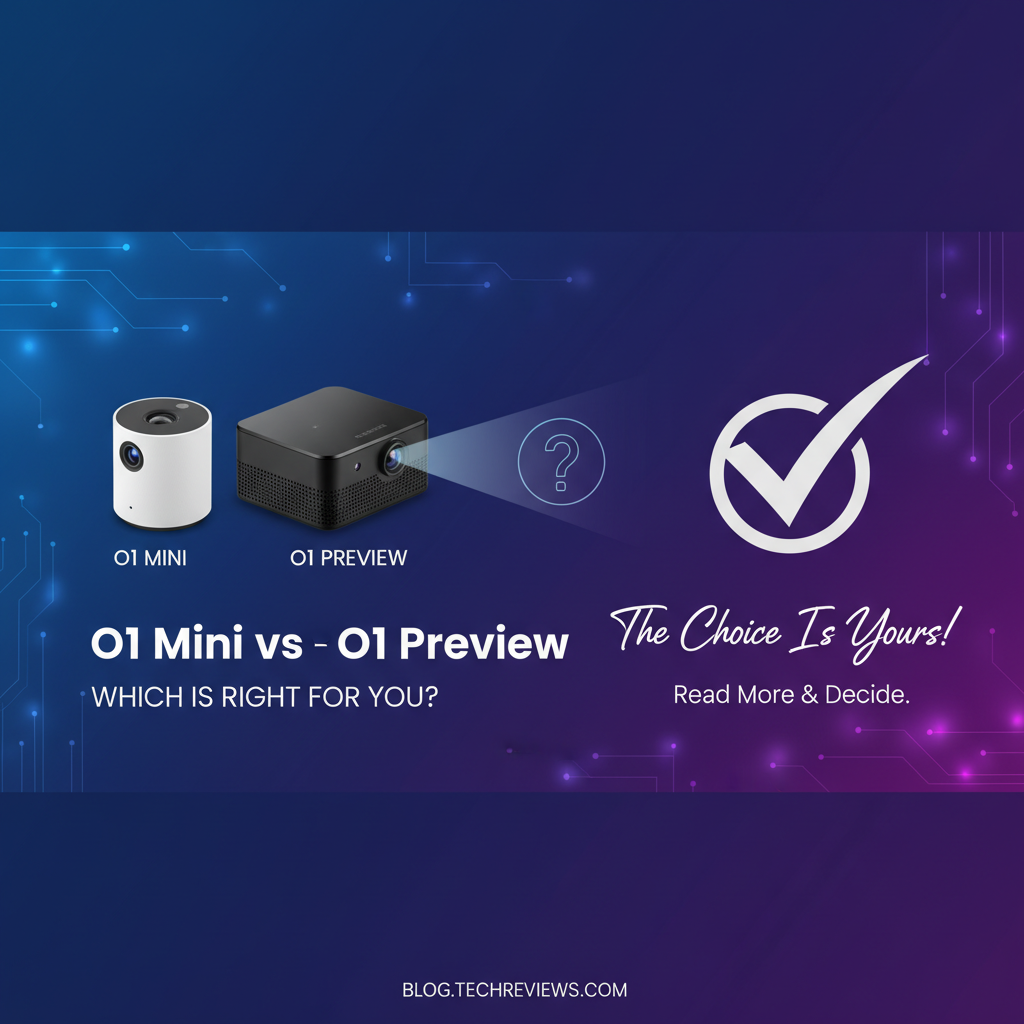
O1 Mini vs O1 Preview: Which is Right for You?


In the rapidly evolving landscape of compact computing and embedded systems, making the right choice can feel like navigating a labyrinth. For enthusiasts, developers, and everyday users alike, the "O1" brand has emerged as a compelling contender, offering a range of devices designed to cater to diverse needs. Two particular models frequently spark debate and comparison: the O1 Mini and the O1 Preview. Each brings a unique set of capabilities, design philosophies, and target audiences to the table, making the decision between them a nuanced one.
This in-depth guide aims to demystify the core differences between the O1 Mini vs O1 Preview, offering a detailed exploration of their features, performance, use cases, and overall value proposition. Whether you're seeking a simple, unobtrusive device for home automation or a powerful, flexible platform for cutting-edge AI development, understanding the intricate details of each O1 variant is paramount. By the end of this extensive comparison, you'll be equipped with all the necessary insights to confidently answer the question: Which O1 device is truly right for you?
Understanding the O1 Ecosystem: A Glimpse into the Brand's Philosophy
Before diving into the specifics of the O1 Mini vs O1 Preview, it's crucial to grasp the overarching vision behind the O1 brand. O1 aims to democratize access to compact yet capable computing, blurring the lines between traditional desktop PCs, single-board computers (SBCs), and specialized embedded systems. Their philosophy revolves around creating devices that are not only powerful but also energy-efficient, versatile, and supported by a growing community. This commitment to innovation and accessibility forms the bedrock upon which both the O1 Mini and O1 Preview are built, albeit with distinctly different manifestations of that vision.
The O1 devices are not merely static pieces of hardware; they are platforms designed for continuous evolution, supported by an operating system (O1 OS) that emphasizes user-friendliness, security, and updateability. This ecosystem approach means that choosing an O1 device is also an investment in a community, a software environment, and a pathway to future innovations. With this broader context in mind, let's peel back the layers and examine what makes the O1 Mini and O1 Preview stand out from each other.
Deep Dive: O1 Mini – The Compact Powerhouse for Everyday Simplicity
The O1 Mini is often lauded as the entry point into the O1 ecosystem, a device engineered for efficiency, simplicity, and reliability. It embodies the principle that powerful computing doesn't always require a large footprint or a hefty price tag. Designed with the everyday user in mind, the O1 Mini excels in scenarios where discretion, energy conservation, and straightforward functionality are paramount.
Target Audience and Philosophy
The O1 Mini primarily targets users who need a dependable, low-maintenance device for common tasks without unnecessary complexity. This includes:
- Casual Home Users: For web browsing, media streaming (Netflix, YouTube), basic productivity tasks, and digital photo management.
- Home Automation Enthusiasts: As a central hub for smart home devices, running Home Assistant or similar platforms with minimal fuss.
- Small Business & Kiosk Applications: For digital signage, point-of-sale systems, or as a thin client for cloud-based applications.
- Educational Settings: A cost-effective solution for basic computing in classrooms or for remote learning setups.
- IoT Projects: Simple sensor data collection, gateway applications, or lightweight edge processing where power efficiency is critical.
Its design philosophy centers on a "set it and forget it" approach. The O1 Mini is built to be unobtrusive, reliable, and capable of handling its designated tasks without constant tinkering or advanced technical knowledge.
Key Features and Specifications
The O1 Mini packs a surprising amount of capability into its diminutive form factor. Let's delve into its core components:
- Processor (CPU): At its heart lies a custom O1-Lite ARM-based quad-core processor. This chip is meticulously optimized for energy efficiency, delivering ample performance for its intended use cases while consuming minimal power. It's not designed for heavy-duty computation but handles general tasks with commendable responsiveness.
- Graphics (GPU): An integrated Mali-G31 GPU provides capable video decoding and light graphical rendering, making it perfect for 4K video playback at 30fps and smooth UI navigation. It's not a gaming powerhouse, but it ensures a crisp visual experience for multimedia.
- Memory (RAM): Typically configured with 4GB of LPDDR4 RAM. While not expansive, this is perfectly adequate for multitasking with a few browser tabs open, streaming applications, or running a smart home server.
- Storage: Most O1 Mini models come with 64GB of eMMC storage. This provides fast boot times and sufficient space for the operating system and a good selection of applications. For larger media libraries, external storage options are readily available.
- Connectivity:
- Wireless: Integrated Wi-Fi 5 (802.11ac) ensures stable wireless internet access, and Bluetooth 4.2 allows for seamless connection with peripherals like keyboards, mice, and audio devices.
- Wired: Two USB-A 2.0 ports offer connectivity for standard peripherals. A single HDMI 1.4 port supports up to 4K output. A 100Mbps Ethernet port provides reliable wired network access, essential for server applications or stable streaming.
- Form Factor: True to its name, the O1 Mini is remarkably compact, often no larger than a coaster or a small external hard drive. It's typically fanless, ensuring silent operation, which is a significant advantage for living room or bedroom environments.
- Operating System: It runs a streamlined version of the O1 OS, optimized for its hardware. This Linux-based OS features a clean, intuitive user interface, easy access to app stores, and robust security updates, designed for users who prioritize ease of use over deep customization.
Performance Expectations and Real-World Use
The O1 Mini's performance should be viewed through the lens of its design philosophy.
- Everyday Tasks: It handles web browsing, email, word processing, and spreadsheet work with ease. Multiple tabs in a modern browser might start to show some slowdown, but for typical usage, it's perfectly capable.
- Media Consumption: This is where the O1 Mini truly shines. Its hardware decoding capabilities make it an excellent streaming client for platforms like Netflix, Hulu, Disney+, and YouTube, even at 4K resolutions (though usually limited to 30Hz refresh rates due to HDMI 1.4).
- Home Automation: As a dedicated server for Home Assistant, OpenHAB, or other smart home platforms, it's an ideal choice. Its low power consumption means it can run 24/7 without significantly impacting your electricity bill.
- Light Gaming: Don't expect to run modern AAA titles. However, retro emulation (e.g., SNES, PS1, N64) and simple indie games from app stores run surprisingly well.
Pros and Cons of the O1 Mini
| Aspect | Pros | Cons |
|---|---|---|
| Cost | Very affordable entry point into the O1 ecosystem. | Limited upgradeability compared to other options. |
| Size | Ultra-compact and lightweight, easily hidden or mounted. | Fewer ports and expansion options. |
| Power | Extremely energy-efficient, ideal for 24/7 operation. | Lower processing power, not suitable for heavy tasks. |
| Noise | Fanless design ensures completely silent operation. | Not designed for intensive cooling needs of high performance. |
| Ease of Use | User-friendly O1 OS, simple setup, minimal maintenance. | Less flexible for advanced configurations or custom OS. |
| Connectivity | Sufficient for basic peripherals and network needs. | Limited to Wi-Fi 5, fewer high-speed USB ports. |
| Target Use | Excellent for streaming, home automation, basic productivity. | Not ideal for complex development, video editing, or heavy gaming. |
Deep Dive: O1 Preview – The Frontier of Innovation for Developers and Power Users
In stark contrast to its smaller sibling, the O1 Preview is designed for those who demand more power, more flexibility, and more control. It represents the cutting edge of O1's offerings, often incorporating newer technologies and a more robust architecture tailored for experimentation, advanced development, and resource-intensive applications. If the O1 Mini is the everyday commuter car, the O1 Preview is the high-performance sports car built for the track.
Target Audience and Philosophy
The O1 Preview caters to a more specialized and demanding audience:
- Developers and Makers: Ideal for coding, compiling, running virtual machines, and prototyping hardware projects with its extensive I/O.
- AI/Machine Learning Enthusiasts: With more powerful processors and potentially dedicated neural processing units (NPUs), it's a platform for running local AI models, training smaller datasets, or interacting with advanced AI APIs.
- Power Users: Those who need to run demanding applications, compile large codebases, or engage in light video editing or advanced data analysis.
- Edge Computing & Industrial IoT: Its robust connectivity and processing power make it suitable for collecting and processing data at the network edge.
- Enthusiast Gaming & Emulation: Capable of running more demanding emulators and some lighter PC games.
- Advanced Home Servers: Beyond basic automation, for running media servers (Plex, Jellyfin), self-hosted cloud solutions, or more complex network services.
Its philosophy is about unlocking potential, providing a versatile canvas for innovation, and pushing the boundaries of what a compact device can achieve. It assumes a certain level of technical proficiency and an eagerness to experiment.
Key Features and Specifications
The o1 preview elevates the hardware stakes significantly, reflecting its more ambitious design goals.
- Processor (CPU): Often featuring a more powerful O1-Pro x86 or a high-end ARM processor, typically with 6-8 cores and higher clock speeds. Some iterations might include a dedicated NPU (Neural Processing Unit) for accelerating AI/ML workloads, a crucial differentiator when considering the o1 preview vs o1 mini for modern applications.
- Graphics (GPU): A more robust integrated GPU (e.g., Intel Iris Xe equivalent or a powerful ARM Mali-G52/G68). This provides significantly better graphics performance, supporting higher resolutions, multiple displays, and more demanding graphical applications, including some moderate gaming.
- Memory (RAM): Available with 8GB, 16GB, or even 32GB of faster LPDDR5 or DDR5 RAM. This allows for extensive multitasking, running virtual machines, and handling large datasets common in development or AI tasks.
- Storage: Typically ships with 128GB or 256GB NVMe SSD storage, offering vastly superior read/write speeds compared to eMMC. Crucially, it often includes M.2 slots for easy storage expansion, allowing users to add terabytes of fast storage.
- Connectivity:
- Wireless: Cutting-edge Wi-Fi 6E (802.11ax) provides ultra-fast wireless speeds and lower latency, essential for demanding network applications. Bluetooth 5.2 ensures highly reliable peripheral connections.
- Wired: Multiple high-speed USB-A 3.1 ports, at least one USB-C port (often supporting DisplayPort Alternate Mode for video output and Power Delivery), two HDMI 2.0 ports for dual-display setups at 4K 60Hz, and a 2.5Gbps or even 5Gbps Ethernet port for blazing-fast wired networking. Crucially, it often features GPIO (General Purpose Input/Output) pins for direct hardware interfacing, a boon for makers and embedded developers.
- Expansion: Dedicated M.2 slots are common, not just for storage but also for add-on modules like cellular modems, AI accelerators, or specialized I/O cards, providing unparalleled expandability compared to the o1 mini vs o1 preview.
- Form Factor: While still compact, the O1 Preview is generally slightly larger and heavier than the Mini, accommodating more sophisticated cooling solutions (often active cooling with a quiet fan) and additional I/O. Its design often reflects a more utilitarian, modular approach.
- Operating System: Runs a full-featured O1 Pro OS, which is often a more open, developer-friendly Linux distribution (e.g., Ubuntu LTS based) that allows for extensive customization, dual-booting with other operating systems, and direct access to system internals. It supports virtualization out of the box.
Performance Capabilities and Real-World Applications
The O1 Preview is built to handle significantly more intensive workloads.
- Development Workflows: Compiling large codebases, running Docker containers, hosting local development servers, and managing multiple IDEs are well within its capabilities. Its ample RAM and fast storage contribute significantly here.
- AI/Machine Learning: This is a strong suit for the O1 Preview. With potentially an NPU and a more powerful CPU/GPU, it can run local inference for various AI models, process real-time data from sensors, and even train smaller machine learning models at the edge. For more intensive AI tasks, it can seamlessly act as a client for powerful cloud-based AI platforms. For instance, connecting to an API platform like XRoute.AI, which offers a unified API for over 60 large language models from more than 20 providers, allows the O1 Preview to leverage cloud-scale intelligence for complex AI applications without needing massive local computational resources. This integration enables developers to build advanced chatbots, intelligent data analysis tools, or sophisticated automated workflows right from their O1 Preview device, benefiting from XRoute.AI's low latency and cost-effective AI solutions.
- Advanced Multimedia: Capable of handling light video editing, higher-bitrate media transcoding, and more complex graphic design tasks. Its multiple display outputs are excellent for productivity setups.
- Home Server Excellence: Can host multiple services simultaneously, such as a robust media server (Plex with transcoding), a network-attached storage (NAS) solution, a virtualized smart home hub, and a personal cloud server, all running concurrently without breaking a sweat.
- Gaming: While not a dedicated gaming PC, it can comfortably run older AAA titles at modest settings, a wide range of indie games, and handle demanding emulation for systems up to PS2/GameCube/Wii generations with excellent performance.
Pros and Cons of the O1 Preview
| Aspect | Pros | Cons |
|---|---|---|
| Cost | Excellent value for its performance and feature set. | Significantly more expensive than the O1 Mini. |
| Size | Still compact, but larger than the Mini. | May have active cooling, leading to some (minimal) fan noise. |
| Power | Higher processing power, suitable for demanding applications. | Consumes more power than the Mini, though still efficient for its class. |
| Noise | Often includes a quiet fan for active cooling, not entirely silent. | Not fanless, which might be a concern for ultra-quiet environments. |
| Ease of Use | More complex setup, requires higher technical proficiency. | Designed for customization, which can be daunting for novices. |
| Connectivity | Extensive high-speed ports (USB 3.1, USB-C, 2.5GbE), GPIO. | Potential for more complicated driver management with specialized peripherals. |
| Target Use | Ideal for development, AI/ML, power users, advanced servers. | Overkill and unnecessarily complex for simple media consumption or basic tasks. |
Head-to-Head Comparison: O1 Mini vs O1 Preview
Now that we've thoroughly explored each device individually, let's put them side-by-side to highlight the crucial distinctions that define the o1 mini vs o1 preview debate. This direct comparison will help illuminate where each device truly excels and where its limitations lie.
Feature Comparison Matrix
The table below provides a concise overview of the key specifications and features, offering a quick reference for the differences between the o1 preview vs o1 mini.
| Feature | O1 Mini | O1 Preview |
|---|---|---|
| Processor (CPU) | O1-Lite Quad-Core ARM (e.g., A53/A55 class) | O1-Pro Hex/Octa-Core ARM (e.g., A72/A76 class) or x86 (e.g., N100) |
| Graphics (GPU) | Integrated Mali-G31 | Integrated Mali-G52/G68 or Intel UHD/Iris Xe Graphics |
| Memory (RAM) | 4GB LPDDR4 | 8GB / 16GB / 32GB LPDDR5 or DDR5 |
| Storage | 64GB eMMC | 128GB / 256GB NVMe SSD (with M.2 expansion) |
| Wireless | Wi-Fi 5 (802.11ac), Bluetooth 4.2 | Wi-Fi 6E (802.11ax), Bluetooth 5.2/5.3 |
| Wired USB | 2x USB-A 2.0 | 2-4x USB-A 3.1, 1x USB-C (DP Alt Mode, PD) |
| Video Output | 1x HDMI 1.4 (up to 4K@30Hz) | 2x HDMI 2.0 (up to 4K@60Hz), via USB-C |
| Ethernet | 100Mbps | 2.5Gbps / 5Gbps |
| Other I/O | N/A | GPIO pins, M.2 slots (for storage, modem, AI accelerators) |
| Cooling | Fanless (Passive) | Active (Quiet Fan) |
| Operating System | Streamlined O1 OS (User-Friendly Linux) | O1 Pro OS (Developer-Friendly Linux, Full Desktop) |
| Power Consumption | Very Low (e.g., 5-10W under load) | Moderate (e.g., 15-30W under load) |
| Starting Price | ~$99 - $149 | ~$299 - $499+ |
| Target User | Casual User, Home Automation, Media Streamer | Developer, Power User, AI/ML Enthusiast, Edge Computing |
Performance Benchmarks and Real-World Scenarios
The raw specifications translate directly into tangible performance differences across various tasks.
- General Computing: For basic web browsing, email, and word processing, both devices perform adequately. However, the O1 Preview offers a noticeably snappier experience, especially with multiple tabs open, heavier JavaScript applications, or more complex document editing. The O1 Mini might exhibit slight delays or stuttering when pushing its limits, whereas the O1 Preview maintains smooth operation.
- Multimedia & Streaming: Both can handle 4K video playback, but the O1 Preview offers superior refresh rates (4K@60Hz) and potentially better HDR support, leading to a smoother and more vibrant visual experience on compatible displays. The O1 Preview's more powerful CPU also makes it better suited for media server applications that require on-the-fly transcoding for multiple clients (e.g., Plex).
- Development & Compilation: This is where the o1 preview vs o1 mini gap becomes a chasm. The O1 Preview's faster CPU, ample RAM, and NVMe storage dramatically reduce compilation times, virtual machine load times, and overall development iteration cycles. Running IDEs, Docker containers, and complex build tools feels native and responsive. The O1 Mini, while capable of basic scripting, would struggle immensely with these tasks, leading to frustrating wait times.
- AI/Machine Learning Workloads: The O1 Preview, especially models with an NPU, is designed to excel here. It can perform local inference tasks with significantly higher throughput and lower latency than the O1 Mini. For applications that require real-time processing of sensor data, image recognition, or natural language processing at the edge, the O1 Preview is the clear choice. Its ability to integrate with platforms like XRoute.AI further enhances its utility, allowing developers to build sophisticated AI applications that combine local processing with cloud-based LLM power for ultimate flexibility and efficiency. The O1 Mini, lacking the specialized hardware and raw processing power, is generally not suitable for anything beyond the most trivial AI inference tasks.
- Gaming & Emulation: The O1 Preview offers a far superior gaming experience. It can handle a much wider range of emulated systems (PS2, GameCube, Wii, some Switch emulation with caveats) and even some lighter PC games. The O1 Mini is largely limited to retro 8-bit/16-bit emulation and very casual Android-style games.
Price and Value Proposition
The cost difference between the o1 mini vs o1 preview is significant, and it directly reflects their respective capabilities and target markets.
- O1 Mini: At ~$99 - $149, the O1 Mini offers exceptional value for money if your needs align with its strengths. It's an incredibly affordable way to get a silent, energy-efficient mini-PC for home entertainment, basic computing, or smart home management. Its low power consumption translates to minimal running costs over its lifetime, further enhancing its value.
- O1 Preview: Starting around $299 and potentially going up to $499 or more for higher-end configurations (more RAM, larger NVMe, NPU), the O1 Preview is a more substantial investment. However, for developers, power users, or anyone needing its advanced capabilities, it represents excellent value. The time saved in compilation, the ability to run complex applications, and the flexibility for future projects can easily justify the higher upfront cost. It's an investment in productivity and innovation.
Ease of Use vs. Flexibility
This is perhaps one of the most fundamental distinctions between the o1 mini vs o1 preview.
- O1 Mini: Prioritizes ease of use. Its streamlined O1 OS is designed to be intuitive, with a guided setup process and a focus on essential applications. Updates are handled seamlessly, and maintenance is minimal. It's a plug-and-play experience for its target audience. The trade-off is limited flexibility; modifying core system components or installing highly specialized software can be challenging.
- O1 Preview: Emphasizes flexibility and customization. The O1 Pro OS, being a more comprehensive Linux distribution, offers unparalleled control over the system. Users can install virtually any Linux-compatible software, experiment with different kernel versions, configure network services, and leverage its extensive I/O for hardware projects. However, this flexibility comes with a steeper learning curve. Setup can be more involved, and troubleshooting may require technical knowledge. It's for users who want to delve deep into the system.
Connectivity and Expansion Options
The difference in I/O is a clear indicator of each device's intended purpose.
- O1 Mini: Provides essential connectivity. Enough USB ports for a keyboard, mouse, and perhaps an external drive. A single HDMI and a basic Ethernet port cover fundamental display and networking needs. There are generally no internal expansion slots, meaning you're largely limited to its out-of-the-box configuration.
- O1 Preview: Offers a rich array of high-speed ports and internal expansion. The inclusion of USB 3.1, USB-C (with DP Alt Mode), faster Ethernet, and dual HDMI outputs means it can support a more complex peripheral ecosystem and multi-monitor setups. The GPIO pins are invaluable for electronics projects, while internal M.2 slots for additional NVMe drives, Wi-Fi modules, or AI accelerators open up a world of upgradeability and customization not found in the O1 Mini. This modularity is a key selling point for those considering the o1 preview.
Software Ecosystem and Support
Both devices benefit from the O1 brand's commitment to software, but their implementations differ.
- O1 Mini: Relies on a curated and tightly integrated software ecosystem. The O1 App Store provides verified applications, ensuring compatibility and stability. Updates are regular and automatic, focusing on security and essential feature improvements. Community support is geared towards common usage scenarios and basic troubleshooting.
- O1 Preview: While still part of the O1 ecosystem, it leverages a broader, more open software environment. Users have access to vast Linux repositories, enabling them to install almost any software package. The community support for the O1 Preview tends to be more technically oriented, with forums and documentation catering to developers, custom builds, and advanced problem-solving. It's a platform for exploring, building, and contributing.
XRoute is a cutting-edge unified API platform designed to streamline access to large language models (LLMs) for developers, businesses, and AI enthusiasts. By providing a single, OpenAI-compatible endpoint, XRoute.AI simplifies the integration of over 60 AI models from more than 20 active providers(including OpenAI, Anthropic, Mistral, Llama2, Google Gemini, and more), enabling seamless development of AI-driven applications, chatbots, and automated workflows.
Who Should Choose the O1 Mini?
The O1 Mini is the undisputed champion for:
- The Budget-Conscious User: If cost is a primary concern and your needs are modest, the O1 Mini offers unparalleled value.
- The Media Streamer: For building a dedicated, silent media center in your living room, it's perfect. Stream 4K content, browse YouTube, and access your favorite streaming services effortlessly.
- The Smart Home Enthusiast: An ideal, low-power hub for Home Assistant, Zigbee/Z-Wave gateways, or other smart home control systems that need to run 24/7.
- The Minimalist: If you want a clean, unobtrusive computing device that gets out of your way and performs its core functions reliably without fuss.
- The Basic Productivity User: For emails, web browsing, and simple document editing, it provides a perfectly adequate experience.
- Educational Environments: A cost-effective, durable, and easy-to-manage device for basic computing tasks in classrooms or for students.
It's the perfect choice when simplicity, affordability, and energy efficiency are your top priorities, and you don't anticipate needing extensive processing power or advanced customization.
Who Should Choose the O1 Preview?
The O1 Preview is the go-to device for:
- The Developer: If you write code, compile software, work with containers (Docker), or need to run local development servers, the O1 Preview's superior CPU, RAM, and storage will significantly boost your productivity.
- The AI/Machine Learning Enthusiast: For experimenting with local AI models, running inference, processing real-time data at the edge, or integrating with powerful LLM platforms like XRoute.AI, its enhanced processing power and potential NPU are invaluable.
- The Maker & Hardware Hacker: With its GPIO pins and extensive I/O, it's a fantastic platform for robotics, custom sensor projects, and embedded system development.
- The Power User: Anyone who needs to run more demanding applications, multitask heavily, use virtual machines, or perform light content creation (e.g., photo editing, light video work).
- The Advanced Home Server Builder: For those who want to host multiple services, run a full-featured media server with transcoding, or build a robust personal cloud/NAS solution.
- The Future-Proof Seeker: If you want a device that offers significant room for growth, customization, and can adapt to evolving technological demands, especially in AI and edge computing.
The o1 preview is for those who embrace complexity for the sake of capability, seeking a versatile and powerful platform for innovation and demanding workloads.
Making Your Decision: Factors to Consider
Choosing between the O1 Mini vs O1 Preview ultimately boils down to a clear understanding of your specific needs, your technical comfort level, and your budget. Here's a framework to guide your final decision:
- Primary Use Case:
- Simplicity and Media? Go O1 Mini.
- Development, AI, and Power? Go O1 Preview.
- Budget:
- Under $150? O1 Mini is your only viable option.
- Willing to invest $300-$500+ for performance and flexibility? The O1 Preview is a strong contender.
- Technical Expertise:
- Prefer a "set it and forget it" experience? O1 Mini.
- Comfortable with Linux, command lines, and tinkering? O1 Preview will reward your efforts.
- Future-Proofing & Expandability:
- Happy with a fixed set of features? O1 Mini.
- Need room to grow, upgrade storage, or add specialized modules (like AI accelerators or modems)? The O1 Preview offers far more longevity and adaptability.
- Connectivity Needs:
- Basic USB, single display, standard Ethernet? O1 Mini.
- Multiple high-speed USB, USB-C, dual displays, 2.5GbE+, GPIO? O1 Preview.
- Power Consumption and Noise:
- Absolute silence and minimal power draw are critical? O1 Mini (fanless).
- A quiet fan is acceptable for significantly more power? O1 Preview.
The Evolving Landscape of O1 Devices and the Role of AI
The introduction of devices like the O1 Mini and especially the O1 Preview highlights a broader trend in computing: the decentralization of intelligence. As AI and machine learning become increasingly pervasive, the ability to process data closer to its source – at the "edge" – is gaining immense importance. This is precisely where the O1 Preview, with its superior processing capabilities and expansion options for NPUs, shines.
Moreover, the integration of edge devices with powerful cloud AI platforms is becoming a standard practice. While the O1 Preview can handle local inference, many complex AI tasks, particularly those involving large language models (LLMs), still require the immense computational power of the cloud. This is where services like XRoute.AI become invaluable. By providing a unified, OpenAI-compatible API to over 60 AI models from more than 20 active providers, XRoute.AI enables developers using an O1 Preview to seamlessly access cutting-edge LLMs without the hassle of managing multiple API connections. This symbiotic relationship – powerful local processing on the O1 Preview combined with the vast intelligence accessible via XRoute.AI – unlocks a new generation of intelligent applications, from sophisticated local chatbots to advanced data analysis pipelines, truly embodying the spirit of low latency AI and cost-effective AI development.
The future of O1 devices will undoubtedly see continued innovation, likely with even more powerful and efficient processors, advanced AI capabilities integrated at the hardware level, and deeper integration with cloud services. As these technologies mature, the line between "mini" and "preview" will continue to evolve, offering users even more granular choices tailored to an increasingly intelligent world.
Conclusion
The choice between the O1 Mini vs O1 Preview is not about one being inherently "better" than the other; it's about finding the device that best aligns with your specific requirements and aspirations.
The O1 Mini is a testament to the power of simplicity and efficiency. It's an excellent, cost-effective, and silent companion for everyday tasks, media consumption, and basic home automation. It excels when you need a reliable workhorse that does its job without demanding much attention or a deep technical understanding.
The O1 Preview, conversely, is a formidable tool for those who crave performance, flexibility, and the ability to innovate. It's a developer's dream, an AI enthusiast's playground, and a power user's robust platform. Its higher price point is justified by its enhanced capabilities, extensive connectivity, and potential for advanced applications, especially in the realm of AI and edge computing, where leveraging platforms like XRoute.AI can amplify its potential exponentially.
Ultimately, take the time to honestly assess your needs, your budget, and your comfort level with technology. Both O1 devices represent excellent engineering and value within their respective niches. By understanding the detailed distinctions laid out in this guide, you can confidently select the O1 device that will empower you to achieve your computing goals, whether they are simple and straightforward or ambitious and groundbreaking.
Frequently Asked Questions (FAQ)
Q1: Can the O1 Mini run Windows?
A1: No, the O1 Mini typically runs a highly optimized, custom Linux-based O1 OS. Its ARM-based processor is not compatible with standard Windows installations, which are primarily designed for x86 architecture. There might be some highly experimental ARM-based Windows projects, but they are not officially supported or recommended for the O1 Mini.
Q2: Is the O1 Preview suitable for gaming?
A2: The O1 Preview is significantly more capable for gaming than the O1 Mini. While it's not a dedicated high-end gaming PC, its more powerful integrated GPU, faster CPU, and increased RAM allow it to comfortably run older AAA titles at modest settings, a wide range of indie games, and demanding emulators for systems like PlayStation 2, GameCube, and Wii with good performance.
Q3: What is the main benefit of the O1 Preview's M.2 slots?
A3: The M.2 slots in the O1 Preview offer versatile expansion capabilities. Primarily, they allow for the installation of high-speed NVMe SSDs, providing much faster storage performance and significantly larger capacities than the O1 Mini's eMMC. Beyond storage, these slots can also accommodate other M.2 modules, such as Wi-Fi 6E/7 cards, cellular modems, or specialized AI accelerator cards, dramatically increasing the device's functionality and future-proofing.
Q4: How does XRoute.AI relate to O1 devices?
A4: XRoute.AI is a unified API platform that simplifies access to large language models (LLMs). While O1 devices, especially the O1 Preview, can handle local AI inference, XRoute.AI allows developers to leverage a vast array of powerful, cloud-based LLMs from over 20 providers through a single, easy-to-use API. An O1 Preview, with its superior processing and network capabilities, can act as an excellent client device to interact with XRoute.AI, enabling developers to build sophisticated AI applications that combine local data processing with advanced cloud intelligence for tasks like complex natural language processing, content generation, and intelligent automation, benefiting from XRoute.AI's low latency and cost-effectiveness.
Q5: Can I use the O1 Mini as a desktop replacement for basic office work?
A5: Yes, for basic office work like word processing, spreadsheets, presentations, and web-based applications, the O1 Mini can serve as a desktop replacement. It handles these tasks adequately, especially given its compact size and low power consumption. However, if your workflow involves heavy multitasking, complex software, or extensive use of resource-intensive applications, you might find the O1 Preview to offer a much smoother and more productive experience.
🚀You can securely and efficiently connect to thousands of data sources with XRoute in just two steps:
Step 1: Create Your API Key
To start using XRoute.AI, the first step is to create an account and generate your XRoute API KEY. This key unlocks access to the platform’s unified API interface, allowing you to connect to a vast ecosystem of large language models with minimal setup.
Here’s how to do it: 1. Visit https://xroute.ai/ and sign up for a free account. 2. Upon registration, explore the platform. 3. Navigate to the user dashboard and generate your XRoute API KEY.
This process takes less than a minute, and your API key will serve as the gateway to XRoute.AI’s robust developer tools, enabling seamless integration with LLM APIs for your projects.
Step 2: Select a Model and Make API Calls
Once you have your XRoute API KEY, you can select from over 60 large language models available on XRoute.AI and start making API calls. The platform’s OpenAI-compatible endpoint ensures that you can easily integrate models into your applications using just a few lines of code.
Here’s a sample configuration to call an LLM:
curl --location 'https://api.xroute.ai/openai/v1/chat/completions' \
--header 'Authorization: Bearer $apikey' \
--header 'Content-Type: application/json' \
--data '{
    "model": "gpt-5",
    "messages": [
        {
            "content": "Your text prompt here",
            "role": "user"
        }
    ]
}'
With this setup, your application can instantly connect to XRoute.AI’s unified API platform, leveraging low latency AI and high throughput (handling 891.82K tokens per month globally). XRoute.AI manages provider routing, load balancing, and failover, ensuring reliable performance for real-time applications like chatbots, data analysis tools, or automated workflows. You can also purchase additional API credits to scale your usage as needed, making it a cost-effective AI solution for projects of all sizes.
Note: Explore the documentation on https://xroute.ai/ for model-specific details, SDKs, and open-source examples to accelerate your development.