O1 Preview vs O1 Mini: Key Differences Explained
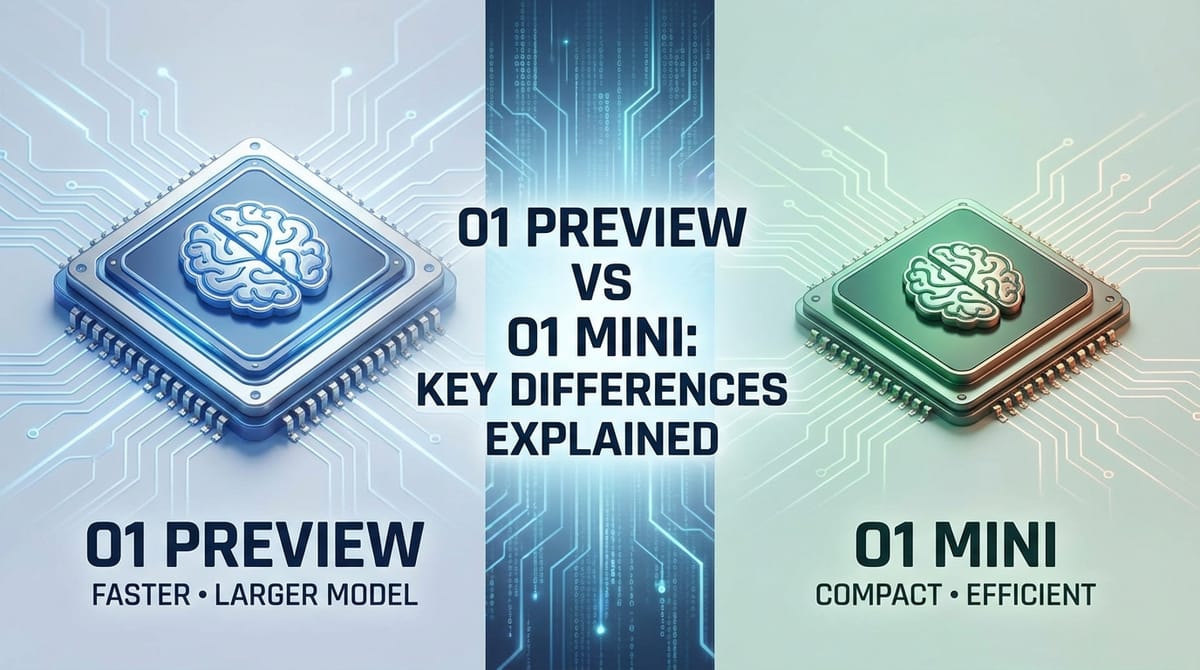

The landscape of artificial intelligence is in a perpetual state of flux, characterized by rapid innovation and the continuous emergence of new models designed to push the boundaries of what machines can achieve. From gargantuan, general-purpose models that aim for encyclopedic knowledge and reasoning to lean, specialized versions crafted for efficiency and targeted applications, the choices available to developers and businesses are more diverse than ever. In this dynamic environment, understanding the nuances between various models is not merely an academic exercise; it's a critical strategic imperative that can dictate the success or failure of AI-driven projects.
Among the latest discussions surfacing in the developer communities are comparisons between emergent or conceptual models like "O1 Preview" and "O1 Mini." While "O1 Preview" hints at a perhaps more expansive, feature-rich, or experimental iteration, "O1 Mini" suggests an optimized, streamlined counterpart, specifically engineered for agility and cost-effectiveness. This distinction mirrors a broader trend in the industry, where the pursuit of raw power is increasingly balanced by the demand for practical, deployable, and resource-efficient solutions. Simultaneously, the recent introduction of models like GPT-4o Mini by OpenAI has set a high bar for what "mini" models can achieve, particularly in multimodal capabilities and broad accessibility. This article will delve deep into the hypothetical yet highly relevant comparison of O1 Preview vs O1 Mini, drawing parallels with GPT-4o Mini to provide a comprehensive understanding of their potential roles, strengths, and ideal use cases. We will explore how these models, real or conceptual, fit into the evolving AI ecosystem, scrutinizing their design philosophies, performance profiles, economic implications, and the strategic choices they present to those looking to harness the power of AI. Our goal is to equip readers with the insights needed to navigate this complex terrain, ensuring informed decisions in an era where AI efficiency is paramount.
The Evolving AI Model Landscape: From General Giants to Specialized Sprinters
The journey of large language models (LLMs) has been nothing short of revolutionary. Initially, the focus was squarely on scale – building models with ever-increasing parameters, trained on colossal datasets, to achieve unprecedented levels of general intelligence. Models like the early GPT versions, BERT, and T5 demonstrated an astonishing ability to understand, generate, and process human language across a vast array of tasks. These early successes were driven by the "bigger is better" mantra, where more parameters often translated to superior performance on complex, multifaceted problems, showcasing emergent capabilities that were once thought to be science fiction. Researchers and developers marveled at their capacity for creative writing, sophisticated problem-solving, and nuanced comprehension. However, this pursuit of general intelligence came with significant trade-offs: exorbitant training costs, substantial computational requirements for inference, and often, noticeable latency in real-time applications. Deploying these colossal models in production environments could be a resource-intensive endeavor, both in terms of financial outlay and hardware infrastructure.
As the AI field matured, and as businesses began to integrate LLMs into their core operations, a new set of priorities emerged. While raw intelligence remained important, practicality, efficiency, and cost-effectiveness gained significant traction. Not every application requires a model that can write poetry, debug complex code, and synthesize academic papers simultaneously. Many business use cases – such as powering customer service chatbots, summarizing emails, generating marketing copy, or performing sentiment analysis – demand speed, reliability, and predictable costs more than they demand the absolute pinnacle of general reasoning. This realization fueled the rise of specialized and optimized models, often termed "mini" or "lite" versions. These models are designed to deliver strong performance on a targeted set of tasks while drastically reducing computational overhead, inference latency, and operational expenses. They represent a strategic pivot, acknowledging that "good enough" performance delivered efficiently can be far more valuable than "perfect" performance that is prohibitively expensive or slow.
The shift towards these agile contenders reflects a broader democratizing trend in AI. Smaller, more efficient models lower the barrier to entry for startups, small and medium-sized enterprises (SMEs), and individual developers who may not have the resources to deploy and maintain colossal general-purpose models. They enable the deployment of AI in edge devices, mobile applications, and environments with limited bandwidth or processing power, expanding the reach and utility of AI beyond the cloud-native, data-center-centric paradigm. Furthermore, the development of these optimized models often involves innovative architectural designs, advanced distillation techniques, and rigorous fine-tuning processes that squeeze maximum performance out of fewer parameters. This not only makes them more efficient but also drives innovation in model optimization and deployment strategies across the board.
In this context, the discussion surrounding O1 Preview vs O1 Mini becomes particularly pertinent. If O1 Preview represents the exploratory, feature-rich, or perhaps foundational model – akin to a full-fledged research project or an initial, unconstrained vision – then O1 Mini would embody the distilled essence, the production-ready iteration tailored for specific performance and economic targets. This mirrors the trajectory seen with many AI frameworks, where an ambitious initial version is later refined into more manageable, deployable variants. The entry of GPT-4o Mini into this arena further intensifies the conversation, as it provides a tangible, high-performing benchmark for what an efficient "mini" model can truly deliver. Understanding these underlying trends and the strategic rationale behind different model types is crucial for appreciating the distinct value propositions that O1 Preview, O1 Mini, and GPT-4o Mini might bring to the table. This evolving landscape underscores a fundamental truth: the future of AI isn't just about building bigger models, but about building the right models for the right jobs, optimized for both intelligence and real-world applicability.
Deep Dive into O1 Preview – The Visionary Antecedent
To fully appreciate the role and potential of O1 Mini, it's crucial to first conceptualize what an O1 Preview model might represent. If O1 Preview were to exist, it would likely embody the initial, perhaps unconstrained, vision of a powerful new AI architecture or methodology. Imagine it as the cutting-edge experimental model, designed without the immediate limitations of production cost or real-time latency as primary drivers. Instead, its raison d'être would be to push the boundaries of intelligence, explore novel capabilities, and serve as a research-oriented flagship.
Core Philosophy and Strengths:
An O1 Preview model would likely prioritize breadth of capabilities and depth of reasoning. Its architecture might be more complex, potentially featuring a larger parameter count, innovative network topologies, or advanced training paradigms designed to capture highly nuanced patterns and relationships within vast datasets. This could translate into superior performance on tasks requiring:
- Complex Problem-Solving: Tackling multi-step reasoning, logical inference, and intricate analytical challenges that demand a deep understanding of context and subtle implications. Imagine it excelling at scientific hypothesis generation, sophisticated financial modeling explanations, or legal document synthesis.
- Creative and Generative Tasks: Producing highly original, coherent, and contextually rich content across various modalities (text, code, perhaps even multimodal elements if its design allows). This could include generating nuanced prose for novels, crafting intricate musical compositions, or developing innovative design concepts based on abstract prompts. Its creative outputs would likely exhibit a higher degree of originality and less repetition compared to more constrained models.
- In-depth Analysis and Synthesis: Processing large volumes of disparate information, identifying subtle connections, and synthesizing comprehensive, insightful reports. This might involve analyzing complex medical research, dissecting market trends with granular detail, or providing strategic recommendations based on extensive data evaluation. The model's ability to cross-reference and contextualize information from diverse sources would be a hallmark.
- Research and Development: Serving as a powerful tool for AI researchers themselves, enabling them to test new hypotheses, explore emergent behaviors, and accelerate the development of future AI breakthroughs. Its "preview" designation suggests it might be a testbed for features that eventually trickle down to more optimized versions.
Potential Use Cases:
Given these strengths, O1 Preview would find its niche in demanding, high-stakes environments where accuracy, depth, and novel insights outweigh immediate cost or speed considerations. Potential applications could include:
- Advanced Scientific Research: Assisting scientists in discovering new materials, simulating complex biological processes, or interpreting astrophysical data.
- High-End Content Creation: Generating complex narratives, screenplays, or detailed technical documentation that requires a high degree of coherence and creativity.
- Strategic Business Intelligence: Providing C-suite executives with deeply analyzed market forecasts, risk assessments, and scenario planning based on extensive data.
- AI Model Prototyping and Evaluation: Acting as a foundational model for internal development teams, allowing them to benchmark new techniques or build custom solutions on top of a highly capable base.
Potential Drawbacks and Considerations:
However, the pursuit of maximum capability often comes with inherent trade-offs. The "preview" nature of such a model would likely imply certain limitations, especially when contrasted with optimized versions:
- Higher Computational Cost: A larger model with a more complex architecture would naturally demand more computational resources for both training and inference. This translates directly to higher operational expenses, making it potentially unsuitable for budget-constrained projects or high-volume, repetitive tasks.
- Increased Latency: The processing of more parameters and complex computations would likely result in longer response times. For applications requiring real-time interaction (e.g., live chatbots, voice assistants), this latency could be a significant hindrance, impacting user experience and system responsiveness.
- Resource Intensiveness: Deploying and maintaining
O1 Previewwould require robust hardware infrastructure, potentially including specialized GPUs and significant memory. This could pose challenges for deployment in edge environments or on standard cloud instances without careful resource provisioning. - Less Refined for Production: As a "preview" model, it might be less optimized for stability, robustness, or specific production workflows. It could be more prone to unexpected behaviors, require more careful prompt engineering, or lack the polished integration tools found in production-ready models. Its focus might be on raw output quality rather than seamless deployability.
- Data Scarcity for Fine-tuning: If it's a very new or proprietary architecture, the availability of fine-tuning datasets or community support might be limited, making it harder for users to tailor it to highly specific domain needs without significant internal effort.
In essence, O1 Preview would represent the ambitious, perhaps uncompromising, pursuit of AI capability. It’s the "big idea" model, designed to explore what's possible, setting the stage for future refinements and specialized iterations. Its existence would justify the development of models like O1 Mini, which would then inherit the distilled intelligence of the Preview version, repackaged for efficiency and widespread applicability, much like a concept car eventually leads to a mass-produced, market-ready vehicle. Understanding this foundational concept is key to appreciating the strategic role of its more agile counterparts.
Introducing O1 Mini – The Agile Contender
Following the potential ambitious blueprint of O1 Preview, the emergence of O1 Mini signifies a strategic shift towards practical utility, efficiency, and broad accessibility. O1 Mini would be conceived as an optimized, streamlined version, meticulously engineered to deliver robust performance for a wide array of common AI tasks, but crucially, within much tighter constraints of cost and speed. It represents the maturation of an AI vision from experimental capability to production-ready utility, addressing the pervasive demand in the market for AI solutions that are not only intelligent but also economically viable and responsive.
Core Philosophy and Strengths:
The design philosophy behind O1 Mini would revolve around distillation, optimization, and efficiency. Its developers would likely leverage advanced techniques such as knowledge distillation, quantization, and architectural pruning to achieve a significantly smaller footprint without drastically compromising core capabilities. This focus would manifest in several key strengths:
- Speed and Low Latency: For applications requiring instantaneous responses, such as real-time chatbots, voice assistants, or interactive user interfaces,
O1 Miniwould be designed to excel. Its smaller size and optimized architecture would allow for faster inference times, drastically improving user experience and system responsiveness. This low latency AI capability is often a make-or-break factor for many modern applications. - Cost-Effectiveness: With fewer parameters and reduced computational demands,
O1 Miniwould naturally incur lower inference costs. This makes it an attractive option for businesses operating on tight budgets or for applications requiring high-volume processing, where every fraction of a cent per token adds up quickly. The pursuit of cost-effective AI solutions is a driving force behind such models. - Performance on Common Tasks: While
O1 Previewmight excel at niche, highly complex tasks,O1 Miniwould be tuned to deliver excellent performance on the most frequently encountered AI tasks. This includes summarization, text generation (e.g., short articles, emails, social media posts), translation, sentiment analysis, basic question answering, and content moderation. It aims for a "sweet spot" of intelligence and efficiency. - Developer-Friendliness and Ease of Integration: A "mini" model is often designed with developers in mind. Its smaller size makes it easier to download, deploy, and integrate into existing software stacks. It might come with well-documented APIs, comprehensive SDKs, and a clear focus on ease of use, reducing the development overhead for implementing AI features.
- Resource Efficiency: Requiring less memory and fewer computational cycles,
O1 Miniwould be ideal for deployment in environments with limited resources, such as edge devices, mobile applications, or on standard virtual machines where a larger model would be impractical. This expands the potential reach of AI into new form factors and use cases.
Target Use Cases:
O1 Mini would be the workhorse for a broad spectrum of everyday AI applications across various industries:
- Customer Service & Support: Powering intelligent chatbots that can handle a high volume of routine inquiries, provide instant answers, and escalate complex issues to human agents. Its speed and cost-effectiveness would be paramount here.
- Content Generation & Marketing: Assisting marketers in generating social media captions, ad copy, email drafts, or blog outlines efficiently and at scale.
- Personalized User Experiences: Enabling personalized recommendations, dynamic content adaptation, or smart notifications in applications.
- Internal Automation: Summarizing internal reports, drafting meeting minutes, or automating routine communications within organizations.
- Education: Providing quick explanations, generating practice questions, or summarizing learning materials.
Initial Considerations for O1 Mini vs GPT-4o Context:
The arrival of GPT-4o Mini from OpenAI has set a formidable benchmark for "mini" models. When considering O1 Mini, its developers would inevitably draw comparisons to GPT-4o Mini in terms of performance, features, and pricing. While O1 Mini would strive for its own unique advantages, the competitive landscape necessitates a model that can either match or offer compelling alternatives to GPT-4o Mini's multimodal capabilities, efficiency, and widespread adoption. The challenge for O1 Mini would be to carve out its niche by potentially offering even greater specialization, superior cost-effectiveness for specific tasks, or a unique architectural advantage that yields better results in particular scenarios.
In essence, O1 Mini embodies the pragmatic evolution of AI. It acknowledges that while raw intelligence is compelling, widespread adoption hinges on accessibility, affordability, and efficient performance. It is the model designed to solve real-world problems at scale, making advanced AI capabilities available to a broader audience and driving tangible business value by optimizing for the critical metrics of speed, cost, and developer experience.
A Head-to-Head Comparison: O1 Preview vs O1 Mini
When evaluating the hypothetical O1 Preview and O1 Mini models, understanding their direct differences across various critical dimensions is paramount. While O1 Preview would likely prioritize raw capability and exploratory features, O1 Mini would be engineered for efficiency and widespread deployment. This divergence in design philosophy leads to distinct profiles that cater to different needs and use cases. Let's delineate these differences across key parameters.
Performance and Accuracy
- O1 Preview: Expected to offer state-of-the-art performance, particularly on highly complex, nuanced, or creative tasks. Its larger parameter count and potentially more intricate architecture would allow for a deeper understanding of context, more sophisticated reasoning, and a wider range of emergent capabilities. It would excel where absolute accuracy, subtlety, and originality are critical, such as generating highly coherent long-form content, performing multi-step logical inferences, or tackling open-ended research questions. Its outputs would likely exhibit greater richness and fewer factual inaccuracies on challenging queries.
- O1 Mini: Designed to provide strong, reliable performance on a broad spectrum of common tasks. While it might not match the O1 Preview's peak performance on the most esoteric or complex problems, it would offer excellent accuracy for summarization, translation, typical question-answering, sentiment analysis, and standard content generation (e.g., emails, short articles, ad copy). The focus here is on "good enough" or "very good" performance that is consistently delivered and highly efficient, rather than pushing the absolute frontier of AI capability. Its outputs would be functional and coherent, optimized for speed and cost.
Speed and Latency
- O1 Preview: Due to its larger size and computational demands,
O1 Previewwould likely exhibit higher latency. Processing more parameters and executing more complex operations inherently takes more time. This would make it less suitable for real-time interactive applications where instantaneous responses are crucial. - O1 Mini: A primary design goal for
O1 Miniwould be low latency. Its optimized architecture and smaller footprint would enable significantly faster inference times. This makes it an ideal choice for applications requiring real-time interactions, such as live chatbots, voice interfaces, or any system where quick user feedback is essential. Thelow latency AIaspect is a key differentiator.
Cost-Efficiency
- O1 Preview: Operating
O1 Previewwould likely entail higher computational costs, both in terms of GPU hours for inference and potentially higher memory requirements. This would make it a more expensive option, suitable for projects with larger budgets or where the value derived from its superior capabilities justifies the increased expenditure. - O1 Mini:
O1 Miniwould be engineered forcost-effective AI. Its reduced computational footprint directly translates to lower inference costs per query or token. This makes it highly attractive for high-volume applications, startups, or businesses looking to integrate AI without incurring prohibitive operational expenses. It broadens the accessibility of advanced AI capabilities.
Complexity of Tasks Suited For
- O1 Preview: Best suited for tasks requiring deep reasoning, advanced problem-solving, creative generation, comprehensive analysis, and handling highly unstructured or ambiguous inputs. Examples include scientific research, strategic business planning, complex legal document review, and high-fidelity content creation.
- O1 Mini: Ideally suited for focused, common AI tasks that require efficiency and reliable output. This includes basic information retrieval, content summarization, routine email drafting, customer service automation, simple code generation, and language translation. It excels at practical, everyday applications.
Fine-tuning Capabilities
- O1 Preview: As a potentially more complex model,
O1 Previewmight offer advanced fine-tuning options, allowing for highly specialized adaptations to unique datasets or domain-specific nuances. However, the process might be more resource-intensive and require deeper technical expertise. - O1 Mini:
O1 Miniwould likely be designed for easier and more efficient fine-tuning. Its smaller size means fine-tuning requires fewer computational resources and less data, making it more accessible for developers to tailor it to specific use cases without extensive overhead.
Target Audience and Use Cases
- O1 Preview: Researchers, advanced developers, enterprises with high-end AI requirements, and those pushing the boundaries of AI applications. Use cases include R&D, advanced analytics, and bespoke AI solutions.
- O1 Mini: Mainstream developers, startups, SMEs, and enterprises looking for practical, scalable, and affordable AI solutions. Use cases include customer support, marketing automation, internal tools, and general productivity enhancements.
Resource Requirements
- O1 Preview: Demands significant computational resources (high-end GPUs, substantial RAM) for efficient operation, making cloud deployment a necessity for most.
- O1 Mini: Can run efficiently on more modest hardware, including standard cloud instances, edge devices, or even some mobile platforms, significantly lowering deployment barriers.
Scalability and Production Readiness
- O1 Preview: While powerful, its resource intensity might make scaling
O1 Previewfor massive production loads challenging and expensive. Its "preview" nature might also imply less maturity for rigorous, large-scale production deployments. - O1 Mini: Designed for
high throughputand scalability in production environments. Its efficiency allows for handling a large volume of requests with consistent performance, making it highly suitable for enterprise-level applications and consumer-facing services.
This comparative overview highlights a clear divergence in purpose. O1 Preview is about exploration and maximum capability, while O1 Mini is about optimization and practical deployment. The choice between them would depend entirely on the specific requirements, constraints, and strategic objectives of a given AI project.
Table 1: O1 Preview vs O1 Mini – Feature Comparison
| Feature/Metric | O1 Preview | O1 Mini |
|---|---|---|
| Primary Goal | Pushing boundaries, deep reasoning | Efficiency, practical deployment |
| Performance Peak | State-of-the-art on complex tasks | Very good on common tasks |
| Latency | Higher | Significantly lower (Low Latency AI) |
| Cost-Efficiency | Higher operational costs | Highly cost-effective (Cost-Effective AI) |
| Task Complexity | Highly complex, creative, research-oriented | Common, repetitive, practical applications |
| Resource Intensity | High (demands powerful GPUs, ample RAM) | Low (runs on modest hardware) |
| Fine-tuning Effort | Potentially more resource-intensive | Easier, more efficient |
| Target Audience | Researchers, advanced enterprises | Mainstream developers, startups, SMEs |
| Scalability | Challenging/expensive for mass production | High throughput, easily scalable |
| Development Stage | Experimental, visionary, feature-rich | Production-ready, optimized for performance |
| Key Advantage | Unparalleled depth, novel capabilities | Speed, affordability, broad accessibility |
Understanding these distinctions is crucial, as it sets the stage for how O1 Mini would then stack up against an established and highly capable "mini" model like GPT-4o Mini. The competition in this segment is fierce, and unique differentiators will be key to market success.
XRoute is a cutting-edge unified API platform designed to streamline access to large language models (LLMs) for developers, businesses, and AI enthusiasts. By providing a single, OpenAI-compatible endpoint, XRoute.AI simplifies the integration of over 60 AI models from more than 20 active providers(including OpenAI, Anthropic, Mistral, Llama2, Google Gemini, and more), enabling seamless development of AI-driven applications, chatbots, and automated workflows.
The Elephant in the Room: GPT-4o Mini and Its Relevance
In any discussion concerning efficient and capable "mini" AI models, it's impossible to overlook GPT-4o Mini. OpenAI's GPT-4o (Omni) model, and its more streamlined GPT-4o Mini counterpart, have quickly established themselves as benchmarks for what modern AI can achieve, particularly in terms of multimodality, efficiency, and accessibility. GPT-4o Mini is not just another iterative improvement; it represents a significant leap in making sophisticated AI capabilities available at scale, serving as a direct competitor and a crucial point of comparison for any new entrant like O1 Mini.
Key Characteristics of GPT-4o Mini:
GPT-4o Mini inherits many of the groundbreaking features of its larger sibling, GPT-4o, but repackages them for optimal performance within a more constrained resource footprint. Its core characteristics include:
- Multimodal Capabilities: One of the standout features of the GPT-4o family is its inherent multimodality. This means it can process and generate content across various modalities – text, audio, and vision – seamlessly within a single model. For
GPT-4o Mini, this translates to being able to understand spoken commands, interpret images, and respond with relevant text or even synthesized speech, making it incredibly versatile for interactive and context-rich applications. This is a significant differentiator from many text-only "mini" models. - High Performance on Diverse Tasks: Despite its "mini" designation,
GPT-4o Minidelivers impressive performance across a wide range of NLP tasks. It excels at summarization, translation, code generation, creative writing, complex question-answering, and sentiment analysis. Its performance often approaches or even surpasses that of much larger, older models, demonstrating the efficacy of OpenAI's architectural and training innovations. - Exceptional Efficiency and Low Cost: A cornerstone of
GPT-4o Mini's appeal is its remarkable efficiency. It is designed to be highly cost-effective, offering lower API pricing than its more powerful predecessors like GPT-4 Turbo. This, combined with its optimized inference speed, makes it an attractive option for businesses looking to deploy advanced AI capabilities without breaking the bank. It truly embodiescost-effective AI. - Developer-Friendly Integration: OpenAI's ecosystem is renowned for its ease of use.
GPT-4o Minibenefits from well-documented APIs, extensive SDKs, and a large, supportive developer community, facilitating quick and straightforward integration into new and existing applications. - Robustness and Scalability: Backed by OpenAI's robust infrastructure,
GPT-4o Minioffers high reliability and scalability. It can handle massive volumes of requests, making it suitable for large-scale enterprise deployments and consumer-facing applications that experience fluctuating demand.
Positioning GPT-4o Mini as a Benchmark:
For a model like O1 Mini, GPT-4o Mini serves as a critical benchmark. Any new "mini" model entering the market must be able to articulate its value proposition in direct comparison to what GPT-4o Mini already offers. This includes:
- Performance Parity or Superiority: Can
O1 MinimatchGPT-4o Mini's general performance across common tasks? Or does it offer superior performance in specific niches? - Cost Advantage: Can
O1 Miniprovide a more attractive pricing model, especially for high-volume users, offering even greatercost-effective AI? - Latency Advantage: Can
O1 Miniachieve even lower latency for real-time applications, pushing the boundaries oflow latency AI? - Unique Features: Does
O1 Minioffer any unique features or architectural advantages (e.g., better fine-tuning capabilities for specific domains, inherent privacy features, open-source advantages if applicable) thatGPT-4o Minidoes not? - Multimodality: If
O1 Miniis primarily text-based, how does it compete againstGPT-4o Mini's inherent multimodality, which is increasingly becoming a standard expectation for advanced AI?
The very existence and success of GPT-4o Mini underscore the market's strong appetite for models that blend high intelligence with unparalleled efficiency. It has democratized access to advanced AI capabilities, making them accessible to a broader range of developers and businesses. Therefore, the strategic planning and positioning of O1 Mini must be done with a keen awareness of the high bar set by GPT-4o Mini, aiming to either compete head-on or carve out a specialized niche where it can demonstrate distinct advantages. The following section will directly address this crucial comparison: O1 Mini vs GPT-4o.
Table 2: Key Specifications: O1 Mini vs. GPT-4o Mini (Hypothetical Comparison)
| Feature/Metric | O1 Mini (Hypothetical) | GPT-4o Mini (Known) |
|---|---|---|
| Core Focus | Text-centric efficiency, targeted tasks | Multimodal (text, vision, audio), broad tasks |
| Performance Profile | Strong on common NLP tasks, optimized speed | Excellent across multimodal and NLP tasks |
| Cost Structure | Designed for aggressive cost-effectiveness | Highly cost-effective for its capabilities |
| Latency Metrics | Aims for ultra-low latency (Low Latency AI) |
Very low latency, especially for text |
| Multimodality | Primarily text-based (assumed for comparison) | Full multimodal capabilities |
| Key Advantages | Potentially niche specialization, hyper-efficiency | Versatility, multimodal power, established ecosystem |
| Ideal Use Cases | High-volume text automation, specific domain tasks | Interactive agents, comprehensive content creation, multimodal applications |
| Ecosystem & Support | Emerging, potentially community-driven | Extensive, robust, backed by OpenAI |
This table provides a snapshot of where O1 Mini might need to position itself to stand out in a market already graced by the formidable presence of GPT-4o Mini. The key for O1 Mini will be to demonstrate either superior efficiency for text-based tasks, a unique specialized capability, or an even more compelling cost proposition to differentiate itself effectively.
O1 Mini vs GPT-4o Mini: A Detailed Showdown
The real battleground for efficiency and effectiveness in the modern AI landscape is often found within the "mini" category. With GPT-4o Mini setting a high standard, any new contender like O1 Mini faces the challenge of carving out its own space by demonstrating compelling differentiators. This section will directly address the critical comparison of O1 Mini vs GPT-4o Mini, examining how they might stack up against each other across several vital parameters.
Architectural Philosophy
- O1 Mini (Hypothetical): The architectural philosophy of
O1 Miniwould likely emphasize extreme efficiency and possibly domain-specific optimizations. This might involve novel, compact transformer architectures, highly efficient attention mechanisms, or specialized pre-training objectives tailored for particular types of text processing. Its design might prioritize speed and minimal resource footprint above all else, potentially even sacrificing some of the broad generalization in favor of focused excellence. This could lead to a highly performant model for specific text-based tasks. - GPT-4o Mini:
GPT-4o Miniis a distilled version of theGPT-4o"Omni" model, meaning its architecture is inherently designed for multimodality from the ground up. This allows it to process text, audio, and vision within a single neural network, enabling seamless understanding and generation across these different data types. While also highly optimized for efficiency, its core design retains the ability to unify diverse inputs, making it incredibly versatile. Its efficiency comes from advanced distillation and optimization techniques applied to a fundamentally multimodal architecture.
Performance Benchmarks
- General Text-based Tasks: For common tasks like summarization, translation, basic Q&A, and sentiment analysis, both models would likely exhibit strong performance.
GPT-4o Minihas already shown it can often outperform larger, older models in these areas.O1 Miniwould need to demonstrate competitive, if not superior, accuracy and coherence, particularly if it's focusing purely on text to achieve greater optimization. - Multimodal Tasks: This is where
GPT-4o Minihas a distinct advantage. Its native multimodal architecture allows it to handle tasks that combine text with images or audio effortlessly (e.g., describing an image, transcribing speech and then answering questions about it). IfO1 Miniis primarily text-based, it would require external integrations or auxiliary models to achieve similar multimodal capabilities, adding complexity and potentially latency. - Creative and Complex Reasoning: While both are "mini" models,
GPT-4o Ministill benefits from the deep intelligence of the GPT-4o lineage, potentially offering more nuanced understanding and creative flair for more open-ended text generation tasks.O1 Minimight focus on generating functional, coherent text but might not reach the same levels of creative depth or sophisticated reasoning on highly ambiguous prompts.
Cost-Effectiveness in Practice
- O1 Mini: The ambition for
O1 Miniwould be to push the boundaries ofcost-effective AIeven further. If its architectural innovations allow for significantly fewer computational operations per token, it could potentially offer even lower API costs, making it the most budget-friendly option for extremely high-volume, repetitive text tasks. This would be a major selling point for businesses with very tight margins or massive data processing needs. - GPT-4o Mini:
GPT-4o Miniis already praised for its cost-effectiveness, offering premium capabilities at a much lower price point than previous flagship models. Its pricing structure is highly competitive, especially considering its multimodal prowess. For many users, the balance of capability and cost it offers is already compelling.
Latency Metrics
- O1 Mini: A primary goal for
O1 Miniwould be to achieve ultra-low latency AI. Its streamlined design could potentially lead to even faster inference times thanGPT-4o Mini, especially for text-only processing. This would make it exceptionally well-suited for applications where every millisecond counts, such as real-time conversational AI, gaming interactions, or high-frequency trading insights. - GPT-4o Mini:
GPT-4o Minialready boasts impressive low latency for its text capabilities, and its multimodal processing is also remarkably quick. While very fast,O1 Minimight seek to gain an edge by further optimizing for pure text speed, potentially by shedding the overhead associated with multimodal capabilities.
Developer Experience and Ecosystem
- O1 Mini: As an emerging model,
O1 Miniwould need to build its developer ecosystem. This involves providing excellent documentation, easy-to-use SDKs, and responsive community support. Its success would hinge on its ability to attract and retain developers, potentially by offering unique architectural advantages or more flexible licensing. - GPT-4o Mini: Benefits from OpenAI's mature and extensive ecosystem. Developers are familiar with OpenAI's APIs, and there's a vast community providing examples, tutorials, and integrations. This established infrastructure significantly lowers the barrier to entry for developers and ensures robust support.
Scalability for Enterprise Solutions
- O1 Mini: With a focus on efficiency,
O1 Miniwould be designed forhigh throughputand robust scalability. Its lower resource demands would make it easier and more affordable to scale across numerous instances, handling peak loads efficiently for enterprise-level applications. - GPT-4o Mini: OpenAI's infrastructure is built for enterprise-grade scalability, and
GPT-4o Minileverages this. It can reliably handle large volumes of requests, making it a dependable choice for mission-critical applications that require consistent performance under heavy load.
The showdown between O1 Mini and GPT-4o Mini is less about one being unequivocally "better" than the other, and more about strategic specialization. GPT-4o Mini offers an incredibly versatile and powerful multimodal package at a highly competitive price, making it a strong general-purpose "mini" model. O1 Mini, on the other hand, might succeed by pushing the boundaries of low latency AI and cost-effective AI for purely text-based tasks, potentially offering even greater efficiency or unique domain-specific advantages that justify its adoption over a multimodal powerhouse. The choice will ultimately depend on the specific needs of the project, weighing the value of multimodality against potential gains in pure text efficiency and cost.
Strategic Implementation: Choosing the Right O1 Model (or GPT-4o Mini)
The proliferation of advanced AI models, each with its unique strengths and trade-offs, presents both opportunities and challenges for developers and businesses. The decision of whether to opt for an O1 Preview-like model, an O1 Mini-like model, or the well-established GPT-4o Mini requires a strategic framework that considers various project-specific factors. This isn't a one-size-fits-all decision; rather, it’s about aligning the AI model's capabilities with the specific needs, constraints, and long-term vision of an application.
Key Factors to Consider in Model Selection:
- Project Scope and Complexity:
- High Complexity/Research-Oriented: If your project involves cutting-edge research, requires deep, multi-step reasoning, or aims for highly original creative outputs (e.g., generating novel scientific hypotheses, complex code debugging, or artistic compositions), an
O1 Preview-like model would be the logical choice. Its superior capabilities, breadth of knowledge, and potential for emergent behavior would justify its higher cost and latency. - Common Tasks/Production-Ready: For applications focused on routine tasks like customer support chatbots, content summarization, or quick translation,
O1 MiniorGPT-4o Miniwould be more appropriate. Their efficiency and optimized performance for these common tasks make them ideal production workhorses.
- High Complexity/Research-Oriented: If your project involves cutting-edge research, requires deep, multi-step reasoning, or aims for highly original creative outputs (e.g., generating novel scientific hypotheses, complex code debugging, or artistic compositions), an
- Budget and Cost Sensitivity:
- Budget-Constrained/High Volume: If
cost-effective AIis a paramount concern, especially for applications expecting high query volumes, thenO1 Miniwould be a strong contender, potentially offering the most aggressive pricing for text-based tasks.GPT-4o Minialso provides excellent value for its capabilities and is highly cost-efficient. - Flexible Budget/Value-Driven: Projects where the value of unparalleled accuracy, complexity handling, or multimodal capabilities outweighs higher costs might consider
GPT-4o Minior even anO1 Preview-like model.
- Budget-Constrained/High Volume: If
- Latency Requirements:
- Real-time Interactions: For applications requiring instantaneous responses (e.g., live voice assistants, interactive gaming, real-time code suggestions), models optimized for
low latency AIare essential. This points strongly towardsO1 MiniorGPT-4o Mini, withO1 Minipotentially offering an edge for pure text speed if its architecture is highly streamlined. - Asynchronous Processing: For tasks that don't require immediate feedback (e.g., batch processing of documents, overnight report generation), latency is less of a concern, making
O1 Preview-like models more viable.
- Real-time Interactions: For applications requiring instantaneous responses (e.g., live voice assistants, interactive gaming, real-time code suggestions), models optimized for
- Specific Task Modality:
- Multimodal Needs: If your application requires seamless processing and generation across text, images, and audio,
GPT-4o Ministands out as the clear choice due to its native multimodal architecture. It simplifies development by providing a single endpoint for diverse inputs. - Pure Text-based: If your application is exclusively text-based, then the choice between
O1 MiniandGPT-4o Mininarrows down to performance, cost, and latency optimizations within the text domain.O1 Minimight offer a specialized advantage here.
- Multimodal Needs: If your application requires seamless processing and generation across text, images, and audio,
- Fine-tuning and Customization:
- Extensive Customization: If your project requires extensive fine-tuning on highly specific, proprietary datasets to achieve niche performance, consider which model offers the most flexible and resource-efficient fine-tuning process. Smaller models like
O1 MiniandGPT-4o Minigenerally require fewer resources for fine-tuning. - Out-of-the-box Performance: For many applications, the base model's performance out-of-the-box is sufficient, reducing the need for intensive fine-tuning.
- Extensive Customization: If your project requires extensive fine-tuning on highly specific, proprietary datasets to achieve niche performance, consider which model offers the most flexible and resource-efficient fine-tuning process. Smaller models like
- Ecosystem, Support, and Community:
- Established Ecosystem:
GPT-4o Minibenefits from OpenAI's mature ecosystem, extensive documentation, and a large developer community, providing robust support and ready-made integrations. - Emerging Ecosystem:
O1 Mini, as a newer or hypothetical model, would require you to consider its developer support, community, and the ease with which it integrates into your existing tech stack.
- Established Ecosystem:
When to Choose Each Model:
- Choose O1 Preview (or a similar research-grade model) if:
- Your project is exploratory, pushing the boundaries of AI capabilities.
- You require the absolute highest level of accuracy, depth of reasoning, or creative originality.
- Budget and latency are secondary concerns to raw computational power and insight.
- You are building foundational AI components or conducting advanced R&D.
- Choose O1 Mini (Hypothetical) if:
- You prioritize extreme
low latency AIandcost-effective AIfor text-based tasks. - Your application demands high throughput and seamless scalability for common NLP tasks.
- You are primarily working with text and do not require multimodal capabilities.
- You are looking for a highly optimized, lean model that can run efficiently on constrained resources or for high-volume, repetitive operations.
- You are willing to explore potentially newer ecosystems for specialized performance.
- You prioritize extreme
- Choose GPT-4o Mini if:
- Your application requires versatile multimodal capabilities (text, vision, audio) within a single model.
- You need excellent general performance across a wide range of common AI tasks at a highly competitive price.
- You value a mature, well-supported ecosystem with extensive documentation and community resources.
- You require robust scalability and reliability for enterprise-grade applications, balancing strong capabilities with efficiency.
- You are comfortable with a closed-source model and its associated API usage.
The strategic implementation hinges on a clear understanding of your project's specific needs. By carefully evaluating these factors, businesses and developers can make informed decisions, ensuring they harness the most suitable AI model to achieve their objectives efficiently and effectively, whether it's the exploratory power of O1 Preview, the agile efficiency of O1 Mini, or the versatile robustness of GPT-4o Mini.
The Broader Impact on AI Development
The emergence and ongoing refinement of diverse AI models, particularly the growing category of efficient "mini" models like O1 Mini and GPT-4o Mini, represent a profound shift in the trajectory of AI development. This evolution extends beyond mere technological advancements; it has significant implications for how AI is conceived, built, deployed, and ultimately utilized across industries and by individuals. The trend towards specialized, optimized, and cost-effective AI is not just about incremental improvements; it’s about fundamentally reshaping the accessibility and practical applicability of artificial intelligence.
Democratization of AI: One of the most significant impacts is the accelerating democratization of AI. Historically, access to cutting-edge AI capabilities was largely confined to well-funded research institutions and large tech giants, due to the immense computational resources and expertise required. O1 Mini and GPT-4o Mini, by making sophisticated AI more affordable and easier to deploy, are effectively lowering the barrier to entry. Startups, small and medium-sized enterprises (SMEs), and even independent developers can now integrate powerful AI features into their products and services without incurring prohibitive costs or needing to manage vast, complex infrastructure. This widespread access fosters a more vibrant and diverse ecosystem of innovation, leading to a broader array of AI-powered applications that cater to a wider range of needs and niche markets. The ability to leverage cost-effective AI means more ideas can be prototyped and brought to market, driving economic growth and technological advancement from the ground up.
Push for Efficiency and Innovation: The competitive landscape, especially between models like O1 Mini vs GPT-4o Mini, forces continuous innovation in efficiency. Developers are compelled to explore novel architectural designs, advanced compression techniques, and more optimized training methodologies to squeeze maximum performance out of minimal resources. This focus on low latency AI and high throughput is not just about making models smaller; it's about making them smarter in how they utilize computational power. This ongoing pursuit of efficiency benefits the entire AI field, pushing the boundaries of what's possible with constrained resources and paving the way for AI to be deployed in new, previously inaccessible environments, such as edge devices and mobile applications.
Specialization and Domain-Specific AI: The "mini" trend also encourages greater specialization. Instead of striving for a single, monolithic general intelligence, developers are increasingly building models tailored for specific domains or tasks. While GPT-4o Mini offers broad versatility, the potential for an O1 Mini-like model to provide superior performance or cost-efficiency for a very particular text task (e.g., legal document summarization, medical transcript analysis) highlights this shift. This allows for the creation of highly performant, precise, and contextually aware AI solutions that can outperform general-purpose models in their niche. This focus on domain-specific AI leads to more accurate, reliable, and trustworthy applications in critical sectors.
Simplification of AI Integration: The proliferation of diverse models, however, can also introduce complexity for developers. Managing multiple API connections, navigating different pricing structures, and optimizing for various model endpoints can become a significant overhead. In this fragmented yet exciting landscape, platforms like XRoute.AI emerge as critical enablers. XRoute.AI, a cutting-edge unified API platform, is designed to streamline access to a vast array of large language models (LLMs), including those like GPT-4o Mini and potentially future optimized models like O1 Mini. By offering a single, OpenAI-compatible endpoint, it simplifies integration for developers, providing crucial tools for achieving low latency AI and cost-effective AI solutions without the overhead of managing numerous API connections. This strategic approach empowers users to leverage the strengths of various models, whether it’s the nuanced power of an O1 Preview-like model for exploration or the agile efficiency of an O1 Mini-like model for production, all while optimizing for high throughput and scalability. XRoute.AI's focus on developer-friendly tools, combined with its flexible pricing and ability to route requests to the best-performing or most cost-efficient model in real-time, is invaluable in making the promise of diverse AI models a practical reality for businesses and developers alike.
Ethical Considerations and Responsible AI: As AI becomes more ubiquitous, the development of diverse models also brings ethical considerations to the forefront. Optimized models still need rigorous evaluation for biases, fairness, and transparency. The ease of deployment of "mini" models means that these ethical considerations become even more critical, as biased models can propagate misinformation or unfair decisions at scale. Therefore, the broader impact also includes a reinforced emphasis on responsible AI development, ensuring that these powerful tools are used for societal benefit.
In conclusion, the dynamic interplay between models like O1 Preview, O1 Mini, and GPT-4o Mini underscores a transformative era in AI. It signals a move towards an ecosystem where intelligence is not just about raw power but also about nuanced efficiency, specialized utility, and broad accessibility. This evolution is democratizing AI, fostering unprecedented innovation, and enabling a future where intelligent applications are integrated seamlessly into every facet of our lives, made possible by platforms that intelligently manage this growing complexity.
Conclusion
The journey through the hypothetical comparison of O1 Preview vs O1 Mini, contextualized against the formidable GPT-4o Mini, illuminates the strategic complexities and exciting opportunities within the rapidly evolving AI landscape. We've seen that O1 Preview would likely represent the vanguard of AI research – a model pushing the boundaries of intelligence, depth, and creative capability, albeit with higher resource demands and latency. Its purpose would be to explore the limits of what AI can achieve, paving the way for future innovations.
In contrast, O1 Mini emerges as the embodiment of practical efficiency. Conceived as a streamlined, optimized version, its core strengths would lie in delivering low latency AI and cost-effective AI for a wide array of common, production-ready tasks. Its focus on speed, affordability, and developer-friendliness positions it as a workhorse for businesses and developers seeking to integrate AI without prohibitive overheads.
The pivotal comparison of O1 Mini vs GPT-4o Mini highlights the intense competition in the "mini" model category. GPT-4o Mini has set a high benchmark with its powerful multimodal capabilities, impressive efficiency, and robust ecosystem, making it a highly versatile and accessible option. For O1 Mini to truly differentiate itself, it would need to offer a compelling edge in areas such as ultra-low latency for pure text, even greater cost-effectiveness for specific tasks, or unique domain specialization that surpasses its established competitor.
Ultimately, the choice among these models is not about identifying a single "best" solution, but rather about making an informed, strategic decision tailored to specific project requirements. Factors such as project scope, budget, latency sensitivity, multimodal needs, and the existing developer ecosystem all play crucial roles in determining which model will yield the most effective and efficient outcomes.
The broader impact of these diverse AI models is profound. They are democratizing access to advanced AI, fostering innovation in efficiency, and driving the development of specialized, domain-specific solutions. This complex but opportunity-rich environment underscores the critical need for platforms that can simplify AI integration. Platforms like XRoute.AI, by providing a unified API for a multitude of large language models, stand as essential tools for navigating this landscape. They empower developers to seamlessly leverage the unique strengths of models like GPT-4o Mini or a hypothetical O1 Mini, optimizing for low latency AI, cost-effective AI, and high throughput, thus accelerating the deployment of intelligent applications across all sectors.
As AI continues to evolve, the trend towards optimized, accessible, and purpose-built models will only intensify. Understanding the distinct value propositions of each model, from the visionary O1 Preview to the agile O1 Mini and the versatile GPT-4o Mini, will be key to unlocking the full potential of artificial intelligence in an increasingly intelligent world.
Frequently Asked Questions (FAQ)
Q1: What is the primary difference between O1 Preview and O1 Mini?
A1: The primary difference lies in their design philosophy and intended use. O1 Preview (hypothetically) would be a more expansive, feature-rich, or experimental model, prioritizing advanced capabilities, deep reasoning, and complex problem-solving. It would likely have higher resource demands and latency. O1 Mini, on the other hand, would be an optimized, streamlined version focused on efficiency, low latency AI, and cost-effective AI for common, practical tasks. It would be smaller, faster, and more affordable to operate.
Q2: How does O1 Mini compare to GPT-4o Mini?
A2: Both O1 Mini (hypothetical) and GPT-4o Mini are designed for efficiency and common AI tasks. However, GPT-4o Mini from OpenAI is a formidable benchmark, offering strong performance across multimodal inputs (text, vision, audio) with excellent cost-effective AI and low latency AI. O1 Mini would likely differentiate itself by potentially offering even greater efficiency or specialization for purely text-based tasks, possibly achieving even lower latency or a more aggressive cost structure in that specific domain. The key distinction would likely be GPT-4o Mini's inherent multimodality versus O1 Mini's potential text-centric hyper-efficiency.
Q3: Why would a developer choose a "mini" model over a larger, more powerful one?
A3: Developers choose "mini" models primarily for their efficiency, speed, and cost-effectiveness. Larger models, while powerful, often incur higher inference costs and suffer from increased latency, making them impractical for high-volume or real-time applications. "Mini" models, like O1 Mini or GPT-4o Mini, provide a sweet spot of strong performance for common tasks, significantly reduced operational costs (i.e., cost-effective AI), and much faster response times (i.e., low latency AI), making them ideal for production environments and scaling applications.
Q4: In what scenarios would O1 Mini be the ideal choice?
A4: O1 Mini would be the ideal choice for applications that demand extreme low latency AI and cost-effective AI for high-volume, text-based tasks. This includes real-time customer service chatbots, efficient content summarization, rapid email generation, sentiment analysis, or any scenario where speed, affordability, and high throughput for textual processing are paramount, and multimodal capabilities are not a primary requirement.
Q5: How can developers manage multiple AI models like O1 Mini and GPT-4o Mini efficiently?
A5: Managing multiple AI models, each with different APIs and pricing, can be complex. Platforms like XRoute.AI are specifically designed to simplify this. XRoute.AI offers a unified API platform that provides a single, OpenAI-compatible endpoint to access over 60 AI models from more than 20 providers. This streamlines integration, enables real-time routing to the most cost-effective or highest-performing model, and helps achieve optimal low latency AI and cost-effective AI solutions without the need to manage individual API connections.
🚀You can securely and efficiently connect to thousands of data sources with XRoute in just two steps:
Step 1: Create Your API Key
To start using XRoute.AI, the first step is to create an account and generate your XRoute API KEY. This key unlocks access to the platform’s unified API interface, allowing you to connect to a vast ecosystem of large language models with minimal setup.
Here’s how to do it: 1. Visit https://xroute.ai/ and sign up for a free account. 2. Upon registration, explore the platform. 3. Navigate to the user dashboard and generate your XRoute API KEY.
This process takes less than a minute, and your API key will serve as the gateway to XRoute.AI’s robust developer tools, enabling seamless integration with LLM APIs for your projects.
Step 2: Select a Model and Make API Calls
Once you have your XRoute API KEY, you can select from over 60 large language models available on XRoute.AI and start making API calls. The platform’s OpenAI-compatible endpoint ensures that you can easily integrate models into your applications using just a few lines of code.
Here’s a sample configuration to call an LLM:
curl --location 'https://api.xroute.ai/openai/v1/chat/completions' \
--header 'Authorization: Bearer $apikey' \
--header 'Content-Type: application/json' \
--data '{
    "model": "gpt-5",
    "messages": [
        {
            "content": "Your text prompt here",
            "role": "user"
        }
    ]
}'
With this setup, your application can instantly connect to XRoute.AI’s unified API platform, leveraging low latency AI and high throughput (handling 891.82K tokens per month globally). XRoute.AI manages provider routing, load balancing, and failover, ensuring reliable performance for real-time applications like chatbots, data analysis tools, or automated workflows. You can also purchase additional API credits to scale your usage as needed, making it a cost-effective AI solution for projects of all sizes.
Note: Explore the documentation on https://xroute.ai/ for model-specific details, SDKs, and open-source examples to accelerate your development.