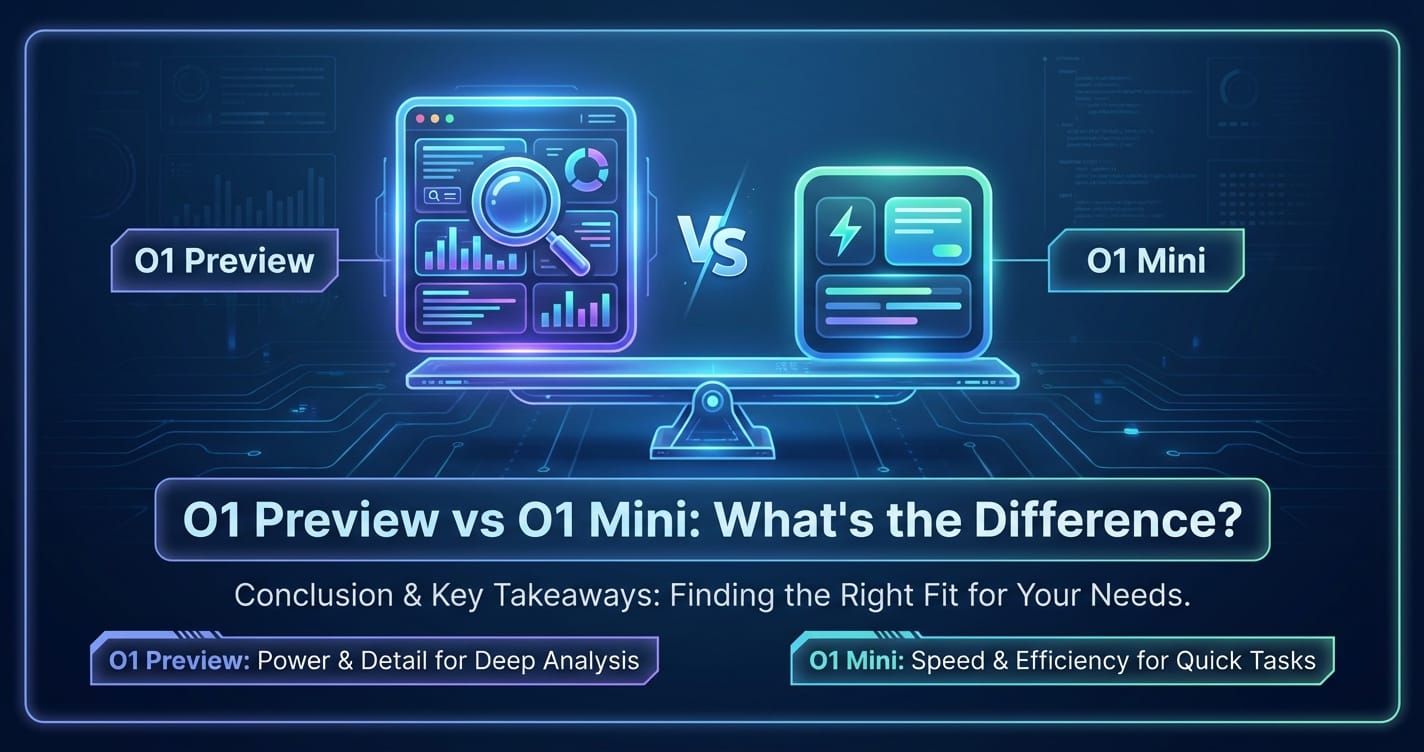
O1 Preview vs O1 Mini: What's the Difference?

The landscape of Artificial Intelligence (AI) is evolving at an unprecedented pace, marked by a continuous push towards models that are not only more capable but also more efficient, accessible, and specialized. In this dynamic environment, developers and businesses are constantly on the lookout for tools that can provide a competitive edge, whether through cutting-edge performance or optimized resource utilization. This relentless innovation has given rise to a new lexicon of model offerings, including "Preview" versions and "Mini" variants, each designed to serve distinct purposes within the development lifecycle and application ecosystem.
Amidst this backdrop, two emerging (or perhaps hypothetical, representing a growing trend) models, O1 Preview and O1 Mini, are generating significant buzz. Their names alone suggest a dichotomy: one hinting at an early, comprehensive look into advanced capabilities, and the other promising a streamlined, optimized experience. To truly appreciate their potential impact, it's crucial to understand their individual philosophies and how they stack up against each other, as well as against established benchmarks like GPT-4o Mini. This article delves deep into the O1 Preview vs O1 Mini debate, dissecting their features, performance characteristics, ideal use cases, and ultimately, guiding you through the strategic decisions involved in choosing the right model for your specific needs. We'll also place them in context with the formidable GPT-4o Mini, offering a comprehensive analysis that informs your AI strategy.
The Evolving Paradigm: Why Specialized AI Models Matter
For a long time, the quest in AI development was largely about scaling models to unprecedented sizes, yielding increasingly powerful and generalized capabilities. Models like GPT-3, GPT-4, and their counterparts demonstrated incredible versatility, capable of handling a vast array of tasks from natural language understanding and generation to code synthesis and complex reasoning. However, this pursuit of generality often comes with significant tradeoffs: colossal computational requirements, higher inference costs, and sometimes, slower response times.
Recognizing these limitations, the industry has begun to pivot towards more specialized and optimized models. This shift is driven by several factors:
- Cost Efficiency: Running large, generalized models for every task can quickly become prohibitively expensive, especially for applications requiring high throughput or frequent API calls. "Mini" models are specifically engineered to reduce these operational costs.
- Performance Optimization: For real-time applications or scenarios where latency is critical, smaller models often offer faster inference speeds without sacrificing too much on accuracy for specific tasks.
- Resource Constraints: Not every deployment environment can accommodate massive models. Edge devices, mobile applications, or constrained cloud environments benefit immensely from compact, efficient models.
- Targeted Capabilities: Many applications only require a subset of an LLM's full capabilities. A "mini" model can be fine-tuned or designed from the ground up to excel at these specific tasks, often outperforming a generalist model on those particular benchmarks.
- Developer Agility: Simpler, more focused models can be easier to integrate, test, and maintain, accelerating the development cycle.
- Innovation and Feedback: "Preview" models serve as vital feedback loops, allowing developers to experiment with cutting-edge features and provide input that shapes the final product.
This industry trend sets the stage for understanding the distinct roles that O1 Preview and O1 Mini are poised to play, each addressing a unique facet of the modern AI development challenge.
Unveiling O1 Preview: A Glimpse into the Bleeding Edge
The term "Preview" in software and AI development typically signifies an early-access version of a product or model, offered to a select group of developers or a broader public for testing and feedback before a general release. O1 Preview, therefore, can be conceptualized as a cutting-edge iteration of a foundational AI model, representing the latest advancements and experimental features that the O1 family of models has to offer.
What is O1 Preview?
O1 Preview is likely designed to be the "canary in the coal mine" – a pre-release version that showcases the maximum potential and breadth of capabilities inherent in the O1 architecture. It's not necessarily optimized for cost or speed in the same way a "Mini" model would be, but rather for pushing the boundaries of what's possible. It might feature:
- Expanded Context Windows: Allowing for processing and understanding much longer pieces of text or complex dialogues.
- Enhanced Multimodality: Incorporating advanced capabilities beyond text, such as sophisticated image understanding, audio processing, or even video analysis.
- Novel Reasoning Abilities: Demonstrating improvements in logical inference, problem-solving, and complex decision-making.
- Experimental Features: Incorporating new architectural improvements, training methodologies, or interaction paradigms that are still under active development.
- Broader Generalization: Aiming to handle an even wider array of tasks with higher accuracy and nuance than previous iterations.
Key Characteristics of O1 Preview
- Bleeding-Edge Capabilities: The primary allure of O1 Preview lies in its potential to offer features that are not yet stable or widely available in production models. This could include novel instruction following, deeper contextual understanding, or advanced creative generation.
- Higher Resource Demands: Given its likely focus on pushing boundaries, O1 Preview would naturally demand more computational resources (GPU, memory) during inference. This translates to potentially higher operational costs and slower response times compared to optimized models.
- Potential Instability/Changes: As a preview version, it is inherently subject to frequent updates, API changes, or even occasional performance fluctuations. Developers must be prepared for breaking changes and active development cycles.
- Limited Availability/Access: Access might initially be restricted to specific developer programs, early adopters, or enterprise partners who are willing to provide detailed feedback.
- Comprehensive Feature Set: Unlike "mini" versions that often pare down features for efficiency, O1 Preview would aim to present the full suite of capabilities that the O1 family intends to offer in its most capable form.
Ideal Use Cases for O1 Preview
O1 Preview is not designed for every application. Its sweet spot lies in scenarios where:
- Research and Development: Academic institutions, AI research labs, and corporate R&D departments can leverage O1 Preview to explore new AI paradigms, test novel hypotheses, and develop groundbreaking applications.
- Early Product Prototyping: Companies looking to build next-generation products that rely on advanced AI capabilities can use O1 Preview to rapidly prototype features that will eventually be powered by stable O1 models.
- Benchmarking and Evaluation: Developers can use O1 Preview to benchmark their existing systems against state-of-the-art capabilities, understanding the gap and identifying areas for improvement.
- Content Generation Requiring High Nuance: For creative industries requiring highly sophisticated and nuanced content generation (e.g., complex narratives, sophisticated marketing copy, detailed technical documentation).
- Complex Problem Solving: Applications that involve multi-step reasoning, intricate data analysis, or dynamic decision-making processes.
Advantages and Disadvantages of O1 Preview
| Aspect | Advantages | Disadvantages |
|---|---|---|
| Capabilities | Access to cutting-edge features, potentially higher accuracy for complex tasks. | May include experimental features that are not fully robust. |
| Innovation | Opportunity to build truly novel applications, influence future model development. | Requires continuous adaptation to evolving APIs and model behavior. |
| Cost | Provides a benchmark for future cost-performance targets. | Likely higher per-token or per-query cost due to resource demands. |
| Speed/Latency | Not its primary focus, but can provide insights into theoretical maximums. | Potentially slower inference speeds, not ideal for real-time applications. |
| Stability | None | Subject to frequent updates, breaking changes, and potential instability. |
| Integration | Offers a glimpse into future integration paradigms. | May require more complex integration due to evolving APIs and limited documentation. |
| Support | Often comes with direct channels for feedback to the model developers. | Community support might be nascent; reliance on official channels is higher. |
| Use Cases | R&D, advanced prototyping, high-complexity tasks. | Not suitable for production environments requiring high stability and low cost. |
In essence, O1 Preview is for the pioneers, those willing to navigate the frontier of AI in exchange for a first look at what tomorrow's technology holds.
Introducing O1 Mini: The Compact Powerhouse for Efficiency
Where O1 Preview aims for the expansive and experimental, O1 Mini targets precision, efficiency, and accessibility. The "Mini" designation, popularized by models like GPT-3.5 Turbo and more recently GPT-4o Mini, signals a version of a larger model that has been rigorously optimized for a specific set of criteria – typically cost, speed, and size – while retaining a significant portion of its parent model's core capabilities.
What is O1 Mini?
O1 Mini is likely a streamlined, production-ready model derived from the same underlying O1 architecture as its "Preview" counterpart, but with a strong emphasis on practical deployment. It's engineered to deliver robust performance for common tasks without the overhead associated with the most expansive general-purpose models. Key characteristics would include:
- Optimized Performance: Fine-tuned for speed and cost-effectiveness, making it suitable for high-volume applications.
- Specific Task Focus: While still general-purpose, it might be particularly strong on tasks like summarization, translation, classification, or conversational AI, where prompt engineering can yield excellent results.
- Reduced Footprint: Smaller parameter count or more efficient architecture, allowing for easier deployment and lower computational resource usage.
- Stable API: Designed for stability and reliability, ensuring consistent performance in production environments.
- Competitive Pricing: Positioned to offer an attractive price-to-performance ratio, making advanced AI more accessible.
Key Characteristics of O1 Mini
- Efficiency First: The paramount goal of O1 Mini is to achieve maximum utility with minimal resource consumption. This translates to lower inference costs per token or per query and faster response times.
- Balanced Capability: While not as all-encompassing as a "Preview" or a full-scale model, O1 Mini would possess a highly competent set of capabilities for a wide range of common LLM tasks, often sufficient for 80-90% of typical application needs.
- Production-Ready Stability: Developers can rely on O1 Mini for consistent behavior, stable APIs, and predictable performance, critical for building robust applications that serve end-users.
- Broader Accessibility: Due to its lower cost and higher efficiency, O1 Mini is likely to be much more broadly available and suitable for a wider range of businesses and developers, from startups to large enterprises.
- Simplified Integration: With stable APIs and good documentation, O1 Mini would be easier to integrate into existing workflows and applications.
Ideal Use Cases for O1 Mini
O1 Mini shines in scenarios where efficiency, cost-effectiveness, and speed are paramount, and where the tasks are well-defined but still benefit from LLM intelligence:
- Chatbots and Conversational AI: Powering customer service bots, virtual assistants, and interactive dialogue systems that require quick, coherent responses.
- Content Summarization: Automatically distilling long articles, reports, or meeting transcripts into concise summaries.
- Translation Services: Providing fast and accurate translations for a variety of languages in real-time.
- Data Extraction and Classification: Automatically pulling specific information from unstructured text or categorizing content based on predefined criteria.
- Automated Email/Message Generation: Drafting responses, generating personalized communications, or automating routine correspondence.
- Code Generation and Debugging Assistance: Providing intelligent suggestions, completing code snippets, or helping identify errors in programming tasks.
- Search and Recommendation Engines: Enhancing relevance and personalization in search results and content recommendations.
Advantages and Disadvantages of O1 Mini
| Aspect | Advantages | Disadvantages |
|---|---|---|
| Capabilities | Strong performance on common tasks, reliable for specific use cases. | May lack the nuanced understanding or advanced reasoning of larger models for highly complex, open-ended problems. |
| Innovation | None | Not designed for bleeding-edge research; focus is on practical application. |
| Cost | Highly cost-effective, significantly lower per-token/per-query pricing. | Still incurs costs, careful management required for very high-volume scenarios. |
| Speed/Latency | Excellent inference speeds, ideal for real-time and high-throughput applications. | May still have some latency for ultra-low latency requirements compared to specialized hard-coded solutions. |
| Stability | High stability, reliable for production deployments. | Features are more static, less frequent updates once stable. |
| Integration | Straightforward integration with well-documented, stable APIs. | May require specific prompt engineering to maximize performance for complex tasks. |
| Support | Strong community and official support for production issues. | None |
| Use Cases | Production-ready applications, high-volume tasks, cost-sensitive projects. | Less suitable for experimental AI or tasks requiring cutting-edge, unexplored capabilities. |
O1 Mini is for the pragmatists – those who need robust, reliable, and affordable AI capabilities to build scalable, production-grade applications today.
The Head-to-Head: O1 Preview vs O1 Mini
Now that we've explored each model individually, let's put them side-by-side to understand their direct differences and how these impact practical decision-making. The comparison highlights a fundamental trade-off between leading-edge capability and production-ready efficiency.
Performance and Accuracy
- O1 Preview: Likely to exhibit superior performance on highly complex, nuanced, or open-ended tasks. Its larger size and more experimental architecture might allow for deeper contextual understanding, more creative outputs, and stronger reasoning. However, this could come with higher variability in performance due to its "preview" nature.
- O1 Mini: Engineered for optimized performance on common, well-defined tasks. It aims for high accuracy within its specific scope but might struggle with highly abstract, novel, or extremely complex requests that require broader world knowledge or deeper inferential capabilities. Its performance, however, will be more consistent and predictable.
Speed and Latency
- O1 Preview: Given its probable larger size and potentially less optimized computational graphs, O1 Preview would likely have higher latency and slower inference speeds. It's not built for instantaneous responses in high-throughput scenarios.
- O1 Mini: Designed specifically for speed and low latency. Its optimized architecture and smaller parameter count enable much faster token generation and quicker API response times, making it ideal for real-time applications like chatbots or interactive tools.
Cost-Effectiveness
- O1 Preview: Running O1 Preview would almost certainly be more expensive per token or per API call. The cost reflects the extensive resources required to develop and operate such a cutting-edge, large-scale model, as well as its experimental nature.
- O1 Mini: A major selling point of O1 Mini would be its cost-effectiveness. By trimming down unnecessary complexity and optimizing for specific tasks, it offers a significantly lower price point, making advanced AI economically viable for a much wider range of applications and budgets.
Feature Set and Flexibility
- O1 Preview: Expected to boast a comprehensive and potentially multimodal feature set, showcasing all the cutting-edge capabilities the O1 family can offer. This provides maximum flexibility for exploratory development.
- O1 Mini: Will have a more focused feature set, optimized for common text-based tasks (and perhaps basic multimodality like image input, but likely less sophisticated than Preview). Its flexibility comes from its ability to be integrated into diverse production environments reliably.
Stability and Reliability
- O1 Preview: Inherently less stable. Developers should anticipate frequent updates, potential API changes, and occasional performance shifts. It’s not recommended for mission-critical production systems.
- O1 Mini: Built for stability and reliability. It would undergo rigorous testing to ensure consistent performance, uptime, and API compatibility, making it suitable for production deployments.
Target Audience and Use Case Suitability
- O1 Preview: Primarily targets researchers, AI innovators, R&D departments, and early-adopter product teams who are exploring the frontier of AI capabilities and are willing to tolerate instability for access to the latest advancements.
- O1 Mini: Caters to developers and businesses focused on building scalable, cost-efficient, and performant AI applications for end-users. This includes product managers, software engineers, and small to large enterprises needing reliable AI for day-to-day operations.
Here's a tabular summary of the key distinctions between O1 Preview and O1 Mini:
Table 1: Feature Comparison: O1 Preview vs O1 Mini
| Feature | O1 Preview | O1 Mini |
|---|---|---|
| Primary Goal | Showcasing bleeding-edge capabilities, R&D, feedback. | Optimized for efficiency, cost, speed, production deployment. |
| Capabilities | Expansive, potentially multimodal, highly nuanced, experimental. | Focused, highly competent on common tasks, reliable. |
| Performance | Potentially higher on complex tasks, but variable. | High accuracy and consistency for defined tasks. |
| Speed/Latency | Slower inference, higher latency. | Fast inference, low latency, real-time capable. |
| Cost | Higher per-token/per-query cost. | Significantly lower per-token/per-query cost. |
| Stability | Lower (subject to change, updates, instability). | High (production-ready, stable API). |
| Resource Needs | High computational resources. | Lower computational resources. |
| Target Users | Researchers, innovators, early adopters, R&D. | Developers, product teams, businesses needing scalable AI. |
| Ideal Use Cases | Advanced prototyping, scientific research, cutting-edge exploration. | Chatbots, summarization, translation, code assist, data extraction. |
The choice between O1 Preview and O1 Mini hinges entirely on your project's objectives. Are you exploring the future or building for the present?
XRoute is a cutting-edge unified API platform designed to streamline access to large language models (LLMs) for developers, businesses, and AI enthusiasts. By providing a single, OpenAI-compatible endpoint, XRoute.AI simplifies the integration of over 60 AI models from more than 20 active providers(including OpenAI, Anthropic, Mistral, Llama2, Google Gemini, and more), enabling seamless development of AI-driven applications, chatbots, and automated workflows.
O1 Mini vs GPT-4o Mini: A New Contender Enters the Ring
The discussion of "Mini" models in AI would be incomplete without acknowledging the formidable presence of OpenAI's offerings, particularly the recently introduced GPT-4o Mini. GPT-4o Mini, as a highly anticipated and robust "mini" version of the flagship GPT-4o model, sets a high bar for performance, cost-effectiveness, and versatility within its category. Therefore, understanding how O1 Mini positions itself relative to GPT-4o Mini is critical for any developer making strategic model choices.
GPT-4o Mini as a Benchmark
GPT-4o Mini benefits from:
- OpenAI's Extensive Research: Leveraging years of large-scale model development and fine-tuning.
- Broad Multimodal Capabilities: Inheriting some of the impressive text, vision, and audio understanding from the full GPT-4o.
- Massive Training Data: Trained on an immense and diverse dataset, leading to strong generalization.
- Developer Ecosystem: Backed by a vast developer community, extensive documentation, and integration across numerous platforms.
- Reputation and Trust: OpenAI's reputation often translates to a perception of reliability and state-of-the-art performance.
Given this, O1 Mini must present a compelling value proposition to carve out its niche.
Comparative Analysis: O1 Mini vs GPT-4o Mini
1. Performance on Common Tasks
- GPT-4o Mini: Expected to perform exceptionally well across a wide array of general-purpose tasks, including complex reasoning, creative writing, nuanced conversation, and some multimodal inputs. Its foundation as a "mini" version of GPT-4o implies a strong overall capability.
- O1 Mini: While likely strong on its optimized tasks (e.g., summarization, specific language generation), it might either match or slightly trail GPT-4o Mini on broader, more generalized tasks. However, O1 Mini might excel in specific niches or domains if it has been specialized or fine-tuned for particular industries or languages. The key here is specific benchmarks that align with the developer's use case.
2. Cost Models
- GPT-4o Mini: OpenAI has established competitive pricing for its "mini" models, aiming to make advanced AI accessible. Its cost structure is typically based on input and output tokens.
- O1 Mini: To compete effectively, O1 Mini would likely aim for a highly aggressive pricing model, potentially offering lower per-token costs or more flexible pricing tiers to attract users. Cost-effectiveness will be a critical differentiator. This could also involve different tokenization schemes or handling of complex inputs.
3. Speed and Throughput
- GPT-4o Mini: Designed for low latency and high throughput, making it suitable for many real-time applications.
- O1 Mini: Will aggressively pursue superior speed and throughput, potentially leveraging novel architectural optimizations or a leaner model structure. For applications where every millisecond counts, O1 Mini might present an edge if its optimizations are more specialized.
4. Multimodality
- GPT-4o Mini: Benefits from the GPT-4o family's multimodal capabilities, meaning it can likely process and understand text, images, and potentially audio inputs to a significant degree.
- O1 Mini: Might focus primarily on text, or offer a more limited form of multimodality optimized for specific use cases (e.g., image-to-text for specific content analysis, but less generalized image understanding). If O1 Mini can deliver highly efficient multimodality for specific tasks, that could be a strong selling point.
5. API Compatibility and Ecosystem
- GPT-4o Mini: Integrates seamlessly within OpenAI's established API ecosystem, which is widely adopted and often serves as a de facto standard for LLM integration. This means a rich set of tools, libraries, and community support.
- O1 Mini: Its API design and compatibility would be crucial. If it adheres to common standards (like OpenAI's API schema), integration would be smoother. However, establishing a comparable ecosystem and community takes time and significant investment. This is where unified API platforms can become invaluable (more on this later).
6. Customization and Fine-tuning
- Both models are likely to offer some degree of customization or fine-tuning capabilities, allowing users to adapt them to specific datasets or domain requirements. The ease, cost, and effectiveness of these processes would be key comparison points.
Table 2: O1 Mini vs GPT-4o Mini: Key Differentiators
| Feature | O1 Mini | GPT-4o Mini |
|---|---|---|
| Core Strength | Efficiency, cost-effectiveness, specialized performance. | Generalized capability, robust performance across many tasks. |
| Pricing Strategy | Likely aggressive, aiming for lowest cost per inference. | Competitive, reflecting OpenAI's scale and R&D. |
| Inference Speed | Potentially market-leading for specific optimizations. | Very fast, suitable for real-time applications. |
| Multimodality | May be text-focused, or targeted multimodal capabilities. | Strong, generalized multimodal (text, vision, possibly audio). |
| Ecosystem/Support | Emerging, relies on strong value proposition for adoption. | Extensive, mature, wide-ranging community and tooling. |
| API Compatibility | Varies, might adopt common standards or introduce proprietary. | Widely adopted, often a benchmark for LLM APIs. |
| Use Cases | High-volume, cost-sensitive, specific task optimization. | Broad applications, where strong general intelligence is required. |
| Differentiation Aim | Optimized niche, specific speed/cost advantage, unique features. | Broad appeal, strong default choice for many AI tasks. |
Ultimately, the choice between O1 Mini vs GPT-4o Mini will depend on a detailed analysis of specific application requirements, budget constraints, performance benchmarks for your particular tasks, and the importance of a robust ecosystem. O1 Mini would need to demonstrably outperform GPT-4o Mini in key metrics that matter to the target audience, or offer a unique feature set, to truly stand out.
Navigating the Choice: When to Opt for Each Model
Deciding which model to use in the rapidly expanding AI landscape is a critical strategic decision. It's rarely a one-size-fits-all answer, and understanding the strengths and weaknesses of models like O1 Preview, O1 Mini, and GPT-4o Mini is paramount.
When to Choose O1 Preview
Opt for O1 Preview if your objectives align with exploration, innovation, and pushing the boundaries of what AI can do:
- Bleeding-Edge R&D: You are a research institution or an advanced R&D team looking to explore the very latest in AI capabilities, even if it's unstable.
- Future-Proofing: You want to understand the future direction of AI models and integrate the knowledge into your long-term product roadmap.
- Advanced Prototyping: You are building a proof-of-concept for a revolutionary application that requires capabilities not yet available in stable production models.
- Strategic Feedback: You want to actively contribute to the development of the O1 family of models by providing early and detailed feedback.
- High-Stakes, Non-Production Exploration: For tasks where absolute correctness is less critical than uncovering new possibilities, such as brainstorming complex ideas or generating highly creative content that will be refined manually.
Caution: Never deploy O1 Preview in a mission-critical production environment. Its instability and potential for breaking changes make it unsuitable for applications requiring reliability and uptime.
When to Choose O1 Mini
Select O1 Mini when your priority is building robust, scalable, and cost-efficient AI applications for real-world deployment:
- Production-Ready AI: You need a reliable model for a production application that demands consistent performance and a stable API.
- Cost Optimization: Your application involves high-volume API calls, and cost-efficiency is a primary concern. O1 Mini's optimized pricing can lead to significant savings.
- Real-time Performance: Your application requires low latency and fast response times, such as interactive chatbots, real-time content moderation, or dynamic recommendations.
- Specific Task Specialization: You have well-defined AI tasks (summarization, translation, classification) where O1 Mini demonstrates strong performance and efficiency.
- Scalability: You anticipate high user loads and need a model that can scale efficiently without incurring prohibitive costs or performance bottlenecks.
- Budget-Conscious Development: You are a startup or a team with limited resources, seeking to leverage advanced AI without a massive upfront investment.
When to Choose GPT-4o Mini
Consider GPT-4o Mini if your project benefits from a widely recognized, highly capable, and multimodal "mini" model with strong community support:
- Generalized AI Needs: Your application requires a versatile model that can handle a broad range of tasks competently, without needing extreme specialization in one area.
- Multimodal Applications: You need robust capabilities in processing and generating not just text, but also understanding images and potentially audio, efficiently.
- Established Ecosystem Preference: You prefer leveraging OpenAI's extensive ecosystem, tooling, and developer community for easier integration and troubleshooting.
- Reliable Performance Baseline: You need a proven, high-quality "mini" model that serves as a strong default choice and a benchmark for other models.
- Trust and Brand Recognition: For applications where leveraging a well-known AI provider adds a layer of confidence and trust for end-users or stakeholders.
Scenario Example: Imagine you're building a new AI-powered customer support system. * For researching novel ways to understand highly emotional or nuanced customer feedback (e.g., tone, sentiment from voice memos and complex text), you might experiment with O1 Preview to see if its cutting-edge multimodal capabilities offer new insights. * However, for the core chatbot that handles 80% of routine inquiries, provides quick answers, and generates summaries of chat logs, you would likely opt for O1 Mini or GPT-4o Mini due to their speed, cost-effectiveness, and stability in production. If O1 Mini offers a significant cost advantage for comparable performance on these core tasks, it might be the preferred choice. If multimodal interpretation (e.g., analyzing screenshots from customers) is paramount and needs to be robust, GPT-4o Mini might be favored.
The decision-making process should always involve benchmarking models against your specific datasets and performance requirements.
The Broader Ecosystem of LLM Integration and Optimization
The proliferation of diverse AI models – from the expansive O1 Preview to the efficient O1 Mini and the versatile GPT-4o Mini – presents both incredible opportunities and significant challenges for developers. Each model often comes with its own API, its own set of parameters, and its own pricing structure. Managing multiple API keys, understanding varying rate limits, ensuring consistent latency, and optimizing costs across different providers can quickly become a logistical nightmare.
This complexity is where unified API platforms have emerged as a game-changer. These platforms act as a single, standardized gateway to a multitude of large language models from various providers, abstracting away the underlying complexities. They allow developers to seamlessly switch between models, leverage the best-performing or most cost-effective option for a given task, and manage their AI infrastructure with unprecedented ease.
One such cutting-edge platform is XRoute.AI. It exemplifies the innovation in this space, offering a unified API platform designed to streamline access to large language models (LLMs) for developers, businesses, and AI enthusiasts. By providing a single, OpenAI-compatible endpoint, XRoute.AI simplifies the integration of over 60 AI models from more than 20 active providers. This means that whether you're experimenting with an emerging model like O1 Mini, relying on the robust performance of GPT-4o Mini, or exploring other specialized LLMs, XRoute.AI allows for seamless development of AI-driven applications, chatbots, and automated workflows without the complexity of managing multiple API connections.
XRoute.AI’s focus on low latency AI and cost-effective AI directly addresses the core challenges developers face. It empowers users to build intelligent solutions with high throughput and scalability, enabling them to dynamically choose the optimal model based on real-time performance, cost, and availability, all through a single, developer-friendly interface. This flexible pricing model and extensive model access make it an ideal choice for projects of all sizes, from agile startups to complex enterprise-level applications, ensuring that the promise of advanced AI is accessible and manageable. By using a platform like XRoute.AI, developers can focus on innovation rather than infrastructure, making the strategic choice between models like O1 Preview, O1 Mini, and GPT-4o Mini a matter of simple configuration rather than a deep technical overhaul.
Future Outlook and Trends
The journey from O1 Preview to O1 Mini, and their competition with models like GPT-4o Mini, illustrates a crucial trend in the AI industry: the continuous refinement and specialization of large language models. The future will likely see:
- More "Mini" and "Micro" Models: A continued drive towards even smaller, more efficient, and hyper-specialized models capable of running on edge devices or with extremely low latency.
- Increased Multimodality: Broader and more sophisticated integration of text, vision, audio, and potentially other sensory inputs across all model tiers.
- Enhanced Customization: Easier and more effective fine-tuning and adaptation of models to specific enterprise data and use cases.
- Robustness and Explainability: A greater focus on making models more reliable, secure, and transparent, especially as they integrate into critical systems.
- Unified API Platforms as the Standard: As the number of models and providers grows, platforms like XRoute.AI will become indispensable for managing this complexity, enabling seamless model switching and performance optimization.
The landscape is not static; what is "preview" today will be "mini" or "turbo" tomorrow, and new, even more capable models will always be on the horizon. Agility and a clear understanding of your specific needs will be the keys to success.
Conclusion
The emergence of models like O1 Preview and O1 Mini, alongside established players such as GPT-4o Mini, underscores a vibrant and rapidly evolving AI ecosystem. While O1 Preview offers a tantalizing glimpse into the cutting edge of AI capabilities, best suited for research and high-stakes prototyping, O1 Mini represents the practical, efficient, and cost-effective workhorse designed for scalable production applications. The comparison between O1 Mini vs GPT-4o Mini highlights a competitive landscape where efficiency, specialized performance, and comprehensive multimodal capabilities are key battlegrounds.
For developers and businesses, the decision isn't about finding a universally "best" model, but rather identifying the model that precisely aligns with their project's technical requirements, budget constraints, and strategic goals. Whether you prioritize exploring groundbreaking features or building robust, cost-effective solutions, the diversity of models now available provides unprecedented flexibility. Furthermore, leveraging unified API platforms like XRoute.AI becomes crucial in navigating this complex ecosystem, simplifying integration, optimizing performance, and ensuring that you can harness the full power of AI models, regardless of their origin or specialization, to build the intelligent applications of tomorrow. The future of AI development is not just about building better models, but also about building better ways to access and utilize them.
Frequently Asked Questions (FAQ)
1. What are the main differences between O1 Preview and O1 Mini?
O1 Preview is an early-access, cutting-edge version of a hypothetical O1 model, designed for research, advanced prototyping, and exploring new capabilities. It is likely less stable, more resource-intensive, and more expensive. O1 Mini, conversely, is an optimized, production-ready version, focused on efficiency, cost-effectiveness, speed, and stability for common AI tasks in real-world applications.
2. How does O1 Mini compare to GPT-4o Mini in terms of cost and performance?
Both O1 Mini and GPT-4o Mini aim for efficiency and cost-effectiveness. GPT-4o Mini typically offers strong, generalized performance across many multimodal tasks with competitive pricing. O1 Mini would likely differentiate itself by potentially offering even lower costs, faster inference speeds for specific tasks, or a more specialized set of capabilities tailored to certain niches. The choice often depends on specific benchmarks for your use case and overall budget.
3. When should I consider using a "Preview" model like O1 Preview?
You should consider O1 Preview primarily for non-production environments such as academic research, exploring new AI paradigms, advanced proof-of-concept development, or providing feedback to model developers. It's suitable when you need access to the latest, potentially unstable features and are willing to manage potential changes or inconsistencies. It should not be used for mission-critical production systems.
4. Can O1 Mini be used for real-time applications?
Yes, O1 Mini is designed with efficiency and speed in mind, making it highly suitable for real-time applications. Its optimized architecture aims for low latency and high throughput, which are crucial for interactive experiences like chatbots, live translation, or dynamic content generation where immediate responses are required.
5. How can platforms like XRoute.AI help with integrating these models?
Platforms like XRoute.AI serve as a unified API gateway to various LLMs, including models like O1 Mini and GPT-4o Mini. They simplify integration by providing a single, OpenAI-compatible endpoint, abstracting away the complexities of managing multiple APIs, different pricing structures, and varying model specificities. This allows developers to easily switch between models, optimize for cost or performance, and build AI-driven applications with greater agility and less operational overhead.
🚀You can securely and efficiently connect to thousands of data sources with XRoute in just two steps:
Step 1: Create Your API Key
To start using XRoute.AI, the first step is to create an account and generate your XRoute API KEY. This key unlocks access to the platform’s unified API interface, allowing you to connect to a vast ecosystem of large language models with minimal setup.
Here’s how to do it: 1. Visit https://xroute.ai/ and sign up for a free account. 2. Upon registration, explore the platform. 3. Navigate to the user dashboard and generate your XRoute API KEY.
This process takes less than a minute, and your API key will serve as the gateway to XRoute.AI’s robust developer tools, enabling seamless integration with LLM APIs for your projects.
Step 2: Select a Model and Make API Calls
Once you have your XRoute API KEY, you can select from over 60 large language models available on XRoute.AI and start making API calls. The platform’s OpenAI-compatible endpoint ensures that you can easily integrate models into your applications using just a few lines of code.
Here’s a sample configuration to call an LLM:
curl --location 'https://api.xroute.ai/openai/v1/chat/completions' \
--header 'Authorization: Bearer $apikey' \
--header 'Content-Type: application/json' \
--data '{
    "model": "gpt-5",
    "messages": [
        {
            "content": "Your text prompt here",
            "role": "user"
        }
    ]
}'
With this setup, your application can instantly connect to XRoute.AI’s unified API platform, leveraging low latency AI and high throughput (handling 891.82K tokens per month globally). XRoute.AI manages provider routing, load balancing, and failover, ensuring reliable performance for real-time applications like chatbots, data analysis tools, or automated workflows. You can also purchase additional API credits to scale your usage as needed, making it a cost-effective AI solution for projects of all sizes.
Note: Explore the documentation on https://xroute.ai/ for model-specific details, SDKs, and open-source examples to accelerate your development.