o1 Preview vs o1 Mini: Which Should You Choose?
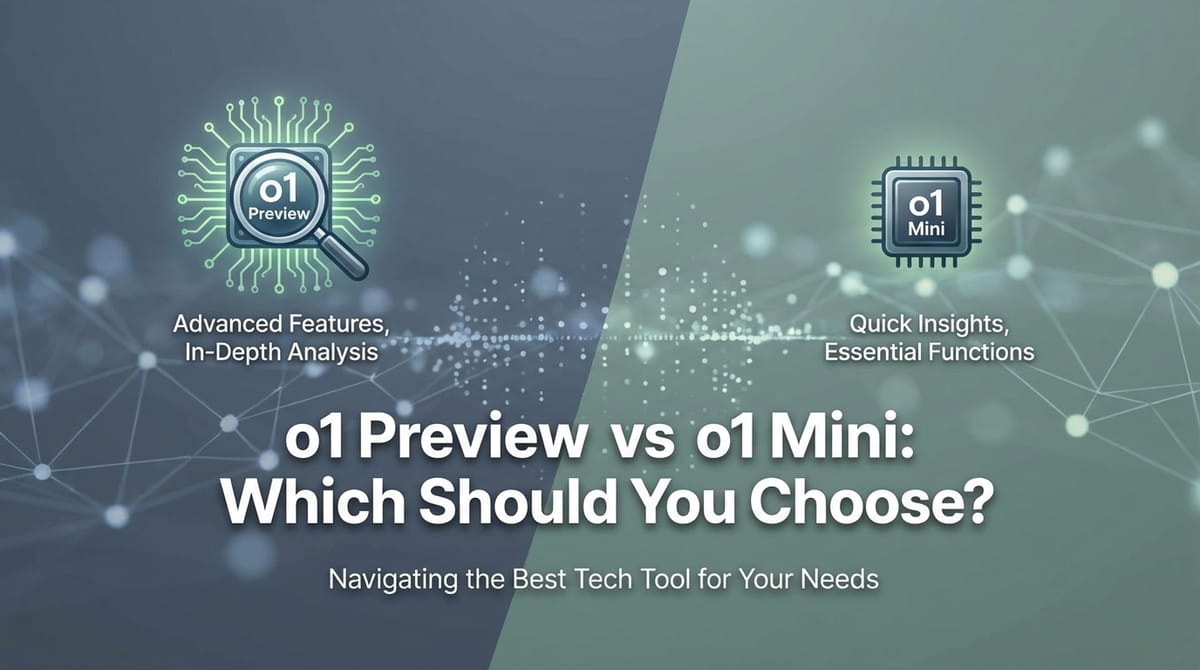

The world of compact computing and embedded systems is constantly evolving, presenting developers, hobbyists, and industrial innovators with an exciting array of choices. Among the latest contenders capturing significant attention are the "o1 Preview" and the "o1 Mini." These two devices, while seemingly similar in their overarching goal of delivering powerful capabilities in a small form factor, cater to distinctly different philosophies and user needs. The dilemma for many now revolves around a critical question: when facing the choice between o1 Preview vs o1 Mini, which one emerges as the superior option for a specific application?
This article delves deep into the architectural nuances, performance metrics, feature sets, and practical applications of both the o1 Preview and the o1 Mini. We will meticulously dissect their strengths and weaknesses, offering a comprehensive guide to help you make an informed decision. Whether you're an experienced developer prototyping a complex IoT solution, a hobbyist embarking on a smart home project, or an enterprise looking to deploy efficient edge computing, understanding the subtle yet significant differences between these two platforms is paramount. Join us as we explore every facet, ensuring your next technological endeavor is built upon the most suitable foundation.
Understanding the o1 Preview: The Visionary's Canvas
The o1 Preview is not just another compact computing device; it represents a commitment to pushing boundaries, offering a robust platform for experimentation, high-fidelity prototyping, and demanding edge applications. Positioned as a developer-centric offering, the o1 Preview is designed for those who require more horsepower, greater flexibility, and a wider array of connectivity options than typically found in its class. It embodies the spirit of an early-access, high-performance toolkit, providing a glimpse into future possibilities and empowering innovators to bring complex ideas to life with fewer compromises.
Philosophy and Target Audience
The core philosophy behind the o1 Preview revolves around uncompromised performance and maximum expandability within a compact footprint. It’s built for the visionary – the engineer developing advanced robotics, the AI researcher deploying sophisticated machine learning models at the edge, or the IoT architect building industrial-grade sensor networks. The target audience includes professional developers, research institutions, industrial automation specialists, and advanced hobbyists who are not afraid to delve into deep technical configurations and custom software development. These users prioritize raw computational power, extensive I/O capabilities, and a robust, often open-source, development environment.
Key Features and Specifications of o1 Preview
The o1 Preview stands out with its impressive hardware ensemble, carefully curated to meet high-performance demands.
- Processor: At its heart lies a powerful quad-core ARM Cortex-A78 processor, often clocked at up to 2.5 GHz, coupled with a dedicated NPU (Neural Processing Unit) capable of delivering 4-8 TOPs (Tera Operations Per Second) for AI inference tasks. This significantly boosts performance for vision processing, natural language understanding, and complex data analysis directly on the device.
- Memory: Typically equipped with 8GB or 16GB of LPDDR5 RAM, the o1 Preview ensures ample memory bandwidth for multi-threaded applications, large datasets, and simultaneous execution of various processes without bottlenecks.
- Storage: It usually features a robust 32GB or 64GB eMMC storage, with an M.2 slot for NVMe SSD expansion, providing both speed and capacity for operating systems, applications, and data storage.
- Connectivity: The o1 Preview excels in its connectivity suite. It includes dual Gigabit Ethernet ports, Wi-Fi 6E, Bluetooth 5.2, and often an optional 5G/LTE module, making it suitable for both wired and wireless high-bandwidth communication.
- I/O Ports: This is where the o1 Preview truly shines for developers. It offers a rich assortment of I/O, including multiple USB 3.0 ports, USB-C (with DisplayPort Alt Mode), HDMI 2.1, CSI (Camera Serial Interface) for high-resolution cameras, DSI (Display Serial Interface) for dedicated displays, and a generous 40-pin GPIO header compatible with popular development ecosystems. Additional UART, SPI, I2C, and CAN bus interfaces further expand its utility for embedded systems.
- Power Management: Despite its power, the o1 Preview incorporates advanced power management ICs, allowing for flexible power input (e.g., 5V via USB-C or wider voltage range via DC barrel jack) and offering various power modes for optimization.
- Form Factor: While still compact, the o1 Preview is slightly larger than its "Mini" counterpart to accommodate its extensive I/O and cooling solutions. Its sturdy construction often includes passive or active cooling options for sustained high-load operations.
Performance Analysis
The performance of the o1 Preview is tailored for computationally intensive tasks. * CPU Performance: The multi-core A78 architecture delivers exceptional general-purpose computing power, capable of handling complex algorithms, data processing, and running full-fledged operating systems like various Linux distributions with a desktop environment. * GPU & NPU Performance: The integrated GPU provides sufficient power for graphical user interfaces and basic multimedia tasks. However, the dedicated NPU is the game-changer, accelerating AI/ML inference workloads significantly. This enables real-time object detection, complex natural language processing, and predictive analytics at the edge, reducing reliance on cloud resources and minimizing latency. * Thermal Management: To sustain its high performance, the o1 Preview often features more sophisticated thermal solutions, including larger heatsinks or provisions for active cooling, which are crucial for applications requiring continuous high-load operation without throttling.
Software Ecosystem and Development Potential
The o1 Preview boasts a robust software ecosystem, primarily built around Linux distributions (e.g., Debian, Ubuntu, Yocto) optimized for ARM architectures. This provides developers with a familiar and powerful environment. * Operating Systems: Users can choose from a variety of OS images, often with pre-installed development tools. * Development Tools: Support for popular programming languages like Python, C++, Java, and Go is standard. Frameworks like TensorFlow Lite, PyTorch Mobile, and OpenCV are well-optimized for the NPU, enabling seamless AI/ML development. Docker and containerization are also well-supported, allowing for isolated application deployment. * Community Support: Given its developer-centric nature, the o1 Preview often benefits from an active community forum, extensive documentation, and open-source projects, facilitating problem-solving and knowledge sharing. * Advanced AI Integration: For developers pushing the boundaries of AI integration, especially with large language models (LLMs) and advanced AI services, the robust compute and network capabilities of the o1 Preview are invaluable. Leveraging platforms like XRoute.AI, which provides a cutting-edge unified API platform for over 60 AI models from 20+ providers, can significantly accelerate development. Imagine deploying an o1 Preview device at a remote industrial site, using its powerful NPU for local inference, while simultaneously communicating with XRoute.AI's low latency AI and cost-effective AI unified API to access more sophisticated LLMs in the cloud for complex decision-making or natural language interaction. This synergy allows the o1 Preview to handle real-time edge processing while seamlessly extending its intelligence with advanced cloud AI capabilities, all managed through a single, developer-friendly endpoint provided by XRoute.AI. This truly unleashes the potential for intelligent solutions, bridging the gap between local processing and scalable cloud AI.
Ideal Use Cases for o1 Preview
- Industrial Automation & Edge AI: Deploying AI models for quality control, predictive maintenance, or anomaly detection directly on factory floors.
- Robotics: As the primary brain for autonomous robots, drones, or sophisticated robotic arms, processing sensor data and executing complex navigation algorithms.
- Advanced IoT Gateways: Aggregating data from numerous sensors, performing local analytics, and securely communicating with cloud platforms.
- High-Performance Prototyping: Rapidly developing and testing new hardware and software solutions that demand significant computational resources.
- Multimedia & Vision Systems: Building intelligent surveillance systems, digital signage with real-time content adaptation, or advanced medical imaging devices.
Pros and Cons of o1 Preview
| Pros | Cons |
|---|---|
| Exceptional raw computational power (CPU, GPU, NPU). | Higher upfront cost compared to the o1 Mini. |
| Extensive I/O options for unparalleled expandability. | Larger physical footprint (though still compact). |
| Robust connectivity suite (Gigabit Ethernet, Wi-Fi 6E, optional 5G). | Potentially higher power consumption under heavy load. |
| Strong support for AI/ML frameworks and edge inference. | Might be overkill for simpler, less demanding projects. |
| Active developer community and comprehensive documentation. | Requires more technical expertise for full utilization. |
| Ideal for demanding industrial and research applications. | More complex thermal management considerations for sustained loads. |
Understanding the o1 Mini: The Streamlined Companion
In stark contrast to its "Preview" sibling, the o1 Mini embodies the principles of efficiency, compactness, and accessibility. It's engineered for scenarios where space is at a premium, power consumption needs to be minimal, and the primary focus is on streamlined functionality rather than raw, unbridled power or extensive expandability. The o1 Mini is often the choice for mass-produced embedded devices, smart home integrations, or projects where cost-effectiveness and ease of deployment are paramount. It represents a more polished, user-friendly iteration, optimized for specific, well-defined tasks.
Philosophy and Target Audience
The underlying philosophy of the o1 Mini centers on delivering essential computing capabilities in the most compact and energy-efficient package possible. Its design prioritizes integration into existing systems, stealth deployment, and low operational costs. The target audience typically includes hobbyists embarking on their first embedded projects, manufacturers developing smart appliances, system integrators creating discreet monitoring solutions, or anyone looking for a reliable, small-footprint device for focused tasks. These users value simplicity, reliability, low power draw, and a more accessible price point.
Key Features and Specifications of o1 Mini
The o1 Mini carefully balances performance with its compact design and power efficiency.
- Processor: It typically features a dual-core or quad-core ARM Cortex-A53 or A55 processor, usually clocked up to 1.5 GHz. While not as powerful as the o1 Preview's A78, these processors are highly energy-efficient and perfectly capable of handling most embedded and light edge computing tasks. It may include a smaller, less powerful NPU or rely solely on CPU for light AI inference.
- Memory: Common configurations include 2GB or 4GB of LPDDR4 RAM. This is generally sufficient for operating systems, a few concurrently running applications, and modest data processing.
- Storage: Usually comes with 8GB or 16GB eMMC storage, sometimes with a microSD card slot for expandable storage. The focus here is on essential storage rather than high-speed, high-capacity needs.
- Connectivity: The o1 Mini typically offers essential wireless connectivity: Wi-Fi 5 (802.11ac) or Wi-Fi 6, and Bluetooth 5.0. It usually features a single Fast Ethernet (100Mbps) or Gigabit Ethernet port, adequate for most network-connected applications.
- I/O Ports: While less extensive than the o1 Preview, the o1 Mini provides sufficient I/O for its target applications. This commonly includes one or two USB 2.0 or 3.0 ports, a micro-HDMI or mini-HDMI output, and a more streamlined 26-pin or 40-pin GPIO header. Essential UART, SPI, and I2C interfaces are usually present for sensor and peripheral integration.
- Power Management: Designed for low power consumption, the o1 Mini can often be powered conveniently via a micro-USB or USB-C port, drawing minimal current, making it ideal for battery-powered applications or environments with limited power supply.
- Form Factor: True to its name, the o1 Mini is significantly smaller and lighter than the o1 Preview, often boasting dimensions comparable to a credit card or even smaller, making it highly portable and easy to integrate into tight spaces.
Performance Analysis
The performance profile of the o1 Mini is geared towards efficiency and reliability for its designated workloads. * CPU Performance: The A53/A55 cores provide a good balance of performance and power efficiency for general-purpose computing. It can comfortably run lightweight Linux distributions, web servers, automation scripts, and basic data logging applications. * GPU & NPU Performance: The integrated GPU is sufficient for basic display outputs and graphical interfaces. If an NPU is present, it's typically for very light inference tasks, meaning heavier AI/ML workloads would need to rely more on the CPU, which might be slower. * Thermal Management: Due to its lower power consumption, the o1 Mini usually relies on passive cooling, often with just a small heatsink or no heatsink at all, which simplifies deployment and reduces noise.
Software Ecosystem and Development Potential
The o1 Mini also leverages the power of the Linux ecosystem, often with highly optimized distributions for its hardware. * Operating Systems: Lightweight Linux distributions like Raspbian Lite, Armbian, or custom embedded Linux images are common, providing a stable and efficient environment. * Development Tools: Support for Python, C, C++, and various scripting languages is readily available. While it can run AI/ML frameworks like TensorFlow Lite, the smaller RAM and less powerful NPU mean that models need to be highly optimized and simpler in architecture. * Community Support: Given its broader appeal to hobbyists and embedded developers, the o1 Mini often benefits from a large, active community, extensive tutorials, and numerous open-source projects. * Simplified AI Integration: For developers building compact, energy-efficient AI-powered devices, the o1 Mini, while less powerful than the Preview, can still be augmented with cloud AI services. For instance, connecting an o1 Mini device to XRoute.AI's unified API allows it to send sensor data or simple queries to be processed by sophisticated LLMs, receiving intelligent responses without needing to run complex models locally. This is particularly beneficial for cost-effective AI applications where the edge device primarily acts as a data collector and communicator, offloading heavy processing to scalable cloud resources accessed via XRoute.AI's low latency AI endpoint.
Ideal Use Cases for o1 Mini
- Smart Home Automation: Controlling lights, thermostats, security cameras, or acting as a central hub for various smart devices.
- Basic IoT Devices: Sensor nodes, environmental monitoring stations, or simple data loggers in remote locations.
- Retro Gaming & Media Centers: Building compact, low-power emulation stations or media players.
- Educational Projects: An accessible and affordable platform for teaching programming, electronics, and basic computing concepts.
- Embedded Systems: Integrating into appliances, industrial control panels, or vending machines where space and power are critical.
- Wearable & Portable Devices: Projects requiring extremely small form factors and battery operation.
Pros and Cons of o1 Mini
| Pros | Cons |
|---|---|
| Extremely compact and lightweight design. | Lower raw computational power (CPU, GPU, NPU). |
| Very low power consumption, ideal for battery-powered projects. | Limited I/O options and expandability compared to o1 Preview. |
| More affordable and accessible price point. | Less robust connectivity (e.g., typically Wi-Fi 5, single Ethernet). |
| Easier to integrate into small enclosures and existing systems. | May struggle with very demanding AI/ML or multi-threaded applications. |
| Simpler thermal management (often passive). | Smaller memory and storage options. |
| Large community support, excellent for hobbyists. | Less suitable for high-performance industrial or research tasks. |
o1 Preview vs o1 Mini: A Head-to-Head Comparison
The choice between o1 Preview vs o1 Mini boils down to a detailed comparison across several critical dimensions. Understanding these differences is key to aligning the device with your project's specific requirements.
Feature Comparison Table
To provide a clear side-by-side view, here's a detailed comparison table highlighting the key specifications and features of the o1 Preview and o1 Mini:
| Feature | o1 Preview | o1 Mini |
|---|---|---|
| Processor | Quad-core ARM Cortex-A78 (up to 2.5 GHz) | Dual/Quad-core ARM Cortex-A53/A55 (up to 1.5 GHz) |
| NPU | Dedicated NPU (4-8 TOPs) | Smaller NPU or CPU-only for inference |
| RAM | 8GB / 16GB LPDDR5 | 2GB / 4GB LPDDR4 |
| Storage | 32GB / 64GB eMMC + M.2 NVMe slot | 8GB / 16GB eMMC + microSD slot |
| Connectivity | Dual Gigabit Ethernet, Wi-Fi 6E, BT 5.2, optional 5G/LTE | Single Fast/Gigabit Ethernet, Wi-Fi 5/6, BT 5.0 |
| USB Ports | Multiple USB 3.0, USB-C (DP Alt Mode) | 1-2 USB 2.0/3.0, Micro-USB (power only) |
| Video Output | HDMI 2.1, USB-C DP Alt Mode, DSI | Micro/Mini HDMI |
| Camera Interface | CSI (Multiple lanes) | Basic CSI or none |
| GPIO Header | 40-pin (extensive, diverse protocols) | 26-pin / 40-pin (basic, general-purpose) |
| Other I/O | UART, SPI, I2C, CAN Bus | UART, SPI, I2C |
| Power Input | USB-C (PD), DC Jack (wider range) | Micro-USB / USB-C (5V) |
| Form Factor | Moderately compact, robust casing | Ultra-compact, credit-card sized or smaller |
| Cooling | Passive with optional active fan support | Primarily passive |
| Target Use Case | Edge AI, Robotics, Industrial IoT, Prototyping | Smart Home, Basic IoT, Education, Embedded Systems |
| Price Point | Higher | Lower |
Performance Benchmarks
While specific benchmarks would vary depending on the exact model and workload, we can generalize their performance profiles:
- CPU-Intensive Tasks: The o1 Preview with its A78 cores will significantly outperform the o1 Mini in tasks requiring heavy general-purpose computation, such as compiling large codebases, running complex simulations, or serving high-traffic web applications. Its higher clock speeds and more advanced architecture provide a clear advantage.
- AI/ML Inference: This is a major differentiator. The o1 Preview's dedicated NPU offers orders of magnitude faster inference speeds for trained AI models compared to the o1 Mini, which would rely mostly on its less powerful CPU or a very modest NPU. For real-time object detection, complex image recognition, or natural language processing at the edge, the Preview is undeniably superior.
- Memory Bandwidth: LPDDR5 in the o1 Preview provides substantially higher bandwidth than LPDDR4 in the o1 Mini. This translates to faster data access for applications that manipulate large datasets or require high-speed memory operations.
- Network Throughput: Dual Gigabit Ethernet and Wi-Fi 6E on the o1 Preview ensure much higher and more stable network throughput, critical for applications involving large data transfers or high-bandwidth streaming. The o1 Mini's Fast Ethernet or single Gigabit Ethernet and Wi-Fi 5/6 are adequate but less robust for demanding network loads.
Price and Value Proposition
- o1 Preview: Commands a higher price point, reflecting its advanced processor, generous memory, extensive I/O, and specialized components like the NPU. The value here lies in its future-proofing, versatility, and ability to tackle complex, demanding projects that might otherwise require a larger, more expensive industrial PC or even cloud resources. For professional use cases where performance directly impacts ROI, the investment is often justified.
- o1 Mini: Is significantly more affordable, making it an excellent entry point for new users, hobbyists, or for large-scale deployments where cost per unit is a major consideration. Its value is derived from its cost-effectiveness, low power consumption, and ability to reliably perform specific tasks without unnecessary overhead. It offers excellent value for basic automation, monitoring, and educational purposes.
Design and Portability
- o1 Preview: While still compact, its design accommodates more ports and often requires a slightly larger footprint for thermal dissipation. Its robustness makes it suitable for semi-rugged environments but might be too large for ultra-miniature integrations.
- o1 Mini: Is designed for ultimate compactness. Its small size and light weight make it incredibly portable and easy to conceal or integrate into extremely tight spaces, like inside appliances, wearable devices, or discreet sensor housings.
Development Experience and Ecosystem Support
Both devices benefit from the broad ARM Linux ecosystem, but the experience differs:
- o1 Preview: Offers a more "desktop-like" development experience due to its higher performance and more memory. It can comfortably run IDEs, multiple terminals, and heavy development tools. The extensive I/O encourages complex hardware integrations. The developer community tends to focus on cutting-edge applications and performance optimization.
- o1 Mini: Provides a leaner development environment, often requiring cross-compilation or remote development setups for heavy tasks. Its simplicity makes it excellent for learning and rapid prototyping of focused, less resource-intensive applications. The community is vast and very supportive for common hobbyist projects.
Longevity and Future-Proofing
- o1 Preview: With its more powerful processor, larger memory, and advanced NPU, the o1 Preview is inherently more future-proof. It can adapt to more complex software demands, larger AI models, and evolving connectivity standards for a longer period. Its expandability via M.2 slots also allows for future upgrades.
- o1 Mini: While durable for its intended use, its hardware limitations mean it might become obsolete faster for computationally demanding tasks. However, for its niche of low-power, dedicated applications, its longevity can still be substantial, as these tasks often don't require ever-increasing computational power.
Who Should Choose o1 Preview?
You should strongly consider the o1 Preview if your project fits any of the following criteria:
- Demanding Computational Power: Your application requires significant CPU horsepower for complex calculations, data processing, or running multiple services concurrently.
- Edge AI & Machine Learning: You need to deploy sophisticated AI models for real-time inference, computer vision, or natural language processing directly on the device, minimizing latency and bandwidth use. The dedicated NPU is a game-changer here.
- Extensive Connectivity & I/O: Your project requires multiple network interfaces (e.g., dual Ethernet for redundancy or segregation), high-speed wireless, or a wide array of GPIO, CSI, DSI, and other industrial interfaces for integrating numerous sensors, actuators, and displays.
- High-Fidelity Prototyping: You are prototyping an industrial-grade solution, a complex robotics platform, or an advanced IoT gateway where expandability and raw performance are critical for rapid iteration and testing.
- Future-Proofing & Scalability: You anticipate that your project's demands might grow, and you need a platform that can evolve with those needs without requiring a complete hardware overhaul.
- Professional & Research Applications: For academic research, enterprise deployments, or industrial automation where reliability, performance, and flexibility are non-negotiable.
Who Should Choose o1 Mini?
The o1 Mini is the ideal choice if your project aligns with these characteristics:
- Compactness is Paramount: Space is extremely limited, and you need the smallest possible footprint for your embedded system, smart device, or portable application.
- Budget-Conscious Projects: Cost-effectiveness is a primary concern, and you need a reliable platform without breaking the bank, especially for mass production or educational initiatives.
- Low Power Consumption: Your device needs to run on battery power for extended periods, or operate in environments with strict power constraints.
- Dedicated, Streamlined Tasks: Your application has a well-defined scope and doesn't require excessive computational power or extensive I/O – examples include basic sensor monitoring, simple automation, or acting as a lightweight network client.
- Ease of Integration: You need a device that is straightforward to embed, power, and get running quickly, perhaps for a smart home project or a simple data logger.
- Hobbyist & Educational Use: You're new to embedded systems, or you're teaching fundamental concepts, and require an accessible, well-supported, and affordable platform.
XRoute is a cutting-edge unified API platform designed to streamline access to large language models (LLMs) for developers, businesses, and AI enthusiasts. By providing a single, OpenAI-compatible endpoint, XRoute.AI simplifies the integration of over 60 AI models from more than 20 active providers(including OpenAI, Anthropic, Mistral, Llama2, Google Gemini, and more), enabling seamless development of AI-driven applications, chatbots, and automated workflows.
Edge Cases and Niche Applications
Beyond the typical use cases, there are specific scenarios where one device might unexpectedly excel:
- o1 Preview for Media Servers: While overkill for a simple media center, the o1 Preview's powerful CPU and generous RAM make it an excellent choice for a robust, high-performance media server capable of transcoding multiple 4K streams simultaneously, acting as a home automation hub, and running various network services – all from one compact box.
- o1 Mini for Distributed Sensor Networks: If you need to deploy hundreds of identical sensor nodes across a vast area, the o1 Mini's low cost, small size, and minimal power consumption make it ideal. Even with lower individual processing power, the collective intelligence of many o1 Minis, perhaps sending data to a central o1 Preview gateway, can achieve sophisticated monitoring.
- o1 Preview in Portable AI Tools: For field engineers or researchers needing to run complex diagnostics or AI models on-site without internet access, a battery-powered o1 Preview with its NPU becomes an invaluable portable AI workstation.
- o1 Mini as a Dedicated Network Appliance: Instead of a full-fledged router, the o1 Mini can be configured as a very low-power DNS server, ad-blocker (like Pi-hole), or a secure tunnel endpoint, performing these single tasks efficiently without resource waste.
Installation & Setup Considerations
Regardless of your choice, setting up these devices typically involves a few common steps:
- Operating System Installation: Both devices will likely require an OS image to be flashed onto an eMMC or microSD card. This usually involves tools like Balena Etcher or the manufacturer's specific flashing utilities.
- Initial Boot & Configuration: Connecting a display (HDMI or USB-C DP Alt Mode), keyboard, and mouse for the first boot to configure network settings, user accounts, and update the system. Headless setup via SSH is also a common and often preferred method for embedded deployments.
- Power Supply: Ensuring you have an adequate power supply. While the o1 Mini might be fine with a standard 5V/2A USB adapter, the o1 Preview will often demand a higher current (e.g., 5V/4A or more) to support its powerful components and any attached peripherals.
- Peripheral Integration: Connecting sensors, cameras, displays, or other custom hardware via the GPIO pins, USB ports, or dedicated interfaces. This often requires writing custom drivers or using existing libraries.
- Software Development Environment: Setting up your preferred programming languages, libraries, and frameworks. For AI/ML, this means installing TensorFlow Lite, PyTorch Mobile, OpenCV, and potentially NPU-specific SDKs. For advanced integrations, especially for leveraging LLMs, remember that platforms like XRoute.AI offer unified API access to a vast array of models, simplifying the process regardless of your chosen device.
Community Support & Resources
Both the o1 Preview and o1 Mini benefit from the strong ARM Linux ecosystem, which means a wealth of resources are generally available.
- Official Documentation: Manufacturers typically provide comprehensive documentation, including datasheets, schematics, and getting started guides.
- Community Forums: Active forums are invaluable for troubleshooting, sharing projects, and learning from experienced users. Look for dedicated sections for each device.
- Open-Source Projects: GitHub and other code repositories are brimming with open-source projects, drivers, and examples specifically designed for these types of ARM-based mini-PCs and development boards.
- Blogs and Tutorials: A quick search will usually yield numerous blogs, YouTube tutorials, and online courses that walk you through various projects and setup procedures.
- Product-Specific Tools: Some devices come with their own utilities for system monitoring, firmware updates, or hardware configuration.
Engaging with the community can significantly accelerate your development process, provide solutions to common challenges, and inspire new ideas for your projects.
Future Outlook for Both Platforms
The landscape of embedded and edge computing is constantly evolving, driven by advancements in silicon design, AI algorithms, and connectivity.
- o1 Preview: As a cutting-edge platform, the o1 Preview is likely to see continuous software updates, driver improvements, and potentially new iterations with even more powerful NPUs and faster interconnects. Its open-ended nature means it will likely remain at the forefront for experimental and high-performance applications. The demand for powerful edge devices that can handle complex AI tasks, potentially collaborating with cloud-based LLM platforms like XRoute.AI, is only set to grow, ensuring the Preview's relevance.
- o1 Mini: The o1 Mini, while more focused, will also evolve. Future versions might incorporate slightly more powerful yet still energy-efficient processors, updated wireless standards, or even more compact form factors. Its enduring appeal lies in its role as a reliable, cost-effective workhorse for the vast market of embedded and IoT devices. As AI becomes more optimized, even the Mini might gain more sophisticated on-device AI capabilities for simpler tasks, further augmented by scalable cloud AI accessed via unified APIs.
Making the Final Decision
Ultimately, the decision between o1 Preview vs o1 Mini is not about which device is inherently "better," but rather which device is better suited for your specific needs.
- If your project demands high performance, extensive expandability, cutting-edge AI capabilities at the edge, and flexibility for complex integrations, the o1 Preview is the clear winner. It's an investment in power and versatility, designed to tackle the most ambitious tasks.
- If your priority is ultra-compactness, low power consumption, cost-effectiveness, and streamlined functionality for dedicated tasks, the o1 Mini is your go-to. It offers an elegant solution for mass-produced embedded systems, smart home devices, and learning platforms.
Take the time to thoroughly list out your project's requirements: what kind of computational power do you need? How much memory and storage? What specific I/O interfaces are critical? What are your budget and size constraints? By answering these questions honestly, you'll find that one device's profile aligns perfectly with your vision.
Conclusion
The choice between the o1 Preview and the o1 Mini represents a fundamental fork in the road for anyone embarking on a new embedded or compact computing project. While both are exemplary pieces of engineering designed to deliver powerful computing in a small package, they cater to distinctly different philosophies and application requirements. The o1 Preview stands as the powerhouse, the developer's dream canvas for cutting-edge AI, robotics, and industrial automation, offering unparalleled performance and expandability. On the other hand, the o1 Mini shines as the paragon of efficiency and compactness, perfectly suited for cost-sensitive, low-power, and highly integrated applications in smart homes, basic IoT, and education.
By meticulously examining the architectural differences, performance metrics, connectivity options, and ideal use cases, we've aimed to illuminate the path forward. Remember that the "best" device is always the one that most precisely matches your project's unique demands. Whether you need the brute force and advanced AI capabilities that can be seamlessly enhanced by unified API platforms like XRoute.AI for complex LLM interactions, or the discreet efficiency for a simple, elegant solution, both the o1 Preview and o1 Mini offer compelling pathways to success. Choose wisely, and empower your next innovation with the right foundation.
Frequently Asked Questions (FAQ)
1. Can I run a full desktop operating system on both o1 Preview and o1 Mini? Yes, both devices are capable of running Linux-based desktop operating systems (e.g., various Ubuntu or Debian derivatives). However, the o1 Preview, with its more powerful CPU and significantly more RAM, will provide a much smoother and more responsive desktop experience, capable of handling more demanding applications simultaneously. The o1 Mini will be better suited for lightweight desktop environments or command-line interfaces.
2. Which device is better for AI/Machine Learning projects? The o1 Preview is significantly better for AI/Machine Learning projects due to its powerful dedicated NPU (Neural Processing Unit) and larger RAM. This allows for faster, more complex AI model inference at the edge. While the o1 Mini can perform simpler AI tasks, it relies more on its CPU, which is slower, or a much smaller NPU, making it less suitable for real-time, high-demand AI workloads. For advanced AI models like large language models (LLMs), both devices can leverage external services, and platforms like XRoute.AI simplify integrating these powerful cloud-based AI models regardless of your local device's compute power.
3. Is the o1 Mini compatible with Raspberry Pi accessories? While both devices often share a similar 40-pin GPIO header standard with Raspberry Pi, specific pinouts and electrical characteristics can vary. It's crucial to check the documentation for the o1 Mini (and o1 Preview) to ensure compatibility with specific HATs or accessories. Many generic sensors and modules that use common protocols like I2C or SPI will likely work across platforms.
4. What are the main power consumption differences? The o1 Mini is designed for very low power consumption, often drawing just a few watts, making it ideal for battery-powered or energy-efficient applications. The o1 Preview, with its more powerful components, will consume significantly more power, especially under heavy load. This difference directly impacts battery life for portable projects and overall operational costs for continuous deployments.
5. Can I use both devices together in a project? Absolutely! In a hierarchical system, the o1 Mini could serve as a distributed network of low-power sensor nodes or actuators, collecting data or performing simple tasks. This data could then be aggregated and processed by a central o1 Preview gateway, which performs more complex analytics, runs sophisticated AI models, and communicates with cloud services or other network resources. This combination leverages the strengths of both devices for a robust and efficient solution.
🚀You can securely and efficiently connect to thousands of data sources with XRoute in just two steps:
Step 1: Create Your API Key
To start using XRoute.AI, the first step is to create an account and generate your XRoute API KEY. This key unlocks access to the platform’s unified API interface, allowing you to connect to a vast ecosystem of large language models with minimal setup.
Here’s how to do it: 1. Visit https://xroute.ai/ and sign up for a free account. 2. Upon registration, explore the platform. 3. Navigate to the user dashboard and generate your XRoute API KEY.
This process takes less than a minute, and your API key will serve as the gateway to XRoute.AI’s robust developer tools, enabling seamless integration with LLM APIs for your projects.
Step 2: Select a Model and Make API Calls
Once you have your XRoute API KEY, you can select from over 60 large language models available on XRoute.AI and start making API calls. The platform’s OpenAI-compatible endpoint ensures that you can easily integrate models into your applications using just a few lines of code.
Here’s a sample configuration to call an LLM:
curl --location 'https://api.xroute.ai/openai/v1/chat/completions' \
--header 'Authorization: Bearer $apikey' \
--header 'Content-Type: application/json' \
--data '{
    "model": "gpt-5",
    "messages": [
        {
            "content": "Your text prompt here",
            "role": "user"
        }
    ]
}'
With this setup, your application can instantly connect to XRoute.AI’s unified API platform, leveraging low latency AI and high throughput (handling 891.82K tokens per month globally). XRoute.AI manages provider routing, load balancing, and failover, ensuring reliable performance for real-time applications like chatbots, data analysis tools, or automated workflows. You can also purchase additional API credits to scale your usage as needed, making it a cost-effective AI solution for projects of all sizes.
Note: Explore the documentation on https://xroute.ai/ for model-specific details, SDKs, and open-source examples to accelerate your development.