OpenClaw API Key Security: Best Practices for Protection

In the interconnected digital landscape, Application Programming Interfaces (APIs) serve as the backbone for countless applications, enabling seamless communication and data exchange between different software systems. For developers leveraging powerful platforms like OpenClaw, the convenience and flexibility offered by APIs are invaluable. However, this power comes with a critical responsibility: securing the API keys that grant access to these systems. An API key is more than just a string of characters; it's a digital credential, a cryptographic key to your application's kingdom. Its compromise can lead to data breaches, unauthorized access, financial losses, and significant reputational damage.
This comprehensive guide delves into the essential best practices for OpenClaw API key security, offering a detailed roadmap to safeguard your applications and data. We'll explore the nuances of Api key management, delve into sophisticated strategies for token control, and provide actionable insights into holistic token management to ensure your OpenClaw integrations remain resilient against evolving threats. By understanding the inherent risks and implementing robust protective measures, you can harness the full potential of OpenClaw with confidence and peace of mind.
The Foundation: Understanding OpenClaw API Keys and Their Inherent Vulnerabilities
Before we can effectively protect OpenClaw API keys, we must first thoroughly understand what they are, how they function, and the common pitfalls that render them vulnerable. An API key, in the context of OpenClaw, is a unique identifier used to authenticate a user or application when making requests to the OpenClaw API. It's often a long, alphanumeric string that serves multiple purposes: identifying the calling project, authorizing access to specific functionalities, and sometimes even tracking usage for billing or analytics.
While incredibly convenient, their very nature makes them prime targets for malicious actors. Unlike traditional usernames and passwords that are typically guarded by user interaction and multi-factor authentication, API keys are often embedded directly into code, configuration files, or environment variables, making them susceptible to different attack vectors.
Common Vulnerability Points for API Keys:
- Hardcoding in Client-Side Code: Perhaps the most egregious error is embedding API keys directly into front-end JavaScript, mobile applications, or other publicly accessible client-side code. Once deployed, these keys are trivial for anyone with basic developer tools to extract.
- Insecure Storage in Repositories: Storing API keys directly in version control systems like Git without proper encryption or
.gitignorerules is a common developer oversight. Public or even private repositories, if compromised, can expose these sensitive credentials. - Exposed Configuration Files: Leaving API keys in unencrypted configuration files that are accessible via web servers or deployed without proper permissions can lead to their discovery.
- Logging and Monitoring Systems: If not handled carefully, API keys can accidentally be logged in plain text during debugging or routine application logging, creating a trove for attackers to sift through.
- Lack of Least Privilege: Granting an API key more permissions than it strictly needs for its intended function significantly amplifies the damage potential if that key is compromised. A key with read-write access to sensitive data is far more dangerous than one restricted to read-only access on public information.
- Absence of Rotation: API keys that remain static indefinitely provide a longer window of opportunity for attackers. Once compromised, they can be used indefinitely until manually revoked.
- Insufficient "Token Control" and "Token Management" Frameworks: Without a structured approach to managing the lifecycle and usage of these tokens, their proliferation and potential misuse become inevitable. This is where dedicated Api key management strategies become indispensable.
Understanding these vulnerabilities is the crucial first step. It underpins every subsequent best practice we will discuss, guiding us toward a more secure integration with OpenClaw and any other API-driven service.
The Pillars of Robust OpenClaw API Key Security
Effective security for OpenClaw API keys isn't about implementing a single magical solution; it's about adopting a multi-layered defense strategy. This involves a combination of technical safeguards, rigorous processes, and a culture of security awareness. Let's explore the core pillars that uphold this defense.
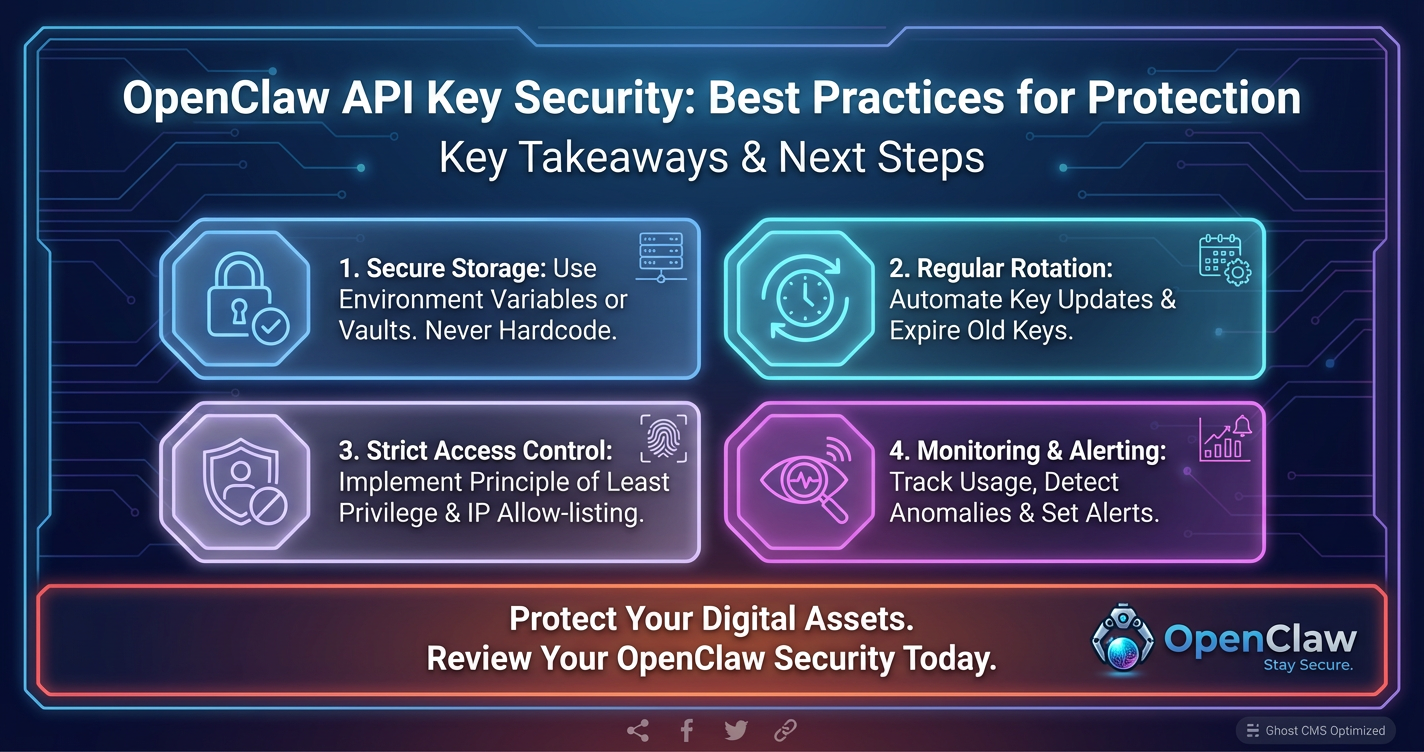
1. Principle of Least Privilege (PoLP): Minimizing Exposure
The Principle of Least Privilege dictates that any user, program, or process should be granted only the minimum necessary permissions to perform its intended function. For OpenClaw API keys, this means:
- Granular Permissions: Instead of using a single "master" API key with full access, generate separate keys for different functionalities. For instance, if one application only needs to read OpenClaw data, provide it with a read-only key. If another needs to create resources, give it a key with specific write permissions for only those resources. This significantly limits the blast radius if a key is compromised.
- Specific Resource Access: Whenever possible, restrict API keys to interact only with the specific OpenClaw resources they need. Avoid broad permissions like
/*(all resources) unless absolutely necessary and thoroughly justified. - Time-Bound Access (When Applicable): For temporary tasks, consider if OpenClaw supports time-limited API keys or if your infrastructure can generate and revoke keys on a schedule.
Why PoLP is Critical: Imagine a thief steals a set of keys. If those keys only open a single, low-value storage locker, the damage is minimal. If they open every door in a high-security vault, the damage is catastrophic. The same logic applies to API keys. Robust token control starts with minimizing the inherent power of each token.
2. Secure Storage: Guarding the Keys to the Kingdom
Where and how you store your OpenClaw API keys is paramount. Never hardcode them directly into your application's source code, especially for client-side applications.
- Environment Variables: For server-side applications, storing API keys as environment variables is a significant improvement over hardcoding. They are not checked into version control and are only loaded at runtime.
- Example (Node.js):
process.env.OPENCLAW_API_KEY - Example (Python):
os.environ.get('OPENCLAW_API_KEY')
- Example (Node.js):
- Dedicated Secret Management Services: This is the gold standard for secure storage, especially in complex or enterprise environments. Services like AWS Secrets Manager, Azure Key Vault, Google Secret Manager, HashiCorp Vault, or even self-hosted solutions like Doppler or CyberArk, are designed specifically for securely storing, retrieving, and managing secrets like API keys.
- Benefits: Centralized management, automatic rotation, fine-grained access control, auditing capabilities, and integration with CI/CD pipelines. This directly feeds into sophisticated Api key management.
- Hardware Security Modules (HSMs): For the highest level of security, particularly for root keys that protect other secrets, HSMs provide a tamper-resistant environment for cryptographic operations and secure storage. While typically overkill for individual API keys, understanding their role in the overall security chain is valuable.
- Configuration Management Tools (with caution): Tools like Ansible, Chef, or Puppet can manage configurations, but ensure that API keys stored within them are encrypted at rest and in transit, and access to these tools is strictly controlled.
Table 1: Comparison of API Key Storage Methods
| Storage Method | Security Level | Ease of Implementation | Best Use Case | Downsides |
|---|---|---|---|---|
| Hardcoding (Client-Side) | Very Low | Very Easy | NEVER | Publicly exposed, trivial to extract |
| Hardcoding (Server-Side) | Low | Easy | Small, non-production projects | Still in source control, less flexible, no rotation |
| Environment Variables | Medium | Moderate | Server-side apps, smaller teams | Can be leaked via process inspection, less centralized |
| Encrypted Config Files | Medium-High | Moderate | Environments without dedicated secret managers | Key management overhead, encryption key needs protection |
| Dedicated Secret Managers | High | Moderate-High | Large teams, enterprise, multi-cloud, automated ops | Learning curve, infrastructure overhead, cost |
| Hardware Security Modules (HSM) | Very High | High | Root keys, high-security financial/government apps | High cost, complexity, specialized expertise required |
3. Access Control and IP Whitelisting: Who Can Use the Key?
Beyond the key itself, controlling who and from where an API key can be used is another vital layer of security.
- IP Whitelisting: If your OpenClaw API keys are meant to be used by known servers or specific IP addresses, configure the API to only accept requests originating from those approved IPs. This acts as a powerful firewall; even if a key is compromised, it becomes useless from an unauthorized location.
- Caveat: This is less effective for client-side applications or services with dynamic IP addresses (e.g., serverless functions without fixed egress IPs).
- Referrer Restrictions: For client-side API keys that must be publicly available (e.g., for mapping services), restrict their usage to specific domain names or application package names. This prevents others from simply copying your key and using it on their own website or app. OpenClaw might offer similar restrictions.
- User/Role-Based Access Control (RBAC): If your OpenClaw integration involves different users or services within your organization, leverage OpenClaw's (or your secret manager's) RBAC capabilities to ensure that only authorized entities can retrieve or manage specific API keys. This is a core aspect of robust token control.
4. Rotation and Revocation: Dynamic Security
Static security measures are insufficient in a dynamic threat landscape. API keys, like passwords, should not live forever.
- Regular Rotation: Implement a schedule for automatically rotating your OpenClaw API keys. This means generating a new key, updating your applications to use the new key, and revoking the old one. Common rotation periods range from 30 to 90 days, depending on sensitivity.
- Benefits: Reduces the window of opportunity for a compromised key to be exploited. If an attacker gains access to an old key, it will eventually become useless.
- Automation: Secret management services can often automate key rotation, making this process seamless and reducing manual error.
- Immediate Revocation: Have a clear, well-rehearsed process for immediate API key revocation in case of suspected or confirmed compromise. This should be as simple and quick as possible.
- Impact Assessment: After revocation, review logs to determine the extent of potential misuse.
- Graceful Degradation: When implementing rotation, consider strategies for graceful key transitions (e.g., allowing both old and new keys to be active for a brief period) to avoid service interruptions during updates.
Table 2: API Key Lifecycle Stages and Security Actions
| Lifecycle Stage | Description | Key Security Actions | Related Keyword |
|---|---|---|---|
| Generation | Creating a new API key. | Use strong, random keys; enforce granular permissions (PoLP). | Api key management |
| Distribution | Provisioning the key to an application or service. | Secure channels only (e.g., secret managers); avoid logging. | Token management |
| Storage | Where the key resides during its active life. | Environment variables, secret managers; encryption at rest. | Api key management, Token control |
| Usage | The application making calls with the key. | HTTPS only, IP whitelisting, rate limiting; monitor access patterns. | Token control |
| Rotation | Replacing an active key with a new one. | Automated processes, seamless transition; revoke old key promptly. | Token management |
| Revocation | Deactivating a key due to compromise or end-of-life. | Immediate action; clear audit trail; incident response plan. | Token control, Api key management |
| Destruction | Securely erasing a key from storage. | Ensure all copies are purged after revocation; digital shredding if applicable. | Token management |
5. Monitoring and Alerting: The Eyes and Ears of Security
Even with the best preventative measures, breaches can occur. Proactive monitoring and timely alerting are crucial for detecting and responding to suspicious activity.
- Audit Logging: Ensure comprehensive logging of all OpenClaw API requests, including the API key used, timestamp, request details, and outcome. These logs are invaluable for forensic analysis.
- Anomaly Detection: Implement systems to detect unusual patterns of API key usage. This could include:
- Requests from new or unexpected IP addresses.
- Sudden spikes in request volume.
- Attempts to access unauthorized resources.
- Requests outside of typical operating hours.
- Real-time Alerts: Configure alerts to notify security teams or on-call personnel immediately when anomalies or potential compromises are detected. The faster you know, the faster you can react.
- Centralized Logging: Integrate OpenClaw access logs into a centralized Security Information and Event Management (SIEM) system for easier correlation with other security events and more comprehensive analysis. This is a critical component of effective token control.
6. Secure Transmission: Keeping Data Private
API keys, like any sensitive data, must always be transmitted securely.
- HTTPS/SSL Everywhere: Always use HTTPS (HTTP Secure) for all API communications. This encrypts data in transit, protecting API keys and other sensitive information from eavesdropping and man-in-the-middle attacks. Never send API keys over unencrypted HTTP.
- Avoid Query Parameters: Do not pass API keys in URL query parameters (
?apiKey=yourkey). These can be logged in server logs, browser histories, and referral headers, making them easily discoverable. Instead, use HTTP headers (e.g.,Authorization: Bearer YOUR_API_KEY) or request bodies (for POST requests) when necessary.
7. Client-Side Security Considerations: Special Care for Public Environments
Client-side applications (web browsers, mobile apps) present unique challenges because their code is accessible to users.
- Never Embed Sensitive API Keys: As reiterated, never embed sensitive OpenClaw API keys that grant broad access directly into client-side code. This is a fundamental violation of secure Api key management.
- Backend Proxy/Gateway: For any OpenClaw API call that requires a sensitive key, route the request through your own secure backend server. The client application calls your backend, which then makes the secure, authenticated call to OpenClaw using its securely stored API key. This acts as a protective shield, centralizing token control.
- Publicly Consumable Keys: If OpenClaw provides keys specifically designed for public client-side use (e.g., with very limited permissions and strict domain/referrer restrictions), these might be acceptable for direct client-side embedding, but only after careful review of their scope and limitations.
Implementing Effective OpenClaw API Key Management Strategies
Beyond the individual pillars, a holistic approach to Api key management is about integrating these best practices into a cohesive strategy that encompasses the entire lifecycle of your OpenClaw API keys. This involves tools, processes, and a shift in development culture.
1. Dedicated Secret Management Tools: The Modern Standard
We touched on this earlier, but it warrants deeper exploration. For any serious application integrating with OpenClaw, a dedicated secret management solution is not just a recommendation; it's a necessity.
- HashiCorp Vault: A popular open-source solution that secures, stores, and tightly controls access to tokens, passwords, certificates, encryption keys, and more. It offers dynamic secrets, automatic rotation, and a comprehensive audit log.
- Cloud Provider Secrets Managers:
- AWS Secrets Manager: Integrates seamlessly with other AWS services, allowing for easy rotation of secrets, fine-grained IAM policies, and automatic injection into EC2 instances or Lambda functions.
- Azure Key Vault: Provides secure storage for cryptographic keys and other secrets, with strong integration into Azure services and Active Directory for access control.
- Google Secret Manager: Offers a fully managed service for storing API keys, passwords, and other secrets, with features like automatic rotation, versioning, and access control policies.
- Benefits for "Api key management":
- Centralization: A single source of truth for all OpenClaw API keys and other secrets.
- Automation: Automated rotation, revocation, and provisioning reduce manual errors and overhead.
- Auditability: Detailed logs of who accessed which secret, when, and from where.
- Dynamic Secrets: Some managers can generate short-lived, on-demand credentials, further limiting exposure. This is a prime example of advanced token control.
2. CI/CD Pipeline Integration: Securing Automation
Modern software development relies heavily on Continuous Integration/Continuous Deployment (CI/CD) pipelines. Ensuring these pipelines handle OpenClaw API keys securely is paramount.
- Avoid Storing Keys in Build Artifacts: Never embed API keys directly into Docker images, deployment packages, or other build artifacts.
- Inject at Runtime: Configure your CI/CD pipeline to fetch OpenClaw API keys from a secure secret manager just before deployment or at application startup. Tools like Kubernetes Secrets, environment variables (for less sensitive keys), or direct integration with cloud secret managers are common patterns.
- Limited Scope for CI/CD Credentials: The credentials used by your CI/CD system to access the secret manager should themselves follow the Principle of Least Privilege. They should only be able to retrieve the specific secrets required for deployment and nothing more.
- Scan for Leaks: Incorporate static analysis security testing (SAST) tools into your CI/CD pipeline that scan code for accidentally hardcoded API keys or other secrets before they make it into production. Tools like GitGuardian, TruffleHog, or custom regex scanners can be highly effective.
3. Developer Best Practices and Training: The Human Element
Even the most sophisticated tools are only as effective as the people using them. A strong security culture among developers is non-negotiable for effective token management.
- Security Training: Regular training for developers on secure coding practices, the risks of API key exposure, and how to properly use secret management tools is crucial.
- Code Review: Implement mandatory peer code reviews with a specific focus on security vulnerabilities, including how API keys are handled. Developers should be trained to spot insecure patterns.
- "Do Not Commit Secrets" Policy: Enforce a strict policy against committing sensitive information, including OpenClaw API keys, into version control systems. Provide tools (like pre-commit hooks) to help developers adhere to this.
- Secure Development Lifecycle (SDL): Integrate security considerations throughout the entire development lifecycle, from design to deployment. This ensures security isn't an afterthought but an intrinsic part of every stage.
4. Comprehensive Key Lifecycle Management: A Holistic "Token Management" Approach
Effective token management for OpenClaw API keys covers every phase of a key's existence, from its inception to its eventual retirement.
- Centralized Inventory: Maintain a clear, centralized inventory of all OpenClaw API keys, including:
- Which application/service uses it.
- Its granted permissions.
- Its creation date.
- Its last rotation date.
- Its planned expiration/rotation schedule.
- The owner/responsible team.
- Automated Provisioning and Deprovisioning: Automate the process of generating new keys and provisioning them to authorized applications. Equally important, automate or streamline the deprovisioning and revocation of keys when an application is retired or a developer leaves the team.
- Version Control for Secrets (via Secret Manager): While direct Git commits are bad, secret managers often offer versioning of secrets. This allows you to track changes to an OpenClaw API key, revert to previous versions if needed, and maintain an audit trail.
- Regular Audits: Periodically audit your Api key management processes and the inventory of keys to ensure compliance with security policies and to identify any keys that might be unused, overly permissive, or overdue for rotation.
This meticulous approach to token management ensures that every OpenClaw API key is accounted for, appropriately secured, and dynamically managed throughout its operational life.
XRoute is a cutting-edge unified API platform designed to streamline access to large language models (LLMs) for developers, businesses, and AI enthusiasts. By providing a single, OpenAI-compatible endpoint, XRoute.AI simplifies the integration of over 60 AI models from more than 20 active providers(including OpenAI, Anthropic, Mistral, Llama2, Google Gemini, and more), enabling seamless development of AI-driven applications, chatbots, and automated workflows.
Advanced "Token Control" and "Token Management" Techniques
As applications grow in complexity and the threat landscape evolves, more sophisticated techniques are required for robust "token control" and "token management." These methods aim to further reduce the risk profile associated with long-lived, static credentials.
1. Short-Lived Tokens and Token Exchange Mechanisms
Traditional API keys are often long-lived, providing a constant target. Modern security emphasizes reducing the time window an attacker has to exploit a compromised credential.
- Dynamic, Short-Lived Credentials: Instead of directly using a long-lived OpenClaw API key, your application can use a more restricted, temporary credential (e.g., an IAM role, a service account token) to request a short-lived OpenClaw API token from a secure token service or a cloud provider's STS (Security Token Service). This short-lived token is then used for actual API calls.
- Token Exchange: This pattern involves an initial, highly secure authentication step that returns a limited, short-lived token. If the application needs to perform more privileged actions, it exchanges this short-lived token for another, more powerful short-lived token, provided it meets specific authorization criteria. This provides fine-grained "token control" on demand.
- Benefits: Even if a short-lived token is compromised, its utility to an attacker is drastically limited by its brief lifespan, typically minutes or hours.
2. Service Accounts and IAM Roles: Beyond Direct Keys
For cloud-native applications and microservices, relying solely on static API keys for internal communication can be cumbersome and insecure. Service accounts and IAM (Identity and Access Management) roles offer a more secure and flexible alternative.
- Cloud IAM Roles: In cloud environments (AWS, Azure, GCP), instead of giving a server an OpenClaw API key directly, you assign an IAM role to the compute instance (e.g., EC2, Azure VM, GKE pod). This role has specific permissions to access other services or external APIs like OpenClaw. The instance then automatically receives temporary credentials based on its assigned role, which are rotated automatically by the cloud provider.
- Advantages: No need to hardcode keys, automatic rotation, tight integration with cloud security policies, and easy auditing. This is an advanced form of Api key management that leverages underlying infrastructure capabilities.
- Service Accounts: Similar to IAM roles but often used within a specific platform (e.g., Kubernetes service accounts). A service account identifies a process or application within a system and can be granted permissions to interact with other services, potentially including fetching OpenClaw API keys from a secret manager.
This approach significantly improves token control by decoupling the access credential from the application's configuration and tying it to the identity of the underlying compute resource.
3. API Gateways and Proxies: Centralized "Token Control"
API Gateways act as a single entry point for all API requests, providing a powerful layer for centralized "token control" and security enforcement.
- Authentication and Authorization Enforcement: An API Gateway can be configured to intercept all requests, validate OpenClaw API keys, apply IP whitelisting, enforce rate limits, and even perform token introspection before forwarding requests to your actual backend or directly to OpenClaw.
- Token Transformation: The gateway can abstract away complex token mechanisms. For instance, an incoming request might use an OAuth token, which the gateway then transforms into an appropriate OpenClaw API key (retrieved securely from a secret manager) before making the outbound call.
- Caching and Rate Limiting: Prevent abuse and denial-of-service attacks by caching responses and applying rate limits at the gateway level, reducing the load on your OpenClaw integration and protecting against credential stuffing attacks.
- Benefits: A centralized point for all security policies related to your OpenClaw integration, simplifying Api key management and enhancing overall "token control."
4. Tokenization for Sensitive Data: Broader Security Context
While API keys are themselves tokens, the concept of tokenization can be applied more broadly to protect sensitive data accessed via APIs. Though not directly about API keys, it relates to the overall security posture and data protection achieved through "token management."
- What it is: Replacing sensitive data (e.g., credit card numbers, PII) with a unique, non-sensitive token. The actual sensitive data is stored securely in a separate token vault.
- How it relates: When your OpenClaw application processes sensitive data, instead of storing or transmitting the raw data, you work with its tokenized representation. The API key for OpenClaw might grant access to retrieve the real data from the vault (via another API), but only when absolutely necessary and under strict controls. This reduces the surface area of sensitive data exposure, complementing robust API key security.
5. Behavioral Analytics and AI-driven Anomaly Detection: Proactive "Token Control"
Leveraging machine learning and AI for real-time threat detection represents the cutting edge of token management and token control.
- Baseline User Behavior: AI systems can establish baselines for typical OpenClaw API key usage patterns: normal request volume, common endpoints accessed, typical geographical origins, and time-of-day access patterns.
- Detecting Deviations: Any significant deviation from this baseline can trigger alerts. For example, if an API key usually makes 100 requests per minute from a specific region and suddenly starts making 10,000 requests from an unusual IP address, an AI system can flag this as anomalous behavior indicative of a potential compromise.
- Threat Intelligence Integration: Integrate threat intelligence feeds to identify requests originating from known malicious IP addresses or associated with common attack vectors.
- Automated Response: In advanced systems, AI-driven anomaly detection can even trigger automated responses, such as temporarily blocking an API key or requiring re-authentication, providing proactive "token control."
These advanced techniques elevate API key security from reactive measures to a proactive, intelligent defense, offering a robust framework for managing and controlling access to your OpenClaw resources.
Building a Secure OpenClaw API Ecosystem: A Practical Checklist
Bringing all these concepts together, here's a practical checklist for anyone integrating with OpenClaw, aimed at solidifying your Api key management and token control strategies.
- Understand OpenClaw's Specific Security Features:
- Does OpenClaw offer granular API key permissions?
- Does it support IP whitelisting or referrer restrictions?
- Does it have audit logs available for API key usage?
- What are its recommendations for key rotation?
- Implement the Principle of Least Privilege:
- Create separate OpenClaw API keys for each application/service.
- Assign only the minimum required permissions to each key.
- Regularly review key permissions to ensure they haven't become overly broad.
- Utilize a Secret Management Solution:
- Adopt a dedicated secret manager (AWS Secrets Manager, Azure Key Vault, HashiCorp Vault, etc.) for all OpenClaw API keys.
- Avoid storing keys in source code, configuration files, or public repositories.
- Ensure access to the secret manager is itself tightly controlled via IAM/RBAC.
- Enforce Secure Key Transmission:
- Always use HTTPS for all communications involving OpenClaw API keys.
- Never pass API keys in URL query parameters. Use HTTP headers or request bodies.
- Establish Robust Rotation and Revocation Procedures:
- Implement an automated schedule for OpenClaw API key rotation (e.g., every 30-90 days).
- Develop a clear, rapid response plan for immediate key revocation in case of compromise.
- Test your revocation process periodically.
- Monitor and Alert on API Key Usage:
- Enable comprehensive logging for all OpenClaw API calls.
- Integrate OpenClaw logs into your SIEM or centralized logging system.
- Set up alerts for suspicious activities: unusual IP addresses, high request volumes, unauthorized access attempts.
- Secure Client-Side Integrations:
- If a client-side application needs to interact with OpenClaw using sensitive keys, route requests through a secure backend proxy/gateway.
- Only use OpenClaw API keys directly in client-side code if they are specifically designed for public use, are highly restricted, and have strong domain/referrer restrictions.
- Integrate Security into CI/CD:
- Ensure CI/CD pipelines fetch API keys from a secret manager at runtime, never hardcoding them.
- Use static analysis tools to scan code for accidentally committed secrets.
- Foster Developer Security Awareness:
- Provide regular training on secure Api key management and general security best practices.
- Enforce security-focused code reviews.
- Cultivate a culture where security is a shared responsibility.
- Regularly Audit and Review:
- Conduct periodic security audits of your OpenClaw integrations and token management processes.
- Review your API key inventory to identify and deprovision inactive or overly permissive keys.
By systematically addressing each point on this checklist, you build a resilient defense against common and advanced threats to your OpenClaw API keys.
The Future of API Security: Adapting to an Evolving Landscape
The digital frontier is constantly expanding, and with it, the sophistication of cyber threats. The future of API security, including the advanced practices for Api key management, token control, and token management, will likely be shaped by several key trends.
- Zero Trust Architecture: Moving away from the traditional "trust but verify" model, Zero Trust dictates "never trust, always verify." This means every request, regardless of origin (inside or outside the network), must be authenticated, authorized, and continuously validated. For API keys, this translates to even shorter-lived tokens, continuous monitoring of context, and dynamic policy enforcement.
- Machine Learning and AI for Threat Detection: As highlighted in anomaly detection, AI will play an even larger role in identifying subtle patterns of misuse that human analysts or rule-based systems might miss. AI can adapt to new attack vectors, predict potential breaches, and even automate response mechanisms.
- Passwordless and Decentralized Identity: The move towards passwordless authentication (e.g., FIDO2, biometrics) and decentralized identity solutions (e.g., blockchain-based IDs) could fundamentally change how authentication tokens are managed, offering potentially more secure and user-friendly alternatives to traditional API keys.
- Runtime Application Self-Protection (RASP): RASP solutions integrate security directly into the application runtime, providing real-time protection against attacks by analyzing application behavior and data flow. This offers an additional layer of defense for applications consuming OpenClaw APIs.
- API Security Gateways with Advanced Capabilities: The role of API Gateways will evolve further, incorporating more advanced security features like API discovery, posture management, and integration with cloud-native security services, becoming more intelligent hubs for "token control" and threat mitigation.
- Unified API Platforms and Simplified AI Integration: As the landscape of AI models and providers grows, managing a multitude of distinct API keys and endpoints becomes a developer burden and a security headache. This is precisely where innovative platforms emerge to simplify complexity.
Consider XRoute.AI, a cutting-edge unified API platform designed to streamline access to large language models (LLMs) for developers, businesses, and AI enthusiasts. By providing a single, OpenAI-compatible endpoint, XRoute.AI simplifies the integration of over 60 AI models from more than 20 active providers, enabling seamless development of AI-driven applications, chatbots, and automated workflows.
From a security perspective, XRoute.AI inherently simplifies Api key management for its users by offering a single point of integration. Instead of managing dozens of individual keys for different LLMs, users interact with XRoute.AI's API with their XRoute.AI credentials. This centralization reduces the surface area for key exposure, standardizes token control policies, and abstracts away the underlying complexities of individual provider keys. With a focus on low latency AI, cost-effective AI, and developer-friendly tools, XRoute.AI empowers users to build intelligent solutions without the complexity of managing multiple API connections. The platform’s high throughput, scalability, and flexible pricing model make it an ideal choice for projects of all sizes, from startups to enterprise-level applications, all while indirectly enhancing security through streamlined token management at the integration layer. The future is about making powerful technologies accessible and secure, and platforms like XRoute.AI are at the forefront of this evolution.
Conclusion
Securing OpenClaw API keys is not merely a technical task; it is an ongoing commitment to protecting your digital assets, maintaining user trust, and upholding your organization's reputation. By diligently applying the best practices outlined in this guide – from understanding vulnerabilities and implementing the principle of least privilege to employing advanced token control mechanisms and embracing robust Api key management strategies – you can build a formidable defense.
The journey towards impenetrable API security is continuous. It demands constant vigilance, regular review, and a willingness to adapt to new threats and technologies. Investing in comprehensive token management systems, fostering a security-aware development culture, and staying informed about emerging trends will empower you to leverage OpenClaw's capabilities securely and confidently, paving the way for innovation without compromise. Remember, your API keys are the digital gates to your services; protecting them with the utmost care is non-negotiable in today's interconnected world.
Frequently Asked Questions (FAQ)
Q1: What is the most critical first step for securing OpenClaw API keys? A1: The most critical first step is to never hardcode sensitive OpenClaw API keys directly into your application's source code, especially client-side code. Instead, use environment variables for server-side applications or, ideally, a dedicated secret management solution. This directly addresses fundamental Api key management principles.
Q2: How often should I rotate my OpenClaw API keys? A2: The frequency depends on the sensitivity of the data or operations the key grants access to. For highly sensitive keys, rotation every 30-60 days is recommended. For less critical keys, 90 days might be acceptable. Automating this process via a secret manager is highly encouraged for effective token management.
Q3: What should I do immediately if I suspect an OpenClaw API key has been compromised? A3: Immediately revoke the suspected compromised key through your OpenClaw dashboard or API. After revocation, review your application's logs and OpenClaw's audit logs to determine the extent of potential unauthorized access or data exfiltration. Update all applications to use new, securely generated keys. This is a crucial aspect of rapid token control.
Q4: Can I use IP whitelisting for all my OpenClaw API keys? A4: IP whitelisting is highly effective for server-side applications where your server's IP address is static and known. However, it is generally not suitable for client-side applications (like web browsers or mobile apps) or services with dynamic IP addresses, as these would require whitelisting a broad range of IPs, diminishing its security value. For client-side keys, refer to OpenClaw's specific domain/referrer restrictions.
Q5: How does a unified API platform like XRoute.AI contribute to better API key security? A5: XRoute.AI simplifies API key security by acting as a single, secure gateway to multiple underlying LLMs. Instead of managing individual API keys for dozens of different AI providers, users manage a single set of credentials for XRoute.AI. This centralization reduces the attack surface, streamlines Api key management by abstracting away complexities, and allows XRoute.AI to implement robust, centralized token control and security policies for all integrated models, ultimately enhancing overall security for developers and businesses.
🚀You can securely and efficiently connect to thousands of data sources with XRoute in just two steps:
Step 1: Create Your API Key
To start using XRoute.AI, the first step is to create an account and generate your XRoute API KEY. This key unlocks access to the platform’s unified API interface, allowing you to connect to a vast ecosystem of large language models with minimal setup.
Here’s how to do it: 1. Visit https://xroute.ai/ and sign up for a free account. 2. Upon registration, explore the platform. 3. Navigate to the user dashboard and generate your XRoute API KEY.
This process takes less than a minute, and your API key will serve as the gateway to XRoute.AI’s robust developer tools, enabling seamless integration with LLM APIs for your projects.
Step 2: Select a Model and Make API Calls
Once you have your XRoute API KEY, you can select from over 60 large language models available on XRoute.AI and start making API calls. The platform’s OpenAI-compatible endpoint ensures that you can easily integrate models into your applications using just a few lines of code.
Here’s a sample configuration to call an LLM:
curl --location 'https://api.xroute.ai/openai/v1/chat/completions' \
--header 'Authorization: Bearer $apikey' \
--header 'Content-Type: application/json' \
--data '{
    "model": "gpt-5",
    "messages": [
        {
            "content": "Your text prompt here",
            "role": "user"
        }
    ]
}'
With this setup, your application can instantly connect to XRoute.AI’s unified API platform, leveraging low latency AI and high throughput (handling 891.82K tokens per month globally). XRoute.AI manages provider routing, load balancing, and failover, ensuring reliable performance for real-time applications like chatbots, data analysis tools, or automated workflows. You can also purchase additional API credits to scale your usage as needed, making it a cost-effective AI solution for projects of all sizes.
Note: Explore the documentation on https://xroute.ai/ for model-specific details, SDKs, and open-source examples to accelerate your development.