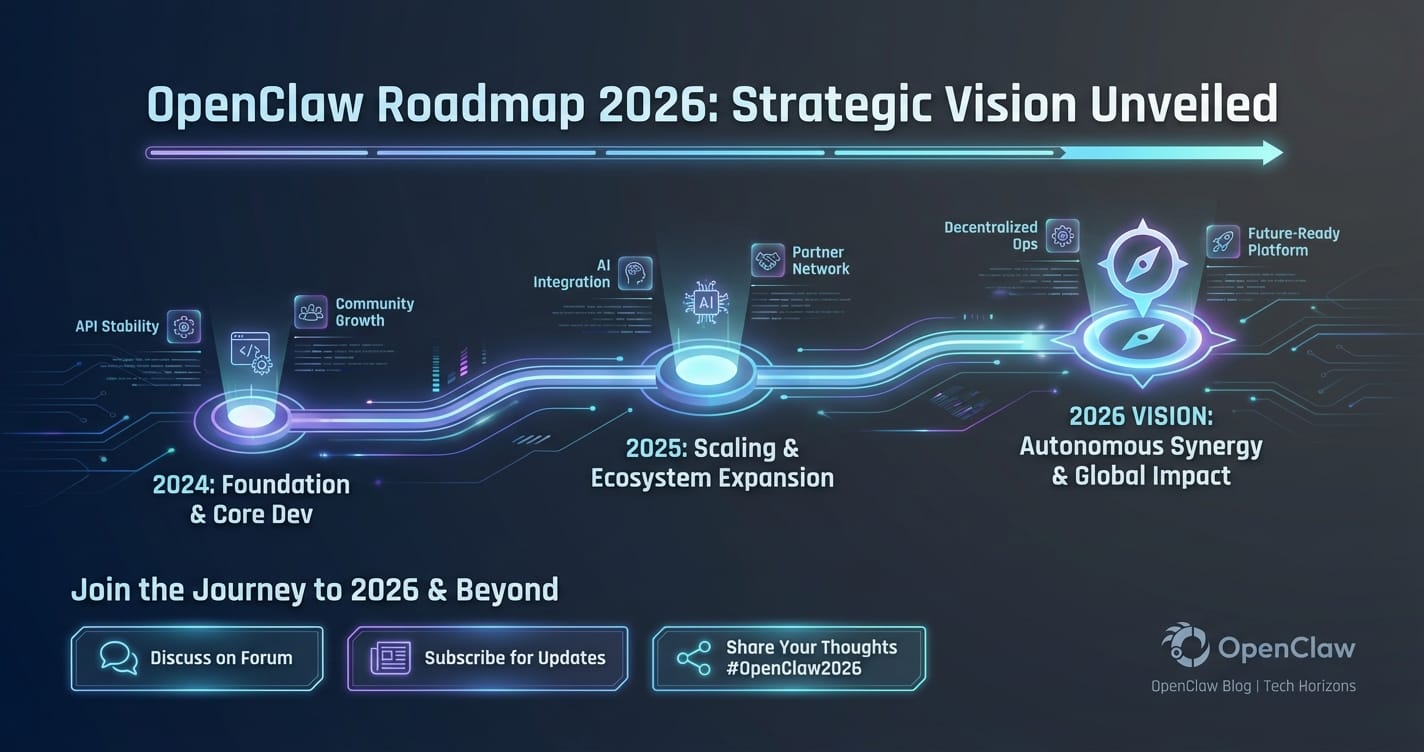
OpenClaw Roadmap 2026: Strategic Vision Unveiled

The landscape of artificial intelligence is in a perpetual state of flux, characterized by breathtaking innovation and increasingly complex technological ecosystems. As we stand on the precipice of a new era, OpenClaw – a name synonymous with cutting-edge AI infrastructure – is proud to unveil its ambitious OpenClaw Roadmap 2026. This strategic vision is not merely an incremental upgrade; it represents a fundamental re-imagining of how developers, businesses, and researchers interact with and harness the power of AI. Our roadmap outlines a future where the complexities of integrating diverse models and managing intricate API connections are replaced by seamless efficiency, unparalleled flexibility, and intelligent optimization.
At its core, the OpenClaw Roadmap 2026 is built upon three transformative pillars: the establishment of a truly Unified API, offering robust Multi-model support, and pioneering intelligent LLM routing. These foundational elements are designed to dismantle existing barriers, accelerate innovation, and democratize access to advanced AI capabilities for a global audience. This document delves into the intricacies of each pillar, exploring the technological advancements, strategic implications, and the profound impact these innovations will have on the broader AI ecosystem. We invite you to explore this vision with us, as we chart a course toward an AI future that is more accessible, powerful, and intelligently managed than ever before.
The Strategic Imperative: Why a 2026 Roadmap?
The rapid proliferation of AI models, particularly Large Language Models (LLMs), has created both immense opportunities and significant challenges. While new models emerge almost daily, each boasting unique capabilities and performance characteristics, integrating them into production-grade applications remains a daunting task. Developers grapple with a fragmented ecosystem where different models require disparate APIs, varying authentication methods, and distinct data formats. This fragmentation leads to increased development time, higher maintenance costs, and a steep learning curve that hinders rapid prototyping and agile deployment.
Furthermore, the choice of an AI model is no longer a static decision. What performs optimally today might be surpassed by a newer, more efficient, or more cost-effective model tomorrow. Businesses need the agility to switch between models, or even combine them, without undertaking a complete re-architecture of their applications. The economic realities of AI usage – fluctuating pricing across providers, varying latency based on geographical location, and the sheer computational cost of inference – demand intelligent solutions that go beyond simple API calls.
OpenClaw recognizes these pressing needs. Our 2026 roadmap is a direct response to these market dynamics, designed to solve the critical pain points that impede AI adoption and innovation. We envision a future where:
- Complexity is abstracted away: Developers can focus on building intelligent features rather than managing infrastructure.
- Flexibility is paramount: Applications can seamlessly leverage the best available AI models, adapting to evolving requirements and technological advancements.
- Efficiency is optimized: Costs are minimized, and performance is maximized through intelligent resource allocation.
- Accessibility is universal: Advanced AI tools are within reach for individuals and organizations of all sizes, fostering a new wave of creativity and problem-solving.
This strategic imperative guides every facet of the OpenClaw 2026 roadmap, propelling us towards a unified, intelligent, and developer-friendly AI ecosystem.
Pillar 1: Architecting the Future with a Revolutionary Unified API
The concept of a Unified API stands as the cornerstone of the OpenClaw 2026 vision. In the current fragmented AI landscape, integrating multiple models from different providers often means juggling various SDKs, authentication schemes, and data schemas. This complexity not only slows down development but also introduces potential points of failure and increases the burden of maintenance. OpenClaw’s Unified API aims to obliterate this friction, providing a singular, standardized interface through which developers can access an expansive universe of AI models.
The Vision for a Truly Unified API
Our goal is to create an abstraction layer so robust and intuitive that the underlying model or provider becomes largely irrelevant to the developer. Imagine a scenario where you can swap out one LLM for another, or even combine their capabilities, with minimal code changes. This is the promise of OpenClaw’s Unified API. It’s not just about consolidating endpoints; it’s about standardizing the entire interaction paradigm – from request formatting and response structures to error handling and authentication.
Key characteristics of OpenClaw’s Unified API by 2026:
- Standardized Request/Response Schema: A universal JSON schema for model inputs and outputs, regardless of the specific model or its original API. This includes common parameters for text generation, embeddings, image processing, and more.
- Single Authentication Point: A single API key or token provides access to all integrated models and services, simplifying security management.
- Cross-Model Feature Parity (where applicable): Where models offer similar functionalities (e.g., text completion, summarization), the API will present a consistent interface, mapping underlying model-specific parameters to OpenClaw’s standard.
- Intelligent Parameter Mapping: Our system will intelligently translate developer-friendly parameters into the specific arguments required by individual models, handling nuances and defaults automatically.
- Robust Error Handling: A consistent error structure that provides clear, actionable feedback, abstracting away provider-specific error codes.
- Comprehensive SDKs and Libraries: Native client libraries for popular programming languages (Python, JavaScript, Go, Java, C#) that encapsulate the API’s simplicity.
Benefits for Developers: Beyond Convenience
The advantages of such a Unified API extend far beyond mere convenience:
- Accelerated Development: Developers spend less time on integration headaches and more time on building innovative applications. Rapid prototyping becomes a reality, enabling faster iteration cycles.
- Reduced Technical Debt: Standardized integrations mean less bespoke code, fewer dependencies to manage, and a more maintainable codebase over time.
- Future-Proofing Applications: As new and improved models emerge, they can be seamlessly integrated into OpenClaw’s platform without requiring developers to rewrite significant portions of their applications. This ensures that applications can always leverage the state-of-the-art.
- Enhanced Portability: Applications built on OpenClaw’s Unified API become inherently more portable across different models and even different cloud environments, reducing vendor lock-in.
- Cost Efficiency in Development: Less development time translates directly into lower development costs. Moreover, the ability to switch models efficiently contributes to operational cost savings, as we will explore in the context of LLM routing.
Technical Deep Dive: OpenClaw's Approach to Abstraction
Implementing a truly unified API is a complex engineering challenge, requiring sophisticated middleware and intelligent orchestration. OpenClaw’s architecture will involve several layers of abstraction:
- Gateway Layer: This is the primary public-facing endpoint, handling incoming requests, authentication, and initial parsing. It’s designed for high throughput and low latency.
- Normalization Layer: This critical layer takes the standardized OpenClaw request format and translates it into the specific request format required by the target AI model or provider. It also handles parameter mapping, default values, and data type conversions.
- Provider Adapter Layer: A set of interchangeable modules, each designed to interact with a specific AI model or provider API. These adapters understand the nuances of each provider’s API and handle the actual communication, including rate limiting, retry mechanisms, and error translation.
- Response Normalization Layer: Before sending a response back to the developer, this layer takes the provider-specific response and transforms it back into the standardized OpenClaw response format, ensuring consistency.
- Telemetry and Monitoring: Throughout this process, extensive logging and performance monitoring will capture metrics on latency, error rates, and usage patterns, feeding into our LLM routing algorithms and providing valuable insights to developers.
This multi-layered approach ensures that OpenClaw can maintain a consistent public API while abstracting away the inherent heterogeneity of the underlying AI model ecosystem.
Comparison: How OpenClaw's Unified API Stands Apart
While the concept of a unified API is gaining traction, OpenClaw's 2026 roadmap envisions a platform that goes deeper, offering more intelligent features and broader coverage. Unlike simpler aggregators, OpenClaw won't just proxy requests; it will actively transform, optimize, and orchestrate them. Our focus is on intelligent context handling, state management across different models, and predictive optimization, setting a new benchmark for what a Unified API can achieve.
This ambition is not without precedent; platforms like XRoute.AI, a cutting-edge unified API platform, have already demonstrated the immense value of streamlining access to large language models (LLMs) for developers. By providing a single, OpenAI-compatible endpoint, XRoute.AI simplifies the integration of over 60 AI models from more than 20 active providers, enabling seamless development of AI-driven applications, chatbots, and automated workflows. With a focus on low latency AI, cost-effective AI, and developer-friendly tools, XRoute.AI empowers users to build intelligent solutions without the complexity of managing multiple API connections. The platform’s high throughput, scalability, and flexible pricing model make it an ideal choice for projects of all sizes, from startups to enterprise-level applications. OpenClaw draws inspiration from such successful paradigms while forging its unique path, aiming for an even more extensive and deeply integrated ecosystem by 2026.
Table 1: Evolution of OpenClaw's API: From Current to 2026 Unified Vision
| Feature/Aspect | OpenClaw (Current) | OpenClaw (2026 Unified API Vision) |
|---|---|---|
| Model Access | Direct API calls to specific models/providers | Single, universal endpoint for all integrated models. |
| API Complexity | Multiple SDKs, varying parameters, disparate docs | Standardized request/response schema, unified parameters, consistent documentation. |
| Integration Time | High, requires specific knowledge for each model | Significantly reduced; "integrate once, access many models." |
| Developer Focus | Managing API intricacies, model-specific nuances | Building application logic, leveraging AI capabilities directly. |
| Switching Models | High effort, potential re-coding, re-testing | Minimal effort, often just a parameter change or intelligent routing decision. |
| Authentication | Potentially multiple API keys per provider | Single, centralized authentication for all models and services. |
| Error Handling | Provider-specific error codes and messages | Standardized, actionable error codes and messages across all models. |
| Cost Optimization | Manual selection or basic provider preferences | Automated, intelligent LLM routing for real-time cost and performance optimization. |
| Future Proofing | Requires re-integration for new models/providers | New models seamlessly integrated into the existing unified structure. |
This table vividly illustrates the quantum leap OpenClaw intends to make, transforming a complex, fragmented interaction model into a streamlined, efficient, and developer-friendly experience.
Pillar 2: Unlocking Unprecedented Flexibility with Multi-Model Support
The AI landscape is not monolithic. Different tasks require different tools, and in the realm of artificial intelligence, this translates to a diverse array of models, each with its unique strengths and weaknesses. A powerful LLM might excel at creative writing, while a smaller, specialized model might be more efficient and accurate for specific classification tasks. An image recognition model is distinct from a sophisticated code generation engine. OpenClaw's 2026 roadmap boldly addresses this reality by placing Multi-model support at its strategic core, promising an unprecedented level of flexibility and capability to developers.
Beyond Homogeneity: The Power of Diversity
Current AI platforms often focus on a limited set of proprietary models or a few dominant open-source frameworks. This approach inherently restricts developers, forcing them to choose between performance, cost, and specific functional requirements. OpenClaw's vision is to break free from these constraints, offering an expansive and ever-growing ecosystem of models accessible through our Unified API.
Why Multi-model support is crucial:
- Optimal Performance for Diverse Tasks: No single model is a panacea. Multi-model support allows developers to select the absolute best tool for each specific sub-task within an application, leading to superior overall performance and accuracy.
- Cost Efficiency: Specialized, smaller models can be significantly more cost-effective for niche tasks than large, general-purpose LLMs. OpenClaw will enable applications to intelligently leverage these more economical options when appropriate.
- Resilience and Redundancy: If one model or provider experiences downtime or performance degradation, applications can seamlessly switch to an alternative, ensuring continuous operation.
- Access to Specialized Capabilities: Beyond general-purpose LLMs, there's a growing need for domain-specific models (e.g., legal, medical, financial AI) or multimodal models (combining text, image, audio). OpenClaw will provide access to this specialized intelligence.
- Innovation and Experimentation: Developers can rapidly experiment with different models and combinations to discover novel solutions without the heavy integration lift typically associated with model switching.
OpenClaw's Strategy for Integrating a Vast Ecosystem
Our approach to Multi-model support is multi-faceted, encompassing proprietary models, leading open-source models, and specialized, community-driven contributions. By 2026, OpenClaw will support:
- Leading LLMs: Integration with major proprietary LLMs (e.g., from OpenAI, Anthropic, Google) and popular open-source LLMs (e.g., Llama variants, Mixtral) will be standard. This includes both cutting-edge models and more established, stable versions.
- Multimodal Models: Seamless integration of models capable of understanding and generating content across different modalities – text-to-image, image captioning, video analysis, audio transcription, and more.
- Specialized AI Models: Access to models tailored for specific tasks such as sentiment analysis, named entity recognition, code generation, summarization, translation, and structured data extraction.
- Foundation Models for Fine-tuning: Providing easy access to powerful base models that developers can fine-tune with their own data directly within the OpenClaw ecosystem, or connect existing fine-tuned models.
- Community and Enterprise Models: A vision for a marketplace where developers and enterprises can contribute or offer their own specialized models, expanding the ecosystem further.
Seamless Switching and Interoperability: A key design principle is the ability to switch between models with minimal friction. The Unified API will allow developers to specify a preferred model by name, capability, or even dynamically based on predefined routing rules. This means a single line of code could switch an application from using one provider's LLM to another's, or to a specialized OpenClaw-hosted model.
Technical Challenges and Solutions for Maintaining Performance and Consistency
Integrating a multitude of models, each with its unique architecture, training data, and inference requirements, presents significant technical challenges:
- Model Versioning and Lifecycle Management: Models are constantly updated. OpenClaw will implement robust versioning strategies, allowing developers to pin to specific model versions for stability while offering easy upgrades to newer iterations. Our platform will manage the lifecycle from integration to deprecation transparently.
- Dependency Management: Different models rely on different libraries, frameworks, and hardware accelerators. OpenClaw's infrastructure will leverage containerization (e.g., Docker, Kubernetes) and serverless functions to isolate model environments, preventing dependency conflicts and ensuring efficient resource allocation.
- Performance Optimization Across Diverse Architectures: Optimizing inference speed and throughput across models running on different hardware (GPUs, TPUs, custom ASICs) and software stacks is critical. OpenClaw will employ advanced techniques such as:
- Dynamic Batching: Grouping requests for simultaneous processing to maximize hardware utilization.
- Model Quantization and Pruning: Techniques to reduce model size and accelerate inference while preserving accuracy.
- Distributed Inference: Spreading model computation across multiple nodes for large or complex models.
- Caching Mechanisms: Storing frequently requested model outputs to reduce redundant computations, particularly for deterministic tasks.
- Consistency in Outputs: While models differ, ensuring a baseline level of consistency in the format of outputs (thanks to the Unified API) is paramount. OpenClaw will provide tools for post-processing model outputs to align them with common standards, offering configurable options for developers.
Expanding the Model Horizon: Beyond 2026
The 2026 roadmap lays the foundation for an endlessly expandable model ecosystem. Post-2026, OpenClaw envisions:
- Hyper-Specialized Models: Support for ultra-niche models trained on very specific datasets, catering to highly specialized industry needs.
- Personalized AI Models: Tools and infrastructure to allow enterprises to deploy and manage highly personalized AI models, fine-tuned on their proprietary data for internal use.
- Federated Learning Integration: Exploring frameworks for collaborative model training without centralizing sensitive data, enhancing privacy and data security.
- Automatic Model Discovery and Recommendation: AI-powered systems that can suggest optimal models for a given task based on performance metrics, cost, and developer preferences.
By embracing this comprehensive Multi-model support, OpenClaw empowers developers to build AI applications that are not only powerful and efficient but also adaptable and future-proof, capable of evolving with the ever-changing tides of AI innovation.
Pillar 3: Intelligent LLM Routing for Optimal Performance and Cost-Efficiency
In the increasingly complex world of AI, merely having access to a multitude of models is no longer sufficient. The true power lies in intelligently choosing the right model for the right task at the right time, optimizing for often conflicting objectives like cost, latency, and accuracy. This is where LLM routing emerges as a critical differentiator in OpenClaw’s 2026 roadmap. It’s the brain behind the brawn, dynamically orchestrating interactions with various models and providers to deliver an unparalleled developer and user experience.
The Art and Science of LLM Routing
LLM routing refers to the automated process of directing an incoming API request to the most suitable underlying Large Language Model or AI service based on a set of predefined and real-time criteria. Without intelligent routing, developers are forced to manually choose a model, often making trade-offs that might not be optimal under fluctuating conditions. OpenClaw’s vision is to make this decision intelligent, automated, and highly configurable.
Why LLM routing is critical:
- Optimizing for Cost: Different models and providers have varying pricing structures. Routing can intelligently select the most cost-effective model that still meets performance and accuracy requirements for a given query. This can lead to substantial savings, especially at scale.
- Minimizing Latency: Geographical proximity to inference servers, current server load, and model size all impact response times. Intelligent routing can direct requests to the fastest available endpoint, crucial for real-time applications.
- Maximizing Accuracy and Quality: Some models excel at specific types of tasks (e.g., code generation vs. creative writing). Routing can ensure that a request is handled by the model best suited for its specific nature, even if multiple models are capable.
- Ensuring Reliability and High Availability: By acting as a load balancer and failover mechanism, routing can redirect requests away from models or providers experiencing issues, maintaining uninterrupted service.
- Handling Rate Limits and Quotas: Providers often impose rate limits. Intelligent routing can distribute requests across multiple providers or queue them strategically to avoid hitting limits and incurring errors.
OpenClaw's Advanced Routing Algorithms
OpenClaw's 2026 roadmap includes sophisticated, AI-powered routing algorithms that learn and adapt in real-time. These algorithms will consider a multitude of factors to make optimal routing decisions:
- Latency-Based Routing:
- Geographical Proximity: Routing requests to the closest available data center or edge location where the model is hosted, minimizing network travel time.
- Real-time Performance Metrics: Continuously monitoring the actual response times, queue lengths, and processing speeds of different models and providers. Requests are then routed to the one with the lowest current latency.
- Predictive Latency: Utilizing historical data and machine learning to predict potential bottlenecks and proactively route around them.
- Cost-Based Routing:
- Dynamic Pricing Models: Integrating with the real-time pricing APIs of various providers. For a given request, the system identifies all capable models and selects the most economical one that satisfies other constraints (e.g., minimum accuracy).
- Budget Constraints: Allowing developers to set budget thresholds or preferences, guiding the routing decisions towards cost-optimized solutions.
- Tiered Pricing Management: Automatically navigating between different pricing tiers or commitment levels to maximize cost efficiency.
- Capability-Based Routing:
- Matching Request Complexity to Model Strengths: Analyzing the input prompt or task type (e.g., summarization, translation, complex reasoning, creative generation) and directing it to the model specifically known for excelling in that area. This leverages OpenClaw's deep understanding of the capabilities of each integrated model.
- Model Versioning: Routing requests to specific model versions if an application relies on particular behaviors or features of an older iteration.
- Load Balancing & Failover:
- Distribution Across Instances: Spreading requests evenly across multiple instances of the same model or across different providers if they offer similar capabilities, preventing any single point of congestion.
- Automatic Failover: Detecting model or provider outages and instantly rerouting traffic to healthy alternatives without service interruption to the end-user.
- Hybrid Routing Strategies: The most powerful aspect of OpenClaw's routing will be its ability to combine these strategies. Developers can define complex routing policies, for example, "prioritize lowest latency, but if the cost difference is negligible, choose the higher accuracy model; if latency exceeds 500ms, failover to a cheaper but slightly slower model."
Transparency and Configurability for Developers
While the routing will be highly automated, OpenClaw recognizes the need for developer control and transparency. Our roadmap includes:
- Declarative Routing Policies: Developers will be able to define routing rules using a simple, declarative language (e.g., YAML or JSON), specifying priorities and fallback mechanisms.
- Routing Observability: Tools to visualize how requests are being routed, including which model was selected, why, and the resulting performance/cost metrics. This allows developers to understand and refine their policies.
- A/B Testing for Routing Strategies: Experimentation platforms within OpenClaw to test different routing policies in a controlled environment, optimizing for specific business outcomes.
Real-world Impact: Use Cases Demonstrating the Value of Intelligent Routing
Consider a few scenarios where OpenClaw’s intelligent LLM routing provides immense value:
- Customer Support Chatbot: For simple FAQ queries, the router sends requests to a smaller, faster, and cheaper LLM. For complex, nuanced questions requiring deep understanding, it routes to a more powerful, potentially more expensive LLM. If the primary LLM provider experiences high latency, the router seamlessly shifts to an alternative.
- Content Generation Platform: When generating short social media posts, the system routes to a cost-optimized model. For long-form articles requiring creative flair, it directs to a premium, high-quality model. For code snippets, it selects a specialized code generation model.
- Global Application Deployment: Users in Europe might have their requests routed to a model hosted on an EU-based server for data residency compliance and lower latency. Users in Asia might be routed to a local provider, optimizing for regional network performance and cost.
Table 2: Key LLM Routing Strategies and Their Primary Objectives
| Routing Strategy | Primary Objective(s) | How it Works | Ideal Use Case |
|---|---|---|---|
| Latency-Based | Minimize response time | Routes to the physically closest or currently fastest-performing model/provider. | Real-time user interactions (chatbots, voice assistants). |
| Cost-Based | Minimize operational expenses | Selects the most economical model/provider that meets minimum quality standards for a given request. | Batch processing, internal tools, cost-sensitive applications. |
| Capability-Based | Maximize accuracy/quality for specific tasks | Matches the request's nature (e.g., summarization, code, creative) to the best-suited model. | Mixed-task applications, specialized content generation. |
| Load Balancing | Ensure service reliability & prevent bottlenecks | Distributes requests across multiple identical or similar models/instances. | High-traffic applications, consistent performance. |
| Failover | Guarantee continuous availability | Automatically redirects requests to a backup model/provider if the primary experiences issues. | Mission-critical applications, disaster recovery. |
| Hybrid (Configurable) | Achieve balance across multiple objectives (cost, latency, quality) | Combines rules from various strategies based on developer-defined policies and real-time conditions. | Any sophisticated AI application with dynamic requirements. |
OpenClaw’s intelligent LLM routing is the engine that drives true efficiency and agility in AI applications. It transforms the daunting task of model selection into an automated, dynamic process, ensuring that applications always leverage the optimal AI resources available, precisely when they need them.
XRoute is a cutting-edge unified API platform designed to streamline access to large language models (LLMs) for developers, businesses, and AI enthusiasts. By providing a single, OpenAI-compatible endpoint, XRoute.AI simplifies the integration of over 60 AI models from more than 20 active providers(including OpenAI, Anthropic, Mistral, Llama2, Google Gemini, and more), enabling seamless development of AI-driven applications, chatbots, and automated workflows.
Pillar 4: Elevating the Developer Experience and Expanding the Ecosystem
The most sophisticated technology is only as impactful as its usability. OpenClaw’s 2026 roadmap places a paramount emphasis on the developer experience (DX), ensuring that the power of our Unified API, Multi-model support, and intelligent LLM routing is not only accessible but also enjoyable and intuitive to wield. This pillar focuses on building a vibrant ecosystem, fostering collaboration, and providing tools that empower developers to innovate at an unprecedented pace.
Developer-Centric Tools and SDKs
A core aspect of a superior DX is providing developers with the right tools that seamlessly integrate with their existing workflows. By 2026, OpenClaw will offer:
- Comprehensive Client SDKs: Officially supported client libraries for a wide range of popular programming languages including Python, JavaScript (Node.js and browser), Go, Java, C#, Ruby, and more. These SDKs will abstract away HTTP requests, handle authentication, and provide idiomatic interfaces to OpenClaw’s Unified API.
- Intuitive CLI (Command Line Interface): A powerful command-line tool for developers to interact with OpenClaw services, manage API keys, monitor usage, test models, and deploy routing policies directly from their terminal.
- Integrated Development Environment (IDE) Plugins: Plugins for popular IDEs (e.g., VS Code, IntelliJ IDEA) that offer features like intelligent code completion for OpenClaw API calls, syntax highlighting, direct access to documentation, and even integrated debugging tools.
- Robust Documentation and Tutorials: A living documentation portal that is comprehensive, easy to navigate, and kept rigorously up-to-date. It will feature:
- Quick Start Guides: To get new users up and running in minutes.
- Detailed API References: Covering every endpoint, parameter, and response field.
- Practical Use Cases and Code Examples: Demonstrating how to leverage OpenClaw for common and advanced AI tasks across various industries.
- Conceptual Guides: Explaining the underlying principles of the Unified API, Multi-model support, and LLM routing.
- Enhanced Debugging and Monitoring Tools:
- Real-time Request/Response Logs: Detailed logs of all API interactions, including the chosen model, routing decisions, latency, and cost.
- Usage Dashboards: Customizable dashboards to visualize API usage, token consumption, expenditure, and performance metrics over time.
- Alerting and Notifications: Configurable alerts for unusual usage patterns, performance degradation, or errors, allowing developers to proactively address issues.
- Playground Environment: An interactive web-based environment where developers can experiment with different models, prompts, and routing policies without writing code, seeing immediate results.
Community and Collaboration
A thriving ecosystem is built on the strength of its community. OpenClaw is committed to fostering a vibrant and supportive community around its platform:
- Developer Forums and Q&A Platforms: Dedicated online spaces where developers can ask questions, share knowledge, report bugs, and connect with OpenClaw experts and peers.
- OpenClaw Community Hub: A central portal for announcements, blog posts, community-contributed examples, and events.
- Hackathons and Challenges: Regularly hosted events to inspire innovation, showcase the platform's capabilities, and gather valuable feedback from the developer community.
- Open-Source Contributions: Where appropriate, OpenClaw will open-source components of its SDKs or tools, encouraging community contributions and transparency.
- Model Marketplace: A platform for model developers to publish and monetize their specialized AI models, making them accessible through OpenClaw’s Unified API. This will democratize model distribution and provide diverse options for users.
Strategic Partnerships
Expanding the ecosystem also means forging strong alliances. OpenClaw’s roadmap includes a proactive strategy for strategic partnerships:
- Cloud Provider Integrations: Deep integration with major cloud platforms (AWS, Azure, GCP) to optimize deployment, leverage existing infrastructure, and offer seamless billing.
- Model Developer Collaborations: Partnering directly with leading AI research labs and model creators to ensure early access to cutting-edge models and seamless integration into the OpenClaw platform.
- Enterprise Solution Providers: Collaborating with system integrators and enterprise software vendors to bring OpenClaw’s capabilities to large organizations, accelerating their AI transformation initiatives.
- Academic and Research Collaborations: Working with universities and research institutions to advance AI methodology, develop new routing algorithms, and contribute to ethical AI practices.
By focusing relentlessly on the developer experience, nurturing a strong community, and forging strategic alliances, OpenClaw aims to create an AI ecosystem that is not only technologically advanced but also exceptionally welcoming and empowering for everyone involved. This comprehensive approach ensures that the true potential of the OpenClaw 2026 roadmap is realized through widespread adoption and continuous innovation from its users.
Pillar 5: Security, Compliance, and the Ethical Fabric of AI
As AI systems become increasingly powerful and integrated into critical applications, the imperatives of security, data privacy, and ethical deployment rise to the forefront. The OpenClaw Roadmap 2026 fundamentally recognizes that technological advancement must go hand-in-hand with robust safeguards and a steadfast commitment to responsible AI. This pillar outlines our comprehensive strategy to ensure the OpenClaw platform is secure by design, compliant with global regulations, and fosters the ethical development and use of AI.
Robust Security Frameworks
Security is not an afterthought; it is woven into the very architecture of OpenClaw’s platform. Our multi-layered security strategy will encompass:
- Data Encryption:
- Encryption in Transit: All data transmitted to and from OpenClaw's API will be encrypted using industry-standard TLS 1.2+ protocols, protecting against eavesdropping and tampering.
- Encryption at Rest: All sensitive data stored within OpenClaw’s infrastructure (e.g., API keys, cached model outputs, logs) will be encrypted using AES-256 or equivalent standards, protecting against unauthorized access.
- Access Controls and Identity Management:
- Role-Based Access Control (RBAC): Granular permissions will ensure that users and applications only have access to the resources and functionalities they absolutely need.
- Multi-Factor Authentication (MFA): Mandatory MFA for all administrative access and recommended for all user accounts, adding an extra layer of security.
- API Key Management: Secure generation, rotation, and revocation of API keys, with strict policies for storage and usage.
- Network Security:
- Firewalls and Intrusion Detection Systems (IDS/IPS): Implementing robust network security measures to monitor and filter incoming and outgoing network traffic, detecting and preventing malicious activities.
- Vulnerability Scanning and Penetration Testing: Regular, automated, and manual security audits conducted by internal teams and third-party experts to identify and mitigate potential vulnerabilities before they can be exploited.
- Incident Response Plan: A well-defined and regularly tested incident response plan to quickly detect, contain, eradicate, and recover from any security breaches, minimizing impact and ensuring transparency.
- Supply Chain Security: Extending security scrutiny to our integrated model providers and underlying cloud infrastructure partners, ensuring their security practices meet OpenClaw’s high standards.
Navigating Regulatory Landscapes
The global regulatory environment for data privacy and AI is rapidly evolving. OpenClaw is committed to proactive compliance, ensuring our platform adheres to the highest standards worldwide.
- Global Data Protection Regulations:
- GDPR (General Data Protection Regulation): Ensuring compliance with EU data protection laws, particularly regarding data residency, data minimization, and user rights (e.g., right to access, rectification, erasure).
- CCPA/CPRA (California Consumer Privacy Act/California Privacy Rights Act): Adhering to California’s stringent privacy regulations, providing consumers with control over their personal information.
- Other Regional Regulations: Continuously monitoring and adapting to emerging data privacy laws in various jurisdictions (e.g., LGPD in Brazil, PIPEDA in Canada, sector-specific regulations).
- AI-Specific Regulatory Compliance: Actively tracking and preparing for anticipated AI regulations (e.g., EU AI Act, proposed US AI legislation) that will govern transparency, risk assessment, and accountability in AI systems.
- Data Minimization and Anonymization: Implementing policies and tools to minimize the collection of personal data and to anonymize or pseudonymize data wherever possible, reducing privacy risks.
- Audit Trails and Logging: Comprehensive, immutable audit trails of all data processing activities, enabling transparency and accountability for compliance purposes.
Ethical AI and Responsible Model Deployment
Beyond legal compliance, OpenClaw is dedicated to fostering the ethical development and deployment of AI. This commitment is reflected in several key areas:
- Bias Detection and Mitigation:
- Model Evaluation Frameworks: Providing tools and guidelines for developers to evaluate integrated models for potential biases in their outputs (e.g., fairness metrics, demographic parity).
- Bias Mitigation Techniques: Integrating access to techniques and research that can help developers identify and reduce biases in their data and models, ensuring more equitable and fair AI systems.
- Transparency and Explainability (XAI):
- Feature Importance Tools: Offering mechanisms to understand which input features or prompt elements most influenced a model’s output, enhancing interpretability.
- Model Cards/Fact Sheets: Encouraging and supporting the creation of "model cards" for all integrated models, detailing their training data, intended use, limitations, and potential biases, promoting transparency.
- Confidence Scores: Where applicable, providing confidence scores alongside model outputs, giving developers insights into the reliability of predictions.
- Human Oversight and Accountability: Designing systems that facilitate human review and intervention, ensuring that critical AI decisions are subject to appropriate oversight. The OpenClaw platform will support logging of human feedback to continuously improve model performance and ethical alignment.
- Preventing Misuse: Developing policies and mechanisms to identify and prevent the malicious or harmful use of AI models accessed through OpenClaw, including generation of hate speech, misinformation, or illegal content. This includes content moderation APIs and usage policy enforcement.
- Stakeholder Engagement: Actively engaging with ethical AI researchers, policymakers, and civil society organizations to refine our ethical guidelines and contribute to the broader discourse on responsible AI.
Table 3: OpenClaw's Commitment to Security, Compliance, and Ethical AI
| Aspect | OpenClaw 2026 Commitment | Impact on Developers/Users |
|---|---|---|
| Data Security | End-to-end encryption (in transit & at rest), robust access controls, regular pen testing. | Peace of mind regarding data privacy and integrity; protected intellectual property. |
| Privacy Compliance | Adherence to GDPR, CCPA, and other global data privacy laws; data minimization and anonymization principles. | Facilitates compliance for developer applications; ensures user data is handled responsibly. |
| Ethical AI | Tools for bias detection/mitigation, transparency (XAI), human oversight, and clear usage policies. | Enables creation of fair, unbiased, and responsible AI applications; builds public trust. |
| System Resilience | High availability architecture, automated failover, comprehensive incident response. | Ensures uninterrupted service, even during unexpected events; reliable platform for critical applications. |
| Trust & Transparency | Detailed logging, audit trails, model cards, engagement with ethical AI community. | Provides visibility into AI system behavior; fosters trust in AI-driven decisions. |
By meticulously addressing security, compliance, and ethical considerations, OpenClaw aims to build a platform that is not only powerful and efficient but also fundamentally trustworthy. Our 2026 roadmap reflects a deep understanding that the future of AI depends not just on what we can build, but on how responsibly we choose to build and deploy it.
Strategic Implications and Market Transformation
The unveiling of the OpenClaw Roadmap 2026 is more than a technical announcement; it is a declaration of intent to fundamentally reshape the AI landscape. By committing to a Unified API, expansive Multi-model support, and intelligent LLM routing, OpenClaw is positioning itself as an indispensable nexus in the global AI ecosystem. This strategic vision carries profound implications, promising to transform how AI is developed, deployed, and experienced across industries.
Positioning OpenClaw: Redefining the Competitive Landscape for AI Platforms
In a crowded market filled with proprietary AI solutions and disparate open-source tools, OpenClaw aims to carve out a unique and dominant position. Our strategic differentiation stems from:
- Vendor Agnostic Orchestration: Unlike single-vendor platforms, OpenClaw acts as an intelligent orchestrator across all major AI providers and open-source models. This removes vendor lock-in and provides unparalleled flexibility.
- Developer-First Philosophy: By rigorously focusing on the developer experience – simplifying complex integrations and automating tedious decisions – OpenClaw becomes the preferred choice for engineers seeking efficiency and rapid innovation.
- Cost-Performance Optimization: The intelligent LLM routing capabilities mean OpenClaw isn't just a gateway; it's an optimization engine that continuously seeks the best balance between performance and cost for every single request. This is a crucial value proposition for businesses operating at scale.
- Future-Proofing AI Investments: Developers building on OpenClaw can rest assured that their applications will remain adaptable to future AI breakthroughs, as new models and providers can be seamlessly integrated into the unified framework. This protects long-term AI investments.
- Catalyst for AI Democratization: By lowering the barriers to entry, OpenClaw accelerates the adoption of advanced AI by a broader audience, from individual developers to small startups and even non-technical business units within large enterprises.
This strategic positioning moves OpenClaw beyond being merely an API provider to becoming a critical piece of infrastructure, much like cloud providers themselves, but specifically tailored for the AI layer.
Benefits for Diverse Stakeholders
The transformative nature of the OpenClaw 2026 roadmap extends benefits across the entire spectrum of AI stakeholders:
- For Startups and Innovators:
- Rapid Prototyping: The Unified API dramatically reduces the time and effort required to integrate advanced AI capabilities, allowing startups to build and iterate on AI-driven products much faster.
- Cost Efficiency: Intelligent LLM routing ensures that initial development and scaling are highly cost-effective, leveraging the most economical models without sacrificing performance.
- Access to Enterprise-Grade AI: Small teams gain access to a diverse portfolio of cutting-edge models that would otherwise be difficult or prohibitively expensive to manage individually.
- For Enterprises and Large Organizations:
- Scalable and Robust Solutions: OpenClaw provides a reliable, high-throughput platform for integrating AI into mission-critical enterprise applications, handling massive volumes of requests.
- Centralized AI Governance: The unified platform offers a single point of control for managing AI models, API keys, usage policies, and compliance across an entire organization.
- Enhanced Security and Compliance: Built-in security features and a strong commitment to regulatory compliance simplify the integration of AI into regulated industries.
- Optimized Resource Utilization: Intelligent routing allows enterprises to optimize their AI spend, ensuring they always use the most efficient model for each task across their diverse operations.
- Accelerated Digital Transformation: OpenClaw empowers enterprises to embed advanced AI capabilities into their products, services, and internal workflows more quickly and effectively, driving innovation and competitive advantage.
- For Researchers and Academics:
- Access to Diverse Models: Researchers gain easy access to a broad spectrum of proprietary and open-source models, facilitating comparative studies and novel experimental designs.
- Reduced Infrastructure Overhead: They can focus on AI research and discovery rather than spending time on complex model integration and infrastructure management.
- Platform for Innovation: OpenClaw can serve as a powerful platform for testing new algorithms, fine-tuning models, and validating research findings in a real-world environment.
- For Model Developers and Providers:
- Broader Distribution: OpenClaw provides a new, extensive channel for model developers to distribute and monetize their innovations to a global audience.
- Simplified Integration: Model providers can integrate once with OpenClaw’s abstraction layer and immediately gain access to a vast network of developers and enterprises.
The Future of AI Development: How OpenClaw Will Accelerate Innovation
By dismantling the technical and operational barriers to AI adoption, OpenClaw will become a significant accelerator of innovation.
- Lowering the Barrier to Entry: More developers, startups, and enterprises will be able to leverage AI without deep specialized knowledge in every model's nuances. This will lead to an explosion of AI-powered applications across new domains.
- Fostering Experimentation: The ease of switching between models and dynamic routing encourages developers to experiment with different AI approaches, leading to more creative and effective solutions.
- Democratizing Access to State-of-the-Art: Even smaller players will be able to access and utilize the most advanced AI models, leveling the playing field and fostering more equitable innovation.
- Driving a New Era of AI Composability: OpenClaw enables the seamless combination of multiple AI models, creating powerful, composite AI systems that can perform complex, multi-stage reasoning and generation. This moves beyond single-model applications to truly intelligent workflows.
- Shifting Focus to Value Creation: With OpenClaw handling the infrastructure and optimization complexities, developers can shift their focus from 'how to integrate' to 'what to build', dedicating more time to solving real-world problems and creating tangible value.
The OpenClaw Roadmap 2026 is not just a plan for a product; it is a vision for a transformed AI ecosystem – one that is more open, intelligent, efficient, and ultimately, more capable of driving the next wave of global innovation.
Addressing Challenges and Future-Proofing the Roadmap
No ambitious vision is without its inherent challenges. The dynamic nature of the AI industry, coupled with the technical complexities of building a platform of OpenClaw's proposed scale, necessitates a proactive approach to risk mitigation and future-proofing. Our 2026 roadmap is designed with these considerations firmly in mind, ensuring resilience, adaptability, and sustained relevance.
1. Technological Evolution: Adapting to New Models and Research Breakthroughs
The pace of AI research and development is relentless. New models emerge frequently, often demonstrating superior performance, novel capabilities, or significant efficiency gains. A major challenge for OpenClaw is ensuring its platform remains agile enough to integrate these advancements swiftly without disrupting existing applications.
- Mitigation Strategy:
- Modular Architecture: The underlying architecture, particularly the Provider Adapter Layer for the Unified API, is designed to be highly modular. This allows for rapid development and deployment of new adapters for new models or providers with minimal impact on the core system.
- Automated Integration Pipelines: Investing in automated pipelines for model integration, including testing, performance benchmarking, and documentation generation, to accelerate the onboarding of new AI capabilities.
- Active Research and Partnerships: Maintaining strong relationships with leading AI research institutions and model developers ensures early awareness of emerging technologies and facilitates smoother integration processes.
- Versioning Strategy: A robust model versioning system will allow developers to explicitly choose which model version to use, providing stability for production applications while allowing for experimentation with newer, potentially unstable, versions.
2. Scalability Demands: Ensuring the Infrastructure Can Handle Exponential Growth
As OpenClaw's Unified API gains traction and intelligent LLM routing becomes central to countless applications, the platform will face immense demands for scalability – handling millions, if not billions, of requests per day with low latency.
- Mitigation Strategy:
- Cloud-Native Architecture: Built entirely on scalable cloud-native principles, leveraging microservices, container orchestration (Kubernetes), and serverless functions that can automatically scale horizontally based on demand.
- Distributed Systems Design: Implementing geographically distributed data centers and edge nodes to minimize latency and ensure redundancy.
- Optimized Data Planes: Continuously optimizing the data path for inference requests, employing techniques like dynamic batching, GPU acceleration, and efficient network protocols.
- Predictive Scaling: Utilizing machine learning to predict usage patterns and proactively scale resources up or down, optimizing both performance and cost.
- Capacity Planning and Load Testing: Regular, rigorous load testing and capacity planning exercises to identify bottlenecks and ensure the infrastructure can meet anticipated future demands.
3. Maintaining Trust: Continuous Efforts in Security, Privacy, and Ethics
As detailed in Pillar 5, security, privacy, and ethical considerations are paramount. However, maintaining trust is an ongoing process, especially as regulations evolve and new threats emerge.
- Mitigation Strategy:
- Continuous Security Monitoring: Implementing 24/7 real-time security monitoring, intrusion detection, and anomaly detection systems to identify and respond to threats immediately.
- Regular Compliance Audits: Conducting frequent internal and external audits to ensure ongoing adherence to global data protection and emerging AI regulations.
- Transparent Communication: Being transparent with users about data handling practices, security incidents (if they occur), and ethical AI policies.
- Ethical AI Review Board: Establishing an internal or external ethical AI review board to guide platform development, model integration, and policy decisions, ensuring alignment with responsible AI principles.
- User Education: Providing resources and guidelines for developers on how to responsibly use AI models, mitigate bias in their applications, and protect user data.
4. Interoperability and Ecosystem Cohesion
Ensuring that a vast array of models from different providers can truly work together seamlessly, maintaining consistent quality and performance, is a significant challenge.
- Mitigation Strategy:
- Rigorous API Standardization: Continuously refining the Unified API schema to cover new model types and functionalities while maintaining backward compatibility.
- Comprehensive Testing Frameworks: Developing automated test suites to validate model integrations, ensure consistent output formats, and benchmark performance across different providers.
- Semantic Interoperability: Investing in research and development to enable models to not just exchange data, but to understand and act upon the meaning of that data across different contexts.
- Feedback Loops: Implementing strong feedback mechanisms from developers to quickly identify and address any interoperability issues or inconsistencies.
The OpenClaw Roadmap 2026 is not a static document but a living strategy. By anticipating these challenges and embedding proactive mitigation strategies into our core philosophy and architecture, we aim to build a platform that is not only powerful and transformative today but also robust, adaptable, and trustworthy for the foreseeable future. Our commitment is to continuous improvement, ensuring that OpenClaw remains at the forefront of AI innovation and reliability.
Conclusion: OpenClaw 2026 – A Vision Realized
The OpenClaw Roadmap 2026 represents a bold and transformative leap forward in the journey of artificial intelligence. We envision a future where the current fragmentation and complexity of the AI landscape are replaced by a streamlined, intelligent, and highly accessible ecosystem. By meticulously engineering a truly Unified API, championing extensive Multi-model support, and pioneering intelligent LLM routing, OpenClaw is set to dismantle the barriers that have long constrained AI development.
This strategic vision is more than just a collection of technical features; it is a commitment to empowering every developer, every business, and every researcher with the tools they need to harness the full, unbridled potential of AI. We believe that by abstracting away the operational complexities, optimizing for both performance and cost, and fostering an environment of ethical and secure innovation, OpenClaw will not only accelerate the pace of AI adoption but also inspire a new generation of groundbreaking applications.
From startups rapidly prototyping their next big idea to global enterprises deploying mission-critical AI solutions, the OpenClaw platform will serve as the intelligent backbone, ensuring agility, efficiency, and reliability. We are creating a future where the choice of an AI model is a strategic decision, not an integration headache; where the power of diverse AI capabilities is at your fingertips, and where innovation is limited only by imagination.
We invite you to join us on this exciting journey. Explore the possibilities, leverage the power, and contribute to a future where AI is truly for everyone. The OpenClaw Roadmap 2026 is not merely a plan; it is an invitation to build the future, together.
FAQ (Frequently Asked Questions)
Q1: What is the core philosophy behind OpenClaw's 2026 roadmap?
A1: The core philosophy is to simplify and democratize access to advanced AI. We aim to abstract away the complexity of integrating diverse AI models, optimize their usage for cost and performance, and provide a secure, ethical, and developer-friendly platform. Our goal is to enable developers to focus on building innovative applications rather than managing infrastructure.
Q2: How does the Unified API benefit developers compared to existing solutions?
A2: The Unified API dramatically reduces development time and technical debt by providing a single, standardized interface for accessing a multitude of AI models. Instead of learning different APIs, authentication methods, and data formats for each model, developers integrate once with OpenClaw. This allows for rapid prototyping, easier model switching, future-proofed applications, and ensures a consistent development experience across all integrated AI services.
Q3: What kind of models will OpenClaw's Multi-model support encompass by 2026?
A3: By 2026, OpenClaw will offer comprehensive Multi-model support, including leading proprietary LLMs, popular open-source LLMs (like Llama variants), multimodal models (text-to-image, video analysis), and specialized AI models for tasks such as sentiment analysis, code generation, translation, and structured data extraction. We also envision a marketplace for community and enterprise-contributed models.
Q4: How will OpenClaw's LLM routing optimize my application's performance and cost?
A4: OpenClaw's intelligent LLM routing dynamically selects the most suitable model or provider for each request based on real-time criteria. It optimizes for factors like lowest latency (routing to the fastest server), lowest cost (selecting the most economical model), and highest accuracy (matching the request to the best-suited model for the task). This automation ensures your applications always leverage optimal AI resources, reducing operational costs and enhancing user experience without manual intervention.
Q5: What are OpenClaw's plans for ensuring ethical AI and data privacy?
A5: OpenClaw is deeply committed to ethical AI and data privacy. Our plans include robust security frameworks with end-to-end encryption, strict access controls, and regular penetration testing. We ensure compliance with global data protection regulations like GDPR and CCPA. Furthermore, we provide tools for bias detection and mitigation, promote transparency through explainable AI (XAI) features, and maintain clear usage policies to prevent misuse, all guided by an active engagement with the ethical AI community.
🚀You can securely and efficiently connect to thousands of data sources with XRoute in just two steps:
Step 1: Create Your API Key
To start using XRoute.AI, the first step is to create an account and generate your XRoute API KEY. This key unlocks access to the platform’s unified API interface, allowing you to connect to a vast ecosystem of large language models with minimal setup.
Here’s how to do it: 1. Visit https://xroute.ai/ and sign up for a free account. 2. Upon registration, explore the platform. 3. Navigate to the user dashboard and generate your XRoute API KEY.
This process takes less than a minute, and your API key will serve as the gateway to XRoute.AI’s robust developer tools, enabling seamless integration with LLM APIs for your projects.
Step 2: Select a Model and Make API Calls
Once you have your XRoute API KEY, you can select from over 60 large language models available on XRoute.AI and start making API calls. The platform’s OpenAI-compatible endpoint ensures that you can easily integrate models into your applications using just a few lines of code.
Here’s a sample configuration to call an LLM:
curl --location 'https://api.xroute.ai/openai/v1/chat/completions' \
--header 'Authorization: Bearer $apikey' \
--header 'Content-Type: application/json' \
--data '{
    "model": "gpt-5",
    "messages": [
        {
            "content": "Your text prompt here",
            "role": "user"
        }
    ]
}'
With this setup, your application can instantly connect to XRoute.AI’s unified API platform, leveraging low latency AI and high throughput (handling 891.82K tokens per month globally). XRoute.AI manages provider routing, load balancing, and failover, ensuring reliable performance for real-time applications like chatbots, data analysis tools, or automated workflows. You can also purchase additional API credits to scale your usage as needed, making it a cost-effective AI solution for projects of all sizes.
Note: Explore the documentation on https://xroute.ai/ for model-specific details, SDKs, and open-source examples to accelerate your development.