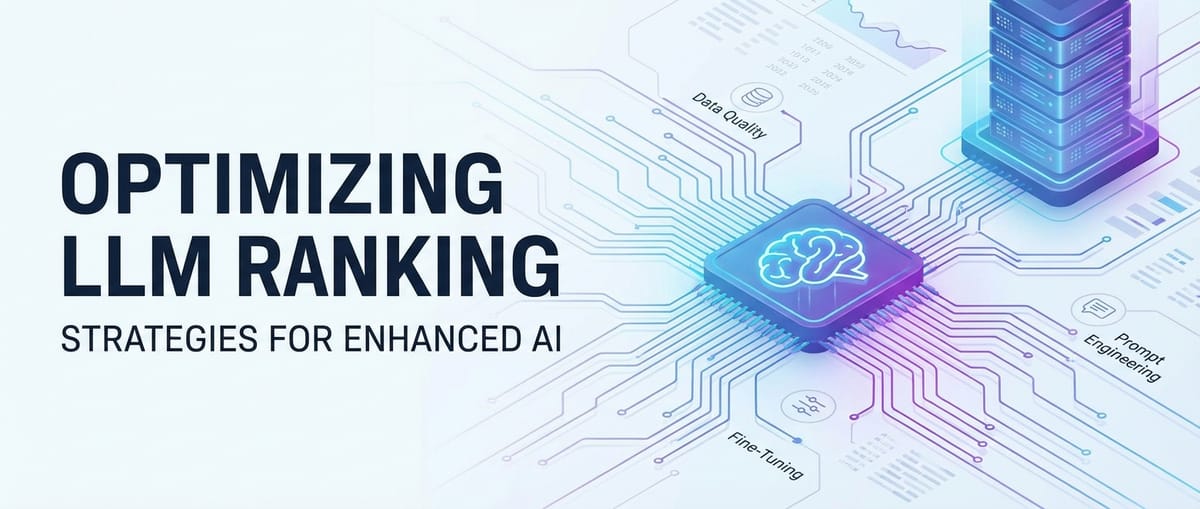
Optimizing LLM Ranking: Strategies for Enhanced AI

In the rapidly evolving landscape of artificial intelligence, Large Language Models (LLMs) have emerged as pivotal tools, transforming everything from content generation and customer service to complex data analysis and scientific research. The efficacy of these powerful models, however, is not solely determined by their raw computational power or the sheer volume of data they are trained on. A critical, often underestimated, factor in their real-world utility is the ability to effectively rank and present information—a process we broadly refer to as llm ranking. This refers to the intelligent prioritization and presentation of outputs, whether it's the most relevant search result, the most appropriate conversational response, or the most accurate piece of synthesized information.
Optimizing llm ranking is paramount for several reasons. Firstly, it directly impacts user experience; a well-ranked response feels intuitive, helpful, and intelligent, while a poorly ranked one leads to frustration and mistrust. Secondly, it dictates the efficiency and effectiveness of AI-driven applications, ensuring that resources are utilized to deliver maximum value. This article delves deep into the multifaceted strategies for enhancing llm ranking, meticulously exploring techniques for both Performance optimization and Cost optimization. We aim to provide a comprehensive guide for developers, researchers, and businesses looking to harness the full potential of LLMs, ensuring their AI systems are not only intelligent but also efficient, agile, and economically viable.
The journey to superior llm ranking involves a delicate balance between achieving peak accuracy and relevance (Performance optimization) and managing the significant computational and financial resources required (Cost optimization). As LLMs grow in size and complexity, these optimization efforts become not just desirable, but absolutely essential for sustainable and impactful AI deployment.
Understanding the Core of LLM Ranking: Beyond Simple Output
At its heart, llm ranking is the process of ordering, prioritizing, and selecting the most pertinent, accurate, or contextually appropriate output from an LLM. This isn't just about what the LLM generates, but how that generation is presented and chosen, especially when multiple possibilities exist or when the LLM is used in conjunction with retrieval systems. The concept of llm ranking manifests in various critical applications:
- Retrieval-Augmented Generation (RAG): Here, llm ranking is crucial for selecting the most relevant documents or passages from a vast corpus to inform the LLM's response. A poor ranking of retrieved documents can lead to hallucination or irrelevant answers, despite the LLM's inherent capabilities.
- Search and Recommendation Systems: LLMs can process queries and document content in sophisticated ways, but the ultimate utility comes from ranking the search results or recommendations in an order that aligns with user intent and preferences.
- Conversational AI and Chatbots: In a dialogue, the LLM might generate several plausible responses. LLM ranking helps choose the most coherent, contextually appropriate, and helpful reply, steering the conversation effectively.
- Information Extraction and Summarization: When extracting entities or summarizing long texts, llm ranking might involve prioritizing the most salient points or ensuring the extracted information aligns with specific criteria.
The importance of effective llm ranking cannot be overstated. It is the bridge between raw LLM output and actionable intelligence. Without it, even the most advanced LLMs can struggle to deliver consistent value, leading to diminished user trust, increased operational costs due to unnecessary computational cycles, and ultimately, a failure to meet application objectives. Achieving excellence in this domain requires a deep understanding of underlying mechanisms, rigorous evaluation, and a strategic approach to both Performance optimization and Cost optimization.
Foundational Principles Driving Effective LLM Ranking
Before delving into specific optimization strategies, it’s imperative to establish the foundational principles that underpin any successful llm ranking system. These principles serve as the bedrock upon which all subsequent optimizations are built.
1. Data Quality and Preparation: The Bedrock of Relevance
The adage "garbage in, garbage out" holds profoundly true for LLMs and their ranking capabilities. The quality, relevance, and cleanliness of the data used throughout the LLM lifecycle—from pre-training to fine-tuning and retrieval—directly influence the effectiveness of llm ranking.
- Training Data: If the LLM itself is trained on biased, outdated, or noisy data, its inherent understanding and ability to discern relevance will be compromised. While pre-trained models are vast, domain-specific fine-tuning data must be meticulously curated.
- Retrieval Corpus: For RAG systems, the quality and structure of the external knowledge base are paramount. Documents should be accurate, up-to-date, semantically coherent, and free from duplication. Poorly indexed or unstructured data will inevitably hinder the retriever's ability to fetch relevant chunks, making effective llm ranking a futile exercise.
- Annotation and Labeling: For supervised llm ranking models (e.g., learning-to-rank models), high-quality human annotations are indispensable. These labels provide the ground truth for what constitutes a "good" or "bad" ranking, allowing the model to learn preferences.
Effective data preparation involves rigorous cleaning, deduplication, normalization, and, where necessary, semantic chunking for retrieval systems. This foundational step is often labor-intensive but yields significant dividends in the long-term Performance optimization of llm ranking.
2. Feature Engineering for Ranking Models: Context is King
Beyond the raw text, the judicious use of features can dramatically enhance the ability of a model to perform llm ranking. While LLMs can implicitly learn many features, explicitly engineered features often provide valuable signals that are difficult for large models to extract efficiently or consistently.
- Query-Document Features:
- Keyword Overlap: Simple count or TF-IDF based overlaps between query and document.
- Semantic Similarity: Embeddings-based cosine similarity between query and document chunks.
- Entity Recognition: Shared entities (persons, organizations, locations) between query and document.
- Temporal Features: Recency of the document or information relative to the query.
- Document-Specific Features:
- Authority/Quality Scores: PageRank-like scores, citation counts, expert ratings.
- Document Length: Shorter documents might be preferred for concise answers, longer for detailed ones.
- Document Type: Distinguishing between articles, FAQs, product pages, etc.
- User-Specific Features (for personalized ranking):
- Past Interactions: User click history, previous queries, preferences.
- Demographics: If available and ethically permissible.
Thoughtful feature engineering can significantly reduce the complexity an LLM needs to resolve, leading to more precise llm ranking and contributing directly to Performance optimization.
3. Model Selection and Architectural Choices: Tailoring the Solution
The choice of LLM and the overall architecture of the ranking system are pivotal. There isn't a one-size-fits-all solution; the best approach depends on the specific task, available resources, and desired trade-offs between performance and cost.
- Fine-tuning vs. Prompt Engineering:
- Prompt Engineering: Adapting pre-trained LLMs through clever prompting (few-shot, chain-of-thought) can be a fast and cost-effective way to achieve reasonable llm ranking. It offers flexibility and quick iteration.
- Fine-tuning: For domain-specific tasks requiring high accuracy and consistency, fine-tuning a smaller LLM on a relevant dataset can yield superior llm ranking performance. While more resource-intensive initially, it can lead to better Cost optimization in the long run by using smaller models more effectively.
- Ensemble Approaches: Combining multiple ranking signals or models (e.g., a simple keyword match, a semantic similarity model, and an LLM re-ranker) can often outperform individual components. This leverages the strengths of different models while mitigating their weaknesses, enhancing overall llm ranking robustness.
These foundational principles lay the groundwork. Neglecting any of them can undermine even the most sophisticated optimization efforts. A holistic approach, beginning with these core tenets, is crucial for building resilient and highly effective llm ranking systems.
Strategies for Performance Optimization in LLM Ranking
Achieving peak performance in llm ranking means maximizing the accuracy, relevance, and responsiveness of the system. This involves a spectrum of techniques, from sophisticated prompt engineering to advanced model architecture and deployment strategies.
1. Advanced Prompt Engineering Techniques
Prompt engineering is the art and science of crafting inputs to LLMs to elicit desired outputs. For llm ranking, this translates to guiding the LLM to identify and prioritize information effectively.
- Few-Shot Learning: Providing the LLM with a few examples of well-ranked items and their explanations allows it to generalize and apply similar ranking logic to new inputs. This significantly improves the LLM's understanding of "what good ranking looks like" for a specific task.
- Chain-of-Thought (CoT) Prompting: By instructing the LLM to "think step-by-step" or explain its reasoning process for ranking, you can guide it towards more logical and accurate decisions. This is particularly effective for complex ranking tasks where multiple criteria need to be considered.
- Self-Consistency: This technique involves prompting the LLM multiple times with the same query or slightly varied prompts to generate several ranking candidates. A subsequent voting mechanism or aggregation step then determines the final, most consistent ranking, reducing the impact of individual LLM "mistakes."
- Role-Play Prompting: Assigning the LLM a specific persona (e.g., "You are an expert financial analyst ranking investment opportunities") can help it adopt the appropriate contextual understanding and bias for a particular llm ranking task.
- Context Compression: For tasks involving long contexts, instead of feeding the entire raw text, specific instructions can be given to the LLM to first summarize or extract key entities before performing the ranking, reducing noise and focusing the LLM on salient information.
These techniques, when applied judiciously, can significantly enhance the accuracy and precision of llm ranking without necessarily requiring model fine-tuning, offering a rapid path to Performance optimization.
2. Model Fine-tuning and Adaptation
While prompt engineering offers flexibility, fine-tuning an LLM allows for deeper, more specialized adaptation to specific llm ranking tasks or domains.
- Domain-Specific Fine-tuning: Training a pre-trained LLM on a smaller, highly relevant dataset from a particular industry (e.g., legal documents, medical research) helps it understand the nuances, terminology, and implicit ranking criteria of that domain. This leads to superior llm ranking for specialized queries.
- Parameter-Efficient Fine-tuning (PEFT) Methods: Techniques like LoRA (Low-Rank Adaptation) and Adapters allow for fine-tuning only a small subset of the LLM's parameters, rather than the entire model. This significantly reduces computational costs and time while still achieving substantial improvements in llm ranking performance. PEFT is a powerful tool for striking a balance between Performance optimization and Cost optimization.
- Instruction Tuning: Fine-tuning an LLM specifically on datasets of (instruction, input, output) triples can make it much more adept at following complex instructions, including those related to ranking.
3. Retrieval-Augmented Generation (RAG) Architectures
RAG systems combine the generative power of LLMs with the ability to retrieve information from external knowledge bases. Effective llm ranking within RAG is multi-layered, involving both retrieval and re-ranking.
- Improving Retriever Performance:
- Advanced Embedding Models: Using state-of-the-art embedding models (e.g., specialized sentence transformers, dense retrievers like DPR) to convert queries and documents into rich vector representations improves the accuracy of initial document retrieval.
- Hybrid Retrieval: Combining sparse retrieval (e.g., BM25, TF-IDF for keyword matching) with dense retrieval (embedding similarity) can leverage the strengths of both, leading to more robust initial candidate sets for llm ranking.
- Indexing Strategies: Efficient vector databases (e.g., Pinecone, Weaviate, Milvus) and optimized indexing techniques are crucial for fast and accurate similarity searches, which directly impacts the latency of llm ranking.
- Re-ranking Techniques: Once initial documents are retrieved, a re-ranking step refines their order.
- Cross-Encoders: These models take both the query and each retrieved document (or passage) as input and score their relevance, often outperforming bi-encoders in accuracy for llm ranking.
- Learning-to-Rank (LTR): Traditional machine learning models can be trained on labeled data to learn the optimal ordering of documents based on various features (query-document similarity, document quality, recency, etc.). LLMs themselves can also be used as powerful re-rankers.
- Iterative RAG and Adaptive Retrieval: In complex scenarios, an initial LLM response might trigger further retrieval steps based on missing information or ambiguities. This iterative refinement enhances the final llm ranking and response quality.
4. Inference Optimization
Even with the best models, slow inference can negate llm ranking benefits. Optimizing the speed at which the LLM processes requests is crucial for real-time applications.
- Quantization: Reducing the precision of the model's weights (e.g., from 32-bit floats to 16-bit integers or even 8-bit integers) significantly decreases model size and memory footprint, leading to faster inference with minimal loss in llm ranking quality.
- Distillation: Training a smaller "student" model to mimic the behavior of a larger "teacher" model can create a more efficient LLM that performs nearly as well but with much faster inference times and lower computational costs. This is a powerful technique for both Performance optimization and Cost optimization.
- Pruning: Removing less important weights or neurons from the model can reduce its size and computational requirements without drastically impacting llm ranking capabilities.
- Optimized Inference Engines: Using specialized libraries and frameworks (e.g., ONNX Runtime, TensorRT, vLLM) designed for high-performance deep learning inference can provide substantial speedups.
5. Hardware Acceleration and Distributed Computing
For very large models or high-throughput scenarios, leveraging advanced hardware and distributed systems is essential.
- GPUs and TPUs: These specialized processors are designed for parallel computation, dramatically accelerating LLM inference.
- Distributed Inference: Spreading the computation of a single LLM across multiple GPUs or machines allows for faster processing of large models or concurrent requests, critical for Performance optimization in demanding environments.
6. Caching Mechanisms
Implementing caching can dramatically reduce redundant computations and improve latency for frequently asked queries or similar contexts.
- Result Caching: Storing the ranked output for common queries or specific contexts. If the same query appears, the cached result is served instantly.
- Semantic Caching: Instead of exact string matching, semantic caching uses embedding similarity. If a new query is semantically very close to a cached query, the cached ranked output can be reused, further improving responsiveness and contributing to Cost optimization.
7. Real-time Feedback Loops and Continuous Learning
LLM ranking is not a static process; it benefits immensely from continuous improvement based on real-world interactions.
- A/B Testing: Deploying multiple llm ranking strategies in parallel to a subset of users and measuring key metrics (click-through rate, dwell time, conversion) helps identify the most effective approaches.
- User Feedback Integration: Directly incorporating user ratings, explicit feedback (e.g., "Was this helpful?"), or implicit signals (e.g., scrolling behavior, query reformulation) to fine-tune ranking models.
- Reinforcement Learning from Human Feedback (RLHF): This advanced technique uses human preferences to train a reward model, which then guides the LLM to generate outputs (and subsequently, rankings) that align more closely with human judgment. This is a powerful method for truly "learning to rank" from human input.
8. Evaluation Metrics for Performance
Measuring the effectiveness of llm ranking requires appropriate metrics. These metrics quantify various aspects of relevance and order.
| Metric | Description | Application in LLM Ranking |
|---|---|---|
| Precision@k | The proportion of relevant items among the top k ranked items. Focuses on the accuracy of the top results. |
How many of the first k results are actually useful? |
| Recall@k | The proportion of total relevant items that are found within the top k ranked items. Useful when finding most relevant items is critical. |
How many relevant documents did the LLM retrieve from the entire corpus? |
| F1-score | The harmonic mean of Precision and Recall. Provides a single score balancing both. | A balanced view of the ranking's overall effectiveness. |
| Mean Reciprocal Rank (MRR) | The average of the reciprocal ranks of the first relevant item across a set of queries. Higher values mean the first relevant item typically appears earlier. | Crucial for single-best answer scenarios (e.g., FAQs, factual queries). |
| Normalized Discounted Cumulative Gain (NDCG) | Measures the quality of ranking, considering not just relevance but also the position of relevant items and their graded relevance (e.g., highly relevant, somewhat relevant). | Ideal for complex ranking where items have varying degrees of relevance and position matters greatly. |
| Latency | The time taken for the system to generate a ranked output from receiving a query. | Critical for real-time applications and user experience. |
| Throughput | The number of queries or ranking requests the system can process per unit of time. | Important for high-volume applications and system scalability. |
By meticulously applying these strategies and evaluating them against relevant metrics, organizations can achieve significant Performance optimization in their llm ranking systems, leading to more accurate, reliable, and responsive AI applications.
XRoute is a cutting-edge unified API platform designed to streamline access to large language models (LLMs) for developers, businesses, and AI enthusiasts. By providing a single, OpenAI-compatible endpoint, XRoute.AI simplifies the integration of over 60 AI models from more than 20 active providers(including OpenAI, Anthropic, Mistral, Llama2, Google Gemini, and more), enabling seamless development of AI-driven applications, chatbots, and automated workflows.
Strategies for Cost Optimization in LLM Ranking
While maximizing performance is crucial, the computational demands of LLMs can lead to substantial operational costs. Effective Cost optimization strategies ensure that high-performing llm ranking is achieved within sustainable budgetary constraints.
1. Prudent Model Selection and Tiering
The choice of LLM itself is perhaps the most significant factor in cost. Not all tasks require the largest, most expensive models.
- Matching Model Size to Task Complexity: For simple llm ranking tasks (e.g., binary relevance classification), smaller, fine-tuned models can often perform just as well as, or even better than, massive general-purpose LLMs, at a fraction of the cost. Reserve larger models for tasks demanding nuanced understanding and generation.
- Leveraging Open-Source Models: Exploring open-source LLMs (e.g., Llama 2, Mistral, Gemma) can significantly reduce or eliminate API costs, especially when deployed on self-managed infrastructure. While requiring more internal expertise for deployment and maintenance, the long-term Cost optimization benefits can be substantial.
- Tiered Model Strategy: Implement a multi-tiered approach. Use a smaller, faster, cheaper model for initial screening or simpler queries. Only if that model cannot confidently perform the llm ranking or if the query is complex, escalate to a larger, more powerful (and more expensive) model. This dynamic routing is a powerful Cost optimization technique.
2. API Management and Provider Diversification
Relying on a single LLM provider can limit flexibility and expose applications to fluctuating pricing and service disruptions.
- Multi-Provider Strategy: Integrate with multiple LLM API providers. This allows for dynamic routing of requests to the most cost-effective provider at any given moment, based on real-time pricing and availability. It also builds resilience into the system.
- Dynamic Routing based on Cost and Performance: Implement intelligent routing logic that can switch between providers or models based on predefined cost thresholds, performance metrics (e.g., latency), or even time of day. This is where platforms like XRoute.AI become invaluable.
XRoute.AI is a cutting-edge unified API platform designed to streamline access to large language models (LLMs) for developers, businesses, and AI enthusiasts. By providing a single, OpenAI-compatible endpoint, XRoute.AI simplifies the integration of over 60 AI models from more than 20 active providers, enabling seamless development of AI-driven applications, chatbots, and automated workflows. With a focus on low latency AI, cost-effective AI, and developer-friendly tools, XRoute.AI empowers users to build intelligent solutions without the complexity of managing multiple API connections. The platform’s high throughput, scalability, and flexible pricing model make it an ideal choice for projects of all sizes, from startups to enterprise-level applications, offering significant advantages in both Performance optimization and Cost optimization for llm ranking systems.
3. Batching and Parallel Processing
Individual API calls for LLM inference often incur fixed overheads. Batching multiple requests into a single API call can drastically reduce per-request costs and improve throughput.
- Query Batching: If multiple user queries arrive concurrently, process them as a single batch through the LLM for llm ranking tasks.
- Document Batching: For re-ranking retrieved documents, process several document chunks simultaneously rather than individually.
4. Token Optimization Techniques
LLM API costs are typically calculated based on the number of input and output tokens. Minimizing token usage is a direct path to Cost optimization.
- Prompt Compression:
- Summarization Before LLM: If the raw input context is very long, use a smaller, faster model or a traditional summarization algorithm to condense the text before passing it to the main LLM for llm ranking.
- Keyword Extraction: Instead of passing entire documents for relevance scoring, extract key phrases or entities and pass only those to the LLM.
- Context Window Management: Carefully manage the context window to include only the most relevant information. Avoid sending redundant or irrelevant text.
- Output Truncation: Instruct the LLM to provide concise answers or specific formats. For example, explicitly ask for "the top 3 ranked items and a 1-sentence explanation" rather than an open-ended response, reducing output token count.
- Input Filtering/De-duplication: Ensure that identical or near-identical inputs are not sent repeatedly to the LLM within a short timeframe.
5. Smart Caching Strategies
As mentioned under Performance optimization, caching is also a powerful tool for Cost optimization. By serving cached responses, you bypass the need for fresh LLM inferences, saving API calls and computational resources.
- Aggressive Caching: For frequently occurring queries or static data, cache ranked results for extended periods.
- Intelligent Cache Invalidation: Develop strategies to invalidate cached results when underlying data changes or model updates occur, ensuring fresh information while maximizing cache hits.
6. Cloud Cost Management and Infrastructure Choices
If deploying open-source LLMs or fine-tuned models on cloud infrastructure, intelligent resource management is critical.
- Spot Instances: Utilize lower-cost spot instances for non-critical or batch llm ranking tasks.
- Reserved Instances/Savings Plans: Commit to long-term usage for predictable workloads to secure significant discounts.
- Serverless Functions: For sporadic or bursty workloads, serverless platforms can offer cost-effectiveness by only paying for actual computation time.
- Optimized Containerization: Efficiently package and deploy models using containerization (e.g., Docker, Kubernetes) to maximize resource utilization.
7. Monitoring and Alerting
Implementing robust monitoring for LLM usage and API costs is fundamental.
- Real-time Cost Tracking: Integrate with cloud billing APIs or LLM provider dashboards to monitor spending in real-time.
- Budget Alerts: Set up alerts to notify teams when spending approaches predefined thresholds, allowing for proactive adjustments to llm ranking strategies or resource allocation.
- Usage Analytics: Analyze patterns in LLM usage to identify opportunities for optimization (e.g., identifying frequently repeated queries, areas where smaller models could suffice).
8. Cost-Benefit Analysis and Iteration
Regularly perform a cost-benefit analysis for different llm ranking strategies. The goal is to find the sweet spot where the desired performance level is achieved at the minimum viable cost. This often involves iterative experimentation and adjustments.
| Cost Optimization Strategy | Description | Potential Savings | Considerations |
|---|---|---|---|
| Model Tiering | Use smaller, cheaper models for simple tasks; larger models only when necessary. | High (up to 90% for simple tasks) | Requires careful task complexity assessment; routing logic. |
| API Diversification | Route requests to multiple providers based on cost/performance. | Moderate to High (leverages competitive pricing) | Integration complexity; ensures consistency across models. |
| Batching | Group multiple LLM requests into a single API call. | Moderate (reduces overhead per call) | Introduces latency for individual requests if not real-time. |
| Token Optimization | Minimize input/output tokens through summarization, compression, or truncation. | High (direct impact on usage-based pricing) | May require additional processing steps; potential for context loss if over-aggressive. |
| Caching | Store and reuse previous LLM responses for similar queries. | Moderate to High (reduces redundant API calls) | Cache invalidation strategy; storage costs for cache. |
| Open-Source LLMs | Deploy and manage models on own infrastructure. | Potentially Very High (eliminates API costs) | Requires significant internal ML expertise and infrastructure investment. |
| Cloud Cost Mgmt. | Use spot instances, reserved plans, serverless, etc. | Moderate (optimizes infrastructure spend) | Requires cloud expertise; may impact availability for spot instances. |
By diligently implementing these Cost optimization strategies, organizations can ensure their llm ranking systems remain economically viable while still delivering exceptional performance and value. The synergy between Performance optimization and Cost optimization is key to building truly successful and sustainable AI applications.
Synergistic Approaches: Balancing Performance and Cost
The pursuit of optimal llm ranking is fundamentally about finding the right balance between peak performance and controlled costs. These two aspects are not mutually exclusive; indeed, they often inform and enhance one another. Synergistic approaches aim to maximize both, recognizing the inherent trade-offs and leveraging intelligent design to overcome them.
1. Hybrid Model Architectures
One of the most powerful synergistic approaches is to combine different types of models in a hybrid architecture, where each component excels at a particular aspect of the llm ranking task.
- Two-Stage Ranking (Retrieve-and-Rerank): This is a classic example.
- Stage 1 (Retrieval): Use a fast, cost-effective retriever (e.g., a bi-encoder embedding model, BM25) to quickly narrow down a vast corpus to a manageable set of candidate documents. This prioritizes Cost optimization and initial speed.
- Stage 2 (Re-ranking): Employ a more powerful, often larger, and potentially more expensive LLM or cross-encoder model to meticulously re-rank the smaller candidate set. This focuses on Performance optimization (accuracy) where it matters most, reducing the number of expensive LLM calls.
- Small Model First, Large Model Second: Similar to tiered model selection, use a smaller, faster LLM for an initial llm ranking pass. If the confidence score is high, or the query is straightforward, use that result. If confidence is low or the query is complex, escalate to a larger, more capable LLM for a refined ranking. This strategy intelligently conserves resources by avoiding unnecessary calls to expensive models.
2. Adaptive LLM Ranking Strategies
Adaptive systems dynamically adjust their approach to llm ranking based on various real-time signals.
- Query Complexity Detection: Analyze incoming queries to determine their complexity. Simple, factual questions might be handled by cached results or smaller models, while ambiguous or nuanced queries are routed to more powerful LLMs and advanced RAG pipelines. This optimizes both performance (by ensuring complex queries get robust handling) and cost (by not over-processing simple ones).
- User Context and Preferences: Incorporate user-specific data to adapt llm ranking. For a user who frequently asks technical questions, prioritize technical documents. For a user seeking quick answers, favor concise summaries. This personalized approach enhances perceived performance and relevance.
- Real-time Cost/Latency Monitoring: Systems can dynamically switch between LLM providers or internal models based on real-time API latency and cost, ensuring the most efficient path for each request. This is precisely the kind of capability offered by unified API platforms like XRoute.AI, which can intelligently route requests to the best performing and most cost-effective LLMs from a diverse pool of providers, thereby achieving superior low latency AI and cost-effective AI without manual intervention.
3. Progressive Degradation / Graceful Fallback
In scenarios where optimal performance isn't always attainable (e.g., due to high load, API rate limits, or budget constraints), designing for graceful fallback ensures a reasonable user experience.
- Fallback to Simpler Models: If the primary LLM ranking model is unavailable or too expensive, a simpler keyword-based ranking or a smaller, local model can provide a degraded but still functional experience.
- Prioritized Ranking: If response time is critical, prioritize the delivery of the top N results quickly, then asynchronously refine and deliver additional results.
4. Continuous Learning and A/B Testing for Trade-offs
The ideal balance between performance and cost is rarely static. It evolves with user needs, model capabilities, and business objectives.
- Systematic A/B Testing: Continuously test different llm ranking strategies, comparing not just accuracy and latency, but also the associated operational costs. This data-driven approach allows for informed decisions on where to invest more (performance) or optimize more aggressively (cost).
- Feedback-Driven Refinement: Integrate user feedback and business metrics (e.g., conversion rates, customer satisfaction) to iteratively adjust the weighting of performance vs. cost. For high-value interactions, a higher cost for superior performance might be acceptable, whereas for low-stakes interactions, cost efficiency might take precedence.
By strategically combining these approaches, organizations can build robust and adaptable llm ranking systems that deliver exceptional user experiences while maintaining financial prudence. The key lies in understanding the context, anticipating trade-offs, and implementing intelligent, dynamic solutions.
Challenges and Future Trends in LLM Ranking Optimization
The field of llm ranking optimization is dynamic and fraught with ongoing challenges, yet it also promises exciting future developments. Understanding these aspects is crucial for staying ahead in AI deployment.
1. Ethical Considerations and Bias
One of the most significant challenges is ensuring fairness and mitigating bias in llm ranking. LLMs, being trained on vast datasets, can inadvertently perpetuate and amplify societal biases present in that data.
- Challenge: Biased llm ranking can lead to unfair treatment, discrimination, and erosion of trust. For example, search results might disproportionately favor certain demographics or viewpoints.
- Future Trend: Active research into bias detection, fairness metrics, and bias mitigation techniques (e.g., re-sampling, adversarial debiasing, bias-aware ranking algorithms). The development of "explainable AI" (XAI) for ranking will also be crucial for understanding why certain items are prioritized.
2. Interpretability and Explainability
LLMs are often referred to as "black boxes" due to their complex internal mechanisms. This lack of transparency poses a challenge for debugging and building trust in llm ranking decisions.
- Challenge: When an llm ranking yields unexpected or undesirable results, it's often difficult to pinpoint the exact reasons, hindering Performance optimization.
- Future Trend: Development of more interpretable LLM architectures and techniques for extracting explanations for ranking decisions. This includes generating natural language explanations for why an item was ranked highly, or visualizing the contribution of different features to the final rank.
3. Evolving Models and Techniques
The pace of innovation in LLMs is staggering, with new models, architectures, and fine-tuning techniques emerging constantly.
- Challenge: Staying abreast of the latest advancements and integrating them into existing llm ranking systems requires continuous learning and adaptation. Legacy systems can quickly become suboptimal.
- Future Trend: Increased focus on modular and adaptable llm ranking frameworks that can easily swap in new models or components. Standardized APIs (like those offered by XRoute.AI) will play a crucial role in abstracting away underlying model complexities, allowing developers to benefit from new models without extensive re-integration efforts. Automated machine learning (AutoML) for ranking models will also grow.
4. Data Scarcity for Fine-tuning and Evaluation
While pre-training data is abundant, high-quality, labeled data for domain-specific fine-tuning and rigorous evaluation of llm ranking can be scarce and expensive to acquire.
- Challenge: Lack of sufficient ground truth data can limit the effectiveness of supervised fine-tuning and make robust evaluation difficult, impacting Performance optimization.
- Future Trend: Advances in synthetic data generation, weak supervision, and self-supervised learning for ranking. Leveraging transfer learning more effectively to adapt models with minimal target-domain data.
5. Specialized Hardware and Edge Deployment
The computational demands of LLMs are pushing the boundaries of hardware innovation.
- Challenge: Deploying large llm ranking models on resource-constrained edge devices or within specific privacy-sensitive environments remains complex and costly.
- Future Trend: Continued development of specialized AI chips (e.g., smaller, more energy-efficient NPUs), further advances in model compression techniques (quantization, pruning for edge deployment), and federated learning approaches for llm ranking to enhance privacy and reduce bandwidth requirements.
6. Regulatory Landscape and Data Governance
As AI systems become more prevalent, governments and regulatory bodies are increasingly scrutinizing their operation, particularly concerning data privacy, fairness, and transparency.
- Challenge: Adhering to evolving regulations (e.g., GDPR, AI Act) adds complexity to llm ranking system design and data handling.
- Future Trend: Development of privacy-preserving AI techniques (e.g., differential privacy, homomorphic encryption) for llm ranking. Greater emphasis on robust data governance frameworks throughout the entire LLM lifecycle.
Navigating these challenges and embracing future trends will be key to unlocking the next generation of highly effective, ethical, and efficient llm ranking systems. The journey is continuous, demanding innovation and a proactive approach to both technological and societal considerations.
Conclusion: The Continuous Pursuit of Excellence in LLM Ranking
The journey to optimizing llm ranking is a complex yet profoundly rewarding endeavor. As this article has meticulously explored, achieving excellence in how Large Language Models prioritize and present information is not merely an incremental improvement; it is a fundamental driver of enhanced AI application utility, user satisfaction, and operational efficiency. We have delved into a comprehensive array of strategies, segmenting them into two critical pillars: Performance optimization and Cost optimization.
For Performance optimization, we've highlighted the transformative power of advanced prompt engineering, domain-specific fine-tuning, robust Retrieval-Augmented Generation (RAG) architectures, and the crucial role of inference acceleration techniques. Each strategy, from the meticulous crafting of prompts to the deployment of real-time feedback loops, contributes to making llm ranking more accurate, relevant, and responsive. The ultimate goal here is to ensure that the AI system consistently delivers the most pertinent information, thereby maximizing its value to the end-user.
Concurrently, we've emphasized that peak performance cannot come at an unsustainable cost. Our exploration of Cost optimization strategies has revealed the importance of judicious model selection, intelligent API management through diversification (with platforms like XRoute.AI playing a pivotal role in enabling cost-effective AI), token reduction techniques, and smart cloud infrastructure choices. These methods are designed to prune unnecessary expenses, ensuring that high-quality llm ranking remains economically viable and scalable for businesses of all sizes.
The synergy between Performance optimization and Cost optimization is not coincidental; it is by design. Intelligent hybrid architectures, adaptive ranking strategies, and continuous A/B testing allow organizations to dynamically balance these objectives, achieving a sweet spot where superior outcomes are delivered efficiently. The ability of platforms like XRoute.AI to provide a unified API platform for diverse LLMs and intelligent routing exemplifies this synergy, offering developers a streamlined path to building low latency AI solutions that are also inherently cost-effective AI.
Ultimately, llm ranking is not a static problem to be solved once, but a continuous process of refinement, adaptation, and innovation. The landscape of AI is ever-changing, with new models, techniques, and challenges emerging regularly. By adopting a proactive, data-driven approach, embracing the foundational principles discussed, and strategically implementing the optimization strategies outlined, organizations can ensure their LLM-powered applications remain at the forefront of intelligence, efficiency, and user satisfaction. The future of AI is not just about generating content; it's about intelligently ranking and delivering the right content, at the right time, and at the right cost.
Frequently Asked Questions (FAQ)
1. What exactly is LLM Ranking, and why is it so important? LLM ranking refers to the process of ordering, prioritizing, and selecting the most relevant, accurate, or contextually appropriate output from a Large Language Model (LLM). It's crucial because it directly impacts the user experience, the effectiveness of AI applications (like search, chatbots, or Q&A systems), and the overall value derived from an LLM. Without effective ranking, even a powerful LLM can generate irrelevant or confusing information.
2. How do Performance optimization and Cost optimization relate to LLM Ranking? Performance optimization for llm ranking focuses on maximizing the accuracy, relevance, and speed of the ranked outputs. This ensures users get the best possible information quickly. Cost optimization, on the other hand, aims to achieve this high performance while minimizing the computational and financial resources consumed by the LLM and its surrounding infrastructure. Both are critical for building sustainable and impactful AI systems, as high performance at prohibitive costs is not viable, nor is low cost with poor performance.
3. What are some practical strategies for improving LLM Ranking performance? Key strategies include advanced prompt engineering (e.g., few-shot, chain-of-thought), domain-specific fine-tuning of models, implementing robust Retrieval-Augmented Generation (RAG) architectures with strong retrievers and re-rankers, and optimizing inference through techniques like quantization and distillation. Real-time feedback loops and A/B testing also play a vital role in continuous improvement.
4. How can I reduce the costs associated with running LLM ranking systems? Cost optimization can be achieved through several methods: carefully selecting LLMs based on task complexity (using smaller models when appropriate), diversifying API providers and dynamically routing requests to the most cost-effective option (platforms like XRoute.AI excel here), batching multiple requests, aggressively optimizing token usage, smart caching, and efficient cloud infrastructure management (e.g., using spot instances).
5. How does XRoute.AI specifically help with LLM Ranking optimization? XRoute.AI acts as a unified API platform that simplifies access to over 60 LLMs from more than 20 providers through a single, OpenAI-compatible endpoint. This enables developers to dynamically route requests to the most suitable model based on performance optimization (e.g., low latency AI) and cost optimization (e.g., cost-effective AI). By abstracting away the complexities of managing multiple APIs, XRoute.AI facilitates seamless experimentation, provider diversification, and intelligent load balancing, ensuring optimal llm ranking at the best possible price-performance ratio.
🚀You can securely and efficiently connect to thousands of data sources with XRoute in just two steps:
Step 1: Create Your API Key
To start using XRoute.AI, the first step is to create an account and generate your XRoute API KEY. This key unlocks access to the platform’s unified API interface, allowing you to connect to a vast ecosystem of large language models with minimal setup.
Here’s how to do it: 1. Visit https://xroute.ai/ and sign up for a free account. 2. Upon registration, explore the platform. 3. Navigate to the user dashboard and generate your XRoute API KEY.
This process takes less than a minute, and your API key will serve as the gateway to XRoute.AI’s robust developer tools, enabling seamless integration with LLM APIs for your projects.
Step 2: Select a Model and Make API Calls
Once you have your XRoute API KEY, you can select from over 60 large language models available on XRoute.AI and start making API calls. The platform’s OpenAI-compatible endpoint ensures that you can easily integrate models into your applications using just a few lines of code.
Here’s a sample configuration to call an LLM:
curl --location 'https://api.xroute.ai/openai/v1/chat/completions' \
--header 'Authorization: Bearer $apikey' \
--header 'Content-Type: application/json' \
--data '{
    "model": "gpt-5",
    "messages": [
        {
            "content": "Your text prompt here",
            "role": "user"
        }
    ]
}'
With this setup, your application can instantly connect to XRoute.AI’s unified API platform, leveraging low latency AI and high throughput (handling 891.82K tokens per month globally). XRoute.AI manages provider routing, load balancing, and failover, ensuring reliable performance for real-time applications like chatbots, data analysis tools, or automated workflows. You can also purchase additional API credits to scale your usage as needed, making it a cost-effective AI solution for projects of all sizes.
Note: Explore the documentation on https://xroute.ai/ for model-specific details, SDKs, and open-source examples to accelerate your development.