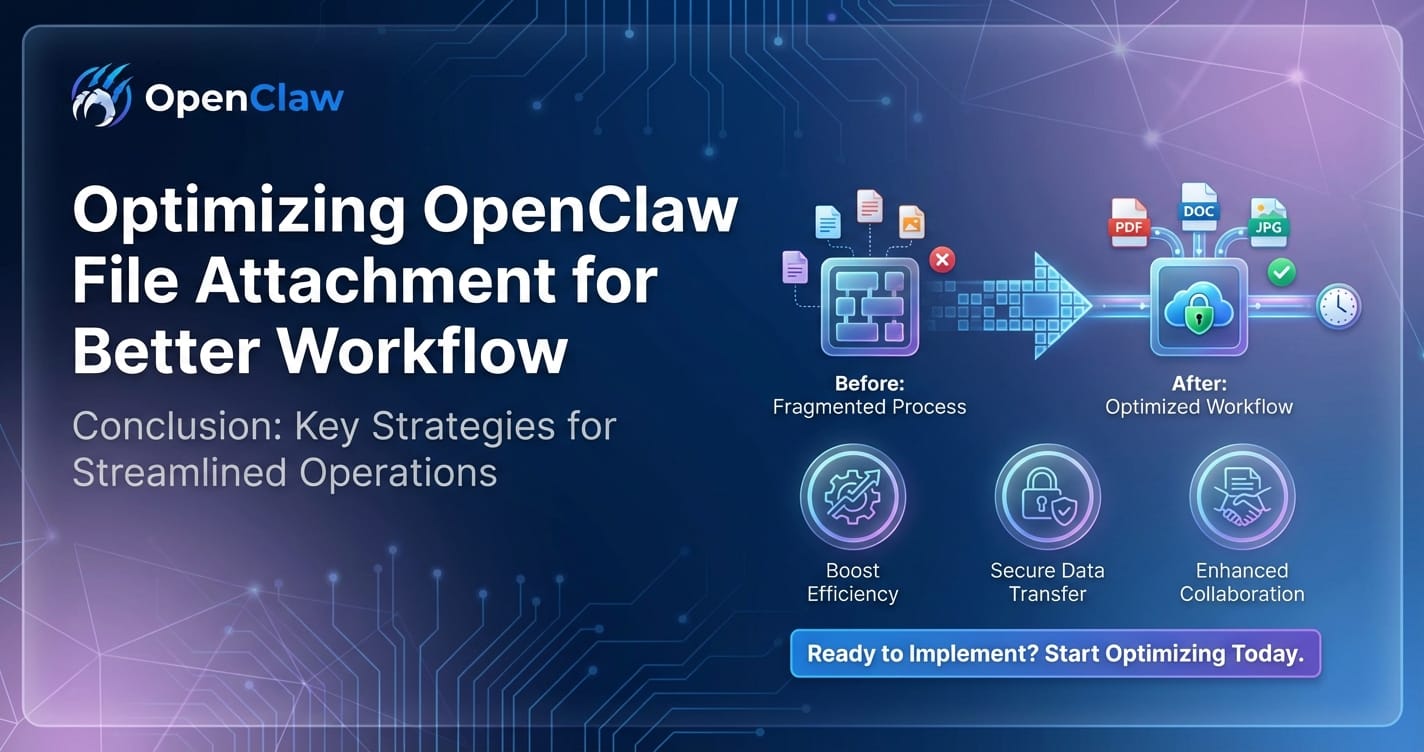
Optimizing OpenClaw File Attachment for Better Workflow


In the digital age, where information flows at an unprecedented pace, efficient data management is not just a convenience but a critical determinant of productivity and operational success. For organizations relying on powerful platforms like OpenClaw to manage their projects, communications, and internal processes, the seamless handling of file attachments is paramount. Yet, the seemingly simple act of attaching a file can often become a bottleneck, leading to frustration, delays, and unexpected costs. From sluggish uploads and downloads to overwhelming storage bills and fragmented data silos, the challenges are numerous and complex.
This article delves deep into the multifaceted world of optimizing file attachments within the OpenClaw ecosystem. We will navigate through comprehensive strategies aimed at achieving significant performance optimization and cost optimization, ultimately enhancing the overall workflow. Furthermore, we will explore how leveraging cutting-edge technologies, including the transformative power of a unified API, can revolutionize how OpenClaw handles attachments, paving the way for more intelligent, automated, and efficient operations. By understanding the underlying principles and implementing proven techniques, businesses can transform their OpenClaw file attachment experience from a point of friction into a seamless engine for enhanced productivity and reduced operational overhead.
1. Understanding the Landscape of OpenClaw File Attachments
Before diving into solutions, it's essential to grasp the current state and common pitfalls associated with file attachments in a system like OpenClaw. OpenClaw, as a hypothetical but representative enterprise platform, likely serves as a central hub for various departmental activities—project management, customer relationship management, internal communications, document sharing, and more. Files, ranging from simple text documents and spreadsheets to high-resolution images, videos, and complex CAD files, are routinely attached to tasks, tickets, messages, and records, forming an integral part of collaborative workflows.
1.1 What Are OpenClaw File Attachments and Their Typical Use Cases?
In OpenClaw, a file attachment is any digital document or media file linked to a specific record or entry within the system. This could be: * Project Management: Design specifications, mock-ups, progress reports, client feedback documents attached to project tasks. * Customer Support: Screenshots of errors, log files, relevant user documents attached to support tickets. * HR & Onboarding: Resumes, offer letters, training materials, policy documents attached to employee profiles. * Sales & Marketing: Pitch decks, marketing collateral, contract drafts attached to CRM opportunities. * Internal Communications: Meeting minutes, presentation slides, internal memos attached to communication threads. * Compliance & Legal: Audit reports, legal documents, regulatory filings attached to compliance records.
These attachments are not mere additions; they are often the core context, evidence, or deliverable of a particular workflow step. Their accessibility, integrity, and timely delivery directly impact the efficiency and accuracy of operations.
1.2 Common Challenges Faced with OpenClaw File Attachments
Despite their utility, managing attachments in a dynamic environment presents several hurdles:
- File Size Limits and Upload/Download Bottlenecks: Large files can quickly hit system limits, leading to users finding workarounds (e.g., external file sharing services) that fragment data and compromise security. Even within limits, large attachments can significantly slow down upload and download times, especially for users with limited bandwidth. This directly impacts performance optimization.
- Network Latency: Geographic dispersion of teams means data has to travel further, introducing latency that degrades the user experience. Uploads from a remote office to a central server can be frustratingly slow.
- Storage Bloat and Uncontrolled Growth: Every attachment consumes storage space. Without proper management, storage requirements can escalate rapidly, leading to increased infrastructure costs and potentially impacting system responsiveness. This is a direct hit on cost optimization.
- Security Concerns: Attachments often contain sensitive information. Ensuring these files are encrypted, properly permissioned, and protected from malware is a constant battle.
- Version Control and Duplication: Multiple users working on the same document can lead to a proliferation of versions, making it hard to identify the authoritative file. Users might re-upload files with minor changes, creating unnecessary duplicates that consume storage.
- Lack of Intelligent Organization: Files are often dumped into a record without proper categorization or metadata, making them difficult to find later. This hampers discoverability and efficient information retrieval.
- Compliance and Retention: Different types of files have varying retention requirements based on legal and regulatory standards. Manual management of these policies is prone to error and can lead to non-compliance.
1.3 Why Optimization is Critical
Ignoring these challenges carries significant consequences: * Reduced Productivity: Slow systems and difficulty finding files waste valuable employee time. * Increased Operational Costs: Uncontrolled storage growth, bandwidth consumption, and manual management tasks translate directly into higher expenses. * Poor User Experience: Frustrated users may abandon the system or seek less secure workarounds. * Security Risks: Unmanaged files are a prime target for data breaches or unauthorized access. * Compliance Penalties: Failure to adhere to data retention and privacy regulations can result in hefty fines.
Therefore, a systematic approach to optimizing OpenClaw file attachments is not merely a technical exercise but a strategic imperative for any organization aiming for operational excellence.
2. Deep Dive into Performance Optimization Strategies
Performance optimization for OpenClaw file attachments focuses on making the entire process—from upload to retrieval—faster, smoother, and more reliable. This involves addressing various layers, including the files themselves, network infrastructure, server-side processing, and user interaction.
2.1 File Size Management: The First Line of Defense
The larger a file, the longer it takes to transfer and store. Reducing file sizes without compromising quality is a fundamental optimization technique.
- Compression Techniques:
- Lossless Compression (e.g., ZIP, GZIP, Brotli): These methods reduce file size by eliminating redundant data without discarding any information. They are ideal for text documents, code, and certain image formats. For instance, OpenClaw could automatically GZIP large text logs or CSV exports before storage or transfer. Brotli, a newer algorithm, often outperforms GZIP in compression ratio for web assets.
- Lossy Compression (e.g., JPEG, MP3, MP4): These methods achieve greater size reduction by discarding some data, which is typically imperceptible to humans. They are perfect for images, audio, and video where slight quality degradation is acceptable for significant file size savings.
- Practical Application: OpenClaw could implement an automatic compression module that applies appropriate compression based on file type upon upload. For instance, any PDF over 10MB is run through a compression utility, or images exceeding a certain resolution are re-encoded.
- Image Optimization: Images are often the biggest culprits for bloat.
- Format Selection: Encourage or automatically convert images to modern, efficient formats like WebP or AVIF, which offer superior compression to traditional JPEGs and PNGs at similar quality levels.
- Resizing and Cropping: Ensure images are only as large as needed for their display purpose. A hero image on a web page doesn't need to be 4000 pixels wide if it's only displayed at 1200 pixels.
- Lazy Loading: Implement lazy loading for images in OpenClaw interfaces, so they only load when they enter the user's viewport, reducing initial page load times.
- Metadata Stripping: Images often contain EXIF data (camera model, location, date, etc.) that is unnecessary for general display and can add to file size and privacy concerns. Stripping this metadata can offer minor savings.
- Video Encoding and Streaming Considerations:
- Video files are notoriously large. For OpenClaw, if video attachments are common, consider:
- Standardized Encoding: Enforce specific video codecs (e.g., H.264, H.265/HEVC) and resolutions.
- Adaptive Bitrate Streaming (ABS): If OpenClaw supports direct video playback, ABS allows the system to deliver different video quality versions based on the user's network conditions, ensuring a smooth experience while saving bandwidth.
- Transcoding: Automatically transcode uploaded videos into optimized formats and resolutions suitable for different viewing contexts.
- Video files are notoriously large. For OpenClaw, if video attachments are common, consider:
- Document Sanitization and Metadata Stripping: Similar to images, documents (especially PDFs, Word, Excel) can contain hidden data, comments, or revision histories that are not meant for general consumption. Tools can "flatten" PDFs or clean up Word documents to reduce their size and remove potentially sensitive information.
Table 1: Comparison of Common Compression Formats for OpenClaw Attachments
| Feature | ZIP (Deflate) | GZIP | Brotli | WebP | AVIF |
|---|---|---|---|---|---|
| Type | Lossless | Lossless | Lossless | Lossy / Lossless | Lossy / Lossless |
| Primary Use | Archives, multiple files | Single files (web assets) | Web assets, text | Images (web) | Images (web, high quality) |
| Compression Ratio | Good | Good | Very Good (text) | Excellent (images) | Superior (images) |
| Decompression Speed | Fast | Fast | Fast | Fast | Moderate |
| Browser Support | Universal (download) | Universal (web) | Widespread | Widespread | Growing, but not universal |
| Typical Scenario | Archiving project files | Compressing JSON/CSS/JS | Compressing HTML/text docs | Replacing JPEG/PNG | Next-gen image format |
| OpenClaw Application | Batch downloads, archival | Server-side API responses | Text-based documents | All image attachments | High-quality image attachments |
2.2 Network Efficiency: Speeding Up Data Transfer
Even with optimized file sizes, network inefficiencies can cripple performance.
- Content Delivery Networks (CDNs): For globally distributed OpenClaw users, a CDN is invaluable. CDNs cache static assets (including file attachments) on servers located geographically closer to the end-users. When a user requests an attachment, it's served from the nearest CDN edge location instead of the central OpenClaw server, dramatically reducing latency and improving download speeds. This is crucial for performance optimization in a distributed environment.
- Client-Side Caching: Leverage browser caching and service workers to store frequently accessed attachments locally on the user's device. For files that rarely change (e.g., policy documents, static templates), setting appropriate cache-control headers can prevent repeated downloads.
- Asynchronous Uploads/Downloads: Implement asynchronous file operations. Instead of waiting for a file upload to complete before allowing further interaction with OpenClaw, the system can upload the file in the background, allowing the user to continue working. This significantly improves the perceived responsiveness and overall user experience.
- HTTP/2 and HTTP/3 Benefits: Ensure OpenClaw's underlying web server and communication protocols support modern HTTP versions. HTTP/2 introduced multiplexing (multiple requests over a single connection) and header compression, while HTTP/3 builds on this with UDP-based QUIC, further reducing latency and improving performance, especially on lossy networks.
- Chunked Uploads for Large Files: For very large attachments, break the file into smaller "chunks" that are uploaded independently. This offers several benefits:
- Resilience: If an upload fails midway, only the failed chunk needs to be re-uploaded, not the entire file.
- Progress Indicators: Provides accurate, real-time feedback to the user on upload progress.
- Parallelism: Multiple chunks can potentially be uploaded in parallel, speeding up the process.
2.3 Server-Side Processing & Storage: The Backbone of Efficiency
The way OpenClaw's backend handles, stores, and processes attachments significantly impacts performance and scalability.
- Efficient Storage Solutions:
- Object Storage (e.g., AWS S3, Azure Blob Storage, Google Cloud Storage): These services are highly scalable, durable, and cost-effective for storing large volumes of unstructured data like file attachments. They often come with built-in features for lifecycle management, versioning, and security. Integrating OpenClaw with an object storage solution is usually superior to storing files directly on application servers or traditional block storage for attachments.
- Intelligent File Indexing and Metadata Management: Beyond basic file names, storing rich metadata (e.g., author, date, department, tags, content type, keywords extracted from content) about each attachment is critical for fast search and retrieval. Implement a robust indexing system (e.g., Elasticsearch) that can quickly locate relevant files.
- Background Processing for Transformations/Virus Scans: Resource-intensive tasks like virus scanning, optical character recognition (OCR) for scanned documents, video transcoding, or large-file compression should be offloaded to background workers. This prevents these operations from blocking the main application thread and ensures the OpenClaw UI remains responsive.
- Database Optimization for Attachment References: While files themselves are best stored in object storage, references to these files (e.g., their URLs, metadata, associated record IDs) are stored in OpenClaw's database. Ensure this database schema is optimized, with appropriate indexing, for fast queries related to attachments.
- Scaling Strategies for High Load: As attachment usage grows, OpenClaw's infrastructure must scale. This includes:
- Horizontal Scaling: Adding more application servers or workers to handle increased processing load.
- Auto-scaling: Dynamically adjusting resources based on demand, ensuring performance during peak times without over-provisioning.
- Distributed Architectures: Designing the attachment service to be stateless and distributed, allowing it to handle concurrent requests efficiently.
2.4 User Interface/User Experience (UI/UX) for Attachments
Even the most technically optimized backend can be let down by a poor user interface.
- Clear Progress Indicators: Users need to know that their upload/download is in progress and how long it might take. Visual progress bars, percentage completion, and estimated time remaining reduce anxiety and improve perceived performance.
- Drag-and-Drop Functionality: A simple yet powerful feature that significantly streamlines the attachment process.
- Preview Functionalities: Allowing users to preview attachments (images, PDFs, common document types) directly within OpenClaw without downloading them reduces unnecessary data transfers and saves time.
- Robust Error Handling and Feedback: When an upload fails, clearly communicate why it failed (e.g., "File too large," "Unsupported format," "Network error") and suggest a solution.
- Batch Operations: For users needing to attach multiple files, enable batch uploads. For managing existing attachments, provide options for batch deletion, tagging, or moving.
3. Strategies for Cost Optimization in OpenClaw File Management
Cost optimization is equally critical, ensuring that the benefits of efficient file handling don't come at an exorbitant price. This involves careful planning, smart technology choices, and continuous monitoring of resource consumption.
3.1 Storage Cost Reduction: Smart Archiving and Lifecycle Management
Storage costs can quickly balloon with unmanaged growth.
- Tiered Storage Strategies: Cloud providers offer different storage tiers based on access frequency and performance requirements (e.g., "hot" storage for frequently accessed files, "cold" or "archive" storage for rarely accessed but retained data).
- Implementation: Automatically move attachments in OpenClaw that haven't been accessed for a defined period (e.g., 90 days) from expensive "hot" storage to cheaper "cold" storage. If accessed again, they can be retrieved, albeit with a slight delay and potential retrieval fee.
- Data Lifecycle Management (DLM): Define and automate policies for how long different types of attachments are retained.
- Retention Policies: Based on compliance requirements (e.g., legal documents for 7 years, temporary project files for 6 months), automatically move files to archive tiers or delete them after their retention period expires.
- Automated Deletion: Regularly purge irrelevant or outdated attachments that no longer serve a purpose, freeing up valuable storage space.
- Deduplication and Incremental Backups:
- Deduplication: Identify and eliminate duplicate files. If users frequently attach the same boilerplate contract or internal template, OpenClaw could store only one copy and reference it multiple times.
- Incremental Backups: For backup strategies, only back up the changes since the last backup, rather than full copies, significantly reducing storage consumption for backups.
- Region-Specific Pricing Considerations: Cloud storage prices can vary by geographic region. If data locality is not strictly mandated, choosing a cheaper region for non-critical archives might offer savings, though this needs to be balanced with latency and compliance.
3.2 Network & Egress Cost Control: Minimizing Unnecessary Transfers
While "ingress" (data coming into the cloud) is often free or cheap, "egress" (data leaving the cloud) can be very expensive.
- Minimizing Unnecessary Data Transfers:
- Preview over Download: As mentioned, enabling previews reduces the need for full downloads.
- Smart Syncing: Only sync changes or new files rather than entire directories.
- Efficient APIs: Design attachment retrieval APIs to fetch only necessary metadata or partial file content when appropriate.
- Optimizing CDN Usage and Choosing Cost-Effective Providers:
- CDNs reduce egress costs from your primary cloud provider by serving cached content from their edge locations. However, CDNs themselves have egress costs.
- Provider Selection: Compare pricing models of different CDN providers. Some offer more favorable terms for high-volume egress.
- Cache Hit Ratio Optimization: Maximize the number of requests served from the CDN cache (high cache hit ratio) by setting appropriate cache headers and reducing cache invalidations, thereby minimizing requests that "miss" the cache and hit your origin server (incurring egress).
- Monitoring and Alert Systems for Cost Anomalies: Implement cloud cost management tools that track storage, network, and compute usage. Set up alerts for unusual spikes in egress or storage growth, indicating potential issues or areas for optimization.
3.3 Compute & Processing Cost Efficiency: Smart Resource Allocation
The resources used to process attachments also contribute to cost.
- Serverless Functions for File Processing: Use "Functions as a Service" (FaaS) like AWS Lambda, Azure Functions, or Google Cloud Functions for attachment processing (e.g., image resizing, virus scanning, OCR). You only pay for the compute time consumed when the function executes, making it extremely cost-effective for intermittent or event-driven tasks.
- Batch Processing During Off-Peak Hours: Schedule computationally intensive tasks (e.g., large-scale data analysis of attachments, batch metadata extraction) during off-peak hours when compute resources might be cheaper or more readily available.
- Optimizing Resource Allocation: Ensure that the virtual machines or containers running OpenClaw's attachment services are appropriately sized. Over-provisioning leads to wasted resources, while under-provisioning leads to performance optimization issues. Regularly review and adjust resource allocations based on actual usage patterns.
3.4 Vendor Lock-in and Cloud Agnosticism: Long-term Cost Control
- Open Standards and Portable Formats: Where possible, avoid proprietary file formats or APIs that tie you to a single vendor. Using open standards makes it easier to migrate data or switch providers if a more cost-effective option emerges.
- Strategies for Multi-Cloud Deployments: For large enterprises, a multi-cloud strategy can provide negotiating leverage with cloud providers and reduce the risk of being beholden to a single vendor's pricing changes. This also enables workload placement based on cost and performance.
XRoute is a cutting-edge unified API platform designed to streamline access to large language models (LLMs) for developers, businesses, and AI enthusiasts. By providing a single, OpenAI-compatible endpoint, XRoute.AI simplifies the integration of over 60 AI models from more than 20 active providers(including OpenAI, Anthropic, Mistral, Llama2, Google Gemini, and more), enabling seamless development of AI-driven applications, chatbots, and automated workflows.
4. Leveraging Advanced Tools and Architectures for Superior Workflow
Beyond basic performance and cost considerations, modern OpenClaw workflows can be dramatically enhanced by integrating advanced tools and architectural paradigms. This section explores automation, security, and crucially, the transformative potential of a unified API in unlocking AI-driven capabilities.
4.1 Automation and Orchestration: Streamlining Attachment Workflows
Automation removes manual drudgery, reduces errors, and ensures consistency.
- Automated Tagging, Categorization, and Routing:
- Upon upload, OpenClaw can automatically analyze the file content (e.g., using natural language processing for documents, image recognition for photos) to suggest or apply tags, categorize the file (e.g., "Invoice," "Contract," "Marketing Material"), and even route it to the correct department or workflow based on its content.
- Workflow Engines for Complex Attachment Processing:
- For scenarios requiring multiple steps (e.g., upload -> virus scan -> OCR -> metadata extraction -> approval -> archival), a workflow engine can orchestrate these processes automatically, ensuring each step is completed in sequence and handling exceptions gracefully.
- Integration with Other Systems (CRM, ERP, DMS):
- Seamless integration ensures that attachments in OpenClaw are not isolated islands of information. For example, a contract attached to a sales opportunity in OpenClaw could automatically be mirrored in the legal department's Document Management System (DMS) or flagged for review in an ERP system. This eliminates data duplication and ensures data consistency across the enterprise.
4.2 Security Best Practices for Attachments: Protecting Sensitive Data
Security is non-negotiable for sensitive attachments in OpenClaw.
- Encryption at Rest and In Transit:
- At Rest: Ensure all stored attachments are encrypted (e.g., using AES-256). Cloud object storage typically offers server-side encryption, but client-side encryption before upload provides an additional layer of security.
- In Transit: All uploads and downloads to/from OpenClaw must use secure protocols like HTTPS/TLS to prevent eavesdropping and data tampering.
- Access Control and Permission Management:
- Implement granular, role-based access control (RBAC) within OpenClaw. Users should only be able to view, download, or delete attachments for which they have explicit permissions. This should extend to folders, records, and individual files.
- Regularly audit access logs to identify unusual activity.
- Virus Scanning and Malware Detection:
- All incoming attachments should be automatically scanned for viruses and malware before they are stored or made accessible to other users. This is a critical security layer to protect the entire organization.
- Implement real-time or near real-time scanning upon upload, potentially using cloud-native security services or dedicated antivirus engines.
- Audit Trails and Compliance:
- Maintain detailed audit trails of all attachment-related activities: who uploaded, downloaded, modified, or deleted which file, and when. This is crucial for forensic analysis, troubleshooting, and demonstrating compliance with regulatory requirements (e.g., GDPR, HIPAA, ISO 27001).
4.3 The Power of a Unified API for AI-Driven Workflows
The true frontier of OpenClaw attachment optimization lies in integrating advanced artificial intelligence capabilities. However, integrating numerous AI models from different providers can be a developer's nightmare, fraught with complex API management, varying data formats, and inconsistent performance. This is where the concept of a unified API becomes a game-changer.
A unified API acts as a single, standardized interface that abstracts away the complexities of interacting with multiple underlying services or models. In the context of AI, it means that instead of developers needing to learn and integrate with dozens of individual APIs for different large language models (LLMs) or specialized AI services (like image analysis, sentiment analysis, translation), they can interact with a single API endpoint. This dramatically simplifies development, speeds up integration, and reduces maintenance overhead.
For OpenClaw, a unified API can unlock a new realm of intelligent attachment processing: * Intelligent Content Analysis: Automatically extract key entities, summarize documents, identify sentiment in text attachments, or even translate documents upon upload. * Smart Categorization: Beyond basic tagging, AI models can deeply understand the context of an attachment to categorize it with higher accuracy, improving search and workflow routing. * Data Extraction: Automatically pull specific data points from structured or semi-structured documents (e.g., invoice numbers from PDFs, dates from contracts). * Enhanced Security: AI can be used for more sophisticated anomaly detection in attachments, identifying suspicious patterns that traditional virus scanners might miss.
For developers looking to integrate powerful AI capabilities into their OpenClaw workflows without the complexity of managing multiple API connections, a platform like XRoute.AI offers a revolutionary solution. XRoute.AI is a cutting-edge unified API platform designed to streamline access to large language models (LLMs). By providing a single, OpenAI-compatible endpoint, it simplifies the integration of over 60 AI models from more than 20 active providers. This not only enables seamless development of AI-driven applications, chatbots, and automated workflows, but also helps achieve low latency AI and cost-effective AI for tasks like document analysis, sentiment analysis of attached text, or even generating smart summaries of document content. XRoute.AI empowers users to build intelligent solutions without the complexity of managing multiple API connections, making it an ideal choice for performance optimization and cost optimization in AI-powered OpenClaw workflows. By abstracting away the intricacies of different AI providers, XRoute.AI allows OpenClaw developers to focus on building features rather than managing infrastructure, leading to faster development cycles and more robust, intelligent solutions. Its focus on low latency AI ensures that AI-driven processing of attachments occurs quickly, maintaining a fluid user experience, while its cost-effective AI approach helps manage the expenses associated with advanced AI capabilities.
Table 2: Benefits of a Unified API for OpenClaw Attachment Processing
| Benefit | Description | Impact on OpenClaw Attachments |
|---|---|---|
| Simplified Integration | Single API endpoint for multiple AI models/providers. | Faster development of AI features like smart tagging, summarization, and content analysis. |
| Reduced Complexity | No need to manage various APIs, SDKs, or authentication methods. | Lower maintenance overhead for AI-powered attachment features, reduced developer burden. |
| Enhanced Flexibility | Easily switch between AI models/providers based on performance, cost, or specific task requirements. | Optimize for cost-effective AI by using the best model for each task; improve accuracy. |
| Future-Proofing | As new AI models emerge, they can be integrated into the unified API without disrupting existing code. | OpenClaw stays current with cutting-edge AI without constant re-engineering. |
| Improved Performance | Optimized routing and load balancing across providers. | Achieves low latency AI for real-time attachment processing and analysis. |
| Cost Optimization | Centralized management and usage tracking, potentially discounted rates through aggregation. | Better control over AI spending; dynamic routing to cheaper models for specific tasks. |
| Accelerated Innovation | Developers can focus on building solutions, not on API plumbing. | Rapid prototyping and deployment of intelligent attachment features in OpenClaw. |
5. Practical Implementation Guide and Best Practices
Implementing these optimization strategies requires a structured approach and continuous effort.
5.1 Assessment Phase: Understanding Your Current State
Before making any changes, it's crucial to understand where OpenClaw currently stands regarding file attachments. * Analyze Current Bottlenecks: Identify where delays occur most frequently (uploads, downloads, processing). * Evaluate Current Costs: Detailed breakdown of storage, network egress, and compute costs related to attachments. * Gather User Feedback: Conduct surveys or interviews with OpenClaw users to understand their pain points and needs. What are their biggest frustrations? What features would they value most? * Audit Existing Attachments: Determine file types, average sizes, distribution of access patterns, and existing metadata. This helps prioritize optimization efforts.
5.2 Pilot Projects: Start Small, Measure Impact
Don't attempt a "big bang" overhaul. * Identify a Specific Workflow: Choose a particular OpenClaw workflow (e.g., project documentation for one team, customer support ticket attachments) as a pilot. * Implement Focused Optimizations: Apply one or two key strategies (e.g., image compression, CDN integration). * Measure Before and After: Crucially, establish clear metrics (upload/download times, storage consumption, user satisfaction) and rigorously measure the impact of your changes. This data will justify broader implementation.
5.3 Monitoring and Iteration: Continuous Improvement
Optimization is not a one-time project; it's an ongoing process. * Real-time Monitoring: Continuously monitor performance optimization metrics (latency, throughput) and cost optimization metrics (storage, egress, compute). * Alerting Systems: Set up alerts for deviations from baselines or unexpected spikes. * Regular Review: Periodically review attachment policies, retention rules, and technology choices. As OpenClaw's usage evolves and new technologies (like advanced unified API platforms) emerge, adapt your strategies. * A/B Testing: For UI/UX changes, consider A/B testing different approaches to see which yields the best results.
5.4 Training and Documentation: Empowering Users and Administrators
Technical solutions are only as effective as their adoption. * User Training: Educate OpenClaw users on best practices for file attachments (e.g., preferred file formats, how to use new features like batch uploads or previews). * Administrator Documentation: Provide clear documentation for OpenClaw administrators on managing storage tiers, monitoring costs, and troubleshooting attachment-related issues. * Communication: Clearly communicate the benefits of optimization efforts to all stakeholders – faster workflows, reduced frustration, and better overall system performance.
5.5 Scalability Planning: Designing for Future Growth
Always design with the future in mind. * Anticipate Growth: Estimate future attachment volumes, user concurrency, and data access patterns. * Flexible Architecture: Build OpenClaw's attachment infrastructure using scalable, cloud-native components (object storage, serverless functions, microservices) that can grow or shrink with demand without requiring a complete re-architecture. * Regular Capacity Planning: Periodically review your infrastructure's capacity to ensure it can handle anticipated load spikes.
Conclusion
Optimizing OpenClaw file attachments for a better workflow is a journey that encompasses a holistic approach to technology, process, and people. By meticulously addressing performance optimization, organizations can ensure that files are uploaded, processed, and retrieved with speed and reliability, directly enhancing user productivity and satisfaction. Simultaneously, a sharp focus on cost optimization prevents ballooning expenses, ensuring that these efficiencies are achieved sustainably.
The strategic integration of advanced tools, particularly through a unified API platform, represents the next frontier. Solutions like XRoute.AI empower developers to effortlessly weave sophisticated AI capabilities into OpenClaw's attachment workflows, enabling intelligent processing, automated categorization, and data extraction that were once complex or impossible. This move towards low latency AI and cost-effective AI through a unified gateway not only streamlines development but also unlocks unprecedented levels of intelligence in how OpenClaw handles its most valuable asset: information.
By embracing these strategies—from basic file compression and CDN integration to advanced AI-driven automation and continuous monitoring—businesses can transform their OpenClaw experience. The result is not just a faster, cheaper system, but a more intelligent, secure, and resilient platform that truly empowers its users and fuels organizational growth in an increasingly data-intensive world.
Frequently Asked Questions (FAQ)
Q1: What is the most impactful initial step for optimizing OpenClaw file attachments? A1: The most impactful initial step is often to address file size management. Implementing automatic image optimization (e.g., converting to WebP, resizing) and encouraging or enforcing compression for other large documents (e.g., PDFs, large spreadsheets) can immediately reduce upload/download times and storage consumption, leading to noticeable performance optimization and cost optimization.
Q2: How can a CDN specifically help with OpenClaw attachment performance for remote teams? A2: A Content Delivery Network (CDN) caches frequently accessed OpenClaw attachments on servers located physically closer to your remote teams. When a user requests an attachment, it's delivered from the nearest CDN edge server instead of your central OpenClaw server, significantly reducing network latency and improving download speeds for remote users. This is a core strategy for geographical performance optimization.
Q3: What are the primary ways to achieve cost optimization for storage in OpenClaw? A3: Key strategies for storage cost optimization include implementing tiered storage (moving less frequently accessed files to cheaper "cold" storage), defining and automating data lifecycle management policies for retention and deletion, and exploring deduplication to eliminate redundant copies of files. Monitoring storage usage regularly is also crucial to identify and address cost-driving anomalies.
Q4: How does a "Unified API" like XRoute.AI fit into optimizing OpenClaw's file attachments? A4: A unified API like XRoute.AI acts as a single, standardized gateway to numerous AI models (including LLMs) from various providers. For OpenClaw attachments, this means you can easily integrate AI for tasks like content summarization, intelligent tagging, data extraction from documents, or sentiment analysis. This simplifies development, enhances performance optimization by routing requests efficiently, and enables cost-effective AI by allowing flexible switching between models or providers based on task and budget, all without managing multiple API connections.
Q5: Are there security risks associated with optimizing file attachments, and how can they be mitigated in OpenClaw? A5: Yes, any data handling comes with security considerations. When optimizing OpenClaw attachments, ensure: 1. Encryption: All files are encrypted at rest (in storage) and in transit (during upload/download via HTTPS). 2. Access Control: Granular, role-based permissions prevent unauthorized access to specific attachments. 3. Virus Scanning: Implement robust, automated virus and malware scanning for all incoming files. 4. Audit Trails: Maintain detailed logs of all attachment activities for compliance and forensic purposes. These measures are crucial for maintaining data integrity and confidentiality while pursuing performance optimization and cost optimization.
🚀You can securely and efficiently connect to thousands of data sources with XRoute in just two steps:
Step 1: Create Your API Key
To start using XRoute.AI, the first step is to create an account and generate your XRoute API KEY. This key unlocks access to the platform’s unified API interface, allowing you to connect to a vast ecosystem of large language models with minimal setup.
Here’s how to do it: 1. Visit https://xroute.ai/ and sign up for a free account. 2. Upon registration, explore the platform. 3. Navigate to the user dashboard and generate your XRoute API KEY.
This process takes less than a minute, and your API key will serve as the gateway to XRoute.AI’s robust developer tools, enabling seamless integration with LLM APIs for your projects.
Step 2: Select a Model and Make API Calls
Once you have your XRoute API KEY, you can select from over 60 large language models available on XRoute.AI and start making API calls. The platform’s OpenAI-compatible endpoint ensures that you can easily integrate models into your applications using just a few lines of code.
Here’s a sample configuration to call an LLM:
curl --location 'https://api.xroute.ai/openai/v1/chat/completions' \
--header 'Authorization: Bearer $apikey' \
--header 'Content-Type: application/json' \
--data '{
    "model": "gpt-5",
    "messages": [
        {
            "content": "Your text prompt here",
            "role": "user"
        }
    ]
}'
With this setup, your application can instantly connect to XRoute.AI’s unified API platform, leveraging low latency AI and high throughput (handling 891.82K tokens per month globally). XRoute.AI manages provider routing, load balancing, and failover, ensuring reliable performance for real-time applications like chatbots, data analysis tools, or automated workflows. You can also purchase additional API credits to scale your usage as needed, making it a cost-effective AI solution for projects of all sizes.
Note: Explore the documentation on https://xroute.ai/ for model-specific details, SDKs, and open-source examples to accelerate your development.