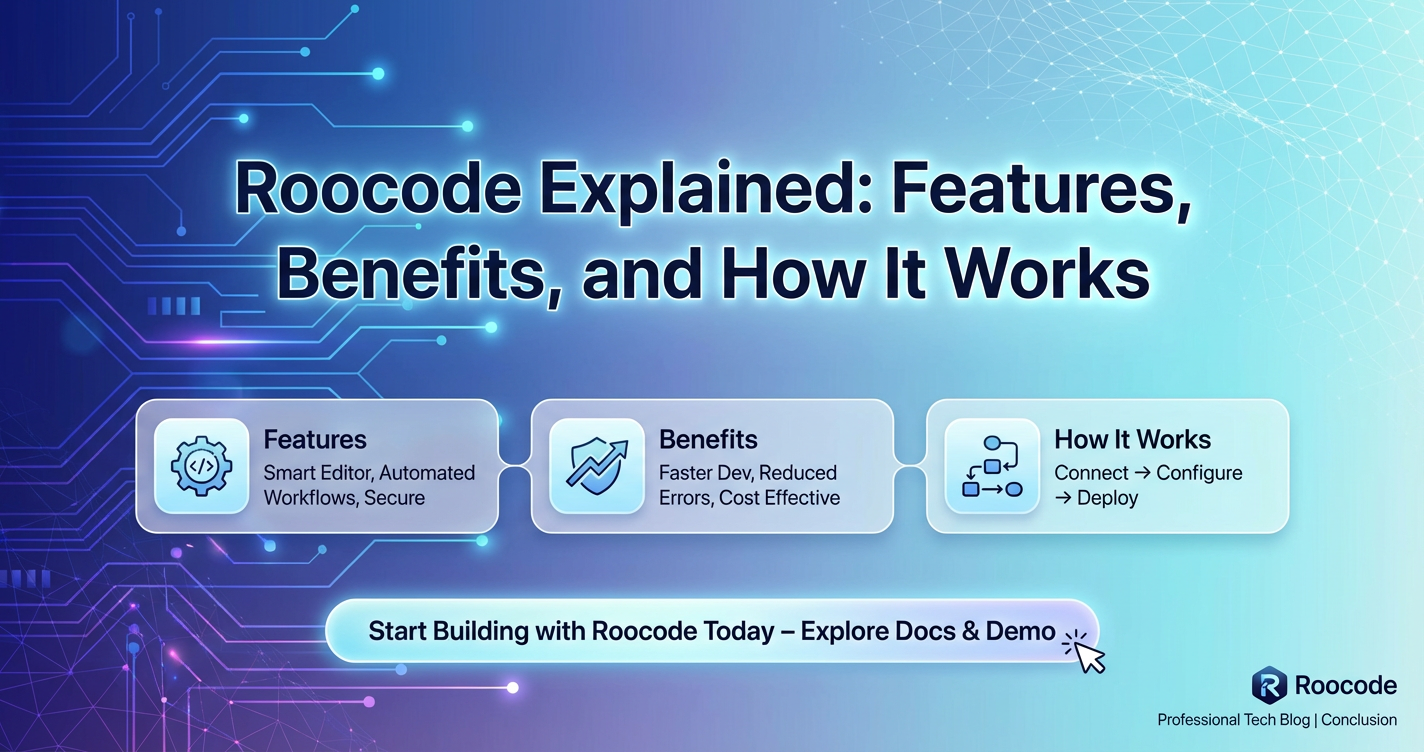
Roocode Explained: Features, Benefits, and How It Works

The Dawn of a New Era in Software Development
In the ever-evolving landscape of technology, software development stands as the bedrock of innovation. From intricate enterprise systems to elegant mobile applications, code powers our modern world. Yet, despite significant advancements in tools and methodologies, the core challenges of development—complexity, boilerplate repetition, elusive bugs, and the relentless pressure of time-to-market—persist. Developers constantly seek smarter ways to build, debug, and deploy high-quality software faster and more efficiently.
Enter the age of artificial intelligence, particularly the transformative power of Large Language Models (LLMs). These sophisticated AI systems have moved beyond mere text generation, demonstrating remarkable capabilities in understanding, analyzing, and even generating code. They offer a tantalizing glimpse into a future where AI acts not just as a helper, but as an intelligent co-pilot, augmenting human ingenuity at every step of the development lifecycle.
However, harnessing the full potential of these powerful AI models for coding isn't straightforward. The sheer number of available LLMs, their varying strengths, and the complexities of integrating them into existing workflows often create more hurdles than solutions. Developers face a fragmented ecosystem, requiring deep expertise to select the best LLM for coding for specific tasks, manage multiple APIs, and ensure seamless interaction within their development environments.
This is precisely the chasm that Roocode aims to bridge. Roocode is not merely another coding assistant; it represents a revolutionary paradigm, a comprehensive intelligence layer designed to seamlessly integrate advanced AI capabilities into the fabric of software development. It promises to transform how developers interact with code, from initial conception and design to debugging, testing, and deployment.
This article will embark on an in-depth exploration of Roocode. We will dissect its core philosophy, unravel its impressive array of features, illuminate the profound benefits it brings to individuals and teams, and meticulously explain the intricate mechanics of how it operates. By the end, you will understand why Roocode is poised to become a game-changer, not just enhancing productivity, but fundamentally reshaping the future of coding by delivering intelligent, high-quality, and maintainable software with unprecedented speed and precision.
Understanding the Modern Coding Landscape and the AI Imperative
The contemporary software development landscape is characterized by its dynamic nature, rapid iteration cycles, and increasing demands for robust, scalable, and secure applications. Developers today grapple with a multitude of challenges that can hinder productivity and innovation:
- Escalating Complexity: Modern applications are inherently complex, often involving distributed systems, microservices architectures, multiple programming languages, frameworks, and vast dependency trees. Navigating this intricate web requires significant mental overhead.
- Boilerplate Fatigue: Many development tasks involve writing repetitive, standardized code (boilerplate) for configurations, API interactions, data models, or basic CRUD operations. This consumes valuable time that could otherwise be spent on unique problem-solving.
- Debugging Dilemmas: Identifying and resolving bugs remains one of the most time-consuming and frustrating aspects of software development. Complex bugs, especially in large codebases or distributed systems, can take days or even weeks to diagnose.
- Technical Debt Accumulation: Pressure to deliver quickly often leads to shortcuts, resulting in code that is difficult to maintain, understand, or extend. This "technical debt" slows down future development and increases long-term costs.
- Skill Gaps and Knowledge Silos: The rapid pace of technological change means developers constantly need to acquire new skills. Furthermore, specialized knowledge often resides with a few individuals, leading to bottlenecks and inefficiencies.
- Time-to-Market Pressures: Businesses demand faster delivery of features and products to stay competitive, placing immense pressure on development teams to accelerate their cycles without compromising quality.
The Rise of LLMs in Programming: A Beacon of Hope
Amidst these challenges, Large Language Models (LLMs) have emerged as a powerful new ally. Trained on colossal datasets of text and code, these AI models exhibit an astonishing ability to understand context, generate human-like text, and crucially, manipulate and generate programming code. Their applications in programming are rapidly expanding:
- Code Generation: From simple functions to complex algorithms and entire classes, LLMs can generate code snippets based on natural language descriptions or existing code context.
- Debugging Assistance: They can analyze error messages, suggest potential fixes, and even explain the underlying causes of bugs.
- Code Refactoring: LLMs can propose improvements to code structure, readability, and adherence to best practices.
- Documentation: They can automatically generate inline comments, function docstrings, and even comprehensive API documentation.
- Translation: LLMs can translate code between different programming languages or frameworks.
- Learning and Explanation: They can explain complex code segments, algorithms, or design patterns to developers, acting as an interactive tutor.
Why Traditional Methods Fall Short
While individual LLM-powered tools and plugins have started appearing, traditional development methods often fall short in fully leveraging the collective power of these models. The current landscape is fragmented:
- Disparate Tools: Developers might use one tool for code generation, another for debugging, and yet another for documentation. This context switching and tool proliferation disrupt flow.
- Steep Learning Curves: Each LLM or AI tool might have its own API, prompting techniques, and limitations, requiring developers to invest time in learning multiple systems.
- Lack of Contextual Integration: Many AI tools operate in isolation, lacking a deep understanding of the entire project context, architectural patterns, or specific team coding standards. This leads to generic or suboptimal suggestions.
- Scalability and Performance Concerns: Managing direct API calls to multiple LLM providers can be complex, leading to latency issues, cost inefficiencies, and difficulties in scaling AI assistance across an organization.
- Security and Compliance: Integrating AI tools often raises questions about data privacy, intellectual property, and adherence to enterprise security policies.
The Vision Behind Roocode: Bridging the Gap
Roocode emerges from the recognition that for AI to truly revolutionize software development, it needs to be seamlessly integrated, intelligently orchestrated, and contextually aware. The vision behind Roocode is to create a unified, intelligent layer that sits atop the vast capabilities of LLMs, making them accessible, effective, and indispensable for every developer.
It aims to bridge the gap between raw AI power and practical developer needs by:
- Consolidating AI Capabilities: Providing a single, coherent interface for a multitude of AI-powered coding tasks.
- Contextual Understanding: Moving beyond simple prompts to analyze the entire project, codebase, and developer intent.
- Intelligent Orchestration: Dynamically selecting and utilizing the best LLM for coding for each specific task, optimizing for accuracy, speed, and cost.
- Seamless Workflow Integration: Embedding AI assistance directly into IDEs, version control systems, and CI/CD pipelines.
- Empowering, Not Replacing: Augmenting human developers, freeing them from mundane tasks, and allowing them to focus on creative problem-solving and strategic thinking.
By offering a comprehensive ecosystem, Roocode aspires to transform software development from a labor-intensive craft into a highly intelligent, accelerated, and collaborative endeavor, where human creativity is amplified by the precision and speed of artificial intelligence.
What is Roocode? A Deeper Dive into its Core Philosophy
At its heart, Roocode is more than just a tool; it's a paradigm shift in how we approach software development. It represents an intelligent, proactive co-pilot designed to augment human developers throughout the entire software lifecycle. Fundamentally, Roocode envisions a development environment where the immense power of Large Language Models (LLMs) is not just accessible, but intelligently applied and seamlessly integrated, making coding faster, smarter, and more enjoyable.
Imagine having an expert peer available 24/7, not just offering suggestions, but understanding your project's nuances, anticipating your needs, and proactively guiding you towards optimal solutions. That's the essence of Roocode. It moves beyond simple autocomplete or isolated code generation; it aims to be a comprehensive intelligence layer that understands context, anticipates requirements, and actively participates in the development process from inception to deployment.
Roocode's Foundational Principles:
- Automation & Efficiency: Roocode's primary goal is to automate repetitive, error-prone, and time-consuming coding tasks. By handling boilerplate code, generating tests, and simplifying debugging, it dramatically boosts developer efficiency, allowing them to focus on creative problem-solving.
- Intelligence & Contextual Awareness: Unlike generic AI assistants, Roocode is designed to understand the deep context of your project – its architecture, coding standards, existing codebase, and even the developer's intent. This allows it to provide highly relevant, accurate, and actionable suggestions. It strives to leverage the best LLM for coding specific problems, rather than a one-size-fits-all approach.
- Collaboration & Augmentation: Roocode is built to augment, not replace, human developers. It acts as an intelligent assistant, facilitating collaboration by standardizing outputs, improving documentation, and democratizing best practices. It empowers developers to achieve more by enhancing their capabilities.
- Continuous Learning & Adaptability: Roocode isn't static. It learns from every interaction, every code change, and every successful debug session. This continuous feedback loop allows it to adapt to specific team coding styles, project requirements, and evolving technological landscapes, becoming more effective over time.
- Customization & Flexibility: Recognizing that every development team and project is unique, Roocode offers extensive customization options. Developers can configure its behavior, integrate it with their preferred tools, and even fine-tune its AI models to align with their specific needs and domain expertise.
How Roocode Stands Out: Beyond Mere Code Suggestion
Many existing tools offer code suggestions or simple AI prompts. Roocode distinguishes itself by offering a holistic approach:
- Intelligent Problem-Solving: Instead of just generating code, Roocode helps in understanding and solving complex problems. It can analyze requirements, suggest architectural patterns, and even identify potential pitfalls before they manifest as bugs.
- Architectural Guidance: For larger projects, Roocode can assist in designing robust and scalable architectures, recommending appropriate design patterns and technologies based on project constraints and goals. This is a level of intelligence rarely seen in current coding tools.
- Full Lifecycle Support: From generating initial project structure, through writing complex algorithms, to comprehensive testing, debugging, and continuous documentation, Roocode provides support across the entire software development lifecycle, not just isolated parts.
- Quality Assurance from the Start: By integrating AI-powered code analysis and refactoring, Roocode helps maintain high code quality from the outset, reducing technical debt and improving long-term maintainability.
The "Brains" Behind Roocode: Leveraging the Best LLM for Coding
The intelligence of Roocode stems from its sophisticated integration with, and intelligent orchestration of, multiple advanced LLMs. It doesn't rely on a single model but rather on a dynamic selection mechanism that identifies the most suitable LLM for a given task. For instance, one LLM might excel at complex algorithmic generation, while another might be superior for natural language documentation, and yet another for identifying subtle security vulnerabilities. Roocode intelligently routes requests to the appropriate model, ensuring optimal performance and accuracy.
This capability is critically enabled by the concept of a unified LLM API. Instead of Roocode having to manage dozens of direct API connections to various LLM providers, it leverages a unified interface that abstracts away the complexities. This allows Roocode to remain agile, incorporating new and improved LLMs as they emerge, without requiring extensive refactoring of its core architecture. This unified access is crucial for delivering the "best LLM for coding" experience, providing Roocode with the flexibility to always tap into the cutting-edge of AI.
In essence, Roocode is building an intelligent bridge between the raw power of AI models and the practical needs of software developers. It's about empowering humans with unparalleled intelligence, transforming the act of coding from a sometimes arduous task into a highly productive, insightful, and even enjoyable creative endeavor.
Key Features of Roocode – Empowering Developers
Roocode's power lies in its comprehensive suite of features, each meticulously designed to address specific pain points in the development process and amplify developer capabilities. By integrating cutting-edge AI, particularly the best LLM for coding, into every facet, Roocode transforms the traditional workflow into an intelligent, accelerated experience.
1. Intelligent Code Generation
Beyond simple autocomplete, Roocode's code generation is context-aware and deeply intelligent. * Contextual Snippets: Based on your current file, project structure, and even natural language comments, Roocode can generate code snippets, functions, classes, or entire modules. For instance, if you're working with a database, it can generate CRUD operations for a specific table just by understanding the schema. * Framework-Aware Generation: It understands popular frameworks (e.g., React, Angular, Spring Boot, Django) and generates code that adheres to their conventions and best practices, saving countless hours of boilerplate writing. * Customization and Adaptation: Developers can provide specific requirements or examples, allowing Roocode to adapt its generation style to match team coding standards and architectural patterns.
2. Advanced Debugging & Error Resolution
Debugging is notoriously time-consuming. Roocode leverages LLMs to turn this chore into an insightful process. * Intelligent Error Analysis: When a compilation error or runtime exception occurs, Roocode doesn't just display the message; it analyzes the stack trace, identifies the probable root cause, and offers precise suggestions for fixes. * Proactive Bug Detection: During development, Roocode can scan your code for potential logical errors, common anti-patterns, or edge cases that might lead to bugs, flagging them before they even manifest. * Explain and Fix: For complex errors, Roocode can provide a detailed explanation of why the error is occurring and then offer a corrected code snippet, along with an explanation of the fix. * Learning from Past Errors: Roocode can integrate with your project's issue tracker, learning from resolved bugs to offer even more accurate and context-specific debugging advice over time.
3. Automated Code Refactoring & Optimization
Maintaining clean, efficient, and readable code is crucial. Roocode automates this critical aspect. * Readability & Maintainability: Roocode suggests improvements to variable names, function structures, and overall code organization to enhance readability and make it easier for other developers to understand. * Performance Optimization: It identifies code segments that could be optimized for better performance (e.g., more efficient algorithms, reduced database queries, improved data structures) and provides refactored alternatives. * Security Best Practices: Roocode scans for common security vulnerabilities (e.g., SQL injection, XSS, insecure deserialization) and recommends secure coding practices, ensuring code robustness from a security perspective. * Adherence to Standards: It ensures the codebase adheres to specified coding standards (e.g., PEP 8 for Python, ESLint rules for JavaScript), enforcing consistency across the team.
4. Seamless Documentation Generation
Up-to-date and comprehensive documentation is a developer's dream. Roocode makes it a reality. * Automatic Inline Comments & Docstrings: As you write code, Roocode can automatically generate descriptive inline comments or function/class docstrings, explaining the purpose, parameters, and return values. * API Documentation Generation: Based on your code and defined interfaces, Roocode can generate comprehensive API documentation in formats like OpenAPI/Swagger, keeping it synchronized with code changes. * User Manuals & Tutorials: For higher-level components or features, Roocode can assist in drafting user manuals or step-by-step tutorials, translating technical details into user-friendly language. * Version Control Integration: It integrates with version control systems to ensure documentation is always in sync with the latest codebase, reducing the burden of manual updates.
5. Test Case Generation
Ensuring code reliability through thorough testing is non-negotiable. Roocode accelerates this process. * Unit Test Generation: For newly written functions or classes, Roocode can automatically generate a suite of unit tests, covering typical inputs, edge cases, and expected outputs. * Integration Test Scaffolding: It can scaffold integration tests for interactions between different modules or services, helping developers quickly set up robust testing environments. * End-to-End Test Ideas: Based on application features and user stories, Roocode can suggest scenarios for end-to-end tests, ensuring the entire system functions as expected from a user's perspective. * Test Coverage Analysis: While not a direct feature, Roocode can integrate with test coverage tools to identify areas with insufficient testing and suggest new test cases to improve coverage.
6. Architectural Guidance & Design Patterns
For complex systems, choosing the right architecture is paramount. Roocode offers intelligent guidance. * Pattern Recommendation: Based on project requirements, scale, and desired characteristics (e.g., scalability, fault tolerance, low latency), Roocode can recommend suitable architectural patterns (e.g., microservices, event-driven, MVC). * Code Structure Scaffolding: It can generate initial project structures based on chosen architectural patterns, complete with boilerplate code for layers, modules, and configurations. * Technology Stack Suggestions: For new projects, Roocode can suggest appropriate technologies, frameworks, and libraries, weighing their pros and cons against project goals. * Security Architecture Review: It can provide insights into potential security vulnerabilities at an architectural level and suggest robust mitigation strategies.
7. Multi-language Support & Framework Agnosticism
Roocode is designed for broad applicability across the diverse ecosystem of software development. * Polyglot Capabilities: It supports a wide array of programming languages (e.g., Python, JavaScript, Java, Go, C#, C++, Rust, Kotlin, Swift, Ruby) and is continually expanding its linguistic repertoire. * Framework Compatibility: Roocode is largely framework-agnostic, meaning it can integrate and provide assistance regardless of whether you're using React, Vue, Angular, Spring Boot, Django, Flask, .NET Core, or others. Its contextual understanding adapts to the specific conventions of each framework.
This comprehensive set of features positions Roocode as an indispensable tool for any developer seeking to elevate their craft, accelerate their workflow, and consistently deliver high-quality, intelligent software solutions.
Table: Roocode's Key Features at a Glance
| Feature Category | Description | Primary Benefit |
|---|---|---|
| Intelligent Code Generation | Generates context-aware code snippets, functions, modules, and boilerplate based on natural language/context. | Accelerates development, reduces boilerplate, ensures adherence to patterns. |
| Advanced Debugging | Analyzes errors, suggests fixes, explains root causes, and proactively detects potential bugs. | Reduces debugging time, improves code stability, enhances developer understanding. |
| Automated Refactoring | Optimizes code for readability, performance, and security; enforces coding standards. | Improves code quality, reduces technical debt, boosts maintainability. |
| Documentation Generation | Automatically creates inline comments, docstrings, API documentation, and user manuals. | Ensures up-to-date documentation, improves collaboration, saves time. |
| Test Case Generation | Generates unit, integration, and suggests E2E test cases to ensure code robustness. | Enhances code reliability, reduces manual testing effort, improves test coverage. |
| Architectural Guidance | Recommends design patterns, technology stacks, and project structures based on requirements. | Facilitates robust system design, minimizes rework, supports informed decisions. |
| Multi-language Support | Compatible with a wide range of programming languages and frameworks. | Versatility for diverse projects, broad applicability across tech stacks. |
XRoute is a cutting-edge unified API platform designed to streamline access to large language models (LLMs) for developers, businesses, and AI enthusiasts. By providing a single, OpenAI-compatible endpoint, XRoute.AI simplifies the integration of over 60 AI models from more than 20 active providers(including OpenAI, Anthropic, Mistral, Llama2, Google Gemini, and more), enabling seamless development of AI-driven applications, chatbots, and automated workflows.
The Transformative Benefits of Adopting Roocode
The integration of Roocode into a development workflow is not just an incremental improvement; it's a transformative shift that yields profound benefits for individual developers, development teams, and organizations as a whole. By intelligently leveraging the best LLM for coding, Roocode addresses core challenges and unlocks new levels of potential.
1. Dramatic Increase in Productivity
One of the most immediate and impactful benefits of Roocode is the significant boost in developer productivity. * Faster Development Cycles: By automating repetitive coding tasks, generating boilerplate, and quickly resolving issues, Roocode drastically reduces the time spent on mundane activities. This means features can be developed and deployed faster. * Reduced Context Switching: With an intelligent assistant embedded directly into the IDE, developers spend less time searching for solutions, consulting documentation, or switching between various tools, maintaining a focused flow state. * Enhanced Focus on Innovation: Free from the burden of routine coding and debugging, developers can allocate more of their intellectual energy to creative problem-solving, architectural design, and developing innovative features that truly differentiate their products. * Quantifiable Metrics: Teams often report a measurable increase in lines of code generated per hour, a decrease in task completion times, and an overall acceleration of project milestones.
2. Enhanced Code Quality & Reliability
Quality is paramount in software. Roocode acts as a vigilant guardian, ensuring high standards are met consistently. * Fewer Bugs in Production: Roocode's proactive bug detection, advanced debugging capabilities, and automated test generation significantly reduce the number of defects reaching production environments, leading to more stable and reliable applications. * Maintainable and Readable Code: Through automated refactoring and adherence to coding standards, Roocode helps maintain a clean, organized, and easily understandable codebase, which is crucial for long-term project health and team collaboration. * Reduced Technical Debt: By encouraging best practices, facilitating refactoring, and ensuring proper documentation from the outset, Roocode helps prevent the accumulation of technical debt, making future development smoother and less costly. * Improved Security Posture: Its ability to identify and suggest fixes for common security vulnerabilities means applications are built with security in mind, reducing risks of breaches and compliance issues.
3. Accelerated Learning & Skill Development
Roocode is an invaluable mentor, democratizing advanced coding techniques and accelerating the learning curve for developers of all experience levels. * On-Demand Mentorship: Junior developers can learn best practices, understand complex algorithms, and grasp new frameworks much faster by interacting with Roocode's intelligent explanations and code examples. It's like having a senior engineer constantly by their side. * Exposure to Best Practices: Roocode consistently suggests industry-standard patterns, efficient algorithms, and secure coding practices, implicitly training developers and elevating the overall skill level of the team. * Rapid Adoption of New Technologies: When exploring new languages or frameworks, Roocode can generate idiomatic code and provide immediate context-sensitive assistance, significantly reducing the ramp-up time. * Democratizing Expertise: Complex architectural patterns or highly optimized code segments, once the domain of a few experts, can now be guided and generated by Roocode, making advanced development more accessible to a broader team.
4. Cost Reduction
The operational efficiencies brought by Roocode translate directly into tangible cost savings for organizations. * Reduced Development Hours: Faster feature delivery and reduced time spent on repetitive tasks mean fewer developer hours are needed for project completion. * Lower Debugging & Maintenance Costs: Fewer bugs in production and a more maintainable codebase mean less time and resources are diverted to fixing critical issues post-launch. * Optimized Resource Usage: By making developers more efficient, organizations can achieve more with their existing team, potentially delaying the need to expand headcount or allowing current teams to tackle more ambitious projects. * Faster Time-to-Market: Getting products and features to market quicker can provide a significant competitive advantage, leading to earlier revenue generation and stronger market positioning.
5. Improved Collaboration
Software development is inherently a collaborative effort, and Roocode enhances this aspect significantly. * Standardized Outputs: By consistently enforcing coding standards and generating documentation, Roocode ensures a more uniform and predictable codebase, making it easier for team members to understand and contribute to each other's work. * Clearer Communication: Automated documentation and intelligent explanations reduce ambiguity and knowledge silos, fostering better communication within the team and with non-technical stakeholders. * Reduced Code Review Burden: With Roocode assisting in quality and best practices, code reviews can shift from identifying basic errors to focusing on higher-level architectural and business logic considerations, making them more productive.
6. Innovation Catalyst
Ultimately, Roocode's greatest benefit might be its ability to act as a catalyst for innovation. * Freedom to Experiment: By handling the grunt work, developers are freed to experiment with new ideas, explore novel solutions, and push the boundaries of what's possible, without being bogged down by implementation details. * Focus on Business Logic: Teams can dedicate more resources to understanding business requirements, refining user experience, and developing features that directly add value, rather than wrestling with low-level coding challenges. * Agility and Responsiveness: The increased speed and efficiency allow organizations to respond more rapidly to market changes, competitor actions, and emerging opportunities, staying ahead in a fast-paced environment.
In summary, Roocode transforms software development from a resource-intensive, error-prone process into a highly efficient, quality-driven, and innovative endeavor. It's an investment that pays dividends across productivity, quality, cost, and human capital, making it an indispensable asset for any forward-thinking development organization.
Table: Comparing Development Metrics Before and After Roocode (Hypothetical)
| Metric | Before Roocode (Manual/Traditional) | After Roocode (AI-Augmented) | Improvement (%) |
|---|---|---|---|
| Feature Delivery Time | 4 weeks | 2 weeks | 50% |
| Boilerplate Code Time | 25% of development cycle | 5% of development cycle | 80% |
| Debugging & Fixing Time | 30% of development cycle | 10% of development cycle | 67% |
| Code Quality (Defect Density) | High (e.g., 10 bugs/1000 LOC) | Low (e.g., 2 bugs/1000 LOC) | 80% |
| Test Coverage | Moderate (e.g., 60%) | High (e.g., 90%+) | 50% |
| Documentation Up-to-dateness | Often outdated | Always synchronized with code | Significant |
| Developer Satisfaction | Moderate (frustration with repetitive tasks) | High (focus on creative problem-solving) | High |
| Time Spent on Learning New Tech | Long ramp-up periods | Accelerated learning with AI guidance | Significant |
Note: These figures are hypothetical and illustrative, representing the potential impact of integrating a comprehensive AI platform like Roocode into a typical development workflow.
How Roocode Works: An Architectural Deep Dive
Understanding the "how" behind Roocode's intelligence reveals a sophisticated architecture designed for maximum flexibility, performance, and accuracy. Roocode's operational mechanics are a testament to advanced engineering, seamlessly integrating various components to deliver its powerful features. It's a ballet of contextual analysis, intelligent routing, and continuous refinement, all underpinned by robust AI infrastructure.
The Roocode Workflow: From Prompt to Precision
The core workflow within Roocode can be broken down into several interconnected stages:
1. Input & Context Gathering
This is the initial phase where Roocode begins to understand the developer's need. * Developer Interaction: This can be a natural language prompt (e.g., "Generate a Python function to calculate the Fibonacci sequence recursively and add unit tests"), a selected code block for refactoring, an error message in the console, or simply opening a new file in the IDE. * IDE Integration: Roocode deeply integrates with popular Integrated Development Environments (IDEs) like VS Code, IntelliJ IDEA, PyCharm, etc. This allows it to gather rich contextual information: * Current File & Project: The specific file being edited, its language, the broader project structure, dependencies, and configured build tools. * Git History: Relevant commit history, recent changes, and branching information. * Coding Standards: ESLint rules, Prettier configurations, or any custom linting rules defined for the project. * External Documentation: Links to project-specific wikis, READMEs, or internal API documentation. * Semantic Code Analysis: Roocode's internal parsers and Abstract Syntax Tree (AST) analyzers break down the existing codebase to understand its structure, relationships between components, data flows, and overall intent. This goes beyond keyword matching to grasp the meaning of the code.
2. Intelligent Orchestration Layer
Once the input and context are gathered, Roocode's orchestration layer takes over. This is the "brain" that decides the optimal path to fulfilling the request. * Task Classification: The orchestration layer first classifies the developer's request. Is it code generation, debugging, refactoring, documentation, or an architectural suggestion? * Contextual Relevance Scoring: It evaluates the gathered context and the classified task against the capabilities of various internal modules and external LLMs. * Dynamic Routing: Based on the classification and scoring, the orchestration layer intelligently routes the request to the most appropriate AI model or internal processing module. This is where the concept of a unified LLM API becomes absolutely critical.
3. LLM Integration & Selection: The Power of a Unified API
To truly offer the best LLM for coding capabilities, Roocode relies on a robust and flexible backend for accessing diverse large language models. This is precisely where platforms like XRoute.AI come into play. XRoute.AI provides a cutting-edge unified API platform that streamlines access to over 60 AI models from more than 20 active providers. By offering a single, OpenAI-compatible endpoint, XRoute.AI simplifies the integration of these models, enabling Roocode to dynamically select the most suitable LLM for a given coding task—whether it's generating intricate algorithms, debugging complex errors, or refining architectural designs.
This low latency AI and cost-effective AI approach ensures Roocode remains performant and economically viable, delivering high-throughput and scalable solutions without the complexity of managing multiple API connections directly. Without a unified LLM API like XRoute.AI, Roocode would face:
- API Proliferation: Managing individual APIs for each LLM provider, each with its unique authentication, rate limits, and data formats.
- Vendor Lock-in: Being tied to a specific provider, limiting flexibility to switch to better or more cost-effective models.
- Performance Bottlenecks: Inefficient routing or redundant calls due to lack of a centralized optimization layer.
- Increased Development Overhead: Significant engineering effort required to integrate and maintain connections to new models as they emerge.
With XRoute.AI, Roocode can abstract away these complexities, focusing on its core intelligence layer. It can query XRoute.AI, specifying desired model characteristics (e.g., best for code generation, cheapest for simple tasks, fastest for real-time suggestions), and XRoute.AI handles the underlying routing, load balancing, and provider-specific interactions. This ensures Roocode always has access to the most powerful and efficient AI models available, making it a truly future-proof platform.
4. Semantic Code Understanding & Reasoning
Once the appropriate LLM receives the task and context, it doesn't just "guess." Roocode's internal mechanisms, coupled with the LLM's inherent capabilities, perform deep semantic understanding: * Intent Recognition: Deciphering the actual goal behind the developer's prompt or code block. * Dependency Mapping: Understanding how different parts of the code interact and rely on each other. * Constraint Awareness: Recognizing language syntax, framework conventions, project-specific rules, and performance requirements. * Knowledge Retrieval: Accessing a vast knowledge base of programming patterns, algorithms, best practices, and security guidelines.
5. Output Generation & Refinement
The LLM generates an initial response, which then undergoes a critical refinement process. * Code Generation: If the task is code generation, the LLM produces a code snippet. * Explanation/Suggestions: For debugging or refactoring, it generates explanations, potential fixes, or refactored code. * Validation: Roocode's internal validators check the generated output for syntax errors, logical consistency, and adherence to project-specific coding standards (e.g., using a local linting tool). * Contextual Alignment: The output is further refined to ensure it perfectly aligns with the project's existing codebase, variable naming conventions, and architectural patterns. * Human-Readable Formatting: The final output is presented in a clear, actionable format within the IDE, often with options to accept, modify, or regenerate.
6. Feedback Loop & Continuous Learning
Roocode is a learning system, constantly improving its accuracy and utility. * User Feedback: Developers provide explicit feedback (e.g., accepting a suggestion, modifying it, rejecting it). This data is anonymized and used to refine Roocode's models. * Implicit Learning: Roocode observes how developers interact with its suggestions and the subsequent changes made to the codebase. If a suggested fix leads to a stable build, it reinforces that pattern. * Model Updates: As new and improved LLMs become available (often via the unified LLM API provided by platforms like XRoute.AI), Roocode can seamlessly integrate them, ensuring it always leverages the cutting edge of AI. * Project-Specific Adaptation: Over time, Roocode builds a rich understanding of individual project nuances, team preferences, and unique domain requirements, tailoring its suggestions to be increasingly precise and relevant.
Technical Stack (Hypothetical):
While the specifics of Roocode's internal stack would be proprietary, a conceptual overview includes: * Core AI Engine: A highly optimized inference engine capable of running multiple LLMs (or interfacing with them via XRoute.AI) with low latency. * Data Processing & Context Management: Components for parsing code, managing project metadata, and maintaining contextual state. * IDE Extensions/Plugins: The interface layer that integrates Roocode directly into popular IDEs. * API Gateway/Service Mesh: For managing internal and external service communications, including secure interaction with the unified LLM API. * Security & Compliance Modules: Ensuring data privacy, intellectual property protection, and adherence to industry standards through encryption, access controls, and auditing. * Cloud Infrastructure: Leveraging scalable cloud services for computing, storage, and networking to ensure high availability and performance.
This intricate architecture allows Roocode to transform raw code and natural language into intelligent actions, making it an indispensable partner for modern software developers. The strategic use of a unified LLM API is not just an optimization; it's a foundational pillar that enables Roocode's agility, power, and future-readiness in a rapidly evolving AI landscape.
Implementing Roocode in Your Development Workflow
Integrating a powerful tool like Roocode into an existing development workflow requires thoughtful planning and execution to maximize its benefits. It's not just about installing a plugin; it's about fostering a new way of interacting with code and leveraging AI as a true partner.
Getting Started: The Initial Integration Steps
- Installation and Configuration:
- IDE Plugin: The first step is typically installing the Roocode plugin or extension for your preferred IDE (e.g., VS Code, IntelliJ, PyCharm). This plugin serves as your primary interface.
- Project Setup: Configure Roocode for your specific project. This might involve pointing it to your project root, defining specific coding standards (e.g., ESLint rules, Prettier config), and integrating with your version control system (e.g., Git).
- Authentication: Set up authentication with the Roocode service, which might involve API keys or single sign-on (SSO) credentials, ensuring secure access to its AI backend (and indirectly, the unified LLM API powering it).
- Initial Exploration and Customization:
- Start with Small Tasks: Begin by using Roocode for less critical tasks, such as generating simple boilerplate code, documentation for a new function, or suggesting refactorings for non-core modules. This allows developers to become familiar with its capabilities without high stakes.
- Review and Refine: Actively review Roocode's suggestions. Understand why it made a particular recommendation. Provide feedback to the system where possible to help it learn and adapt to your team's specific style and preferences.
- Configure Preferences: Explore Roocode's settings to customize its behavior. You might adjust verbosity, disable certain features if they are not relevant, or prioritize specific aspects like performance over strict adherence to obscure coding standards.
Best Practices for Maximizing Roocode's Utility
To truly unlock the full potential of Roocode, developers should adopt a few best practices:
- Be Explicit and Contextual: While Roocode is intelligent, providing clear and concise natural language prompts, along with sufficient code context, will always yield the best results. Explain your intent, constraints, and desired outcome.
- Iterate and Refine: Don't expect Roocode to generate perfect code on the first try every time, especially for complex problems. Treat its output as a strong starting point that you can then refine, much like collaborating with a human peer.
- Learn from Roocode: Use Roocode not just as a code generator, but as an educational tool. When it suggests a refactoring or explains a bug, take a moment to understand the underlying principle. This accelerates your own learning and makes you a better developer.
- Integrate into Code Reviews: Leverage Roocode's suggestions during code reviews. It can help flag potential issues before human reviewers even see them, making reviews more focused on architectural and business logic concerns.
- Maintain High-Quality Input: "Garbage in, garbage out" still applies. Ensure your existing codebase is reasonably clean and well-structured. Roocode performs best when operating on a solid foundation, as it learns from and adapts to your project's quality.
- Regular Updates: Keep your Roocode plugin and underlying services updated. As AI models rapidly evolve, frequent updates will ensure you are always leveraging the best LLM for coding and the latest features.
Training and Adoption for Development Teams
Successful adoption of Roocode across a team requires more than just individual effort. * Pilot Program: Start with a small, enthusiastic pilot team to test Roocode in a real-world project. Gather feedback, identify common challenges, and refine integration strategies. * Internal Workshops: Conduct workshops to train developers on Roocode's features, best practices, and effective prompting techniques. Share success stories from the pilot program. * Establish Guidelines: Define clear guidelines for using Roocode, especially concerning code generation and automated changes. For instance, establish a policy that all AI-generated code still undergoes human review. * Championing the Tool: Identify "Roocode champions" within the team who can advocate for its use, answer questions, and help others overcome initial hurdles. * Feedback Mechanism: Create an internal feedback loop for developers to report issues, suggest improvements, and share their experiences with Roocode.
Future Outlook: The Evolution of Roocode and AI in Coding
The journey with Roocode is an ongoing one. As LLMs continue to advance, Roocode will evolve to incorporate even more sophisticated capabilities: * Proactive System Monitoring: Roocode could evolve to monitor production systems, predict potential failures based on code changes, and suggest preventative measures. * Natural Language to System Design: Moving beyond code, Roocode might assist in translating high-level business requirements directly into detailed system designs and architectural blueprints. * Autonomous Agent Development: The future could see Roocode orchestrating multiple AI agents to collaboratively build and test complex software components with minimal human intervention.
By thoughtfully implementing Roocode and continuously refining its usage, development teams can unlock unprecedented levels of productivity, quality, and innovation, firmly positioning themselves at the forefront of the AI-augmented coding revolution.
Conclusion
The landscape of software development is in the midst of its most significant transformation yet, propelled by the exponential advancements in artificial intelligence. In this new era, tools like Roocode are not just desirable; they are becoming indispensable. As we have explored in detail, Roocode stands as a testament to what is possible when the raw power of Large Language Models is intelligently orchestrated and seamlessly integrated into the developer's workflow.
We've delved into the intricacies of Roocode's core philosophy, revealing its commitment to automation, contextual intelligence, collaborative augmentation, continuous learning, and unparalleled customization. Its comprehensive suite of features—from intelligent code generation and advanced debugging to automated refactoring, documentation, test case creation, and architectural guidance—collectively empowers developers to transcend the limitations of traditional coding.
The benefits of adopting Roocode are profound and far-reaching: a dramatic increase in productivity, leading to faster development cycles and reduced costs; significantly enhanced code quality and reliability, resulting in fewer bugs and reduced technical debt; accelerated learning and skill development, democratizing advanced coding techniques; improved team collaboration through standardized outputs; and ultimately, fostering a culture of innovation where developers are free to focus on creative problem-solving rather than mundane tasks.
The architectural deep dive showcased how Roocode achieves this, highlighting its intelligent orchestration layer and its critical reliance on a unified LLM API from platforms like XRoute.AI. This strategic integration ensures Roocode always leverages the best LLM for coding for any given task, delivering low latency AI and cost-effective AI at scale, without the burdensome complexities of managing myriad API connections.
Implementing Roocode effectively means embracing a new collaborative paradigm with AI. By starting with thoughtful integration, adopting best practices, and fostering team-wide training, organizations can smoothly transition into an AI-augmented future. Roocode is more than just a tool; it's a vision for the future of coding—a future where human ingenuity is magnified by artificial intelligence, leading to the creation of more robust, innovative, and impactful software than ever before. The time to embrace this revolution is now.
Frequently Asked Questions (FAQ)
1. What kind of projects is Roocode best suited for?
Roocode is highly versatile and designed to benefit a wide range of projects, from small startups to large enterprise applications. It excels in projects that involve significant amounts of boilerplate code, require high code quality and consistency, have complex debugging challenges, or demand rapid iteration and deployment. Its multi-language and framework-agnostic nature make it suitable for almost any modern software development initiative, whether it's web development, mobile apps, backend services, or data science projects.
2. How does Roocode ensure code security and privacy?
Roocode prioritizes security and privacy through several mechanisms. All code and data processed by Roocode are encrypted both in transit and at rest. It operates under strict access control protocols, ensuring that only authorized personnel and processes can interact with sensitive information. Furthermore, Roocode typically operates within your configured environment, meaning your proprietary code doesn't necessarily leave your trusted ecosystem unless explicitly allowed for training purposes (often anonymized and aggregated). Roocode also aims to identify and suggest fixes for common security vulnerabilities within your code, enhancing your application's overall security posture.
3. Can Roocode integrate with my existing IDEs and CI/CD pipelines?
Yes, seamless integration is a core design principle of Roocode. It provides plugins and extensions for popular Integrated Development Environments (IDEs) such as VS Code, IntelliJ IDEA, PyCharm, and others, allowing developers to access its features directly within their preferred coding environment. For CI/CD pipelines, Roocode can integrate as a build step, automating code quality checks, test generation, and documentation updates, ensuring that AI-augmented benefits extend throughout your automated deployment process.
4. Is Roocode suitable for both beginners and experienced developers?
Absolutely. Roocode offers immense value to developers across the entire experience spectrum. For beginners, it acts as an intelligent mentor, providing explanations for complex code, suggesting best practices, and accelerating their learning curve. For experienced developers, it frees them from repetitive tasks, automates time-consuming chores like debugging and refactoring, and provides intelligent architectural guidance, allowing them to focus on higher-level problem-solving and innovation. It augments, rather than replaces, human expertise.
5. How does Roocode stay updated with the latest coding practices and language versions?
Roocode's intelligence is continuously evolving. It leverages a dynamic integration with multiple Large Language Models (LLMs), often facilitated by a unified LLM API like XRoute.AI, which ensures it always has access to the most current and powerful AI models. Its internal learning mechanisms constantly process new code, documentation, and user feedback, allowing it to adapt to emerging coding practices, new language features, and framework updates. Regular software updates to the Roocode platform and its IDE plugins also ensure that developers always have access to the latest capabilities and improvements.
🚀You can securely and efficiently connect to thousands of data sources with XRoute in just two steps:
Step 1: Create Your API Key
To start using XRoute.AI, the first step is to create an account and generate your XRoute API KEY. This key unlocks access to the platform’s unified API interface, allowing you to connect to a vast ecosystem of large language models with minimal setup.
Here’s how to do it: 1. Visit https://xroute.ai/ and sign up for a free account. 2. Upon registration, explore the platform. 3. Navigate to the user dashboard and generate your XRoute API KEY.
This process takes less than a minute, and your API key will serve as the gateway to XRoute.AI’s robust developer tools, enabling seamless integration with LLM APIs for your projects.
Step 2: Select a Model and Make API Calls
Once you have your XRoute API KEY, you can select from over 60 large language models available on XRoute.AI and start making API calls. The platform’s OpenAI-compatible endpoint ensures that you can easily integrate models into your applications using just a few lines of code.
Here’s a sample configuration to call an LLM:
curl --location 'https://api.xroute.ai/openai/v1/chat/completions' \
--header 'Authorization: Bearer $apikey' \
--header 'Content-Type: application/json' \
--data '{
    "model": "gpt-5",
    "messages": [
        {
            "content": "Your text prompt here",
            "role": "user"
        }
    ]
}'
With this setup, your application can instantly connect to XRoute.AI’s unified API platform, leveraging low latency AI and high throughput (handling 891.82K tokens per month globally). XRoute.AI manages provider routing, load balancing, and failover, ensuring reliable performance for real-time applications like chatbots, data analysis tools, or automated workflows. You can also purchase additional API credits to scale your usage as needed, making it a cost-effective AI solution for projects of all sizes.
Note: Explore the documentation on https://xroute.ai/ for model-specific details, SDKs, and open-source examples to accelerate your development.