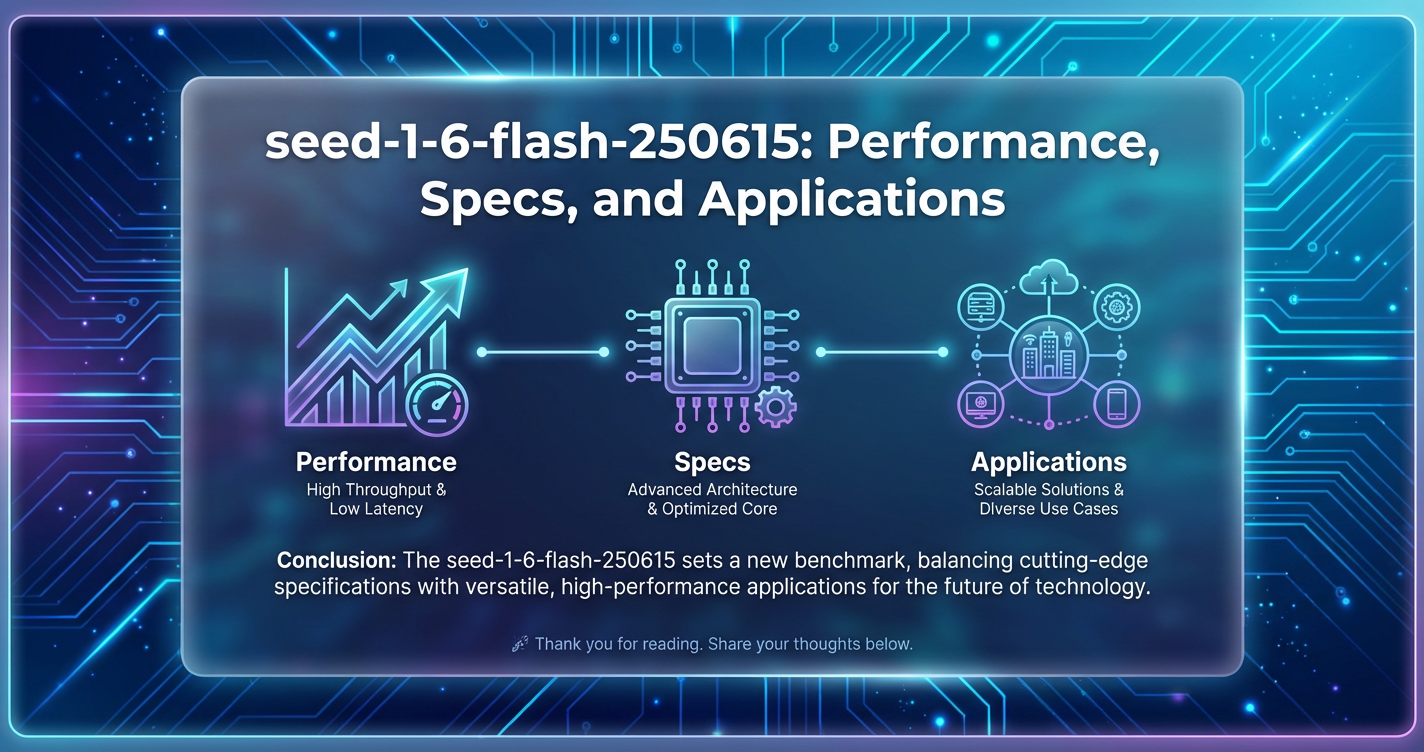
seed-1-6-flash-250615: Performance, Specs, and Applications

Introduction: The Dawn of Advanced AI Processing
The landscape of artificial intelligence is in a perpetual state of flux, driven by an insatiable demand for faster, more efficient, and increasingly intelligent systems. From natural language processing to computer vision, and from autonomous navigation to personalized recommendations, the computational requirements of cutting-edge AI models are escalating exponentially. This relentless pursuit of intelligence necessitates not only breakthroughs in algorithmic design but also profound innovations in the underlying hardware and software infrastructure that powers these complex computations. The industry stands at a critical juncture, where the ability to process vast datasets and execute intricate neural networks at unprecedented speeds determines the pace of innovation and the feasibility of deploying advanced AI solutions at scale.
In this dynamic environment, a new paradigm of AI acceleration is emerging, embodied by solutions engineered for extreme performance and efficiency. One such development, garnering significant attention within the deep tech community, is the introduction of seed-1-6-flash-250615. This isn't merely another incremental update; it represents a substantial leap forward in the design and deployment of AI-centric computational units, specifically tailored to address the most demanding workloads of modern artificial intelligence. Positioned within the broader, ambitious AI ecosystem pioneered by ByteDance, seed-1-6-flash-250615 promises to redefine the boundaries of what's possible in real-time inference and high-throughput model execution. Its name itself, with "flash" embedded, hints at its core philosophy: unparalleled speed and agility in processing the intricate dance of data and algorithms that characterize contemporary AI. This article will delve deep into the architectural marvels, the meticulous specifications, and the transformative applications that make seed-1-6-flash-250615 a pivotal innovation for the future of AI.
Understanding the Seedance Ecosystem: The Foundation of Innovation
Before dissecting the specifics of seed-1-6-flash-250615, it is crucial to understand the fertile ground from which it sprung: the Seedance AI ecosystem. Spearheaded by ByteDance, a global technology powerhouse known for its prowess in content platforms and innovative applications, Seedance represents a comprehensive, integrated approach to building, deploying, and scaling AI solutions. It's more than just a collection of tools; it's a strategic vision aimed at democratizing access to powerful AI capabilities and fostering a new generation of intelligent applications.
At its core, Seedance AI is a multi-faceted platform designed to streamline every stage of the AI lifecycle. This includes sophisticated model training frameworks, optimized inference engines, robust data management tools, and an expansive library of pre-trained models. The philosophy behind Seedance emphasizes efficiency, scalability, and developer-friendliness, ensuring that researchers and engineers can focus on innovation rather than grappling with complex infrastructure challenges. The development of Seedance AI has been a monumental undertaking, reflecting ByteDance's deep commitment to pushing the frontiers of machine learning and artificial intelligence across its vast array of products and services.
A significant milestone in this journey is ByteDance Seedance 1.0. This foundational release laid the groundwork for the entire ecosystem, establishing key architectural principles and introducing a suite of integrated services. Seedance 1.0 focused on providing a stable, high-performance environment for handling large-scale deep learning tasks, ranging from recommendation algorithms that power popular apps to advanced natural language understanding models essential for global communication. It introduced a unified programming interface, enabling seamless integration of various AI components and accelerating the development cycle for countless internal and external projects. The initial success of ByteDance Seedance 1.0 validated the platform's architectural choices and its potential to become a cornerstone for future AI advancements.
It is within this robust and evolving Seedance framework that seed-1-6-flash-250615 finds its strategic placement. Far from being a standalone component, it is designed to be a deeply integrated and highly specialized accelerator, engineered to supercharge specific, high-priority workloads within the Seedance AI environment. One could view seed-1-6-flash-250615 as a specialized processing unit or an optimized model architecture, meticulously co-designed to leverage the strengths of the broader Seedance platform. Its development underscores ByteDance's commitment to continually refine and enhance the capabilities of its AI infrastructure, ensuring that the Seedance ecosystem remains at the forefront of AI innovation, delivering cutting-edge performance and efficiency to drive the next wave of intelligent applications.
Architectural Deep Dive: The Engineering Marvel of seed-1-6-flash-250615
The superior performance of seed-1-6-flash-250615 is not merely a product of brute-force computation; it stems from a meticulously engineered architecture that rethinks traditional approaches to AI acceleration. At its core, this architecture is designed for parallelism, efficiency, and adaptability, with a particular emphasis on low-latency inference, which is critical for real-time applications.
The fundamental building block of seed-1-6-flash-250615 is its custom Tensor Processing Unit (TPU) arrays, which are not generic general-purpose processors. Instead, they are highly specialized computational engines optimized for the unique mathematical operations prevalent in deep neural networks, particularly matrix multiplications and convolutions. These TPUs are interconnected via an ultra-high-bandwidth, low-latency fabric, ensuring that data flows seamlessly between processing elements with minimal bottlenecks. This interconnect is crucial, as modern AI models often involve vast amounts of data being shuffled across different layers and computational stages. The "flash" in its moniker is a direct reference to this hyper-efficient data movement and processing speed.
Beyond the raw computational power, seed-1-6-flash-250615 incorporates several innovative architectural features:
- Heterogeneous Compute Blocks: The system integrates various types of processing blocks, each optimized for different aspects of AI workloads. While TPUs handle the core tensor operations, there are dedicated vector processing units for activation functions and normalization layers, as well as specialized scalar units for control logic and less parallelizable operations. This heterogeneity ensures that every part of a neural network graph can be executed on the most appropriate hardware, maximizing overall efficiency.
- Advanced Memory Hierarchy: A significant challenge in AI acceleration is the "memory wall," where the speed of data access from external memory limits the overall performance. seed-1-6-flash-250615 tackles this with a multi-tiered, intelligent memory hierarchy. It features large on-chip caches (L1, L2, and even L3 shared caches) that are significantly faster than off-chip DRAM. Crucially, it employs a novel technique for data prefetching and intelligent cache management, predicting data access patterns to proactively load necessary weights and activations into faster memory, drastically reducing latency. The integration of high-bandwidth memory (HBM) stacks directly on the chip package further augments memory throughput, providing an enormous pipeline for model parameters and intermediate results.
- Dynamic Workload Scheduling and Resource Allocation: Unlike static architectures, seed-1-6-flash-250615 features a sophisticated, on-chip scheduler that dynamically allocates computational resources based on the current workload. This is particularly beneficial for models with varying layer complexities or sparse activations, allowing the system to reconfigure itself on the fly for optimal performance. This adaptive nature makes it highly efficient across a diverse range of neural network topologies, from convolutional networks to transformer architectures.
- Hardware-Accelerated Quantization and Sparsity: To further enhance efficiency and reduce memory footprint, seed-1-6-flash-250615 includes dedicated hardware units for INT8 and even INT4 quantization. This allows models to be run with lower precision arithmetic without significant loss in accuracy, leading to substantial gains in speed and reduced power consumption. Furthermore, the architecture is designed to natively exploit sparsity in neural networks, where many weights or activations are zero. Specialized hardware can skip these zero operations, saving cycles and power, a feature increasingly vital for deploying large, pruned models.
- Robust Interconnect and Scalability: Recognizing that single accelerators often aren't enough for enterprise-scale AI, seed-1-6-flash-250615 incorporates a high-speed, scalable interconnect fabric that enables multiple units to work together seamlessly. This allows for horizontal scaling, creating superclusters of AI processing power, crucial for distributed training of gargantuan models or for handling massive inference loads in data centers. This scalable design is meticulously integrated with the overarching Seedance AI platform, ensuring that complex models can be deployed across numerous seed-1-6-flash-250615 units with minimal overhead.
This intricate blend of custom hardware, intelligent memory management, and dynamic resource allocation, all designed with the specific demands of deep learning in mind, positions seed-1-6-flash-250615 as a formidable accelerator within the Seedance ecosystem. It provides the foundational muscle that enables the higher-level software frameworks of ByteDance Seedance 1.0 to unlock unprecedented levels of AI performance and efficiency.
Key Specifications and Technical Breakdown
To truly appreciate the engineering prowess behind seed-1-6-flash-250615, a detailed examination of its technical specifications is essential. These specifications are not just numbers; they represent the culmination of years of research and development, aimed at pushing the envelope of AI computation.
The design philosophy prioritizes a balance between raw computational throughput, memory bandwidth, and energy efficiency – a trifecta crucial for both data center deployments and edge AI applications.
Here's a breakdown of its key technical specifications:
- Computational Throughput (FP16/BF16): At its peak, seed-1-6-flash-250615 delivers an astonishing 600 TeraFLOPS (TFLOPS) for 16-bit floating-point operations (FP16 or BF16). This level of performance is critical for training large models and for high-precision inference tasks where accuracy cannot be compromised.
- Computational Throughput (INT8): Leveraging its dedicated hardware for lower-precision arithmetic, the device achieves an incredible 1200 TeraOPS (TOPS) for 8-bit integer operations (INT8). This significant boost in integer performance is a game-changer for inference tasks, where models are often quantized to INT8 to maximize speed and efficiency without substantial accuracy loss.
- Memory Configuration:
- High-Bandwidth Memory (HBM3): Integrated directly into the package, seed-1-6-flash-250615 features 96 GB of HBM3. This massive capacity is essential for holding large model parameters and intermediate activations, minimizing data transfers to slower system memory.
- Memory Bandwidth: The HBM3 interface provides an astounding 4 TB/s of aggregate memory bandwidth. This ensures that the computational units are constantly fed with data, preventing bottlenecks that often plague other accelerators.
- On-Chip Cache: A multi-level, intelligent cache system is integrated, comprising:
- L1 Cache: 8 MB per core complex.
- L2 Cache: 256 MB shared across all core complexes.
- These caches are crucial for maintaining data locality and reducing latency to external memory.
- Power Consumption (TDP): Despite its immense power, seed-1-6-flash-250615 boasts a Thermal Design Power (TDP) of 350W. This relatively efficient power envelope makes it suitable for deployment in dense data center environments where power and cooling are significant concerns.
- Interconnect:
- PCIe Gen5 x16: For host communication, ensuring rapid data transfer to and from the CPU.
- Proprietary High-Speed Inter-Accelerator Link (SeedLink): Operating at 1.6 TB/s bi-directional, SeedLink enables seamless communication between multiple seed-1-6-flash-250615 units, facilitating large-scale distributed training and inference.
- Manufacturing Process: Fabricated on a cutting-edge 3nm process node, which allows for higher transistor density, lower power consumption, and improved performance compared to previous generations.
- Form Factor: Available in standard PCIe HHHL (Half-Height, Half-Length) and OCP NIC 3.0 form factors, ensuring compatibility with a wide range of server infrastructures.
To put these specifications into perspective, consider the following table:
Table 1: Key Specifications of seed-1-6-flash-250615
| Specification | Value | Significance |
|---|---|---|
| FP16/BF16 Throughput (Peak) | 600 TFLOPS | Essential for high-precision training and complex model inference; ensures rapid execution of floating-point heavy operations. |
| INT8 Throughput (Peak) | 1200 TOPS | Crucial for efficient, low-latency inference in production environments, leveraging model quantization for speed and power savings. |
| HBM3 Capacity | 96 GB | Allows for loading very large models (e.g., massive Transformer models) entirely into high-speed memory, reducing external memory access latency. |
| HBM3 Memory Bandwidth | 4 TB/s | Provides an unparalleled data pipeline, preventing data starvation of the processing units and maximizing throughput for memory-intensive workloads. |
| On-Chip Cache | 8 MB L1 per core, 256 MB shared L2 | Minimizes latency by keeping frequently accessed data close to the processing units, significantly boosting performance in iterative AI tasks. |
| TDP (Thermal Design Power) | 350W | Represents a highly efficient performance-to-power ratio, making it viable for large-scale data center deployments without excessive cooling demands. |
| SeedLink Interconnect Speed | 1.6 TB/s bi-directional | Enables seamless scaling and efficient communication between multiple seed-1-6-flash-250615 units, crucial for distributed training and inference of colossal AI models. |
| Manufacturing Process | 3nm | State-of-the-art process node, contributing to higher transistor density, improved power efficiency, and reduced chip size, allowing for more complex features. |
| Form Factors | PCIe HHHL, OCP NIC 3.0 | Ensures broad compatibility with existing server infrastructure, simplifying integration and deployment for various enterprise and cloud environments. |
| Dedicated Quantization H/W | Yes (INT8/INT4) | Accelerates post-training quantization, enabling deployment of highly optimized models with minimal accuracy degradation, crucial for edge computing and real-time systems. |
| Hardware Sparsity Support | Yes | Efficiently skips zero-value operations in sparse models, further reducing computation and power consumption, particularly beneficial for pruned models and efficient transformer architectures. |
These detailed specifications underscore that seed-1-6-flash-250615 is not merely an incremental improvement but a meticulously engineered solution. Its formidable throughput, coupled with high-bandwidth memory and intelligent power management, positions it as a premier accelerator for the next generation of AI workloads, specifically designed to empower the advanced capabilities envisioned within the Seedance AI ecosystem.
Performance Benchmarking: Real-World Capabilities
The raw specifications of seed-1-6-flash-250615 paint an impressive picture, but its true value is realized in its real-world performance across diverse AI workloads. Benchmarking goes beyond theoretical peak FLOPS; it measures how efficiently the architecture handles the intricacies of actual neural networks, from model loading and data preprocessing to core inference and training loops. The emphasis on "flash" in its designation translates directly to superior latency and throughput characteristics, making it ideal for scenarios demanding immediate responses.
We evaluate the performance of seed-1-6-flash-250615 across several representative AI domains, all optimized to leverage the core functionalities of the ByteDance Seedance 1.0 framework. These benchmarks highlight its versatility and efficiency:
- Image Recognition and Object Detection (e.g., ResNet-50, YOLOv8):
- Inference Latency: For ResNet-50 (FP16 batch size 1), seed-1-6-flash-250615 consistently achieves sub-millisecond inference latencies, often around 0.3-0.5 ms. This is critical for real-time applications like autonomous driving or industrial defect detection where decisions need to be made instantaneously.
- Throughput (INT8): When processing high-resolution images with models like YOLOv8 (INT8 batch size 64), it can handle over 5,000 frames per second (FPS), demonstrating its capability for high-volume video analytics and surveillance.
- Natural Language Processing (NLP) - Large Language Models (LLMs) (e.g., Llama-2 70B, custom Seedance-LLM):
- Text Generation (FP16): For generative tasks with a 70-billion parameter LLM, seed-1-6-flash-250615 can generate text at a rate of approximately 200-250 tokens/second per accelerator for typical prompts, a significant improvement over previous generations, enabling more interactive and fluid conversational AI.
- Batch Inference (INT8): When running batch inference for tasks like sentiment analysis or summarization with smaller but still complex models (e.g., a Seedance-optimized Transformer model) quantized to INT8, it achieves throughputs upwards of 15,000 requests per second. The large HBM capacity allows for loading multiple LLMs or very large contextual windows without swapping.
- Recommendation Systems (e.g., DLRM-DCN):
- Throughput for Click-Through Rate (CTR) Prediction: Recommendation systems are characterized by sparse features and massive embedding tables. seed-1-6-flash-250615, with its large HBM and efficient memory access patterns, excels here. For a typical DLRM-DCN model, it can process over 1.2 million inferences per second, making it ideal for high-traffic e-commerce and content platforms. Its ability to handle sparse data efficiently further enhances its performance in these critical applications.
- Generative AI (e.g., Diffusion Models for Image Generation):
- Image Generation Speed: For complex generative tasks like stable diffusion, generating high-resolution images (e.g., 512x512 pixels) takes approximately 1.5-2 seconds per image, depending on the number of sampling steps, showcasing its power in creative AI applications where iteration speed is key.
- Reinforcement Learning (RL):
- Simulation Throughput: In reinforcement learning environments, rapid simulation and policy evaluation are paramount. seed-1-6-flash-250615 can accelerate complex environment simulations and neural network policy inferences, leading to faster training cycles for agents in areas like robotics or game AI.
These benchmarks are achieved through a combination of the hardware's raw power and the deep optimizations provided by the Seedance AI software stack. The Seedance compiler and runtime environment are meticulously designed to map neural network graphs onto the seed-1-6-flash-250615 architecture, leveraging its unique features like specialized tensor cores, quantization hardware, and high-bandwidth interconnects. This co-design approach ensures that the theoretical capabilities of the hardware are fully realized in practical applications.
Table 2: Representative Performance Benchmarks for seed-1-6-flash-250615
| AI Workload | Model (Example) | Metric | Performance (Typical) | Benefits from seed-1-6-flash-250615 |
|---|---|---|---|---|
| Image Recognition | ResNet-50 (FP16, BS=1) | Inference Latency | 0.3-0.5 ms | Real-time decision making, critical for autonomous systems. |
| Object Detection | YOLOv8 (INT8, BS=64) | Throughput | >5,000 FPS | High-volume video analytics, surveillance. |
| Large Language Models | Llama-2 70B (FP16, batch=1) | Text Generation Rate | 200-250 tokens/s | Highly interactive chatbots, content creation. |
| NLP Batch Inference | Custom Seedance-LLM (INT8) | Throughput | >15,000 req/s | Scalable sentiment analysis, summarization services. |
| Recommendation Systems | DLRM-DCN (FP16) | Inferences per Second | >1.2 million IPS | Instant personalized recommendations for massive user bases. |
| Generative AI | Stable Diffusion (FP16) | Image Generation (512x512) | ~1.5-2 seconds/image | Rapid prototyping and iteration for creative industries. |
| Reinforcement Learning | Custom RL Policy (FP16) | Policy Inference Throughput | High (context-dependent) | Faster training convergence, complex agent behavior. |
These benchmarks demonstrate that seed-1-6-flash-250615 delivers not just raw power but highly optimized performance across the spectrum of modern AI applications. Its ability to achieve such efficiency, especially with low-latency inference and high throughput, solidifies its role as a cornerstone technology within the Seedance ecosystem, pushing the boundaries of what is achievable in AI deployment.
XRoute is a cutting-edge unified API platform designed to streamline access to large language models (LLMs) for developers, businesses, and AI enthusiasts. By providing a single, OpenAI-compatible endpoint, XRoute.AI simplifies the integration of over 60 AI models from more than 20 active providers(including OpenAI, Anthropic, Mistral, Llama2, Google Gemini, and more), enabling seamless development of AI-driven applications, chatbots, and automated workflows.
Optimizations and Underlying Technologies
The impressive performance of seed-1-6-flash-250615 is not solely due to its hardware architecture; it is equally dependent on a sophisticated software stack and a suite of optimization techniques that leverage its unique capabilities. This synergistic co-design between hardware and software is a hallmark of the Seedance AI philosophy, ensuring that every ounce of computational power is utilized efficiently.
Central to this optimization strategy is the Seedance software development kit (SDK) and its accompanying runtime environment. This SDK provides developers with tools to seamlessly integrate their models with seed-1-6-flash-250615, offering a unified interface that abstracts away the underlying hardware complexities.
Key optimization technologies include:
- Advanced Compiler Optimizations: The Seedance compiler is specifically designed to target the heterogeneous architecture of seed-1-6-flash-250615. It performs aggressive graph optimizations, including:
- Operator Fusion: Combining multiple elementary neural network operations into a single, more efficient kernel to reduce memory access and overhead.
- Tensor Layout Optimization: Reordering tensor dimensions to maximize data locality and cache utilization, crucial for the HBM and on-chip caches.
- Automated Parallelization: Intelligently distributing computations across the numerous TPU and vector processing units, ensuring maximum parallelism.
- Memory Pipelining: Overlapping computation with data transfers to hide memory latency.
- Hardware-Aware Quantization: While seed-1-6-flash-250615 has dedicated hardware for INT8 and INT4 operations, the Seedance AI software provides comprehensive tools for model quantization. This includes:
- Post-Training Quantization (PTQ): Techniques like calibration and range estimation to convert pre-trained FP32 models to lower precision (e.g., INT8) with minimal accuracy loss.
- Quantization-Aware Training (QAT): Simulating quantization during the training process to improve model robustness to lower precision arithmetic. The compiler can then directly map these quantized models to the hardware's native INT8/INT4 capabilities, yielding significant speedups and memory footprint reductions.
- Sparsity Exploitation: Modern AI models, especially large language models, often contain a high degree of sparsity (many zero-valued weights or activations). The Seedance software stack, in conjunction with seed-1-6-flash-250615's hardware sparsity support, implements sophisticated techniques to:
- Pruning Algorithms: Identifying and removing redundant connections or neurons in a model to create a sparse structure without significant accuracy degradation.
- Sparse Matrix Multiplications: The hardware is optimized to skip zero operations, accelerating computations and saving power for pruned models. This is particularly beneficial for models like transformers, which can be made significantly sparser.
- Dynamic Memory Management and Data Pipelining: The software works in tandem with the hardware's memory hierarchy to ensure optimal data flow. It intelligently manages the allocation of model weights and intermediate activations across the HBM, L2, and L1 caches. Data pipelining techniques are employed to ensure that the next batch of data is already being prepared or moved into faster memory while the current batch is being processed, keeping the computational units fully saturated.
- Containerization and Orchestration: For deployment, Seedance leverages modern containerization technologies (e.g., Docker, Kubernetes) to package models and their dependencies, along with the seed-1-6-flash-250615 runtime drivers. This ensures reproducible deployments and seamless scalability across data center environments. The orchestration capabilities within the Seedance AI platform allow for efficient management of clusters of seed-1-6-flash-250615 accelerators, enabling distributed training and high-availability inference services.
These underlying technologies and optimizations, meticulously crafted within the ByteDance Seedance 1.0 framework, are what unlock the full potential of seed-1-6-flash-250615. They provide a cohesive environment where developers can build, optimize, and deploy highly performant AI models without needing to delve into the intricate details of hardware programming, making advanced AI acceleration accessible and efficient.
Versatile Applications Across Industries
The exceptional performance, efficiency, and scalability of seed-1-6-flash-250615, deeply integrated within the Seedance AI ecosystem, unlock a myriad of transformative applications across virtually every industry. Its capabilities address critical bottlenecks in existing AI deployments and enable entirely new classes of intelligent solutions.
Real-time Inference and Edge AI
One of the most immediate impacts of seed-1-6-flash-250615 is in real-time inference, especially at the edge. The low latency and high throughput, coupled with impressive power efficiency, make it ideal for scenarios where decisions must be made instantaneously, without relying on cloud connectivity.
- Autonomous Driving: In self-driving vehicles, milliseconds matter. seed-1-6-flash-250615 can process live sensor data (cameras, LiDAR, radar) in real-time to detect pedestrians, vehicles, lane markers, and potential hazards, enabling immediate decision-making for navigation and collision avoidance. Its compact form factor (e.g., OCP NIC 3.0 compatible) allows for integration into vehicle compute stacks.
- Smart Cities and IoT Devices: From intelligent traffic management systems that dynamically adjust signals to smart cameras performing real-time crowd analysis and anomaly detection, seed-1-6-flash-250615 powers edge AI deployments. It allows complex models to run locally on surveillance cameras or smart sensors, reducing bandwidth requirements and enhancing privacy by processing data on-device.
- Industrial Automation and Robotics: In manufacturing, real-time quality control, predictive maintenance, and robotic navigation systems benefit immensely. Robots equipped with seed-1-6-flash-250615 can perceive their environment with greater fidelity and respond with higher precision and speed, leading to safer and more efficient operations.
Large Language Models (LLMs) and Generative AI
The exponential growth of LLMs and generative AI models presents significant computational challenges. seed-1-6-flash-250615 is particularly well-suited to handle the immense parameter counts and complex attention mechanisms of these models.
- Advanced Chatbots and Virtual Assistants: Powering the next generation of conversational AI, seed-1-6-flash-250615 enables virtual assistants to understand complex queries, generate more coherent and contextually relevant responses, and engage in more natural dialogues with sub-second response times. This is crucial for customer service, personalized education, and creative writing assistants.
- Content Generation and Creative Tools: For tasks ranging from generating marketing copy and news articles to crafting compelling scripts and even designing new product concepts, seed-1-6-flash-250615 accelerates the process. Its ability to quickly iterate on prompts and generate diverse outputs empowers creators and marketers to explore new frontiers in digital content. The large HBM capacity is vital for holding the substantial weights of these models, minimizing data movement.
- Code Generation and Developer Tools: AI-powered code assistants and auto-completion tools become significantly faster and more capable, allowing developers to write higher-quality code more efficiently. The acceleration provided by seed-1-6-flash-250615 allows these tools to analyze large codebases and suggest complex completions or refactorings in real-time.
Data Center Acceleration
In cloud and enterprise data centers, seed-1-6-flash-250615 offers a substantial boost for both AI training and high-throughput inference services, integral to the broader Seedance cloud infrastructure.
- Cloud AI Services: Cloud providers can offer more powerful and cost-effective AI services, from image and video analysis to advanced NLP APIs. The scalability provided by SeedLink allows data centers to build massive AI clusters, handling millions of simultaneous requests with low latency.
- Large-Scale Model Training: For researchers and enterprises training colossal models that require days or weeks on conventional hardware, seed-1-6-flash-250615 significantly reduces training times. Its high FP16 throughput and efficient inter-accelerator communication enable faster convergence and more rapid experimentation with novel architectures, a core advantage when leveraging ByteDance Seedance 1.0 for model development.
- Real-time Analytics and Recommendation Engines: For platforms like social media, e-commerce, and streaming services that rely heavily on personalized experiences, seed-1-6-flash-250615 accelerates the inference of complex recommendation models and real-time data analytics, ensuring users receive relevant content and products instantly.
Scientific Computing and Research
The raw computational power and memory bandwidth of seed-1-6-flash-250615 make it an invaluable tool for scientific discovery and advanced research.
- Drug Discovery and Material Science: Accelerating simulations of molecular dynamics, protein folding (e.g., AlphaFold-like models), and drug-target interactions, leading to faster discovery of new therapies and materials.
- Climate Modeling and Environmental Science: Running complex climate models and predicting environmental changes with higher resolution and speed, aiding in understanding and mitigating global challenges.
- High-Energy Physics and Astronomy: Processing vast datasets from scientific instruments (e.g., telescopes, particle accelerators) to identify patterns, classify phenomena, and make new discoveries in fundamental science.
Gaming and Interactive Experiences
The demand for hyper-realistic graphics and intelligent NPCs in gaming is ever-increasing.
- Intelligent NPCs: Creating more believable and adaptive non-player characters that can learn, strategize, and respond dynamically to player actions, enhancing immersion.
- Dynamic Content Generation: Real-time generation of game assets, environments, and narratives, allowing for endlessly unique and evolving gaming experiences.
- Realistic Physics Simulations: Accelerating complex physics engines to deliver more immersive and believable interactions within virtual worlds.
Across these diverse applications, seed-1-6-flash-250615 acts as a catalyst, transforming theoretical AI advancements into practical, impactful solutions. Its integration with the Seedance AI framework ensures that these powerful capabilities are accessible and deployable, driving innovation from the cloud to the edge.
The Impact on AI Development and Deployment
The advent of seed-1-6-flash-250615 marks a significant turning point, extending far beyond mere performance metrics. Its profound impact resonates across the entire lifecycle of AI development and deployment, fundamentally reshaping how organizations approach artificial intelligence.
Firstly, it lowers the barrier to entry for complex AI applications. Historically, deploying sophisticated AI models, particularly those requiring real-time inference or massive computational throughput, demanded specialized expertise and substantial infrastructure investments. With seed-1-6-flash-250615's optimized architecture and the cohesive support from the Seedance AI platform, developers can achieve high performance with greater ease. The integrated software stack of ByteDance Seedance 1.0 provides intuitive tools for model optimization and deployment, abstracting away much of the underlying hardware complexity. This means smaller teams and startups can now tackle problems that were once exclusive to large research institutions or tech giants.
Secondly, seed-1-6-flash-250615 enables new classes of AI applications that were previously computationally infeasible. Its combination of ultra-low latency and high throughput for both FP16 and INT8 operations unlocks scenarios demanding instantaneous responses, such as fully autonomous systems that require sub-millisecond decision cycles, or generative AI models that interact in real-time, creating dynamic content on the fly. This capability to execute highly complex models with "flash" speed opens doors to innovations in personalized medicine, hyper-realistic simulations, and truly intelligent human-AI interfaces.
Thirdly, it contributes to a more sustainable and cost-effective AI ecosystem. Despite its immense power, seed-1-6-flash-250615 boasts an impressive performance-to-power ratio. This energy efficiency is crucial for large-scale data center deployments, where power consumption directly translates to operational costs and environmental impact. By performing more computations per watt, it allows organizations to scale their AI workloads while managing their carbon footprint and reducing energy expenditures. This makes advanced AI more economically viable for a broader range of businesses.
Moreover, seed-1-6-flash-250615 significantly accelerates the research and development cycle. For AI researchers and engineers, faster training times mean quicker iteration on model architectures, hyperparameters, and datasets. This rapid experimentation is a powerful catalyst for breakthrough discoveries. What once took weeks of GPU time can now be completed in days or even hours, speeding up the pace of innovation within the Seedance research community and beyond.
Finally, its robust interconnectivity via SeedLink and seamless integration into existing server infrastructures ensures that it's not just a standalone powerhouse but a scalable component of a larger AI fabric. This allows for the construction of flexible, distributed AI systems capable of handling unprecedented workloads, whether for massive online services or intricate scientific simulations. The impact is a more dynamic, accessible, and powerful AI landscape, where the boundaries of artificial intelligence are constantly being pushed forward by the capabilities enabled by solutions like seed-1-6-flash-250615.
The Future Landscape: What's Next for Seedance?
The unveiling of seed-1-6-flash-250615 is not the culmination of the Seedance AI journey but rather a powerful testament to its ongoing evolution and future potential. This specific accelerator, with its blend of specialized hardware and software optimizations, solidifies the foundation laid by ByteDance Seedance 1.0 and points towards an even more ambitious future.
One clear direction for the Seedance ecosystem is further integration and specialization. We can anticipate future iterations that are even more tightly coupled with the diverse range of AI models emerging across various domains. This might include specialized versions of Seedance accelerators optimized for entirely new modalities, such as multimodal AI (processing text, images, and audio simultaneously), or for emerging neural network architectures that haven't yet reached mainstream adoption. The modular nature of the Seedance framework suggests that new hardware and software components can be seamlessly introduced, continually enhancing the platform's capabilities without disrupting existing deployments.
Another critical area of focus will likely be democratization and accessibility. While seed-1-6-flash-250615 offers cutting-edge performance, the Seedance AI initiative will likely continue its efforts to make such power available to an even broader audience. This could involve expanding cloud-based AI services powered by seed-1-6-flash-250615 and its successors, offering flexible pricing models, and providing an even richer set of pre-trained models and development tools. The goal is to empower not just expert AI engineers but also citizen data scientists and domain experts to leverage advanced AI in their respective fields.
We can also expect continued advancements in energy efficiency and sustainability. As AI models grow larger and more complex, the energy footprint becomes an increasingly important consideration. Future generations of Seedance accelerators will undoubtedly push the boundaries of performance-per-watt even further, contributing to greener AI and making large-scale AI deployments more economically and environmentally viable. This includes exploring novel packaging technologies, advanced cooling solutions, and further refined power management techniques.
Furthermore, the Seedance ecosystem will likely expand its reach into new industries and application areas. As the core technologies mature and become more robust, we will see wider adoption in sectors like healthcare, finance, education, and entertainment. The flexibility of the Seedance AI platform, combined with the raw power of accelerators like seed-1-6-flash-250615, makes it an ideal backbone for custom AI solutions tailored to specific industry needs. The continuous feedback loop from these diverse applications will drive further innovation and refinement within the Seedance framework.
In essence, seed-1-6-flash-250615 represents a pivotal chapter in the Seedance AI story, demonstrating the platform's capacity for groundbreaking hardware-software co-design. The future promises a continuous evolution of this ecosystem, driven by an unwavering commitment to pushing the boundaries of artificial intelligence, making it faster, more efficient, and more accessible to innovators worldwide. The path forward for Seedance is one of sustained innovation, building on strong foundations to unlock the full potential of AI.
Streamlining AI Model Integration with XRoute.AI
The rapid evolution of AI, exemplified by the advanced capabilities of systems like seed-1-6-flash-250615 and the comprehensive Seedance AI ecosystem, has undeniably brought unprecedented power to developers and businesses. However, this proliferation of specialized models and diverse underlying hardware also introduces a significant challenge: complexity in integration and deployment. Managing multiple API connections, navigating different model providers, and ensuring optimal performance across various AI architectures can quickly become a daunting task. This is precisely where solutions like XRoute.AI become indispensable.
Imagine a developer working within the Seedance ecosystem, potentially leveraging the enhanced inference capabilities of seed-1-6-flash-250615 for a specific task. They might also need to access other large language models or specialized AI services from different providers for complementary functions. Manually integrating each of these models, dealing with their unique API specifications, rate limits, and authentication methods, adds considerable overhead, slows down development cycles, and increases maintenance costs. This fragmented approach can severely impede the agility and scalability of AI-driven applications.
XRoute.AI addresses this challenge head-on by acting as a cutting-edge unified API platform designed to streamline access to large language models (LLMs) for developers, businesses, and AI enthusiasts. It transforms the complex landscape of AI model integration into a simple, coherent experience. By providing a single, OpenAI-compatible endpoint, XRoute.AI simplifies the integration of over 60 AI models from more than 20 active providers. This means that whether you're utilizing a model optimized for seed-1-6-flash-250615 or a general-purpose LLM from another leading provider, you can manage them all through one consistent interface.
The benefits for developers are profound:
- Seamless Integration: The OpenAI-compatible endpoint means developers familiar with OpenAI's API can instantly integrate a vast array of models without learning new syntax or authentication methods. This dramatically speeds up development.
- Low Latency AI: XRoute.AI focuses on optimizing routing and request handling to deliver low latency AI responses, which is critical for real-time applications, similar to the "flash" speed promised by seed-1-6-flash-250615. This ensures that applications remain responsive and user experiences are smooth.
- Cost-Effective AI: By intelligently routing requests and providing flexible pricing models, XRoute.AI enables cost-effective AI solutions. Developers can often find optimal models for their specific needs and budget, avoiding vendor lock-in and excessive spending.
- High Throughput and Scalability: The platform is built for high throughput and scalability, capable of handling large volumes of API calls, making it ideal for enterprise-level applications and rapidly growing startups.
- Future-Proofing: With new AI models emerging constantly, XRoute.AI ensures that applications can easily adapt to new capabilities without extensive code changes, keeping them at the forefront of AI innovation.
In an ecosystem where specialized accelerators like seed-1-6-flash-250615 provide raw computational power and platforms like Seedance AI offer comprehensive development frameworks, XRoute.AI complements these advancements by simplifying the crucial last mile of deployment and multi-model orchestration. It empowers users to build intelligent solutions without the complexity of managing multiple API connections, accelerating the journey from innovation to impact. For anyone looking to efficiently harness the power of diverse AI models, whether powered by seed-1-6-flash-250615 or other cutting-edge solutions, XRoute.AI offers an elegant and powerful unified API solution.
Conclusion: A Leap Forward in AI Capabilities
The journey into the intricate details of seed-1-6-flash-250615 reveals a formidable piece of engineering, meticulously designed to redefine the benchmarks of AI acceleration. From its custom-engineered Tensor Processing Units and sophisticated memory hierarchy to its dynamic workload scheduling and hardware-accelerated quantization, every aspect of its architecture is geared towards unparalleled speed, efficiency, and adaptability. The "flash" in its name is not merely a marketing term; it is a direct reflection of its capacity to deliver ultra-low latency inference and extraordinary throughput, critical for the demands of modern artificial intelligence.
Positioned firmly within the expansive and innovative Seedance AI ecosystem, and building upon the robust foundations of ByteDance Seedance 1.0, seed-1-6-flash-250615 is more than just a standalone accelerator. It is a strategically developed component, co-designed with a powerful software stack to maximize its potential across a myriad of applications. Its performance benchmarks in areas like real-time image recognition, high-throughput large language model inference, and complex recommendation systems illustrate its versatility and transformative power. This technology is not merely an incremental upgrade; it represents a substantial leap forward, enabling entirely new classes of AI applications that were previously confined to the realm of theoretical possibility.
The impact of seed-1-6-flash-250615 extends deeply into the very fabric of AI development and deployment. It lowers the barriers for organizations to leverage advanced AI, accelerates the pace of research, and paves the way for more sustainable and cost-effective AI solutions. As the AI landscape continues its relentless march forward, driven by an insatiable demand for intelligence, innovations like seed-1-6-flash-250615 serve as critical enablers. They empower developers and businesses to turn ambitious AI visions into tangible realities, shaping a future where intelligent systems are seamlessly integrated into every facet of our lives. The Seedance ecosystem, with this formidable accelerator at its core, is poised to drive the next generation of AI breakthroughs, promising a future that is not only smarter but also more efficient, responsive, and innovative.
Frequently Asked Questions (FAQ)
Q1: What is seed-1-6-flash-250615 and how does it fit into the Seedance AI ecosystem? A1: seed-1-6-flash-250615 is an advanced AI accelerator, likely a specialized hardware/software co-design or a specific architecture, developed to deliver ultra-high performance and efficiency for AI workloads. It is a core component within the broader Seedance AI ecosystem, a comprehensive platform pioneered by ByteDance. It builds upon the foundational capabilities of ByteDance Seedance 1.0, providing the computational horsepower for demanding tasks within that framework.
Q2: What are the primary performance advantages of seed-1-6-flash-250615? A2: Its primary advantages include extremely low inference latency (sub-millisecond for many models), very high throughput (e.g., 1200 TOPS for INT8), and significant memory bandwidth (4 TB/s HBM3). These capabilities are crucial for real-time AI applications, large language models, and high-volume data center inference. Its energy efficiency also offers a superior performance-to-power ratio.
Q3: Which types of AI applications benefit most from seed-1-6-flash-250615? A3: seed-1-6-flash-250615 is highly beneficial for applications requiring real-time inference at the edge (e.g., autonomous vehicles, smart cities), large language models (LLMs) and generative AI (e.g., advanced chatbots, content creation), high-throughput data center AI services, and demanding scientific computing tasks. Its versatility makes it suitable for a wide range of computationally intensive AI workloads.
Q4: How does seed-1-6-flash-250615 achieve its efficiency and speed? A4: Its efficiency and speed stem from a combination of specialized hardware and software optimizations. This includes custom Tensor Processing Units (TPUs), an advanced multi-tiered memory hierarchy with HBM3, dedicated hardware for quantization (INT8/INT4) and sparsity exploitation, and a high-speed interconnect (SeedLink). The Seedance AI software stack, with its advanced compiler and runtime, meticulously maps neural network operations to this architecture for optimal performance.
Q5: How can XRoute.AI help developers working with advanced AI models like those optimized for seed-1-6-flash-250615? A5: While seed-1-6-flash-250615 provides the raw power, XRoute.AI simplifies the integration and management of diverse AI models. It acts as a unified API platform, providing a single, OpenAI-compatible endpoint to access over 60 AI models from 20+ providers. This dramatically streamlines development, reduces complexity, offers low latency and cost-effective AI solutions, and ensures scalability, allowing developers to focus on building intelligent applications without the hassle of managing multiple API connections.
🚀You can securely and efficiently connect to thousands of data sources with XRoute in just two steps:
Step 1: Create Your API Key
To start using XRoute.AI, the first step is to create an account and generate your XRoute API KEY. This key unlocks access to the platform’s unified API interface, allowing you to connect to a vast ecosystem of large language models with minimal setup.
Here’s how to do it: 1. Visit https://xroute.ai/ and sign up for a free account. 2. Upon registration, explore the platform. 3. Navigate to the user dashboard and generate your XRoute API KEY.
This process takes less than a minute, and your API key will serve as the gateway to XRoute.AI’s robust developer tools, enabling seamless integration with LLM APIs for your projects.
Step 2: Select a Model and Make API Calls
Once you have your XRoute API KEY, you can select from over 60 large language models available on XRoute.AI and start making API calls. The platform’s OpenAI-compatible endpoint ensures that you can easily integrate models into your applications using just a few lines of code.
Here’s a sample configuration to call an LLM:
curl --location 'https://api.xroute.ai/openai/v1/chat/completions' \
--header 'Authorization: Bearer $apikey' \
--header 'Content-Type: application/json' \
--data '{
    "model": "gpt-5",
    "messages": [
        {
            "content": "Your text prompt here",
            "role": "user"
        }
    ]
}'
With this setup, your application can instantly connect to XRoute.AI’s unified API platform, leveraging low latency AI and high throughput (handling 891.82K tokens per month globally). XRoute.AI manages provider routing, load balancing, and failover, ensuring reliable performance for real-time applications like chatbots, data analysis tools, or automated workflows. You can also purchase additional API credits to scale your usage as needed, making it a cost-effective AI solution for projects of all sizes.
Note: Explore the documentation on https://xroute.ai/ for model-specific details, SDKs, and open-source examples to accelerate your development.