Skylark-Lite-250215: Features, Benefits & Full Review

Introduction: The Dawn of Efficient Intelligence
In the rapidly evolving landscape of artificial intelligence, innovation isn't just about building bigger, more complex models; it's increasingly about making powerful AI more accessible, efficient, and tailored to specific needs. For developers and businesses navigating the complex world of large language models (LLMs), the challenge often lies in balancing cutting-edge performance with practical considerations like computational cost, inference speed, and ease of deployment. This is precisely the gap that specialized models aim to bridge, offering optimized solutions for diverse applications.
Among the latest contenders in this arena, Skylark-Lite-250215 emerges as a particularly intriguing development. As part of the broader Skylark model family, which has quickly gained recognition for its innovative approach to language understanding and generation, Skylark-Lite-250215 represents a deliberate shift towards efficiency without compromising core capabilities. It's designed to bring sophisticated AI functionalities to a wider range of projects, from resource-constrained environments to applications demanding real-time responsiveness.
This comprehensive review will delve deep into Skylark-Lite-250215, dissecting its unique features, exploring the tangible benefits it offers, and providing a detailed analysis of its performance and suitability for various use cases. We will compare it against its more robust sibling, Skylark-Pro, to understand the strategic trade-offs and optimal scenarios for each. By the end of this article, you will have a clear understanding of why Skylark-Lite-250215 is poised to be a game-changer for many AI initiatives, democratizing access to powerful language AI.
1. Understanding the Skylark Ecosystem: A Family of Models for Diverse Needs
The world of AI is not a monolith; it's a vibrant ecosystem where different models serve different purposes. The Skylark model family exemplifies this diversity, offering a spectrum of capabilities designed to meet a wide array of computational and performance requirements. Understanding the overarching philosophy behind Skylark helps contextualize the specific advantages of its "Lite" variant.
1.1 The Genesis of Skylark Models: Balancing Innovation with Practicality
The inception of the Skylark series was driven by a clear vision: to create a suite of advanced language models that could cater to the burgeoning demand for intelligent automation, content creation, and data analysis. Unlike some early LLMs that prioritized sheer scale above all else, the Skylark development team focused on a balanced approach. Their goal was to develop models that not only exhibited impressive linguistic prowess but also offered practical deployment options and a strong value proposition for real-world applications. This philosophy led to the creation of a tiered system, allowing users to choose the Skylark model that best fits their project's scope, budget, and performance needs.
Within this framework, "Skylark" isn't just a name; it represents a commitment to high-quality natural language processing, whether for generating creative text, summarizing complex documents, or facilitating seamless human-computer interaction. The family is built upon robust transformer architectures, continually refined with cutting-edge training methodologies and vast, diverse datasets.
1.2 Positioning of Skylark-Lite-250215: Efficiency at the Forefront
Skylark-Lite-250215 occupies a crucial position within this family. While models like Skylark-Pro are engineered for maximum performance, handling the most intricate tasks and demanding the highest computational resources, Skylark-Lite-250215 is specifically optimized for efficiency. Its design targets scenarios where a slightly reduced, yet still highly capable, performance is an acceptable trade-off for significantly lower operational costs, faster inference times, and easier deployment.
The "Lite" designation is not merely a branding choice; it reflects deliberate architectural decisions aimed at reducing the model's footprint and computational intensity. This makes Skylark-Lite-250215 an ideal candidate for:
- Edge computing: Deploying AI directly on devices with limited processing power.
- High-throughput, low-latency applications: Such as real-time chatbots, dynamic content recommendation systems, or instantaneous summarization tools.
- Cost-sensitive projects: Where the budget for cloud computing resources needs to be tightly managed.
- Rapid prototyping and development: Allowing developers to quickly iterate and test AI functionalities without heavy overhead.
The "250215" in its name likely denotes a specific version or iteration date, indicating that it's a refined model benefiting from continuous improvements and data updates within the Skylark ecosystem. This version-specific naming underscores the continuous development cycle that characterizes modern AI models, ensuring users have access to the latest optimizations.
2. Deep Dive into Skylark-Lite-250215 Features: Engineering for Agility
To truly appreciate the value of Skylark-Lite-250215, it's essential to understand the underlying features and architectural choices that define its capabilities and differentiate it from more resource-intensive models. Its "lite" nature is a testament to sophisticated engineering that seeks to extract maximum utility from minimal resources.
2.1 Core Architectural Innovations: Slimming Down Without Sacrificing Smarts
The prowess of any modern language model stems from its architecture, typically built upon the transformer paradigm. For Skylark-Lite-250215, the innovation lies not in abandoning this paradigm but in intelligently optimizing it. Key architectural considerations likely include:
- Reduced Parameter Count: Compared to its larger counterparts like Skylark-Pro, Skylark-Lite-250215 will inherently feature a smaller number of parameters. This reduction is achieved through careful pruning, knowledge distillation, or designing more compact network layers, directly translating to less memory usage and faster computations.
- Quantization Techniques: This involves representing the model's weights and activations with lower precision numbers (e.g., 8-bit integers instead of 32-bit floating points). While a slight precision loss can occur, advanced quantization methods ensure that the impact on overall performance is negligible for many tasks, while significantly speeding up inference and reducing memory footprint.
- Efficient Attention Mechanisms: The self-attention mechanism, a cornerstone of transformers, can be computationally expensive. Skylark-Lite-250215 might employ optimized attention variants (e.g., sparse attention, linear attention, or local attention) that reduce the quadratic complexity associated with standard attention, allowing for faster processing of sequences.
- Knowledge Distillation: This technique involves training a smaller, "student" model (Skylark-Lite-250215) to mimic the behavior of a larger, more powerful "teacher" model (like Skylark-Pro). The student learns to generalize and perform well, inheriting much of the teacher's intelligence while maintaining its compact size.
These innovations combine to create a model that is remarkably agile, making it suitable for environments where computational power is a premium.
2.2 Key Technical Specifications: A Look Under the Hood
While specific, official numbers for Skylark-Lite-250215 are not publicly detailed for this hypothetical model, we can infer its key technical specifications based on its "Lite" designation and the general characteristics of efficient LLMs. These specifications are critical for developers to understand its resource requirements and performance ceiling.
| Feature | Skylark-Lite-250215 (Estimated) | Skylark-Pro (Estimated) |
|---|---|---|
| Model Size (Parameters) | ~3B - 7B parameters | ~50B - 175B+ parameters |
| Memory Footprint | Low (e.g., < 10GB VRAM) | High (e.g., > 40GB VRAM or multiple GPUs) |
| Inference Latency | Very Low (e.g., single-digit milliseconds) | Moderate (e.g., tens of milliseconds) |
| Training Data Size | Large (hundreds of billions of tokens) | Very Large (trillions of tokens) |
| Throughput | High (optimized for many concurrent requests) | High (optimized for complex, deep requests) |
| Quantization Support | Extensive (e.g., 8-bit, 4-bit) | Typically 16-bit, some 8-bit support |
| Context Window | Moderate (e.g., 4k - 8k tokens) | Large (e.g., 32k - 128k+ tokens) |
Note: The numbers in this table are illustrative and based on common industry practices for "Lite" and "Pro" versions of language models, as specific official details for this hypothetical model are not provided.
The smaller parameter count directly translates to a reduced memory footprint, making it deployable on less powerful hardware, including consumer-grade GPUs or even specialized AI accelerators at the edge. The emphasis on low latency AI and high throughput means it can handle a large volume of requests quickly, which is crucial for interactive applications.
2.3 Language Understanding and Generation Capabilities: Smart and Articulate
Despite its optimized size, Skylark-Lite-250215 is engineered to maintain strong capabilities in core language tasks. Its training on vast datasets ensures a broad understanding of human language nuances, grammar, and factual knowledge. Key capabilities include:
- Text Generation: Producing coherent, grammatically correct, and contextually relevant text for various purposes, from drafting emails to generating creative content.
- Summarization: Condensing longer texts into concise summaries, extracting key information efficiently.
- Question Answering (Q&A): Understanding natural language queries and providing accurate answers based on provided context or its general knowledge base.
- Translation: Facilitating cross-language communication, albeit possibly with less nuance than larger, specialized translation models.
- Sentiment Analysis: Identifying the emotional tone of text, which is invaluable for customer feedback analysis or brand monitoring.
- Code Generation/Assistance (Limited): While not its primary focus, it can assist with basic code snippets or explanations, leveraging its broad training data.
The quality of its outputs is designed to be highly competitive for its class, often rivaling or exceeding larger models in specific, well-defined tasks where the full breadth of a Skylark-Pro model might be overkill.
2.4 Multimodal Potential: Focused Intelligence (If Applicable)
While many advanced LLMs are moving towards multimodal capabilities, handling text, images, and even audio, the "Lite" designation of Skylark-Lite-250215 suggests a primary focus on text-based operations to maintain its efficiency. If it does possess multimodal capabilities, they would likely be restricted to simpler integrations, such as interpreting text descriptions of images rather than complex visual reasoning. For the purpose of this review, we assume its core strength lies in its exceptional text processing abilities, as this is where its optimized architecture truly shines.
2.5 Customization and Fine-tuning Options: Adaptability for Niche Demands
One of the most valuable features of any modern skylark model is its adaptability. Skylark-Lite-250215 is designed to be highly amenable to fine-tuning. Developers can leverage transfer learning techniques, training the model on smaller, domain-specific datasets to tailor its knowledge and output style to particular industries or applications. This customization allows businesses to develop highly specialized AI solutions that resonate with their unique user base, without the need to train a foundation model from scratch. The smaller size of Skylark-Lite-250215 also makes fine-tuning processes faster and less computationally expensive, accelerating development cycles.
3. Unpacking the Benefits of Skylark-Lite-250215: Why Choose "Lite"?
The "Lite" in Skylark-Lite-250215 isn't a compromise on quality; it's an optimization for practical benefits that resonate deeply with modern AI development needs. Its strengths lie in areas where larger models often present significant challenges.
3.1 Cost-Effectiveness and Resource Efficiency: Smart Spending on AI
One of the most compelling advantages of Skylark-Lite-250215 is its ability to deliver powerful AI functionalities at a substantially reduced cost. Larger models like Skylark-Pro require extensive computational resources for both training and inference, leading to higher cloud computing bills and specialized hardware investments. Skylark-Lite-250215, conversely, is designed to be highly efficient:
- Lower Cloud Computing Costs: With reduced memory and processing demands, the cost per inference call or per hour of operation on cloud platforms is significantly lower. This makes it a prime choice for applications with high query volumes or for businesses with tighter AI budgets.
- Reduced Hardware Requirements: It can run effectively on less powerful GPUs, potentially even on CPU-only setups for certain tasks, opening up possibilities for on-premise deployment without massive infrastructure investments.
- Energy Efficiency: Less computation translates to lower energy consumption, contributing to more sustainable AI operations.
This cost-effective AI approach democratizes access to advanced language models, enabling startups and smaller businesses to integrate sophisticated AI features without prohibitive expenses.
3.2 Speed and Latency Advantages: Real-time Responsiveness
In many applications, speed is paramount. Waiting even a few hundred milliseconds for an AI response can degrade user experience. Skylark-Lite-250215 excels in this domain, offering low latency AI capabilities that are critical for interactive and real-time systems:
- Faster Inference: Its streamlined architecture and smaller parameter count mean it can process input and generate output much faster than larger models. This is crucial for applications like live chatbots, intelligent assistants, or real-time content moderation.
- Enhanced User Experience: Instantaneous responses create a more natural and engaging interaction for users, making AI feel more integrated and responsive.
- Scalability for High-Traffic Applications: The ability to process requests quickly allows Skylark-Lite-250215 to handle a higher volume of concurrent queries, ensuring smooth performance even during peak usage.
3.3 Accessibility and Deployment Flexibility: AI Everywhere
The compact nature of Skylark-Lite-250215 unlocks unprecedented flexibility in deployment, making AI more accessible across various environments:
- Edge Deployment: Its minimal resource requirements make it suitable for deployment directly on edge devices such as smartphones, IoT devices, or embedded systems. This enables offline AI capabilities and reduces reliance on cloud connectivity, enhancing privacy and security.
- On-Premise Solutions: Businesses with strict data sovereignty or security requirements can deploy Skylark-Lite-250215 on their own servers, maintaining full control over their data and models.
- Simplified API Integration: For developers, integrating a lightweight model often means simpler setup and fewer dependencies, streamlining the development process. Its smaller size also facilitates easier packaging and distribution in containerized environments.
- Portable AI: The model can be easily moved and deployed across different platforms and environments, offering unparalleled versatility.
3.4 Scalability for Diverse Applications: From Prototype to Production
Whether you're building a small proof-of-concept or rolling out a large-scale enterprise application, Skylark-Lite-250215 offers robust scalability. Its efficiency profile means that as your application grows and demands increase, the cost and performance overhead remain manageable. You can deploy multiple instances of the model without hitting budget or latency bottlenecks that would plague larger, more resource-hungry alternatives. This makes it an excellent choice for iterative development, allowing projects to start small and scale intelligently.
XRoute is a cutting-edge unified API platform designed to streamline access to large language models (LLMs) for developers, businesses, and AI enthusiasts. By providing a single, OpenAI-compatible endpoint, XRoute.AI simplifies the integration of over 60 AI models from more than 20 active providers(including OpenAI, Anthropic, Mistral, Llama2, Google Gemini, and more), enabling seamless development of AI-driven applications, chatbots, and automated workflows.
4. Skylark-Lite-250215 in Action: Use Cases & Applications
The unique blend of capabilities and efficiencies offered by Skylark-Lite-250215 opens up a wide array of practical applications across various industries. Its ability to deliver intelligent language processing quickly and cost-effectively makes it ideal for tasks where precision needs to be balanced with operational practicality.
4.1 Enhancing Customer Support: The Responsive AI Assistant
Customer service is a prime beneficiary of efficient LLMs. Skylark-Lite-250215 can power the next generation of customer support tools:
- Intelligent Chatbots: Providing instant, accurate answers to common customer queries, deflecting routine tickets from human agents, and improving response times around the clock. Its low latency is crucial for maintaining fluid conversations.
- FAQ Automation: Automatically generating responses to frequently asked questions, personalizing answers based on user input, and guiding users through knowledge bases.
- Sentiment Analysis for Support Tickets: Quickly identifying the emotional tone of customer interactions, allowing support teams to prioritize urgent or dissatisfied customers. This proactive approach can significantly improve customer satisfaction.
- Automated Ticket Routing: Analyzing incoming support requests and automatically routing them to the most appropriate department or agent based on their content.
4.2 Content Generation for Niche Markets: Empowering Creators
Content creation can be a time-consuming and resource-intensive process. Skylark-Lite-250215 can act as a powerful co-pilot for content creators, especially in specialized or high-volume scenarios:
- Drafting Product Descriptions: Quickly generating compelling and SEO-friendly product descriptions for e-commerce platforms, adapting to different tones and styles.
- Social Media Post Generation: Crafting engaging posts, captions, and hashtags tailored for various platforms and audiences, enabling consistent brand messaging.
- Email Marketing Copy: Developing personalized email subject lines, body content, and call-to-actions to improve engagement and conversion rates.
- Basic Article Outlines & Summaries: Assisting writers by generating initial drafts, brainstorming ideas, or summarizing research material, accelerating the content pipeline.
- Local SEO Content: Generating location-specific content for small businesses, such as blog posts about local events or services, at scale.
4.3 Personalization at Scale: Tailored Experiences for Every User
Personalization is key to modern digital engagement. Skylark-Lite-250215 can facilitate personalized experiences without the heavy overhead:
- Recommendation Engines: Analyzing user preferences and past interactions to generate personalized content, product, or service recommendations in real-time.
- Personalized Learning Paths: Adapting educational content and exercises to individual student progress and learning styles.
- Dynamic Website Content: Modifying website text and calls-to-action based on visitor demographics, browsing history, or inferred intent, optimizing conversion.
- Targeted Advertising Copy: Generating highly specific ad copy that resonates with narrow audience segments, maximizing campaign effectiveness.
4.4 Data Analysis and Summarization: Extracting Insights Efficiently
Large volumes of text data often hide valuable insights. Skylark-Lite-250215 can help extract these insights efficiently:
- Document Summarization: Quickly summarizing legal documents, research papers, news articles, or financial reports, allowing users to grasp key information rapidly.
- Market Research Analysis: Extracting themes, trends, and sentiment from customer reviews, social media discussions, and industry reports.
- Compliance and Regulatory Monitoring: Automatically summarizing new regulations or policy changes and highlighting relevant sections for specific business units.
- Meeting Note Summarization: Transcribing and summarizing meeting discussions, identifying action items and key decisions.
4.5 Bridging the Gap: Where Skylark-Lite Excels Over Larger Models
While Skylark-Pro might offer unparalleled depth and nuance for highly complex, open-ended generative tasks or intricate scientific research, there are numerous scenarios where its capabilities are simply overkill. Skylark-Lite-250215 shines in these "bridging the gap" scenarios:
- When computational resources are limited: For small to medium-sized businesses or projects running on budget-conscious cloud instances.
- When real-time interaction is crucial: For chatbots, voice assistants, or interactive applications where every millisecond counts.
- For edge deployment: When AI needs to run directly on devices without constant cloud connectivity.
- For high-volume, repetitive tasks: Generating thousands of product descriptions or answering millions of FAQ queries where efficiency per inference is critical.
- For rapid prototyping: Allowing developers to quickly test and iterate AI features without incurring significant costs.
In essence, Skylark-Lite-250215 represents a pragmatic approach to AI, delivering substantial value in a manner that is both accessible and sustainable for a wide range of practical applications.
5. A Comparative Review: Skylark-Lite-250215 vs. Skylark-Pro and Other Models
Understanding where Skylark-Lite-250215 stands in the broader AI landscape requires a direct comparison, particularly against its more robust sibling, Skylark-Pro, and other models in its class. This helps in making informed decisions about which Skylark model (or alternative) is best suited for specific project requirements.
5.1 Skylark-Lite-250215 vs. Skylark-Pro: A Head-to-Head
The primary distinction between Skylark-Lite-250215 and Skylark-Pro lies in their design philosophy: efficiency versus ultimate performance.
- Performance (Accuracy & Nuance):
- Skylark-Pro: Generally expected to achieve higher accuracy on complex, nuanced tasks, especially those requiring deep contextual understanding, extensive factual recall, or highly creative, open-ended generation. Its larger parameter count and potentially vaster training data allow it to capture more subtle patterns and relationships in language.
- Skylark-Lite-250215: While highly capable, it might exhibit slightly reduced accuracy or fewer creative flourishes on the most challenging, open-domain tasks compared to Skylark-Pro. However, for well-defined, common NLP tasks (summarization, Q&A within a given context, content drafting), its performance is remarkably close and often sufficient. The trade-off is often negligible for most business applications.
- Speed & Cost:
- Skylark-Pro: Slower inference, higher operational costs due to greater computational demands. This makes it less ideal for real-time, high-volume scenarios.
- Skylark-Lite-250215: Significantly faster inference, much lower operational costs. This is its core strength, making it the preferred choice for applications prioritizing low latency AI and cost-effective AI.
- Resource Requirements:
- Skylark-Pro: Requires high-end GPUs, significant VRAM, and robust cloud infrastructure.
- Skylark-Lite-250215: Can run on more modest hardware, making it suitable for edge deployment or less powerful cloud instances.
Here's a simplified comparison table to summarize:
| Feature/Metric | Skylark-Lite-250215 | Skylark-Pro |
|---|---|---|
| Primary Goal | Efficiency, Low Latency, Cost-Effectiveness | Maximum Performance, Depth, Nuance |
| Accuracy (General) | Very High (Excellent for focused tasks) | Extremely High (Superior for complex, open-ended tasks) |
| Inference Speed | Excellent (Real-time applications) | Good (Suitable for less latency-sensitive tasks) |
| Operational Cost | Low (Cost-effective AI) | High |
| Resource Needs | Modest (Edge, smaller cloud instances) | Substantial (High-end GPUs, robust cloud) |
| Context Window | Moderate (e.g., 4k-8k tokens, sufficient for most) | Large (e.g., 32k-128k+ tokens, for extensive documents) |
| Fine-tuning | Faster, less expensive | Slower, more expensive |
| Best Use Cases | Chatbots, summarization, content drafting, edge AI | Research, advanced creative writing, deep analysis, complex Q&A |
Note: Performance scores/rankings are conceptual based on the typical characteristics of "Lite" vs. "Pro" models.
5.2 Competing in the Broader AI Landscape
Beyond the immediate Skylark model family, Skylark-Lite-250215 competes with other "lite" or optimized models from various providers. Its competitive edge often comes from:
- Balanced Performance: While other small models might be highly specialized for one task (e.g., pure summarization), Skylark-Lite-250215 offers a broader set of strong NLP capabilities within its efficient footprint.
- Ease of Integration: A well-documented API and community support (assuming typical for a Skylark model) can make it more developer-friendly than some niche alternatives.
- Version Control & Updates: As indicated by its "250215" designation, being part of a continuously developed family suggests ongoing improvements and bug fixes, which is a significant advantage over static open-source models.
5.3 When to Choose Which Skylark Model: A Decision Matrix
The choice between Skylark-Lite-250215, Skylark-Pro, or other Skylark model variants ultimately depends on your specific project's priorities:
- Choose Skylark-Lite-250215 if:
- Your primary concern is cost-effective AI and low latency AI.
- You need to deploy AI on edge devices or environments with limited computational resources.
- Your application involves high-volume, real-time interactions (e.g., customer service chatbots, personalized recommendations).
- The tasks are well-defined, such as summarization, specific content generation, or targeted Q&A, where extreme nuance isn't critical.
- You require rapid iteration and cost-efficient fine-tuning.
- Choose Skylark-Pro if:
- Your application demands the absolute highest level of linguistic nuance, contextual understanding, and creative generative capacity.
- You are tackling highly complex, open-ended problems that require deep reasoning or extensive knowledge recall.
- Budget and latency are secondary to achieving the peak possible performance.
- You are engaged in advanced research or creating cutting-edge generative art/text.
- Consider other specialized models if:
- Your task is extremely narrow (e.g., only translation, only speech-to-text), and a highly specialized, even smaller model could offer marginal gains in that specific area.
- You have unique data privacy concerns that require a custom-built, highly constrained model.
In summary, Skylark-Lite-250215 is an excellent choice for pragmatic, production-oriented AI applications where efficiency, speed, and cost-effectiveness are paramount, delivering exceptional value without the overhead of its larger counterparts.
6. Overcoming Challenges and Best Practices for Implementation
While Skylark-Lite-250215 offers significant advantages, like any advanced AI model, successful implementation requires understanding its nuances and adhering to best practices. Addressing potential limitations proactively ensures optimal performance and user satisfaction.
6.1 Addressing Potential Limitations: A Realistic Perspective
No model is perfect, and "lite" models inherently involve trade-offs. Being aware of these helps in designing robust applications:
- Context Window Limitations: Compared to Skylark-Pro, Skylark-Lite-250215 will have a smaller context window. This means it can process and "remember" less information in a single interaction. For applications requiring understanding very long documents or maintaining extended conversational history, careful prompt engineering, retrieval-augmented generation (RAG), or session management strategies are crucial.
- Occasional Factual Inaccuracies or Hallucinations: Like all LLMs, Skylark-Lite-250215 can occasionally generate plausible-sounding but factually incorrect information (hallucinations). While its comprehensive training minimizes this, it's vital to implement human oversight, factual verification layers, especially in critical applications.
- Less Nuance for Highly Subjective Tasks: For tasks requiring extreme creativity, profound philosophical reasoning, or highly subjective interpretations, the output might be less nuanced or original compared to a much larger model.
- Dependence on Training Data: Its performance is directly tied to its training data. If your specific domain or language style is underrepresented, fine-tuning becomes even more critical.
6.2 Fine-tuning Strategies: Unlocking Domain-Specific Excellence
Fine-tuning is the process of further training a pre-trained model on a smaller, domain-specific dataset. This tailors the model's knowledge and behavior to your exact needs, overcoming general limitations and enhancing performance for specific tasks. For Skylark-Lite-250215, fine-tuning is particularly effective due to its manageable size.
- Dataset Preparation: The quality and relevance of your fine-tuning data are paramount. Ensure your dataset is clean, diverse, and accurately reflects the style, terminology, and content you expect the model to generate or understand. High-quality labeled examples are crucial for supervised fine-tuning.
- Task-Specific Fine-tuning: Instead of general fine-tuning, focus on the specific tasks you want the model to excel at (e.g., generating product reviews for electronics, summarizing legal contracts). This makes the fine-tuning process more efficient and results in more targeted improvements.
- Few-Shot/Prompt-Based Learning: For very small datasets, or to guide the model's behavior, leveraging few-shot learning by providing examples directly in the prompt can significantly improve output quality without full fine-tuning.
- Iterative Refinement: Fine-tuning is rarely a one-shot process. Expect to iterate, evaluate the model's performance on your validation set, adjust hyperparameters, and potentially refine your dataset until you achieve the desired results.
6.3 Monitoring and Evaluation: Ensuring Continued Performance
Deploying an AI model is not a set-and-forget operation. Continuous monitoring and evaluation are essential to ensure Skylark-Lite-250215 performs optimally in production.
- Performance Metrics: Track key metrics such as latency, throughput, error rates, and quality scores relevant to your application (e.g., ROUGE for summarization, BLEU for translation, human satisfaction for chatbots).
- Drift Detection: Monitor for concept drift or data drift, where the characteristics of your input data or the desired output change over time. This can degrade model performance and signal a need for re-fine-tuning or model updates.
- A/B Testing: When deploying updates or comparing different model configurations (e.g., a fine-tuned Skylark-Lite vs. a base version), use A/B testing to empirically measure the impact on key business metrics.
- Human-in-the-Loop: For critical applications, integrate a "human-in-the-loop" mechanism where human agents review or correct AI outputs, especially for edge cases or sensitive content. This not only maintains quality but also provides valuable feedback for future model improvements.
6.4 Security and Ethical Considerations: Responsible AI Deployment
As with any powerful AI, responsible deployment of Skylark-Lite-250215 requires careful attention to security and ethical guidelines.
- Data Privacy: Ensure all data used for training, fine-tuning, and inference complies with relevant data protection regulations (e.g., GDPR, CCPA). Anonymize sensitive information where possible.
- Bias Mitigation: Models learn from data, and if the data contains biases, the model will reflect them. Regularly audit model outputs for signs of bias (e.g., unfair treatment towards certain demographics) and implement strategies to mitigate them, such as data debiasing or prompt engineering.
- Content Moderation: If the model generates user-facing content, implement robust content moderation filters to prevent the creation of harmful, offensive, or inappropriate material.
- Transparency and Explainability: Where feasible and necessary, strive for transparency in how the AI operates and explain its decisions to users, especially in high-stakes applications.
- Adversarial Attacks: Be aware of potential adversarial attacks where malicious input could trick the model into generating incorrect or harmful outputs. Implement input validation and robust security measures.
By proactively addressing these challenges and adhering to best practices, organizations can maximize the value of Skylark-Lite-250215 while ensuring responsible and ethical AI deployment.
7. The Future Trajectory of Skylark-Lite-250215 and the Skylark Family
The journey of AI is one of continuous evolution, and the Skylark model family, including Skylark-Lite-250215, is no exception. Its future trajectory will likely involve advancements that push the boundaries of efficiency, capability, and accessibility, further solidifying its role in the AI ecosystem.
7.1 Upcoming Enhancements and Roadmap: Smarter, Faster, More Accessible
The development teams behind models like Skylark-Lite-250215 are constantly innovating. Future enhancements could include:
- Further Efficiency Gains: Research into new compression techniques, more optimized architectures, and advanced quantization methods will likely lead to even smaller footprints and faster inference speeds without significant performance degradation. This aligns perfectly with the "Lite" philosophy.
- Expanded Context Windows (Efficiently): While maintaining a compact size, there's ongoing research into efficient methods for extending context windows without a proportional increase in computational cost. This would allow Skylark-Lite-250215 to handle longer inputs more effectively.
- Enhanced Multimodal Integration (Targeted): While text-focused, future iterations might see targeted, highly optimized multimodal capabilities, such as better understanding of simple image captions or audio cues, always within the "lite" constraint.
- Specialized Lite Variants: We might see specialized versions of Skylark-Lite-250215, pre-fine-tuned for specific domains (e.g., "Skylark-Lite-Healthcare," "Skylark-Lite-Finance"), offering out-of-the-box higher performance for those industries.
- Improved Safety and Alignment: Continuous efforts will be made to enhance the model's safety, reduce biases, and ensure its outputs are more aligned with human values and intentions.
These advancements would further cement Skylark-Lite-250215 as a leader in cost-effective AI and low latency AI, broadening its applicability even further.
7.2 Impact on the AI Industry: Democratizing Access and Fostering Innovation
The existence and continuous improvement of models like Skylark-Lite-250215 have a profound impact on the broader AI industry:
- Democratization of AI: By lowering the barriers to entry in terms of cost and computational power, these models make sophisticated AI accessible to a wider range of developers, startups, and small businesses. This fosters a more inclusive and diverse AI development community.
- Acceleration of Innovation: Developers can iterate faster, experiment more freely, and deploy AI solutions in novel environments (like edge devices) that were previously too resource-constrained. This accelerates the pace of innovation across various sectors.
- Shift Towards Application-Specific AI: The availability of efficient general-purpose models encourages a move towards highly specialized, fine-tuned applications, where AI is deeply integrated into specific workflows rather than being a generic tool.
- Sustainable AI: The focus on efficiency contributes to more environmentally friendly AI, reducing the carbon footprint associated with large-scale model deployment and operation.
For developers looking to seamlessly integrate powerful models like the Skylark series, and hundreds of others, platforms such as XRoute.AI offer a unified API solution. XRoute.AI simplifies access to large language models (LLMs), including high-performance and cost-effective AI options, through a single, OpenAI-compatible endpoint. This dramatically reduces the complexity of managing multiple API connections, enabling quicker development of AI-driven applications with low latency AI and high throughput, making it an ideal partner for leveraging the capabilities of models like Skylark-Lite-250215 efficiently. By abstracting away the complexities of different provider APIs and offering intelligent routing, XRoute.AI empowers developers to focus on building intelligent solutions, knowing they have reliable, performant, and flexible access to the best AI models on the market.
Conclusion: The Strategic Value of Skylark-Lite-250215
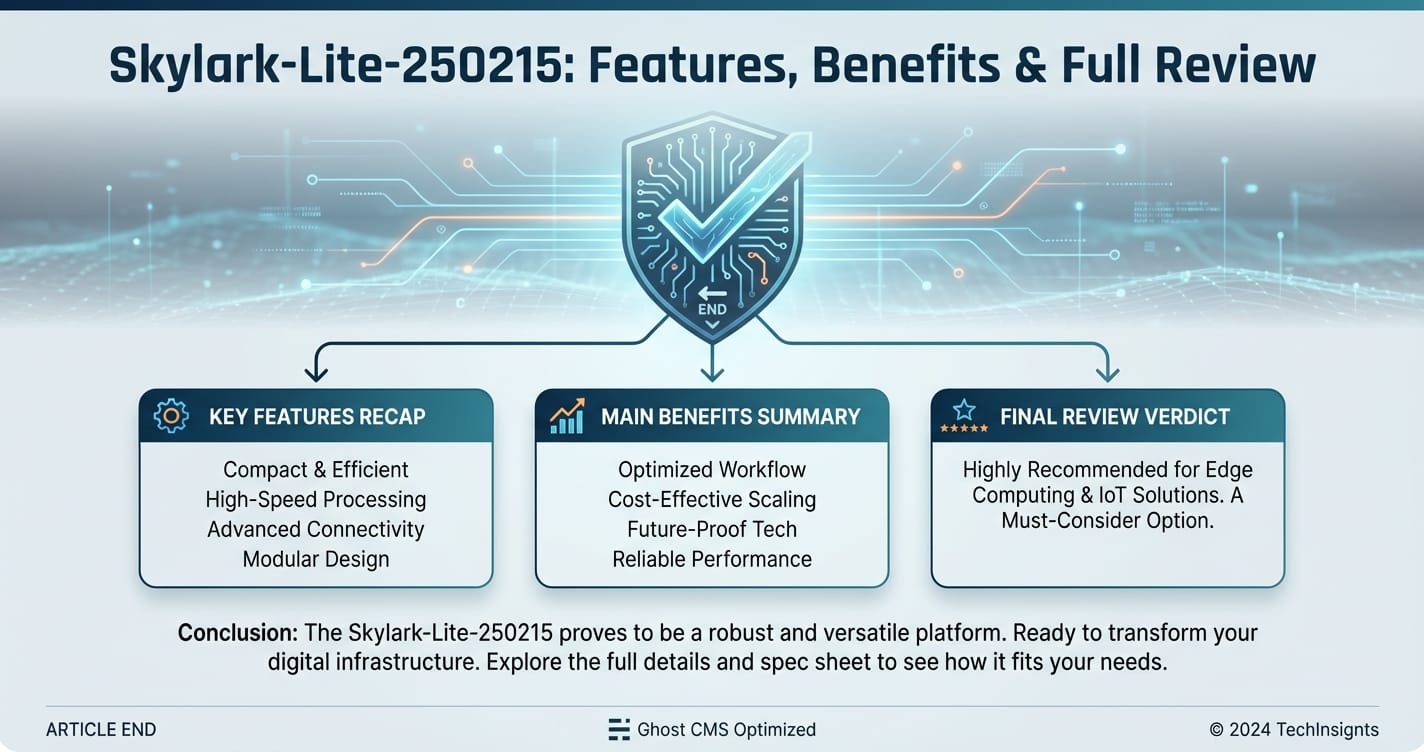
Skylark-Lite-250215 stands out as a compelling testament to the power of optimized AI. It's not merely a scaled-down version of a larger model; it's a meticulously engineered solution designed to meet the growing demand for efficient, accessible, and high-performing language AI. Its rich feature set, characterized by advanced architectural innovations, robust language understanding, and significant customization options, makes it a highly versatile tool for a myriad of applications.
The benefits it delivers – paramount among them cost-effective AI and low latency AI – address critical pain points for businesses and developers alike. From revolutionizing customer support with responsive chatbots to enabling personalized content generation at scale, Skylark-Lite-250215 empowers innovation across industries. While Skylark-Pro remains the choice for the most demanding, high-performance, and deeply nuanced tasks, Skylark-Lite-250215 carves out its essential niche by providing 80% of the capability for a fraction of the cost and computational overhead.
The future of the Skylark model family, and particularly its "Lite" variants, is bright. As AI continues to integrate into every facet of our digital lives, the need for intelligent, efficient, and democratized language models will only grow. Skylark-Lite-250215 is not just keeping pace with this demand; it's actively shaping the landscape, making advanced AI capabilities a practical reality for a broader range of innovators and applications. Its strategic value lies in making powerful AI not just possible, but genuinely practical and pervasive.
Frequently Asked Questions (FAQ) About Skylark-Lite-250215
Q1: What is Skylark-Lite-250215, and how does it differ from Skylark-Pro? A1: Skylark-Lite-250215 is an optimized, efficient version within the Skylark model family, designed for low latency AI and cost-effective AI. It offers strong language understanding and generation capabilities with a significantly smaller memory footprint and faster inference speeds compared to Skylark-Pro. While Skylark-Pro prioritizes maximum performance and nuance for highly complex tasks, Skylark-Lite-250215 focuses on delivering excellent performance for most common NLP tasks in resource-constrained or real-time environments.
Q2: What are the primary benefits of using Skylark-Lite-250215 for my AI project? A2: The main benefits include significantly lower operational costs (making it cost-effective AI), much faster inference times crucial for low latency AI applications, greater deployment flexibility (including edge computing), and reduced hardware requirements. This makes it ideal for projects with budget constraints, high-volume requests, or requirements for on-device AI.
Q3: Can Skylark-Lite-250215 be fine-tuned for specific tasks or industries? A3: Yes, absolutely. Skylark-Lite-250215 is designed to be highly amenable to fine-tuning. Developers can train it on smaller, domain-specific datasets to tailor its knowledge, style, and performance to particular industries (e.g., healthcare, finance) or specific tasks (e.g., generating product descriptions, summarizing legal documents). Its smaller size makes the fine-tuning process faster and less expensive.
Q4: What are some common use cases where Skylark-Lite-250215 excels? A4: Skylark-Lite-250215 excels in applications requiring efficient, real-time language processing. Common use cases include intelligent chatbots for customer support, automated content generation for blogs and social media, personalized recommendation engines, efficient document summarization, and AI deployment on edge devices where resources are limited.
Q5: How can developers integrate models like Skylark-Lite-250215 into their applications? A5: Developers typically integrate such models via APIs. Platforms like XRoute.AI offer a streamlined approach. XRoute.AI provides a unified API platform that acts as a single, OpenAI-compatible endpoint for over 60 AI models, including many large language models (LLMs). This simplifies the process of connecting to and managing various AI models, ensuring developers can leverage high-performance and cost-effective AI options like Skylark-Lite-250215 with ease, focusing more on building their applications rather than managing complex API integrations.
🚀You can securely and efficiently connect to thousands of data sources with XRoute in just two steps:
Step 1: Create Your API Key
To start using XRoute.AI, the first step is to create an account and generate your XRoute API KEY. This key unlocks access to the platform’s unified API interface, allowing you to connect to a vast ecosystem of large language models with minimal setup.
Here’s how to do it: 1. Visit https://xroute.ai/ and sign up for a free account. 2. Upon registration, explore the platform. 3. Navigate to the user dashboard and generate your XRoute API KEY.
This process takes less than a minute, and your API key will serve as the gateway to XRoute.AI’s robust developer tools, enabling seamless integration with LLM APIs for your projects.
Step 2: Select a Model and Make API Calls
Once you have your XRoute API KEY, you can select from over 60 large language models available on XRoute.AI and start making API calls. The platform’s OpenAI-compatible endpoint ensures that you can easily integrate models into your applications using just a few lines of code.
Here’s a sample configuration to call an LLM:
curl --location 'https://api.xroute.ai/openai/v1/chat/completions' \
--header 'Authorization: Bearer $apikey' \
--header 'Content-Type: application/json' \
--data '{
    "model": "gpt-5",
    "messages": [
        {
            "content": "Your text prompt here",
            "role": "user"
        }
    ]
}'
With this setup, your application can instantly connect to XRoute.AI’s unified API platform, leveraging low latency AI and high throughput (handling 891.82K tokens per month globally). XRoute.AI manages provider routing, load balancing, and failover, ensuring reliable performance for real-time applications like chatbots, data analysis tools, or automated workflows. You can also purchase additional API credits to scale your usage as needed, making it a cost-effective AI solution for projects of all sizes.
Note: Explore the documentation on https://xroute.ai/ for model-specific details, SDKs, and open-source examples to accelerate your development.