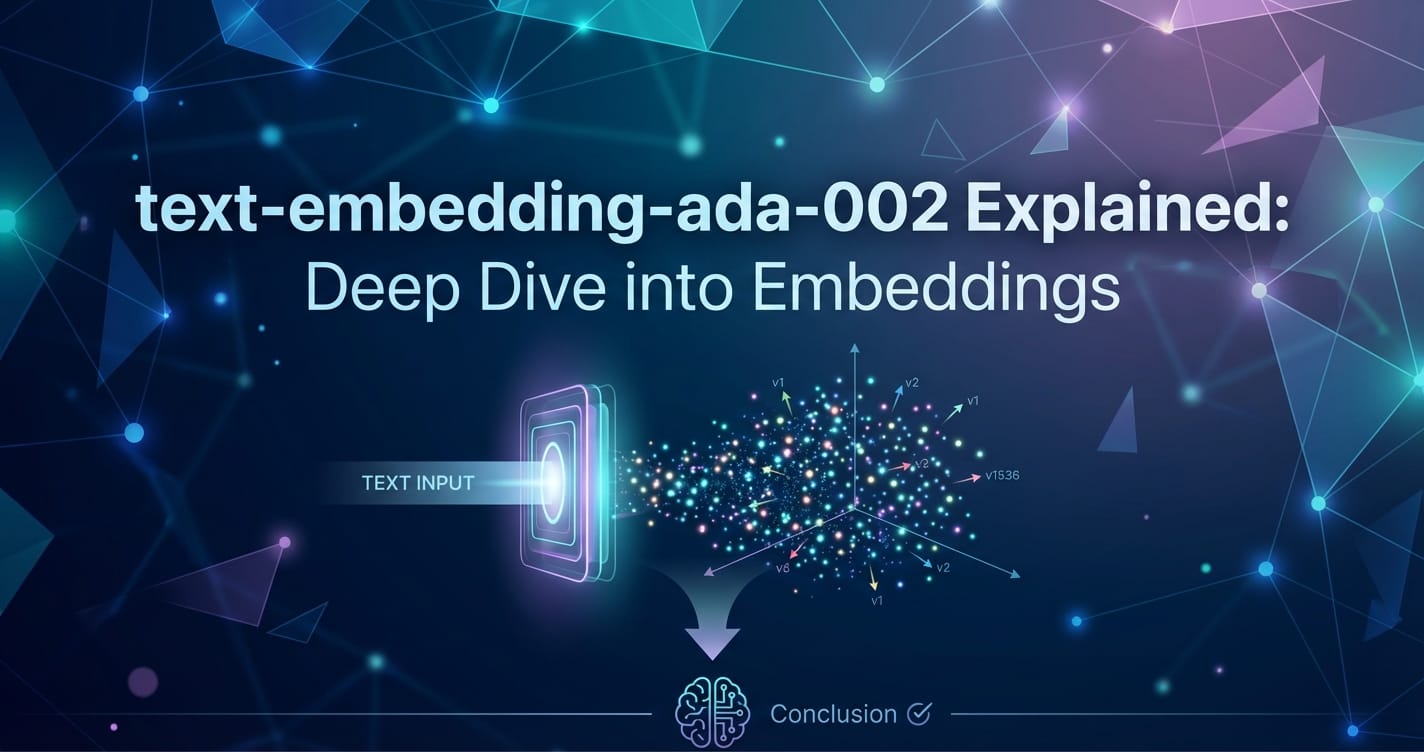
text-embedding-ada-002 Explained: Deep Dive into Embeddings

Unlocking the Fabric of Language: A Journey into Text Embeddings
In the rapidly evolving landscape of artificial intelligence, understanding and processing human language remains one of the most profound challenges and fertile grounds for innovation. At the heart of many breakthroughs in natural language processing (NLP) lies a seemingly simple yet incredibly powerful concept: text embeddings. These numerical representations of text, whether words, phrases, sentences, or even entire documents, act as the bridge between human language and machine comprehension. They transform the rich, complex, and often ambiguous tapestry of linguistic meaning into a mathematical format that algorithms can readily process, compare, and learn from.
The advent of sophisticated embedding models has democratized access to advanced NLP capabilities, enabling a wide array of applications from semantic search to intelligent recommendation systems. Among the various models that have emerged, OpenAI's text-embedding-ada-002 quickly became a cornerstone, offering a robust and cost-effective solution for a myriad of tasks. Its impact was significant, providing developers and researchers with a powerful tool to capture nuanced semantic relationships. However, the pace of AI innovation is relentless, and with new demands for higher performance, greater efficiency, and more granular control, the field continues to evolve, leading to the introduction of more advanced models like text-embedding-3-large.
This comprehensive guide embarks on a deep dive into the world of text embeddings, beginning with the foundational principles that govern their creation and utility. We will meticulously unpack the architecture and capabilities of text-embedding-ada-002, exploring its strengths, limitations, and the diverse applications it has powered. Subsequently, we will turn our attention to its more advanced successor, text-embedding-3-large, dissecting the key innovations and performance enhancements that set it apart. Throughout this exploration, we will also provide practical insights into leveraging the OpenAI SDK to interact with these powerful models, equipping you with the knowledge to integrate them into your own AI-driven projects. By the end of this journey, you will possess a profound understanding of how embeddings work, how they have evolved, and how to harness their full potential to build intelligent, language-aware systems.
The Genesis of Understanding: Decoding text-embedding-ada-002
The concept of representing words as vectors dates back decades, with early attempts often relying on statistical methods like TF-IDF (Term Frequency-Inverse Document Frequency) or latent semantic analysis (LSA). While these methods provided a rudimentary form of semantic representation, they often struggled to capture the nuanced contextual meanings of words. The true revolution began with the introduction of neural network-based embeddings, such as Word2Vec and GloVe, which learned continuous vector representations by predicting surrounding words or leveraging co-occurrence statistics. These models demonstrated a remarkable ability to capture semantic and syntactic relationships, where words with similar meanings would be located closer together in the vector space.
What are Embeddings, Fundamentally?
At its core, a text embedding is a dense vector of floating-point numbers. Imagine a high-dimensional space where each dimension represents a latent semantic feature. When a piece of text (a word, sentence, or document) is embedded, it is projected into this space as a single point, represented by its coordinates along these dimensions. The magic happens because texts with similar meanings or contexts are mapped to nearby points in this vector space. This spatial proximity directly translates to semantic similarity, allowing algorithms to perform operations like:
- Similarity Search: Finding documents or queries that are semantically related.
- Clustering: Grouping similar texts together without prior labels.
- Classification: Training models to categorize texts based on their semantic content.
- Anomaly Detection: Identifying texts that deviate significantly from a norm.
text-embedding-ada-002: A Benchmark Model
OpenAI's text-embedding-ada-002 emerged as a game-changer in the embedding landscape. Released as part of OpenAI's suite of powerful AI models, it quickly became a go-to solution for developers due to its balanced performance, cost-effectiveness, and ease of use. Unlike earlier models that often required extensive fine-tuning or were specific to certain languages, ada-002 offered a generalized, robust solution trained on a vast corpus of diverse text data.
Key Features and Architectural Insights:
text-embedding-ada-002 is built upon a transformer architecture, a neural network design that has become the de facto standard for state-of-the-art NLP models. Transformers excel at understanding long-range dependencies in text and processing input sequences in parallel, leading to highly contextualized embeddings. While OpenAI hasn't publicly disclosed the exact architectural details or the full training dataset, it's understood to be trained on an enormous volume of text and code, allowing it to generalize across a wide range of topics and linguistic styles.
- Unified Embedding: A significant departure from previous models was its ability to produce a single, unified embedding for any length of text – from a single word to a large document. This eliminated the need for separate models for different granularities of text, simplifying development workflows considerably.
- Dimensionality:
ada-002generates embeddings with 1536 dimensions. This relatively high dimensionality allows it to capture a rich and detailed semantic representation of the input text, enabling fine-grained distinctions between meanings. - Cost-Effectiveness: At its release,
ada-002was lauded for its significantly reduced cost per token compared to previous OpenAI embedding models, making advanced NLP capabilities accessible to a broader audience. This economic advantage played a crucial role in its widespread adoption. - Multilinguality: Although primarily trained on English text,
ada-002exhibited impressive cross-lingual capabilities, often performing reasonably well on texts in other languages, which further broadened its utility for global applications. - Robustness: Its extensive training made it robust to variations in input text, including typos, grammatical errors, and informal language, providing consistent and reliable embeddings.
Common Use Cases Powered by text-embedding-ada-002:
The versatility of text-embedding-ada-002 allowed it to power an extensive array of applications across various industries:
- Semantic Search: Moving beyond keyword matching,
ada-002enabled search engines to understand the intent behind a query, returning results that are semantically relevant even if they don't contain the exact keywords. For instance, a query like "recipes for gluten-free cakes" could match documents discussing "wheat-free dessert options." - Recommendation Systems: By embedding user preferences, item descriptions, or viewing history,
ada-002could identify items or content that are semantically similar to what a user has enjoyed in the past, leading to highly personalized recommendations for products, movies, articles, or music. - Text Classification and Categorization: From sentiment analysis (classifying text as positive, negative, or neutral) to spam detection or content moderation, embeddings provided a powerful feature set for machine learning models to classify text into predefined categories with high accuracy.
- Clustering and Topic Modeling: Grouping similar news articles, customer feedback, or research papers together without prior labels became more effective.
ada-002could help uncover hidden themes and topics within large unstructured datasets. - Anomaly Detection: Identifying unusual or outlier text entries, such as fraudulent reviews, unusual network traffic descriptions, or unique support tickets, by measuring their distance from the general cluster of embeddings.
- Question Answering and Chatbots: By embedding user questions and a knowledge base,
ada-002facilitated the retrieval of relevant answers, making chatbots more intelligent and conversational AI systems more effective in understanding and responding to user queries. - Code Search and Generation: Given its training on code,
ada-002was also effective in understanding code snippets, allowing for semantic code search, suggesting related code, or even aiding in code generation tasks.
Strengths and Limitations of text-embedding-ada-002:
| Feature | Strengths | Limitations |
|---|---|---|
| Generality | Unified model for various text granularities. | Performance might vary for highly specialized domains or very long documents. |
| Cost-Efficiency | Significantly cheaper than previous models, enabling broader adoption. | Not the absolute cheapest option for all use cases, especially with huge volumes. |
| Performance | Good balance of speed and accuracy for most common NLP tasks. | Can be outperformed by more specialized or larger models in specific benchmarks. |
| Dimensionality | 1536 dimensions capture rich semantic detail. | High dimensionality can increase storage and computational cost for retrieval. |
| Multilinguality | Decent performance in multiple languages. | Primarily English-centric, might not be optimal for deeply nuanced non-English texts. |
| Ease of Use | Simple API integration via OpenAI SDK. |
Despite its impressive capabilities, text-embedding-ada-002 wasn't without its areas for improvement. As the demands of AI applications grew, particularly in terms of performance benchmarks, cost-efficiency at scale, and the desire for even finer-grained control over embedding properties, the stage was set for the next generation of models.
The Evolution of Precision: Unpacking text-embedding-3-large
The landscape of AI is one of continuous advancement, where even highly successful models eventually pave the way for more sophisticated successors. OpenAI's text-embedding-ada-002 set a high bar, but the relentless pursuit of perfection in NLP capabilities, coupled with the ever-increasing scale of AI applications, necessitated further innovation. This drive led to the development and release of text-embedding-3-large, a model designed to push the boundaries of performance and efficiency even further.
Why the Upgrade? Addressing ada-002's Evolving Constraints
While text-embedding-ada-002 was remarkably effective, several factors prompted the need for an upgrade:
- Performance Ceilings: For highly critical applications like complex semantic search over massive knowledge bases, or very nuanced classification tasks, even minor improvements in embedding quality could translate into significant gains in accuracy and user experience.
ada-002had reached its natural performance ceiling. - Cost Optimization at Scale: While
ada-002was cost-effective, extremely large-scale deployments involving billions of embeddings could still incur substantial costs. Developers sought models that offered even better price-performance ratios. - Dimensionality Trade-offs: The 1536 dimensions of
ada-002provided rich detail but also came with computational overhead for storage, indexing, and similarity calculations, especially in vector databases. A flexible solution allowing for controlled dimensionality reduction without significant performance loss was desired. - Handling Long Contexts: As language models grew in their ability to process longer inputs, so did the need for embedding models that could encapsulate the meaning of extended texts with greater fidelity.
text-embedding-3-large: Key Improvements and Innovations
text-embedding-3-large represents a significant leap forward, offering a new benchmark in quality, flexibility, and cost-efficiency. It was released alongside text-embedding-3-small, providing a spectrum of choices to suit different application needs. Our focus here will be on the "large" variant due to its superior capabilities.
- Superior Performance: The most notable improvement is
text-embedding-3-large's significantly enhanced performance across various standard embedding benchmarks. This translates to more accurate similarity comparisons, better classification results, and generally more intelligent NLP applications. OpenAI reported thattext-embedding-3-largeachieved a significant jump in MTEB (Massive Text Embedding Benchmark) scores compared toada-002, particularly excelling in tasks like retrieval, classification, and STS (Semantic Textual Similarity). - Flexible Dimensionality (Truncation): A groundbreaking feature of
text-embedding-3-large(andtext-embedding-3-small) is its ability to produce embeddings that can be truncated to smaller dimensions while retaining much of their original performance. This means a user can request an embedding of, say, 3072 dimensions, but then choose to use only the first 512, 1024, or 1536 dimensions (or any specified length up to the maximum) for their specific application. This offers incredible flexibility, allowing developers to balance performance needs with storage and computational constraints.- The maximum dimensionality for
text-embedding-3-largeis 3072. - This truncation capability is not simply cutting off numbers; the model is designed such that the leading dimensions carry the most semantic information, making truncation a viable strategy without rebuilding the embedding from scratch.
- The maximum dimensionality for
- Enhanced Cost-Effectiveness: Alongside its improved performance,
text-embedding-3-largealso boasts a more attractive pricing structure per token compared toada-002. This makes it a compelling choice for projects requiring high volumes of embeddings without breaking the bank. - Contextual Understanding: While
ada-002was good,text-embedding-3-largeexhibits an even deeper understanding of context, subtle nuances, and complex relationships within text. This likely stems from advancements in its transformer architecture, larger model size, and potentially more extensive or specialized training data. - Multilingual Prowess: Building on the foundations of its predecessor,
text-embedding-3-largefurther refines its multilingual capabilities, making it an even stronger contender for global applications that deal with diverse linguistic inputs.
Comparison: text-embedding-ada-002 vs. text-embedding-3-large
To truly appreciate the advancements, a direct comparison is illuminating:
| Feature | text-embedding-ada-002 |
text-embedding-3-large |
|---|---|---|
| Max Dimensionality | 1536 | 3072 |
| Dimensionality Control | Fixed | Flexible; can truncate to smaller dimensions (e.g., 256, 512, 1024, 1536) |
| Performance (MTEB) | Solid, widely adopted benchmark. | Significantly higher scores, setting a new state-of-the-art for general embeddings. |
| Cost Per Token | Cost-effective for its time (e.g., $0.0001 / 1K tokens). | Even more cost-effective (e.g., $0.00013 / 1K tokens at full 3072 dim, with text-embedding-3-small even lower). |
| Semantic Fidelity | Good, captures general semantic relationships. | Excellent, captures more nuanced and complex semantic relationships. |
| Primary Use Cases | General semantic search, classification, recommendation. | All previous use cases with higher accuracy; ideal for high-precision retrieval and RAG. |
| Release Date | Late 2022 | Early 2024 |
This table vividly illustrates the significant strides made. text-embedding-3-large doesn't just offer incremental improvements; it provides a new paradigm for managing embedding costs and performance through its flexible dimensionality, making it suitable for a broader range of applications and more dynamic resource allocation.
Expanded Use Cases and Performance Benchmarks:
With its superior performance, text-embedding-3-large excels in scenarios where ada-002 might have shown limitations:
- Advanced RAG (Retrieval-Augmented Generation): In RAG systems, the quality of retrieved documents directly impacts the output of the language model.
text-embedding-3-largeensures more precise document retrieval, leading to more accurate, relevant, and less "hallucinated" responses from generative AI models. - Hyper-Personalized Recommendation Engines: By capturing even finer details of user preferences and item attributes, the model can power recommendation systems that are remarkably accurate and anticipate user needs with greater precision.
- Legal and Medical Document Analysis: In domains where semantic precision is paramount,
text-embedding-3-largecan better distinguish between subtly different legal clauses or medical conditions, improving the accuracy of document comparison, summarization, and information extraction. - Low-Resource Language Support: While still primarily English-centric in its training foundation, its enhanced generalization capabilities may lead to better performance in few-shot or zero-shot scenarios for languages with fewer available resources.
- Complex Anomaly Detection: Identifying sophisticated anomalies in large textual datasets, such as detecting subtle shifts in public sentiment, emerging fraud patterns, or novel security threats, becomes more feasible.
The introduction of text-embedding-3-large marks a new era for embedding models, offering developers and businesses an even more potent tool to imbue their applications with a deeper understanding of human language. Its flexibility in dimensionality is particularly noteworthy, allowing for highly optimized deployments tailored to specific performance and cost requirements.
The Mathematical Heart: A Deep Dive into Embeddings' Theoretical Foundations
While we've discussed the practical applications and model evolution, a deeper understanding of the theoretical underpinnings of embeddings is crucial for leveraging them effectively. At their core, embeddings are about representing meaning in a quantifiable, mathematical way.
Vectors in Multi-Dimensional Space: The Language of Embeddings
Every embedding, regardless of the model that generates it, is essentially a vector—an ordered list of numbers. For text-embedding-ada-002, this vector has 1536 numbers, and for text-embedding-3-large, it can have up to 3072. Each number represents the text's "position" along a specific dimension in an abstract, high-dimensional space. These dimensions don't correspond to human-interpretable concepts like "happiness" or "sadness" in a one-to-one fashion; instead, they capture complex, latent semantic features learned during the model's training process.
The fundamental idea is that semantic similarity translates to geometric proximity in this vector space. If two pieces of text have similar meanings, their corresponding embedding vectors will be "close" to each other. Conversely, texts with very different meanings will be far apart.
Distance Metrics: Quantifying Similarity
To determine how "close" two embeddings are, we use distance or similarity metrics. The choice of metric can subtly influence the results of similarity searches or clustering tasks.
- Cosine Similarity: This is by far the most commonly used metric for text embeddings. Cosine similarity measures the cosine of the angle between two vectors. A value of 1 indicates perfect similarity (the vectors point in the exact same direction), a value of 0 indicates orthogonality (no linear relationship), and a value of -1 indicates perfect dissimilarity (the vectors point in opposite directions).
- Formula:
cos(θ) = (A · B) / (||A|| ||B||)whereA · Bis the dot product of vectors A and B, and||A||is the Euclidean norm (magnitude) of vector A. - Why it's preferred: Cosine similarity is particularly effective for high-dimensional data because it focuses on the orientation of the vectors rather than their magnitude. This means it's less sensitive to the length of the text or the frequency of words, which might otherwise skew results if only Euclidean distance were used.
- Formula:
- Euclidean Distance: This is the straight-line distance between two points in Euclidean space. It's often referred to as L2 distance.
- Formula:
d(A, B) = √Σ(Ai - Bi)² - Considerations: While intuitive, Euclidean distance can be less suitable for high-dimensional spaces where the concept of "distance" can become less meaningful (the "curse of dimensionality"). It is also sensitive to the magnitude of vectors.
- Formula:
- Dot Product (or Inner Product): When embeddings are normalized (meaning their length is 1), the dot product is equivalent to cosine similarity. Some vector databases optimize for dot product similarity directly.
- Formula:
A · B = Σ(Ai * Bi)
- Formula:
Understanding these metrics is crucial for properly setting up your similarity search queries or clustering algorithms. For most general-purpose text embedding tasks with text-embedding-ada-002 or text-embedding-3-large, cosine similarity is the recommended and most robust choice.
Dimensionality Reduction: Taming the High-Dimensional Beast
While high dimensionality allows embeddings to capture rich semantic information, it also introduces challenges: increased storage requirements, slower similarity computations (especially for brute-force searches), and difficulty in visualization. Dimensionality reduction techniques aim to project these high-dimensional vectors into a lower-dimensional space while preserving as much of the original semantic information as possible.
- Principal Component Analysis (PCA): A linear technique that identifies the directions (principal components) along which the data varies the most and projects the data onto these new axes. It's useful for reducing noise and simplifying data while retaining the most important variance.
- t-Distributed Stochastic Neighbor Embedding (t-SNE): A non-linear technique particularly well-suited for visualizing high-dimensional data in 2 or 3 dimensions. It preserves local proximities, meaning points that are close in the high-dimensional space remain close in the lower-dimensional visualization.
- UMAP (Uniform Manifold Approximation and Projection): Similar to t-SNE but often faster and better at preserving both local and global structure of the data.
Crucially, text-embedding-3-large's ability to be truncated is a form of intrinsic dimensionality reduction. The model is explicitly trained such that the first k dimensions already contain a highly meaningful semantic representation. This is superior to applying a post-hoc technique like PCA, as the model itself is optimized for this property.
Training Methods: The Engine Behind Meaning
Modern text embedding models, especially those from OpenAI, are trained using sophisticated techniques, primarily leveraging Transformer architectures. A simplified overview of how these models learn semantic meaning:
- Large Text Corpora: Models are trained on colossal datasets of text (and often code) from the internet, books, articles, etc. This vast exposure allows them to learn the statistical properties of language.
- Self-Supervised Learning: Instead of requiring human-labeled data for every task, these models learn through self-supervised tasks. Common examples include:
- Masked Language Modeling (MLM): The model is given a sentence with some words "masked out" (replaced with a special token) and must predict the original masked words. This forces the model to understand context.
- Next Sentence Prediction (NSP): The model is given two sentences and must predict if the second sentence logically follows the first. This helps in understanding document-level coherence.
- Contextual Embeddings: Unlike older models like Word2Vec that produced a single, fixed embedding for each word, Transformer-based models generate contextual embeddings. This means the embedding for a word like "bank" will differ depending on whether it's used in the context of a "river bank" or a "financial bank." This capability is vital for capturing the true richness of language.
- Fine-Tuning (for specific tasks, though not for OpenAI's base embeddings): While OpenAI provides pre-trained embeddings ready for use, the underlying Transformer models can sometimes be fine-tuned on specific downstream tasks (e.g., medical text classification) to improve performance in niche domains.
The combination of massive training data, self-supervised learning, and advanced architectures like Transformers allows models like text-embedding-ada-002 and text-embedding-3-large to generate high-quality, dense, and context-aware vector representations of text, making them indispensable tools in the modern AI toolkit.
Practical Applications: Harnessing Embeddings for Real-World Impact
The theoretical elegance of text embeddings truly shines when translated into practical, impactful applications. From enhancing search functionalities to powering intelligent agents, these numerical representations form the backbone of many cutting-edge AI systems. Let's delve deeper into some of the most compelling use cases, illustrating how both text-embedding-ada-002 and text-embedding-3-large drive innovation.
1. Semantic Search and Retrieval-Augmented Generation (RAG)
Perhaps the most intuitive and widely adopted application of embeddings is semantic search. Traditional keyword-based search often falls short when users express their queries using different terminology than what's present in the indexed documents. Semantic search, powered by embeddings, overcomes this limitation by understanding the meaning or intent behind the query.
How it works: 1. All documents (or chunks of documents) in a knowledge base are converted into embeddings and stored in a vector database. 2. When a user enters a query, it is also converted into an embedding using the same model (ada-002 or text-embedding-3-large). 3. The query embedding is then compared against all document embeddings in the database using a similarity metric (e.g., cosine similarity). 4. The top-N most similar document chunks are retrieved and presented to the user.
Impact: This dramatically improves search relevance, especially for complex or nuanced queries. For instance, a search for "sustainable energy solutions for urban areas" can retrieve documents discussing "eco-friendly power generation in cities" even if the exact keywords aren't present.
RAG Integration: Semantic search forms the critical "Retrieval" component of Retrieval-Augmented Generation (RAG) systems. In a RAG pipeline, retrieved context from a knowledge base is fed to a large language model (LLM) alongside the user's query. This allows the LLM to generate more informed, accurate, and up-to-date responses, mitigating issues like "hallucinations" or outdated information inherent in base LLMs. text-embedding-3-large's superior retrieval performance is particularly beneficial for RAG, ensuring the LLM receives the most relevant and high-quality context, leading to more reliable AI outputs.
2. Recommendation Systems
Personalized recommendations are omnipresent, from e-commerce platforms suggesting products to streaming services curating movies. Embeddings play a pivotal role in these systems, enabling the discovery of similar items or content.
How it works: 1. Items (products, movies, articles, songs) are embedded based on their descriptions, metadata, or user reviews. 2. Users can also be represented by embeddings based on their interaction history (e.g., average embedding of items they liked, search queries, or explicit preferences). 3. By finding items whose embeddings are close to a user's embedding, or by finding items similar to what a user previously interacted with, the system can generate highly personalized recommendations.
Impact: Embeddings move beyond simple collaborative filtering (users who liked X also liked Y) to understanding the semantic characteristics of items and users. This allows for cold-start recommendations (new items or new users) and the discovery of unexpected but relevant content, boosting engagement and satisfaction.
3. Text Classification and Sentiment Analysis
Categorizing text into predefined labels is a fundamental NLP task. Whether it's sorting customer feedback, moderating content, or analyzing market sentiment, embeddings provide powerful features for classification models.
How it works: 1. Texts are embedded using ada-002 or text-embedding-3-large. 2. These embeddings are then used as input features for a traditional machine learning classifier (e.g., SVM, Logistic Regression, XGBoost) or a neural network. 3. The model is trained on labeled data to learn the mapping from embeddings to categories.
Impact: Embeddings capture the semantic essence of text, making classifiers more robust and accurate than those relying on simpler features like bag-of-words. For sentiment analysis, the embedding inherently encapsulates the emotional tone, allowing for nuanced positive, negative, or neutral classifications across various expressions.
4. Clustering and Anomaly Detection
Uncovering natural groupings within unstructured text data (clustering) or identifying unusual outliers (anomaly detection) are crucial for tasks like data exploration, fraud detection, and system monitoring.
How it works for Clustering: 1. A collection of texts (e.g., customer reviews, news articles) is embedded. 2. Clustering algorithms (e.g., K-Means, DBSCAN, Hierarchical Clustering) are applied to these embeddings. 3. The algorithms group texts whose embeddings are geometrically close, revealing underlying themes or categories.
How it works for Anomaly Detection: 1. Embeddings of "normal" or expected text patterns are collected. 2. New incoming texts are embedded. 3. If a new text's embedding is significantly distant from the clusters of normal embeddings, it's flagged as an anomaly. This could detect unusual support requests, fraudulent transactions described in text, or novel threats in security logs.
Impact: These applications enable discovery of hidden patterns, automatic categorization without pre-labeling, and proactive identification of critical deviations, providing valuable insights from vast amounts of text.
5. Knowledge Graphs and Information Extraction
Knowledge graphs represent entities and their relationships in a structured format. Embeddings can aid in both building and querying these graphs.
How it works: 1. Entity Linking: Embeddings of text mentions can be compared to embeddings of known entities in a knowledge base to resolve ambiguities and link text to the correct entity. 2. Relationship Extraction: By embedding sentences or phrases that describe relationships between entities, models can learn to extract new relational triples (subject-predicate-object) from unstructured text to enrich the knowledge graph. 3. Graph Querying: Queries can be embedded and used to semantically search the graph for relevant entities or relationships, going beyond exact matches.
Impact: Embeddings accelerate the construction and enhance the utility of knowledge graphs, making them more dynamic and comprehensive for applications requiring deep factual understanding.
6. Cross-Lingual Applications
While not perfectly universal, text-embedding-ada-002 and text-embedding-3-large demonstrate remarkable cross-lingual transfer capabilities, meaning an embedding for a concept in English might be relatively close to the embedding of the same concept in another language.
How it works: 1. Embed texts from different languages into the same vector space. 2. Perform tasks like cross-lingual information retrieval (query in one language, retrieve documents in another), multilingual topic modeling, or sentiment analysis across languages.
Impact: This capability is crucial for global businesses and research, enabling systems to operate across linguistic barriers without needing separate models for each language, significantly reducing development overhead and cost.
The diverse range of applications underscores the transformative power of text embeddings. As models like text-embedding-3-large continue to refine their ability to capture meaning with greater precision and efficiency, the possibilities for intelligent systems that truly understand and interact with human language will only expand.
XRoute is a cutting-edge unified API platform designed to streamline access to large language models (LLMs) for developers, businesses, and AI enthusiasts. By providing a single, OpenAI-compatible endpoint, XRoute.AI simplifies the integration of over 60 AI models from more than 20 active providers(including OpenAI, Anthropic, Mistral, Llama2, Google Gemini, and more), enabling seamless development of AI-driven applications, chatbots, and automated workflows.
Programming the Semantic World: Leveraging the OpenAI SDK for Embeddings
Interacting with powerful AI models like text-embedding-ada-002 and text-embedding-3-large is made incredibly straightforward through the OpenAI SDK. This software development kit provides a convenient and idiomatic way to integrate OpenAI's API services into your applications, abstracting away the complexities of HTTP requests and API authentication.
Installation and Setup
Before you can generate embeddings, you need to install the openai Python package and set up your API key.
pip install openai
Once installed, you'll need to configure your OpenAI API key. It's best practice to load this from an environment variable rather than hardcoding it directly into your script for security reasons.
import os
from openai import OpenAI

# Ensure your OpenAI API key is set as an environment variable (e.g., OPENAI_API_KEY)
# client = OpenAI(api_key=os.environ.get("OPENAI_API_KEY")) # Old way, still works
client = OpenAI() # If OPENAI_API_KEY is in your environment variables, this works by default
Basic Usage: Creating Embeddings with text-embedding-ada-002
Let's start with a simple example of how to generate an embedding for a single piece of text using text-embedding-ada-002.
from openai import OpenAI

client = OpenAI() # Assumes OPENAI_API_KEY is set in environment

def get_embedding_ada(text):
    """Generates an embedding for a given text using text-embedding-ada-002."""
    response = client.embeddings.create(
        input=text,
        model="text-embedding-ada-002"
    )
    # The embedding is in the 'data' list, usually the first element
    return response.data[0].embedding

# Example usage
text_to_embed = "Artificial intelligence is rapidly transforming industries worldwide."
embedding = get_embedding_ada(text_to_embed)

print(f"Text: '{text_to_embed}'")
print(f"Embedding length: {len(embedding)}") # Should be 1536
print(f"First 5 dimensions of embedding: {embedding[:5]}")
This simple function takes a string, sends it to the OpenAI API, and returns the 1536-dimensional vector representing its semantic content.
Generating Embeddings with text-embedding-3-large and Flexible Dimensionality
The process for text-embedding-3-large is very similar, but it introduces the optional dimensions parameter for controlling the output vector size.
from openai import OpenAI

client = OpenAI() # Assumes OPENAI_API_KEY is set in environment

def get_embedding_large(text, dimensions=None):
    """
    Generates an embedding for a given text using text-embedding-3-large,
    with optional dimensionality control.
    """
    params = {
        "input": text,
        "model": "text-embedding-3-large"
    }
    if dimensions is not None:
        params["dimensions"] = dimensions

    response = client.embeddings.create(**params)
    return response.data[0].embedding

# Example usage with full dimensionality (3072)
text_to_embed_large_full = "The quick brown fox jumps over the lazy dog."
embedding_large_full = get_embedding_large(text_to_embed_large_full)
print(f"\nText: '{text_to_embed_large_full}'")
print(f"Embedding (large, full) length: {len(embedding_large_full)}") # Should be 3072

# Example usage with reduced dimensionality (e.g., 512 dimensions)
text_to_embed_large_reduced = "Machine learning models require vast amounts of data for training."
embedding_large_reduced = get_embedding_large(text_to_embed_large_reduced, dimensions=512)
print(f"\nText: '{text_to_embed_large_reduced}'")
print(f"Embedding (large, 512 dim) length: {len(embedding_large_reduced)}") # Should be 512
print(f"First 5 dimensions of reduced embedding: {embedding_large_reduced[:5]}")
This demonstrates the power and flexibility of text-embedding-3-large. You can dynamically choose the embedding size that best suits your storage and computational needs without sacrificing too much semantic fidelity.
Handling Multiple Inputs (Batching)
For efficiency and to reduce API call overhead, the OpenAI SDK allows you to send multiple text inputs in a single request. This is highly recommended for processing large volumes of text.
from openai import OpenAI

client = OpenAI()

def get_batch_embeddings(texts, model_name="text-embedding-3-large", dimensions=None):
    """Generates embeddings for a list of texts."""
    params = {
        "input": texts,
        "model": model_name
    }
    if dimensions is not None:
        params["dimensions"] = dimensions

    response = client.embeddings.create(**params)
    # Returns a list of embeddings, one for each input text
    return [d.embedding for d in response.data]

# Example batch usage
texts_for_batch = [
    "The sun rises in the east.",
    "The moon orbits the Earth.",
    "Planets revolve around stars.",
    "Galaxies are vast collections of stars."
]

batch_embeddings = get_batch_embeddings(texts_for_batch, model_name="text-embedding-ada-002")
print(f"\nGenerated {len(batch_embeddings)} embeddings for the batch using text-embedding-ada-002.")
print(f"Length of first embedding: {len(batch_embeddings[0])}") # 1536

batch_embeddings_large = get_batch_embeddings(texts_for_batch, model_name="text-embedding-3-large", dimensions=1024)
print(f"\nGenerated {len(batch_embeddings_large)} embeddings for the batch using text-embedding-3-large (1024 dim).")
print(f"Length of first embedding: {len(batch_embeddings_large[0])}") # 1024
Batching is crucial for optimizing your usage, especially when dealing with large datasets. The OpenAI SDK automatically handles the request structure for you.
Managing API Keys and Errors
- API Key Security: Always store your API key securely, preferably as an environment variable or in a secure secret management system. Avoid committing it directly to version control.
- Error Handling: API calls can fail due to network issues, rate limits, invalid inputs, or authentication problems. It's good practice to wrap your API calls in
try-exceptblocks to handle potentialopenai.APIErrorsor other exceptions. Implementing retry logic with exponential backoff can also make your application more robust.
import time
from openai import OpenAI
from openai import OpenAIError # Specific error type for OpenAI

client = OpenAI()

def robust_get_embedding(text, model="text-embedding-3-large", max_retries=3):
    """Generates an embedding with retry logic."""
    for i in range(max_retries):
        try:
            response = client.embeddings.create(input=text, model=model)
            return response.data[0].embedding
        except OpenAIError as e:
            print(f"Attempt {i+1} failed: {e}")
            if i < max_retries - 1:
                time.sleep(2 ** i) # Exponential backoff
            else:
                raise # Re-raise after max retries
        except Exception as e:
            print(f"An unexpected error occurred: {e}")
            raise

# Example of robust usage (will still fail if API key is invalid, but handles transient errors)
try:
    # Intentionally provide a string instead of a list for 'input' to demonstrate an API error if allowed
    # Note: For actual embedding models, 'input' can be a string or list of strings.
    # This example is conceptual for error handling, you'd usually pass valid input.
    # embedding = robust_get_embedding("This is a test.", model="invalid-model") # To test error handling
    embedding = robust_get_embedding("This is a valid test sentence.", model="text-embedding-3-small") # A valid model to show success
    print(f"\nSuccessfully got embedding of length: {len(embedding)}")
except Exception as e:
    print(f"Failed to get embedding after multiple retries: {e}")
Best Practices for Performance and Cost
- Batching: As shown above, batching multiple inputs into a single API call significantly reduces latency and API overhead.
- Truncation (
text-embedding-3-largespecific): Use thedimensionsparameter to request smaller embeddings if full 3072 dimensions are not strictly necessary. This saves on storage, memory, and computational costs for downstream tasks without a drastic loss in quality, especially when moving from 3072 to 1536 or even 1024. - Model Selection: Choose the appropriate model for your task. While
text-embedding-3-largeoffers superior performance,text-embedding-3-small(not detailed here but also available) is even more cost-effective for tasks where a slight drop in accuracy is acceptable.text-embedding-ada-002remains a solid choice for many general purposes where maximum performance isn't critical. - Asynchronous Calls: For high-throughput applications, consider using asynchronous API calls if your application architecture supports it. The
OpenAI SDKhas anAsyncOpenAIclient for this purpose. - Caching: If you frequently request embeddings for the same pieces of text, cache the results locally. This avoids redundant API calls and saves costs.
- Input Text Length: Be mindful of the token limits for embedding models. While these models can handle quite long inputs (typically up to 8191 tokens), very long documents should be chunked into smaller, semantically coherent segments before embedding to avoid exceeding limits and to improve the quality of local context capture.
By following these best practices and leveraging the capabilities of the OpenAI SDK, you can efficiently and effectively integrate text-embedding-ada-002 and text-embedding-3-large into your applications, unlocking powerful semantic understanding for your AI projects.
Performance, Cost, and Best Practices: Optimizing Your Embedding Strategy
Effectively utilizing text embedding models goes beyond merely generating vectors. It involves strategic decisions about model choice, cost management, performance optimization, and data preparation. These considerations are critical for building scalable, efficient, and impactful AI applications.
Choosing the Right Embedding Model: ada-002 vs. text-embedding-3-large
The choice between text-embedding-ada-002 and text-embedding-3-large (and its smaller sibling, text-embedding-3-small) depends heavily on your specific application's requirements, budget, and performance expectations.
- For General-Purpose & Cost-Sensitive Applications:
text-embedding-ada-002remains a very capable and highly cost-effective model for many common NLP tasks like basic semantic search, simple categorization, or preliminary clustering. If your application doesn't demand state-of-the-art precision and budget is a primary concern,ada-002is often sufficient.text-embedding-3-smallalso offers a very compelling price-performance ratio, often outperformingada-002at an even lower cost. - For High-Precision & Critical Applications:
text-embedding-3-largeis the clear winner when accuracy, nuanced semantic understanding, and robust retrieval performance are paramount. This is especially true for:- Retrieval-Augmented Generation (RAG): Where the quality of retrieved context directly impacts the generative output.
- Fine-grained Semantic Search: For large, complex knowledge bases (e.g., legal, medical, technical documentation).
- Sophisticated Classification: Where distinguishing between very similar categories is crucial.
- Anomaly Detection: Requiring high sensitivity to subtle deviations. Its higher default dimensionality (3072) and superior MTEB scores make it the go-to for pushing the boundaries of what embeddings can achieve.
- For Balanced Performance and Cost with Flexibility:
text-embedding-3-largewith dimensionality truncation offers the best of both worlds. You can experiment to find the optimal dimension size (e.g., 1024 or 1536) that provides sufficient performance for your task while minimizing storage and computational costs. This flexibility is a significant advantage.
Decision Flow: * Start with text-embedding-3-large (or text-embedding-3-small for maximum economy). * Test with default 3072 dimensions for large to establish a performance baseline. * If performance is overkill or cost/storage is an issue, experiment with dimensions parameter for text-embedding-3-large (e.g., 1536, 1024, 512) to find the sweet spot. * Only revert to text-embedding-ada-002 if text-embedding-3-small or truncated text-embedding-3-large still doesn't meet specific budget constraints while ada-002's performance is acceptable.
Strategies for Reducing Embedding Costs
Even with cost-effective models, generating embeddings at scale can accumulate costs. Smart strategies are essential:
- Batching API Calls: As demonstrated with the
OpenAI SDK, sending multiple text inputs in a single API request significantly reduces the per-call overhead, effectively lowering your operational costs and improving throughput. Aim for batch sizes that maximize efficiency without hitting API request size limits. - Input Text Truncation: While embedding models are designed to handle long texts, sometimes not all text is equally important for its core meaning. Consider pre-processing long documents to retain only the most semantically rich sections (e.g., abstract, key paragraphs, section headers) before embedding. Be cautious with aggressive truncation, as it can lead to loss of context. OpenAI models have a token limit (e.g., 8191 tokens), so truncating inputs that exceed this is mandatory.
- Caching: Implement robust caching mechanisms for frequently embedded texts. If a piece of content (e.g., a product description, a news article) has already been embedded, store its vector and reuse it rather than re-requesting from the API. This is particularly effective for static content.
- Incremental Updates: For dynamic datasets, instead of re-embedding everything when a small change occurs, only embed the new or modified content. Update your vector database incrementally.
- Utilize
dimensionsParameter (text-embedding-3-largeonly): This is a direct cost-saving feature. Lower dimensions mean less data to store and process in your vector database, potentially reducing infrastructure costs, even if the per-token API cost remains stable for the requested input.
Optimizing for Latency and Throughput
Beyond cost, performance metrics like latency (time per request) and throughput (requests per second) are critical for responsive applications.
- Asynchronous API Calls: For applications that need to handle many concurrent embedding requests, using the
AsyncOpenAIclient in theOpenAI SDKallows your application to send requests without blocking, significantly improving overall throughput. - Parallel Processing: If you're processing large offline datasets, you can parallelize embedding generation across multiple threads or processes (or even distributed computing frameworks) to leverage multi-core CPUs and generate embeddings much faster.
- Local Vector Database Indexing: Once embeddings are generated, efficiently storing and retrieving them is crucial. Vector databases (e.g., Pinecone, Weaviate, Milvus, Chroma) are optimized for high-dimensional vector search, employing indexing techniques like HNSW (Hierarchical Navigable Small World) or IVF (Inverted File Index) to perform approximate nearest neighbor (ANN) searches rapidly, even over billions of vectors.
- Hardware Acceleration: For very high-throughput, self-hosted embedding models (not directly applicable to OpenAI's API but good to know for larger AI strategy), leveraging GPUs or specialized AI accelerators can drastically speed up inference.
Data Preparation and Cleaning for Better Embedding Quality
The quality of your input text directly impacts the quality of your embeddings. "Garbage in, garbage out" applies here.
- Text Cleaning:
- Remove Boilerplate: Eliminate headers, footers, advertisements, navigation elements, or other non-content text.
- Remove HTML/Markdown Markup: Convert rich text into plain text unless the markup itself carries semantic meaning you wish to preserve.
- Handle Special Characters/Emojis: Decide whether to remove, normalize, or keep them based on their relevance to your task.
- Correct Typos/Grammar (Optional): While models are robust, extremely poor text quality can degrade embeddings. Tools like language models themselves or rule-based systems can help.
- Normalization: Standardize text where possible (e.g., converting all text to lowercase if case insensitivity is desired, though modern embeddings often benefit from case information).
- Chunking Long Documents: For documents exceeding the token limit or simply too long for a single embedding to capture all nuances, split them into smaller, semantically coherent chunks. Overlapping chunks by a few sentences can help preserve context across boundaries. Each chunk then gets its own embedding.
- Contextual Information: If available, sometimes adding metadata or a short descriptive prefix to text chunks (e.g., "Product: XYZ. Description: This is a highly durable and waterproof jacket...") can help the embedding model better contextualize the input.
Evaluating Embedding Performance
How do you know if your chosen model and strategy are working? Evaluation is key.
- Quantitative Benchmarks: For retrieval tasks, metrics like Recall@k, Precision@k, and Mean Average Precision (MAP) are essential. For classification, standard metrics like accuracy, F1-score, precision, and recall are used.
- Qualitative Review: Conduct human evaluations. Ask subject matter experts to assess the relevance of search results, the coherence of clusters, or the correctness of classifications based on embeddings.
- Visualization: Use dimensionality reduction techniques like t-SNE or UMAP to visualize your embeddings in 2D or 3D space. This can provide intuitive insights into how well semantically similar items cluster together and how well different categories are separated.
By meticulously planning and optimizing your embedding strategy across these dimensions, you can unlock the full potential of models like text-embedding-ada-002 and text-embedding-3-large, transforming raw text into actionable intelligence for your AI applications.
The Future Horizon of Text Embeddings
The evolution from text-embedding-ada-002 to text-embedding-3-large is not merely an incremental upgrade; it's a testament to the dynamic and rapidly advancing nature of AI. As we look ahead, the field of text embeddings is poised for even more profound transformations, driven by research into multimodal AI, dynamic representations, and ethical considerations.
Multimodal Embeddings: Bridging Modalities
Currently, our discussion has focused primarily on text. However, the future of embeddings lies in their ability to represent information across different modalities—text, images, audio, video, and more—within a single, unified vector space.
- How it works: Multimodal embedding models are trained on datasets containing aligned data from multiple modalities (e.g., an image with its caption, a video with its transcript). The goal is to learn a shared representation where, for instance, the embedding of an image of a cat is close to the embedding of the word "cat" or a spoken audio clip of someone saying "cat."
- Impact: This unlocks truly groundbreaking applications like:
- Cross-modal Search: Search for images using text queries, or search for text documents based on audio content.
- Image Captioning/Generation: Generating descriptive text for images or creating images from textual descriptions.
- AI Assistants: Enabling assistants to understand and respond to queries that involve multiple forms of input (e.g., "Find me a picture of this object [user shows image] and tell me its history [user speaks query]"). Models like OpenAI's CLIP (Contrastive Language-Image Pre-training) are early pioneers in this space, and we can expect more sophisticated multimodal embedding models to emerge, becoming foundational to future AI.
Dynamic and Personalized Embeddings
Most current embedding models produce static embeddings: once a piece of text is embedded, its vector representation is fixed. However, meaning can be fluid, context-dependent, and even personalized.
- Dynamic Embeddings: Imagine embeddings that adapt in real-time based on the ongoing conversation or interaction. For instance, the embedding for "apple" might lean towards the tech company in a discussion about smartphones, but towards the fruit in a cooking context.
- Personalized Embeddings: Furthermore, embeddings could be personalized to individual users or domains. A doctor's embedding for "diagnosis" might carry different weight or nuance than a general user's.
- Impact: Dynamic and personalized embeddings would lead to highly adaptive and context-aware AI systems, making interactions more natural, relevant, and precise. This could enhance conversational AI, personalized learning platforms, and adaptive recommendation engines.
Ethical Considerations and Bias in Embeddings
As embeddings become more ubiquitous, it's crucial to acknowledge and address their ethical implications, particularly concerning bias.
- Bias Reflection: Embedding models are trained on vast amounts of real-world text data, which unfortunately often contains societal biases (e.g., gender stereotypes, racial prejudices). These biases can be encoded into the embeddings, leading to unfair or discriminatory outcomes when used in downstream applications (e.g., biased hiring tools, discriminatory loan application processing).
- Mitigation Strategies:
- Debiasing Techniques: Researchers are developing methods to debias embeddings, either by modifying the training data or by post-processing the learned vectors to reduce unwanted correlations.
- Fairness Metrics: Developing robust metrics to evaluate and monitor bias in embedding models.
- Transparency and Explainability: Increasing transparency in how embedding models are trained and how their outputs are generated to better understand and mitigate potential biases.
- Impact: Addressing bias is not just an ethical imperative but also a practical necessity to ensure that AI technologies are fair, equitable, and trustworthy for all users. The focus will increasingly shift towards "responsible AI" development, where embedding models play a critical role.
The Role of Embeddings in Achieving Artificial General Intelligence (AGI)
The ultimate goal of many AI researchers is Artificial General Intelligence (AGI)—AI that can understand, learn, and apply knowledge across a wide range of tasks at a human-like level. Embeddings are foundational to this aspiration.
- Knowledge Representation: Embeddings provide a dense, rich, and flexible way to represent knowledge, allowing AGI systems to understand concepts, relationships, and context across vast information spaces.
- Learning and Transfer: They facilitate transfer learning, allowing models to leverage knowledge gained from one task or domain to accelerate learning in another.
- Interoperability: As embeddings become more standardized and multimodal, they could serve as a common language for different AI modules to communicate and integrate diverse forms of information seamlessly.
The ongoing advancements in embedding models, exemplified by the progression from text-embedding-ada-002 to text-embedding-3-large, are crucial steps on the path toward more sophisticated and ultimately, more generally intelligent AI systems. The ability to precisely and efficiently transform abstract concepts into computable forms remains a cornerstone of this ambitious journey.
Streamlining AI Development with Unified Platforms: A Modern Approach
The rapid proliferation of large language models (LLMs) and specialized AI models from various providers has undeniably supercharged innovation. However, this diversity also introduces significant complexity for developers. Managing multiple API keys, understanding different model-specific request/response formats, optimizing for cost and latency across providers, and ensuring fallback mechanisms can quickly become a daunting task. This is where unified API platforms emerge as an invaluable solution, simplifying and streamlining the development of AI-driven applications.
The Challenge of Multi-Provider LLM Integration
Consider a scenario where an application needs to leverage a state-of-the-art text embedding model, a powerful generative model for summarization, and a specialized vision model for image analysis. Each of these might come from a different provider, each with its own API, pricing structure, and performance characteristics.
- Fragmented Integration: Developers must write custom code for each API, handling authentication, request serialization, response parsing, and error handling for every distinct model.
- Optimization Headache: Choosing the "best" model for a given task often involves trade-offs between cost, latency, and quality. Optimizing these factors across multiple providers is a constant battle.
- Vendor Lock-in Risk: Deep integration with a single provider's specific API can make switching providers or leveraging new models a costly and time-consuming endeavor.
- Scalability and Reliability: Managing rate limits, ensuring high availability, and implementing robust fallback strategies across heterogeneous APIs adds significant operational overhead.
These challenges highlight a pressing need for a more consolidated and developer-friendly approach.
XRoute.AI: A Unified Solution for LLM Access
Addressing these modern AI development complexities head-on, XRoute.AI stands out as a cutting-edge unified API platform designed to streamline access to large language models (LLMs) for developers, businesses, and AI enthusiasts. By providing a single, OpenAI-compatible endpoint, XRoute.AI significantly simplifies the integration of over 60 AI models from more than 20 active providers. This innovative approach enables seamless development of AI-driven applications, chatbots, and automated workflows, removing the tedious burden of juggling multiple API connections.
Key Benefits of XRoute.AI for AI Developers:
- Single, OpenAI-Compatible Endpoint: The most compelling feature is its standardized API. Developers familiar with the
OpenAI SDKor OpenAI's API structure can instantly integrate with a vast ecosystem of models, including leading embedding models liketext-embedding-ada-002andtext-embedding-3-large(when integrated via XRoute.AI), without learning new API specifications for each provider. This dramatically accelerates development cycles. - Extensive Model Hub: With access to over 60 AI models from more than 20 providers, XRoute.AI offers unparalleled choice. This allows developers to pick the optimal model for specific tasks based on performance, cost, or unique capabilities, without having to integrate each one individually.
- Low Latency AI: XRoute.AI is engineered for performance, focusing on delivering low latency AI. This is crucial for real-time applications where prompt responses are critical, such as interactive chatbots, live recommendation engines, or instant semantic search. Their optimized routing and infrastructure ensure that your requests are handled with minimal delay.
- Cost-Effective AI: Beyond performance, XRoute.AI helps users achieve cost-effective AI. By abstracting away provider-specific pricing and often leveraging smart routing, they can help optimize costs by directing requests to the most economical yet performant model available for a given task, without the developer needing to manage complex logic themselves.
- Simplified Development: The platform’s developer-friendly tools reduce complexity, allowing engineers to focus on building intelligent solutions rather than spending time on integration boilerplate. This includes consistent error handling, unified logging, and streamlined authentication.
- High Throughput and Scalability: XRoute.AI is built to handle high volumes of requests, ensuring that your applications can scale seamlessly as user demand grows. Their infrastructure is designed for reliability and robust performance under load.
- Flexibility and Future-Proofing: By using a unified platform, applications become more resilient to changes in the AI landscape. New models or providers can be integrated by XRoute.AI, and your application can leverage them with minimal or no code changes, effectively future-proofing your AI strategy and avoiding vendor lock-in.
Whether you're building a semantic search engine leveraging text-embedding-3-large, a sophisticated chatbot, or an automated workflow, XRoute.AI provides the essential infrastructure to manage and access powerful LLMs efficiently. It empowers users to build intelligent solutions without the complexity of managing multiple API connections, allowing innovators to focus on their core product vision.
Conclusion: The Unfolding Power of Embeddings
Our journey through the intricate world of text embeddings has illuminated their fundamental role in bridging the gap between human language and machine intelligence. From the foundational principles of vector space models to the nuanced capabilities of cutting-edge architectures, we've explored how text embeddings transform the rich tapestry of linguistic meaning into a computable format, unlocking a universe of AI applications.
We began by dissecting text-embedding-ada-002, understanding its rapid adoption due to its balanced performance and cost-effectiveness. This model set a high bar, empowering developers to build sophisticated semantic search, recommendation, and classification systems with relative ease using the OpenAI SDK. Its 1536-dimensional vectors captured significant semantic detail, proving invaluable for a wide range of tasks.
The subsequent evolution to text-embedding-3-large marked a significant leap forward, driven by the relentless pursuit of higher performance, greater efficiency, and enhanced flexibility. With its superior MTEB scores, increased dimensionality of 3072, and, crucially, the ability to truncate embeddings to smaller sizes without drastic performance degradation, text-embedding-3-large offers an unprecedented balance of power and control. This innovation allows developers to meticulously optimize for cost and storage while maintaining top-tier semantic fidelity, making it ideal for the most demanding RAG systems and high-precision AI applications. We also delved into the practicalities of leveraging the OpenAI SDK for both models, demonstrating how to efficiently generate and manage embeddings, alongside critical best practices for cost and performance optimization.
Beyond specific models, we explored the theoretical underpinnings of embeddings – the mathematical elegance of vectors, the importance of distance metrics like cosine similarity, and the role of dimensionality reduction. This foundational knowledge is key to understanding why embeddings work and how to apply them effectively across diverse real-world use cases, including semantic search, recommendation systems, text classification, clustering, and even cross-lingual applications.
Looking to the horizon, the future of embeddings promises even more transformative capabilities with multimodal representations, dynamic and personalized embeddings, and a continued focus on addressing ethical considerations like bias. These advancements will be pivotal in our collective pursuit of more generally intelligent and universally beneficial AI systems.
In this exciting landscape, tools like XRoute.AI are playing an increasingly vital role. By providing a unified API platform that simplifies access to over 60 diverse LLMs through a single, OpenAI-compatible endpoint, XRoute.AI empowers developers to navigate the complexity of the multi-model AI ecosystem with unprecedented ease. Its emphasis on low latency AI and cost-effective AI, combined with high throughput and scalability, ensures that businesses and innovators can focus on building cutting-edge solutions without getting bogged down in intricate API management.
The journey of text embeddings is far from over. As models continue to evolve in sophistication and platforms simplify their integration, the potential for AI to understand, process, and generate human language will only expand, leading to a future brimming with intelligent, intuitive, and impactful applications. The ability to harness these semantic representations effectively remains a cornerstone of modern AI development.
Frequently Asked Questions (FAQ)
Q1: What is the main difference between text-embedding-ada-002 and text-embedding-3-large?
A1: The main differences lie in performance, maximum dimensionality, and flexibility. text-embedding-3-large offers significantly superior performance on various semantic tasks, particularly in retrieval benchmarks, making it more accurate for demanding applications like RAG. It has a higher maximum dimensionality (3072 vs. 1536 for ada-002) and uniquely allows for truncating embeddings to smaller dimensions (e.g., 512, 1024, 1536) while retaining much of the performance, offering better cost and storage efficiency. text-embedding-ada-002 is still a capable and very cost-effective general-purpose model, but text-embedding-3-large sets a new state-of-the-art for precision and flexibility.
Q2: Why are text embeddings important for AI applications?
A2: Text embeddings are crucial because they convert human-readable text into dense numerical vectors that machines can understand and process. This transformation allows AI algorithms to measure semantic similarity between pieces of text, cluster related content, classify documents, power intelligent search, and enable recommendation systems. Without embeddings, AI systems would struggle to comprehend the nuanced meaning and context of human language, limiting their capabilities to simple keyword matching or statistical frequency analysis.
Q3: How can I choose the right embedding model for my project?
A3: Consider your project's specific needs: 1. Performance Requirements: For high-precision tasks like critical RAG systems, detailed semantic search, or advanced classification, text-embedding-3-large (or even text-embedding-3-small for a good balance) is recommended. 2. Budget Constraints: If cost is a primary concern and slightly lower performance is acceptable, text-embedding-ada-002 or text-embedding-3-small are more economical choices. 3. Dimensionality Needs: If you need flexibility in embedding size for storage or computational efficiency, text-embedding-3-large with its truncation feature is ideal. It's often beneficial to start with text-embedding-3-large, test its performance, and then experiment with its dimensions parameter or text-embedding-3-small to find the optimal balance for your application.
Q4: What is the OpenAI SDK and how do I use it to generate embeddings?
A4: The OpenAI SDK is a software development kit provided by OpenAI, primarily for Python, that simplifies interaction with OpenAI's API services, including their embedding models. To use it, you first install the openai Python package (pip install openai), then initialize the client with your API key (preferably via an environment variable). You then call the client.embeddings.create() method, passing your input text and the desired model name (e.g., "text-embedding-ada-002" or "text-embedding-3-large"). For text-embedding-3-large, you can also specify the dimensions parameter to control the output embedding size. The SDK handles the API request and returns the embedding vector.
Q5: How does XRoute.AI relate to using OpenAI's embedding models?
A5: XRoute.AI is a unified API platform that streamlines access to a multitude of large language models from various providers, including those that offer powerful embedding models like OpenAI's. While you can use the OpenAI SDK directly with OpenAI's models, XRoute.AI provides a single, OpenAI-compatible endpoint that allows you to access over 60 models from more than 20 providers, including potentially OpenAI's embedding models through their platform. This simplifies development by standardizing API interactions, helping manage multiple models, and offering features like low latency AI and cost-effective AI optimization, which can be particularly beneficial when your application needs to leverage embeddings alongside other LLM functionalities across different providers.
🚀You can securely and efficiently connect to thousands of data sources with XRoute in just two steps:
Step 1: Create Your API Key
To start using XRoute.AI, the first step is to create an account and generate your XRoute API KEY. This key unlocks access to the platform’s unified API interface, allowing you to connect to a vast ecosystem of large language models with minimal setup.
Here’s how to do it: 1. Visit https://xroute.ai/ and sign up for a free account. 2. Upon registration, explore the platform. 3. Navigate to the user dashboard and generate your XRoute API KEY.
This process takes less than a minute, and your API key will serve as the gateway to XRoute.AI’s robust developer tools, enabling seamless integration with LLM APIs for your projects.
Step 2: Select a Model and Make API Calls
Once you have your XRoute API KEY, you can select from over 60 large language models available on XRoute.AI and start making API calls. The platform’s OpenAI-compatible endpoint ensures that you can easily integrate models into your applications using just a few lines of code.
Here’s a sample configuration to call an LLM:
curl --location 'https://api.xroute.ai/openai/v1/chat/completions' \
--header 'Authorization: Bearer $apikey' \
--header 'Content-Type: application/json' \
--data '{
    "model": "gpt-5",
    "messages": [
        {
            "content": "Your text prompt here",
            "role": "user"
        }
    ]
}'
With this setup, your application can instantly connect to XRoute.AI’s unified API platform, leveraging low latency AI and high throughput (handling 891.82K tokens per month globally). XRoute.AI manages provider routing, load balancing, and failover, ensuring reliable performance for real-time applications like chatbots, data analysis tools, or automated workflows. You can also purchase additional API credits to scale your usage as needed, making it a cost-effective AI solution for projects of all sizes.
Note: Explore the documentation on https://xroute.ai/ for model-specific details, SDKs, and open-source examples to accelerate your development.