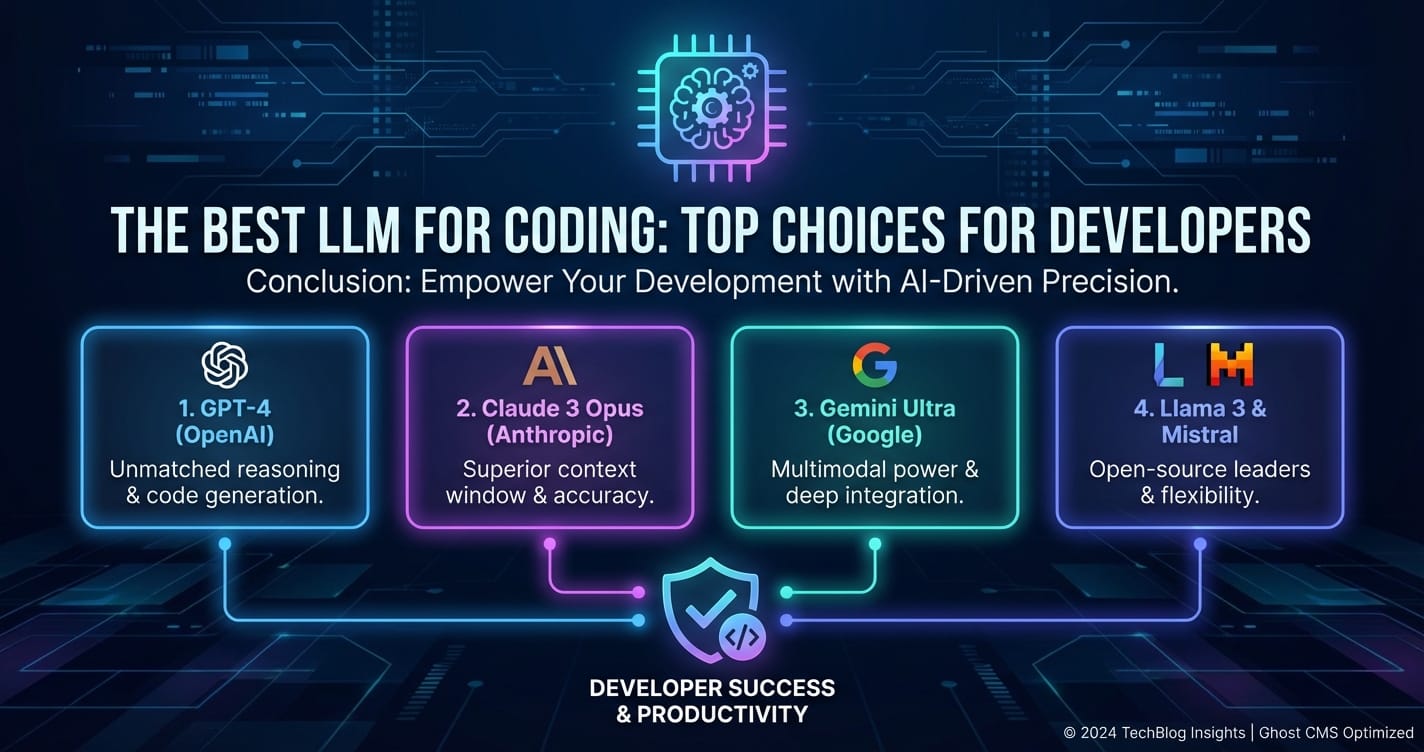
The Best LLM for Coding: Top Choices for Developers

In the rapidly evolving landscape of artificial intelligence, Large Language Models (LLMs) have emerged as powerful allies for software developers, fundamentally reshaping how code is written, debugged, and maintained. The promise of AI for coding is no longer a futuristic fantasy but a tangible reality, offering unprecedented efficiency, accuracy, and innovation. From generating boilerplate code to assisting with complex algorithmic challenges, LLMs are proving indispensable in the modern development toolkit. However, with a proliferation of models boasting varying capabilities, identifying the best LLM for coding can feel like navigating a dense jungle without a compass. Developers are constantly seeking tools that can genuinely enhance their productivity, minimize errors, and accelerate project timelines, pushing the boundaries of what's possible in software engineering.
This comprehensive guide aims to illuminate the path, delving deep into the world of LLMs tailored for coding tasks. We will explore the critical attributes that define a truly effective coding LLM, dissect the strengths and weaknesses of the leading models available today, and provide insights into their practical applications. Whether you're a seasoned professional looking to optimize your workflow or a burgeoning developer eager to harness the power of AI, understanding which LLM fits your specific needs is paramount. We will provide detailed comparisons, discuss the challenges and future trends, and ultimately help you make an informed decision on which AI companion can elevate your coding prowess. Get ready to unlock new levels of creativity and efficiency as we uncover the top choices for developers in the exciting realm of AI-assisted programming.
The Rise of AI in Software Development: A Paradigm Shift
The journey of software development has been a continuous quest for efficiency and innovation. From punch cards to integrated development environments (IDEs) with intelligent auto-completion, each technological leap has sought to streamline the coding process. The advent of AI for coding represents one of the most significant paradigm shifts in this evolution. It's not just about automating mundane tasks; it's about augmenting human intelligence, allowing developers to focus on higher-level problem-solving and creative design rather than getting bogged down in syntax or repetitive code patterns.
Historically, developer tools focused on static analysis, version control, and basic code completion. While invaluable, these tools operated within predefined rules. The introduction of LLMs has shattered these limitations, bringing dynamic, context-aware, and even generative capabilities to the forefront. These models, trained on colossal datasets of code from various programming languages, open-source repositories, and natural language texts, possess an uncanny ability to understand programming logic, generate syntactically correct and semantically meaningful code, and even reason about complex software architectures.
The impact of AI for coding extends across the entire software development lifecycle. In the initial design phase, LLMs can help brainstorm architectural patterns or suggest optimal data structures. During implementation, they become a co-pilot, churning out functions, classes, and entire modules. For debugging, they can pinpoint errors, explain cryptic stack traces, and propose fixes. Even in maintenance and documentation, LLMs can automatically generate comments, create API documentation, or refactor legacy code into more modern paradigms. This holistic influence transforms development from a solitary human endeavor into a collaborative effort between human ingenuity and artificial intelligence.
The allure is clear: faster development cycles, reduced time-to-market, fewer bugs, and democratized access to complex programming concepts. Junior developers can accelerate their learning curve by having an AI explain intricate code snippets or suggest alternative approaches. Senior developers can offload repetitive tasks, freeing up cognitive bandwidth for architecting innovative solutions. The embrace of AI for coding is no longer optional; it's becoming a competitive necessity for individuals and organizations striving for excellence in the digital age.
What Makes an LLM "Best" for Coding? Key Evaluation Criteria
Defining the "best" LLM for coding is not a one-size-fits-all proposition. The ideal model depends heavily on the specific tasks, programming languages, development environment, and budgetary constraints of a project or individual. However, a set of universal criteria can help developers evaluate and choose the best coding LLM for their unique requirements. Understanding these factors is crucial before diving into specific model comparisons.
1. Accuracy and Syntactic Correctness
The most fundamental requirement for any coding LLM is its ability to generate accurate and syntactically correct code. Code that doesn't compile or run properly is worse than no code at all, as it introduces debugging overhead. The LLM should adhere strictly to the grammar and conventions of the target programming language, minimizing errors that would typically be caught by a compiler or linter.
2. Context Understanding and Window Size
Coding often involves understanding intricate relationships between different parts of a codebase. The best LLM for coding must possess a robust understanding of context, meaning it can effectively leverage surrounding code, file structures, and even project documentation to generate relevant and coherent suggestions. A larger context window allows the model to "see" more of your code at once, leading to more contextually aware and accurate outputs, reducing the need for manual copy-pasting or summarization.
3. Language Support and Idiomatic Code Generation
Developers work with a multitude of programming languages, frameworks, and libraries. An effective coding LLM should support a wide array of popular languages (Python, JavaScript, Java, C++, Go, Rust, etc.) and be capable of generating idiomatic code for each. Idiomatic code adheres to the standard practices and conventions of a language community, making it more readable, maintainable, and robust. A model that generates "generic" code might be syntactically correct but fail to fit naturally into existing codebases.
4. Problem-Solving and Reasoning Capabilities
Beyond mere code generation, the best LLM for coding should exhibit strong problem-solving and reasoning capabilities. This includes understanding the intent behind a natural language prompt and translating it into a logical, efficient, and correct programming solution. It should be able to break down complex problems, identify algorithms, and even suggest data structures appropriate for the task at hand. This is where the "intelligence" of the AI truly shines, moving beyond simple pattern matching.
5. Code Refactoring and Optimization
Existing codebases often require refactoring for improved readability, performance, or adherence to new architectural patterns. A good AI for coding tool can assist in this process by suggesting ways to simplify complex functions, optimize loops, improve variable naming, or migrate older syntax to modern equivalents. It should be able to analyze code and propose performance enhancements without altering its core functionality.
6. Debugging Assistance
Debugging is notoriously time-consuming. The best coding LLM can significantly reduce this burden by helping developers identify the root cause of errors, explain error messages, and suggest potential fixes. This might involve analyzing stack traces, reviewing logs, or even predicting common pitfalls based on the provided code snippet.
7. Security and Privacy
When interacting with proprietary code, security and privacy are paramount. Developers must consider whether the LLM provider offers robust data protection, anonymization, and adherence to compliance standards. Models that run locally or offer strong privacy guarantees might be preferred for sensitive projects. The risk of code leakage or unintended use of proprietary information is a significant concern.
8. Integration with Existing Tools (IDEs, CI/CD)
For an LLM to be truly effective, it must integrate seamlessly into a developer's existing workflow. This means strong support for popular IDEs (VS Code, IntelliJ IDEA, PyCharm), version control systems (Git), and potentially CI/CD pipelines. Easy-to-use plugins and APIs are essential for minimizing friction and maximizing adoption.
9. Cost-Effectiveness and Latency
The operational cost of using an LLM, especially for high-volume tasks, can be a major factor. This includes API call costs, model inference time (latency), and throughput. Developers need to balance performance with budget. A model that is incredibly powerful but prohibitively expensive or too slow for real-time interaction might not be the best coding LLM for practical applications.
10. Fine-tuning Capabilities
For specialized domains or highly specific coding styles, the ability to fine-tune an LLM on proprietary datasets can dramatically improve its performance. This allows the model to learn project-specific patterns, conventions, and terminologies, making its generated code even more tailored and useful. The availability and ease of fine-tuning options can be a decisive factor for enterprise-level adoption.
By carefully weighing these criteria against their project's unique demands, developers can navigate the complex landscape of LLMs and pinpoint the solution that truly enhances their coding capabilities.
Top Contenders: The Best LLM for Coding Today
The market for AI for coding solutions is vibrant and competitive, with several major players and innovative startups vying for developer attention. Each model brings its unique strengths, architectural nuances, and training methodologies to the table. Understanding these differences is key to identifying the best LLM for coding for your specific needs.
3.1. OpenAI's GPT Models: The Pacesetters
OpenAI's Generative Pre-trained Transformer (GPT) series has largely defined the current era of LLMs, and their impact on coding has been profound.
GPT-3.5 Turbo
GPT-3.5 Turbo is often the entry point for many developers due to its accessibility, speed, and relatively lower cost. While not specifically trained on code to the same extent as some specialized models, its vast general knowledge and strong reasoning capabilities allow it to perform admirably in a wide range of coding tasks.
- Strengths:
- Versatility: Excellent for generating code snippets in various languages, explaining complex concepts, debugging simple errors, and writing documentation.
- Speed: Relatively fast inference times, making it suitable for interactive coding assistants.
- Cost-effectiveness: More affordable than its successor, GPT-4, allowing for broader application in projects with budget constraints.
- Accessibility: Widely available through API and integrated into numerous developer tools.
- Weaknesses:
- Accuracy for complex tasks: Can sometimes hallucinate or generate less optimal solutions for highly intricate coding challenges compared to more advanced models.
- Context window: While improved, its context window might still be limiting for extremely large codebases.
- Ideal Use Cases: Rapid prototyping, generating boilerplate, explaining code to junior developers, simple debugging, educational tools, general-purpose coding assistance.
GPT-4 and GPT-4 Turbo
GPT-4 represents a significant leap forward in reasoning, contextual understanding, and instruction following. GPT-4 Turbo further enhances this with an even larger context window and updated knowledge cutoff, making it a strong contender for the title of best LLM for coding.
- Strengths:
- Enhanced Reasoning: Unparalleled ability to understand complex prompts, break down problems, and generate sophisticated, logically sound code.
- Larger Context Window: Can process and generate much longer code segments, improving contextual awareness across larger files or multiple related snippets.
- Reduced Hallucination: Generally produces more accurate and reliable code, minimizing the need for extensive corrections.
- Multi-modal (GPT-4V): Can understand image inputs, potentially useful for tasks like interpreting UI mockups to generate code.
- Weaknesses:
- Cost: Significantly more expensive per token than GPT-3.5 Turbo, which can accumulate rapidly in high-usage scenarios.
- Speed: Slower inference times compared to GPT-3.5 Turbo, potentially impacting real-time interactive coding experiences.
- Rate Limits: Stricter rate limits often apply, requiring careful API management.
- Ideal Use Cases: Complex algorithm generation, architectural design assistance, advanced debugging, code refactoring of large functions, sophisticated documentation, highly accurate code generation for critical components.
3.2. Google's Gemini Models: A New Frontier
Google's Gemini family of models is designed to be multi-modal and highly performant, aiming to compete directly with OpenAI's offerings across various scales.
Gemini Pro
Gemini Pro is Google's mid-tier model, offering a balance of performance and efficiency. While its multi-modal capabilities extend beyond pure text, its coding prowess is formidable.
- Strengths:
- Multi-modality: While current AI for coding tasks are primarily text-based, the inherent multi-modal nature of Gemini could open doors for future applications involving diagrams, screenshots, or even video inputs for code generation.
- Strong Performance: Provides robust code generation, explanation, and debugging assistance comparable to leading models in its tier.
- Integration with Google Cloud: Seamless integration with Google Cloud Platform services (Vertex AI), making it attractive for developers already in the Google ecosystem.
- Weaknesses:
- Novelty: Being a newer player, its long-term consistency and community support for coding-specific tasks are still maturing compared to established models.
- Context Window: While competitive, might not always match the largest context windows offered by competitors.
- Ideal Use Cases: General AI for coding tasks, developers leveraging Google Cloud, scenarios where potential future multi-modal coding interactions are anticipated.
Gemini Ultra (When Generally Available)
Gemini Ultra is Google's most capable model, designed to tackle highly complex tasks that require advanced reasoning. When it becomes broadly available for developers, it's expected to be a direct competitor to GPT-4.
- Strengths: Expected to offer state-of-the-art reasoning, larger context windows, and superior performance for the most challenging coding problems.
- Weaknesses: Will likely come with a higher cost and potentially slower inference times, similar to other top-tier models.
- Ideal Use Cases: Cutting-edge research, highly complex software engineering challenges, applications requiring the utmost precision and reasoning.
3.3. Anthropic's Claude Models: Safety and Long Context
Anthropic's Claude series emphasizes safety, ethical AI, and exceptionally large context windows, making them suitable for specific types of coding tasks, especially those requiring extensive code review or secure development.
Claude 2.1 / Claude 3 (Opus, Sonnet, Haiku)
The Claude models, especially Claude 3, are known for their strong reasoning, nuanced understanding, and impressive context handling. Claude 3 Opus is their most intelligent model, Sonnet offers a balance, and Haiku is designed for speed and cost-effectiveness.
- Strengths:
- Exceptional Context Window: Claude 2.1 offered up to 200K tokens, and Claude 3 maintains very large context windows, allowing it to process entire codebases or lengthy documentation. This is a significant advantage for understanding project-wide context.
- Strong Reasoning for Complex Tasks: Excels at analyzing complex code, identifying subtle bugs, and providing detailed explanations. Claude 3 Opus, in particular, shows advanced reasoning.
- Safety Focus: Designed with a strong emphasis on safety and harmlessness, which can be beneficial for sensitive code or compliance-heavy environments.
- Less Prone to Hallucination: Generally generates more truthful and reliable information.
- Weaknesses:
- Speed (Opus): The most capable models like Opus can be slower and more expensive than their mid-tier counterparts. Haiku aims to address speed and cost.
- Niche Focus: While good for general coding, its strong suit lies in tasks requiring extensive context or rigorous code analysis rather than just rapid code generation.
- Ideal Use Cases: Comprehensive code reviews, understanding and refactoring large legacy systems, generating detailed documentation for vast projects, secure coding practices, complex debugging scenarios.
3.4. Meta's Llama Family: The Open-Source Powerhouses
Meta's Llama series, particularly Llama 2 and Llama 3, represents a significant contribution to the open-source AI community. While the base models are general-purpose, their open nature has led to numerous fine-tuned variants specifically for coding.
Llama 2 / Llama 3
These foundational models provide excellent starting points for developers who prefer open-source solutions or need to fine-tune models on private data. Llama 3, in particular, has shown significantly improved performance across various benchmarks.
- Strengths:
- Open Source: Freedom to deploy locally, inspect the model architecture, and fine-tune without proprietary vendor lock-in.
- Community Support: A massive and active community contributes to fine-tuning, tools, and extensions.
- Privacy: Can be run entirely offline or on private infrastructure, addressing significant security and privacy concerns for sensitive projects.
- Cost-Effective (Self-Hosted): Once infrastructure is set up, inference costs are typically lower than API-based proprietary models, especially for high volume.
- Weaknesses:
- Infrastructure Overhead: Requires significant computational resources (GPUs) and expertise to deploy and manage effectively.
- Initial Setup Complexity: Not as plug-and-play as API services; requires more setup and configuration.
- Performance (Base Models): While strong, the base Llama models might not always match the raw, out-of-the-box performance of proprietary top-tier models for all coding tasks without fine-tuning.
- Ideal Use Cases: Developers prioritizing privacy and security, academic research, organizations with the infrastructure to self-host, highly specialized coding tasks requiring custom fine-tuning.
Code Llama
Code Llama is a specialized version of Llama, explicitly trained on a massive dataset of code. It comes in various sizes (7B, 13B, 34B, and an instruct version) and is available in Python, C++, Java, PHP, Typescript (JavaScript), C#, and Bash versions.
- Strengths:
- Code-Specific Training: Highly optimized for code generation, completion, and understanding across multiple programming languages.
- Fill-in-the-Middle (FIM): Excellent at completing partially written code, even in the middle of functions, based on context.
- Open Source: Benefits from all the advantages of the Llama ecosystem.
- Performance for Size: Even smaller versions (e.g., 7B) can deliver impressive coding performance.
- Weaknesses:
- Resource Intensive (Larger Models): While smaller models are manageable, the larger versions still demand substantial computational resources for self-hosting.
- Less General Knowledge: Being specialized, it might not be as adept at general conversational tasks or explanations outside of coding.
- Ideal Use Cases: Developers needing a powerful, open-source, code-specific LLM for self-hosting, enhancing IDEs with AI capabilities, advanced code completion, and generation.
3.5. Specialized AI for Coding Models
Beyond the general-purpose giants, several models have been developed with a primary focus on code, often excelling in specific areas.
Mistral AI (Mistral, Mixtral)
Mistral AI's models (Mistral 7B, Mixtral 8x7B) have gained rapid popularity for their remarkable performance relative to their size and computational efficiency. Mixtral, a Sparse Mixture of Experts (SMoE) model, is particularly compelling.
- Strengths:
- Efficiency: Delivers high performance with significantly fewer computational resources compared to larger models.
- Speed: Known for fast inference, making it excellent for real-time interactive applications.
- Strong General Coding: Performs very well on a wide array of coding tasks, often outperforming much larger models.
- Open Weights (for some versions): Offers flexibility for deployment and fine-tuning.
- Weaknesses:
- Context Window: While substantial, it might not always match the extreme context windows of some Claude or GPT models.
- Ideal Use Cases: Deploying AI for coding on edge devices, cost-sensitive projects, real-time code assistance, developers seeking high performance with efficient resource utilization.
StarCoder / StarCoder2
Developed by Hugging Face in collaboration with ServiceNow, StarCoder and its successor, StarCoder2, are specifically trained on an extensive dataset of permissively licensed code from GitHub, making them highly specialized for coding.
- Strengths:
- Code-Centric Training: Uniquely positioned for code generation, completion, and understanding due to its training data.
- Fill-in-the-Middle (FIM): Excellent at predicting and filling in missing code within existing structures.
- Permissive Licensing: Trained on permissively licensed code, reducing some legal concerns regarding generated code.
- Open Access: Available through Hugging Face, allowing for easy experimentation and deployment.
- Weaknesses:
- General Knowledge: Less capable in general conversational or non-coding tasks compared to broader LLMs.
- Resource Requirements: The larger models still require significant compute for self-hosting.
- Ideal Use Cases: Code completion in IDEs, generating new functions, refactoring existing code, generating docstrings, particularly for open-source projects.
This landscape of models demonstrates a clear trend: both general-purpose LLMs are becoming increasingly adept at coding, while specialized AI for coding models are pushing the boundaries of what's possible within the domain. The "best" choice often comes down to balancing raw power, cost, speed, open-source flexibility, and integration capabilities.
Comparing the Best Coding LLM Options: A Detailed Look
With such a diverse array of powerful LLMs, choosing the best coding LLM requires a nuanced understanding of their comparative strengths and weaknesses. There's no single model that reigns supreme in every aspect; instead, developers must align model characteristics with their project's priorities. The following table provides a quick overview, followed by a more in-depth discussion of trade-offs.
Table 1: Key Features Comparison of Leading LLMs for Coding
| LLM Model/Family | Primary Strengths for Coding | Primary Weaknesses for Coding | Ideal Use Case for Developers |
|---|---|---|---|
| GPT-4/Turbo | Superior reasoning, large context, high accuracy, advanced problem-solving | High cost, slower inference for real-time, stricter rate limits | Complex algorithms, architectural design, critical code generation, advanced debugging, deep code analysis |
| GPT-3.5 Turbo | Cost-effective, fast, versatile, good for general tasks | Less accurate for complex problems, smaller context than GPT-4 | Rapid prototyping, boilerplate generation, code explanation, simple debugging, learning assistant |
| Gemini Pro | Multi-modal potential, strong performance, good balance of cost/speed | Less mature ecosystem, potentially smaller context than top-tier competitors | Google Cloud users, general coding tasks, future multi-modal interactions |
| Claude 3 Opus | Extremely large context, strong reasoning, detailed explanations, safety-focused | Higher cost, can be slower for quick iterations, primary focus on "safety" output | Comprehensive code reviews, refactoring large systems, extensive documentation, secure coding |
| Claude 3 Sonnet | Balance of intelligence, speed, and cost, good for enterprise applications | Not as powerful as Opus, might still be slower than pure speed-optimized models | Enterprise-grade coding assistant, balanced performance for varied tasks, moderate context needs |
| Llama 3 (Open Source) | Open-source, flexible, privacy, fine-tuning potential, strong community support | Requires self-hosting resources/expertise, performance depends on fine-tuning | Privacy-sensitive projects, custom fine-tuning, academic research, resource-rich teams |
| Code Llama | Code-specific training, FIM, excellent completion, open-source flexibility | Less general knowledge, still requires self-hosting resources | IDE integration, advanced code completion, code generation for specific languages, open-source development |
| Mixtral 8x7B | High performance for size, cost-efficient inference, fast, good general coding | Context window not as vast as some top-tier models | Edge deployments, real-time code assistance, cost-optimized projects, efficient code generation |
| StarCoder2 | Code-centric training, strong FIM, permissively licensed code training | Less general conversation ability, still requires significant compute for larger models | Code completion, docstring generation, code refactoring, specific code library assistance |
Discussion on Trade-offs: Choosing Your Companion
The choice of the best coding LLM often boils down to a series of critical trade-offs:
- Open Source vs. Proprietary:
- Open-source models (Llama, Code Llama, Mistral, StarCoder2) offer unparalleled flexibility, privacy, and cost control (if self-hosting). You can fine-tune them on private data without concerns about data leakage, audit their inner workings, and deploy them in environments with strict security requirements. However, this comes at the cost of infrastructure overhead, requiring significant GPU resources and expertise to manage.
- Proprietary models (GPT, Gemini, Claude) offer out-of-the-box performance, often superior accuracy for general tasks, and ease of use through managed APIs. They handle the underlying infrastructure, allowing developers to focus solely on integration. The downsides include API costs, potential vendor lock-in, and reliance on the provider's privacy and security policies, which might not always align with strict enterprise requirements.
- Generalist vs. Specialist:
- Generalist LLMs (GPT, Gemini, Claude) excel at a broad range of tasks, from writing stories to generating code. Their wide training data makes them versatile for understanding diverse prompts and complex instructions. This makes them good all-rounders for a coding assistant that can also help with documentation, explanations, or even brainstorming.
- Specialist LLMs (Code Llama, StarCoder2) are fine-tuned on massive datasets of code, making them exceptionally good at code-specific tasks like completion, generation, and refactoring. They often produce more idiomatic and syntactically correct code for their target languages. Their weakness lies in general knowledge or creative writing outside the coding domain. If your primary need is pure code generation, a specialist might be the best coding LLM.
- Cost vs. Performance vs. Speed:
- High-performance models (GPT-4, Claude 3 Opus) offer superior reasoning and accuracy but come with a higher price tag per token and often slower inference times. These are ideal for critical tasks where correctness and deep understanding are paramount, and budget is less constrained.
- Mid-range models (GPT-3.5 Turbo, Gemini Pro, Claude 3 Sonnet, Mixtral) strike a balance. They provide very good performance at a more accessible price point and faster speeds, making them suitable for most daily coding tasks.
- Cost-optimized/speed-optimized models (Mistral 7B, Claude 3 Haiku) prioritize efficiency, often at the expense of peak reasoning power or context window size. They are excellent for real-time interactions, edge deployments, and applications where cost per interaction is a critical metric.
Ultimately, the decision for the best LLM for coding is highly contextual. A developer might use GPT-4 for architecting complex systems, Code Llama for routine code generation, and GPT-3.5 Turbo for quick explanations, potentially integrating them all into their workflow. The flexibility to choose and switch between models based on the task at hand is increasingly becoming the preferred strategy.
XRoute is a cutting-edge unified API platform designed to streamline access to large language models (LLMs) for developers, businesses, and AI enthusiasts. By providing a single, OpenAI-compatible endpoint, XRoute.AI simplifies the integration of over 60 AI models from more than 20 active providers(including OpenAI, Anthropic, Mistral, Llama2, Google Gemini, and more), enabling seamless development of AI-driven applications, chatbots, and automated workflows.
Practical Applications of AI for Coding
The integration of AI for coding has moved beyond theoretical discussions into tangible, impactful applications that are transforming the daily lives of developers. From augmenting individual productivity to enhancing team collaboration, LLMs are proving their worth across various stages of the software development lifecycle.
1. Code Generation: From Boilerplate to Complex Functions
One of the most immediate and widely adopted applications of AI for coding is code generation. Developers can prompt an LLM with a natural language description, and the model will generate a code snippet, function, or even an entire class. * Boilerplate Code: LLMs can quickly churn out common patterns like setting up a web server, creating a database connection, or defining a class structure, saving countless hours. * Functional Code: Given a specific problem, an LLM can generate the logic for sorting algorithms, data parsing routines, or API integrations. For example, "Write a Python function to fetch data from a REST API and parse it into a Pandas DataFrame." * Domain-Specific Code: With appropriate fine-tuning or prompt engineering, LLMs can generate code for niche domains, such as scientific computing, financial modeling, or game development.
2. Debugging and Error Correction: Your Smart Troubleshooting Partner
Debugging is often cited as one of the most time-consuming and frustrating aspects of programming. LLMs offer a powerful new approach to troubleshooting. * Error Explanation: When faced with a cryptic error message or a stack trace, an LLM can provide a clear, concise explanation of what went wrong and why. * Bug Identification: By analyzing code, LLMs can often identify potential logic errors, off-by-one errors, or common anti-patterns that lead to bugs. * Suggested Fixes: Beyond just identifying problems, the best coding LLM can propose concrete solutions, often with alternative approaches, allowing developers to quickly resolve issues. For instance, "This C++ code has a segmentation fault. Can you identify the issue and suggest a fix?"
3. Code Refactoring and Optimization: Enhancing Code Quality
Maintaining clean, efficient, and readable code is crucial for long-term project success. LLMs can act as intelligent code reviewers and optimizers. * Readability Improvements: Suggesting better variable names, breaking down complex functions into smaller, more manageable units, or improving code structure for clarity. * Performance Optimization: Identifying inefficient loops, redundant computations, or suboptimal data structures and recommending more performant alternatives. * Modernization: Helping to refactor legacy code by migrating older syntax to modern language features or adopting newer framework conventions. For example, converting old callback-based JavaScript to async/await.
4. Documentation Generation: Bridging the Knowledge Gap
Keeping documentation up-to-date is a perpetual challenge. LLMs can automate much of this process. * Docstring Generation: Automatically creating comprehensive docstrings for functions and classes, explaining parameters, return values, and overall purpose. * API Documentation: Generating detailed API endpoints, request/response examples, and usage guides from code. * Code Explanation: Providing natural language explanations of how complex code sections work, which is invaluable for onboarding new team members or reviewing unfamiliar code.
5. Learning and Education: Accelerating Developer Growth
For aspiring and experienced developers alike, LLMs serve as an invaluable educational resource. * Code Explanation: Demystifying complex algorithms, design patterns, or framework concepts by explaining them in simple terms or providing relevant examples. * Tutorial Generation: Creating step-by-step guides for specific coding tasks or technologies. * Interactive Learning: Acting as a tutor, answering questions, providing hints, and even offering alternative solutions during coding exercises.
6. Test Case Generation: Ensuring Code Robustness
Writing thorough unit and integration tests is essential for robust software, but it can be tedious. * Unit Test Generation: Based on a given function, an LLM can generate a suite of unit tests covering various edge cases and expected behaviors. * Integration Test Scenarios: Suggesting integration test cases based on how different components of an application interact. * Mock Data Generation: Creating realistic mock data for testing purposes, saving time from manual data entry.
7. Security Vulnerability Detection: Proactive Risk Management
While not a replacement for dedicated security tools, LLMs can assist in identifying potential vulnerabilities. * Code Pattern Analysis: Detecting common security flaws like SQL injection vulnerabilities, cross-site scripting (XSS), or insecure direct object references by analyzing code patterns. * Compliance Checks: Helping ensure code adheres to specific security standards or coding guidelines by flagging non-compliant practices.
These diverse applications underscore the transformative power of AI for coding. By offloading repetitive, time-consuming tasks and augmenting human analytical capabilities, LLMs enable developers to innovate faster, build more reliable software, and push the boundaries of what's achievable in the digital realm. The journey with these intelligent companions has only just begun.
Challenges and Considerations for Using LLMs for Coding
While the benefits of AI for coding are undeniable, the adoption of LLMs in software development is not without its challenges and crucial considerations. Developers and organizations must approach these tools with a clear understanding of their limitations and potential pitfalls to maximize their advantages while mitigating risks.
1. Bias and Hallucinations: The "AI Telling Lies" Problem
LLMs are trained on vast datasets, and if these datasets contain biases, the model can inadvertently perpetuate them in generated code or explanations. More critically, LLMs are prone to "hallucination"—generating factually incorrect but syntactically plausible information. * Code Inaccuracies: An LLM might generate code that looks correct but contains subtle logic errors, uses outdated APIs, or implements an inefficient algorithm. * Misleading Explanations: Explanations or debugging suggestions might be entirely wrong, leading developers down a rabbit hole. * Mitigation: Developers must always treat LLM-generated code as a first draft, critically review it, verify its correctness, and test it thoroughly. Human oversight remains indispensable.
2. Security Concerns: Data Leakage and Proprietary Code Exposure
Feeding proprietary or sensitive code into a publicly available LLM API raises significant security and privacy questions. * Data Training: While most major LLM providers claim not to train their public models on user input by default, the possibility of accidental data leakage or inadvertent use of proprietary information is a concern. * Compliance Risks: For industries with strict regulatory compliance (e.g., healthcare, finance), exposing sensitive code, even temporarily, can violate regulations like GDPR, HIPAA, or industry-specific standards. * Mitigation: Organizations should implement strict policies regarding what kind of code can be shared with public LLM services. Using on-premises or fine-tuned open-source models (like Code Llama) can offer greater control over data privacy. Leveraging unified API platforms that prioritize security and allow routing to private endpoints can also be a solution.
3. Over-reliance and Skill Erosion: Maintaining Human Programming Skills
The ease with which LLMs can generate code or answer questions poses a risk of over-reliance, potentially leading to a degradation of core programming skills among developers. * Reduced Problem-Solving: If developers always defer to AI for solutions, they might not develop the critical thinking and problem-solving skills necessary for complex, novel challenges. * Lack of Deep Understanding: Copy-pasting AI-generated code without truly understanding it can lead to unmaintainable codebases and make debugging harder when the AI's logic breaks down. * Mitigation: LLMs should be viewed as assistants, not replacements. Developers should actively engage with the generated code, understand its rationale, and use the AI as a tool to accelerate learning and productivity, not to bypass fundamental understanding.
4. Integration Complexity: Managing Multiple APIs and Ensuring Compatibility
As the LLM ecosystem expands, developers might find themselves wanting to use different models for different tasks (e.g., one for code generation, another for documentation, a third for secure coding analysis). * API Sprawl: Managing multiple API keys, different authentication methods, and varying input/output formats from several LLM providers can become cumbersome. * Version Control: Ensuring compatibility and consistent behavior across different LLM versions and providers adds another layer of complexity. * Mitigation: Unified API platforms, which we will discuss next, are emerging as a solution to streamline access and management of diverse LLMs.
5. Cost Management: API Calls Adding Up
While some LLMs are affordable for individual use, enterprise-level adoption or high-volume usage can quickly lead to substantial API costs. * Token Consumption: Each interaction with an LLM consumes tokens, and complex prompts or long code generations can rapidly increase costs. * Pricing Models: Understanding the varied pricing models (per token, per request, context window size impact) across different providers is crucial for budget forecasting. * Mitigation: Careful monitoring of API usage, optimizing prompts to be concise, and utilizing more cost-effective models (like GPT-3.5 Turbo or Mixtral) for less critical tasks can help manage expenses. Benchmarking different models for cost-efficiency for specific tasks is also advisable.
By being mindful of these challenges, developers and organizations can strategically integrate LLMs into their workflows, leveraging their immense power while maintaining control, security, and a strong foundation of human expertise.
Optimizing Your Workflow with a Unified API: The XRoute.AI Solution
The promise of using the best LLM for coding for every specific task is alluring. Imagine using GPT-4 for deep architectural reasoning, Code Llama for rapid function generation, and Claude for comprehensive code review, all within the same project. However, the reality often hits a wall of integration complexity. Managing separate API keys, understanding diverse model schemas, handling different rate limits, and navigating varying pricing structures from numerous LLM providers quickly becomes an operational nightmare. This complexity creates friction, slows down experimentation, and hinders the ability to dynamically switch between models to find the truly optimal solution for a given problem.
This is precisely where innovative solutions like XRoute.AI come into play, offering a paradigm shift in how developers interact with the vast LLM ecosystem. XRoute.AI is a cutting-edge unified API platform designed to streamline access to large language models (LLMs) for developers, businesses, and AI enthusiasts. By providing a single, OpenAI-compatible endpoint, XRoute.AI simplifies the integration of over 60 AI models from more than 20 active providers, enabling seamless development of AI-driven applications, chatbots, and automated workflows.
Instead of coding against multiple provider-specific APIs, developers can integrate with XRoute.AI once, using an API interface they are likely already familiar with – the OpenAI standard. This single integration then unlocks a vast library of models, allowing you to easily experiment with and switch between the best coding LLM options on the fly, whether it's GPT-4, Claude, Mixtral, or others, without changing your core application code.
The benefits of leveraging a platform like XRoute.AI are profound:
- Simplified Integration: A single, OpenAI-compatible endpoint drastically reduces development time and effort. You write your code once, and it works across dozens of LLMs.
- Unleashed Experimentation: Easily test different models to find the best LLM for coding for specific tasks, balancing accuracy, speed, and cost without refactoring your application. This agility is crucial in the fast-paced AI landscape.
- Low Latency AI: XRoute.AI prioritizes performance, ensuring that your AI calls are routed efficiently to provide low latency AI, which is critical for interactive coding assistants and real-time applications.
- Cost-Effective AI: By enabling easy switching between models, XRoute.AI helps you optimize costs. You can use powerful, expensive models for critical reasoning and more cost-effective AI for simpler, high-volume tasks, ensuring you get the best value without compromising quality.
- High Throughput and Scalability: The platform is designed for high throughput and scalability, making it suitable for projects of all sizes, from individual startups to enterprise-level applications with demanding AI workloads.
- Reduced Vendor Lock-in: By abstracting away the underlying provider APIs, XRoute.AI gives you the freedom to choose the best coding LLM based purely on performance and cost, rather than being tied to a single vendor's ecosystem.
- Enhanced Reliability and Fallback: A unified platform can offer built-in redundancy and intelligent routing, ensuring higher uptime and allowing for automatic fallback to alternative models if a primary provider experiences issues.
For developers seeking to harness the full power of AI for coding without getting entangled in API complexity, XRoute.AI offers a compelling solution. It empowers users to build intelligent solutions without the complexity of managing multiple API connections, accelerating innovation and making the selection and utilization of the best LLM for coding a seamless and efficient process. Whether you need the nuanced understanding of a GPT-4 or the cost-efficiency of a Mixtral, XRoute.AI puts the choice, and the power, directly into your hands.
Future Trends in AI for Coding
The rapid evolution of AI for coding suggests that today's cutting-edge capabilities will soon become baseline expectations. The future promises even more sophisticated, integrated, and autonomous AI companions that will further redefine the role of the developer. Understanding these emerging trends is crucial for staying ahead in this dynamic field.
1. Multi-modal Coding Assistants Beyond Text
While current LLMs are primarily text-based, the next generation of AI for coding will increasingly embrace multi-modality. This means assistants that can: * Understand Visual Inputs: Interpret screenshots of user interfaces, wireframes, or hand-drawn diagrams to generate corresponding code (HTML, CSS, UI frameworks). * Process Audio/Video: Analyze developer discussions or screen recordings to understand intent, identify bugs, or generate code. * Integrate Sensor Data: Potentially use biometric data (e.g., eye-tracking, brain activity) in highly specialized contexts to understand developer focus or fatigue, though this is further out.
2. Autonomous Agentic Systems for Software Development
Beyond simple code generation, we are moving towards more autonomous AI agents capable of orchestrating complex development tasks. These agents could: * Plan and Execute: Understand a high-level requirement, break it down into smaller coding tasks, write the code, test it, and even deploy it without constant human intervention. * Self-Improve: Learn from their own coding mistakes, adapt to new programming paradigms, and continuously refine their generated code for better performance and correctness. * Collaborate: Interact with other AI agents or human developers to build larger, more intricate software systems.
3. Deeper Integration with Development Environments
The integration of AI for coding will become even more seamless and pervasive within IDEs and other developer tools. * Proactive Assistance: AI will not just respond to prompts but will proactively suggest code improvements, potential bugs, or relevant documentation as you type, anticipating your needs. * Context-Aware Debugging: LLMs will have real-time access to runtime data, variable states, and call stacks, enabling highly accurate and context-specific debugging suggestions. * Personalized Learning: AI will adapt to individual developer's coding styles, learning patterns, and knowledge gaps, providing tailored learning paths and assistance.
4. Code Security and Compliance by Design
Given the growing concerns around security vulnerabilities and regulatory compliance, future AI for coding tools will increasingly embed these considerations from the outset. * Secure Code Generation: Models will be specifically trained to generate secure code, adhering to OWASP guidelines and other best practices, actively avoiding common vulnerabilities. * Automated Compliance Checks: LLMs will automatically flag code that deviates from enterprise-specific coding standards or regulatory requirements, providing real-time feedback. * Vulnerability Remediation: Not just identifying vulnerabilities, but actively suggesting and implementing fixes for them.
5. Ethical AI and Governance in Software Creation
As AI takes on a more central role in code creation, ethical considerations and robust governance frameworks will become paramount. * Transparency and Explainability: Models will need to provide clearer explanations for their code generation decisions, enabling developers to understand the "why" behind the "what." * Bias Mitigation: Continued efforts to reduce biases in training data and ensure fair and inclusive code generation. * Legal and IP Frameworks: Development of clearer legal guidelines regarding the ownership and liability of AI-generated code, especially concerning intellectual property and potential copyright issues.
The future of AI for coding is one of profound transformation, promising a world where developers can achieve unprecedented levels of productivity and creativity. These advancements will not diminish the role of human developers but rather augment it, allowing them to tackle even more complex and innovative challenges, making software development more accessible, efficient, and ultimately, more powerful than ever before.
Conclusion: Navigating the Future of Coding with AI
The journey to discover the best LLM for coding reveals a vibrant and rapidly evolving landscape, where innovation is the only constant. As we've explored, there is no single, universally "best" model, but rather a spectrum of powerful tools, each with unique strengths and ideal applications. From the robust reasoning of GPT-4 and Claude 3 Opus to the open-source flexibility of Code Llama and the efficiency of Mixtral, developers now have an unprecedented array of intelligent companions to assist them.
The transformative power of AI for coding is undeniable. These models are not just glorified autocomplete tools; they are powerful reasoning engines capable of generating sophisticated code, identifying elusive bugs, refactoring legacy systems, and even driving innovation at an architectural level. They are accelerating development cycles, enhancing code quality, and democratizing access to complex programming knowledge.
However, intelligent adoption demands discernment. Developers must remain vigilant against potential pitfalls such as hallucinations, security concerns related to proprietary code, and the risk of over-reliance. Critical thinking, thorough testing, and a deep understanding of generated code remain paramount. AI for coding is a powerful co-pilot, not an autonomous driver.
Ultimately, the most effective strategy often involves a hybrid approach—leveraging the strengths of multiple LLMs for different tasks. This is where platforms like XRoute.AI become invaluable, simplifying the integration and management of diverse models, enabling developers to seamlessly switch between the best coding LLM for any given scenario, and optimizing for both performance and cost.
As we look to the future, the trends point towards even more intelligent, multi-modal, and autonomous AI agents that will further revolutionize software creation. The developer's role will evolve, shifting towards higher-level problem-solving, architectural design, and orchestrating these sophisticated AI tools. Embrace the change, experiment with the possibilities, and let these incredible LLMs elevate your coding journey to new heights. The era of intelligent software development is here, and it's exhilarating.
FAQ: Frequently Asked Questions about LLMs for Coding
Q1: What is the best LLM for coding tasks?
A1: There isn't a single "best" LLM for all coding tasks, as the ideal choice depends on your specific needs. For complex reasoning and high accuracy, models like OpenAI's GPT-4 or Anthropic's Claude 3 Opus are excellent. For speed and cost-effectiveness in general tasks, GPT-3.5 Turbo or Mistral AI's Mixtral are strong contenders. For open-source flexibility and code-specific training, Code Llama is highly recommended. Many developers use a combination of models for different purposes.
Q2: How do LLMs help with debugging and error correction?
A2: LLMs can significantly assist in debugging by explaining cryptic error messages, analyzing code snippets to identify potential logic flaws, and suggesting concrete fixes. They can even predict common pitfalls based on patterns learned from vast code datasets. However, it's crucial to always verify and test their suggestions, as they can sometimes "hallucinate" incorrect solutions.
Q3: Are LLMs for coding safe to use with proprietary code?
A3: This is a critical concern. When using public LLM APIs, there's always a theoretical risk of proprietary code being inadvertently used for future model training or data leakage. Most major providers offer options to opt-out of data usage for training, but developers in sensitive industries might prefer open-source models (like Llama/Code Llama) that can be self-hosted on private infrastructure, or unified API platforms like XRoute.AI that provide secure routing and better control over data privacy.
Q4: Can LLMs replace human programmers?
A4: No, LLMs are powerful tools designed to augment, not replace, human programmers. While they excel at automating repetitive tasks, generating boilerplate code, and assisting with debugging, they lack true understanding, creativity, and the ability to handle novel, abstract problem-solving that human developers possess. They are best viewed as intelligent assistants that enhance productivity and allow developers to focus on higher-level design and innovation.
Q5: What is a unified API platform like XRoute.AI, and why is it useful for LLMs in coding?
A5: A unified API platform like XRoute.AI provides a single, consistent interface (often OpenAI-compatible) to access multiple large language models from various providers. This simplifies integration, as you only need to code against one API regardless of which underlying LLM you're using. It's incredibly useful for coding because it allows developers to easily experiment with different models (e.g., GPT, Claude, Mixtral) to find the most accurate, cost-effective, or low-latency solution for specific coding tasks without rewriting their integration code, reducing vendor lock-in and optimizing workflows.
🚀You can securely and efficiently connect to thousands of data sources with XRoute in just two steps:
Step 1: Create Your API Key
To start using XRoute.AI, the first step is to create an account and generate your XRoute API KEY. This key unlocks access to the platform’s unified API interface, allowing you to connect to a vast ecosystem of large language models with minimal setup.
Here’s how to do it: 1. Visit https://xroute.ai/ and sign up for a free account. 2. Upon registration, explore the platform. 3. Navigate to the user dashboard and generate your XRoute API KEY.
This process takes less than a minute, and your API key will serve as the gateway to XRoute.AI’s robust developer tools, enabling seamless integration with LLM APIs for your projects.
Step 2: Select a Model and Make API Calls
Once you have your XRoute API KEY, you can select from over 60 large language models available on XRoute.AI and start making API calls. The platform’s OpenAI-compatible endpoint ensures that you can easily integrate models into your applications using just a few lines of code.
Here’s a sample configuration to call an LLM:
curl --location 'https://api.xroute.ai/openai/v1/chat/completions' \
--header 'Authorization: Bearer $apikey' \
--header 'Content-Type: application/json' \
--data '{
    "model": "gpt-5",
    "messages": [
        {
            "content": "Your text prompt here",
            "role": "user"
        }
    ]
}'
With this setup, your application can instantly connect to XRoute.AI’s unified API platform, leveraging low latency AI and high throughput (handling 891.82K tokens per month globally). XRoute.AI manages provider routing, load balancing, and failover, ensuring reliable performance for real-time applications like chatbots, data analysis tools, or automated workflows. You can also purchase additional API credits to scale your usage as needed, making it a cost-effective AI solution for projects of all sizes.
Note: Explore the documentation on https://xroute.ai/ for model-specific details, SDKs, and open-source examples to accelerate your development.