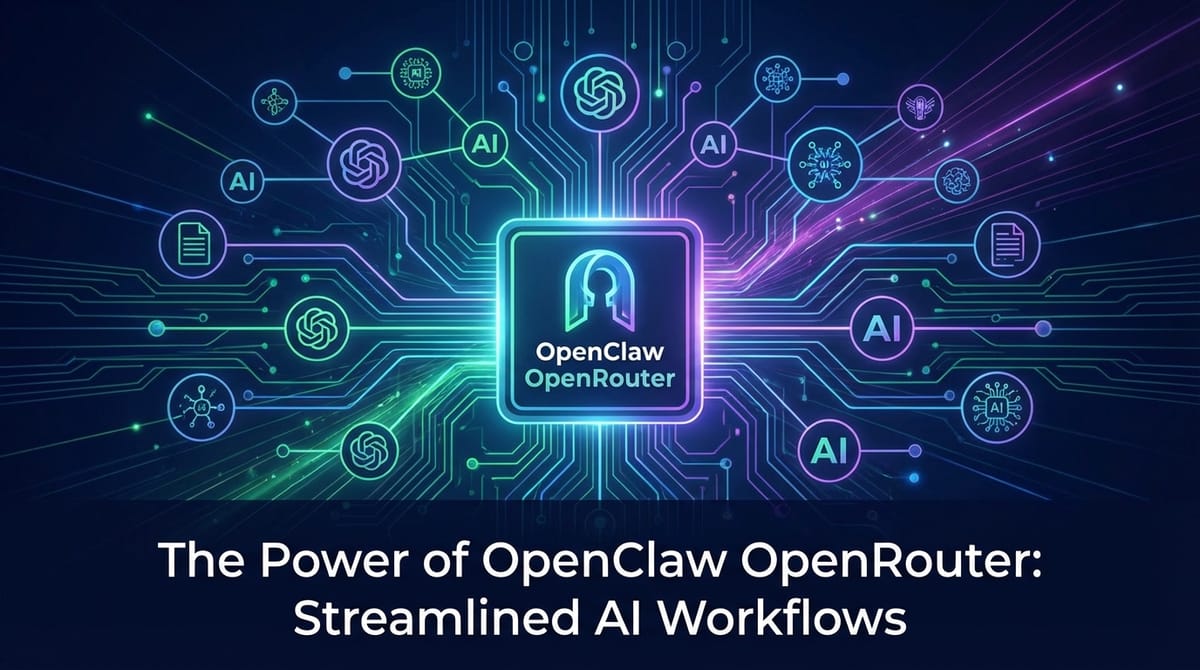
The Power of OpenClaw OpenRouter: Streamlined AI Workflows

The landscape of artificial intelligence is evolving at a breathtaking pace, with new large language models (LLMs) and specialized AI models emerging almost daily. From enhancing customer service with intelligent chatbots to automating complex data analysis and revolutionizing content creation, AI is no longer a futuristic concept but a vital component of modern business strategy. Yet, beneath the surface of this innovation lies a significant challenge for developers and enterprises: managing the inherent complexity of integrating, orchestrating, and optimizing access to this fragmented ecosystem of AI models. This is where the visionary concept of "OpenClaw OpenRouter" – representing a new paradigm for Unified API platforms – steps in, promising not just to simplify but to fundamentally transform the way we interact with AI.
Imagine a world where you can effortlessly switch between the most advanced generative AI models, experiment with cutting-edge tools, and scale your AI applications without wrestling with multiple API keys, diverse documentation, and inconsistent protocols. This is the promise of an "OpenClaw OpenRouter" approach: a single gateway that unlocks an extensive universe of open router models, empowering developers with unprecedented flexibility and accelerating innovation. More than just convenience, these platforms introduce a critical element of strategic advantage: profound cost optimization. By intelligently routing requests and leveraging competitive pricing across providers, they ensure that the immense power of AI remains accessible and economically viable for projects of all scales. This article delves deep into the transformative potential of such a Unified API, exploring how it streamlines AI workflows, fosters unparalleled experimentation, and champions intelligent cost optimization, ultimately reshaping the future of AI development.
The AI Revolution and Its Growing Pains
The last few years have witnessed an explosive growth in artificial intelligence capabilities, particularly in the realm of large language models (LLMs). From OpenAI's GPT series to Anthropic's Claude, Google's Gemini, Meta's Llama, and a myriad of specialized open-source and proprietary models, the sheer volume of powerful AI tools available is staggering. Each model brings its unique strengths: some excel at creative writing, others at code generation, some at logical reasoning, and still others at multilingual translation or specialized domain knowledge. This diversification is a boon for innovation, offering developers an unprecedented palette of capabilities to build sophisticated, intelligent applications.
However, this abundance also presents significant challenges, creating what can only be described as "AI growing pains" for developers and organizations alike. The primary struggle lies in integration. To leverage the best features of different models, developers often find themselves in a labyrinth of disparate APIs. Each AI provider typically offers its own unique API endpoint, authentication mechanism, request/response formats, rate limits, and pricing structures.
Consider a scenario where an application needs to perform several AI-powered tasks: generating marketing copy (best with one model), summarizing lengthy documents (another model might be superior), and providing code suggestions (yet another specialized model). Without a Unified API, this requires: 1. Multiple API Integrations: Writing separate code for each model, managing different client libraries, and handling distinct error codes. 2. Diverse Authentication: Juggling multiple API keys, managing their lifecycle, and ensuring secure access for each provider. 3. Inconsistent Data Handling: Adapting input and parsing output to match the specific requirements of each model, leading to extensive data transformation logic. 4. Varying Rate Limits: Implementing complex retry mechanisms and backoff strategies to avoid hitting limits for individual APIs, which can differ significantly. 5. Documentation Overload: Developers must constantly consult multiple sets of documentation, leading to increased cognitive load and slower development cycles.
This fragmentation leads to increased development overhead, slower time-to-market, and greater maintenance complexity. Every time a new, better model emerges, or an existing provider updates its API, the development team faces the daunting task of re-integrating and re-testing. The dream of easily experimenting with various "open router models" to find the optimal solution for a specific task becomes a nightmare of engineering effort. This cumbersome approach stifles innovation, diverting valuable resources from building core product features to solving API plumbing issues. The industry desperately needs a more elegant, efficient, and scalable solution to harness the full potential of the AI revolution, and that solution comes in the form of Unified API platforms.
Understanding the "OpenClaw OpenRouter" Paradigm – What is a Unified API?
The "OpenClaw OpenRouter" paradigm, at its core, embodies the concept of a Unified API. In essence, a Unified API acts as a single, standardized gateway through which developers can access and interact with a multitude of underlying AI models from various providers. Instead of integrating directly with OpenAI, Anthropic, Google, and potentially dozens of other independent AI services, a developer integrates once with the Unified API. This single integration then provides access to a vast ecosystem of "open router models".
Think of it like a universal adapter for all your electronic devices. Instead of needing a different charger for every phone, laptop, or tablet, you plug everything into one universal power strip. Similarly, a Unified API abstracts away the idiosyncrasies of each individual AI provider, presenting a consistent interface regardless of the model you choose to use.
The "Open Router Models" Concept
The term "open router models" within this context highlights two critical aspects: 1. Openness to Choice: It signifies the platform's ability to provide access to a broad and diverse range of AI models. This includes not only major proprietary models but also increasingly powerful open-source alternatives, specialized domain-specific models, and even fine-tuned custom models. Developers are no longer locked into a single provider but can select the best model for their specific task, performance requirements, and budget. 2. Routing Intelligence: The "router" aspect refers to the platform's inherent capability to intelligently direct requests to the appropriate underlying model. This routing can be based on various factors: * Developer Preference: Explicitly choosing a specific model (e.g., "use gpt-4o for this request, but claude-3-opus for that one"). * Performance Metrics: Automatically routing to the fastest available model. * Cost-Effectiveness: Directing requests to the cheapest model that meets performance criteria (a key aspect of cost optimization). * Availability/Reliability: Failing over to an alternative model if the primary choice is unresponsive.
How a Unified API Simplifies and Accelerates Development
The benefits of this approach for simplifying integration and accelerating development are manifold:
- Single Integration Point: Developers write their code once to interact with the Unified API. This drastically reduces boilerplate code, accelerates initial setup, and makes future model upgrades or switches trivial.
- Standardized Request/Response Formats: Regardless of the underlying model, the Unified API translates requests into a consistent format and normalizes responses. This means developers don't have to worry about differing parameter names, output structures, or tokenization rules across models.
- Centralized Authentication: Instead of managing multiple API keys, developers manage a single set of credentials for the Unified API. This simplifies security management, key rotation, and access control.
- Abstracted Rate Limiting and Error Handling: The Unified API typically handles the intricacies of individual provider rate limits, implementing intelligent queuing and retry mechanisms. It also normalizes error codes, making debugging much simpler.
- Faster Experimentation and Iteration: The ability to swap out "open router models" with a single line of code change (or even dynamically at runtime) empowers developers to rapidly experiment, A/B test different models, and iterate on their AI features without significant re-engineering. This agility is crucial in the fast-paced AI landscape.
Technical Deep Dive: Under the Hood
Technically, a Unified API operates as a sophisticated proxy layer. When a developer sends a request to the Unified API endpoint, the platform performs several critical steps: 1. Authentication: Validates the developer's credentials. 2. Request Parsing: Interprets the standardized request payload. 3. Model Selection/Routing: Determines which underlying AI model should handle the request based on developer specification, internal routing rules (e.g., lowest cost, lowest latency, highest availability), or a combination thereof. 4. Provider-Specific Translation: Translates the standardized request into the specific format required by the chosen AI provider's API. 5. Forwarding and Execution: Sends the request to the target AI provider. 6. Response Aggregation and Normalization: Receives the response from the AI provider, processes it (e.g., extracts relevant data, handles provider-specific nuances), and translates it back into the Unified API's standardized response format. 7. Response Delivery: Sends the normalized response back to the developer.
This complex orchestration happens seamlessly and transparently to the end-user, providing the illusion of interacting with a single, incredibly versatile AI model.
To illustrate the stark contrast, consider the table below:
Table 1: Comparison of Traditional vs. Unified API Integration for AI Models
| Feature | Traditional Integration (Multiple APIs) | Unified API Integration (e.g., OpenClaw OpenRouter) |
|---|---|---|
| API Endpoints | Multiple (one per provider) | Single endpoint |
| Authentication | Multiple API keys, complex management | Single API key, centralized management |
| Request/Response | Varies significantly between providers | Standardized, consistent format across all models |
| Development Time | High (integration, data transformation for each provider) | Low (integrate once, minimal data transformation) |
| Model Switching | High effort (re-coding, re-testing) | Low effort (change model name in request, or dynamic routing) |
| Rate Limiting | Manual handling per provider, complex logic | Automated management, intelligent queuing, and retry |
| Error Handling | Provider-specific error codes, diverse interpretations | Normalized error codes, simplified debugging |
| Maintenance Burden | High (updates for each provider's API) | Low (platform handles provider updates, abstraction layer) |
| Cost Management | Difficult to track and optimize across providers | Centralized monitoring, intelligent routing for cost optimization |
| Experimentation | Slow and costly | Fast, agile, and cost-effective |
| "Open Router Models" | Limited by direct integration capabilities | Access to a vast, curated, and ever-growing selection of models |
The "OpenClaw OpenRouter" model, by offering a Unified API, fundamentally shifts the developer experience from a burden of integration to an opportunity for boundless innovation, all while laying the groundwork for significant cost optimization.
Unlocking Efficiency: Streamlined AI Workflows
The adoption of a Unified API architecture, as championed by the "OpenClaw OpenRouter" paradigm, isn't just about simplifying API calls; it's about fundamentally streamlining the entire AI development lifecycle. This streamlining translates into tangible benefits, accelerating innovation and allowing development teams to focus on value creation rather than technical plumbing.
Reduced Development Overhead: From Weeks to Hours
One of the most immediate and impactful benefits is the dramatic reduction in development overhead. In a traditional multi-API setup, integrating a new AI model or provider can be a multi-day or even multi-week endeavor. This involves: * Reading new documentation. * Setting up new authentication credentials. * Writing client code for a specific API. * Implementing data transformation logic to adapt input/output. * Developing specific error handling and retry mechanisms. * Rigorous testing to ensure compatibility and reliability.
With a Unified API, this entire process is drastically simplified. Once the initial integration with the Unified API is complete, adding a new model or switching between existing "open router models" often requires nothing more than changing a single parameter in your API request. The platform handles all the underlying complexities – authentication, data normalization, rate limiting, and error translation. This means: * Faster Prototyping: Developers can rapidly test different AI models for a specific use case, validating ideas and iterating quickly. What once took days of setup can now be done in minutes. * Accelerated Feature Development: Integrating AI-powered features into existing applications becomes a much quicker process, allowing teams to deliver value to users faster. * Reduced Bug Surface: Less custom integration code means fewer potential points of failure and a more robust application overall.
Enhanced Flexibility and Experimentation: The AI Sandbox
The true power of open router models accessible via a Unified API lies in the unparalleled flexibility it offers for experimentation. Imagine you're building a content generation tool. You might want to try different LLMs for different parts of the content creation process: * One model for brainstorming initial ideas. * Another for drafting the main body of text. * A third for refining grammar and style. * A fourth, potentially a smaller, faster model, for generating short, factual snippets.
Without a Unified API, performing such comparative analysis or dynamic switching is an enormous undertaking. You'd have to build out separate integration paths for each model. With an "OpenClaw OpenRouter" system, this becomes as simple as specifying model_A for brainstorming, model_B for drafting, and model_C for refinement in your API calls. This transforms your development environment into a dynamic AI sandbox, where: * A/B Testing Models is Trivial: Easily compare the performance, quality, and even cost optimization potential of different "open router models" for a given task. * Dynamic Model Selection: Implement logic within your application to automatically select the best model based on user input, context, or real-time performance metrics. For example, use a powerful, expensive model for critical tasks, but a faster, cheaper one for less demanding queries. * Staying Ahead of the Curve: As new, more performant, or more cost-effective models are released, you can integrate and test them with minimal effort, ensuring your application always leverages the latest advancements.
Future-Proofing Your AI Infrastructure
The AI landscape is highly volatile. Today's cutting-edge model might be superseded by a new one tomorrow, or a preferred provider might change its pricing or API. Directly integrating with individual providers creates a tight coupling that makes your application vulnerable to these external changes. A Unified API acts as an essential abstraction layer, providing crucial future-proofing: * Insulation from Provider Changes: If an underlying AI provider changes its API, the Unified API platform handles the adaptation, shielding your application from breaking changes. * Seamless Model Upgrades: When a new version of a model is released, the Unified API often makes it available with minimal disruption, allowing you to upgrade without rewriting your integration code. * Reduced Vendor Lock-in: By providing access to multiple "open router models" from various providers, a Unified API reduces your reliance on any single vendor, giving you leverage and flexibility.
Simplified Model Management and Governance
For organizations, managing access to various AI models can become a governance nightmare. Who has access to which API keys? Which models are approved for specific use cases? How do we monitor usage across different providers? A Unified API centralizes these aspects: * Centralized Access Control: Manage user permissions and API key access from a single dashboard. * Unified Usage Monitoring: Track aggregate usage across all "open router models" and providers, simplifying budgeting and compliance. * Policy Enforcement: Implement organization-wide policies for model usage, data privacy, and security through the Unified API gateway.
Focus on Innovation, Not Integration
Ultimately, the most profound impact of streamlined AI workflows is allowing developers to shift their focus from the mundane tasks of API integration and maintenance to the exciting work of innovation. Instead of spending hours debugging API calls or rewriting integration logic, engineers can: * Design more intelligent prompts and agents. * Develop unique application logic that leverages AI capabilities. * Create novel user experiences powered by sophisticated AI orchestration. * Focus on the core business problems they are trying to solve.
For instance, consider a company building an AI-powered legal research assistant. With a Unified API, they can quickly experiment with different models for summarizing legal documents, extracting key clauses, or generating legal arguments. If a new model proves more adept at extracting specific types of information, they can integrate it in minutes without disrupting their core application. This agility ensures they remain competitive and can continuously enhance their product's capabilities, all while achieving significant cost optimization through intelligent model selection. The "OpenClaw OpenRouter" approach liberates development teams, unleashing their creative potential in the rapidly expanding world of AI.
XRoute is a cutting-edge unified API platform designed to streamline access to large language models (LLMs) for developers, businesses, and AI enthusiasts. By providing a single, OpenAI-compatible endpoint, XRoute.AI simplifies the integration of over 60 AI models from more than 20 active providers(including OpenAI, Anthropic, Mistral, Llama2, Google Gemini, and more), enabling seamless development of AI-driven applications, chatbots, and automated workflows.
The Strategic Advantage: Cost Optimization in AI Development
While the ease of integration and streamlined workflows offered by a Unified API are incredibly valuable, perhaps one of the most compelling reasons for adopting an "OpenClaw OpenRouter" paradigm is the significant potential for cost optimization. As AI model usage scales, the expenses associated with API calls can quickly become substantial. A Unified API platform is uniquely positioned to help manage and reduce these costs through intelligent routing, competitive pricing, and granular usage insights.
Dynamic Routing and Model Selection for Cost-Effective AI
The cornerstone of cost optimization within a Unified API framework is its ability to dynamically route requests. This isn't just about choosing a model based on performance; it's about choosing the most cost-effective AI model that still meets the application's requirements.
- Intelligent Load Balancing: The platform can analyze real-time pricing and performance data from multiple providers for various "open router models." For a given request, it can identify which provider offers the desired model at the lowest current cost.
- Task-Specific Model Selection: Not every AI task requires the most powerful (and often most expensive) model.
- For simple tasks like sentiment analysis on short sentences or quick rephrasing, a smaller, faster, and cheaper model might be perfectly adequate.
- For complex tasks like detailed code generation or nuanced legal analysis, a top-tier model like GPT-4o or Claude 3 Opus might be necessary. A Unified API allows developers to specify default models but also to define rules that route requests to more economical alternatives for less demanding use cases.
- Fallbacks and Tiered Models: If a primary, cost-effective model is unavailable or encounters an error, the platform can automatically fall back to a slightly more expensive but reliable alternative, ensuring service continuity while maintaining cost awareness.
This dynamic routing mechanism is like having a skilled procurement manager constantly evaluating the market for the best deals on AI compute, ensuring you always get the optimal balance of price and performance.
Leveraging Competitive Pricing and Volume Discounts
Unified API platforms often aggregate vast amounts of usage from multiple customers across various providers. This collective volume gives them significant leverage to negotiate better pricing directly with AI model providers. These negotiated rates can then be passed on to their users, leading to direct savings compared to individual businesses negotiating their own contracts.
Furthermore, these platforms can act as a buffer against arbitrary price changes from individual providers. If one provider significantly raises its prices, the Unified API can dynamically shift traffic to other "open router models" from more competitive providers, maintaining a stable and optimized cost structure for its users.
Granular Usage Monitoring and Analytics
To effectively optimize costs, you first need to understand where your money is being spent. A Unified API provides a centralized dashboard for monitoring and analyzing AI usage across all models and providers. * Detailed Cost Breakdowns: See exactly how much you're spending on each specific model, provider, and even per API call type. * Usage Trends: Identify patterns in your AI consumption, helping you predict future costs and make informed decisions about scaling. * Alerts and Budgeting: Set up alerts for spending thresholds and define budgets to prevent unexpected cost overruns. * Performance Metrics: Correlate cost with performance (e.g., tokens per dollar, latency per query) to make truly data-driven decisions about model selection.
These insights empower teams to identify inefficient workflows, switch to more cost-effective AI models, and fine-tune their prompts to reduce token usage, leading to substantial savings.
Flexible Pricing Models and Scaling
Many Unified API platforms offer flexible pricing models designed to accommodate various usage patterns, from small startups to large enterprises. This might include: * Pay-as-you-go: Only pay for what you use, ideal for unpredictable workloads. * Tiered Pricing: Volume-based discounts as your usage increases. * Subscription Plans: Predictable monthly costs for consistent usage. * Reserved Capacity: For large enterprises, dedicated resources at negotiated rates.
This flexibility ensures that you're never overpaying for idle capacity or being penalized for burst usage. The platform scales with your needs, optimizing costs at every stage of your AI journey.
Illustrative Cost Savings Scenario
To concretely demonstrate the impact of cost optimization through a Unified API, let's consider a hypothetical application that processes 10 million tokens per month.
Table 2: Illustrative Cost Savings Scenario with Unified API (Hypothetical Data)
| Factor | Traditional Direct Integration | Unified API (e.g., OpenClaw OpenRouter) Approach | Potential Savings |
|---|---|---|---|
| Model Used | GPT-3.5-Turbo (fixed choice) | Dynamic Routing: 80% GPT-3.5-Turbo, 20% Cheaper Open-Source Model | |
| Average Cost per 1M Tokens (Input) | $1.50 (Provider A, standard rate) | $1.20 (Platform negotiated rate for GPT-3.5-Turbo) | $0.30 per 1M tokens ($3/month) |
| Average Cost per 1M Tokens (Output) | $2.00 (Provider A, standard rate) | $1.60 (Platform negotiated rate for GPT-3.5-Turbo) | $0.40 per 1M tokens ($4/month) |
| Routing Benefit (20% to cheaper model) | N/A | 20% traffic routed to a model costing $0.50/1M tokens (avg.) | Significant (varies) |
| Estimated Monthly API Cost | $(10M * \$1.50) + (10M * \$2.00) = \$35.00$ | For 8M tokens (GPT-3.5-T): $(8M * \$1.20) + (8M * \$1.60) = \$22.40$ | |
| For 2M tokens (Cheaper): $(2M * \$0.50) + (2M * \$0.50) = \$2.00$ | |||
| Total Unified API Cost | \$24.40 | ||
| Total Monthly Savings | N/A | \$10.60 (approx. 30% reduction) | \$10.60 (approx. 30%) |
| Hidden Costs (Developer Time) | High (integration, maintenance, switching) | Low (streamlined workflow) | Huge (intangible, but real) |
This simplified example demonstrates how a Unified API not only offers direct savings through better rates but also empowers strategic model selection for ongoing cost optimization. Over time, and at scale, these savings become incredibly significant, turning AI from a potential budget drain into a strategically sound investment. The "OpenClaw OpenRouter" approach is not just about making AI accessible; it's about making it sustainably affordable and efficient.
Beyond Basics: Advanced Features and Capabilities
While the core benefits of a Unified API for accessing open router models and achieving cost optimization are compelling, leading platforms built on the "OpenClaw OpenRouter" philosophy often extend their capabilities far beyond the basics. These advanced features are crucial for enterprise-grade applications, high-performance use cases, and robust AI infrastructure.
Low Latency AI: Speed is Paramount
In many real-world AI applications, speed is not just a luxury; it's a necessity. Think of real-time chatbots, live translation services, or interactive AI assistants. High latency can lead to a frustrating user experience and negate the benefits of powerful AI. Unified API platforms are engineered to deliver low latency AI through several mechanisms:
- Optimized Network Paths: Routing requests through geographically closer data centers and optimizing network hops to minimize transit time.
- Caching Mechanisms: Caching frequently accessed information or common model responses (where appropriate and secure) to serve requests faster.
- Connection Pooling: Maintaining persistent connections to underlying AI providers to reduce handshake overhead for each request.
- Load Balancing and Redundancy: Distributing requests across multiple instances of AI models or providers to prevent bottlenecks and ensure rapid processing.
By meticulously optimizing the entire request-response lifecycle, these platforms ensure that even complex AI queries receive responses with minimal delay, making low latency AI a standard, not an exception.
High Throughput and Scalability: Handling Demand Spikes
For applications with fluctuating or high-volume AI demands, such as viral apps or enterprise systems processing millions of daily transactions, high throughput and scalability are non-negotiable. An effective Unified API infrastructure is designed to handle massive loads without faltering:
- Distributed Architecture: Built on a distributed, cloud-native architecture that can scale horizontally to accommodate increased request volumes.
- Automatic Scaling: Automatically provisions or de-provisions resources based on real-time demand, ensuring consistent performance even during peak hours.
- Intelligent Queuing and Prioritization: Manages incoming requests efficiently, prioritizing critical queries and gracefully handling surges to prevent system overload.
- Provider Agnosticism for Scale: If one underlying AI provider hits its rate limits or experiences an outage, the Unified API can intelligently route traffic to alternative providers or models, maintaining overall system throughput and reliability.
This ensures that your application can grow and adapt to demand without requiring complex infrastructure management on your part, simplifying the path to cost-effective AI at scale.
Fallbacks, Redundancy, and Reliability
Even the most robust AI models and providers can experience outages or performance degradation. A critical feature of advanced Unified API platforms is their built-hand redundancy and fallback mechanisms:
- Automatic Failover: If a primary AI model or provider becomes unresponsive, the Unified API can automatically reroute the request to a pre-configured backup model or provider, ensuring uninterrupted service.
- Health Monitoring: Continuously monitors the health and performance of all integrated open router models and providers, enabling proactive detection of issues.
- Intelligent Error Handling: Beyond simply returning an error, these platforms can attempt retries, route to a different model, or provide a graceful degradation of service, minimizing disruption to the end-user.
This level of resilience is paramount for mission-critical applications where downtime is unacceptable, contributing directly to a reliable and cost-effective AI solution.
Customization and Fine-tuning Workflows
For specialized applications, leveraging general-purpose LLMs might not be sufficient. Many organizations require models that are fine-tuned on their proprietary data or for specific domain tasks. Advanced Unified API platforms are beginning to offer:
- Custom Model Integration: The ability to integrate and manage your own fine-tuned models alongside public "open router models" through the same Unified API.
- Fine-tuning Workflows: Tools or integrations that streamline the process of preparing data, training, and deploying fine-tuned models using the platform's infrastructure or connectors to specialized fine-tuning services.
- Private Model Hosting: Securely hosting proprietary models within the Unified API environment, ensuring data privacy and intellectual property protection.
This capability empowers businesses to build truly bespoke AI solutions without sacrificing the benefits of a Unified API's ease of management and cost optimization.
Security and Compliance
Integrating AI models, especially with sensitive data, raises significant security and compliance concerns. Leading Unified API platforms address these proactively:
- Enterprise-Grade Security: Robust security measures, including end-to-end encryption, secure data handling practices, and adherence to industry-standard security protocols.
- Data Privacy Controls: Features to manage and control how data is processed and stored by underlying AI providers, often with options for data residency and anonymization.
- Compliance Certifications: Adherence to relevant regulatory standards (e.g., GDPR, HIPAA, SOC 2), providing peace of mind for enterprises operating in regulated industries.
- Audit Trails: Comprehensive logging and audit trails for all API requests and model interactions, essential for compliance and troubleshooting.
By providing these advanced capabilities, an "OpenClaw OpenRouter" platform transforms from a mere convenience into a foundational component of a sophisticated, scalable, secure, and cost-effective AI strategy. It elevates AI development from a series of fragmented integrations to a unified, high-performance, and resilient ecosystem.
Embracing the Future with XRoute.AI
The discussions surrounding the "OpenClaw OpenRouter" paradigm, the benefits of a Unified API, seamless access to diverse open router models, and the critical importance of cost optimization paint a clear picture of the future of AI development. While "OpenClaw OpenRouter" represents this ideal vision, it's important to recognize that platforms like XRoute.AI are actively bringing this vision to life today.
XRoute.AI is a cutting-edge unified API platform meticulously designed to streamline access to large language models (LLMs) for developers, businesses, and AI enthusiasts. It perfectly embodies the principles we've explored, addressing the very challenges developers face in a fragmented AI landscape.
By providing a single, OpenAI-compatible endpoint, XRoute.AI dramatically simplifies the integration process. Imagine the relief of having one interface to manage, instead of dozens. This platform doesn't just promise flexibility; it delivers it, enabling seamless development of AI-driven applications, chatbots, and automated workflows. With XRoute.AI, you gain access to an impressive array of over 60 AI models from more than 20 active providers – a true playground of open router models at your fingertips. This means you can easily switch between models like GPT-4, Claude 3, Llama 3, Gemini, and many others, finding the perfect fit for every specific task without ever rewriting your core integration code.
XRoute.AI places a strong emphasis on what truly matters for production-ready AI: low latency AI and cost-effective AI. Their infrastructure is optimized to ensure rapid response times, crucial for interactive applications where speed is paramount. Furthermore, its intelligent routing capabilities are designed to drive significant cost optimization. By dynamically selecting the most efficient model or provider based on real-time performance and pricing, XRoute.AI ensures that you're always getting the best value for your AI expenditure. This focus on cost-effective AI makes advanced LLM capabilities accessible to projects of all sizes, from bootstrapped startups to large-scale enterprise deployments.
Beyond technical prowess, XRoute.AI is built with developer-friendly tools, aiming to empower users to build intelligent solutions without the complexity of managing multiple API connections. Its high throughput, scalability, and flexible pricing model make it an ideal choice for any project. Whether you're experimenting with new AI concepts, building a robust enterprise application, or looking to maximize the efficiency of your existing AI workflows, XRoute.AI provides the foundation for success.
In essence, XRoute.AI isn't just another API; it's a strategic partner for navigating the complexities of the AI ecosystem, delivering on the promise of a Unified API where efficiency, flexibility, and cost optimization converge. It’s the smart route to unlocking the full potential of AI. We encourage you to explore its capabilities and experience the future of AI development firsthand.
Conclusion
The journey through the intricate world of artificial intelligence has brought us to a pivotal realization: the future of AI development hinges not just on the creation of more powerful models, but on the creation of more intelligent ways to access and manage them. The "OpenClaw OpenRouter" paradigm, with its emphasis on a Unified API, represents this critical evolution. It offers a clear, compelling answer to the growing pains of AI integration, transforming complexity into elegant simplicity.
We've delved into how a Unified API dramatically streamlines AI workflows, liberating developers from the tedious tasks of integrating disparate systems and allowing them to focus on true innovation. The ability to seamlessly switch between a vast array of open router models fosters unprecedented experimentation, empowering teams to quickly find the optimal AI solution for any given challenge, without sacrificing agility or incurring prohibitive development costs. This flexibility, coupled with the inherent future-proofing that a Unified API provides, ensures that applications remain robust and adaptable in a rapidly changing technological landscape.
Crucially, the strategic advantage of such platforms extends deep into the realm of cost optimization. Through intelligent routing, leveraging competitive pricing, and providing granular usage analytics, a Unified API transforms AI spending from an opaque expense into a transparent, managed, and economically viable investment. It ensures that the immense power of advanced AI models is not just accessible, but also sustainable for businesses of all sizes, making cost-effective AI a reality.
From delivering low latency AI and high throughput for demanding applications to offering robust security, custom model integration, and comprehensive monitoring, advanced Unified API platforms are building the bedrock for the next generation of intelligent systems. They are more than just aggregators; they are sophisticated orchestrators, designed to maximize efficiency, resilience, and strategic value.
Platforms like XRoute.AI are at the forefront of this transformation, embodying the "OpenClaw OpenRouter" vision by offering a powerful, OpenAI-compatible unified API platform that grants access to over 60 models from 20+ providers. By prioritizing low latency AI and cost-effective AI while simplifying the developer experience, XRoute.AI is empowering businesses and innovators to build, experiment, and scale AI-driven solutions with unparalleled ease and efficiency.
In an era where AI is rapidly becoming the circulatory system of modern enterprises, embracing a Unified API approach is no longer an option but a strategic imperative. It's the key to unlocking the full potential of artificial intelligence, driving innovation, and securing a competitive edge in the digital future. The power of "OpenClaw OpenRouter" is not just in its technology, but in its promise: to make AI development smarter, faster, and more accessible for everyone.
FAQ
Q1: What exactly is an "OpenClaw OpenRouter" or Unified API in the context of AI? A1: An "OpenClaw OpenRouter" or Unified API acts as a single, standardized gateway that allows developers to access and interact with multiple different AI models (e.g., GPT, Claude, Llama) from various providers through one consistent interface. Instead of integrating with each AI provider's unique API, you integrate once with the Unified API, which then handles all the underlying complexities like authentication, data translation, and routing.
Q2: How does a Unified API help with "cost optimization" for AI usage? A2: A Unified API contributes to cost optimization in several ways: 1. Dynamic Routing: It can intelligently route requests to the most cost-effective AI model or provider available in real-time for a given task, while still meeting performance requirements. 2. Negotiated Rates: Platforms often aggregate usage from many customers, allowing them to secure better volume-based pricing from AI providers, which is then passed on to users. 3. Usage Analytics: Centralized dashboards provide detailed breakdowns of spending across models and providers, helping users identify and correct inefficiencies. 4. Task-Specific Model Selection: Enables easy switching to cheaper models for less demanding tasks.
Q3: What are "open router models" and why are they important? A3: "Open router models" refers to the diverse range of AI models—both proprietary (like GPT-4) and open-source (like Llama 3)—that are accessible through a Unified API. They are important because they give developers immense flexibility and choice. You're not locked into a single provider or model; you can experiment, compare, and select the best model for your specific needs, performance requirements, and budget without re-architecting your entire application.
Q4: Can a Unified API help with low latency AI requirements? A4: Yes, leading Unified API platforms are designed for low latency AI. They achieve this by optimizing network paths, using caching mechanisms, maintaining persistent connections, and implementing intelligent load balancing. By streamlining the entire request-response cycle and managing communication with underlying providers efficiently, they significantly reduce the time it takes to get responses from AI models.
Q5: Is it possible to integrate custom or fine-tuned AI models through a Unified API? A5: Many advanced Unified API platforms are starting to offer capabilities for integrating custom or fine-tuned AI models. This means you can host your specialized models (trained on your proprietary data) alongside public "open router models" and manage them all through the same single interface. This allows you to leverage the benefits of a Unified API while maintaining the unique capabilities of your bespoke AI solutions.
🚀You can securely and efficiently connect to thousands of data sources with XRoute in just two steps:
Step 1: Create Your API Key
To start using XRoute.AI, the first step is to create an account and generate your XRoute API KEY. This key unlocks access to the platform’s unified API interface, allowing you to connect to a vast ecosystem of large language models with minimal setup.
Here’s how to do it: 1. Visit https://xroute.ai/ and sign up for a free account. 2. Upon registration, explore the platform. 3. Navigate to the user dashboard and generate your XRoute API KEY.
This process takes less than a minute, and your API key will serve as the gateway to XRoute.AI’s robust developer tools, enabling seamless integration with LLM APIs for your projects.
Step 2: Select a Model and Make API Calls
Once you have your XRoute API KEY, you can select from over 60 large language models available on XRoute.AI and start making API calls. The platform’s OpenAI-compatible endpoint ensures that you can easily integrate models into your applications using just a few lines of code.
Here’s a sample configuration to call an LLM:
curl --location 'https://api.xroute.ai/openai/v1/chat/completions' \
--header 'Authorization: Bearer $apikey' \
--header 'Content-Type: application/json' \
--data '{
    "model": "gpt-5",
    "messages": [
        {
            "content": "Your text prompt here",
            "role": "user"
        }
    ]
}'
With this setup, your application can instantly connect to XRoute.AI’s unified API platform, leveraging low latency AI and high throughput (handling 891.82K tokens per month globally). XRoute.AI manages provider routing, load balancing, and failover, ensuring reliable performance for real-time applications like chatbots, data analysis tools, or automated workflows. You can also purchase additional API credits to scale your usage as needed, making it a cost-effective AI solution for projects of all sizes.
Note: Explore the documentation on https://xroute.ai/ for model-specific details, SDKs, and open-source examples to accelerate your development.