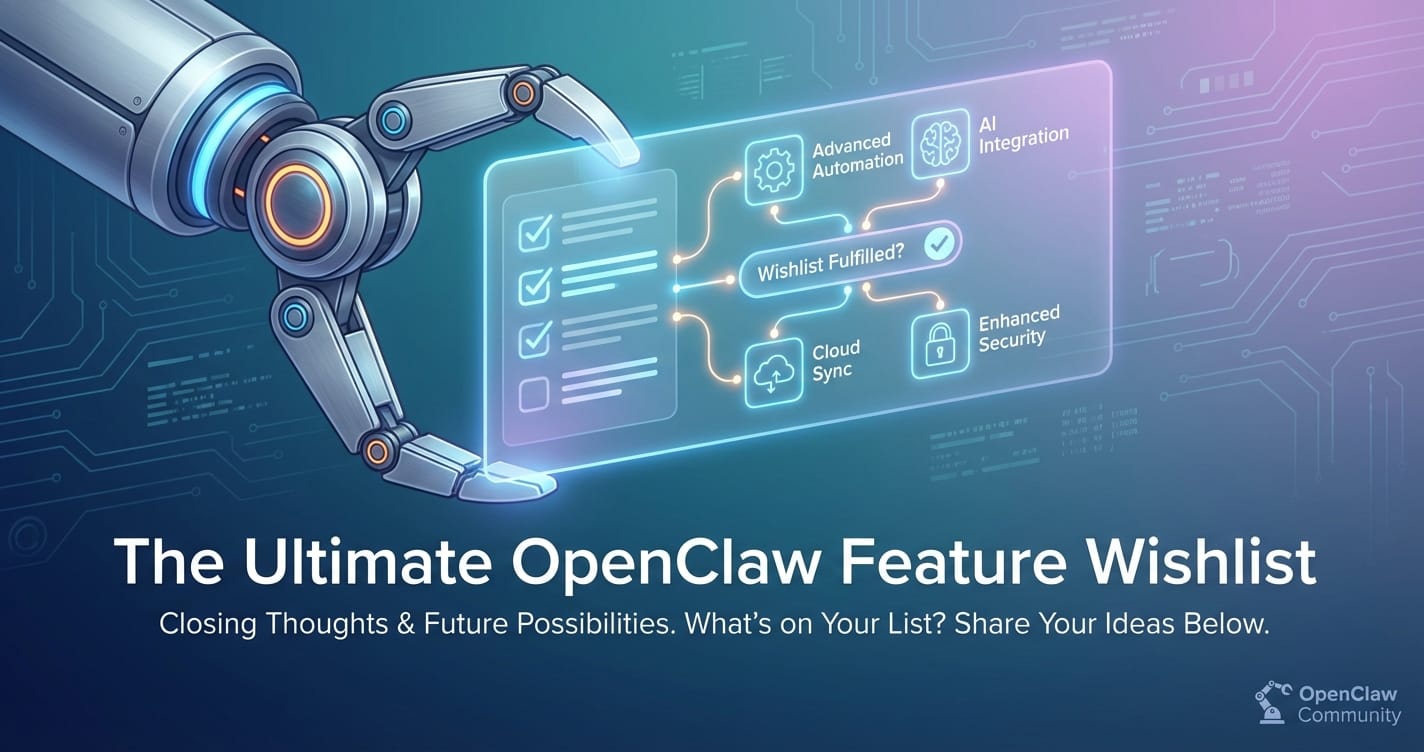
The Ultimate OpenClaw Feature Wishlist

The landscape of Artificial Intelligence is evolving at an exhilarating pace, with new models, providers, and capabilities emerging almost daily. For developers, businesses, and researchers alike, this rapid innovation presents both immense opportunity and significant challenges. Integrating these diverse AI assets into applications, managing their lifecycle, optimizing their performance, and controlling costs can quickly become a labyrinthine endeavor. Imagine a platform, an ideal solution, that could untangle this complexity, streamline workflows, and unlock unprecedented potential. We call this envisioned platform "OpenClaw."
OpenClaw is not just another API; it's a dream, a meticulously crafted blueprint for the ultimate AI development hub. It represents the pinnacle of what a developer-centric, future-proof AI platform should be. In this comprehensive wishlist, we will delve deep into the essential features that would define OpenClaw, exploring how it could revolutionize how we interact with, deploy, and scale AI. From its foundational Unified API to its intelligent Multi-model support and critical Cost optimization strategies, OpenClaw aims to be the indispensable companion for every AI journey. This isn't merely a list of functionalities; it's a vision for a more accessible, efficient, and powerful AI future.
The Bedrock of Innovation: A Seamless Unified API
At the heart of OpenClaw's transformative power lies its commitment to a truly seamless and robust Unified API. In an ecosystem fragmented by proprietary interfaces, disparate data formats, and ever-changing authentication schemes, the promise of a single, coherent gateway to the world's leading AI models is nothing short of revolutionary. This isn't just about convenience; it's about fundamentally altering the development paradigm, shifting focus from integration headaches to innovative application building.
The Imperative for Unification
Consider the current reality: a developer seeking to leverage Large Language Models (LLMs) might be evaluating offerings from OpenAI, Anthropic, Google, Cohere, and various open-source models hosted on platforms like Hugging Face. Each of these typically comes with its own SDK, its own API endpoint, its own set of parameters, and its own unique way of handling requests and responses. Building an application that can intelligently switch between these models, perhaps for redundancy, performance, or cost reasons, becomes a monumental integration project in itself. This "integration tax" saps valuable development time, introduces unnecessary complexity, and hinders the agility required to adapt to a fast-moving field.
An OpenClaw Unified API would abstract away this underlying heterogeneity. It would provide a consistent, standardized interface – ideally, one that leverages familiar patterns, much like the widely adopted OpenAI API specification. This means a developer could write their application logic once, targeting the OpenClaw API, and then seamlessly swap out the underlying model provider with a simple configuration change, or even dynamically, based on real-time conditions.
Core Attributes of OpenClaw's Unified API
- OpenAI-Compatible Endpoint: The most powerful feature of an OpenClaw Unified API would be its adherence to a widely accepted standard, such as the OpenAI API specification. This immediately grants developers access to a vast ecosystem of existing tools, libraries, and examples. It drastically flattens the learning curve and enables rapid prototyping. Imagine reusing your existing OpenAI client library, simply pointing it to an OpenClaw endpoint, and instantly gaining access to a multitude of models from various providers. This capability alone would save countless hours of development and refactoring.
- Standardized Request/Response Formats: Beyond the endpoint, the API must standardize the payloads for requests and responses. Whether you're calling a model for text generation, embeddings, or image processing, the input parameters (e.g.,
prompt,temperature,max_tokens) and the output structure (e.g.,choices,text,usage_statistics) should remain consistent. This allows for generic parsing logic and reduces the need for model-specific data mapping layers within the application. - Unified Authentication & Authorization: Instead of managing API keys for a dozen different providers, OpenClaw would offer a single, secure authentication mechanism. This centralizes security, simplifies credential management, and makes it easier to implement role-based access control (RBAC) across an organization. Developers could generate OpenClaw-specific API keys with granular permissions, enhancing security posture and reducing surface area for breaches.
- Error Handling and Idempotency: A well-designed Unified API provides consistent error codes and messages, regardless of the upstream provider's specific failure mode. This makes debugging and implementing robust retry logic significantly easier. Furthermore, support for idempotency keys would ensure that retried requests do not inadvertently trigger duplicate operations, which is crucial for transactional workflows and financial integrity.
- Rate Limiting & Throttling Management: OpenClaw would manage the nuances of rate limits imposed by individual providers. Developers could configure their overall rate limits with OpenClaw, and the platform would intelligently queue or distribute requests to avoid hitting provider-specific caps, ensuring smoother operation and higher availability for applications.
The Developer's Advantage: Agility and Future-Proofing
The practical implications of such a Unified API are profound:
- Accelerated Development: Developers spend less time on integration and more time on core application logic and feature innovation. Proof-of-concept to production timelines would shrink dramatically.
- Reduced Vendor Lock-in: The ability to seamlessly switch between models and providers empowers developers to choose the best tool for the job, rather than being bound by existing integrations. This fosters competition among AI providers, ultimately benefiting users with better models and more competitive pricing.
- Simplified A/B Testing: Experimenting with different models to find the optimal balance of performance, cost, and quality becomes trivial. A developer could A/B test OpenAI's GPT-4 against Anthropic's Claude 3 Opus with minimal code changes, gaining actionable insights quickly.
- Enhanced Resilience: If one provider experiences an outage or performance degradation, OpenClaw could automatically failover to another compatible model or provider, ensuring continuous service for end-users. This built-in redundancy is a critical feature for enterprise-grade applications.
- Future-Proof Architecture: As new models and providers emerge, OpenClaw's architecture would be designed to integrate them swiftly, meaning applications built on OpenClaw's Unified API would automatically gain access to cutting-edge advancements without requiring extensive refactoring.
In essence, OpenClaw's Unified API would serve as the universal translator and orchestrator for the AI world, turning a complex, fragmented landscape into a coherent, developer-friendly ecosystem. It's the foundational layer that makes all other advanced features not just possible, but effortlessly accessible. Companies like XRoute.AI are already pioneering this vision, offering a cutting-edge unified API platform that streamlines access to over 60 AI models from more than 20 active providers through a single, OpenAI-compatible endpoint. This demonstrates the tangible benefits and the growing demand for such a powerful and simplifying abstraction layer.
Empowering Choice: Comprehensive Multi-Model Support and Beyond
While a Unified API provides the entry point, the true power of OpenClaw lies in its comprehensive Multi-model support. This feature isn't merely about listing a plethora of models; it's about intelligent orchestration, dynamic routing, and empowering developers to harness the unique strengths of each AI without friction. In today's diverse AI landscape, no single model is a panacea for all tasks. Some excel at creative writing, others at precise code generation, and yet others at summarizing dense technical documents. OpenClaw recognizes this nuance and transforms it into an advantage.
Deepening the Meaning of Multi-Model Support
For OpenClaw, Multi-model support encompasses several critical dimensions:
- Breadth of Model Coverage:
- Leading LLMs: Access to flagship models from major players like OpenAI (GPT series), Anthropic (Claude series), Google (Gemini series), Meta (Llama series), and Cohere, among others.
- Specialized Models: Support for models tailored for specific tasks, such as code generation (e.g., Code Llama, AlphaCode), creative writing, summarization, or translation.
- Open-Source & Fine-tuned Models: Seamless integration with popular open-source models (e.g., Mistral, Falcon) and the ability for users to deploy and manage their own fine-tuned versions of these models or proprietary models.
- Beyond Text: While LLMs are prominent, comprehensive multi-model support also includes vision models (e.g., for image generation, object detection, OCR), speech-to-text, text-to-speech, and embedding models. This ensures OpenClaw can support truly multimodal AI applications.
- Dynamic Model Routing (The "Smart Proxy"): This is where OpenClaw's intelligence truly shines. Instead of hardcoding a specific model, developers could specify criteria, and OpenClaw would dynamically route the request to the optimal model.
- Cost-Based Routing: Automatically choose the cheapest model that meets a minimum performance threshold.
- Latency-Based Routing: Route to the fastest available model, crucial for real-time applications.
- Performance-Based Routing: For critical tasks, route to the model with the highest proven accuracy or quality for that specific task, as determined by internal benchmarks or user-defined metrics.
- Task-Specific Routing: Configure rules to send summarization requests to a model specialized in summarization, while sending creative writing prompts to another.
- Fallback Routing: If a primary model or provider is unavailable or fails, OpenClaw automatically retries with a designated fallback model.
- Model Versioning and Lifecycle Management: AI models are constantly updated, with new versions offering improved performance or new features, while older ones might be deprecated. OpenClaw would provide:
- Version Pinning: Allow developers to pin their applications to specific model versions, ensuring stability and reproducibility.
- Migration Tools: Tools and guidance for migrating applications between model versions, highlighting breaking changes or performance differences.
- Deprecation Policies: Clear communication and timelines for model deprecations, allowing ample time for transitions.
- Custom Model Integration: Enterprise users often have proprietary or highly specialized fine-tuned models. OpenClaw would offer a secure and efficient way to:
- Upload and Host Custom Models: Allow users to upload their own models (e.g., ONNX, PyTorch, TensorFlow formats) and host them securely on the OpenClaw infrastructure, benefiting from its scaling and management features.
- Private Endpoint Access: Provide private endpoints for these custom models, ensuring data isolation and security.
- Built-in Benchmarking and Evaluation Tools: To truly leverage Multi-model support, developers need objective ways to compare model performance. OpenClaw would integrate:
- Comparative Benchmarking: Tools to run the same prompt across multiple models and quantitatively compare their outputs based on user-defined metrics (e.g., toxicity scores, factual accuracy, coherence, specific task metrics).
- A/B Testing Frameworks: An integrated framework to conduct A/B tests on live traffic, routing a percentage of requests to different models and analyzing user feedback or application metrics.
- Human-in-the-Loop Evaluation: Tools to facilitate human review and scoring of model outputs, crucial for fine-tuning and quality control.
Leveraging the Power of Choice
The ability to seamlessly switch between and orchestrate multiple models transforms AI development:
- Optimized Performance: Always use the best model for a given task, leading to superior application performance and user experience.
- Increased Flexibility: Adapt quickly to new AI advancements or changes in model availability/pricing without major architectural overhaul.
- Enhanced Innovation: Experiment with different AI approaches and combinations without significant overhead, fostering creativity and novel solutions.
- Risk Mitigation: Reduce reliance on a single AI provider, distributing risk and ensuring business continuity.
Consider a chatbot application: simple greeting responses might go to a smaller, faster, and cheaper model, while complex information retrieval or creative content generation would be routed to a more powerful, specialized LLM. If a user asks for an image, the request is routed to a vision model. This intelligent segregation, managed effortlessly by OpenClaw's Multi-model support, ensures efficiency, cost-effectiveness, and optimal user interaction.
The table below illustrates hypothetical categories of models OpenClaw would support, demonstrating the breadth of its vision for Multi-model support:
| Model Category | Example Models (Hypothetical/Real) | Primary Use Cases | Key Performance Indicators (KPIs) |
|---|---|---|---|
| General Purpose LLMs | GPT-4, Claude 3 Opus, Gemini Ultra | Text generation, summarization, Q&A, coding | Coherence, factual accuracy, creativity, latency |
| Cost-Optimized LLMs | GPT-3.5 Turbo, Claude 3 Haiku, Llama 3 8B | Simple Q&A, basic content, data extraction | Cost per token, throughput, latency |
| Code Generation LLMs | Code Llama, AlphaCode, GPT-4 | Code completion, debugging, code translation | Code correctness, efficiency, security, generation speed |
| Embeddings Models | OpenAI Embeddings, Cohere Embed | Semantic search, recommendation systems, clustering | Semantic similarity, recall, embedding size |
| Vision Models | DALL-E 3, Midjourney, Stable Diffusion | Image generation, object detection, image analysis | Image quality, realism, prompt adherence, speed |
| Speech-to-Text | Whisper, Google Speech-to-Text | Transcription, voice assistants, meeting notes | Accuracy (WER), latency, language support |
| Text-to-Speech | ElevenLabs, Google Text-to-Speech | Voiceovers, audio content generation | Naturalness, emotional range, voice variety, latency |
| Translation Models | Google Translate API, DeepL API | Language translation, localization | Translation accuracy, fluency, cultural nuance |
This comprehensive approach to Multi-model support positions OpenClaw not just as an API aggregator, but as an intelligent AI orchestration layer. It's about giving developers the freedom to choose, the tools to manage, and the intelligence to optimize their AI resources, making advanced AI truly accessible and manageable.
The Smart Path: Intelligent Cost Optimization Strategies
In the world of AI, particularly with the rise of LLMs, costs can quickly spiral out of control. Large-scale deployments, extensive prompt engineering, and iterative development cycles can lead to significant expenditures on API calls and token usage. For OpenClaw, Cost optimization isn't an afterthought; it's a fundamental design principle, seamlessly integrated into its architecture and presented as a suite of intelligent tools. Without effective cost management, even the most powerful AI capabilities can become economically unsustainable.
Why Cost Optimization is Non-Negotiable
The economic realities of AI development are complex:
- Per-token Billing: Many leading models charge per input and output token, which can accumulate rapidly with verbose prompts or extensive generated content.
- Variable Pricing: Different models and providers have varying price structures, often with tiers based on usage volume.
- Scaling Challenges: As an application scales, the volume of API calls increases proportionally, directly impacting operational costs.
- Development & Experimentation Costs: Iterative prompt engineering, model tuning, and A/B testing can incur significant costs before a stable solution is found.
- Provider Lock-in Effects: Once deeply integrated with a single provider, switching to a more cost-effective alternative can be a costly and time-consuming endeavor.
OpenClaw's Cost optimization features are designed to mitigate these challenges, ensuring that developers and businesses can leverage advanced AI capabilities without breaking the bank.
OpenClaw's Intelligent Cost Optimization Toolkit
- Dynamic Provider & Model Selection (Cost-Aware Routing): This is perhaps the most impactful Cost optimization feature. Building on its Multi-model support, OpenClaw would dynamically route requests not just for performance, but specifically for cost.
- Real-time Price Monitoring: OpenClaw continuously monitors the pricing of all integrated models and providers.
- Cost-Benefit Analysis: Developers could set policies (e.g., "always use the cheapest model that achieves at least 90% accuracy for summarization") and OpenClaw would execute this logic in real-time.
- Geographic Price Differences: Leverage regional pricing advantages where applicable, routing requests to data centers with lower operational costs for AI inference.
- Intelligent Tiered Caching Mechanisms: Many prompts, especially for common queries or frequently generated content, are repetitive. OpenClaw would implement a sophisticated caching layer:
- Deterministic Caching: For identical input prompts and parameters, OpenClaw could serve cached responses, completely bypassing API calls to upstream providers.
- Semantic Caching: More advanced caching could identify semantically similar prompts, and if a sufficiently similar answer exists in the cache, serve it. This is more complex but offers greater savings.
- Configurable Cache Policies: Developers could define cache expiry times, maximum cache size, and which types of requests are eligible for caching.
- Comprehensive Token Usage Monitoring & Alerts: Transparency is key to cost control. OpenClaw would provide:
- Real-time Dashboards: Visualizations of token usage, API call volume, and estimated costs, broken down by project, model, provider, and even individual user/API key.
- Configurable Spend Limits & Alerts: Set daily, weekly, or monthly spending thresholds. OpenClaw would automatically send notifications or even temporarily disable API access when limits are approached or exceeded, preventing unexpected bills.
- Detailed Billing Analytics: Granular breakdown of charges, making it easy to allocate costs to specific departments or features.
- Cost-Aware Prompt Engineering Tools: OpenClaw would integrate tools to help developers write more efficient prompts.
- Token Estimators: Real-time feedback on the estimated token count of a prompt before it's sent, allowing developers to optimize for brevity.
- Prompt Compression Suggestions: AI-driven suggestions to rephrase or condense prompts without losing critical context.
- Input/Output Truncation: Options to automatically truncate overly long inputs or outputs to manage token limits.
- Batch Processing & Asynchronous APIs: For tasks that are not latency-sensitive but involve large volumes of data, batch processing can be significantly more cost-effective.
- Batching Endpoints: OpenClaw would offer endpoints specifically designed for sending multiple requests in a single batch, often benefiting from bulk pricing or more efficient resource utilization by providers.
- Asynchronous Processing: For long-running or large-volume tasks, providing asynchronous APIs where results can be retrieved later via webhooks or polling.
- Optimized Model Chaining: For complex workflows involving multiple AI steps, OpenClaw would intelligently optimize the sequence and choice of models to minimize overall cost while maintaining desired output quality. For example, using a cheaper model for initial data extraction, then routing only critical parts to a more expensive, powerful model for nuanced analysis.
The Financial Advantage: Sustainable AI Growth
By integrating these Cost optimization strategies, OpenClaw empowers businesses to:
- Predictable Spending: Gain better control and predictability over AI expenditures.
- Maximized ROI: Ensure that every dollar spent on AI delivers maximum value.
- Scalable Solutions: Build applications that can scale economically, even with high usage volumes.
- Budget Adherence: Stay within allocated budgets, avoiding unpleasant surprises at the end of the billing cycle.
The strategic importance of Cost optimization cannot be overstated. It transforms AI from a potentially prohibitive expense into a manageable, scalable, and ultimately profitable investment. Platforms like XRoute.AI emphasize cost-effective AI as a core benefit, providing developers with the tools to balance performance and budget, showcasing the critical nature of this feature in the modern AI landscape.
Below is a table illustrating the potential impact of OpenClaw's hypothetical Cost optimization features:
| Cost Optimization Feature | Mechanism | Expected Impact | Typical Savings (%) |
|---|---|---|---|
| Dynamic Model Routing | Automatically selects cheapest model meeting quality/latency needs. | Significant reduction in per-call cost. | 10-40% |
| Intelligent Tiered Caching | Stores and reuses common model responses, bypassing API calls. | Drastic reduction in repeated API call volume. | 15-50% (for repetitive tasks) |
| Token Usage Monitoring/Alerts | Real-time tracking and automated alerts for budget thresholds. | Prevents unexpected overspending, fosters mindful usage. | 5-15% (preventative) |
| Cost-Aware Prompt Engineering | Tools to reduce prompt verbosity and token count. | Reduces input token costs. | 5-20% |
| Batch Processing/Async APIs | Consolidates multiple requests, leverages bulk pricing, off-peak processing. | Lower cost per transaction for non-real-time workloads. | 10-30% |
| Optimized Model Chaining | Intelligent sequencing of models to use cheaper options for simpler steps. | Reduces cost of multi-step AI workflows. | 5-25% |
These features collectively form a robust framework for managing and optimizing AI spending, making OpenClaw an indispensable tool for sustainable AI development.
XRoute is a cutting-edge unified API platform designed to streamline access to large language models (LLMs) for developers, businesses, and AI enthusiasts. By providing a single, OpenAI-compatible endpoint, XRoute.AI simplifies the integration of over 60 AI models from more than 20 active providers(including OpenAI, Anthropic, Mistral, Llama2, Google Gemini, and more), enabling seamless development of AI-driven applications, chatbots, and automated workflows.
Elevating Development: Unparalleled Developer Experience and Productivity
Beyond the core functionalities of a Unified API, Multi-model support, and Cost optimization, OpenClaw's ultimate success hinges on delivering an exceptional developer experience. A platform can offer groundbreaking features, but if it's difficult to use, poorly documented, or lacks robust support, its adoption will falter. OpenClaw envisions a holistic approach to developer productivity, anticipating needs and providing tools that not only simplify but also accelerate the entire AI application lifecycle.
Foundations of a Superior Developer Experience
- Comprehensive, Interactive Documentation:
- Clear & Concise: Easy-to-understand explanations of API endpoints, parameters, and response structures, with practical examples in multiple programming languages (Python, JavaScript, Go, Ruby, etc.).
- Interactive API Explorer: A built-in tool that allows developers to send sample requests, view responses, and experiment with parameters directly within the documentation.
- Use Case Guides & Tutorials: Step-by-step guides for common AI application scenarios (e.g., building a chatbot, integrating an image generator, creating a semantic search engine).
- Robust SDKs and Client Libraries:
- Multi-Language Support: Official SDKs for all major programming languages, providing idiomatic wrappers around the OpenClaw API.
- Async Support: Built-in support for asynchronous operations to handle high concurrency and non-blocking I/O efficiently.
- Error Handling & Retries: SDKs that gracefully handle API errors, implement intelligent retry logic with backoff, and expose meaningful error messages.
- Interactive Playground & Sandboxes:
- No-Code Experimentation: A web-based UI where developers can test different models, experiment with prompt variations, and observe outputs in real-time, without writing a single line of code.
- Parameter Tuning: Intuitive controls for adjusting model parameters (temperature, top_p, max_tokens, etc.) and immediate feedback on their impact.
- Prompt Versioning & Sharing: Ability to save, version, and share prompts and their outputs with team members for collaborative development.
- Robust Monitoring, Observability, and Logging:
- Real-time Dashboards: Comprehensive dashboards showing key metrics: API call volume, latency (average, p90, p99), error rates, token usage, and cost estimates.
- Request/Response Logging: Detailed logs of every API request and response, including parameters, timestamps, and model used, with configurable retention policies.
- Alerting System: Configurable alerts for anomalies (e.g., sudden spike in errors, unusual latency, exceeding spend limits) delivered via email, Slack, PagerDuty, etc.
- Distributed Tracing: Integration with popular tracing tools (e.g., OpenTelemetry) to track API calls across different services and identify performance bottlenecks.
- Advanced Prompt Engineering Tools:
- Prompt Template Management: A system for creating, storing, and managing prompt templates, allowing for consistent and repeatable interactions with models.
- A/B Testing Framework: Built-in capabilities to A/B test different prompt variations or model configurations in a controlled manner, measuring impact on quality metrics or user engagement.
- Prompt Version Control: Git-like versioning for prompts, enabling rollback to previous versions and tracking changes.
- Input/Output Validation: Tools to validate model inputs and outputs, ensuring data quality and adherence to specific formats (e.g., JSON schema validation for structured outputs).
- Enterprise-Grade Security & Compliance:
- Data Encryption: All data in transit and at rest is encrypted using industry-standard protocols.
- Access Control (RBAC): Granular role-based access control to manage who can access which models, projects, and data.
- Audit Trails: Detailed audit logs of all user actions and API calls for compliance and security monitoring.
- Compliance Certifications: Adherence to relevant industry standards and certifications (e.g., ISO 27001, SOC 2, GDPR, HIPAA compliance).
- Private Network Access: Options for private connectivity (e.g., AWS PrivateLink, Azure Private Link) for enhanced security and lower latency for enterprise customers.
- Seamless Integration with CI/CD & MLOps Workflows:
- API-First Design: All OpenClaw features should be accessible via API, enabling automation and integration into existing CI/CD pipelines for deployment and testing.
- Terraform/CloudFormation Support: Infrastructure-as-Code support for provisioning and managing OpenClaw resources.
- MLOps Tool Integrations: Compatibility with popular MLOps platforms (e.g., MLflow, Kubeflow) for model management, experimentation tracking, and deployment.
- Active Community & Responsive Support:
- Developer Forum/Community: A vibrant online community where developers can share knowledge, ask questions, and collaborate.
- Dedicated Support Channels: Multiple tiers of technical support, from community-driven to enterprise-level SLA-backed support.
- Regular Updates & Changelogs: Transparent communication about new features, model integrations, and platform improvements.
The Productivity Dividend
A platform built with such a strong emphasis on developer experience becomes more than just a tool; it becomes an extension of the developer's thought process. It minimizes friction, reduces cognitive load, and enables faster iteration cycles. This translates directly into:
- Faster Time-to-Market: Accelerate the development and deployment of AI-powered features and applications.
- Higher Quality Applications: With robust monitoring and testing tools, developers can build more reliable and performant AI solutions.
- Reduced Operational Overhead: Automation, comprehensive logging, and smart alerts free up valuable engineering time.
- Empowered Teams: Developers feel more confident and capable when working with advanced AI, fostering innovation and job satisfaction.
OpenClaw's vision for developer experience is about creating an environment where the complexity of AI is managed by the platform, allowing developers to focus their creativity and problem-solving skills on building groundbreaking applications. It's about making the advanced world of AI as approachable and productive as possible.
Glimpse into Tomorrow: Visionary Features for OpenClaw's Evolution
As powerful as the core features are, OpenClaw's "wishlist" extends beyond immediate needs, envisioning the cutting edge of AI development. These visionary features anticipate future trends and challenges, positioning OpenClaw as not just a current leader, but a forward-thinking innovator that continuously pushes the boundaries of what's possible in AI. They aim to tackle more complex AI paradigms, enhance user interactions, and ensure ethical considerations are at the forefront.
Anticipating the Next Wave of AI
- Contextual Memory Management for State-Aware AI:
- Persistent Conversation History: For chatbots and AI agents, OpenClaw would manage and retrieve conversation history across sessions, providing models with crucial context for more coherent and personalized interactions.
- Semantic Memory Stores: Beyond raw history, OpenClaw could provide tools to summarize, extract key facts, and represent long-term memories in vector databases, allowing models to efficiently access relevant information without re-processing entire chat logs.
- Memory Eviction Policies: Configurable strategies for managing memory size and retention, balancing cost with contextual richness.
- Agentic AI Capabilities and Orchestration Frameworks:
- Tool Integration Layer: A robust framework for connecting AI models to external tools and APIs (e.g., search engines, databases, CRMs, custom internal services). OpenClaw would manage the invocation and response handling.
- Autonomous Agent Design: Tools and SDKs to help developers design and deploy AI agents that can break down complex tasks, reason, plan, execute multiple steps, and use tools independently.
- Workflow Definition Languages: A declarative way to define complex multi-step AI workflows and decision trees, allowing agents to navigate dynamic problem spaces.
- Human-in-the-Loop Feedback: Mechanisms for human oversight and intervention in agent workflows, ensuring safety and allowing for correctional learning.
- Ethical AI, Bias Detection, and Transparency Tools:
- Bias Detection Modules: Integrated tools that can analyze model outputs for potential biases (e.g., gender, racial, cultural) and flag problematic responses.
- Explainable AI (XAI) Integrations: Features that help developers understand why a model made a particular decision or generated a specific output, improving trust and debuggability.
- Transparency Reports: Automated generation of reports on model behavior, potential risks, and adherence to ethical guidelines.
- Content Moderation APIs: Built-in or seamlessly integrated content moderation tools to filter out harmful, hateful, or inappropriate content generated by models.
- True Multi-Modal AI Orchestration:
- Unified Multimodal Input/Output: Go beyond separate text, image, and audio APIs. OpenClaw would allow developers to send truly multimodal inputs (e.g., an image with a text prompt about its contents) and receive multimodal outputs (e.g., a generated image accompanied by descriptive text).
- Inter-Modal Reasoning: Orchestration capabilities that allow different types of models to "talk" to each other within a single workflow (e.g., a vision model identifies objects in an image, then an LLM generates a story based on those objects).
- Low-Code/No-Code Interface for Business Users:
- Visual Workflow Builder: A drag-and-drop interface for non-technical users to build simple AI applications, automation workflows, or custom chatbots using OpenClaw's models and tools.
- Pre-built Templates: A library of customizable templates for common business use cases (e.g., customer support assistant, content generation tool, data analysis agent).
- Business User Analytics: Dashboards tailored for business stakeholders to monitor AI application performance, usage, and ROI without deep technical diving.
- Edge AI Deployment Options:
- Model Optimization for Edge Devices: Tools to quantize, prune, and compile models for efficient deployment on resource-constrained edge devices (e.g., IoT, mobile).
- Hybrid Cloud/Edge Inference: Seamless orchestration of workloads, allowing some inference to occur locally on the edge for low latency or privacy, while complex tasks are offloaded to the cloud via OpenClaw.
- Secure Edge Updates: Mechanisms for securely updating models deployed on edge devices.
- Decentralized AI and Federated Learning Integration:
- Support for Federated Learning Workflows: Tools for integrating models trained using federated learning approaches, where data remains localized and only model updates are shared.
- Decentralized Model Registries: Integration with blockchain-based or decentralized model registries for enhanced transparency, provenance, and trust in AI models.
The Future of Innovation, Unlocked
These visionary features position OpenClaw not just as a reactive platform, but as a proactive enabler of future AI advancements. By providing robust tools for agentic AI, ensuring ethical considerations, simplifying multimodal interactions, and democratizing access through low-code interfaces, OpenClaw would accelerate the adoption and impact of AI across all industries. It's about building a platform that not only meets today's needs but actively shapes tomorrow's possibilities, fostering a new era of intelligent applications that are more capable, more ethical, and more integrated into the fabric of our digital lives.
Conclusion: The Dawn of a New AI Era with OpenClaw
The journey through the OpenClaw Feature Wishlist paints a vivid picture of an ideal future for AI development. We've explored how a truly comprehensive platform, built with developers at its core, can demystify the complexities of an ever-expanding AI landscape. The challenges of integrating disparate models, managing escalating costs, and ensuring robust performance are not insurmountable. Instead, they represent opportunities for innovation and intelligent design.
At its foundation, OpenClaw's Unified API stands as the universal translator, transforming a chaotic multi-vendor environment into a coherent, standardized, and effortlessly navigable ecosystem. This single, consistent gateway eliminates integration headaches, accelerates development cycles, and liberates developers from the shackles of vendor lock-in. It's the essential first step towards a more agile and future-proof AI architecture, a vision already being realized by pioneering platforms such as XRoute.AI, which offers an OpenAI-compatible endpoint to over 60 models, significantly simplifying access and integration.
Building upon this foundation, OpenClaw's intelligent Multi-model support empowers developers with unprecedented choice and flexibility. It's more than just access to a vast array of LLMs, vision, and speech models; it's the sophisticated orchestration layer that dynamically routes requests to the optimal model based on task, performance, and real-time conditions. This ensures that every AI interaction is powered by the best available intelligence, leading to superior application quality and user experience.
Crucially, the OpenClaw vision recognizes that powerful AI must also be economically sustainable. Its advanced Cost optimization strategies, from dynamic pricing to intelligent caching and granular usage monitoring, ensure that innovation doesn't come at an exorbitant price. By providing tools to manage, predict, and reduce AI spending, OpenClaw enables businesses to scale their AI initiatives confidently and cost-effectively, transforming AI from a potential financial drain into a strategic investment with measurable ROI.
Beyond these core pillars, OpenClaw's commitment to an unparalleled developer experience — encompassing intuitive tools, comprehensive documentation, robust monitoring, and enterprise-grade security — ensures that the platform is not just powerful, but also a joy to use. And as we peered into the future, features like agentic AI capabilities, ethical AI tools, and true multimodal orchestration demonstrated OpenClaw's ambition to be a proactive enabler of the next generation of intelligent applications.
In essence, OpenClaw is more than a collection of features; it's a paradigm shift. It represents a future where AI development is streamlined, efficient, cost-effective, and deeply empowering. It's a platform that transforms the complexity of cutting-edge AI into accessible, actionable intelligence, allowing developers to focus their creativity on building applications that truly matter. The ultimate OpenClaw Feature Wishlist is a blueprint for a more intelligent, integrated, and impactful AI world, a future we eagerly anticipate and strive to build.
Frequently Asked Questions (FAQ)
Q1: What is a Unified API, and why is it important for AI development?
A1: A Unified API acts as a single, consistent interface to access various AI models and providers, regardless of their underlying proprietary APIs. It's crucial because it simplifies integration, reduces development time, allows for easy model switching (reducing vendor lock-in), and streamlines the management of diverse AI resources, much like how XRoute.AI provides a single endpoint for many LLMs.
Q2: How does OpenClaw's Multi-model support differ from simply using multiple individual APIs?
A2: OpenClaw's Multi-model support goes beyond merely aggregating APIs. It includes intelligent orchestration capabilities like dynamic model routing based on cost, latency, or performance, model versioning, custom model integration, and built-in benchmarking tools. This enables developers to strategically use the best model for each specific task without manual switching or complex custom logic.
Q3: What are the key strategies OpenClaw employs for Cost optimization?
A3: OpenClaw utilizes several Cost optimization strategies, including dynamic provider and model selection based on real-time pricing, intelligent tiered caching to reduce redundant API calls, comprehensive token usage monitoring with alerts, cost-aware prompt engineering tools, and support for batch processing/asynchronous APIs. These features help developers and businesses manage and reduce their AI spending effectively.
Q4: How does OpenClaw aim to provide a superior developer experience?
A4: OpenClaw focuses on developer experience through comprehensive and interactive documentation, robust SDKs for multiple languages, an intuitive interactive playground for experimentation, real-time monitoring and observability dashboards, advanced prompt engineering tools, enterprise-grade security features like RBAC and audit trails, and seamless integration with CI/CD/MLOps workflows.
Q5: What are some of the visionary features OpenClaw might integrate in the future?
A5: Future visionary features for OpenClaw include advanced contextual memory management for state-aware AI, robust agentic AI capabilities with tool integration, ethical AI and bias detection tools, true multi-modal AI orchestration, low-code/no-code interfaces for business users, and options for edge AI deployment. These features aim to push the boundaries of AI application development.
🚀You can securely and efficiently connect to thousands of data sources with XRoute in just two steps:
Step 1: Create Your API Key
To start using XRoute.AI, the first step is to create an account and generate your XRoute API KEY. This key unlocks access to the platform’s unified API interface, allowing you to connect to a vast ecosystem of large language models with minimal setup.
Here’s how to do it: 1. Visit https://xroute.ai/ and sign up for a free account. 2. Upon registration, explore the platform. 3. Navigate to the user dashboard and generate your XRoute API KEY.
This process takes less than a minute, and your API key will serve as the gateway to XRoute.AI’s robust developer tools, enabling seamless integration with LLM APIs for your projects.
Step 2: Select a Model and Make API Calls
Once you have your XRoute API KEY, you can select from over 60 large language models available on XRoute.AI and start making API calls. The platform’s OpenAI-compatible endpoint ensures that you can easily integrate models into your applications using just a few lines of code.
Here’s a sample configuration to call an LLM:
curl --location 'https://api.xroute.ai/openai/v1/chat/completions' \
--header 'Authorization: Bearer $apikey' \
--header 'Content-Type: application/json' \
--data '{
    "model": "gpt-5",
    "messages": [
        {
            "content": "Your text prompt here",
            "role": "user"
        }
    ]
}'
With this setup, your application can instantly connect to XRoute.AI’s unified API platform, leveraging low latency AI and high throughput (handling 891.82K tokens per month globally). XRoute.AI manages provider routing, load balancing, and failover, ensuring reliable performance for real-time applications like chatbots, data analysis tools, or automated workflows. You can also purchase additional API credits to scale your usage as needed, making it a cost-effective AI solution for projects of all sizes.
Note: Explore the documentation on https://xroute.ai/ for model-specific details, SDKs, and open-source examples to accelerate your development.