Top 5 Best LLMs: Choosing the Right Model for You

The landscape of artificial intelligence is evolving at an unprecedented pace, with Large Language Models (LLMs) standing at the forefront of this revolution. These sophisticated AI algorithms, trained on vast datasets of text and code, are capable of understanding, generating, and processing human language with remarkable fluency and coherence. From writing compelling marketing copy and summarizing lengthy documents to powering advanced chatbots and coding assistants, the applications of LLMs are as diverse as they are transformative. However, with a growing number of powerful models emerging from various research labs and tech giants, the task of identifying the best LLMs for a specific project has become increasingly complex. Developers, businesses, and AI enthusiasts alike face the challenge of navigating through an ever-expanding array of options, each with its unique strengths, weaknesses, and cost implications.
This comprehensive guide aims to demystify the process of ai model comparison by delving deep into the characteristics, capabilities, and ideal use cases of what we consider to be the top contenders in the current LLM arena. We understand that "best" is subjective and highly dependent on individual needs, budget, and desired performance metrics. Therefore, instead of offering a one-size-fits-all solution, we will provide a detailed analysis to empower you to make an informed decision, tailored to your specific requirements. We'll explore crucial factors to consider during your evaluation, present a curated list of leading LLMs with a thorough breakdown of each, and discuss how to approach your own comprehensive llm rankings to ensure you select the model that truly aligns with your goals. The journey to harnessing the full potential of AI begins with choosing the right foundation, and this article is your compass.
Understanding the LLM Landscape: More Than Just Buzzwords
Before we dive into specific models, it's essential to grasp what makes an LLM powerful and what critical metrics differentiate them. At their core, LLMs are neural networks, typically transformer-based architectures, that learn patterns, grammar, facts, and reasoning abilities from massive text corpuses. This learning enables them to perform a wide range of natural language processing (NLP) tasks.
The "power" of an LLM isn't solely determined by its parameter count, though that often correlates with capability. More nuanced aspects come into play:
- Context Window: This refers to the maximum amount of text (tokens) an LLM can consider at one time when generating a response. A larger context window allows the model to maintain coherence over longer conversations, process entire documents, or handle complex instructions spanning multiple paragraphs. For tasks requiring extensive document analysis or sustained interaction, a generous context window is paramount.
- Reasoning Capability: Beyond simple pattern matching, a truly advanced LLM can perform complex logical deductions, understand implied meanings, and generate creative solutions. This capability is often tested through benchmarks involving problem-solving, mathematical reasoning, and multi-step instructions.
- Multimodality: Some advanced LLMs are now multimodal, meaning they can process and generate content across different modalities, such as text, images, audio, and video. This opens up entirely new use cases, like describing images, generating captions, or even interacting with users through voice.
- Latency: For real-time applications like chatbots or interactive tools, how quickly an LLM can generate a response is crucial. High latency can lead to a frustrating user experience.
- Throughput: This measures how many requests an LLM can process per unit of time. It's critical for applications that need to handle a large volume of concurrent user queries or batch processing tasks.
- Cost: Accessing LLMs, especially powerful ones, comes with a cost, typically measured per token processed (both input and output). For large-scale deployments, cost efficiency can be a primary driver for
ai model comparison. - Safety and Bias: LLMs, trained on human-generated data, can inherit and amplify biases present in that data. Ensuring a model's safety, robustness against harmful content generation, and efforts to mitigate bias are significant considerations, especially for public-facing applications.
- Developer Experience & Ecosystem: The ease of integration (APIs, SDKs), availability of fine-tuning options, documentation, and community support can significantly impact development time and overall project success.
Understanding these foundational aspects will equip you to better interpret the llm rankings and ai model comparison presented here, allowing you to weigh the trade-offs that matter most for your specific application.
Crucial Factors for Your AI Model Comparison: Beyond Raw Performance
Selecting an LLM is a strategic decision that extends beyond simply picking the "smartest" model. A thorough ai model comparison requires a holistic view, considering technical specifications, business objectives, and operational realities. Here are the critical factors you must evaluate:
1. Performance and Accuracy
This is often the first criterion developers look at. How well does the model perform on general tasks like text generation, summarization, translation, and question-answering? * Benchmarks: While benchmarks like MMLU (Massive Multitask Language Understanding), GSM8K (math word problems), and HumanEval (coding) offer a standardized way to compare models, remember they are often academic and might not perfectly reflect real-world performance for your specific use case. * Domain-Specific Accuracy: If your application is highly specialized (e.g., legal tech, medical AI), you need an LLM that performs exceptionally well on domain-specific data and tasks. This might involve fine-tuning or selecting models known for strong performance in particular niches. * Robustness: How well does the model handle ambiguous inputs, edge cases, or adversarial prompts? A robust model provides consistent and reliable outputs.
2. Cost-Effectiveness
LLM usage typically incurs costs based on input and output tokens. For applications with high query volumes, these costs can quickly escalate. * Token Pricing: Compare the cost per 1,000 or 1,000,000 tokens for different models. Note that pricing can vary significantly between different models and even different context window sizes of the same model. * Input vs. Output Cost: Some models have different pricing for input (prompt) tokens versus output (completion) tokens. Output tokens are often more expensive. * Model Efficiency: A more efficient model that requires fewer tokens to achieve the desired output can be more cost-effective, even if its per-token price is slightly higher. * Tiered Pricing/Volume Discounts: Consider if providers offer discounts for higher usage volumes, which can be beneficial for scaling applications.
3. Latency and Throughput
For applications requiring real-time interaction or processing massive datasets, latency and throughput are non-negotiable. * Latency: The time it takes for a model to respond to a prompt. High-latency models are unsuitable for interactive chatbots or voice assistants. * Throughput: The number of requests a model can handle concurrently. For applications serving many users simultaneously or processing large batches of data, high throughput is essential to prevent bottlenecks and ensure scalability. * API Load and Provider Infrastructure: The provider's infrastructure, network capacity, and API design significantly influence both latency and throughput. Testing with realistic loads is crucial.
4. Context Window Size
As discussed, this defines how much information the model can "remember" or process in a single interaction. * Long-form Content: For summarizing books, analyzing extensive legal documents, or maintaining multi-turn, complex conversations, a large context window is indispensable. * Code Generation/Analysis: For understanding large codebases or generating complex programs, a model with a substantial context window can process more related files and provide more accurate, context-aware suggestions.
5. Ease of Integration and Developer Experience
The time and effort required to integrate an LLM into your existing systems can be a significant factor. * API Design and Documentation: A well-documented, intuitive API (e.g., RESTful, OpenAI-compatible) simplifies integration. * SDKs and Libraries: Availability of SDKs for popular programming languages (Python, Node.js, Go) speeds up development. * Community Support: A vibrant developer community can provide valuable resources, troubleshooting help, and examples. * Fine-tuning Capabilities: The ability to fine-tune a model on your specific data can dramatically improve performance for specialized tasks, but the ease and cost of doing so vary by provider.
6. Data Privacy and Security
For many businesses, especially those handling sensitive information, data privacy and compliance are paramount. * Data Usage Policies: Understand how the LLM provider uses your input data. Is it used for model training? Is it retained? What are the data retention policies? * Compliance: Does the provider comply with relevant regulations like GDPR, HIPAA, CCPA? * On-premise/Self-hosting Options: For maximum control over data, some organizations might consider open-source models that can be hosted on their own infrastructure, though this comes with operational overhead.
7. Multimodality (if applicable)
If your application requires more than just text processing, consider models with multimodal capabilities. * Image Understanding: Generating descriptions, analyzing visual content. * Audio Processing: Speech-to-text, text-to-speech, sentiment analysis from audio. * Video Analysis: Summarizing video content, identifying objects/actions.
By systematically evaluating these factors against your project's specific needs, you can move beyond general llm rankings and identify the truly best LLMs for your unique situation.
The Top 5 Best LLMs: A Deep Dive into Leading Models
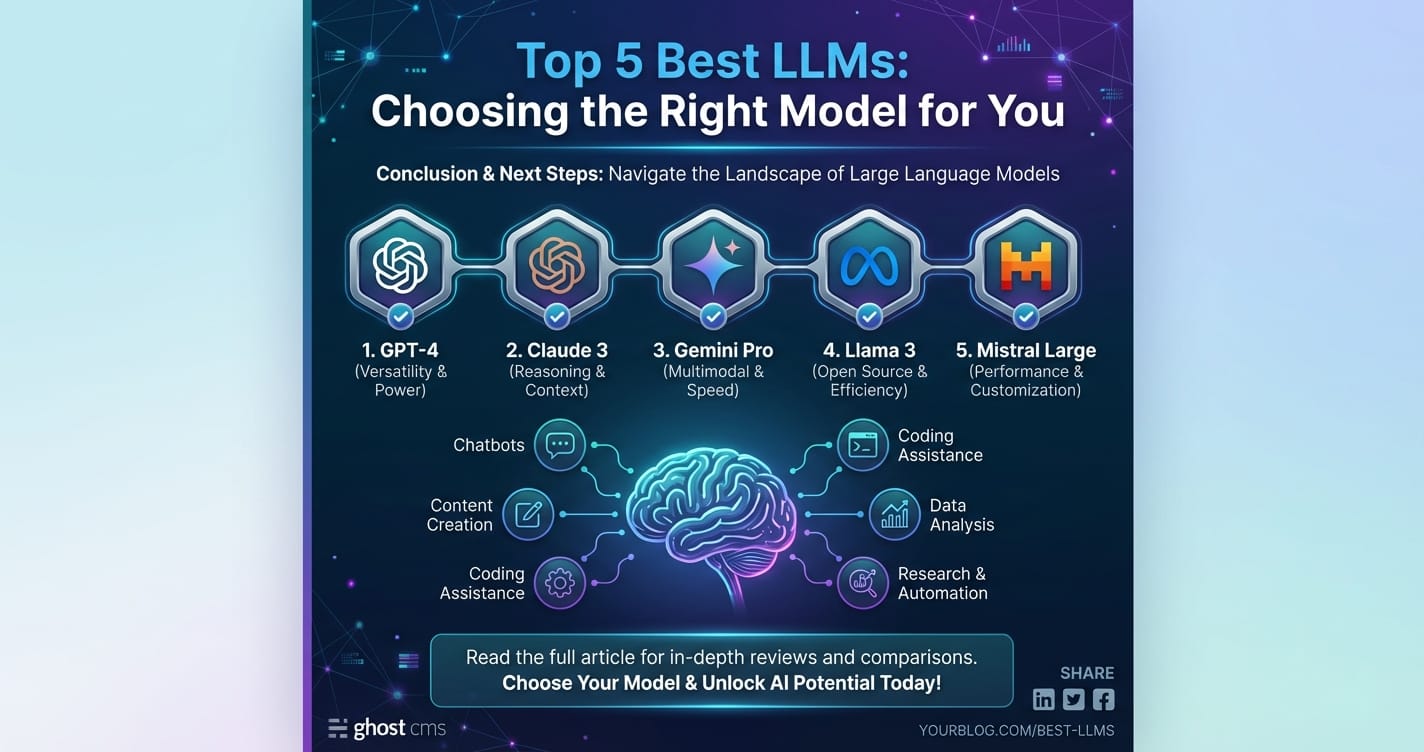
The field of LLMs is highly dynamic, with new models and updates emerging constantly. Our selection of the best LLMs focuses on models that have consistently demonstrated cutting-edge performance, broad applicability, and strong developer support, making them leading contenders in most ai model comparison scenarios.
1. OpenAI's GPT-4o (and GPT-4 Turbo)
Overview: OpenAI's GPT series has consistently set the benchmark for general-purpose language understanding and generation. GPT-4o ("omni") represents the latest iteration, offering unprecedented multimodal capabilities, significantly improved speed, and cost-effectiveness compared to its predecessors. GPT-4 Turbo (and GPT-4) remains a foundational model known for its robust reasoning and vast knowledge base.
Key Features and Strengths: * Unrivaled General Intelligence: GPT-4o excels across a wide array of cognitive tasks, demonstrating strong reasoning, creativity, and instruction-following abilities. Its general knowledge base is immense. * Exceptional Multimodality: GPT-4o can seamlessly process and generate text, audio, and images. It can take in any combination of inputs and generate any combination of outputs, making it incredibly versatile for interactive and rich media applications. * Low Latency & High Throughput: Designed for speed, GPT-4o can respond to audio inputs in as little as 232 milliseconds (on average 320 milliseconds), comparable to human response times in conversations. This makes it ideal for real-time interactions. * Large Context Window: GPT-4 Turbo offers a substantial context window (128K tokens), allowing it to handle lengthy documents and complex, multi-turn conversations while maintaining coherence. * Cost-Effectiveness: GPT-4o is significantly cheaper than GPT-4 Turbo, costing 50% less for input tokens and 66% less for output tokens, making advanced AI more accessible for scale. * Robust API & Ecosystem: OpenAI provides excellent documentation, SDKs, and a vast ecosystem of tools and integrations, fostering a vibrant developer community.
Ideal Use Cases: * Advanced AI Assistants & Chatbots: Real-time, multimodal customer support, personal assistants, educational tutors. * Content Generation: High-quality articles, marketing copy, creative writing, scripts, and code generation. * Complex Problem Solving: Research assistance, data analysis interpretation, multi-step reasoning tasks. * Multimodal Applications: Image analysis, video description generation, interactive voice applications. * Developer Tools: Code completion, debugging, documentation generation.
Limitations/Considerations: * Cost (for high volume GPT-4 Turbo): While GPT-4o is more affordable, very high volume usage of GPT-4 Turbo can still accumulate significant costs. * Data Privacy: For highly sensitive data, reliance on a third-party API requires careful consideration of OpenAI's data usage policies and compliance. * Potential for Bias: Despite mitigation efforts, like all LLMs, it can still exhibit biases inherited from its training data.
2. Anthropic's Claude 3 Opus (and Sonnet, Haiku)
Overview: Anthropic, founded by former OpenAI researchers, has distinguished itself with a strong emphasis on AI safety and responsible development. Their Claude 3 family—Opus, Sonnet, and Haiku—offers a spectrum of models tailored for different performance and cost requirements, with Opus being their most intelligent and powerful.
Key Features and Strengths: * Cutting-Edge Performance: Claude 3 Opus rivals or surpasses GPT-4 and Gemini Ultra on many benchmarks, demonstrating exceptional reasoning, mathematical ability, and coding prowess. * Very Large Context Window: All Claude 3 models support a 200K token context window, extendable up to 1M tokens for specific use cases. This is a significant advantage for processing entire books, detailed financial reports, or extensive codebases. * Strong Safety and Ethics Focus: Anthropic's constitutional AI approach aims to make models more helpful, harmless, and honest, which is a major draw for enterprise and sensitive applications. * Multimodal Capabilities: Claude 3 models can process various visual formats (including photos, charts, and graphs) and extract insights, making them valuable for mixed-media applications. * Haiku for Speed/Cost, Sonnet for Balance: Haiku offers near-instantaneous responses and cost-effectiveness, ideal for high-volume, quick queries. Sonnet provides a strong balance of intelligence and speed for enterprise workloads.
Ideal Use Cases: * Legal & Medical Analysis: Processing lengthy legal documents, clinical notes, and research papers with high accuracy and safety. * Financial Services: Risk assessment, market analysis, compliance monitoring from extensive reports. * Enterprise Search & Knowledge Management: Building advanced internal search engines and knowledge bases. * Customer Support Automation: Handling complex customer queries, ticket summarization, and agent assistance, especially where safety and accuracy are paramount. * Creative Writing & Research: Generating detailed reports, creative narratives, and in-depth research summaries.
Limitations/Considerations: * Availability: While widely available, access might be managed, especially for larger context window tiers. * Ecosystem Maturity: While growing rapidly, Anthropic's ecosystem of integrations and third-party tools might not yet be as extensive as OpenAI's, though platforms like XRoute.AI are bridging this gap. * Cost (Opus): Opus is a premium model, and its per-token cost reflects its advanced capabilities, though its efficiency can offset this for complex tasks.
3. Google's Gemini 1.5 Pro (and Ultra)
Overview: Google's Gemini family represents a significant leap in AI capabilities, specifically designed from the ground up to be multimodal. Gemini 1.5 Pro offers a breakthrough in context window size and multimodal reasoning, making it a compelling choice for complex enterprise applications, while Gemini Ultra leads in top-tier performance.
Key Features and Strengths: * Massive Context Window: Gemini 1.5 Pro boasts a native 1 million-token context window (currently in private preview, 128K publicly available), allowing it to process entire codebases, multi-hour videos, or extensive documentation in a single prompt. This is a game-changer for information retrieval and summarization. * Native Multimodality: Designed inherently for multimodal inputs, Gemini excels at understanding and reasoning across text, images, audio, and video. It can analyze video content, interpret charts within PDFs, and interact with diverse data types. * Strong Performance: Gemini 1.5 Pro demonstrates competitive performance on various benchmarks, particularly excelling in long-context reasoning and coding tasks. * Function Calling: Advanced function calling capabilities enable seamless integration with external tools and APIs, expanding the model's utility beyond pure text generation. * Google Cloud Ecosystem: Benefits from deep integration with Google Cloud services, offering robust infrastructure, security, and scalability for enterprise deployments.
Ideal Use Cases: * Video Content Analysis: Summarizing video meetings, identifying key moments in lectures, generating descriptions for video libraries. * Document Processing & Analysis: Analyzing legal contracts, financial statements, research papers, and technical manuals for specific insights. * Codebase Understanding & Generation: Interpreting large code repositories, suggesting improvements, generating new code segments, and debugging. * Hyper-Personalized Experiences: Building highly context-aware assistants that can understand user preferences across various interaction modalities. * Enterprise AI Solutions: Any application requiring deep analysis of extensive and varied data sources.
Limitations/Considerations: * Availability (1M token context): The full 1M token context window is still in private preview, with 128K being generally available. * Pricing: While competitive for its capabilities, the cost for such a large context window can be significant for high-volume, long-context usage. * Ecosystem Adoption: While Google's ecosystem is vast, developers might be more familiar with OpenAI's specific API paradigms.
4. Meta's Llama 3 (8B and 70B)
Overview: Meta's Llama series stands out as a leading open-source family of LLMs. Llama 3, released with 8B and 70B parameter versions, has significantly improved upon its predecessors, offering competitive performance, especially for an open-weight model. Its open nature makes it incredibly valuable for researchers, developers, and businesses seeking more control and customization.
Key Features and Strengths: * Open Source/Open Weight: Llama 3 is open-weight, meaning researchers and developers can download, inspect, modify, and deploy the models on their own infrastructure. This offers unparalleled flexibility, data privacy control, and freedom from vendor lock-in. * Strong Performance (for open-source): The 70B version of Llama 3 demonstrates performance comparable to closed-source models like GPT-3.5 and even some smaller GPT-4 variants on various benchmarks, particularly excelling in reasoning and coding. * Scalability & Customization: Being open-source, Llama 3 can be fine-tuned extensively on private datasets, enabling highly specialized applications. It can be deployed on a wide range of hardware, from local machines to large cloud clusters. * Growing Ecosystem: A rapidly expanding community of developers, researchers, and startups is building on Llama 3, creating tools, fine-tuned versions, and support resources. * Cost-Effective Deployment: While requiring infrastructure, self-hosting can eliminate per-token API costs, making it highly cost-effective for large-scale, internal deployments once initial setup costs are absorbed.
Ideal Use Cases: * On-Premise/Private Cloud Deployment: For organizations with stringent data privacy and security requirements. * Custom Fine-tuning: Building highly specialized LLMs for unique domain knowledge or specific tasks. * Research & Development: Academic research, experimenting with new architectures, and pushing the boundaries of LLM capabilities. * Cost-Sensitive Large-Scale Applications: After initial setup, the operational cost for token generation can be much lower than API calls, especially for internal use cases. * Edge AI & Local Applications: Smaller versions (8B) can potentially run on more constrained hardware.
Limitations/Considerations: * Infrastructure Overhead: Deploying and managing Llama 3 requires significant computational resources, MLOps expertise, and infrastructure investment. * Performance Gap (vs. top closed-source): While strong, Llama 3 (especially the 70B version) may not always match the absolute cutting-edge performance of the best LLMs like GPT-4o or Claude 3 Opus on all complex, general-intelligence tasks. * Maintenance & Updates: Users are responsible for their own model updates, security patches, and performance optimizations.
5. Mistral Large (and Mixtral 8x7B)
Overview: Mistral AI, a European startup, has quickly risen to prominence with its efficient and powerful open-source and commercial models. Mistral Large is their flagship commercial model, offering top-tier reasoning capabilities at a competitive price point, while Mixtral 8x7B (a Sparse Mixture of Experts model) provides excellent performance for its size and cost, available both open-source and via API.
Key Features and Strengths: * High Performance-to-Cost Ratio: Mistral Large is designed to compete with the top proprietary models, offering excellent reasoning, coding, and multilingual capabilities at a potentially more favorable cost. * Efficient Architecture (Mixtral): Mixtral 8x7B utilizes a Mixture of Experts (MoE) architecture, allowing it to process information efficiently. While having 47B total parameters, only 13B are active per token, leading to faster inference and lower costs for its performance tier. * Strong Multilingual Capabilities: Mistral models are known for their proficiency in multiple languages, making them suitable for global applications. * Large Context Window: Mistral Large supports a 32K token context window, adequate for many complex tasks and conversations. * Developer-Friendly API: Mistral provides a straightforward API for accessing its models, making integration relatively easy. * Open-Source Option (Mixtral 8x7B): Mixtral is available under an Apache 2.0 license, offering flexibility for self-hosting and fine-tuning for those who prefer an open model with strong performance.
Ideal Use Cases: * Enterprise Applications: High-performance tasks in industries requiring robust reasoning and accuracy, such as finance, legal, and healthcare. * Multilingual Chatbots and Content Generation: Building global applications that need to understand and generate content in various languages. * Code Generation and Analysis: Assisting developers with coding tasks, script generation, and code review. * Summarization and Information Extraction: Efficiently summarizing long documents and extracting key data points. * Cost-Optimized High-Performance Workloads: Where high quality is needed but budget constraints are tight, Mixtral via API or Mistral Large offers compelling value.
Limitations/Considerations: * Ecosystem Maturity: While growing, Mistral's ecosystem is newer compared to OpenAI's. * Context Window (vs. others): While 32K is substantial, it's not as large as the context windows offered by Claude 3 Opus or Gemini 1.5 Pro, which might be a limiting factor for extremely long-form document processing. * Brand Recognition: While a strong contender, it might have slightly less public recognition compared to Google or OpenAI models.
Top LLMs at a Glance: AI Model Comparison Table
To aid in your ai model comparison, here's a summary table highlighting key characteristics of these best LLMs. Note that performance metrics and pricing are subject to change and depend heavily on specific use cases and API usage.
| Feature / Model | OpenAI GPT-4o / GPT-4 Turbo | Anthropic Claude 3 Opus / Sonnet / Haiku | Google Gemini 1.5 Pro | Meta Llama 3 (70B) | Mistral Large / Mixtral 8x7B (API) |
|---|---|---|---|---|---|
| Type | Proprietary (Closed Source) | Proprietary (Closed Source) | Proprietary (Closed Source) | Open Weight / Open Source (Self-hostable) | Proprietary (Mistral Large) / Open Source (Mixtral 8x7B) |
| Intelligence/Rank | Leading general intelligence, multimodal leader | Top-tier, strong reasoning, safety focus | Top-tier, multimodal leader, long context | High-end open-source, strong general performance | High-end commercial (Mistral Large), efficient (Mixtral) |
| Multimodality | Yes (Text, Audio, Vision - fully integrated) | Yes (Text, Vision - strong visual processing) | Yes (Text, Vision, Audio, Video - native) | Text only (though community efforts add some) | Text only (community efforts for multimodal) |
| Context Window (Tokens) | 128K (GPT-4 Turbo), 128K (GPT-4o) | 200K (expandable to 1M) | 128K (public), 1M (private preview) | 8K | 32K (Mistral Large), 32K (Mixtral) |
| Key Strength(s) | General reasoning, multimodal interaction, speed, cost efficiency (4o) | Safety, extremely large context, nuanced reasoning, enterprise-focused | Massive context, native multimodality, Google Cloud integration | Customization, privacy, cost control (self-hosting), open ecosystem | Performance/cost balance, multilingual, efficient MoE |
| Ideal For | General AI apps, real-time assistants, creative generation | High-stakes enterprise, long-form content, safety-critical apps | Deep document/video analysis, complex coding, multimodal R&D | Fine-tuning, on-premise, data privacy, R&D | Global enterprise, cost-sensitive high performance, coding |
| Typical Cost Model | Per token (input/output) | Per token (input/output), tiered | Per token (input/output) | Infrastructure/compute (if self-hosted) | Per token (input/output) |
| Ease of Integration | Excellent (OpenAI API standard) | Good (standard API) | Good (Google Cloud AI/Vertex AI) | Requires MLOps/infrastructure expertise | Good (standard API) |
(Note: "Open Weight" means the model weights are publicly available, allowing anyone to run and modify the model, typically distinct from "Open Source" software which implies more comprehensive community governance and contribution mechanisms, though often used interchangeably in LLM context.)
XRoute is a cutting-edge unified API platform designed to streamline access to large language models (LLMs) for developers, businesses, and AI enthusiasts. By providing a single, OpenAI-compatible endpoint, XRoute.AI simplifies the integration of over 60 AI models from more than 20 active providers(including OpenAI, Anthropic, Mistral, Llama2, Google Gemini, and more), enabling seamless development of AI-driven applications, chatbots, and automated workflows.
Beyond the Top 5: Emerging Trends and Specialized Models
While the models above represent the pinnacle of current general-purpose LLM technology, the field is far broader and continually innovating. When conducting your llm rankings, consider these additional dimensions:
Specialized and Fine-Tuned Models
For highly specific tasks, a general-purpose LLM, even one of the best LLMs, might not be the most efficient or accurate choice. * Domain-Specific LLMs: Models trained on narrower, expert datasets (e.g., BloombergGPT for finance, BioGPT for biology) can outperform general models in their niche. * Fine-Tuned Versions: Many open-source models (like Llama 3 or Mistral) have community-contributed fine-tuned versions (e.g., Llama-2-Chat, various instruction-tuned models on Hugging Face) that excel at particular conversational styles or tasks. You can also fine-tune models yourself on your proprietary data for unparalleled performance in your specific context.
Smaller, Efficient Models
Not every application requires the power of a flagship LLM. * Edge AI: Smaller models (e.g., TinyLlama, Phi-2) are designed to run efficiently on devices with limited computational resources, like mobile phones or embedded systems. * Cost Optimization: For simple tasks like basic text classification, data extraction, or short summarization, a smaller, faster, and cheaper model can be significantly more cost-effective than an advanced one. These models might not make it into llm rankings based on raw intelligence but excel in efficiency.
Open-Source Movement
The open-source community is a powerful force driving innovation, offering alternatives to proprietary models. * Hugging Face Ecosystem: The Hugging Face Hub is a central repository for thousands of open-source models, datasets, and tools, allowing developers to experiment, compare, and deploy a vast range of LLMs. * Community Contributions: The rapid iteration and collaboration in the open-source world lead to constant improvements, new fine-tunes, and novel applications.
When assessing the best LLMs for your project, remember that the right choice might not always be the most talked-about flagship. Sometimes, a combination of models, or a highly specialized smaller model, will provide the optimal solution for your specific requirements.
How to Conduct Your Own Comprehensive AI Model Comparison
Given the subjective nature of "best," conducting your own ai model comparison is indispensable. This ensures that the chosen LLM truly aligns with your unique operational and strategic goals. Here’s a structured approach:
Step 1: Define Your Use Case and Success Metrics
Before evaluating any model, clearly articulate what you want the LLM to achieve. * Specific Tasks: Is it for content generation, summarization, coding, chatbot interaction, data extraction, or a combination? * Key Performance Indicators (KPIs): What constitutes success? (e.g., accuracy percentage, response time, user satisfaction scores, reduction in manual effort, cost savings). * Constraints: What are your budget limits, latency requirements, data privacy needs, and integration complexities?
Step 2: Create a Representative Dataset
Benchmarking models purely on academic scores is insufficient. You need real-world data. * Evaluation Prompts: Develop a set of prompts that mirror the types of inputs your application will receive. Include typical queries, edge cases, and potentially challenging scenarios. * Expected Outputs: For each prompt, define what a "correct" or "ideal" output looks like. This forms your ground truth for comparison. * Diverse Scenarios: Ensure your dataset covers a range of topics, lengths, complexities, and potentially different languages if multilingual capabilities are needed.
Step 3: Set Up a Testing Framework
To systematically evaluate models, you need a consistent environment. * API Integration: Use the official APIs or SDKs for each model. * Automated Evaluation (where possible): For quantifiable metrics like accuracy, use scripts to automatically send prompts and compare outputs against your ground truth. * Human Evaluation: For subjective qualities like fluency, creativity, coherence, or tone, human evaluators are crucial. Have multiple raters to reduce bias.
Step 4: Run Your Experiments and Collect Data
Execute your testing framework, recording all relevant data. * Performance Metrics: Record accuracy, precision, recall, F1-score for classification tasks; BLEU/ROUGE for generation (though use with caution); perplexity, etc. * Operational Metrics: Log response times (latency), API call costs, and token usage for each model. * Qualitative Feedback: Document observations from human evaluators, noting strengths, weaknesses, and any unexpected behaviors.
Step 5: Analyze and Compare Results
Consolidate all your data to create informed llm rankings. * Weighted Scoring: Assign weights to different factors based on your project's priorities (e.g., if latency is paramount, give it a higher weight in your decision matrix). * Cost-Benefit Analysis: Compare the performance gains against the financial costs. A slightly less performant but significantly cheaper model might be the best LLM for your budget. * Trade-off Analysis: Identify the compromises you're willing to make. Is a larger context window worth higher cost? Is slightly lower accuracy acceptable for faster response times?
Step 6: Iterate and Refine
The LLM landscape is constantly changing. Your ai model comparison process should be iterative. * Pilot Testing: Before full deployment, run a small-scale pilot with your chosen model to gather real-user feedback. * Monitor Performance: Continuously monitor the model's performance in production and be prepared to re-evaluate if new models emerge or your requirements change.
By following this rigorous process, you move beyond subjective opinions and general llm rankings, arriving at a data-driven decision for the best LLMs tailored specifically to your organizational needs.
Streamlining Your LLM Integration and Management with XRoute.AI
After carefully navigating the ai model comparison process and identifying the best LLMs for your needs, the next challenge often lies in their integration and ongoing management. Developers and businesses frequently find themselves juggling multiple API keys, handling varying rate limits, optimizing for low latency AI, and constantly seeking cost-effective AI solutions across a fragmented ecosystem of AI providers. This is where platforms like XRoute.AI become invaluable.
XRoute.AI is a cutting-edge unified API platform designed to streamline access to large language models (LLMs) for developers, businesses, and AI enthusiasts. By providing a single, OpenAI-compatible endpoint, XRoute.AI simplifies the integration of over 60 AI models from more than 20 active providers, enabling seamless development of AI-driven applications, chatbots, and automated workflows.
Imagine you've determined that for your core task, Claude 3 Opus offers unparalleled reasoning, but for quick, high-volume summarization, GPT-4o provides better cost-effective AI and low latency AI. Historically, integrating both would mean managing two separate API clients, handling their distinct authentication methods, and writing conditional logic within your application. XRoute.AI eliminates this complexity.
How XRoute.AI Transforms LLM Integration: * Unified Access: Instead of connecting to multiple APIs, you integrate with a single, OpenAI-compatible endpoint. This significantly reduces development time and complexity. You can easily switch between models or even route requests dynamically based on your application's logic, without changing your core codebase. * Enhanced AI Model Comparison & Benchmarking: With all models accessible via a unified interface, A/B testing different LLMs for performance, latency, and cost becomes dramatically simpler. You can quickly run your ai model comparison tests through XRoute.AI's platform to identify the optimal model for any given query. * Optimized for Performance and Cost: XRoute.AI focuses on providing low latency AI by intelligently routing requests and optimizing connections. It also helps achieve cost-effective AI by allowing developers to set routing rules that direct queries to the cheapest available model that meets performance criteria, or dynamically fallback to alternative models if a primary one is unavailable or too slow. * Simplified Model Management: From a single dashboard, you can monitor usage across all your integrated models, manage API keys, and gain insights into performance metrics, making ongoing operations far more manageable. * Scalability and Reliability: The platform's high throughput and scalability ensure that your AI applications can handle increasing loads without performance degradation, offering a robust foundation for growth.
In essence, XRoute.AI acts as an intelligent abstraction layer, allowing you to focus on building innovative AI applications rather than grappling with the intricacies of multiple LLM APIs. It empowers you to leverage the best LLMs from across the industry, ensuring your solutions are always powered by the most appropriate, performant, and cost-efficient models available, thereby accelerating your AI development journey.
Conclusion: Navigating the Future of LLMs
The journey to identifying the best LLMs for your specific needs is a nuanced exploration, not a simple selection from a static list. As we've seen, the landscape is rich with powerful contenders like OpenAI's GPT-4o, Anthropic's Claude 3 Opus, Google's Gemini 1.5 Pro, Meta's Llama 3, and Mistral Large, each bringing unique strengths to the table. From unparalleled general intelligence and multimodal prowess to exceptional context handling and the flexibility of open-source models, the choice hinges on a careful ai model comparison against your project's distinct requirements for performance, cost, latency, scalability, and data privacy.
The process of conducting your own llm rankings demands a structured approach: defining clear use cases, creating representative datasets, employing rigorous testing, and conducting thorough analysis. It's an iterative process that acknowledges the dynamic nature of AI. Furthermore, integrating and managing these diverse models efficiently poses its own set of challenges, often necessitating a unified approach.
Platforms like XRoute.AI represent the future of LLM integration, simplifying access to a multitude of models through a single, OpenAI-compatible endpoint. By abstracting away the complexities of multiple APIs, XRoute.AI empowers developers to seamlessly switch between the best LLMs, optimize for low latency AI and cost-effective AI, and accelerate their development workflows. This unified platform ensures that businesses and developers can always leverage the most suitable and cutting-edge AI capabilities without getting bogged down by integration headaches.
As LLMs continue to evolve at breakneck speed, staying informed, experimenting proactively, and adopting intelligent integration strategies will be paramount. By carefully considering the factors discussed and embracing tools that streamline the AI development lifecycle, you can confidently choose the right foundation to build the next generation of intelligent applications and unlock the full potential of artificial intelligence.
Frequently Asked Questions (FAQ)
Q1: What are the primary factors to consider when choosing an LLM for a specific project?
A1: The most critical factors include: 1. Performance and Accuracy: How well the model performs on benchmarks and, more importantly, on your specific tasks and data. 2. Cost-Effectiveness: The pricing per token (input/output) and overall cost efficiency for your expected usage volume. 3. Latency and Throughput: Response time and the number of requests the model can handle concurrently, crucial for real-time and high-volume applications. 4. Context Window Size: The maximum amount of information the model can process at once, vital for long documents or complex conversations. 5. Ease of Integration: Availability of APIs, SDKs, good documentation, and developer community support. 6. Data Privacy and Security: How the provider handles your data and compliance with regulations. 7. Multimodality: If your application requires processing beyond text (e.g., images, audio, video).
Q2: Is "open source" always better than "proprietary" for LLMs?
A2: Not necessarily. Both have distinct advantages. * Open-source (or open-weight) LLMs like Llama 3 offer unparalleled flexibility, customization through fine-tuning, greater control over data privacy (if self-hosted), and cost savings on per-token API fees (though requiring significant infrastructure investment). They are great for research, specialized applications, and environments with strict data sovereignty needs. * Proprietary LLMs like GPT-4o or Claude 3 Opus often lead in raw performance, general intelligence, and ease of use via managed APIs. They benefit from continuous updates, robust infrastructure, and dedicated support from the provider. The "best" choice depends on your specific priorities regarding control, budget, performance, and operational overhead.
Q3: How important is the context window size, and when does it matter most?
A3: The context window size is crucial when your application needs the LLM to understand and generate responses based on a large amount of information in a single interaction. It matters most for: * Summarizing lengthy documents: Legal contracts, research papers, books. * Maintaining long, complex conversations: Chatbots that need to remember details from many previous turns. * Analyzing extensive codebases: For generating or debugging code across multiple files. * Information retrieval from large texts: Extracting specific data points from entire reports. A larger context window reduces the need for complex prompt engineering to fit information or chunking strategies, leading to more coherent and accurate outputs.
Q4: How can I effectively benchmark different LLMs for my specific use case?
A4: To effectively benchmark, you should: 1. Define clear success metrics for your application (e.g., accuracy, fluency, response time). 2. Create a representative dataset of prompts and expected outputs that mirror real-world scenarios. 3. Use a consistent testing framework to query each model via its API. 4. Automate quantitative evaluation (e.g., comparing output against ground truth for accuracy). 5. Conduct human evaluation for subjective qualities like creativity or coherence. 6. Track operational metrics like latency, throughput, and token costs for each model. 7. Analyze trade-offs between performance, cost, and other factors based on your project's priorities.
Q5: How can a platform like XRoute.AI help with managing multiple LLMs?
A5: XRoute.AI simplifies LLM management by providing a unified API platform. This means you only integrate with one OpenAI-compatible endpoint, regardless of how many different LLMs you use from various providers. It helps by: * Simplifying Integration: Reduces development time by eliminating the need to manage multiple, disparate APIs. * Optimizing Costs and Latency: Enables intelligent routing of requests to the most cost-effective AI or low latency AI models dynamically. * Easier AI Model Comparison: Makes A/B testing and switching between models seamless for performance benchmarking. * Centralized Monitoring: Offers a single dashboard for tracking usage, performance, and managing keys across all integrated models. * Enhanced Scalability: Provides a robust and scalable infrastructure to handle high request volumes.
🚀You can securely and efficiently connect to thousands of data sources with XRoute in just two steps:
Step 1: Create Your API Key
To start using XRoute.AI, the first step is to create an account and generate your XRoute API KEY. This key unlocks access to the platform’s unified API interface, allowing you to connect to a vast ecosystem of large language models with minimal setup.
Here’s how to do it: 1. Visit https://xroute.ai/ and sign up for a free account. 2. Upon registration, explore the platform. 3. Navigate to the user dashboard and generate your XRoute API KEY.
This process takes less than a minute, and your API key will serve as the gateway to XRoute.AI’s robust developer tools, enabling seamless integration with LLM APIs for your projects.
Step 2: Select a Model and Make API Calls
Once you have your XRoute API KEY, you can select from over 60 large language models available on XRoute.AI and start making API calls. The platform’s OpenAI-compatible endpoint ensures that you can easily integrate models into your applications using just a few lines of code.
Here’s a sample configuration to call an LLM:
curl --location 'https://api.xroute.ai/openai/v1/chat/completions' \
--header 'Authorization: Bearer $apikey' \
--header 'Content-Type: application/json' \
--data '{
    "model": "gpt-5",
    "messages": [
        {
            "content": "Your text prompt here",
            "role": "user"
        }
    ]
}'
With this setup, your application can instantly connect to XRoute.AI’s unified API platform, leveraging low latency AI and high throughput (handling 891.82K tokens per month globally). XRoute.AI manages provider routing, load balancing, and failover, ensuring reliable performance for real-time applications like chatbots, data analysis tools, or automated workflows. You can also purchase additional API credits to scale your usage as needed, making it a cost-effective AI solution for projects of all sizes.
Note: Explore the documentation on https://xroute.ai/ for model-specific details, SDKs, and open-source examples to accelerate your development.