Top LLM Models 2025: Predictions & Insights for AI's Future
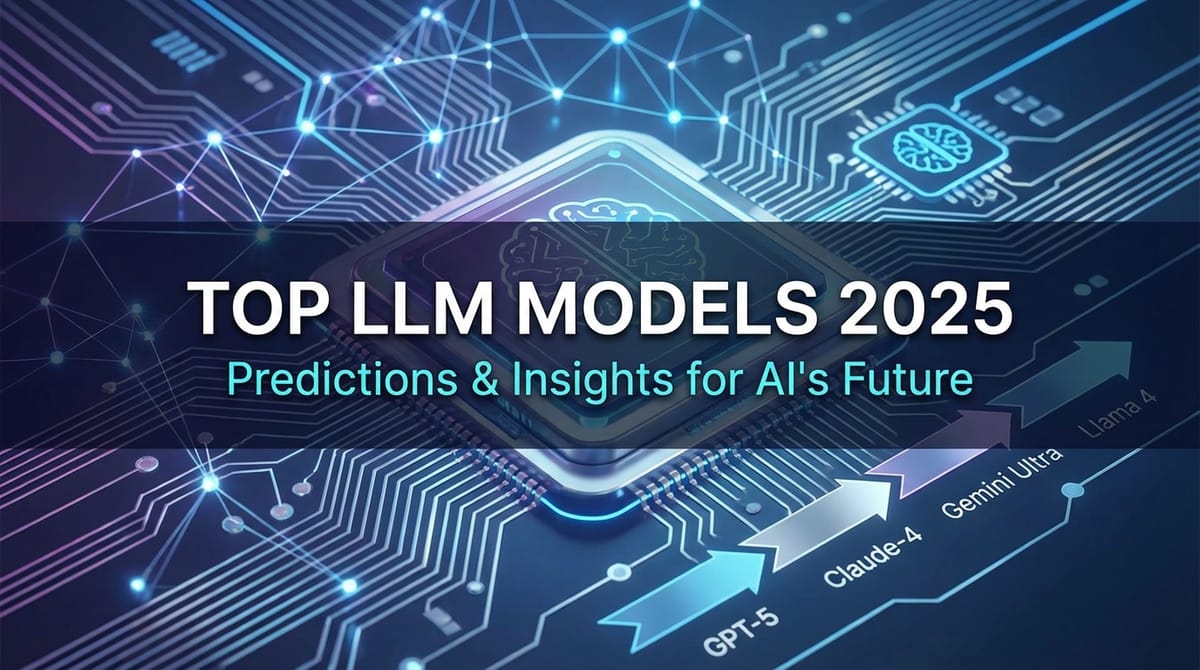

The landscape of Artificial Intelligence is in a perpetual state of flux, characterized by breathtaking innovation and rapid evolution. As we stand on the cusp of 2025, the trajectory of Large Language Models (LLMs) suggests a future far more sophisticated, integrated, and impactful than anything we've witnessed to date. These colossal neural networks, trained on unfathomable amounts of text and data, have already revolutionized how we interact with technology, generate content, and process information. From powering intelligent chatbots to assisting in complex scientific research, LLMs have become indispensable tools across myriad sectors. The anticipation surrounding the next generation of these models, particularly the front-runners vying for the title of top LLM models 2025, is palpable, driven by whispers of unprecedented capabilities that promise to redefine the very boundaries of artificial intelligence.
This comprehensive exploration delves into the forecasted advancements, key players, and transformative potential of LLMs as we head into 2025. We will dissect the current trends, peer into the crystal ball of AI research, and make informed predictions about the architectures and capabilities that will likely dominate the scene. Understanding the evolving dynamics of LLM rankings will be crucial for developers, businesses, and enthusiasts alike, offering insights into which models are setting the benchmarks for performance, efficiency, and ethical considerations. Moreover, the fervent speculation around models like GPT-5 underscores a collective excitement about a future where AI's intellectual prowess continues its exponential climb, offering solutions to challenges previously deemed insurmountable and opening doors to entirely new paradigms of human-computer interaction. Prepare to embark on a journey into the near future of AI, where the lines between science fiction and reality blur, and the potential of intelligent machines reaches new, exhilarating heights.
The Current LLM Landscape: A Foundation of Innovation (2024 Retrospective)
Before we cast our gaze forward to the anticipated top LLM models 2025, it's essential to briefly ground ourselves in the remarkable achievements of the recent past. The period leading up to 2024 has been nothing short of a Cambrian explosion in AI, with several foundational models pushing the envelope in terms of understanding, generation, and reasoning. OpenAI's GPT series, especially the iterative refinements following GPT-4, set new standards for conversational AI, creative writing, and complex problem-solving. Its multimodal capabilities, albeit limited initially, hinted at a future where AI could seamlessly integrate different forms of information.
Google's Gemini represented a significant leap, designed from the ground up to be natively multimodal, capable of understanding and operating across text, images, audio, and video inputs. This holistic approach marked a strategic shift, recognizing that real-world intelligence isn't confined to a single modality. Gemini's various versions, from Nano for on-device applications to Ultra for highly complex tasks, demonstrated a commitment to scalability and adaptability across diverse computational environments.
Anthropic, with its Claude series (particularly Claude 3 Opus), emerged as a formidable competitor, distinguished by its focus on "Constitutional AI" – a methodology emphasizing safety, helpfulness, and harmlessness. Claude 3 showcased impressive reasoning abilities, a massive context window, and a nuanced understanding of prompts, earning it high marks in various benchmarks and appealing to users prioritizing ethical AI development.
Meta's Llama series, particularly Llama 2 and Llama 3, democratized access to powerful LLMs by making them open-source. This strategic move galvanized the broader AI community, fostering an ecosystem of innovation, fine-tuning, and application development that might not have been possible with purely proprietary models. Llama's accessibility fueled countless startups and researchers, leading to specialized derivatives and novel use cases, proving that open collaboration can accelerate progress profoundly.
Beyond these titans, models like Mistral AI's series carved out their niche by offering exceptional performance in smaller, more efficient packages, challenging the notion that bigger is always better. Cohere focused heavily on enterprise solutions, while Perplexity AI pioneered conversational search, demonstrating the versatility and specialized potential of LLMs. This vibrant, competitive landscape has not only driven rapid advancements but also laid a robust foundation for the innovations we anticipate in 2025, setting the stage for even more powerful and versatile iterations. The experiences gained, the benchmarks established, and the challenges encountered in training and deploying these models will undoubtedly inform the development of the next generation of leading AI systems.
Key Trends Shaping LLMs in 2025: Beyond Pure Text Generation
As we project into 2025, the evolution of LLMs will be defined by several converging trends, each pushing the boundaries of what these models can achieve. These shifts will fundamentally alter how we perceive and interact with AI, moving far beyond mere text completion and ushering in an era of truly intelligent agents. The models vying for the top LLM models 2025 designation will undoubtedly embody these advancements.
1. Advanced Multimodality and Cross-Modal Reasoning
The initial steps into multimodality seen in 2024 will mature significantly. Future LLMs won't just process text, images, and audio separately; they will seamlessly integrate and reason across these modalities. Imagine an AI that can watch a video of a complex surgical procedure, read the accompanying medical texts, listen to the surgeon's commentary, and then generate a comprehensive report, answer questions about specific steps, or even offer real-time guidance. This cross-modal reasoning will unlock unprecedented capabilities in fields like robotics, scientific discovery, and creative industries, allowing for a more holistic understanding of the world. Models will be able to generate images from text descriptions, compose music from visual cues, and even create interactive 3D environments based on natural language prompts.
2. Enhanced Reasoning, Planning, and Problem-Solving
One of the persistent challenges for current LLMs is deep, step-by-step reasoning and complex problem-solving that goes beyond pattern matching. In 2025, we anticipate significant breakthroughs in these areas. Future models will exhibit improved logical deduction, mathematical prowess, and the ability to plan multi-step actions to achieve a goal. This will manifest in advanced coding assistants that not only generate code but also debug, optimize, and refactor it with a deep understanding of the underlying logic. We'll see AIs capable of strategizing in complex scenarios, designing experiments, or even assisting in legal case analysis with a level of precision and insight approaching human experts. The integration of symbolic AI techniques with neural networks might play a crucial role in bridging this gap.
3. Exponential Context Window Expansion and Long-Term Memory
The "context window" – the amount of information an LLM can consider at once – has been steadily growing. By 2025, it's plausible that leading models will boast context windows measured in millions of tokens, enabling them to process entire books, lengthy legal documents, or years of conversational history in a single pass. More importantly, this expansion will be coupled with improved long-term memory and retrieval mechanisms, allowing LLMs to maintain coherence and consistency over extended interactions or across vast corpuses of information. This will transform applications requiring sustained understanding, such as virtual personal assistants, perpetual learning systems, and enterprise knowledge management tools, making them far more effective and less prone to "forgetting" past interactions.
4. Unprecedented Efficiency and Cost-Effectiveness
The immense computational resources required to train and run current large-scale LLMs are a significant barrier to wider adoption. In 2025, expect a strong push towards more efficient architectures, training methodologies, and inference techniques. Innovations like sparse models, distillation, quantization, and specialized hardware accelerators will drastically reduce the cost and energy footprint of deploying powerful LLMs. This efficiency will democratize access to advanced AI, allowing smaller organizations and even individual developers to leverage cutting-edge capabilities without prohibitive expenses. We will see a greater focus on smaller, highly optimized models that perform exceptionally well on specific tasks, rather than a universal model attempting to do everything. This trend will directly impact the accessibility and practical utility of leading models.
5. Increased Specialization and Domain-Specific Expertise
While general-purpose LLMs are impressive, the future will also see a proliferation of highly specialized models. These models will be fine-tuned on vast datasets specific to particular industries or tasks – think medical LLMs trained exclusively on biomedical literature and patient data, legal LLMs versed in jurisprudence, or engineering LLMs fluent in CAD and simulation data. These specialized AI agents will offer unparalleled accuracy, domain-specific insights, and safety guarantees within their narrow focus, outperforming general models in their respective niches. The development of robust frameworks for creating, deploying, and continually updating these specialized LLMs will be a key area of innovation.
6. Robust Ethical AI, Transparency, and Safety Protocols
As LLMs become more integrated into critical systems, the ethical considerations surrounding bias, fairness, transparency, and potential misuse will become paramount. In 2025, regulatory pressures and public demand will drive significant advancements in building inherently safer and more accountable AI. This will involve improved techniques for identifying and mitigating bias, developing robust interpretability tools to understand model decisions, and implementing advanced safety protocols to prevent the generation of harmful or misleading content. "Constitutional AI" approaches will become more refined and widely adopted, emphasizing human values and ethical alignment in model training and deployment. The ability of a model to demonstrate transparent and auditable decision-making will be a crucial factor in its reputation and inclusion in LLM rankings.
7. The Evolving Dynamics of Open-Source vs. Closed-Source
The debate between open-source and closed-source LLMs will intensify and evolve. While proprietary models from tech giants will continue to push the absolute bleeding edge of capabilities (often requiring immense compute), open-source alternatives will grow in sophistication and adoption. The community-driven innovation around models like Llama will lead to highly optimized, specialized, and accessible open-source solutions that rival closed models in specific domains. This dynamic will foster a healthy competition, with open-source models driving democratization and customization, while closed-source models continue to lead in foundational research and pushing raw performance benchmarks. Both will play crucial, complementary roles in shaping the ecosystem of top LLM models 2025.
These trends collectively paint a picture of an AI landscape in 2025 that is not only more powerful but also more nuanced, ethical, and integrated into the fabric of our digital and physical worlds. The models that successfully navigate and leverage these trends will undoubtedly rise to the forefront of the field.
Predicting the Top Contenders for 2025: The Race to Redefine AI
The race to develop the most advanced LLMs is fiercely competitive, with tech giants and innovative startups pouring billions into research and development. As we look towards 2025, several key players are poised to lead the pack, each bringing unique strengths and strategic visions to the fore. The anticipation around the next generation of these models is immense, particularly concerning how they will reshape LLM rankings and set new industry benchmarks.
OpenAI's Potential Dominance: The Arrival of GPT-5 (and Beyond?)
Few models have captured the global imagination quite like OpenAI's GPT series. The consistent leap in capabilities from GPT-3 to GPT-3.5 to GPT-4 has fueled an intense speculation about what comes next. By 2025, the arrival of GPT-5 is not just probable, but almost certain, and it is poised to be a game-changer, potentially solidifying OpenAI's position at the apex of LLM rankings.
GPT-5 is expected to usher in an era of unprecedented intelligence and fluency. Speculations suggest that it will feature significantly larger training datasets, potentially encompassing petabytes of text, code, images, and audio, allowing for a richer, more nuanced understanding of the world. Its architecture will likely build upon the transformer framework but incorporate novel improvements in attention mechanisms, sparsity, and perhaps even dynamic network architectures that adapt during inference. This could translate into a dramatic reduction in hallucinations, a pervasive issue in current LLMs, making its outputs far more reliable for critical applications.
The capabilities of GPT-5 are predicted to extend far beyond improved text generation. We can anticipate deeply integrated multimodal capabilities, allowing it to interpret complex visual scenes, understand spoken language with nuanced emotion, and generate corresponding multimodal outputs with remarkable coherence. Imagine an AI that can not only describe a video but also edit it, generate a voiceover, and create new visual elements based on a simple text prompt. Its reasoning and planning abilities are expected to see a significant upgrade, moving closer to human-level common sense and sequential decision-making. This means GPT-5 could excel at tasks requiring deep strategic thinking, such as designing complex systems, formulating scientific hypotheses, or even navigating intricate legal arguments with greater autonomy and accuracy. Its context window could expand dramatically, allowing it to "remember" and reason over entire books or extensive project documentation, leading to highly personalized and persistent interactions.
Furthermore, OpenAI has historically pushed the boundaries of safety and alignment. GPT-5 will likely incorporate advanced safety features, robust bias mitigation techniques, and greater transparency into its decision-making processes, addressing growing concerns about ethical AI. The arrival of GPT-5 will undoubtedly recalibrate LLM rankings, forcing competitors to innovate even more aggressively to keep pace with its anticipated intellectual prowess and versatility.
Google's Gemini Ultra & Future Iterations: The Integrated AI Ecosystem
Google's commitment to AI is deeply ingrained in its corporate DNA. Following the impressive debut of Gemini, we anticipate further significant advancements by 2025. Google's strategy often involves a seamless integration of its AI models across its vast ecosystem – Search, Workspace, Android, and Cloud. Future Gemini iterations (perhaps Gemini 2 or Gemini Pro/Ultra 2) will likely become even more deeply embedded, offering hyper-personalized experiences across all Google products.
Google's strengths lie in its unparalleled access to diverse data and its expertise in distributed computing. This positions them well to develop models that are not only powerful but also incredibly efficient and scalable. We can expect Gemini to further refine its multimodal capabilities, potentially setting new benchmarks for real-time video understanding and audio analysis. Its ability to process and synthesize information from the web at an unprecedented scale will make it a formidable force in knowledge retrieval and summarization. Google's focus on enterprise solutions means future Gemini models will be designed for robust performance, security, and fine-tuning capabilities, catering to businesses looking to integrate advanced AI into their workflows. Their research in areas like federated learning and on-device AI also suggests a future where powerful, privacy-preserving LLMs can run efficiently on personal devices, further extending their reach and utility.
Anthropic's Claude Opus & Future Iterations: The Ethical & Long-Context Champion
Anthropic has distinguished itself with its "Constitutional AI" approach, prioritizing safety, transparency, and helpfulness. By 2025, Claude's future iterations (e.g., Claude 4) are expected to build upon this foundation, offering models that are not only highly capable but also inherently more trustworthy and less prone to generating harmful outputs. This focus makes Claude particularly attractive for applications in sensitive domains like healthcare, finance, and legal services, where reliability and ethical considerations are paramount.
Anthropic has also excelled in developing models with exceptionally large context windows, allowing Claude to process and reason over vast amounts of text. This capability will likely be further expanded, enabling Claude 4 to handle entire legal libraries, extensive codebases, or years of corporate communications, making it an invaluable tool for complex analytical tasks. Its conversational fluency and ability to maintain long-term coherence in dialogue will continue to improve, creating more natural and effective interactions. As the ethical landscape of AI becomes increasingly important, Anthropic's unique position and continued advancements in safety could see it climb significantly in LLM rankings for specific, high-stakes applications.
Meta's Llama Series: The Open-Source Powerhouse & Community Catalyst
Meta's Llama series has been a game-changer for the open-source AI community. By releasing powerful foundational models, Meta has not only contributed to the democratization of AI but also fostered an explosion of innovation. By 2025, we anticipate the release of Llama 4 or even Llama 5, which will likely be significantly more capable than its predecessors, potentially nearing or even surpassing the performance of some closed-source models.
The strength of Llama lies in its community. Thousands of researchers, developers, and companies are building upon, fine-tuning, and optimizing Llama, creating a diverse ecosystem of specialized models. Future Llama releases will likely benefit from this collective intelligence, incorporating novel architectures and training techniques discovered by the open-source community. Meta's continued investment in Llama underscores its belief in the power of open collaboration to accelerate AI progress. Llama 4/5 could feature enhanced multimodality, improved reasoning, and greater efficiency, making it an even more compelling choice for developers seeking powerful, customizable, and cost-effective solutions. Its impact on the accessibility of advanced AI, especially for startups and academic research, will continue to be profound, securing its place among the most influential models, even if not always topping the raw performance LLM rankings against the largest proprietary models.
Emerging Players & Niche Innovators: Diverse Contributions to LLM Rankings
Beyond the tech giants, a vibrant ecosystem of startups and research institutions is contributing significantly to the LLM landscape. Companies like Mistral AI have demonstrated that smaller, more efficient models can achieve competitive performance, challenging the "bigger is better" paradigm. Their focus on highly optimized architectures and efficient inference makes them attractive for scenarios where computational resources are limited, or speed is critical. Mistral's approach could inspire a new wave of highly performant, domain-specific models that fill crucial gaps in the market.
Cohere continues its strong focus on enterprise AI, offering powerful embeddings and RAG (Retrieval-Augmented Generation) solutions tailored for business needs. Their models are designed for integration into complex corporate environments, prioritizing data privacy, control, and explainability. Perplexity AI, with its innovative approach to conversational search, highlights the potential for LLMs to transform information retrieval, offering direct, sourced answers rather than just links. Stability AI's efforts in open-source multimodal models, particularly in image and video generation, suggest their LLMs could become crucial components in creative AI workflows.
These emerging players, while perhaps not always topping the overall LLM rankings for general intelligence, will be crucial in pushing the boundaries of specific applications and driving innovation in specialized niches. Their contributions will ensure a diverse and robust LLM ecosystem in 2025, providing a wide array of options for different use cases and computational constraints.
Factors Influencing LLM Performance and Rankings
Determining the "best" LLM is rarely a straightforward task, as performance can be highly context-dependent. However, a combination of quantitative benchmarks, real-world utility, and strategic considerations typically shapes LLM rankings and influences adoption. As we look towards 2025, these factors will become even more nuanced and critical in evaluating the prowess of the top LLM models 2025.
1. Benchmark Scores and Standardized Evaluations
Standardized benchmarks remain the primary objective measure of an LLM's raw capabilities. These tests assess various aspects of intelligence, including:
- MMLU (Massive Multitask Language Understanding): Evaluates knowledge across 57 subjects, from history to law to mathematics.
- Hellaswag: Measures common-sense reasoning in everyday situations.
- HumanEval & Codeforces: Assess code generation, debugging, and programming problem-solving.
- GSM8K: Tests mathematical reasoning and problem-solving.
- ARC (AI2 Reasoning Challenge): Focuses on scientific reasoning.
- BIG-bench: A collaborative benchmark covering a wide range of tasks and complexities.
- Multimodal Benchmarks: New benchmarks are continuously emerging to evaluate models' capabilities across text, images, audio, and video, such as multimodal MMLU or specific vision-language tasks.
While benchmarks provide a quantitative snapshot, the future will likely see more sophisticated, adversarial benchmarks designed to stress-test models for subtle biases, logical fallacies, and factual inconsistencies, pushing models towards true robustness.
2. Real-world Application Performance: Latency, Throughput, and Cost
Beyond raw intelligence, an LLM's practical utility hinges on its real-world performance characteristics:
- Latency: How quickly the model responds to a query. For real-time applications like chatbots or interactive tools, low latency is paramount.
- Throughput: The number of requests the model can process per unit of time. High throughput is essential for enterprise-scale deployments with many concurrent users.
- Cost of Inference: The computational expense of running the model. More efficient models offer better cost-effectiveness, democratizing access to powerful AI and making commercial applications viable. This includes the cost per token, per query, and the overall infrastructure cost.
- Energy Consumption: With growing environmental concerns, the energy footprint of training and running LLMs will become an increasingly important factor in sustainable AI development.
A model might perform excellently on benchmarks but be too slow or expensive for practical deployment, thus impacting its standing in real-world LLM rankings.
3. Safety, Alignment, and Bias Mitigation
As LLMs become more integrated into critical systems, their safety, ethical alignment, and ability to mitigate harmful biases are non-negotiable.
- Bias Mitigation: The extent to which a model avoids perpetuating or amplifying societal biases present in its training data.
- Harmful Content Generation: The effectiveness of safeguards against generating hate speech, misinformation, or other dangerous content.
- Factuality and Hallucination Rate: A model's tendency to generate plausible but incorrect information. Reduced hallucination rates are critical for trustworthy AI.
- Transparency and Explainability: The ability to understand why a model made a particular decision or generated a specific output, crucial for debugging, accountability, and user trust.
- Privacy and Security: How well the model protects sensitive user data and resists adversarial attacks.
Models that demonstrate a robust commitment to ethical AI and safety will gain a significant advantage, particularly in regulated industries.
4. Data Quality and Scale
The quality, diversity, and sheer scale of training data are fundamental to an LLM's capabilities. Future models will likely leverage:
- Curated and Filtered Data: Moving beyond simply scraping the internet to meticulously curated datasets that are diverse, high-quality, and free from significant bias or noise.
- Proprietary Datasets: Companies with unique access to specialized datasets (e.g., medical records, financial reports, scientific literature) will be able to train highly specialized and performant models.
- Synthetic Data Generation: Advanced techniques to generate synthetic data that augments real-world data, improving model robustness and reducing bias.
- Multimodal Data Integration: Seamlessly integrating vast quantities of text, image, audio, and video data for truly holistic understanding.
5. Compute Resources and Infrastructure
The ability to command immense computational resources – GPUs, TPUs, and specialized AI accelerators – remains a significant differentiator. Companies with access to massive data centers and cutting-edge hardware can train larger, more complex models. However, innovations in efficient model architectures and training algorithms mean that smart use of compute, rather than just brute force, will also play a critical role. The future may see a shift towards more democratized access to powerful compute through cloud services, leveling the playing field to some extent.
6. Developer Adoption and Ecosystem Maturity
An LLM's true impact is realized through its adoption by developers and the robustness of its surrounding ecosystem.
- Ease of Integration: How straightforward it is for developers to integrate the model into their applications (APIs, SDKs).
- Documentation and Support: Comprehensive documentation, active community forums, and responsive support.
- Fine-tuning Capabilities: The flexibility and tools available for users to fine-tune the model for specific tasks or datasets.
- Tooling and Libraries: Availability of complementary tools, libraries, and frameworks that extend the model's functionality (e.g., RAG frameworks, prompt engineering tools).
A model with a thriving developer community and a rich ecosystem often finds broader application and innovation, influencing its position in the broader LLM rankings.
7. User Experience and Accessibility
Ultimately, the best models are those that are intuitive, reliable, and accessible to a wide range of users, not just technical experts. This includes:
- User-Friendly Interfaces: Simple and effective ways for non-developers to interact with and leverage the models.
- Customization: The ability for users to tailor the model's behavior or personality to their needs.
- Language Support: Broader support for diverse languages and cultural nuances.
These factors combine to form a comprehensive picture of an LLM's value. The top LLM models 2025 will excel across many, if not all, of these dimensions, offering a balance of raw power, practical utility, and responsible AI practices.
Here's a table summarizing the expected strengths of the leading LLM families in 2025:
| Feature/Metric | OpenAI (GPT-5) | Google (Gemini Next) | Anthropic (Claude 4) | Meta (Llama 4/5) | Emerging Players (Mistral, Cohere, etc.) |
|---|---|---|---|---|---|
| Raw Performance (Benchmarks) | Potentially leading, new SOTA | Very strong, highly competitive | Excellent, especially in reasoning | Very strong, closing gap with proprietary | Strong in specific niches, efficiency focused |
| Multimodality | Deeply integrated & advanced | Natively multimodal, holistic understanding | Evolving, strong in text-centric multimodal | Developing, community-driven innovations | Varies, some specializing (e.g., Stability AI) |
| Reasoning & Problem-Solving | Significant leap in complex tasks | Highly capable, integrated with knowledge graph | Exceptional, especially logical coherence | Improving rapidly through community | Task-specific strong reasoning |
| Context Window | Vast, potentially millions of tokens | Very large, optimized for diverse tasks | Industry-leading for long-form content | Growing, with efficient retrieval systems | Varied, some smaller models with optimized context |
| Efficiency/Cost | Improving, but bleeding-edge cost | Highly optimized across diverse hardware | Strong focus on manageable inference cost | Excellent, open-source drives cost reduction | Core strength, often leading in efficiency/price/performance |
| Ethical AI/Safety | Advanced safeguards, continuous improvement | Strong commitment, responsible deployment | Industry leader (Constitutional AI) | Community-driven ethics, diverse perspectives | Varies, some specializing in safety for niche applications |
| Developer Ecosystem | Mature, extensive tooling & community | Expanding, strong Google Cloud integration | Growing, focus on enterprise/ethical use cases | Thriving, most vibrant open-source community | Niche communities, strong API support |
| Specialization | Broad capabilities, adaptable to fine-tuning | Excellent for enterprise, Google ecosystem apps | Strong in legal, medical, complex text analysis | Versatile, strong for custom fine-tuning | Highly specialized models, niche solutions |
| Anticipated Impact | Redefines general AI, drives industry forward | Pervasive across Google products, enterprise scale | Establishes new standards for safe & responsible AI | Democratizes advanced AI, fosters rapid innovation | Disrupts specific markets, pushes efficiency boundaries |
XRoute is a cutting-edge unified API platform designed to streamline access to large language models (LLMs) for developers, businesses, and AI enthusiasts. By providing a single, OpenAI-compatible endpoint, XRoute.AI simplifies the integration of over 60 AI models from more than 20 active providers(including OpenAI, Anthropic, Mistral, Llama2, Google Gemini, and more), enabling seamless development of AI-driven applications, chatbots, and automated workflows.
The Impact of Advanced LLMs on Various Industries
The advancements expected in the top LLM models 2025 will not merely be incremental; they will be transformative, ushering in paradigm shifts across a multitude of industries. The enhanced capabilities in multimodality, reasoning, and efficiency will unlock unprecedented opportunities and reshape existing workflows.
1. Software Development and Engineering
The software development lifecycle is already seeing significant disruption from LLMs, and by 2025, this will intensify. Advanced models will move beyond mere code generation to becoming true AI co-pilots and even autonomous agents. * Intelligent Code Generation: LLMs will generate highly optimized, context-aware code in multiple languages, not just snippets but entire modules or even frameworks, based on high-level natural language specifications. * Automated Debugging and Testing: Models will be able to pinpoint errors, suggest fixes, and even write comprehensive test suites with greater accuracy and speed, significantly reducing development cycles. * System Design and Architecture: LLMs will assist in designing complex software architectures, evaluating trade-offs, and generating documentation automatically. * Legacy Code Modernization: Automating the refactoring and modernization of legacy codebases, translating them into newer languages or paradigms. * Personalized Developer Mentors: Providing real-time, context-aware guidance and learning resources to developers, akin to having an expert peer constantly available.
2. Healthcare and Life Sciences
The healthcare sector stands to be profoundly impacted by advanced LLMs, moving towards more personalized, efficient, and accessible care. * Diagnostic Assistance: Multimodal LLMs will analyze patient data (medical images, lab results, clinical notes, genomics) to assist clinicians in more accurate and earlier diagnoses, identifying subtle patterns that human eyes might miss. * Drug Discovery and Research: Accelerating the discovery of new drugs and therapies by analyzing vast biological datasets, predicting molecular interactions, and designing novel compounds. * Personalized Treatment Plans: Creating highly individualized treatment plans based on a patient's unique genetic profile, medical history, and lifestyle factors, continuously adapting as new data emerges. * Automated Medical Scribing and Documentation: Generating accurate medical notes and administrative reports directly from clinician-patient interactions, freeing up medical professionals for patient care. * Patient Engagement and Education: Providing personalized health information, answering patient queries in natural language, and supporting chronic disease management with empathetic, informed responses.
3. Education and Learning
Education will become more personalized, accessible, and engaging with the integration of future LLMs. * Adaptive Learning Platforms: LLMs will power platforms that dynamically adjust curricula, content, and teaching methods based on an individual student's learning style, pace, and knowledge gaps. * Intelligent Tutors: Providing 24/7 personalized tutoring across subjects, offering explanations, solving problems, and identifying areas for improvement, complete with multimodal feedback. * Content Creation and Curation: Generating customized learning materials, interactive exercises, and summarizing complex topics into digestible formats for diverse age groups and proficiency levels. * Assessment and Feedback: Automating the grading of essays and complex assignments, providing detailed, constructive feedback that helps students understand and improve. * Language Learning Acceleration: Offering immersive, conversational practice with AI tutors capable of understanding nuances, correcting pronunciation, and adapting to a learner's fluency level.
4. Creative Industries and Content Generation
The creative landscape will be redefined, empowering creators with powerful generative tools. * Advanced Content Creation: LLMs will generate highly coherent and engaging long-form articles, books, screenplays, and marketing copy with specific tones, styles, and audience targeting. * Multimodal Storytelling: Creating entire narratives complete with visuals, soundscapes, and character voices based on text prompts. * Design and Media Generation: Assisting in graphic design, generating unique logos, crafting advertising campaigns, and even composing original music or video content. * Personalized Entertainment: Generating unique storylines, character interactions, or game scenarios in real-time based on user preferences. * Translation and Localization: Achieving near-perfect, culturally nuanced translation, adapting content for diverse global audiences, including complex idioms and regionalisms.
5. Customer Service and Support
Customer service will undergo a significant transformation, moving towards proactive, highly personalized, and efficient interactions. * Hyper-Personalized Virtual Assistants: AI agents will understand customer history, preferences, and emotional states to provide tailored support, anticipate needs, and resolve complex issues autonomously. * Proactive Problem Solving: LLMs monitoring system logs and user behavior to identify potential issues before they escalate, often resolving them automatically or alerting human agents with comprehensive context. * Multichannel Integration: Seamlessly managing customer interactions across text, voice, video calls, and social media, maintaining context across platforms. * Agent Augmentation: Providing human agents with real-time insights, suggested responses, and access to vast knowledge bases, significantly improving efficiency and first-contact resolution rates. * Language Agnostic Support: Offering high-quality customer service in any language, breaking down communication barriers for global enterprises.
6. Research and Science
Scientific discovery will be accelerated by LLMs that can analyze vast quantities of data and generate novel hypotheses. * Automated Literature Review: LLMs will summarize and synthesize millions of research papers, identify trends, conflicting findings, and crucial knowledge gaps at unprecedented speed. * Hypothesis Generation: Suggesting novel hypotheses and experimental designs based on complex data analysis, guiding scientific inquiry. * Data Analysis and Visualization: Interpreting complex scientific datasets, identifying anomalies, and generating insightful visualizations. * Experiment Simulation and Optimization: Running virtual experiments, predicting outcomes, and optimizing parameters to reduce physical lab time and resources. * Material Science and Chemistry: Discovering new materials with desired properties or synthesizing novel chemical compounds based on theoretical predictions.
The impact of the top LLM models 2025 will be pervasive, touching nearly every facet of human endeavor. As these models become more capable and integrated, they will not only automate tasks but also augment human intelligence, creativity, and problem-solving abilities, leading to a more innovative and efficient world.
Challenges and Ethical Considerations for 2025
While the promise of advanced LLMs in 2025 is immense, their widespread deployment also brings significant challenges and ethical considerations that must be proactively addressed. Ignoring these issues could undermine public trust, exacerbate societal inequalities, and even pose risks to fundamental human values. The developers aiming for the top LLM models 2025 must prioritize robust solutions to these complex problems.
1. Persistent Bias and Fairness Issues
LLMs learn from the data they are trained on, and if that data reflects historical or societal biases (which most large datasets do), the models will inevitably perpetuate and even amplify those biases. * Challenge: Biased outputs can lead to unfair decisions in critical areas like hiring, lending, criminal justice, and healthcare. For instance, an LLM used for medical diagnosis might perform worse for certain demographic groups if its training data was predominantly from another group. * 2025 Focus: Developing more sophisticated techniques for bias detection and mitigation, including algorithmic debiasing, diverse data collection strategies, and "fairness-aware" training objectives. Regulatory bodies will likely introduce stricter guidelines for demonstrating fairness in AI systems.
2. Hallucinations and Reliability
Despite advancements, LLMs still "hallucinate" – generating information that is plausible but factually incorrect or nonsensical. * Challenge: Hallucinations undermine the trustworthiness of AI, especially in applications where accuracy is paramount (e.g., medical advice, legal documents, scientific research). * 2025 Focus: Significant research will go into reducing hallucination rates through improved architectures, retrieval-augmented generation (RAG) techniques, self-correction mechanisms, and rigorous factual verification processes. The ability to cite sources and provide confidence scores for generated facts will become standard.
3. Data Privacy and Security
The vast amounts of data required to train and operate LLMs raise profound privacy and security concerns. * Challenge: Training data might inadvertently contain sensitive personal information, leading to privacy leaks. Furthermore, LLMs can be vulnerable to adversarial attacks, where subtle changes in input can lead to drastically different or harmful outputs. * 2025 Focus: Implementing advanced privacy-preserving techniques like differential privacy and federated learning during training. Robust encryption, secure data handling protocols, and continuous monitoring for adversarial threats will be essential for deployment, particularly for enterprise-level models.
4. Energy Consumption and Environmental Impact
The sheer scale of LLMs translates to an enormous computational footprint, leading to substantial energy consumption. * Challenge: Training and running large LLMs require massive amounts of electricity, contributing to carbon emissions and environmental concerns. The demand for specialized hardware is also increasing. * 2025 Focus: Research into more energy-efficient model architectures (e.g., sparse models, neuromorphic computing), optimized training algorithms, and improved inference techniques will be critical. There will be a greater push for "green AI" that balances performance with environmental responsibility.
5. Job Displacement and Economic Impact
The increasing capabilities of LLMs naturally raise concerns about job displacement across various sectors. * Challenge: Automation of tasks currently performed by humans, from content creation to customer service, could lead to significant shifts in the labor market, potentially exacerbating economic inequality. * 2025 Focus: Policy discussions around universal basic income, retraining programs, and fostering job roles that focus on AI oversight, augmentation, and ethical development. The narrative will shift from "AI replacing jobs" to "AI changing jobs," emphasizing augmentation rather than full replacement.
6. Misinformation, Manipulation, and Malicious Use
The ability of LLMs to generate highly convincing text, images, and audio can be exploited for malicious purposes. * Challenge: The proliferation of deepfakes, synthetic propaganda, and sophisticated phishing attacks can erode trust, manipulate public opinion, and sow discord. * 2025 Focus: Developing robust detection mechanisms for AI-generated content (watermarking, digital provenance). Stronger regulatory frameworks, ethical guidelines for AI developers, and international cooperation to combat misuse will be crucial.
7. Over-Reliance and Loss of Human Skills
As AI becomes more capable, there's a risk of over-reliance, potentially leading to a degradation of human critical thinking, problem-solving, and creative skills. * Challenge: If humans delegate too much cognitive work to AI, there's a risk of becoming less proficient in those areas, potentially leading to complacency or an inability to function without AI assistance. * 2025 Focus: Promoting AI literacy, critical evaluation of AI outputs, and emphasizing human-in-the-loop approaches where AI augments rather than replaces human judgment. Designing AI systems that foster learning and skill development, rather than merely performing tasks, will be key.
Addressing these challenges requires a concerted effort from researchers, developers, policymakers, and society at large. The truly top LLM models 2025 will not just be powerful; they will be developed and deployed responsibly, with these ethical and societal considerations at their core.
Navigating the LLM Ecosystem: Tools and Platforms for 2025 (Featuring XRoute.AI)
As the LLM landscape continues its rapid expansion, with numerous specialized models and powerful general-purpose systems vying for position in the LLM rankings, developers and businesses face a growing complexity: how to effectively integrate, manage, and optimize access to this diverse ecosystem. The challenge lies not just in identifying the top LLM models 2025 for a specific task, but in building robust applications that can seamlessly switch between models, leverage the unique strengths of each, and remain adaptable to future innovations, all while maintaining efficiency and cost-effectiveness.
Historically, integrating multiple LLMs meant managing separate APIs, different authentication mechanisms, varying data formats, and diverse pricing structures. This fragmentation can significantly increase development time, introduce technical debt, and make it difficult to pivot to newer, more performant models as they emerge. The overhead of maintaining these connections can quickly become a bottleneck, especially for projects aiming for agility and scalability. Moreover, optimizing for factors like low latency and cost-effectiveness often requires a dynamic routing mechanism that intelligently selects the best model for a given query based on real-time performance, cost, and availability – a daunting task for individual developers.
This is precisely where platforms like XRoute.AI become invaluable, offering a cutting-edge unified API solution that simplifies this complex environment. As the landscape of top LLM models 2025 continues to diversify and specialize, developers and businesses need a streamlined way to leverage the best models without getting bogged down in API management.
XRoute.AI addresses this by providing a single, OpenAI-compatible endpoint. This design choice is critical, as it allows developers familiar with the de facto standard of OpenAI's API to effortlessly integrate and experiment with a vast array of other LLMs without learning new interfaces or rewriting significant portions of their codebase. Imagine building an application that needs a powerful creative text generator, a specialized code assistant, and a highly factual knowledge retriever. Instead of managing three separate API connections, XRoute.AI allows you to access over 60 AI models from more than 20 active providers through one consistent interface.
This unification is more than just convenience; it's a strategic advantage. It enables developers to build intelligent solutions and automated workflows with unprecedented ease, allowing them to focus on their core application logic rather than the intricacies of API integration. XRoute.AI's focus on low latency AI ensures that applications remain responsive, crucial for real-time interactions and user experience. Their commitment to cost-effective AI means that businesses can optimize their expenditures by dynamically routing requests to the most efficient model for each specific query, without manually configuring complex load balancing or model selection logic.
Furthermore, the platform's developer-friendly tools, high throughput, and scalability make it an ideal choice for projects of all sizes, from startups iterating rapidly to enterprise-level applications demanding robust, production-ready solutions. Whether a developer is aiming to build next-generation chatbots, intelligent data analysis tools, or sophisticated AI agents, XRoute.AI empowers them to access and experiment with the very best models, regardless of where they rank on the dynamic LLM rankings, for their specific needs. It's about building intelligent solutions without the complexity of managing multiple API connections, ensuring that the transformative power of the top LLM models 2025 is truly accessible and deployable.
Conclusion: The Dawn of a More Intelligent Future
As we draw to a close on our deep dive into the top LLM models 2025, one undeniable truth emerges: the future of Artificial Intelligence is poised for an era of unprecedented intelligence, integration, and impact. The rapid advancements in model architecture, training methodologies, and computational efficiency are propelling us towards a reality where AI agents possess capabilities far beyond current imaginings. From the anticipated arrival of GPT-5, promising to redefine the very benchmarks of artificial intelligence, to the robust and ethically aligned offerings from Anthropic, the democratizing power of Meta's Llama series, and Google's seamlessly integrated Gemini ecosystem, the competition is fierce, driving innovation at a breakneck pace.
The key trends shaping 2025 – including advanced multimodality, enhanced reasoning, exponential context windows, and a relentless pursuit of efficiency – will collectively give rise to LLMs that are not just more powerful, but also more versatile, reliable, and specialized. These next-generation models will transform every sector, from revolutionizing software development and accelerating medical breakthroughs to personalizing education and unleashing new waves of creativity. They will act as powerful augmentations to human intellect, automating mundane tasks, discovering new insights, and enabling us to tackle complex problems with unparalleled efficacy.
However, this exciting future is not without its caveats. The journey towards advanced AI is intrinsically linked with the responsibility to address critical ethical considerations. Challenges related to bias, hallucination, data privacy, energy consumption, and the societal implications of job displacement demand proactive and thoughtful solutions. The models that ultimately secure their place among the LLM rankings in 2025 will be those that not only push the boundaries of performance but also demonstrate a profound commitment to fairness, transparency, and responsible deployment.
For developers and businesses eager to harness this immense power, platforms like XRoute.AI will be indispensable, providing the critical infrastructure to navigate the increasingly complex LLM ecosystem. By simplifying access to a vast array of models through a unified API, XRoute.AI empowers innovators to build intelligent applications efficiently and cost-effectively, ensuring that the transformative potential of AI is accessible to all.
In essence, 2025 stands as a landmark year for LLMs – a period where theoretical possibilities begin to manifest as tangible realities. The ongoing innovation, coupled with a growing focus on ethical development, promises a future where AI not only aids but truly elevates human endeavor. The journey ahead is bound to be dynamic and awe-inspiring, continuously reshaping our world in ways we are only just beginning to comprehend.
Frequently Asked Questions (FAQ)
Q1: What are the key features expected in the top LLM models of 2025?
A1: The top LLM models 2025 are expected to feature significantly advanced multimodality (seamlessly integrating text, images, audio, video), enhanced reasoning and problem-solving capabilities, much larger context windows (potentially millions of tokens), and improved efficiency. There will also be a strong focus on reduced hallucinations, better ethical alignment, and specialized domain expertise.
Q2: How will GPT-5 specifically impact the LLM landscape?
A2: GPT-5 is anticipated to set new benchmarks in AI capabilities, potentially leading the LLM rankings with unprecedented intelligence and fluency. It's expected to feature dramatically larger training datasets, advanced multimodal integration, superior reasoning and planning, and potentially novel architectural improvements. Its arrival will likely redefine industry standards and force competitors to accelerate their own research and development.
Q3: What factors will primarily determine an LLM's ranking in 2025?
A3: LLM rankings in 2025 will be determined by a combination of factors: 1. Benchmark Scores: Performance on standardized tests for language understanding, reasoning, and coding. 2. Real-world Utility: Latency, throughput, and cost-effectiveness in practical applications. 3. Safety & Ethics: Robustness against bias, harmful content, and privacy concerns. 4. Developer Adoption: Ease of integration, ecosystem maturity, and community support. 5. Specialization: Superior performance in specific domains or niche tasks.
Q4: Will open-source LLMs like Llama still be relevant compared to proprietary models in 2025?
A4: Absolutely. While proprietary models often lead in foundational research and sheer scale, open-source LLMs like the Llama series will remain highly relevant. They drive democratization of AI, foster rapid community-driven innovation, and allow for extensive customization and fine-tuning. By 2025, open-source models are expected to significantly close the performance gap with proprietary models in specific areas, offering powerful and cost-effective alternatives for a wide range of applications.
Q5: How can businesses and developers effectively use the rapidly evolving LLM landscape without getting overwhelmed?
A5: To effectively navigate the rapidly evolving LLM landscape, businesses and developers should leverage unified API platforms and intelligent routing solutions. Tools like XRoute.AI offer a single, OpenAI-compatible endpoint to access over 60 AI models from multiple providers. This simplifies integration, reduces development complexity, and enables dynamic optimization for low latency AI and cost-effective AI, allowing users to focus on building innovative applications rather than managing disparate API connections.
🚀You can securely and efficiently connect to thousands of data sources with XRoute in just two steps:
Step 1: Create Your API Key
To start using XRoute.AI, the first step is to create an account and generate your XRoute API KEY. This key unlocks access to the platform’s unified API interface, allowing you to connect to a vast ecosystem of large language models with minimal setup.
Here’s how to do it: 1. Visit https://xroute.ai/ and sign up for a free account. 2. Upon registration, explore the platform. 3. Navigate to the user dashboard and generate your XRoute API KEY.
This process takes less than a minute, and your API key will serve as the gateway to XRoute.AI’s robust developer tools, enabling seamless integration with LLM APIs for your projects.
Step 2: Select a Model and Make API Calls
Once you have your XRoute API KEY, you can select from over 60 large language models available on XRoute.AI and start making API calls. The platform’s OpenAI-compatible endpoint ensures that you can easily integrate models into your applications using just a few lines of code.
Here’s a sample configuration to call an LLM:
curl --location 'https://api.xroute.ai/openai/v1/chat/completions' \
--header 'Authorization: Bearer $apikey' \
--header 'Content-Type: application/json' \
--data '{
    "model": "gpt-5",
    "messages": [
        {
            "content": "Your text prompt here",
            "role": "user"
        }
    ]
}'
With this setup, your application can instantly connect to XRoute.AI’s unified API platform, leveraging low latency AI and high throughput (handling 891.82K tokens per month globally). XRoute.AI manages provider routing, load balancing, and failover, ensuring reliable performance for real-time applications like chatbots, data analysis tools, or automated workflows. You can also purchase additional API credits to scale your usage as needed, making it a cost-effective AI solution for projects of all sizes.
Note: Explore the documentation on https://xroute.ai/ for model-specific details, SDKs, and open-source examples to accelerate your development.