Unified LLM API: Master Seamless AI Integration

The digital landscape is currently experiencing a transformative shift, driven by the unprecedented capabilities of Large Language Models (LLMs). From generating sophisticated code and crafting compelling marketing copy to powering intelligent chatbots and summarizing vast datasets, LLMs are reshaping how we interact with technology and process information. Yet, as the field rapidly expands with a multitude of models from various providers, developers and businesses face a growing complexity. Navigating this fragmented ecosystem—each with its unique API, integration requirements, and performance characteristics—can be a daunting task, often hindering the very innovation LLMs promise to deliver.
Enter the Unified LLM API. This powerful abstraction layer emerges as a critical solution, offering a streamlined pathway to harness the collective intelligence of diverse LLMs without the inherent integration headaches. It's more than just a convenience; it's an architectural paradigm shift that enables true Multi-model support and sophisticated LLM routing, paving the way for more resilient, cost-effective, and performant AI applications. This article delves deep into the essence of a Unified LLM API, exploring its profound impact on AI development, uncovering the intricacies of multi-model integration, and unveiling the strategic advantages of intelligent LLM routing. We will dissect the challenges it solves, the opportunities it unlocks, and the considerations for mastering seamless AI integration in an ever-evolving technological frontier.
The LLM Proliferation Problem: A Double-Edged Sword for Developers
The advent of Large Language Models has been nothing short of revolutionary. We’ve witnessed an explosion of innovation, with models like OpenAI’s GPT series, Anthropic’s Claude, Google’s Gemini, Meta’s Llama, and countless specialized open-source models emerging at a dizzying pace. Each model brings its unique strengths, whether it's superior reasoning, creative generation, code understanding, or cost-efficiency for specific tasks. This diverse ecosystem offers an incredible palette for developers to paint intelligent applications, yet it also presents a formidable set of challenges, often referred to as the "LLM proliferation problem."
Imagine a developer tasked with building a complex AI-driven application. They might need a model for generating human-like text, another for precise data extraction, and perhaps a third for coding assistance. Initially, the excitement is palpable as they consider the possibilities. However, the reality of integrating multiple LLMs quickly sets in, revealing a landscape fraught with friction:
- API Incompatibility and Heterogeneous Endpoints: Every LLM provider typically offers its own distinct API. This means different base URLs, different authentication mechanisms (API keys, OAuth tokens), and fundamentally different payload structures for requests and responses. Integrating just two or three models can feel like learning a new programming language for each. What works for OpenAI's
chat/completionsendpoint might be entirely different for a similar function on Anthropic's platform. This leads to boilerplate code, conditional logic, and a bloated codebase just to normalize communication. - Varying Data Formats and Model Parameters: Beyond the basic endpoint differences, the devil is often in the details of the request parameters and response formats. One model might prefer a "messages" array with specific "role" and "content" fields, while another uses a simpler "prompt" string. Temperature, top_p, max_tokens—these common parameters might be named differently or have slightly varied interpretations across models. Handling these nuances requires meticulous mapping and translation layers within the application, increasing development time and potential for errors.
- Authentication and Rate Limiting Management: Juggling multiple API keys, managing secrets securely, and handling provider-specific rate limits becomes a significant operational burden. Each provider imposes its own request quotas, often tiered based on usage or subscription. Failing to manage these effectively can lead to throttling, service interruptions, and degraded user experience. Centralizing this management across disparate systems is a non-trivial engineering feat.
- Vendor Lock-in Fears: Relying heavily on a single LLM provider, while simplifying initial integration, introduces the risk of vendor lock-in. If that provider raises prices, changes its API, deprecates a model, or experiences prolonged downtime, the application could be severely impacted. The cost and effort of migrating to an alternative model can be prohibitive, stifling innovation and strategic flexibility. This fear often drives developers to consider multi-model strategies, only to be confronted by the complexity described above.
- Performance and Cost Optimization Challenges: Different LLMs excel at different tasks and come with varying price tags and latency profiles. A powerful, expensive model might be overkill for a simple classification task, while a faster, cheaper model might lack the nuance for complex creative writing. Without a unified approach, optimizing for both performance (speed, accuracy) and cost requires constant manual adjustments, A/B testing, and potentially re-architecting parts of the application. The sheer volume of models makes it impossible to manually compare and switch efficiently.
- Maintenance Overhead: As LLMs evolve, new versions are released, existing ones are updated, and APIs might change. Keeping an application compatible with multiple, independently evolving LLM APIs is a continuous maintenance nightmare. Bug fixes, security patches, and feature updates require tracking changes across many providers, consuming valuable developer resources that could otherwise be spent on core product innovation.
These challenges collectively hinder the rapid prototyping, deployment, and scaling of AI applications. They turn what should be an exciting journey of innovation into a laborious exercise in infrastructure management. The promise of ubiquitous AI remains just out of reach for many until these foundational integration problems are adequately addressed. This is precisely where the concept of a Unified LLM API emerges not just as a convenience, but as an indispensable architectural component for mastering the modern AI landscape.
Understanding the Unified LLM API: Your AI Command Center
At its core, a Unified LLM API acts as an intelligent abstraction layer that sits between your application and the multitude of Large Language Models from various providers. Think of it as a universal remote control for all your AI models, or a sophisticated switchboard that routes your requests to the most appropriate AI engine, regardless of its origin. Its fundamental purpose is to consolidate and standardize access to a fragmented ecosystem, transforming complexity into simplicity.
Conceptually, a Unified LLM API provides a single, consistent endpoint that your application interacts with, irrespective of which underlying LLM it ultimately leverages. Instead of writing distinct code for OpenAI, Anthropic, Google, and others, you write to one API specification. This specification is typically designed to be familiar and developer-friendly, often adopting common patterns like the OpenAI API standard, which has become a de facto benchmark for conversational AI interactions.
Let’s break down its key features and how they fundamentally reshape the developer experience:
1. Single, Standardized Endpoint
This is perhaps the most significant feature. Instead of managing api.openai.com, api.anthropic.com, generativelanguage.googleapis.com, and so on, your application sends all its LLM-related requests to a single URL provided by the Unified LLM API platform. This dramatically simplifies client-side code, reducing the number of SDKs or HTTP client configurations needed.
2. Standardized Request and Response Formats
The Unified LLM API normalizes the input and output structures across all integrated models. You send a request using a consistent JSON schema (e.g., messages array, model field, temperature, max_tokens), and you receive a response in a consistent format. The platform handles the intricate translation layer, converting your standardized request into the specific format required by the chosen underlying LLM and then translating its response back into your expected format. This eliminates the need for developers to learn and implement custom parsing logic for each LLM.
3. Centralized Authentication
Rather than managing multiple API keys or authentication tokens for each provider, you authenticate once with the Unified LLM API platform. The platform then securely stores and manages the credentials for all the underlying LLMs you wish to use. This not only enhances security by centralizing sensitive keys but also simplifies key rotation, permission management, and auditing.
4. Simplified Model Selection
With a Unified LLM API, selecting a specific model becomes a simple parameter in your request. Instead of hardcoding provider-specific model names like text-davinci-003 or claude-2, you might specify gpt-4, claude-3-opus, or even a custom alias like best-summarizer-model. The platform then intelligently maps this request to the actual underlying LLM, or even routes it dynamically based on predefined rules (which we will discuss in depth under LLM routing).
5. Reduced Code Complexity and Faster Iteration
By abstracting away the complexities of disparate LLM APIs, developers can significantly reduce the amount of boilerplate code required. This means more time spent on building core application logic and less on API integration. The simplified development cycle allows for faster prototyping, easier experimentation with different models, and quicker iteration on AI features. When a new, superior LLM emerges, integrating it often requires only a configuration change or a slight update to a model parameter, rather than a full re-coding effort.
6. Enhanced Reliability and Scalability
A robust Unified LLM API platform often incorporates built-in mechanisms for retries, failovers, and load balancing across providers. If one LLM provider experiences downtime or performance degradation, the platform can automatically route requests to another available model, ensuring high availability for your application. Furthermore, these platforms are designed to handle high throughput, scaling gracefully to meet the demands of growing user bases without requiring extensive infrastructure management from the developer.
Consider this conceptual diagram:

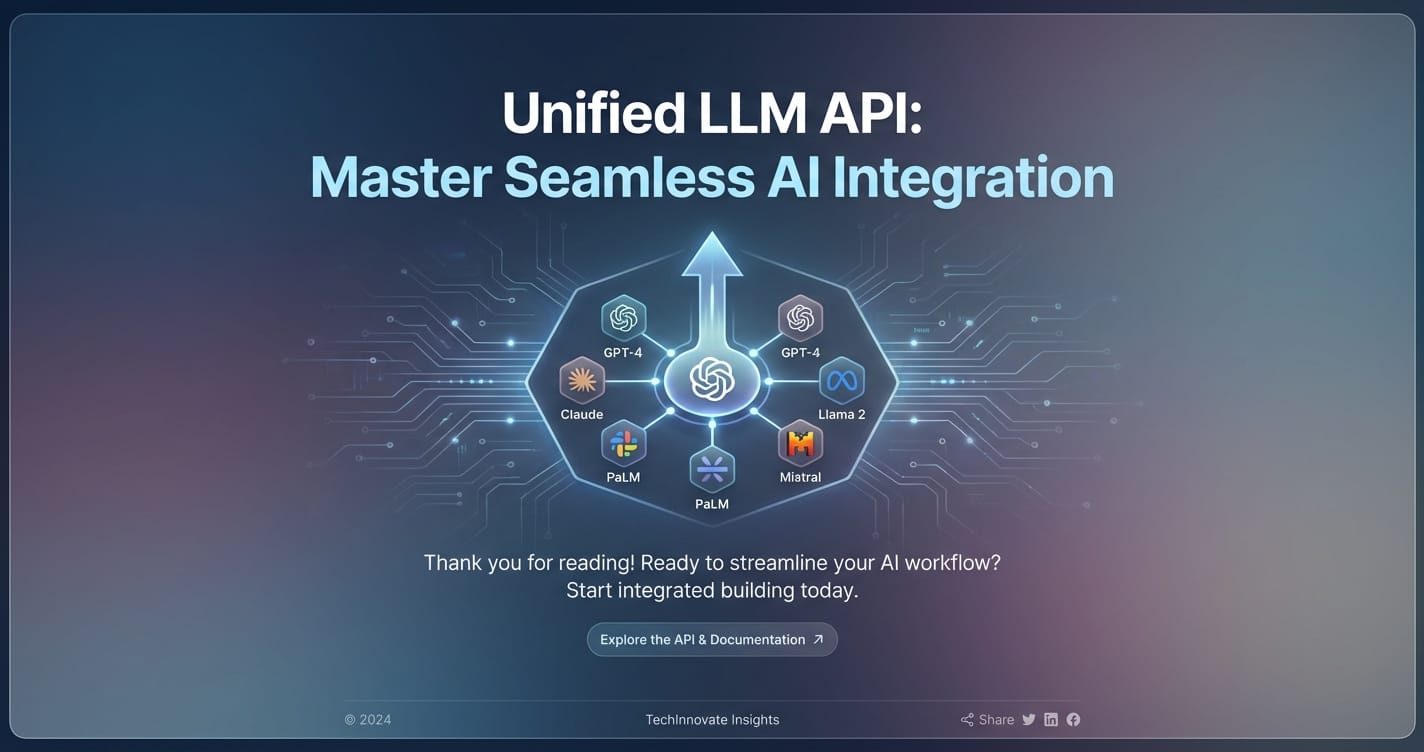
A typical Unified LLM API setup would show an application making requests to a single API endpoint. This endpoint, the Unified LLM API, then intelligently routes these requests to various LLM providers (e.g., OpenAI, Anthropic, Google, open-source models) based on configuration, performance, or cost criteria. The API also handles the translation of request/response formats between the application's standardized format and each provider's specific format.
In essence, a Unified LLM API transforms the challenging multi-LLM landscape into a manageable and coherent system. It frees developers from the minutiae of integration, allowing them to focus on what truly matters: building innovative, intelligent applications that leverage the full power of the latest AI models. It lays the groundwork for truly dynamic and optimized AI solutions, particularly when combined with advanced Multi-model support and sophisticated LLM routing strategies.
The Power of Multi-Model Support: Tailoring AI to Every Task
In the burgeoning world of Large Language Models, the notion of a "one-size-fits-all" solution is rapidly becoming obsolete. While some LLMs are generalists capable of a wide array of tasks, no single model excels at everything. Some might be exceptionally good at creative writing, others at precise factual extraction, some at coding, and yet others at rapid, low-cost summarization. This inherent specialization, coupled with varying performance and pricing structures, makes Multi-model support not just a luxury, but a strategic imperative for any serious AI application.
Multi-model support refers to the capability of an AI system, facilitated by a Unified LLM API, to seamlessly integrate and dynamically switch between multiple Large Language Models from different providers. It's about having access to a diverse toolkit, allowing developers to pick the right tool for the right job, instantly.
Why is Multi-Model Support Crucial?
- Task-Specific Optimization:
- Creative Content Generation: For generating marketing slogans, fictional narratives, or compelling ad copy, a model known for its creativity and fluency (e.g., GPT-4, Claude 3 Opus) might be ideal.
- Code Generation and Refinement: Developers might prefer models specifically fine-tuned for programming languages, like GitHub Copilot's underlying models or specialized open-source code models.
- Factual Q&A and Information Extraction: For precise, fact-based answers or extracting specific entities from text, a model known for its accuracy and reduced hallucination tendency might be chosen.
- Summarization: For quickly distilling long documents, a faster, potentially cheaper model could be sufficient, especially if conciseness is prioritized over deep nuanced understanding.
- Translation: Dedicated or highly proficient multilingual models can provide superior translation quality. By having access to multiple models, applications can intelligently route requests to the model best suited for that specific task, leading to superior output quality and user satisfaction.
- Cost Optimization:
- Different LLMs come with vastly different pricing models, often based on token usage. A premium model might cost significantly more per token than a smaller, open-source alternative.
- With Multi-model support, developers can implement strategies where routine, less critical tasks are routed to cheaper models, reserving more expensive, powerful models for complex, high-value operations. For example, a chatbot might use a low-cost model for initial greetings and simple FAQs, and only escalate to a high-tier model for intricate problem-solving. This granular control over model usage directly translates into substantial cost savings over time.
- Performance Optimization (Latency and Throughput):
- Latency (response time) and throughput (requests per second) vary significantly across models and providers, often depending on model size, current load, and infrastructure.
- For real-time interactive applications like chatbots or live code suggestions, low latency is paramount. A Unified LLM API with multi-model capabilities can route requests to models known for their speed, especially during peak hours.
- For batch processing tasks, where immediate response isn't critical but high throughput is, models optimized for parallel processing or those with higher rate limits can be prioritized.
- Redundancy and Reliability (Failover):
- No single cloud service or API is immune to outages. Relying on just one LLM provider introduces a single point of failure.
- Multi-model support enables robust failover mechanisms. If a primary LLM provider becomes unavailable or experiences degraded performance, the Unified LLM API can automatically switch to a backup model from a different provider. This ensures continuous service availability and significantly enhances the reliability and resilience of your AI application, minimizing user impact during unforeseen disruptions.
- Accessing Cutting-Edge Features and Innovation:
- The LLM landscape is characterized by relentless innovation. New models, improved versions, and novel capabilities (e.g., multimodal inputs, larger context windows) are released constantly.
- With a Unified LLM API that supports multiple models, developers can swiftly integrate and experiment with these new advancements without rebuilding their entire integration layer. This agility allows applications to stay at the forefront of AI capabilities, leveraging the latest and greatest models as soon as they become available.
How a Unified LLM API Makes Multi-Model Support Practical
Without a Unified LLM API, implementing multi-model support would involve: * Integrating each LLM API individually. * Developing custom translation layers for requests and responses. * Managing separate authentication and rate limits. * Building complex logic to decide which model to call based on the task, cost, or performance needs.
A Unified LLM API abstracts all this complexity away. It provides the single interface, the standardized formats, and the centralized management that makes switching between models as simple as changing a model parameter in your API call. The platform itself takes on the burden of maintaining connections to dozens of different providers and handling their unique quirks.
Table 1: Examples of LLM Types and Ideal Use Cases Benefiting from Multi-Model Support
| LLM Category / Characteristic | Example Models (Conceptual) | Primary Strengths | Ideal Use Cases in a Multi-Model Setup |
|---|---|---|---|
| High-Capability / Premium | GPT-4, Claude 3 Opus, Gemini Ultra | Advanced reasoning, creativity, code generation, complex problem-solving | Strategic planning, research summary, complex legal document analysis, creative content generation, sophisticated chatbots |
| Mid-Range / Balanced | GPT-3.5, Claude 3 Sonnet, Llama 3 8B | Good balance of capability and cost, faster than premium models | General copywriting, moderate complexity Q&A, sentiment analysis, data extraction, first-pass code generation |
| Low-Cost / High-Speed | Mistral 7B, Smaller open-source models, Fine-tuned specialized models | High speed, cost-effective for simple tasks, specialized domains | Simple chatbot interactions, basic summarization, classification, content moderation, quick data validation |
| Code-Specialized | Code Llama, GPT-4 (tuned for code) | Superior code understanding, generation, debugging | Developer tools, IDE assistants, automated testing, API generation |
| Multimodal | GPT-4V, Gemini Pro Vision | Interprets text and images/audio/video | Image captioning, visual search, document understanding with diagrams, interactive learning platforms |
| Translation-Optimized | Specialized MT models, certain larger LLMs | High accuracy in language translation, nuance preservation | Global customer support, localization, real-time communication |
This table vividly illustrates why multi-model access is not just a feature, but a necessity. By leveraging a Unified LLM API's Multi-model support, applications can achieve optimal results across various dimensions—quality, cost, and speed—all from a single, consistent integration point. This sets the stage for even more advanced capabilities, particularly the intelligent orchestration offered by LLM routing.
Advanced Strategies with LLM Routing: The AI Orchestrator
While Multi-model support grants access to a diverse array of LLMs, LLM routing is the intelligent mechanism that orchestrates which model is used for each specific request. It's the brain behind the operation, dynamically directing queries to the most appropriate, performant, or cost-effective LLM based on predefined rules, real-time metrics, and even the nuances of the request itself. Without effective LLM routing, the benefits of multi-model support remain largely untapped, requiring manual intervention or static configuration.
LLM routing is the process of intelligently directing an incoming request (a prompt, a query, a task) to a specific Large Language Model among a pool of available models. This decision is not arbitrary; it's driven by a combination of factors aimed at optimizing for various outcomes such as cost, latency, quality, reliability, and specific task requirements.
Different Routing Strategies and Their Mechanisms:
Sophisticated Unified LLM API platforms offer a range of routing strategies, allowing developers to fine-tune their AI stack for maximum efficiency and effectiveness:
- Cost-Based Routing:
- Mechanism: Prioritizes models based on their token pricing. The system maintains a real-time understanding of the cost per input/output token for each integrated LLM.
- Application: For tasks where cost-efficiency is paramount (e.g., internal document summarization, simple chatbot responses, content moderation for large volumes), requests are automatically directed to the cheapest suitable model. Premium models are reserved for critical, high-value tasks.
- Benefit: Significantly reduces operational expenses for AI inference.
- Latency-Based Routing:
- Mechanism: Monitors the response times (latency) of all available models in real-time. Requests are sent to the model currently exhibiting the lowest latency.
- Application: Crucial for real-time interactive applications like chatbots, virtual assistants, live translation, or coding assistants where immediate responses enhance user experience.
- Benefit: Ensures faster response times and a smoother, more responsive user interface.
- Accuracy/Quality-Based Routing:
- Mechanism: Routes requests to models that are known (either through explicit configuration, internal benchmarks, or even prior feedback loops) to provide the highest quality or most accurate responses for a given type of task or prompt. This often involves tags, model capabilities descriptions, or even an initial "pilot" run for complex prompts.
- Application: For critical tasks where precision, creativity, or nuanced understanding is essential, such as generating legal documents, creative marketing copy, or complex scientific summaries.
- Benefit: Maximizes the quality and relevance of AI outputs, leading to better results and reduced post-processing.
- Load Balancing:
- Mechanism: Distributes requests across multiple instances of the same model or across different providers offering similar models to prevent any single endpoint from becoming overloaded.
- Application: High-traffic applications needing to maintain consistent performance and availability during peak usage.
- Benefit: Improves overall system stability, throughput, and reduces the likelihood of rate-limiting or service degradation from individual providers.
- Failover Routing:
- Mechanism: If a primary model or provider becomes unavailable (e.g., due to an outage, API error, or rate limit breach), requests are automatically and transparently rerouted to a pre-configured backup model or provider.
- Application: Essential for mission-critical applications where continuous availability is non-negotiable.
- Benefit: Drastically enhances the reliability and resilience of AI services, minimizing downtime and ensuring business continuity.
- Contextual/Prompt-Based Routing:
- Mechanism: Analyzes the incoming prompt or request payload to identify keywords, intent, or specific data attributes, and then routes it to the most suitable model. This can involve initial classification models or simple rule-based parsers.
- Application: A chatbot might send "coding questions" to a code-focused LLM and "creative writing prompts" to a generative text model. An e-commerce assistant might send "product search" queries to one model and "customer support" questions to another.
- Benefit: Delivers highly specialized and relevant responses by leveraging the unique strengths of different models based on the nature of the request.
- A/B Testing Routing:
- Mechanism: Directs a percentage of requests to one model (A) and another percentage to a different model (B) for comparison. The Unified LLM API can collect metrics on performance, cost, and even user feedback.
- Application: Experimenting with new models, comparing different versions of the same model, or evaluating routing strategies to find optimal configurations.
- Benefit: Enables data-driven decision-making for model selection and optimization without requiring significant code changes or complex testing infrastructure.
Benefits of Effective LLM Routing:
The implementation of sophisticated LLM routing strategies through a Unified LLM API offers a multitude of benefits that extend beyond mere convenience:
- Significant Cost Savings: By intelligently directing traffic to cheaper models where appropriate, organizations can drastically reduce their monthly AI inference bills.
- Improved Application Performance: Routing to low-latency models for real-time tasks and high-throughput models for batch processing ensures optimal speed and responsiveness.
- Enhanced Reliability and Uptime: Failover mechanisms guarantee continuous service, even if individual LLM providers experience issues.
- Increased Flexibility and Agility: Developers can quickly adapt to new model releases, pricing changes, or evolving task requirements by simply updating routing rules, without touching core application logic.
- Simplified Experimentation and Optimization: A/B testing and performance monitoring built into routing capabilities make it easier to continuously improve the AI stack.
- Future-Proofing: As the LLM landscape continues to evolve, robust routing ensures that your application can seamlessly integrate and benefit from future innovations without constant re-architecting.
Table 2: Common LLM Routing Strategies and Their Primary Benefits
| Routing Strategy | Primary Goal / Benefit | Ideal Use Case | Key Mechanism |
|---|---|---|---|
| Cost-Based Routing | Minimize inference expenditure | High-volume, low-stakes internal tasks | Real-time token pricing data |
| Latency-Based Routing | Maximize response speed | Real-time chatbots, interactive UIs | Continuous monitoring of API response times |
| Accuracy/Quality-Based Routing | Maximize output relevance/precision | Creative content, complex analysis, critical Q&A | Model capability tags, internal benchmarks |
| Load Balancing | Ensure consistent performance & uptime | High-traffic applications, preventing rate limits | Distributing requests across multiple instances/providers |
| Failover Routing | Guarantee service continuity | Mission-critical applications, redundancy | Health checks, automatic rerouting on error/downtime |
| Contextual Routing | Deliver highly specialized responses | Diverse task types within a single application | Prompt analysis, keyword detection, intent classification |
| A/B Testing Routing | Data-driven model selection & optimization | Evaluating new models, comparing performance | Percentage-based traffic split, performance metrics collection |
LLM routing transforms a collection of disparate models into a cohesive, intelligent system. It empowers developers to build AI applications that are not only powerful and versatile but also resilient, cost-effective, and continuously optimized—a true orchestrator of artificial intelligence. This level of control and dynamic decision-making is precisely what defines mastering seamless AI integration in today's complex ecosystem.
XRoute is a cutting-edge unified API platform designed to streamline access to large language models (LLMs) for developers, businesses, and AI enthusiasts. By providing a single, OpenAI-compatible endpoint, XRoute.AI simplifies the integration of over 60 AI models from more than 20 active providers(including OpenAI, Anthropic, Mistral, Llama2, Google Gemini, and more), enabling seamless development of AI-driven applications, chatbots, and automated workflows.
Practical Implementation and Real-World Use Cases
The theoretical benefits of a Unified LLM API with its Multi-model support and LLM routing capabilities truly come alive in practical implementation. For developers, integrating such a platform fundamentally changes their workflow, making AI adoption quicker, more robust, and more scalable. Let’s explore how this integration typically works and illustrate its impact across various real-world scenarios.
How Developers Integrate a Unified LLM API
The integration process is designed to be straightforward and familiar, often mimicking the experience of interacting with a single, well-documented API:
- Account Setup & API Key: Developers typically sign up for an account with the Unified LLM API provider and obtain a master API key. This key serves as the primary authentication credential for all interactions with the platform.
- Configuration of Back-end LLM Providers: Within the platform's dashboard, developers link their various LLM provider accounts (e.g., OpenAI, Anthropic, Google). This usually involves inputting individual provider API keys and selecting which models from those providers they wish to make available through the unified endpoint.
- Define Routing Rules (Optional but Recommended): Developers can then define custom routing logic. This might involve:
- Prioritizing
claude-3-opusfor creative writing, but falling back togpt-4ifclaude-3-opusis unavailable. - Sending all short summarization tasks to
gpt-3.5-turboor a cheaper open-source model. - A/B testing a new
llama-3model against an existinggpt-4for a specific task type. - Defining latency thresholds to switch models dynamically.
- Prioritizing
- Application Integration (Single Endpoint, Standardized Payload): The application then interacts with the Unified LLM API through its single, consistent endpoint. Using an SDK provided by the platform (or a standard HTTP client), developers construct requests using a common format (e.g., an OpenAI-compatible
chat/completionspayload).- The
modelparameter in the request can be a specific LLM, an alias for a routing group, or even omitted if the platform's default routing rules are sufficient. - For example:
json { "model": "best-summarizer", // This could be an alias for a routing rule "messages": [ {"role": "system", "content": "You are a helpful assistant."}, {"role": "user", "content": "Summarize this article: [article text]"} ], "temperature": 0.7, "max_tokens": 150 } - The Unified LLM API then handles authentication, format translation, intelligent routing, and error handling before sending the request to the chosen underlying LLM and returning a standardized response.
- The
This streamlined approach significantly reduces the initial setup time and ongoing maintenance, allowing teams to focus on core product innovation.
Real-World Use Cases Transformed by Unified LLM APIs
The impact of a Unified LLM API extends across numerous industries and application types:
- Intelligent Chatbots and Virtual Assistants:
- Scenario: A customer service chatbot needs to handle a wide range of queries, from simple FAQs to complex troubleshooting or creative problem-solving.
- Unified LLM API Solution:
- LLM Routing: Simple informational queries can be routed to a fast, cost-effective LLM. Complex problem-solving or empathetic conversations can be routed to a more powerful, nuanced model. If the primary model fails, a failover ensures continuous conversation.
- Multi-model support: The chatbot can leverage specialized models for different conversational turns: one for extracting entities from customer input, another for generating personalized responses, and a third for translating between languages.
- Benefit: Improved customer satisfaction, reduced operational costs, and higher reliability.
- Advanced Content Generation Platforms:
- Scenario: A marketing agency needs to generate various types of content—blog posts, ad copy, social media updates, and product descriptions—each requiring a different tone, style, and factual accuracy.
- Unified LLM API Solution:
- LLM Routing: Prompts requesting creative ad copy are routed to a generative model known for its imaginative capabilities. Requests for factual product descriptions are sent to a model optimized for accuracy and conciseness. A/B testing can compare different models for blog post generation.
- Multi-model support: Access to a broad range of models ensures that the platform can always select the "best tool for the job," whether it's a specialist in SEO-optimized content or a master of poetic prose.
- Benefit: Higher quality content, increased efficiency, and reduced manual effort for content creators.
- Data Analysis and Summarization Tools:
- Scenario: A financial institution needs to quickly summarize vast amounts of market news, earnings reports, or research papers, and extract key insights.
- Unified LLM API Solution:
- LLM Routing: Depending on the length and complexity of the document, the Unified LLM API can route it to a model with a large context window for deep understanding, or to a faster, cheaper model for quick executive summaries.
- Multi-model support: Different models can be used for different tasks within the workflow: one for initial document categorization, another for extracting key financial metrics, and a third for synthesizing a concise summary.
- Benefit: Faster insights, improved decision-making, and reduced analyst workload.
- Automated Workflow and Process Automation:
- Scenario: A business wants to integrate AI into existing workflows, such as automatically responding to support tickets, categorizing incoming emails, or generating reports based on structured data.
- Unified LLM API Solution:
- Unified LLM API: Provides a single, consistent interface for integrating AI into any part of the workflow via existing automation tools (e.g., Zapier, Make, custom scripts). This avoids the need for complex API integrations for each AI step.
- LLM Routing: Simple email classification might go to a cheap, fast model, while generating a personalized, empathetic response to a critical customer support ticket is routed to a more capable, nuanced model.
- Benefit: Streamlined operations, increased efficiency, and reduced manual intervention in repetitive tasks.
- AI-Powered Search and Recommendation Systems:
- Scenario: An e-commerce platform wants to enhance its product search with natural language understanding and provide personalized recommendations.
- Unified LLM API Solution:
- Multi-model support: One model might be excellent at understanding natural language queries and extracting product features, while another is better at generating compelling product descriptions for recommendations.
- LLM Routing: Queries that are highly specific might go to a model fine-tuned for product catalogs, while broader, exploratory queries go to a more general reasoning model.
- Benefit: More accurate search results, highly relevant recommendations, and an improved shopping experience.
These examples underscore how a Unified LLM API empowers developers to move beyond rudimentary LLM integration to build sophisticated, adaptable, and high-performance AI applications. By simplifying access and enabling intelligent orchestration, it accelerates the pace of innovation across the entire AI ecosystem.
Key Considerations When Choosing a Unified LLM API Platform
The market for Unified LLM API platforms is growing, with various providers offering different features and capabilities. Selecting the right platform is a critical decision that can significantly impact the success, scalability, and cost-effectiveness of your AI initiatives. Here are the key considerations to guide your choice:
- Breadth of Multi-Model Support:
- Question: How many and which LLM providers and models does the platform integrate?
- Detail: Look for a platform that offers access to a wide range of models, including leading proprietary models (e.g., GPT-4, Claude 3, Gemini) and popular open-source alternatives (e.g., Llama, Mistral). The more models, the greater your flexibility for task-specific optimization, cost-efficiency, and future-proofing. Ensure it supports the models you currently use and those you anticipate needing.
- Flexibility and Granularity of LLM Routing:
- Question: How sophisticated are the routing capabilities? Can you define custom rules?
- Detail: A strong platform offers granular control over routing strategies (cost, latency, quality, failover, contextual, A/B testing). Can you set up custom rules based on keywords in the prompt, user metadata, or dynamic conditions? Does it support routing across different providers for the same model type? Look for features that allow you to easily update and manage these rules.
- Performance (Latency and Throughput):
- Question: What are the platform's performance metrics?
- Detail: For real-time applications, low latency is paramount. Investigate the platform's average latency overhead for routing and processing requests. Does it offer high throughput capabilities to handle your peak loads? Look for assurances on network speed, caching mechanisms, and robust infrastructure that minimizes any additional delay introduced by the unified layer.
- Cost-Effectiveness and Transparent Pricing:
- Question: How is the platform priced, and what are the potential cost savings?
- Detail: Evaluate the pricing model (e.g., per-request, per-token, subscription tiers). Does it add a significant markup on top of the underlying LLM costs? Crucially, does the platform provide tools to monitor and analyze your LLM spending across providers, enabling you to identify areas for optimization through routing? A truly valuable platform helps you save money overall, not just simplify integration.
- Security and Data Privacy:
- Question: How does the platform handle your data and API keys?
- Detail: This is non-negotiable. Ensure the platform adheres to industry-standard security protocols, encrypts data in transit and at rest, and offers robust access controls. Verify its compliance certifications (e.g., GDPR, SOC 2). How does it manage and protect the API keys for your underlying LLM providers? Look for features like secret management and audit logs.
- Developer Experience (DX):
- Question: Is it easy to integrate and use?
- Detail: A good developer experience includes comprehensive, clear documentation, well-maintained SDKs for popular programming languages, and intuitive dashboards for configuration and monitoring. Look for features that simplify debugging, offer clear error messages, and provide quick support channels.
- Scalability and Reliability:
- Question: Can the platform scale with your application's growth, and how reliable is it?
- Detail: A robust platform should be built on a scalable infrastructure, capable of handling millions of requests without degradation. Inquire about its uptime guarantees (SLAs), disaster recovery plans, and redundancy measures. A key benefit is its ability to provide failover across multiple LLM providers, ensuring your AI services remain operational.
- Monitoring and Analytics:
- Question: What insights does the platform provide into usage, performance, and costs?
- Detail: A good platform offers centralized dashboards that allow you to monitor API calls, latency, error rates, and costs across all integrated LLMs. This visibility is crucial for identifying bottlenecks, optimizing routing rules, and making informed decisions about model selection. Look for logging capabilities and integration with your existing observability tools.
- Community and Support:
- Question: What kind of support and community resources are available?
- Detail: A thriving community forum, active GitHub repositories, and responsive customer support can be invaluable, especially when encountering complex integration challenges or needing guidance on best practices.
When evaluating platforms, it's also worth considering specific examples that embody these principles. For instance, XRoute.AI stands out as a cutting-edge unified API platform that exemplifies many of these crucial considerations. It's designed to streamline access to large language models (LLMs) for developers, businesses, and AI enthusiasts by providing a single, OpenAI-compatible endpoint. This simplification enables seamless integration of over 60 AI models from more than 20 active providers, making it incredibly versatile for developing AI-driven applications, chatbots, and automated workflows. With a strong focus on low latency AI, cost-effective AI, and developer-friendly tools, XRoute.AI empowers users to build intelligent solutions without the complexity of managing multiple API connections. Its high throughput, scalability, and flexible pricing model make it an ideal choice for projects of all sizes, from startups seeking agile development to enterprise-level applications requiring robust and optimized AI infrastructure. By centralizing access and enabling intelligent routing, platforms like XRoute.AI directly address the challenges and unlock the opportunities discussed throughout this article.
Choosing the right Unified LLM API platform is an investment in the future of your AI development. By carefully evaluating these factors, you can select a solution that not only simplifies your current integrations but also empowers your team to build more innovative, resilient, and cost-efficient AI applications for years to come.
Future Trends and the Evolution of AI Integration
The landscape of Large Language Models is dynamic, characterized by relentless innovation and rapid evolution. As LLMs become more powerful, specialized, and ubiquitous, the role of a Unified LLM API will become even more pronounced, shaping the future of AI integration in profound ways. We are moving beyond mere API abstraction towards intelligent AI middleware that actively orchestrates and optimizes AI operations.
Here are some key future trends and how Unified LLM APIs will continue to adapt and lead:
- Hyper-Specialization of LLMs:
- Trend: While generalist LLMs are impressive, we will see a surge in highly specialized models—fine-tuned for specific industries (e.g., legal, medical, finance), tasks (e.g., hallucination-free factual recall, extreme summarization, multimodal understanding), or even particular user groups.
- Unified LLM API's Role: The platform will become the critical dispatcher, ensuring that requests are routed not just based on cost or latency, but to the exact specialized model that guarantees the best output for a niche task. This requires even more sophisticated contextual routing and advanced metadata management.
- Growth of Multi-Modal AI:
- Trend: LLMs are rapidly evolving beyond text to incorporate images, audio, video, and other data types. Multi-modal models will become standard, requiring inputs and outputs that are far richer and more complex than simple text strings.
- Unified LLM API's Role: It will need to standardize not just text APIs, but multi-modal interfaces. This means accepting diverse input formats (images, audio files, video frames) and returning equally diverse outputs, while routing to models specifically designed for multi-modal reasoning. The abstraction layer will become significantly more complex, yet remain user-friendly.
- Autonomous AI Agents and Workflows:
- Trend: The future will see more autonomous AI agents that can chain together multiple LLM calls, interact with external tools, and make decisions independently to accomplish complex goals. These agents will require dynamic access to a diverse set of AI capabilities.
- Unified LLM API's Role: It will serve as the "brain" or "nervous system" for these agents, providing the on-demand, intelligently routed access to the various LLMs and tools they need. It will manage the orchestration of multiple sequential or parallel LLM calls, potentially even handling the intermediate state between calls to different models.
- Advanced Performance and Cost Optimization:
- Trend: As LLM usage scales, performance and cost will remain paramount. Expect more sophisticated optimization techniques, including dynamic batching, intelligent caching, and even custom model serving infrastructure.
- Unified LLM API's Role: Platforms will integrate advanced techniques like token-level routing (sending parts of a prompt to different models), real-time cost forecasting, and predictive model usage. They will leverage serverless functions and edge computing to minimize latency and optimize resource allocation across a global network of LLM providers.
- Emphasis on Explainability and Governance:
- Trend: With increased reliance on AI, there will be a growing demand for explainability, transparency, and robust governance frameworks. Understanding why a particular LLM was chosen for a task, and auditing its output, will be crucial.
- Unified LLM API's Role: Platforms will offer enhanced logging, auditing capabilities, and potentially AI-driven explanations for routing decisions. They will integrate with governance tools, allowing organizations to enforce policies around model usage, data privacy, and ethical AI.
- Edge AI and Local LLMs:
- Trend: Smaller, more efficient LLMs are being developed that can run on edge devices or private, on-premise infrastructure. This offers benefits in terms of privacy, cost, and latency for specific use cases.
- Unified LLM API's Role: Platforms will need to extend their reach to include the seamless integration and routing to locally hosted or edge-deployed LLMs, providing a hybrid cloud/on-premise AI strategy that optimizes for various constraints.
- Standardization Efforts:
- Trend: While Unified LLM APIs currently abstract away fragmentation, there will be ongoing industry efforts to standardize LLM APIs further, possibly leading to more universal protocols.
- Unified LLM API's Role: These platforms will continue to evolve as key contributors and adopters of new standards, ensuring they remain compatible with the broadest range of current and future models, while still providing value-added services like intelligent routing and cost optimization.
Platforms like XRoute.AI are already at the forefront of this evolution, continuously expanding their multi-model support and refining their LLM routing capabilities to meet these emerging trends. By offering a unified, OpenAI-compatible endpoint for over 60 models from 20+ providers, XRoute.AI is building the foundation for the next generation of AI applications. Their focus on low latency AI and cost-effective AI positions them as a crucial infrastructure layer for developers and businesses aiming to navigate this complex yet exciting future. As LLMs continue to redefine what's possible, Unified LLM APIs will be the invisible, intelligent hand orchestrating their immense power, making sophisticated AI integration truly seamless and universally accessible.
Conclusion: Mastering the AI Frontier with Unified LLM APIs
The era of Large Language Models has ushered in an unparalleled wave of innovation, offering capabilities that are rapidly transforming every facet of technology and business. Yet, this explosion of models and providers has simultaneously introduced a labyrinth of integration challenges, threatening to slow down the very progress it promised. The fragmentation, the incompatible APIs, the disparate performance metrics, and the relentless pace of change have created a significant barrier for developers striving to build robust, scalable, and cost-effective AI applications.
This comprehensive exploration has unveiled the indispensable role of the Unified LLM API in navigating this complex landscape. By acting as a sophisticated abstraction layer, it elegantly solves the "LLM proliferation problem," offering a single, standardized interface to a diverse ecosystem of AI models. This simplification fundamentally changes the developer experience, dramatically reducing code complexity, accelerating development cycles, and liberating precious resources previously consumed by boilerplate integration tasks.
We delved into the profound power of Multi-model support, highlighting why no single LLM can ever be the perfect solution for every task. From task-specific optimization and crucial cost savings to enhanced reliability through failover and agile access to cutting-edge features, the ability to seamlessly switch between models from different providers is a strategic imperative. It ensures that applications can always leverage the right AI tool for the right job, achieving optimal quality, speed, and efficiency.
Furthermore, we explored the transformative potential of LLM routing, the intelligent orchestration layer that dynamically directs requests to the most appropriate model. Whether optimizing for cost, minimizing latency, prioritizing accuracy, ensuring reliability through failover, or conducting A/B tests, sophisticated routing strategies empower developers to build truly resilient, performant, and economically viable AI systems. This dynamic decision-making capability transforms a collection of individual models into a cohesive, optimized AI engine.
The practical implementations and real-world use cases, from intelligent chatbots to advanced content generation and automated workflows, underscore how a Unified LLM API empowers businesses and developers to unlock unprecedented value from AI. By streamlining integration, enabling multi-model flexibility, and providing intelligent routing, these platforms are not just tools; they are foundational infrastructure that future-proofs AI initiatives.
As the AI frontier continues to expand, with specialized models, multi-modal capabilities, and autonomous agents on the horizon, the importance of these unified platforms will only grow. They are essential for simplifying complexity, maximizing performance, optimizing costs, and ensuring the continuous evolution and adaptability of AI applications.
Ultimately, mastering seamless AI integration in this dynamic landscape is no longer about laboriously connecting to each LLM API individually. It's about intelligently commanding the entire ecosystem through a single, powerful gateway. Platforms like XRoute.AI, with their focus on low latency AI, cost-effective AI, and comprehensive multi-model support through a unified API, are leading this charge, empowering developers to build the next generation of intelligent solutions with unprecedented ease and efficiency. Embrace the Unified LLM API, and unlock the full, transformative potential of artificial intelligence.
Frequently Asked Questions (FAQ)
1. What exactly is a Unified LLM API? A Unified LLM API is an abstraction layer that provides a single, consistent interface for interacting with multiple Large Language Models (LLMs) from various providers (e.g., OpenAI, Anthropic, Google). Instead of integrating with each LLM's distinct API, you send all your requests to one unified endpoint, and the platform handles the routing, format translation, and authentication to the underlying models.
2. How does Multi-model support benefit my application? Multi-model support allows your application to access and dynamically switch between a diverse range of LLMs. This is crucial because different models excel at different tasks (e.g., one for creative writing, another for precise data extraction) and have varying costs and performance profiles. By using the best model for each specific task, you can achieve higher quality outputs, optimize for cost, reduce latency, and ensure reliability through failover mechanisms.
3. What are the main types of LLM routing, and why are they important? LLM routing intelligently directs your requests to the most appropriate LLM based on predefined rules or real-time metrics. Key types include: * Cost-based routing: Minimizes expenses by prioritizing cheaper models. * Latency-based routing: Ensures fast responses for real-time applications. * Accuracy/Quality-based routing: Selects models best suited for specific task quality. * Failover routing: Automatically switches to a backup model if the primary one is unavailable. * Contextual routing: Routes based on the content or intent of your prompt. These strategies are vital for optimizing performance, cost, and reliability in complex AI applications.
4. Is a Unified LLM API suitable for small projects or startups? Absolutely. While often associated with enterprise-level complexity, a Unified LLM API is highly beneficial for small projects and startups. It drastically reduces initial integration time, allows for rapid prototyping and experimentation with different models, and offers built-in scalability and cost optimization features that are crucial for growing ventures. It empowers small teams to build sophisticated AI features without extensive engineering overhead.
5. How does a Unified LLM API help with cost optimization? A Unified LLM API helps with cost optimization in several ways: * Cost-based routing: Automatically directs requests to the cheapest suitable model. * Centralized monitoring: Provides clear visibility into spending across all LLMs, allowing you to identify areas for savings. * A/B testing: Enables data-driven comparison of models to find the most cost-effective solution for specific tasks. * Negotiated rates: Some platforms might offer aggregated pricing or volume discounts from providers. By intelligently managing your LLM usage, it ensures you get the most value for your AI expenditure.
🚀You can securely and efficiently connect to thousands of data sources with XRoute in just two steps:
Step 1: Create Your API Key
To start using XRoute.AI, the first step is to create an account and generate your XRoute API KEY. This key unlocks access to the platform’s unified API interface, allowing you to connect to a vast ecosystem of large language models with minimal setup.
Here’s how to do it: 1. Visit https://xroute.ai/ and sign up for a free account. 2. Upon registration, explore the platform. 3. Navigate to the user dashboard and generate your XRoute API KEY.
This process takes less than a minute, and your API key will serve as the gateway to XRoute.AI’s robust developer tools, enabling seamless integration with LLM APIs for your projects.
Step 2: Select a Model and Make API Calls
Once you have your XRoute API KEY, you can select from over 60 large language models available on XRoute.AI and start making API calls. The platform’s OpenAI-compatible endpoint ensures that you can easily integrate models into your applications using just a few lines of code.
Here’s a sample configuration to call an LLM:
curl --location 'https://api.xroute.ai/openai/v1/chat/completions' \
--header 'Authorization: Bearer $apikey' \
--header 'Content-Type: application/json' \
--data '{
    "model": "gpt-5",
    "messages": [
        {
            "content": "Your text prompt here",
            "role": "user"
        }
    ]
}'
With this setup, your application can instantly connect to XRoute.AI’s unified API platform, leveraging low latency AI and high throughput (handling 891.82K tokens per month globally). XRoute.AI manages provider routing, load balancing, and failover, ensuring reliable performance for real-time applications like chatbots, data analysis tools, or automated workflows. You can also purchase additional API credits to scale your usage as needed, making it a cost-effective AI solution for projects of all sizes.
Note: Explore the documentation on https://xroute.ai/ for model-specific details, SDKs, and open-source examples to accelerate your development.