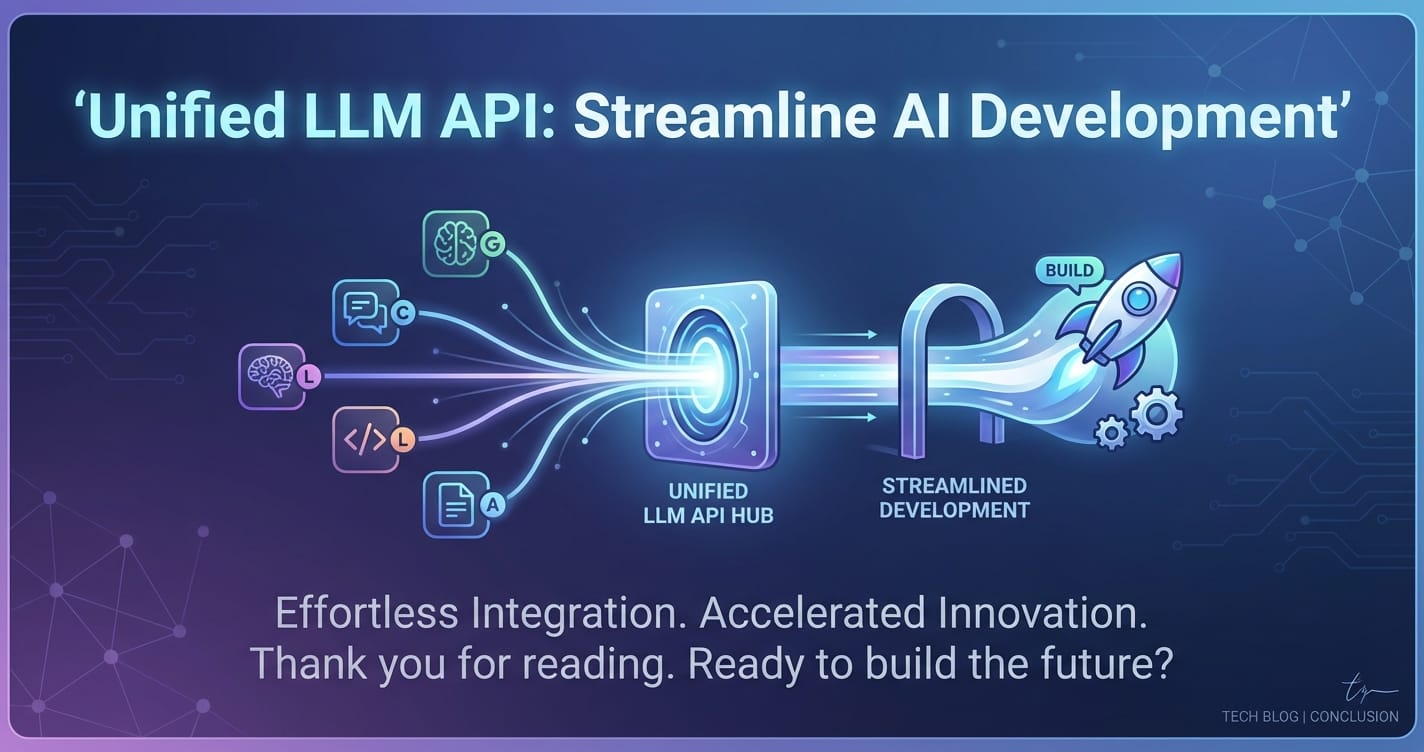
Unified LLM API: Streamline AI Development
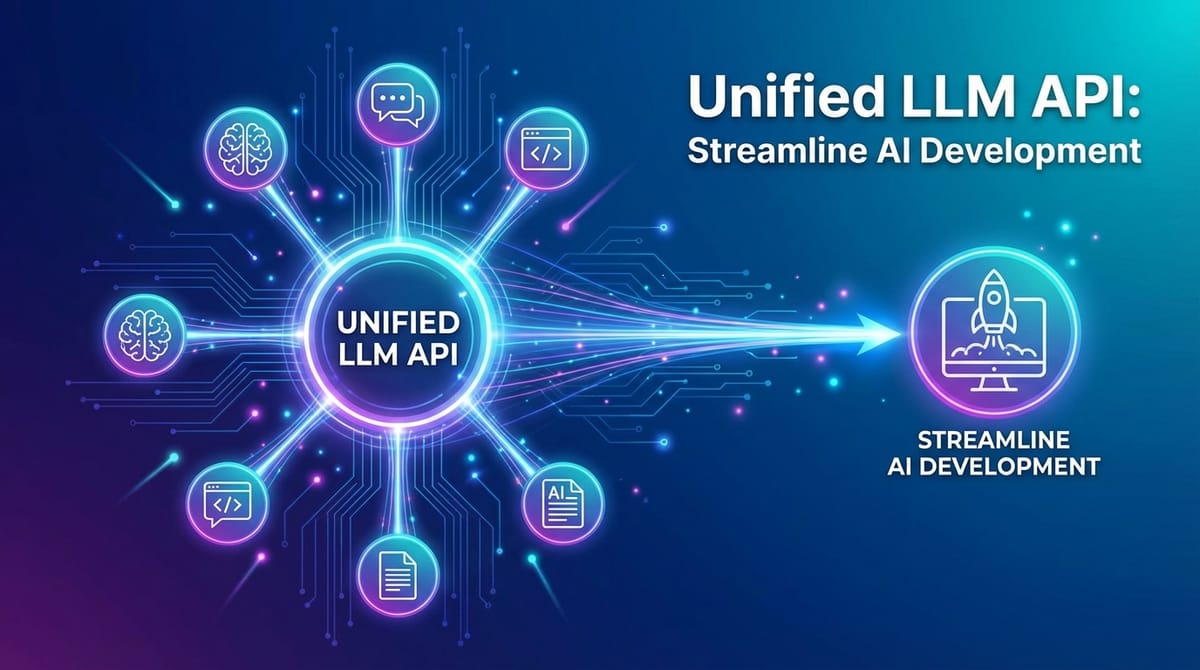

The landscape of Artificial Intelligence is experiencing an unprecedented boom, with Large Language Models (LLMs) standing at the forefront of this revolution. From powering sophisticated chatbots and content generation tools to enabling advanced data analysis and complex decision-making systems, LLMs are reshaping how businesses operate and how individuals interact with technology. However, this proliferation, while exciting, has also introduced a significant hurdle: complexity. Developers and organizations are increasingly faced with a fragmented ecosystem of models, each with its unique API, capabilities, pricing, and integration requirements. This fragmentation often leads to slower development cycles, increased operational overhead, vendor lock-in concerns, and sub-optimal resource utilization.
Imagine a world where integrating the most powerful AI models is as straightforward as plugging into a single, universal socket. This is precisely the promise and transformative power of a unified LLM API. It stands as a pivotal innovation, designed to abstract away the intricate differences between various AI providers, offering a singular, cohesive interface for accessing a multitude of models. This article delves deep into the essence of unified LLM API solutions, exploring how they are not just simplifying, but fundamentally revolutionizing AI development by offering unparalleled multi-model support and enabling sophisticated cost optimization strategies. We will navigate through the challenges posed by the current AI landscape, unveil the mechanics and benefits of a unified approach, and examine how such platforms are empowering developers to build smarter, more flexible, and economically viable AI applications.
The Proliferation of Large Language Models (LLMs) and Its Intrinsic Challenges
The journey of Large Language Models has been nothing short of spectacular. What began with early neural network models has rapidly evolved into sophisticated architectures capable of understanding, generating, and even reasoning with human language. From Google's BERT and T5 to OpenAI's GPT series, Anthropic's Claude, Meta's LLaMA, and numerous open-source alternatives, the sheer diversity and capability of LLMs available today are staggering. Each model brings its unique strengths to the table: some excel at creative writing, others at precise code generation, some are optimized for speed and low latency, while others prioritize factual accuracy or multilingual capabilities. This rich tapestry of choices empowers developers to select the ideal tool for any specific task, pushing the boundaries of what AI can achieve.
However, this very abundance, while a boon for innovation, presents a complex web of challenges for developers and enterprises alike. The dream of harnessing the collective power of these models often turns into an integration nightmare.
API Fragmentation and Incompatibility
The most immediate challenge stems from API fragmentation. Every major LLM provider, and indeed many smaller ones, exposes its models through proprietary APIs. These APIs differ significantly in terms of their endpoint structures, authentication mechanisms, request/response formats, error handling, and even the terminology used for similar operations. For a developer looking to experiment with different models or build an application that can dynamically switch between them based on performance or cost, this means:
- Multiple SDKs and Libraries: Instead of a single client library, developers must integrate and manage multiple software development kits (SDKs) – one for OpenAI, one for Anthropic, another for Google, and so on. This bloats the codebase and introduces inconsistencies.
- Diverse Authentication Schemes: From API keys in headers to OAuth tokens, managing different authentication methods securely across various providers adds significant complexity and potential security vulnerabilities if not handled meticulously.
- Inconsistent Data Models: A
generatecall to one API might require apromptfield, while another expectsmessages, and a third might useinput. The output formats also vary, necessitating extensive parsing and normalization logic for each model. - Vendor-Specific Tooling and Documentation: Navigating through distinct documentation portals, understanding different rate limits, and debugging provider-specific errors can be time-consuming and frustrating.
Difficulty in Switching Models or Providers
The fragmented landscape severely restricts the flexibility to switch LLM models or even entire providers. Once an application is deeply integrated with a specific API, migrating to another model—even a superior or more cost-effective one—becomes a significant undertaking. This can lead to:
- Vendor Lock-in: Businesses become heavily dependent on a single provider, making them vulnerable to price changes, service disruptions, or unfavorable terms. This stifles competition and innovation within their own AI strategy.
- Sub-optimal Performance and Cost: Without the ability to easily pivot, applications might remain tied to a model that is either too expensive for certain tasks, not performant enough, or lacks a specific capability available elsewhere.
- Slow Adaptation to Innovation: The AI landscape evolves at a blistering pace. New, more efficient, or more capable models are released frequently. The inability to quickly integrate these advancements means applications can rapidly become outdated or lose their competitive edge.
Operational Overhead and Management Complexity
Managing multiple LLM integrations also introduces a substantial operational burden:
- Monitoring and Logging: Centralizing logs, usage statistics, and error reports from disparate APIs is a complex task. A unified view of AI resource consumption and performance becomes elusive.
- Rate Limit Management: Each provider imposes its own rate limits, which must be tracked and managed independently to prevent service interruptions. Implementing robust retry logic across multiple APIs further complicates matters.
- Security and Access Control: Managing API keys, access permissions, and security policies for numerous providers creates an administrative nightmare and increases the attack surface.
- Billing and Cost Tracking: Reconciling invoices and tracking spending across various LLM providers requires significant manual effort, making it difficult to gain a holistic view of AI infrastructure costs. This directly impacts effective cost optimization.
Lack of True Multi-Model Support in a Single Interface
Perhaps the most significant consequence is the absence of true multi-model support in a seamless, unified manner. Many sophisticated AI applications require leveraging the unique strengths of different models for different stages of a workflow. For instance:
- A complex customer service chatbot might use a fast, cost-effective model for initial intent recognition, then a more powerful, accurate model for generating detailed responses, and finally a specialized, compact model for sentiment analysis.
- A content generation platform might employ one model for brainstorming ideas, another for drafting long-form articles, and a third for summarization and keyword optimization.
Achieving this "best-of-breed" approach with fragmented APIs is either prohibitively complex or simply impossible without a mediating layer. Developers are often forced to compromise, sticking to a single model for simplicity, thereby sacrificing potential performance, accuracy, or cost efficiencies.
In summary, while the explosion of LLMs offers immense potential, the current fragmented ecosystem erects significant barriers to innovation. These challenges underscore the urgent need for a more streamlined, standardized, and intelligent approach to integrating and managing AI models—a need precisely addressed by the emergence of the unified LLM API.
Understanding the Unified LLM API: A Universal Gateway
In response to the intricate challenges posed by the fragmented LLM landscape, the concept of a unified LLM API has emerged as a powerful paradigm shift. At its core, a unified LLM API acts as a universal gateway, providing a single, standardized interface through which developers can access and interact with a multitude of underlying Large Language Models from various providers. It's an abstraction layer that sits between your application and the diverse world of LLMs, shielding you from the complexities of individual provider APIs.
Definition and Core Principles
A unified LLM API can be defined as an intermediary platform or service that aggregates access to multiple large language models, presenting them through a single, consistent, and often familiar API interface. The overarching goal is to simplify integration, enhance flexibility, and enable intelligent management of AI resources.
Its core principles revolve around:
- Abstraction: Hiding the intricate details and differences of individual LLM provider APIs (e.g., varying request formats, authentication schemes, rate limits).
- Standardization: Offering a consistent API surface (often inspired by popular models like OpenAI's API) that works across all integrated LLMs, regardless of their native interface.
- Flexibility: Empowering developers to easily switch between models, providers, or even leverage multiple models within a single application workflow, without significant code changes.
- Intelligence: Incorporating smart routing, load balancing, and cost optimization logic to enhance performance, reliability, and economic efficiency.
How It Works: The Orchestration Layer
Conceptually, a unified LLM API operates as an intelligent orchestration layer. When your application makes a request to the unified endpoint, the platform performs several critical steps:
- Receiving the Standardized Request: Your application sends a request in the unified API's standard format (e.g.,
POST /v1/chat/completionswith a specific JSON payload). - Authentication and Authorization: The unified API handles your credentials, translating them into the appropriate authentication scheme for the chosen backend LLM provider.
- Intelligent Routing: This is where much of the magic happens. Based on your configuration, specified model, or even dynamic rules (e.g., cheapest model, lowest latency model, specific model for a task), the unified API determines which underlying LLM provider and model should handle the request.
- Request Transformation: The unified API translates your standardized request into the native API format expected by the chosen backend LLM. This includes mapping parameters, adjusting data structures, and handling any provider-specific nuances.
- Sending to Provider: The transformed request is then forwarded to the actual LLM provider (e.g., OpenAI, Anthropic, Google).
- Response Transformation: Once the LLM provider returns a response, the unified API intercepts it, transforms it back into its standardized output format, ensuring consistency for your application.
- Logging and Monitoring (Optional but Crucial): Throughout this process, the unified API can log usage, performance metrics, and cost data, providing a centralized view of your AI consumption.
- Returning to Application: Finally, the standardized response is sent back to your application.
Analogy: The Universal Adapter
Think of a unified LLM API like a universal travel adapter. Instead of carrying a different power adapter for every country (each LLM provider), you carry one universal adapter (the unified API). You plug your device (your application) into the universal adapter, and the adapter handles the conversion and compatibility with whatever local power outlet (LLM provider API) is available. This allows you to effortlessly use your devices anywhere, without worrying about the specifics of each electrical standard.
Key Components of a Robust Unified LLM API Platform
A sophisticated unified LLM API platform typically comprises several interconnected components:
- API Gateway: The primary entry point for all client requests, responsible for authentication, rate limiting, and initial request validation.
- Routing Engine: The core intelligence that decides which backend LLM to use based on predefined rules, policies, or dynamic optimization algorithms.
- Adapter/Transformer Layer: A set of modules, one for each supported LLM provider, responsible for translating between the unified API's format and the provider's native format.
- Caching Mechanism: To improve low latency AI and reduce redundant calls, responses from frequently requested prompts might be cached.
- Monitoring and Analytics Module: Collects and processes data on usage, performance, errors, and costs, offering insights through dashboards and reports.
- Security and Access Control System: Manages API keys, user roles, and enforces security policies across all integrated services.
- Load Balancer/Failover Mechanism: Distributes requests across multiple providers or instances to ensure high availability and performance, with automatic failover in case of provider outages.
By providing this comprehensive orchestration layer, a unified LLM API abstracts away the complexity, empowering developers to focus on building innovative applications rather than wrestling with API integration challenges. This foundation sets the stage for unlocking significant benefits in development efficiency, model flexibility, and, crucially, cost optimization.
Key Benefits of a Unified LLM API
The adoption of a unified LLM API transcends mere convenience; it represents a strategic decision that can profoundly impact the efficiency, flexibility, and economic viability of AI development. By consolidating access to a diverse ecosystem of models, these platforms unlock a myriad of advantages that directly address the challenges of the fragmented LLM landscape.
A. Streamlined Development and Integration
One of the most immediate and tangible benefits is the dramatic simplification of the development process. A unified LLM API transforms what would typically be a complex, multi-faceted integration task into a straightforward, single-point connection.
- Single Codebase, Multiple Models: Developers no longer need to write custom code for each LLM provider. With a unified API, a single set of API calls and a consistent data model suffice for interacting with any supported model. This drastically reduces the amount of boilerplate code, leading to cleaner, more maintainable applications.
- Reduced Integration Time and Effort: Instead of spending weeks integrating and testing different SDKs, developers can connect to a unified API platform in hours or days. This accelerated integration frees up valuable engineering resources, allowing teams to focus on core application logic and innovation rather than API plumbing.
- Simplified API Calls (OpenAI-compatible endpoints often): Many unified LLM APIs adopt the widely accepted and developer-friendly OpenAI API standard. This familiarity means that developers already accustomed to OpenAI's interface can immediately start leveraging a multitude of other models without a steep learning curve. The consistent schema for requests and responses greatly simplifies parsing and error handling.
- Faster Prototyping and Iteration: The ease of switching between models facilitates rapid experimentation. Developers can quickly test different LLMs for specific tasks, compare their outputs, and iterate on their prompts without altering the underlying integration code. This agility is crucial in the fast-paced world of AI development.
- Easier Maintenance and Updates: As LLM providers release new model versions or update their APIs, the unified platform typically handles the necessary adaptations. This means your application remains compatible without requiring continuous code changes on your end, significantly reducing maintenance overhead. Furthermore, if a new, superior model emerges, integrating it into your application is often as simple as updating a configuration parameter within the unified API's dashboard.
B. Unlocking True Multi-Model Support
Perhaps the most compelling advantage of a unified LLM API is its ability to provide genuine multi-model support. This capability is not just about having access to many models; it's about the strategic agility to deploy the right model for the right task at the right time.
- Access to a Vast Ecosystem of LLMs: A robust unified platform typically integrates dozens of leading LLMs from various providers. This grants developers unprecedented access to a diverse array of capabilities, from ultra-fast inference models for chat to highly creative models for content generation, and specialized models for specific language tasks or domains. For instance, platforms like XRoute.AI provide access to over 60 AI models from more than 20 active providers, offering an expansive toolkit for any AI project.
- Freedom to Choose the Best Model for Specific Tasks: Different LLMs have distinct strengths. A unified API allows applications to dynamically select the most suitable model based on criteria such as:
- Accuracy: For critical tasks requiring high precision (e.g., medical transcription, legal document analysis), a larger, more powerful model might be preferred.
- Speed (Latency): For real-time applications like chatbots or interactive voice assistants, a faster, lower-latency model is crucial.
- Creativity: For generating marketing copy, artistic content, or brainstorming ideas, models known for their creative flair would be selected.
- Cost: For high-volume, less critical tasks, a cheaper model can significantly reduce operational expenses.
- Domain Specialization: Some models might be fine-tuned for specific industries or knowledge domains, offering superior performance in those areas.
- No Vendor Lock-in, Promoting Innovation: By abstracting away provider-specific implementations, a unified API eliminates vendor lock-in. Developers can freely switch between providers without re-architecting their applications. This fosters a competitive environment, encouraging providers to offer better models and more attractive pricing, ultimately benefiting the end-user.
- Dynamic Model Switching Based on Requirements: Advanced unified platforms can implement intelligent routing logic that automatically directs requests to the most appropriate model. This could be based on the complexity of the query, the desired response quality, the current load on a specific model, or even a pre-configured A/B test for model performance.
- Example Use Cases for Multi-Model Support:
- Smart Chatbots: Use a lightweight, fast model for initial intent recognition and simple FAQs, then escalate to a more powerful, nuanced model for complex queries requiring deep understanding and comprehensive answers.
- Content Creation Suites: Employ a highly creative model for brainstorming and generating initial drafts, a fact-checking model for verifying information, and a smaller, faster model for summarization and keyword extraction.
- Code Assistants: Leverage a model optimized for code generation for new functions, and a different one for debugging or refactoring existing code.
To illustrate the diversity, consider a simplified comparison of popular LLM characteristics:
| LLM Family | Primary Strengths | Typical Use Cases | Considerations |
|---|---|---|---|
| OpenAI (GPT) | General purpose, strong creativity, reasoning, code generation | Chatbots, content creation, summarization, coding | Widely adopted, diverse models (turbo, 4), varying costs |
| Anthropic (Claude) | Safety, helpfulness, less "hallucination", long context | Customer support, legal analysis, creative writing | Focus on responsible AI, strong conversational ability |
| Google (Gemini, PaLM) | Multimodal capabilities, strong search integration, scale | Data analysis, knowledge retrieval, multimodal apps | Integrated with Google ecosystem, enterprise-focused |
| Meta (LLaMA) | Open-source, flexible, community-driven | Research, fine-tuning, custom applications | Requires self-hosting or specific providers, strong community |
| Mistral AI (Mistral, Mixtral) | Efficiency, speed, cost-effectiveness, sparse mixture of experts | Real-time applications, edge deployments, summarization | Performance-oriented, smaller footprints |
A unified API allows seamless switching between these, utilizing each one's core strengths without re-integrating.
C. Advanced Cost Optimization Strategies
In the realm of AI, cost optimization is not merely a desirable feature but a critical necessity, especially as LLM usage scales. Different models and providers come with varying pricing structures—per token, per request, per minute—and these costs can fluctuate. A unified LLM API provides the tools and intelligence to meticulously manage and significantly reduce these expenditures.
- Dynamic Routing: Automatically Selecting the Cheapest Model: This is perhaps the most impactful cost optimization feature. The unified API can be configured to automatically route requests to the most cost-effective LLM that meets specific performance or quality criteria. For example, for a simple text summarization task, it might route to a cheaper, faster model if it performs adequately, reserving a more expensive, high-accuracy model only for complex summarization needs. This dynamic decision-making happens in real-time, behind the scenes, ensuring you always get the best value.
- Batching Requests: For applications sending numerous small requests, the unified API can aggregate these into larger batches where supported by the underlying provider. This reduces the overhead associated with individual API calls and can lead to significant savings, as many providers offer discounted rates for larger batches.
- Tiered Pricing Management: Providers often offer different pricing tiers based on usage volume. A unified API can track overall usage across all models and suggest or automatically apply the most beneficial pricing tier, helping organizations maximize their investment as their AI consumption grows.
- Monitoring and Analytics: Granular Insights into API Usage and Spending: A crucial component of cost management is visibility. Unified platforms provide centralized dashboards and detailed reports that break down LLM usage by model, provider, application, and even specific user or feature. This granular data allows teams to identify spending patterns, detect inefficiencies, and make informed decisions about resource allocation. You can see precisely where your money is going and identify areas for improvement.
- Avoiding Over-provisioning: By dynamically allocating requests and intelligently switching models, organizations can avoid the need to over-provision capacity with a single, expensive provider "just in case." The flexibility of a unified API means capacity can be scaled on demand across a diverse pool of resources.
- Leveraging Open-Source Models: Many unified platforms also support integration with open-source LLMs that can be self-hosted or run on specialized endpoints. While these might incur infrastructure costs, they can be significantly cheaper per-token for high-volume use cases, providing another avenue for cost optimization. The unified API makes integrating these "bring your own model" options as seamless as using a proprietary service.
Here's an illustrative table showing potential cost savings with dynamic routing for a hypothetical task:
| Model Option | Cost per 1000 tokens (Input) | Cost per 1000 tokens (Output) | Latency (ms) | Quality Score (1-5) |
|---|---|---|---|---|
| Model A (High-End) | $0.01 | $0.03 | 300 | 5 |
| Model B (Mid-Range) | $0.005 | $0.015 | 200 | 4 |
| Model C (Cost-Effective) | $0.001 | $0.003 | 100 | 3 |
For a task where Quality Score 3 is acceptable, a unified API could automatically route to Model C, achieving significant savings without developer intervention. For tasks requiring Quality Score 5, it would route to Model A. This intelligent decision-making is core to effective cost optimization.
D. Enhanced Performance and Reliability
Beyond simplifying development and managing costs, a unified LLM API significantly boosts the performance and resilience of AI-powered applications. This is achieved through intelligent infrastructure design and advanced traffic management.
- Low Latency AI:
- Optimized Routing: Unified platforms can intelligently route requests to the nearest data center or the fastest available model instance, minimizing network travel time.
- Caching Mechanisms: For repetitive prompts or common queries, responses can be cached, allowing for near-instant retrieval and dramatically reducing response times.
- Concurrent Calls: The API can manage concurrent calls to multiple models, ensuring that even if one model is slow, others can pick up the slack.
- This focus on low latency AI is crucial for real-time applications where every millisecond counts, such as interactive chatbots, voice assistants, and dynamic content generation.
- High Throughput and Scalability: A well-designed unified API is built to handle massive volumes of requests. It can distribute load across multiple underlying LLM providers or multiple instances of the same model, preventing bottlenecks and ensuring your application scales effortlessly with user demand. This elasticity means your AI infrastructure can grow or shrink dynamically, optimizing resource usage.
- Automatic Fallback and Failover: What happens if a specific LLM provider experiences an outage or a model becomes temporarily unavailable? A unified API can be configured with automatic fallback mechanisms. If a primary model or provider fails, the system can seamlessly reroute requests to an alternative, ensuring continuous service without interruption to your application. This dramatically improves the resilience and uptime of your AI services.
- Load Balancing Across Providers: The platform can intelligently distribute requests across different providers based on their current load, capacity, or performance metrics. This prevents any single provider from becoming a bottleneck and ensures optimal response times across the board.
- Improved Uptime and Resilience: By diversifying reliance across multiple providers and incorporating intelligent failover, the overall uptime and reliability of your AI services are significantly enhanced. Your application becomes less susceptible to the single point of failure inherent in direct, single-provider integrations.
E. Simplified Governance and Security
Integrating multiple external services often complicates governance, security, and compliance. A unified LLM API centralizes these critical functions, providing a more robust and manageable framework.
- Centralized API Key Management: Instead of managing numerous API keys for different providers, you manage a single set of credentials with the unified API. This simplifies key rotation, access revocation, and reduces the risk of credential compromise.
- Unified Logging and Monitoring: All requests, responses, errors, and usage metrics flow through a single point. This allows for centralized logging, monitoring, and auditing, providing a comprehensive view of all AI interactions, which is invaluable for debugging, performance analysis, and security investigations.
- Consistent Security Policies: The unified API can enforce consistent security policies, access controls, and data governance rules across all integrated LLMs. This ensures that sensitive data is handled uniformly, regardless of which underlying model processes it.
- Easier Compliance Management: For organizations operating under strict regulatory frameworks (e.g., GDPR, HIPAA), a unified API can help streamline compliance by providing a single point to enforce data privacy, retention, and access policies across all AI models. It simplifies demonstrating adherence to these regulations.
In essence, a unified LLM API acts as a force multiplier for AI development. It not only accelerates the journey from concept to deployment but also fortifies the operational backbone of AI applications, making them more adaptable, reliable, and economically sound.
XRoute is a cutting-edge unified API platform designed to streamline access to large language models (LLMs) for developers, businesses, and AI enthusiasts. By providing a single, OpenAI-compatible endpoint, XRoute.AI simplifies the integration of over 60 AI models from more than 20 active providers(including OpenAI, Anthropic, Mistral, Llama2, Google Gemini, and more), enabling seamless development of AI-driven applications, chatbots, and automated workflows.
Implementing a Unified LLM API: Best Practices
Adopting a unified LLM API is a strategic decision that can dramatically reshape your AI development workflow. However, to fully reap its benefits, it's crucial to approach implementation with a clear strategy and adhere to best practices. This ensures that the platform seamlessly integrates into your existing ecosystem and delivers on its promises of efficiency, flexibility, and cost optimization.
1. Choosing the Right Platform/Solution
The market for unified LLM APIs is growing, with various platforms offering different features, integrations, and pricing models. Selecting the right one is paramount. Consider the following:
- Breadth of Model Support: Does the platform integrate with all the LLMs you currently use or foresee needing in the future? Look for comprehensive multi-model support across different providers (OpenAI, Anthropic, Google, open-source options, etc.). Platforms like XRoute.AI, for instance, stand out by offering access to over 60 AI models from more than 20 active providers through a single, OpenAI-compatible endpoint.
- OpenAI Compatibility: An API that is compatible with the OpenAI standard significantly reduces the learning curve and integration effort for many developers.
- Features for Cost Optimization: Evaluate features like dynamic routing based on cost, tiered pricing management, and detailed cost analytics.
- Performance and Latency: Inquire about their infrastructure, caching mechanisms, and claims regarding low latency AI.
- Scalability and Reliability: Understand how the platform handles high throughput, load balancing, and automatic failover.
- Security and Compliance: Assess their security protocols, data privacy policies, and compliance certifications.
- Developer Experience: Look for comprehensive documentation, easy-to-use SDKs, and a responsive support team.
- Pricing Model: Understand their pricing structure (per request, per token, tiered, etc.) and how it aligns with your anticipated usage.
2. Defining Clear Use Cases and Requirements
Before diving into integration, clearly define the specific use cases you intend to address with LLMs and the requirements for each.
- Identify LLM-driven Features: What parts of your application will leverage LLMs (e.g., content generation, summarization, chatbot responses, code completion, data extraction)?
- Determine Performance Needs: For each feature, what are the critical performance metrics? Is low latency AI paramount for a real-time chat, or is a slightly slower but more accurate response acceptable for a background content generation task?
- Establish Quality Benchmarks: How will you measure the quality of LLM outputs for each use case? Define success criteria and evaluation metrics.
- Set Cost Thresholds: For each task, what is the maximum acceptable cost per inference? This is crucial for configuring dynamic routing and cost optimization strategies.
- Security and Data Sensitivity: Understand the sensitivity of the data being processed and any specific security or compliance requirements.
3. Strategies for Dynamic Model Selection
Leverage the intelligent routing capabilities of the unified API to maximize benefits.
- Cost-Based Routing: Implement rules to automatically select the cheapest model that meets your minimum quality and performance thresholds for a given task. This is particularly effective for high-volume, less critical operations.
- Performance-Based Routing: For real-time applications, prioritize models with the lowest latency, even if they are slightly more expensive.
- Task-Based Routing: Design your application to specify the optimal model for a particular task type. For example, explicitly route summarization requests to a model known for its summarization capabilities and creative writing requests to a model known for creativity.
- Hybrid Approaches: Combine these strategies. For instance, default to a cost-effective model, but if a prompt is flagged as "complex" or "high-priority," route it to a more powerful, potentially more expensive model.
- A/B Testing: Use the unified API to easily A/B test different models with real user traffic to determine which performs best for specific metrics (e.g., user satisfaction, conversion rates).
4. Monitoring and Analytics Integration
Effective monitoring is the backbone of efficient LLM management.
- Centralized Dashboards: Utilize the unified API's dashboards for a holistic view of usage, performance, errors, and costs across all models and providers.
- Custom Alerts: Set up alerts for unusual activity, excessive costs, high error rates, or performance degradation.
- Granular Logging: Ensure the platform provides detailed logs that can be integrated with your existing observability stack for deeper analysis and debugging.
- Cost Reporting: Regularly review cost reports to identify trends, pinpoint areas for further cost optimization, and ensure budget adherence. This often includes breakdowns by model, provider, and even API key.
5. Scalability Considerations
Plan for growth and ensure your unified API implementation can handle increasing demand.
- Provider Diversity: Leverage the multi-model support to distribute load across multiple providers. If one provider experiences throttling or capacity issues, the unified API can automatically reroute requests.
- Rate Limit Management: Configure the unified API to respect and manage rate limits across all integrated LLMs, preventing your application from being throttled by individual providers.
- Caching Strategy: Implement a smart caching strategy for frequently requested or static responses to reduce external API calls and improve perceived latency.
- Regional Deployments: If your user base is geographically dispersed, inquire if the unified API supports regional deployments or intelligent routing to the closest LLM endpoints for reduced latency.
6. Security Best Practices
Security must be a paramount concern when dealing with external APIs and potentially sensitive data.
- Secure API Key Management: Treat your unified API keys with the highest level of security. Use environment variables, secret management services, and role-based access control (RBAC).
- Least Privilege: Grant only the necessary permissions to your unified API keys.
- Data Encryption: Ensure that data in transit and at rest is encrypted.
- Input/Output Sanitization: Implement robust input validation and output sanitization to mitigate risks like prompt injection or data leakage.
- Auditing and Logging: Maintain comprehensive audit trails of all API interactions for security monitoring and incident response.
- Compliance: Understand and adhere to all relevant data privacy and security regulations for your industry and region.
By diligently following these best practices, organizations can maximize the value derived from a unified LLM API, transforming their AI development from a fragmented struggle into a streamlined, powerful, and economically sound endeavor.
The Future of AI Development with Unified LLM APIs
The landscape of AI is perpetually in motion, with new frontiers constantly emerging. As Large Language Models evolve, so too must the infrastructure that supports their integration and deployment. Unified LLM APIs are not merely a solution for today's challenges; they are foundational to unlocking the potential of tomorrow's AI innovations. Their inherent flexibility, multi-model support, and intelligent management capabilities position them as indispensable tools for navigating the future of AI development.
Emerging Trends in AI
Several exciting trends are poised to redefine the capabilities and applications of AI:
- AI Agents and Autonomous Workflows: The development of AI agents capable of performing complex, multi-step tasks independently—from planning and execution to error correction—is gaining significant traction. These agents often require sophisticated reasoning and interaction with various tools and data sources.
- Multimodal AI: Beyond text, AI models are increasingly capable of understanding and generating information across multiple modalities: text, images, audio, video. This will lead to richer, more intuitive human-AI interactions and applications that can process a wider range of sensory data.
- Personalized AI: Tailored AI experiences that learn and adapt to individual user preferences, contexts, and behaviors will become more common, moving beyond generic responses to truly personalized interactions.
- Edge AI and Local Models: While cloud-based LLMs are powerful, there's a growing need for smaller, more efficient models that can run on edge devices or in private data centers for enhanced privacy, security, and low latency AI in specific scenarios.
- Generative AI Proliferation: Generative capabilities will extend far beyond text, encompassing sophisticated image, video, and even 3D model generation, transforming industries like design, entertainment, and manufacturing.
How Unified LLM APIs Will Enable These Advancements
A unified LLM API acts as the crucial connective tissue that makes these future visions attainable:
- Fueling AI Agent Architectures: AI agents often need to invoke different LLMs for different parts of their reasoning process. For instance, one model for planning, another for code generation, and a third for natural language interaction. A unified API provides the seamless, standardized interface for an agent to dynamically switch between these specialized models without complex internal logic, leveraging true multi-model support.
- Simplifying Multimodal Integration: As multimodal LLMs emerge, a unified API can abstract away their specific input/output formats, presenting a consistent interface for developers to work with diverse data types (text, image embeddings, audio transcripts) across different multimodal models.
- Enabling Adaptive Personalization: With the ability to dynamically route requests based on user profiles or historical interactions, a unified API can ensure that personalized AI experiences are powered by the most relevant and effective models, while also facilitating A/B testing of different personalization strategies.
- Integrating Edge and Cloud: Unified APIs can act as a bridge, intelligently routing requests to local, on-premise models when privacy or low latency AI is critical, and leveraging powerful cloud-based LLMs for more complex, less time-sensitive tasks. This hybrid approach offers optimal flexibility and cost optimization.
- Accelerating Generative AI Workflows: As generative AI becomes more sophisticated, workflows will involve combining outputs from different generative models (e.g., generating text from one, images from another). A unified API simplifies the orchestration of these complex, multi-stage generative pipelines.
- Democratization of AI Development: By lowering the barrier to entry, unified APIs empower a broader range of developers—including those without deep AI expertise—to build sophisticated AI applications. This expands the pool of innovators and accelerates the pace of AI adoption across industries.
- Innovation Acceleration: The ease of experimentation and the ability to combine "best-of-breed" models fosters a culture of rapid innovation. Developers can quickly prototype new ideas, test hypotheses, and bring groundbreaking AI solutions to market faster than ever before.
A New Era of Accessible and Intelligent AI
The trajectory of AI points towards an increasingly intelligent, integrated, and accessible future. Unified LLM APIs are at the vanguard of this transformation, dissolving the complexities of fragmentation and opening up new avenues for creativity and efficiency. They are not just tools for managing complexity; they are enablers of a more fluid, adaptive, and powerful approach to building AI. As the AI ecosystem continues its explosive growth, the significance of these unified platforms will only amplify, solidifying their role as indispensable architects of the next generation of intelligent applications.
Introducing XRoute.AI: Your Gateway to Streamlined AI Development
For developers, businesses, and AI enthusiasts seeking to truly harness the power of diverse LLMs without the inherent complexity, platforms like XRoute.AI represent the pinnacle of unified LLM API solutions. XRoute.AI is a cutting-edge unified API platform designed to streamline access to large language models (LLMs). It directly addresses the challenges of fragmentation and complexity by offering a singular, elegant solution.
At its core, XRoute.AI provides a single, OpenAI-compatible endpoint. This familiar interface immediately simplifies the integration of a vast array of AI models, making it a truly developer-friendly tool. Instead of wrestling with disparate APIs, SDKs, and authentication methods for each model, you interact with XRoute.AI as you would with a standard OpenAI endpoint, instantly gaining access to an expansive ecosystem.
What truly sets XRoute.AI apart is its comprehensive multi-model support. The platform simplifies the integration of over 60 AI models from more than 20 active providers. This extensive coverage means you have the freedom to choose the best model for any given task—whether it's for natural language understanding, complex reasoning, creative content generation, or specialized industry applications—all from a single point of access. This not only eliminates vendor lock-in but also empowers you to dynamically switch models to ensure optimal performance and accuracy, giving your applications unparalleled flexibility.
XRoute.AI is engineered with a strong focus on both low latency AI and cost-effective AI. Its intelligent routing and optimized infrastructure are designed to minimize response times, making it ideal for real-time applications where speed is critical. Simultaneously, the platform incorporates sophisticated mechanisms for cost optimization, enabling you to automatically leverage the most economical models for various tasks without compromising on quality or performance. This dual focus ensures that your AI applications are not only powerful but also economically sustainable at scale.
By simplifying complex integrations, XRoute.AI empowers users to build intelligent solutions without the complexity of managing multiple API connections. Whether you're developing AI-driven applications, sophisticated chatbots, or automated workflows, XRoute.AI provides the foundation for seamless development. Its high throughput, inherent scalability, and flexible pricing model make it an ideal choice for projects of all sizes, from agile startups innovating with groundbreaking AI features to enterprise-level applications requiring robust, reliable, and efficient AI infrastructure. With XRoute.AI, the future of streamlined, intelligent, and cost-optimized AI development is not just a promise—it's a reality.
Conclusion
The rapid ascent of Large Language Models has heralded a new era of innovation, fundamentally altering the landscape of software development and business operations. Yet, this explosion of powerful AI models has also introduced a significant paradigm shift in how we approach integration: moving from a fragmented, provider-specific model to a unified, intelligent framework. The unified LLM API has emerged as the definitive answer to the complexities arising from a diverse LLM ecosystem.
As we have explored, the advantages of embracing a unified approach are multifaceted and profound. It dramatically streamlines development and integration efforts, transforming what was once a laborious, error-prone process into a swift and intuitive one. Crucially, it unlocks true multi-model support, empowering developers to harness the unique strengths of various LLMs and dynamically deploy the most suitable model for any given task, thereby eliminating vendor lock-in and fostering unparalleled flexibility. Perhaps most significantly for organizations looking to scale their AI initiatives, a unified API platform facilitates sophisticated cost optimization strategies, ensuring that powerful AI solutions remain economically viable. Coupled with enhanced performance through low latency AI, superior reliability, and simplified governance, the case for a unified approach is overwhelmingly strong.
Platforms embodying this vision, such as XRoute.AI, are at the forefront of this transformation. By providing a single, OpenAI-compatible endpoint to over 60 models from 20+ providers, XRoute.AI exemplifies how a cutting-edge unified API platform can simplify integration, ensure cost-effective AI, and deliver low latency AI while maintaining a developer-friendly posture.
The future of AI development is not about choosing a single LLM provider; it's about intelligently orchestrating the best models for every challenge and opportunity. Unified LLM APIs are not just simplifying this orchestration; they are accelerating it, democratizing access to advanced AI, and paving the way for the next generation of intelligent applications. For any organization serious about leveraging the full power of AI without getting bogged down by integration overheads and escalating costs, adopting a unified LLM API is no longer an option—it is an essential strategic imperative.
Frequently Asked Questions (FAQs)
Q1: What exactly is a unified LLM API? A1: A unified LLM API is a single, standardized interface that allows developers to access and interact with multiple different Large Language Models (LLMs) from various providers (e.g., OpenAI, Anthropic, Google, open-source models). It acts as an abstraction layer, hiding the complexities and unique differences of each individual LLM's API, thus simplifying integration and management.
Q2: How does a unified LLM API help with cost optimization? A2: It offers several cost optimization benefits. The most significant is dynamic routing, which can automatically direct your requests to the most cost-effective LLM that still meets your specified quality and performance requirements. It also helps by providing centralized usage analytics to identify spending patterns, avoiding vendor lock-in, and allowing for easier leveraging of cheaper open-source or specialized models.
Q3: Can I really use different models for different tasks through one API? A3: Absolutely. This is one of the core strengths of multi-model support offered by a unified LLM API. You can configure your application to use one model (e.g., a fast, cheap one) for simple tasks like intent recognition, and another, more powerful (and potentially more expensive) model for complex tasks like detailed content generation or complex reasoning, all through the same unified endpoint.
Q4: Is a unified API suitable for small projects or just enterprises? A4: A unified LLM API is beneficial for projects of all sizes. For small projects and startups, it dramatically accelerates development by reducing integration overhead and allowing rapid experimentation with different models. For enterprises, it provides critical benefits in terms of scalability, cost optimization, reliability (through features like automatic failover), and centralized governance across diverse AI initiatives.
Q5: What kind of performance benefits can I expect from a unified LLM API? A5: You can expect significant performance enhancements, particularly in low latency AI and high throughput. Unified APIs often include intelligent routing to the closest or fastest available model, caching mechanisms for frequently asked questions, and load balancing across multiple providers. This helps ensure faster response times, better reliability, and a more resilient AI infrastructure for your applications.
🚀You can securely and efficiently connect to thousands of data sources with XRoute in just two steps:
Step 1: Create Your API Key
To start using XRoute.AI, the first step is to create an account and generate your XRoute API KEY. This key unlocks access to the platform’s unified API interface, allowing you to connect to a vast ecosystem of large language models with minimal setup.
Here’s how to do it: 1. Visit https://xroute.ai/ and sign up for a free account. 2. Upon registration, explore the platform. 3. Navigate to the user dashboard and generate your XRoute API KEY.
This process takes less than a minute, and your API key will serve as the gateway to XRoute.AI’s robust developer tools, enabling seamless integration with LLM APIs for your projects.
Step 2: Select a Model and Make API Calls
Once you have your XRoute API KEY, you can select from over 60 large language models available on XRoute.AI and start making API calls. The platform’s OpenAI-compatible endpoint ensures that you can easily integrate models into your applications using just a few lines of code.
Here’s a sample configuration to call an LLM:
curl --location 'https://api.xroute.ai/openai/v1/chat/completions' \
--header 'Authorization: Bearer $apikey' \
--header 'Content-Type: application/json' \
--data '{
    "model": "gpt-5",
    "messages": [
        {
            "content": "Your text prompt here",
            "role": "user"
        }
    ]
}'
With this setup, your application can instantly connect to XRoute.AI’s unified API platform, leveraging low latency AI and high throughput (handling 891.82K tokens per month globally). XRoute.AI manages provider routing, load balancing, and failover, ensuring reliable performance for real-time applications like chatbots, data analysis tools, or automated workflows. You can also purchase additional API credits to scale your usage as needed, making it a cost-effective AI solution for projects of all sizes.
Note: Explore the documentation on https://xroute.ai/ for model-specific details, SDKs, and open-source examples to accelerate your development.