Unlock AI Potential with a Unified LLM API

The landscape of Artificial Intelligence is evolving at an unprecedented pace, with Large Language Models (LLMs) standing at the forefront of this revolution. From sophisticated chatbots and intelligent content creation tools to complex data analysis and automated code generation, LLMs are reshaping industries and redefining what's possible. However, the very proliferation of these powerful models – each with its unique strengths, API structures, and pricing mechanisms – has introduced a new layer of complexity for developers and businesses striving to integrate AI seamlessly into their applications. The dream of harnessing diverse AI capabilities often collides with the reality of fragmented integrations, high development costs, and the daunting task of managing multiple vendor relationships.
This article delves into the transformative power of a unified LLM API, a solution engineered to dismantle these barriers. We will explore how such an API serves as a single gateway to a multitude of AI models, fundamentally simplifying the development process, enhancing flexibility through robust Multi-model support, and enabling strategic Cost optimization. By abstracting away the intricacies of individual model APIs, a unified platform empowers innovators to focus on building intelligent applications that are scalable, efficient, and future-proof, truly unlocking the full potential of AI.
The Fragmented AI Landscape: Challenges for Modern Development
The journey into AI integration often begins with great excitement, fueled by the promise of enhanced user experiences, automated workflows, and data-driven insights. Yet, the current state of the LLM ecosystem presents a labyrinth of choices and complexities that can quickly turn this excitement into frustration. Developers are faced with a growing array of powerful models from various providers: OpenAI's GPT series, Anthropic's Claude, Google's Gemini, Meta's Llama, along with countless open-source alternatives and specialized models. Each model offers distinct advantages, be it superior reasoning, faster inference, longer context windows, or particular expertise in specific domains.
The Developer's Dilemma: Navigating a Sea of APIs
Consider a scenario where a developer needs to build an application that can summarize long documents, generate creative marketing copy, and assist with coding. Traditionally, this would involve: 1. Selecting multiple models: Perhaps Claude for long document summarization, GPT-4 for creative content, and a fine-tuned Llama model for code generation. 2. Learning disparate APIs: Each provider has its own authentication methods, request/response formats, error codes, and rate limits. This means writing separate SDK integrations, managing different API keys, and understanding varied documentation. 3. Handling API Inconsistencies: A simple text generation request might look drastically different across providers. One might use messages for chat, another prompt, and yet another text_input. Parameters like temperature, max_tokens, and stop_sequences might also have varying names or expected value ranges. 4. Managing Updates and Maintenance: As models evolve and providers release new versions, developers must constantly update their integrations, testing for breaking changes and ensuring compatibility. This ongoing maintenance burden consumes valuable engineering resources that could otherwise be spent on core product innovation. 5. Vendor Lock-in Risk: Deeply embedding an application with a single provider's API makes it incredibly difficult and costly to switch if that provider changes its pricing, performance, or terms of service. The re-architecture required can be prohibitive. 6. Inconsistent Performance Monitoring: Tracking latency, uptime, and throughput across multiple individual APIs is a complex undertaking, requiring separate monitoring tools and dashboards. Aggregating this data for a holistic view of the application's AI performance becomes a significant challenge. 7. Complex Cost Tracking: Each provider bills differently, making it arduous to get a unified view of AI spending. Optimizing costs requires constantly comparing prices, which are often per-token, per-call, or based on specific features, and can fluctuate.
These challenges illustrate a fundamental truth: while individual LLMs are powerful, their fragmented nature impedes agile development, increases operational overhead, and ultimately slows down the pace of innovation. The need for a cohesive, standardized approach to LLM integration has never been more pressing.
The Transformative Power of a Unified LLM API
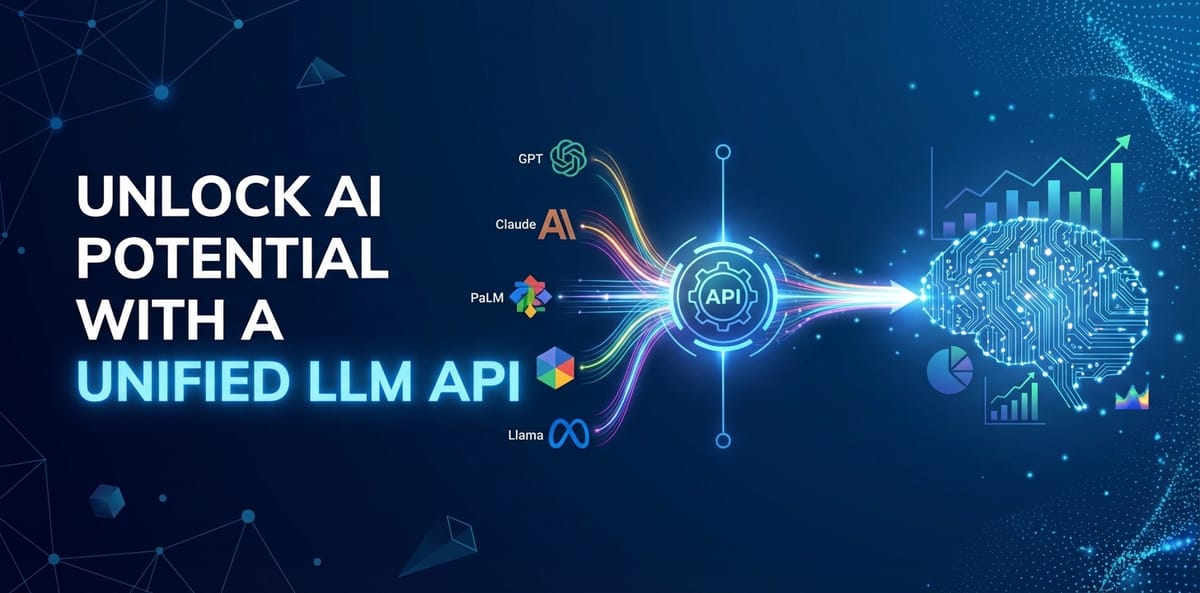
The concept of a unified LLM API emerges as a beacon in this complex landscape, offering a streamlined and efficient pathway to harnessing the full spectrum of AI capabilities. At its core, a unified API acts as an abstraction layer, providing a single, standardized interface through which developers can access a multitude of different LLM providers and models. Imagine a universal remote control for all your AI needs – that's the essence of a unified LLM API.
Defining "Unified LLM API"
A unified LLM API is a platform that consolidates access to various Large Language Models from different vendors under a single, consistent API endpoint. Instead of interacting directly with OpenAI, Anthropic, Google, and others, developers send requests to the unified API, which then intelligently routes and translates these requests to the appropriate backend model. The responses are then normalized and returned to the developer in a consistent format, regardless of the original source model.
Key characteristics include: * Single Endpoint: One URL, one set of authentication credentials. * Standardized Interface: Consistent request and response schemas, parameters, and error handling across all integrated models. * Abstraction Layer: Hides the underlying complexities and idiosyncrasies of each individual LLM provider. * Model Agnostic: Allows developers to switch between models or use multiple models without altering their core application logic.
Simplification of Development: Accelerating Innovation
The most immediate and profound benefit of a unified LLM API is the dramatic simplification of the development process. By providing a "one API to rule them all" approach, these platforms significantly reduce the time, effort, and resources required to build AI-powered applications.
Reduced Coding Effort and Faster Time to Market
Instead of writing and maintaining separate integration code for each LLM, developers only need to integrate with the unified API once. This means: * Fewer Lines of Code: Standardized SDKs and a consistent API interface drastically cut down on boilerplate code. * Accelerated Prototyping: Ideas can be tested with different LLMs almost instantly, allowing for rapid iteration and validation. * Streamlined Deployment: Less complexity in the codebase translates to fewer bugs, easier testing, and quicker deployment cycles.
Standardized Request/Response Formats
The abstraction layer is crucial here. Whether you're calling GPT-3.5 or Claude 2.1, the request payload (e.g., messages, model, temperature) and the response structure (e.g., choices[0].message.content) remain consistent. This eliminates the need for developers to learn and adapt to each provider's specific quirks, freeing them to concentrate on application logic rather than API plumbing. This consistency extends to error handling, making debugging much more straightforward.
Ease of Integration and Future-Proofing
The initial integration with a unified API is often designed to be as simple as integrating with a single, well-documented LLM. Once integrated, adding support for new models or switching to a different provider becomes a configuration change rather than a code rewrite. This inherent flexibility future-proofs applications against the rapidly evolving AI landscape, ensuring that developers can always leverage the latest and most performant models without significant refactoring.
Embracing Diversity: The Power of Multi-model Support
One of the most compelling advantages of a unified LLM API is its inherent capability for robust Multi-model support. The idea that one LLM can perfectly fulfill all needs is increasingly proving to be a myth. Different models excel in different areas: some are powerful for complex reasoning, others for creative generation, some prioritize speed, and others specialized knowledge. A unified API not only makes it easy to access these diverse models but also enables intelligent strategies for deploying them.
The Nuance of LLM Capabilities
Let's consider the vast spectrum of LLMs available today: * OpenAI's GPT series (GPT-3.5, GPT-4, GPT-4o): Known for strong general knowledge, reasoning, coding capabilities, and creative text generation. GPT-4o offers multimodal input/output. * Anthropic's Claude series (Claude 2.1, Claude 3): Praised for long context windows, nuanced reasoning, and safer, less toxic outputs, often preferred for enterprise applications. * Google's Gemini series (Gemini 1.0, 1.5): Offers multimodal reasoning, strong performance across various benchmarks, and deep integration with Google's ecosystem. * Meta's Llama series (Llama 2, Llama 3): Open-source, allowing for local deployment, fine-tuning, and greater control over privacy and customization, suitable for specific domain tasks. * Mistral AI models: Known for efficiency, speed, and strong performance, especially in smaller, more agile models.
Each of these models has its sweet spot. Using a single model for all tasks would inevitably lead to compromises – either in quality, speed, or cost.
Task-Specific Optimization and Hybrid Approaches
Multi-model support through a unified API allows developers to precisely match the right LLM to the right task, optimizing for performance, cost, and specific output requirements.
- Summarization: For extremely long documents, a model like Claude 2.1 or Gemini 1.5 Pro with a large context window might be ideal. For shorter, quick summaries, a faster, less expensive model like GPT-3.5 or Mistral could suffice.
- Content Generation: For highly creative and engaging marketing copy, GPT-4 or Claude 3 might be preferred. For structured data extraction or boilerplate text, a more constrained or fine-tuned model could be more effective.
- Code Generation/Assistance: GPT-4 and Gemini 1.5 are often lauded for their coding prowess. For specific language or framework needs, a fine-tuned Llama model could be leveraged.
- Translation: While many LLMs can translate, dedicated or specialized models might offer superior linguistic accuracy for critical applications.
- Retrieval Augmented Generation (RAG): When retrieving information from a knowledge base, one model might be excellent at querying and understanding context, while another might be better at synthesizing the retrieved information into a coherent answer.
Furthermore, Multi-model support enables sophisticated hybrid approaches. Imagine a workflow where: 1. An initial query is processed by a fast, inexpensive model for intent recognition. 2. If complex reasoning is required, the query is then routed to a more powerful, albeit more expensive, model like GPT-4. 3. The output from GPT-4 is then refined or checked for specific criteria by a specialized model or even a human reviewer.
This "chaining" or "orchestration" of models becomes significantly easier with a unified API, as the switching between models requires only a change in a configuration parameter, not a re-coding of the API call.
Intelligent Routing: The Brain Behind Multi-model Support
Advanced unified LLM APIs take Multi-model support a step further by incorporating intelligent routing capabilities. This means the platform can automatically decide which model to use based on predefined criteria, such as: * Cost: Route to the cheapest model that meets performance requirements. * Latency: Route to the fastest available model. * Capability: Route to a model specifically known for a certain task (e.g., a summarization model for summarization tasks). * Availability/Reliability: Route to an alternative model if the primary choice is experiencing downtime or high load. * Token Limit: Route to a model that can handle the input's context length.
This intelligent routing acts as an "AI traffic controller," ensuring that applications are always utilizing the optimal model for any given request without requiring constant manual intervention from developers. This level of automation is critical for maintaining high performance and efficiency at scale.
Table 1: Traditional vs. Unified API Integration
| Feature / Aspect | Traditional LLM Integration | Unified LLM API Integration |
|---|---|---|
| API Endpoints | Multiple (one per provider) | Single, consistent endpoint |
| API Keys Management | Multiple keys, managed separately | Single key, centralized management |
| Integration Complexity | High (learn diverse APIs, SDKs, formats) | Low (integrate once with a standardized interface) |
| Development Time | Longer (due to repeated integration efforts) | Shorter (rapid prototyping, faster time-to-market) |
| Model Switching | Requires code changes, re-architecture, significant effort | Configuration change, seamless model swapping |
| Multi-model Strategy | Difficult to implement, high overhead | Native support, intelligent routing, easy orchestration |
| Maintenance Overhead | High (track multiple updates, breaking changes) | Low (unified API handles updates, abstracting complexities) |
| Cost Visibility | Fragmented, hard to compare and optimize | Centralized, transparent, advanced Cost optimization tools |
| Vendor Lock-in | High risk | Low risk (easy to switch providers/models) |
| Scalability | Complex to scale individually | Simplified, often managed by the unified platform |
| Performance Monitoring | Disparate tools, difficult to unify | Centralized metrics, holistic view |
The clear advantages of a unified approach, particularly in enabling seamless Multi-model support, underscore its growing importance in the AI development ecosystem.
XRoute is a cutting-edge unified API platform designed to streamline access to large language models (LLMs) for developers, businesses, and AI enthusiasts. By providing a single, OpenAI-compatible endpoint, XRoute.AI simplifies the integration of over 60 AI models from more than 20 active providers(including OpenAI, Anthropic, Mistral, Llama2, Google Gemini, and more), enabling seamless development of AI-driven applications, chatbots, and automated workflows.
Strategic Cost Optimization in AI Development
Beyond simplifying development and enabling advanced Multi-model support, a unified LLM API plays a pivotal role in achieving strategic Cost optimization. In the realm of AI, costs can quickly escalate due to the pay-per-token or pay-per-call nature of most LLM services. Without careful management, what starts as an innovative feature can become a significant drain on resources.
Understanding the Hidden Costs of AI
The costs associated with AI development extend beyond just the direct API call charges: * Direct API Costs: Per-token usage (input and output), per-call charges, specialized feature costs (e.g., fine-tuning, embedding). These vary wildly between providers and models. * Development & Maintenance Costs: Engineering hours spent on initial integration, ongoing updates, debugging, and performance tuning for multiple APIs. This can be substantial. * Data Transfer Costs: Moving data in and out of different cloud environments. * Compute Costs: For self-hosted or fine-tuned models. * Opportunity Costs: Time lost due to inefficient processes or vendor lock-in preventing adoption of more cost-effective models. * Monitoring & Analytics Costs: Tools and infrastructure to track usage and spending across disparate services.
These hidden and overt costs make comprehensive Cost optimization a necessity for any serious AI initiative.
How a Unified API Facilitates Cost Optimization
A unified LLM API provides several mechanisms that directly contribute to significant cost savings:
- Dynamic Model Routing Based on Cost: This is perhaps the most powerful Cost optimization feature. With a unified API, developers can configure intelligent routing rules that automatically direct requests to the cheapest available model that still meets the application's performance and quality requirements.
- For example, a simple chatbot response that doesn't require complex reasoning might be routed to a less expensive model like GPT-3.5 Turbo or a smaller Llama model.
- Only when a query demands advanced reasoning or creative output would it be routed to a premium model like GPT-4 or Claude 3 Opus.
- This dynamic routing ensures that you're never "overpaying" for an AI model when a less expensive one can do the job effectively.
- Centralized Usage Tracking and Transparent Billing: By funneling all LLM requests through a single platform, unified APIs offer a consolidated view of AI consumption across all models and providers. This transparency is invaluable for budgeting and identifying areas for Cost optimization.
- Detailed dashboards show token usage, request counts, and spending breakdown per model, per provider, or even per user/application feature.
- This granular data empowers businesses to make informed decisions about their AI strategy and identify which models are most cost-efficient for specific tasks.
- Volume Discounts and Aggregated Usage: Unified API providers often aggregate the usage of all their customers across various LLM providers. This collective volume can sometimes unlock better pricing tiers or volume discounts from the underlying model providers, benefits that individual developers might not be able to achieve on their own. The savings are then passed on to the users of the unified API.
- Prevention of Vendor Lock-in and Price Flexibility: The ability to easily switch between LLM providers or models (as enabled by Multi-model support) provides immense leverage for Cost optimization. If a particular provider increases its prices significantly, or a new, more cost-effective model emerges, businesses can migrate with minimal effort and cost. This competitive flexibility keeps providers honest and ensures access to the best pricing available in the market.
- Reduced Development and Maintenance Costs: As discussed earlier, the simplification of integration reduces engineering effort. Less time spent on API plumbing means more budget for innovation and less for operational overhead, contributing to overall Cost optimization.
- Performance vs. Cost Trade-offs: Unified platforms often provide tools and metrics that help developers understand the trade-offs between model performance (e.g., latency, quality) and cost. This allows for deliberate choices to be made, ensuring that the chosen model provides the best value for money for a given use case. For instance, a slightly lower quality but significantly cheaper model might be acceptable for internal tools, while a premium model is reserved for customer-facing features.
Table 2: LLM Models and Their Typical Strengths (Illustrative)
| Model Category | Example Models | Typical Strengths | Common Use Cases | Cost Implication (Relative) |
|---|---|---|---|---|
| Premium General-Purpose | GPT-4, Claude 3 Opus, Gemini 1.5 Pro | Advanced reasoning, creativity, coding, long context, multimodal | Complex problem-solving, high-quality content, RAG, research | High |
| Mid-Tier General-Purpose | GPT-3.5 Turbo, Claude 3 Sonnet, Gemini 1.0 Pro | Good balance of performance & cost, faster inference | Chatbots, summarization, content drafts, translation | Medium |
| Efficient/Fast | Mistral Large, Llama 3 (8B) | High speed, cost-effective for simpler tasks, good for scaling | Real-time interactions, quick responses, basic generation | Low to Medium |
| Open Source/Customizable | Llama 2/3 (7B, 13B), Mixtral | Fine-tunability, local deployment, privacy, specific domain tasks | Custom chatbots, specific task automation, data extraction | Variable (compute) |
| Long Context Specialized | Claude 2.1, Gemini 1.5 Flash | Extremely long context window, document analysis | Legal review, research summarization, large document Q&A | Medium to High |
By leveraging a unified LLM API, businesses can dynamically switch between these models, always opting for the most cost-efficient choice without compromising on the overall application experience or being locked into a single vendor's pricing structure.
Table 3: Potential Cost Savings Scenarios with Unified LLM API
| Scenario | Traditional Approach (Challenge) | Unified LLM API (Solution & Savings) |
|---|---|---|
| Daily Operations | Using a single expensive model for all tasks, even simple ones. | Intelligent routing sends simple requests to cheaper models (e.g., GPT-3.5 instead of GPT-4). |
| New Model Release | Expensive re-integration/migration if a cheaper, better model appears. | Seamlessly switch to a new, more cost-effective model with minimal effort. |
| Peak Usage Spikes | High costs during peak demand, potentially hitting rate limits. | Load balancing across multiple providers, routing to available/cheapest capacity. |
| Cost Transparency | Disparate billing across providers, difficult to track and analyze. | Centralized billing, detailed analytics, clear breakdown of spending per model/provider. |
| Developer Productivity | Engineers spend time on API integrations instead of core features. | Reduced development time and maintenance overhead, freeing up resources for innovation. |
| Vendor Price Changes | Trapped with rising costs from a single provider. | Ability to dynamically switch providers if one increases prices, maintaining competitive pricing. |
| A/B Testing Models | Difficult and costly to compare models in production. | Easy A/B testing to identify the most cost-effective model for specific tasks. |
The ability to granularly manage, monitor, and optimize AI spending through these mechanisms makes a unified LLM API an indispensable tool for sustainable AI development.
Beyond the Basics: Advanced Features and Benefits
The value proposition of a unified LLM API extends far beyond simplified integration, Multi-model support, and Cost optimization. These platforms are increasingly incorporating advanced features that elevate the overall developer experience, enhance application performance, and provide critical operational intelligence.
Latency Reduction: Speeding Up AI Responses
In many applications, the speed of an AI response is paramount. A unified API can contribute to reducing latency through several means: * Optimized Network Routing: Intelligent routing can direct requests to the geographically closest or least congested data center of an LLM provider. * Caching Mechanisms: For frequently repeated or identical requests, the unified API can implement caching, returning cached responses almost instantaneously without needing to hit the underlying LLM provider. * Connection Pooling: Maintaining persistent connections to various LLM providers reduces the overhead of establishing new connections for each request. * Parallel Processing: For complex workflows, the API might enable parallel calls to multiple models or endpoints.
These optimizations mean end-users experience faster, more responsive AI interactions, leading to improved satisfaction and engagement.
Reliability and Redundancy: Ensuring Uninterrupted Service
Reliance on a single LLM provider poses a significant risk: if that provider experiences an outage, the entire AI-powered application goes down. A unified API mitigates this risk by offering built-in redundancy and failover capabilities: * Automatic Failover: If the primary LLM model or provider becomes unavailable or experiences high error rates, the unified API can automatically switch to an alternative model or provider without any intervention from the application. This ensures continuous service and minimizes downtime. * Health Checks: Constant monitoring of integrated LLM providers allows the unified API to detect issues proactively and route traffic away from failing services. * Load Balancing: Distributing requests across multiple healthy models and providers prevents any single point of failure from crippling the entire system.
This level of reliability is crucial for mission-critical applications where AI availability is non-negotiable.
Observability and Analytics: Gaining Deep Insights
Understanding how AI models are performing and being utilized is essential for continuous improvement. A unified API centralizes observability and analytics: * Centralized Logging: All requests, responses, errors, and metadata are logged in one place, simplifying debugging and auditing. * Performance Metrics: Unified dashboards provide aggregated data on latency, throughput, error rates, and token usage across all models and providers. This holistic view helps identify bottlenecks, optimize model choices, and track key performance indicators (KPIs). * Cost Analytics: As discussed, detailed cost breakdowns enable precise budgeting and Cost optimization strategies. * Model Comparison: Side-by-side analysis of different models' performance for specific prompts or tasks helps fine-tune model selection.
These insights empower developers and business leaders to make data-driven decisions about their AI strategy.
Security and Compliance: Protecting Sensitive Data
Managing API keys and ensuring data privacy across multiple LLM providers can be a security nightmare. A unified API simplifies this by: * Centralized API Key Management: Instead of distributing individual keys for each provider, developers interact with a single API key for the unified platform. The unified platform securely manages the underlying provider keys. * Enhanced Access Control: Unified APIs often offer robust role-based access control (RBAC), allowing organizations to define who can access which models and data. * Data Masking/Redaction: Some advanced unified APIs offer features to automatically mask or redact sensitive information from prompts before sending them to LLM providers, ensuring data privacy and compliance with regulations like GDPR or HIPAA. * Compliance Certifications: Unified API providers often pursue industry-standard security and compliance certifications (e.g., SOC 2, ISO 27001), giving users confidence in the platform's security posture.
Rate Limiting and Load Balancing: Managing Traffic Efficiently
As applications scale, managing traffic to LLM providers becomes critical. A unified API can implement: * Global Rate Limiting: Enforcing overall limits on requests to prevent abuse or exceeding provider quotas. * Per-Model Rate Limiting: Custom limits for specific models or providers. * Intelligent Load Balancing: Distributing requests evenly or based on specific criteria (e.g., least busy, lowest latency) across multiple instances or providers to prevent any single LLM endpoint from becoming overloaded.
This ensures smooth operation even under heavy load, preventing service degradation and costly overages.
Developer Experience: The Human Element
Ultimately, a truly effective unified LLM API prioritizes the developer experience. This includes: * Comprehensive Documentation: Clear, well-structured guides and examples for integration. * SDKs in Multiple Languages: Making it easy for developers to integrate using their preferred programming language. * Active Community and Support: Forums, Discord channels, and responsive support teams to assist with questions and issues. * User-Friendly Dashboard: An intuitive interface for managing API keys, monitoring usage, and configuring routing rules.
By focusing on these advanced features, unified LLM API platforms transform from mere integration tools into comprehensive AI management solutions, empowering developers to build sophisticated, reliable, and cost-effective AI applications at scale.
The Future of AI Integration with Unified Platforms: A Glimpse into Tomorrow
The trajectory of AI development clearly points towards greater abstraction, intelligence, and accessibility. Unified LLM APIs are not just a current convenience; they are fundamental building blocks for the future of AI integration. As models become even more specialized, multimodal, and diverse, the need for a central orchestrator will only intensify.
Predictive Routing and Personalized Model Selection
Imagine a future where the unified API doesn't just route based on predefined rules but intelligently predicts the optimal model for a given request in real-time, based on historical performance, current costs, latency, and even the nuances of the prompt itself. This could involve machine learning models running within the unified API that analyze incoming requests and dynamically assign the best-fit LLM. Personalized model selection could also emerge, where different end-users or application features automatically get access to models best suited to their individual needs or budgets.
The Role in AGI Development
While Artificial General Intelligence (AGI) remains a distant goal, unified platforms could play a crucial role in its eventual development. By providing a standardized interface to a vast array of specialized AI agents and models, they could act as the "nervous system" connecting diverse AI capabilities, enabling complex, multi-agent systems to collaborate and solve problems that no single model could tackle alone. The ability to seamlessly swap out or combine different 'cognitive' modules would be invaluable for AGI research.
Democratization of AI
Ultimately, unified LLM APIs are democratizing AI. By lowering the barriers to entry, they enable more developers, startups, and even non-technical users to build sophisticated AI applications. This widespread access fosters innovation, creating a more diverse and dynamic AI ecosystem where ideas can flourish without being hampered by technical complexities or prohibitive costs.
For developers and businesses looking to harness these benefits and lead the charge in AI innovation, platforms like XRoute.AI are at the forefront. XRoute.AI offers a cutting-edge unified API platform that streamlines access to large language models (LLMs) for developers, businesses, and AI enthusiasts. By providing a single, OpenAI-compatible endpoint, XRoute.AI simplifies the integration of over 60 AI models from more than 20 active providers, enabling seamless development of AI-driven applications, chatbots, and automated workflows. With a focus on low latency AI, cost-effective AI, and developer-friendly tools, XRoute.AI empowers users to build intelligent solutions without the complexity of managing multiple API connections. The platform’s high throughput, scalability, and flexible pricing model make it an ideal choice for projects of all sizes, from startups to enterprise-level applications, ensuring that the future of AI is accessible, efficient, and transformative for everyone. By leveraging such platforms, organizations can truly unlock their AI potential, moving from fragmented experimentation to cohesive, strategic implementation.
Conclusion
The journey through the intricate world of Large Language Models reveals a clear path forward: the unified LLM API. We have seen how this powerful abstraction layer addresses the inherent challenges of fragmentation, inconsistency, and high operational overhead that plague traditional AI integration. From simplifying development efforts and accelerating time-to-market to providing unparalleled flexibility through robust Multi-model support, a unified API is quickly becoming an indispensable tool for any organization serious about AI.
Crucially, the strategic advantages extend to Cost optimization, allowing businesses to dynamically route requests to the most cost-effective models, gain transparent insights into spending, and avoid vendor lock-in. Beyond these core benefits, advanced features like latency reduction, enhanced reliability, centralized observability, and robust security further solidify the position of unified platforms as the cornerstone of scalable and resilient AI infrastructure.
As AI continues its rapid evolution, embracing a unified LLM API is no longer merely an advantage but a strategic imperative. It empowers developers to transcend the complexities of model management and focus their creativity on building truly intelligent, impactful applications. By abstracting away the 'how' of connecting to AI, these platforms enable us to concentrate on the 'what' – innovating at the speed of thought and truly unlocking the boundless potential of artificial intelligence. The future of AI is collaborative, interconnected, and accessible, and the unified API is the key that opens its doors.
Frequently Asked Questions (FAQ)
Q1: What exactly is a unified LLM API and how is it different from direct API calls?
A1: A unified LLM API acts as a single gateway to multiple Large Language Model providers (e.g., OpenAI, Anthropic, Google). Instead of integrating with each provider's unique API (which often have different formats, authentication, and SDKs), you integrate once with the unified API. This API then handles the translation, routing, and standardization of requests and responses to and from the underlying LLM providers. It simplifies development, provides Multi-model support, and enables better Cost optimization compared to direct, fragmented API calls.
Q2: How does a unified LLM API enable Multi-model support effectively?
A2: A unified LLM API enables Multi-model support by allowing developers to specify which model (from various providers) they want to use within a single, consistent API call. The platform abstracts away the individual model differences, so switching models is often as simple as changing a parameter in your request. Advanced unified APIs also offer intelligent routing, automatically selecting the best model based on criteria like cost, latency, or specific capabilities, without requiring code changes.
Q3: Can a unified LLM API really help with Cost optimization?
A3: Absolutely. Cost optimization is one of the primary benefits. A unified LLM API facilitates this through several mechanisms: 1. Dynamic Routing: Automatically sending requests to the cheapest model that meets performance requirements. 2. Centralized Billing & Analytics: Providing a consolidated view of AI spending across all models and providers for better budgeting. 3. Preventing Vendor Lock-in: Allowing easy switching between providers if prices change. 4. Reduced Development Overhead: Less engineering time spent on integration and maintenance translates to cost savings.
Q4: Is there a specific unified LLM API product that exemplifies these benefits?
A4: Yes, XRoute.AI is an excellent example. It is a cutting-edge unified API platform designed to streamline access to over 60 LLMs from more than 20 active providers via a single, OpenAI-compatible endpoint. XRoute.AI focuses on low latency AI, cost-effective AI, and developer-friendly tools, enabling seamless development of AI-driven applications and automated workflows while simplifying complex multi-model management.
Q5: What are the main benefits for developers when using a unified LLM API?
A5: Developers gain significant advantages, including: 1. Simplified Integration: One API to learn and integrate, reducing development time and complexity. 2. Increased Flexibility: Easy access to a wide range of LLMs with Multi-model support for task-specific optimization. 3. Future-Proofing: Adaptability to new models and providers without rewriting core application logic. 4. Better Performance: Often includes latency reduction, reliability, and load balancing features. 5. Cost Efficiency: Tools for Cost optimization through dynamic routing and centralized analytics. 6. Enhanced Observability: Centralized logging and monitoring for better insights into AI usage and performance.
🚀You can securely and efficiently connect to thousands of data sources with XRoute in just two steps:
Step 1: Create Your API Key
To start using XRoute.AI, the first step is to create an account and generate your XRoute API KEY. This key unlocks access to the platform’s unified API interface, allowing you to connect to a vast ecosystem of large language models with minimal setup.
Here’s how to do it: 1. Visit https://xroute.ai/ and sign up for a free account. 2. Upon registration, explore the platform. 3. Navigate to the user dashboard and generate your XRoute API KEY.
This process takes less than a minute, and your API key will serve as the gateway to XRoute.AI’s robust developer tools, enabling seamless integration with LLM APIs for your projects.
Step 2: Select a Model and Make API Calls
Once you have your XRoute API KEY, you can select from over 60 large language models available on XRoute.AI and start making API calls. The platform’s OpenAI-compatible endpoint ensures that you can easily integrate models into your applications using just a few lines of code.
Here’s a sample configuration to call an LLM:
curl --location 'https://api.xroute.ai/openai/v1/chat/completions' \
--header 'Authorization: Bearer $apikey' \
--header 'Content-Type: application/json' \
--data '{
    "model": "gpt-5",
    "messages": [
        {
            "content": "Your text prompt here",
            "role": "user"
        }
    ]
}'
With this setup, your application can instantly connect to XRoute.AI’s unified API platform, leveraging low latency AI and high throughput (handling 891.82K tokens per month globally). XRoute.AI manages provider routing, load balancing, and failover, ensuring reliable performance for real-time applications like chatbots, data analysis tools, or automated workflows. You can also purchase additional API credits to scale your usage as needed, making it a cost-effective AI solution for projects of all sizes.
Note: Explore the documentation on https://xroute.ai/ for model-specific details, SDKs, and open-source examples to accelerate your development.