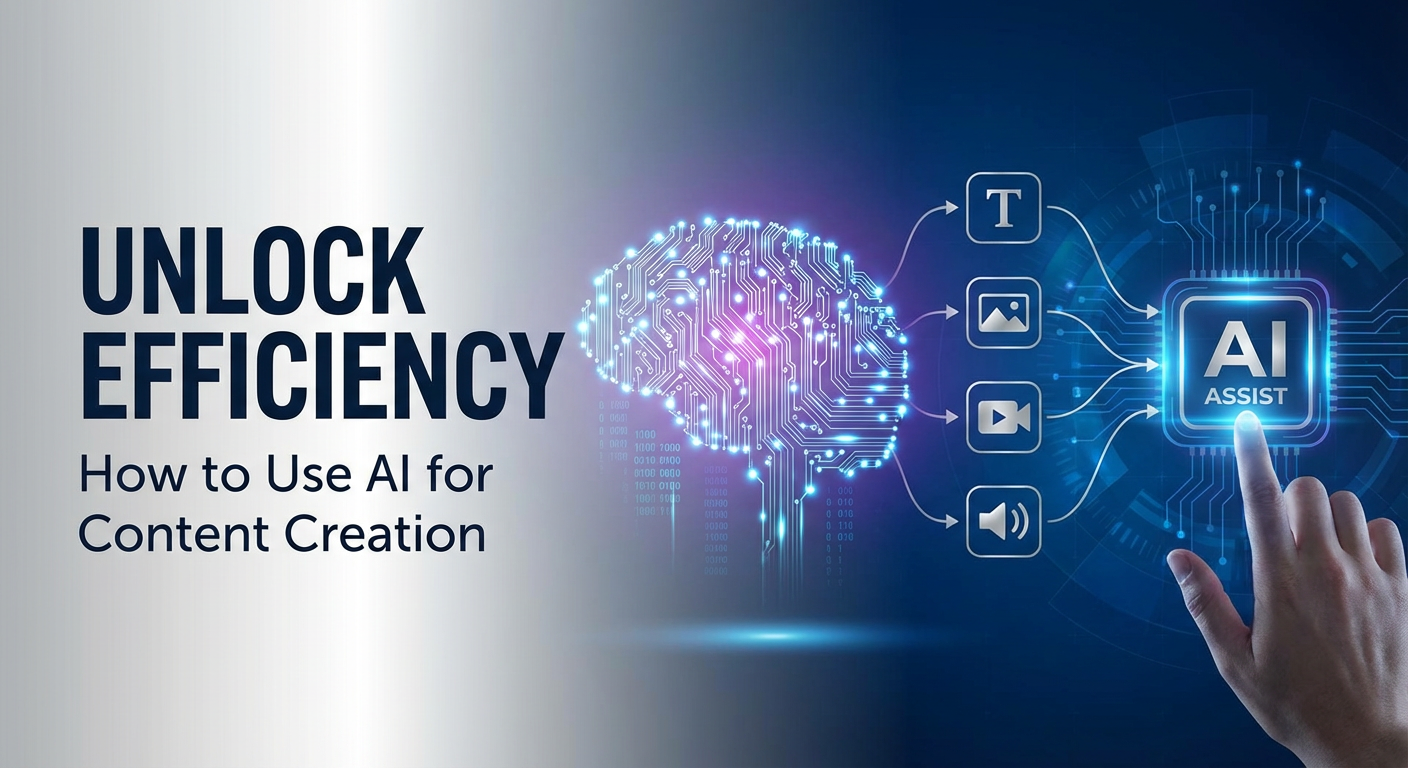
Unlock Efficiency: How to Use AI for Content Creation

In the rapidly evolving digital landscape, content reigns supreme. From engaging blog posts and compelling social media updates to intricate whitepapers and immersive narratives, the demand for high-quality, relevant content has never been higher. Yet, content creators, marketers, and businesses alike often find themselves grappling with a formidable challenge: how to consistently produce the sheer volume of content required to capture audience attention, drive engagement, and achieve business objectives, all while maintaining quality and authenticity. The creative process, by its very nature, can be time-consuming, resource-intensive, and prone to the dreaded writer's block.
Enter Artificial Intelligence. Far from being a futuristic concept, AI has firmly established itself as a transformative force, revolutionizing industries and reshaping workflows. For content creation, AI is not merely an automation tool; it’s a powerful co-pilot, an intelligent assistant capable of augmenting human creativity, streamlining arduous tasks, and unlocking unprecedented levels of efficiency. Understanding how to use AI for content creation effectively is no longer an optional skill but a critical competency for anyone looking to thrive in the modern content ecosystem. This comprehensive guide will delve deep into the practical applications of AI in content generation, exploring everything from foundational concepts to advanced strategies, ensuring you’re equipped to leverage this technology to its fullest potential.
The Content Landscape and the AI Revolution
The digital age has ushered in an era of content saturation. Every minute, vast amounts of information, entertainment, and marketing messages compete for our fleeting attention. For businesses, this means a constant pressure to stand out, to provide unique value, and to maintain a consistent brand voice across myriad platforms. This intense demand presents several challenges:
- Volume and Velocity: The need to publish frequently and across many channels can overwhelm even the most dedicated teams.
- Quality and Consistency: Maintaining high standards of writing, factual accuracy, and brand alignment across all content pieces is difficult at scale.
- Creativity and Originality: Constantly generating fresh ideas and novel approaches can lead to creative burnout.
- Resource Constraints: Budgetary limitations, staffing shortages, and time pressures often hinder ambitious content strategies.
Historically, these challenges were addressed by scaling human teams, which comes with its own set of complexities and costs. However, the advent of sophisticated AI models has presented a paradigm-shifting alternative. AI, particularly in the realm of natural language processing (NLP), has evolved to a point where it can understand, generate, and process human language with remarkable fluency and coherence.
This isn't about AI replacing human creativity; it's about augmenting it. Imagine having an intelligent assistant that can instantly generate ideas, draft outlines, summarize research, or even refine your prose – all at lightning speed. This is the promise of AI in content creation. It frees human creators from repetitive, mundane tasks, allowing them to focus on higher-level strategic thinking, injecting unique insights, and ensuring the emotional resonance and authentic voice that only humans can truly provide. By embracing how to use AI for content creation, we're not just automating tasks; we're redefining the very process of bringing ideas to life through words.
Foundation of AI Content Creation: Understanding Large Language Models (LLMs)
At the heart of much of the current AI content creation revolution are Large Language Models (LLMs). These sophisticated neural networks are the bedrock upon which many AI writing tools are built. To truly understand how to use AI for content creation, it's crucial to grasp what LLMs are and how they operate.
An LLM is essentially a type of artificial intelligence model trained on a massive dataset of text and code. This dataset can span trillions of words, drawn from books, articles, websites, conversations, and more. Through this extensive training, LLMs learn to understand the intricate patterns, grammar, semantics, and context of human language. They don't "understand" in the human sense, but rather become exceptionally adept at predicting the next most probable word or sequence of words given a particular input.
When you interact with an LLM, you provide it with a "prompt" – a piece of text that serves as an instruction or a starting point. The LLM then processes this prompt, draws upon its vast training knowledge, and generates a response that is statistically likely to be coherent, relevant, and grammatically correct.
Key Concepts in LLM Interaction:
- Prompt Engineering: This is the art and science of crafting effective prompts to guide the LLM towards the desired output. A well-engineered prompt is clear, specific, provides context, and often includes examples or constraints. It's the difference between asking "write about dogs" and "write a 300-word blog post introduction about the benefits of owning a golden retriever for first-time pet owners, using an enthusiastic and friendly tone, focusing on companionship and ease of training."
- Fine-tuning: While base LLMs are powerful, they can also be further trained or "fine-tuned" on smaller, domain-specific datasets. This allows them to specialize in particular styles, terminologies, or tasks, making their output even more tailored and accurate for specific use cases.
- Generative Pre-trained Transformer (GPT): One of the most prominent families of LLMs, developed by OpenAI. The "GPT" in gpt chat refers to this architecture. Tools like ChatGPT, which leverage GPT models, have brought AI's capabilities to the mainstream, demonstrating the conversational and creative potential of LLMs.
The power of LLMs lies in their versatility. They can generate text in various styles and formats, summarize complex information, translate languages, answer questions, and even engage in creative writing. However, it's vital to remember that LLMs are predictive engines, not sentient beings. Their output reflects the data they were trained on, which can sometimes include biases or factual inaccuracies. Therefore, human oversight and critical evaluation remain paramount when incorporating AI-generated content into your workflow.
Practical Applications: How to Use AI for Content Creation Across the Workflow
Integrating AI into your content creation workflow can transform every stage of the process, from initial brainstorming to final optimization. Let's explore practical ways to leverage AI to enhance efficiency, quality, and creativity. This section will demonstrate precisely how to use AI for content creation in a hands-on manner.
3.1 Content Ideation and Brainstorming
One of the most common hurdles for content creators is writer's block or a lack of fresh ideas. AI can be an incredible resource for sparking creativity and generating a wealth of concepts.
- Overcoming Writer's Block: When faced with a blank page, simply input a broad topic or a current challenge into an LLM like gpt chat. For example, "Generate 10 unique blog post ideas about sustainable living for urban millennials." The AI can swiftly provide a diverse list of angles, subtopics, and perspectives that you might not have considered.
- Generating Topics, Headlines, Outlines: AI can go beyond just ideas. Provide a topic, and it can suggest compelling headlines designed for click-through, or create a detailed outline with headings and subheadings, giving you a strong structural foundation for your content.
- Prompt Example (GPT Chat): "Generate 5 catchy, SEO-friendly headlines for a blog post about 'remote work productivity tips'. Also, provide a detailed outline for one of the suggested headlines."
- Audience Research Insights: While AI cannot conduct primary market research, it can analyze vast amounts of public data to infer audience interests and pain points. You can ask an AI to "list common challenges faced by small business owners trying to build an online presence" or "identify popular keywords related to 'healthy plant-based recipes' for Gen Z." This helps tailor your content to resonate more deeply with your target audience.
3.2 Research and Information Gathering
Traditional research can be incredibly time-consuming. AI can expedite this phase, providing quick summaries and extracting key information.
- Summarizing Long Articles: Instead of reading through dense academic papers or lengthy reports, paste the text into an AI tool and ask for a concise summary, highlighting the main arguments or key findings. This saves immense time during the initial review process.
- Extracting Key Facts: For specific data points or statistics, AI can quickly scan large documents and pull out relevant information, making it easier to populate your content with credible sources (though human verification is always critical).
- Synthesizing Information: If you have multiple sources on a single topic, AI can help synthesize the information, identifying common themes, contradictory points, and gaps in knowledge, giving you a consolidated overview.
- Citing Sources (Important Disclaimer): While AI can help locate information, it's crucial to understand that it doesn't verify sources in the human sense. Always independently verify any facts, figures, or claims generated by AI by cross-referencing with reputable human-authored sources. AI should be used as a research assistant, not a definitive fact-checker.
3.3 Drafting and Writing Content
This is where AI truly shines, offering assistance at every level of content generation, from initial drafts to polished prose. This demonstrates the core of how to use AI for content creation.
Blog Posts and Articles:
- Generating Initial Drafts: With a solid outline and a clear prompt, AI can produce surprisingly coherent first drafts of entire sections or even full articles. This eliminates the pressure of starting from scratch and provides a foundation to build upon.
- Prompt Example: "Write a 500-word section for a blog post on 'The Rise of Personal Branding' focusing on the importance of authenticity and consistency, targeting entrepreneurs."
- Expanding on Bullet Points: If you have a list of ideas or key points, AI can elaborate on each, transforming them into full paragraphs or detailed explanations.
- Improving Readability and Flow: AI can analyze your writing for clarity, conciseness, and natural flow. It can suggest alternative phrasing, simplify complex sentences, or reorder paragraphs for better logical progression.
Social Media Content:
- Crafting Engaging Captions: Given a topic or a piece of visual content, AI can generate multiple caption options tailored for different platforms (e.g., Twitter, Instagram, LinkedIn), incorporating relevant hashtags and emojis.
- Generating Hashtags: AI can identify trending and relevant hashtags to increase the visibility of your social media posts.
- Tailoring Content for Different Platforms: A single core message can be adapted by AI into various formats suitable for a tweet, a Facebook post, or a LinkedIn article excerpt.
Email Marketing:
- Subject Lines, Body Copy, Calls to Action: AI can generate compelling email subject lines designed to boost open rates, craft persuasive body copy, and formulate clear, actionable calls to action.
- Personalization at Scale: By integrating with customer data, AI can help personalize email content for different segments of your audience, making messages more relevant and effective.
Website Copy and Landing Pages:
- SEO-Optimized Descriptions: AI can assist in writing meta descriptions, product descriptions, and service explanations that are both informative for users and optimized for search engines.
- Compelling Value Propositions: By understanding your product or service, AI can help articulate unique selling points and craft persuasive value propositions for your landing pages.
Long-form Content (E-books, Whitepapers):
- Structuring Complex Documents: For extensive projects, AI can help in structuring chapters, subsections, and appendices, ensuring a logical flow from beginning to end.
- Assisting with Chapter Drafts: Much like with blog posts, AI can generate initial drafts for individual chapters or sections, accelerating the overall writing process for large documents.
3.4 Specialized Content Creation with AI
Beyond general writing tasks, AI is also proving incredibly valuable for more niche and creative content forms.
AI Story Generators:
The imaginative realm of storytelling has also been touched by AI. An ai story generator is a specialized tool designed to assist in creative writing, fiction, screenplays, and more.
- Creative Writing, Fiction, Scripts: Whether you're a novelist, a screenwriter, or just experimenting with creative writing, an AI story generator can provide a strong starting point or help overcome creative blocks. You can feed it a premise, characters, or a genre, and it can generate plot outlines, character descriptions, dialogue, or even full story drafts.
- Brainstorming Plot Points, Character Arcs: Stuck on a twist? Need a compelling character flaw? An AI story generator can suggest diverse plot developments, character motivations, and narrative arcs, offering fresh perspectives.
Here's a table comparing different approaches an ai story generator might take:
| Feature/Approach | Description | Best For | Limitations |
|---|---|---|---|
| Prompt-Based Generation | User provides a detailed prompt (genre, characters, setting, plot points), AI generates story from scratch. | Quickly generating initial drafts, overcoming writer's block. | Can lack deep emotional nuance, consistency over very long narratives. |
| Interactive Storytelling | AI generates a segment, user provides feedback/choices, AI continues story based on input. | Collaborative writing, exploring multiple plot directions. | Requires constant human interaction, can lead to fragmented narratives. |
| Outline & Plot Generation | AI focuses on creating detailed outlines, character bios, world-building elements, not full narratives. | Structuring complex stories, developing consistent lore. | Doesn't write the story itself, requires significant human expansion. |
| Style Emulation | AI attempts to write in the style of a specific author or genre (e.g., "Hemingway style"). | Experimenting with different voices, learning stylistic elements. | Can be superficial, may miss the true essence of a writer's unique voice. |
| Dialogue Generation | AI focuses solely on creating dialogue for characters based on their personalities and scene context. | Scriptwriting, improving character interactions, overcoming dialogue blocks. | May sound unnatural or generic without careful human editing. |
The key with an ai story generator is to view it as a collaborator, not a replacement. It can provide the raw material, but the human author's touch is indispensable for adding depth, emotion, and truly unique storytelling elements.
Video Scripting and Production Aids:
- Generating Scripts, Voiceover Narration: AI can write detailed video scripts, including dialogue, scene descriptions, and voiceover narration, based on your topic and desired length.
- Suggesting Visual Cues: Some advanced AI tools can even suggest visual elements or B-roll footage ideas that complement the script.
Podcast Outlines and Show Notes:
- Structuring Episodes: AI can help outline podcast episodes, suggesting segments, discussion points, and transitions.
- Writing Summaries: After recording, AI can transcribe and then summarize your podcast episodes, generating concise show notes and key takeaways for your listeners.
3.5 Optimization and Refinement
Once content is drafted, AI continues to be invaluable in the optimization and refinement stages.
SEO Optimization:
- Keyword Integration (Assistive): While human expertise is crucial for strategic keyword research, AI can assist in naturally integrating target keywords and related long-tail phrases throughout your content, ensuring it doesn't sound forced.
- Meta Descriptions, Title Tags: AI can generate various options for compelling meta descriptions and title tags that are optimized for both search engines and user clicks.
- Readability Scores: Many AI writing assistants can analyze your text for readability, providing scores (like Flesch-Kincaid) and suggesting improvements to make your content more accessible to your target audience.
Grammar, Spelling, and Style Checks:
- Beyond Basic Spell Checkers: AI-powered grammar tools go far beyond simple spell checks. They can identify complex grammatical errors, punctuation mistakes, and stylistic inconsistencies.
- Tone and Voice Consistency: AI can analyze your writing for its emotional tone (e.g., formal, casual, enthusiastic) and help you maintain a consistent brand voice across all your content.
- Paraphrasing and Rephrasing for Clarity: If a sentence is awkward or unclear, AI can suggest multiple ways to rephrase it, improving clarity and conciseness.
Translation and Localization:
- Reaching Global Audiences: AI-powered translation tools can quickly translate content into multiple languages, enabling businesses to reach a broader, global audience.
- Cultural Nuances (Human Oversight Crucial): While AI translation has improved significantly, human translators are still essential for ensuring cultural appropriateness and nuance, especially for sensitive or highly localized content. AI provides a strong first pass, but human review is non-negotiable for quality.
XRoute is a cutting-edge unified API platform designed to streamline access to large language models (LLMs) for developers, businesses, and AI enthusiasts. By providing a single, OpenAI-compatible endpoint, XRoute.AI simplifies the integration of over 60 AI models from more than 20 active providers(including OpenAI, Anthropic, Mistral, Llama2, Google Gemini, and more), enabling seamless development of AI-driven applications, chatbots, and automated workflows.
Best Practices for Integrating AI into Your Workflow
Maximizing the benefits of AI in content creation requires more than just knowing what tools exist; it demands a strategic approach and an understanding of best practices. Learning how to use AI for content creation optimally involves mastering prompt engineering and maintaining a human-centric perspective.
Prompt Engineering Mastery
The quality of AI output is directly proportional to the quality of the input prompt. Think of the AI as a brilliant but literal student – it will follow your instructions precisely.
- The Art of Crafting Effective Prompts:
- Clarity: Be unambiguous. Avoid vague language that can be interpreted in multiple ways.
- Specificity: Provide as much detail as possible. Define the desired output format, length, tone, target audience, and key points to include.
- Context: Give the AI background information. What is the purpose of this content? Who is it for? What has already been discussed?
- Constraints: Specify what not to include, or what limitations to adhere to (e.g., "do not use jargon," "keep sentences under 20 words").
- Examples (Few-shot prompting): If you have a desired style or format, provide an example. "Write an executive summary in the style of this example: [Paste example here]."
- Iterative Prompting: Don't expect perfection on the first try. AI interaction is often an iterative process. If the first output isn't quite right, refine your prompt. Tell the AI what you liked and disliked, and guide it towards the desired result. "That's good, but make it more humorous," or "Expand on point number 3 with more technical detail."
Human Oversight is Non-Negotiable
While AI is powerful, it is a tool, not a substitute for human intellect, creativity, and judgment.
- Fact-Checking, Ethical Considerations: AI can "hallucinate" information, presenting falsehoods as facts. Every piece of AI-generated content must be rigorously fact-checked. Moreover, consider the ethical implications: Is the content fair? Is it unbiased? Does it perpetuate harmful stereotypes?
- Maintaining Brand Voice and Authenticity: AI can mimic tones, but it struggles with the nuanced, intangible elements that define a unique brand voice. Human creators must infuse their content with genuine emotion, personal experiences, and the distinct personality of their brand. AI should augment your voice, not replace it.
- Adding Human Insight and Creativity: The most compelling content often comes from unique human insights, experiences, and empathy. Use AI to handle the grunt work, freeing you to focus on the strategic, creative, and uniquely human aspects of storytelling and persuasion. AI can write, but humans inspire.
Ethical Considerations and Responsible AI Use
As AI becomes more prevalent, responsible usage becomes paramount.
- Bias in AI Models: LLMs are trained on existing internet data, which often reflects societal biases. AI can inadvertently generate content that is biased, discriminatory, or harmful. Be aware of this potential and actively work to mitigate it through careful prompting and thorough review.
- Plagiarism Concerns: While AI doesn't "plagiarize" in the human sense, it generates text based on patterns it learned from existing data. There's a risk of it producing content that is too similar to its training sources. Always strive for originality and use AI as a tool for drafting and brainstorming, not for direct copying. Some content creators choose to disclose AI usage, especially in sensitive contexts.
- Transparency with Your Audience: Depending on your industry and audience, you might consider being transparent about your use of AI. This can build trust and manage expectations. While not always necessary for internal drafting, for public-facing content, it's a growing consideration.
Choosing the Right AI Tools
The AI landscape is bustling with a myriad of tools, each with its strengths.
- Diversity of Tools Available: From general-purpose LLMs like those behind gpt chat to specialized ai story generator platforms, and tools for grammar checking, SEO optimization, and image generation, the options are vast.
- Considering Features, Cost, Integration: Evaluate tools based on your specific needs: What content types do you create most? What's your budget? How well does the tool integrate with your existing workflow and other software? Do you need a unified solution for multiple AI models?
Advanced Strategies and Future Trends
To truly master how to use AI for content creation, it's beneficial to look beyond basic applications and explore more advanced strategies, while keeping an eye on emerging trends.
Customizing AI Models
For businesses with specific, high-volume content needs, customizing AI models can yield significant advantages.
- Fine-tuning for Specific Use Cases: While basic prompts can steer general LLMs, fine-tuning takes it a step further. This involves training an LLM on your own proprietary data – your brand style guide, past successful content, product descriptions, or internal documentation. This allows the AI to generate content that precisely matches your brand voice, tone, and specific terminology, reducing the need for extensive human editing post-generation. For example, a legal firm could fine-tune an LLM on their vast archive of legal briefs to generate initial drafts of new documents in their specific style and jargon.
- Building Proprietary Knowledge Bases: Integrating AI with your own knowledge base, FAQs, and product information allows it to become an expert on your specific offerings. This is crucial for accurate and contextually relevant content, such as support articles, product descriptions, or even internal communications. This process ensures the AI isn't relying solely on its general training data but has access to your unique, accurate information.
AI Orchestration and Automation
Beyond generating individual pieces of content, AI can be orchestrated to automate entire content pipelines.
- Integrating AI into Larger Content Management Systems: Imagine an AI that not only generates a blog post but also automatically schedules it, formats it for your CMS, and even crafts accompanying social media snippets. Integrations with platforms like WordPress, HubSpot, or custom CMS solutions are becoming more sophisticated, allowing for a seamless end-to-end content workflow.
- Automated Content Pipelines: For high-volume content like product descriptions for e-commerce, news summaries, or recurring reports, AI can be set up to automatically generate, review (with human checkpoints), and publish content based on incoming data or predefined triggers. This creates a highly efficient, scalable content factory.
The Rise of Unified AI API Platforms (XRoute.AI Integration)
As the AI landscape proliferates with an increasing number of LLMs from various providers, managing these diverse APIs can become a significant challenge for developers and businesses. Each model has its own integration requirements, pricing structures, and performance characteristics. This complexity hinders innovation and adds overhead.
This is where unified AI API platforms emerge as a critical solution. They simplify access to a multitude of AI models, abstracting away the underlying complexities. Among these innovative platforms, XRoute.AI stands out as a cutting-edge solution designed to streamline access to Large Language Models (LLMs) for developers, businesses, and AI enthusiasts.
XRoute.AI's Role in Modern Content Creation:
For those looking to leverage the full spectrum of AI capabilities for content creation, XRoute.AI offers a compelling advantage:
- Single, OpenAI-Compatible Endpoint: Instead of integrating with dozens of different APIs from various providers (e.g., OpenAI, Anthropic, Google, Mistral, etc.), developers can access over 60 AI models from more than 20 active providers through a single, standardized, OpenAI-compatible endpoint. This dramatically simplifies the integration process, allowing content creation applications to switch between models or even route requests dynamically without rewriting core code.
- Seamless Development of AI-Driven Applications: Whether you're building an ai story generator, a sophisticated content optimization tool, a smart chatbot for content distribution, or automated workflows for generating blog post drafts, XRoute.AI provides the backend infrastructure to make these applications robust and scalable.
- Focus on Performance and Cost-Effectiveness: XRoute.AI emphasizes low latency AI to ensure that your AI-powered content tools respond quickly, enhancing user experience and workflow efficiency. Furthermore, it aims for cost-effective AI solutions by potentially offering optimized routing to the best-performing and most economical models for a given task, allowing businesses to save on API expenses.
- Developer-Friendly Tools: With a focus on ease of use, XRoute.AI empowers developers to build intelligent solutions without the complexity of managing multiple API connections, accelerating the development cycle for new content creation tools and features.
- High Throughput and Scalability: For content operations requiring high volumes of AI-generated content, XRoute.AI provides the scalability and throughput necessary to handle demanding workloads, from startups to enterprise-level applications.
In the context of how to use AI for content creation, XRoute.AI allows creators and developers to tap into a vast ecosystem of LLMs with unprecedented ease. This means you can experiment with different models for different content tasks – perhaps one for creative brainstorming, another for factual summaries, and yet another for stylistic refinement – all through one unified platform, optimizing both performance and cost. It's about empowering innovation by simplifying access to the most advanced AI models available.
Conclusion
The journey into how to use AI for content creation reveals a landscape rich with opportunity and innovation. Far from being a futuristic threat to human creativity, AI has firmly established itself as an indispensable partner, empowering content creators to transcend traditional limitations and achieve unparalleled levels of efficiency, scale, and quality.
We've explored how AI, underpinned by powerful LLMs like those behind gpt chat, can revolutionize every stage of the content workflow. From generating fresh ideas and outlines to drafting compelling narratives with an ai story generator, from optimizing for SEO to refining grammar and style, AI tools are designed to augment, not replace, human ingenuity. They free up valuable time previously spent on repetitive tasks, allowing creators to focus on strategic thinking, critical analysis, injecting authentic voice, and developing the deep emotional resonance that only human insight can provide.
The effective integration of AI demands a blend of technical understanding and creative foresight. Mastering prompt engineering, maintaining rigorous human oversight, adhering to ethical guidelines, and continuously evaluating new tools are crucial for success. As the AI landscape continues to evolve, platforms like XRoute.AI exemplify the future of AI access, simplifying the complexity of integrating diverse LLMs and enabling developers to build sophisticated, high-performance, and cost-effective AI content solutions with low latency AI.
Ultimately, the future of content creation is a collaborative one – a symbiotic relationship between human creativity and artificial intelligence. Embrace these powerful tools, learn to wield them strategically, and unlock a new era of content creation that is not only efficient but also more innovative, engaging, and impactful than ever before. The content creators who master this collaboration will undoubtedly lead the charge in shaping the digital narratives of tomorrow.
Frequently Asked Questions (FAQ)
Q1: Is AI going to replace content creators? A1: No, AI is not expected to replace content creators entirely. Instead, it serves as a powerful augmentation tool. AI can handle repetitive, data-driven, and preliminary drafting tasks, freeing human creators to focus on higher-level strategic thinking, injecting unique insights, ensuring brand authenticity, and adding the emotional depth and creativity that only humans can provide. It's a co-pilot, not a replacement.
Q2: How accurate is AI-generated content? A2: The accuracy of AI-generated content can vary. While LLMs are trained on vast datasets and can produce factually correct information, they are also prone to "hallucinations," where they generate plausible-sounding but incorrect or fabricated information. Therefore, it is crucial for human creators to rigorously fact-check and verify all AI-generated content before publication, especially for sensitive or critical topics.
Q3: What are the main benefits of using an AI story generator? A3: An ai story generator offers several benefits, primarily for creative writers. It can help overcome writer's block by providing initial plot ideas, character concepts, or dialogue snippets. It speeds up the drafting process, allows for exploration of multiple narrative directions, and can assist in structuring complex stories. It acts as a brainstorming partner, sparking creativity and providing raw material for human refinement.
Q4: Can I use GPT Chat for all my content needs? A4: While gpt chat (or other similar LLM interfaces) is incredibly versatile and can assist with many content tasks, it's generally not suitable for all content needs in isolation. For best results, it should be integrated into a broader workflow. It excels at brainstorming, drafting, summarizing, and refining, but human oversight is essential for fact-checking, ensuring brand voice consistency, and adding the unique perspective and emotional resonance that define high-quality content. Specialized tools might also offer better functionality for specific tasks like SEO optimization or image generation.
Q5: How can a platform like XRoute.AI help my content creation efforts? A5: XRoute.AI streamlines your content creation efforts by providing a unified API platform to access over 60 AI models from 20+ providers through a single, OpenAI-compatible endpoint. This simplifies development, reduces integration complexity, and allows you to seamlessly switch between different LLMs for various content tasks (e.g., one model for creative brainstorming, another for factual summarization). It aims to offer low latency AI and cost-effective AI solutions, ensuring your AI-powered content tools are efficient, scalable, and economical, empowering you to build advanced AI-driven applications without the hassle of managing multiple API connections.
🚀You can securely and efficiently connect to thousands of data sources with XRoute in just two steps:
Step 1: Create Your API Key
To start using XRoute.AI, the first step is to create an account and generate your XRoute API KEY. This key unlocks access to the platform’s unified API interface, allowing you to connect to a vast ecosystem of large language models with minimal setup.
Here’s how to do it: 1. Visit https://xroute.ai/ and sign up for a free account. 2. Upon registration, explore the platform. 3. Navigate to the user dashboard and generate your XRoute API KEY.
This process takes less than a minute, and your API key will serve as the gateway to XRoute.AI’s robust developer tools, enabling seamless integration with LLM APIs for your projects.
Step 2: Select a Model and Make API Calls
Once you have your XRoute API KEY, you can select from over 60 large language models available on XRoute.AI and start making API calls. The platform’s OpenAI-compatible endpoint ensures that you can easily integrate models into your applications using just a few lines of code.
Here’s a sample configuration to call an LLM:
curl --location 'https://api.xroute.ai/openai/v1/chat/completions' \
--header 'Authorization: Bearer $apikey' \
--header 'Content-Type: application/json' \
--data '{
    "model": "gpt-5",
    "messages": [
        {
            "content": "Your text prompt here",
            "role": "user"
        }
    ]
}'
With this setup, your application can instantly connect to XRoute.AI’s unified API platform, leveraging low latency AI and high throughput (handling 891.82K tokens per month globally). XRoute.AI manages provider routing, load balancing, and failover, ensuring reliable performance for real-time applications like chatbots, data analysis tools, or automated workflows. You can also purchase additional API credits to scale your usage as needed, making it a cost-effective AI solution for projects of all sizes.
Note: Explore the documentation on https://xroute.ai/ for model-specific details, SDKs, and open-source examples to accelerate your development.