Unlock Multi-Model Power with Unified LLM API
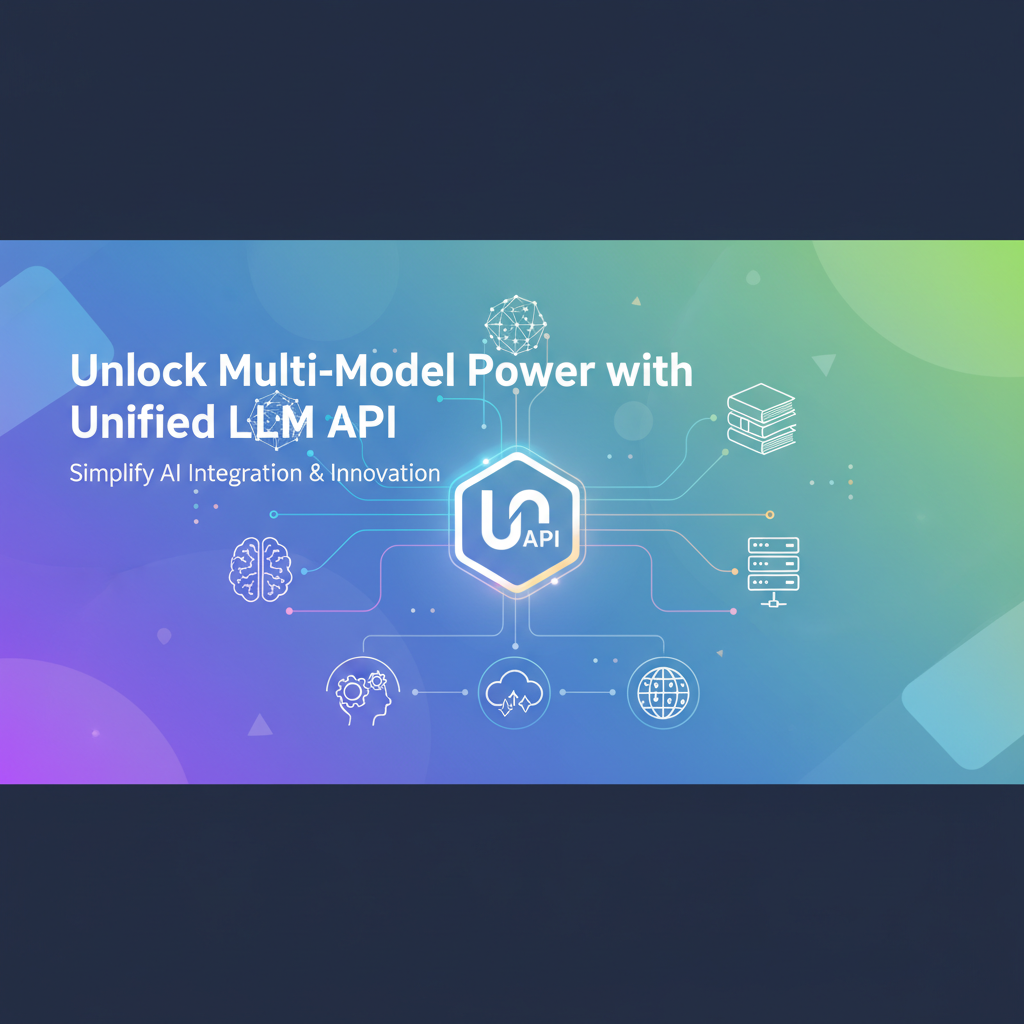

In the rapidly evolving landscape of artificial intelligence, Large Language Models (LLMs) have emerged as pivotal technologies, reshaping how we interact with information, automate tasks, and create content. From sophisticated chatbots that deliver nuanced customer support to advanced content generation engines that fuel marketing campaigns, LLMs are at the forefront of innovation. However, the sheer proliferation of these powerful models, each with its unique strengths, weaknesses, and API specifications, has introduced a significant challenge for developers: complexity. Integrating, managing, and optimizing across multiple LLMs can be a daunting, resource-intensive, and often counterproductive endeavor. This is precisely where the concept of a Unified LLM API steps in, offering a transformative solution that not only simplifies integration but also unlocks unparalleled multi-model support and intelligent LLM routing capabilities.
This comprehensive guide will delve deep into the intricacies of Unified LLM APIs, exploring their fundamental architecture, the myriad benefits they offer, critical use cases, and how they are paving the way for a more flexible, efficient, and future-proof approach to AI development. We will unpack how these platforms streamline the development lifecycle, optimize performance, and significantly reduce operational costs, making advanced AI more accessible and manageable for businesses and developers alike.
The Fragmented Frontier: Understanding the LLM Landscape
The advent of foundation models like GPT, Claude, Llama, Gemini, and a plethora of specialized models has democratized access to powerful AI capabilities. Each model, often developed by different organizations, comes with its own set of characteristics:
- Diverse Architectures and Training Data: Models vary significantly in their underlying architectures, the scale and diversity of their training data, and the specific domains they excel in. For instance, some might be exceptional at creative writing, while others are fine-tuned for code generation or legal document analysis.
- Varying Performance Metrics: Latency, throughput, accuracy, and token limits differ widely across models. A model optimized for speed might sacrifice some accuracy, while a highly accurate model might incur higher latency.
- Proprietary APIs and SDKs: Each LLM provider typically offers its own unique API endpoints, data formats, authentication mechanisms, and software development kits (SDKs). This creates a fragmented ecosystem where integrating even two different models requires significant boilerplate code and specialized knowledge.
- Cost Structures: The pricing models for LLMs are diverse, ranging from per-token costs to subscription-based access, with significant variations based on model size, complexity, and usage tiers.
- Compliance and Data Privacy: Different models and providers may adhere to varying levels of data privacy and compliance standards, which can be a critical consideration for enterprises operating in regulated industries.
The Developer's Dilemma: Challenges of Multi-LLM Integration
For developers and organizations aiming to leverage the full spectrum of LLM capabilities, this fragmentation presents a formidable set of challenges:
- Increased Development Time and Effort: Integrating multiple distinct APIs means writing custom connectors, managing different authentication schemes, normalizing input/output formats, and handling diverse error codes. This repetitive work diverts valuable developer resources from core application logic.
- Maintenance Nightmares: As LLMs evolve, APIs change, and new models emerge, maintaining a codebase that directly integrates with numerous providers becomes a continuous and resource-intensive task. Backward compatibility issues, deprecations, and new feature updates demand constant attention.
- Vendor Lock-in Concerns: Relying heavily on a single LLM provider can lead to vendor lock-in, limiting flexibility to switch to better-performing, more cost-effective, or more specialized models as the market evolves.
- Suboptimal Performance and Cost: Without a unified strategy, applications might default to a single LLM for all tasks, even if other models could offer superior performance, lower latency, or reduced costs for specific queries. Manually switching models based on task requirements is often impractical at scale.
- Lack of Centralized Control and Observability: Managing API keys, monitoring usage, tracking costs, and analyzing performance metrics across disparate LLM services is incredibly complex, hindering effective resource allocation and strategic decision-making.
- Scalability Headaches: Ensuring that multi-LLM integrations scale gracefully under varying loads, while maintaining performance and controlling costs, requires sophisticated infrastructure and load balancing mechanisms that are difficult to build and manage in-house.
These challenges highlight a critical need for a more streamlined, standardized, and intelligent approach to LLM integration – a need that a Unified LLM API is designed to meet head-on.
Introducing the Unified LLM API: A Paradigm Shift
A Unified LLM API acts as an intelligent abstraction layer, sitting between your application and a multitude of underlying LLM providers. Instead of directly interacting with dozens of distinct APIs, developers interact with a single, standardized endpoint. This elegant solution transforms the complex multi-LLM landscape into a coherent, manageable ecosystem.
At its core, a Unified LLM API platform provides:
- A Single Endpoint: Your application sends requests to one consistent API endpoint, regardless of which LLM model you intend to use.
- Standardized Request/Response Formats: All interactions follow a common data format (often inspired by or compatible with the OpenAI API standard), eliminating the need for custom data marshaling and unmarshaling logic for each provider.
- Centralized Authentication: Manage all your LLM provider API keys and credentials in one secure location within the unified platform.
- Intelligent Backend Logic: The platform intelligently handles the translation of your standardized request into the specific API call for the chosen LLM, processes its response, and translates it back into the unified format before sending it to your application.
Think of it like a universal adapter for power outlets. Instead of carrying a different charger for every country you visit, you carry one adapter that allows your device to plug into any outlet. Similarly, a Unified LLM API allows your application to "plug into" any LLM with a single interface.
The Foundation of Flexibility: How It Works
The magic of a Unified LLM API lies in its sophisticated routing and translation layer. When your application makes a request to the unified endpoint, the platform performs several critical functions:
- Request Reception: It receives the standardized request, which might include parameters specifying the desired model, task, or routing preferences.
- Authentication & Authorization: Verifies your credentials and ensures you have access to the requested services.
- Model Selection (LLM Routing): Based on explicit instructions from your application, predefined rules, or dynamic optimization algorithms, the platform selects the most appropriate underlying LLM from its vast network of providers. This is where LLM routing truly shines.
- Request Translation: The platform translates your standardized request into the specific API format required by the chosen LLM provider (e.g., converting a
messagesarray into apromptstring or adapting specific parameters). - Execution & Response: It forwards the translated request to the LLM provider, receives its response, and then translates that response back into the unified format expected by your application.
- Logging & Monitoring: Records usage metrics, performance data, and costs associated with each request, providing centralized observability.
This seamless process occurs within milliseconds, largely imperceptible to the end-user, yet profoundly impactful for the developer.
Unpacking the Core Advantages: Why Unified LLM APIs are Indispensable
The benefits of adopting a Unified LLM API platform extend far beyond mere convenience. They fundamentally alter the economics and operational dynamics of AI development, offering strategic advantages that are difficult to achieve through direct integration.
1. Simplified Integration and Accelerated Development
This is perhaps the most immediate and tangible benefit. By abstracting away the complexities of multiple vendor-specific APIs, a Unified LLM API drastically reduces the boilerplate code developers need to write.
- One API to Learn: Instead of mastering the nuances of OpenAI, Cohere, Anthropic, Google, and dozens of open-source models, developers only need to understand one consistent API specification. This significantly flattens the learning curve.
- Reduced Development Time: Less code means faster development cycles. Teams can focus on building innovative features and improving user experience rather than wrestling with API compatibility issues.
- Streamlined Onboarding: New team members can quickly get up to speed on LLM integration, as the core interaction pattern remains constant.
- Fewer Bugs: A single, well-tested integration point naturally leads to fewer potential points of failure and bugs related to API interactions.
Imagine having a single client library or SDK that seamlessly works across all major LLMs. This drastically reduces the cognitive load and implementation effort for every AI-driven feature.
2. Enhanced Flexibility and Multi-Model Support
The ability to seamlessly switch between and combine various LLMs is a cornerstone of modern AI application development, and a Unified LLM API makes this effortless. Multi-model support is not just a feature; it's a strategic imperative.
- Task-Specific Optimization: Different LLMs excel at different tasks. For instance, one model might be superior for creative storytelling, another for precise summarization, and a third for generating code. With a unified API, you can dynamically select the best model for each specific query or user intent, ensuring optimal performance and output quality.
- Resilience and Fallback: What if your primary LLM provider experiences an outage or performance degradation? A unified API can automatically failover to an alternative model from a different provider, ensuring continuous service availability. This significantly boosts the reliability and robustness of your AI applications.
- Access to Cutting-Edge Models: The LLM landscape is constantly evolving, with new, more powerful, or more specialized models emerging regularly. A unified platform typically integrates these new models quickly, allowing your application to leverage the latest advancements without requiring a complete re-architecture of your integration layer.
- Experimentation and A/B Testing: Developers can easily experiment with different models to identify which performs best for specific use cases or user segments, facilitating rapid iteration and optimization. This is crucial for refining prompts, improving response quality, and discovering unexpected capabilities.
By providing seamless multi-model support, these platforms transform AI development from a rigid, single-model approach to a dynamic, adaptive strategy.
3. Intelligent LLM Routing: The Brain Behind the Operation
Perhaps the most sophisticated and impactful feature of a robust Unified LLM API is its intelligent LLM routing capability. This feature goes beyond simple model selection; it's about dynamically directing requests to the most appropriate model based on a predefined set of criteria, real-time performance metrics, and cost considerations.
How LLM Routing Works:
At its core, LLM routing involves a decision-making engine that analyzes incoming requests and routes them to an optimal backend LLM. This decision can be based on:
- Cost Optimization: Automatically route requests to the most cost-effective model that meets the required performance and quality benchmarks. For instance, less critical internal queries might go to a cheaper, slightly less powerful model, while customer-facing interactions demand a premium model.
- Performance Optimization (Low Latency AI): Prioritize models that offer the lowest latency for time-sensitive applications. If one provider is experiencing higher latency, requests can be dynamically rerouted to a faster alternative. This is critical for real-time applications like chatbots and voice assistants.
- Quality and Accuracy: Route specific types of queries (e.g., highly technical questions, creative writing prompts) to models known for their superior performance in those particular domains.
- Reliability and Redundancy: As mentioned, if a primary model fails or becomes unavailable, requests can be instantly rerouted to a backup model, ensuring high availability and system resilience.
- Load Balancing: Distribute requests across multiple models or even multiple instances of the same model (if available from different providers) to prevent any single model from becoming a bottleneck.
- Task-Specific Routing: Configure rules to send all summarization tasks to Model A, all code generation tasks to Model B, and all creative writing tasks to Model C.
- User-Segment Routing: Provide different models or model configurations for different user tiers (e.g., premium users get access to the most advanced models).
- Sentiment-Based Routing: Route customer service queries based on detected sentiment – urgent or negative sentiment might trigger routing to a highly specialized, empathetic model, while neutral queries go to a standard one.
Advanced Routing Strategies:
Beyond basic rules, sophisticated platforms employ advanced algorithms for LLM routing:
- Dynamic Performance Metrics: Real-time monitoring of LLM latency, error rates, and throughput to make routing decisions on the fly.
- Cost-Aware Algorithms: Integrating up-to-date pricing information to always choose the most economical route without compromising on quality or performance.
- Semantic Routing: Analyzing the semantic content of the prompt itself to determine the best model, even without explicit tagging by the developer.
- Prompt Engineering Optimization: Some routing systems can even dynamically adapt prompt templates for different models to achieve consistent output quality.
The power of intelligent LLM routing is immense. It allows applications to achieve a delicate balance between performance, cost, and quality, adapting dynamically to changes in the LLM ecosystem and the specific demands of each request.
4. Cost-Effectiveness and Optimization (Cost-Effective AI)
Managing costs is paramount for any business leveraging cloud services, and LLMs can become a significant expenditure. A Unified LLM API provides powerful tools for achieving cost-effective AI.
- Dynamic Pricing Leverage: Providers constantly adjust their pricing. A unified platform can integrate these pricing changes in real-time and, through intelligent LLM routing, automatically direct traffic to the most affordable model that meets your performance criteria.
- Tiered Model Usage: Easily implement strategies where less critical or internal requests are routed to cheaper, smaller models, reserving premium, more expensive models for high-value or customer-facing interactions.
- Reduced Overhead: By centralizing management and preventing vendor lock-in, organizations avoid the hidden costs associated with re-integrating systems when switching providers or adapting to new models.
- Granular Cost Tracking: Centralized dashboards provide a clear, consolidated view of LLM usage and expenditure across all providers, making budgeting and financial planning much more transparent and manageable.
- Caching Mechanisms: Some unified APIs implement intelligent caching for common or repeatable requests, significantly reducing the number of calls to expensive LLM providers and thus lowering costs.
5. Improved Reliability and Redundancy
A single point of failure in any critical system is a significant risk. By offering multi-model support and intelligent LLM routing, Unified LLM APIs inherently build in higher levels of reliability and redundancy.
- Automatic Failover: As discussed, if one provider's API goes down or experiences severe degradation, the system can automatically switch to another available model from a different provider, ensuring business continuity. This is a crucial aspect of enterprise-grade AI applications.
- Load Distribution: By distributing requests across multiple models and providers, the platform reduces the load on any single service, minimizing the risk of hitting rate limits or causing performance bottlenecks.
- Geographic Redundancy: Some platforms allow routing to models hosted in different geographical regions, mitigating risks associated with regional outages or network issues.
6. Future-Proofing AI Applications
The AI landscape is characterized by rapid innovation. What is state-of-the-art today might be superseded tomorrow. Direct integrations often lead to legacy code and painful refactoring when new, better models emerge.
- Seamless Model Upgrades: A unified API allows you to experiment with and switch to newer, more advanced models with minimal disruption to your application's codebase. The underlying integration logic remains unchanged; only the configuration of the routing rules needs to be updated.
- Adaptability to Emerging Technologies: As new types of foundation models (e.g., multimodal models, domain-specific small language models) become prevalent, a well-designed unified API can quickly integrate them, keeping your applications at the cutting edge.
- Reduced Technical Debt: By abstracting away the specifics of each LLM, you reduce the technical debt associated with maintaining bespoke integrations, freeing resources for innovation.
7. Centralized Management and Observability
For organizations operating at scale, gaining insight into LLM usage, performance, and costs across numerous models and applications is vital.
- Unified Monitoring Dashboards: Provides a single pane of glass for monitoring API calls, latency, error rates, token usage, and costs across all integrated LLMs. This holistic view is invaluable for performance tuning and resource allocation.
- Centralized Logging: All LLM interactions are logged in a consistent format, simplifying debugging, auditing, and compliance efforts.
- API Key Management: Securely manage and rotate all LLM provider API keys from a single interface, enhancing security posture and reducing administrative burden.
- Access Control: Implement fine-grained access control to different models and features for various teams or users within your organization.
- Quota Management: Set and enforce usage quotas for different models or projects to control spending and prevent unexpected overages.
This centralized control provides the transparency and governance necessary for large-scale AI deployments.
Technical Deep Dive: The Inner Workings
To fully appreciate the power of a Unified LLM API, it's helpful to understand some of the underlying technical mechanisms that make it possible.
The Proxy Layer Concept
At its heart, a Unified LLM API is a sophisticated proxy server. When your application sends a request, it doesn't directly hit the LLM provider's servers. Instead, it hits the unified API's endpoint. This proxy layer performs several critical functions:
- Request Ingestion: Receives the incoming request from your application.
- Authentication & Authorization: Verifies the API key or token provided by your application against its internal user management system. It also checks if your application is authorized to use the requested models or features.
- Payload Transformation (Input): This is a key step. The unified API receives a standardized payload (e.g., an OpenAI-compatible JSON structure). If the target LLM expects a different format (e.g., a simple text string for a prompt, different parameter names), the proxy translates the incoming payload into the target LLM's specific input format. This might involve:
- Converting
messagesarrays into a singlepromptstring. - Mapping
temperaturetocreativity_level. - Adding provider-specific metadata.
- Converting
- Model Selection & Routing: Based on configurations (explicit model choice in the request, or intelligent routing rules), the proxy determines which underlying LLM provider and model to use.
- API Key Insertion: Inserts the appropriate, securely stored API key for the chosen LLM provider into the outgoing request.
- Rate Limiting & Throttling: Applies rate limits either globally, per user, or per model to prevent abuse and manage costs.
- Request Forwarding: Forwards the transformed request to the chosen LLM provider's actual API endpoint.
- Response Ingestion: Receives the response from the LLM provider.
- Payload Transformation (Output): Again, a crucial step. The LLM provider's response is often in its own format. The proxy transforms this back into the unified output format expected by your application. This could involve:
- Extracting the generated text from a nested JSON structure.
- Normalizing error codes and messages.
- Standardizing token usage reporting.
- Response Caching (Optional): If the response is cacheable (e.g., for common, deterministic queries), it stores it for future requests, reducing latency and cost.
- Logging & Metrics: Records details of the request and response, including latency, token usage, cost, and any errors.
- Response Delivery: Sends the transformed, unified response back to your application.
Standardized Request/Response Formats (OpenAI Compatibility)
A common strategy for Unified LLM APIs is to adopt or closely mimic the OpenAI API specification. This is because OpenAI's API has become a de facto standard in the industry, and many developers are already familiar with its structure for sending prompts, managing conversations, and handling responses. By offering an OpenAI-compatible endpoint, unified platforms significantly reduce the barrier to entry for developers who are already working with or accustomed to OpenAI's ecosystem. This compatibility extends to:
- Chat Completion Endpoints:
messagesarray for conversational turns. - Text Completion Endpoints: Simple
promptstring inputs. - Model Parameterization: Common parameters like
temperature,max_tokens,stop_sequences. - Response Structure: Consistent fields for
id,object,created,model,choices, andusage.
This standardization means your application code can largely remain unchanged even when you switch between different backend LLMs.
Caching Strategies
Intelligent caching is a powerful optimization employed by many Unified LLM APIs. It works on the principle that if an identical request is made multiple times, and the LLM's response is likely to be the same, the platform can serve the response from its cache rather than re-querying the LLM provider.
- Benefits of Caching:
- Reduced Latency: Responses are served much faster from a local cache than from a remote LLM API.
- Cost Savings: Fewer calls to expensive LLM providers directly translate to lower operational costs.
- Reduced API Load: Less traffic sent to upstream LLM providers, potentially preventing rate limit issues.
- Types of Caching:
- Exact Match Caching: Stores and retrieves responses only for absolutely identical requests.
- Semantic Caching: More advanced, attempts to determine if two slightly different prompts have the same underlying intent and can reuse a cached response.
- TTL (Time-To-Live) Based Caching: Responses are cached for a specific duration, after which they expire and are re-fetched.
Effective caching is a cornerstone of achieving low latency AI and cost-effective AI at scale.
XRoute is a cutting-edge unified API platform designed to streamline access to large language models (LLMs) for developers, businesses, and AI enthusiasts. By providing a single, OpenAI-compatible endpoint, XRoute.AI simplifies the integration of over 60 AI models from more than 20 active providers(including OpenAI, Anthropic, Mistral, Llama2, Google Gemini, and more), enabling seamless development of AI-driven applications, chatbots, and automated workflows.
Real-World Applications: Where Unified LLM APIs Shine
The versatility and efficiency offered by a Unified LLM API make it an invaluable tool across a multitude of industries and use cases.
1. Advanced Chatbots and Conversational AI
- Dynamic Personalization: Route customer inquiries to the LLM best suited for the topic (e.g., technical support to a highly factual model, empathetic responses to a model tuned for sentiment).
- Robust Fallback: Ensure continuous availability even if one model fails, providing uninterrupted customer service.
- Cost Optimization: Use a cheaper model for initial general queries, switching to a more powerful, expensive model only for complex or critical interactions.
- Multilingual Support: Integrate various LLMs that excel in different languages, providing seamless global customer support.
2. Content Generation and Marketing Automation
- Varied Content Styles: Leverage different models for generating different types of content – one for formal business reports, another for creative social media captions, and a third for SEO-optimized blog posts.
- Automated A/B Testing: Generate multiple versions of marketing copy with different LLMs and test their effectiveness without re-writing integration code for each model.
- Scalable Content Production: Rapidly scale content creation by tapping into a pool of LLMs, ensuring diverse outputs and avoiding single-model bottlenecks.
3. Code Generation and Developer Tools
- Polyglot Code Assistance: Integrate models proficient in different programming languages to offer robust code suggestions, refactoring, and documentation generation across various tech stacks.
- Error Correction & Debugging: Route error messages to specific diagnostic models that can offer more precise solutions or explanations.
- Test Case Generation: Use different models to generate diverse sets of unit tests, improving code coverage and quality.
4. Data Analysis and Insights
- Natural Language Querying (NLQ): Translate complex natural language questions into database queries or data visualizations using specialized models.
- Sentiment Analysis at Scale: Employ multiple sentiment analysis models (some general, some industry-specific) to process large volumes of text data from customer reviews, social media, or internal communications.
- Automated Reporting: Generate summaries and insights from raw data using models best suited for information extraction and synthesis.
5. Customer Support Automation
- Intelligent Ticket Routing: Beyond basic keywords, use LLMs to understand the intent and urgency of customer tickets, routing them to the correct department or a specialized LLM for an initial draft response.
- Knowledge Base Enhancement: Automatically generate FAQs, summarize complex articles, or identify gaps in existing knowledge bases using various LLMs.
- Agent Assist: Provide real-time suggestions to human agents, drawing insights from multiple LLMs to offer comprehensive and accurate information.
6. Education and Personalization
- Adaptive Learning Paths: Personalize educational content and exercises by dynamically selecting LLMs that can generate explanations tailored to a student's learning style or current understanding.
- Interactive Tutoring: Create highly responsive and informative tutoring systems that can answer diverse questions using the best available models for different subjects.
- Content Summarization for Learners: Provide concise summaries of complex texts, adapting the summarization model based on the learner's age or proficiency level.
Choosing the Right Unified LLM API Platform
With the increasing recognition of their value, several platforms are emerging in the Unified LLM API space. Selecting the right one is crucial for long-term success. Here are key considerations:
- Breadth of Supported Models and Providers: Look for a platform that integrates a wide array of LLMs from major providers (OpenAI, Anthropic, Google, Cohere, etc.) as well as popular open-source models. The more options, the greater your flexibility.
- Performance (Low Latency AI, High Throughput): Evaluate the platform's infrastructure and its ability to handle high volumes of requests with minimal latency. Ask about caching mechanisms, geographic distribution of their endpoints, and load balancing strategies.
- Sophistication of LLM Routing Capabilities: Does it offer basic model selection, or advanced, dynamic routing based on cost, performance, content, or custom rules? Can you define complex fallback strategies?
- Developer Experience: How easy is it to get started? Look for clear documentation, comprehensive SDKs (for your preferred languages), intuitive dashboards, and responsive support. An OpenAI-compatible endpoint is a big plus.
- Pricing Model (Cost-Effective AI): Understand the platform's pricing structure. Is it usage-based, subscription-based, or a hybrid? Does it provide tools for cost monitoring and optimization? Are there hidden fees?
- Security and Compliance: Given that LLMs often handle sensitive data, robust security features (data encryption, access control, audit logs) and compliance certifications (e.g., SOC 2, ISO 27001, GDPR) are paramount.
- Scalability: Can the platform scale with your application's growth, accommodating increasing request volumes and new model integrations without performance degradation?
- Observability and Analytics: Does it offer comprehensive dashboards for monitoring usage, costs, latency, and errors across all models? Are logs easily accessible and integrated with existing monitoring tools?
- Customization and Extensibility: Can you add your own fine-tuned models or even integrate private LLMs through the platform? Does it allow for custom pre-processing or post-processing of requests/responses?
The Future of LLM Integration: A Unified Horizon
The trajectory of AI development clearly points towards greater abstraction, intelligence, and accessibility. Unified LLM APIs are not just a temporary fix but a foundational shift in how we build and manage AI applications.
Looking ahead, we can anticipate several key trends:
- Increased Specialization and Multimodality: As LLMs become more specialized (e.g., for specific industries like healthcare or finance) and multimodal (handling text, images, audio, video), Unified APIs will play an even more critical role in orchestrating these diverse capabilities.
- Advanced AI Agents and Orchestration: Unified APIs will form the backbone for more sophisticated AI agents that can dynamically choose tools and models to accomplish complex tasks, seamlessly switching between different LLMs for planning, execution, and verification steps.
- Edge AI Integration: As LLMs become smaller and more efficient, allowing for deployment on edge devices, unified platforms might extend to manage the routing and interaction between cloud-based and edge-based models.
- Greater Focus on Trust and Explainability: Future platforms will likely incorporate more features for tracking model provenance, ensuring data privacy, and providing greater transparency into LLM decisions, crucial for regulatory compliance and public trust.
- Democratization of Advanced AI: By lowering the barrier to entry, Unified LLM APIs will empower a broader range of developers and businesses to build innovative AI solutions without needing deep expertise in the underlying complexities of individual models.
The vision is clear: developers will focus on the "what" – what problem to solve and what user experience to create – while the Unified LLM API handles the "how" – how to optimally access, route, and manage the ever-expanding universe of AI models.
XRoute.AI: Your Gateway to Multi-Model LLM Power
In this dynamic and complex LLM landscape, navigating the myriad of models and APIs can be a significant hurdle. This is precisely where platforms like XRoute.AI emerge as crucial enablers for developers and businesses alike. XRoute.AI stands out as a cutting-edge unified API platform specifically designed to streamline access to large language models (LLMs), offering a powerful solution for those seeking both simplicity and advanced capabilities.
XRoute.AI addresses the core challenges of LLM integration head-on by providing a single, OpenAI-compatible endpoint. This eliminates the need for developers to grapple with multiple, disparate APIs, drastically simplifying the integration of a vast ecosystem of models. The platform boasts support for over 60 AI models from more than 20 active providers, encompassing a wide spectrum of capabilities and ensuring robust multi-model support for any application.
What truly sets XRoute.AI apart is its commitment to facilitating seamless development of AI-driven applications, chatbots, and automated workflows. Its architecture is meticulously designed for low latency AI, ensuring that your applications respond quickly and efficiently, a critical factor for real-time user experiences. Furthermore, XRoute.AI's intelligent LLM routing capabilities are at the heart of its efficiency, allowing developers to dynamically select the most appropriate model based on performance, cost, or specific task requirements. This translates directly into cost-effective AI solutions, as the platform helps optimize expenditures by routing requests to the most economical model that meets your application's needs without compromising on quality.
Developers will find XRoute.AI to be incredibly developer-friendly, with intuitive tools and a consistent interface that accelerates the development process. Its high throughput and scalability ensure that projects of all sizes, from agile startups to expansive enterprise-level applications, can confidently grow and adapt without encountering performance bottlenecks. The flexible pricing model further enhances its appeal, allowing businesses to optimize their AI spending according to their specific usage patterns and strategic goals.
By abstracting away the complexities of managing multiple API connections, XRoute.AI empowers users to build intelligent solutions with unprecedented ease and efficiency. It is more than just an API aggregator; it is a strategic partner for unlocking the full potential of multi-model LLM power, ensuring your AI applications are robust, scalable, and future-proof.
Conclusion
The journey through the world of Large Language Models has revealed a landscape of incredible innovation, yet one fraught with integration complexities. The rise of the Unified LLM API signifies a pivotal moment, offering a beacon of simplicity, efficiency, and intelligence amidst this complexity. By consolidating access to a multitude of models through a single, standardized endpoint, these platforms empower developers to transcend the limitations of fragmented APIs.
The ability to leverage comprehensive multi-model support ensures that applications are no longer bound to the constraints of a single model, but can dynamically tap into the unique strengths of various LLMs for optimal performance and quality. This flexibility, coupled with intelligent LLM routing, allows for unprecedented optimization in terms of cost, latency, and reliability. Developers can build more resilient, responsive, and resource-efficient AI solutions, adapting effortlessly to the ever-evolving AI ecosystem.
Ultimately, a Unified LLM API platform is not just a technological convenience; it's a strategic imperative for any organization serious about building scalable, future-proof, and high-performing AI applications. It liberates developers from integration overhead, fosters innovation through enhanced flexibility, and ensures that the power of AI remains accessible and manageable, driving the next wave of intelligent solutions.
Frequently Asked Questions (FAQ)
Q1: What is a Unified LLM API and why is it important?
A1: A Unified LLM API is an abstraction layer that allows developers to access multiple Large Language Models (LLMs) from different providers through a single, standardized API endpoint. It's important because it simplifies integration, offers multi-model support, enables intelligent LLM routing, optimizes costs, and enhances the reliability of AI applications by reducing the complexity of managing disparate APIs.
Q2: How does intelligent LLM routing work and what are its main benefits?
A2: Intelligent LLM routing dynamically directs incoming requests to the most appropriate LLM based on predefined rules or real-time metrics. This decision can be influenced by factors like cost, latency, required quality, or task specificity. Its main benefits include cost optimization (routing to cheaper models), performance optimization (routing to faster models for low latency AI), enhanced reliability (failover to backup models), and ensuring the best model is used for each specific task.
Q3: Can a Unified LLM API help reduce development time?
A3: Absolutely. By providing a single, consistent interface for all LLMs, developers only need to learn one API specification. This significantly reduces the boilerplate code required for integration, streamlines the development process, accelerates time to market for AI features, and simplifies ongoing maintenance, allowing teams to focus more on core application logic.
Q4: Is vendor lock-in a concern with Unified LLM APIs?
A4: On the contrary, Unified LLM APIs actively mitigate vendor lock-in. By providing a layer of abstraction between your application and specific LLM providers, you gain the flexibility to switch between different models or providers without requiring a complete re-architecture of your application's integration layer. This ensures your application can always leverage the best available models in the market.
Q5: How do platforms like XRoute.AI contribute to cost-effective AI?
A5: XRoute.AI contributes to cost-effective AI through intelligent LLM routing that can prioritize the most economical models based on real-time pricing and performance needs. Additionally, by centralizing management, offering high throughput, and flexible pricing models, it helps businesses optimize their LLM expenditures, reduce hidden costs associated with complex integrations, and gain better visibility into their AI spending.
🚀You can securely and efficiently connect to thousands of data sources with XRoute in just two steps:
Step 1: Create Your API Key
To start using XRoute.AI, the first step is to create an account and generate your XRoute API KEY. This key unlocks access to the platform’s unified API interface, allowing you to connect to a vast ecosystem of large language models with minimal setup.
Here’s how to do it: 1. Visit https://xroute.ai/ and sign up for a free account. 2. Upon registration, explore the platform. 3. Navigate to the user dashboard and generate your XRoute API KEY.
This process takes less than a minute, and your API key will serve as the gateway to XRoute.AI’s robust developer tools, enabling seamless integration with LLM APIs for your projects.
Step 2: Select a Model and Make API Calls
Once you have your XRoute API KEY, you can select from over 60 large language models available on XRoute.AI and start making API calls. The platform’s OpenAI-compatible endpoint ensures that you can easily integrate models into your applications using just a few lines of code.
Here’s a sample configuration to call an LLM:
curl --location 'https://api.xroute.ai/openai/v1/chat/completions' \
--header 'Authorization: Bearer $apikey' \
--header 'Content-Type: application/json' \
--data '{
    "model": "gpt-5",
    "messages": [
        {
            "content": "Your text prompt here",
            "role": "user"
        }
    ]
}'
With this setup, your application can instantly connect to XRoute.AI’s unified API platform, leveraging low latency AI and high throughput (handling 891.82K tokens per month globally). XRoute.AI manages provider routing, load balancing, and failover, ensuring reliable performance for real-time applications like chatbots, data analysis tools, or automated workflows. You can also purchase additional API credits to scale your usage as needed, making it a cost-effective AI solution for projects of all sizes.
Note: Explore the documentation on https://xroute.ai/ for model-specific details, SDKs, and open-source examples to accelerate your development.