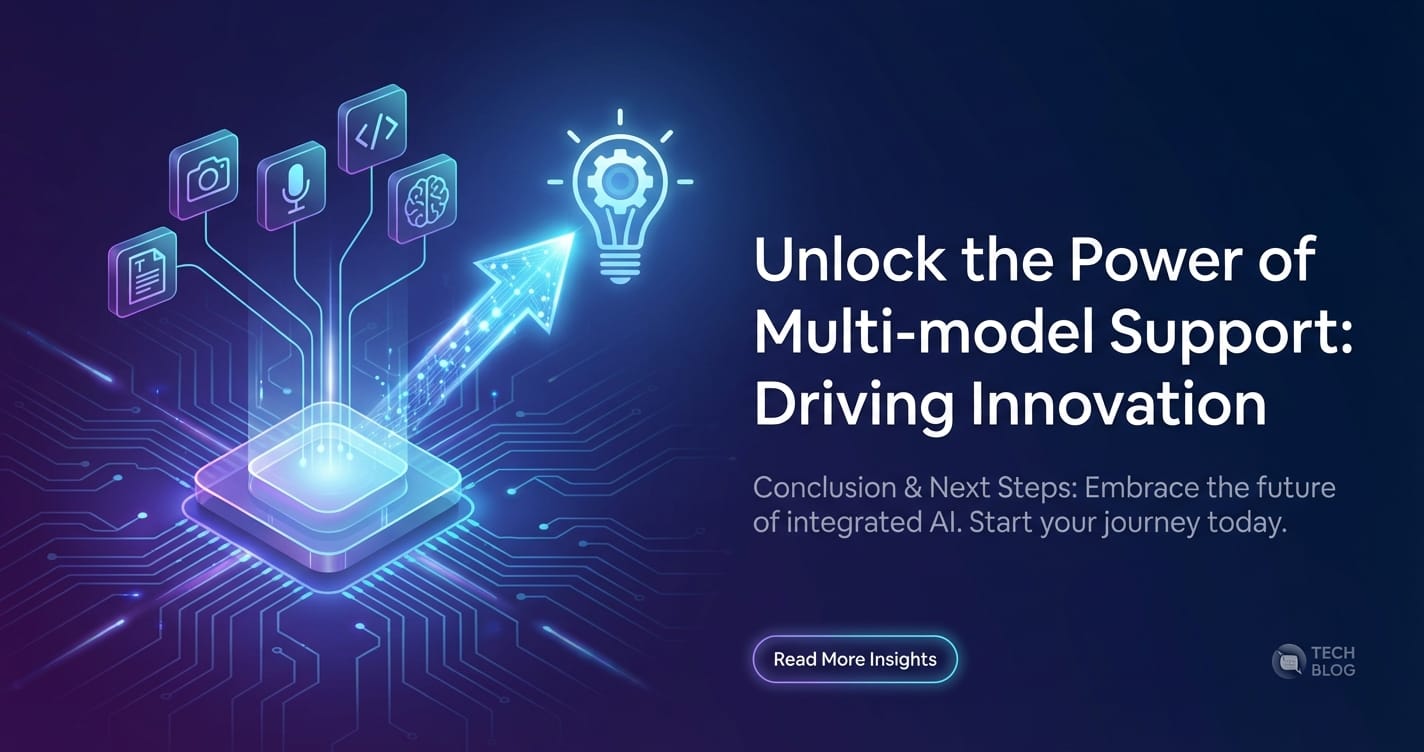
Unlock the Power of Multi-model Support: Driving Innovation


In the rapidly evolving landscape of artificial intelligence, the days of relying on a single, monolithic AI model for all tasks are quickly becoming a relic of the past. As developers and businesses push the boundaries of what AI can achieve, the inherent limitations of a one-size-fits-all approach become increasingly apparent. The modern paradigm demands flexibility, efficiency, and robustness – qualities that are best realized through multi-model support. This strategic shift involves leveraging a diverse array of specialized AI models, each excelling in particular domains or tasks, to create more intelligent, adaptable, and cost-effective applications.
This comprehensive guide will delve into the profound impact of multi-model support on the future of AI innovation. We will explore how a unified API acts as the crucial linchpin, simplifying the complexity of integrating and managing numerous models, and how intelligent LLM routing strategies optimize performance, cost, and reliability. By embracing these advanced methodologies, organizations can unlock unprecedented levels of efficiency, drive innovation, and future-proof their AI investments in an increasingly competitive technological arena.
The Proliferating Landscape of AI Models: A Double-Edged Sword
The past few years have witnessed an explosion in the development and deployment of large language models (LLMs). From foundational models like OpenAI's GPT series and Google's Gemini to open-source powerhouses like Meta's Llama and specialized models from various providers, the sheer volume and diversity of available AI capabilities are astounding. Each model often possesses unique strengths, training data, architectural nuances, and performance characteristics.
For instance, one model might excel at creative writing and generating long-form content, while another might be superior for precise code generation or highly accurate factual extraction. Some are optimized for low-latency inference, crucial for real-time applications, while others are designed for high-throughput batch processing. Furthermore, cost structures vary significantly across providers and model versions, presenting both opportunities for optimization and challenges for consistent budgeting.
This rich ecosystem, while promising immense potential, simultaneously introduces a labyrinth of complexities for developers. Integrating and managing multiple distinct APIs, each with its own authentication protocols, data formats, rate limits, and error handling mechanisms, quickly becomes an operational nightmare. This fragmentation leads to:
- Increased Development Overhead: Each new model requires a bespoke integration effort, diverting valuable developer resources from core product innovation.
- Maintenance Burdens: Keeping up with API changes, deprecations, and updates across numerous providers is a continuous, resource-intensive task.
- Performance Inconsistencies: Ensuring optimal performance across varied models and providers necessitates complex monitoring and fallback logic.
- Cost Management Challenges: Tracking and optimizing expenditures across different billing models and usage patterns can be a significant headache.
- Vendor Lock-in Risk: Over-reliance on a single provider's ecosystem can limit flexibility and increase vulnerability to price changes or service disruptions.
These challenges underscore the urgent need for a more streamlined, flexible, and intelligent approach to harness the full power of this diverse AI landscape.
Understanding Multi-model Support: Beyond Single-Model Constraints
At its core, multi-model support is the strategic capability to seamlessly utilize, switch between, or simultaneously deploy multiple distinct AI models within a single application or workflow. It's about transcending the limitations of "one model to rule them all" and instead embracing a nuanced strategy where the "right model for the right job" becomes the guiding principle.
The benefits of adopting a multi-model strategy are multifaceted and profound, impacting everything from application performance and cost efficiency to innovation capacity and system resilience.
Enhanced Performance and Accuracy
No single LLM is universally superior across all tasks. A model fine-tuned for legal document analysis might perform poorly on creative storytelling, and vice-versa. With multi-model support, developers can:
- Optimize Task-Specific Performance: Route a summarization request to a model known for concise extraction, while sending a complex reasoning task to a more powerful, albeit potentially slower or costlier, model. This ensures optimal output quality for each specific need.
- Improve Accuracy: By having access to multiple models, applications can leverage the strengths of each, even potentially using an ensemble approach where outputs from several models are combined or cross-referenced to achieve higher accuracy and reduce hallucination.
Significant Cost Optimization
Different LLMs come with vastly different pricing structures, often varying by input/output token count, model size, and provider. A critical advantage of multi-model support is the ability to implement sophisticated cost-saving strategies:
- Tiered Model Usage: Use less expensive, smaller models for routine, high-volume tasks (e.g., basic chatbots, simple data extraction) and reserve premium, more expensive models for complex, high-value operations (e.g., strategic content generation, complex problem-solving).
- Dynamic Cost Routing: Based on the complexity or criticality of a request, an application can dynamically select the most cost-effective model that still meets performance requirements. This can lead to substantial savings, especially at scale.
Increased Reliability and Redundancy
The stability of AI services, especially those from external providers, is never absolute. API downtimes, rate limit excursions, or sudden performance degradations can severely impact an application. Multi-model support mitigates these risks by providing:
- Failover Mechanisms: If a primary model or provider experiences an outage or performance issue, requests can be automatically rerouted to an alternative model from a different provider, ensuring continuous service availability.
- Load Balancing: Distribute requests across multiple models or instances to prevent any single model from becoming a bottleneck, enhancing overall system robustness.
Greater Flexibility and Innovation
Embracing a multi-model approach fosters a culture of experimentation and rapid iteration:
- Experimentation: Developers can easily test new models as they emerge, comparing their performance against existing ones without ripping out and replacing core infrastructure. This accelerates the adoption of cutting-edge AI capabilities.
- Feature Expansion: New application features can be built by leveraging specialized models without having to retrain or heavily modify existing models. For example, adding image generation capabilities might involve integrating a dedicated image model alongside text-based LLMs.
- Future-proofing: The AI landscape is dynamic. A multi-model strategy allows applications to adapt quickly to new advancements, ensuring they remain relevant and competitive as new, more powerful, or more efficient models are released.
Simplified Compliance and Data Governance
In certain industries, data residency or specific compliance requirements might dictate which providers or models can be used. Multi-model support allows organizations to select models that adhere to regional regulations or internal governance policies, offering greater control over data flow and processing.
The transition to multi-model support is not merely a technical upgrade; it's a strategic imperative that empowers businesses to build more resilient, efficient, and innovative AI-powered solutions. However, realizing these benefits efficiently requires a fundamental architectural component: the unified API.
The Role of a Unified API in Achieving Multi-model Support
While the concept of multi-model support is compelling, its practical implementation can be daunting without the right tooling. This is where the concept of a unified API becomes indispensable. A unified API acts as an abstraction layer, providing a single, standardized interface through which developers can access a multitude of different AI models and providers. Instead of integrating with a dozen different APIs, each with its unique quirks, developers interact with just one.
Imagine a universal remote control for all your smart home devices – that's essentially what a unified API does for LLMs. It standardizes diverse inputs and outputs, translates requests into the specific formats required by each underlying model, and delivers a consistent response back to the application.
Key Features and Benefits of a Unified API:
- Standardized Interface (e.g., OpenAI-Compatible Endpoint):
- Many unified API platforms adopt the widely recognized OpenAI API standard. This means developers familiar with OpenAI's API can instantly integrate with dozens of other models without learning new syntax or data structures. This significantly reduces the learning curve and accelerates development cycles.
- It simplifies migration. If an application is currently using one specific model, switching to another through a unified API often requires minimal code changes, primarily just updating a model name.
- Simplified Integration:
- Developers no longer need to write custom integration code for each new model or provider. A single API client or SDK is sufficient to interact with the entire ecosystem of supported models.
- This dramatically reduces the initial setup time and ongoing maintenance burden.
- Centralized API Key Management:
- Instead of managing separate API keys for OpenAI, Anthropic, Cohere, Google, etc., a unified API typically allows users to manage all their provider keys in one central dashboard. This enhances security and simplifies access control.
- Built-in Rate Limiting and Caching:
- Many unified API platforms come with intelligent rate limiting capabilities, preventing applications from hitting provider-specific limits.
- Caching mechanisms can store frequently requested responses, reducing latency and often saving costs by avoiding redundant calls to underlying models.
- Robust Error Handling and Fallback Logic:
- A unified API can abstract away provider-specific error messages, presenting them in a consistent format.
- More importantly, it can implement sophisticated fallback logic, automatically rerouting requests to alternative models if a primary one fails, ensuring application resilience.
- Comprehensive Observability and Analytics:
- By centralizing all LLM interactions, a unified API can provide a single pane of glass for monitoring usage, latency, costs, and error rates across all models and providers. This granular insight is critical for optimization and debugging.
- Detailed logs and metrics enable better understanding of model performance and user interactions.
- Cost Tracking and Optimization:
- With centralized usage data, it becomes much easier to track spending across different models and identify areas for cost optimization, often down to individual requests.
- Some platforms provide dashboards that break down costs by model, user, or project, empowering informed decision-making.
By abstracting away the underlying complexities, a unified API empowers developers to truly leverage multi-model support with unprecedented ease. It transforms a daunting task into a streamlined process, allowing teams to focus on building innovative applications rather than wrestling with API integrations. This foundational layer is also where the intelligence of LLM routing truly shines, turning raw access into strategic advantage.
Deep Dive into LLM Routing: The Intelligence Behind Multi-model Support
The ability to access multiple models via a unified API is a significant step, but the true power of multi-model support is unleashed through intelligent LLM routing. LLM routing is the process of dynamically selecting the most appropriate large language model for a given request, based on a set of predefined rules, real-time performance metrics, cost considerations, or even the content of the prompt itself. It's the brain that decides where each query goes, ensuring optimal outcomes for every interaction.
Without effective LLM routing, simply having access to multiple models would be like having a toolbox full of specialized tools but no knowledge of which tool to use for which task. Routing mechanisms add intelligence, automation, and efficiency to the multi-model paradigm.
Why LLM Routing is Crucial:
- Maximizing Performance: Directing complex tasks to powerful, high-capability models while simple tasks go to faster, lighter models.
- Minimizing Costs: Steering requests towards the most cost-effective model that can still meet quality requirements.
- Ensuring Reliability: Providing failover options when a primary model or provider experiences issues.
- Optimizing User Experience: Reducing latency and improving response relevance for end-users.
- Enabling Scalability: Distributing load across multiple models and providers to handle increased traffic.
Types of LLM Routing Strategies:
LLM routing strategies can be sophisticated, often combining multiple criteria to make routing decisions. Here are some common approaches:
- Cost-Based Routing:
- Mechanism: Routes requests to the cheapest available model that meets a minimum quality threshold.
- Use Case: Ideal for high-volume, lower-stakes tasks like basic chatbot interactions, simple data reformatting, or internal knowledge base queries where minor differences in output quality are acceptable in exchange for significant cost savings.
- Example: If a user asks for a simple definition, route to a smaller, cheaper model. If they ask for a detailed business plan, route to a more powerful, potentially more expensive model.
- Performance-Based Routing (Latency & Throughput):
- Mechanism: Routes requests to the model that offers the lowest latency or highest throughput, especially critical for real-time applications.
- Use Case: Conversational AI, real-time code suggestions, live translation services, or any application where immediate responses are paramount. This might involve routing to models geographically closer to the user or those with lower current load.
- Example: For a live customer support chatbot, always prioritize the model with the fastest response time to maintain a fluid conversation, even if it's slightly more expensive.
- Accuracy/Capability-Based Routing:
- Mechanism: Directs requests to the model that is best suited for the specific nature or complexity of the task, often determined by the prompt's content, keywords, or identified intent.
- Use Case: Highly specialized tasks such as legal document summarization, medical diagnosis support, creative writing generation, or complex scientific problem-solving where specialized models might have been fine-tuned on relevant datasets.
- Example: Analyze the input prompt. If it contains programming language keywords, route to a code-generation-optimized model. If it's a creative writing prompt, route to a model known for imaginative text generation.
- Reliability/Availability-Based Routing (Failover):
- Mechanism: Automatically reroutes requests to an alternative model or provider if the primary one is unavailable, experiencing an outage, or returning too many errors.
- Use Case: Essential for mission-critical applications where downtime is unacceptable. It ensures business continuity and a robust user experience even when external services falter.
- Example: If the primary GPT-4 endpoint is down, automatically switch to Claude 3 Opus or Gemini 1.5 Pro to ensure the application remains functional.
- Developer-Defined/Prompt-Based Routing:
- Mechanism: Allows developers to explicitly define routing rules based on custom logic, metadata passed with the request, or even specific instructions embedded within the prompt.
- Use Case: Highly customizable scenarios where specific business rules dictate model choice. This could involve routing based on user subscription tier, language preference, specific project IDs, or explicit model tags in the prompt.
- Example: A developer might add a
{"preferred_model": "llama-3-8b"}tag to a request, overriding default routing to ensure a specific open-source model is used for testing.
- Load Balancing:
- Mechanism: Distributes incoming requests evenly across multiple instances of the same model or similar models to prevent any single endpoint from becoming overwhelmed.
- Use Case: High-traffic applications to ensure consistent performance and prevent rate limit issues with any single provider.
Table 1: Comparison of LLM Routing Strategies
| Routing Strategy | Primary Goal | Key Considerations | Best For | Potential Drawbacks |
|---|---|---|---|---|
| Cost-Based Routing | Minimize expenditure | Token pricing, model size, task complexity | High-volume, low-stakes tasks (e.g., basic FAQs, data reformatting, simple summarization), where output quality variance is acceptable for savings. | May compromise on quality for complex tasks; requires accurate cost tracking. |
| Performance-Based Routing | Maximize speed / throughput | Latency, response time, concurrent requests | Real-time applications (e.g., live chatbots, code autocompletion, interactive content generation), where immediate responses are critical. | Potentially higher costs for premium, low-latency models; may not guarantee best accuracy. |
| Accuracy/Capability-Based Routing | Maximize output quality | Model specialization, fine-tuning, task type | Specialized tasks requiring high precision or specific knowledge (e.g., legal analysis, medical text, creative writing, complex reasoning, code generation), where selecting the best model for the job is paramount. | Requires intelligent prompt parsing and model evaluation; potentially slower or more expensive. |
| Reliability/Availability-Based Routing | Maximize uptime / resilience | Model health, API status, error rates | Mission-critical applications where continuous service is non-negotiable. Ensures failover during outages or rate limit hits. | Requires maintaining multiple provider accounts; potential for slight performance dips during failover. |
| Developer-Defined Routing | Custom control / flexibility | Custom logic, metadata, explicit model selection | Use cases requiring fine-grained control based on business rules, user tiers, project-specific requirements, or for testing and experimentation. | Requires careful implementation and management of rules; can become complex if overused. |
| Load Balancing | Distribute workload | Current model load, rate limits | High-traffic applications to prevent bottlenecks, ensure consistent performance, and manage provider rate limits across multiple instances of the same or similar models. | Less about choosing the best model, more about distributing load across available models. |
The combination of a unified API and intelligent LLM routing transforms the complex landscape of diverse AI models into a manageable and powerful resource. It allows organizations to dynamically adapt to evolving requirements, optimize resource utilization, and significantly enhance the capabilities of their AI-powered applications.
XRoute is a cutting-edge unified API platform designed to streamline access to large language models (LLMs) for developers, businesses, and AI enthusiasts. By providing a single, OpenAI-compatible endpoint, XRoute.AI simplifies the integration of over 60 AI models from more than 20 active providers(including OpenAI, Anthropic, Mistral, Llama2, Google Gemini, and more), enabling seamless development of AI-driven applications, chatbots, and automated workflows.
Practical Applications and Use Cases of Multi-model Strategies
The strategic implementation of multi-model support and LLM routing opens up a vast array of practical applications across various industries, enabling more sophisticated, efficient, and user-centric AI solutions.
1. Advanced Customer Service and Chatbots
- Scenario: A company's customer service chatbot needs to handle a wide range of inquiries, from simple FAQs to complex troubleshooting and personalized assistance.
- Multi-model Solution:
- Routing: Basic informational queries (e.g., "What are your operating hours?") are routed to a smaller, cost-effective LLM for quick, low-latency responses.
- Routing: More complex requests requiring deep knowledge retrieval (e.g., "How do I configure product X with system Y?") might be routed to a powerful, knowledge-augmented LLM.
- Routing: Queries indicating a need for empathy or creative problem-solving (e.g., "I'm frustrated with this issue, can you help me?") could be directed to a model specifically fine-tuned for conversational nuances or customer sentiment analysis.
- Failover: If the primary conversational model becomes unresponsive, requests are automatically routed to a secondary provider to maintain seamless customer interaction.
- Benefit: Improved response accuracy, reduced operational costs, higher customer satisfaction, and enhanced system resilience.
2. Intelligent Content Generation and Marketing
- Scenario: A marketing team needs to generate diverse content – short social media posts, blog drafts, email campaigns, and highly creative ad copy – across different platforms and tones.
- Multi-model Solution:
- Routing: For generating a large volume of routine social media updates or initial blog post drafts, a cheaper, high-throughput model is used.
- Routing: When crafting compelling ad copy or engaging email subject lines, a premium model known for its creativity and persuasive language is engaged.
- Routing: Specific models can be leveraged for summarization of long articles, translation into multiple languages, or rephrasing existing content for different target audiences.
- Experimentation: Easily A/B test outputs from different models for various content types to identify the most effective one for specific campaigns.
- Benefit: Faster content production, improved content quality and diversity, optimized marketing spend, and enhanced brand consistency.
3. Code Generation and Developer Tools
- Scenario: Developers use AI assistants for code completion, bug fixing, documentation generation, and converting code between languages.
- Multi-model Solution:
- Routing: For simple code completion suggestions in a popular language, a fast, lightweight model might be sufficient.
- Routing: For complex tasks like generating entire functions from natural language descriptions or refactoring large codebases, a specialized code-generation model with a deeper understanding of programming logic is preferred.
- Routing: When generating documentation or translating comments into different human languages, a general-purpose text LLM might be used.
- Failover: Critical development workflows benefit from failover to ensure uninterrupted assistance.
- Benefit: Increased developer productivity, higher code quality, faster debugging, and support for a wider range of programming tasks.
4. Data Analysis, Extraction, and Knowledge Management
- Scenario: An organization needs to extract specific entities from unstructured text, summarize lengthy reports, or answer complex questions based on internal documents.
- Multi-model Solution:
- Routing: For extracting structured data (e.g., names, dates, addresses) from standardized forms, a model specifically fine-tuned for entity recognition is employed.
- Routing: For summarizing financial reports or research papers, a model proficient in abstractive summarization is chosen.
- Routing: When answering natural language questions over a proprietary knowledge base, an LLM integrated with retrieval-augmented generation (RAG) capabilities, potentially from a specific provider, is utilized.
- Compliance Routing: Route sensitive data processing to models that can be hosted on-premise or within specific geographic regions for data governance.
- Benefit: More accurate data insights, automated information retrieval, reduced manual effort, and improved compliance.
5. Personalization Engines and Recommendation Systems
- Scenario: An e-commerce platform aims to provide highly personalized product recommendations, dynamically generated descriptions, or tailored user experiences.
- Multi-model Solution:
- Routing: Basic recommendations based on past purchases might use a simpler model for high-speed inference.
- Routing: For generating dynamic product descriptions that appeal to specific user segments (e.g., luxury buyers vs. budget-conscious shoppers), a more creative and context-aware LLM is used.
- Routing: Personalized email subject lines or push notifications that resonate with individual user preferences could leverage a model that excels in persuasive micro-copy.
- A/B Testing: Easily test different models for personalization effectiveness without complex backend changes.
- Benefit: Higher conversion rates, increased user engagement, and a more relevant user experience.
These examples illustrate that multi-model support is not just a theoretical advantage but a practical necessity for building sophisticated, resilient, and economically viable AI applications in the modern era. By carefully selecting and routing requests to the most appropriate models, businesses can unlock truly transformative capabilities.
Overcoming Challenges and Adopting Best Practices
While the benefits of multi-model support are clear, its successful implementation comes with its own set of challenges. Addressing these proactively and adopting best practices will ensure a smooth transition and maximize the return on investment.
Key Challenges:
- Model Evaluation and Selection: With so many models available, how do you objectively compare their performance for specific tasks? Benchmarking across different metrics (accuracy, latency, cost, robustness) becomes crucial but can be complex.
- Prompt Engineering Across Models: Prompts that work well for one model may not yield optimal results for another. Adapting prompt engineering strategies for a diverse set of models requires expertise and iterative testing.
- Data Consistency and Format Translation: Ensuring that input data is correctly formatted and interpreted by different models, and that output data is consistent across models, can be challenging.
- Security and Compliance: Managing data privacy, intellectual property, and regulatory compliance across multiple external AI providers adds layers of complexity. Each provider has its own data handling policies.
- Observability and Debugging: Troubleshooting issues in a multi-model environment, especially when requests are routed dynamically, can be difficult without comprehensive logging and monitoring. Identifying which model caused an error or suboptimal output requires robust tooling.
- Cost Management Complexity: While multi-model support can optimize costs, managing and predicting expenses across diverse billing models and usage patterns still requires careful attention.
Best Practices for Implementing Multi-model Support:
- Define Clear Objectives and KPIs: Before integrating multiple models, clearly define what you aim to achieve (e.g., reduce costs by 20%, improve accuracy by 15%, decrease latency by 50%). Establish key performance indicators (KPIs) to measure success.
- Start with a Phased Approach: Begin by integrating one or two additional models for specific, well-defined tasks where you anticipate significant gains. Gradually expand your multi-model strategy as you gain experience and confidence.
- Leverage a Unified API Platform: As discussed, a unified API is non-negotiable for simplifying integration, management, and observability. It drastically reduces development overhead and accelerates time-to-market.
- Implement Intelligent LLM Routing: Don't just pick a model; strategize LLM routing based on cost, performance, accuracy, and reliability requirements. Continuously refine your routing logic based on real-world usage data.
- Embrace Iterative Testing and A/B Testing: Regularly evaluate model performance against your KPIs. A/B test different models or routing strategies to determine the most effective configurations for various scenarios.
- Develop Robust Observability and Monitoring: Implement comprehensive logging, tracing, and monitoring tools. Track latency, token usage, error rates, and costs for each model. This data is vital for identifying issues, optimizing routing, and managing expenses.
- Standardize Prompt Engineering Guidelines: Develop internal guidelines for prompt engineering that can be adapted across different models, focusing on clarity, specificity, and model-agnostic instructions where possible.
- Prioritize Security and Compliance: Choose providers and routing strategies that align with your organization's security policies and regulatory requirements. Encrypt data in transit and at rest, and ensure proper access controls.
- Stay Informed About Model Advancements: The AI landscape changes rapidly. Allocate time to research new models, benchmarks, and capabilities to continuously refine your multi-model strategy and leverage the latest innovations.
- Build for Flexibility: Design your application architecture to be model-agnostic as much as possible, making it easy to swap out or add new models without extensive re-engineering. This is where the abstraction layer of a unified API is invaluable.
By proactively addressing these challenges and adhering to these best practices, organizations can successfully harness the power of multi-model support, driving innovation and gaining a significant competitive edge in the AI-driven world.
XRoute.AI: A Catalyst for Multi-model Innovation
The challenges of integrating diverse LLMs, optimizing their usage, and managing their lifecycle are precisely what cutting-edge platforms like XRoute.AI are designed to solve. XRoute.AI is a comprehensive unified API platform that acts as a pivotal enabler for organizations looking to embrace the full power of multi-model support and intelligent LLM routing.
At its core, XRoute.AI streamlines access to the vast and fragmented ecosystem of large language models for developers, businesses, and AI enthusiasts. It does so by providing a single, OpenAI-compatible endpoint. This critical feature eliminates the monumental task of individually integrating with over 60 AI models from more than 20 active providers. Instead of wrestling with disparate APIs, developers can integrate once with XRoute.AI and immediately gain access to a broad spectrum of AI capabilities, simplifying the development of AI-driven applications, sophisticated chatbots, and automated workflows.
XRoute.AI is engineered with a strong focus on delivering tangible benefits that directly address the core tenets of effective multi-model support:
- Low Latency AI: For applications where speed is paramount, XRoute.AI's infrastructure is optimized to minimize response times, ensuring a seamless and responsive user experience. This is crucial for real-time interactions and dynamic content generation.
- Cost-Effective AI: By enabling sophisticated LLM routing strategies, XRoute.AI empowers users to dynamically select the most economical model for each specific task without sacrificing quality. This intelligent routing ensures that costly premium models are reserved for high-value tasks, while more affordable options handle routine requests, leading to significant cost savings at scale.
- Developer-Friendly Tools: The platform's OpenAI-compatible endpoint drastically reduces the learning curve and integration effort. Developers can leverage existing OpenAI SDKs and their familiarity with the standard to quickly deploy and experiment with new models, accelerating innovation and time-to-market.
Beyond these core advantages, XRoute.AI offers a robust set of features that underpin a successful multi-model strategy:
- High Throughput and Scalability: Built to handle enterprise-level demands, XRoute.AI ensures that applications can scale effortlessly, managing a high volume of requests across multiple models and providers without performance degradation.
- Centralized Control and Observability: With XRoute.AI, managing API keys, monitoring usage, and tracking costs across all integrated models becomes a centralized and transparent process. This single pane of glass provides invaluable insights for optimization and troubleshooting.
- Flexibility and Redundancy: The platform’s ability to abstract away individual provider complexities inherently offers greater flexibility. In the event of an outage or performance issue with one provider, XRoute.AI's intelligent routing can automatically switch to an alternative, ensuring continuous service and enhancing the overall resilience of your AI applications.
Whether you are a startup building your first AI-powered MVP or an enterprise looking to optimize and scale your existing AI infrastructure, XRoute.AI provides the unified, intelligent, and flexible foundation required to harness the true potential of multi-model support. It transforms the daunting complexity of the modern AI landscape into a manageable and powerful opportunity for innovation. By simplifying access, enabling intelligent routing, and providing robust management tools, XRoute.AI allows developers to focus on what they do best: building groundbreaking AI solutions that drive real-world impact.
Conclusion: The Future is Multi-model
The journey through the intricate world of AI models has brought us to a clear realization: multi-model support is not just a trend but a fundamental shift in how we approach AI development and deployment. The proliferation of diverse LLMs, each with its unique strengths and cost structures, necessitates a strategic move away from single-model dependency towards a more flexible, intelligent, and resilient architecture.
The linchpin of this transformation is the unified API, which abstracts away the bewildering complexity of integrating and managing numerous models. By providing a single, standardized interface, it empowers developers to access a vast ecosystem of AI capabilities with unprecedented ease, significantly reducing development overhead and accelerating innovation cycles. This foundation, in turn, enables the crucial intelligence of LLM routing. Through sophisticated strategies based on cost, performance, accuracy, and reliability, LLM routing ensures that every request is directed to the most appropriate model, optimizing outcomes across the board.
From enhancing customer service and supercharging content generation to accelerating code development and improving data analysis, the practical applications of a well-implemented multi-model strategy are transformative. Organizations that embrace this paradigm can achieve unparalleled levels of efficiency, reduce operational costs, boost application performance, and build more robust, future-proof AI solutions.
Platforms like XRoute.AI exemplify this shift, offering a powerful, developer-friendly unified API platform that simplifies access to over 60 models from more than 20 providers. By focusing on low latency AI and cost-effective AI through intelligent LLM routing, XRoute.AI empowers businesses to fully realize the promise of multi-model support, fostering innovation and competitive advantage in the dynamic world of artificial intelligence.
The future of AI is collaborative, diverse, and intelligent. By unlocking the power of multi-model support, organizations are not just adopting new technology; they are architecting a future where AI systems are more adaptable, more efficient, and ultimately, more capable of driving profound innovation across every sector.
Frequently Asked Questions (FAQ)
Q1: What exactly is "Multi-model support" in the context of AI?
A1: Multi-model support refers to the capability of an AI application or system to seamlessly integrate and utilize multiple different AI models (like various Large Language Models from different providers) for different tasks or based on specific criteria. Instead of relying on a single model for all functions, it allows for dynamic selection and routing of requests to the most appropriate or efficient model, leveraging the unique strengths of each.
Q2: How does a "Unified API" simplify the use of multiple AI models?
A2: A Unified API acts as a single, standardized interface or abstraction layer that allows developers to access numerous different AI models from various providers without having to integrate with each model's specific API individually. It standardizes inputs, outputs, authentication, and error handling, significantly reducing development complexity, integration time, and ongoing maintenance, making it much easier to implement multi-model strategies.
Q3: What is "LLM routing" and why is it important for multi-model strategies?
A3: LLM routing is the intelligent process of dynamically directing an incoming request to the most suitable Large Language Model (LLM) based on predefined rules or real-time conditions. This is crucial because different LLMs excel at different tasks and have varying costs and performance characteristics. LLM routing allows applications to optimize for factors like cost (sending simple queries to cheaper models), performance (routing real-time requests to low-latency models), accuracy (selecting specialized models for complex tasks), or reliability (using failover models during outages), maximizing efficiency and effectiveness.
Q4: Can multi-model support actually save costs, or is it more expensive to use multiple models?
A4: Yes, multi-model support can significantly save costs, especially at scale. While using multiple premium models for every task would be expensive, the core principle of multi-model support, combined with intelligent LLM routing, is to use the right model for the right job. This means routing high-volume, simpler tasks to less expensive, smaller models and reserving more powerful, costly models only for complex, high-value tasks that require their superior capabilities. This strategic allocation of resources leads to optimized spending compared to relying solely on a single, expensive, powerful model for everything.
Q5: How does XRoute.AI fit into the multi-model support and LLM routing ecosystem?
A5: XRoute.AI is a cutting-edge unified API platform specifically designed to empower multi-model support and intelligent LLM routing. It provides a single, OpenAI-compatible endpoint that grants developers access to over 60 AI models from more than 20 providers. XRoute.AI facilitates seamless integration, enables intelligent routing for low latency AI and cost-effective AI, and offers developer-friendly tools. By abstracting complexity and providing robust management features, XRoute.AI allows businesses to effortlessly leverage diverse AI models, optimize performance and cost, and drive innovation without the overhead of managing multiple API connections.
🚀You can securely and efficiently connect to thousands of data sources with XRoute in just two steps:
Step 1: Create Your API Key
To start using XRoute.AI, the first step is to create an account and generate your XRoute API KEY. This key unlocks access to the platform’s unified API interface, allowing you to connect to a vast ecosystem of large language models with minimal setup.
Here’s how to do it: 1. Visit https://xroute.ai/ and sign up for a free account. 2. Upon registration, explore the platform. 3. Navigate to the user dashboard and generate your XRoute API KEY.
This process takes less than a minute, and your API key will serve as the gateway to XRoute.AI’s robust developer tools, enabling seamless integration with LLM APIs for your projects.
Step 2: Select a Model and Make API Calls
Once you have your XRoute API KEY, you can select from over 60 large language models available on XRoute.AI and start making API calls. The platform’s OpenAI-compatible endpoint ensures that you can easily integrate models into your applications using just a few lines of code.
Here’s a sample configuration to call an LLM:
curl --location 'https://api.xroute.ai/openai/v1/chat/completions' \
--header 'Authorization: Bearer $apikey' \
--header 'Content-Type: application/json' \
--data '{
    "model": "gpt-5",
    "messages": [
        {
            "content": "Your text prompt here",
            "role": "user"
        }
    ]
}'
With this setup, your application can instantly connect to XRoute.AI’s unified API platform, leveraging low latency AI and high throughput (handling 891.82K tokens per month globally). XRoute.AI manages provider routing, load balancing, and failover, ensuring reliable performance for real-time applications like chatbots, data analysis tools, or automated workflows. You can also purchase additional API credits to scale your usage as needed, making it a cost-effective AI solution for projects of all sizes.
Note: Explore the documentation on https://xroute.ai/ for model-specific details, SDKs, and open-source examples to accelerate your development.