Unlock the Power of OpenClaw Dynamic Persona: Enhanced Engagement
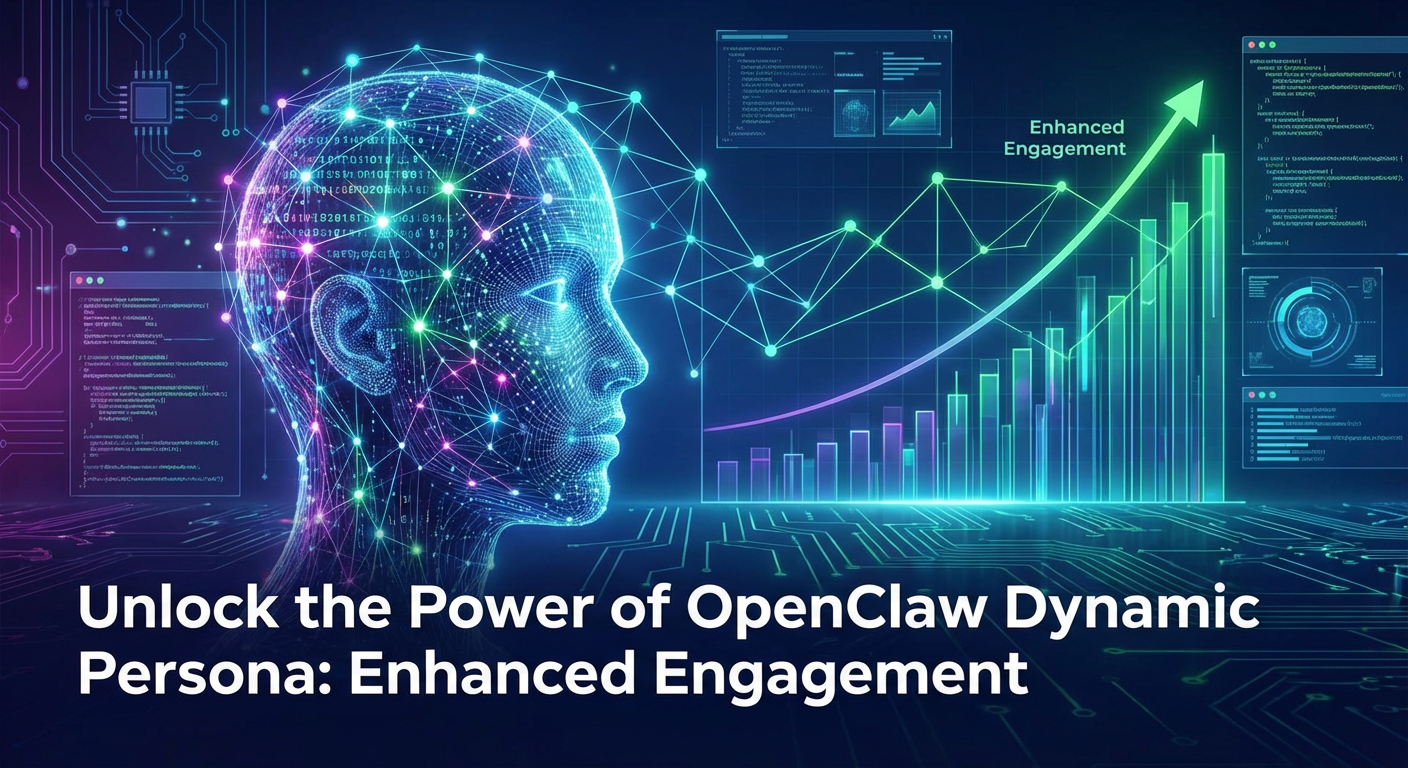

In the rapidly evolving landscape of artificial intelligence, the quest for more human-like, intuitive, and engaging interactions stands as a paramount challenge. Gone are the days when static, rule-based chatbots sufficed for customer service queries or simple information retrieval. Today, users expect an experience that feels personal, intelligent, and even empathetic—an experience where the AI understands context, remembers past interactions, and adapts its persona to foster deeper engagement. This transformative shift is precisely what we aim to address with the concept of OpenClaw Dynamic Persona, a revolutionary approach designed to elevate AI interactions from mere transactions to meaningful dialogues.
This article delves into the core tenets of OpenClaw Dynamic Persona, exploring how it leverages the cutting-edge capabilities of Large Language Models (LLMs) and advanced technological infrastructure to create AI entities that are not just intelligent, but also remarkably adaptable and engaging. We will unravel the intricate mechanisms that allow these personas to maintain coherence, exhibit emotional intelligence, and learn from every interaction, pushing the boundaries of what's possible in human-AI collaboration. From the pivotal role of selecting the best LLM for roleplay to the indispensable convenience offered by a Unified API and robust Multi-model support, we will uncover the foundational elements that empower developers and businesses to craft AI experiences that genuinely resonate with users, ultimately fostering unparalleled engagement and utility.
The Evolution of AI Personas: From Static Bots to Dynamic Companions
The journey of artificial intelligence in mimicking human interaction has been a fascinating one, marked by continuous innovation and paradigm shifts. Initially, AI interaction was rudimentary, characterized by simple, rule-based systems. Think back to early chatbots that followed rigid scripts, often failing to understand nuances or deviations from pre-programmed paths. These systems, while groundbreaking for their time, were inherently static. They lacked memory, contextual understanding, and any semblance of a persistent personality, leading to often frustrating and disjointed user experiences.
As technology progressed, statistical models and machine learning algorithms brought incremental improvements. Chatbots became slightly more adept at recognizing patterns and providing more relevant responses based on large datasets. However, even these advancements largely struggled with maintaining a consistent "persona" over extended interactions. A bot might offer helpful information in one turn but completely forget a user's previous statement in the next, shattering any illusion of an intelligent, continuous dialogue partner. The "persona," if it existed, was often an thin veneer, easily broken by unexpected inputs or prolonged conversations. Users quickly learned to treat these AIs as tools for specific tasks rather than engaging conversationalists. The engagement was transactional, not relational.
The true inflection point arrived with the advent and rapid proliferation of Large Language Models (LLMs). Models like GPT, Llama, and Claude didn't just understand language; they generated it with unprecedented fluency and coherence. This capability fundamentally changed the game for AI personas. Suddenly, AI could compose lengthy, contextually appropriate responses, engage in creative writing, summarize complex information, and even simulate different writing styles and tones. This was the first real step towards creating AI entities that could maintain a consistent character, express nuanced emotions, and adapt their communication style to the user.
The demand for more human-like, adaptive interactions is no longer a luxury but a necessity. In fields ranging from customer service and education to entertainment and mental health support, users crave AI companions that can provide personalized guidance, tell compelling stories, or simply engage in natural, flowing conversations. This heightened expectation underscores the need for AI personas that can evolve, learn, and truly connect with users—a challenge that the OpenClaw Dynamic Persona framework is specifically designed to meet head-on. By moving beyond mere response generation to active persona development, we unlock new dimensions of user engagement and utility.
Deconstructing OpenClaw Dynamic Persona: What Makes it Tick?
At its heart, OpenClaw Dynamic Persona represents a profound conceptual leap in AI design. It transcends the notion of a predefined character or a simple set of programmed responses. Instead, an OpenClaw Dynamic Persona is an adaptable, context-aware, memory-rich entity that can fluidly adjust its behavior, tone, and knowledge base in real-time, all while maintaining a consistent underlying identity. It's not about an AI having a persona; it's about an AI becoming one, learning and evolving through interaction.
To truly grasp what makes this framework tick, we must break down its key operational components. These interconnected elements work in concert to give OpenClaw Dynamic Personas their unparalleled depth and flexibility:
1. Contextual Understanding: Beyond Keywords
The foundation of any intelligent interaction is the ability to understand context. For OpenClaw Dynamic Personas, this goes far beyond merely recognizing keywords or phrases. It involves a deep comprehension of the ongoing conversation, including:
- Semantic Nuance: Understanding the implied meaning, tone, and intent behind a user's words, even when not explicitly stated.
- Conversational History: Recognizing how the current turn relates to previous statements, questions, and topics discussed within the same interaction.
- External Context: Incorporating information from outside the immediate dialogue, such as user profiles, preferences, past behaviors, or real-world events relevant to the conversation.
This advanced contextual understanding allows the persona to avoid generic responses, anticipate user needs, and steer the conversation in a more meaningful direction, making the interaction feel natural and personalized.
2. Memory Management: The Backbone of Consistency
A dynamic persona cannot exist without robust memory. Unlike stateless AI models, an OpenClaw persona possesses both short-term and long-term memory capabilities:
- Short-term Memory (Working Context): This holds the immediate conversational history, typically within a single session. It ensures that the persona remembers what was just said, referred to, or agreed upon, preventing repetitive questions or contradictory statements. This is crucial for maintaining conversational flow and coherence.
- Long-term Memory (Persona Knowledge Base): This encompasses persistent information about the user (e.g., preferences, past interactions, learned facts), the persona's own evolving identity (e.g., learned character traits, specific knowledge domains), and general world knowledge. This memory allows the persona to build a relationship over time, recall previous sessions, and exhibit a consistent character across diverse interactions. It's how a persona "learns" and "remembers" who it is and who it's talking to.
Effective memory management is paramount for an OpenClaw Dynamic Persona to exhibit a consistent character, adapt its responses based on historical data, and truly "remember" the user, fostering a sense of familiarity and trust.
3. Emotional Intelligence Simulation: Responding with Empathy and Appropriateness
While AI doesn't genuinely "feel" emotions, OpenClaw Dynamic Personas are engineered to simulate emotional intelligence convincingly. This involves:
- Sentiment Analysis: Accurately detecting the emotional tone (e.g., happy, frustrated, confused, neutral) in user inputs.
- Empathy Generation: Crafting responses that acknowledge and appropriately respond to the user's emotional state, offering comfort, excitement, or clarification as needed.
- Tonal Consistency: Adjusting the persona's own emotional expression and tone to align with the context and desired interaction style. For example, a support persona might adopt a calm and reassuring tone, while an entertainment persona might be playful and energetic.
This simulation of emotional intelligence elevates interactions from purely informational exchanges to more human-like engagements, making the persona feel more relatable and less robotic.
4. Adaptability & Learning: Evolving Through Interaction
A truly dynamic persona is not static; it evolves. OpenClaw Dynamic Personas incorporate mechanisms for continuous learning and adaptation:
- Behavioral Adjustment: The persona can refine its communication style, response patterns, and even its "personality traits" based on user feedback and interaction outcomes. If a user consistently responds well to a certain type of humor, the persona might incorporate more of it. If a specific phrasing leads to confusion, the persona learns to avoid it.
- Knowledge Augmentation: Beyond just remembering facts, the persona can integrate new information learned from conversations into its knowledge base, enriching its understanding and improving its future responses.
- Goal-Oriented Learning: For task-specific personas, learning also involves optimizing strategies to achieve specific goals more efficiently based on past interaction data.
This adaptability ensures that the persona doesn't just respond, but improves and grows over time, leading to increasingly effective and engaging interactions.
5. Consistency Engine: Maintaining Core Traits Amidst Flexibility
The challenge with "dynamic" is often maintaining "consistency." The Consistency Engine within OpenClaw Dynamic Persona is designed to balance this delicate act. It ensures that while the persona can adapt to context and learn from interactions, its core identity, overarching goals, and fundamental "personality traits" remain coherent.
- Persona Profile: A set of predefined core attributes, values, and objectives that define the persona's fundamental identity. This acts as a north star, guiding all responses and adaptations.
- Constraint Management: Rules and guidelines that prevent the persona from diverging too far from its core identity or violating ethical boundaries, even when adapting.
- Feedback Loops: Mechanisms to review and reinforce desired persona traits, ensuring that learned adaptations enhance rather than detract from the persona's core consistency.
By intricately weaving these components together, OpenClaw Dynamic Persona transforms static AI into living, breathing digital entities capable of fostering deep, meaningful, and consistently engaging interactions. This comprehensive framework is what truly sets it apart, opening up new frontiers for AI applications across industries.
The Role of Advanced LLMs in Crafting Dynamic Personas
Large Language Models (LLMs) are the very sinews and neural networks of an OpenClaw Dynamic Persona. Without their advanced capabilities, the intricate mechanisms of contextual understanding, memory synthesis, and natural language generation would simply not be possible. LLMs have fundamentally transformed what AI can achieve in conversational settings, moving beyond keyword matching to genuine comprehension and creative expression.
At a foundational level, LLMs are indispensable for dynamic personas because they excel at:
- Text Generation: Producing coherent, grammatically correct, and contextually appropriate text that mimics human writing styles. This is the raw material for all persona responses.
- Understanding and Interpretation: Discerning the meaning, intent, and sentiment of user input, even with complex or ambiguous language.
- Summarization: Condensing long conversations or documents into key points, essential for memory retrieval and contextual awareness.
- Creative Writing: Generating stories, poems, or imaginative scenarios, crucial for engaging roleplay and entertainment personas.
- Reasoning (to an extent): Inferring logical connections and making reasonable deductions based on the provided context and knowledge.
The diversity and specialization among LLMs mean that choosing the right model, or combination of models, is critical. Not all LLMs are created equal, especially when it comes to highly specialized tasks like maintaining a deep, consistent character over extended interactions.
Deep Dive: What Makes the Best LLM for Roleplay?
When we talk about the best LLM for roleplay, we're looking for a specific constellation of capabilities that go beyond general conversational fluency. Roleplay demands an LLM that can:
- Maintain Character Consistency: This is perhaps the most crucial aspect. A good roleplay LLM can adhere to a detailed character brief (e.g., personality traits, backstory, motivations, speech patterns, quirks) over hundreds or even thousands of turns without breaking character. It doesn't suddenly forget its "name" or contradict its established beliefs.
- Exhibit Deep Memory and Contextual Awareness: For roleplay, the LLM needs a robust memory of previous interactions within the current roleplay narrative. It must remember plot points, character relationships, past dialogues, and environmental details to weave a continuous, immersive story. This often requires long context windows or sophisticated external memory systems.
- Demonstrate Creativity and Narrative Branching: Roleplay is dynamic. The LLM shouldn't just respond; it should contribute to the narrative, introduce new elements, react imaginatively to user actions, and explore different story branches in a coherent manner. It should feel like a co-creator of the story.
- Generate Nuanced and Expressive Language: The language used by the persona should match its character. A sarcastic villain should sound sarcastic; a wise mentor should sound sagely. This involves not just word choice but also implied tone, pacing, and even subtle emotional cues.
- Adapt to User Input While Staying in Character: While consistent, the persona must also be responsive to the user's choices and actions. It needs to seamlessly integrate user inputs into the ongoing narrative, moving the story forward without forcing the user onto a rigid path.
- Handle Long-Form Dialogue and Complex Scenarios: Roleplay often involves intricate plots, multiple characters, and extended conversations. The best LLM for roleplay can manage these complexities without losing track of the overarching narrative or getting sidetracked.
For OpenClaw Dynamic Persona, leveraging LLMs that excel in these areas is non-negotiable. It allows for the creation of richly detailed, believable, and deeply engaging AI characters across various applications, from interactive storytelling games to sophisticated training simulations. OpenClaw achieves this by carefully orchestrating the capabilities of these advanced LLMs, often employing specific prompt engineering techniques and fine-tuning strategies to reinforce character integrity and narrative coherence. By focusing on models known for their narrative capabilities and long-term consistency, OpenClaw ensures that the personas it powers are not just conversational, but truly immersive and captivating.
The Challenge of LLM Integration and the Solution: Unified API
The proliferation of powerful Large Language Models has opened up unprecedented possibilities for AI development, particularly in crafting dynamic personas. However, this wealth of options also presents a significant challenge: integration complexity. For developers and businesses seeking to build sophisticated AI applications, especially those requiring the flexibility of an OpenClaw Dynamic Persona, managing multiple LLM APIs can quickly become an overwhelming endeavor.
Consider a scenario where an organization wants to leverage the strengths of different LLMs: one model might be superior for creative text generation (ideal for a storyteller persona), another for factual question answering (perfect for an educational assistant), and yet another for multilingual translation. Each of these LLMs typically comes with its own:
- API Endpoint: A unique address to send requests to.
- Authentication Method: Different keys, tokens, or credential management systems.
- Data Formats: Variations in how prompts are structured, how responses are returned (JSON keys, nested objects, streaming formats).
- SDKs and Libraries: Model-specific tools that require separate integration.
- Documentation and Learning Curve: Developers need to spend time understanding each provider's specific guidelines and best practices.
- Rate Limits and Billing: Managing different usage quotas and billing structures across multiple providers.
This fragmentation creates a development nightmare. Integrating just a few LLMs can multiply the engineering effort, introduce compatibility issues, increase maintenance overhead, and slow down the pace of innovation. Debugging issues across disparate systems becomes complex, and switching models for optimization or cost-effectiveness is a laborious process. For a framework like OpenClaw Dynamic Persona, which thrives on the ability to dynamically select and switch between models to achieve optimal persona behavior, this complexity would be a severe bottleneck.
The Introduction of the Unified API Concept
This is precisely where the concept of a Unified API emerges as a game-changer. A Unified API acts as a single, standardized interface that abstracts away the underlying complexities of integrating with multiple LLM providers. Instead of developers needing to learn and implement separate APIs for each model, they interact with one consistent API endpoint, regardless of which LLM is ultimately processing their request.
The benefits of a Unified API are profound and directly address the challenges of multi-LLM integration:
- Simplified Development: Developers write code once to interact with the Unified API. This drastically reduces development time and effort, allowing teams to focus on building innovative applications rather than wrestling with API specifics.
- Faster Iteration and Deployment: With a streamlined integration process, developers can experiment with different models more easily, rapidly prototype new features, and deploy updates quickly. This agility is crucial in the fast-paced AI landscape.
- Reduced Overhead and Maintenance: A single point of integration means less code to maintain, fewer potential points of failure, and simpler debugging. Updates or changes from underlying LLM providers are handled by the Unified API provider, shielding developers from constant adjustments.
- Enhanced Flexibility and Future-Proofing: Businesses are not locked into a single LLM provider. They can easily switch between models or add new ones as they become available, without re-architecting their entire application. This future-proofs their AI solutions against model deprecation or the emergence of superior alternatives.
- Cost and Performance Optimization: A Unified API often comes with intelligent routing capabilities that can direct requests to the most cost-effective or highest-performing model for a given task, based on real-time metrics, thus optimizing resource utilization.
For OpenClaw Dynamic Persona, a Unified API is not just a convenience; it's an enablement layer. It allows the persona's consistency engine to dynamically choose the best LLM for a specific conversational turn—be it for complex roleplay, factual lookup, or creative writing—without the developer having to manage the intricate handoffs. This seamless access to a diverse ecosystem of models is what truly unlocks the full potential of dynamic, adaptable AI personas. It transforms a complex, multi-vendor landscape into a cohesive, manageable, and powerful development environment.
XRoute is a cutting-edge unified API platform designed to streamline access to large language models (LLMs) for developers, businesses, and AI enthusiasts. By providing a single, OpenAI-compatible endpoint, XRoute.AI simplifies the integration of over 60 AI models from more than 20 active providers(including OpenAI, Anthropic, Mistral, Llama2, Google Gemini, and more), enabling seamless development of AI-driven applications, chatbots, and automated workflows.
Leveraging Multi-model Support for Unprecedented Persona Depth
While a single, highly capable LLM might seem sufficient for many tasks, the pursuit of truly dynamic, rich, and deeply engaging personas—the hallmark of OpenClaw Dynamic Persona—often necessitates a more sophisticated approach: Multi-model support. The reality is that no single LLM is a silver bullet; each model has its strengths, weaknesses, and unique characteristics. By intelligently combining the power of multiple LLMs, an OpenClaw Dynamic Persona can achieve a level of depth, flexibility, and cost-efficiency that is simply unattainable with a monolithic approach.
Why a Single LLM Isn't Always Enough for Deep Personas
Consider the multifaceted requirements of a truly dynamic persona:
- Creative Storytelling: Requires an LLM strong in narrative generation, imaginative prose, and character voice.
- Factual Recall and Information Retrieval: Demands an LLM excellent at precise knowledge access, summarization, and avoiding hallucinations.
- Emotional Nuance and Empathy: Needs a model adept at sentiment analysis and generating emotionally appropriate responses.
- Code Generation/Technical Tasks: Might require specialized models fine-tuned for programming languages or specific technical domains.
- Multilingual Capabilities: Certain LLMs excel at processing and generating text in various languages.
- Cost and Latency: Larger, more capable models might be expensive or slower, while smaller, faster models could handle simpler conversational turns more efficiently.
Relying on a single LLM means compromising on one or more of these aspects. If you pick a model optimized for creativity, it might be prone to "hallucinating" facts. If you choose a highly factual model, its creative outputs might be bland. This trade-off limits the potential for a persona that can seamlessly switch between different interaction styles and knowledge domains.
The Power of Multi-model Support
Multi-model support is the strategic use of different LLMs, often from various providers, within a single application or persona framework. For OpenClaw Dynamic Persona, this means intelligently routing requests to the most appropriate model based on the immediate conversational context, desired outcome, or even cost considerations.
Here's how Multi-model support enhances the capabilities of dynamic personas:
- Specialization and Optimal Performance:
- Creative Tasks: When the persona needs to tell a story, generate a poem, or engage in imaginative roleplay (where the best LLM for roleplay comes into play), the request can be routed to an LLM renowned for its creative writing prowess.
- Factual Accuracy: For queries requiring precise, verifiable information, the system can switch to an LLM known for its strong factual grounding and lower hallucination rate.
- Concise Summaries/Simple Queries: For routine conversational turns or quick factual lookups, a smaller, faster, and more cost-effective AI model can be employed to maintain responsiveness and manage expenses.
- Enhanced Flexibility and Resilience: By having access to multiple models, the persona framework becomes more robust. If one model experiences downtime or performance issues, another can serve as a fallback. It also allows developers to rapidly integrate new, cutting-edge models as they emerge, without re-architecting the entire system.
- Cost-Effectiveness and Resource Optimization: Not every conversational turn requires the most powerful or expensive LLM. Multi-model support enables intelligent routing to lower-cost models for simpler tasks, significantly reducing operational expenses while reserving premium models for complex, high-value interactions. This is a critical aspect of cost-effective AI strategy.
- Nuanced Persona Expression: The ability to switch models on the fly allows for a more nuanced and context-sensitive persona. For instance, a customer support persona might use one model for empathetic listening and problem-solving, and another for quick database lookups. This seamless transition enriches the user experience and makes the persona feel more capable and versatile.
Strategies for Model Selection within OpenClaw
Implementing multi-model support within OpenClaw Dynamic Persona involves sophisticated routing and decision-making logic:
- Intent Recognition: Analyzing the user's input to determine the underlying intent (e.g., "ask a question," "tell a story," "express a feeling").
- Contextual Cues: Using the conversational history, current topic, and emotional state to inform model choice.
- Task Specificity: Routing based on the type of task required (e.g., summarization, translation, code generation).
- Performance Metrics: Dynamically selecting models based on real-time latency, throughput, and success rates.
- Cost Management: Prioritizing less expensive models for tasks where their capabilities suffice.
- Fallback Mechanisms: Ensuring that if a primary model fails or returns an unsatisfactory response, a backup model can be automatically engaged.
The following table illustrates a simplified example of how different LLMs might be strategically utilized based on persona requirements:
| Persona Requirement | Optimal LLM Characteristics | Example Model Routing Strategy | Benefit |
|---|---|---|---|
| Immersive Roleplay/Creative Storytelling | High creativity, long context window, strong narrative coherence, expressive language. | Route to a model optimized for creative generation and roleplay (e.g., custom fine-tuned Llama variants). | Engaging, immersive, and consistent character interactions. |
| Factual Information Retrieval/Data Analysis | High accuracy, low hallucination rate, strong summarization, precise knowledge access. | Route to a knowledge-intensive model (e.g., specialized Claude versions or GPT with RAG). | Reliable, accurate, and trustworthy information. |
| Empathetic Listening/Emotional Support | Strong sentiment analysis, ability to generate empathetic and comforting responses. | Route to a model fine-tuned for emotional intelligence and conversational nuance. | Builds rapport, provides appropriate emotional support. |
| Technical Assistance/Code Generation | Expertise in programming languages, technical documentation, problem-solving logic. | Route to a code-oriented model (e.g., Code Llama, specialized GPT models). | Accurate technical guidance and code snippets. |
| Multilingual Interaction | Broad language support, accurate translation, cultural context awareness. | Route to a robust multilingual model. | Seamless communication across language barriers. |
| Simple Queries/Routine Dialogue | Fast inference, low latency, cost-effective. | Route to a smaller, efficient model. | Speedy responses, optimized operational costs. |
By intelligently orchestrating these diverse capabilities, OpenClaw Dynamic Persona, empowered by robust multi-model support, can create AI interactions that are not just smart, but truly dynamic, adaptable, and profoundly engaging across a spectrum of applications.
Enhanced Engagement: The Tangible Benefits of OpenClaw Dynamic Persona
The ultimate goal of OpenClaw Dynamic Persona is to elevate user engagement to unprecedented levels. This isn't just an abstract concept; it translates into concrete, measurable benefits across various dimensions of human-AI interaction. By moving beyond superficial responses to deep, contextual, and adaptive dialogues, OpenClaw transforms the user experience from merely functional to genuinely compelling.
1. Superior User Experience (UX): Natural and Less Robotic Interactions
The most immediate and palpable benefit of OpenClaw Dynamic Persona is a significantly improved user experience. When an AI can understand context, remember past conversations, and adapt its tone and style, interactions cease to feel like talking to a machine. Instead, they feel:
- More Natural: The flow of conversation is smoother, with fewer jarring transitions or nonsensical replies. The AI anticipates needs and responds in a way that feels organic.
- Less Robotic: Generic, templated responses are replaced by tailored, nuanced dialogues. The persona exhibits unique traits and communication patterns, making it feel more like interacting with a distinct entity rather than an anonymous algorithm.
- Intuitive: Users don't need to learn how to "talk to the bot." The persona understands natural language, intent, and subtle cues, reducing friction and making interaction effortless.
This improved UX directly leads to higher user satisfaction and a more positive perception of the AI system.
2. Deep Personalization: Tailored Responses and Evolving Relationships
OpenClaw Dynamic Persona excels at personalization, taking it beyond simple name recognition. Because of its advanced memory and adaptability, the persona can:
- Tailor Content: Provide information, recommendations, or assistance that is highly specific to the user's known preferences, history, and current situation.
- Evolve the Relationship: Over time, the persona "learns" about the user—their likes, dislikes, communication style, emotional tendencies, and ongoing needs. This allows the persona to build a deeper, more personalized rapport, making future interactions even more relevant and engaging.
- Anticipate Needs: Based on learned patterns and contextual understanding, the persona can proactively offer relevant information or assistance, turning reactive interactions into proactive support.
This level of personalization fosters a sense of being truly understood and valued, driving deeper engagement.
3. Increased Retention: Users Stay Engaged Longer
In an age where attention spans are fleeting, retaining user engagement is paramount. OpenClaw Dynamic Persona addresses this challenge directly:
- Compelling Interactions: Users are more likely to return to an AI that offers consistently engaging, interesting, and useful conversations. The novelty of a dynamic, evolving persona keeps them coming back.
- Problem Resolution: By understanding context and offering personalized solutions, dynamic personas are more effective at resolving user issues, whether they are transactional (customer service) or experiential (gameplay). Resolved problems lead to satisfied, returning users.
- Emotional Connection: While not truly emotional, the simulation of empathy and consistent character traits can create a quasi-emotional bond with users, especially in applications like companionship or mental wellness support, significantly boosting retention.
4. Specific Applications: Transforming Industries
The enhanced engagement provided by OpenClaw Dynamic Persona has transformative potential across a myriad of applications:
- Customer Service: Imagine an AI agent that remembers your entire service history, understands your current mood, and adapts its problem-solving approach based on your preferences. This leads to faster, more satisfactory resolutions and improved customer loyalty.
- Education and Training: Dynamic tutor personas can adapt their teaching style, pace, and examples to individual student needs, identifying learning gaps and providing personalized guidance, making learning more effective and engaging.
- Entertainment and Gaming: For interactive storytelling, role-playing games, or virtual companions, OpenClaw Dynamic Personas enable incredibly immersive experiences. Characters can react dynamically to player choices, remember their past actions, and contribute meaningfully to complex narratives, providing the best LLM for roleplay experiences.
- Mental Wellness and Coaching: AI companions offering support can maintain consistent, empathetic personas, remembering personal details and offering tailored advice, providing a stable and trustworthy presence for users.
- Marketing and Sales: Personalized AI assistants can engage potential customers with tailored product information, remember their interests, and adapt their pitch based on real-time feedback, leading to higher conversion rates.
Hypothetical Scenario: "EcoGuard" – An Environmental Awareness Persona
Consider "EcoGuard," an OpenClaw Dynamic Persona designed for environmental education.
- Initial Interaction: A user asks, "How can I reduce my carbon footprint?" EcoGuard, using a factual-focused LLM, provides precise, actionable steps.
- Contextual Shift: The user then says, "I live in a desert region; some of these don't apply." EcoGuard (leveraging its context understanding and memory) immediately adapts, acknowledging the user's location and shifting to advice relevant to arid climates, perhaps drawing on a more specialized environmental LLM.
- Emotional Engagement: The user expresses frustration about policy inaction. EcoGuard (using its emotional intelligence simulation) acknowledges the user's feelings, validates their concerns, and then smoothly transitions to empowering actions they can take, maintaining a supportive and encouraging tone.
- Roleplay Integration: To explain complex ecosystem dynamics, EcoGuard might momentarily adopt a "wise forest spirit" persona (leveraging an LLM strong in creative roleplay), telling an illustrative story rather than just stating facts.
- Long-Term Relationship: Over weeks, EcoGuard remembers the user's specific environmental interests (e.g., water conservation, sustainable farming), their local climate, and their past questions, proactively offering new information, challenges, or success stories tailored to them.
This level of dynamic adaptation, emotional resonance, and consistent learning is what OpenClaw Dynamic Persona delivers, resulting in interactions that are not just efficient but genuinely engaging, impactful, and memorable across diverse applications.
The Technological Backbone: How XRoute.AI Powers OpenClaw Dynamic Persona
The vision of OpenClaw Dynamic Persona—creating intelligent, adaptable, and profoundly engaging AI entities—is ambitious. To transform this vision into a scalable, robust, and economically viable reality, a sophisticated technological infrastructure is not just helpful, but absolutely essential. This is precisely where platforms like XRoute.AI become indispensable, serving as the critical technological backbone that empowers developers to build and deploy such advanced personas with unparalleled ease and efficiency.
XRoute.AI is a cutting-edge unified API platform designed to streamline access to large language models (LLMs) for developers, businesses, and AI enthusiasts. It provides the crucial abstraction layer that makes the complex multi-model, multi-provider landscape manageable, thereby directly enabling the core functionalities of OpenClaw Dynamic Persona.
Here's how XRoute.AI seamlessly integrates with and powers the OpenClaw framework:
1. Unified API: The Gateway to Multi-Model Flexibility
At its core, OpenClaw Dynamic Persona thrives on the ability to dynamically select and switch between various LLMs to achieve optimal persona behavior. This is where XRoute.AI's unified API shines. By providing a single, OpenAI-compatible endpoint, XRoute.AI simplifies the integration of over 60 AI models from more than 20 active providers. Instead of OpenClaw developers having to manage disparate API keys, different data formats, and unique documentation for each LLM provider, they interact with one consistent interface. This singular point of integration drastically reduces development complexity and accelerates iteration cycles for building and refining dynamic personas. It allows the OpenClaw consistency engine to focus on intelligent routing decisions rather than grappling with API minutiae.
2. Multi-Model Support: Enabling Persona Depth and Specialization
OpenClaw's ability to achieve "unprecedented persona depth" relies heavily on its multi-model support, a feature that XRoute.AI inherently delivers. XRoute.AI's platform allows seamless development of AI-driven applications, chatbots, and automated workflows by offering access to a vast array of LLMs. This multi-model support is crucial for OpenClaw's capacity to switch between specialized models for optimal performance and cost. For instance, when an OpenClaw persona needs the best LLM for roleplay capabilities to generate an immersive narrative segment, XRoute.AI can route the request to a model known for its creative storytelling. Conversely, for a factual query requiring high accuracy and low hallucination, XRoute.AI can direct the request to a knowledge-intensive LLM. This flexible routing ensures that the persona always utilizes the most appropriate tool for the task, enhancing both accuracy and user engagement.
3. Focus on Performance: Low Latency AI and High Throughput
Dynamic personas demand responsive interactions. Delays can break immersion and diminish engagement. XRoute.AI's focus on low latency AI ensures that requests to LLMs are processed and responses are delivered with minimal delay. This high-speed performance is vital for maintaining a natural conversational flow, especially in real-time interactive scenarios. Furthermore, its high throughput and scalability mean that OpenClaw Dynamic Personas can handle a large volume of concurrent user interactions without compromising on speed or quality, making it suitable for applications ranging from individual AI companions to large-scale enterprise customer service solutions.
4. Cost-Effective AI: Optimized Resource Utilization
Building and operating sophisticated AI personas can be resource-intensive. XRoute.AI contributes significantly to cost-effective AI by allowing developers to strategically choose models based on their performance-to-cost ratio. With its flexible pricing model and intelligent routing capabilities, XRoute.AI empowers OpenClaw to direct simpler or less critical requests to more affordable models, reserving premium, higher-cost LLMs for complex or highly specialized tasks where their advanced capabilities are truly justified. This optimization ensures that businesses can deploy powerful dynamic personas without incurring prohibitive operational expenses.
5. Developer-Friendly Tools and Scalability
XRoute.AI's platform is designed with developers in mind, offering tools and an environment that simplifies the development and deployment of AI solutions. Its scalability ensures that as an OpenClaw Dynamic Persona application grows in user base or complexity, the underlying infrastructure can effortlessly scale to meet increasing demands. This robust, developer-centric approach allows teams to concentrate on refining persona intelligence and user experience rather than managing complex backend infrastructure.
In essence, XRoute.AI provides the critical infrastructure that abstracts away the complexity of the LLM ecosystem. It is the invisible engine that enables OpenClaw Dynamic Persona to dynamically harness the power of diverse LLMs, ensuring low latency AI, cost-effective AI, and seamless multi-model support through a single, developer-friendly unified API. Without such a powerful platform, the realization of truly dynamic and deeply engaging AI personas would remain a significantly more challenging and resource-intensive endeavor.
Implementing OpenClaw Dynamic Persona: Best Practices and Future Directions
Bringing an OpenClaw Dynamic Persona to life requires more than just access to powerful LLMs and a unified API; it demands careful planning, skilled implementation, and a commitment to ethical AI principles. For developers and organizations embarking on this journey, adhering to best practices is crucial for success.
Practical Steps for Developers
- Define the Persona's Core Identity: Before any coding begins, clearly articulate the persona's purpose, personality traits, knowledge domain, target audience, and communication style. This "persona brief" serves as the guiding star for all subsequent development.
- Example: Is it a helpful, slightly witty financial advisor, or a stoic, lore-keeper in a fantasy game? The choice dictates prompt engineering and model selection.
- Strategic LLM Selection (Leveraging Multi-model Support):
- Identify which parts of the persona's functionality require specific LLM strengths. For example, use the best LLM for roleplay for creative narrative segments and a different, more factual model for data retrieval.
- Utilize a Unified API platform like XRoute.AI to seamlessly access and switch between these models, optimizing for performance and cost.
- Advanced Prompt Engineering:
- System Prompts: Craft detailed, guiding prompts that define the persona's role, instructions, and constraints for the LLM. This is where character consistency is initially established.
- Contextual Prompts: Incorporate short-term and long-term memory elements into each prompt to ensure the LLM remembers previous interactions and maintains coherence. Techniques like summarization of past turns or embedding user profile data are key.
- Few-Shot Examples: Provide specific examples of desired persona responses to help the LLM understand the tone and style you're aiming for.
- Fine-tuning (Where Applicable): For highly specialized personas or those requiring extremely precise adherence to a particular voice or knowledge base, consider fine-tuning a base LLM with custom datasets. This can significantly enhance performance and reduce "hallucinations" in specific contexts.
- Robust Memory Management System:
- Design and implement a system for storing and retrieving conversational history (short-term) and persistent user/persona data (long-term). This might involve vector databases, traditional databases, or sophisticated indexing strategies.
- Ensure memory recall is contextually aware, retrieving only relevant past information to avoid overwhelming the LLM's context window.
- Continuous Evaluation and Iteration:
- A/B Testing: Experiment with different prompts, LLM combinations, and persona attributes to see what resonates most with users and drives engagement.
- User Feedback Loops: Implement mechanisms for users to provide feedback on persona interactions (e.g., "Was this helpful?", "Did the persona stay in character?").
- Performance Monitoring: Track metrics like response latency, coherence, relevance, and user satisfaction to identify areas for improvement.
Ethical Considerations: Building Responsible Dynamic Personas
As OpenClaw Dynamic Personas become more sophisticated, ethical considerations become paramount:
- Bias Mitigation: LLMs can inherit biases from their training data. Implement strategies to detect and mitigate bias in persona responses, ensuring fairness and inclusivity. Regular audits of persona interactions are essential.
- Transparency and Disclosure: Users should be aware they are interacting with an AI. While striving for human-like interaction, avoid deceptive practices. Clearly identify the AI, especially in sensitive applications.
- User Privacy and Data Security: With advanced memory, personas will store sensitive user data. Adhere to strict data privacy regulations (e.g., GDPR, CCPA) and implement robust security measures to protect user information.
- Responsible Persona Design: Consider the potential impact of the persona's behavior on users. Avoid creating personas that could be manipulative, addictive, or harmful, particularly in applications related to mental health or finance.
- Guardrails and Content Moderation: Implement strong guardrails to prevent the persona from generating harmful, inappropriate, or unethical content, even in free-form conversations.
Future Directions: The Horizon of Dynamic Personas
The journey of OpenClaw Dynamic Persona is only just beginning. Several exciting future directions promise to push the boundaries even further:
- Multimodal Personas: Integrating not just text, but also voice, vision, and even haptic feedback. Imagine a persona that can understand your facial expressions, respond with appropriate vocal tone, and even generate visual content relevant to the conversation.
- Self-Improving AI: Personas that can dynamically adapt their own learning strategies, fine-tune their internal models, and even update their knowledge base without constant human intervention.
- Advanced Emotional and Cognitive Modeling: Moving beyond mere simulation to more sophisticated internal models of emotion, theory of mind, and even aspects of consciousness, leading to profoundly empathetic and intelligent interactions.
- Hyper-Personalization at Scale: Leveraging federated learning and secure data architectures to create deeply personalized personas for millions of users while respecting privacy.
- AI with Agency: Personas that can initiate actions, make independent decisions within defined boundaries, and even collaborate with other AIs to achieve complex goals, blurring the lines between AI assistant and true collaborator.
The implementation of OpenClaw Dynamic Persona, guided by best practices and a strong ethical framework, promises to unlock a new era of AI interaction—one where engagement is not just measured by clicks, but by the depth, meaning, and effectiveness of the human-AI connection. Platforms like XRoute.AI are instrumental in paving the way for this exciting future, making sophisticated AI development accessible and efficient for all.
Conclusion
The journey from static, rule-bound chatbots to the sophisticated, adaptable entities we envision with OpenClaw Dynamic Persona marks a monumental leap in the realm of artificial intelligence. We've explored how this groundbreaking framework moves beyond superficial interactions, harnessing the immense power of advanced Large Language Models to craft AI entities that are not only intelligent but also deeply engaging, empathetic, and capable of fostering genuine rapport with users.
The ability of OpenClaw Dynamic Persona to master elements like deep contextual understanding, robust memory management, and convincing emotional intelligence simulation is what sets it apart. Crucially, the capacity to identify and leverage the best LLM for roleplay ensures that personas can maintain character consistency and drive immersive narratives across diverse applications. This unprecedented depth and flexibility are made achievable through the strategic adoption of a Unified API and robust Multi-model support, which together simplify the complex integration of various LLMs, optimize performance, and ensure cost-effective AI solutions.
Ultimately, the benefits of OpenClaw Dynamic Persona are tangible and far-reaching: from transforming user experience through more natural and less robotic interactions, to enabling deep personalization and significantly boosting user retention across industries like customer service, education, entertainment, and mental wellness.
As we look to the future, the continuous evolution of OpenClaw Dynamic Persona, supported by pioneering platforms like XRoute.AI, promises to redefine the boundaries of human-AI collaboration. XRoute.AI, with its focus on a cutting-edge unified API platform and seamless multi-model support, stands as a pivotal enabler, simplifying access to a vast ecosystem of LLMs and empowering developers to build these intelligent solutions with unprecedented ease and efficiency. By embracing these advancements responsibly and ethically, we are on the cusp of unlocking truly transformative AI experiences that will not just enhance engagement but fundamentally enrich our digital lives.
Frequently Asked Questions (FAQ)
Q1: What exactly is an OpenClaw Dynamic Persona, and how is it different from a regular chatbot? A1: An OpenClaw Dynamic Persona is an advanced AI entity that goes beyond simple predefined scripts. It leverages sophisticated LLMs and memory systems to understand deep context, remember past interactions, simulate emotional intelligence, and adapt its personality and responses in real-time. Unlike a regular chatbot, which often feels static and transactional, a Dynamic Persona offers a truly personalized, evolving, and engaging conversational experience, maintaining a consistent character over extended periods.
Q2: How does OpenClaw Dynamic Persona ensure the AI stays "in character" during roleplay or complex interactions? A2: OpenClaw Dynamic Persona employs several mechanisms to maintain character consistency. This includes advanced prompt engineering that sets a detailed persona brief for the LLM, robust memory management to recall character traits and past events, and strategic selection of the best LLM for roleplay capabilities known for their coherence and narrative strength. A "Consistency Engine" within the framework constantly monitors and guides the persona's responses to align with its core identity and established traits.
Q3: Why is a Unified API important for building dynamic personas, and how does XRoute.AI fit in? A3: A Unified API is crucial because modern dynamic personas often need to tap into the strengths of multiple LLMs (e.g., one for creativity, another for factual accuracy). Without a Unified API, developers would have to integrate and manage dozens of different APIs, each with unique requirements. A Unified API, like the one offered by XRoute.AI, provides a single, standardized interface to access numerous LLMs, drastically simplifying development, reducing overhead, and enabling seamless switching between models for optimal performance and cost-effectiveness.
Q4: Can OpenClaw Dynamic Personas be used for enterprise-level applications, like customer service or education? A4: Absolutely. OpenClaw Dynamic Personas are ideal for enterprise applications. In customer service, they can provide personalized, empathetic support, remembering customer histories and adapting solutions. In education, they can act as dynamic tutors, tailoring teaching methods to individual student needs. The scalability, multi-model support, and cost-effectiveness offered by underlying platforms like XRoute.AI make these advanced personas viable and highly beneficial for large-scale deployments, leading to enhanced engagement and efficiency.
Q5: How does OpenClaw Dynamic Persona handle user data and privacy with its advanced memory features? A5: While OpenClaw Dynamic Personas utilize advanced memory to personalize interactions, ethical data handling is paramount. Implementations must adhere strictly to data privacy regulations (like GDPR, CCPA). This involves secure storage of user data, anonymization techniques, transparent policies on what data is collected and how it's used, and providing users with control over their information. The "memory" is typically managed within secure systems, separate from the LLMs themselves, which process contextual information dynamically without retaining long-term personal identifiers unless explicitly consented to.
🚀You can securely and efficiently connect to thousands of data sources with XRoute in just two steps:
Step 1: Create Your API Key
To start using XRoute.AI, the first step is to create an account and generate your XRoute API KEY. This key unlocks access to the platform’s unified API interface, allowing you to connect to a vast ecosystem of large language models with minimal setup.
Here’s how to do it: 1. Visit https://xroute.ai/ and sign up for a free account. 2. Upon registration, explore the platform. 3. Navigate to the user dashboard and generate your XRoute API KEY.
This process takes less than a minute, and your API key will serve as the gateway to XRoute.AI’s robust developer tools, enabling seamless integration with LLM APIs for your projects.
Step 2: Select a Model and Make API Calls
Once you have your XRoute API KEY, you can select from over 60 large language models available on XRoute.AI and start making API calls. The platform’s OpenAI-compatible endpoint ensures that you can easily integrate models into your applications using just a few lines of code.
Here’s a sample configuration to call an LLM:
curl --location 'https://api.xroute.ai/openai/v1/chat/completions' \
--header 'Authorization: Bearer $apikey' \
--header 'Content-Type: application/json' \
--data '{
    "model": "gpt-5",
    "messages": [
        {
            "content": "Your text prompt here",
            "role": "user"
        }
    ]
}'
With this setup, your application can instantly connect to XRoute.AI’s unified API platform, leveraging low latency AI and high throughput (handling 891.82K tokens per month globally). XRoute.AI manages provider routing, load balancing, and failover, ensuring reliable performance for real-time applications like chatbots, data analysis tools, or automated workflows. You can also purchase additional API credits to scale your usage as needed, making it a cost-effective AI solution for projects of all sizes.
Note: Explore the documentation on https://xroute.ai/ for model-specific details, SDKs, and open-source examples to accelerate your development.