Unlock the Power of text-embedding-3-large for AI Applications

In the rapidly evolving landscape of artificial intelligence, the ability to understand, process, and retrieve information from vast quantities of text data is paramount. At the heart of this capability lies the concept of embeddings – numerical representations that capture the semantic meaning of words, phrases, and even entire documents. These dense vector spaces transform complex linguistic nuances into a format that machine learning models can readily interpret, enabling a myriad of sophisticated AI applications, from intelligent search engines to advanced recommendation systems. As AI models grow in complexity and demand for nuanced understanding intensifies, the quality and efficiency of these embeddings become critical differentiators for success.
For years, developers and researchers have sought increasingly powerful and cost-effective embedding models. OpenAI has been at the forefront of this innovation, consistently pushing the boundaries of what's possible. Their latest offering, text-embedding-3-large, represents a significant leap forward, promising enhanced performance, greater dimensionality, and — crucially for many businesses — improved cost optimization. This article delves deep into the capabilities of text-embedding-3-large, exploring its architecture, practical applications, and how to effectively integrate it using the OpenAI SDK. We will also explore advanced strategies for cost optimization and how unified API platforms like XRoute.AI can further amplify its utility, ensuring that your AI applications are not only powerful but also economically viable.
The journey into the world of text-embedding-3-large begins with understanding its predecessors and the continuous drive for better semantic representation. From simple bag-of-words models to more sophisticated transformer-based architectures, the evolution of text embeddings has mirrored the broader advancements in natural language processing (NLP). Each iteration has brought us closer to models that can grasp context, distinguish subtle meanings, and facilitate more accurate and relevant AI-driven interactions. With text-embedding-3-large, OpenAI offers a tool that doesn't just improve on previous versions but opens up new avenues for innovation, making high-quality semantic understanding more accessible and efficient than ever before.
The Foundation: Understanding Text Embeddings and Their Evolution
Before we delve into the specifics of text-embedding-3-large, it's essential to grasp the fundamental concept of text embeddings. Imagine trying to explain the meaning of a word or a sentence to a computer. Computers operate on numbers, not on human language. Text embeddings bridge this gap by converting textual data into numerical vectors in a high-dimensional space. The magic lies in how these vectors are constructed: words or phrases with similar meanings are mapped to points that are geometrically close to each other in this space, while dissimilar meanings result in distant points. This spatial relationship allows algorithms to perform arithmetic operations on concepts, such as "king - man + woman = queen," a classic demonstration of vector analogy.
The evolution of text embeddings has been a fascinating journey, marked by several key milestones:
- Sparse Embeddings (e.g., TF-IDF, Word Count): Early methods focused on the frequency of words. While simple, they lacked semantic understanding and struggled with synonyms, polysemy, and context. "Apple" as a fruit and "Apple" as a company would be treated identically.
- Count-based Dense Embeddings (e.g., Latent Semantic Analysis - LSA): These techniques attempted to capture some semantic relationships by reducing the dimensionality of sparse matrices, but still struggled with word order and contextual nuances.
- Prediction-based Dense Embeddings (e.g., Word2Vec, GloVe): A significant breakthrough came with models like Word2Vec and GloVe, which learned word embeddings by predicting surrounding words or co-occurrence statistics. These models generated denser, more semantically rich vectors, showing impressive results in capturing word-level relationships.
- Contextual Embeddings (e.g., ELMo, BERT, GPT series): The advent of transformer architectures revolutionized embeddings by introducing context-awareness. Models like BERT and the underlying technologies powering GPT can generate different embeddings for the same word based on its surrounding context in a sentence. For instance, "bank" in "river bank" would have a different embedding than "bank" in "savings bank." This dynamic understanding is crucial for nuanced language processing. OpenAI's earlier embedding models, such as
text-embedding-ada-002, belonged to this generation, offering a robust and widely adopted solution for various applications.
Each generation built upon the last, tackling the inherent complexities of human language with increasing sophistication. The transition from static word embeddings to dynamic, context-aware sentence and document embeddings was a game-changer, unlocking capabilities previously thought impossible. These advancements paved the way for models like text-embedding-3-large, which stands on the shoulders of these giants, integrating the latest research to deliver unparalleled performance and efficiency.
Diving Deep into text-embedding-3-large: Features and Capabilities
text-embedding-3-large isn't just an incremental update; it represents a significant refinement in OpenAI's embedding model lineage. Engineered for superior performance and flexibility, it addresses many of the limitations of previous models, particularly text-embedding-ada-002, which was the workhorse for many AI applications for a considerable period.
Key Features and Improvements:
- Enhanced Semantic Understanding: At its core,
text-embedding-3-largeexcels in capturing more subtle and complex semantic relationships within text. This means it can discern finer distinctions between concepts, improving accuracy in tasks like semantic search, content recommendation, and anomaly detection. Its ability to understand context across longer passages is particularly noteworthy. - Higher Dimensionality Options: One of the most impactful new features is the ability to output embeddings with different dimensions. While its native dimension is 3072, users can choose to reduce this to smaller sizes, such as 256 or 1024, without a proportional loss in performance. This flexibility is a game-changer for cost optimization and computational efficiency.
- Full Dimension (3072): Offers the highest fidelity and performance, ideal for tasks requiring maximum semantic precision.
- Reduced Dimensions (e.g., 256, 1024): Allows for smaller vector databases, faster similarity searches, and reduced memory footprint, all while maintaining a surprisingly high level of semantic integrity. This is particularly valuable when resources are constrained or when working with very large datasets where even slight reductions in vector size can lead to significant savings.
- Improved Performance Metrics: OpenAI's benchmarks show that
text-embedding-3-largesignificantly outperformstext-embedding-ada-002across various standard evaluation datasets. For instance, on the MTEB (Massive Text Embedding Benchmark) benchmark,text-embedding-3-largeachieves a notable jump in average score, indicating its superiority in diverse text embedding tasks. This performance gain translates directly into more accurate and relevant results for end-users of AI applications. - Multilinguality: While primarily optimized for English,
text-embedding-3-largedemonstrates robust performance across multiple languages. This makes it a powerful tool for global applications, allowing developers to build systems that cater to a diverse linguistic audience without needing separate, language-specific embedding models. - Lower Cost Per Token (Effectively): Although the base price per token might seem similar or slightly higher for the full-dimension model compared to its predecessor, the ability to achieve comparable or even superior performance at reduced dimensions means that for many applications, the effective cost per quality embedding can be significantly lower. This aspect is crucial for cost optimization strategies, enabling developers to strike an optimal balance between performance and expenditure.
Technical Specifications at a Glance:
| Feature | text-embedding-3-large | text-embedding-ada-002 |
|---|---|---|
| Native Dimensions | 3072 | 1536 |
| Flexible Output Dimensions | Yes (e.g., 256, 1024, 3072) | No (fixed at 1536) |
| Performance (MTEB Average) | Significantly higher | Robust, but lower than text-embedding-3-large |
| Pricing (per 1M tokens) | $0.13 (for text-embedding-3-large) |
$0.10 (for text-embedding-ada-002) |
| Effective Cost | Potentially lower due to performance at smaller dims | Higher for comparable quality |
| Context Window | Large, enabling understanding of longer texts | Good |
| Multilinguality | Enhanced | Good |
Note: Pricing is illustrative and subject to change. Always refer to OpenAI's official pricing page for the most current information.
The architectural advancements underlying text-embedding-3-large stem from continuous research in transformer models and self-supervised learning. These models are trained on vast and diverse datasets, allowing them to learn nuanced patterns and relationships within human language. The improved training methodologies contribute to its superior ability to capture semantic meaning, even in complex or ambiguous contexts. This robustness makes it an ideal candidate for a wide array of demanding AI applications, from highly precise scientific document retrieval to creative content generation.
Practical Applications Powered by text-embedding-3-large
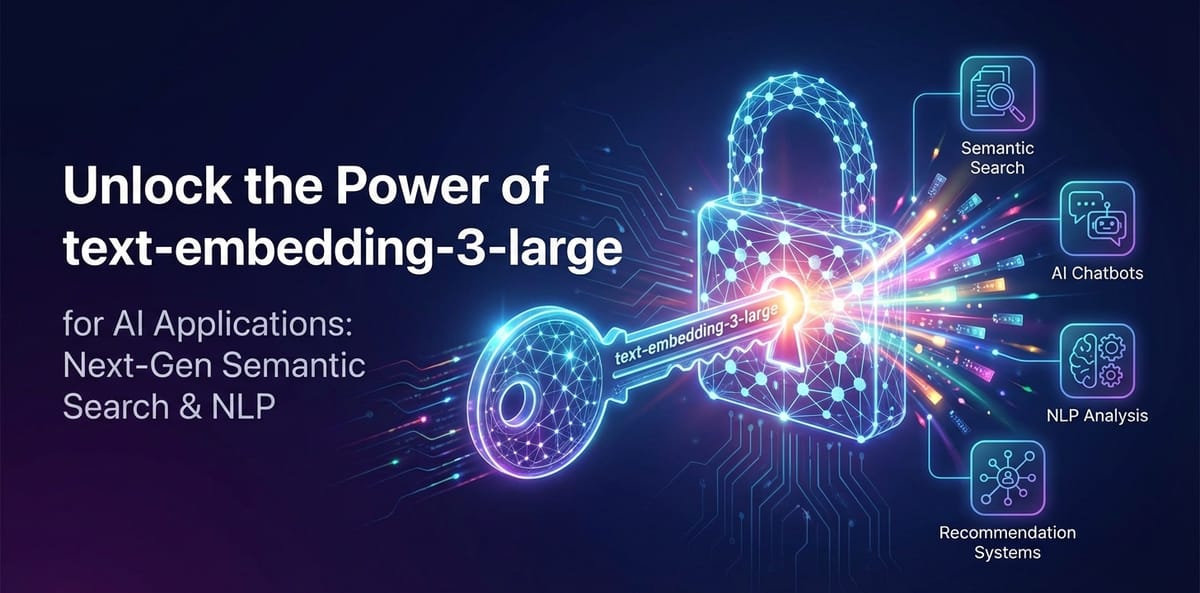
The enhanced capabilities of text-embedding-3-large open up new possibilities and significantly improve existing AI applications across various domains. Its superior semantic understanding and flexible dimensionality make it a versatile tool for developers.
1. Semantic Search and Retrieval-Augmented Generation (RAG)
This is perhaps the most immediate and impactful application. Traditional keyword-based search often fails to capture the true intent behind a query. Semantic search, powered by embeddings, finds documents or passages that are conceptually similar to the query, even if they don't share common keywords.
- Example: A user searches for "recipes for healthy eating during winter." A keyword search might only return documents with "winter" and "healthy eating." Semantic search, using
text-embedding-3-large, could retrieve recipes for "nutritious cold-weather meals" or "seasonal comfort food," understanding the underlying meaning. - RAG Systems: In the context of large language models (LLMs), RAG systems combine the generative power of LLMs with external, up-to-date knowledge bases. When a user asks a question,
text-embedding-3-largecan be used to efficiently retrieve relevant context from a vast corpus of documents. This retrieved context is then fed to an LLM, enabling it to generate more accurate, grounded, and up-to-date answers, reducing hallucinations and improving factual consistency. This is crucial for enterprise-grade chatbots, internal knowledge management systems, and customer support.
2. Recommendation Systems
Personalized recommendations are a cornerstone of modern digital experiences, from e-commerce to media streaming. text-embedding-3-large can significantly enhance these systems.
- Content Recommendations: By embedding descriptions of articles, movies, products, or user reviews, the model can identify items semantically similar to what a user has liked in the past or is currently viewing. This leads to more relevant and engaging recommendations.
- User Similarity: User profiles (e.g., based on browsing history, past purchases, explicit preferences) can also be embedded. By finding users with similar taste profiles in the embedding space, the system can recommend items that similar users enjoyed.
3. Clustering and Anomaly Detection
Understanding patterns and identifying outliers in large text datasets is critical for various analytical tasks.
- Document Clustering: Grouping similar documents together (e.g., news articles on the same topic, customer feedback regarding similar issues) becomes highly effective.
text-embedding-3-largeensures that documents with shared themes, even if using different terminology, are clustered correctly. - Anomaly Detection: In fields like cybersecurity or fraud detection, identifying unusual text patterns (e.g., strange email content, out-of-character transaction descriptions) is vital. Embeddings can highlight text instances that are far from the typical clusters, signaling potential anomalies.
4. Text Classification and Sentiment Analysis
While often addressed by other NLP models, embeddings are a powerful input feature for traditional machine learning classifiers.
- Enhanced Classification: By providing high-quality, semantically rich embeddings as input to models like SVMs, Random Forests, or neural networks, the accuracy of text classification tasks (e.g., categorizing customer emails, routing support tickets, tagging content) can be significantly improved.
- Nuanced Sentiment Analysis: Beyond simple positive/negative/neutral,
text-embedding-3-largecan help capture more granular sentiment, understanding subtle tones and sarcasm, which is invaluable for brand monitoring, social media analysis, and product feedback.
5. Code Search and Understanding
The application extends beyond natural language to programming languages.
- Code Snippet Search: Developers can search for relevant code snippets or functions based on natural language descriptions of what they want to achieve, rather than exact syntax matches.
- Documentation Linking: Automatically link code segments to relevant documentation sections, improving developer productivity and code maintainability.
6. Multi-modal Applications (Bridging Text and Other Modalities)
While text-embedding-3-large specifically deals with text, high-quality text embeddings are crucial components in multi-modal AI systems.
- Image Captioning/Generation: Generating descriptive captions for images or generating images from text prompts often involves a textual component that benefits from sophisticated embeddings.
- Video Search: Searching for specific moments within videos based on spoken dialogue or overlaid text relies heavily on accurate text representation.
The versatility of text-embedding-3-large lies in its ability to convert virtually any piece of text into a universal numerical language, unlocking semantic understanding for machines across an impressive spectrum of applications. Whether building a sophisticated search engine, a highly personalized recommendation system, or a robust RAG pipeline, this model provides the foundational semantic intelligence needed for success.
Seamless Integration with the OpenAI SDK
Integrating text-embedding-3-large into your applications is streamlined and user-friendly, thanks to the comprehensive OpenAI SDK. The SDK provides a consistent interface across different programming languages, abstracting away the complexities of API calls and data handling. While various languages are supported, Python is often the go-to choice for AI development due to its rich ecosystem and ease of use.
Setting Up Your Environment
First, ensure you have the OpenAI Python library installed:
pip install openai
Next, you'll need an OpenAI API key. It's crucial to handle your API key securely. Avoid hardcoding it directly into your script. Environment variables are a much safer approach.
import os
from openai import OpenAI

# Set your OpenAI API key as an environment variable (e.g., OPENAI_API_KEY)
# In your terminal before running the script: export OPENAI_API_KEY='your_api_key_here'
# Or for Windows PowerShell: $env:OPENAI_API_KEY='your_api_key_here'
# Or in your .bashrc/.zshrc for persistent access.

client = OpenAI(api_key=os.environ.get("OPENAI_API_KEY"))
Generating Embeddings with text-embedding-3-large
The process of generating embeddings is straightforward. You call the embeddings.create method, specifying the model and the text you want to embed.
def get_embedding(text, model="text-embedding-3-large", dimensions=None):
    """
    Generates an embedding for the given text using the specified OpenAI model.

    Args:
        text (str or list of str): The input text(s) to embed.
        model (str): The name of the embedding model to use (default: "text-embedding-3-large").
        dimensions (int, optional): The desired output dimension for the embedding.
                                    If None, the model's native dimension will be used.

    Returns:
        list: A list of embedding vectors.
    """
    try:
        if dimensions:
            response = client.embeddings.create(
                input=text,
                model=model,
                dimensions=dimensions
            )
        else:
            response = client.embeddings.create(
                input=text,
                model=model
            )
        return [data.embedding for data in response.data]
    except Exception as e:
        print(f"Error generating embedding: {e}")
        return None

# Example usage:
text_to_embed_single = "Artificial intelligence is revolutionizing the world."
embedding_single = get_embedding(text_to_embed_single, dimensions=1024)

if embedding_single:
    print(f"Single text embedding (first 5 values): {embedding_single[0][:5]}...")
    print(f"Embedding dimension: {len(embedding_single[0])}")

print("-" * 30)

# Example with multiple texts (batching)
texts_to_embed_batch = [
    "The quick brown fox jumps over the lazy dog.",
    "Machine learning models are trained on large datasets.",
    "Semantic search enhances information retrieval efficiency."
]
embeddings_batch = get_embedding(texts_to_embed_batch, dimensions=256)

if embeddings_batch:
    for i, emb in enumerate(embeddings_batch):
        print(f"Text {i+1} embedding (first 5 values): {emb[:5]}...")
        print(f"Embedding {i+1} dimension: {len(emb)}")
Key Considerations for Integration:
- Batching Requests: As shown in the example, the
inputparameter can accept a list of strings. This allows you to send multiple texts in a single API call, which is significantly more efficient than making individual calls for each text. Batching reduces latency and can contribute to cost optimization by minimizing API overhead. - Choosing Dimensions: Carefully consider the
dimensionsparameter. For maximum precision and when computational resources allow, use the native 3072 dimensions. However, for large-scale applications or when memory is a concern, experiment with lower dimensions (e.g., 1024 or 256). Often, the performance drop with reduced dimensions is negligible for many use cases, while the savings in storage and processing can be substantial. - Error Handling and Retries: API calls can fail due to network issues, rate limits, or transient service errors. Implement robust error handling (e.g.,
try-exceptblocks) and consider retry mechanisms with exponential backoff to make your application more resilient. - Rate Limits: Be aware of OpenAI's rate limits (requests per minute, tokens per minute). For high-throughput applications, you might need to implement a queuing system or adjust your batching strategy to stay within these limits.
- Data Preprocessing: While
text-embedding-3-largeis robust, performing basic text preprocessing (e.g., cleaning HTML tags, removing redundant whitespace, handling special characters) can sometimes improve embedding quality and consistency. However, avoid aggressive stemming or lemmatization unless your specific use case benefits from it, as it might remove valuable semantic information. - Storing Embeddings: Once generated, embeddings are typically stored in a vector database (e.g., Pinecone, Weaviate, Milvus, ChromaDB) or a traditional database with vector support (e.g., PostgreSQL with
pgvector). This allows for efficient similarity searches and retrieval. The choice of database depends on scale, performance requirements, and existing infrastructure.
By following these integration guidelines and leveraging the power of the OpenAI SDK, developers can quickly and effectively harness the advanced capabilities of text-embedding-3-large to build intelligent and responsive AI applications. The flexibility in dimensionality, coupled with batch processing, provides a powerful toolkit for balancing performance with practical operational considerations, particularly in the realm of cost optimization.
XRoute is a cutting-edge unified API platform designed to streamline access to large language models (LLMs) for developers, businesses, and AI enthusiasts. By providing a single, OpenAI-compatible endpoint, XRoute.AI simplifies the integration of over 60 AI models from more than 20 active providers(including OpenAI, Anthropic, Mistral, Llama2, Google Gemini, and more), enabling seamless development of AI-driven applications, chatbots, and automated workflows.
Strategic Cost Optimization for Embedding Models
While text-embedding-3-large offers superior performance, managing the associated costs, especially at scale, is a critical aspect of successful AI deployment. Strategic cost optimization involves a multi-faceted approach, combining careful model selection, efficient usage patterns, and leveraging appropriate infrastructure.
1. Understanding the Pricing Model
OpenAI's embedding models are typically priced per 1,000 tokens (or 1 million tokens for larger scales). A token roughly corresponds to a word in English. The cost for text-embedding-3-large is generally higher per token than text-embedding-ada-002. However, this is where the flexibility of text-embedding-3-large shines.
- Token Count is Key: Your total cost is directly proportional to the number of tokens you embed. Minimize redundant embedding generation.
- Dimensions vs. Cost: While the base price per token remains the same regardless of the output dimension you choose for
text-embedding-3-large(e.g., 256 vs. 3072), the value you get for that cost changes. If you can achieve sufficient performance with 256 dimensions, the downstream computational and storage costs for those embeddings will be significantly lower, leading to substantial overall savings.
2. Smart Use of Output Dimensions
This is arguably the most impactful cost optimization lever for text-embedding-3-large.
- Experiment and Benchmark: Don't automatically opt for the highest dimension (3072). For many applications, particularly those not requiring extremely fine-grained semantic distinctions, a lower dimension like 1024 or even 256 might suffice. Conduct A/B tests or evaluate your application's performance with different dimensions on your specific data and tasks.
- Reduced Storage Costs: Smaller embedding vectors require less storage space in your vector database. This translates to lower database costs, especially at scale.
- Faster Similarity Search: Operations like similarity search (e.g., nearest neighbor search) on lower-dimensional vectors are inherently faster and consume fewer computational resources. This can reduce query latency and infrastructure costs for your search endpoints.
- Lower Memory Footprint: Processing and loading smaller vectors require less RAM, potentially allowing you to use smaller, more cost-effective compute instances.
3. Effective Caching Strategies
Generating embeddings is an API call that incurs cost and latency. Caching is paramount for cost optimization.
- Persistent Storage: Once a piece of text (e.g., a document, a user query) has been embedded, store its embedding persistently. Before embedding new text, check if an embedding for that exact text already exists in your cache or database.
- Hashing Text: Use a consistent hashing function for your input texts. The hash can serve as a key to look up existing embeddings. If the text content hasn't changed, reuse its embedding.
- Versioning and Invalidation: If your embedding model changes (e.g., OpenAI releases
text-embedding-3.5-large), you might need to re-embed your data. Implement a versioning system for your embeddings to manage this gracefully. - Time-to-Live (TTL): For highly dynamic content or user queries, you might implement a TTL for cached embeddings to ensure freshness, though this is less common for static document embeddings.
4. Batching Requests Strategically
As mentioned in the SDK integration section, sending multiple texts in a single API request is more efficient.
- Optimize Batch Size: Experiment with different batch sizes to find the optimal balance between throughput and avoiding rate limits. OpenAI's API often performs better with larger batches up to a certain point.
- Asynchronous Processing: For very large datasets, use asynchronous processing and parallel API calls to maximize throughput, but always respect rate limits.
5. Conditional Embedding Generation
Not all text needs to be embedded, or at least not with the highest-fidelity model.
- Filtering: Before sending text to
text-embedding-3-large, consider filtering out irrelevant or duplicate content. - Tiered Embedding: For applications with varying importance of data, consider a tiered embedding strategy.
- High-Value Content: Use
text-embedding-3-large(potentially at full dimensions) for critical documents, core knowledge base articles, or highly sensitive customer queries. - Lower-Value Content: For less critical or shorter texts (e.g., social media comments, ephemeral chat logs), you might use a smaller, less expensive model (if available) or
text-embedding-3-largeat a very low dimension (e.g., 256).
- High-Value Content: Use
6. Leveraging Unified API Platforms for Flexibility and Cost Control
This is where a solution like XRoute.AI becomes invaluable. In a world where multiple AI models from various providers exist, and new ones emerge constantly, locking into a single provider can limit flexibility and hinder cost optimization.
- Provider Agnosticism: XRoute.AI offers a unified, OpenAI-compatible API endpoint that allows you to access over 60 AI models from more than 20 active providers. This means you aren't stuck with just OpenAI's embedding models. If another provider offers a more cost-effective AI embedding solution with comparable performance for your specific needs, XRoute.AI allows you to switch seamlessly without rewriting your integration code.
- Dynamic Routing: Platforms like XRoute.AI can potentially offer intelligent routing based on cost, latency, or specific model capabilities, ensuring your requests are always handled by the most optimal provider at any given moment. This directly contributes to low latency AI and maximizes cost optimization.
- Simplified Management: Instead of managing multiple API keys, rate limits, and SDKs for different providers (e.g., OpenAI, Cohere, Google, local models), XRoute.AI centralizes this, reducing operational overhead and developer complexity. This frees up resources that can be reallocated to core product development.
By combining these strategies—judiciously choosing dimensions, implementing robust caching, batching effectively, conditionally generating embeddings, and leveraging unified API platforms like XRoute.AI for maximum flexibility—businesses can harness the immense power of text-embedding-3-large while maintaining stringent control over their operational costs, making advanced AI solutions both powerful and sustainable.
Advanced Use Cases and Fine-tuning Considerations
The capabilities of text-embedding-3-large extend beyond basic retrieval and classification. When combined with other AI techniques and models, it unlocks advanced use cases and enables highly sophisticated applications.
1. Combining with Generative AI (RAG with Enhanced Context)
As previously touched upon, text-embedding-3-large is a cornerstone of advanced Retrieval-Augmented Generation (RAG) systems. However, its superior semantic understanding allows for even more refined context retrieval:
- Multi-hop Reasoning: For complex questions requiring information from multiple documents, the enhanced embeddings can retrieve interconnected pieces of information more effectively.
- Persona-Based Responses: Embeddings of user profiles or conversational history can be used to retrieve context that helps an LLM tailor its responses to a specific user persona or conversational style.
- Temporal Context: For applications dealing with evolving information (e.g., legal documents, news archives), embeddings can help retrieve the most relevant and most recent information by combining semantic similarity with metadata filtering.
2. Custom Search Facets and Filters
Beyond simple semantic search, embeddings enable dynamic and intelligent filtering.
- Attribute-Based Filtering: Embeddings of product descriptions can be combined with structured attributes (e.g., price range, brand, color) to allow users to search for "comfortable running shoes under $100" with both semantic and attribute-based relevance.
- Categorical Browsing: Automatically categorize new content or products by comparing their embeddings to a set of pre-defined category embeddings, enabling more intelligent browsing experiences.
3. Anomaly Detection in Unstructured Data
text-embedding-3-large can detect subtle deviations from normal patterns in text, which is invaluable for:
- Fraud Detection: Identifying unusual language patterns in financial transaction descriptions, insurance claims, or communication logs that might indicate fraudulent activity.
- Cybersecurity: Detecting phishing attempts or malicious code by flagging emails or code snippets whose embeddings are significantly different from legitimate ones.
- Quality Control: Monitoring manufacturing logs or sensor data (when represented textually) for anomalies that suggest equipment malfunction or process deviations.
4. Data Augmentation and Synthesis
High-quality embeddings can facilitate the creation of synthetic data for training other models.
- Paraphrase Generation: By slightly perturbing an embedding and decoding it, one can generate paraphrases of existing text, expanding training datasets for tasks like natural language understanding (NLU).
- Dataset Balancing: In cases of imbalanced datasets, embeddings can help identify semantic gaps where synthetic examples might be useful, or guide the generation of new text that balances the distribution.
5. Multi-modal Embedding Spaces
While text-embedding-3-large is text-specific, it forms a crucial part of larger multi-modal AI systems. The text embeddings can be aligned with embeddings from other modalities (e.g., image embeddings, audio embeddings) in a shared latent space.
- Image Search by Text: Search for images using natural language descriptions.
- Video Content Summarization: Understand and summarize video content by linking speech-to-text transcripts with visual features.
Considerations for Fine-tuning and Customization
While text-embedding-3-large is a powerful general-purpose model, there might be scenarios where customization or fine-tuning is considered.
- Domain-Specific Nuances: For highly specialized domains (e.g., medical research, niche legal fields), where specific jargon or conceptual relationships are crucial and not well-captured by a general model, fine-tuning might be beneficial.
- Data Distribution Shift: If your application's data significantly deviates from the distribution of data
text-embedding-3-largewas trained on, fine-tuning could improve performance.
However, it's important to approach fine-tuning with caution:
- Complexity and Cost: Fine-tuning large models is computationally expensive, requires significant amounts of high-quality, domain-specific labeled data, and demands specialized expertise. The benefits must outweigh these substantial costs.
- Risk of Catastrophic Forgetting: Fine-tuning on a small, specific dataset can sometimes degrade the model's general-purpose capabilities.
- OpenAI's Stance: OpenAI currently does not offer fine-tuning for their embedding models in the same way they do for their generative models. This means for
text-embedding-3-large, direct fine-tuning is not an option for users.
Alternative Approaches to Customization:
Instead of direct fine-tuning, developers can often achieve excellent results by:
- Careful Prompt Engineering: For RAG systems, crafting precise prompts to the LLM that leverage the retrieved context effectively can compensate for subtle domain nuances.
- Post-processing Embeddings: Applying transformations (e.g., PCA, t-SNE for visualization) or training a small, shallow neural network on top of the
text-embedding-3-largeembeddings for a specific downstream task can be highly effective without modifying the base embedding model. - Data Curation: Focusing on providing high-quality, representative data to
text-embedding-3-largewill yield better embeddings. - Leveraging Unified Platforms like XRoute.AI: While
text-embedding-3-largemight not be fine-tunable, platforms like XRoute.AI allow you to easily switch to other embedding models from different providers if a specific model offers superior domain-specific performance out-of-the-box or supports fine-tuning for your particular use case. This flexibility ensures you always use the best tool for the job without vendor lock-in, which again ties back to cost optimization and getting the most effective AI for your investment.
In conclusion, text-embedding-3-large offers a robust foundation for a vast array of AI applications. While direct fine-tuning of this specific model isn't currently available, its inherent strength and the intelligent strategies for customization and integration through platforms like XRoute.AI ensure that developers can achieve highly sophisticated and domain-relevant results.
The Future of Text Embeddings and Their Role in AI
The advancements seen in text-embedding-3-large are but a snapshot of an accelerating field. The trajectory of text embeddings points towards even more sophisticated, efficient, and versatile models that will continue to redefine the capabilities of AI applications. Understanding these emerging trends is crucial for staying ahead in the rapidly evolving AI landscape.
1. Hyper-Efficient and Smaller Models
While text-embedding-3-large offers flexible dimensions for cost optimization, there's an ongoing push for even smaller, more efficient embedding models that can run on edge devices or with significantly reduced computational resources without sacrificing too much performance. This trend is vital for democratizing AI and deploying intelligence in environments with limited power or connectivity. Techniques like distillation and quantization will play a larger role in creating these compact models.
2. Multilingual and Cross-Lingual Embeddings
As AI becomes increasingly global, the demand for truly multilingual embeddings will grow. Future models will not only support dozens or hundreds of languages but will also allow for seamless cross-lingual understanding – meaning a query in English could retrieve documents in Spanish, or vice versa, based on semantic similarity alone. This will break down language barriers in information access and communication.
3. Dynamic and Adaptive Embeddings
Currently, most embeddings are relatively static once generated. The future may see dynamic embeddings that can adapt in real-time based on new information, user feedback, or the specific context of an ongoing conversation. This would allow AI systems to learn and evolve more rapidly, providing even more personalized and up-to-date insights. Imagine an embedding that subtly shifts its meaning based on the current news cycle or emerging trends.
4. Beyond Text: Truly Multi-modal and Cross-modal Embeddings
The ultimate vision for embeddings involves a unified latent space where all forms of data – text, images, audio, video, sensor data – are represented by semantically meaningful vectors. This would enable AI systems to reason across modalities, understanding a concept whether it's described in text, shown in an image, or spoken in an audio clip. This convergence will unlock truly intelligent systems that perceive and interact with the world in a holistic manner.
5. Explainable and Interpretable Embeddings
As embeddings become more powerful, the need for explainability will intensify. Researchers are exploring ways to make these high-dimensional vectors more interpretable, allowing developers and users to understand why certain texts are considered similar or how specific features contribute to an embedding's meaning. This will be crucial for building trust in AI systems and for debugging and improving their performance.
6. Ethical Considerations and Bias Mitigation
The data used to train embedding models can inadvertently encode societal biases, leading to unfair or discriminatory outcomes in AI applications. Future research will focus heavily on developing techniques to detect, quantify, and mitigate these biases in embeddings. This includes creating more diverse training datasets, implementing debiasing algorithms, and developing robust evaluation metrics that ensure fairness across different demographic groups.
The Role of Unified Platforms in the Future
Platforms like XRoute.AI will become even more critical in this future landscape. As the number of embedding models proliferates across providers, and as models evolve to become more specialized (e.g., domain-specific, multi-modal), developers will face increasing complexity in integrating and managing these diverse tools.
- Seamless Access to Innovation: XRoute.AI's unified API ensures that developers can easily tap into the latest and greatest models, regardless of the provider, without needing to re-engineer their applications. This means faster adoption of new features like dynamic or multi-modal embeddings as they become available.
- Future-Proofing Applications: By abstracting away the underlying model provider, XRoute.AI helps future-proof AI applications. If a new, more advanced embedding model emerges from Google, Anthropic, or a specialized startup, switching to it through XRoute.AI would be a configuration change, not a major refactor.
- Continued Cost Optimization and Performance Tuning: The ability to dynamically switch between providers and models, coupled with XRoute.AI's focus on low latency AI and cost-effective AI, ensures that businesses can always optimize for the best blend of performance, cost, and specific feature requirements, even as the market evolves.
The journey of text embeddings, from simple word counts to sophisticated, context-aware vector representations like text-embedding-3-large, is a testament to the rapid progress in AI. These numerical representations are not just data points; they are the semantic backbone of intelligent systems, empowering machines to truly understand and interact with human language. As we look to the future, the continued innovation in this field promises to unlock even more profound capabilities, driving AI closer to its full potential and transforming how we interact with information and technology.
Conclusion
The advent of text-embedding-3-large marks a pivotal moment in the evolution of AI applications, offering an unparalleled combination of semantic understanding, performance, and flexibility. Its ability to represent the nuances of human language in a high-dimensional vector space empowers developers to build more intelligent, responsive, and relevant systems, from sophisticated semantic search engines to highly personalized recommendation systems and robust RAG architectures.
We've explored how its enhanced capabilities, particularly its flexible output dimensions, are not just about achieving higher accuracy but are also crucial for strategic cost optimization. By carefully selecting the right dimensionality for a given task, implementing intelligent caching mechanisms, and batching requests effectively, businesses can significantly reduce their operational expenses without compromising on performance.
Furthermore, integrating text-embedding-3-large into your tech stack is streamlined and efficient, thanks to the comprehensive OpenAI SDK. This ease of integration, coupled with its robust performance, makes it an accessible and powerful tool for developers at all levels.
Looking ahead, the landscape of text embeddings is poised for even more transformative advancements, promising hyper-efficient models, seamless multilingual capabilities, and true multi-modal understanding. In this dynamic environment, platforms like XRoute.AI become indispensable. By providing a unified, OpenAI-compatible API endpoint to over 60 models from 20+ providers, XRoute.AI not only simplifies the integration of powerful tools like text-embedding-3-large but also offers unparalleled flexibility, enabling developers to dynamically choose the most cost-effective AI and low latency AI solutions available. This strategic advantage ensures that your AI applications are not only cutting-edge today but also future-proofed against the rapid pace of innovation.
Embrace the power of text-embedding-3-large and unlock new frontiers in AI development. With strategic implementation and the right tools, you can build applications that truly understand the world, one semantic vector at a time.
Frequently Asked Questions (FAQ)
1. What is text-embedding-3-large and how does it differ from previous OpenAI embedding models? text-embedding-3-large is OpenAI's latest and most advanced text embedding model. It offers superior semantic understanding, higher performance across various benchmarks, and significantly improved flexibility compared to its predecessors like text-embedding-ada-002. A key differentiator is its ability to output embeddings at various dimensions (e.g., 256, 1024, 3072) without a proportional loss in performance, which is crucial for cost optimization and efficiency.
2. What are the main benefits of using text-embedding-3-large in AI applications? The main benefits include enhanced semantic search accuracy, improved performance in recommendation systems, more precise clustering and anomaly detection, and robust input for text classification. Its superior ability to capture context and nuances in text leads to more relevant and insightful results across a wide range of AI applications, particularly those involving Retrieval-Augmented Generation (RAG).
3. How can I integrate text-embedding-3-large into my Python application? You can integrate text-embedding-3-large using the OpenAI SDK. After installing the openai library (pip install openai), you initialize the OpenAI client with your API key and then call client.embeddings.create(input="your text", model="text-embedding-3-large", dimensions=your_desired_dimension). The SDK handles the API communication, making integration seamless.
4. What strategies can I use for cost optimization when working with text-embedding-3-large? Key strategies for cost optimization include: * Smart Dimension Selection: Experiment with lower dimensions (e.g., 256, 1024) for text-embedding-3-large, as they often provide sufficient performance for many tasks at significantly reduced downstream storage and computation costs. * Robust Caching: Store generated embeddings to avoid re-embedding the same text multiple times. * Batching Requests: Send multiple texts in a single API call to reduce latency and overhead. * Conditional Embedding: Only embed necessary text and filter out irrelevant content. * Leverage Unified API Platforms: Use platforms like XRoute.AI to access various models and providers, enabling you to choose the most cost-effective AI solution dynamically based on your specific needs.
5. How does XRoute.AI relate to using text-embedding-3-large and other AI models? XRoute.AI is a unified API platform that simplifies access to over 60 large language models from more than 20 providers, all through a single, OpenAI-compatible endpoint. While you can directly use text-embedding-3-large via the OpenAI SDK, XRoute.AI enhances this by offering greater flexibility and cost optimization. It allows you to seamlessly switch between text-embedding-3-large and other embedding models (from different providers) without changing your code, ensuring you always use the most efficient or performant model available. This centralized management also contributes to low latency AI and simplifies the complexities of managing multiple API connections.
🚀You can securely and efficiently connect to thousands of data sources with XRoute in just two steps:
Step 1: Create Your API Key
To start using XRoute.AI, the first step is to create an account and generate your XRoute API KEY. This key unlocks access to the platform’s unified API interface, allowing you to connect to a vast ecosystem of large language models with minimal setup.
Here’s how to do it: 1. Visit https://xroute.ai/ and sign up for a free account. 2. Upon registration, explore the platform. 3. Navigate to the user dashboard and generate your XRoute API KEY.
This process takes less than a minute, and your API key will serve as the gateway to XRoute.AI’s robust developer tools, enabling seamless integration with LLM APIs for your projects.
Step 2: Select a Model and Make API Calls
Once you have your XRoute API KEY, you can select from over 60 large language models available on XRoute.AI and start making API calls. The platform’s OpenAI-compatible endpoint ensures that you can easily integrate models into your applications using just a few lines of code.
Here’s a sample configuration to call an LLM:
curl --location 'https://api.xroute.ai/openai/v1/chat/completions' \
--header 'Authorization: Bearer $apikey' \
--header 'Content-Type: application/json' \
--data '{
    "model": "gpt-5",
    "messages": [
        {
            "content": "Your text prompt here",
            "role": "user"
        }
    ]
}'
With this setup, your application can instantly connect to XRoute.AI’s unified API platform, leveraging low latency AI and high throughput (handling 891.82K tokens per month globally). XRoute.AI manages provider routing, load balancing, and failover, ensuring reliable performance for real-time applications like chatbots, data analysis tools, or automated workflows. You can also purchase additional API credits to scale your usage as needed, making it a cost-effective AI solution for projects of all sizes.
Note: Explore the documentation on https://xroute.ai/ for model-specific details, SDKs, and open-source examples to accelerate your development.