What is an AI API? A Beginner's Guide

The digital landscape is evolving at an unprecedented pace, driven largely by the transformative power of Artificial Intelligence (AI). From smart assistants that schedule our meetings to sophisticated algorithms that power medical diagnostics, AI is no longer a futuristic concept but a ubiquitous force shaping our daily lives and industries. Yet, for many, the inner workings of AI remain a black box. How do developers, without being AI experts themselves, integrate these complex intelligent capabilities into their applications, websites, and services? The answer, overwhelmingly, lies in the AI API.
This comprehensive guide will demystify the concept of an AI API, breaking down its definition, functionality, benefits, and practical applications. Whether you're a budding developer, a business owner looking to leverage AI, or simply curious about how these intelligent systems are built, you'll gain a profound understanding of what is an AI API and how it serves as the crucial bridge between your software and cutting-edge AI models. We'll explore various types, delve into how they work, discuss key considerations for choosing the right one, and even touch upon the intriguing world of free AI API options. Prepare to embark on a journey that illuminates how AI is made accessible and actionable for everyone.
The Foundation: Understanding APIs First
Before we dive specifically into AI APIs, it's essential to grasp the fundamental concept of an API (Application Programming Interface). Think of an API as a menu in a restaurant. The menu lists all the dishes (functions) you can order, along with a description of what they are and what ingredients they contain (parameters). You don't need to know how the chef prepares the meal; you just tell the waiter (the API) what you want from the menu, and the kitchen (the server) prepares it and sends it back to you.
In the digital world, an API is a set of rules and protocols that allows different software applications to communicate with each other. It defines the methods and data formats that applications can use to request and exchange information. For instance, when you check the weather on your phone, your weather app likely uses an API to pull data from a weather service. When you pay for something online, your e-commerce site uses an API to communicate with a payment gateway. APIs are the silent workhorses that enable the interconnectedness of modern software, making complex systems seem seamless and intuitive to the end-user. They abstract away complexity, providing a standardized way to access functionalities without needing to understand the underlying implementation details.
What Exactly is an AI API? Deconstructing the Concept
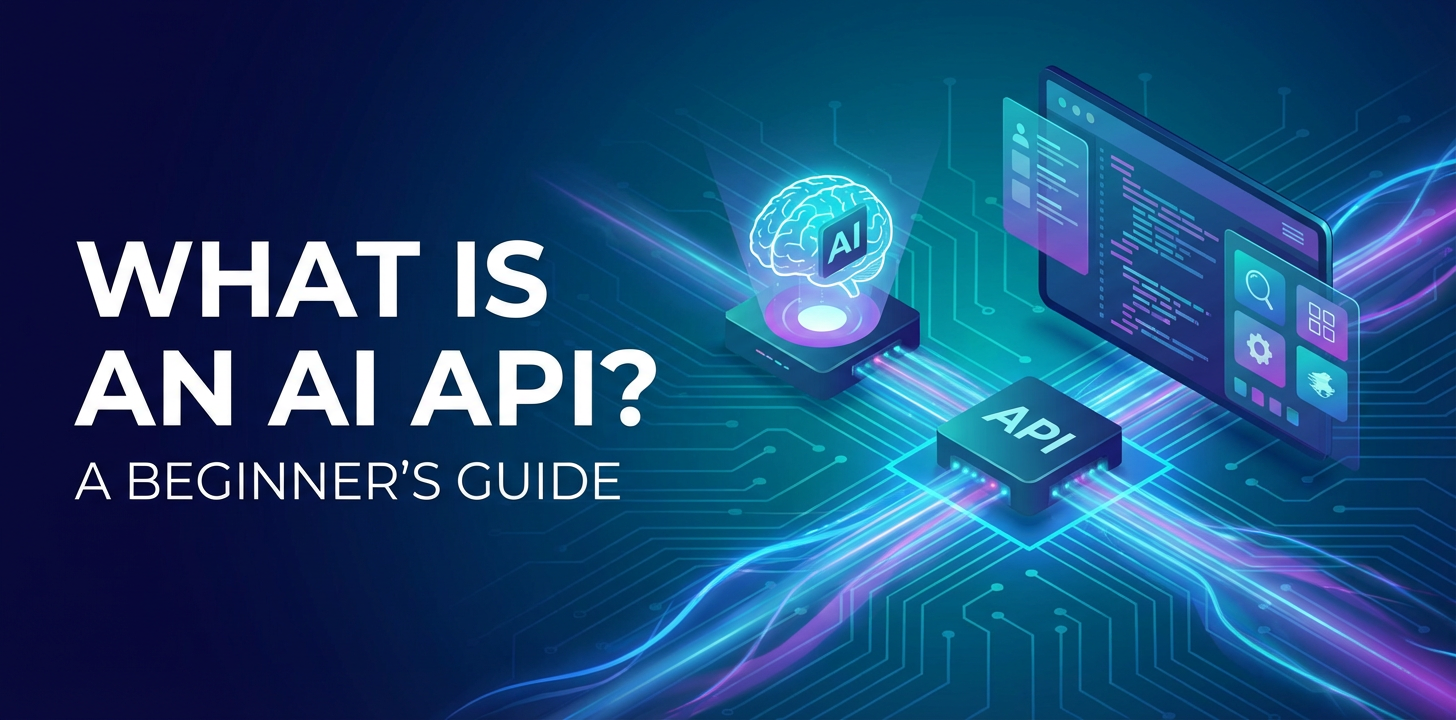
Now, let's bring AI into the picture. An AI API is essentially a specialized type of API that provides access to pre-trained artificial intelligence models and algorithms. Instead of building an AI model from scratch—a task that requires deep expertise in machine learning, vast datasets, and significant computational resources—developers can simply make calls to an AI API. The API then sends the input data to the AI model hosted on the provider's servers, processes it, and returns the AI's output back to the requesting application.
Imagine you want your application to translate text from English to Spanish. Without an AI API, you would need to: 1. Collect a massive dataset of English and Spanish text pairs. 2. Train a complex neural network on this data, a process that could take days or weeks on powerful hardware. 3. Develop inference code to deploy and run this model efficiently. 4. Manage the infrastructure to host and scale your translation model.
With an AI API for translation, you simply send your English text to the API endpoint, and in return, you receive the Spanish translation. The heavy lifting—the model training, deployment, and infrastructure management—is all handled by the AI API provider. This drastically lowers the barrier to entry for incorporating sophisticated AI capabilities into any software product.
The core promise of an AI API is democratizing AI. It allows developers, even those without a background in machine learning, to infuse their applications with intelligence, from natural language processing to computer vision, without the monumental investment in time, expertise, and resources typically associated with AI development. This "AI as a Service" model has become a cornerstone of modern software development, enabling rapid innovation and the creation of smarter applications across virtually every industry.
Why AI APIs Are Indispensable in Modern Development
The pervasive adoption of AI API solutions is not merely a trend; it's a fundamental shift in how software is built and how businesses operate. Their value proposition extends far beyond mere convenience, offering tangible benefits that drive efficiency, innovation, and competitive advantage.
1. Speed and Efficiency in Development
Integrating AI functionalities from scratch is a time-consuming and resource-intensive endeavor. By leveraging an AI API, developers can bypass the entire AI model development lifecycle. This means: * Faster Prototyping: Quickly test AI features without extensive upfront investment. * Rapid Deployment: Integrate production-ready AI models in days or weeks, not months or years. * Reduced Development Costs: Minimize the need for specialized AI/ML engineers on staff.
2. Access to Cutting-Edge Models
AI research is constantly pushing boundaries, with new, more powerful models emerging regularly. AI API providers often have dedicated research teams and vast computational resources, allowing them to train and deploy state-of-the-art models. By using their APIs, your application automatically benefits from: * Superior Performance: Access to models that outperform what an individual team could typically build. * Continuous Improvement: Providers often update their models, offering better accuracy and new features without requiring changes to your integration code.
3. Scalability and Reliability
Training and serving AI models at scale can be incredibly challenging. AI API providers handle: * Infrastructure Management: Servers, GPUs, data centers are all managed by the provider. * Load Balancing: Ensuring the API can handle varying levels of traffic without performance degradation. * High Availability: Minimizing downtime and ensuring consistent service. This allows developers to focus on their core product features rather than worrying about the underlying AI infrastructure.
4. Cost-Effectiveness
While some AI APIs come with a cost, they are often significantly more cost-effective than building and maintaining AI capabilities internally. The pricing models (often pay-as-you-go based on usage) allow businesses to scale their AI consumption with their needs, avoiding large upfront capital expenditures on hardware and specialized personnel. The "total cost of ownership" is typically much lower with an API-driven approach.
5. Democratization of AI
Perhaps the most profound impact of AI API is the democratization of AI. It empowers: * Small Businesses and Startups: To compete with larger enterprises by accessing sophisticated AI without massive budgets. * Non-AI Specialists: To integrate intelligent features into their projects, broadening the scope of what's possible. * Innovators: To experiment with AI in novel ways, fostering a new wave of intelligent applications across industries.
In essence, AI APIs transform AI from an exclusive domain of machine learning experts into a readily consumable utility, much like cloud computing transformed IT infrastructure. They are the essential tools for building the next generation of smart, responsive, and intuitive applications.
Diverse World of AI APIs: Categorizing Intelligence
The term AI API encompasses a vast spectrum of functionalities. AI is not a single technology but a collection of techniques and disciplines, each addressing different types of cognitive tasks. Understanding the major categories helps clarify the immense potential of these tools.
Let's explore some of the most prominent types of AI APIs available today:
1. Natural Language Processing (NLP) APIs
NLP is about enabling computers to understand, interpret, and generate human language. NLP APIs are perhaps one of the most widely adopted categories. * Text Translation: Translate text between different languages (e.g., Google Translate API, DeepL API). * Sentiment Analysis: Determine the emotional tone of text (positive, negative, neutral) (e.g., AWS Comprehend, Google Cloud Natural Language API). * Named Entity Recognition (NER): Identify and classify named entities (people, organizations, locations, dates) in text. * Text Summarization: Condense long pieces of text into shorter summaries. * Language Detection: Automatically identify the language of a given text. * Chatbot/Conversational AI: APIs that power intelligent virtual assistants and chatbots, understanding user intent and generating appropriate responses (e.g., Google's Dialogflow, OpenAI's GPT models). This is where the historical "API.AI" product evolved, focusing on conversational interfaces.
2. Computer Vision (CV) APIs
Computer Vision deals with enabling computers to "see" and interpret visual information from images and videos. * Image Recognition/Classification: Identify objects, scenes, or concepts within an image (e.g., "cat," "beach," "car"). * Object Detection: Locate and identify multiple objects within an image, often drawing bounding boxes around them. * Facial Recognition/Analysis: Detect faces, identify individuals, and analyze facial attributes (e.g., age, emotion). * Optical Character Recognition (OCR): Extract text from images (e.g., digitizing scanned documents). * Image Moderation: Automatically detect and flag inappropriate or harmful content in images. * Video Analysis: Analyze video streams for events, objects, or behaviors.
3. Speech Recognition and Synthesis APIs
These APIs bridge the gap between spoken language and text, and vice versa. * Speech-to-Text (STT): Convert spoken audio into written text (e.g., for voice assistants, transcription services). * Text-to-Speech (TTS): Convert written text into natural-sounding spoken audio (e.g., for virtual assistants, accessibility features, narrations). * Speaker Recognition: Identify individual speakers based on their voice.
4. Machine Learning (ML) Platform APIs
These are broader platforms that provide tools and services for building, deploying, and managing custom machine learning models, rather than just pre-trained ones. * Automated Machine Learning (AutoML): Tools that automate aspects of the ML workflow, from data preprocessing to model selection and deployment, making custom model building accessible to non-experts. * Model Deployment: APIs for deploying your own trained models as scalable web services. * Recommendation Engines: APIs that power personalized recommendations based on user behavior and preferences.
5. Generative AI APIs
A rapidly growing and exciting category, generative AI APIs are capable of creating new, original content. * Text Generation: Generate human-like text, articles, code, or creative content based on prompts (e.g., OpenAI's GPT-3/GPT-4, Google's Gemini, Anthropic's Claude). * Image Generation: Create images from text descriptions (text-to-image) or modify existing images (e.g., DALL-E, Midjourney, Stable Diffusion APIs). * Code Generation: Write or complete programming code based on natural language descriptions. * Music/Audio Generation: Create original music or audio snippets.
Each of these categories plays a vital role in building intelligent applications, offering specialized capabilities that can be combined and leveraged in myriad ways. The choice of which AI API to use depends entirely on the specific problem you're trying to solve and the type of intelligence your application requires.
Here's a quick overview of common AI API categories and their applications:
| AI API Category | Primary Function | Example Use Cases | Key Technologies Involved |
|---|---|---|---|
| Natural Language Processing (NLP) | Understanding, interpreting, and generating human language | Chatbots, sentiment analysis, translation, content summarization, spam detection | Large Language Models (LLMs), Transformers, Recurrent Neural Networks (RNNs) |
| Computer Vision (CV) | Enabling computers to "see" and interpret images/videos | Facial recognition, object detection, image search, augmented reality, visual inspection | Convolutional Neural Networks (CNNs), Generative Adversarial Networks (GANs) |
| Speech Recognition & Synthesis | Converting speech to text and text to speech | Voice assistants, transcription services, accessibility tools, voice control | Deep Neural Networks, Acoustic Models, Language Models |
| Generative AI | Creating new, original content (text, images, code) | Content creation, art generation, code completion, design variations | Transformers, Diffusion Models, GANs, Variational Autoencoders (VAEs) |
| Machine Learning (ML) Platforms | Building, deploying, and managing custom ML models | Predictive analytics, recommendation engines, fraud detection, custom classification | Various ML algorithms, Cloud Infrastructure, AutoML tools |
How AI APIs Work: A Peek Under the Hood
While the beauty of an AI API lies in its abstraction of complexity, understanding its basic operational flow can demystify the process and help developers integrate them more effectively. The fundamental interaction model is a standard client-server request-response pattern, albeit with an AI model as the processing engine.
1. The Client Request
The process begins when a client application (e.g., your mobile app, website backend, or desktop software) sends a request to the AI API endpoint. This request is typically an HTTP request (GET, POST, PUT, DELETE) and usually contains: * Authentication Credentials: An API key, token, or OAuth credentials to verify the client's identity and authorization. This is crucial for security and billing. * Input Data: The data that the AI model needs to process. This could be: * Text for translation or sentiment analysis. * An image file or URL for object detection. * An audio file for speech-to-text. * A prompt for generative AI. * Parameters (Optional): Specific instructions for the AI model, such as the target language for translation, the confidence threshold for detection, or the desired output format.
The input data and parameters are usually sent in a structured format like JSON (JavaScript Object Notation) or XML, as these are universally understood data interchange formats.
2. API Gateway and Routing
Upon receiving the request, an API Gateway acts as the entry point. It handles: * Authentication and Authorization: Validating the API key and ensuring the client has permission to use the requested service. * Rate Limiting: Ensuring no single client overloads the system with too many requests. * Request Routing: Directing the request to the appropriate AI service or model.
3. AI Model Processing
The core of the operation happens here. The AI API server, often leveraging specialized hardware like GPUs (Graphics Processing Units), performs the following steps: * Data Preprocessing: The input data might need to be converted, normalized, or resized to a format compatible with the AI model. For instance, an image might be scaled, or text might be tokenized. * Inference: The preprocessed data is fed into the pre-trained AI model. The model then performs its designated task – recognizing objects, translating text, generating new content, etc. This is the "thinking" part where the model applies its learned patterns to the new input. * Post-processing: The raw output from the AI model might be further processed to make it more digestible and useful for the client application. For example, probabilities might be converted into human-readable labels, or bounding box coordinates might be formatted.
4. The API Response
Finally, the AI API server sends a response back to the client application. This response typically includes: * Output Data: The result of the AI model's processing (e.g., translated text, identified objects, sentiment score, generated image URL). * Metadata: Additional information like confidence scores, processing time, or error messages. * Status Code: An HTTP status code indicating whether the request was successful (e.g., 200 OK) or if an error occurred (e.g., 400 Bad Request, 500 Internal Server Error).
The response is also usually in a structured format like JSON, allowing the client application to easily parse and integrate the AI's output into its own logic and user interface. This entire round trip, from request to response, often happens within milliseconds, making AI APIs suitable for real-time applications.
XRoute is a cutting-edge unified API platform designed to streamline access to large language models (LLMs) for developers, businesses, and AI enthusiasts. By providing a single, OpenAI-compatible endpoint, XRoute.AI simplifies the integration of over 60 AI models from more than 20 active providers(including OpenAI, Anthropic, Mistral, Llama2, Google Gemini, and more), enabling seamless development of AI-driven applications, chatbots, and automated workflows.
Integrating AI APIs: A Developer's Perspective
For developers, integrating an AI API into an application involves a set of common steps, regardless of the specific AI capability being accessed. Understanding this process is key to successfully leveraging these powerful tools.
1. Choose the Right API
Based on your project requirements (e.g., natural language processing, computer vision, generative AI), select an API that offers the desired functionality, accuracy, and performance. Consider providers like Google AI, AWS AI, Microsoft Azure AI, OpenAI, and specialized vendors.
2. Obtain API Credentials
Most AI APIs require authentication. You'll typically register with the provider and obtain an API key or a set of credentials (like client ID/secret for OAuth). This key identifies your application and tracks your usage for billing and security purposes. Never hardcode API keys directly into your client-side code; always handle them securely, preferably on your backend server, or use environment variables.
3. Review Documentation and SDKs
Thoroughly read the API documentation. This will detail: * Endpoints: The URLs where you send your requests. * Request Methods: (GET, POST, etc.) and required headers. * Input Parameters: What data the API expects and in what format. * Response Format: What the API will return. * Error Codes: How to handle different types of errors. Many providers offer Software Development Kits (SDKs) in various programming languages (Python, Java, Node.js, C#, etc.). SDKs simplify the integration process by providing pre-built functions and classes that abstract away the raw HTTP requests, making API calls feel more like calling a local function.
4. Make the API Call
Using your chosen programming language and either raw HTTP requests or an SDK, construct and send the request to the AI API endpoint.
Example (Conceptual Python using an SDK):
import my_ai_api_sdk # Assuming an SDK exists

# Initialize the client with your API key
client = my_ai_api_sdk.Client(api_key="YOUR_API_KEY")

# Prepare your input data
text_to_translate = "Hello, world!"
target_language = "es"

try:
    # Make the API call
    response = client.translate(text=text_to_translate, target_lang=target_language)

    # Process the response
    translated_text = response.get("translated_text")
    print(f"Original: {text_to_translate}")
    print(f"Translated: {translated_text}")

except my_ai_api_sdk.APIError as e:
    print(f"An error occurred: {e}")
5. Handle the Response
Parse the JSON (or other format) response from the API. Extract the relevant AI output and integrate it into your application's logic or user interface. It's crucial to implement robust error handling to gracefully manage situations where the API returns an error or unexpected data.
6. Consider Rate Limits and Usage
Be mindful of the API's rate limits (how many requests you can make per second/minute) and your usage quota. Exceeding these limits can lead to temporary blocks or additional charges. Implement strategies like retries with exponential backoff for transient errors and monitor your API usage.
By following these steps, developers can effectively harness the power of AI APIs to build intelligent features into their applications without needing to become AI research scientists themselves.
Key Considerations When Choosing an AI API
The sheer number of available AI API options can be overwhelming. Selecting the right one is crucial for the success and sustainability of your project. Here are critical factors to consider beyond just basic functionality:
1. Accuracy and Performance
- Accuracy: Does the API's model perform well on tasks relevant to your domain? Test it with your own data samples if possible. Some models might be excellent for general-purpose text but falter with niche industry jargon.
- Latency: How quickly does the API respond? For real-time applications (like chatbots or voice assistants), low latency is paramount. High latency can lead to poor user experience.
- Throughput: How many requests can the API handle per second? This is crucial for applications expecting high traffic volumes.
2. Cost and Pricing Model
- Pricing Structure: Most AI APIs use a pay-as-you-go model, often based on the number of requests, amount of data processed (e.g., characters for text, image megabytes), or compute time.
- Tiered Pricing: Understand if there are different tiers for usage and if bulk discounts apply.
- Free Tiers/Credits: Many providers offer a free AI API tier or initial credits, which are excellent for testing and development but often have limitations on usage or features.
- Hidden Costs: Be aware of potential costs for data storage, outbound data transfer, or specialized features.
3. Ease of Integration (Developer Experience)
- Documentation: Is the documentation clear, comprehensive, and up-to-date? Good examples and tutorials are invaluable.
- SDKs: Are there official SDKs for your preferred programming languages? This significantly streamlines integration.
- Community Support: A strong developer community, forums, and active GitHub repositories can be helpful for troubleshooting and learning.
- OpenAPI/Swagger: Does the API adhere to open standards, making it easier to generate client code?
4. Reliability and Scalability
- Uptime Guarantees (SLA): What Service Level Agreement (SLA) does the provider offer regarding uptime and availability? Critical applications demand high SLAs.
- Scalability: Can the API handle spikes in usage without degradation? This is typically a strength of major cloud providers.
- Redundancy: Does the provider have redundant infrastructure to prevent single points of failure?
5. Data Privacy and Security
- Data Handling: How does the provider handle your input data? Is it stored? Used for model training? Anonymized? This is critical, especially for sensitive data.
- Compliance: Does the API comply with relevant regulations like GDPR, HIPAA, CCPA?
- Security Features: What security measures are in place (encryption in transit and at rest, access controls, audit logs)?
6. Customization and Fine-tuning
- Pre-trained vs. Custom: While many APIs offer powerful pre-trained models, some allow for fine-tuning these models with your own data to improve performance for specific use cases.
- Flexibility: Does the API offer parameters to control the model's behavior, output format, or confidence thresholds?
7. Feature Set and Roadmap
- Current Features: Does the API offer all the specific AI functionalities you need?
- Future Roadmap: Is the provider actively developing and adding new features? A stagnant API might not keep up with evolving AI capabilities.
By carefully evaluating these factors, you can make an informed decision that aligns with your project's technical, financial, and strategic goals, ensuring a robust and future-proof AI API integration.
Exploring the World of Free AI API Options
The term "free AI API" often sparks considerable interest, particularly for individual developers, students, and startups on a tight budget. While truly unlimited, high-performance free AI APIs are rare, there are several ways to access AI capabilities without incurring significant costs. Understanding these options, along with their limitations, is key.
1. Free Tiers and Developer Credits
Most major cloud AI providers (Google Cloud AI, AWS AI/ML, Microsoft Azure AI, IBM Watson) offer substantial free tiers or developer credits. * Google Cloud AI Platform: Often provides a certain amount of free usage for services like Natural Language API, Vision AI, Translation AI, or credits for services like Vertex AI. * AWS Free Tier: Includes services like Amazon Rekognition (computer vision), Amazon Comprehend (NLP), Amazon Polly (text-to-speech), allowing a certain number of free requests or usage hours per month. * Microsoft Azure AI: Offers free access tiers for many Cognitive Services (e.g., computer vision, language, speech) with generous limits, or initial free credits. * OpenAI: While their advanced models (GPT-3, GPT-4, DALL-E) are paid, they often provide initial free credits upon sign-up, allowing developers to experiment. They also offer a free API for their less powerful, older models.
These free tiers are invaluable for: * Experimentation: Quickly test concepts and prototypes. * Learning: Gain hands-on experience with AI APIs without financial commitment. * Low-Volume Applications: For personal projects or applications with very limited usage, these tiers can sometimes suffice indefinitely.
Limitations: Free tiers come with strict usage limits (e.g., X characters translated per month, Y images analyzed per day). Exceeding these limits will typically incur charges or result in service suspension. They might also lack access to the latest or most performant models.
2. Open-Source AI Models and Libraries
While not "APIs" in the traditional sense, using open-source AI models allows you to implement AI functionalities for free, with the caveat that you host and manage everything yourself. * Hugging Face: A leading platform for open-source NLP and other AI models. Many models are available to download and run locally. They also offer a free AI API inference endpoint for many community models, allowing quick testing. * TensorFlow & PyTorch: These are the foundational open-source machine learning frameworks. You can use them to build and train your own models from scratch or fine-tune existing open-source models. This requires significant ML expertise and computational resources. * NLTK (Natural Language Toolkit), OpenCV (Open Source Computer Vision Library): Libraries that provide tools and algorithms for NLP and CV tasks, often including pre-trained models for basic tasks.
Limitations: Requires significant technical expertise (machine learning, deployment, infrastructure). You are responsible for hosting, scaling, and maintaining the models, which can negate the "free" aspect when considering operational costs.
3. Community-Driven or Niche Free APIs
Occasionally, smaller projects or academic institutions might offer free APIs for specific AI tasks, often for research or educational purposes. * Example: Some APIs for niche data analysis, specific language tools, or experimental generative models might offer free access.
Limitations: Often have very limited support, may not be reliable or scalable for production use, and can be discontinued without notice. Security and data privacy should be scrutinized carefully.
4. Limited Functionality or Demo APIs
Some providers offer free "demo" APIs that showcase a subset of their capabilities or apply strict rate limits, primarily for demonstration purposes rather than sustained usage.
When exploring "free AI API" options, it's crucial to distinguish between truly free services (which are rare for robust AI) and free tiers/credits. For any serious development, anticipating the transition from a free tier to a paid plan is a necessary part of the planning process. While free options are excellent starting points, understanding their constraints will help avoid unexpected issues as your project grows.
The Future of AI APIs: Unveiling New Horizons
The landscape of AI API technology is dynamic, evolving rapidly with breakthroughs in AI research and advancements in cloud infrastructure. Looking ahead, several key trends are poised to shape the future of how we access and integrate artificial intelligence.
1. The Rise of Hyper-Specialized and Multi-Modal APIs
While general-purpose LLMs are powerful, we'll see a surge in APIs tailored for extremely specific industries or tasks (e.g., AI for legal document analysis, medical image diagnostics, financial fraud detection). Furthermore, multi-modal APIs, capable of seamlessly processing and generating information across different data types (text, image, audio, video) in a unified way, will become standard, enabling richer and more contextual AI interactions.
2. Enhanced Focus on Responsible AI
As AI becomes more pervasive, concerns around bias, fairness, transparency, and ethical use will intensify. Future AI APIs will increasingly incorporate features for: * Bias Detection and Mitigation: Tools to identify and reduce harmful biases in models. * Explainable AI (XAI): APIs that provide insights into how an AI model arrived at its decision, fostering trust and accountability. * Robustness and Security: Enhanced measures against adversarial attacks and data poisoning. * Privacy-Preserving AI: Techniques like federated learning and differential privacy integrated into APIs to protect sensitive data.
3. Greater Customization and Fine-Tuning Capabilities
While pre-trained models are convenient, the ability to fine-tune these models with proprietary data will become more accessible through APIs. This will allow businesses to create highly specialized AI experiences that leverage their unique datasets, leading to superior performance and competitive differentiation without the need for extensive ML expertise. AutoML (Automated Machine Learning) features will become more sophisticated and integrated directly into API platforms.
4. Edge AI and Hybrid Deployments
For applications requiring ultra-low latency or operating in environments with limited connectivity, AI models will increasingly run closer to the data source (on-device or edge servers). AI APIs will evolve to support hybrid deployments, seamlessly coordinating between cloud-based AI for complex tasks and edge-based AI for real-time, localized processing.
5. Unified AI API Platforms
The proliferation of AI models and providers can lead to integration complexity. We're already seeing the emergence of platforms that offer a unified API gateway to access multiple AI models from various providers. These platforms streamline development by providing a single, consistent interface, abstracting away the idiosyncrasies of different vendor APIs. This significantly reduces integration overhead and allows developers to easily switch or combine models based on performance, cost, or specific task requirements.
This trend toward unified access to a diverse ecosystem of AI models is precisely where innovative platforms like XRoute.AI come into play. XRoute.AI stands out as a cutting-edge unified API platform designed to streamline access to large language models (LLMs) for developers, businesses, and AI enthusiasts. By providing a single, OpenAI-compatible endpoint, XRoute.AI simplifies the integration of over 60 AI models from more than 20 active providers, enabling seamless development of AI-driven applications, chatbots, and automated workflows. With a focus on low latency AI, cost-effective AI, and developer-friendly tools, XRoute.AI empowers users to build intelligent solutions without the complexity of managing multiple API connections. The platform’s high throughput, scalability, and flexible pricing model make it an ideal choice for projects of all sizes, from startups to enterprise-level applications, perfectly embodying the future direction of AI API accessibility.
6. AI Agent Frameworks
Beyond single-task APIs, we'll see more sophisticated AI agent frameworks emerge, accessible via APIs. These agents can chain multiple AI calls, reason, plan, and execute multi-step tasks autonomously, moving towards truly intelligent automation within applications.
The future of AI API is bright, promising not just more powerful AI, but also more accessible, responsible, and adaptable intelligence that can be seamlessly woven into the fabric of our digital world.
Conclusion: Empowering Innovation with AI APIs
The journey from understanding the foundational concept of an API to delving into the sophisticated world of AI API reveals a crucial truth: these interfaces are the keystones of modern intelligent application development. They serve as the great democratizers of artificial intelligence, taking complex, resource-intensive AI models and transforming them into readily consumable services accessible to developers and businesses of all sizes.
We've explored what is an AI API by defining its core function as a bridge between applications and pre-trained AI models, enabling features like natural language processing, computer vision, speech recognition, and cutting-edge generative AI. The profound benefits, from accelerating development cycles and reducing costs to providing access to state-of-the-art AI, underscore their indispensability. We've also navigated the practicalities of integration, emphasizing the importance of factors like accuracy, cost, security, and developer experience when choosing an AI API. Furthermore, we've shed light on the various ways to access free AI API options, understanding their utility for experimentation and learning while acknowledging their limitations for large-scale production.
As AI continues its rapid evolution, the role of AI APIs will only grow in significance. The future promises more specialized, secure, and customizable AI capabilities, all delivered through flexible, unified platforms. For any individual or organization looking to harness the power of AI without the formidable challenge of building it from the ground up, the AI API is not merely a convenience; it is an essential tool, a catalyst for innovation, and the gateway to building a smarter, more responsive digital future. By embracing these powerful interfaces, developers are not just writing code; they are crafting the intelligence that will define the next generation of applications.
Frequently Asked Questions (FAQ)
Q1: What is the main difference between a regular API and an AI API?
A1: A regular API allows different software applications to communicate and exchange data, providing access to specific functionalities or data (e.g., retrieving weather data, processing payments). An AI API is a specialized type of API that specifically provides access to pre-trained artificial intelligence models and algorithms. This means you send data to it, and it returns an "intelligent" output, like a translation, an image classification, or a generated text, based on its AI model's learning.
Q2: Is "API.AI" the same as an AI API?
A2: Historically, "API.AI" was the original name for what is now Google's Dialogflow, a platform specifically designed for building conversational interfaces (chatbots, voice assistants). While Dialogflow (and thus "API.AI") is a type of AI API that provides natural language understanding capabilities, the broader term "AI API" refers to any API that provides access to any AI functionality, including computer vision, speech recognition, machine learning, and generative AI, not just conversational AI.
Q3: Are AI APIs always free to use?
A3: No, most robust AI APIs from major providers are not entirely free. They typically operate on a pay-as-you-go model, where you are charged based on your usage (e.g., number of requests, amount of data processed). However, many providers offer a free AI API tier or initial credits that allow developers to experiment and build prototypes with limited usage without charge. For production-level applications, you will generally incur costs.
Q4: What are the biggest challenges when integrating an AI API?
A4: Key challenges include: 1. Authentication and Security: Securely managing API keys and credentials. 2. Error Handling: Gracefully managing API errors, rate limits, and unexpected responses. 3. Data Formatting: Ensuring your input data matches the API's expected format. 4. Performance Optimization: Dealing with latency for real-time applications and scaling for high throughput. 5. Cost Management: Monitoring usage to stay within budget and avoid unexpected charges. 6. Model Selection: Choosing the most accurate and suitable AI model for your specific task from the many available options.
Q5: How can a platform like XRoute.AI help with AI API integration?
A5: XRoute.AI addresses many of the challenges of AI API integration by acting as a unified API platform. Instead of integrating with dozens of different AI providers directly, XRoute.AI provides a single, OpenAI-compatible endpoint to access over 60 AI models from more than 20 providers. This simplifies integration, reduces development complexity, and allows developers to easily switch between models or leverage the best model for a given task without rewriting code. It focuses on low latency AI and cost-effective AI, offering a streamlined solution for managing and utilizing diverse LLMs.
🚀You can securely and efficiently connect to thousands of data sources with XRoute in just two steps:
Step 1: Create Your API Key
To start using XRoute.AI, the first step is to create an account and generate your XRoute API KEY. This key unlocks access to the platform’s unified API interface, allowing you to connect to a vast ecosystem of large language models with minimal setup.
Here’s how to do it: 1. Visit https://xroute.ai/ and sign up for a free account. 2. Upon registration, explore the platform. 3. Navigate to the user dashboard and generate your XRoute API KEY.
This process takes less than a minute, and your API key will serve as the gateway to XRoute.AI’s robust developer tools, enabling seamless integration with LLM APIs for your projects.
Step 2: Select a Model and Make API Calls
Once you have your XRoute API KEY, you can select from over 60 large language models available on XRoute.AI and start making API calls. The platform’s OpenAI-compatible endpoint ensures that you can easily integrate models into your applications using just a few lines of code.
Here’s a sample configuration to call an LLM:
curl --location 'https://api.xroute.ai/openai/v1/chat/completions' \
--header 'Authorization: Bearer $apikey' \
--header 'Content-Type: application/json' \
--data '{
    "model": "gpt-5",
    "messages": [
        {
            "content": "Your text prompt here",
            "role": "user"
        }
    ]
}'
With this setup, your application can instantly connect to XRoute.AI’s unified API platform, leveraging low latency AI and high throughput (handling 891.82K tokens per month globally). XRoute.AI manages provider routing, load balancing, and failover, ensuring reliable performance for real-time applications like chatbots, data analysis tools, or automated workflows. You can also purchase additional API credits to scale your usage as needed, making it a cost-effective AI solution for projects of all sizes.
Note: Explore the documentation on https://xroute.ai/ for model-specific details, SDKs, and open-source examples to accelerate your development.