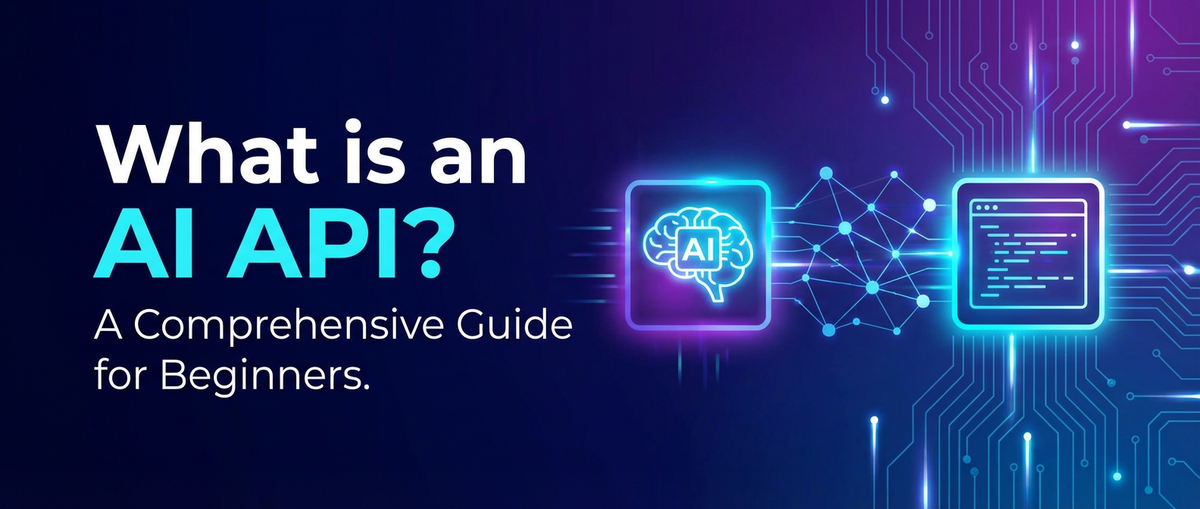
What is an AI API? A Comprehensive Guide for Beginners.

The digital landscape is undergoing a profound transformation, powered by the incredible advancements in Artificial Intelligence. From intelligent chatbots that answer our questions instantly to sophisticated recommendation engines that understand our preferences, AI is no longer a futuristic concept but a pervasive reality. Yet, for many, the inner workings of AI remain shrouded in mystery, often perceived as a realm accessible only to an elite cadre of data scientists and machine learning engineers. This perception, however, is rapidly changing, thanks to a powerful concept known as the AI API.
At its core, an API (Application Programming Interface) acts as a bridge, allowing different software systems to communicate and interact with each other. When we add "AI" to this equation, we unlock a world where complex artificial intelligence models become readily accessible tools for developers, businesses, and innovators, regardless of their deep AI expertise. Understanding what is an AI API is crucial for anyone looking to leverage the power of AI without building models from scratch. It's the key to integrating intelligent capabilities into applications, automating workflows, and creating smarter user experiences with remarkable efficiency.
This comprehensive guide is designed for beginners, aiming to demystify the concept of the AI API. We will explore not only what is an AI API but also delve into their various types, the immense benefits they offer, and most importantly, provide a practical walkthrough on how to use AI API effectively. By the end of this article, you'll have a solid foundation to confidently embark on your journey of integrating AI into your projects, understanding how these powerful tools streamline development and open new avenues for innovation.
1. Understanding the Foundation: What Exactly is an API?
Before we dive deep into the specifics of what is an AI API, it's essential to grasp the fundamental concept of an API itself. Imagine you're at a restaurant. You don't go into the kitchen to cook your meal; instead, you look at a menu, tell the waiter your order, and the waiter communicates with the kitchen. The kitchen then prepares your food and sends it back to you via the waiter. In this analogy:
- You (the application/user) are requesting a service.
- The Menu represents the documentation of the API, showing you what services are available.
- The Waiter is the API, taking your request to the kitchen and bringing the response back.
- The Kitchen (the server/service) is where the work is done.
In the digital world, an API serves a similar purpose. It's a set of rules, protocols, and tools for building software applications. It specifies how software components should interact. Think of it as a contract that allows different applications to talk to each other, exposing specific functionalities while keeping the underlying complexities hidden.
Key Components of an API:
- Endpoint: A specific URL where an API can be accessed. For example,
api.example.com/usersmight be an endpoint to retrieve user data. - Request: The message sent by one application to the API to ask for a service or information. This often includes specific parameters and data.
- Response: The message returned by the API after processing the request. It typically contains the requested data or the result of an action.
- Authentication: Mechanisms (like API keys, tokens, or OAuth) to verify the identity of the application making the request, ensuring secure access.
Most modern APIs, especially those you'll encounter in the AI space, follow the REST (Representational State Transfer) architectural style. REST APIs use standard HTTP methods (GET, POST, PUT, DELETE) to perform operations on resources, making them straightforward to understand and implement for web-based interactions. The data is usually exchanged in formats like JSON (JavaScript Object Notation) or XML, with JSON being the most prevalent due to its lightweight and human-readable nature.
APIs are the backbone of the modern internet. They allow services like Google Maps to be integrated into ride-sharing apps, enable social media login on various websites, and facilitate seamless data exchange between countless applications. Without APIs, the interconnected web of services we rely on daily would simply not exist, making them indispensable for software development, innovation, and scalability. This fundamental understanding sets the stage for grasping how AI capabilities are similarly exposed and utilized through these programmatic interfaces.
2. Demystifying AI APIs: What is an AI API?
Now that we have a firm grasp of what an API is, let's zoom in on the specific domain of artificial intelligence. So, what is an AI API? Simply put, an AI API is an Application Programming Interface that allows developers and applications to interact with and leverage pre-built Artificial Intelligence models or AI services without needing to understand the intricate details of their underlying algorithms or train them from scratch.
Imagine you want your application to translate text from English to Spanish. Traditionally, this would involve extensive expertise in natural language processing (NLP), access to vast linguistic datasets, and significant computational resources to train a robust translation model. With an AI API, this complexity is abstracted away. You send your English text to a translation AI API, and it returns the Spanish equivalent. The AI model itself, its training data, and the powerful infrastructure running it are all managed by the AI API provider. Your application simply acts as the consumer of that intelligent service.
Distinction from Traditional APIs:
While both traditional APIs and AI APIs facilitate communication between software systems, their core function and the nature of the service they provide differ significantly:
- Traditional APIs: Primarily deal with data retrieval, storage, and manipulation (e.g., getting a list of users, updating a database record, sending an email). Their responses are deterministic and based on predefined logic.
- AI APIs: Process complex, often unstructured data (text, images, audio, video) and return intelligent insights, predictions, or generated content. Their responses can be probabilistic, adaptive, and mimic human cognitive abilities. They don't just return data; they analyze, interpret, understand, or create based on sophisticated algorithms.
The beauty of the API AI paradigm is that it treats AI models as services. This concept is often referred to as "AI-as-a-Service" (AIaaS) or "Machine Learning-as-a-Service" (MLaaS). Developers don't need to be machine learning experts; they just need to know how to use AI API endpoints to send data and receive intelligent output. This "black box" approach democratizes AI, making powerful capabilities accessible to a much broader audience, from individual developers building hobby projects to large enterprises integrating advanced analytics into their core operations.
The evolution of AI APIs has been driven by several factors: 1. Increased Computational Power: The ability to train larger, more complex models. 2. Availability of Massive Datasets: Fueling the training of highly accurate models. 3. Standardization of API Protocols: Making it easier to expose and consume these services. 4. Demand for AI Integration: Businesses across all sectors seek to embed intelligence into their products and processes.
In essence, an AI API is your gateway to augmenting your applications with intelligence—be it understanding human language, recognizing objects in images, predicting future trends, or generating creative content—all without the prohibitive overhead of building and maintaining your own AI infrastructure.
3. The Diverse Landscape of AI APIs: Types and Categories
The world of AI APIs is incredibly vast and continues to expand rapidly, encompassing a wide array of intelligent services. These APIs cater to different modalities of data and offer specialized capabilities, allowing developers to pick and choose the exact intelligence they need. Understanding the different types helps in grasping the full potential of what is an AI API can do.
Let's explore some of the most prominent categories:
3.1. Natural Language Processing (NLP) APIs
NLP APIs are designed to enable computers to understand, interpret, and generate human language. They are among the most popular and versatile AI APIs.
- Text Generation (Large Language Models - LLMs): Perhaps the most revolutionary in recent times, these APIs (like those powering ChatGPT, Google Bard, etc.) can generate human-like text, answer questions, write code, summarize documents, and even craft creative content. Examples include OpenAI's GPT series, Anthropic's Claude, and Google's Gemini.
- Sentiment Analysis: These APIs analyze text to determine the emotional tone—whether it's positive, negative, or neutral. Ideal for customer feedback analysis, social media monitoring, and brand reputation management.
- Translation: Translate text from one language to another, breaking down language barriers for global communication and content localization. Google Translate API, DeepL API are prime examples.
- Summarization: Condense lengthy texts into shorter, coherent summaries, saving time and aiding information retrieval. Useful for news articles, reports, and academic papers.
- Named Entity Recognition (NER): Identifies and classifies named entities in text (e.g., names of people, organizations, locations, dates). Essential for information extraction and structuring unstructured data.
- Speech-to-Text (STT) & Text-to-Speech (TTS): STT APIs convert spoken audio into written text, enabling voice assistants, transcription services, and voice commands. TTS APIs do the reverse, converting text into natural-sounding speech for narration, accessibility features, and virtual assistants.
3.2. Computer Vision (CV) APIs
Computer Vision APIs enable applications to "see" and interpret visual information from images and videos, mimicking human sight.
- Object Detection and Recognition: Identify and locate objects within an image or video (e.g., detecting cars, people, animals). Used in autonomous vehicles, surveillance, and inventory management.
- Facial Recognition and Analysis: Detect faces, identify individuals, and analyze facial attributes like age, gender, and emotions. Applied in security, user authentication, and demographic analysis.
- Image Classification: Categorize an entire image into predefined classes (e.g., "landscape," "portrait," "animal"). Useful for content moderation, photo organization, and product categorization.
- Optical Character Recognition (OCR): Extracts text from images or scanned documents, converting it into machine-readable text. Critical for digitizing documents, processing invoices, and extracting information from forms.
- Image Moderation: Automatically detect and flag inappropriate or harmful content in images, crucial for online platforms.
3.3. Machine Learning (ML) / Predictive Analytics APIs
These APIs leverage various machine learning algorithms to make predictions or uncover patterns from structured data.
- Recommendation Engines: Suggest products, content, or services to users based on their past behavior, preferences, and similar user data. Powers personalized experiences on e-commerce sites, streaming platforms, and social media.
- Anomaly Detection: Identify unusual patterns or outliers in data that deviate from expected behavior, signaling potential issues like fraud, system malfunctions, or security breaches.
- Forecasting: Predict future trends or values based on historical data, used in finance, sales, weather prediction, and resource planning.
- Classification and Regression: General-purpose ML APIs that can categorize data into classes (e.g., spam/not spam) or predict numerical values (e.g., house prices).
3.4. Generative AI APIs
A rapidly expanding field, Generative AI APIs create new content rather than just analyzing existing data.
- Image Generation: Create novel images from text descriptions (text-to-image) or based on existing images. Examples include OpenAI's DALL-E, Stability AI's Stable Diffusion, and Midjourney (though often without a direct public API).
- Code Generation: Generate programming code snippets, functions, or even entire applications from natural language prompts, aiding developers and accelerating coding.
- Video Generation: While nascent, APIs are emerging that can generate short video clips from text or images.
3.5. Other Specialized AI APIs
Beyond these core categories, many specialized AI APIs address niche applications:
- Chatbot Frameworks: Provide tools and services to build conversational AI agents and virtual assistants.
- AI Search: Enhance search capabilities with semantic understanding and contextual relevance.
- Time Series Analysis: Specific APIs for handling sequential data for pattern recognition and forecasting over time.
The diversity of these AI APIs highlights their immense utility across virtually every industry. Whether you're building a customer service bot, an automated content creator, or a predictive analytics dashboard, there's likely an API AI ready to integrate, making it easier than ever to bring intelligence into your applications.
4. Why AI APIs Matter: Benefits for Developers and Businesses
The rise of AI APIs isn't just a technological trend; it's a paradigm shift that democratizes access to advanced artificial intelligence. For both individual developers and large enterprises, understanding what is an AI API leads to recognizing the profound strategic advantages they offer. These benefits translate directly into faster innovation, reduced costs, and increased competitive edge.
4.1. Accessibility to Advanced AI for Everyone
One of the most significant advantages of AI APIs is that they make sophisticated AI capabilities accessible without requiring deep expertise in machine learning, data science, or neural networks.
- No ML Expertise Required: You don't need to be an AI expert to integrate powerful features like natural language understanding or computer vision. The heavy lifting of model training, optimization, and deployment is handled by the API provider. You just need to know how to use AI API endpoints.
- Pre-trained Models: AI APIs expose pre-trained models that have been developed and refined by experts, often on vast and high-quality datasets. This means you benefit from state-of-the-art performance without the immense effort of building a model from scratch.
4.2. Speed and Efficiency in Development
AI APIs drastically accelerate the development process, enabling rapid prototyping and quicker time-to-market.
- Rapid Prototyping: Developers can quickly experiment with different AI functionalities, integrate them into prototypes, and test concepts without significant upfront investment.
- Faster Development Cycles: Instead of spending months training and fine-tuning an AI model, developers can integrate an existing API in days or even hours, allowing them to focus on the unique aspects of their application.
- Reduced Complexity: The abstract nature of the API AI means developers interact with a simple interface (e.g., sending a JSON request) rather than dealing with complex machine learning libraries, frameworks, or infrastructure.
4.3. Cost-Effectiveness and Scalability
Leveraging AI APIs is often far more economical and scalable than building and maintaining AI solutions internally.
- Pay-as-You-Go Models: Most AI API providers offer usage-based pricing. You only pay for what you consume (e.g., per API call, per character, per image processed), eliminating large upfront investments in hardware, software licenses, or specialized talent.
- Reduced Infrastructure Costs: You don't need to acquire and maintain expensive GPUs, servers, or cloud infrastructure for training and inference. The API provider manages all the computational resources.
- Automatic Scalability: AI API providers build their services to handle massive loads. As your application grows, the underlying AI infrastructure scales seamlessly to meet demand without any effort on your part. This ensures reliable performance even during peak usage.
4.4. Focus on Core Business Logic and Innovation
By offloading AI capabilities to external APIs, businesses and developers can redirect their resources and efforts.
- Focus on Differentiation: Instead of reinventing the AI wheel, teams can concentrate on building unique features, improving user experience, and solving specific business problems that differentiate their product or service.
- Innovation: AI APIs enable smaller teams and startups to integrate advanced AI features that were once only available to tech giants, fostering a more innovative and competitive ecosystem.
4.5. Continuous Improvement and Maintenance
AI API providers are constantly improving their models, security, and infrastructure.
- Up-to-Date Models: AI models are continuously updated and retrained with new data to improve accuracy and performance. When you use an API, you automatically benefit from these enhancements without manual upgrades.
- Security and Compliance: Reputable API providers adhere to strict security protocols and often comply with industry standards and regulations, reducing the burden on individual developers to manage these aspects for their AI components.
In summary, AI APIs act as a force multiplier, enabling individuals and organizations to harness the transformative power of artificial intelligence with unprecedented ease, speed, and cost-efficiency. They are not just tools; they are enablers of a smarter, more automated, and more innovative future.
XRoute is a cutting-edge unified API platform designed to streamline access to large language models (LLMs) for developers, businesses, and AI enthusiasts. By providing a single, OpenAI-compatible endpoint, XRoute.AI simplifies the integration of over 60 AI models from more than 20 active providers(including OpenAI, Anthropic, Mistral, Llama2, Google Gemini, and more), enabling seamless development of AI-driven applications, chatbots, and automated workflows.
5. Diving Deeper: How to Use AI API (A Practical Guide)
Once you understand what is an AI API and its benefits, the next logical step is to learn how to use AI API in your own applications. This section will walk you through the practical steps, offering insights into the typical workflow and essential considerations for integrating these intelligent services. While specific implementations vary by API and programming language, the core principles remain consistent.
5.1. Prerequisites
Before you begin, a few foundational elements will be helpful:
- Basic Programming Knowledge: Familiarity with a programming language like Python, JavaScript, Java, or C#. Python is often favored for its simplicity and rich ecosystem for data and AI.
- Understanding of HTTP Requests: AI APIs typically communicate over HTTP/HTTPS using methods like GET and POST.
- JSON (JavaScript Object Notation): Most AI APIs send and receive data in JSON format, so knowing how to parse and construct JSON objects is crucial.
5.2. Step-by-Step Process to Use an AI API
Here's a general workflow for integrating an AI API into your project:
Step 1: Choose an AI API Provider
This is the initial and crucial decision. Research different providers based on:
- Specific AI Capability Needed: Do you need text generation, image recognition, sentiment analysis, etc.?
- Performance (Latency & Throughput): How fast do you need responses? How many requests per second will you make?
- Cost: Understand their pricing models (per call, per token, per minute).
- Documentation Quality: Clear and comprehensive documentation is invaluable for beginners.
- Community Support & SDKs: A thriving community and official SDKs (Software Development Kits) can simplify integration.
- Consider a Unified API Platform: For accessing multiple AI models from various providers, platforms like XRoute.AI offer a single, simplified endpoint, which can be immensely beneficial for flexibility and cost-efficiency.
Step 2: Sign Up & Get Your API Key
Once you choose a provider, you'll typically need to:
- Create an Account: Register on their platform.
- Generate an API Key: This unique string of characters authenticates your requests, identifying you as a legitimate user. Always keep your API keys secret and never hardcode them directly into publicly accessible code (e.g., client-side JavaScript). Use environment variables or secure configuration management.
Step 3: Read the Documentation Thoroughly
This cannot be stressed enough. The API documentation is your blueprint. It will detail:
- Available Endpoints: The specific URLs for different AI functions (e.g.,
/v1/chat/completionsfor text generation,/v1/images/generationsfor image creation). - Required Parameters: What data you need to send in your request (e.g., the text to be analyzed, the image URL, the desired model).
- Response Format: What the API will send back, including the structure of the JSON response and potential error codes.
- Authentication Methods: How to pass your API key (e.g., in a header, as a query parameter).
- Rate Limits: How many requests you can make within a certain timeframe to prevent abuse.
Step 4: Make Your First Request (Testing and Prototyping)
Before integrating into your full application, it's good practice to test the API.
- Using
curl(Command Line): A simple and quick way to send HTTP requests.bash curl -X POST https://api.example.com/ai/sentiment \ -H "Authorization: Bearer YOUR_API_KEY" \ -H "Content-Type: application/json" \ -d '{"text": "This product is absolutely amazing!"}' - Using a Programming Language (Python Example): ```python import requests import osapi_key = os.environ.get("MY_AI_API_KEY") # Securely get API key if not api_key: raise ValueError("API key not found in environment variables.")url = "https://api.example.com/ai/sentiment" headers = { "Authorization": f"Bearer {api_key}", "Content-Type": "application/json" } data = { "text": "This product is absolutely amazing!" }try: response = requests.post(url, headers=headers, json=data) response.raise_for_status() # Raise an exception for HTTP errors (4xx or 5xx) sentiment_result = response.json() print("Sentiment Analysis Result:", sentiment_result) # Expected output might be something like: {'sentiment': 'positive', 'score': 0.95} except requests.exceptions.RequestException as e: print(f"API request failed: {e}") if response is not None: print("Response content:", response.text)
`` This example demonstrates how to send text for sentiment analysis. Therequests` library in Python simplifies HTTP interactions.
Step 5: Handle Responses and Errors
- Parse the JSON Response: Extract the relevant data from the API's JSON response.
- Error Handling: Implement robust error handling. APIs will return specific HTTP status codes (e.g., 400 for bad request, 401 for unauthorized, 500 for server error) and often provide error messages in the JSON response. Your application should gracefully handle these to provide a good user experience and for debugging.
Step 6: Integrate into Your Application
Once you've successfully tested the API, integrate it into your application's logic. This might involve:
- Creating a Service Layer: Encapsulate API calls within a dedicated service or module to keep your code organized and maintainable.
- User Interface Integration: Display the AI's output to the user, or use it to drive internal application logic.
- Asynchronous Operations: For long-running AI tasks, consider using asynchronous programming to prevent your application from freezing.
5.3. Key Concepts in Usage
- Authentication: Beyond API keys, some APIs use OAuth for more granular permission management, or JWT (JSON Web Tokens). Always secure your authentication credentials.
- Rate Limiting: Be aware of and respect rate limits imposed by the API provider. Implement retry logic with exponential backoff for rate limit errors to avoid being blocked.
- SDKs (Software Development Kits): Many providers offer official SDKs for popular programming languages. These SDKs abstract away the HTTP request details, making API interaction even simpler and more Pythonic/idiomatic for your chosen language.
- Webhook Callbacks: For tasks that take a long time to process, some APIs offer webhooks, where the API calls a URL you provide once the processing is complete, rather than you having to constantly poll for a result.
| AI API Category | Common Use Cases | Example Providers (Illustrative) | Key Input/Output |
|---|---|---|---|
| Natural Language Processing (NLP) | Chatbots, content generation, translation, sentiment analysis, summarization, entity extraction | OpenAI, Google Cloud AI, AWS Comprehend, DeepL, Hugging Face | Input: Text, Speech (audio) Output: Text, Speech (audio), Sentiment score, Entities |
| Computer Vision (CV) | Image recognition, object detection, facial analysis, OCR, content moderation | Google Cloud Vision AI, AWS Rekognition, Azure Computer Vision | Input: Image (URL or byte data), Video Output: Labels, Bounding boxes, Facial attributes, Extracted text |
| Generative AI | Image creation, text-to-code, synthetic data generation | OpenAI (DALL-E, GPT), Stability AI, Midjourney (limited API) | Input: Text prompt, Image Output: Generated image, Text, Code |
| Predictive Analytics | Recommendation systems, fraud detection, forecasting, anomaly detection | Google Cloud AI Platform, AWS SageMaker, Azure Machine Learning | Input: Structured data (features) Output: Prediction (numerical, categorical), Probability score |
By diligently following these steps and understanding these key concepts, you can effectively learn how to use AI API and integrate powerful intelligence into your applications, unlocking new possibilities for innovation and functionality.
6. Challenges and Considerations When Using AI APIs
While AI APIs offer tremendous benefits and ease of access to advanced intelligence, their adoption also comes with a unique set of challenges and considerations. Being aware of these aspects is crucial for responsible, secure, and cost-effective deployment, especially when you are just starting to understand what is an AI API.
6.1. Data Privacy and Security
When you send data to an AI API, you are, by definition, sending it to a third-party service. This raises significant concerns:
- Data Handling Policies: Understand precisely how the API provider handles your data. Is it stored? For how long? Is it used to retrain their models? Is it anonymized?
- Regulatory Compliance: Ensure the provider's data practices comply with relevant regulations like GDPR, CCPA, HIPAA, or local data residency laws, especially if you're dealing with sensitive user information.
- Encryption: Data should be encrypted both in transit (using HTTPS) and at rest.
- API Key Security: As mentioned, API keys are powerful credentials. Their compromise can lead to unauthorized access, data breaches, or unexpected billing. Secure storage and rotation are paramount.
6.2. Bias and Fairness in AI Models
AI models are only as good and unbiased as the data they are trained on. This is a critical ethical consideration:
- Inherited Bias: If the training data contains societal biases (e.g., gender, race, age), the AI model will learn and perpetuate these biases in its predictions or generations. For instance, a facial recognition API might perform less accurately on certain demographics.
- Unintended Consequences: Biased AI can lead to unfair outcomes, discrimination, or even harm, particularly in sensitive applications like hiring, loan approvals, or legal systems.
- Mitigation: Be aware of potential biases in the models you use. Test them rigorously with diverse datasets relevant to your use case. Consider if the API AI provider offers fairness metrics or tools.
6.3. Cost Management
While AI APIs are generally cost-effective, managing expenses requires vigilance:
- Complex Pricing Models: Pricing can vary significantly (per call, per token, per character, per image, per minute of compute). It's essential to thoroughly understand the structure and estimate your usage.
- Unexpected Usage Spikes: Bugs, malicious attacks, or unoptimized code can lead to a sudden surge in API calls, resulting in surprisingly high bills. Implement monitoring and set budget alerts.
- Free Tiers and Limits: While attractive, free tiers often have strict limits. Be prepared to transition to paid plans as your application scales.
6.4. Latency and Throughput
Performance is critical, especially for real-time applications:
- Latency: The time it takes for the API to process a request and return a response. Network distance to the API server and the complexity of the AI model's computation can affect this. High latency can degrade user experience.
- Throughput: The number of requests the API can handle per unit of time. If your application makes many simultaneous requests, ensure the API AI provider can handle the load without throttling your requests or returning errors.
- Regional Availability: Choose an API provider with data centers geographically close to your users to minimize latency.
6.5. Vendor Lock-in
Relying heavily on a single AI API provider can create a dependency:
- Difficulty Switching: If you deeply integrate a proprietary API into your core logic, switching to another provider later might involve significant refactoring.
- Pricing Changes & Feature Deprecation: Providers can change pricing, modify features, or even deprecate services, impacting your application.
- Mitigation: Design your architecture with an abstraction layer that allows you to swap out AI API providers more easily. Consider unified API platforms like XRoute.AI, which provide a single interface to multiple underlying AI models, reducing single-vendor dependency.
6.6. Model Updates and Versioning
AI models are continuously improved, which can be a double-edged sword:
- Improvements: Newer versions often bring better accuracy, speed, or new features.
- Breaking Changes: Sometimes, model updates or API version changes might introduce breaking changes that require adjustments to your code. Providers typically offer versioned APIs to allow you to upgrade at your own pace.
- Consistency: For certain applications, consistent model behavior is more critical than the latest features. Understand how API providers handle model versioning and backward compatibility.
6.7. Ethical Implications
Beyond bias, the broader ethical implications of deploying AI are paramount:
- Misinformation/Disinformation: Generative AI APIs can create highly convincing fake content.
- Malicious Use: Facial recognition for surveillance, targeted propaganda, or automated harassment.
- Accountability: Who is responsible when an AI makes a mistake or causes harm?
- Responsible AI: Develop guidelines and principles for how your application uses AI. Be transparent with users when they are interacting with AI.
Navigating these challenges requires careful planning, thorough research, and continuous monitoring. By proactively addressing these considerations, you can leverage the immense power of AI APIs responsibly and effectively, building robust and ethical intelligent applications.
7. The Future of AI APIs: Unification and Specialization
The trajectory of AI APIs is characterized by both a drive towards unification and an increasing degree of specialization. These twin forces are shaping how developers interact with AI, making it simultaneously more accessible and more powerful. Understanding these trends provides insight into the evolving landscape of what is an AI API will be capable of in the coming years.
7.1. Emergence of Unified API Platforms
One of the most significant trends is the rise of unified AI API platforms. As the number of AI models and providers explodes, developers face a growing challenge: managing multiple API keys, different documentation standards, varying input/output formats, and disparate pricing models. This complexity hinders agility and introduces vendor lock-in risks.
Unified platforms, such as XRoute.AI, address this pain point directly. They act as an abstraction layer, providing:
- A Single, Standardized Endpoint: Instead of integrating with 20 different AI providers, you integrate with one platform. This significantly simplifies development and maintenance.
- OpenAI-Compatible Interfaces: Many unified platforms adopt the widely recognized OpenAI API standard, making it easier for developers already familiar with that ecosystem to switch or expand.
- Model Agnosticism: These platforms allow you to switch between different AI models (e.g., GPT-4, Claude, Gemini, custom models) from various providers with minimal code changes. This fosters competition among models, enabling developers to choose the best fit for performance, cost, or specific task requirements.
- Automated Optimization: Some platforms intelligently route requests to the best-performing or most cost-effective model in real-time, delivering low latency AI and cost-effective AI automatically.
This trend toward unification significantly streamlines how to use AI API for multi-model or multi-provider strategies, reducing complexity and increasing flexibility for developers and businesses.
7.2. Hyper-Specialization and Niche APIs
While unification simplifies access, the underlying AI models are simultaneously becoming more specialized.
- Domain-Specific AI: We're seeing APIs tailored for specific industries (e.g., healthcare AI for medical imaging analysis, legal AI for document review, financial AI for fraud detection). These models are trained on highly relevant, niche datasets, leading to superior accuracy within their domain compared to general-purpose AI.
- Task-Specific Optimization: Even within a general category like NLP, there's a drive for models specifically optimized for, say, legal summarization, code translation, or creative storytelling, rather than a single large model trying to do everything.
- Smaller, Efficient Models: While large foundational models grab headlines, there's a growing need for smaller, more efficient AI models that can run on edge devices or offer faster inference for specific tasks, accessible via specialized APIs.
7.3. Multi-Modal AI APIs
The future is increasingly multi-modal, where AI can seamlessly understand and generate content across different data types.
- Text-to-Image, Image-to-Text: Current generative AI is already bridging these modalities.
- Text-to-Video, Video-to-Text: The ability to generate complex video sequences from text prompts or extract rich textual descriptions from video is rapidly advancing.
- Integrated Understanding: AI APIs will become more adept at understanding context derived from a combination of text, images, audio, and even sensor data, leading to more human-like comprehension.
7.4. Edge AI and Hybrid Cloud Solutions
As AI models become more efficient, we'll see more AI APIs enabling computations closer to the data source (edge devices) rather than exclusively in the cloud. This reduces latency, enhances privacy, and lowers bandwidth requirements. Hybrid cloud AI APIs will allow organizations to combine the scalability of public cloud AI with the control and security of on-premise solutions.
7.5. Increased Customization and Fine-Tuning via APIs
While current AI APIs primarily offer pre-trained models, future iterations will likely provide more accessible programmatic interfaces for:
- Fine-tuning: Allowing users to adapt a pre-trained foundational model with their specific data to improve performance on niche tasks, all through an API call.
- Prompt Engineering as a Service: Advanced API tools to optimize prompts for specific models to achieve desired outputs.
The interplay of these trends—unification for ease of access and management, and specialization for enhanced performance and domain relevance—is setting the stage for an even more intelligent, integrated, and accessible AI ecosystem. For anyone exploring what is an AI API, understanding these evolving dynamics is key to anticipating and harnessing future innovations.
8. Introducing XRoute.AI: Streamlining Your AI API Experience
As we've explored the diverse landscape of AI APIs and the challenges associated with managing them, a clear need emerges for solutions that simplify access, optimize performance, and control costs. This is precisely where platforms like XRoute.AI come into play, embodying the future of API AI and making the process of how to use AI API dramatically more efficient.
Imagine a world where you could access the best AI models from OpenAI, Anthropic, Google, Stability AI, and many others, all through a single, consistent interface. This is the core promise of XRoute.AI. It is a cutting-edge unified API platform designed to streamline access to large language models (LLMs) and other AI services for developers, businesses, and AI enthusiasts.
The Problem XRoute.AI Solves:
In the current ecosystem, if you wanted to experiment with different AI models for, say, text generation, you'd typically need to:
- Sign up for accounts with multiple providers (e.g., OpenAI, Anthropic, Google).
- Manage separate API keys for each.
- Read distinct documentation for each API, noting variations in endpoints, request formats, and response structures.
- Write custom code to integrate with each individual API.
- Develop logic to switch between models, often requiring significant code changes.
- Monitor usage and costs across several dashboards.
This fragmented approach leads to increased development time, higher maintenance overhead, potential vendor lock-in, and difficulties in optimizing for performance or cost.
How XRoute.AI Transforms Your AI API Integration:
XRoute.AI tackles these challenges head-on by providing a single, OpenAI-compatible endpoint. This means that if you're already familiar with the OpenAI API structure, you can quickly integrate XRoute.AI and gain immediate access to a vast array of models.
Here are the key advantages and features that make XRoute.AI an indispensable tool for anyone looking to simplify how to use AI API:
- Unified Access to 60+ AI Models: XRoute.AI consolidates access to over 60 AI models from more than 20 active providers. This expansive reach ensures you're not limited to a single vendor's offerings, giving you unparalleled flexibility to choose the best model for any task.
- OpenAI-Compatible Endpoint: The platform's commitment to an OpenAI-compatible interface significantly simplifies integration. Developers can leverage existing codebases or familiar SDKs, drastically reducing the learning curve and integration effort.
- Seamless Development of AI-Driven Applications: Whether you're building chatbots, automated workflows, content generation tools, or complex AI-driven applications, XRoute.AI simplifies the underlying AI infrastructure, allowing you to focus on your application's unique logic and user experience.
- Focus on Low Latency AI: Performance is critical for many AI applications. XRoute.AI is engineered for low latency AI, ensuring that your applications receive responses quickly, which is crucial for real-time interactions and a smooth user experience.
- Cost-Effective AI Solutions: Beyond performance, cost optimization is a major benefit. XRoute.AI helps users achieve cost-effective AI by providing tools to compare model pricing, intelligently route requests to the most affordable suitable model, and offer flexible pricing models.
- High Throughput and Scalability: The platform is built for enterprise-grade performance, offering high throughput and robust scalability. Your application can grow without worrying about the underlying AI infrastructure keeping pace.
- Developer-Friendly Tools: XRoute.AI empowers users with tools designed for developers, making it easier to manage API keys, monitor usage, and troubleshoot issues.
By abstracting away the complexities of managing multiple API connections, XRoute.AI enables developers and businesses to build intelligent solutions faster, more reliably, and more efficiently. It not only simplifies what is an AI API integration but also optimizes it for performance and cost, making it an ideal choice for projects of all sizes, from startups to enterprise-level applications seeking to harness the full power of AI.
Conclusion
The journey through what is an AI API reveals a powerful truth: artificial intelligence, once the exclusive domain of highly specialized researchers, is now readily accessible to a broad spectrum of developers and businesses. AI APIs are the digital bridges that connect our applications to a world of intelligent capabilities, democratizing innovation and fundamentally transforming how we build software.
We've seen how these interfaces abstract away the immense complexity of machine learning models, allowing anyone with basic programming knowledge to integrate sophisticated features like natural language understanding, computer vision, and generative AI. The benefits are profound: accelerated development cycles, significant cost savings, unparalleled scalability, and the ability for teams to focus on core business innovation rather than infrastructure.
Moreover, we've explored the practical aspects of how to use AI API, emphasizing the importance of choosing the right provider, securing API keys, and thoroughly understanding documentation. We also highlighted critical considerations such as data privacy, managing potential biases, cost control, and the strategic implications of vendor lock-in. The future points towards unified platforms like XRoute.AI, which are further simplifying the API AI landscape by offering single points of access to a multitude of models, optimizing for low latency AI and cost-effective AI, and enabling seamless integration.
In an increasingly AI-driven world, understanding and leveraging AI APIs is no longer a luxury but a necessity for staying competitive and fostering innovation. Whether you're looking to enhance customer service with intelligent chatbots, automate content creation, or gain deeper insights from vast datasets, the power to do so lies readily available through these sophisticated yet user-friendly interfaces. Now is the perfect time to explore, experiment, and integrate AI APIs into your next project, unlocking unprecedented levels of intelligence and efficiency.
FAQ: Frequently Asked Questions About AI APIs
1. Is an AI API the same as a regular API?
No, while an AI API is fundamentally a type of API (Application Programming Interface), its core function is distinct. A regular API typically deals with data retrieval, storage, and manipulation based on predefined logical rules (e.g., getting user data from a database). An AI API, on the other hand, allows applications to interact with pre-trained artificial intelligence models or AI services. It processes complex data (like text, images, or audio) and returns intelligent insights, predictions, or generated content. The responses from an AI API are often probabilistic and aim to mimic human-like cognitive functions, making them perform actions that require "intelligence."
2. Do I need to be an AI expert to use an AI API?
Absolutely not! One of the greatest benefits of AI APIs is that they democratize access to AI. You do not need to be a data scientist, a machine learning engineer, or have deep knowledge of neural networks to use them. The AI API abstracts away the complexity of the underlying AI model, its training, and its infrastructure. Your primary requirement is to have basic programming knowledge (to send requests and process responses) and to understand the API's documentation to know what data to send and what kind of output to expect.
3. How much does it cost to use AI APIs?
The cost of using AI APIs varies significantly depending on the provider, the specific AI model, and your usage. Most providers employ a "pay-as-you-go" pricing model, where you are charged based on your consumption. This could be per API call, per unit of data processed (e.g., per token for text, per character for speech, per image), or based on compute time. Many providers offer a free tier for low usage or for experimentation. For higher usage, costs can scale, so it's crucial to understand the pricing structure, monitor your usage, and potentially leverage platforms like XRoute.AI to find cost-effective AI options and manage expenses across multiple providers.
4. What are the main risks of using AI APIs?
While beneficial, using AI APIs comes with several risks: * Data Privacy & Security: Sending sensitive data to third-party APIs requires careful consideration of their data handling policies and compliance with regulations. API key security is also paramount. * Bias & Fairness: AI models can inherit biases from their training data, leading to unfair or discriminatory outcomes if not properly tested and managed. * Cost Overruns: Unmonitored or unoptimized usage can lead to unexpectedly high bills. * Latency & Performance: API response times can impact user experience, especially for real-time applications. * Vendor Lock-in: Becoming too reliant on a single provider's proprietary API can make it difficult to switch later. * Ethical Concerns: The potential for misuse (e.g., generating misinformation) or unintended societal impacts.
5. Can I use AI APIs to build my own chatbot?
Yes, absolutely! AI APIs, particularly those in the Natural Language Processing (NLP) and Generative AI categories, are fundamental tools for building sophisticated chatbots. You can use text generation APIs (like those offered by OpenAI or XRoute.AI) to power the conversational aspect, allowing your chatbot to understand user queries and generate human-like responses. Additionally, sentiment analysis APIs can gauge the user's mood, and Named Entity Recognition (NER) APIs can extract key information from user input. By combining these different AI API functionalities, you can create highly intelligent and interactive conversational agents tailored to your specific needs.
🚀You can securely and efficiently connect to thousands of data sources with XRoute in just two steps:
Step 1: Create Your API Key
To start using XRoute.AI, the first step is to create an account and generate your XRoute API KEY. This key unlocks access to the platform’s unified API interface, allowing you to connect to a vast ecosystem of large language models with minimal setup.
Here’s how to do it: 1. Visit https://xroute.ai/ and sign up for a free account. 2. Upon registration, explore the platform. 3. Navigate to the user dashboard and generate your XRoute API KEY.
This process takes less than a minute, and your API key will serve as the gateway to XRoute.AI’s robust developer tools, enabling seamless integration with LLM APIs for your projects.
Step 2: Select a Model and Make API Calls
Once you have your XRoute API KEY, you can select from over 60 large language models available on XRoute.AI and start making API calls. The platform’s OpenAI-compatible endpoint ensures that you can easily integrate models into your applications using just a few lines of code.
Here’s a sample configuration to call an LLM:
curl --location 'https://api.xroute.ai/openai/v1/chat/completions' \
--header 'Authorization: Bearer $apikey' \
--header 'Content-Type: application/json' \
--data '{
    "model": "gpt-5",
    "messages": [
        {
            "content": "Your text prompt here",
            "role": "user"
        }
    ]
}'
With this setup, your application can instantly connect to XRoute.AI’s unified API platform, leveraging low latency AI and high throughput (handling 891.82K tokens per month globally). XRoute.AI manages provider routing, load balancing, and failover, ensuring reliable performance for real-time applications like chatbots, data analysis tools, or automated workflows. You can also purchase additional API credits to scale your usage as needed, making it a cost-effective AI solution for projects of all sizes.
Note: Explore the documentation on https://xroute.ai/ for model-specific details, SDKs, and open-source examples to accelerate your development.