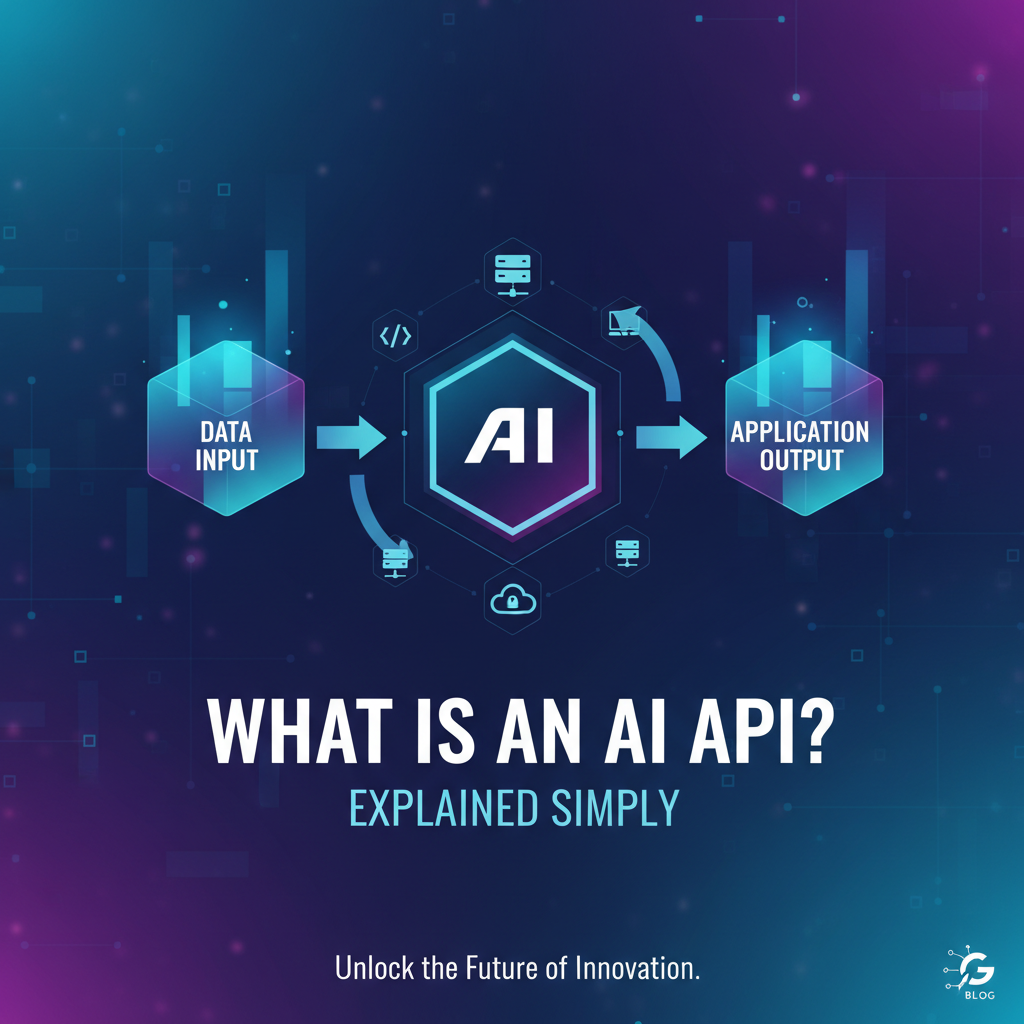
What is an AI API? Explained Simply

In the rapidly evolving landscape of artificial intelligence, a term frequently encountered by developers, businesses, and tech enthusiasts alike is the "AI API." But what exactly does this acronym represent, and how does it empower the creation of intelligent applications that are transforming our world? This comprehensive guide will demystify the concept of an AI API, breaking down its fundamental principles, exploring its diverse applications, and shedding light on its profound impact on modern technology. Whether you're a seasoned developer or simply curious about the backbone of AI-driven innovation, understanding what is an AI API is crucial for navigating the future of digital interaction.
Chapter 1: The Foundation - Understanding APIs in General
Before we delve into the specifics of AI APIs, it's essential to grasp the broader concept of an API. The term API stands for Application Programming Interface. In its simplest form, an API acts as a set of rules and protocols that allows different software applications to communicate with each other. Think of it as a universal translator and a waiter for digital services.
1.1 What is an API? An Everyday Analogy
Imagine you're at a restaurant. You don't go into the kitchen to cook your meal yourself; instead, you look at the menu (which lists what's available and how to order it), and you tell your order to a waiter. The waiter takes your request to the kitchen, the kitchen prepares your meal, and the waiter brings it back to you.
In this analogy: * You (the customer): Your software application that needs a service. * The Menu: The API documentation, which specifies what functions are available, what inputs they require, and what outputs you can expect. * The Waiter: The API itself, the intermediary that takes your request to the "kitchen" (another software system or service) and delivers the response back to your application. * The Kitchen: The other software application or service that provides the requested functionality (e.g., a payment gateway, a weather service, or an AI model).
This simple analogy illustrates the core principle: APIs abstract away complexity, allowing developers to leverage existing functionalities without needing to understand or rebuild the underlying system.
1.2 How Do APIs Work? The Request-Response Cycle
The interaction between applications via an API typically follows a request-response cycle:
- Request: Your application sends a request to the API, specifying what action it wants to perform (e.g., "get weather data for London," "translate this text to Spanish," "analyze the sentiment of this review"). This request includes necessary data and parameters, often formatted in a specific way (like JSON or XML).
- Processing: The API receives the request, authenticates it (if necessary, using API keys or tokens), and then forwards it to the service or server that can fulfill the request.
- Action: The backend service processes the request, performs the required computation or data retrieval.
- Response: The backend service sends the result back to the API. The API then formats this result according to its specifications and sends it back to your application.
- Integration: Your application receives the response and integrates the data or outcome into its own workflow.
This cycle is fundamental to how most modern web applications and services interact.
1.3 Types of APIs (Briefly)
While the core concept remains, APIs come in various architectural styles, each suited for different use cases:
- REST (Representational State Transfer) APIs: The most common type for web services, REST APIs use standard HTTP requests (GET, POST, PUT, DELETE) to access and manipulate data. They are stateless, meaning each request from a client to a server contains all the information needed to understand the request.
- SOAP (Simple Object Access Protocol) APIs: An older, more complex, and structured protocol that relies on XML for message formatting. SOAP APIs are often used in enterprise environments requiring strict security and transaction reliability.
- GraphQL APIs: A query language for APIs that allows clients to request exactly the data they need, no more and no less. This can lead to more efficient data fetching compared to REST.
- RPC (Remote Procedure Call) APIs: These APIs allow a client to execute a procedure or function on a remote server.
1.4 Why Are APIs Important?
APIs are the unsung heroes of the digital age, enabling:
- Interoperability: Different software systems, often built with diverse technologies, can seamlessly communicate.
- Innovation and Speed to Market: Developers can build new applications faster by leveraging existing services instead of reinventing the wheel. This allows them to focus on unique features.
- Scalability: Services can be decoupled, allowing individual components to scale independently.
- Openness and Ecosystems: APIs allow companies to open up their services to third-party developers, fostering vibrant ecosystems (e.g., app stores, payment integrations).
With this foundation laid, we can now smoothly transition to understanding how this powerful mechanism integrates with the world of artificial intelligence.
Chapter 2: Demystifying AI APIs - The Core Concept
Now that we understand the basics of APIs, let's connect it to the intelligence revolution. What is an AI API specifically, and what role does API in AI play in bringing sophisticated machine learning models to the masses?
2.1 What is an AI API? The Specifics
An AI API is an Application Programming Interface that provides access to pre-trained or customizable artificial intelligence and machine learning models as a service. Instead of requiring developers to build, train, and deploy complex AI models from scratch—a process that demands specialized expertise, vast datasets, and significant computational resources—AI APIs offer a streamlined way to integrate advanced AI capabilities into any application with a few lines of code.
Essentially, an AI API allows your application to "talk" to an AI model living on a remote server. Your application sends data (e.g., text, images, audio) to the AI API, and the API sends it to the underlying AI model. The model processes the data, performs its intelligent task (e.g., recognizes objects, translates text, generates new content), and sends the result back through the API to your application.
This abstraction democratizes AI, making it accessible to a much broader audience of developers who might not be AI experts but want to harness its power.
2.2 What is API in AI? Emphasizing Its Role
When we ask what is API in AI, we're focusing on the fundamental mechanism that transforms theoretical AI research and complex models into practical, deployable tools. The API is the bridge that connects the highly specialized world of AI model development with the broader world of software application development.
Its role is multifaceted:
- Simplification: It hides the immense complexity of machine learning algorithms, data pipelines, and infrastructure management.
- Standardization: It provides a consistent interface for interacting with diverse AI models, even if they were built using different frameworks (TensorFlow, PyTorch, etc.).
- Modularity: It allows AI capabilities to be treated as modular building blocks that can be plugged into various applications.
- Scalability: Cloud-based AI APIs can handle varying workloads, scaling resources up or down based on demand, which would be prohibitively expensive for individual developers to manage.
Without APIs, the adoption of AI would be severely limited, confined mostly to large corporations with dedicated AI research teams. APIs unlock AI's potential for startups, small businesses, and individual developers.
2.3 The Evolution of AI APIs
The journey of AI APIs has mirrored the advancements in AI itself:
- Early Days (Rule-Based Systems): Initial "intelligent" systems often relied on hard-coded rules, and any API access was for very specific, limited functions.
- Specialized Machine Learning APIs (2010s): As machine learning matured, major cloud providers (Google, AWS, Microsoft) began offering APIs for specific tasks like image recognition, sentiment analysis, and language translation. These were often focused on narrow AI capabilities.
- General Purpose AI & Large Language Models (Late 2010s - Present): The advent of deep learning and transformer models, particularly large language models (LLMs) like GPT-3/4, Bard, Llama, and diffusion models for image generation, brought about a new era of highly versatile AI APIs. These APIs can perform a wide range of tasks and even "reason" in novel ways, driving a surge in their adoption.
- Unified API Platforms: With the proliferation of countless AI models from various providers, platforms like XRoute.AI have emerged. These platforms offer a single, unified API endpoint to access a multitude of models, simplifying integration and offering benefits like cost optimization and automatic fallback for developers.
2.4 Key Characteristics of AI APIs
AI APIs share several common traits that distinguish them:
- Data Input/Output: They typically expect data in specific formats (e.g., JSON for text, base64 encoded strings for images, audio files) and return results in a structured format.
- Model Inference: The core function is to perform "inference" – using a trained AI model to make predictions or generate outputs based on new input data.
- Real-time Processing: Many AI APIs are designed for low-latency processing, enabling real-time interactions for applications like chatbots, voice assistants, and live translation.
- Statelessness (often RESTful): Similar to general REST APIs, many AI APIs are stateless, making them easier to scale and integrate.
- Authentication & Usage Tracking: Due to the computational cost and proprietary nature of AI models, AI APIs always require authentication (API keys, OAuth) and track usage for billing and resource management.
This detailed exploration of what is an AI API provides a solid framework for understanding its practical applications, which we'll dive into next.
Chapter 3: The Diverse Landscape of AI APIs
The power of an AI API lies in its ability to bring a vast array of intelligent capabilities to developers' fingertips. The landscape of AI APIs is incredibly diverse, covering almost every facet of artificial intelligence. Understanding these categories is key to appreciating the breadth of API AI applications.
3.1 Natural Language Processing (NLP) APIs
NLP APIs are perhaps the most widely recognized category, dealing with the interaction between computers and human language. They enable applications to understand, interpret, and generate human language.
- Text Generation: These APIs can create human-like text based on prompts, used for content creation, email drafting, code generation, and story writing. (e.g., OpenAI's GPT series, Google's Bard/PaLM, Anthropic's Claude).
- Sentiment Analysis: Determines the emotional tone (positive, negative, neutral) of a piece of text, crucial for customer feedback analysis, social media monitoring, and market research.
- Language Translation: Automatically translates text from one language to another, powering global communication tools. (e.g., Google Translate API, DeepL API).
- Speech-to-Text (STT) & Text-to-Speech (TTS): STT converts spoken language into written text, used in voice assistants, transcription services, and call center automation. TTS converts written text into natural-sounding spoken audio, used for narration, accessibility tools, and interactive voice response (IVR) systems.
- Named Entity Recognition (NER): Identifies and categorizes key information (names of people, organizations, locations, dates) within unstructured text.
- Text Summarization: Condenses long documents or articles into shorter, coherent summaries.
3.2 Computer Vision (CV) APIs
Computer Vision APIs enable applications to "see" and interpret visual information from images and videos, mimicking human sight.
- Object Detection and Recognition: Identifies and locates specific objects within an image or video stream. (e.g., recognizing cars, people, street signs in autonomous vehicles or security footage).
- Facial Recognition: Identifies or verifies individuals from images or video, used in security, authentication, and user experience.
- Image Classification: Assigns predefined categories or labels to entire images (e.g., "landscape," "portrait," "animal").
- Video Analysis: Processes video streams to detect events, track objects, or analyze behavior over time.
- Optical Character Recognition (OCR): Extracts text from images of documents, photos, or scanned files, converting it into machine-readable text.
3.3 Speech APIs (Beyond NLP's STT/TTS)
While STT and TTS are part of NLP, dedicated Speech APIs often offer more advanced voice-specific functionalities:
- Speaker Recognition/Verification: Identifies who is speaking or verifies a speaker's identity based on their voice biometrics.
- Voice Activity Detection (VAD): Detects when speech is present in an audio stream, helping to optimize processing.
3.4 Machine Learning (ML) Platform APIs
These APIs offer access to broader machine learning capabilities, often allowing users to deploy their own models or leverage pre-built predictive analytics.
- Predictive Analytics: APIs that can forecast future outcomes based on historical data (e.g., predicting stock prices, customer churn, equipment failure).
- Recommendation Engines: Suggests products, content, or services to users based on their past behavior and preferences (e.g., Netflix, Amazon recommendations).
- Anomaly Detection: Identifies unusual patterns or outliers in data, useful for fraud detection, network security, and operational monitoring.
3.5 Generative AI APIs
A rapidly growing and particularly exciting category, Generative AI APIs can create entirely new content, rather than just analyzing or processing existing data.
- Text-to-Image: Generates images from textual descriptions (prompts). (e.g., DALL-E, Midjourney, Stable Diffusion APIs).
- Text-to-Video/3D: Emerging APIs that generate short video clips or 3D models from text prompts.
- Text-to-Code: Generates programming code snippets, functions, or entire scripts based on natural language descriptions.
3.6 Unified AI API Platforms: The Modern Approach
With the explosion of specialized and general-purpose AI models from dozens of providers, developers face a new challenge: managing multiple API integrations, dealing with different data formats, pricing structures, and reliability concerns. This is where unified AI API platforms like XRoute.AI come into play.
XRoute.AI is a cutting-edge unified API platform designed to streamline access to large language models (LLMs) for developers, businesses, and AI enthusiasts. By providing a single, OpenAI-compatible endpoint, XRoute.AI simplifies the integration of over 60 AI models from more than 20 active providers. This means developers can switch between models or providers with minimal code changes, optimize for low latency AI or cost-effective AI, and build robust AI-driven applications without the complexity of managing multiple API connections. Its focus on high throughput, scalability, and flexible pricing makes it an ideal choice for diverse AI projects.
Here's a comparison highlighting the shift:
| Aspect | Traditional AI API Integration | Unified AI API Platform (e.g., XRoute.AI) |
|---|---|---|
| Integration | Multiple APIs, different endpoints, varying authentication. | Single, OpenAI-compatible endpoint for many models/providers. |
| Model Choice | Limited to the provider's models; switching is complex. | Access to 60+ models from 20+ providers; easy switching for best performance/cost. |
| Cost Optimization | Manual management, prone to overspending on expensive models. | Built-in routing and fallback mechanisms for cost-effective AI and performance. |
| Reliability/Latency | Dependent on a single provider; manual fallback implementation. | Automatic fallback to other providers; routes requests for low latency AI. |
| Developer Focus | Managing API specifics, model updates, provider changes. | Focusing on application logic and user experience; platform handles model complexities. |
| Scalability | Managing rate limits and infrastructure per provider. | Platform handles scaling across multiple providers for high throughput. |
This table clearly illustrates why understanding what is an AI API now increasingly includes understanding the role of unified platforms that aggregate these powerful services.
Chapter 4: How AI APIs Work Under the Hood
To fully appreciate the utility of API AI, it's beneficial to have a deeper understanding of the technical flow when an application interacts with an AI API. While the API abstracts away much of the complexity, there are several key stages involved in the request-response cycle.
4.1 The Request Lifecycle
When your application makes a call to an AI API, a sophisticated series of events unfolds:
- Application Initiates Request: Your client application (web app, mobile app, backend service) prepares the data it wants the AI model to process. For example, if it's an NLP API for sentiment analysis, it might be a JSON object containing a text string.
json { "text": "The service was absolutely fantastic, very quick and helpful!" } - API Endpoint Call: The application sends an HTTP request (typically POST for data submission) to the specific API endpoint provided by the AI service. This request includes the data and usually an API key or token for authentication.
- API Gateway/Load Balancer: The request first hits an API Gateway or Load Balancer. This component handles:
- Authentication & Authorization: Verifies the API key/token to ensure the request is legitimate and the caller has permission.
- Rate Limiting: Prevents abuse and ensures fair usage by limiting the number of requests a single client can make within a certain timeframe.
- Routing: Directs the request to the appropriate backend service or AI model instance. For unified platforms like XRoute.AI, this step might involve intelligent routing based on model availability, cost, or latency requirements.
- Data Preprocessing (Optional but Common): Before feeding data to the AI model, it often undergoes preprocessing. This could involve:
- Tokenization: Breaking down text into individual words or sub-word units for NLP models.
- Resizing/Normalization: Adjusting image dimensions or pixel values for computer vision models.
- Feature Engineering: Extracting relevant features from raw data.
- AI Model Inference: The preprocessed data is fed into the trained AI model. This is where the core "intelligence" happens. The model performs its computation based on its learned parameters. This step can be computationally intensive, often leveraging GPUs or specialized AI accelerators.
- For a sentiment analysis model, it predicts whether the input text expresses positive, negative, or neutral sentiment, often with a confidence score.
- For an image generation model, it synthesizes new pixel data to form an image.
- Post-processing (Optional): The raw output from the AI model might need further processing before being returned. For example, converting numerical probabilities into human-readable labels ("positive," "negative"), or decoding an image from an internal representation.
- Response Formatting: The processed result is then formatted into a standard output (again, typically JSON).
json { "sentiment": "positive", "score": 0.95, "language": "en" } - API Response: The formatted response is sent back through the API Gateway to the requesting client application.
- Application Consumes Response: Your application receives the response and uses the AI model's output to perform its next action (e.g., display a positive sentiment indicator, save the generated image, provide a translation).
4.2 Data Input and Output Formats
Consistency in data formats is crucial for seamless API interaction. Most AI APIs primarily use:
- JSON (JavaScript Object Notation): The most common and preferred format due to its lightweight nature, human readability, and ease of parsing in virtually all programming languages.
- XML (Extensible Markup Language): Less common for modern AI APIs, but still found in some enterprise or legacy systems.
- Plain Text: For very simple text inputs or outputs.
- Base64 Encoded Strings: Often used to transmit binary data like images or audio files within a JSON payload.
- Direct File Uploads: For larger files like audio or video, some APIs might support direct multipart form-data uploads.
Understanding the required input format and expected output structure from the API documentation is paramount for successful integration.
4.3 Authentication and Authorization
Given the resources involved and the potential for abuse, AI APIs employ robust security measures:
- API Keys: A unique alphanumeric string that identifies the calling application. It's usually passed in the request header or as a query parameter.
- OAuth 2.0: A more sophisticated authorization framework often used for granting third-party applications limited access to user accounts without sharing passwords.
- JWT (JSON Web Tokens): Compact, URL-safe means of representing claims to be transferred between two parties. Used for authentication and information exchange.
Properly securing and managing API keys is a critical best practice. Never hardcode them directly into client-side code, and use environment variables or secure credential management systems.
4.4 Latency and Throughput Considerations
When working with API AI, two performance metrics are particularly important:
- Latency: The delay between sending a request and receiving a response. For real-time applications (chatbots, voice assistants), low latency is critical. Factors affecting latency include network speed, model complexity, and server load.
- Throughput: The number of requests an API can handle per unit of time. High-throughput APIs are essential for applications processing large volumes of data or serving many users concurrently.
Providers like XRoute.AI explicitly optimize for low latency AI by routing requests to the fastest available models and employ distributed architectures to ensure high throughput, even across diverse model providers. These optimizations are crucial for building responsive and scalable AI applications.
Chapter 5: Benefits of Leveraging AI APIs
The widespread adoption of AI API solutions isn't merely a trend; it's a fundamental shift in how businesses and developers approach problem-solving and innovation. The advantages of using these interfaces are compelling and far-reaching.
5.1 Speed to Market and Rapid Prototyping
One of the most significant benefits is the dramatic reduction in development time. Building an AI model from scratch involves: * Data collection and cleaning. * Model selection and training. * Hyperparameter tuning. * Deployment and infrastructure management.
This entire process can take months, even years, and requires specialized teams. By contrast, an AI API allows developers to integrate sophisticated AI capabilities in a matter of hours or days. This enables rapid prototyping, allowing businesses to test ideas quickly and iterate on products without massive upfront investments. The ability to quickly integrate capabilities like "what is an ai api" in practice means features can be deployed faster.
5.2 Cost Efficiency
Leveraging AI APIs is often significantly more cost-effective than building and maintaining in-house AI infrastructure and talent. * No Infrastructure Costs: You don't need to purchase expensive GPUs or manage complex cloud infrastructure. The API provider handles all of that. * Reduced Labor Costs: You don't need a team of highly paid data scientists and ML engineers to develop and maintain models. Regular software developers can integrate AI functionalities. * Pay-as-You-Go Models: Most AI APIs operate on a usage-based pricing model, meaning you only pay for what you use, making it budget-friendly for projects of all sizes. Platforms like XRoute.AI further enhance this by facilitating cost-effective AI through intelligent routing to optimize spending.
5.3 Scalability and Reliability
AI models can be computationally intensive, and scaling them to handle millions of requests can be a daunting task. AI API providers build their services on robust, scalable cloud infrastructure designed to handle immense loads. * Automatic Scaling: APIs automatically scale up or down based on demand, ensuring your application remains responsive even during peak usage. * High Availability: Providers implement redundancies and failover mechanisms, offering high uptime and reliability, which is critical for business-critical applications. Unified platforms like XRoute.AI provide an additional layer of reliability by offering fallback to alternative models or providers if one service experiences issues, a testament to what an ai api can offer in robustness.
5.4 Accessibility and Democratization of AI
AI APIs democratize access to advanced AI technology. They lower the barrier to entry, allowing: * Non-ML Experts: Regular software developers can integrate powerful AI without needing deep expertise in machine learning. * Small Businesses and Startups: These entities can leverage cutting-edge AI capabilities that were once exclusive to tech giants. * Innovation: By abstracting complexity, developers can focus their creativity on building innovative applications rather than the underlying AI plumbing. This broadens the scope of "what is api in ai" to include almost any developer.
5.5 Access to State-of-the-Art Models
Leading AI API providers constantly update and improve their models, incorporating the latest research and advancements. By using their APIs, your application automatically benefits from these improvements without any additional effort on your part. This ensures your AI capabilities remain cutting-edge without continuous re-training or model migration.
5.6 Focus on Core Business Logic
By offloading AI model management to an API provider, your development team can concentrate on what they do best: building the core features and user experience of your application. This streamlines development cycles and allows for a sharper focus on solving specific business problems. The ability to simply "call an API" for complex tasks frees up significant resources, highlighting the practical essence of api ai.
These benefits collectively underscore why AI APIs are not just a convenience but a strategic imperative for any organization looking to integrate intelligence into their products and services effectively.
XRoute is a cutting-edge unified API platform designed to streamline access to large language models (LLMs) for developers, businesses, and AI enthusiasts. By providing a single, OpenAI-compatible endpoint, XRoute.AI simplifies the integration of over 60 AI models from more than 20 active providers(including OpenAI, Anthropic, Mistral, Llama2, Google Gemini, and more), enabling seamless development of AI-driven applications, chatbots, and automated workflows.
Chapter 6: Practical Use Cases and Applications
The versatility of AI API technology means its applications span nearly every industry and business function. From enhancing customer service to revolutionizing content creation, the practical implications of understanding what is an AI API are vast.
6.1 Chatbots and Virtual Assistants
Perhaps the most common and visible application of AI APIs, chatbots and virtual assistants leverage NLP, STT, and TTS APIs to understand user queries, provide relevant information, and even perform tasks.
- Customer Service: Automated support for frequently asked questions, order tracking, and issue resolution, improving efficiency and availability.
- Healthcare: Providing appointment scheduling, answering health-related queries, and guiding patients through processes.
- E-commerce: Assisting shoppers with product recommendations, size guides, and purchase processes.
6.2 Content Generation and Curation
Generative AI APIs are transforming how content is created and managed.
- Marketing and Copywriting: Automatically generating ad copy, product descriptions, social media posts, and blog outlines.
- Personalized Content: Creating tailored news feeds, email newsletters, or website content based on individual user preferences.
- Article Summarization: Quickly extracting key information from long documents, useful for researchers, journalists, and busy professionals.
- Image Generation: Creating unique images for marketing campaigns, website assets, or design inspiration from text prompts.
6.3 Personalized Recommendations
Recommendation engines powered by ML APIs analyze user behavior, preferences, and historical data to suggest relevant products, services, or content.
- E-commerce: Suggesting products a customer might like based on their browsing history and purchases, driving sales.
- Streaming Services: Recommending movies, TV shows, or music tailored to individual tastes.
- News and Media: Curating personalized news feeds and article suggestions.
6.4 Automated Data Processing and Analysis
AI APIs can automate tedious and time-consuming data-related tasks.
- Document Analysis: Extracting key information from invoices, contracts, or legal documents using OCR and NER APIs.
- Data Entry Automation: Converting scanned forms or handwritten notes into digital data.
- Sentiment Monitoring: Continuously analyzing customer reviews, social media mentions, and feedback channels to gauge brand perception and identify emerging issues.
- Fraud Detection: Identifying unusual patterns in financial transactions to flag potential fraud in real-time.
6.5 Enhanced Security and Surveillance
Computer Vision and ML APIs contribute significantly to security applications.
- Facial Recognition for Authentication: Securing access to devices, buildings, or online accounts.
- Object Detection in Surveillance: Automatically identifying unusual activities, intrusions, or suspicious objects in video feeds.
- Anomaly Detection in Cybersecurity: Identifying network intrusions or unusual user behavior that might indicate a cyberattack.
6.6 Healthcare and Life Sciences
AI APIs are accelerating research, improving diagnostics, and streamlining administrative tasks in healthcare.
- Medical Image Analysis: Assisting radiologists in detecting anomalies in X-rays, MRIs, and CT scans.
- Drug Discovery: Analyzing vast datasets of chemical compounds and biological interactions to identify potential new drugs.
- Clinical Trial Matching: Using NLP to match patients with suitable clinical trials based on their medical history.
6.7 Smart Cities and IoT
Integrating AI APIs with IoT devices can create smarter, more efficient urban environments.
- Traffic Management: Analyzing real-time traffic camera feeds to optimize traffic light timings and reduce congestion.
- Environmental Monitoring: Processing sensor data to predict air quality issues or detect pollution sources.
- Waste Management: Optimizing collection routes based on sensor data from smart bins.
The sheer breadth of these applications demonstrates why understanding what is api in ai is no longer just for specialized engineers but for anyone looking to innovate in today's digital economy. The ease of integration offered by unified platforms like XRoute.AI only expands these possibilities further, making powerful AI accessible for even more diverse use cases.
Chapter 7: Challenges and Considerations for AI API Integration
While the benefits of leveraging AI API solutions are clear, successful integration and deployment also come with a set of challenges and important considerations. Navigating these aspects is crucial for anyone building with API AI.
7.1 Data Privacy and Security
When sending sensitive data (e.g., personal information, proprietary business data, medical records) to a third-party AI API, privacy and security become paramount concerns.
- Data Transmission: Ensuring data is encrypted during transit (HTTPS/TLS) is fundamental.
- Data Handling at Rest: Understanding how the API provider stores, processes, and retains your data. Do they use it for model training? What are their data deletion policies?
- Compliance: Adhering to regulations like GDPR, CCPA, HIPAA, or local data privacy laws. Choosing providers that offer compliance certifications is essential.
7.2 Ethical AI and Bias
AI models, especially large language models (LLMs), can inadvertently perpetuate or amplify biases present in their training data. This can lead to unfair, discriminatory, or harmful outputs.
- Bias Detection: Implementing mechanisms to detect and mitigate bias in AI outputs.
- Fairness: Ensuring the AI system treats all user groups equitably.
- Transparency: Understanding, to the extent possible, how a black-box AI model arrives at its conclusions.
- Responsible Use: Developers must consider the ethical implications of their AI-powered applications.
7.3 Cost Management and Optimization
While cost-effective compared to in-house development, API usage can become expensive, especially with high-volume applications or complex models.
- Usage-Based Pricing: Most AI APIs charge per request, per token, or per unit of computation. Understanding these models is critical.
- Budget Monitoring: Implementing alerts and dashboards to track API usage and costs in real-time.
- Optimization Strategies: For example, caching frequently requested results, compressing inputs, or using cheaper models for less critical tasks. Unified platforms like XRoute.AI often provide intelligent routing for cost-effective AI, automatically directing requests to the most affordable suitable model.
7.4 Vendor Lock-in
Relying heavily on a single AI API provider can lead to vendor lock-in. If the provider changes its pricing, deprecates a model, or experiences prolonged outages, it can significantly impact your application.
- Multi-vendor Strategy: Designing your application to be able to switch between different providers for similar functionalities. This is where unified API platforms shine, as they inherently support this flexibility.
- Abstracting API Calls: Encapsulating API interactions within your code so that changing providers requires modifying only a small part of your codebase.
7.5 API Performance and Reliability
The performance of your application will be directly tied to the performance of the AI API you integrate.
- Latency: As discussed, high latency can degrade user experience, especially in real-time interactions.
- Throughput: Ensuring the API can handle your application's expected load.
- Uptime and Error Rates: Monitoring the API's availability and reliability. Providers offering Service Level Agreements (SLAs) are preferable. Intelligent routing by platforms like XRoute.AI helps mitigate these issues by routing for low latency AI and providing automatic fallbacks.
7.6 Integration Complexity (Despite Simplification)
While APIs simplify AI, integration still requires careful attention:
- Understanding Documentation: Thoroughly reading and understanding the API documentation is essential for correct usage.
- Error Handling: Implementing robust error handling mechanisms in your application to gracefully manage API failures, rate limits, or invalid inputs.
- Input/Output Mapping: Correctly mapping your application's data structures to the API's required input format and then processing the API's output.
7.7 Keeping Up with Model Evolution
The field of AI is advancing at an unprecedented pace. New models are released frequently, and existing ones are updated.
- Model Obsolescence: Older models might be deprecated or become less effective over time.
- Feature Changes: API endpoints or capabilities might change, requiring updates to your integration.
- Staying Informed: Developers need to stay updated on the latest advancements and changes from their chosen API providers. Unified platforms can help by abstracting some of these changes, allowing developers to upgrade models with minimal effort.
Addressing these challenges proactively ensures that the promise of API AI translates into successful, responsible, and sustainable AI-powered applications. It underscores why a thorough understanding of "what is an ai api" also encompasses its practical operational aspects.
Chapter 8: Best Practices for Integrating and Using AI APIs
Successfully harnessing the power of API AI goes beyond simply making a call to an endpoint. Adhering to best practices ensures robust, efficient, secure, and scalable AI-powered applications. For anyone contemplating "what is an ai api" in a practical sense, these guidelines are invaluable.
8.1 Define Clear Objectives and Choose the Right API
Before writing a single line of code, clearly define what problem you're trying to solve with AI and what specific outcome you expect.
- Match API to Task: Don't use a general-purpose LLM for a simple sentiment analysis if a specialized, cheaper API exists. Understand the nuances of each AI API category.
- Evaluate Providers: Compare different API providers based on their model performance, latency, pricing, documentation quality, support, and compliance.
- Consider Unified Platforms: For maximum flexibility, cost optimization, and resilience, investigate platforms like XRoute.AI. They provide a single interface to many models, simplifying provider switching and offering built-in intelligent routing for low latency AI and cost-effective AI.
8.2 Thoroughly Understand API Documentation
The API documentation is your blueprint. Read it meticulously.
- Endpoints and Methods: Know which URLs to call and which HTTP methods (GET, POST) to use.
- Request/Response Formats: Understand the exact JSON or other data structures required for input and expected for output.
- Authentication: Grasp how to properly authenticate your requests (API keys, OAuth tokens).
- Rate Limits: Be aware of how many requests you can make in a given timeframe to avoid being throttled.
- Error Codes: Understand what different error codes mean and how to handle them.
8.3 Implement Robust Error Handling
API calls can fail for numerous reasons (network issues, invalid input, rate limits, server errors). Your application must be resilient.
- Try-Catch Blocks: Encapsulate API calls within error-handling constructs.
- Specific Error Responses: Parse API error responses and provide meaningful feedback to users or logs.
- Retry Mechanisms: Implement exponential backoff for transient errors, where you retry a failed request after increasing delays.
- Fallback Logic: If a primary API fails, consider having a fallback to a different model or even a simpler, non-AI solution if appropriate. Unified platforms like XRoute.AI provide this automatically across multiple providers, enhancing the reliability of your api ai integration.
8.4 Monitor Performance and Usage
Active monitoring is crucial for cost control, performance optimization, and identifying issues.
- Logging: Log all API requests and responses, including latency, status codes, and any errors.
- Metrics: Track key metrics such as API call volume, average response time, error rates, and token/usage counts.
- Alerting: Set up alerts for unusual activity, high error rates, or approaching budget limits.
- Cost Analysis: Regularly review your API billing to ensure efficient spending. Platforms like XRoute.AI offer advanced analytics to help you pinpoint where your AI spend is going and optimize it for cost-effective AI.
8.5 Optimize Data Input and Processing
Efficient data handling can significantly impact performance and cost.
- Minimize Redundancy: Avoid sending the same data repeatedly if the result can be cached.
- Batching: If the API supports it, batch multiple smaller requests into a single larger one to reduce overhead.
- Data Compression: Compress large inputs (e.g., images) before sending, if feasible, to reduce network latency.
- Pre-filtering/Pre-processing: Only send relevant data to the AI API. Perform basic validation or filtering on your end to avoid unnecessary API calls or errors.
8.6 Prioritize Security
Treat API keys and sensitive data with the utmost care.
- Never Hardcode API Keys: Use environment variables, secure configuration files, or secret management services.
- Restrict Permissions: If using cloud provider APIs, grant your application only the minimum necessary permissions.
- Encrypt Data in Transit: Always use HTTPS/TLS for all API communications.
- Sanitize Inputs: Validate and sanitize all user-generated inputs before sending them to an AI API to prevent injection attacks or unexpected model behavior.
8.7 Consider Unified AI API Platforms
For serious AI development, especially with LLMs, platforms like XRoute.AI offer a powerful advantage.
- Simplified Integration: A single OpenAI-compatible endpoint for 60+ models from 20+ providers. This dramatically reduces the complexity of integrating diverse AI capabilities and makes understanding "what is api in ai" much simpler from an integration perspective.
- Cost and Performance Optimization: XRoute.AI intelligently routes requests to optimize for low latency AI and cost-effective AI, automatically switching providers as needed.
- Enhanced Reliability: Built-in failover and fallback mechanisms ensure your application remains operational even if a specific provider experiences downtime.
- Future-Proofing: Easily experiment with new models or switch providers without significant code changes, allowing your application to stay at the cutting edge of AI.
By embracing these best practices, developers can confidently build powerful, reliable, and intelligent applications powered by AI APIs, maximizing their impact and ensuring long-term success.
Chapter 9: The Future of AI APIs
The landscape of artificial intelligence is in a state of perpetual innovation, and AI APIs are at the forefront of this transformation. Looking ahead, several key trends are likely to shape the evolution of AI API technology, making the question of "what is an ai api" even more dynamic.
9.1 Increased Specialization and Generalization
We will likely see a dual trend: * Hyper-Specialized APIs: As AI research progresses, highly focused APIs will emerge for niche tasks where precision and domain-specific knowledge are paramount (e.g., specific medical diagnostics, legal document analysis, material science simulations). * More Capable General-Purpose APIs: Large Language Models will continue to grow in size and capability, becoming even more versatile and multimodal, able to handle complex reasoning, planning, and creative tasks across various data types. The goal is to move beyond "what is api in ai" to "what is the brain behind the API."
9.2 More Sophisticated Multimodal AI
Current AI often works with one type of data at a time (text, image, audio). The future of AI APIs will increasingly involve multimodal models that can seamlessly process and generate information across different modalities. Imagine an API that can: * Generate a video from a text description and an audio prompt. * Answer questions about an image using natural language. * Create a 3D model from a combination of text and reference images.
This will unlock entirely new categories of applications, making AI interactions far more natural and powerful.
9.3 Edge AI Integration and Hybrid Models
While cloud-based AI APIs offer immense power, there's a growing need for AI processing closer to the data source—at the "edge" (e.g., on smart devices, drones, industrial sensors). * Edge AI APIs: Lightweight APIs optimized for low-power devices, performing basic inference locally. * Hybrid AI: Combinations where initial processing happens on the edge for speed and privacy, and complex tasks are offloaded to cloud AI APIs. This balances latency, privacy, and computational demands.
9.4 Standardization and Interoperability
As the number of AI models and providers explodes, there will be an increasing demand for standardization to simplify integration and reduce vendor lock-in. * Open Standards: Efforts to create open standards for AI model formats and API interfaces. * Unified Platforms as the New Standard: Platforms like XRoute.AI are already paving the way by offering a single, OpenAI-compatible endpoint to numerous models, effectively creating a de facto standard for seamless interaction across diverse AI services. This addresses the "what is an ai api" question with a focus on ease of use and flexibility.
9.5 Ethical AI by Design and Explainable AI
As AI becomes more pervasive, the focus on ethical considerations will intensify. * Built-in Fairness and Bias Detection: Future AI APIs may incorporate tools to analyze and report on potential biases in their outputs. * Explainable AI (XAI) APIs: APIs that can not only provide a prediction but also offer insights into why the model made that prediction, increasing trust and accountability, especially in critical applications like healthcare or finance.
9.6 Further Simplification and Abstraction
The trend of abstracting complexity will continue. For many developers, interacting with API AI will become even more intuitive, requiring less specialized knowledge of AI internals. * No-Code/Low-Code AI Platforms: Tools built on top of AI APIs will allow non-technical users to build sophisticated AI applications with drag-and-drop interfaces. * AI Agent Frameworks: APIs that enable the creation of autonomous AI agents capable of performing multi-step tasks, interacting with other tools and services, and adapting their behavior.
The future of AI APIs is one of increasing intelligence, accessibility, and integration. They will continue to be the primary conduit through which the revolutionary power of AI is delivered to applications across every sector, continuously redefining what is an AI API and its boundless potential.
Conclusion
We've embarked on a comprehensive journey to answer the fundamental question: what is an AI API? From understanding the foundational role of APIs as digital intermediaries to exploring the intricate workings of AI API requests, their diverse categories, profound benefits, and looming challenges, it's clear that these interfaces are not merely technical conveniences but the very backbone of modern artificial intelligence innovation.
AI APIs democratize access to powerful machine learning models, transforming complex algorithms into readily usable services. They empower developers and businesses to integrate cutting-edge capabilities—from natural language understanding and generative AI to sophisticated computer vision—into their applications with unprecedented speed, efficiency, and scalability. This shift has not only accelerated innovation but has also made AI accessible to a much broader audience, moving API AI from the realm of specialized research to everyday practical application.
Looking ahead, the evolution of AI APIs promises even greater versatility, intelligence, and ease of integration. With the continuous emergence of multimodal models, advancements in edge AI, and the growing demand for ethical and explainable AI, the future of these interfaces is set to be as dynamic and transformative as AI itself.
In this exciting landscape, platforms like XRoute.AI stand out by simplifying the integration of this burgeoning ecosystem. By offering a unified, OpenAI-compatible endpoint to a vast array of models, XRoute.AI eliminates the complexity of managing multiple API connections, enabling developers to build intelligent solutions faster, more cost-effectively, and with greater resilience. It embodies the future of low latency AI and cost-effective AI, ensuring that developers can focus on innovation rather than integration hurdles.
Ultimately, understanding what is an AI API is crucial for anyone looking to build, innovate, or simply comprehend the intelligent systems that are reshaping our world. They are the invisible threads weaving intelligence into the fabric of our digital lives, empowering a future where smart applications are not just possible, but effortlessly deployable.
Frequently Asked Questions (FAQ)
Q1: What is the main difference between a regular API and an AI API?
A1: A regular API allows different software applications to communicate and access predefined functionalities or data from another service (e.g., getting weather data, processing payments). An AI API specifically provides access to pre-trained artificial intelligence or machine learning models, allowing your application to perform intelligent tasks like generating text, recognizing objects in an image, translating languages, or analyzing sentiment, without needing to build and train the AI model yourself.
Q2: Why should I use an AI API instead of building my own AI model?
A2: Using an AI API offers significant advantages in terms of speed, cost, and expertise. Building and deploying an AI model from scratch requires specialized knowledge in data science and machine learning, extensive data collection, significant computational resources (like powerful GPUs), and ongoing maintenance. AI APIs abstract all this complexity, allowing standard developers to integrate powerful AI capabilities into their applications quickly, often with a pay-as-you-go cost model, and benefit from continuously updated, state-of-the-art models.
Q3: Are AI APIs secure? What about data privacy?
A3: Reputable AI API providers implement robust security measures, including data encryption in transit (HTTPS/TLS) and at rest, strong authentication (API keys, OAuth), and strict access controls. However, data privacy is a shared responsibility. Developers must ensure they understand the provider's data handling policies, data retention practices, and compliance with relevant privacy regulations (like GDPR or HIPAA) before sending sensitive information.
Q4: Can I use different AI models from various providers through a single AI API?
A4: Traditionally, integrating AI models from different providers meant dealing with multiple distinct APIs, each with its own documentation, authentication, and data formats. However, unified AI API platforms like XRoute.AI solve this challenge. They offer a single, standardized (often OpenAI-compatible) endpoint that allows you to access and switch between over 60 AI models from more than 20 active providers, greatly simplifying integration and providing options for cost and latency optimization.
Q5: What are some common applications built using AI APIs?
A5: AI APIs power a vast array of applications across almost every industry. Common examples include: * Chatbots and virtual assistants (for customer service, support, and information retrieval). * Content generation tools (for marketing, copywriting, and creative writing). * Personalized recommendation engines (for e-commerce, streaming services, and news feeds). * Automated data processing (like optical character recognition (OCR) and sentiment analysis). * Image and video analysis (for security, object detection, and facial recognition). * Language translation services and speech-to-text/text-to-speech functionalities.
🚀You can securely and efficiently connect to thousands of data sources with XRoute in just two steps:
Step 1: Create Your API Key
To start using XRoute.AI, the first step is to create an account and generate your XRoute API KEY. This key unlocks access to the platform’s unified API interface, allowing you to connect to a vast ecosystem of large language models with minimal setup.
Here’s how to do it: 1. Visit https://xroute.ai/ and sign up for a free account. 2. Upon registration, explore the platform. 3. Navigate to the user dashboard and generate your XRoute API KEY.
This process takes less than a minute, and your API key will serve as the gateway to XRoute.AI’s robust developer tools, enabling seamless integration with LLM APIs for your projects.
Step 2: Select a Model and Make API Calls
Once you have your XRoute API KEY, you can select from over 60 large language models available on XRoute.AI and start making API calls. The platform’s OpenAI-compatible endpoint ensures that you can easily integrate models into your applications using just a few lines of code.
Here’s a sample configuration to call an LLM:
curl --location 'https://api.xroute.ai/openai/v1/chat/completions' \
--header 'Authorization: Bearer $apikey' \
--header 'Content-Type: application/json' \
--data '{
    "model": "gpt-5",
    "messages": [
        {
            "content": "Your text prompt here",
            "role": "user"
        }
    ]
}'
With this setup, your application can instantly connect to XRoute.AI’s unified API platform, leveraging low latency AI and high throughput (handling 891.82K tokens per month globally). XRoute.AI manages provider routing, load balancing, and failover, ensuring reliable performance for real-time applications like chatbots, data analysis tools, or automated workflows. You can also purchase additional API credits to scale your usage as needed, making it a cost-effective AI solution for projects of all sizes.
Note: Explore the documentation on https://xroute.ai/ for model-specific details, SDKs, and open-source examples to accelerate your development.