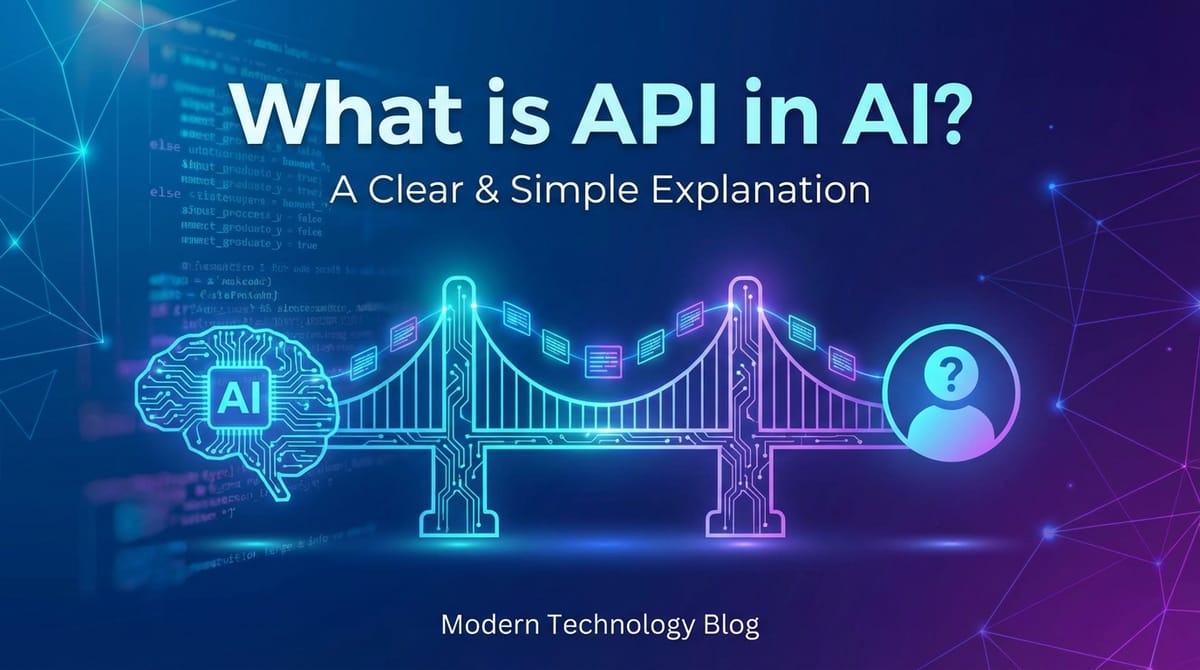
What is API in AI? A Clear & Simple Explanation

In an increasingly digital and interconnected world, Artificial Intelligence (AI) has transcended the realm of science fiction to become an indispensable component of our daily lives. From the personalized recommendations on your favorite streaming service to the sophisticated fraud detection systems safeguarding your finances, AI is working tirelessly behind the scenes. But how do ordinary applications, websites, and services tap into this complex, intelligent power? The answer lies in a fundamental concept of modern software development: the Application Programming Interface, or API. When we talk about what is API in AI, we're referring to the invisible yet incredibly powerful bridges that connect our everyday digital experiences to the cutting-edge algorithms and vast data processing capabilities of artificial intelligence.
Understanding api ai is not just for seasoned developers; it's becoming increasingly important for businesses, product managers, and even tech enthusiasts who want to grasp how AI is truly integrated and scaled across industries. This comprehensive guide will demystify the concept of an AI API, breaking down its core principles, exploring its diverse applications, and shedding light on why it's the cornerstone of scalable, accessible artificial intelligence. We will delve into the technical underpinnings, discuss the strategic advantages, navigate potential challenges, and look towards the future of this pivotal technology. By the end, you'll have a clear and simple explanation of what is an ai api and its profound impact on the intelligent systems shaping our future.
Demystifying APIs: The Foundation of Digital Interaction
Before we dive specifically into the realm of AI, it's essential to first establish a solid understanding of what an API is in its most general sense. This foundational knowledge will illuminate how AI fits into the broader API ecosystem and clarify the unique characteristics that define api ai.
What Exactly is an API?
Imagine you're at a restaurant. You don't go into the kitchen to cook your meal, nor do you need to understand the intricate cooking processes. Instead, you look at a menu, tell the waiter what you want, and the waiter takes your order to the kitchen. The kitchen then prepares your meal, and the waiter brings it back to your table. In this analogy, the API (Application Programming Interface) is the waiter, the menu, and the standardized way you communicate your desires.
More formally, an API is a set of defined rules, protocols, and tools for building software applications. It acts as an intermediary that allows two separate software systems to communicate and exchange information. It specifies how software components should interact, providing a clear contract for communication. This "contract" dictates: * What requests can be made: What information or actions can one system ask of another? * How to make those requests: What format should the request be in? * What data formats are supported: How should the information be sent and received? * What to expect in return: What kind of response will be provided?
The beauty of an API lies in its abstraction. It allows developers to use a service without needing to understand the underlying implementation details. Just as you don't need to be a chef to order a meal, a developer doesn't need to know the inner workings of a complex system to leverage its functionalities via its API.
How Traditional APIs Work
The typical interaction with an API follows a clear request-response cycle, often over the internet using standardized protocols like HTTP (Hypertext Transfer Protocol), the same protocol that powers web browsing.
- The Client Request: An application (the "client") wants to access a service or retrieve data from another application (the "server"). It constructs a request specifying:
- Endpoint: A specific URL that identifies the resource or function being requested (e.g.,
api.example.com/usersto get user data). - Method: An HTTP verb indicating the desired action (e.g.,
GETto retrieve data,POSTto send new data,PUTto update,DELETEto remove). - Headers: Metadata about the request, such as authentication tokens, content type, or caching instructions.
- Body (optional): For methods like
POSTorPUT, this contains the data being sent to the server, typically in a structured format like JSON (JavaScript Object Notation) or XML.
- Endpoint: A specific URL that identifies the resource or function being requested (e.g.,
- Server Processing: The server receives the request, validates it (e.g., checks authentication, ensures correct parameters), processes the request using its internal logic and data, and then generates a response.
- The Server Response: The server sends a response back to the client, which includes:
- Status Code: A three-digit number indicating the outcome of the request (e.g., 200 OK for success, 404 Not Found, 500 Internal Server Error).
- Headers: Metadata about the response.
- Body: The actual data or result of the operation, usually in JSON format, which the client application can then parse and use.
This seamless back-and-forth communication is the backbone of almost every modern digital service, from social media feeds to online banking. It's the mechanism that allows different software components, often developed by different teams or even different companies, to work together harmoniously.
The Intersection of AI and APIs: A Symbiotic Relationship
With a clear understanding of what an API is, we can now narrow our focus to its crucial role within the realm of Artificial Intelligence. The marriage of AI and APIs has been a game-changer, fundamentally altering how AI capabilities are developed, deployed, and consumed.
The Evolution of AI and Its Accessibility
For decades, AI remained largely an academic pursuit, confined to specialized research labs and requiring deep expertise in mathematics, statistics, and computer science. Building an AI model from scratch was an incredibly complex, time-consuming, and resource-intensive endeavor. It often involved: * Gathering and meticulously cleaning massive datasets. * Designing and implementing intricate algorithms. * Training models on powerful, often proprietary, computing infrastructure. * Evaluating and fine-tuning performance, which could take months or even years.
This high barrier to entry meant that sophisticated AI capabilities were largely inaccessible to the average developer, small businesses, or even departments within large corporations. The challenge was not just about the intellectual complexity but also the practical hurdles of infrastructure and specialized talent.
The rise of Machine Learning (ML) and Deep Learning (DL) frameworks (like TensorFlow, PyTorch, Scikit-learn) in the 2010s marked a significant shift. These frameworks provided powerful tools and libraries that simplified model development to some extent. However, even with these tools, deploying and managing these models in a production environment — handling scaling, latency, security, and maintenance — remained a formidable task.
This is where the API model truly shines and becomes an accelerant for AI adoption.
Defining what is an ai api?
An api ai is, at its core, an API specifically designed to expose the functionalities of an Artificial Intelligence or Machine Learning model as a service. Instead of requiring developers to build, train, and host their own AI models, an AI API allows applications to interact with pre-trained, robust, and often highly optimized AI models hosted by a third-party provider.
In essence, what is an ai api is the mechanism through which your application can "talk" to an AI model and leverage its intelligence without needing to understand the complex neural networks or statistical algorithms running underneath. It abstracts away the heavy lifting of AI development and deployment, making advanced capabilities readily available with just a few lines of code.
Think of it this way: if you want to know the weather, you don't build a weather station; you check a weather app. That weather app gets its data from a weather service via an API. Similarly, if you want your application to perform sentiment analysis on user comments, you don't build a sentiment analysis model from scratch; you send the comments to an AI API endpoint, and it returns the sentiment (e.g., positive, negative, neutral).
The power of what is an ai api lies in its ability to transform complex, specialized AI tasks into simple, standardized web requests. This democratizes AI, making it accessible to a much broader audience of developers and allowing them to focus on integrating intelligence into their applications rather than becoming AI experts themselves.
Why APIs are Indispensable for AI Development
The adoption of AI APIs has become a cornerstone of modern software development, not merely a convenience but a strategic imperative. Their indispensability stems from a multitude of benefits that address the inherent complexities and resource demands of AI.
4.1 Democratizing AI
One of the most profound impacts of api ai is its role in democratizing artificial intelligence. Prior to the widespread availability of AI APIs, implementing AI often required a team of highly specialized data scientists, machine learning engineers, and significant computational resources. This created a high barrier to entry, limiting AI development to large corporations and well-funded research institutions.
AI APIs break down these barriers by: * Abstracting Complexity: Developers no longer need to understand the intricate mathematical models, machine learning algorithms, or deep neural network architectures. They only need to know how to send data to an API and process the response. * Reducing Expertise Requirements: A traditional web developer, app developer, or business analyst can integrate sophisticated AI capabilities without having a Ph.D. in AI. This broadens the pool of individuals and teams who can innovate with AI. * Lowering Infrastructure Costs: Providers of AI APIs manage the vast and expensive infrastructure (GPUs, TPUs, distributed computing) required to train and run large AI models. Users pay only for what they consume, eliminating significant upfront investment.
This democratization empowers startups, small and medium-sized enterprises (SMEs), and individual developers to infuse their products and services with intelligence, fostering a more innovative and competitive ecosystem.
4.2 Accelerating Development
Time-to-market is a critical factor in today's fast-paced digital economy. Building and deploying an AI model from scratch can take months, even years. AI APIs drastically reduce this development cycle.
- Pre-trained Models: Many AI APIs offer access to models that have already been trained on massive datasets, performing at a high level. This bypasses the most time-consuming phase of AI development: data collection, cleaning, and model training.
- Ready-to-Use Services: Developers can instantly integrate functionalities like sentiment analysis, image recognition, or natural language understanding into their applications with minimal setup. This allows for rapid prototyping and quick deployment of AI-powered features.
- Focus on Core Logic: By offloading the AI heavy lifting to an API, developers can dedicate more resources and time to their application's unique business logic, user experience, and overall product differentiation.
This acceleration is vital for businesses looking to rapidly iterate and adapt to market demands, quickly test new ideas, and deliver intelligent features ahead of the competition.
4.3 Specialization and Expertise
The field of AI is vast and constantly evolving, with breakthroughs occurring regularly across various sub-domains (e.g., natural language processing, computer vision, reinforcement learning). It's virtually impossible for any single team to maintain expertise in every cutting-edge AI discipline.
AI APIs allow businesses to leverage the specialized expertise of leading AI research organizations and cloud providers. * State-of-the-Art Models: Major cloud providers (Google, Amazon, Microsoft) and dedicated AI companies (OpenAI) invest heavily in R&D to develop and continuously improve state-of-the-art AI models. By using their APIs, businesses gain access to these cutting-edge models without having to replicate that investment or expertise. * Continuous Improvement: These providers constantly fine-tune their models, update them with new data, and implement the latest research findings. When you use an api ai service, your application often benefits from these improvements automatically, ensuring your AI capabilities remain current and effective. * Diverse Portfolio: Companies can mix and match the best AI services from different providers for specific tasks. For example, using one provider for speech-to-text, another for advanced image recognition, and yet another for generative text.
This access to specialized, top-tier AI talent and models ensures that applications are powered by the best available technology for each specific task.
4.4 Scalability and Maintainability
Deploying and scaling AI models in production can be incredibly challenging. AI workloads are often unpredictable, with sudden spikes in demand requiring elastic infrastructure. Furthermore, maintaining these models (monitoring performance, handling updates, ensuring uptime) adds significant operational overhead.
AI APIs inherently offer solutions to these challenges: * Elastic Scalability: API providers manage the underlying infrastructure that automatically scales up or down based on demand. Whether your application has 10 users or 10 million, the api ai service handles the scaling, ensuring consistent performance without manual intervention from your team. * Reduced Operational Burden: The provider is responsible for server maintenance, security patches, hardware upgrades, and ensuring high availability. This significantly reduces the operational burden on the consuming organization, allowing them to focus on their core product. * Simplified Updates: When the AI model behind an API is updated or improved, these changes are typically rolled out seamlessly by the provider, often with backward compatibility, meaning your application can benefit from enhancements without requiring code changes on your end.
This means businesses can grow their AI-powered applications confidently, knowing that the underlying intelligence will scale with them and remain robust.
4.5 Cost-Effectiveness
The upfront and ongoing costs associated with building and maintaining AI infrastructure can be prohibitive. This includes hardware (GPUs), specialized personnel salaries, and operational expenses.
AI APIs offer a highly cost-effective model, typically based on consumption: * Pay-as-You-Go: Most AI API services employ a "pay-as-you-go" pricing model, where you only pay for the actual number of requests or the amount of data processed. This eliminates large upfront capital expenditures. * No Infrastructure Investment: Businesses avoid the significant investment in high-performance computing hardware and the ongoing costs of power, cooling, and maintenance for such infrastructure. * Optimized Resource Utilization: Providers are experts at optimizing their infrastructure for AI workloads, often achieving economies of scale that individual companies cannot. This efficiency translates into lower per-unit costs for consumers.
By leveraging AI APIs, even small businesses and startups can access powerful AI capabilities without breaking the bank, transforming AI from an exclusive luxury into an accessible utility.
In summary, the question of what is api in ai extends far beyond a simple definition; it encompasses a paradigm shift in how artificial intelligence is developed, consumed, and integrated into the fabric of our digital world. The benefits of democratizing AI, accelerating development, accessing specialized expertise, ensuring scalability, and achieving cost-effectiveness make AI APIs an indispensable tool for any organization looking to harness the power of intelligence.
Exploring the Landscape of AI APIs: Categories and Use Cases
The universe of AI APIs is incredibly diverse, reflecting the broad and varied capabilities of artificial intelligence itself. These APIs are generally categorized by the type of intelligence or task they perform, each opening up a unique set of possibilities for developers and businesses. Understanding these categories is key to comprehending what is an ai api in its full breadth.
5.1 Natural Language Processing (NLP) APIs
NLP APIs are designed to understand, interpret, and generate human language. They are among the most widely adopted api ai services due to the pervasive nature of text and speech in digital communication.
- Key Tasks:
- Sentiment Analysis: Determining the emotional tone (positive, negative, neutral) of a piece of text (e.g., customer reviews, social media posts).
- Language Translation: Converting text from one language to another (e.g., Google Translate API).
- Entity Recognition: Identifying and classifying named entities (people, organizations, locations, dates) within text.
- Text Summarization: Condensing long documents into shorter, coherent summaries.
- Keyword Extraction: Pulling out the most important keywords or phrases from a text.
- Text Generation: Creating human-like text based on prompts (a cornerstone of generative AI, discussed further below).
- Use Cases:
- Chatbots and Virtual Assistants: Understanding user queries and generating appropriate responses.
- Customer Support: Automating responses, routing inquiries, analyzing customer feedback.
- Content Moderation: Automatically flagging inappropriate or harmful content online.
- Business Intelligence: Extracting insights from unstructured text data (e.g., market research, legal documents).
5.2 Computer Vision (CV) APIs
Computer Vision APIs enable applications to "see" and interpret visual data, much like the human eye and brain. They transform images and videos into structured data that machines can understand.
- Key Tasks:
- Image Recognition: Identifying objects, scenes, and activities within images (e.g., "this is a cat," "this is a beach").
- Object Detection: Locating and outlining specific objects within an image (e.g., drawing bounding boxes around cars, pedestrians).
- Facial Recognition: Identifying individuals based on their facial features.
- Optical Character Recognition (OCR): Extracting text from images (e.g., digitizing documents, reading license plates).
- Image Moderation: Detecting inappropriate or unsafe visual content.
- Use Cases:
- Security and Surveillance: Identifying intruders, monitoring public spaces.
- Autonomous Vehicles: Recognizing traffic signs, pedestrians, and other vehicles.
- Medical Imaging: Assisting doctors in detecting anomalies in X-rays or MRI scans.
- Retail: Analyzing customer behavior in stores, inventory management.
- Accessibility: Describing images for visually impaired users.
5.3 Speech Recognition and Synthesis APIs
These APIs deal with the conversion between spoken language and text, and vice-versa, allowing applications to interact with users through voice.
- Key Tasks:
- Speech-to-Text (STT): Transcribing spoken words into written text.
- Text-to-Speech (TTS): Converting written text into natural-sounding spoken audio.
- Speaker Recognition/Verification: Identifying or verifying individuals based on their voice.
- Use Cases:
- Voice Assistants: Powering devices like Amazon Alexa, Google Assistant, Siri.
- Transcription Services: Automating meeting notes, legal depositions, medical dictation.
- Call Centers: Analyzing customer calls, providing automated responses.
- Accessibility Tools: Enabling voice control for users with disabilities, reading digital content aloud.
5.4 Recommendation Engine APIs
Recommendation APIs analyze user behavior, preferences, and content characteristics to suggest relevant items, significantly enhancing user engagement and satisfaction.
- Key Tasks:
- Personalized Recommendations: Suggesting products, movies, articles, or music tailored to individual users.
- Content Filtering: Presenting relevant content based on past interactions.
- Use Cases:
- E-commerce: "Customers who bought this also bought...", product suggestions.
- Streaming Services: Movie and TV show recommendations (e.g., Netflix, Spotify).
- Social Media: Suggesting friends, content, or groups.
- News and Content Platforms: Personalized news feeds.
5.5 Generative AI APIs (LLMs and Image Generation)
This category represents a cutting-edge frontier of AI, focusing on creating novel content rather than just analyzing existing data. The development of Large Language Models (LLMs) has particularly transformed what is api in ai within this segment.
- Key Tasks:
- Text Generation: Creating articles, stories, emails, code, marketing copy, or even entire scripts from a simple prompt. (e.g., OpenAI's GPT models, Claude, Google Gemini).
- Code Generation: Writing or assisting in writing code in various programming languages.
- Image Generation: Creating unique images, illustrations, or digital art from text descriptions (e.g., DALL-E, Stable Diffusion, Midjourney).
- Music Composition: Generating musical pieces in various styles.
- Video Generation: Creating short video clips from text or image prompts.
- Use Cases:
- Content Creation: Automating blog posts, social media updates, marketing materials.
- Software Development: Auto-completing code, generating test cases, translating code between languages.
- Design and Art: Generating unique visuals for websites, games, or artistic projects.
- Personalized Learning: Creating custom educational content.
The rise of generative AI APIs, especially LLMs, has redefined expectations for what is an ai api by offering unprecedented levels of creative capability and flexibility, enabling applications to do more than just process information—they can now actively create it.
5.6 Predictive Analytics APIs
Predictive analytics APIs leverage historical data to forecast future outcomes, identify trends, and detect anomalies, providing actionable insights for decision-making.
- Key Tasks:
- Forecasting: Predicting sales figures, stock prices, resource demand.
- Anomaly Detection: Identifying unusual patterns that might indicate fraud, defects, or system failures.
- Risk Assessment: Evaluating credit risk, insurance risk.
- Use Cases:
- Finance: Fraud detection, credit scoring, algorithmic trading.
- Manufacturing: Predictive maintenance (forecasting equipment failures).
- Healthcare: Predicting disease outbreaks, patient readmission risks.
- Supply Chain: Optimizing inventory, predicting demand fluctuations.
This diverse range of AI APIs illustrates how intelligent capabilities can be woven into almost any application or business process, making AI not just a niche technology but a pervasive utility. Each category addresses specific challenges and unlocks unique opportunities, collectively demonstrating the immense potential of api ai.
Deep Dive: How an AI API Works (Technical Perspective)
To truly appreciate the elegance and efficiency of what is api in ai, it helps to understand the underlying technical workflow. While the API abstracts away much of the complexity, there's a sophisticated orchestration happening behind the scenes that allows an AI model to seamlessly integrate into your application.
6.1 The Client Request
The journey begins when your application, acting as the client, decides it needs an AI-powered insight or action. This could be anything from analyzing a user's typed message for sentiment to detecting objects in an uploaded image.
- Data Preparation: The client application gathers the necessary input data. For an NLP API, this might be a block of text. For a Computer Vision API, it could be an image file (encoded as Base64 or a direct URL). This data needs to be in a format expected by the API.
- API Endpoint Identification: The client targets a specific URL, known as an API endpoint, which corresponds to the desired AI function. For example,
https://api.example.com/v1/sentiment-analysisorhttps://vision.example.com/v2/object-detection. - Authentication: Most AI APIs require authentication to ensure that only authorized users can access the service and to track usage for billing. This often involves sending an API Key (a unique string) in the request headers or as part of the URL parameters. Some advanced APIs might use OAuth 2.0 for more robust security.
- Request Construction: The client constructs an HTTP request. For sending data to an AI model for processing, the
POSTmethod is typically used. The prepared input data is packaged into the request body, usually in JSON format. For instance:json { "text": "This movie was absolutely fantastic! I loved every minute of it." }or for an image:json { "image_url": "https://example.com/my-picture.jpg" }or even Base64 encoded image data directly. - Transmission: The client sends this HTTP request over the internet to the API server.
6.2 The AI Model's Role
Once the API server receives the request, a series of sophisticated steps unfold to process it with the underlying AI model. This is where the core intelligence of api ai resides.
- API Gateway and Routing: An API Gateway, a crucial component of modern API architectures, first receives the incoming request. It performs initial validation (e.g., checking API keys, rate limits) and then routes the request to the appropriate backend service or AI model.
- Input Pre-processing: Raw data from the client often needs to be transformed into a format that the AI model can understand. This can involve:
- Tokenization: For NLP, breaking text into individual words or sub-word units.
- Numerical Encoding: Converting text or categorical data into numerical vectors.
- Image Resizing/Normalization: Scaling image dimensions or adjusting pixel values.
- Feature Engineering: Extracting relevant features from the input.
- Model Inference: This is the heart of the operation. The pre-processed input is fed into the pre-trained AI model (e.g., a neural network, a decision tree ensemble, a large language model). The model then performs its designated task:
- For sentiment analysis, it predicts the sentiment score.
- For object detection, it identifies objects and their locations.
- For text generation (e.g., a query to
what is an ai apifor content creation), it generates a sequence of new tokens. This process is known as inference – making predictions or generating outputs based on new, unseen data.
- Hardware Acceleration: For complex AI models, especially deep learning models, inference often occurs on specialized hardware like Graphics Processing Units (GPUs) or Tensor Processing Units (TPUs) to accelerate computations, ensuring low latency.
6.3 The API Response
After the AI model completes its inference, the results are prepared and sent back to the client application.
- Output Post-processing: The raw output from the AI model (e.g., numerical scores, probabilities, raw generated tokens) is often transformed into a more human-readable or application-friendly format. This could involve:
- Converting sentiment scores into labels ("positive," "negative").
- Drawing bounding boxes and adding labels to object detection results.
- Formatting generated text.
- Response Construction: The processed results are packaged into an HTTP response. This response includes:Example response for sentiment analysis:
json { "sentiment": "positive", "score": 0.92, "labels": ["joy", "excitement"] }Example response for object detection:json { "objects": [ {"label": "cat", "confidence": 0.98, "box": {"x1": 50, "y1": 100, "x2": 200, "y2": 300}}, {"label": "ball", "confidence": 0.85, "box": {"x1": 120, "y1": 250, "x2": 150, "y2": 280}} ] }3. Return to Client: The response is sent back to the client application, which then parses the JSON data and integrates the AI's insights into its own user interface or internal logic.- A Status Code (e.g., 200 OK for a successful inference).
- Headers containing metadata.
- A Body containing the AI's output, almost universally in JSON format for easy parsing by the client.
6.4 Infrastructure Supporting api ai
The seamless operation of an api ai relies on a robust and scalable infrastructure that handles millions of requests efficiently.
- Cloud Computing: Most AI API providers leverage powerful cloud platforms (AWS, Google Cloud, Azure) for their elasticity, global reach, and specialized AI services.
- Serverless Functions/Containers: AI models can be deployed as serverless functions (e.g., AWS Lambda, Google Cloud Functions) or within containers (e.g., Docker, Kubernetes) for efficient resource management and scaling.
- Load Balancing: Distributes incoming requests across multiple instances of the AI model, preventing any single instance from becoming a bottleneck and ensuring high availability.
- Auto-Scaling: Automatically adjusts the number of active model instances based on current demand, ensuring performance during peak loads and optimizing costs during low periods.
- Monitoring and Logging: Continuous monitoring of API performance, model accuracy, and resource utilization is crucial for maintaining service quality and quickly identifying issues.
This intricate dance between client requests, intelligent model inference, and a highly optimized infrastructure is what defines the technical sophistication behind what is api in ai, making complex AI capabilities accessible and performant for countless applications.
Strategic Advantages of Integrating AI APIs
Beyond the technical benefits and accessibility, the integration of AI APIs into business strategies offers significant competitive and operational advantages. These advantages underscore why api ai has become a critical tool for digital transformation and innovation across virtually every sector.
7.1 Enhanced User Experience
In today's competitive digital landscape, user experience (UX) is paramount. AI APIs empower applications to deliver more intelligent, personalized, and intuitive interactions, leading to higher user satisfaction and retention.
- Personalization: Recommendation engines, powered by
api ai, can analyze user behavior and preferences to offer tailored content, products, or services. This creates a highly relevant and engaging experience, making users feel understood and valued. - Intelligent Interactions: NLP APIs enable chatbots and virtual assistants to understand natural language queries, providing quick and accurate responses. This reduces friction, improves customer support efficiency, and makes interfaces more human-like.
- Automation of Mundane Tasks: AI can automate repetitive tasks within an application, freeing users to focus on more complex or creative activities. For example, automatic text summarization or image tagging.
- Accessibility: Speech-to-text and text-to-speech APIs enhance accessibility for users with disabilities, making applications more inclusive.
By making applications smarter and more responsive to individual needs, AI APIs directly contribute to a superior user experience, which is a powerful differentiator in the market.
7.2 Business Transformation
AI APIs are not just about improving existing processes; they are catalysts for fundamental business transformation. They enable companies to unlock new capabilities, optimize operations, and gain unprecedented insights.
- Automated Workflows: Many back-office processes can be automated using AI APIs. Document processing (OCR), data extraction from invoices, sentiment analysis of customer feedback, or intelligent routing of support tickets can significantly reduce manual labor and human error.
- Data-Driven Decision Making: Predictive analytics APIs can forecast trends, identify risks, and uncover hidden patterns in vast datasets. This allows businesses to make more informed, proactive decisions in areas like inventory management, marketing campaigns, and financial planning.
- New Product Development: The ease of integrating AI allows businesses to quickly experiment with and launch new AI-powered products and services that might have been impossible or too costly to develop traditionally.
- Enhanced Security: Computer vision APIs for anomaly detection, or predictive AI for fraud detection, can significantly bolster security measures, protecting assets and customer data.
The ability to embed intelligence seamlessly across various business functions drives efficiency, reduces operational costs, and opens doors to innovative business models.
7.3 Innovation and Competitive Edge
The rapid pace of technological change demands constant innovation. AI APIs provide a powerful toolkit for businesses to stay ahead of the curve and gain a significant competitive advantage.
- Rapid Adoption of New AI Capabilities: As new AI breakthroughs emerge (e.g., advanced LLMs, multimodal AI), providers quickly integrate them into their APIs. Businesses using these APIs can adopt these cutting-edge capabilities almost instantly, often without major re-engineering. This allows them to iterate faster than competitors relying on in-house AI development.
- Experimentation and Prototyping: The pay-as-you-go model and ease of integration make it cost-effective to experiment with different AI services and develop prototypes for new features. This fosters a culture of innovation and allows companies to quickly validate ideas.
- Focus on Core Differentiation: By outsourcing generic AI tasks to APIs, businesses can dedicate their internal R&D resources to developing proprietary AI models or unique applications that truly differentiate them in the market. They can innovate on top of existing AI rather than reinventing the wheel.
A company that can quickly integrate the latest AI intelligence into its offerings will naturally possess a strong competitive edge, able to respond to market shifts and customer needs with greater agility.
7.4 Resource Optimization
Building and maintaining robust AI infrastructure demands specialized resources, both human and computational. AI APIs offer a powerful solution for optimizing these resources.
- Reduced Need for Specialized Talent: While some AI expertise is valuable for strategic planning, the reliance on pre-built API services reduces the need for large teams of highly specialized (and expensive) AI researchers and ML engineers for every project. Existing development teams can often integrate
api aisolutions. - Efficient Hardware Utilization: As discussed, API providers manage the massive computational infrastructure required for AI models. This eliminates the need for individual companies to invest in and maintain expensive GPUs, data centers, and the associated power and cooling costs. Resources are efficiently pooled and shared across many users.
- Operational Cost Savings: Beyond hardware, the operational overhead of deploying, monitoring, and updating AI models is shifted to the API provider. This frees up IT and DevOps teams from complex infrastructure management, allowing them to focus on core business operations.
By optimizing both human and capital resources, AI APIs enable organizations to allocate their investments more strategically, achieving more with less and making advanced AI accessible to a broader range of businesses. These strategic advantages collectively demonstrate why embracing what is api in ai is not just about technology, but about driving business growth, efficiency, and innovation.
XRoute is a cutting-edge unified API platform designed to streamline access to large language models (LLMs) for developers, businesses, and AI enthusiasts. By providing a single, OpenAI-compatible endpoint, XRoute.AI simplifies the integration of over 60 AI models from more than 20 active providers(including OpenAI, Anthropic, Mistral, Llama2, Google Gemini, and more), enabling seamless development of AI-driven applications, chatbots, and automated workflows.
Navigating the Challenges and Considerations
While the benefits of AI APIs are compelling, their adoption also comes with a set of challenges and considerations that businesses and developers must carefully navigate. A clear understanding of these aspects is crucial for successful and responsible integration of api ai.
8.1 Data Privacy and Security
Sending sensitive data to a third-party API provider for processing naturally raises concerns about data privacy and security.
- Data Handling Practices: It's critical to understand how the API provider handles your data. Does it store the data? For how long? Is it used for model retraining? Are there robust encryption measures in place both in transit and at rest?
- Compliance: Businesses operating in regulated industries (healthcare, finance) must ensure that the AI API provider complies with relevant data protection regulations such as GDPR, HIPAA, CCPA, etc. Data residency requirements might also be a factor.
- Authentication and Authorization: While APIs use keys or tokens for access control, robust internal practices for managing these credentials are vital to prevent unauthorized access.
- Vendor Due Diligence: Thoroughly vetting the security posture, certifications, and track record of API providers is essential.
8.2 Bias and Fairness
AI models are only as unbiased as the data they are trained on. If training data reflects societal biases or underrepresents certain demographics, the AI model can perpetuate and even amplify these biases in its predictions or generations.
- Algorithmic Bias: An
api aifor facial recognition might perform poorly on certain skin tones, or an NLP API might show gender bias in language generation. - Fairness in Outcomes: Using biased AI APIs can lead to unfair or discriminatory outcomes in critical applications like loan approvals, hiring decisions, or criminal justice systems.
- Mitigation: Developers must be aware of potential biases in the AI models they use and, where possible, choose providers who actively address bias. Strategies might include using fairness metrics, auditing AI output, and seeking diverse data sources if fine-tuning is an option.
8.3 Vendor Lock-in
Relying heavily on a single AI API provider can lead to vendor lock-in, making it difficult and costly to switch providers later.
- Dependency on Specific Features: An API might offer unique features or performance characteristics that are hard to replicate with other providers.
- Migration Costs: Switching providers can involve rewriting integration code, re-training internal systems, and potentially migrating data, all of which incur time and cost.
- Pricing Changes: Once locked in, a provider might increase prices, leaving the customer with limited alternatives.
- Mitigation: Design your applications with abstraction layers that decouple your core logic from specific API implementations. Use open standards where available. Consider unified API platforms (like XRoute.AI, which we will discuss next) that provide a single interface to multiple underlying AI models, reducing single-vendor dependency, especially for LLMs.
8.4 Cost Management
While AI APIs can be cost-effective due to their pay-as-you-go model, managing costs effectively requires careful planning and monitoring.
- Pricing Models: Understand the pricing structure – is it per request, per character, per image, per minute of processing, or based on token usage for LLMs? Different models can have vastly different cost implications for different use cases.
- Usage Spikes: Unexpected spikes in API calls due to viral content, automated testing gone wrong, or malicious attacks can lead to unforeseen charges.
- Unnecessary Calls: Inefficient code or design might lead to redundant API calls, racking up costs.
- Monitoring and Budgeting: Implement robust monitoring of API usage and set spending limits with providers where possible to avoid budget overruns.
8.5 Latency and Performance
For real-time applications (e.g., voice assistants, autonomous driving components, live chatbots), the latency (the delay between sending a request and receiving a response) of an AI API is a critical factor.
- Network Latency: The physical distance between your application and the API server's data center contributes to latency.
- Processing Latency: The time it takes for the AI model to process the request and generate a response. Larger, more complex models typically have higher processing latency.
- Throughput: The number of requests an API can handle per second is also important for high-volume applications.
- Mitigation: Choose API providers with data centers geographically close to your users. Select models optimized for speed if low latency is paramount. Utilize asynchronous processing where real-time response is not strictly necessary. This is a key area where specialized platforms like XRoute.AI aim to offer low latency AI solutions.
8.6 Integration Complexity (and its solution)
While individual AI APIs simplify access to specific AI models, integrating multiple AI APIs from different providers into a single application can introduce its own set of complexities. Each provider might have:
- Different API Endpoints: Varied URL structures.
- Inconsistent Data Formats: Slightly different JSON structures for requests and responses.
- Unique Authentication Methods: Different ways to handle API keys or tokens.
- Disparate Rate Limits: Varying restrictions on the number of requests per second.
- Evolving APIs: Updates and changes from individual providers need to be monitored and managed, increasing maintenance overhead.
This patchwork of integrations can become cumbersome to manage, leading to increased development time, maintenance costs, and a steeper learning curve for developers trying to piece together disparate AI services. The sheer variety in how what is an ai api functions across different providers can be a significant hurdle.
Streamlining AI API Integration with Unified Platforms: The XRoute.AI Advantage
The integration complexity highlighted in the previous section is a very real challenge for developers and businesses attempting to leverage the full spectrum of AI capabilities. As the number of specialized AI models and providers explodes, especially in the generative AI space with Large Language Models (LLMs), managing these disparate connections becomes a significant operational burden. This is precisely where unified API platforms emerge as a powerful solution, streamlining how applications interact with a diverse ecosystem of AI services.
Imagine a world where you need to integrate 20 different AI services into your application. Each service might have its own API endpoint, its own unique way of handling authentication, its specific input/output data formats, and its own SDKs or libraries. Every time you want to switch a provider for a better price or performance, or add a new cutting-edge model, you're faced with substantial re-engineering. This scenario illustrates a common headache when dealing with what is an ai api from various sources.
This is the problem that unified API platforms solve. They act as a single, standardized gateway to multiple underlying AI models from various providers. By presenting a consistent interface, they abstract away the complexities of interacting with each individual vendor's API. This means developers write their integration code once, to the unified platform's API, and then gain access to a multitude of AI models behind it.
Introducing XRoute.AI: a cutting-edge unified API platform designed to streamline access to large language models (LLMs) for developers, businesses, and AI enthusiasts. XRoute.AI directly addresses the challenges of integrating and managing the rapidly expanding landscape of generative api ai models.
Here’s how XRoute.AI provides a distinct advantage:
- Single, OpenAI-Compatible Endpoint: This is a game-changer. By offering a single API endpoint that is compatible with the widely adopted OpenAI API standard, XRoute.AI drastically simplifies integration. Developers who are already familiar with OpenAI's API structure can seamlessly switch to or integrate XRoute.AI, minimizing the learning curve and coding effort. This consistency across diverse models makes understanding
what is api in aifor LLMs much more straightforward. - Simplifies Integration of Over 60 AI Models from More Than 20 Active Providers: Instead of building individual connectors for each LLM from every provider, XRoute.AI does the heavy lifting. It aggregates access to a vast array of models from major players and niche providers alike (like Google, Anthropic, Cohere, etc.), all accessible through that single unified endpoint. This allows developers unparalleled flexibility and choice.
- Enables Seamless Development of AI-Driven Applications, Chatbots, and Automated Workflows: With XRoute.AI, building intelligent solutions becomes much faster and more efficient. Developers can focus on the application's core logic and user experience, knowing that the platform handles the intricate details of model orchestration and provider communication.
- Focus on Low Latency AI and Cost-Effective AI: Performance and cost are critical for real-world AI applications. XRoute.AI is engineered to provide low latency AI, ensuring that responses from LLMs are delivered quickly, which is crucial for interactive applications like chatbots. Furthermore, its flexible pricing model and intelligent routing mechanisms aim to provide cost-effective AI solutions by potentially optimizing which model (from which provider) is used for a given request based on performance or price, or allowing users to define these preferences.
- Developer-Friendly Tools, High Throughput, Scalability, and Flexible Pricing Model: These features make XRoute.AI an ideal choice for projects of all sizes. Developers benefit from a clear API, robust documentation, and reliable infrastructure. The platform's ability to handle high throughput and scale means it can support applications from startups to enterprise-level deployments without performance bottlenecks.
- Empowers Users to Build Intelligent Solutions Without the Complexity of Managing Multiple API Connections: This is the core value proposition. XRoute.AI liberates developers from the "integration hell" of managing numerous API keys, endpoints, and data formats. It allows them to experiment with different LLMs, switch providers, and leverage the best models for their specific needs, all while maintaining a consistent and clean codebase.
By unifying access to the burgeoning world of LLMs, XRoute.AI fundamentally redefines api ai integration, especially for generative AI. It turns a fragmented and complex landscape into a cohesive, manageable, and highly efficient ecosystem, accelerating innovation and making advanced AI more accessible than ever before. For anyone building with LLMs, understanding and leveraging platforms like XRoute.AI is not just beneficial, but rapidly becoming essential.
Practical Guide: Implementing an AI API
Integrating an AI API into your application might seem daunting at first, but with a clear step-by-step approach, it becomes a manageable process. This guide provides a general workflow, though specific details will vary depending on the chosen API and programming language.
10.1 Choose Your AI Service
Before you write any code, clearly define the specific AI capability your application needs. * What problem are you trying to solve? (e.g., automatically tag images, understand customer feedback, generate marketing copy). * Which AI task is required? (e.g., object detection, sentiment analysis, text generation). * What kind of input data will you send? (e.g., text strings, image files, audio snippets). * What kind of output do you expect? (e.g., labels, scores, generated text, bounding box coordinates).
Having a clear understanding of your requirements will help you select the most appropriate api ai service.
10.2 Select a Provider
Once you know what you need, research available AI API providers. * Major Cloud Providers: AWS (Rekognition, Comprehend, Polly), Google Cloud (Vision AI, Natural Language API, Dialogflow, Vertex AI), Microsoft Azure (Cognitive Services). These offer a broad range of general-purpose AI services. * Specialized AI Companies: OpenAI (GPT models, DALL-E), Anthropic (Claude), Cohere for generative AI and LLMs. * Unified API Platforms: For LLMs, consider platforms like XRoute.AI. These platforms offer a single, consistent interface to multiple AI models from various providers, simplifying integration and offering flexibility. This is particularly beneficial if you want to experiment with different LLMs or ensure future flexibility without significant code changes. * Factors to Consider: Performance, accuracy, pricing, documentation quality, security measures, data privacy policies, and community support.
10.3 Obtain API Credentials
After selecting a provider, you'll need to sign up for their service and obtain the necessary authentication credentials. * API Key: Most providers issue a unique string (API key) that you include with every request to identify your application and authorize access. Treat this key like a password; never hardcode it directly into client-side code (like browser-based JavaScript) or public repositories. Use environment variables or a secure key management system. * Service Accounts/Tokens: Some providers (especially cloud services) use more complex authentication mechanisms like OAuth 2.0 or service account keys. Follow their specific instructions for secure setup.
10.4 Read the Documentation
This step is critical and often overlooked. Thoroughly read the API documentation provided by your chosen vendor. * Endpoints: Identify the specific URLs for the AI functionalities you need. * Request Format: Understand the required HTTP method (usually POST), headers (e.g., Content-Type: application/json), and the exact structure of the JSON body you need to send (parameter names, data types). * Response Format: Know what kind of JSON structure to expect in return, including status codes, data fields, and potential error messages. * Rate Limits: Be aware of any restrictions on the number of requests you can make per second or minute to avoid getting temporarily blocked. * SDKs (Software Development Kits): Many providers offer SDKs in popular programming languages (Python, Node.js, Java, Go). Using an SDK simplifies interaction with the API by providing pre-built functions and handling boilerplate tasks like authentication and request formatting.
10.5 Code the Integration
Now it's time to write the code that connects your application to the AI API.
- Installation: If using an SDK, install it into your project (e.g.,
pip install openaifor Python,npm install @google-cloud/languagefor Node.js). - Authentication: Configure your API key or other credentials securely.
- Construct Request: Prepare your input data and construct the API request according to the documentation.
- Using an SDK (example in Python with a hypothetical
api_ai_service): ```python import api_ai_service api_ai_service.api_key = "YOUR_SECURE_API_KEY"text_to_analyze = "The customer service was exceptionally helpful and quick." response = api_ai_service.nlp.sentiment_analysis(text=text_to_analyze) print(response.sentiment)* **Direct HTTP Request (example in Python using `requests` library):**python import requests import os # For environment variablesapi_endpoint = "https://api.example.com/v1/sentiment-analysis" api_key = os.getenv("AI_API_KEY") # Get key from environment variableheaders = { "Content-Type": "application/json", "Authorization": f"Bearer {api_key}" # Common for bearer tokens } data = { "text": "This product completely exceeded my expectations!" }try: response = requests.post(api_endpoint, headers=headers, json=data) response.raise_for_status() # Raise HTTPError for bad responses (4xx or 5xx) result = response.json() print(f"Sentiment: {result.get('sentiment')}, Score: {result.get('score')}") except requests.exceptions.RequestException as e: print(f"API request failed: {e}") ``` 4. Handle Response: Parse the JSON response and extract the AI's output. Implement error handling to gracefully manage API failures, network issues, or invalid responses.
- Using an SDK (example in Python with a hypothetical
10.6 Test and Deploy
Thorough testing is crucial to ensure your integration works as expected. * Unit Tests: Test the API integration logic in isolation. * Integration Tests: Test how your application interacts with the live API. Use realistic data. * Edge Cases: Test with unusual inputs, very long texts, empty inputs, or malformed data to see how the API and your application handle them. * Performance Testing: Evaluate latency and throughput, especially for critical real-time features. * Monitoring: Once deployed, implement monitoring to track API call usage, performance, and error rates. This helps in managing costs, identifying issues, and optimizing your api ai usage.
By following these practical steps, developers can effectively integrate AI APIs into their applications, harnessing the power of artificial intelligence to create more intelligent and capable digital solutions. The key is careful planning, thorough documentation review, and robust error handling.
The Future Landscape of AI APIs
The evolution of what is api in ai is far from over; it's a rapidly accelerating field with new breakthroughs constantly pushing the boundaries of what's possible. Looking ahead, several key trends are poised to shape the future landscape of AI APIs, making artificial intelligence even more integrated, sophisticated, and accessible.
11.1 Multimodal AI APIs
Current AI APIs often specialize in one modality: text (NLP), images (Computer Vision), or speech. However, the real world is inherently multimodal, and human intelligence seamlessly integrates information from various senses. The future of AI APIs is increasingly moving towards multimodal AI, where models can process and generate information across different types simultaneously.
- Capabilities: Imagine an API that can analyze an image, understand the text within it, and respond to a spoken query about its contents, all in one go. Or an API that generates a video clip based on a text prompt and an audio description.
- Impact: This will lead to more natural and comprehensive AI interactions, enabling applications to understand context more deeply and generate richer, more immersive content. Use cases will expand to encompass intelligent assistants that truly "see" and "hear," advanced content creation tools that combine text, image, and audio generation, and sophisticated robots that perceive and react to their environment holistically.
11.2 Autonomous AI Agents
Beyond simply performing a single task in response to a prompt, the next generation of api ai will facilitate the development of autonomous AI agents. These agents are designed to perform complex, multi-step tasks, make decisions, and even interact with other systems independently to achieve a goal.
- Capabilities: An API for an autonomous agent might not just translate text but could take a high-level goal like "plan a trip to Paris" and then use other APIs (for flights, hotels, local attractions, weather) to propose an itinerary, book reservations, and even handle cancellations if plans change. These agents learn and adapt over time.
- Impact: This shifts the paradigm from simple AI utilities to intelligent collaborators that can manage projects, automate entire workflows, and provide proactive solutions, dramatically increasing productivity and efficiency across various industries.
11.3 Ethical AI and Explainability APIs
As AI becomes more powerful and pervasive, concerns around ethics, fairness, transparency, and accountability grow. The future will see a greater emphasis on api ai that not only delivers intelligent results but also helps developers understand how those results were reached.
- Capabilities: Explainability APIs (XAI) will provide insights into an AI model's decision-making process, highlighting which factors contributed most to a particular prediction. Ethical AI APIs might offer tools for detecting and mitigating bias in models or ensuring compliance with ethical guidelines.
- Impact: These APIs are crucial for building trust in AI systems, especially in critical domains like healthcare, finance, and legal applications. They enable developers to audit AI behavior, ensure fairness, and comply with emerging AI regulations, moving towards responsible AI development.
11.4 Edge AI APIs
While cloud-based AI APIs offer immense power and scalability, there are scenarios where processing data closer to its source, "at the edge" (e.g., on a smartphone, drone, or IoT device), is advantageous. This is where Edge AI APIs come into play.
- Capabilities: These APIs expose lightweight, optimized AI models that can run directly on devices with limited computing resources, reducing reliance on cloud connectivity. This is vital for tasks requiring immediate response, privacy, or operation in offline environments.
- Impact: Benefits include lower latency AI (no network round trip), enhanced data privacy (data doesn't leave the device), reduced bandwidth consumption, and improved reliability in areas with intermittent connectivity. This will accelerate the development of truly intelligent IoT devices, personalized health monitors, and real-time robotics.
The continuous evolution of what is api in ai will lead to more sophisticated and integrated solutions. Platforms like XRoute.AI, by simplifying access to a vast array of cutting-edge models (especially LLMs), are already laying the groundwork for this future, allowing developers to easily plug into these emerging capabilities. The trajectory is clear: AI APIs will become increasingly intelligent, intuitive, and seamlessly woven into the fabric of our technological world, driving an era of unprecedented innovation and digital transformation.
Conclusion: The Gateway to an Intelligent Future
In the vast and rapidly expanding universe of artificial intelligence, APIs serve as the indispensable gateways, transforming complex algorithms and intricate models into accessible, consumable services. We've explored what is API in AI from its fundamental definition as a communication bridge to its profound impact on democratizing intelligence, accelerating development, and fostering innovation across every industry.
The journey through the various categories of api ai – from Natural Language Processing and Computer Vision to the cutting-edge realm of Generative AI and Large Language Models – highlights the immense versatility and power that these interfaces bring to the table. They abstract away the colossal challenges of building, training, and deploying AI models, allowing developers and businesses to focus on integrating intelligence into their unique applications rather than becoming AI specialists themselves. This capability has not only enhanced user experiences but has also become a strategic driver for business transformation and a critical source of competitive advantage.
While navigating the landscape of AI APIs requires careful consideration of data privacy, potential biases, cost management, and the challenges of integrating multiple disparate services, the benefits far outweigh the complexities. Platforms like XRoute.AI exemplify the future of api ai by providing a unified, OpenAI-compatible endpoint to over 60 LLM models from 20+ providers. This innovation directly addresses the integration complexity, ensuring low latency AI and cost-effective AI, thereby empowering developers to build intelligent solutions without the burden of managing multiple API connections.
The future promises even more sophisticated AI APIs, moving towards multimodal interactions, autonomous agents, and a greater emphasis on ethical and explainable AI. These advancements will continue to break down barriers, making artificial intelligence an even more pervasive and transformative force. Ultimately, understanding what is an ai api is not just about comprehending a technical concept; it's about recognizing the fundamental building blocks of an intelligent future, a future where AI is not a distant dream, but an everyday reality, accessible to all who dare to innovate.
Comparison of Common AI API Categories
| Category | Description | Example Tasks | Key Benefits | Potential Challenges |
|---|---|---|---|---|
| NLP | Understanding, interpreting, and generating human text and speech. | Sentiment analysis, Language translation, Text summarization, Entity recognition. | Automates text processing, enhances communication, extracts insights from unstructured data. | Nuances of human language, handling slang/sarcasm, language-specific models. |
| Computer Vision | Enabling machines to "see" and interpret visual data (images, video). | Object detection, Facial recognition, Image classification, Optical Character Recognition (OCR). | Automates visual inspections, enhances security, enables visual search and content analysis. | Data volume for processing, accuracy in diverse lighting/angles, ethical concerns (facial recognition). |
| Speech | Converting between spoken words and written text. | Speech-to-Text (STT), Text-to-Speech (TTS), Speaker recognition. | Improves accessibility, enables voice interfaces, automates transcription services. | Accuracy in noisy environments, diverse accents/dialects, real-time latency for interactive use. |
| Generative AI | Creating new, original content (text, images, code, audio) based on prompts. | Text generation (articles, code), Image creation, Music composition, Video generation. | Drives innovation and creativity, automates content creation, rapid prototyping of ideas. | Factual accuracy (hallucinations), ethical implications (deepfakes), computational cost for large models. |
| Recommendation Engines | Suggesting relevant items or content to users based on preferences and behavior. | Product recommendations (e-commerce), Content suggestions (streaming), Friend suggestions (social media). | Increases sales/engagement, improves user satisfaction, personalizes user experience. | Filter bubbles, cold start problem (new users), scalability with massive user bases. |
| Predictive Analytics | Using historical data to forecast future outcomes and identify patterns. | Fraud detection, Demand forecasting, Predictive maintenance, Risk assessment. | Proactive decision-making, cost savings from early detection, operational optimization. | Data quality dependence, model interpretability, dynamic changing environments. |
FAQ (Frequently Asked Questions)
Q1: What is an AI API in simple terms?
A1: In simple terms, an AI API (Application Programming Interface for Artificial Intelligence) is like a digital messenger that allows your applications to use powerful AI models without needing to build them yourself. You send data (like text or an image) to the AI API, and it sends back an intelligent response (like sentiment analysis results, object recognition, or generated text). It acts as a bridge, making complex AI capabilities accessible and easy to integrate into any software.
Q2: Why should I use an API AI instead of building my own AI model?
A2: Using an API AI offers several significant advantages over building your own model: * Time & Cost Savings: It bypasses the lengthy and expensive process of data collection, model training, and infrastructure setup. You pay for what you use, rather than investing heavily upfront. * Expertise & Quality: You leverage state-of-the-art models developed and maintained by leading AI experts and cloud providers, ensuring high accuracy and performance. * Scalability: API providers handle the complex scaling infrastructure, so your application can grow without worrying about AI model performance under heavy load. * Faster Development: You can integrate AI features in days or weeks, not months or years, accelerating your time to market.
Q3: Are AI APIs secure for handling sensitive data?
A3: Most reputable AI API providers implement robust security measures, including data encryption in transit and at rest, strict access controls, and compliance with various data protection regulations (like GDPR, HIPAA). However, it is crucial for users to: 1. Read the provider's data privacy policies carefully to understand how your data is handled and whether it's used for model training. 2. Implement secure API key management within your applications. 3. Perform due diligence on the provider's security certifications and practices. For highly sensitive data, consider anonymization or on-premise solutions if available.
Q4: Can I combine multiple AI APIs in one application?
A4: Yes, absolutely! Combining multiple AI APIs is a common and powerful practice. For example, you might use a Speech-to-Text API to transcribe a voice message, then send that text to an NLP API for sentiment analysis, and finally use a Text-to-Speech API to vocalize a personalized response. While integrating many individual APIs can lead to management complexity due to varying endpoints and formats, platforms like XRoute.AI simplify this by offering a unified API endpoint to access multiple LLM models from various providers, streamlining complex integrations.
Q5: What is API in AI regarding new generative models like ChatGPT?
A5: For generative models like ChatGPT (which are Large Language Models or LLMs), what is API in AI means providing programmatic access to their text generation capabilities. Instead of interacting with a web interface, developers can send prompts to the LLM via its API. The API then returns generated text, code, or other creative content based on that prompt. This allows developers to integrate powerful text generation, summarization, translation, and conversational AI directly into their own applications, chatbots, and automated workflows. Platforms like XRoute.AI specifically focus on offering a unified API for easy access to a wide range of these cutting-edge generative AI models.
🚀You can securely and efficiently connect to thousands of data sources with XRoute in just two steps:
Step 1: Create Your API Key
To start using XRoute.AI, the first step is to create an account and generate your XRoute API KEY. This key unlocks access to the platform’s unified API interface, allowing you to connect to a vast ecosystem of large language models with minimal setup.
Here’s how to do it: 1. Visit https://xroute.ai/ and sign up for a free account. 2. Upon registration, explore the platform. 3. Navigate to the user dashboard and generate your XRoute API KEY.
This process takes less than a minute, and your API key will serve as the gateway to XRoute.AI’s robust developer tools, enabling seamless integration with LLM APIs for your projects.
Step 2: Select a Model and Make API Calls
Once you have your XRoute API KEY, you can select from over 60 large language models available on XRoute.AI and start making API calls. The platform’s OpenAI-compatible endpoint ensures that you can easily integrate models into your applications using just a few lines of code.
Here’s a sample configuration to call an LLM:
curl --location 'https://api.xroute.ai/openai/v1/chat/completions' \
--header 'Authorization: Bearer $apikey' \
--header 'Content-Type: application/json' \
--data '{
    "model": "gpt-5",
    "messages": [
        {
            "content": "Your text prompt here",
            "role": "user"
        }
    ]
}'
With this setup, your application can instantly connect to XRoute.AI’s unified API platform, leveraging low latency AI and high throughput (handling 891.82K tokens per month globally). XRoute.AI manages provider routing, load balancing, and failover, ensuring reliable performance for real-time applications like chatbots, data analysis tools, or automated workflows. You can also purchase additional API credits to scale your usage as needed, making it a cost-effective AI solution for projects of all sizes.
Note: Explore the documentation on https://xroute.ai/ for model-specific details, SDKs, and open-source examples to accelerate your development.