What is API in AI? A Simple Explanation
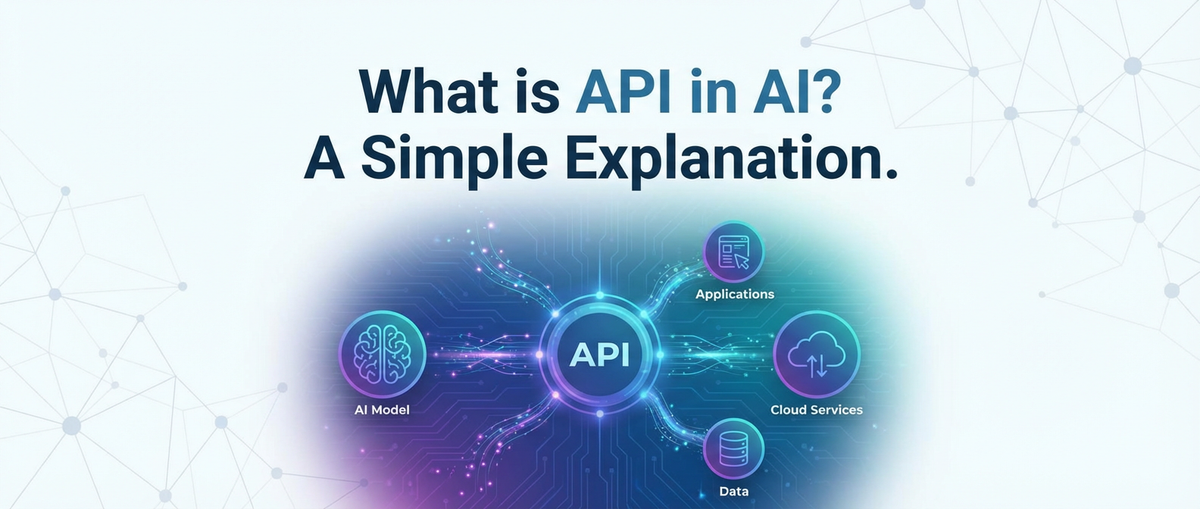

In the rapidly evolving landscape of artificial intelligence, a single acronym frequently emerges as the silent architect behind countless innovations: API. For anyone delving into the world of AI, understanding what is API in AI is not merely beneficial; it's absolutely essential. It represents the connective tissue that allows disparate software systems to communicate, collaborate, and, most importantly, for your applications to harness the immense power of artificial intelligence without having to build complex models from scratch.
This comprehensive guide will demystify APIs in the context of AI, explaining their fundamental role, various types, real-world applications, and the transformative impact they have on development and innovation. We’ll explore the intricate dance between your software and intelligent algorithms, shedding light on why an AI API is the cornerstone of modern AI-driven solutions and ultimately, what is an AI API at its core. By the end, you'll have a profound understanding of how these crucial interfaces are democratizing AI, making sophisticated capabilities accessible to developers and businesses worldwide.
The Foundation: Understanding APIs Beyond AI
Before we zoom into the specifics of AI, it's vital to grasp the concept of an Application Programming Interface (API) in its broader sense. Think of an API as a waiter in a restaurant. You, the customer, know what you want (a meal). The kitchen is where the meal is prepared. You don't go into the kitchen yourself, grab ingredients, and cook; you tell the waiter your order. The waiter takes your order to the kitchen, the kitchen prepares it, and the waiter brings it back to your table. You don't need to know how the food is cooked, just how to order it and what to expect.
In the digital world, an API plays that waiter's role. It's a set of definitions, protocols, and tools for building application software. It specifies how different software components should interact. It allows one software application to talk to another without human intervention, securely and efficiently.
Key Characteristics of an API:
- Interface: It defines the methods, functions, and protocols that software components can use to communicate with each other.
- Contract: It acts as a contract between two software programs. If one program makes a specific request formatted correctly, the other program guarantees a specific response.
- Abstraction: It hides the internal complexities of a system. Developers don't need to know the underlying code or infrastructure of an external service; they just need to know how to use its API.
- Standardization: APIs often follow established standards (like REST or SOAP) to ensure interoperability and ease of use.
How Traditional APIs Work:
- Request: Your application sends a request to an API endpoint. This request typically includes parameters (e.g., what data you're looking for, what action you want to perform) and authentication credentials.
- Processing: The API receives the request, processes it using the backend server's logic, and retrieves or manipulates data as required.
- Response: The API sends back a response, usually in a standardized format like JSON or XML, containing the requested data or the result of the action.
The prevalence of APIs is staggering. Every time you use an app that shows a map, checks the weather, logs in with your Google or Facebook account, or processes a payment, you're interacting with APIs. They are the invisible threads weaving together the fabric of our interconnected digital world. This fundamental understanding sets the stage for grasping what is an AI API and its specific nuances.
Diving into AI APIs: Connecting to Intelligence
Now, let's bring AI into the picture. When we ask what is API in AI, we're referring to an interface that allows software applications to access and utilize artificial intelligence capabilities, models, or services without the need for developers to build these complex AI systems from scratch. An AI API is essentially a gateway to pre-trained or specialized AI models that reside on a remote server.
Imagine you want to add facial recognition to your security camera application. Without an AI API, you would need to: 1. Collect a massive dataset of faces. 2. Design and train a deep learning model (which requires significant expertise in machine learning, mathematics, and programming). 3. Acquire powerful computing resources (GPUs) for training. 4. Deploy and maintain the model in a production environment.
This process is incredibly resource-intensive, time-consuming, and demands specialized expertise. This is precisely where an AI API becomes a game-changer. Instead of all that heavy lifting, you can simply send an image to a facial recognition API, and it returns the identities of the people detected, or indicates if a known person is present.
Why are AI APIs Crucial?
The significance of AI APIs cannot be overstated. They are fundamental to the democratization and accelerated adoption of artificial intelligence for several compelling reasons:
- Democratization of AI: They make sophisticated AI capabilities accessible to developers who may not have deep machine learning expertise. This lowers the barrier to entry for integrating AI into a wide range of applications.
- Speed to Market: Integrating an AI API is significantly faster than developing and deploying custom AI models. This allows businesses to rapidly prototype, test, and launch AI-powered features.
- Cost Efficiency: Developing, training, and maintaining AI models is expensive. AI APIs offer a pay-as-you-go model, often charging per request or per unit of data processed, making AI more affordable.
- Scalability: Providers of AI APIs handle the underlying infrastructure and scaling. As your application's usage grows, the API provider automatically scales their services to meet demand, without you needing to worry about server capacity or performance.
- Access to State-of-the-Art Models: API providers typically offer access to the latest and most advanced AI models, which are continuously updated and improved by expert teams.
- Focus on Core Business Logic: Developers can focus on building their core application features and user experience, leaving the complex AI computations to specialized API providers.
In essence, an AI API transforms AI from a specialized, resource-intensive undertaking into a readily consumable service, allowing innovation to flourish across industries.
How AI APIs Work Under the Hood
While the magic of an AI API seems seamless to the user, a lot happens behind the scenes:
- Model Hosting and Management: The API provider hosts the pre-trained AI model (e.g., a neural network) on powerful servers, often equipped with GPUs or TPUs for efficient computation. They manage model versions, updates, and maintenance.
- Inference Engine: When a request comes in, it's routed to an inference engine. This engine takes the input data (e.g., text, image, audio) and feeds it into the deployed AI model.
- Prediction/Output Generation: The AI model processes the input and generates a prediction or output (e.g., sentiment score, object labels, translated text, generated image).
- Data Handling and Security: The API handles the input and output data, ensuring it's transmitted securely. This often involves encryption, authentication, and compliance with data privacy regulations.
- API Gateway and Load Balancing: For high availability and performance, API providers use API gateways to manage incoming requests, enforce rate limits, authenticate users, and distribute traffic across multiple servers using load balancing.
This robust infrastructure ensures that when you make a request to an AI API, you receive a fast, accurate, and reliable response.
Diverse Landscape: Types of AI APIs
The world of AI APIs is incredibly diverse, mirroring the vast applications of artificial intelligence itself. Understanding the different categories helps clarify what is API in AI for specific use cases. Each type of AI API is designed to perform a particular set of intelligent tasks, allowing developers to pick and choose the exact capabilities they need.
Here’s a breakdown of the major categories:
1. Natural Language Processing (NLP) APIs
NLP APIs are designed to enable computers to understand, interpret, and generate human language. They are among the most widely used AI APIs.
- Text Classification/Sentiment Analysis: Analyzes text to determine its underlying sentiment (positive, negative, neutral) or categorize it into predefined topics (e.g., spam detection, customer feedback analysis).
- Translation APIs: Translates text from one human language to another (e.g., Google Translate API, DeepL API).
- Named Entity Recognition (NER): Identifies and categorizes key information in text, such as names of people, organizations, locations, dates, and products.
- Text Summarization: Automatically condenses longer texts into shorter, coherent summaries.
- Text Generation/Completion: Generates human-like text based on a given prompt, or completes sentences and paragraphs (e.g., OpenAI's GPT models, often accessed via API). This is a prime example of a generative AI API.
- Question Answering: Processes natural language questions and retrieves relevant answers from a knowledge base or text.
2. Computer Vision (CV) APIs
Computer Vision APIs empower applications to "see" and interpret visual information from images and videos, mimicking human sight.
- Object Detection and Recognition: Identifies and locates objects within an image or video frame (e.g., detecting cars, people, animals).
- Facial Recognition and Analysis: Detects human faces, identifies individuals, and can analyze attributes like emotion, age, or gender.
- Image Classification: Categorizes images into predefined classes (e.g., distinguishing between photos of cats and dogs).
- Optical Character Recognition (OCR): Extracts text from images or scanned documents, converting it into machine-readable text.
- Image Moderation: Automatically detects and flags inappropriate or harmful content in images.
- Video Analysis: Processes video streams to detect events, track objects, or analyze behavior.
3. Speech Recognition and Synthesis APIs
These APIs bridge the gap between human voice and digital text, enabling voice-controlled applications and realistic spoken output.
- Speech-to-Text (STT) APIs: Converts spoken language into written text (e.g., for voice assistants, transcription services).
- Text-to-Speech (TTS) APIs: Converts written text into natural-sounding spoken audio (e.g., for virtual assistants, audiobooks, accessibility tools).
- Speaker Recognition: Identifies who is speaking based on their voice.
4. Machine Learning (ML) Platform APIs
These APIs provide access to broader machine learning services, often for model building, deployment, and MLOps (Machine Learning Operations).
- AutoML APIs: Automate parts of the machine learning pipeline, such as data preprocessing, feature engineering, model selection, and hyperparameter tuning.
- Custom Model Deployment APIs: Allow users to upload their own trained ML models and deploy them as an API endpoint for inference.
- Prediction/Inference APIs: While many specific AI APIs fall into this, platform APIs might offer a generic endpoint for custom models to make predictions.
5. Recommender System APIs
These specialized APIs analyze user behavior and item characteristics to suggest relevant products, content, or services.
- Product Recommendation: Suggests items to users based on their past purchases, browsing history, or similar users' behavior (e-commerce).
- Content Recommendation: Suggests articles, videos, or music based on user preferences (streaming services, news platforms).
6. Generative AI APIs
A rapidly expanding category, these APIs are designed to create new, original content, rather than just analyzing existing data. This is where the magic of Large Language Models (LLMs) and diffusion models truly shines.
- Text-to-Image APIs: Generate images from textual descriptions (e.g., DALL-E, Midjourney, Stable Diffusion APIs).
- Code Generation APIs: Write code snippets or even entire functions based on natural language prompts.
- Music Generation APIs: Create musical compositions based on input parameters.
- 3D Model Generation APIs: Generate 3D assets from text or image prompts.
7. Robotics APIs
While often more specialized, these APIs connect AI capabilities to robotic systems, enabling intelligent automation and control.
- Path Planning APIs: Calculate optimal routes for robots based on environmental data and obstacles.
- Object Manipulation APIs: Allow robots to identify, grasp, and move objects using AI-driven vision and control.
The diversity of these APIs highlights the broad applicability of AI and how accessible these sophisticated technologies have become. Each AI API serves as a specialized tool in a developer's toolkit, enabling the creation of truly intelligent and innovative applications.
To illustrate the breadth of these APIs, let's look at a comparative table:
| API Category | Common Use Cases | Key Functionality | Example Providers (Illustrative) |
|---|---|---|---|
| Natural Language Processing (NLP) | Chatbots, customer support, content analysis, translation, summarization, sentiment tracking, smart search. | Understanding text, generating text, identifying entities, translating languages, analyzing sentiment. | OpenAI, Google Cloud NLP, AWS Comprehend, IBM Watson NLP |
| Computer Vision (CV) | Image search, facial recognition, autonomous vehicles, quality control, medical imaging, security monitoring. | Object detection, image classification, facial analysis, optical character recognition (OCR), video analysis. | Google Cloud Vision AI, AWS Rekognition, Azure Computer Vision |
| Speech Recognition/Synthesis | Voice assistants, call center automation, transcription services, audiobooks, accessibility tools. | Converting speech to text (STT), converting text to speech (TTS), speaker identification. | Google Cloud Speech-to-Text/Text-to-Speech, AWS Polly, Azure Speech Services |
| Generative AI | Content creation (articles, marketing copy), image generation, code generation, personalized design, synthetic data. | Creating new text, images, code, or other media from prompts; filling in missing data; style transfer. | OpenAI (DALL-E, GPT), Stability AI (Stable Diffusion), Midjourney (though often not a direct API) |
| Machine Learning Platforms | Custom model deployment, MLOps, automated machine learning (AutoML), predictive analytics, anomaly detection. | Training custom models, deploying models as APIs, data preprocessing, feature engineering, model monitoring. | Google Cloud AI Platform, AWS SageMaker, Azure Machine Learning |
| Recommender Systems | E-commerce product suggestions, content recommendations (movies, music, news), personalized user experiences. | Analyzing user preferences and item attributes to suggest relevant items. | Google Cloud Recommendations AI, AWS Personalize |
The Architecture of AI API Integration
Integrating an AI API into your application involves more than just making a simple call. It requires careful planning, understanding of the API's specifications, and robust error handling. The elegance of an API AI solution lies in its ability to abstract away complexity, but successful integration demands attention to detail.
Choosing the Right AI API
With so many providers and types of AI APIs available, selecting the most suitable one is a critical first step. Consider these factors:
- Functionality and Accuracy: Does the API offer the specific AI capability you need? How accurate are its predictions or generations for your particular use case and data? Benchmarking is often required.
- Performance (Latency and Throughput): How quickly does the API respond? Can it handle the volume of requests your application anticipates? Low latency AI is crucial for real-time applications, while high throughput AI is vital for batch processing.
- Cost Model: Understand the pricing structure. Is it per request, per character, per image, or based on compute time? Are there free tiers for testing? Costs can escalate rapidly with high usage.
- Scalability and Reliability: Can the API scale with your application's growth? What are the uptime guarantees (SLA)?
- Documentation and Support: Is the documentation clear, comprehensive, and easy to follow? What kind of developer support is available?
- Data Privacy and Security: How does the API provider handle your data? Is it compliant with relevant regulations (GDPR, HIPAA, CCPA)? Does it offer data encryption and robust authentication?
- Ease of Integration: Does the API offer SDKs (Software Development Kits) in your preferred programming languages? Is it well-designed and intuitive?
- Vendor Lock-in: While convenient, relying heavily on a single provider can create vendor lock-in. Consider strategies to mitigate this risk if needed.
The Integration Process: A Step-by-Step Approach
Once an AI API is selected, the integration typically follows these steps:
- Authentication:
- Most AI APIs require authentication to ensure secure access and to track usage for billing. Common methods include API keys, OAuth tokens, or JWTs (JSON Web Tokens).
- You'll obtain credentials from the API provider and include them in your requests. Never hardcode API keys directly into your client-side code; use environment variables or a secure backend service.
- Making Requests:
- Endpoints: Each API has specific URLs, called endpoints, for different functionalities (e.g.,
/sentiment,/detect_objects,/generate_text). - HTTP Methods: Requests are typically made using standard HTTP methods (GET, POST, PUT, DELETE). Most AI APIs use POST for sending data (like an image or text) for processing.
- Request Body: The data you send to the API (e.g., the text to be translated, the image file) is included in the request body, usually in JSON format.
- Headers: HTTP headers provide additional information, such as content type, authorization tokens, and preferred response format.
- Endpoints: Each API has specific URLs, called endpoints, for different functionalities (e.g.,
- Handling Responses:
- The API returns a response, typically in JSON format, containing the results of the AI processing (e.g., sentiment scores, detected objects, generated text).
- Your application needs to parse this JSON response to extract the relevant information.
- Error Handling:
- Robust applications must anticipate and handle errors. APIs can return various HTTP status codes indicating success (2xx), client errors (4xx), or server errors (5xx).
- Implement logic to gracefully handle network issues, invalid requests, authentication failures, or service outages.
- Rate Limiting and Quotas:
- API providers often impose rate limits (e.g., 100 requests per minute) and quotas (e.g., 1 million requests per month) to prevent abuse and ensure fair usage.
- Your application should implement exponential backoff and retry mechanisms for rate-limited requests to avoid being blocked.
- Monitoring and Logging:
- Monitor your API usage, performance, and error rates. Logging API calls and responses is crucial for debugging and understanding how your application interacts with the AI service.
Tools and SDKs for Easier Integration
To simplify the integration process, many AI API providers offer:
- SDKs (Software Development Kits): Language-specific libraries that wrap the API's HTTP calls into easy-to-use functions and objects, abstracting away much of the boilerplate code for authentication, request formatting, and response parsing.
- CLI Tools (Command Line Interface): Utilities that allow you to interact with the API directly from the command line, useful for testing and scripting.
- API Playgrounds/Explorers: Web-based interfaces that let you test API endpoints, experiment with parameters, and see responses in real-time before writing any code.
These tools significantly reduce the development effort and accelerate the integration of powerful AI API capabilities into your applications.
XRoute is a cutting-edge unified API platform designed to streamline access to large language models (LLMs) for developers, businesses, and AI enthusiasts. By providing a single, OpenAI-compatible endpoint, XRoute.AI simplifies the integration of over 60 AI models from more than 20 active providers(including OpenAI, Anthropic, Mistral, Llama2, Google Gemini, and more), enabling seamless development of AI-driven applications, chatbots, and automated workflows.
Real-World Applications and Use Cases of AI APIs
The integration of AI APIs has unleashed a wave of innovation across virtually every industry, fundamentally changing how businesses operate and how users interact with technology. Understanding what is API in AI truly means comes alive through these practical examples. From enhancing customer service to powering autonomous systems, the applications are vast and varied.
Here are some compelling real-world applications of AI APIs:
1. Customer Service and Support
- Chatbots and Virtual Assistants: Companies leverage NLP and generative AI APIs to build intelligent chatbots that can answer customer queries, provide support, and guide users through processes, often indistinguishably from human agents. This significantly reduces customer service costs and improves response times.
- Sentiment Analysis: NLP APIs analyze customer feedback from emails, social media, and call transcripts to gauge satisfaction levels and identify urgent issues, allowing businesses to proactively address problems.
- Automated Ticketing: AI APIs can categorize incoming support tickets, route them to the appropriate department, and even suggest solutions to agents, streamlining workflows.
2. Content Creation and Management
- Automated Content Generation: Generative AI APIs can produce articles, marketing copy, product descriptions, social media posts, and even code snippets, drastically accelerating content creation processes. This is especially useful for e-commerce sites needing thousands of unique product descriptions.
- Image and Video Generation: Text-to-image APIs allow marketers and designers to generate unique visuals for campaigns, mockups, and presentations from simple text prompts, saving time and resources on traditional design processes.
- Content Moderation: Computer Vision and NLP APIs automatically detect and filter inappropriate or harmful content (text, images, video) on platforms, ensuring a safer online environment.
- Translation and Localization: Translation APIs enable real-time translation of websites, documents, and communications, facilitating global reach and multi-language support.
3. Healthcare and Life Sciences
- Medical Image Analysis: CV APIs assist radiologists in detecting anomalies in X-rays, MRIs, and CT scans, potentially leading to earlier and more accurate diagnoses.
- Drug Discovery: NLP and ML APIs can analyze vast scientific literature and chemical databases to identify potential drug candidates and accelerate research.
- Personalized Medicine: AI APIs can help process patient data to identify risk factors, predict disease progression, and recommend personalized treatment plans.
- Telemedicine: Speech-to-text APIs transcribe doctor-patient conversations, automating note-taking and improving record accuracy.
4. Finance and Banking
- Fraud Detection: ML APIs analyze transaction patterns in real-time to identify and flag suspicious activities, preventing financial fraud.
- Algorithmic Trading: AI APIs provide market predictions and analysis, informing automated trading strategies.
- Credit Scoring: ML APIs assess creditworthiness more accurately by analyzing a wider range of data points than traditional methods.
- Personalized Financial Advice: AI-powered chatbots and recommendation engines offer tailored financial advice and product suggestions to customers.
5. E-commerce and Retail
- Product Recommendations: Recommender system APIs suggest products to shoppers based on their browsing history, past purchases, and similar customer behavior, significantly boosting sales.
- Personalized Shopping Experiences: AI APIs tailor website content, promotions, and search results to individual preferences.
- Visual Search: CV APIs allow customers to search for products by uploading an image, finding similar items in the catalog.
- Inventory Management: ML APIs predict demand fluctuations, optimizing stock levels and reducing waste.
6. Automotive and Transportation
- Autonomous Driving: CV APIs are fundamental for object detection, lane keeping, and pedestrian recognition in self-driving cars.
- Predictive Maintenance: ML APIs analyze sensor data from vehicles to predict potential mechanical failures, enabling proactive maintenance and preventing costly breakdowns.
- Route Optimization: AI APIs can calculate the most efficient routes for delivery fleets, considering traffic, weather, and multiple stops, a functionality often enhanced by tools like XRoute.AI for real-time adjustments.
7. Education
- Personalized Learning: AI APIs analyze student performance and learning styles to recommend customized educational content and pathways.
- Automated Grading: NLP APIs can assist in grading essays and open-ended questions, providing quick feedback to students.
- Language Learning: Speech recognition APIs help learners practice pronunciation, while translation APIs support multilingual education.
8. Security and Surveillance
- Biometric Authentication: Facial recognition and voice recognition APIs provide secure and convenient methods for identity verification.
- Threat Detection: ML APIs analyze network traffic and system logs to identify and flag potential cyber threats or anomalies.
- Public Safety: CV APIs can monitor public spaces for unusual activities or assist in locating missing persons.
These examples vividly illustrate that what is an AI API can do is incredibly diverse, transforming abstract AI models into tangible, practical solutions that drive efficiency, innovation, and value across virtually every sector. The accessibility provided by these APIs means that even small startups can leverage cutting-edge AI to compete with larger enterprises.
Benefits and Challenges of Using AI APIs
While the advantages of integrating an AI API are numerous and transformative, it's also crucial to acknowledge the potential challenges. A balanced understanding of both aspects helps in making informed decisions about leveraging API AI solutions.
The Overwhelming Benefits
- Accelerated Innovation and Development Speed:
- Reduced Time-to-Market: Developers don't need to spend months or years researching, designing, and training complex AI models. They can integrate pre-built functionalities in a matter of days or weeks.
- Focus on Core Product: Teams can concentrate on their unique application logic and user experience, rather than diverting resources to build foundational AI capabilities.
- Cost Efficiency:
- Lower Development Costs: No need for specialized AI/ML engineers for every AI feature.
- Reduced Infrastructure Expenses: API providers manage the expensive compute resources (GPUs, TPUs) required for AI model training and inference. You pay for consumption, not for maintaining infrastructure.
- Optimized Resource Usage: Pay-as-you-go models mean you only incur costs for the AI processing you actually use, making it highly cost-effective, especially for startups or fluctuating workloads.
- Accessibility and Democratization of AI:
- AI for Everyone: AI APIs make advanced AI accessible to developers and businesses without deep machine learning expertise or vast budgets. This broadens the base of innovators.
- Leveraging Cutting-Edge Models: Users get immediate access to state-of-the-art, continuously updated, and improved AI models maintained by experts at leading tech companies.
- Scalability and Reliability:
- Effortless Scaling: API providers handle the scaling of their AI services to meet fluctuating demands, ensuring consistent performance even during peak loads.
- High Availability: Providers often offer robust service level agreements (SLAs) guaranteeing high uptime and reliability.
- Simplified Maintenance:
- No Model Maintenance: The API provider is responsible for model updates, bug fixes, and performance tuning. Your application benefits from these improvements automatically.
- Reduced Operational Overhead: Less operational effort required from your team to manage AI infrastructure.
The Inherent Challenges
- Vendor Lock-in:
- Relying heavily on a single API provider can make it difficult and costly to switch to another vendor later if their pricing, features, or service quality change. The integration might be deeply embedded.
- Latency and Performance:
- Network Overhead: API calls involve network requests, which introduce latency compared to running models locally. For real-time applications, this can be a significant concern.
- Throughput Limitations: While scalable, there might be rate limits or architectural constraints on how many requests an API can handle in a given timeframe, which could affect high-volume applications. While many unified API platforms aim to offer low latency AI and high throughput AI, it's still a factor to consider.
- Data Privacy and Security Concerns:
- Data Transmission: Sending sensitive data to third-party APIs requires careful consideration of data privacy regulations (e.g., GDPR, HIPAA). Understanding how the API provider uses, stores, and protects your data is paramount.
- Security Vulnerabilities: Any external API integration introduces a potential attack surface. Secure authentication and transmission protocols are vital.
- Cost Management at Scale:
- While cost-effective initially, API costs can become substantial as usage scales. Unoptimized usage or unexpected traffic spikes can lead to surprisingly high bills if not carefully monitored.
- Complexity in comparing pricing models across different providers.
- Limited Customization and Control:
- You are using a pre-trained model. While powerful, it might not be perfectly tailored to your specific niche data or unique requirements. Customization options are often limited or non-existent.
- Lack of transparency into the model's internal workings, making debugging or understanding biases challenging.
- API Management Complexity:
- Integrating multiple AI APIs from different providers can become complex, requiring different authentication methods, data formats, and error handling strategies. This can lead to increased development and maintenance overhead. This is precisely where solutions like XRoute.AI come into play, addressing this fragmentation by offering a unified API platform that simplifies access to numerous LLMs and other AI models through a single, OpenAI-compatible endpoint. This significantly streamlines the developer experience and offers cost-effective AI solutions by providing flexible routing options.
- Ethical Considerations and Bias:
- Pre-trained AI models can inherit biases present in their training data, leading to unfair or discriminatory outcomes. Using an AI API requires awareness and careful validation of its outputs, especially in sensitive applications.
- Downtime and Service Dependency:
- Your application becomes dependent on the availability and performance of the API provider's service. An outage on their end can directly impact your application's functionality.
Navigating these challenges requires careful planning, robust architecture, and sometimes, the strategic use of platforms designed to mitigate these issues.
The Future Landscape of AI APIs and Unified Platforms
The trajectory of AI APIs points towards increasing sophistication, greater standardization, and a concerted effort to simplify their integration and management. The future of what is API in AI will be defined by how well these interfaces adapt to evolving AI capabilities and developer needs.
Emerging Trends in AI APIs:
- Multimodal AI APIs:
- Current AI APIs often specialize in one modality (text, image, audio). The future will see more powerful multimodal APIs that can process and generate content across different data types simultaneously. Imagine an API that can understand a spoken query, generate an image based on it, and then describe the image in text.
- Edge AI APIs:
- While many AI APIs run in the cloud, there's a growing need for AI inference to occur closer to the data source (on-device, or "at the edge") for reduced latency, enhanced privacy, and offline capabilities. Edge AI APIs will enable this by providing optimized, smaller models or local inference capabilities.
- Ethical AI and Explainability:
- As AI becomes more pervasive, the demand for ethical, fair, and transparent AI will grow. Future AI APIs will likely incorporate features for explaining model decisions (explainable AI or XAI) and tools to identify and mitigate biases, addressing critical ethical concerns.
- Specialized and Domain-Specific APIs:
- Beyond general-purpose APIs, there will be a proliferation of highly specialized AI APIs tailored for niche industries or complex scientific domains (e.g., specific genomics analysis APIs, advanced materials science prediction APIs).
- Standardization and Interoperability:
- The current landscape has many proprietary API designs. There's a growing movement towards standardization (e.g., Open API Specification for documentation, efforts for common data formats) to make AI APIs easier to discover, understand, and integrate.
The Rise of Unified API Platforms: Simplifying the AI Integration Maze
One of the most significant developments addressing the complexity of AI API management is the emergence of unified API platforms. As developers integrate more AI capabilities into their applications, managing multiple API keys, different rate limits, varied data formats, and diverse authentication schemes from various providers becomes a significant headache. This is where a unified API platform steps in.
A platform like XRoute.AI is a prime example of this trend. It acts as an abstraction layer, providing a single, OpenAI-compatible endpoint that allows developers to access a vast array of Large Language Models (LLMs) and other AI models from over 20 active providers (and growing).
How XRoute.AI addresses the challenges:
- Simplified Integration: Instead of managing 20+ individual API integrations, developers integrate with just one: XRoute.AI. This significantly reduces development time and effort. Its OpenAI-compatible endpoint means existing OpenAI integrations can be easily redirected.
- Cost-Effective AI: XRoute.AI enables flexible routing, allowing users to select models based on performance, cost, or specific features. This means you can choose the most cost-effective AI model for each particular task or dynamically switch providers to optimize spending.
- Low Latency AI and High Throughput: By optimizing routes and leveraging robust infrastructure, platforms like XRoute.AI aim to reduce API call latency and increase throughput, ensuring your applications remain responsive and efficient, even under heavy load.
- Provider Agnostic: It mitigates vendor lock-in by allowing developers to switch between different AI models and providers without changing their application's core integration code.
- Unified Monitoring and Analytics: A single platform often provides centralized dashboards for monitoring usage, costs, and performance across all integrated AI models, simplifying management.
- Access to a Broad Ecosystem: Developers gain immediate access to a wide variety of cutting-edge models (over 60 models from 20+ providers in XRoute.AI's case) without the individual effort of integrating each one.
The future of API AI is undoubtedly moving towards more intelligent, interconnected, and easily manageable solutions. Unified API platforms like XRoute.AI are at the forefront of this movement, empowering developers and businesses to build sophisticated AI-driven applications with unprecedented ease and efficiency. They abstract away the underlying complexity, allowing innovators to focus on creating value rather than wrestling with integration challenges, truly demonstrating the power of what is an AI API when streamlined.
Conclusion: The Interconnected Future Driven by AI APIs
The journey from understanding the foundational principles of APIs to grasping the intricate world of what is API in AI reveals a powerful narrative of technological evolution. APIs have always been the unseen enablers of software interoperability, but in the realm of artificial intelligence, their role transcends mere connectivity; they are the democratizers of intelligence, making sophisticated AI models accessible to a global community of developers and businesses.
We've explored how an AI API serves as the vital bridge, allowing applications to tap into a vast ecosystem of pre-trained models—from natural language processing and computer vision to advanced generative AI capabilities. This accessibility fuels rapid innovation, significantly reduces development costs, and accelerates time-to-market for AI-powered solutions across every conceivable industry. The transition from abstract algorithms to tangible, impactful applications is largely facilitated by the well-defined contracts and seamless communication that AI APIs provide.
While the benefits are profound, we've also acknowledged the challenges, such as vendor lock-in, latency, and the complexity of managing multiple API integrations. These challenges, however, are driving further innovation, particularly with the emergence of unified API platforms like XRoute.AI. By offering a single, OpenAI-compatible endpoint to over 60 AI models from 20+ providers, XRoute.AI exemplifies the future—a future where integrating low latency AI and cost-effective AI becomes not just feasible, but effortlessly scalable. These platforms simplify the developer experience, ensuring that the focus remains on building intelligent solutions rather than navigating API fragmentation.
In essence, what is an AI API is much more than a technical interface; it is the linchpin of modern AI development, a catalyst for widespread adoption, and a testament to the power of abstraction in engineering. As AI continues its rapid evolution, the role of these intelligent interfaces will only grow, paving the way for a future where artificial intelligence is not just a specialized domain, but an integral, seamlessly integrated part of every digital experience. The interconnected intelligence facilitated by AI APIs is not just shaping our technology; it's redefining what's possible.
Frequently Asked Questions (FAQ)
1. What is the fundamental difference between a regular API and an AI API?
A regular API defines how software components interact to perform general tasks like retrieving data from a database, processing payments, or sending notifications. An AI API, on the other hand, specifically provides access to artificial intelligence models and capabilities, allowing applications to perform intelligent tasks like understanding language, recognizing images, generating content, or making predictions without the developer needing to build or train the underlying AI model. The core distinction lies in the specialized, intelligent processing capabilities offered by the AI API.
2. Can I use AI APIs without being a machine learning expert?
Absolutely! This is one of the primary advantages of AI APIs. They are designed to democratize AI, making sophisticated machine learning capabilities accessible to developers who may not have deep expertise in AI or data science. You interact with the API using standard programming concepts, sending data and receiving results, without needing to understand the complex algorithms or neural network architectures running behind the scenes.
3. Are AI APIs expensive to use?
The cost of using AI APIs varies widely depending on the provider, the specific API, and your usage volume. Many providers offer free tiers for limited usage, allowing developers to test and prototype. Pricing models are typically pay-as-you-go, based on the number of requests, the amount of data processed (e.g., per character, per image), or compute time. While initial costs can be low, it's crucial to monitor usage as applications scale, as costs can increase significantly. Platforms like XRoute.AI aim to offer cost-effective AI by providing flexible routing options to optimize spending across multiple providers.
4. What are the main challenges when integrating multiple AI APIs?
Integrating multiple AI APIs from different providers can present several challenges: * Varying Authentication: Each API might require different API keys, tokens, or authentication methods. * Inconsistent Data Formats: Request and response data structures can differ significantly between providers. * Diverse Error Handling: Error codes and messages are often unique to each API, requiring custom handling. * Rate Limits and Quotas: Managing different usage limits for each API can be complex. * Vendor Lock-in Risk: Becoming too dependent on specific features of one provider. * Increased Development Overhead: More code is needed to manage and normalize interactions with each unique API. These challenges are precisely what unified API platforms like XRoute.AI aim to solve by providing a single, consistent interface.
5. How do unified AI API platforms like XRoute.AI help developers?
Unified AI API platforms like XRoute.AI streamline the process of accessing and managing various AI models. They provide a single, standardized endpoint (often OpenAI-compatible) that developers can integrate with, rather than having to integrate with dozens of individual API providers. This approach offers several benefits: * Simplified Integration: One API to learn, one set of credentials to manage. * Flexibility and Provider Agnosticism: Easily switch between different AI models or providers (e.g., from OpenAI to Anthropic to Google) through the same endpoint without changing your application's code. * Cost Optimization: Intelligent routing can automatically direct requests to the most cost-effective AI model for a given task, or the one offering the low latency AI. * High Throughput AI: Consolidated infrastructure can optimize performance and handle high request volumes. * Centralized Monitoring: A single dashboard to track usage, performance, and costs across all integrated models. Ultimately, they reduce complexity, accelerate development, and offer greater control and efficiency for building AI-powered applications.
🚀You can securely and efficiently connect to thousands of data sources with XRoute in just two steps:
Step 1: Create Your API Key
To start using XRoute.AI, the first step is to create an account and generate your XRoute API KEY. This key unlocks access to the platform’s unified API interface, allowing you to connect to a vast ecosystem of large language models with minimal setup.
Here’s how to do it: 1. Visit https://xroute.ai/ and sign up for a free account. 2. Upon registration, explore the platform. 3. Navigate to the user dashboard and generate your XRoute API KEY.
This process takes less than a minute, and your API key will serve as the gateway to XRoute.AI’s robust developer tools, enabling seamless integration with LLM APIs for your projects.
Step 2: Select a Model and Make API Calls
Once you have your XRoute API KEY, you can select from over 60 large language models available on XRoute.AI and start making API calls. The platform’s OpenAI-compatible endpoint ensures that you can easily integrate models into your applications using just a few lines of code.
Here’s a sample configuration to call an LLM:
curl --location 'https://api.xroute.ai/openai/v1/chat/completions' \
--header 'Authorization: Bearer $apikey' \
--header 'Content-Type: application/json' \
--data '{
    "model": "gpt-5",
    "messages": [
        {
            "content": "Your text prompt here",
            "role": "user"
        }
    ]
}'
With this setup, your application can instantly connect to XRoute.AI’s unified API platform, leveraging low latency AI and high throughput (handling 891.82K tokens per month globally). XRoute.AI manages provider routing, load balancing, and failover, ensuring reliable performance for real-time applications like chatbots, data analysis tools, or automated workflows. You can also purchase additional API credits to scale your usage as needed, making it a cost-effective AI solution for projects of all sizes.
Note: Explore the documentation on https://xroute.ai/ for model-specific details, SDKs, and open-source examples to accelerate your development.