What is API in AI? Explained Simply

In the rapidly evolving landscape of artificial intelligence, the term "API" (Application Programming Interface) has become an indispensable concept. Far from being a mere technical jargon, understanding what is API in AI is crucial for anyone looking to build, integrate, or even simply comprehend modern AI-powered applications. Whether you're a seasoned developer, a business leader, or an curious enthusiast, grasping the essence of API AI can demystify how intelligent systems communicate and collaborate, opening up a world of possibilities for innovation and efficiency.
This comprehensive guide aims to demystify the concept of an API in the context of Artificial Intelligence. We'll start by breaking down the fundamental principles of APIs, then delve into how they revolutionize AI development, what types of AI APIs exist, and their transformative impact across various industries. By the end, you'll have a clear understanding of what is an AI API, its benefits, and how it empowers the creation of intelligent, interconnected systems that are shaping our future.
The Foundation: Understanding APIs
Before we can fully appreciate the role of APIs in AI, it's essential to grasp what an API is in its most basic form. Think of an API as a digital messenger or a universal translator that allows different software applications to talk to each other.
What is an API? An Analogy
Imagine you're at a restaurant. You don't go into the kitchen to cook your meal yourself. Instead, you look at a menu (which lists all the dishes the kitchen can prepare) and tell the waiter your order. The waiter takes your order to the kitchen, the kitchen prepares it, and the waiter brings it back to your table.
In this analogy: * You (the customer) are one software application. * The Kitchen is another software application or a server with a specific function. * The Menu is the API documentation – it tells you what functions (dishes) are available and how to request them (what ingredients/options you can specify). * The Waiter is the API itself – it takes your request, delivers it to the kitchen, and brings back the response (your meal).
Just as the waiter ensures you get your desired meal without needing to understand the intricacies of cooking, an API allows one program to access functionalities or data from another program without needing to understand its internal complexities.
How APIs Work: The Request-Response Cycle
At its core, an API operates on a request-response cycle. Here's a simplified breakdown:
- Client Application (You): Your software needs to perform a specific task that another service can provide (e.g., get weather data, translate text, identify an object in an image).
- API Call/Request: Your software sends a request to the API's designated endpoint. This request typically includes:
- Method: What action you want to perform (e.g., GET data, POST new data).
- Endpoint: The specific URL that represents the resource or function you want to access.
- Parameters: Any specific instructions or data needed for the request (e.g., location for weather, text to translate, image file).
- Authentication: Often, a key or token to verify your identity and authorization.
- API Server (The Kitchen): The server hosting the API receives the request, processes it according to its defined rules, and performs the requested action.
- Response: The API server sends back a response to your application. This response typically includes:
- Status Code: Indicates if the request was successful (e.g., 200 OK) or if an error occurred (e.g., 404 Not Found, 500 Internal Server Error).
- Data: The actual information or result of the requested action, usually in a standardized format like JSON (JavaScript Object Notation) or XML.
This standardized communication protocol is what makes modern software development so efficient and modular. Developers can build complex applications by stitching together various services, each exposed through its own API.
Why APIs Are Essential in Modern Software Development
APIs are the backbone of the interconnected digital world we live in. They enable:
- Modularity and Reusability: Developers don't have to reinvent the wheel. They can use existing, proven functionalities from other services.
- Interoperability: Different systems, often built with different technologies, can communicate seamlessly.
- Innovation: By providing access to powerful functionalities, APIs foster rapid prototyping and the creation of novel applications.
- Scalability: Services can be scaled independently, and applications can leverage the scalability of external API providers.
- Efficiency: Reduces development time and cost by outsourcing complex tasks to specialized services.
With this foundational understanding of APIs, we can now explore how they intersect with the fascinating world of Artificial Intelligence.
Diving into Artificial Intelligence: A Brief Overview
Artificial Intelligence (AI) is a broad field of computer science dedicated to creating machines that can perform tasks typically requiring human intelligence. This includes learning, problem-solving, perception, decision-making, and understanding language.
Key branches of AI include:
- Machine Learning (ML): A subset of AI that enables systems to learn from data without explicit programming. Algorithms are trained on large datasets to identify patterns and make predictions or decisions.
- Deep Learning (DL): A subfield of ML that uses neural networks with many layers (hence "deep") to learn complex patterns, often excelling in tasks like image recognition, speech recognition, and natural language processing.
- Natural Language Processing (NLP): Focuses on the interaction between computers and human language, enabling machines to understand, interpret, and generate human text and speech.
- Computer Vision: Enables computers to "see" and interpret visual information from the real world, such as images and videos.
- Generative AI: A newer class of AI models capable of creating new content, such as text, images, audio, and code, often based on patterns learned from vast datasets. Large Language Models (LLMs) are a prominent example.
Building sophisticated AI models from scratch requires immense computational resources, specialized expertise in machine learning, extensive data collection and annotation, and significant time investment. This is where APIs come into play, democratizing access to powerful AI capabilities.
The Intersection: What is API in AI?
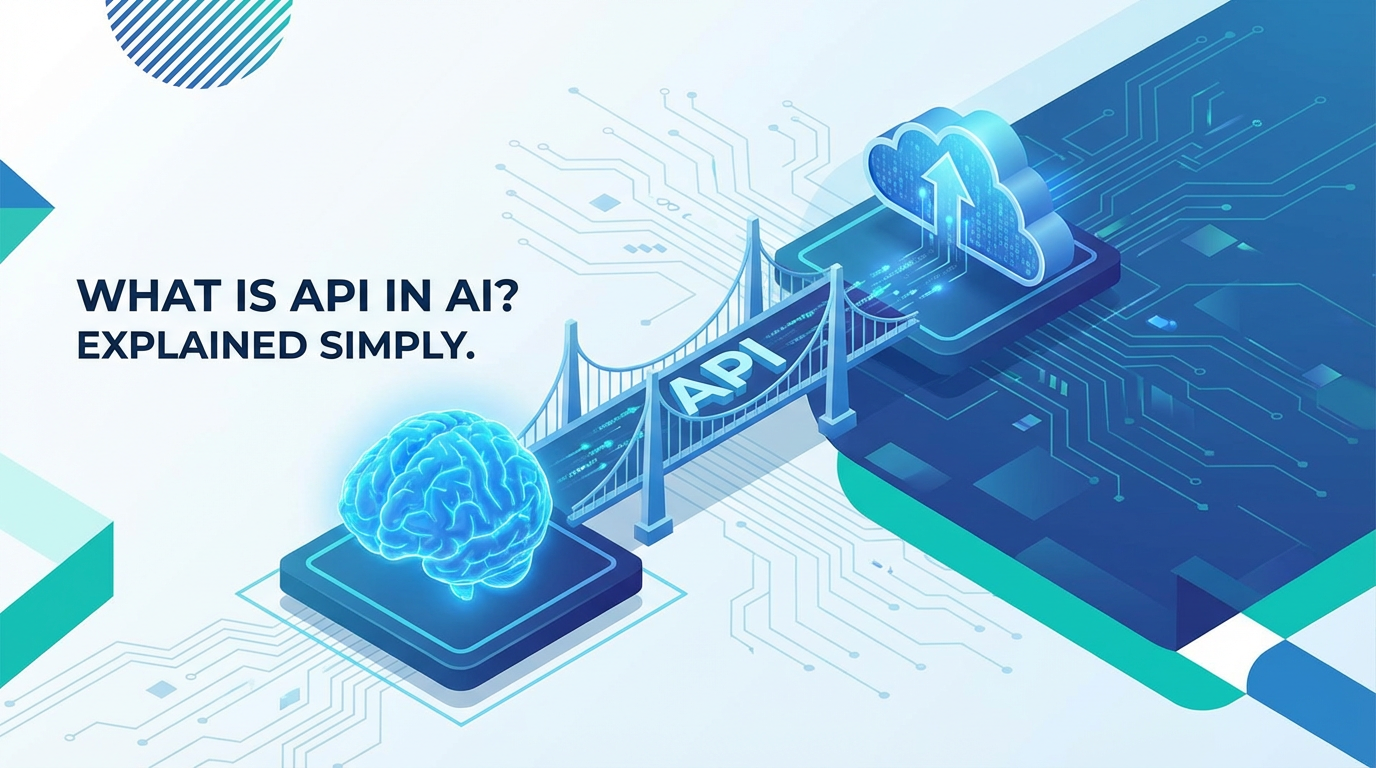
Now, let's bring these two powerful concepts together. What is API in AI? Simply put, an API AI is an interface that allows developers and applications to access pre-built, pre-trained Artificial Intelligence models or AI-powered services without needing to understand or manage the underlying complex AI infrastructure. It acts as a bridge, enabling your application to send data to an AI model and receive intelligent insights, predictions, or generated content back.
To further elaborate on what is an AI API, imagine you have an application that needs to translate text from English to Spanish. Instead of training your own translation model (which would involve acquiring massive datasets, deep linguistic expertise, and powerful computing hardware), you can use a translation API. You send your English text to the API, and it returns the Spanish translation. The heavy lifting of the AI model is handled by the API provider.
Types of AI APIs: A Landscape of Intelligence
The world of AI APIs is incredibly diverse, catering to almost every imaginable intelligent task. Here are some prominent categories:
1. Machine Learning Model APIs
These APIs provide access to pre-trained machine learning models designed for specific tasks. * Examples: * Image Recognition APIs: Identify objects, scenes, and activities in images (e.g., "Is there a cat in this picture?", "What brand is this car?"). * Sentiment Analysis APIs: Determine the emotional tone (positive, negative, neutral) of a piece of text (e.g., customer reviews, social media posts). * Recommendation Engine APIs: Suggest products, content, or services based on user preferences and behavior. * Fraud Detection APIs: Identify suspicious transactions or activities.
2. Generative AI APIs (Large Language Models, Image Generation, etc.)
These are at the forefront of AI innovation, capable of creating new, original content. * Examples: * Large Language Model (LLM) APIs: Generate human-like text, answer questions, summarize documents, write code, translate languages, and engage in conversational AI (e.g., OpenAI's GPT series, Google's Gemini, Anthropic's Claude). * Image Generation APIs: Create photorealistic or artistic images from text descriptions (e.g., Midjourney, DALL-E, Stable Diffusion). * Code Generation APIs: Assist developers by generating code snippets, completing functions, or even entire programs based on natural language prompts. * Text-to-Speech (TTS) & Speech-to-Text (STT) APIs: Convert written text into natural-sounding speech and vice-versa, essential for voice assistants and accessibility tools.
3. Natural Language Processing (NLP) APIs
These APIs focus on understanding, interpreting, and manipulating human language. * Examples: * Text Summarization APIs: Condense long articles or documents into concise summaries. * Named Entity Recognition (NER) APIs: Identify and classify named entities (people, organizations, locations, dates) in text. * Language Detection APIs: Automatically identify the language of a given text. * Translation APIs: Translate text between different human languages.
4. Computer Vision APIs
These APIs enable applications to process, analyze, and understand visual data. * Examples: * Object Detection APIs: Locate and identify multiple objects within an image or video frame. * Facial Recognition APIs: Identify or verify a person from a digital image or a video frame. * Optical Character Recognition (OCR) APIs: Extract text from images of documents or photographs. * Image Moderation APIs: Detect inappropriate content in images.
5. Vector Database APIs
While not directly an "AI model," these APIs are crucial for building advanced AI applications, particularly those involving Retrieval Augmented Generation (RAG) with LLMs. They allow for efficient storage and similarity search of high-dimensional vector embeddings, which represent the semantic meaning of data. * Examples: Pinecone, Weaviate, Milvus.
How AI APIs Work in Practice
The fundamental request-response mechanism remains the same, but with an AI twist:
- Input Data: Your application sends specific data to the AI API. This could be text, an image, an audio file, a user query, or structured data.
- AI Processing: The AI API receives the data and passes it to its underlying pre-trained AI model. The model then performs its designated task (e.g., analyzes sentiment, generates text, identifies objects).
- Output/Result: The AI model produces an output, which the API then packages into a structured format (usually JSON) and sends back to your application. This output could be a sentiment score, a generated paragraph, a list of detected objects with bounding box coordinates, or a translated text.
This abstraction allows developers to integrate cutting-edge AI capabilities into their applications with just a few lines of code, without needing to be AI experts themselves.
Benefits of Using AI APIs: Fueling Innovation and Efficiency
The adoption of AI APIs has become a game-changer for businesses and developers alike, offering a multitude of compelling advantages:
1. Speed and Time-to-Market
Building AI models from scratch is a monumental task, often requiring months or even years of research, data collection, training, and fine-tuning. AI APIs provide instant access to robust, pre-trained models. This drastically reduces development cycles, allowing companies to integrate intelligent features and launch products much faster, gaining a significant competitive edge. For instance, a startup needing a chatbot can plug into an LLM API within days, rather than spending a year developing their own.
2. Cost-Effectiveness
The infrastructure required to train and deploy complex AI models—including powerful GPUs, specialized servers, and vast data storage—can be prohibitively expensive. AI APIs operate on a pay-as-you-go model, where you only pay for the computational resources you consume (e.g., per API call, per token, per image generated). This eliminates massive upfront investments and converts capital expenditure into operational expenditure, making advanced AI accessible even for small businesses and individual developers.
3. Accessibility and Democratization of AI
AI APIs lower the barrier to entry for AI development. You don't need a Ph.D. in machine learning or a team of data scientists to leverage AI. Any developer familiar with making API calls can integrate sophisticated AI capabilities into their applications. This democratization empowers a wider range of creators and businesses to innovate with AI, regardless of their internal AI expertise.
4. Scalability and Reliability
Leading AI API providers build their services on highly scalable and reliable cloud infrastructure. This means your application can effortlessly handle varying loads, from a few requests per day to millions, without you having to worry about managing servers, load balancers, or downtimes. The API provider ensures the underlying AI models are constantly optimized for performance and availability.
5. Focus on Core Business Logic
By offloading complex AI tasks to external APIs, development teams can concentrate their efforts on building unique application features, user experiences, and core business logic. Instead of spending cycles on model training and infrastructure management, they can focus on what truly differentiates their product or service. This specialization leads to better products and more efficient development.
6. Continuous Improvement
Reputable AI API providers constantly update and improve their models with new data, better algorithms, and enhanced performance. When you use an API, your application automatically benefits from these improvements without any additional effort on your part. This ensures your AI features remain state-of-the-art.
7. Access to Specialized Expertise
AI APIs often provide access to models that have been developed and fine-tuned by world-class AI researchers. This means you're leveraging cutting-edge algorithms and massive datasets that would be impossible for most organizations to replicate independently.
The table below summarizes the key benefits:
| Benefit | Description |
|---|---|
| Speed & Time-to-Market | Rapid integration of AI features into applications, significantly reducing development cycles and enabling faster product launches. |
| Cost-Effectiveness | Eliminates the need for expensive AI infrastructure and expertise; pay-as-you-go models make advanced AI accessible on a budget. |
| Accessibility | Lowers the barrier for AI adoption, allowing developers without deep AI expertise to build AI-powered solutions. |
| Scalability | Effortlessly handles fluctuating demand, from small projects to enterprise-level loads, backed by robust cloud infrastructure. |
| Focus on Core Logic | Frees up development teams to concentrate on unique application features and user experience, rather than managing complex AI models. |
| Continuous Improvement | Automatically benefits from ongoing model updates, performance enhancements, and new features provided by the API vendor. |
| Specialized Expertise | Accesses world-class AI models developed and maintained by expert researchers and engineers, leveraging state-of-the-art technology. |
XRoute is a cutting-edge unified API platform designed to streamline access to large language models (LLMs) for developers, businesses, and AI enthusiasts. By providing a single, OpenAI-compatible endpoint, XRoute.AI simplifies the integration of over 60 AI models from more than 20 active providers(including OpenAI, Anthropic, Mistral, Llama2, Google Gemini, and more), enabling seamless development of AI-driven applications, chatbots, and automated workflows.
Real-World Applications and Examples of API AI
The impact of API AI is profound and spans nearly every industry. Here are just a few examples of how these interfaces are being used to create intelligent, dynamic applications:
1. Enhanced Customer Service and Support
- Chatbots and Virtual Assistants: Companies integrate LLM APIs to power intelligent chatbots that can answer customer queries, provide personalized recommendations, and even resolve issues 24/7, reducing workload on human agents.
- Sentiment Analysis: Customer support platforms use sentiment analysis APIs to gauge the emotional tone of customer interactions (emails, chat logs, social media posts), allowing them to prioritize urgent or dissatisfied customers.
- Automated Ticketing: NLP APIs can analyze incoming support requests, extract key information, and automatically route tickets to the appropriate department or agent.
2. Content Creation and Marketing
- Automated Content Generation: Marketing teams use generative AI APIs to draft blog posts, product descriptions, social media updates, and email campaigns, saving time and scaling content production.
- Personalized Marketing: Recommendation engine APIs analyze user behavior to suggest personalized product recommendations or content to individual customers, increasing engagement and conversion rates.
- SEO Optimization: NLP APIs can help analyze keyword trends, optimize content for search engines, and even generate meta descriptions.
3. Healthcare and Life Sciences
- Medical Image Analysis: Computer vision APIs assist radiologists in detecting anomalies in X-rays, MRIs, and CT scans, aiding in early diagnosis of diseases.
- Drug Discovery: AI APIs can analyze vast datasets of chemical compounds and biological interactions to accelerate the drug discovery process.
- Personalized Medicine: ML APIs can analyze patient data (genetics, medical history, lifestyle) to predict disease risks and recommend personalized treatment plans.
4. Finance and Banking
- Fraud Detection: Financial institutions use ML APIs to detect unusual transaction patterns that might indicate fraudulent activity, protecting customers and assets.
- Credit Scoring: AI APIs can assess creditworthiness by analyzing a wider range of data points than traditional methods, leading to more accurate and inclusive lending decisions.
- Algorithmic Trading: AI APIs provide real-time market insights and can execute trades based on complex algorithms, optimizing investment strategies.
5. Manufacturing and Logistics
- Predictive Maintenance: Manufacturers use ML APIs to analyze sensor data from machinery, predicting potential equipment failures before they occur, reducing downtime and maintenance costs.
- Supply Chain Optimization: AI APIs optimize logistics routes, inventory management, and demand forecasting, leading to more efficient and resilient supply chains.
- Quality Control: Computer vision APIs inspect products on assembly lines for defects, ensuring consistent quality and reducing waste.
6. Education
- Personalized Learning: AI APIs power adaptive learning platforms that tailor educational content and pace to individual student needs and learning styles.
- Automated Grading: NLP APIs can assist in grading essays and providing feedback, particularly for objective questions.
- Language Learning: Translation and speech APIs facilitate language acquisition by providing real-time feedback and practice.
These examples highlight the transformative power of AI APIs, enabling businesses and developers to infuse intelligence into virtually any application or workflow, driving innovation and creating more intelligent, responsive, and efficient systems.
Challenges and Considerations When Using AI APIs
While the benefits of using AI APIs are undeniable, it's also important to be aware of potential challenges and considerations to ensure successful and responsible implementation.
1. Data Privacy and Security
When sending data to an external AI API, you are entrusting that data to a third-party provider. This raises critical questions about data privacy, compliance (e.g., GDPR, HIPAA), and security protocols. * Considerations: Understand the API provider's data handling policies, encryption methods, data retention practices, and compliance certifications. For sensitive data, explore on-premise or private cloud AI solutions if available, or consider anonymizing data before sending it.
2. Latency and Throughput
The performance of your application can be heavily dependent on the API's response time (latency) and its ability to handle a large volume of requests (throughput). High latency can lead to slow user experiences, while low throughput can cause bottlenecks. * Considerations: Test API performance thoroughly. Choose providers with robust infrastructure, geographically distributed servers, and high-performance guarantees. Implement caching strategies where appropriate to reduce redundant API calls.
3. Cost Management
While often more cost-effective than building in-house, API usage costs can quickly escalate, especially with high-volume applications or complex models (like LLMs, which are priced per token). Unexpected spikes in usage can lead to budget overruns. * Considerations: Carefully review pricing models (per call, per token, per feature). Implement monitoring and alerts for API usage. Optimize requests to send only necessary data and minimize redundant calls. Explore tiered pricing or enterprise plans for high usage.
4. Model Bias and Ethical Considerations
AI models are trained on data, and if that data is biased, the model's outputs will reflect and potentially amplify those biases. This can lead to unfair or discriminatory outcomes. * Considerations: Be aware of the potential for bias in the AI models you use. Understand the training data used by the API provider if possible. Implement human oversight and review mechanisms for critical AI-driven decisions. Consider the ethical implications of your AI application and strive for fairness and transparency.
5. Vendor Lock-in
Relying heavily on a single AI API provider can lead to vendor lock-in, making it difficult and costly to switch providers if circumstances change (e.g., pricing increases, feature deprecation, performance issues). * Considerations: Evaluate the long-term viability of the provider. Design your application with an abstraction layer for AI services, making it easier to swap out different APIs if needed. Explore unified API platforms that provide access to multiple models, mitigating single-vendor dependency.
6. Integration Complexity and Documentation
While APIs simplify AI, integrating them still requires understanding their documentation, data formats, and authentication mechanisms. Poorly documented or complex APIs can slow down development. * Considerations: Choose APIs with clear, comprehensive, and up-to-date documentation, along with developer-friendly SDKs and support resources.
7. Versioning and Deprecation
API providers periodically update their APIs, introduce new versions, or deprecate old ones. This can potentially break your application if not managed carefully. * Considerations: Monitor API versioning policies. Plan for updates and migrations by testing against new API versions in development environments before deploying to production.
Addressing these challenges proactively is key to harnessing the full power of AI APIs effectively and responsibly.
Choosing the Right AI API: A Strategic Decision
Selecting the appropriate AI API for your project involves more than just picking the most popular option. It requires a strategic evaluation of various factors to ensure it aligns with your technical requirements, budget, and long-term goals.
1. Performance: Latency and Throughput
- Latency: How quickly does the API respond to a request? Crucial for real-time applications (e.g., voice assistants, live chatbots).
- Throughput: How many requests can the API handle per second? Important for high-volume applications.
- Consider: Look for APIs with low average latency and high throughput, often advertised with Service Level Agreements (SLAs). Geographic availability of data centers can also impact latency.
2. Accuracy and Model Quality
- Does the model provide accurate and relevant results for your specific use case?
- Consider: Evaluate the API's underlying model benchmarks and scientific papers. Conduct your own testing with representative data samples to assess its performance, including potential biases. Some APIs offer fine-tuning capabilities for better domain-specific accuracy.
3. Pricing Models
- AI API pricing varies widely (per call, per token, per second, subscription). Costs can quickly add up.
- Consider: Understand the pricing structure thoroughly. Estimate your expected usage volume and calculate potential costs. Look for tiered pricing, free tiers for development, and transparent cost reporting. Watch out for egress fees or hidden costs.
4. Documentation and Developer Experience
- A well-documented API with clear examples, SDKs, and tutorials significantly speeds up integration.
- Consider: Review the API documentation before committing. Is it easy to understand? Are there client libraries for your preferred programming language? Is there an active developer community or readily available support?
5. Scalability and Reliability
- Can the API scale seamlessly with your application's growth? What are the uptime guarantees?
- Consider: Look for providers known for robust, cloud-native infrastructure and high availability. Check their uptime history and SLA commitments.
6. Security and Compliance
- How does the API provider handle your data? Is it compliant with relevant industry regulations (e.g., GDPR, HIPAA, CCPA)?
- Consider: Prioritize providers with strong security protocols, data encryption (in transit and at rest), and clear privacy policies. For highly sensitive data, ensure the provider offers necessary certifications and guarantees.
7. Customization and Fine-tuning
- Can you adapt the pre-trained model to better suit your specific domain or data?
- Consider: Some advanced AI APIs allow fine-tuning with your own datasets, which can significantly improve performance for niche applications.
8. Ecosystem and Integrations
- Does the API integrate well with other tools and services you use?
- Consider: A broader ecosystem can provide more flexibility and options for your overall tech stack.
Unified API Platforms: Simplifying AI API Management
Navigating the multitude of AI APIs from different providers can be complex, leading to challenges like vendor lock-in, inconsistent API interfaces, and managing multiple authentication keys. This is where unified API platforms like XRoute.AI become incredibly valuable.
XRoute.AI is a cutting-edge unified API platform designed to streamline access to large language models (LLMs) for developers, businesses, and AI enthusiasts. Instead of integrating with dozens of individual AI providers, XRoute.AI offers a single, OpenAI-compatible endpoint. This means you write your code once and can seamlessly switch between over 60 AI models from more than 20 active providers, including major players and specialized models.
This approach directly addresses many of the challenges discussed above:
- Mitigating Vendor Lock-in: You're not tied to a single provider's specific API. You can easily experiment with or switch to different models to find the best fit for performance, accuracy, or cost.
- Simplified Integration: A single, standardized API endpoint reduces development complexity and time.
- Optimized Performance: XRoute.AI focuses on low latency AI and high throughput, intelligently routing requests to ensure the fastest response times and handle large volumes of traffic efficiently.
- Cost-Effective AI: By providing access to a wide array of models and potentially optimizing routes, XRoute.AI helps users achieve cost-effective AI solutions by selecting the most economical model for a given task.
- Scalability: The platform's robust infrastructure ensures your AI applications can scale without concerns about underlying model management.
- Developer-Friendly: With comprehensive tools and a focus on ease of use, XRoute.AI empowers developers to build intelligent solutions without the complexity of managing multiple API connections.
By utilizing such platforms, developers can focus on building innovative applications rather than getting bogged down in API management, truly embodying the spirit of accessible and efficient AI development.
Conclusion: APIs as the Neural Network of AI
In conclusion, understanding what is API in AI is fundamental to navigating the modern technological landscape. APIs serve as the crucial connective tissue, the digital messengers that enable disparate software components to communicate and collaborate, democratizing access to powerful Artificial Intelligence capabilities. From powering intelligent chatbots and generating creative content to optimizing complex industrial processes and revolutionizing healthcare, API AI is no longer a niche technical concept but a ubiquitous enabler of innovation.
The ability to seamlessly integrate pre-trained AI models through well-defined interfaces empowers developers and businesses to build sophisticated, intelligent applications with unprecedented speed, efficiency, and cost-effectiveness. While challenges related to data privacy, cost management, and ethical considerations require careful attention, the benefits of leveraging AI APIs overwhelmingly outweigh the complexities.
As AI continues its rapid evolution, platforms like XRoute.AI will play an increasingly vital role in simplifying this ecosystem. By unifying access to a diverse array of models, optimizing for performance and cost, and providing developer-friendly tools, they pave the way for an even more interconnected and intelligently automated future. Embracing the power of what is an AI API is not just about adopting a technology; it's about unlocking limitless potential for creativity, problem-solving, and building the next generation of intelligent systems that will continue to shape our world.
Frequently Asked Questions (FAQ)
1. What is the core difference between building an AI model from scratch and using an AI API?
Building an AI model from scratch involves extensive data collection, cleansing, model architecture design, training on powerful hardware, and continuous maintenance by AI specialists. This requires significant time, expertise, and resources. Using an AI API, conversely, means you're leveraging a pre-built, pre-trained model hosted by a third-party provider. You simply send your data to the API and receive the AI-generated output, without managing any of the underlying AI infrastructure. It's faster, more cost-effective, and doesn't require deep AI expertise.
2. Are AI APIs suitable for all types of AI projects?
AI APIs are ideal for projects that can leverage general-purpose AI tasks (like language translation, sentiment analysis, image recognition, or text generation) or those where the specific capabilities of available APIs align well with project needs. For highly specialized, proprietary AI tasks that require unique data or algorithms, building an in-house model might still be necessary. However, many APIs offer fine-tuning options to adapt general models to specific domains.
3. How do I choose the right AI API for my application?
Consider several factors: the specific AI task you need to perform (e.g., text generation, image analysis), the required accuracy and performance (latency, throughput), your budget (pricing models vary widely), the ease of integration (documentation, SDKs), security and compliance needs, and the API provider's reliability and scalability. Platforms like XRoute.AI can simplify this by offering a unified interface to multiple models, allowing you to easily compare and switch providers.
4. What are the potential risks or downsides of relying on AI APIs?
Key risks include vendor lock-in (being tied to one provider), data privacy concerns (as your data is processed externally), potential for unexpected cost increases with high usage, and performance dependency on the API provider's infrastructure. Ethical concerns like model bias and accountability also need to be considered. It's crucial to understand the API provider's policies and design your application with some level of abstraction to mitigate these risks.
5. What are unified AI API platforms like XRoute.AI, and why are they useful?
Unified AI API platforms, such as XRoute.AI, provide a single, standardized interface to access a multitude of AI models from various providers. They are useful because they simplify integration, reduce vendor lock-in by allowing easy switching between models, often optimize for performance (low latency, high throughput) and cost, and streamline API key management. This enables developers to focus more on building their applications and less on the complexities of managing diverse AI model APIs.
🚀You can securely and efficiently connect to thousands of data sources with XRoute in just two steps:
Step 1: Create Your API Key
To start using XRoute.AI, the first step is to create an account and generate your XRoute API KEY. This key unlocks access to the platform’s unified API interface, allowing you to connect to a vast ecosystem of large language models with minimal setup.
Here’s how to do it: 1. Visit https://xroute.ai/ and sign up for a free account. 2. Upon registration, explore the platform. 3. Navigate to the user dashboard and generate your XRoute API KEY.
This process takes less than a minute, and your API key will serve as the gateway to XRoute.AI’s robust developer tools, enabling seamless integration with LLM APIs for your projects.
Step 2: Select a Model and Make API Calls
Once you have your XRoute API KEY, you can select from over 60 large language models available on XRoute.AI and start making API calls. The platform’s OpenAI-compatible endpoint ensures that you can easily integrate models into your applications using just a few lines of code.
Here’s a sample configuration to call an LLM:
curl --location 'https://api.xroute.ai/openai/v1/chat/completions' \
--header 'Authorization: Bearer $apikey' \
--header 'Content-Type: application/json' \
--data '{
    "model": "gpt-5",
    "messages": [
        {
            "content": "Your text prompt here",
            "role": "user"
        }
    ]
}'
With this setup, your application can instantly connect to XRoute.AI’s unified API platform, leveraging low latency AI and high throughput (handling 891.82K tokens per month globally). XRoute.AI manages provider routing, load balancing, and failover, ensuring reliable performance for real-time applications like chatbots, data analysis tools, or automated workflows. You can also purchase additional API credits to scale your usage as needed, making it a cost-effective AI solution for projects of all sizes.
Note: Explore the documentation on https://xroute.ai/ for model-specific details, SDKs, and open-source examples to accelerate your development.